On January 28, 1986, NASA Challenger mission STS-51‑L exploded in the sky, into a twisting plume of smoke, a mere 73 seconds after takeoff. It left a nation stunned, and seven astronauts dead. Among them was the pilot, physicist and MIT grad Ronald McNair, who, in 1984, had become only the second African-American to travel into outer space.
As this animation narrated by his own brother explains, McNair’s path to becoming an astronaut wasn’t easy. Born and raised in the Jim Crow South (in Lake City, South Carolina, to be precise) McNair encountered racism in his everyday life. One touching story helps crystallize what his experience was like. As a nine-year-old, McNair tried to check out books from the “public” library — only to discover that “public” meant books were for whites, not blacks. The video tells the rest of the story. And I’ll just flag one important detail mentioned at the very end: On January 28, 2011, exactly 25 years after his death, the library was renamed The Dr. Ronald E. McNair Life History Center. You’ll also find a Ronald E. McNair Building on MIT’s campus too. And deservedly so.
As a sometime musician, it’s only natural that I want my four-year-old daughter to take an interest in music. Sure, it’s a fun bonding activity, and sure, there may be a bit of a stage dad lurking inside me at times. But I’m also convinced of the tangible benefits playing a musical instrument can have on one’s personal development. New science, it seems, backs up this intuition. The Washington Post reported last year on a recent study from Northwestern University which found that “Music training not only helps children develop fine motor skills, but aids emotional and behavioral maturation as well.”
This may not come as a surprise. And yet, the details of the study provide insights our intuitions about the power of musical education may lack. For one thing, as you can see in the CNN report above, the benefits of learning to play music as a child can last for decades, even if someone hasn’t picked up an instrument since those early lessons. As Dr. Nina Kraus, director of Northwestern’s Auditory Neuroscience Laboratory, explains, good musical timing is strongly correlated with reading skills and general mental acuity. According to a co-author of the study, James Hudziak, professor of psychiatry at the University of Vermont, early musical training was shown to have “accelerated cortical organization in attention skill, anxiety management and emotional control.” These brain changes can accompany us well into old age.
Another, Canadian study, published in February in the The Journal of Neuroscience, found that childhood music lessons boost the ability of older adults to hear speech, a skill that begins to weaken later in life. The study found “robust” evidence that “starting formal lessons on a musical instrument prior to age 14 and continuing intense training for up to a decade appears to enhance key areas in the brain that support speech recognition.” Even music lessons taken later life can help rehabilitate the brains of older adults. “The findings,” writes Science Daily, “underscore the importance of music instruction in schools and in rehabilitative programs for older adults.”
Music teachers certainly need this kind of evidence to bolster support for ailing programs in schools, and musically-inclined parents will cheer these findings as well. But before the stage parent in you begins enrolling your kid in every music lesson you can fit into the schedule, take heed. As Dr. Kraus discovered in the Northwestern study, forcing kids to show up and participate under duress won’t exercise their brains. Real, active engagement is key. “We like to say that ‘making music matters,’” says Kraus, “because it is only through the active generation and manipulation of sound that music can rewire the brain.” While musical training may be one particularly enjoyable way to strengthen cognition, it isn’t the only way. But even if they don’t stick with it, the kids willing to put in the hours (and yes, the longer the better) will experience positive change that lasts a lifetime.
Like most of us, engineer Destin Sandlin, creator of the educational science website Smarter Every Day, learned how to ride a bike as a child. Archival footage from 1987 shows a confident, mullet-haired Sandlin piloting a two-wheeler like a boss.
Flash forward to the present day, when a welder friend threw a major wrench in Sandlin’s cycling game by tweaking a bike’s handlebar/front wheel correspondence. Turn the handlebars of the “backwards bike” to the left, and the wheel goes to the right. Steer right, and the front wheel points left.
Sandlin thought he’d conquer this beast in a matter of minutes, but in truth it took him eight months of daily practice to conquer his brain’s cognitive bias as to the expected operation. This led him to the conclusion that knowledge is not the same thing as understanding.
He knew how to ride a normal bike, but had no real grasp of the complex algorithm that kept him upright, a simultaneous ballet of balance, downward force, gyroscopic procession, and navigation.
As he assures fans of his Youtube channel, it’s not a case of the stereotypical uncoordinated science geek—not only can he juggle, when he took the backwards bike on tour, a global roster of audience volunteers’ brains gave them the exact same trouble his had.
Interestingly, his 6‑year-old son, who’d been riding a bike for half his young life, got the hang of the backwards bike in just two weeks. Children’s brain’s possess much more neuroplasticity than those of adults, whose seniority means habits and biases are that much more ingrained.
It couldn’t have hurt that Sandlin bribed the kid with a trip to Australia to meet an astronaut.
Did the arduousness of mastering the backwards bike ruin Sandlin for normally configured bicycles? Watch the video above all the way to the end for an incredible spontaneous moment of mind over matter.
For some years now linguist Daniel Everett has challenged the orthodoxy of Noam Chomsky and other linguists who believe in an innate “universal grammar” that governs human language acquisition. A 2007 New Yorker profile described his work with a reclusive Amazonian tribe called the Piraha, among whom Everett found a language “unrelated to any other extant tongue… so confounding to non-natives that” until he arrived in the 70s, “no outsider had succeeded in mastering it.” And yet, for all its extraordinary differences, at least one particular feature of Piraha is shared by humans across the globe—“its speakers can dispense with their vowels and consonants altogether and sing, hum, or whistle conversations.”
In places as far flung as the Brazilian rainforest, mountainous Oaxaca, Mexico, the Canary Islands, and the Black Sea coast of Turkey, we find languages that sound more like the speech of birds than of humans. “Whistled languages,” writes Michelle Nijhuis in a recent New Yorker post, “have been around for centuries. Herodotus described communities in Ethiopia whose residents ‘spoke like bats,’ and reports of the whistled language that is still used in the Canary Islands date back more than six hundred years.”
In the short video from UNESCO at the top of the post, you can hear the whistled language of Canary Islanders. (See another short video from Time magazine here.) Called Silbo Gomero, the language “replicates the islanders’ habitual language (Castilian Spanish) with whistling,” replacing “each vowel or consonant with a whistling sound.” Spoken (so to speak) among a very large community of over 22,000 inhabitants and passed down formally in schools and ceremonies, Silbo Gomero shows no signs of disappearing. Other whistled languages have not fared as well. As you will see in the documentary above, when it comes to the whistled language of northern Oaxacan peoples in a mountainous region of Mexico, “only a few whistlers still practice their ancient tongue.” In a previous Open Culture post on this film, Matthias Rascher pointed us toward some scholarly efforts at preservation from the Summer Institute of Linguistics in Mexico, who recorded and transcribed a conversation between two native Oaxacan whistlers.
Whistled languages evolved for much the same reason as birdcalls—they enable their “speakers” to communicate across large distances. “Most of the forty-two examples that have been documented in recent times,” Nijhuis writes, “arose in places with steep terrain or dense forests—the Atlas Mountains, in northwest Africa; the highlands of northern Laos, the Brazilian Amazon—where it might otherwise be hard to communicate at a distance.” Such is the case for the Piraha, the Canary Islanders, the Oaxacan whistlers, and another group of whistlers in a mountainous region of Turkey. As Nijhuis documents in her post, these several thousand speakers have learned to transliterate Turkish into “loud, lilting whistles” that they call “bird language.” New Scientist brings us the example of whistled Turkish above (with subtitles), and you can hear more recorded examples at The New Yorker.
As with most whistled languages, the Turkish “bird language” makes use of similar structures—though not similar sounds—as human speech, making it a bit like semaphore or Morse code. As such, whistled languages are not likely to offer evidence against the idea of a universal grammar in the architecture of the brain. Yet according to biopsychologist Onur Güntürkün—who conducted a study on the Turkish whistlers published in the latest Current Biology—these languages can show us that “the organization of our brain, in terms of its asymmetrical structure, is not as fixed as we assume.”
Where we generally process language in the left hemisphere and “pitch, melody, and rhythm” in the right, Nijhuis describes how the whistled Turkish study suggests “that both hemispheres played significant roles” in comprehension. The opportunities to study whistled languages will diminish in the years to come, as cell phones take over their function and more of their speakers lose regional distinctiveness. But the work of Güntürkün and other biological researchers may have fascinating implications for linguists as well, creating further connections between speech and music—and perhaps even between the speech of humans and that of other animals.
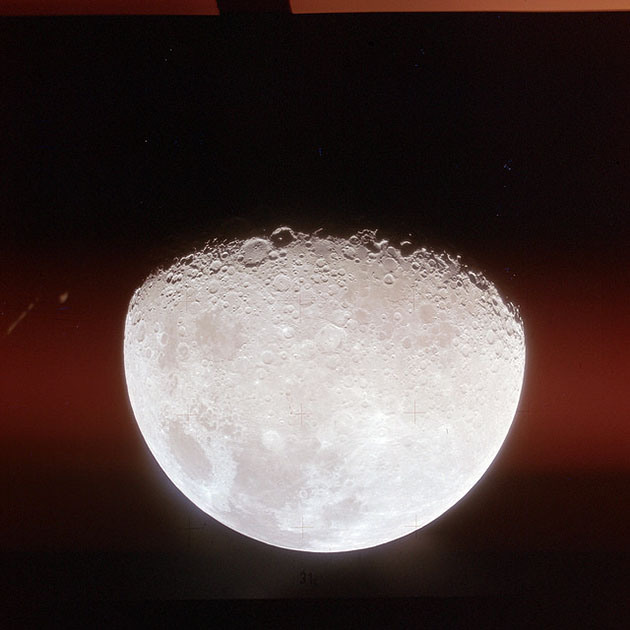
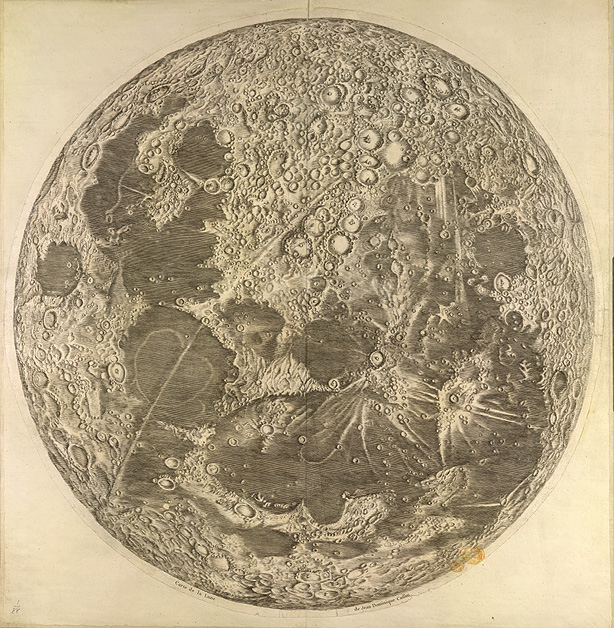
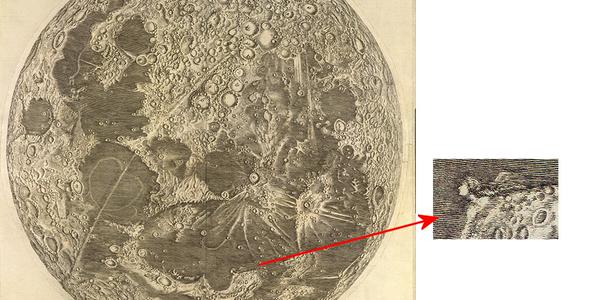
Needless to say, the event was not televised and Cassini never had the opportunity to walk on the surface he studied. Instead he observed it through the eyepiece of a telescope, a relatively new invention.
Cassini, then eight years into his forty year career as Director of the Paris Observatory, produced a map so exhaustive, it provided his peers with far more details of the moon’s surface than they had with regard to their own planet.
He also used his powers of observation to expand human understanding of Mars, Saturn, and France itself (which turned out to be much smaller than previously believed).
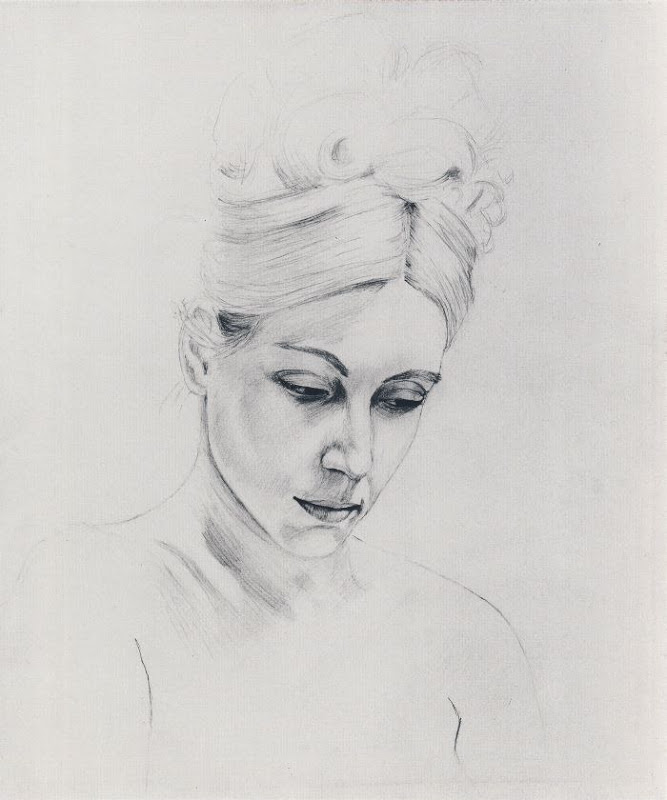
A man of science, he may not have been entirely immune to the sort of moon-based whimsy that has long infected poets, songwriters, and 19th-century romantic heroines. Hiding in the lower right quadrant, near Cape Heraclides on the Sinus Iridum (aka Bay of Rainbows), is a tiny, bare-shouldered moon maid. See right above.
Or perhaps this appealingly playful vision can be attributed to Cassini’s engraver Claude Mellan.
Either way, she seems exactly the sort of female life form a 17th-century human male might hope to encounter on a trip to the moon.
Beatboxing, the practice of producing drum machine-like beats (especially TR-808-like beats) with one’s voice, has long since made the transition from parlor trick to acknowledged musical art form. But we still have much to understand about it, as the recently-emerged first generation of beatboxing scholars knows full well. “A team of linguistics and engineering students at USC wanted to learn more about the mechanics behind the rhythms,” writes Los Angeles Times music critic Randall Roberts. “By using MRI technology, they recorded an unnamed local beatboxer working his magic, broke down the most commonly employed sounds by examining the movements of his mouth and then analyzed the data.”
This resulted in a paper called “Paralinguistic Mechanisms of Production in Human ‘Beatboxing’: A Real-Time Magnetic Resonance Imaging Study.” Roberts describes it as “predictably heavy with linguistic jargon, but even to a civilian, the results are illuminating,” especially the video the research team recorded, “which reveals how the human mouth can so convincingly create the pop of a snare drum.” At the top of the post, you can see this sort of thing for yourself: in this video “The Diva and the Emcee,” featured at the International Society for Magnetic Resonance in Medicine (ISMRM) Scientific Sessions in Seattle, we see how a beatboxer’s technique compares to that of an opera singer.
You can find out more at the site of the Speech Production and Articulation Knowledge group (SPAN), the USC team that performed this pioneering research into an important component of one of the pillars of hip hop. Keep their findings in mind next time you watch a beatboxing clip that goes viral (such as the Goldberg Variations one we featured back in 2012) for a richer listening experience. After all, it does no harm to the romance of the beatbox, to paraphrase Carl Sagan, to know a little bit about it.
If you would like to sign up for Open Culture’s free email newsletter, please find it here. It’s a great way to see our new posts, all bundled in one email, each day.
If you would like to support the mission of Open Culture, consider making a donation to our site. It’s hard to rely 100% on ads, and your contributions will help us continue providing the best free cultural and educational materials to learners everywhere. You can contribute through PayPal, Patreon, and Venmo (@openculture). Thanks!
I freely admit it—like a great many people these days, I have a social media addiction. My drug of choice, Twitter, can seem like a particularly schizoid means of acquiring and sharing information (or knee-jerk opinion, rumor, innuendo, nonsense, etc.) and a particularly accelerated form of distractibility that never, ever sleeps. Given the profound degree of over-stimulation such outlets provide, we might be justified in thinking we owe our short attention spans to 21st century technological advances. Not necessarily, says Michigan State University professor Natalie Phillips—who studies 18th and 19th century English literature from the perspective of a 21st century cognitive theorist, and who cautions against “adopting a kind of historical nostalgia, or assuming those of the 18th century were less distracted than we are today.”
Early modern writers were just as aware of—and as concerned about—the problem of inattention as contemporary critics, Phillips argues, “amidst the print-overload of 18th-century England.” We might refer, for example, to Alexander Pope’s epic satire “The Dunciad,” a hilariously apocalyptic jeremiad against the proliferation of careless reading and writing in the new media environment of his day. (A world “drowning in print, where everything was ephemeral, of the moment.”)
Phillips focuses on the work of Jane Austen, whom, she believes, “was drawing on the contemporary theories of cognition in her time” to construct distractible characters like Pride and Prejudice’s Elizabeth Bennett. Taking her cues from Austen and other Enlightenment-era writers, as well as her own inattentive nature, Phillips uses contemporary neuroscience to inform her research, including the use of brain imaging technology and computer programs that track eye movements.
In collaboration with Stanford’s Center for Cognitive and Biological Imaging (CNI), Phillips devised an experiment in 2012 in which she asked literary PhD candidates—chosen, writes Stanford News, “because Phillips felt they could easily alternate between close reading and pleasure reading”—to read a full chapter from Austen’s Mansfield Park, projected onto a mirror inside an MRI scanner. At times, the subjects were instructed to read the text casually, at others, to read closely and analytically. Afterwards, they were asked to write an essay on the passages they read with attention. As you’ll hear Phillips describe in the short NPR piece above, the neuroscientists she worked with told her to expect only the subtlest of differences between the two types of reading. The data showed otherwise. Phillips describes her surprise at seeing “how much the whole brain, global activations across a number of different regions, seems to be transforming and shifting between the pleasure and the close reading.” As CNI neuroscientist Bob Dougherty describes it, “a simple request to the participants to change their literary attention can have such a big impact on the pattern of activity during reading,” with close reading stimulating many more areas of the brain than the casual variety. What are we to make of these still inconclusive results? As with many such projects in the emerging interdisciplinary field of “literary neuroscience,” Phillips’ goal is in part to demonstrate the continued relevance of the humanities in the age of STEM. Thus, she theorizes, the practice and teaching of close reading “could serve—quite literally—as a kind of cognitive training, teaching us to modulate our concentration and use new brain regions as we move flexibly between modes of focus.”
The study also provides us with a fascinating picture—quite literally—of the ways in which the imaginative experience of reading takes place in our bodies as well as our minds. Close, sustained, and attentive reading, Phillips found, activates parts of the brain responsible for movement and touch, “as though,” writes NPR, “readers were physically placing themselves within the story as they analyzed it.” Phillips’ study offers a scientific look at a mysterious experience serious readers know well—“how the right patterns of ink on a page,” says Dougherty, “can create vivid mental imagery and instill powerful emotions.” As with the so-called “hard problem of consciousness,” we may not understand exactly how this happens anytime soon, but we can observe that the experience of close reading is a rewarding one for our entire brain, not just the parts that love Jane Austen. While not everyone needs convincing that “literary study provides a truly valuable exercise of people’s brains,” Phillips’ research may prove exactly that.
We're hoping to rely on loyal readers, rather than erratic ads. Please click the Donate button and support Open Culture. You can use Paypal, Venmo, Patreon, even Crypto! We thank you!
Open Culture scours the web for the best educational media. We find the free courses and audio books you need, the language lessons & educational videos you want, and plenty of enlightenment in between.