The Templeton Foundation asked some heavy-hitter thinkers to answer the question, “Does the Universe Have a Purpose”. Some said “Yes” and “Certainly.” Others concluded “Unlikely” and “No.” Neil deGrasse Tyson — astrophysicist, director of the Hayden Planetarium, and popularizer of science — gave an answer that falls technically in the “Not Certain” camp.
Above, you can watch a video where Tyson reads his answer aloud, and the makers of Minute Physics provide the rudimentary animation. One thing astrophysicists have is a knack for putting things into a deeper context, often making “big” human questions look remarkably small (if not somewhat absurd). Carl Sagan did it remarkably well in his famous ‘The Pale Blue Dot’ speech. And Tyson picks up right where Sagan left off.
We still live in a world where, despite Copernicus, we think the world revolves essentially around us. And, to the extent that that’s true, some will find Tyson’s data points disorienting. Others might wonder whether we should angst so much about the questions we perennially ask in the first place. I guess I am kind of there today.
A joint operation of five participating countries and the European Space Agency, the International Space Station is an enormous achievement of human cooperation across ideological and national boundaries. Generations of people born in the nineties and beyond will have grown up with the ISS as a symbol of the triumph of STEM education and decades of space travel and research. What they will not have experienced is something that seems almost fundamental to the cultural and political landscape of the Boomers and Gen Xers—the Cold War space race. But it is worth noting that while Russia is one of the most prominent partners in ISS operations, current Communist republic China has virtually no presence on it at all.
But this does not mean that China has been absent from the space race—quite the contrary. While it seems to those of us who witnessed the exciting interstellar competition between superpowers that the only players were the big two, the Chinese entered the race in the 1960s and launched their first satellite in 1970. This craft, writes space history enthusiast Sven Grahn, “would lead to China being a major player in the commercial space field.”
Since its launch into orbit, the satellite has continuously broadcast a song called Dong Fang Hong, a eulogy for Mao Zedong (which “effectively replaced the National Anthem” during the Cultural Revolution—hear the broadcast here). The satellite, now referred to, after its song, as DFH‑1 (or CHINA‑1), marked a significant breakthrough for the Chinese space program, spearheaded by rocket engineer Qian Xuesen, who had been previously expelled from the Jet Propulsion Lab in Pasadena for suspected Communist sympathies.
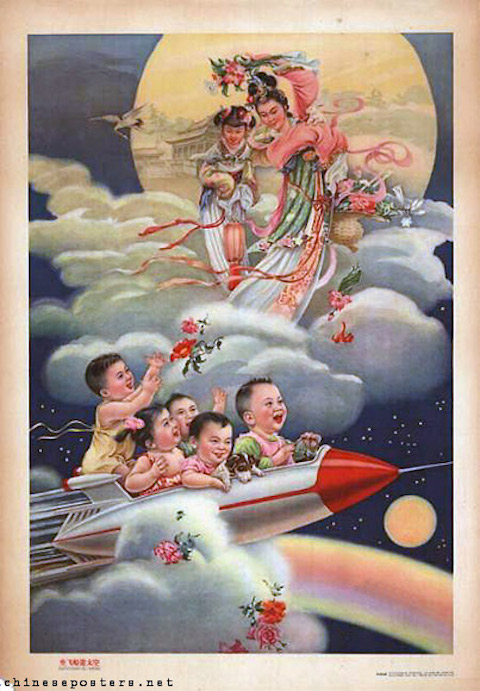
Before DFH‑1, the national imagination was primed for the prospect of Chinese space flight by images like the poster just above, titled “Roaming outer space in an airship,” and designed by Zhang Ruiheng in 1962. This striking piece of work comes to us from Chinese Posters, a compendium of images of “propaganda, politics, history, art.” Images like this one and that of a Chinese taikonaut at the top—“Bringing his playmates to the stars”—from 1980, appropriate imagery from the traditional nianhua, or New Years picture.
This fanciful style, which “catered to the tastes and beliefs in the countryside,” became the “most important influence on the propaganda posters produced by the Chinese Communist Party,” who began using it in the 1940s. The poster above, “Little guests in the Moon Palace,” dates from the early 1970s, after the launch of DFH‑1 and its sister satellite SJ‑I (CHINA‑2).
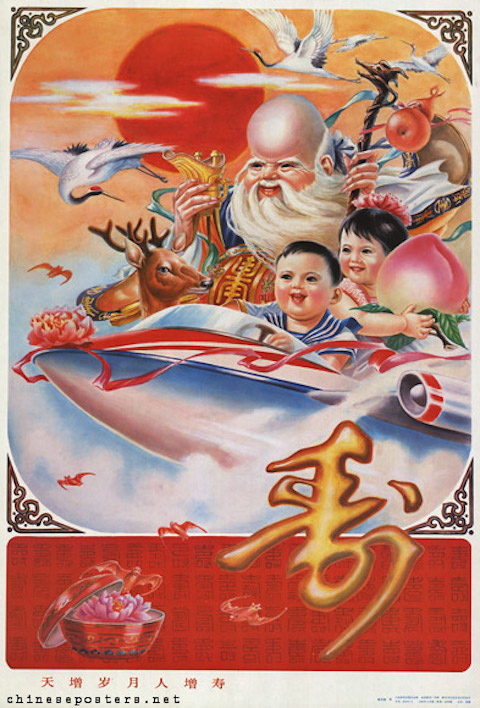
As you can see from the 1989 poster above—“Heaven increases the years, man gets older”—the CCP continued to use the nianhua style well into the eighties, but in the following decades, they began to move away from it and toward more militaristic imagery, like that in the image below from 2002. With different colors and symbols, it would look right at home on the wall of an armed forces recruiting station in any small town, U.S.A.
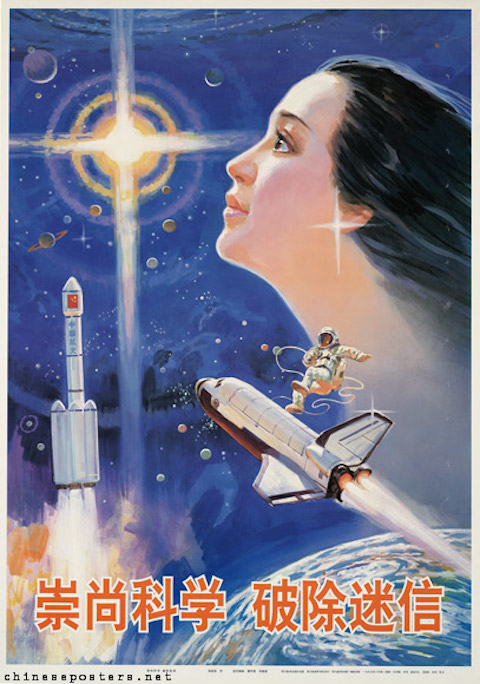
Like many U.S. advocates for space travel and exploration, such as the increasingly visible Neil deGrasse Tyson, the CCP has used space as a means of promoting scientific literacy. In the poster below, “Uphold science, eradicate superstition,” space imagery is used to bring much-persecuted Falon Gong adherents “back into the fold” and to oppose science to religious superstition.
Although some of the imagery may suggest otherwise, the Chinese space program has developed along similar lines as the U.S.’s, and has been put to similar uses. These include the use of space exploration as a means of unifying nationalist sentiment, driving support for science and technology funding and research, and pushing a vision of scientific progress as the national ethos. In 2012, the same year that Sally Ride—first American woman in space—passed away, China began selecting its first female taikonaut, making their space program a venue for increasing gender equality as well.
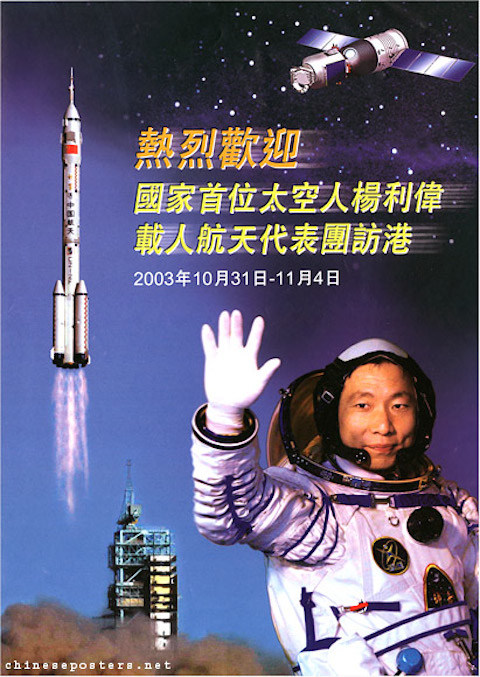
It was only very recently that the Chinese space program successfully completed its first manned mission, sending its first taikonaut, Yang Liewei, abord the Shenzhou 5 in a low earth orbit mission. Although the achievement—as you can see in the poster above commemorating a visit of the taikonaut to Hong Kong—marked a moment of significant national pride, there was one encouraging sign for the future of international cooperation: though you cannot see it in the photo, Yang wore the flag of the United Nations in addition to that of the People’s Republic of China.
See more of these fascinating works of propaganda at Chinese Posters
At the start of 2014, Edge.org posed its annual question to 176 scientific minds: “What Scientific Idea is Ready for Retirement?” The question (as we noted in January) came prefaced by this thought:
Science advances by discovering new things and developing new ideas. Few truly new ideas are developed without abandoning old ones first. As theoretical physicist Max Planck (1858–1947) noted, “A new scientific truth does not triumph by convincing its opponents and making them see the light, but rather because its opponents eventually die, and a new generation grows up that is familiar with it.” In other words, science advances by a series of funerals. Why wait that long?
As is its custom, Edge initially gathered and published the responses (in text format) from thinkers like Steven Pinker, Kevin Kelly, Sherry Turkle, Robert Sapolsky, and Daniel Dennett. Now, as the sun sets on 2014, filmmaker Jesse Dylan has created a four-minute film based on the project, featuring some of the same figures mentioned above. Watch it up top.
In a few short weeks, we’ll bring you the Edge question of 2015.
If you would like to support the mission of Open Culture, consider making a donation to our site. It’s hard to rely 100% on ads, and your contributions will help us continue providing the best free cultural and educational materials to learners everywhere. You can contribute through PayPal, Patreon, and Venmo (@openculture). Thanks!
Humanists believe that human beings produced the progressive advance of human society and also the ills that plague it. They believe that if the ills are to be alleviated, it is humanity that will have to do the job. They disbelieve in the influence of the supernatural on either the good or the bad of society, on either its ills or the alleviation of those ills.
There’s a widely disseminated Kurt Vonnegut quote that puts things even more succinctly:
I am a humanist, which means, in part, that I have tried to behave decently without any expectation of rewards or punishment after I’m dead.
It’s a definition Vonnegut, Asimov’s honorary successor as AHA president, a scientist’s son, and, famously, a survivor of the firebombing of Dresden, embodied, though surely not the only one he coined.
…a humanist, perhaps, was somebody who was crazy about human beings, who, like Will Rogers, had never met one he didn’t like. That certainly did not describe me. It did describe my dog, though.
As the title of Vonnegut’s speech implies (“Why My Dog is Not a Humanist”), Sandy, his undiscriminating Hungarian sheepdog, ultimately fell short of satisfying the criteria that would have labelled him a humanist. He lacked the capacity for rational thought of the highest order, and moreover, he regarded all humans — not just Vonnegut — as gods.
Ergo, your dog is probably not a humanist either.
Characteristically, Vonnegut ranged far and wide in his consideration of the matter, touching on a number of topics that remain germane, some 20 years after his remarks were made: race, excessive force, the treatment of prisoners…and Bill Cosby.
Danko Nikolic, a researcher at the Max-Planck Institute for Brain Research, has come up with a theory called “ideasthesia,” which questions the reality of two philosophical dualities: 1.) the mind and body, and 2.) sense perception and ideas. Nikolic’s research suggests that these dualities may not exist at all, and particularly that sense perception and ideas are inextricably bound up in one another. If you want to better understand “ideasthesia,” I can’t recommend reading the term’s Wikipedia page. It’s tough sledding. But you can make it through Nikolic’s TED-Ed video released last month. It still requires you to wear a thinking cap. But if you’re reading this site, you’re probably willing to put one on for five minutes.
If only someone could have invented the internet by 1825. Not only would we have reached unimagined realms of communication by now, but we would have a full 189 years of Christmas lectures to stream online at our leisure. A production of the Royal Institution in the United Kingdom, the Christmas lectures began with the educational endeavors of electromagnetism and electrochemistry pioneer Michael Faraday. Between 1827 and 1860, Faraday gave the first Christmas lectures on the London grounds of the Royal Institution, holding forth on subjects like chemistry, electricity, and matter in an effort to get the general public excited about science. According to one of his soundest principles of lecturing, “a flame should be lighted at the commencement and kept alive with unremitting splendour to the end.” Generations of scientific lecturers have stepped forward to light and keep that splendid flame to this day.
At the top of the post, we have the first of Carl Sagan’s six Christmas lectures on Earth, Mars, and our solar system from 1977. Just above, you can watch the first of Richard Dawkins’ 1991 Christmas lecture series entitled Growing Up in the Universe. Though Sagan and Dawkins ostensibly geared their lectures toward kids — just as Faraday intended his scientific spectacles for a “juvenile audience” — don’t let that turn you off if you’ve already reached adulthood. In fact, grown-ups may stand to gain more than kids, given our tendency to binge-watch. Why not give yourself an educational holiday treat by plowing through the past several years of Christmas lectures archived at the Royal Institution’s web site? This Christmas, they’ve got professor Danielle George on “how the spark of your imagination and some twenty first century tinkering can change the world” — so get ready to gather ’round with all the future world-changers you know, young or old.
Since the 19th century, thinkers like Ludwig Feuerbach, Friedrich Nietzsche, and Sigmund Freud have theorized religion as a strictly psychological and anthropological phenomenon born of the tendency of the human mind to project its contents out into the heavens. The Darwinian revolution provided another framework—one grounded in experimental science—to explain religion. Social scientists like Pascal Boyer have integrated these paradigms in comprehensive accounts of the origins of religious belief, and in theories like E.O. Wilson’s Sociobiology, evolutionary biology provides an explanation for all social phenomena, of which religion is but one among many human adaptations. Advances in neurobiology have furthered scientists’ understanding of religion as a product not only of human consciousness, but also of the physical structure of the brain. In experiments like the “God helmet,” for example, scientists can induce religious experiences by prodding certain areas of subjects’ brains.
It is in this context of psychology, anthropology, and evolutionary and neurobiology that we need to situate the lecture above from Stanford professor Robert Sapolsky. Where many critics of religion explicitly reject religious authority and belief, Sapolsky, though himself “stridently atheistic,” has no such agenda. As an article in the Colorado Springs Independent puts it, “he’s no Christopher Hitchens.” Sapolsky freely admits, as do many scientists—religious and non—that religion has many benefits: “It makes you feel better. It tends to decrease anxiety, and it gets you a community.” However, he claims, these positives are the result of evolutionary adaptations, not proofs of any supernatural realm. In fact, religiosity, Professor Sapolsky argues above, is biologically based and related to seemingly much less adaptive traits like obsessive compulsive disorder, schizophrenia, and epilepsy.
Part of a lecture course on “Human Behavioral Biology” at Stanford, the religion lecture is one Sapolsky admits he is “most nervous for, simply because this one people wind up having strong opinions about.” As he moves ahead, he presents his case (with occasional interruptions from his students) for religiosity as a result of natural selection, connecting belief to the selection of genes for diseases like Tay-Sachs, the existence of which can help to explain dispiriting historical cases like the European Pogroms against the Jews in the Middle Ages. Throughout his lecture, Sapolsky makes connections between religiosity and biology, theorizing, for example, that St. Paul had temporal-lobe epilepsy.
At the end of his lecture, around the 1:19:30 mark, Sapolsky issues a disclaimer about what he’s “not saying”: “I’m not saying ‘you gotta be crazy to be religious.’ That would be nonsense. Nor am I saying, even, that most people who are, are psychiatrically suspect.” What he is saying, he continues, is that “the same exact traits which in a secular context are life-destroying” and “separate you from the community” are, “at the core of what is protected, what is sanctioned, what is rewarded, what is valued in religious settings.” What fascinates Sapolsky is the “underlying biology” of these traits. Sapolsky even confesses that he “most regrets” his own break with the Orthodox religion of his upbringing, but that his atheism is something he “appears to be unable to change.” The questions Sapolsky asks broadly cover the physical determinism of gaining faith, and of losing it, which he says, is “just as biological.” What we are to make of all this is a question he leaves open.
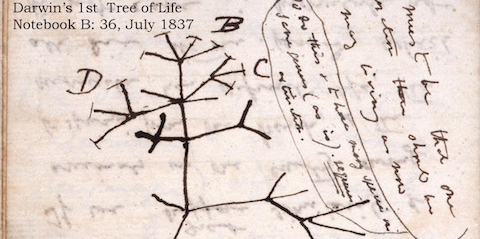
The Darwinian theory of evolution is an amazing scientific idea that seems, at least to a layperson like me, to meet all the criteria for what scientists like Ian Glynn praise highly as “elegance”—all of them perhaps except one: Simplicity. Evolutionary theory may seem on its face to be a fairly simple explanation of the facts—all life begins as single-celled organisms, then changes and adapts in response to its environment, branching and developing into millions of species over billions of years. But the journey Darwin took to arrive at this idea was hardly straightforward and it certainly didn’t arrive in one eureka moment of enlightenment.
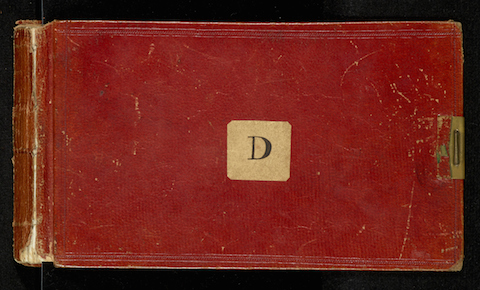
The process for him took over two decades, represented by the hundreds of pages of notes he left behind, all of which will be freely available online at the Darwin Manuscripts Project at the American Museum of Natural History in 2015. This means 30,000 digitized documents, like the naturalist’s first “Tree of Life” at the top of the page, from a July 1837 notebook entry, and Transmutation Notebook D above, the first notebook in which Darwin began working on the theory of natural selection.
The Museum has currently announced that it is a little over the halfway point, with just over 16,000 digitized documents that cover, they write, “the 25-year period in which Darwin became convinced of evolution; discovered natural selection; developed explanations of adaptation, speciation, and a branching tree of life and wrote the Origin [of Species].” Director of the project David Kohn describes that latter famous work as “the mature fruit of a prolonged process of scientific exploration and creativity that began toward the end of his Beagle voyage… and that continued to expand in range and deepen in conceptual rigor through numerous well-marked stages.”
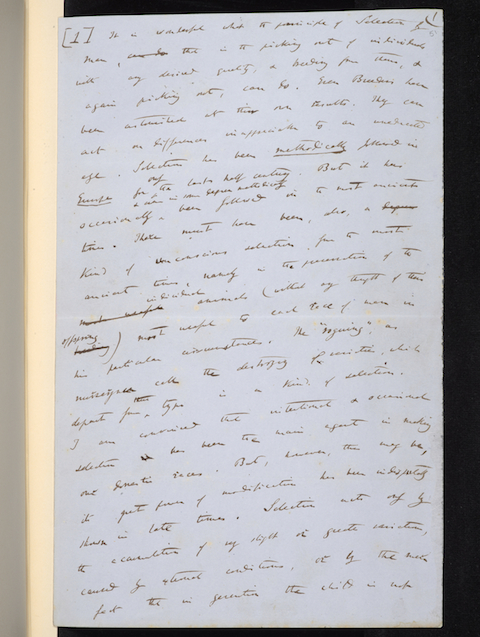
Now historians of science can trace those stages as though they were a fossil record, starting with that famous H.M.S. Beagle voyage, in which the young Darwin sailed from South America to the Pacific Islands—stopping at numerous sites, including the Galapagos Islands of course, and collecting samples and making observations. The journey produced a lively account, 1839’s Voyage of the Beagle, prelude to the fully developed theory presented 20 years later in On the Origin of Species. Looking into the Beagle voyage section, you’ll find hundreds of pages of notes, like that above on Galapagos mockingbirds. Darwin’s handwriting will present a challenge, which is why, Hyperallergic tells us, the project is “adding transcriptions and a scholarly structure to its high-resolution images.”
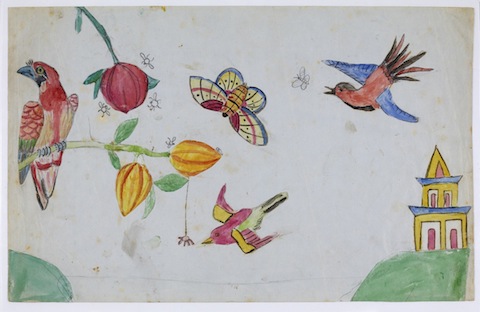
Hyperallergic also sums up the remaining contents of the huge archive, which in addition to the Beagle material will feature everything “from the rest of his life, which he spent defending his work.” This means “scribblings in books he studied, abstracts, his own book drafts, articles and their revisions, journals he read, and his notebooks on transmutation.” You’ll also find “some charming oddities” like drawings by the scientist’s children (above) on the back of original Origin manuscript pages. Learn much more about the archive, and Darwin’s lifelong work, at the American Museum of Natural History’s Darwin Manuscript Project site.
We're hoping to rely on loyal readers, rather than erratic ads. Please click the Donate button and support Open Culture. You can use Paypal, Venmo, Patreon, even Crypto! We thank you!
Open Culture scours the web for the best educational media. We find the free courses and audio books you need, the language lessons & educational videos you want, and plenty of enlightenment in between.