What explains the immense quarantine-time popularity in America of this quaint British reality cooking show? What do we get out of watching talented amateurs bake things? Stephen Carlile, who is famous for playing Scar in The Lion King on Broadway (and is VERY British himself), joins your hosts Erica Spyres, Brian Hirt, and Mark Linsenmayer to consider the format, context, and appeal of the show.
A few articles we reviewed to prepare included:
During the early days of the pandemic, the Talking Sopranos podcast (previously discussed on OC here) got underway. Hosted by Michael Imperioli (Christopher Moltisanti) and Steve Schirripa (Bobby Bacala), the podcast revisits every episode of HBO’s groundbreaking TV series. It starts naturally with the 1999 pilot and then moves forward sequentially. And each installment features a guest (usually an actor, writer, or director who contributed to the show), followed by a scene-by-scene breakdown of a complete Sopranos episode. (They covered the celebrated “Pine Barrens” episode a few weeks back.) Past guests have included Edie Falco, Aida Turturro, Steve Buscemi, Lorraine Bracco and more.
Now almost halfway through the entire series, Imperioli and Schirripa spent 90 minutes this week with Sopranos’ creator David Chase. In a rare interview (watch above), Chase talks about his creative ambitions for the show, the real people (friends and acquaintances) he modeled characters on, his sometimes friction-filled relationship with James Gandolfini, and the upcoming Sopranos film.
If you would like to support the mission of Open Culture, consider making a donation to our site. It’s hard to rely 100% on ads, and your contributions will help us continue providing the best free cultural and educational materials to learners everywhere. You can contribute through PayPal, Patreon, and Venmo (@openculture). Thanks!
You need never endeavor to make any of the recipes world renowned chef Jacques Pépin produced on camera in his 2008 series More Fast Food My Way.
The helpful hints he tosses off during each half hour episode more than justify a viewing.
The menu for the episode titled “The Egg First!,” above, includes Red Pepper Dip, Asparagus Fans with Mustard Sauce, Scallops Grenobloise, Potato Gratin with Cream, and Jam Tartines with Fruit Sherbet so simple, a child could make it (provided they’re set up with good quality poundcake in advance.)
Delicious… especially when prepared by a culinary master Julia Child lauded as “the best chef in America.”
And he’s definitely not stingy with matter-of-fact advice on how to peel asparagus, potatoes and hard boiled egg, grate fresh nutmeg with a knife, and dress up store bought mayo any number of ways.
Many of the dishes harken to his childhood in World War II-era Lyon:
When we were kids, before going to school, my two brothers and I would go to the market with my mother in the morning. She had a little restaurant… There was no car, so we walked to the market—about half a mile away—and she bought, on the way back, a case of mushrooms which was getting dark so she knew the guy had to sell it, so she’d try to get it for half price… She didn’t have a refrigerator. She had an ice box: that’s a block of ice in a cabinet. In there she’d have a couple of chickens or meat for the day. It had to be finished at the end of the day because she couldn’t keep it. And the day after we’d go to the market again. So everything was local, everything was fresh, everything was organic. I always say my mother was an organic gardener, but of course, the word ‘organic’ did not exist. But chemical fertilizer did not exist either.
If you have been spending a lot of time by yourself, some of the episode themes may leave a lump in your throat—Dinner Party Special, Game Day Pressure, and Pop Over Anytime, which shows how to draw on pantry staples and convenience foods to “take the stress out of visitors popping in.”
The soon to be 85-year-old Pépin (Happy Birthday December 18, Chef!) spoke to Zagat earlier about the pandemic’s effect on the restaurant industry, how we can support one another, and the beauty of home cooked meals:
People—good chefs—are wondering how they will pay their rent. It is such a terrible feeling to have to let your employees go. In a kitchen, or a restaurant, we are like a family, so it is painful to separate or say goodbye. That said, it is important to be optimistic. This is not going to last forever.
Depending on where you are, perhaps this is a chance to reconnect with the land, with farmers, with the sources of food and cooking. This is a good time to plant a garden. And gardening can be very meditative. Growing food is not just for the food, but this process helps us to reconnect with who we are, why we love food, and why we love cooking. With this time, cook at home. Cook for your neighbor and drop the food off. Please your family and your friends and your own palate with food, for yourself. This is not always easy for a chef with the pressure of running a restaurant. Cooking is therapeutic…
Many people now are beginning to suffer economically. But if you can afford it, order take-out, and buy extra for your neighbors. If you can afford it, leave a very large tip. Think about the servers and dishwashers and cooks that may not be able to pay their rent this month. If you can be more generous than usual, that would be a good idea. We need to do everything we can to keep these restaurants in our communities alive.
…this moment is a reassessment and re-adjustment of our lives. Some good things may come of it. We may have the opportunity to get closer to one another, to sit as a family together at the table, not one or two nights a week, but seven! We may not see our friends, but we may talk on the phone more than before. Certainly, with our wives and children we will be creating new bonds. We will all be cooking more, even me. This may be the opportunity to extend your palate, and to get your kids excited about cooking and cooking with you.
Ayun Halliday is an author, illustrator, theater maker and Chief Primatologist of the East Village Inky zine. She most recently appeared as a French Canadian bear who travels to New York City in search of food and meaning in Greg Kotis’ short film, L’Ourse. Follow her @AyunHalliday.
When was the last time you saw a Surrealist (or even just a surrealist) painter appear on national television? If such a figure did appear on national television today, for that matter, who would know? Perhaps surrealist painting does not, in our time, make the impact it once did, but nor does national television. So imagine what a spectacle it must have been in 1950s America, cradle of the “mass media” as we once knew them, when Salvador Dalí turned up on a major U.S. television network. Such a fabulously incongruous broadcasting event happened more than once, and in these clips we see that, among the “big three,” CBS was especially receptive to his impulsive, otherworldly artistic presence.
On the quiz show What’s My Line?, one of CBS’ most popular offerings throughout the 50s, contestants aimed to guess the occupation of a guest. They did so wearing blindfolds, without which they’d have no trouble pinning down the job of an instantaneously recognizable celebrity like Dalí — or would they? To the panel’s yes-or-no questions, the only kind permitted by the rules, Dalí nearly always responds flatly in the affirmative.
Is he associated with the arts? “Yes.” Would he ever have been seen on television? “Yes.” Would he be considered a leading man? “Yes.” At this host John Charles Daly steps in to clarify that, in the context of the question, Dalí would not, in fact, be considered a leading man. One contestant offers an alternative: “He’s a misleading man!” Few titles have captured the essence of Dalí so neatly.
The artist, showman, and human conscious-altering substance later appeared on The Mike Wallace Interview. Hosted by the formidable CBS newsman well before he became one of the faces of 60 Minutes, the show featured a range of guests from Aldous Huxley and Frank Lloyd Wright to Eleanor Roosevelt and Ayn Rand. In this broadcast, Wallace and Dalí discuss “everything from surrealism to nuclear physics to chastity to what artists in general contribute to the world,” as Brain Pickings’ Maria Popova describes it. A curious if occasionally bemused Wallace, writes The Wallbreakers’ Matt Weckel, “asks Dalí such gems as ‘What is philosophical about driving a car full of cauliflowers?’ and ‘Why did you lecture with your head enclosed in a diving helmet?’ ” But they also seriously discuss “the fear of death, and their own mortality,” topics to which American airwaves have hardly grown more accommodating over the past sixty years.
Based in Seoul, Colin Marshall writes and broadcasts on cities, language, and culture. His projects include the Substack newsletterBooks on Cities, the book The Stateless City: a Walk through 21st-Century Los Angeles and the video series The City in Cinema. Follow him on Twitter at @colinmarshall, on Facebook, or on Instagram.
What happens when a male android loves a female android VERY much, and they nurse human embryos together on a distant planet after fleeing from war-torn Earth? Why the female android flies and makes a bunch of people explode with her eyes, that’s what happens! …In the first episode of this bonkers HBO Max series by Aaron Guzikowski (with notable assistance from Ridley Scott of Alien and Blade Runner fame).
Your hosts Brian Hirt, Erica Spyres, and Mark Linsenmayer reflect on how much we’re supposed to understand, what if any character we’re supposed to identify with, whether the imagery is just TOO heavy-handed, and how this show compares with related sci-fi like Westworld or post-apocalyptic shows like The Walking Dead. Beware: Spoilers abound in this one, so you might want to watch the show, or just let us reveal its weirdness to you.
Bob Ross is as renowned for the gentle encouragement of his voice as for his speedy technique: indeed, these very qualities are synonymous with the name “Bob Ross.” His revival in recent years has as much to do with the de-stressing effects of his permed onscreen persona as with our awe, ironic or otherwise, at his kitschy picture-perfect landscapes in under an hour. He’s become as much a saint of public television as Mr. Rogers and even more of an internet icon.
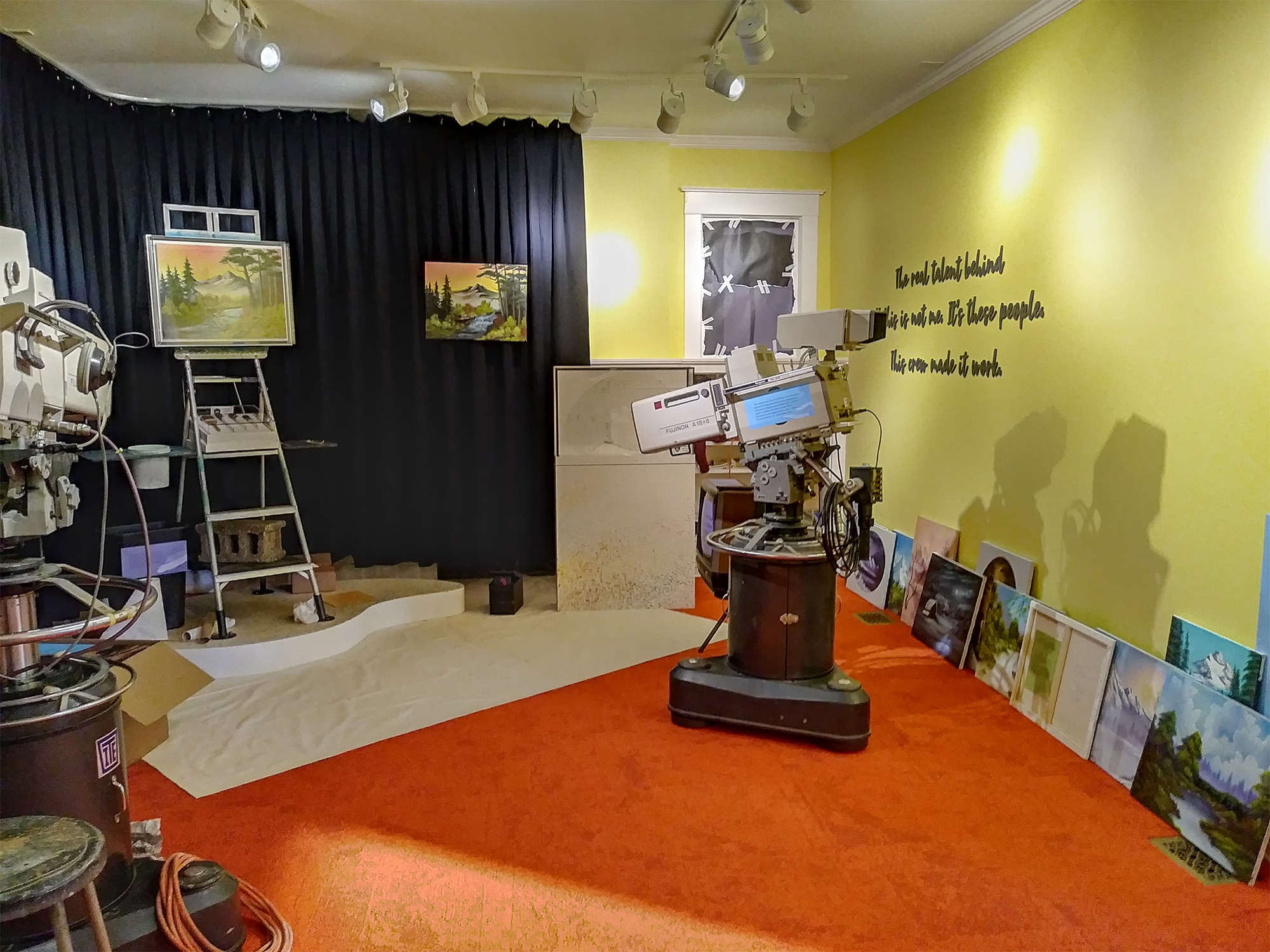
But unlike most other fandoms, the devoted lovers of Bob Ross have had no place to call their own. They might show up in Bob Ross cosplay at comic con. Yet no Bob Ross Con has made the scene. Leave it to Ross’s original Joy of Painting studio to fill the gap with a museum dedicated to the painting instructor. The Bob Ross Experience is part of a larger campus of buildings called Minnetrista in Muncie, Indiana, founded by the Ball family of Ball mason jars. It’s an “immersive exhibit,” featuring “original paintings and artifacts” and “inspiring visitors with Bob’s message of fearless creativity.”
What more could you want from a Bob Ross museum? Well, maybe a fully-online experience these days. For now, you’ll have to make the trip to Muncie, where locals pay $8 a ticket (kids $6, 3 & under are free) and non-residents shell out $15 ($12 per kid, etc). There may be nowhere else you can see Ross’s happy little trees in person. As Ayun Halliday wrote here recently, “sales of his work hover around zero.” Almost all of his paintings, save a few owned by the Smithsonian and a few private individuals, reside in storage in Northern Virginia, where an exhibit came and went last year.
Ross himself, who honed his method during short breaks in the Air Force, hardly ever exhibited in his lifetime; he was a made-for-TV painter with a small merchandising empire to match. Now, fans can make the pilgrimage to his creative TV home at the Lucius L. Ball house. Swoon over personal relics like his keys and hair pick and, of course, “the artist’s palette knife, easel, and brushes,” writes Colossal. “Many of the artifacts are free to touch.” A current exhibition at the Experience, “Bob Ross at Home” through August 15, 2021, showcases “a few dozen of the artist’s canvases, many on loan from Muncieans who got the works directly from Ross.”
Not only can you hang out on set and view Ross’s paintings and personal effects, but you can also, Artnet reports, “sign up for $70 master classes with certified Bob Ross instructors.” That’s $70 more than it costs to watch the master himself on YouTube, but if you’ve already made the trip…. One only hopes the instructors can channel what George Buss, vice president of the Experience, calls Ross’s best quality, his gentle fearlessness: “He takes what looks like a mistake and turns it into something beautiful.” And that, friends, is the true joy of the Bob Ross experience.
After a time of great personal loss, a friend of mine set off on a road trip around the United States. When I later asked what part of the country had made the deepest impression on him, he named a few towns about thirty miles east of Seattle: the shooting locations, he hardly needed tell a fellow David Lynch fan, of Twin Peaks. Raised in Spokane, Washington, among a variety of other modest American cities, Lynch saw clearly the look and feel of the titular setting by the time he co-created the show with writer Mark Frost. He eventually found it in the Washingtonian towns of Snoqualmie, North Bend and Fall City, which even today offer a friendly reception to the occasional Twin Peaks pilgrim — at least according to my friend.
This was more recently corroborated by Jeremiah Beaver, creator of Youtube “Twin Peaks theory and analysis show” Take the Ring. Thirty years after the premiere of the famously cryptic yet transfixing original series, the Indianapolis-based Beaver made the trip to Washington to visit its every remaining location — as well as those used in the 1992 prequel film Twin Peaks: Fire Walk with Me, 2017’s Twin Peaks: The Return, and even these productions’ deleted scenes.
Into the half-hour-long “Three Days in Twin Peaks” Beaver fits a great deal of information related to Twin Peaks’ production and mythos as well as the real-life history of the relevant places. “It was at times hard to distinguish the Twin Peaks that lived in my imagination versus the ground beneath my feet,” he admits.
Beaver makes his way to locations both major and minor, from the Twin Peaks Sheriff’s Department (now the DirtFish Rally Racing School) and the Double R diner (Twede’s Cafe, “one of the few spots in Washington state that really owns its Peakness”) to the shack of the Book House biker club and the bench in E.J. Roberts Park once sat upon by the late Harry Dean Stanton’s Carl Robb. Some real buildings played dual roles: both Twin Peaks’ Blue Pine Lodge and Great Northern Hotel are in reality different parts of Poulsbo’s Kiana Lodge, and the Mt. Si Motel appears as “two different motels with elements of the supernatural,” first in Fire Walk with Me, then even more seedily in The Return. “That fresh mountain air and smell of trees is no joke,” says Beaver, words to heed if you plan on making your own Twin Peaks pilgrimage — and if you do, you can surely guess how he describes the coffee and cherry pie at Twede’s.
Based in Seoul, Colin Marshall writes and broadcasts on cities, language, and culture. His projects include the Substack newsletterBooks on Cities, the book The Stateless City: a Walk through 21st-Century Los Angeles and the video series The City in Cinema. Follow him on Twitter at @colinmarshall, on Facebook, or on Instagram.
If you’re a fan of Tom Jones and you don’t care who knows it, then no one needs to justify the jovial Welsh superstar’s lounge-soul covers of pop, R&B, and rock songs to you. Certain purists have been a tougher sell on Jones’ act, including, in 1969, Neil Young, who joined Jones onstage once, and only once, on the This is Tom Jones show and immediately regretted it. But who cares about Neil Young’s cranky dislike of commercial television? Who is Neil Young to say we can’t enjoy Jones’ bravado vocals on Crosby, Stills, Nash & sometimes Young’s “Long Time Gone”? The audience sure got a kick out of it, as apparently did the rest of the band.
Janis Joplin didn’t have any such hangups when she went on Jones’ show that same year. Well, she had a hangup, but it wasn’t Jones. “God bless her,” Jones remembered, “she said to me when she came on, ‘Look, I don’t do variety shows; I’m only doing it because it’s you.’ So she saw through it. Then when Janis and I did the rehearsal for Raise Your Hand she looked at me and said, ‘Jesus, you can really sing! (laughs) I thought, thank God people like Janis Joplin had taken note.” If she outshines Jones in the televised performance of the song, above, and I think we can agree she does, he doesn’t seem to mind it much.
Jones may not have had much rock cred; he would never have been invited to share the Woodstock stage with CSNY and Joplin, but as a singer, he’s always earned tremendous respect from everyone, and rightly so.
“Tom held his own,” writes Society of Rock, “and kept up beautifully as he was swept up in the storm that was Janis Joplin’s stage presence, trading verbal licks and sending her into fits of joy when he let go and surrendered to her overwhelming energy. This wasn’t just your regular, run of the mill variety show but then again, nothing was ordinary after Janis was through with it.”
This includes any stage that had her on it, which she immediately dominated as soon as she opened her mouth. Hear her live version of “Raise Your Hand” at Woodstock from earlier that year, further up, and see her tear it up in Frankfurt on her European tour with the Kozmic Blues Band. “I make it a policy not to tell anyone to sit down,” she says by way of introduction. “That’s to encourage everybody to stand up.” Joplin’s death the following year deprived the world of one of its all-time greatest blues singers, but thanks to the internet, and Tom Jones, we’ll always have performances like these to remember her by.
We're hoping to rely on loyal readers, rather than erratic ads. Please click the Donate button and support Open Culture. You can use Paypal, Venmo, Patreon, even Crypto! We thank you!
Open Culture scours the web for the best educational media. We find the free courses and audio books you need, the language lessons & educational videos you want, and plenty of enlightenment in between.