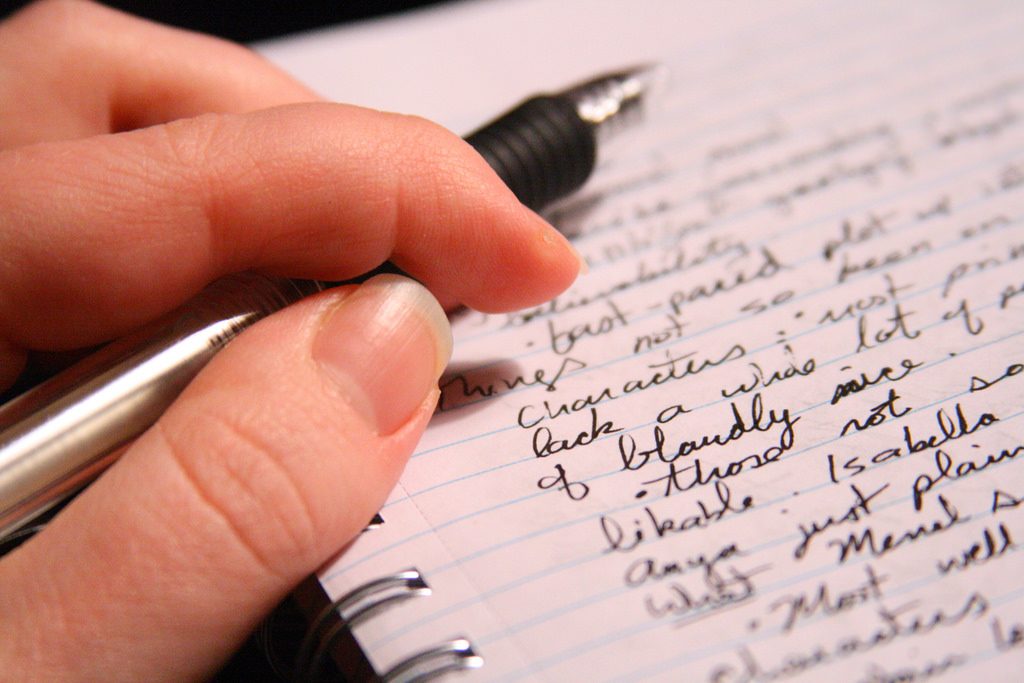
We’ve all read fiction, but how to go about writing it? Nobody has the definitive answer, and there, in the multiplicity of possible approaches, methods, and frames of mind, lies both the challenge and the fascination of the craft. The English writer Tim Clare, who before reaching forty years of age has published poetry, a memoir, and a novel as well as hosted a television series called How to Get a Book Deal, seems to know that full well. Hence the variety of challenges he’ll put you through in “The Couch to 80k” (80,000 words being the industry-standard length of a novel), his free eight-week fiction-writing “boot camp” available for anyone to take free online.
Produced as a part of Clare’s writing-advice podcast Death of 1000 Cuts, the mini-series consists of 48 episodes, each of which, he says, “teaches you new writing skills through a 10 minute exercise – it even times you while you do the exercise, so once the podcast finishes, you’re done for the day. No homework!”
You need only “something to listen to them on, and a pen and notebook or a laptop, so you can write. The whole idea is to give you something low commitment but intense, packing in everything you’d learn on a Fiction MA and more, so every day you’re doing focused exercises that build upon your previous work and rapidly build your imaginative muscles.”
Clare’s jokey, conversational tone makes the course entertaining even if you don’t actually want to write fiction, though Clare himself, in the very first episode (above), cautions strongly against listening unless you’re ready to put pen to paper — and ready to consign everything you’ve written on that paper, through all eight weeks, straight to the recycle bin. Some of the challenges Clare throws down may seem silly, but they do get you writing, and he undergirds the series with forays into more technical matters like the “mathsy business of sentence composition” as well. Reviewing his novel Honours, the Guardian’s Sarah Perry called Clare “a storyteller who knows what his reader wants, and isn’t shy of giving plenty of it.” As this boot camp reveals, he’s also a teacher who knows what his students need.
Enter the “The Couch to 80k”bootcamp here. And if you follow it through to completion, “you’ll have the knowledge and the motivation to finish a novel.”
Based in Seoul, Colin Marshall writes and broadcasts on cities and culture. His projects include the book The Stateless City: a Walk through 21st-Century Los Angeles and the video series The City in Cinema. Follow him on Twitter at @colinmarshall or on Facebook.
Everyone should learn to write well, I used to tell students in Composition classes, and I believed it. To write well, in a certain sense, is to become a better thinker. But writing differs from writing, perhaps, in the same way that walking the dog differs from hiking the Appalachian trail. There are levels of difficulty. How badly do you need to say something that no one else can—or wants to—say? How badly do you need to push this thing you’ve said into the world?
These are separate questions. Some writers really do write for themselves, some write for money, though they might also write for free. Some write as a means to other ends, and some require, at all times, an audience. It may be a sexual compulsion or an animal reflex or the only way to get one’s mind right. Or some combination of the above. As a Jesuit scholar I once knew would say, “I’ve never met a motive that wasn’t mixed.” Given the difficulty of discerning why anyone does anything, there could be as many mixed motives as there are writers.
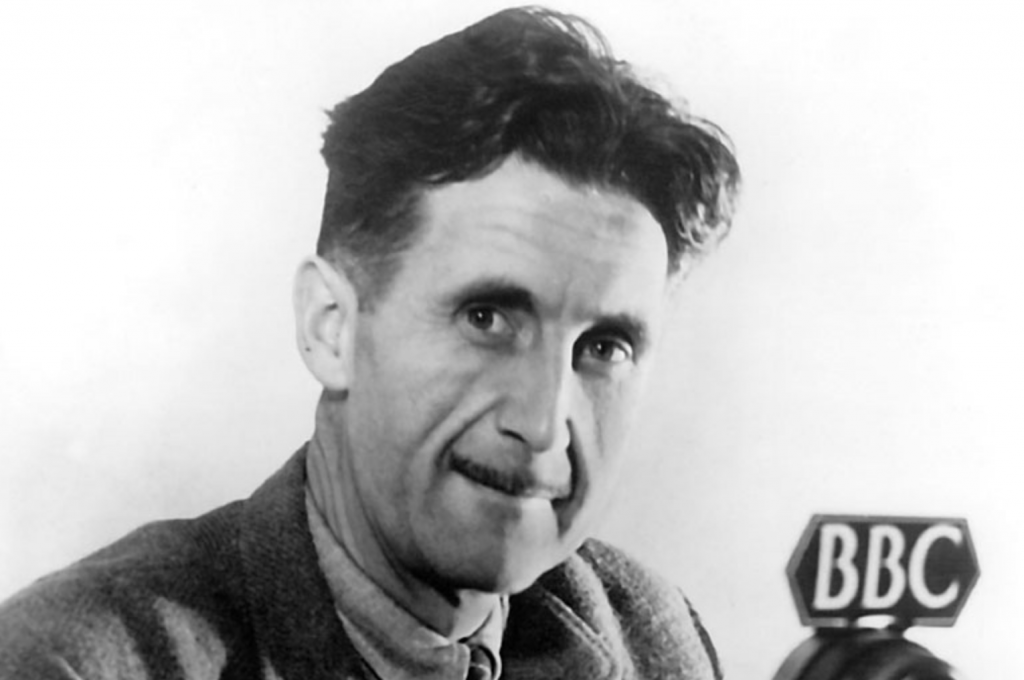
That said, I tend to think that every writer who reads George Orwell’s essay “Why I Write” sees themselves in some part of his description of his early life. “I was somewhat lonely,” he tells us, “and I soon developed disagreeable mannerisms which made me unpopular throughout my schooldays. I had the lonely child’s habit of making up stories and holding conversations with imaginary persons, and I think from the start my literary ambitions were mixed up with the feeling of being isolated and undervalued.”
Maybe everyone has such feelings, but again it is a question of degree. Given Orwell’s keen understanding of the writer’s mind from the inside out, and his diligent pursuit of his work through the most trying times, we might be inclined to give him a hearing when he claims, “there are four great motives for writing, at any rate for writing prose.” Orwell allows that these motives will be mixed, existing “in different degrees in every writer, and in any one writer the proportions will vary from time to time, according to the atmosphere in which he is living.”
But no one whom we might call a writer, Orwell suggests, writes solely for utility or money. The rewards are too peculiarly psychological, as are the pains. And the pleasures too otherworldly and practically useless. Orwell begins with one of those psychological compensations, fame, then proceeds to pleasure, then to duty to posterity and, finally, to persuasion; the four reasons, he says:
(i) Sheer egoism. Desire to seem clever, to be talked about, to be remembered after death, to get your own back on the grown-ups who snubbed you in childhood, etc., etc. It is humbug to pretend this is not a motive, and a strong one. Writers share this characteristic with scientists, artists, politicians, lawyers, soldiers, successful businessmen — in short, with the whole top crust of humanity. The great mass of human beings are not acutely selfish. After the age of about thirty they almost abandon the sense of being individuals at all — and live chiefly for others, or are simply smothered under drudgery. But there is also the minority of gifted, willful people who are determined to live their own lives to the end, and writers belong in this class. Serious writers, I should say, are on the whole more vain and self-centered than journalists, though less interested in money.
(ii) Aesthetic enthusiasm. Perception of beauty in the external world, or, on the other hand, in words and their right arrangement. Pleasure in the impact of one sound on another, in the firmness of good prose or the rhythm of a good story. Desire to share an experience which one feels is valuable and ought not to be missed. The aesthetic motive is very feeble in a lot of writers, but even a pamphleteer or writer of textbooks will have pet words and phrases which appeal to him for non-utilitarian reasons; or he may feel strongly about typography, width of margins, etc. Above the level of a railway guide, no book is quite free from aesthetic considerations.
(iii) Historical impulse. Desire to see things as they are, to find out true facts and store them up for the use of posterity.
(iv) Political purpose. — Using the word ‘political’ in the widest possible sense. Desire to push the world in a certain direction, to alter other peoples’ idea of the kind of society that they should strive after. Once again, no book is genuinely free from political bias. The opinion that art should have nothing to do with politics is itself a political attitude.
Surely, someone will suggest others, but it may be that other reasons would still fall into these categories. Neither are these motives consonant, “they must war with one another,” Orwell writes, and readers tend to egg the conflict on, declaring historical memoirs as products of pure egotism or turning their noses up at overly “political” novels.
Surprisingly, Orwell reveals that he might have done the same, had not circumstances forced his hand. “In a peaceful age I might have written ornate or merely descriptive books, and might have remained almost unaware of my political loyalties,” he says. But who lives in a peaceful age? In any case, we might wonder if he is being completely honest. “What I have most wanted to do throughout the past ten years is to make political writing into an art. My starting point is always a feeling of partisanship, a sense of injustice.”
Orwell admits that his task “is not easy,” and he offers unsparing examples of times when his writing has moved too far toward one end of the spectrum on which he situates himself. What is instructive about his framework for understanding his motivations, however, is that he has the tools to self-correct. Such self-knowledge can serve anyone in good stead. For the writer, who is compelled to reveal themselves over and over, it may be essential.
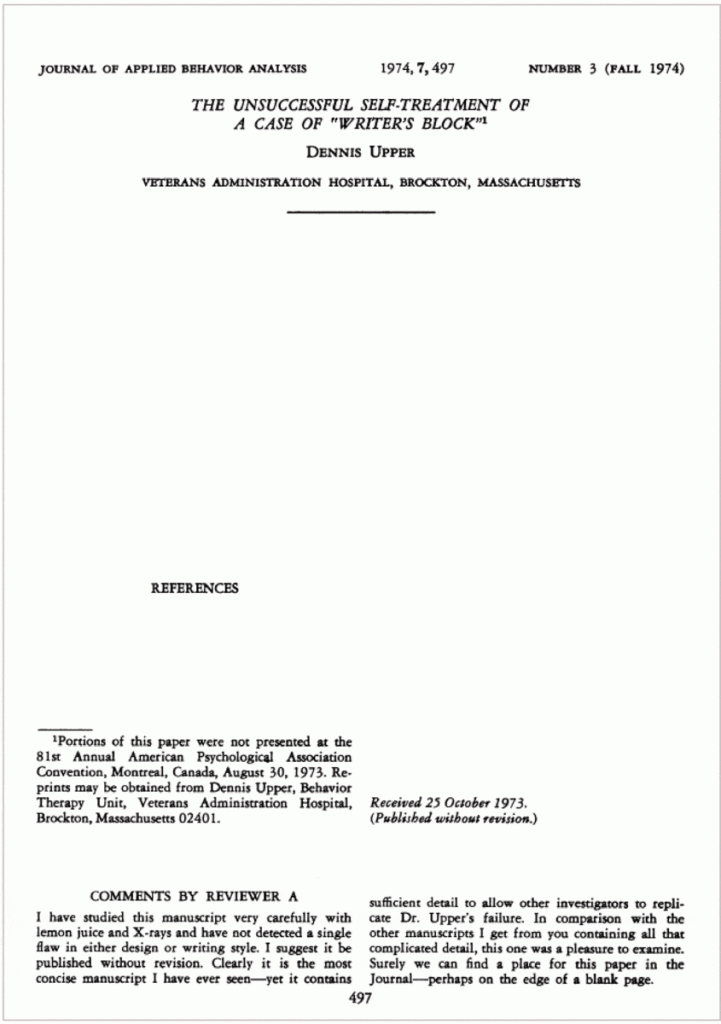
We’ve featured impressively short academic papers here on Open Culture before, like John Nash’s 26-page PhD thesis and this two-sentence “Counterexample to Euler’s Conjecture on Sums and Like Powers,” but if you’ve set your sights on writing one shorter still, don’t get your hopes up. The almost certainly unbeatable example of a short academic paper appeared more than forty years ago, in the fall 1974 issue of the Journal of Applied Behavior Analyses, its main text coming in at exactly zero words. You can read it, if indeed “read” is the word, above or at the National Center for Biotechnology Information.
Written, or at least thought up, by psychologist Dennis Upper, “The Unsuccessful Self-Treatment of a Case of ‘Writer’s Block’ ” has nothing but its title, one footnote (indicating that “portions of this paper were not presented at the 81st annual American Psychological Association Convention”), and the fulsome comments of a reviewer: “I have studied this manuscript very carefully with lemon juice and X‑rays and have not detected a single flaw in either design or writing style. I suggest it be published without revision. Clearly it is the most concise manuscript I have ever seen — yet it contains sufficient detail to allow other investigators to replicate Dr. Upper’s failure. In comparison with the other manuscripts I get from you containing all that complicated detail, this one was a pleasure to examine.”
Some describe writer’s block, whether in science or literature or any other field requiring the proper arrangement of words, as a fear of the blank page. If looking at Upper’s void-like paper frightens you, consider having a look at the Louisiana Channel series we featured in 2016 wherein writers like Margaret Atwood, Jonathan Franzen, Joyce Carol Oates, and David Mitchell talk about how they deal with the blank page themselves. Atwood finds that it “beckons you in to write something on it,” that “it must be filled,” but if you don’t hear the same call, you’ll have to come up with an approach of your own. Just don’t try titling, footnoting, and turning in the empty sheet — it’s been done.
Based in Seoul, Colin Marshall writes and broadcasts on cities and culture. His projects include the book The Stateless City: a Walk through 21st-Century Los Angeles and the video series The City in Cinema. Follow him on Twitter at @colinmarshall or on Facebook.
Joseph Frank Keaton was born into showbiz. His father was a comedian. His mother, a soubrette. He emerged into the world during a one night engagement in Kansas City. His father’s business partner, escape artist Harry Houdini, inadvertently renamed him Buster, approving of the way the rubbery little Keaton weathered an accidental tumble down a flight of stairs.
As Keaton recalls in the interview accompanying silent movie fan Don McHoull’s edit of some of his most amazing stunts, above:
My old man was an eccentric comic and as soon as I could take care of myself at all on my feet, he had slapped shoes on me and big baggy pants. And he’d just start doing gags with me and especially kickin’ me clean across the stage or taking me by the back of the neck and throwing me. By the time I got up to around seven or eight years old, we were called The Roughest Act That Was Ever in the History of the Stage.
By the time of his first film role in the 1917 Roscoe “Fatty” Arbuckle vehicle, The Butcher Boy, Keaton was a seasoned clown, with plenty of experience stringing physical gags into an entertaining narrative whole.
Like his silent peers, Harold Lloyd and Charlie Chaplin, Keaton was an idea man, who saw no need for a script. Armed with a firm concept of how the film should begin and end, he rolled cameras without much idea of how the middle would turn out, fine tuning his physical set pieces on the fly, scrapping the ones that didn’t work and embracing the happy accidents.
Perhaps it’s more helpful to think of his approach as an antidote to creative block and timidity. We’ve cobbled together some of his advice, below, in the hope that it might prove useful to storytellers of all stripes.
Buster Keaton’s 5 Rules of Comic Storytelling
Make a strong start - grab the audience with a dynamic, easy to grasp premise, like the one in 1920’s One Week, which finds anewlywed Buster struggling to assemble a house from a do-it-yourself kit.
Decide how you want things to finish up - for Keaton, this usually involved getting the girl, though he learned to keep a poker face after a preview audience booed the broad grin he tried out in one of Arbuckle’s shorts. Once you know where your story’s going, trust that the middle will take care of itself.
If it’s not working, cut it — Keaton may not have had a script, but he invested a lot of thought into the physical set pieces of his films. If it didn’t work as well as he hoped in execution, he cut it loose. If some serendipitous snafu turned out to be funnier than the intended gag, he put that in instead.
Play it like it matters to you. As many a beginning improv student finds out, if you let your own material crack you up, the audience is rarely inclined to laugh along. Why settle for low stakes and diffidence, when high stakes and commitment are so much funnier?
Action over words Whether dealing with dialogue or exposition, Keaton strove to minimize the intertitles in his silent work. Show, don’t tell.
Films excerpted at top:
Three Ages Cops Day Dreams Sherlock Jr. One Week Hard Luck Neighbors The General Steamboat Bill, Jr. Seven Chances Our Hospitality The Bell
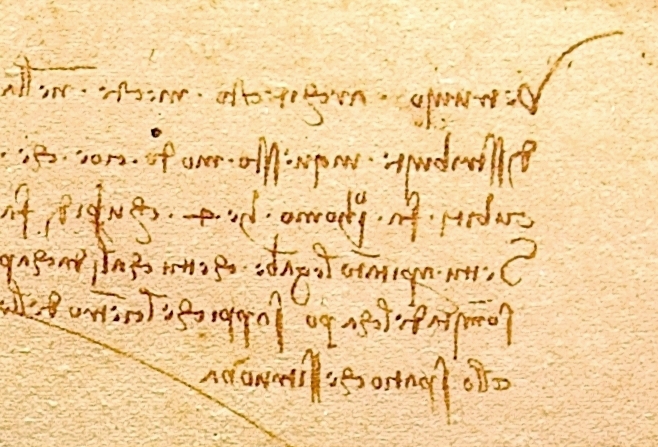
As the standout example of the “Renaissance Man” ideal, Leonardo da Vinci racked up no small number of accomplishments in his life. He also had his eccentricities, and tried his hand at a number of experiments that might look a bit odd even to his admirers today. In the case of one practice he eventually mastered and with which he stuck, he tried his hand in a more literal sense than usual: Leonardo, the evidence clearly shows, had a habit of writing backwards, starting at the right side of the page and moving to the left.
“Only when he was writing something intended for other people did he write in the normal direction,” says the Museum of Science. Why did he write backwards? That remains one of the host of so far unanswerable questions about Leonardo’s remarkable life, but “one idea is that it may have kept his hands clean. People who were contemporaries of Leonardo left records that they saw him write and paint left handed. He also made sketches showing his own left hand at work. As a lefty, this mirrored writing style would have prevented him from smudging his ink as he wrote.”
Or Leonardo could have developed his “mirror writing” out of fear, a hypothesis acknowledged even by books for young readers: “Throughout his life, he was worried about the possibility of others stealing his ideas,” writes Rachel A. Koestler-Grack in Leonardo Da Vinci: Artist, Inventor, and Renaissance Man. “The observations in his notebooks were written in such a way that they could be read only by holding the books up to a mirror.” The blog Walker’s Chaptersmakes a representative counterargument: “Do you really think that a man as clever as Leonardo thought it was a good way to prevent people from reading his notes? This man, this genius, if he truly wanted to make his notes readable only to himself, he would’ve invented an entirely new language for this purpose. We’re talking about a dude who conceptualized parachutes even before helicopters were a thing.”
Perhaps the most widely seen piece of Leonardo’s mirror writing is his notes on Vitruvian Man(a piece of which appears at the top of the post), his enormously famous drawing that fits the proportions of the human body into the geometry of both a circle and a square (and whose elegant mathematics we featured last week). Many examples of mirror writing exist after Leonardo, from his countryman Matteo Zaccolini’s 17th-century treatise on color to the 18th- and 19th-century calligraphy of the Ottoman Empire to the front of ambulances today. Each of those has its function, but one wonders whether as curious a mind as Leonardo’s would want to write backwards simply for the joy of mastering and using a skill, any skill, however much it might baffle others — or indeed, because it might baffle them.
If you’re interested in all things da Vinci, make sure you check out the new bestselling biography, Leonardo da Vinci, by Walter Isaacson.
Based in Seoul, Colin Marshall writes and broadcasts on cities and culture. His projects include the book The Stateless City: a Walk through 21st-Century Los Angeles and the video series The City in Cinema. Follow him on Twitter at @colinmarshall or on Facebook.
FYI: If you sign up for a MasterClass course by clicking on the affiliate links in this post, Open Culture will receive a small fee that helps support our operation.
You can take this class by signing up for a MasterClass’ All Access Pass. The AllAccessPass will give you instant access to this course and 85 others for a 12-month period.
If you would like to support the mission of Open Culture, consider making a donation to our site. It’s hard to rely 100% on ads, and your contributions will help us continue providing the best free cultural and educational materials to learners everywhere. You can contribute through PayPal, Patreon, and Venmo (@openculture). Thanks!
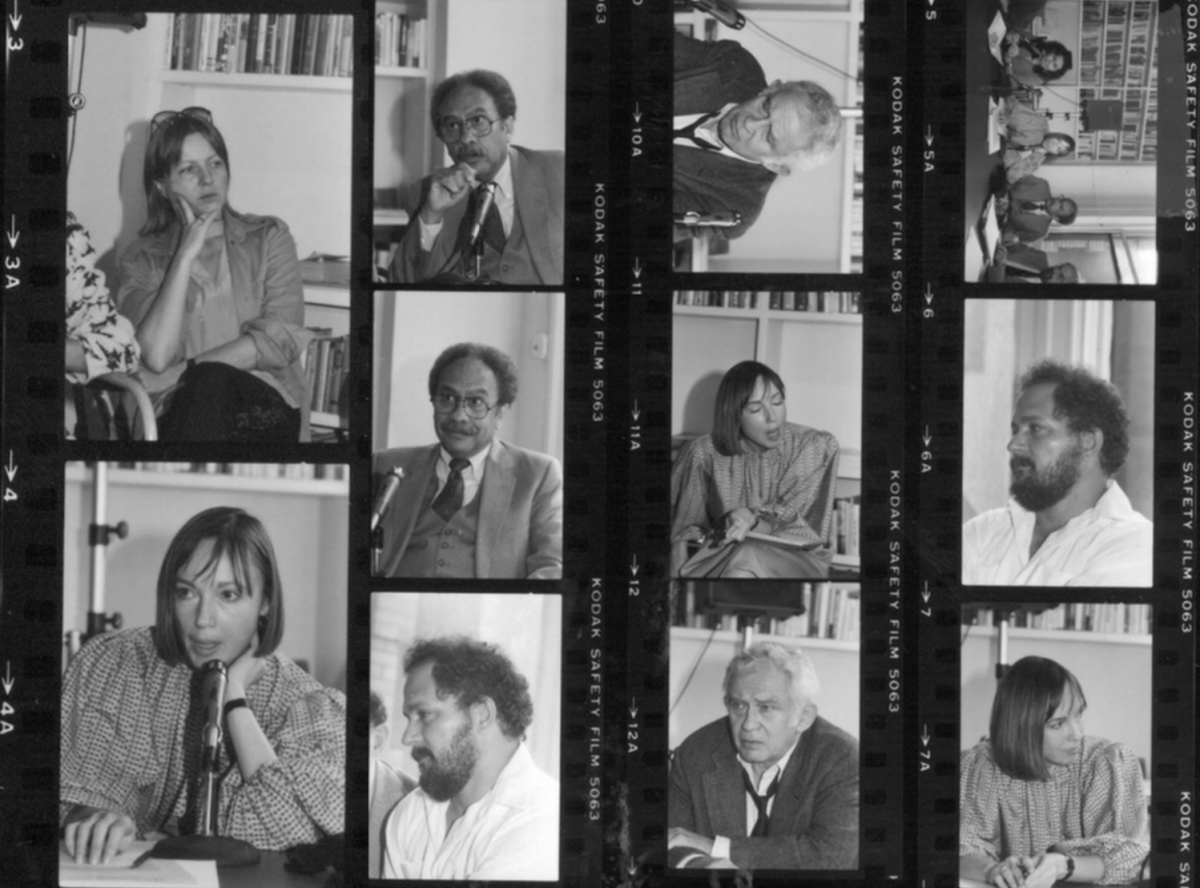
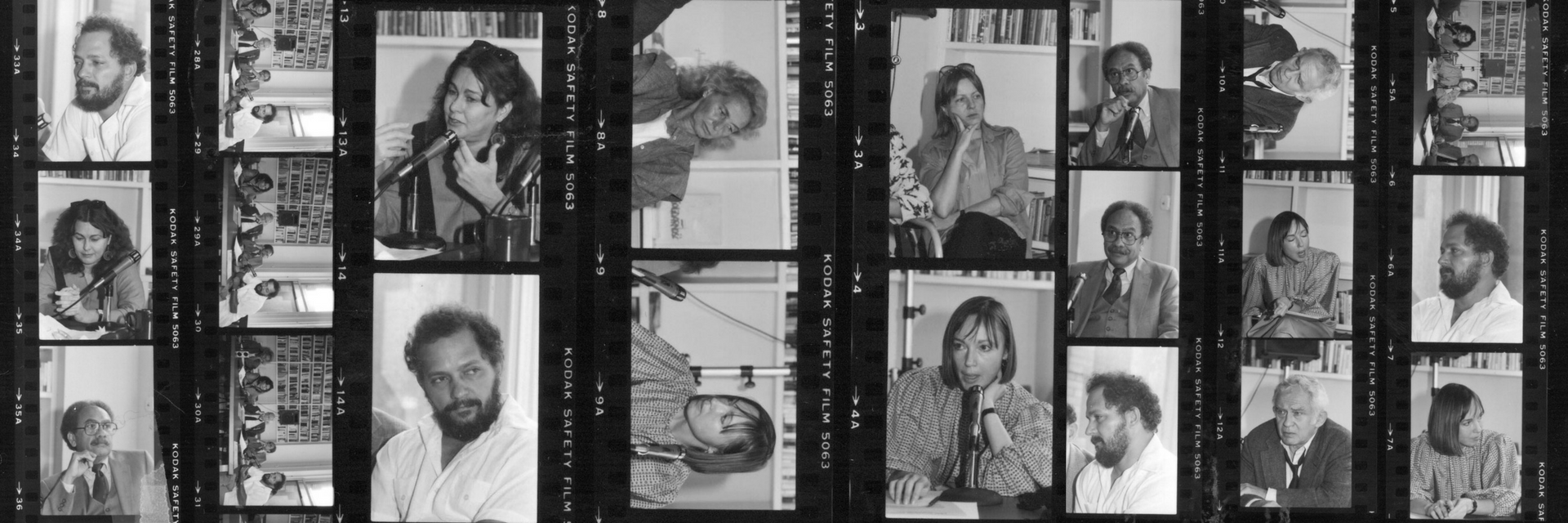
The recently launched PEN America Digital Archive is an Aladdin’s cave of literary treasures. An incredible amount of cultural programming has grown up around the organization’s commitment to championing writers’ civil liberties–over 1,500 hours worth of audio and visual files.
Delve into this free, searchable archive for previously inaccessible lectures, readings, and discussions featuring the leading writers, intellectuals, and artists of the last 50 years. Many of these New York City-based events were planned in response to the oppression and hardship suffered by fellow writers around the world.
We are lucky that Nobel Prize-winner Morrison, a vigorous cultural observer and critic, still walks among us. Also, that the archive affords us a chance to spend quality time with so many great literary eminences who no longer do:
Maybe it doesn’t take much to get a grammar nerd in a state of agitation, or even, perhaps, violent rage. While I generally avoid the term “grammar nazi,” it does bluntly convey the severe intolerance of certain grammarians. One of the most popular recent books on grammar, Lynn Truss’s Eats, Shoots & Leaves, announces itself in its subtitle as a “Zero Tolerance Approach to Punctuation.” And sure enough, the main title of the entertaining guide comes from a violent joke, in which a panda enters a bar, eats a sandwich, then shoots up the joint. Asked why, he tells the bartender to look up “panda” in the dictionary: “Panda. Large black-and-white bear-like mammal, native to China. Eats, shoots and leaves.”
Truss’s example illustrates not a grammatical point of contention, but a mistake, a misplaced comma that completely changes the meaning of a sentence. But we might refer to many technically correct examples involving the absence of the Oxford comma, the final comma in a series that sets off the last item.
Many people have argued, with particular vehemence, that the “and” at the end of a series satisfies the comma’s function. No, say other strict grammarians, who point to the confusing ambiguity between, say, “I went to dinner with my sister, my wife, and my friend” and “I went to dinner with my sister, my wife and my friend.” We could adduce many more potentially embarrassing examples.
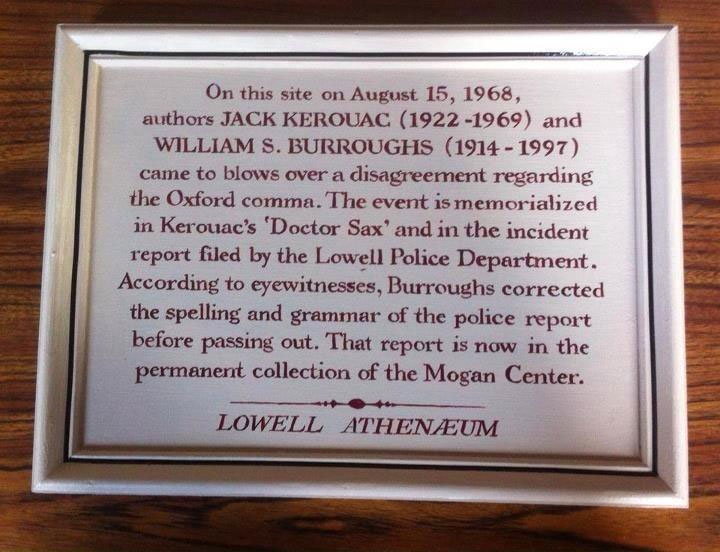
The Oxford comma is so contentious a grammatical issue that it supposedly provoked a drunken fistfight between Beat writers Jack Kerouac and William S. Burroughs. At least, that is, according to a plaque at Mill No. 5 in Lowell, Massachusetts, a historic textile mill built in 1873 and since revitalized into a performance space with shops and a farmer’s market. “On this site on August 15, 1968,” the plaque reads, Kerouac and Burroughs “came to blows over a disagreement regarding the Oxford comma. The event is memorialized in Kerouac’s ‘Doctor Sax’ and in the incident report filed by the Lowell Police Department.” The next line should give us a clue as to how seriously we should take this historical tidbit: “According to eyewitnesses, Burroughs corrected the spelling and grammar of the police report.”
The plaque is a hoax, the fight never happened. (And it is one of many such joke historical markers at the mill.) Doctor Sax was written nine years earlier, in 1959, and Kerouac and Burroughs hadn’t even met at the time of that novel’s events. But it’s a great story. “We imagine Burroughs grabbing the policemen’s pen,” writes Alexis Madrigal at The Atlantic, “lucid as a shaman, and then plopping onto the grass, out cold.” (The Anarchist’s Guide to Historic House Museums calls the spurious plaque “an act of historic vandalism.”) We like the story not only because it’s a juicy bit of lore involving two legendary writers, but also because the Oxford comma, for whatever reason, is such a weirdly inflammatory issue. The TED-Ed video above calls it “Grammar’s great divide.” (The comma acquired its name, points out Mental Floss, “because the Oxford University Press style guidelines require it.”)
If it isn’t already evident, I seriously favor the Oxford comma, perhaps enough to defend it in pitched battle. But if you need convincing by gentler means, you might heed the wisdom of The New Yorker’s resident “comma queen,” who, in the video above, serves up another humorous instance of a serial comma faux pas involving strippers, JFK, and Stalin (or “the strippers, JFK and Stalin”). For a much more serious Oxford comma kerfuffle, we might refer to a class action lawsuit involving overtime pay for truckers, a case that “hinged entirely” on the serial comma, “a debate that has bitterly divided friends, families and foes,” writes Daniel Victor at The New York Times, in a sentence that puckishly, or contrarily, leaves out the last comma, and sets the grammar intolerant among us grinding our teeth. But the Oxford comma is no joke. Its lack may cost Maine company Oakhurst millions of dollars, or their employees millions in pay. “The debate over commas is often a pretty inconsequential one,” writes Victor. Until it isn’t, and someone gets sued, shot, or punched in the face. So snub the Oxford comma, I say, at your peril.
We're hoping to rely on loyal readers, rather than erratic ads. Please click the Donate button and support Open Culture. You can use Paypal, Venmo, Patreon, even Crypto! We thank you!
Open Culture scours the web for the best educational media. We find the free courses and audio books you need, the language lessons & educational videos you want, and plenty of enlightenment in between.