In 2011, Theo Gray (co-founder of Wolfram Research, Popular Science columnist, and element collector) won the ACS Grady Stack Award for Interpreting Chemistry for the Public. And here you can see why. In this clip, Gray introduces you to his DIY masterpiece — the world’s first “periodic table table.” Yes, we’re talking about a hand-carved wooden table that brings to life the Periodic Table, and lets you play with the elements. The project began back in 2002, and now, a decade later, Gray puts it on display in a video produced by the American Chemical Society.
Just when you think you’ve seen everything Jean-Luc Godard has ever shot, something like this surfaces. If you’re only now considering tucking into the feast that is Godard’s filmography, don’t let his abundance of uncollected odds, ends, clips, and shorts intimidate you. Not only do they promise a little thrill down the road when you’ve already digested his major works, but they offer quick bursts at any time of the revolutionary cinematic zest with which the filmmaker took on the world. With the man alive and working, I should perhaps say “the revolutionary cinematic zest with which the filmmaker takes on the world,” but that gets into one of the most fascinating conversations that swirls around him: has Godard still got it?
Some say yes, that his latest picture Film Socialismepresents the logical continuation of all Godard has ever represented; some say no, that the Godard to watch remains the scrappy star of the 1960s’ French New Wave. In his study Everything is Cinema: The Working Life of Jean-Luc Godard, New Yorker film blogger Richard Brody somehow makes both claims.
In the chapter “Revolution (1968–1972)” he describes Godard’s improvised method of shooting a 1968 Jefferson Airplane concert:
He took over from the specialists and operated the camera from the window of Leacock-Pennebaker’s office on West Forty-fifth street, shooting the band on the roof of the Schuyler Hotel across the street. (Pennebaker recalled him to be an amateurish cameraman who could not avoid the beginner’s pitfall of frequent zooming in and out.) The performance took place without a permit, at standard rock volume: as singer Grace Slick later wrote, “We did it, deciding that the cost of getting out of jail would be less than hiring a publicist…”
Amateurish or not, a piece of the footage has surfaced on YouTube. Listen to the Airplane perform “The House at Pooneil Corners,” watch Godard’s dramatic swings of focus and zoom as he attempts to convey the spectacle of the band and the spectacle of countless surprised Manhattanites at once, and think for yourself about this peculiar intersection of two bold lines in the era’s alternative zeitgeist. As Jefferson Airplane co-founder Paul Kantner said in a 1986 interview, “Just for a while there, maybe for about 25 minutes in 1967, everything was perfect.” But these seven minutes in November 1968, from opening shouts to inevitable arrest, don’t seem so dull themselves.
If you would like to support the mission of Open Culture, consider making a donation to our site. It’s hard to rely 100% on ads, and your contributions will help us continue providing the best free cultural and educational materials to learners everywhere. You can contribute through PayPal, Patreon, and Venmo (@openculture). Thanks!
Earlier this month, Harvard students made their way to the Sanders Theatre for the 2012 edition of Harvard Thinks Big. It’s a TED-style event which gets pitched like this: “8 all-star professors. 8 big ideas. All ten minutes each.” You get the gist.
This year’s version had as much substance, though perhaps not quite the same sizzle, as the 2011 version, which featured talks by Steven Pinker, Lawrence Lessig, Daniel Gilbert and Elaine Scarry. Above, we have one talk from the latest Harvard Thinks Big. It features Daniel Lieberman, the renowned biologist (perhaps you know his work on barefoot running?) talking about how evolutionary biology explains why obesity is on the rise in the United States.
Other speakers at the event included Doug Melton, Eleanor Duckworth, Nicholas Christakis, Kaia Stern, Donhee Ham, Stephen Greenblatt, and Jill Lepore. The lectures can be watched via YouTube (follow the previous links) or via iTunes. Regrettably the talks by Greenblatt, Ham and Lepore haven’t made it to the web, at least not yet. When they do, we’ll mention it on our Twitter stream, where we post lots of other cultural goodies.
The Moon is a mystery. For all its familiarity–the regularity of its phases, the fact that everywhere on Earth it looks the same–the Moon has always been an enigma, a luminous question mark rolling across the night sky.
In this new video from Cosmic Journeys, we learn about some of the latest scientific research into the structure and history of the Moon. In particular, we learn the latest ideas on what is perhaps the greatest of lunar mysteries: the question of how the Moon got there in the first place.
The leading candidate for an answer is the Giant Impact Hypothesis, which posits that sometime in the early stage of the Solar System–about four and a half billion years ago–a large proto-Earth collided with a Mars-sized body named “Theia,” causing a huge cloud of material from both bodies to fly out into space. Some of the material remained in the Earth’s orbit and coalesced into the Moon. It’s a fascinating hypothesis. To see more videos from the same series, visit the Cosmic Journeys channel on YouTube, or the SpaceRip blog.
As a carless cinephile, I’ve spent hours upon hours listening to film podcasts while riding my bike or the train.Battleship Pretension, hosted by knowledgeable but still knowledge-hungry young critics Tyler Smith and David Bax, has long held top priority on these rides — and even if the title’s referent doesn’t flood your mind with memories of artistic awe, you probably get the pun. But if you want to go deeper and talk about how film editing went from grunt work to art form, you have little choice but to talk about Battleship Potemkin(1925) and its director, Sergei Eisenstein. A Russian double-threat of filmmaker and film theorist in the 1920s through the late 1940s, Eisenstein pioneered many now-essential editing techniques, figuring out how images could be arranged to serve not just a film’s story but its rhythm, its tone, and even its themes.
Like cinema itself, Eisenstein came from the theater. Unlike most of his contemporaries, he made great strides in dragging cinema out of the theater behind him, casting off staid storytelling habits in favor of the vast possibilities of the then-new medium, most of which remain uncharted even today. Tasked by his government with producing what came down to revolutionary propaganda, Eisenstein couldn’t push the thematic envelope very far. Even so, today’s filmmakers looking for ways to advance their form, or today’s filmgoers eager to learn more about how movies work, would do well to look at what Eisenstein managed to do 85 years ago, and how aesthetically exhilarating it all remains.
This you can do from the comfort of your computer by browsing Open Culture’s collection of Free Movies Online, where you’ll find links to Eisenstein pictures viewable at the click of the mouse, including the sweepingAlexander Nevsky, the doomed¡Que viva México!, and of course, the iconicBattleship Potemkin(above). Watch a few, and you’ll see why Battleship Pretension’s listeners voted Eisenstein into the top hundred directors of all time. Smith and Bax called on yours truly to write his blurb on the list, but don’t take my word for the filmmaker’s importance; his movies, whether you catch them in a grand revival screening or on your web browser right now, show you everything you need to know.
The clip above is apparently the oldest collegiate football footage surviving today. And, in case you’re keeping score, Princeton won the game 11–6.
But if you’re counting the number of Free Courses provided by the two universities, we have the score at 38–1, with Yale coming out way on top.
In April of 1964, the British Broadcasting Corporation launched BBC Two as a highbrow alternative to its mainstream TV channel. One of the new channel’s first programs was Jazz 625, which spotlighted many of the greatest Jazz musicians of the day. Dizzy Gillespie, Thelonious Monk, Dave Brubeck, Bill Evans and others performed on the show, which featured straight-forward camera work and a minimalist set. The focus was on the music.
The title of the show referred to the channel’s 625-line UHF bandwidth, which offered higher resolution than the 405-line VHF transmission on BBC One. Among the surviving episodes is Thelonious Monk’s March 14, 1965 performance at the Marquee Club in London. You can watch a 35-minute excerpt above. The quartet features Monk on piano, Charlie Rouse on tenor saxophone, Larry Gales on bass and Ben Riley on drums. They perform four numbers:
Straight No Chaser
Hackensack
Rhythm-A-Ning
Epistrophy
You can learn the story behind Jazz 625 by reading an article by Louis Barfe at Transdiffusion. And to see more from the shows, scroll down.
The Oscar Peterson Trio:
Above is a 25-minute excerpt from the Oscar Peterson Trio’s October 1, 1964 performance. The original show, like other episodes of Jazz 625, was over an hour long. The trio features Peterson on piano, Ray Brown on bass and Ed Thigpen on drums.
The Bill Evans Trio:
Above are two 35-minute episodes, shown back-to-back, featuring the Bill Evans Trio. The two sets were recorded on March 19, 1965 and feature Evans on piano, Chuck Israels on bass and Larry Bunker on drums.
The Modern Jazz Quartet:
The Modern Jazz Quartet performed for Jazz 625 on April 28, 1964. Above is a 27-minute except, featuring the Quartet’s musical director John Lewis on piano, Milt Jackson on vibraphone, Percy Heath on bass and Connie Kay on drums. Brazilian guitarist Laurindo Almeida makes a special appearance.
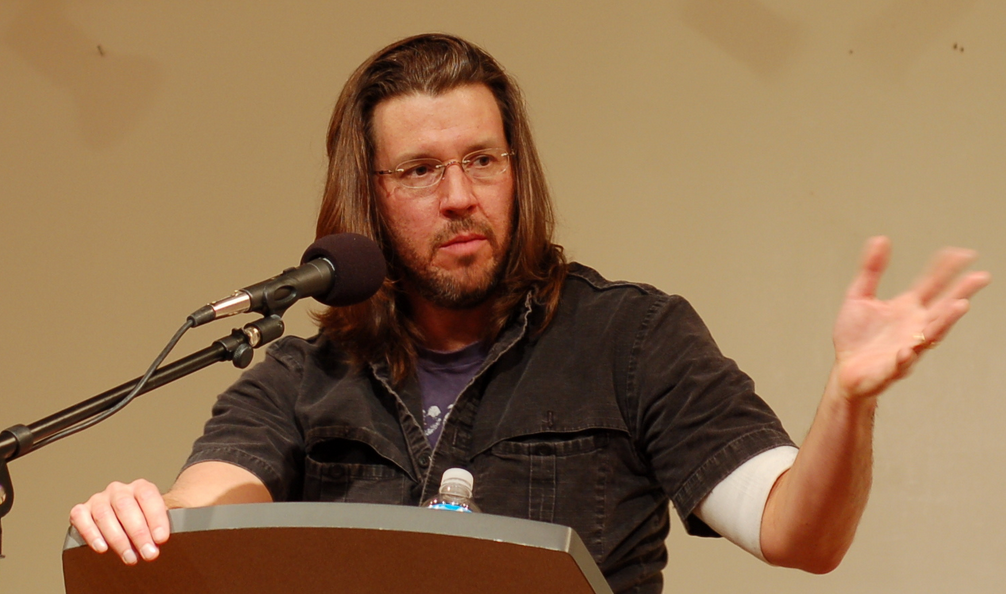
We started the week expecting to publish one David Foster Wallace post. Then, because of the 50th birthday celebration, it turned into two. And now three. We spent some time tracking down free DFW stories and essays available on the web, and they’re all now listed in our collection, 800 Free eBooks for iPad, Kindle & Other Devices. But we didn’t want them to escape your attention. So here they are — 23 pieces published by David Foster Wallace between 1989 and 2011, mostly in major U.S. publications like The New Yorker, Harper’s, The Atlantic, and The Paris Review. Enjoy, and don’t miss our other collections of free writings by Philip K. Dick and Neil Gaiman.
An Ingmar Bergman retrospective begins next month here in Los Angeles, and as I mark my calendar, I reflect on what turned me on to his films in the first place. Who can approach Bergman now without first running a cultural gauntlet of knowing references, gushing appreciations, and contrarian broadsides? What young cinephile could resist the temptation to inflate an opinion about The Seventh Seal, or Wild Strawberries, or Persona after seeing them for the first time — or indeed, before? We could all benefit from someone to show us the way into the “Swedish master’s” loaded, time-consuming filmography, and as this BBC interview by film critic Mark Kermode reveals (watch Part 1 above, and Part 2 here), Woody Allen could well be it.
Allen holds a surprisingly plausible claim to the title of Bergman’s number-one fan, or at least his most prominent one. How to square his dedication to these solemn Swedish meditations on mortality, emotional isolation, and the impossibility of faith with his creation of beloved light comedies like Bananas, Sleeper, and Annie Hall? But watch Allen’s filmography in full, especially pictures like Love and Death, Crimes and Misdemeanors, and Shadows and Fog, and the answer comes into view. Mortality, emotional isolation, the impossibility of faith — Bergman’s preoccupations are Allen’s, but Allen grapples with the unanswerable questions by making jokes about them. What Allen describes as a “thematic connection” to Bergman ultimately becomes a much more complicated entanglement: his hiring of Bergman’s cinematographer Sven Nykvist to shoot Another Woman, Crimes and Misdemeanors, and Celebrity, for instance, suggests something beyond simple influence.
In conversation with Kermode, Allen remembers joining the vanguard of New York Bergman enthusiasm after seeing Summer with Monika and The Naked Night, films that, to his mind, displayed an obviously higher level of craft than anything else playing in town. The days when discovering Bergman really meant discovering Bergman have long passed, but it will never be too late to feel the same excitement Allen did about Bergman’s ability to express internal conflicts — “inner states of anxiety,” Allen calls them — so richly and dramatically on film. The Woody Allen-approved points of entry for the Bergman novice: The Seventh Seal, Wild Strawberries, and Cries and Whispers “for sure.” And maybe The Magician. H/T @opedr
In early 1964, Bob Dylan was at the apex of his journey as a socially conscious folk singer. The fleeting moment is preserved in this rare half-hour TV program, recorded on February 1 of that year. Within a week the Beatles would land in America. In a little over a month, Dylan would rent an electric guitar.
The television performance is from Quest, a Canadian Broadcasting Corporation series that ran between 1961 and 1964 and showcased a wide range of literary and performing arts. It was produced in Toronto by Daryl Duke, who went on to direct American television programs and feature films.
Dylan appears in his classic Woody Guthrie mode on a set made to look like a western bunkhouse. He plays six songs–half from The Times They Are a‑Changin’, his third album released just a few weeks before, and half from his previous album, The Freewheelin’ Bob Dylan. In order of appearance:
The Times They Are A Changin’
Talkin’ World War III Blues
Lonesome Death of Hattie Carroll
Girl From the North Country
A Hard Rain’s A‑Gonna Fall
Restless Farewell
“The Times They Are a‑Changin’,” as the program is titled, offers a unique glimpse of the early Bob Dylan, just before his music turned from social issues to personal ones, just before he put away the blue jeans and work shirts and began wearing Beatle boots and sunglasses. “Dylan’s appearance on Quest,” says writer and filmmaker Erek Barsczewski, “provides the closest approximation available of what his early performances in Greenwich Village would have looked and sounded like.”
Cinema went into its death throes on September 31, 1983. The instrument of its demise? The video remote control. When the “zapper” endowed the viewer with the ability to play, pause, stop, fast-forward, and rewind at will, the medium’s artists lost their absolute control over the rhythm, duration, and other chronological subtleties of the cinematic experience. Or so filmmaker Peter Greenaway claims in this lecture at UC Berkeley. Anyone fan enough to read all the interviews the director has granted — and I count myself in the group — will by now be familiar with, even weary of, Greenaway’s ideas about cinema’s technical and economic straitjacketing, its arbitrary aesthetic boundaries, and its squandered potential as a freestanding art form. Nowhere else, though, does he explain and elaborate upon these ideas in such detail, or in such an entertainingly oratorical manner.
“The death of cinema,” though? Really? Knowing how dramatic that sounds, Greenaway frames what’s happened in another way: perhaps cinema has yet to be born. What if the last century or so has offered only the prologue to cinema, and modern filmmakers must take it upon themselves to bring the real thing into the world? These may strike you as the thoughts of a crackpot, and maybe they are, but watch and listen as Greenaway recounts the stunted development of the art form in which he works. We’ve grown so accustomed to the limitations of cinema, so his argument goes, that we don’t even feel the pressure of the “four tyrannies” that have lorded over it since the beginning: the frame, the text, the actor, and the camera. Even if you loathe Greenaway’s films, can you help asking yourself whether the rarely questioned dominance of an elite class of essentially theatrical performers, following textually conceived instructions, viewed from one perspective at a time through a simple rectangle, holds the movies back?
Since his feature-length debut The Falls in 1980, Greenaway has struggled against what he sees as the barriers put up by cinema’s unhealthy entanglement with the narrative-driven forms of theater and literature. Trained originally as a painter, he wonders explicitly in public and implicitly through his work why films can’t enjoy the same freedom to explore the creative space at their disposal that paintings do. All his pictures, even the best-known like The Draughtsman’s Contract; The Cook, the Thief, His Wife and Her Lover; and 8½ Women, use settings, actors, images, words, and sounds like colors on a palette, applying them with infinitude of strokes, creating a whole from which no one element can be easily separated. In this lecture, Greenaway marshals footage from his projects conducted even farther out at the medium’s edge: his transformation of an actual Italian palace into one big non-narrative film, his collaborations with avant-garde composer David Lang, and, of course, his VJ-ing sessions.
We're hoping to rely on loyal readers, rather than erratic ads. Please click the Donate button and support Open Culture. You can use Paypal, Venmo, Patreon, even Crypto! We thank you!
Open Culture scours the web for the best educational media. We find the free courses and audio books you need, the language lessons & educational videos you want, and plenty of enlightenment in between.