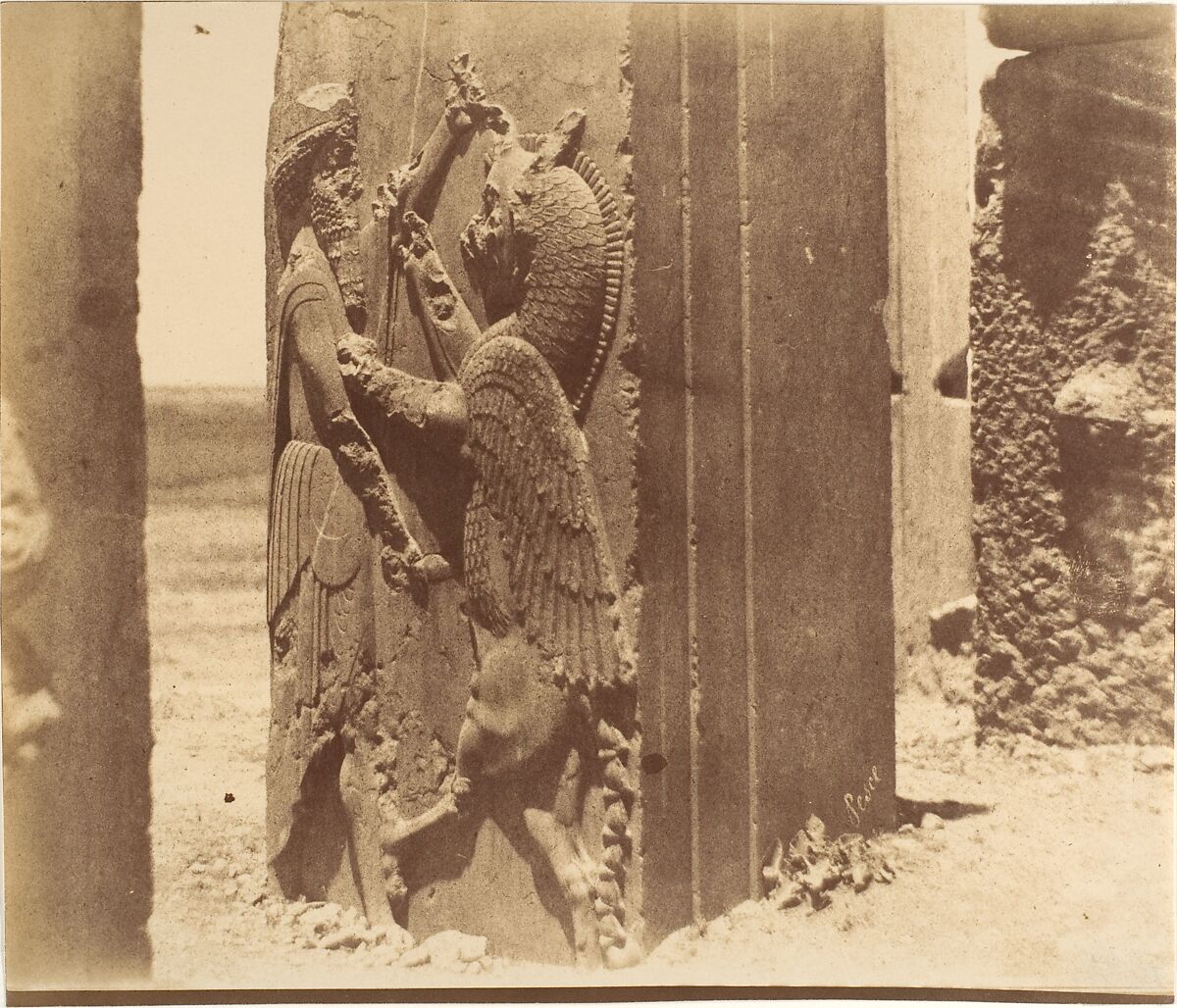
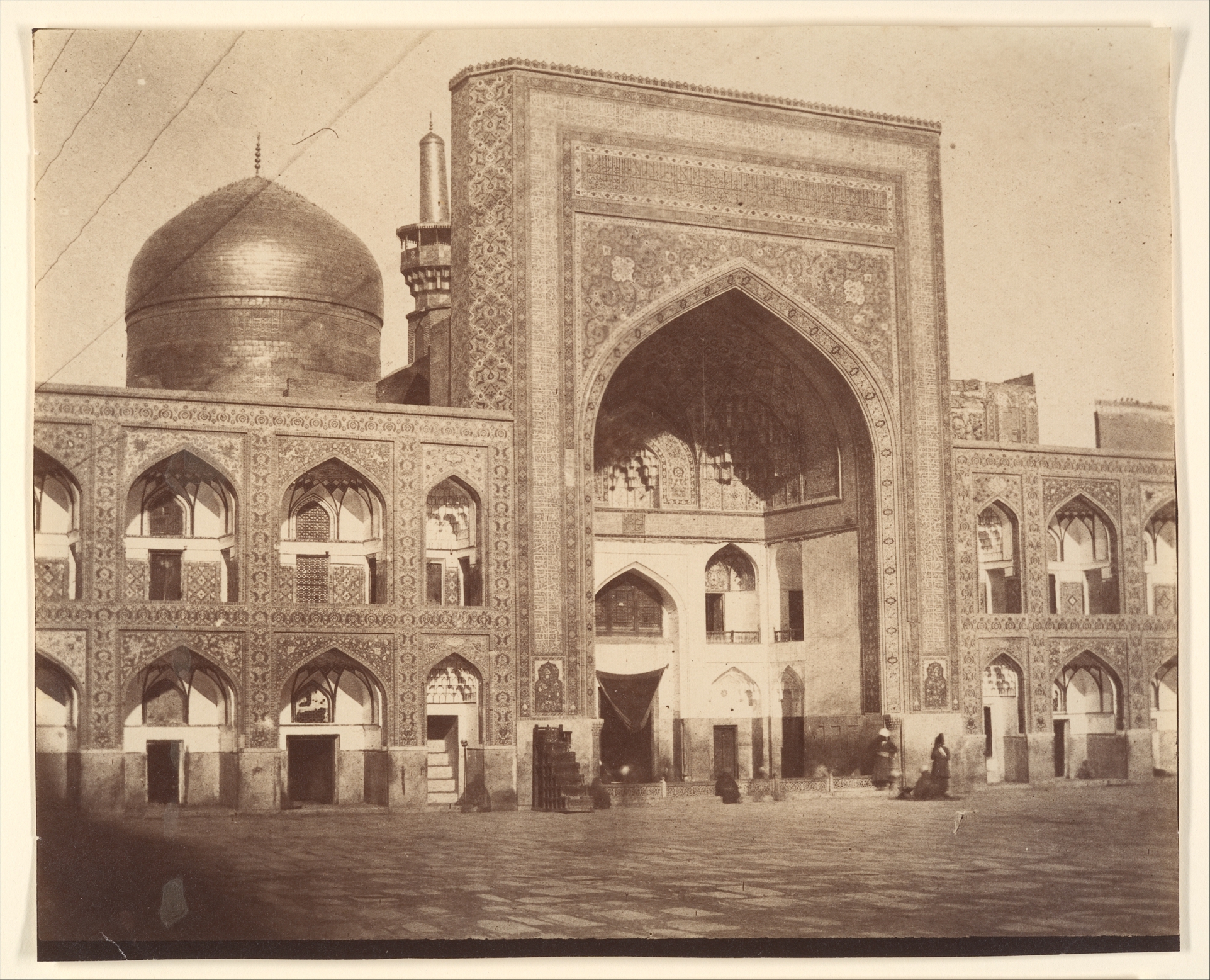
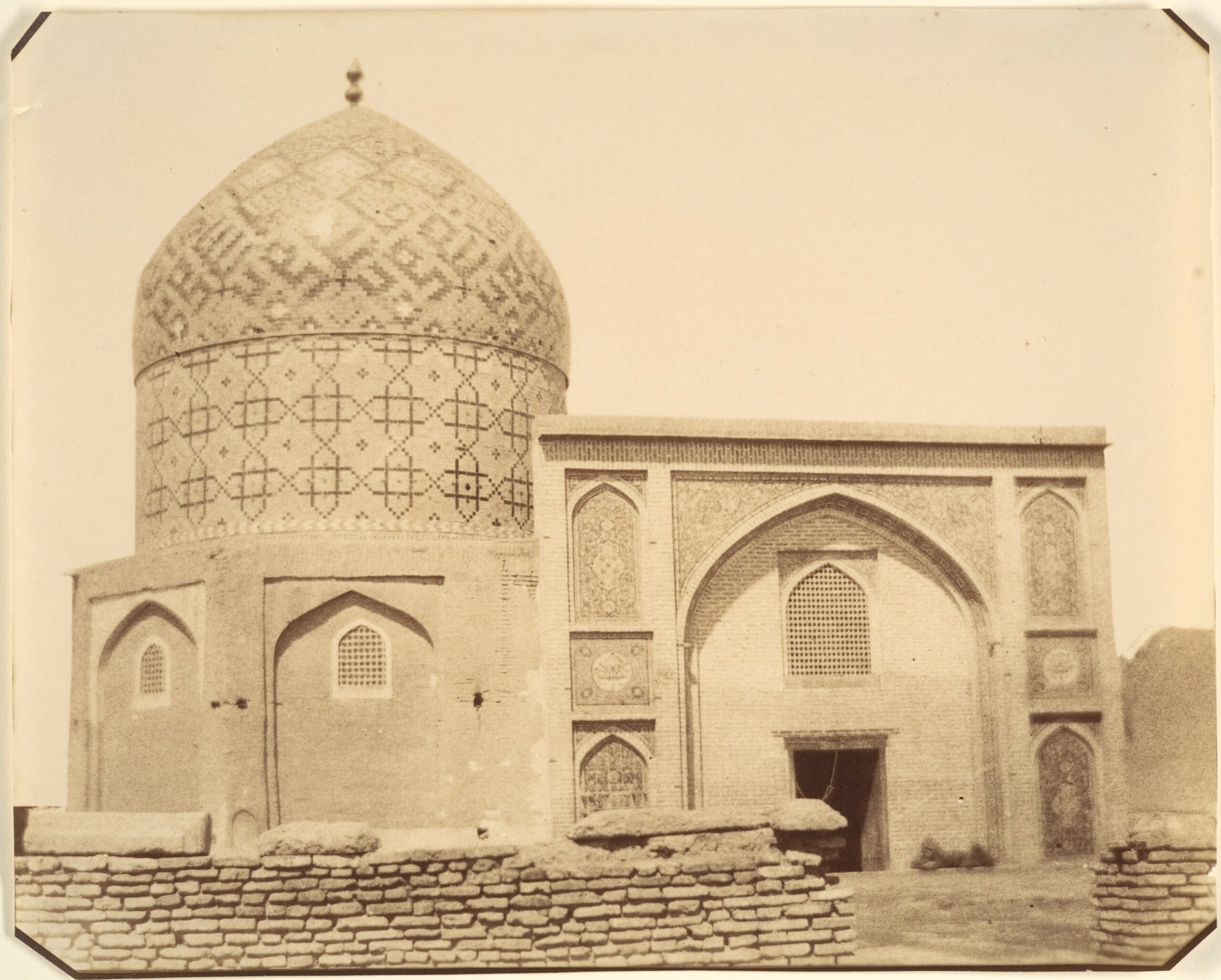
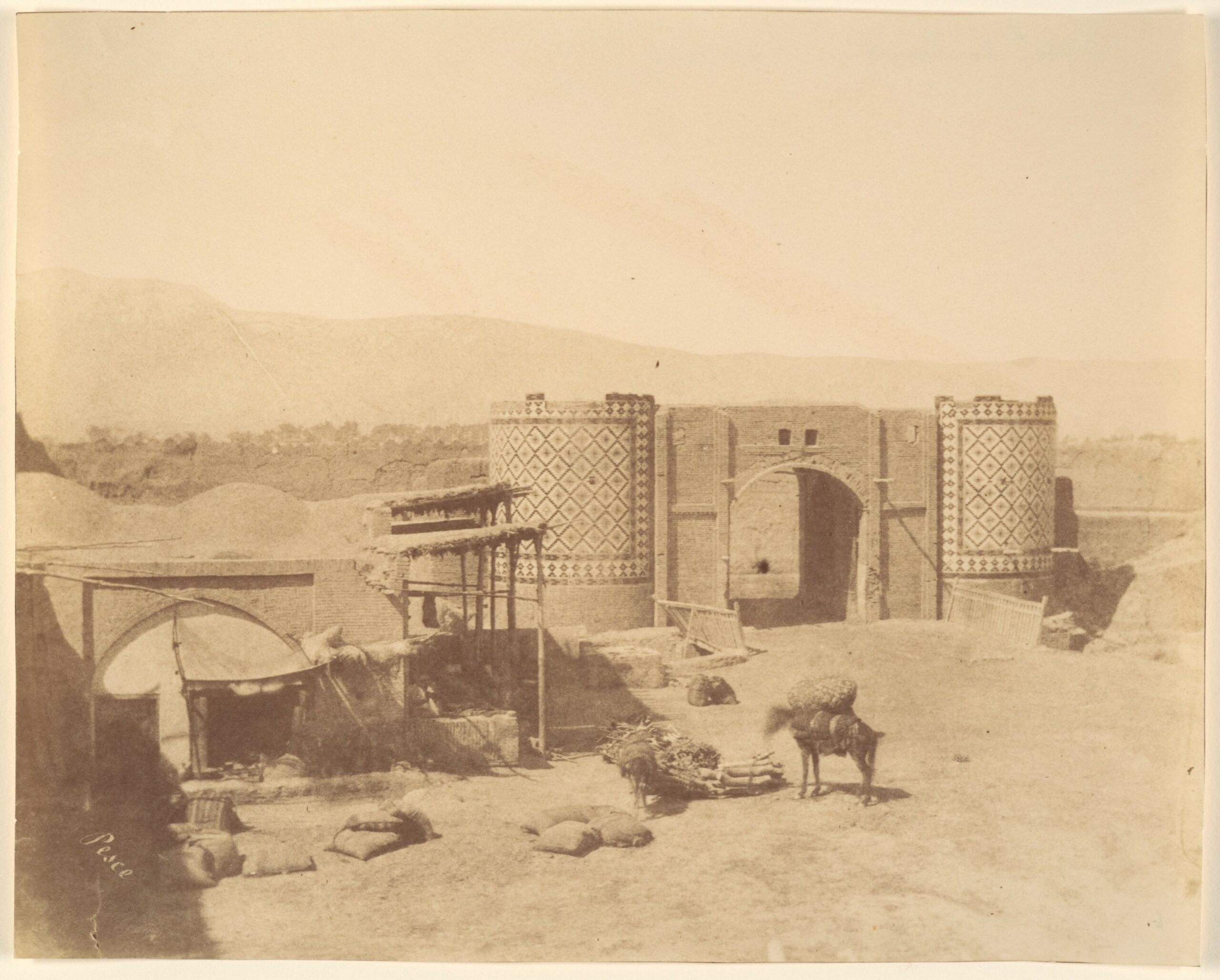
The technology and art of photography emerged in nineteenth-century Europe. And so, when a part of the world outside Europe was well-photographed in those days, it tended to be a traveling European behind the camera. Take John Thomson, previously featured here on Open Culture, for his photos of China in the eighteen-seventies. Even before that, an Italian colonel and photographer named Luigi Pesce was hard at work documenting a land geographically closer to Europe, but hardly less exotic in the European worldview of the time: Persia, or what we would today call Iran.
“According to scholars and historians, the first photographer in Iran was Jules Richard, a Frenchman who, as stated in his diaries, arrived in Tehran in 1844,” says the web site of the National Museum of Asian Art.
“He served as the French language tutor of the Gulsaz family and took daguerreotypes of Mohammad Shah (reigned 1834–48) and his son, the crown prince, Nasir al-Din Mirza.” Alas, these photographs seem to be lost, much like most others taken before Pesce’s arrival in the country in 1848, “during the reign of Naser al-Din Shah Qajar, to train Iranian infantry units.”
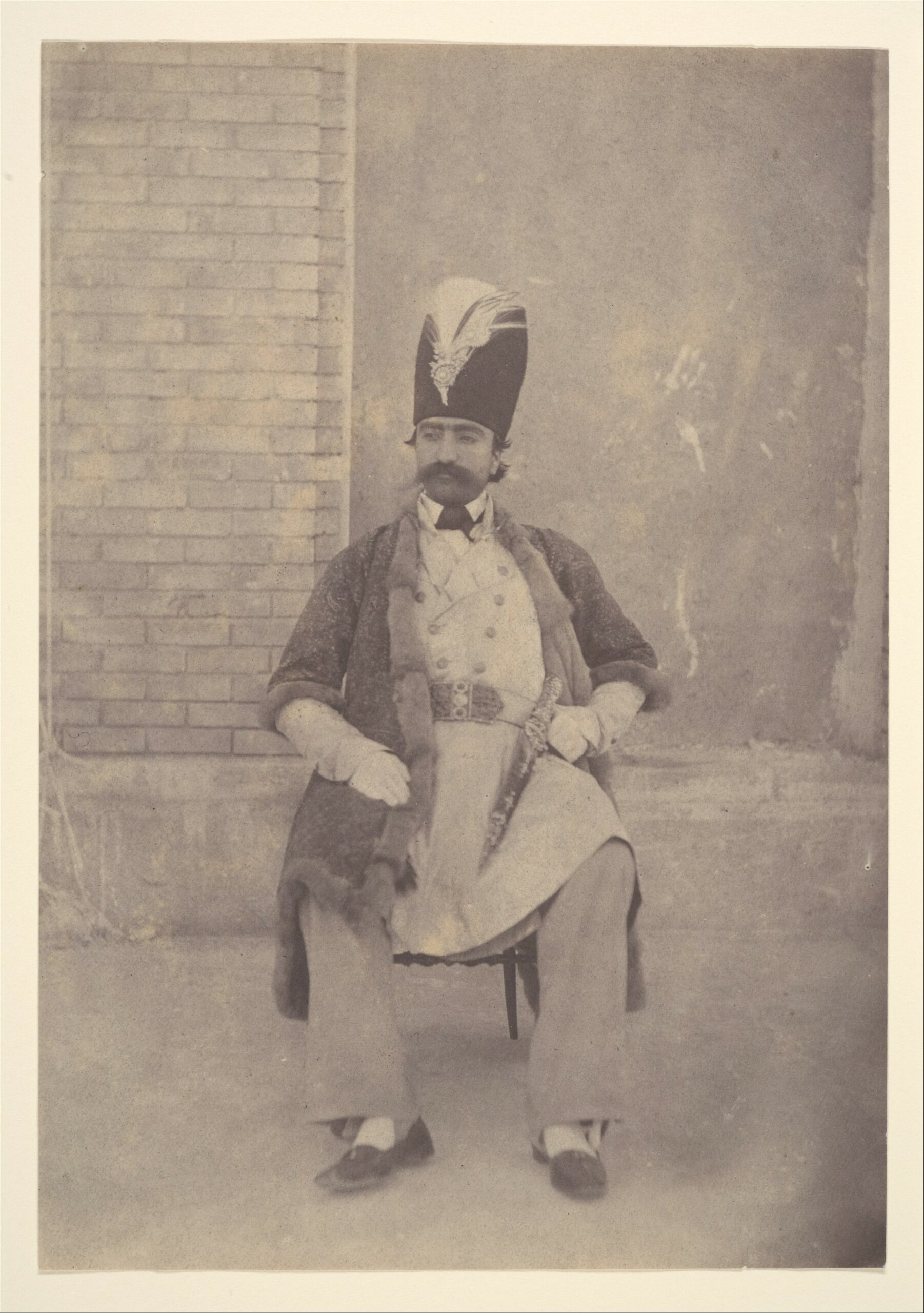
Pesce’s photographic subjects included Naser al-Din himself, pictures of whom appear in the online collection of Pesce’s work at the Metropolitan Museum of Art. It was the Met that received a copy of the photo collection Pesce produced of Iran’s ancient monuments — probably the very same copy that the photographer had originally sent to Prince William I, King of Prussia.
In those days, even such exalted figures had a great deal of curiosity about far-flung realms, and before photography, they had no easier way of seeing what those realms really looked like than making the arduous journey themselves.
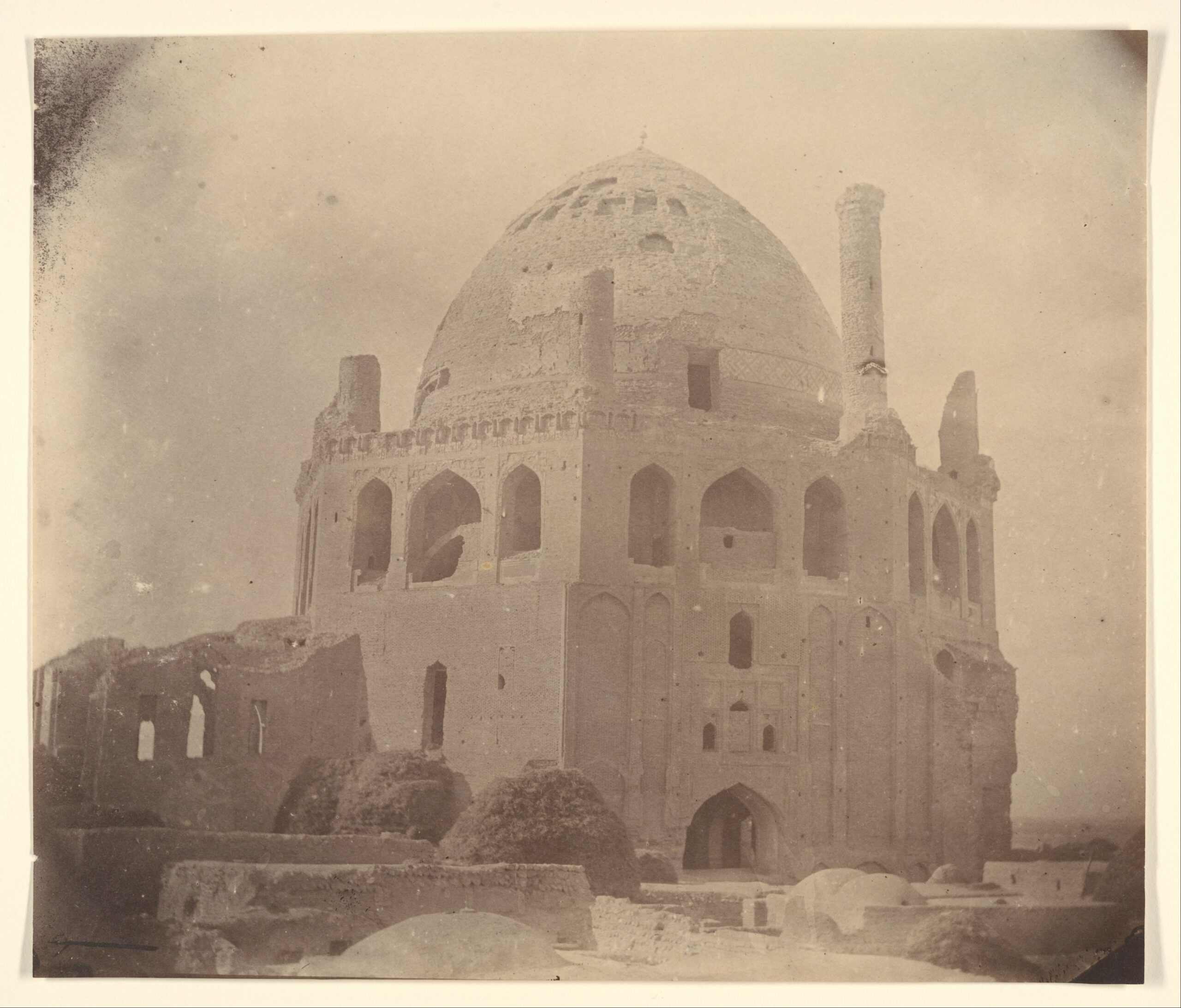
The sites captured in this collection include Toghrol Tower, the Tomb of Seeh‑i Mumin, and the Mosque of Nasser-eddin Shah — as well as Pasargadae, Naqsh‑e Rustam, and Persepolis, the famed ceremonial capital complex of the ancient Achaemenid Empire, which Pesce was the first to photograph. Or at least he was the first to succeed in doing so, Naser al-Din having previously sent Richard off to make some daguerreotypes of Persepolis that never came out.
But even Pesce’s photographs, fully executed using just about the height of the technology at the time, no longer have the immediacy they would have when Prince William gazed upon them; more than a century and a half later, they have a patina of historical distance that shades into unreality, making them feel not unlike ruins themselves. You can also view more photos on Google Arts and Culture.
Based in Seoul, Colin Marshall writes and broadcasts on cities, language, and culture. His projects include the Substack newsletterBooks on Cities, the book The Stateless City: a Walk through 21st-Century Los Angeles and the video series The City in Cinema. Follow him on Twitter at @colinmarshall or on Facebook.
It costs roughly $20,000, weighs nearly 100 pounds, and looks like a high-end microscope. Handmade in Switzerland, the MANUMENT Leva Machine makes espresso. How well does it make espresso? How do the shots taste?: According to coffee expert James Hoffmann–he’s the author of The World Atlas of Coffee–the shots have a texture that is “very enjoyable.” The texture is “silky, buttery and soft.” That verdict is sandwiched in the middle of a 20-minute review of the machine, which you can watch above.
If you would like to support the mission of Open Culture, consider making a donation to our site. It’s hard to rely 100% on ads, and your contributions will help us continue providing the best free cultural and educational materials to learners everywhere. You can contribute through PayPal, Patreon, and Venmo (@openculture). Thanks!
Read a story set in the Middle Ages, Beowulf or anything more recently written, and you’re likely to run across a reference to mead, which seems often to have been imbibed heartily in halls dedicated to that very activity. The same goes for medieval-themed plays, movies, and even video games. Take Assassin’s Creed Valhalla, described by Max Miller, host of Youtube channel Tasting History, as “a history-based game of, like, my favorite time period — Saxons and Vikings, you know, fightin’ it out — so I’m assuming that there’s going to be mead in there somewhere.” He uploaded the video, below, in the fall of 2020, just before that game’s release, but according to the Assassin’s Creed Wiki, he was right: there is, indeed, mead in there.
Perhaps throwing back a digital horn of mead in a video game has its satisfactions, but surely it would only make us curious to taste the real thing. Hence Miller’s episode project of “making medieval mead like a viking,” which requires only three basic ingredients: water, honey, and ale dregs or dry ale yeast. (The set of required tools is a bit more complex, involving several different vessels and, ideally, a “bubbler” to let out the carbonation.)
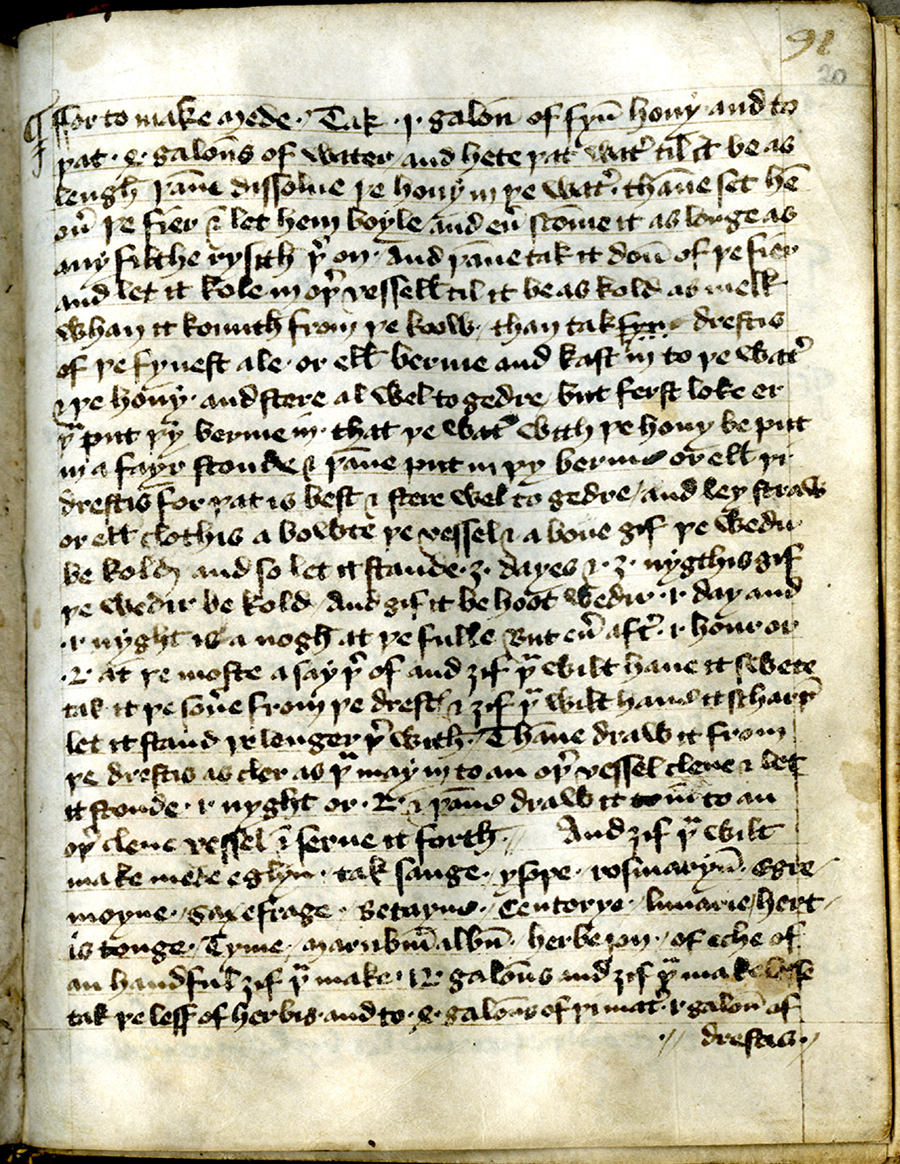
In it he consults a thirteenth- or fourteenth-century manuscript (above) called the Tractatus de Magnetate et Operationibus eius, which includes not just a letter on the workings of magnets — and “a university handbook on the theory of numbers, proportions, and harmony” and “the seven signs of bad breeding; the seven signs of elegance” — but also “one of the oldest known surviving English mead recipes.”
“When you think of Saxons and Vikings, yes, you think of mead,” Miller says, “but mead actually got its start way before that,” evidenced in the alcohol-and-honey residue found on Chinese pottery dating to 7000 BC and a written mention in the Indian Rigveda. “I have tasted the sweet drink of life, knowing that it inspires good thoughts and joyous expansiveness to the extreme, that all the gods and all mortals seek it together,” says that sacred text. Even if Miller’s mead doesn’t make you feel like a god, it does have the virtue of requiring only a few days’ fermentation, as opposed to the traditional period of months. Toward the video’s end, he mentions having set one bottle aside to ripen further, and possibly to feature in a later episode. That was nearly three years ago; today, Tasting History fans can only speculate as to what alcoholic Valhalla that brew has so far ascended.
You can find the text of the medieval recipe below:
//ffor to make mede. Tak .i. galoun of fyne hony and to
þat .4. galouns of water and hete þat water til it be as
lengh þanne dissolue þe hony in þe water. thanne set hem
ouer þe fier & let hem boyle and ever scomme it as longe as
any filthe rysith þer on. and þanne tak it doun of þe fier
and let it kole in oþer vesselle til it be as kold as melk
whan it komith from þe koow. than tak drestis
of þe fynest ale or elles berme and kast in to þe water
& þe hony. and stere al wel to gedre but ferst loke er
þu put þy berme in. that þe water with þe hony be put
in a fayr stonde & þanne put in þy berme or elles þi
drestis for þat is best & stere wel to gedre/ and ley straw
or elles clothis a bowte þe vessel & a boue gif þe wedir
be kolde and so let it stande .3. dayes & .3. nygthis gif
þe wedir be kold And gif it be hoot wedir .i. day and
.1. nyght is a nogh at þe fulle But ever after .i. hour or
.2. at þe moste a say þer of and gif þu wilt have it swete
tak it þe sonere from þe drestis & gif þu wilt have it scharpe
let it stand þe lenger þer with. Thanne draw it from
þe drestis as cler as þu may in to an oþer vessel clene & let
it stonde .1. nyght or .2. & þanne draw it in to an
oþer clene vessel & serve it forth // And gif þu wilt
make mede eglyn. tak sauge .ysope. rosmaryne. Egre-
moyne./ saxefrage. betayne./ centorye. lunarie/ hert-
is tonge./ Tyme./ marubium album. herbe jon./ of eche of
an handful gif þu make .12. galouns and gif þu mak lesse
tak þe less of herbis. and to .4. galouns of þi mater .i. galoun of
drestis.
Based in Seoul, Colin Marshall writes and broadcasts on cities, language, and culture. His projects include the Substack newsletterBooks on Cities, the book The Stateless City: a Walk through 21st-Century Los Angeles and the video series The City in Cinema. Follow him on Twitter at @colinmarshall or on Facebook.
First up is 1935’s A Midsummer Night’s Dream, featuring Olivia de Havilland, Jimmy Cagney, Dick Powell, and, in the role of Puck, a 15-year-old Mickey Rooney, hailed by the New York Times as “one of the major delights” of the film, and Variety as “so intent on being cute that he becomes almost annoying.”
Tragedies dominate, with no fewer than six Hamlets, Shakespeare’s most filmed work, and “one of the most fascinating and most thankless tasks in show business” according to novelist and frequent film critic James Agee:
There can never be a definitive production of a play about which no two people in the world can agree. There can never be a thoroughly satisfying production of a play about which so many people feel so personally and so passionately. Very likely there will never be a production good enough to provoke less argument than praise.
MacBeth, Richard III, Romeo and Juliet, and The Tempest — a comedy — are other crowd-pleasing workhorses, chewy assignments for actors and directors alike.
Moviegoing connoisseurs of the Bard may feel moved to stump for films that didn’t make the playlist. If you can find a trailer for it, go for it! Lobby the Shakespeare Network on its behalf, or make your case in the comments.
We’ll throw our weight behind Michael Almereyda’s Cymbeline, featuring Ed Harris roaring down the porch steps of a dilapidated Brooklyn Victorian on a motorcycle, the bizarre Romeo.Juliet pairing A‑list British vocal talent with an all-feline line-up of Capulets and Montagues, and Shakespeare Behind Bars, a 2005 documentary following twenty incarcerated men who spent nine months delving into The Tempest prior to a production for guards, fellow inmates, and invited guests.
Enjoy the complete playlist of Shakespeare film trailers below. They move from 1935 to 2021.
Salvador Dalí led a long and eventful life, so much so that certain of its chapters outlandish enough to define anyone else’s existence have by now been almost forgotten. “You’ve done some very mysterious things,” Dick Cavett says to Dalí on the 1971 broadcast of his show above. “I don’t know if you like to be asked what they mean, but there was an incident once where you appeared for a lecture in Paris, at the Sorbonne, and you arrived in a Rolls-Royce filled with cauliflowers.” At that, the artist wastes no time launching into an elaborate, semi-intelligible explanation involving rhinoceros horns and the golden ratio.
The incident in question had occurred sixteen years earlier, in 1955. “With bedlam in his mind and a quaint profusion of fresh cauliflower in his Rolls-Royce limousine, Spanish-born Surrealist Painter Salvador Dalí arrived at Paris’ Sorbonne University to unburden himself of some gibberish,” says the contemporary notice in Time. “His subject: ‘Phenomenological Aspects of the Critical Paranoiac Method.’ Some 2,000 ecstatic listeners were soon sharing Salvador’s Dalirium.”
To them he announced his discovery that “ ‘everything departs from the rhinoceros horn! Everything departs from [Dutch Master] Jan Vermeer’s The Lacemaker! Everything ends up in the cauliflower!’ The rub, apologized Dali, is that cauliflowers are too small to prove this theory conclusively.”
Nearly seven decades later, Honi Soit’s Nicholas Osiowy takes these ideas rather more seriously than did the sneering correspondent from Time. “Beneath the simple shock value and easy surrealism, it becomes clear Dalí was onto something; the humble cauliflower is considered one of the best examples of the legendary golden ratio,” Osiowy writes. “Cauliflowers, rhinoceroses and anteaters’ tongues were to Dali essential manifestations of a glorious shape; deserving of an explicit depiction in his The Sacrament of the Last Supper,” painted in the year of his Sorbonne lecture. “Shape, the idea of geometry itself, is the unsung magic of not just art but our entire cultural consciousness.” Not that Dalí himself would have copped to communicating that: “I am against any kind of message,” he insists in response to a question from fellow Dick Cavett Show guest, who happened to be silent-film icon Lillian Gish. The seventies didn’t need the surreal; they were the surreal.
Based in Seoul, Colin Marshall writes and broadcasts on cities, language, and culture. His projects include the Substack newsletterBooks on Cities, the book The Stateless City: a Walk through 21st-Century Los Angeles and the video series The City in Cinema. Follow him on Twitter at @colinmarshall or on Facebook.
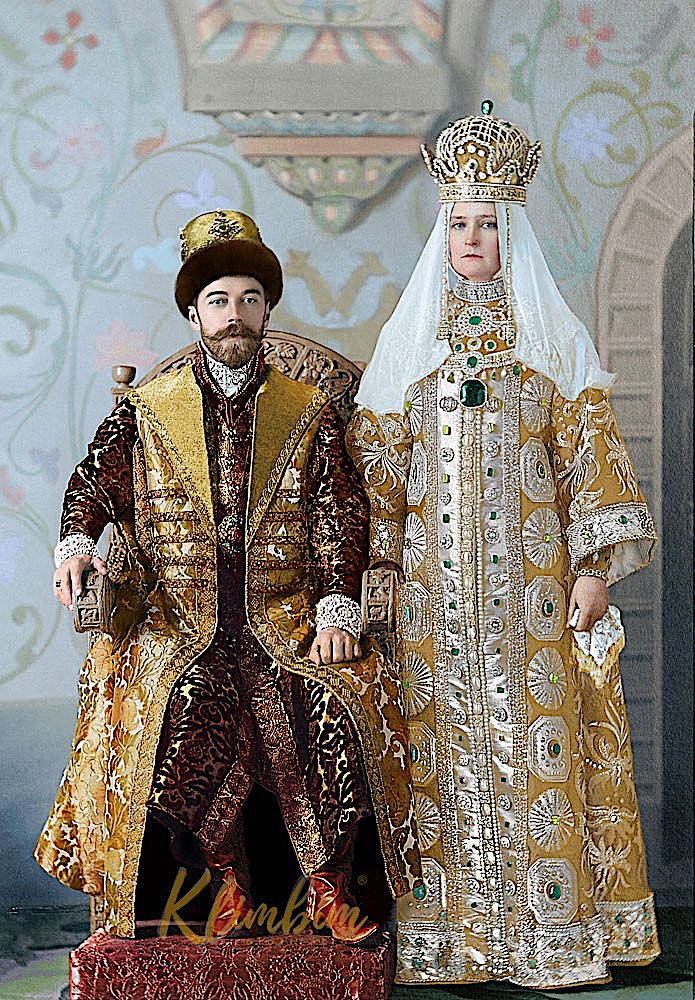
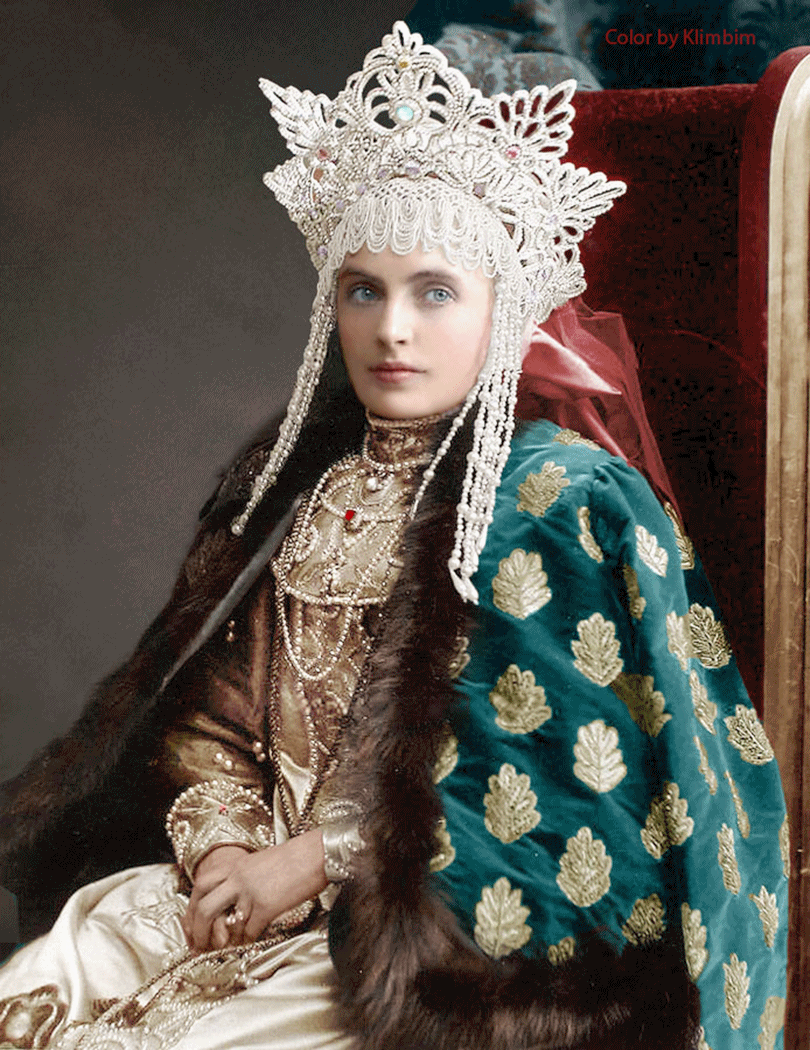
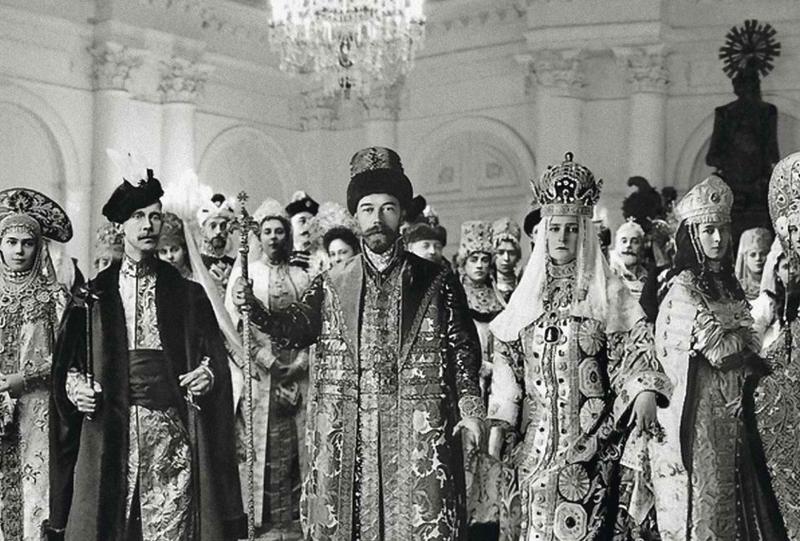
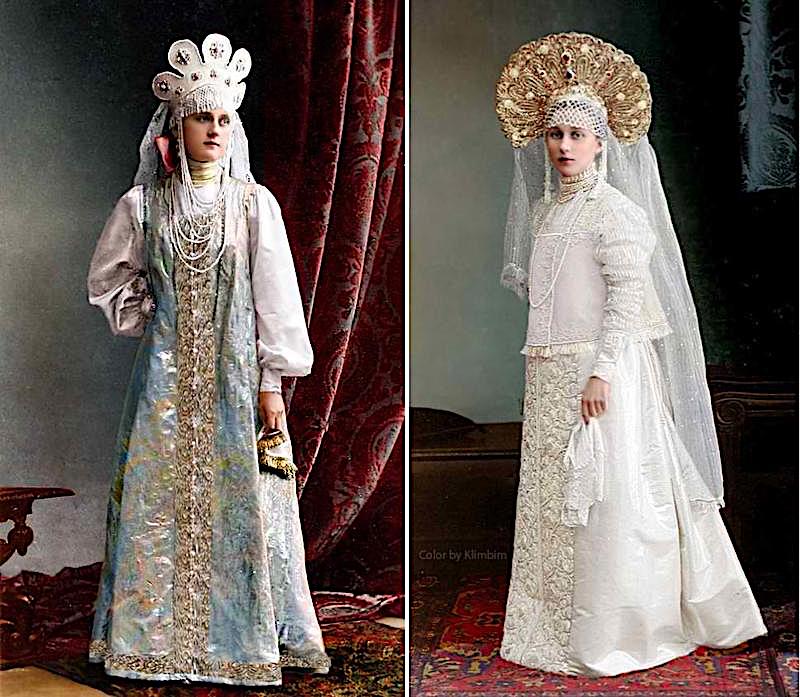
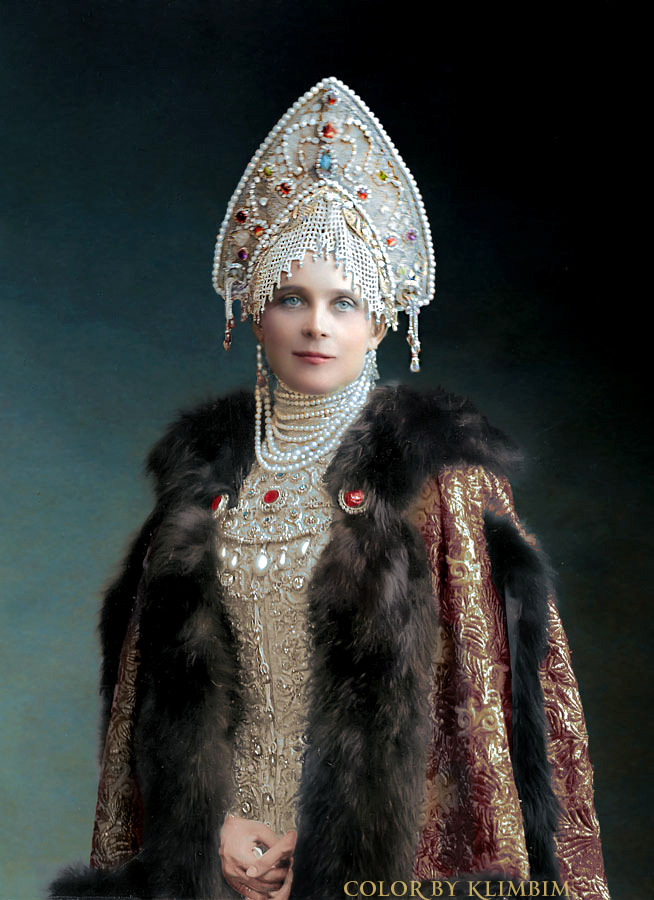
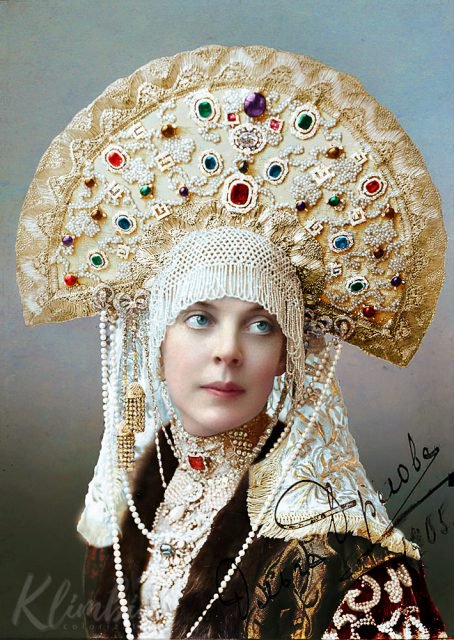
In 1903, the Romanovs, Russia’s last and longest-reigning royal family, held a lavish costume ball. It was to be their final blowout, and perhaps also the “last great royal ball” in Europe, writes the Vintage News. The party took place at the Winter Palace in St. Petersburg, 14 years before Czar Nicholas II’s abdication, on the 290th anniversary of Romanov rule. The Czar invited 390 guests and the ball ranged over two days of festivities, with elaborate 17th-century boyar costumes, including “38 original royal items of the 17th century from the armory in Moscow.”
“The first day featured feasting and dancing,” notes Russia Beyond, “and a masked ball was held on the second. Everything was captured in a photo album that continues to inspire artists to this day.” The entire Romanov family gathered for a photograph on the staircase of the Hermitage theater, the last time they would all be photographed together.
It is like seeing two different dead worlds superimposed on each other—the Romanovs’ playacting their beginning while standing on the threshold of their last days.
With the irony of hindsight, we will always look upon these poised aristocrats as doomed to violent death and exile. In a morbid turn of mind, I can’t help thinking of the baroque gothic of “The Masque of the Red Death,” Edgar Allan Poe’s story about a doomed aristocracy who seal themselves inside a costume ball while a contagion ravages the world outside: “The external world could take care of itself,” Poe’s narrator says. “In the meantime it was folly to grieve or to think. The prince had provided all the appliances of pleasure…. It was a voluptuous scene, that masquerade.”
Maybe in our imagination, the Romanovs and their friends seem haunted by the weight of suffering outside their palace walls, in both their country and around Europe as the old order fell apart. Or perhaps they just look haunted the way everyone does in photographs from over 100 years ago. Does the colorizing of these photos by Russian artist Klimbim—who has done similar work with images of WW2 soldiers andportraits of Russian poets and writers—make them less ghostly?
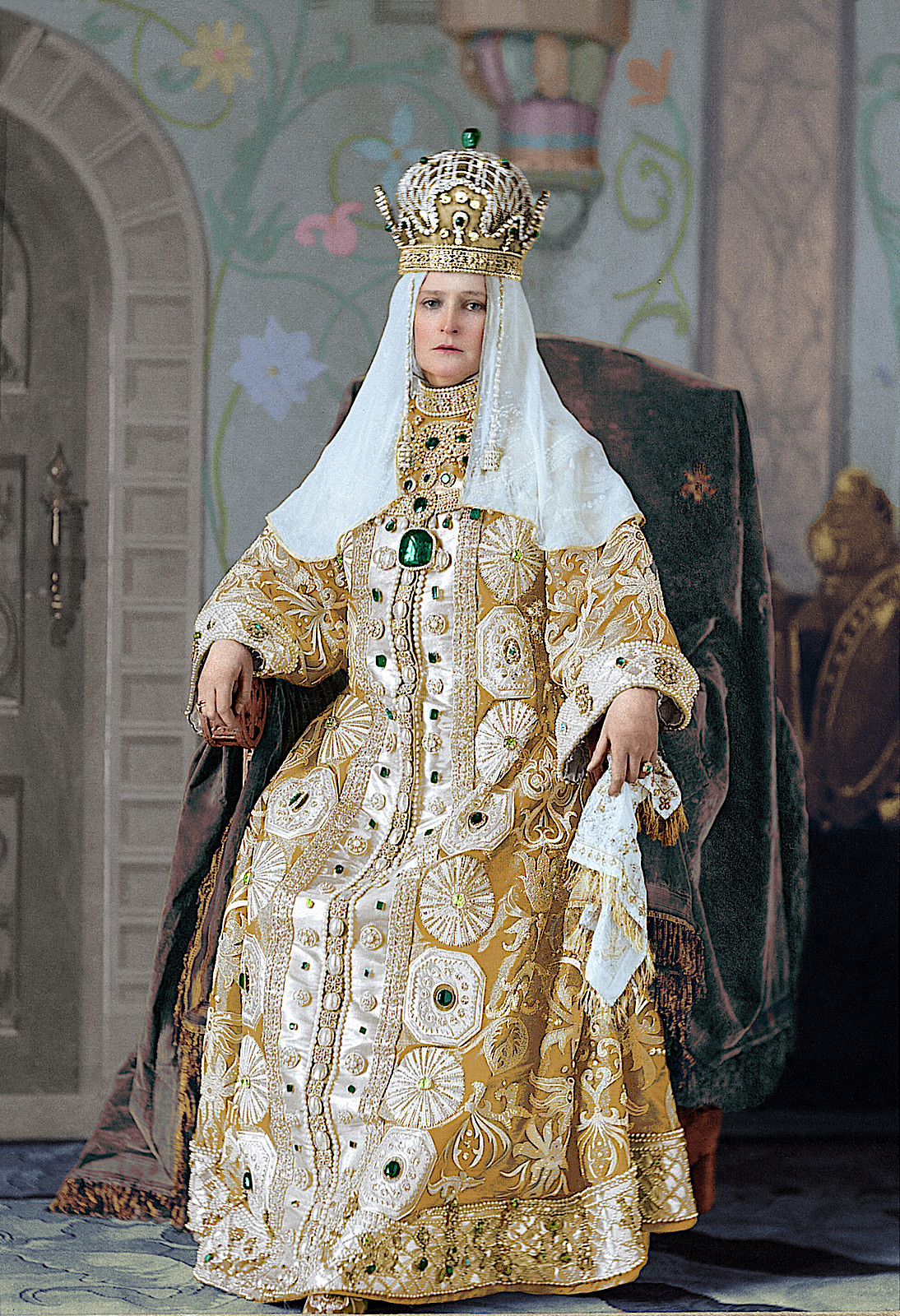
It puts flesh on the pale monochromatic faces, and gives the lavish costuming and furniture texture and dimension. Some of the images almost look like art nouveau illustrations (and resemble those of some of the finest illustrators of Poe’s work) and the work of contemporary painters like Gustav Klimt. Maybe it’s just me, but it seems that unease lingers in the eyes of some subjects—Empress Alexandra Fedorovna among them—a certain vague and troubled apprehension.
In their book A Lifelong Passion, authors Andrei Maylunas and Sergei Mironenko quote the Grand Duke Alexander Mikhailovitch who remembered the event as “the last spectacular ball in the history of the empire.” The Grand Duke also recalled that “a new and hostile Russia glared through the large windows of the palace… while we danced, the workers were striking and the clouds in the Far East were hanging dangerously low.” As Russia Beyond notes, soon after this celebration, “The global economic crisis marked the beginning of the end for the Russian Empire, and the court ceased to hold balls.”
In 1904, the Russo-Japanese War began, a war Russia was to lose the following year. Then the aristocracy’s power was further weakened by the Revolution of 1905, which Lenin would later call the “Great Dress Rehearsal” for the Revolutionary takeover of 1917. While the aristocracy costumed itself in the trappings of past glory, armies amassed to force their reckoning with the 20th century.
Who knows what thoughts went through the mind of the tzar, tzarina, and their heirs during those two days, and the minds of the almost 400 noblemen and women dressed in costumes specially designed by artist Sergey Solomko, who drew from the work of several historians to make accurate 17th-century recreations, while Peter Carl Fabergé chose the jewelry, including, writes the Vintage News, the tzarina’s “pearls topped by a diamond and emerald-studded crown” and an “enormous emerald” on her brocaded dress?
If the Romanovs had any inkling their almost 300-year dynasty was coming to its end and would take all of the Russian aristocracy with it, they were, at least, determined to go out with the highest style; the family with “almost certainly… the most absolutist powers” would spare no expense to live in their past, no matter what the future held for them. See the original, black and white photos, including that last family portrait, at History Daily, and see several more colorized images at the Vintage News.
Note: An earlier version of this post appeared on our site in 2019.
In the neverending quest to elevate themselves above the fray, today’s mixologists — formerly known as bartenders — are putting a modern spin on obscure cocktail recipes, and resurrecting anachronistic spirits like mahia, Chartreuse, Usquebaugh, and absinthe.
It’s got coca in it, known for its psychoactive alkaloid, cocaine.
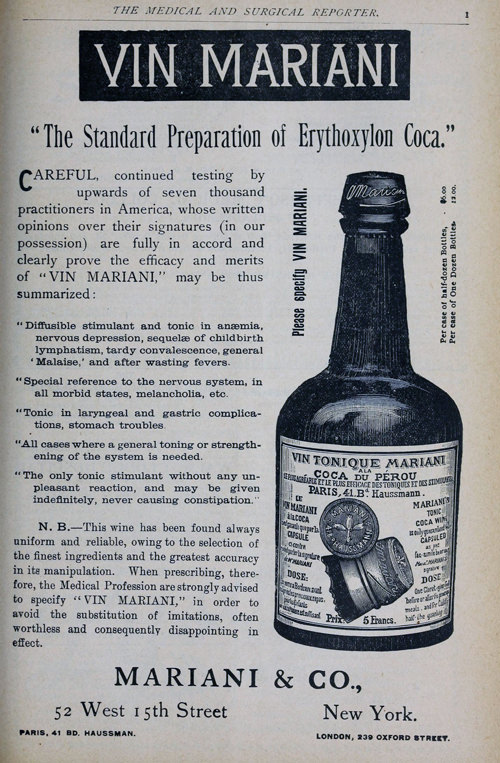
Corsican chemist Angelo Mariani came up with the restorative beverage, formally known as Vin Tonique Mariani à la Coca de Peroum, in 1863, inspired by physician and anthropologist Paolo Mantegazza who served as his own guinea pig after observing native use of coca leaves while on a trip to South America:
I sneered at the poor mortals condemned to live in this valley of tears while I, carried on the wings of two leaves of coca, went flying through the spaces of 77,438 words, each more splendid than the one before…An hour later, I was sufficiently calm to write these words in a steady hand: God is unjust because he made man incapable of sustaining the effect of coca all life long. I would rather have a life span of ten years with coca than one of 10,000,000,000,000,000,000 000 centuries without coca.
Mariani identified an untapped opportunity and added ground coca leaves to Bordeaux, at a ratio of 6 milligrams of coca to one ounce of wine.
Unsurprisingly, the resulting concoction not only took the edge off, it was accorded a number of healthful benefits in an age where general cure-alls were highly prized.
The recommended dosage for adults was two or three glasses a day, before or after meals. For kids, the amount could be divided in two.
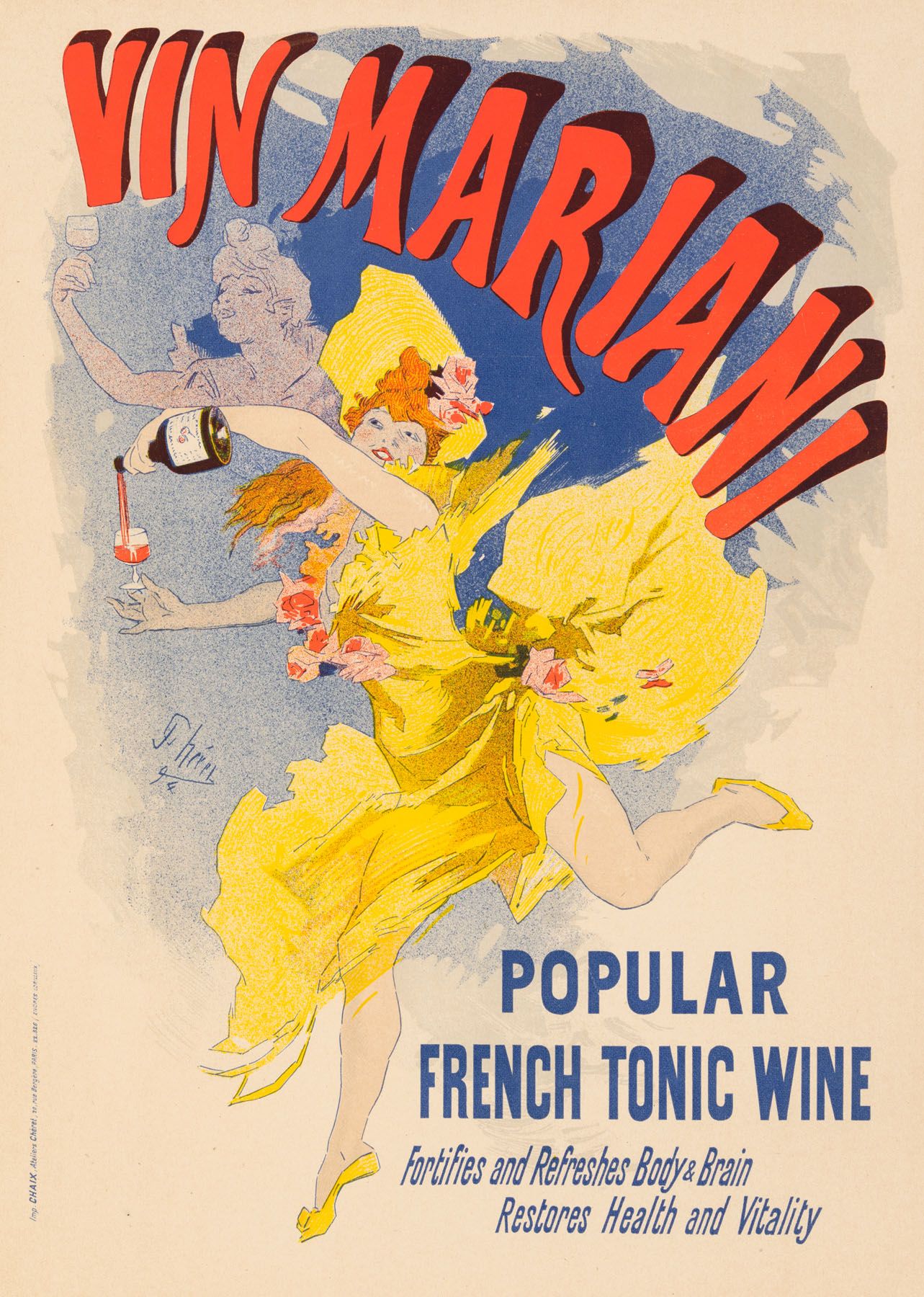
Reigning masters of graphic design were enlisted to promote the miracle elixir.
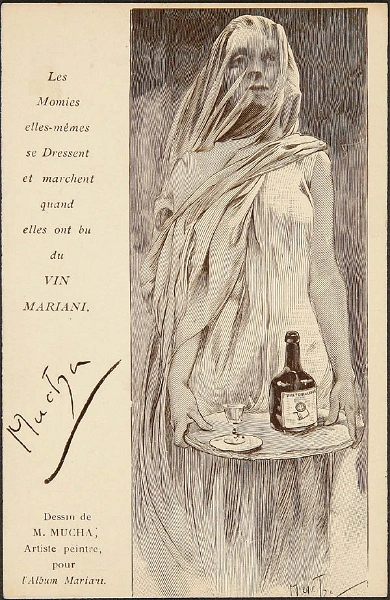
Jules Chéret leaned into its energy boosting effects by depicting a comely young woman clad in skimpy, sheer yellow replenishing her glass mid-leap, while Alphonse Mucha went dark, claiming that “the mummies themselves stand up and walk after drinking Vin Mariani.”
While we’re on the subject of corpse revivers, 21st-century mixologists will please note that a cocktail of Vin Mariani, vermouth and bitters, served with a twist, was a particularly popular preparation, especially across the Atlantic, where Vin Mariani was exported in a more potent version containing 7.2 milligrams of coca.
Angelo Mariani’s innovations were not limited to the chemistry of alcoholic compounds.
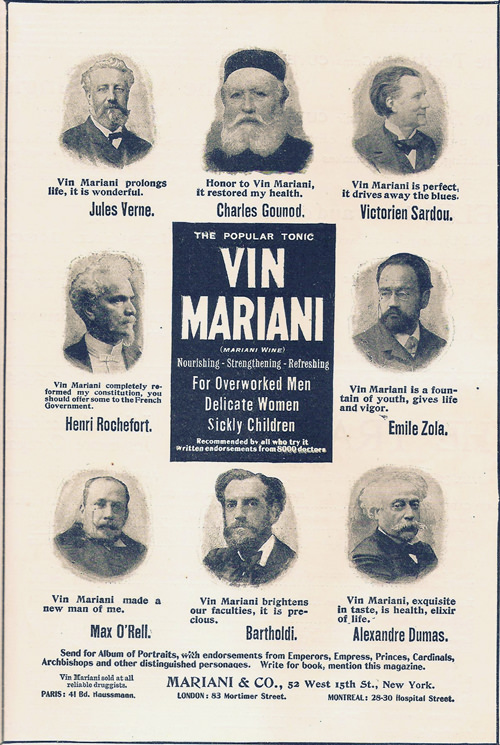
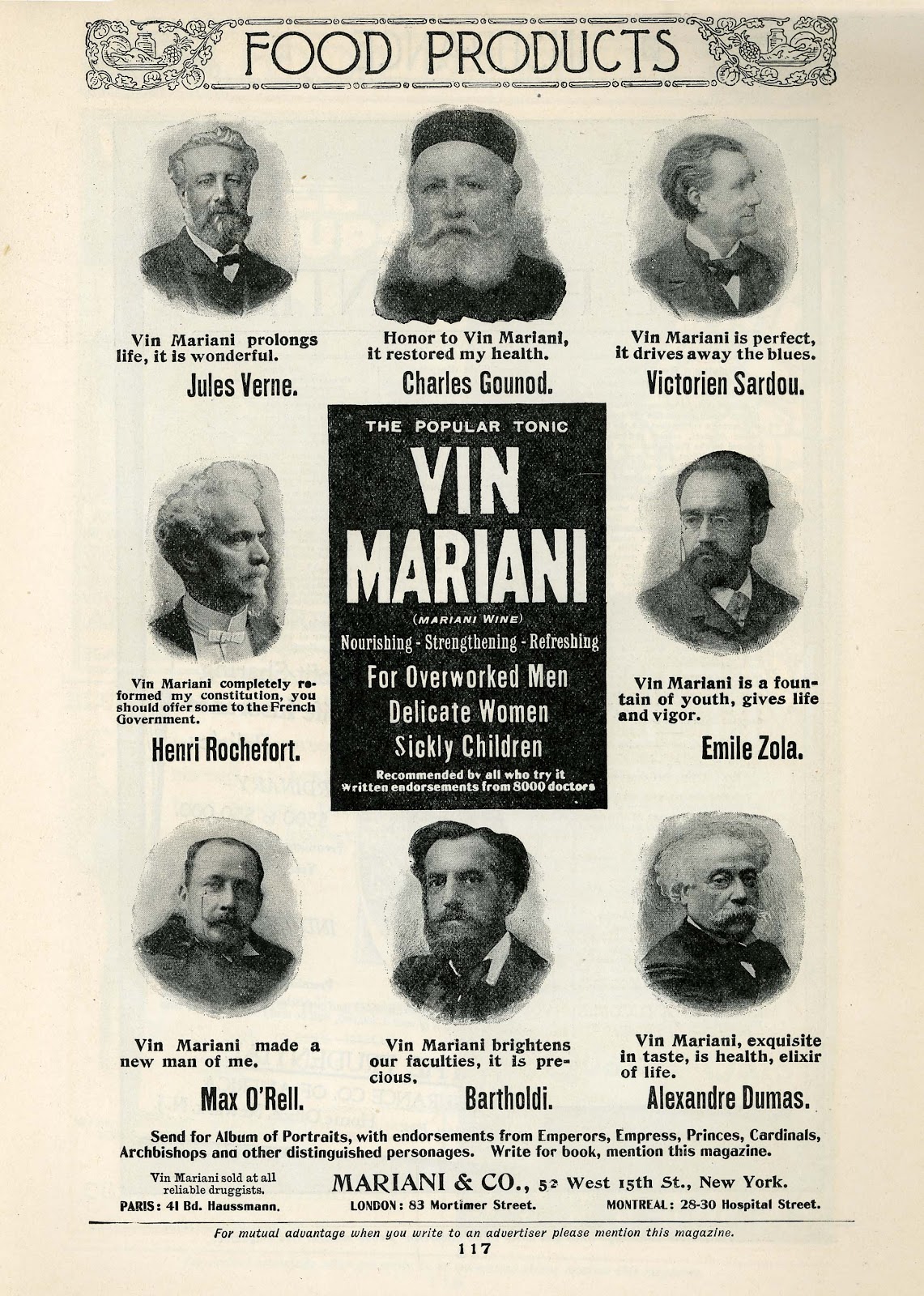
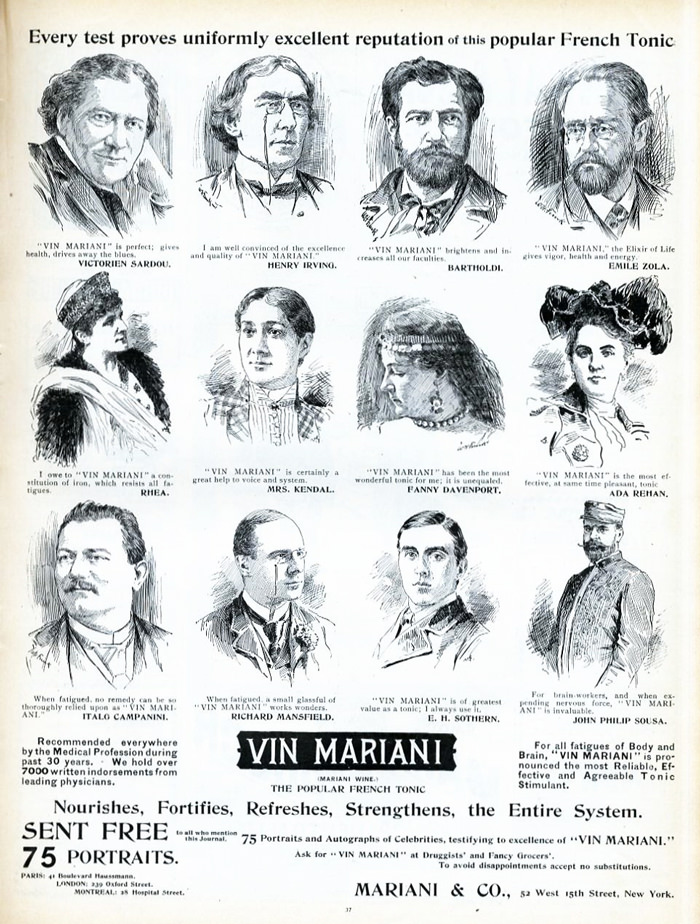
He was also a marketing genius, who curried celebrity favor by sending a complimentary case of Vin Mariani to dozens of famous names, along with a humble request for an endorsement and photo, should the contents prove pleasing.
These accolades were collected and repurposed as advertisements that assured adoring fans and followers of the product’s quality.
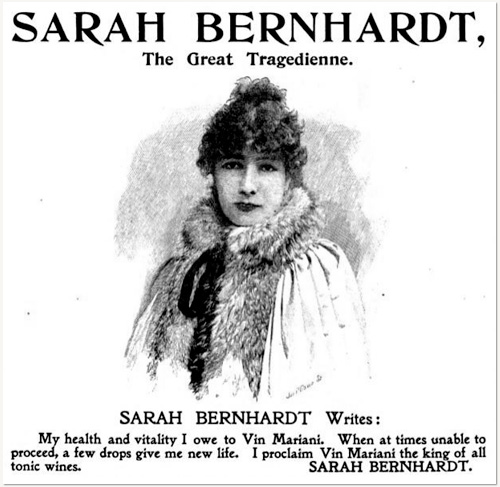
Sarah Bernhardt conferred superstar status on the drink, and not so subtly shored up her own, grandly pronouncing the blend the “King of Tonics, Tonic of Kings:”
I have been delighted to find Vin Mariani in all the large cities of the United States, and it has, as always, largely helped to give me that strength so necessary in the performance of the arduous duties which I have imposed upon myself. I never fail to praise its virtues to all my friends and I heartily congratulate upon the success which you so well deserve.
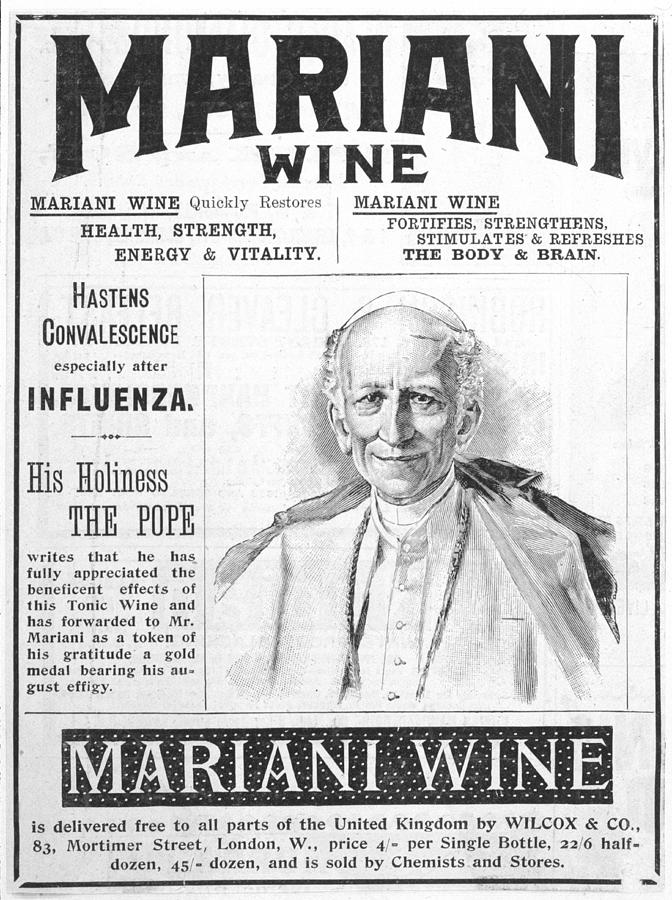
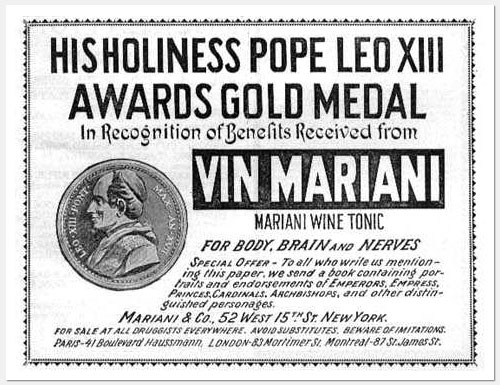
Pope Leo XIII not only carried “a personal hip flask” of the stuff to “fortify himself in those moments when prayer was insufficient,” he invented and awarded a Vatican gold medal to Vin Mariani “in recognition of benefits received.”
Mariani eventually packaged the glowing endorsements he’d been squirreling away as Portraits from Album Mariani. It’s a compendium of famous artists, writers, actors, and musicians of the day, some remembered, mostly not…
When worn out after a long rehearsal or a performance, I find nothing so helpful as a glass of Vin Mariani. To brain workers and those who expend a great deal of nervous force, it is invaluable.
Vin Mariani is the greatest of all tonic stimulants for the voice and system. During my professional career, I have never been without it.
At last! At last! It has been discovered — they hold it, that celebrated microbe so long sought after — the microbe of microbes that kills all other microbes. It is the great, the wonderful, the incomparable microbe of health! It is, it is Vin Mariani!
(We suspect Robida penned his entry after swallowing more than a few glasses… or he was of a mischievous nature and would’ve fit right in with the Surrealists, the Futurists, Fluxus, or any other movement that jabbed at the bourgeoisie with hyperbole and humor.
Mariani used the album to publish the Philadelphia Medical Times’ defense of celebrity endorsements:
The array of notable names is a strong one. Too strong in standing, as well as in numbers, to allow of the charge of interested motives.
Mariani also included an excerpt from the New York Medical Journal, denouncing the unscrupulous manufacturers of “rival preparations of coca” who pirated Vin Mariani’s glowing reviews, “craftily making those records appear to apply to their own preparations.”
Elsewhere in the album, medical authorities tout Vin Mariani’s success in combatting such maladies as headaches, heart strain, brain exhaustion, spasms, la grippe, laryngeal afflictions, influenza, inordinate irritability and worry.
They fail to mention that it could get you much higher than vins ordinaires, defined, for purposes of this post, as “wines lacking in coca.”
The psychoactive properties of coca definitely received a boost from the alcohol, a collision that gave rise to a third chemical compound, cocaethylene, a long-lasting intoxicant that produces intense euphoria, along with a heightened risk of cardiotoxicity and sudden death.
…some dead celebrities could likely tell us a thing or two about it.
Mariani’s fortunes began to turn early in the 20th century, owing to the Pure Food and Drug Act, the growing temperance movement, and increased public awareness of the dangers of cocaine.
The samurai class first took shape in Japan more than 800 years ago, and it captures the imagination still today. Up until at least the seventeenth century, their life and work seems to have been relatively prestigious and well-compensated. By Katsu Kokichi’s day, however, the way of the samurai wasn’t what it used to be. Born in 1802, Katsu lived through the first half of the century in which the samurai as we know it would go extinct, rendered unsupportable by evolving military technology and a changing social order. But reading his autobiography Musui’s Story: The Autobiography of a Tokugawa Samurai, one gets the feeling that he wouldn’t exactly have excelled even in his profession’s heyday.
“From childhood, Katsu was given to mischief,” says the site of the book’s publisher. “He ran away from home, once at thirteen, making his way as a beggar on the great trunk road between Edo and Kyoto, and again at twenty, posing as the emissary of a feudal lord. He eventually married and had children but never obtained official preferment and was forced to supplement a meager stipend by dealing in swords, selling protection to shopkeepers, and generally using his muscle and wits.”
But don’t take it from The University of Arizona Press when you can hear selections of Katsu’s dissolute picaresque of a life retold in his own words — and narrated in English translation — in the animated Voices of the Past video above.
“Unable to distinguish right and wrong, I took my excesses as the behavior of heroes and brave men,” writes a 42-year-old Katsu in a particularly self-flagellating passage. “In everything, I was misguided, and I will never know how much anguish I caused my relatives, parents, wife, and children. Even more reprehensible, I behaved most disloyally to my lord and master the shogun and with uttermost defiance to my superiors. Thus did I finally bring myself to this low estate.” But if was from that inglorious position that Katsu could produce such an entertaining and illuminating set of reflections. He may have been no Miyamoto Musashi, but he left us a more vivid description of everyday life in nineteenth-century Japan than his exalted contemporaries could have managed.
Based in Seoul, Colin Marshall writes and broadcasts on cities, language, and culture. His projects include the Substack newsletterBooks on Cities, the book The Stateless City: a Walk through 21st-Century Los Angeles and the video series The City in Cinema. Follow him on Twitter at @colinmarshall or on Facebook.
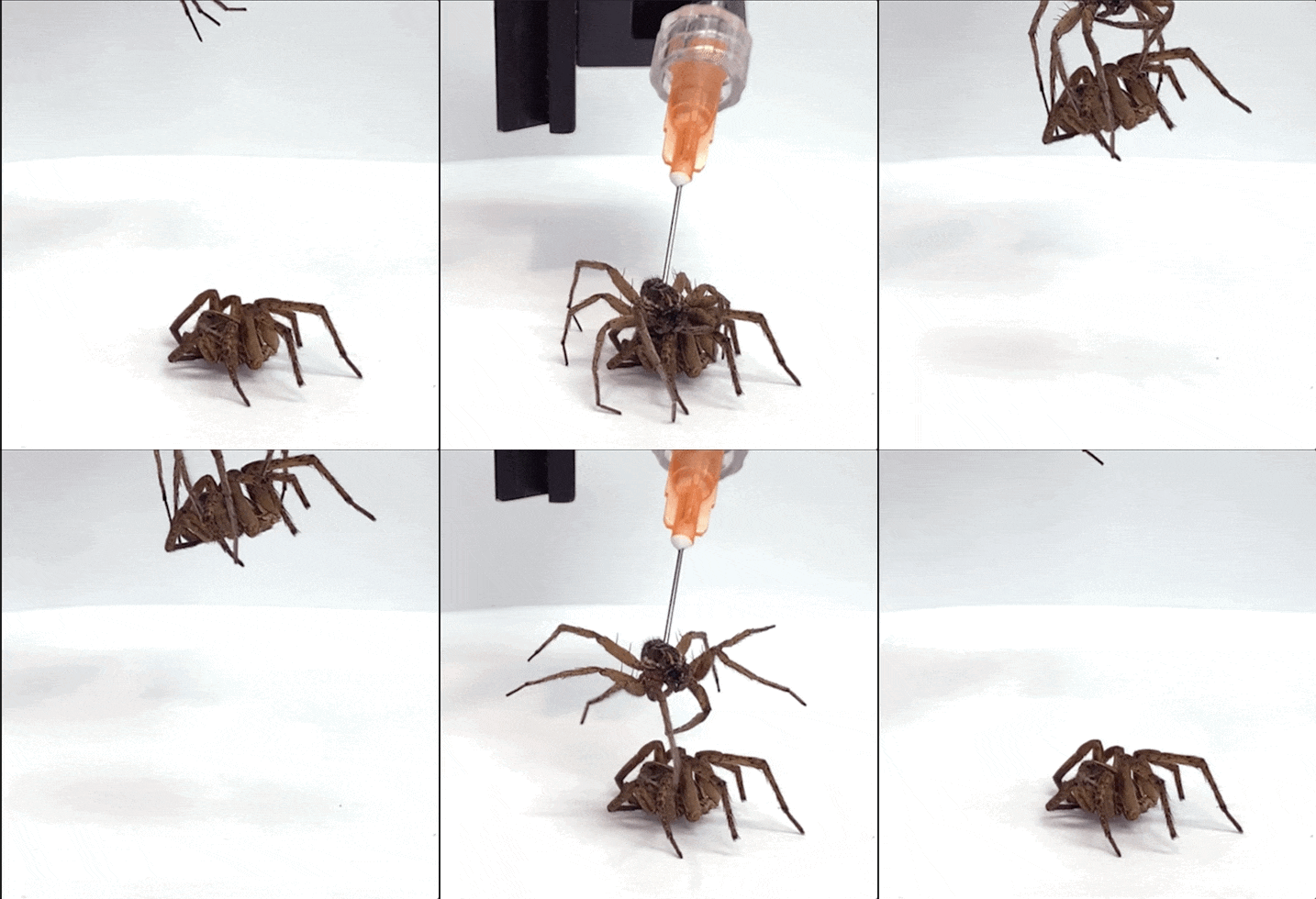
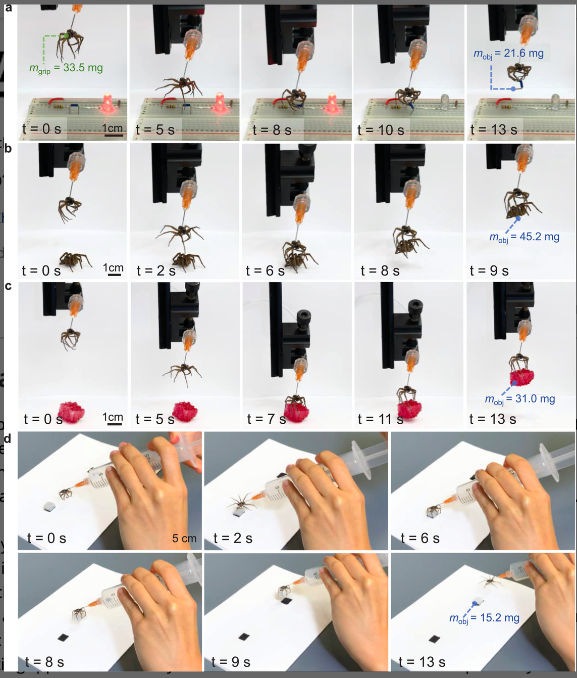
They only have flexor muscles, which allow their legs to curl in, and they extend them outward by hydraulic pressure. When they die, they lose the ability to actively pressurize their bodies. That’s why they curl up.
When a scientifically inclined human inserts a needle into a deceased spider’s hydraulic prosoma chamber, seals it with superglue, and delivers a tiny puff of air from a handheld syringe, all eight legs will straighten like fingers on jazz hands.
These necrobiotic spider gripper tools can lift around 130% of their body weight — smaller spiders are capable of handling more — and each one is good for approximately 1000 grips before degrading.
Preston and Yap envision putting the spiders to work sorting or moving small scale objects, assembling microelectronics, or capturing insects in the wild for further study.
Eventually, they hope to be able to isolate the movements of individual legs, as living spiders can.
Environmentally, these necrobiotic parts have a major advantage in that they’re fully biodegradable. When they’re no longer technologically viable, they can be composted. (Humans can be too, for that matter…)
The idea is as innovative as it is offbeat. As a soft robotics specialist, Preston is always seeking alternatives to hard plastics, metals and electronics:
We use all kinds of interesting new materials like hydrogels and elastomers that can be actuated by things like chemical reactions, pneumatics and light. We even have some recent work on textiles and wearables…The spider falls into this line of inquiry. It’s something that hasn’t been used before but has a lot of potential.”
Conquer any lingering arachnophobia by reading Yap and Preston’s research article, Necrobotics: Biotic Materials as Ready-to-Use Actuators, here.
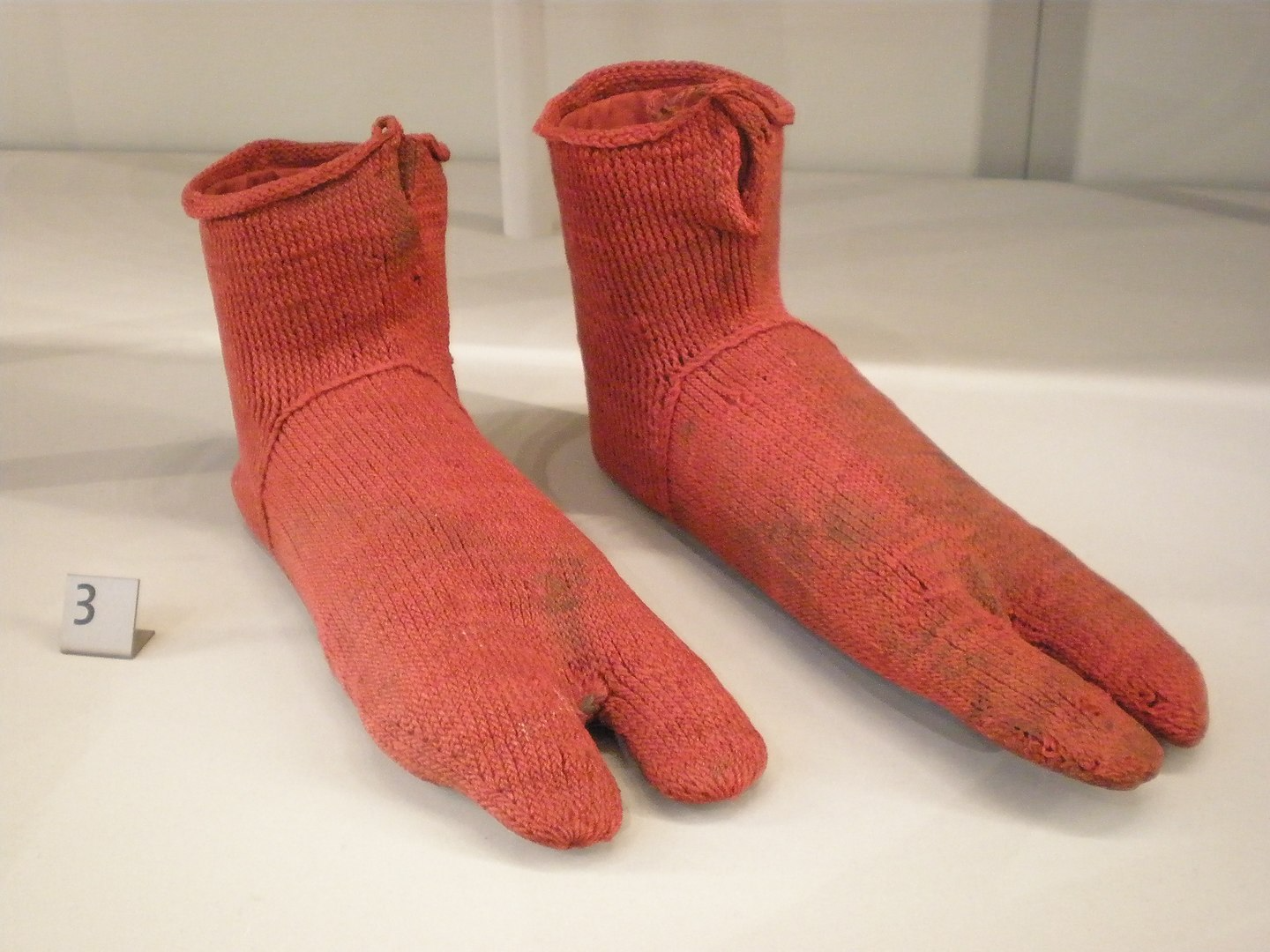
We have, above, a pair of socks. You can tell that much by looking at them, of course, but what’s less obvious at a glance is their age: this pair dates back to 250–420 AD, and were excavated in Egypt at the end of the nineteenth century. That information comes from the site of the Victoria and Albert Museum, where you can learn more about not just these Egyptian socks but the distinctive, now-vanished technique used to make socks in Egypt at the time: “nålbindning, sometimes called knotless netting or single needle knitting — a technique closer to sewing than knitting,” which, as we know it, wouldn’t emerge until the eleventh century in Islamic Egypt. The technique still remains in use today.
Time consuming and skill-intensive, nålbindning produced especially close-fitting garments, and “fit is of particular importance in a cold climate but also for protecting feet clothed in sandals only.” And yes, it seems that socks like these were indeed worn with sandals, a function indicated by their split-toe construction.
A few years ago, we featured archaeological research here on Open Culture pointing to the ancient Romans as the first sock-and-sandal wearers in human history. These particular socks were also made in the time of the Roman Empire, though they were unearthed at its far reaches, from “the burial grounds of ancient Oxyrhynchus, a Greek colony on the Nile.”
As Smithsonian.com’s Emily Spivack writes, “We don’t know for sure whether these socks were for everyday use, worn with a pair of sandals to do the ancient Egyptian equivalent of running errands or heading to work — or if they were used as ceremonial offerings to the dead (they were found by burial grounds, after all).” But the fact that their appearance is so striking to us today, at least sixteen centuries later, reminds us that we aren’t as familiar as we think with the world that produced them. And if, to our modern eyes, they even look a bit goofy — though less goofy than they would if worn properly, along with a pair of sandals — we should remember the painstaking method with which they must have been crafted, as well as the way they constitute a thread, as it were, through the history of western civilization.
Based in Seoul, Colin Marshall writes and broadcasts on cities, language, and culture. His projects include the Substack newsletterBooks on Cities, the book The Stateless City: a Walk through 21st-Century Los Angeles and the video series The City in Cinema. Follow him on Twitter at @colinmarshall or on Facebook.
You may not hear the term mash-up very often these days, but the concept itself isn’t exactly the early-two-thousands fad that it might imply. It seems that, as soon as technology made it possible for enthusiasts to combine ostensibly unrelated pieces of media — the more incongruous, the better — they started doing so: take the synchronization of The Wizard of Oz and Pink Floyd’s The Dark Side of the Moon, known as The Dark Side of the Rainbow. But even back in the seventies, the art of the proto-mash-up wasn’t practiced only by rogue projectionists in altered states of mind, as evidenced by the 1976 20th Century Fox Release All This and World War II, which assembled real and dramatized footage of that epoch-making geopolitical conflict with Beatles covers.
Upon its release, All This and World War II “was received so harshly it was pulled from theaters after two weeks and never spoken of again,” as Keith Phipps writes at The Reveal.
Those who actually seek it out and watch it today will find that it gets off to an even less auspicious start than they might imagine: “A clip of Charlie Chan (Sidney Toler) skeptically receiving the news of Neville Chamberlain’s ‘peace in our time’ declaration in the 1939 film City in Darkness gives way to a cover of ‘Magical Mystery Tour’ by ’70s soft-rock giants Ambrosia. Accompanying the song: footage of swastika banners, German soldiers marching in formation, and a climactic appearance from a smiling Adolf Hitler, by implication the organizer of the ‘mystery tour’ that was World War II.”
The other recording artists of the seventies enlisted to supply new versions of well-known Beatles numbers include the Bee Gees, Elton John, the Who’s Keith Moon, and Peter Gabriel, names that assured the soundtrack album (which you can hear on this Youtube playlist) a much greater success than the film itself, with its fever-dream mixture of newsreels Axis and Allied with 20th Century Fox war-picture clips.
As for what everyone involved was thinking in the first place, Phipps quotes an explanation that soundtrack producer Lou Reizner once provided to UPI: “It would have been easy to take the music of the era and dub it to match the action on screen. But we’d have lost the young audience. We want all age groups to see this picture because we think it makes a statement about the absurdity of war. It is the definitive anti-war film” — or, as Phipps puts it, the definitive “cult film in search of cult.”
Based in Seoul, Colin Marshall writes and broadcasts on cities, language, and culture. His projects include the Substack newsletterBooks on Cities, the book The Stateless City: a Walk through 21st-Century Los Angeles and the video series The City in Cinema. Follow him on Twitter at @colinmarshall or on Facebook.
We're hoping to rely on loyal readers, rather than erratic ads. Please click the Donate button and support Open Culture. You can use Paypal, Venmo, Patreon, even Crypto! We thank you!
Open Culture scours the web for the best educational media. We find the free courses and audio books you need, the language lessons & educational videos you want, and plenty of enlightenment in between.