The Chinese film industry began around the turn of the 20th century, but unfortunately nothing survives of those first two decades–films lost to fire, to age, and just plain lost. Any person wanting to study this history must make do with synopses, photos, and imagination. However, after that? This YouTube playlist curated by the Department of Asian Studies of the University of British Columbia features a dozen notable films and influential classics from two and half decades of Chinese history, some of the most tumultuous years for that nation. China ousted the British, fought off the Japanese, and began a revolution under Mao. The print quality varies here and there, but all are entertaining, from musicals to horror movies to social dramas.
The collection begins with the oldest surviving film in the series, Labourer’s Love, a two-reeler from 1922 directed by Zhang Shichuan. Most of the original Chinese filmmakers were trained by Americans, so early shorts like this tended to be silent comedies filled with visual gags–this one features a carpenter who opens up a fruit stand to woo a woman, and uses his woodworking skills and tools to increase his business.
By the late 20s however, China was already developing its own genres and styles, just as it was developing a modern nationalist pride away from colonial influence. The first martial arts film would be produced in 1928. Other studios opted for folklore tales or family melodramas.
Trained and educated in the United Stated, Sun Yu was one of the major filmmakers of the 1930s (a group of directors known as the Second Generation filmmakers) until the invasion of Japan sent him fleeing Shanghai for the interior. But the films he made for the leftist film studio Lianhua are now classics. Three of his are represented here: 1933’s Daybreak, a tale of a young country couple who get corrupted in the big city; Queen of Sports, a 1934 drama of a plucky track star who has to navigate class stratas as well as competitions; and maybe Sun Yu’s most famous film The Big Road (above), a story of six young men building a road for the Chinese army to battle the Japanese. Yes, it’s wartime propaganda, but Sun Yu was always focused on working men and women. These three films also star Li Lili, considered by some to be the “Chinese Mae West,” and who lived to a ripe age (as did Sun Yu). She has a role in Stanley Kwan’s Center Stage from 1992, his ode to the movie stars of the 1930s.
China’s first horror film is also in this list: 1937’s Song at Midnight, Ma-Xu Weibang’s retelling of Phantom of the Opera (with a bit of Frankenstein thrown in–the Universal Studios influence is very apparent here). It’s also a musical, with karaoke-like subs for you to sing along if you know Cantonese.
Lastly, Fei Mu’s Spring in a Small Town from 1947 is one of the most influential on this list. A sickly man’s friend visits in the aftermath of the Sino-Japanese war, and the wife recognizes him as a lover from long ago. Romantic tensions soon begin to smolder. Wong Kar-Wai’s In the Mood for Love borrowed its repressed, longing mood. And filmmaker Tian Zhuangzhaung remade it in 2002, keeping the original setting. Many Chinese filmmakers and critics consider it one of the best of all time, China’s Casablanca.
Hopefully this dozen will whet your appetite for more Chinese cinema and provide an alternative to watching another binge-worthy but shallow Netflix series.
Ted Mills is a freelance writer on the arts who currently hosts the Notes from the Shed podcast and is the producer of KCRW’s Curious Coast. You can also follow him on Twitter at @tedmills, and/or watch his films here.
Last week, Nick Cave announced “It’s 10.30 Wednesday evening, and if the world wasn’t in lockdown, I’d be onstage in Toulouse, France singing my heart out with The Bad Seeds. But I’m not. I’m doing the next best thing—sitting at home watching Bad Seed TeeVee. Pure non-stop joy!” And you can too. Above, watch a new 24/7 YouTube livestream that will feature, writes NME, “rare and unseen footage from the band’s archives,” including “promo videos, interviews, live footage, outtakes and other exclusive unseen footage from the band’s archives.” Enjoy.
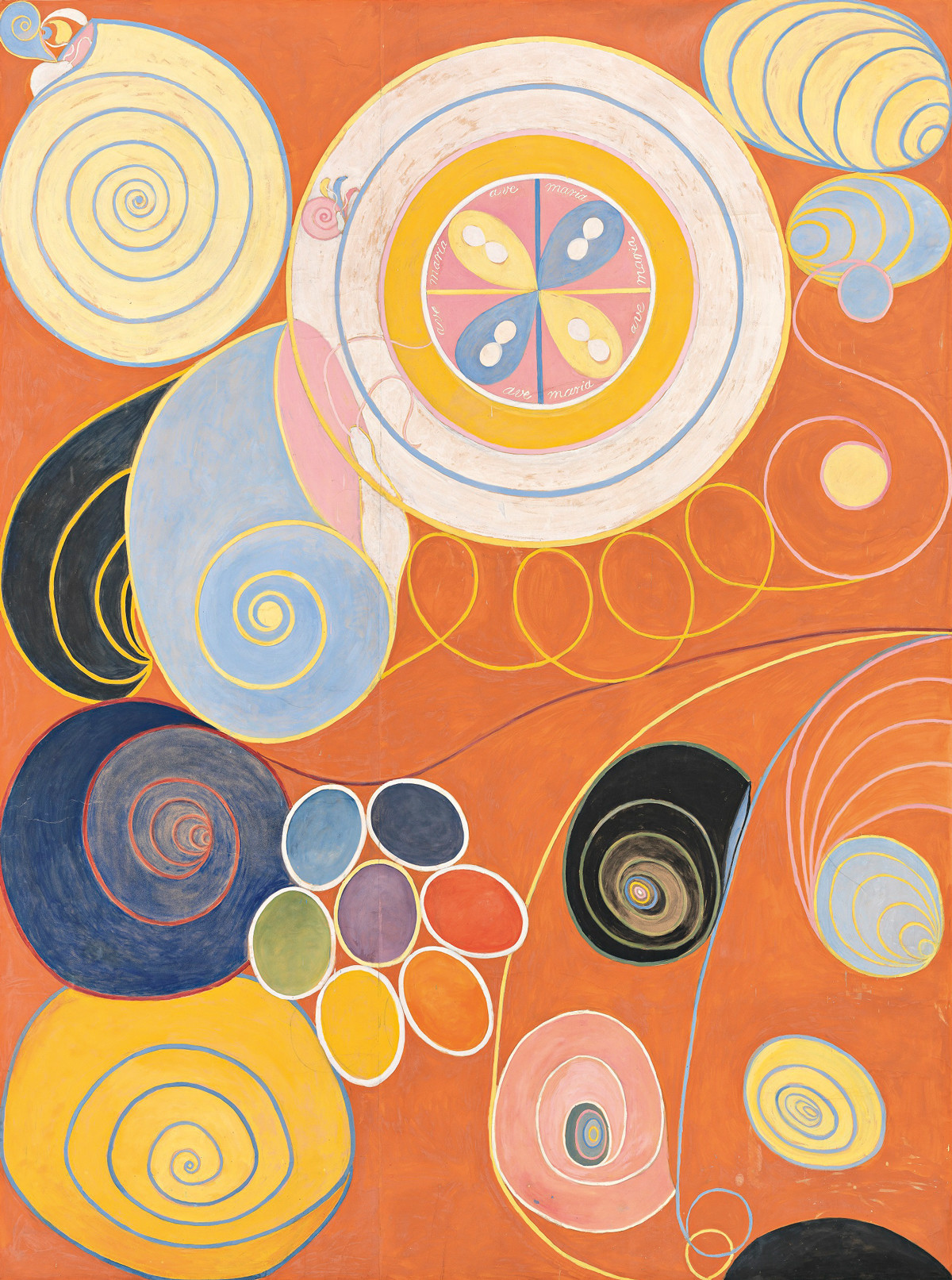
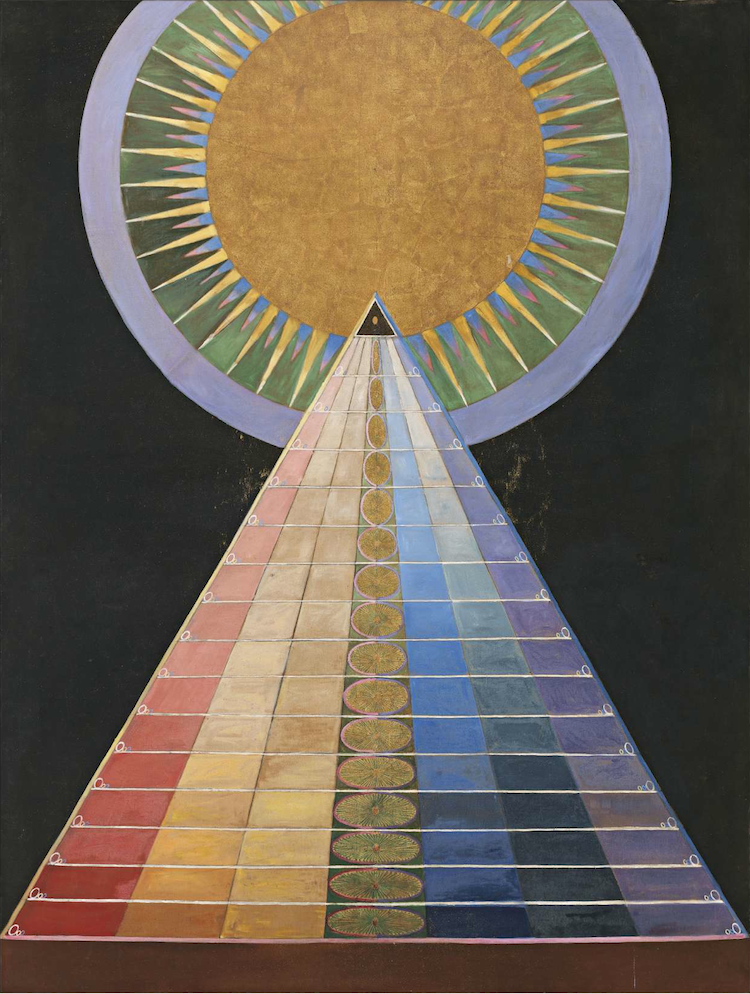
It’s not often an entire chapter of art history textbooks needs rewriting, but as fans of Hilma af Klint see it, one such time has come. A Swedish artist and mystic who lived from the mid-19th to the mid-20th century, af Klint left behind a body of work amounting to more than 1,200 paintings — all of which she insisted not be taken out of storage until 20 years after her death. She suspected the public wouldn’t be ready for them before then, and she was more right than she knew: offered the paintings as a donation in the 1970s, Stockholm’s Moderna Museet turned them down. Only in the following decade did the art history world begin to understand that, far from just a productive amateur painting in obscurity, af Kint might be the very first abstract artist.
Today af Klint’s abstract paintings, the first of which she produced in middle-age in 1906, have appreciators all over the world. Some, we’d like to think, came because of all the times we’ve previouslyfeaturedher here on Open Culture; others were brought in by the Guggenheim’s recent retrospective Hilma af Klint: Paintings for the Future.
These paintings, says the museum’s web site, “were like little that had been seen before: bold, colorful, and untethered from any recognizable references to the physical world. It was years before Vasily Kandinsky, Kazimir Malevich, Piet Mondrian, and others would take similar strides to rid their own artwork of representational content.” This year the story of af Klint and her work is told cinematically in Beyond the Visible, a new documentary by German filmmaker Halina Dyrschka whose trailer appears at the top of the post.
In his review of the film, New York Times critic A.O. Scott briefly recounts af Klint’s early years: “Born in 1862 to an aristocratic Swedish family and raised partly on the grounds of the military academy where her father was an instructor, she trained at the Royal Academy of Fine Arts in Stockholm, mastering the traditional genres of portrait, still life and landscape. By the late 1880s, her notebooks and paintings began incorporating forms that, while they sometimes evoked natural phenomena (like snail shells, flower petals and insect wings), did not resemble anything in the visible world.” This change in the artist’s aesthetic sensibility came along with her growing interest in mysticism and ways of accessing a realm beyond human senses. (She even offered a painting to the Anthroposophical Society founder Rudolf Steiner, who rejected it.)
Scott calls Beyond theVisible “a chapter in the wholesale revision of the critical and historical record that began only recently, and it enlists a passionate and knowledgeable cadre of curators, scholars, scientists and artists to press the argument for af Klint’s importance.” But “the paintings themselves are the best evidence — even through the mediation of a home screen, their vibrancy, wit and formal command is thrilling.” With many movie theaters temporarily shut down by the coronavirus epidemic, you can watch the documentary through Kino Marquee’s “virtual cinema,” a service that streams over the internet but also supports local art houses. Most of us may be no closer to the unseen world into which af Klint yearned to tap than were any of her everyday compatriots. But as far as historical moments in which her work and life can find a fascinated audience, there’s never been a better one.
Based in Seoul, Colin Marshall writes and broadcasts on cities, language, and culture. His projects include the book The Stateless City: a Walk through 21st-Century Los Angeles and the video series The City in Cinema. Follow him on Twitter at @colinmarshall, on Facebook, or on Instagram.
If there were ever a time to rush a pandemic-themed project to market, this is it. The move can seem well-intentioned, generous, or cynical, depending on the artist and the audience. The Rolling Stones proofed themselves against the latter criticism ages ago by building cynicism into their brand. They know what their audience wants, and they consistently deliver, decade after decade, playing the hits. When vague social commentary slips into a Stones tune, it vibrates at the same frequency as their trademark sleaze.
But why would we expect relevance from a band that hasn’t released any new music in eight years? “On their most recent tour,” writes Alexis Petridies at The Guardian, “which began in 2017 and would still be on course were it not for the coronavirus pandemic—the most up-the-minute addition to their setlist was 25 years old.” Who indeed “would have thought that the Rolling Stones would be early to market with a Covid-19-themed song?” They certainly don’t need the money.
In fact, the band wrote and began recording the song in February 2019. “It wasn’t written for now,” Mick Jagger told Zane Lowe in an Apple Music interview. “But it was written about being in a place which was full of life, and then now (is) all bereft of life, so to speak. And when I went back to what I’d written originally lyrically, it was all full of… well, I didn’t use them in the lyrics, it was all full of plague terms and things like that.” Jagger and Richards decided they had to release the song, part of a collection of new material the band was working on. Or as Richards put it in a statement:
So, let’s cut a long story short. We cut this track well over a year ago in L.A. for part of a new album, an ongoing thing, and then s— hit the fan. Mick and I decided this one really needed to go to work right now and so here you have it.
Richards sounds almost apologetic about the rushed version you hear above, which they finished remotely after the lockdowns began, but in his interview with Lowe, he says he’s pleased. “We sort of did it from outer space. But I actually liked the way it turned out.” The track has a tight, bluesy, stripped-down dub groove. Shots of Sir Mick reading lyrics from his iPad, in what is presumably his home studio, add a Zoom meeting-like vibe to the video. “We’ve worked on it in isolation,” Jagger says.
He also admits he rewrote the lyrics, “but didn’t have to rewrite very much, to be honest. It’s very much how I originally did it. I was just jamming. I was just playing a guitar and just wrote it like that. I don’t know what frame of mind I must’ve been in. I mean, it was semi-humorous, then it got less humorous….” I think we’ve all said something like that, many times, over the last few years. The Stones were in the right place and right time to play out the end of the 1960s, when things got decidedly less humorous. But who would have guessed they’d show up over fifty years later to soundtrack our current 21st century tragedy?
While there are obviously much greater tragedies unfolding daily, it’s hard not to empathize with students who have watched countless special events—proms, commencements, spring sports, performances, hotly anticipated rites of passage—go poof.
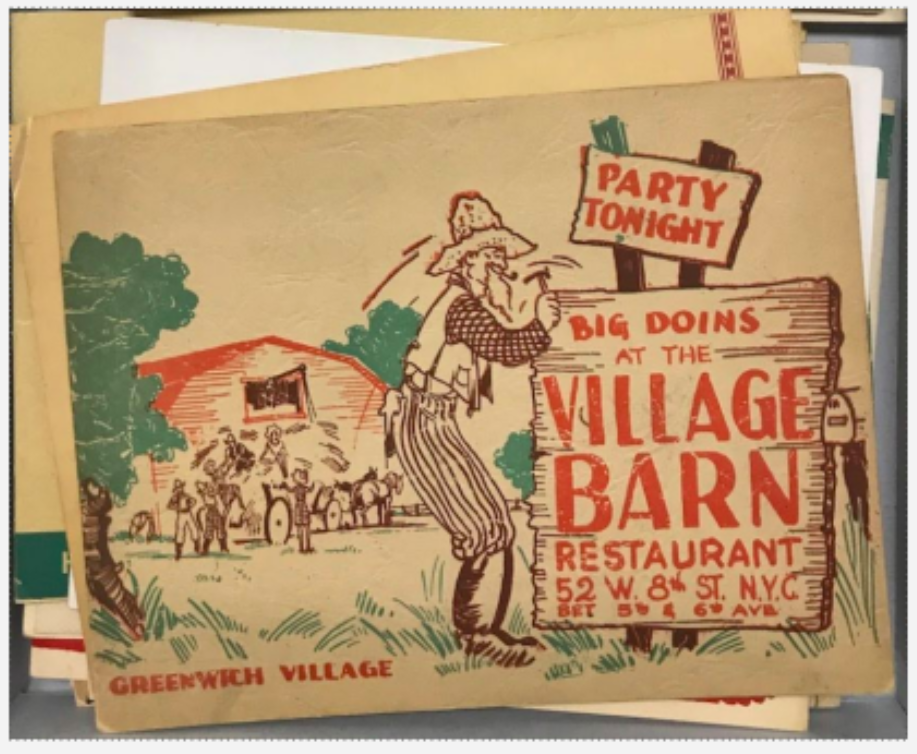
In New York City, students in Parsons School of Design’s Narrative Spaces: Design Tools for Spatial Storytelling course were crestfallen to learn that their upcoming open-to-the-public exhibition of group and solo projects in the West Village—the centerpiece of the class and a huge opportunity to connect with an audience outside of the classroom—was suddenly off the menu.
Multidisciplinary artist Jeff Stark, who co-teaches the class with Pamela Parker, was disappointed on their behalves.
Stark’s own work, from Empire Drive In to Miss Rockaway Armada, is rooted in live experience, and New York City holds a special place in his heart. (He also edits the weekly email list Nonsense NYC, an invaluable resource for independent art and Do-It-Yourself events in the city.)
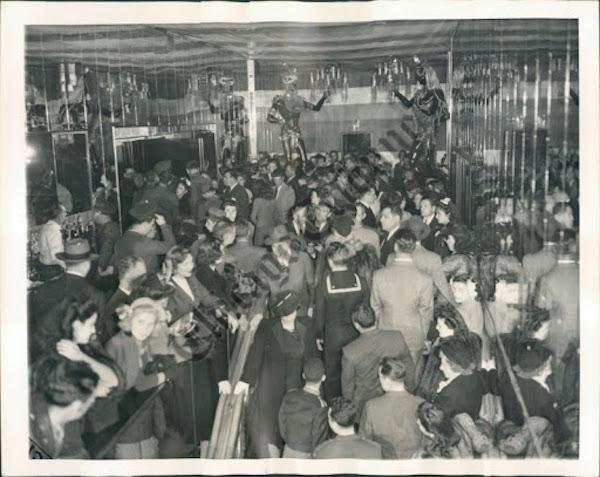
Student Rylie Cooke, an Australian who aspires to launch a design company, found that her research deepened her connection to artifacts she encountered at the Reliquary, as she came to appreciate the fabled Copacabana’s influence on the popular culture, food, and music of the period:
… with COVID-19 it became important to have this connection to the artifacts as I wasn’t able to physically touch or look at them when Parsons moved to online for the semester. I am a very hands-on creative and I love curating things, especially in an exhibit format.
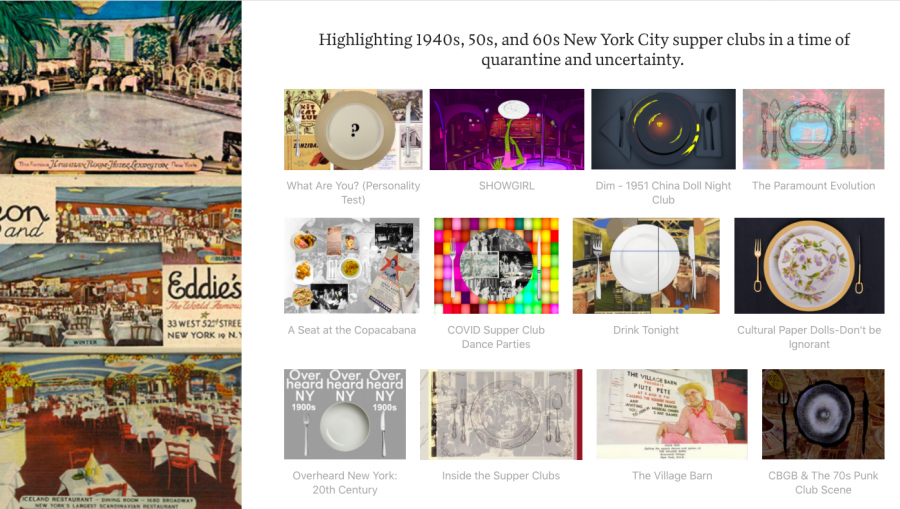
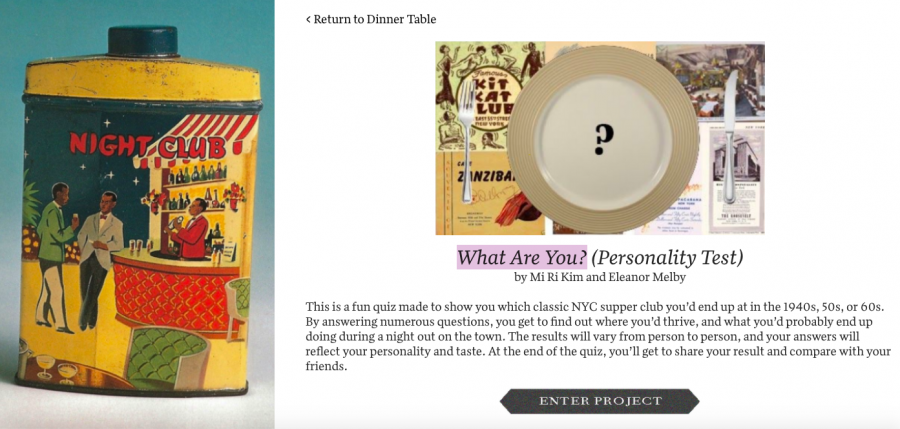
Rather than scrap their goal of public exhibition, the class decided to take things into the virtual realm, hustling to adapt their original concepts to a purely screen-based experience, The New York Supper Club: From Nightlife to Social Distancing.
The plan to wow visitors with a period-appropriate table in the center of their West Village exhibition space became a grid of digital placemats that serve as portals to each project.
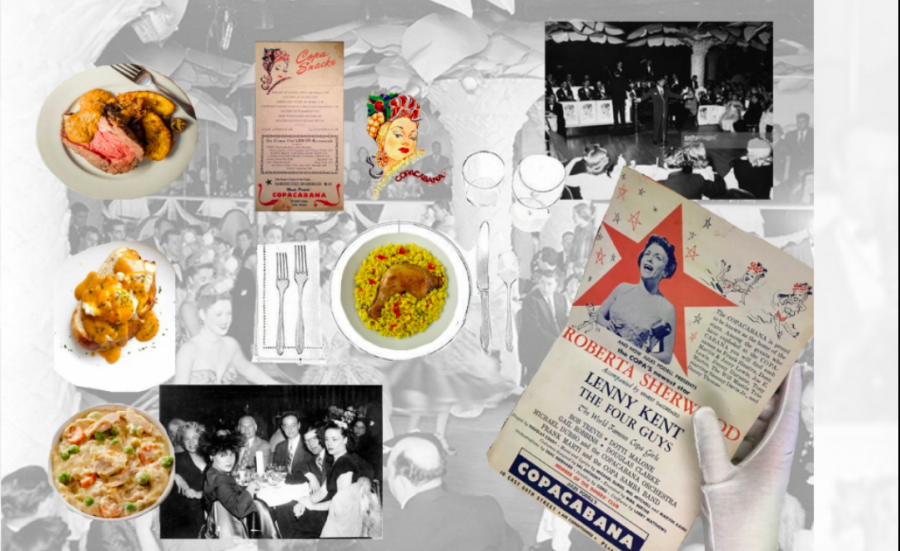
Cooke’s contribution, A Seat at the Copacabana, begins with an interview in which baseball great Mickey Mantle recounts getting into a cloakroom brawl as he and fellow New York Yankees celebrated a birthday with a Sammy Davis Jr. set. Recipes for steak and potatoes, Chicken a la King, rarebit, and arroz con pollo provide flavor for a floorshow represented by archival footage of “Let’s Do the Copacabana” starring Carmen Miranda, a Martin and Lewis appearance, and a dance rehearsal from 1945. The tour ends at the Copa’s current incarnation in Times Square, with a vision of pre-socially distanced contemporary merrymakers salsa-ing the night away.
(Navigate this exhibit using toolbar arrows at the bottom of the screen.)
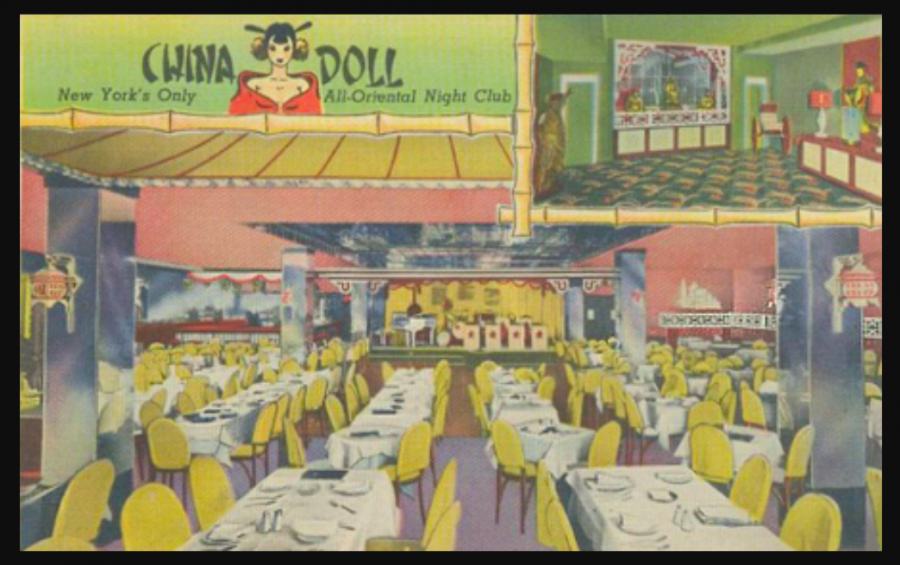
Student Hongxi Chen’s investigations into The China Doll nightclub resulted in an elaborate interactive immersive experience on the topic of cultural appropriation:
The China Doll… was founded in 1946 by Caucasian stage producer Tom Ball, who deemed it the only “all-oriental” night club in New York. While the club sometimes played off “Oriental” stereotypes, and titled one of its shows “Slant-Eyed Scandals,” they featured Asian dancers and Asian singers presenting popular songs in a way New Yorkers had never seen before. The Dim interactive experience unfolds with the story of Thomas, a waiter at the China Doll.
As a junior in Parsons’ Design and Technology program, Chen had plenty of previous experience forging virtual environments, but working with a museum collection was new to him, as was collaborating on a virtual platform.
He sought Stark’s advice on creating vivid dialogue for his fictional waiter.
Chen stayed up until 7 am for two weeks, devouring open source tutorials in an attempt to wrangle and debug the many elements of his ambitious project—audio, video, character models and animation, software, game engines, and game server platform.
As Chen noted at the exhibition’s recent Zoom opening (an event that was followed by a digital dance party), the massive game can be a bit slow to load. Don’t worry, it’s worth the wait, especially as you will have a hand in the story, steering it to one of five different endings.
Chen, an international student, could not safely return to China and has not left his student apartment since mid-March, but gamely states that remaining in the same time zone as his school allowed him to communicate efficiently with his professors and the majority of his classmates. (Cooke is back home in Australia.)
Adds Chen:
Even though we are facing a difficult circumstance under the pandemic and had to pivot our original ideas into a virtual presentation, I’m glad that our class was able to quickly change plans and adapt to the situation. This… actually inspired me a lot and opened up ways to invite and connect people with virtual artwork.
(Apparently, I’m headed to Cafe Zanzibar, below, where the drinks are cheap, the aspirin is free, and Cab Calloway is a frequent headliner.)
Stark admits that initially, his students may not have shared his swooning response to the source material, but they share his love of New York City and the desire to “get in the thick of it.” By bringing a Generation Z perspective to this historical ephemera, they stake a claim, making work that could help the City Reliquary connect to a new audience.
Enter The New York Supper Club: From Nightlife to Social Distancing here.
Explore the City Reliquary online here, and join in the civic pride by participating in its weekly Instagram Live events, including Thursday Collectors’ Nights.
(All images used with permission of the artists and The City Reliquary)
Pink Floyd is helping you get through the coronavirus by streaming free concert films on YouTube. First came Pulse, a 22-song set from the 1994 Division Bell tour. Now comes Pink Floyd: Live at Pompeii, a 1972 concert film featuring the band performing within the ancient Roman amphitheatre at Pompeii. It’s a classic. Watch it above. And learn more about the film in our prior post here.
Note: The film is only streaming free on YouTube for 24 hours. So watch it while you can. Once the film goes dark, you can watch outtakes here.
If you would like to support the mission of Open Culture, consider making a donation to our site. It’s hard to rely 100% on ads, and your contributions will help us continue providing the best free cultural and educational materials to learners everywhere. You can contribute through PayPal, Patreon, and Venmo (@openculture). Thanks!
There are many roads through the coronavirus crisis. One is denial, which only makes things worse. Another is service and self-sacrifice, a choice we honor in the medical professionals putting their lives at risk every day. For most of us, however, the best course of action is non-action—staying home and isolating ourselves from others. Days bleed into weeks, weeks into months. It can seem like life has come to a complete halt. It hasn’t, of course. All sorts of things are happening inside us. We don’t know how long this will last; current courses of action don’t bode well. What do we do with the fear, anger, loneliness, grief, and buzzing, ever-present anxiety?
Maybe the first thing to do is to accept that we have those feelings and feel them, instead of stuffing them down, covering them up, or pushing them onto someone else. Then we can recognize we aren’t by any means alone. That’s easier said than done in quarantine, but psychologists and inspirational writers and speakers like Elizabeth Gilbert have come together under the auspices of the TED Connect series, hosted by the head of TED Chris Anderson, to help.
TED, known for showcasing “thinkers and doers [giving] the talk of their lives in 18 minutes (or less),” has wisely recognized the need to dig much deeper. Anderson and head of curation Helen Walters’ conversation with Gilbert, above, runs a little over an hour.
As for that ceaseless anxiety, Gilbert suggests we should all give ourselves “a measure of mercy and compassion.” We might feel like we need permission to do so in societies that demand we constantly justify our existence. But admitting vulnerability is the beginning of strength. Then we find constructive ways forward. The kind of resilience we can build in isolation is the kind that can outlast a crisis. Still, it is hard won. As Anderson says above, in addition to the external battle we must fight with the virus and our own governments, “there’s this other battle as well, that is probably equally as consequential. It’s a battle that’s going on right inside our minds.”
Rather than killing time waiting fitfully for some acceptable form of normal to return, we can build what psychologist Susan David calls “emotional courage.” In conversation with TED’s Whitney Pennington Rogers, above, David reveals that she herself has good reason to fear: her husband is a physician. She also understands the consequences of a collective denial of suffering and death. “The circumstance that we are in now is not something that we asked for, but life is calling on every single one of us to move into the place of wisdom in ourselves… into the space of wisdom and fortitude, solidarity, community, courage.” We move into that space by recognizing that “life’s beauty is inseparable from its fragility.”
Themes of courage and connection come up again and again in other TED Connects interviews, such as that above with Rabbi Lord Jonathan Sacks and below with author Priya Parker. Elsewhere on the internet, you’ll find similar kinds of advice.
Stoicism has gathered a particularly rich store of wisdom about how to live in crisis. In his own meditation on isolation, Michel de Montaigne drew on the Stoics in advising readers to “reserve a backshop, wholly our own and entirely free, wherein to settle our true liberty, our principle solitude and retreat…. We have a mind pliable in itself, that will be company; that has wherewithal to attack and to defend, to receive and to give: let us not then fear in this solitude to languish under an uncomfortable vacuity.” In other words, the road through isolation, though fraught with painful emotions and uncertainties, can be, if we choose, one of significant personal and collective growth.
For a few months, David Hockney was the most expensive artist in the world, after his masterwork Portrait of an Artist (Pool with Two Figures)sold at auction for $90 million in November 2018. (He was outsold last May by Jeff Koons, who set the previous record in 2013.) The sale says all kinds of things about the state of the art market, but Hockney has always been driven by a need to make things, not to profit, a compulsion as relentless as that of one of his heroes, Vincent van Gogh.
A Portrait of an Artist’s creation, told in the 1974 film A Bigger Splash, is the story of a labor of love. Hockney painted and repainted and repainted, giving up once then starting over again, working with a very van Gogh-like intensity. Otherwise the influence may not be obvious from his most famous, and most expensive, canvas. After his “L.A. swimming pool period,” however, Hockney moved on to other subjects and other media.
In the late 90s, he returned to the Yorkshire of his boyhood when his mother became ill. He took up plein air landscapes painting in oils and watercolors. Hockney describes this transition in a March 2019 interview above from the Van Gogh Museum. In part, he says, he wanted to answer a challenge. “I knew landscape was seen as something you couldn’t do today,” he says. “And I thought, ‘why?’ Because the landscape’s become so boring? It’s not the landscape that’s become boring, it’s the depictions of it that have become boring. You can’t be bored of nature, can you?”
You also cannot become bored of van Gogh. He knew, Hockney says, how to “really look. He saw very clearly. I mean, very, very clearly.” Van Gogh expressed the clarity of his vision in lucid, lyrical prose. Hockney begins the short interview above with a quote from a December 1882 van Gogh letter: “Sometimes I long so much to do landscape, just as one would go for a long walk to refresh oneself, and in all of nature, in trees for instance, I see expression and a soul.” The passage gets a knowing nod from Hockney, who has had much more to say on this theme lately.
Both van Gogh and Hockney describe their experiences with landscape painting as a kind of intensive art therapy. Hockney, now sequestered in Normandy while France is in lockdown, has suggested that others should do the same during this time, as a way of relieving stress and appreciating their place in nature. People should put away their cameras (and, by definition, their phones). “I would suggest people could draw at this time,” he says, “Question everything and do not think about photography. I would suggest they really look hard at something and think about what they are really seeing.”
Hockney has come away from his time painting nature with some particularly intriguing insights. “In a way,” he says above, “nature doesn’t really have perspective. I’ve noticed trees don’t follow the rules of perspective…. Perspective is a strangling, I think. It’s not really making space, it’s strangling space.” It’s an observation we can apply to rigid ways of seeing at reality, none of which seem to make much sense anymore. We won’t all be as visionary or as driven as van Gogh or David Hockney, but time spent learning to “really look” might be time well spent indeed.
Though the coronavirus pandemic has put a stop to many formerly normal activities around the world, it’s hardly put a stop to global communication. In fact, it’s almost certainly intensified global communication, what with all the attention the struggle against COVID-19 commands from 24-hour media professionals — and all the time and energy the rest of us have put into social media as a substitute for socialization. But how would we have communicated amid a pandemic of this kind in an age before the internet? Assuming postal services remained in good working order, we would, of course, have written letters to each other.
We can still write letters to each other in the 21st century, but now we can also read them to each other, wherever in the world we may be. This is the basis for the #ReadALetter campaign, which actor Benedict Cumberbatch introduces in the video at the top of the post. “I really hope this letter finds you in good spirits as we navigate our way through this truly surreal crisis, where upheaval and uncertainty are daily realities,” he says, reading aloud a missive composed at his home and meant for the world at large.
“But so, thankfully, is the totally inspiring self-sacrifice, togetherness, courage, generosity, and camaraderie the people are exhibiting.” It is those honorable qualities, Cumberbatch continues, that “we at Letters Live are looking for a way to celebrate through our favorite medium of the letter.”
You may remember Letters Live, a series of events inspired by Letters of Note, from when we’ve previously featured Cumberbatch’s appearances there interpreting correspondence by the likes of Kurt Vonnegut, Albert Camus, and Alan Turing. The stars of Letters Live have heretofore been historically important letter-writers and the skilled professional performers who read their words. But now, Cumberbatch says, “we want to hear you read letters. They can be letters to the heroes on the front line. They could be letters to relatives in need. They could be letters to strangers who have stepped up and made a difference. They could be letters to neighboring families or streets or towns or countries.” To participate, you need only use a camera phone to record yourself reading a letter aloud, then post that video on Twitter or Instagram and send it to re**@*********ve.com.
What you read on camera (or off it, if you prefer) could be “an important letter you have always wanted to send, or a cherished letter you once received. It could be a favorite letter of yours that offers hope in our current crisis or a prescient warning too important to be ignored.” Here we’ve included the #ReadALetter videos so far contributed by other notables including Margaret Atwood, Stephen Fry, and Griffin Dunne, who reads a letter his father Dominick Dunne wrote when he put himself into isolation for creative purposes in 1980. Other participants from all walks of life include a rabbi, a college student, an emergency department doctor, and even a couple of nonagenarians. If you need more inspiration to #ReadALetter yourself, revisit Cumberbatch’s Letters of Live performance of Sol Lewitt’s 1965 letter to Eva Hesse, the one in which he delivers invaluable words of advice: “Stop It and Just DO.”
Based in Seoul, Colin Marshall writes and broadcasts on cities, language, and culture. His projects include the book The Stateless City: a Walk through 21st-Century Los Angeles and the video series The City in Cinema. Follow him on Twitter at @colinmarshall, on Facebook, or on Instagram.
The state of virtual and augmented reality technology has reached the threshold of a time in which VR meetings will be the norm. Apart from other applications, this may soon allow consumers to stroll through virtual aisles rather than clicking boxes on a screen, picking up products and viewing them from every angle. Still, designers recognize that an essence of the human experience is lost without the sense of touch. There may even be a future in which we wear clothes with haptic feedback systems embedded in them, to feel the pages of a virtual book beneath our fingers…
Yet our slow transition from the physical to the virtual world leaves out intangibles. Something is lost from both. Big box stores still devote significant floor space to books and records, for example. But I submit that a glossiness prevails in print design, perhaps a consequence of competing with screens. There’s a wabi-sabi quality to browsing a used bookstore or record shop in person, thumbing through an old collection of vintage paperbacks and LPs, that cannot be simulated or enhanced in any way. On the internet, however, where video is king, it can be made the subject of some hypnotic video art.
As the sensible majority of us are hopefully staying put for the long haul (if we can), we may find ourselves curiously edified by the video art of Henning M. Lederer. We’ve previously featured Lederer’s animations of mid-century minimalist book covers and vintage psychology and philosophy books. He turns the abstract geometric patterns beloved by book and record company designers of the latter half of the 20th century into moving images that hint at how proper cover design can set the imagination whirring (even if it’s a cover design for Basic Accounting).
If Lederer’s mesmerizing videos simulate anything, it’s the experience of wandering into a used bookstore next to a liberal arts college—full of professors’ fascinatingly outdated hand-me-downs—after having ingested a small quantity of LSD. Maybe you’ll have a slightly different association. But the point is that Lederer’s art suggests a scenario rather than attempting to recreate one. His studies of modernist cover designs also recall Marcel Duchamp’s Rotoreliefs, conceptual art pieces intended for popular use as optical illusions.
Duchamp’s spinning disks became features of early Surrealist cinema, iconic symbols of dreams on film. There is a mysterious opacity to his physical objects onscreen, just as Lederer’s book and record covers seem to have a weight of their own, a use of digital technology to highlight the strange uniqueness of physical objects, rather than their endless reproducibility.
A few years ago we featured the Japanese art of chindōgu, or the invention of amusingly “useless” inventions. The chindōgu canon includes such simultaneously sensible and nonsensical objects as miniature toecap umbrellas (to keep one’s shoes dry in the rain) and chopsticks fitted with miniature fans (to cool down ramen noodles before consumption). Today we present a Japanese invention that may at first glance look chindōgu-like, but would never qualify due to its simplicity and sheer usefulness: an anti-virus face shield that anyone can make in three easy steps. After you’ve downloaded the template, all you need is a printer, paper, scissors, and some kind of clear plastic sheet.
“Healthcare workers around the world are putting their lives on the line to fight COVID-19 but their battle continues to be fought uphill as a shortage of medical supplies threatens to disrupt an already overwhelmed system,” writes Spoon & Tamago’s Johnny Waldman. We’ve all read of the lack of necessities like face masks and ventilators in some of the most afflicted countries, and in such places having access to face shields could make a real difference in the number of lives saved.
“Face shields are typically made with multiple parts and would be difficult to create and assemble at home,” Waldman notes. “But Tokujin Yoshioka’s brilliant idea simplifies the design greatly, allowing it to be held in place with ordinary eyewear.” Best known as an artist and designer, Yoshioka has made his name creating striking sculptures, installations, works of architecture, and many other objects besides.
Yoshioka even designed the torch for the 2020 Summer Olympics in Tokyo, shaped like a Japanese cherry blossom and made with the same aluminum extrusion technology used to manufacture the country’s equally iconic bullet trains. Clearly the coronavirus-caused postponement of the games hasn’t got Yoshioka too down to continue pursuing his calling. “I am grateful to the brave and dedicated healthcare workers for fighting the contagious disease,” he writes in the note accompanying the video at the top of the post that shows you how to make and wear his face shield. As you can see, it’s made to be worn with glasses, so the non-bespectacled will need to stick with other forms of protection against the virus — or take the opportunity to order some fashionable frames of the kind that all the best designers seem to be wearing these days.
Based in Seoul, Colin Marshall writes and broadcasts on cities, language, and culture. His projects include the book The Stateless City: a Walk through 21st-Century Los Angeles and the video series The City in Cinema. Follow him on Twitter at @colinmarshall, on Facebook, or on Instagram.
We're hoping to rely on loyal readers, rather than erratic ads. Please click the Donate button and support Open Culture. You can use Paypal, Venmo, Patreon, even Crypto! We thank you!
Open Culture scours the web for the best educational media. We find the free courses and audio books you need, the language lessons & educational videos you want, and plenty of enlightenment in between.