By the time of these recordings, Zappa’s Halloween shows were “already the stuff of legends,” we learn from the official source, Zappa.com. “While the shows began in the late ‘60s, around 1972, these monumental performances would become annual events, initially in Passaic, NJ and Chicago IL before moving to New York City in 1974, where they’d remain…. From October 28–31, Zappa and his band played six historic shows at the 3,000 capacity Palladium. All the performances were recorded with four being filmed, resulting in Zappa’s mammoth film project, ‘Baby Snakes.’”
The 1979 film failed to find an audience beyond Zappa’s rabidly loyal cult following, or a distributor beyond Zappa himself. Many of the songs Zappa and his band played during the series of concerts appeared that same year on Sheik Yerbouti (say it out loud), an album that made sure to piss people off. The song “Bobby Brown” was banned from the radio in the U.S.; The Anti-Defamation League demanded an apology, which Zappa refused, for the song “Jewish Princess,” which was only performed once, during the ’77 Halloween shows; and the album’s major hit, “Dancin’ Fool,” made audiences dance to a song that made fun of them.
Zappa’s anti-social antics were not bugs but features—he maintained a rabid fanbase no matter what he did because he was a phenomenally talented, irrepressibly creative musician who attracted the best players in the business. The 1977 Halloween show band—including madman drummer Terry Bozzio and King Crimson guitarist Adrian Belew—could not have been in finer form. Zappa’s arrogance may have rubbed non-fans of his music the wrong way, but to those who couldn’t get enough of his virtuoso prog-rock carnival, he had every reason to hold such people in contempt.
Zappa inspired so much devotion among fellow musicians that a number of them have agreed to tour with a hologram of the late guitarist-bandleader, to be produced by Eyellusion, “live music’s premier hologram production company,” explains the official Zappa site. The project has proven, in the words of Belew, who signed on then dropped out of the tour, “caustic and divisive.” It may also, whether you’re a fan of Zappa or not, seem more than a little spooky, and not in the fun trick-or-treat way. Maybe you, or your Zappa fan, would prefer to remember him as he was, in the flesh, sneering and shredding at the Palladium on Halloween night, 1977.
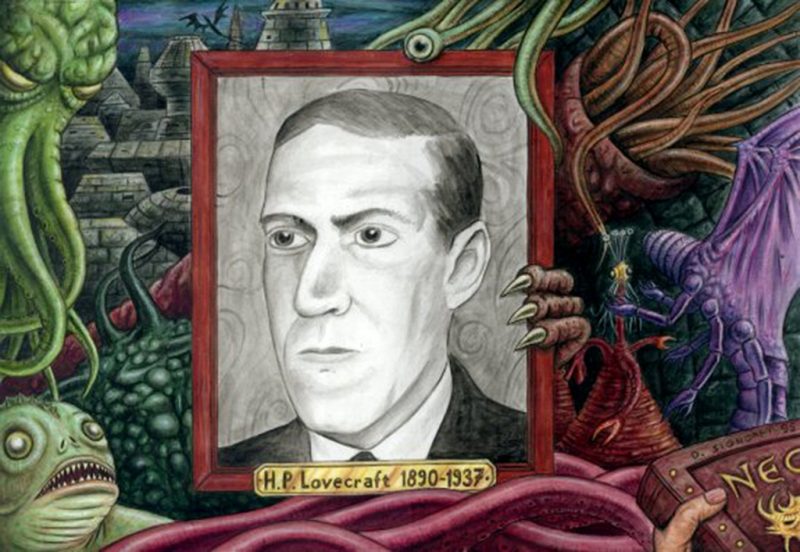
“The most merciful thing in the world, I think, is the inability of the human mind to correlate all its contents. We live on a placid island of ignorance in the midst of black seas of infinity, and it was not meant that we should voyage far.” So writes the narrator of “The Call of Cthulhu,” the best-known story by Howard Phillips Lovecraft, who, before he burnt out and died young, spent his whole literary career looking into that infinity and reporting on the psychological effects of what he sensed lurking there. What better writer to read on Halloween night, when — amid all the partying and the candy — we all permit ourselves a glimpse into the abyss?
Indeed, what better writer to hear on Halloween night? Once it gets dark, consider firing up this fourteen-hour Spotify playlist of H.P. Lovecraft audiobooks, featuring readings of not just “The Call of Cthulhu” but The Shadow over Innsmouth, “The Dunwich Horror,” “The Thing on the Doorstep,” and other stories besides. (If you don’t have Spotify’s free software, you can download it here.)
Though Lovecraft has a much wider readership now than he ever accrued in his lifetime, some of your guests might still never have heard his work and thus struggle to pin it down: is it horror? Is it suspense? Is it the macabre, the sort of thing perfected by Lovecraft’s predecessor in frightening American letters Edgar Allan Poe?
The word they need is “weird,” not in the modern sense of “somewhat unusual,” but in the early 20th-century sense — the sense of Weird Tales, the pulp magazine that published Lovecraft — of a heady blend of the supernatural, the mythical, the scientific, and the mundane. Joyce Carol Oates once wrote that Lovecraft’s stories, seldom sensational, “develop by way of incremental detail, beginning with quite plausible situations — an expedition to Antarctica, a trip to an ancient seaside town, an investigation of an abandoned eighteenth-century house in Providence, Rhode Island, that still stood in Lovecraft’s time. One is drawn into Lovecraft by the very air of plausibility and characteristic understatement of the prose, the question being When will weirdness strike?” An ideal question to ask while floating along the black sea of Halloween night.
Based in Seoul, Colin Marshall writes and broadcasts on cities and culture. His projects include the book The Stateless City: a Walk through 21st-Century Los Angeles and the video series The City in Cinema. Follow him on Twitter at @colinmarshall or on Facebook.
FYI: Illustrators Chris Skinner and Andrew Archer present a new illustrated edition of two Philip K. Dick’s novels, Do Androids Dream of Electric Sheep? & A Scanner Darkly. And it comes in a great format. Read one novel, then flip the book upside down and enter the next altered reality.
If you would like to support the mission of Open Culture, consider making a donation to our site. It’s hard to rely 100% on ads, and your contributions will help us continue providing the best free cultural and educational materials to learners everywhere. You can contribute through PayPal, Patreon, and Venmo (@openculture). Thanks!
“Where would we be without books?” That question, sung over and over again by Sparks in the theme song of the long-running public-radio show Bookworm, gets a troubling answer in The Inksect, the animated film above by Mexican Filmmaker Pablo Calvillo. In the bookless dystopia it envisions, fossil fuels have run out — one premise it shares with many modern works of its subgenre — but the powers that be found a way to delay the inevitable by burning all of humanity’s printed matter for energy instead. “Soon after,” announce the opening titles, “we, the human race, devolved into illiterate cockroaches.”
But among those cockroaches, a few still remembered books, and not only did they remember them, they “knew that their powers could liberate our minds and help us evolve into human beings once again.”
Taking place in a grim, gray, technologically malevolent, and elaborately rendered New York City, the story follows the journey of one such relatively enlightened man-bug’s quest for not just a return to his prior form but to the richer, brighter world contained in and made possible by books. He catches a glimpse of Edgar Allan Poe with the raven of his most famous poem perched atop his head, a sight that might look absurd to us but inspires the protagonist to put pen to paper and write a single word: liberty.
The Inksect’s literary references don’t end with The Raven. Nor do they begin with it: you’ll no doubt have already made the connections between the film’s notions of a book-burning dystopia or men turning into cockroaches and their probable inspirations. Even apart from the many visually striking qualities on its surface, Calvillo’s film illustrates just how deeply works of literature, from Ray Bradbury and Franz Kafka and many other minds besides, lie buried in the foundation of our collective culture. Even a film so expressive of 21st-century anxieties has to understand and incorporate the concerns that humanity has always dealt with — and so often dealt with, in many different areas and many different ways, through books.
Based in Seoul, Colin Marshall writes and broadcasts on cities and culture. His projects include the book The Stateless City: a Walk through 21st-Century Los Angeles and the video series The City in Cinema. Follow him on Twitter at @colinmarshall or on Facebook.
Their ardor is bookended by the enmity of Broadway diehards underwhelmed by the stars’ singing and dancing chops and those who detest musicals on principle.
The above video may not lead the detractors to swallow Chazelle’s Kool-Aid colored vision, but listening to choreographer Mandy Moore’s behind-the-scenes blow-by-blow of the complicated opening number, “Another Day of Sun,” should inspire respect for the massive feat of cinematic coordination below.
This may be the first time in history that a choreographer has singled out the Transport Department for public praise.
Remember how your folks used to freak out about you denting the hood when you capered atop the family Country Squire? Turns out they were right.
One of the Transpo’ crew’s crucial assignments was placing vehicles with specially reinforced hoods and roofs in the spots where dancers had been choreographed to bound on top of them. Getting it wrong early on would have wasted valuable time on a two day shoot that shut down an exit ramp connecting the 110 and 105 freeways.
The real La La Land conjures fantasies of Angelyne clad in head-to-toe pink behind the wheel of her matching pink Corvette, but for this number, the Costume Department collaborated with the Transport Department to diversify the palette.
In other words, the red-gowned flamenco dancer could emerge from a yellow car, and the yellow-shirted krumper could emerge from a red car, but not vice versa.
Mercifully, the art department refrained from a total color-coordination blackout. That moment when a gust of wind catches the skirts of the blonde conductor’s yellow dress plays like an intentional tribute to Marilyn Monroe, when in fact it was a lucky accident made all the more glorious by the sunny drawers she was sporting underneath.
Other day-of accidents required on-the-fly ingenuity, such as enlisting three burly crew members to provide off screen help to a performer struggling with a malfunctioning door to the truck concealing a Latin band within. (With temperatures soaring to 104°, they were hot in more ways than one.)
Moore was also off-camera, hiding under a chassis to cue the skateboarder, who was unfamiliar with the 8‑count the 30 main dancers were trained to respond to.
Other “special skills” performers include a BMX biker, a Parkour traceur, the director’s hula hooping sister, and a stunt woman whose ability to backflip into the narrow channel between two parked cars landed her the part… and kept her injury-free for over 40 takes.
Half of the finished film’s gridlocked celebrants are CGI generated, but the live performers had to remain in synch with the pre-recorded song by Justin Hurwitz, Benj Pasek, and Justin Paul, a particular challenge given the size of the outdoor filming area. Executive music producer Marius de Vries and engineer Nicholai Baxter solved that one by looping the track into each car’s radio, plus a number of hidden speakers and two more on a moving rig.
Moore was determined to keep her carefully plotted moves from feeling too dance‑y—the only time the dancers perform in unison is at the very end, right before they hop back down, reenter their vehicles, and slam their doors shut as one.
For a more naturalistic vision, watch director Chazelle’s iPhone footage of the main dancers rehearsing in a parking lot, prior to the shoot.
Funny how, left to their own devices, these Angelenos seem to wear almost as much black and grey as their counterparts on the east coast….
When we think of political propaganda, we do not typically think of French Neoclassical painter Jacques-Louis David. There’s something debased about the term—it stinks of insincerity, staginess, emotional manipulation, qualities that cannot possibly belong to great art. But let us put aside this prejudice and consider David’s 1787 The Death of Socrates. Created two years before the start of the French Revolution, the painting “gave expression to the principle of resisting unjust authority,” and—like its source, Plato’s Phaedo—it makes a martyr of its hero, who is the soul of reason and a thorn in the side of dogma and tradition.
Nonetheless, as Evan Puschak, the Nerdwriter, shows us in the short video above, The Death of Socrates situates itself firmly within the traditions of European art, drawing heavily on classical sculptures and friezes as well as the greatest works of the Renaissance. There are echoes of da Vinci’s Last Supper in the number of figures and their placement, and a distinct reference of Raphael’s School of Athens in Socrates’ upward-pointing finger, which belongs to Plato in the earlier painting. Here, David has Plato, already an old man, seated at the foot of the bed, the scene arranged behind him as if “exploding from the back of his head.”
Socrates, says Puschak, “has been discussing at length the immortality of the soul, and he doesn’t even seem to care that he’s about to take the implement of his death in hand. On the contrary, Socrates is defiant… David idealizes him… he would have been 70 at the time and somewhat less muscular and beautiful than painted here.” He is a “symbol of strength over passion, of stoic commitment to an abstract ideal,” a theme David articulated with much less subtlety in an earlier painting, The Oath of the Horatii, with its Roman salutes and bundled swords—a “severe, moralistic canvas,” with which the artist “effectively invented the Neoclassical style.”
In The Death of Socrates, David refines his moralistic tendencies, and Puschak ties the composition loosely to a sense of prophecy about the coming Terror after the storming of the Bastille. The Nerdwriter summation of the painting’s angles and influences does help us see it anew. But Puschak’s vague historicizing doesn’t quite do the artist justice, failing to mention David’s direct part in the wave of bloody executions under Robespierre.
David was an active supporter of the Revolution and designed “uniforms, banners, triumphal arches, and inspirational props for the Jacobin Club’s propaganda,” notes a Boston College account. He was also “elected a Deputy form the city of Paris, and voted for the execution of Louis XVI.” Historians have identified over “300 victims for whom David signed execution orders.” The severity of his earlier classical scenes comes into greater focus in The Death of Socrates around the central figure, a great man of history, one whose heroic feats and tragic sacrifices drive the course of all events worth mentioning.
Indeed, we can see David’s work as a visual precursor to philosopher and historian Thomas Carlyle’s theories of “the heroic in history.” (Carlyle also happened to write the 19th century’s definitive history of the French Revolution.) In 1793, David took his visual great man theory and Neoclassical style and applied them for the first time to a contemporary event, the murder of his friendJean-Paul Marat, Swiss Jacobin journalist, by the Girondist Charlotte Corday. (Learn more in the Khan Academy video above.) This is one of three canvases David made of “martyrs of the Revolution”—the other two are lost to history. And it is here that we can see the evolution of his political painting from classical allegory to contemporary propaganda, in a canvas widely hailed, along with The Death of Socrates, as one of the greatest European paintings of the age.
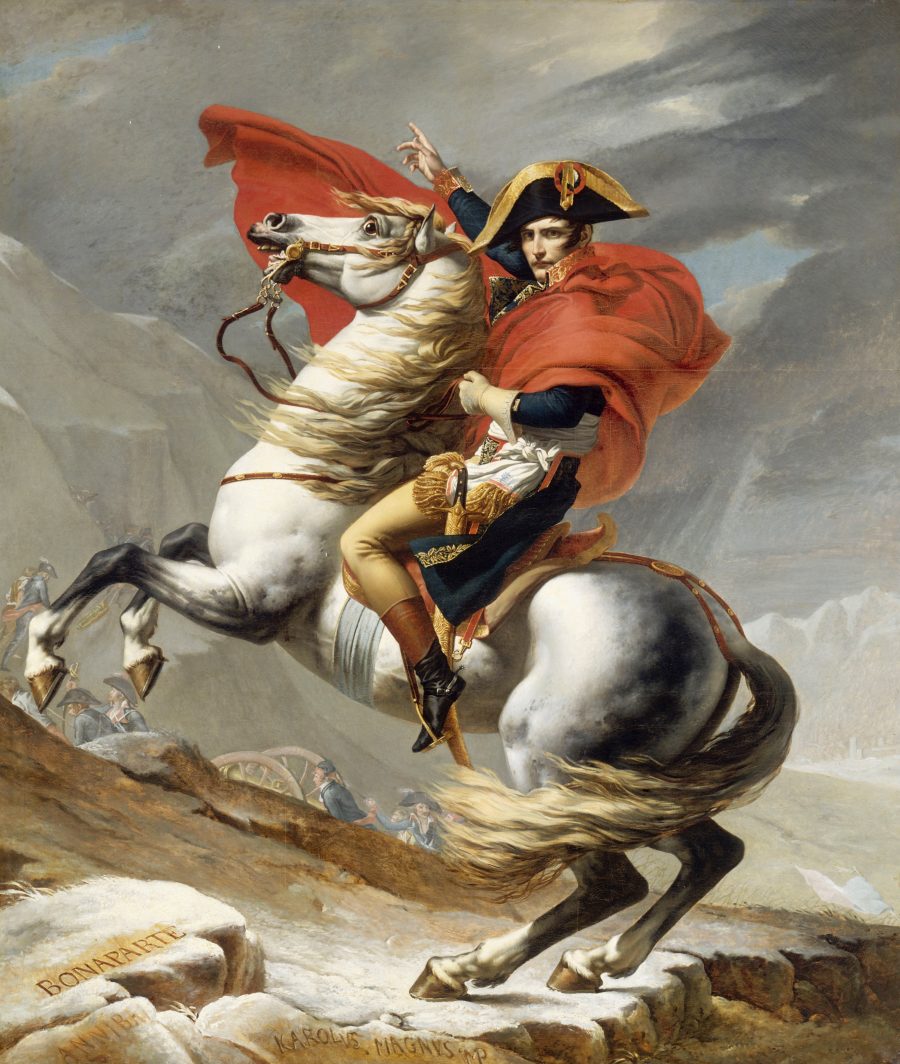
We can look to David for both formal mastery and didactic intent. But we should not look to him for political constancy. He was no John Milton—the poet of the English Revolution who was still devoted to the cause even after the restoration of the monarch. David, on the other hand, “could easily be denounced as a brilliant cynic,” writes Michael Glover at The Independent. Once Napoleon came to power and began his rapid ascension to the self-appointed role of Emperor, David quickly became court painter, and created the two most famous portraits of the ruler.
We’re quite familiar with The Emperor Napoleon in His Study at the Tuileries, in which the subject stands in an awkward pose, his hand thrust into his waistcoat. And surely know Napoleon at the Saint-Bernard Pass, above. Here, the finger pointing upward takes on an entirely new resonance than it has in The Death of Socrates. It is the gesture not of a man nobly prepared to leave the world behind, but of one who plans to conquer and subdue it under his absolute rule.
If there was cause for celebration, it didn’t last that long. Earlier this year, Google followed up with another announcement–that it planned to discontinue development of the Nik Collection, and essentially let it wither on the vine.
Now here’s the latest chapter in the story. A seemingly good one. The image processing company DxO has acquired the Nik Collection from Google. Jérôme Ménière, DxO’s founder and CEO, declared in a press release, “DxO revolutionized the image processing market many times over the years with its innovative solutions, and we will continue to do so with Nik’s tools, which offer new creative opportunities to millions of photographers.” Apparently the Nik Collection gets to live another day.
Also on the DxO website they’ve announced plans for a future iteration of the Nik Collection, saying “The new ‘Nik Collection 2018 Edition’ will be released mid-2018, please leave your email below to be informed when it’s available.” Whether that 2018 edition will stay free remains to be seen.
A fond and appreciative portrait of one of American journalism’s superstars, “Joan Didion: The Center Will Not Hold” may not contain any revelations that will surprise those who’ve followed Didion’s eloquent, often autobiographical writing over the years. But the fact that it was made by her nephew, actor/filmmaker Griffin Dunne, gives it a warmth and intimacy that might not have graced a more standard documentary.
If you would like to support the mission of Open Culture, consider making a donation to our site. It’s hard to rely 100% on ads, and your contributions will help us continue providing the best free cultural and educational materials to learners everywhere. You can contribute through PayPal, Patreon, and Venmo (@openculture). Thanks!
Over the course of this tumultuous year, new CIA director Mike Pompeo has repeatedly indicated that he would move the Agency in a “more aggressive direction.” In response, at least one person took on the guise of former Chilean president Salvador Allende and joked, incredulously, “more aggressive”? In 1973, the reactionary forces of General Augusto Pinochet overthrew Allende, the first elected Marxist leader in Latin America. Pinochet then proceeded to institute a brutal 17-year dictatorship characterized by mass torture, imprisonment, and execution. The Agency may not have orchestrated the coup directly but it did at least support it materially and ideologically under the orders of President Richard Nixon, on a day known to many, post-2001, as “the other 9/11.”
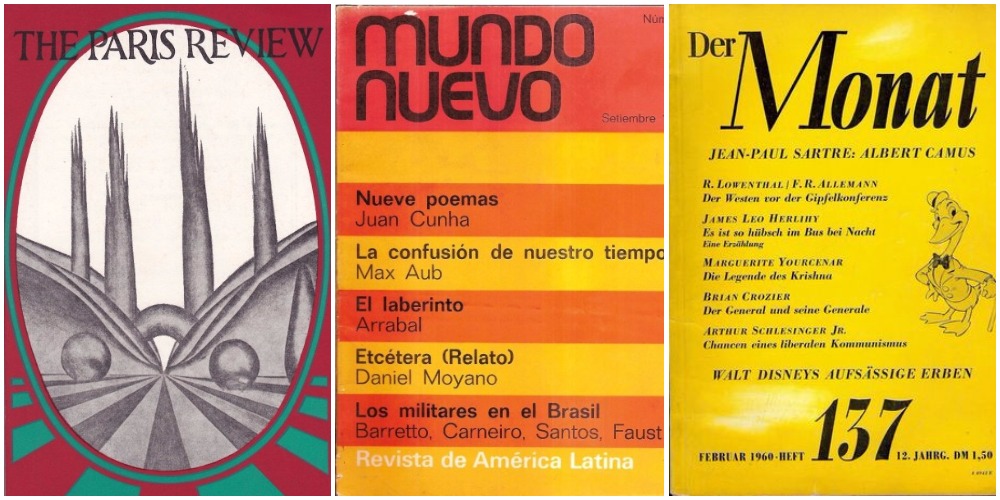
The Chilean coup is one of many CIA interventions into the affairs of Latin America and the former European colonies in Africa and Asia after World War II. It is by now well known that the Agency “occasionally undermined democracies for the sake of fighting communism,” as Mary von Aue writes at Vice, throughout the Cold War years. But years before some of its most aggressive initiatives, the CIA “developed several guises to throw money at young, burgeoning writers, creating a cultural propaganda strategy with literary outposts around the world, from Lebanon to Uganda, India to Latin America.” The Agency didn’t invent the post-war literary movements that first spread through the pages of magazines like The Partisan Reviewand The Paris Reviewin the 1950s. But it funded, organized, and curated them, with the full knowledge of editors like Paris Review co-founder Peter Matthiessen, himself a CIA agent.
The Agency waged a cold culture war against international Communism using many of the people who might seem most sympathetic to it. Revealed in 1967 by former agent Tom Bradenin the pages of the Saturday Evening Post, the strategy involved secretly diverting funds to what the Agency called “civil society” groups. The focal point of the strategy was the CCF, or “Congress for Cultural Freedom,” which recruited liberal and leftist writers and editors, oftentimes unwittingly, to “guarantee that anti-Communist ideas were not voiced only by reactionary speakers,” writes Patrick Iber at The Awl. As Braden contended in his exposé, in “much of Europe in the 1950s, socialists, people who called themselves ‘left’—the very people whom many Americans thought no better than Communists—were about the only people who gave a damn about fighting Communism.”
No doubt some literary scholars would find this claim tendentious, but it became agency doctrine not only because the CIA saw funding and promoting writers like James Baldwin, Gabriel Garcia Márquez, Richard Wright, and Ernest Hemingway as a convenient means to an end, but also because many of the program’s founders were themselves literary scholars. The CIA began as a World War II spy agency called the Office of Strategic Services (OSS). After the war, says Guernica magazine editor Joel Whitney in an interview with Bomb, “some of the OSS guys became professors at Ivy League Universities,” where they recruited people like Matthiessen.
The more liberal guys who were part of the brain trust that formed the CIA saw that the Soviets in Berlin were getting masses of people from other sectors to come over for their symphonies and films. They saw that culture itself was becoming a weapon, and they wanted a kind of Ministry of Culture too. They felt the only way they could get this paid for was through the CIA’s black budget.
McCarthy-ism reigned at the time, and “the less sophisticated reactionaries,” says Whitney, “who represented small states, small towns, and so on, were very suspicious of culture, of the avant-garde, the little intellectual magazines, and of intellectuals themselves.” But Ivy League agents who fancied themselves tastemakers saw things very differently.
Whitney’s book, Finks: How the CIA Tricked the World’s Best Writers, documents the Agency’s whirlwind of activity behind literary magazines like the London-based Encounter, French Preuves, Italian Tempo Presente, Austrian Forum, Australian Quadrant, Japanese Jiyu, and Latin American Cuadernos and Mundo Nuevo. Many of the CCF’s founders and participants conceived of the enterprise as “an altruistic funding of culture,” Whitney tells von Aue. “But it was actually a control of journalism, a control of the fourth estate. It was a control of how intellectuals thought about the US.”
While we often look at post-war literature as a bastion of anti-colonial, anti-establishment sentiment, the pose, we learn from researchers like Iber and Whitney, was often carefully cultivated by a number of intermediaries. Does this mean we can no longer enjoy this literature as the artistic creation of singular geniuses? “You want to know the truth about the writers and publications you love,” says Whitney, “but that shouldn’t mean they’re ruined.” Indeed, the Agency’s cultural operations went far beyond the little magazines. The Congress of Cultural Freedoms used jazz musicians like Louie Armstrong, Dave Brubeck, and Dizzy Gillespie as “goodwill ambassadors” in concerts all over the world, and funded exhibitions of Abstract Expressionists like Mark Rothko, Jackson Pollack, and Willem de Kooning.
The motives behind funding and promoting modern art might mystify us unless we include the context in which such cultural warfare developed. After the Cuban Revolution and subsequent Communist fervor in former European colonies, the Agency found that “soft liners,” as Whitney puts it, had more anti-Communist reach than “hard liners.” Additionally, Communist propagandists could easily point to the U.S.‘s socio-political backwardness and lack of freedom under Jim Crow. So the CIA co-opted anti-racist writers at home, and could silence artists abroad, as it did in the mid-60s when Louis Armstrong went behind the Iron Curtain and refused to criticize the South, despite his previous strong civil rights statements. The post-war world saw thriving free presses and arts and literary cultures filled with bold experimentalism and philosophical and political debate. Knowing who really controlled these conversations offers us an entirely new way to view the directions they inevitably seemed to take.
“The greatest obstacle to living is expectancy, which hangs upon tomorrow and loses today,” wrote Lucius Annaeus Seneca the Younger. “You are arranging what is in Fortune’s control and abandoning what lies in yours.” That still much-quoted observation from the first-century Roman philosopher and statesman, best known simply as Seneca, has a place in a much larger body of work. Seneca’s writings stand, along with those of Zeno, Epictetus, and Marcus Aurelius, as a pillar of Stoic philosophy, a system of thinking which emphasizes the primacy of personal virtue and the importance of observing oneself objectively and mastering, instead of being mastered by, one’s own emotions.
The Stoics found their way of life beneficial indeed in the harsh reality of more than 2,000 years ago, but Stoicism loses none of its value when practiced by those of us living today.
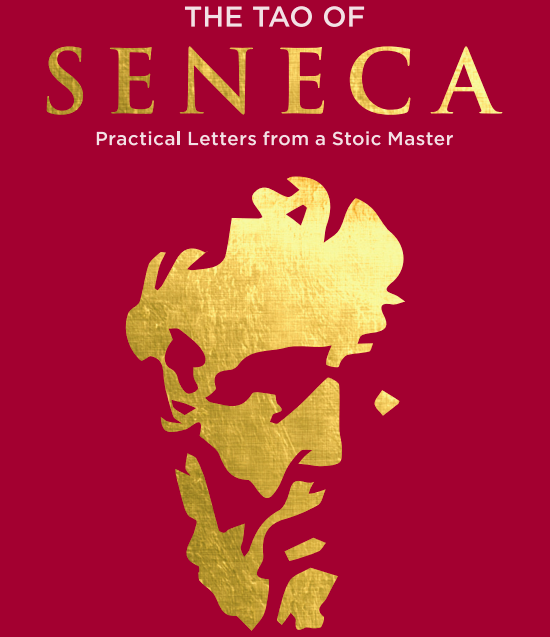
“At its core, it teaches you how to separate what you can control from what you cannot, and it trains you to focus exclusively on the former,” writes self-improvement maven Tim Ferriss in his introduction to The Tao of Seneca, the three-volume collection of Seneca’s letters, illustration and lined modern commentary, that he’s just published free on the internet. (For instructions on how to upload them to your Kindle, see this page.)
Ferris suggests making Seneca “part of your daily routine. Set aside 10–15 minutes a day and read one letter. Whether over coffee in the morning, right before bed, or somewhere in between, digest one letter.” He also adds that “Stoicism has spread like wildfire throughout Silicon Valley and the NFL in the last five years, becoming a mental toughness training system for CEOs, founders, coaches, and players alike,” evidencing a results-oriented approach that may divide Stoicism enthusiasts, many of whom believe that the true Stoic should never consider the product, which will always lie outside one’s realm of control, but only the process. But even the ancients would surely agree that any prompt to action is worth taking, especially when it asks the cost of not a single coin — drachma, denarius, penny, or bit.
Based in Seoul, Colin Marshall writes and broadcasts on cities and culture. His projects include the book The Stateless City: a Walk through 21st-Century Los Angeles and the video series The City in Cinema. Follow him on Twitter at @colinmarshall or on Facebook.
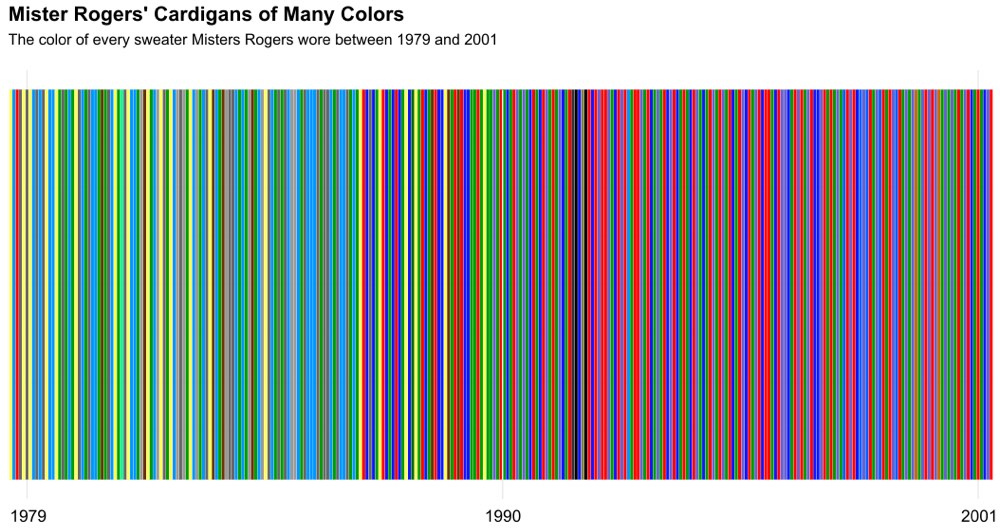
Writer Owen Phillips may be a solid data analyst, but I suspect he’s not much of a knitter.
The software he used to run a scientific analysis of 22 years worth of Fred Rogers’ sweaters ultimately reduces the beloved children’s television host’s homey zip-front cardigans to a slick graphic of colorful bars.
A knitter would no doubt prioritize other types of patterns — stitch numbers, wool weight, cable variations…the sort of information Mister Rogers’ mother, Nancy, would have had at her fingertips.
As Mister Rogers reveals in the story of his sweaters, his mom was the knitter behind many of the on-air sweaters Phillips crunched with R code. Whether their subtly shifting palette reflects an adventurous spirit on the part of the maker or the recipient’s evolving taste is not for us to know.
After Mrs. Rogers’ death, producers had to resort to buying similar models. Many of her originals had worn through or been donated to charity events.
“Not an easy challenge in the 80’s and 90s,” Margy Whitmer, a producer of Mister Rogers’ Neighborhood told Rewire. “It certainly wasn’t in style! But we found a company who made cotton ones that were similar, so we bought a bunch and dyed them.”
(A moment of silent gratitude that no one tried to shoehorn Fred Rogers into a Cosby Show sweater…)
It would be interesting to see what Phillips’ code could do with faulty viewer memories.
His input for the Mister Rogers’ Cardigans of Many Colors project was a chart on super fan Tim Lybarger’s Neighborhood Archive detailing the hue of every sweater Mister Rogers changed into on-camera from 1979 to 2001.
For those who’d rather code than purl, Phillips shares MrRogers.R, the program he used to scrape the Neighborhood Archive for Mister Rogers daily sweater colors.
We're hoping to rely on loyal readers, rather than erratic ads. Please click the Donate button and support Open Culture. You can use Paypal, Venmo, Patreon, even Crypto! We thank you!
Open Culture scours the web for the best educational media. We find the free courses and audio books you need, the language lessons & educational videos you want, and plenty of enlightenment in between.





.jpg)

