Voltaire, the clearest of Enlightenment thinkers wrote those words in his 1765 essay, “Questions sur les miracles.” Andthey resonate as much now, 250 years later, as they did then.
I rarely say much about myself on the site. But I’ll just say today that I did my doctoral work on the French Revolution, spent a couple years living in Paris, and developed a deep affection for the city, as many others have. What happened tonight is heartbreaking, tragic and downright maddening. My thoughts are with all Parisians tonight, friends and strangers alike.
I think we here at Open Culture can freely own up to a deficiency in our content: despite its outsized presence in American culture, we’ve really neglected to post much about NASCAR. Luckily, film director, animator, and Monty Python member Terry Gilliam has given us reason to change our ways by shooting a short film at Alabama’s Talladega Superspeedway, one of the best-known venues for NASCAR races. But The Legend of Hallowdega, made to promote something called AMP Energy Juice, tells not a straight (or rather, constantly left-turning) story about racing, but adds another layer of intrigue: the paranormal.
That might sound like a random conceptual mashup, but a little bit of research reveals Talladega as a regular Overlook Hotel, what with its history of mysterious compulsions, freak injuries and deaths, and unexplained acts of sabotage. (Some even chalk all this up to a curse placed on the Talladega’s valley by its original Native American inhabitants, driven out for their collaboration with Andrew Jackson.) Enter tattooed, Fu-Manchu’d, bead-festooned ghost hunter Kiyash Monsef, here to answer the question, “What is the truth? And what is truer that the truth?” — the words of the khaki-wrapped host of World of the Unexplained, the fictitious, highly sensationalistic, and not especially competent television show that frames The Legend of Hallowdega’s story.
Nothing in the first few minutes of the film gives it away as a Terry Gilliam project, but as soon as it enters Monsef’s elaborate yet makeshift, thoroughly analog lair — located underneath Talladega itself — the famously imaginative director starts making his touch apparent. We could easily dismiss David Arquette’s performance as Monsef as over-the-top, but to many of us, he surely comes off as no more unfamiliar than some of the locals providing their own testimony about the curse in the interview segments. Where has the oft-lamented “old, weird America” gone? In (the American-born but British-naturalized and thus sufficiently distanced) Terry Gilliam’s eyes, it lives on, especially in places like Talladega.
The Harlem Renaissance lives in the form of Alice Barker, a soft spoken lady who just last week received a belated Happy 103rd Birthday card from the Obamas.
That’s her on the right in the first clip, below. She’s in the back right at the 2:07 mark. Perched on a lunch counter stool, showing off her shapely stems at 9:32.
Barker’s newfound celebrity is an unexpected reward for one who was never a marquee name.
She was a member of the chorus—a pretty, talented, hardworking young lady, whose name was misspelled on one of the occasions when she was credited. She danced throughout the 1930s and 40s in legendary Harlem venues like the Apollo, the Cotton Club, and the Zanzibar Club. Shared the stage with Frank Sinatra, Gene Kelly, and Bill “Bojangles” Robinson. Racked up a number of film, commercial and TV credits, getting paid to do something she later confided from a nursing home bed she would have gladly done for free.
Barker’s chorus girl days had been mothballed for decades when she crossed paths with video editor David Shuff, a volunteer visitor to the nursing home where she lives. Shuff seems to be a kindred spirit to the writer David Greenberger, whose Duplex Planet zines—and later books, comics, and performances—captured the stories (and personalities) of the elderly residents of a Boston nursing home where he served as activities director.
Intrigued by glimmers of Barker’s glamorous past, Shuff joined forces with recreational therapist Gail Campbell, to see if they could truffle up any evidence. Barker herself had lost all of the photos and memorabilia that would have backed up her claims.
Eventually, their search led them to historians Alicia Thompson and Mark Cantor, who were able to identify Barker strutting her stuff in a handful of extant 1940s jukebox shorts, aka “soundies.”
Though Barker had caught herself in a couple of commercials, she had never seen any of her soundie performances. A friend of Shuff’s serendipitously decided to record her reaction to her first private screening on Shuff’s iPad. The video went viral as soon as it hit the Internet, and suddenly, Barker was a star.
The loveliest aspect of her late-in-life celebrity is an abundance of old fashioned fan mail, flowers and artwork. She also received a Jimmie Lunceford Legacy Award for excellence in music and music education.
Fame is heady, but seems not to have gone to Barker’s, as evidenced by a remark she made to Shuff a couple of months after she blew up the Internet, “I got jobs because I had great legs, but also, I knew how to wink.”
Shuff maintains a website for fans who want to stay abreast of Alice Barker. You can also write her at the address below:
Alice Barker c/o Brooklyn Gardens 835 Herkimer Street Brooklyn, NY11233
Ayun Halliday is an author, illustrator, and Chief Primatologist of the East Village Inky zine. Her play, Fawnbook, is running through November 20 in New York City. Follow her @AyunHalliday
In My Day, so much of the music we listened to seemed angrier, more raucous and unruly—more aggressive and plainly evil—than music today. Not that I have any hard evidence for these assertions; customarily none is required for an In My Day rant. But I submit to you this: all that musical rage, in my opinion, was a good thing.
And it seems at least in this case, I can substantiate my opinion with science. This past summer, we reported on a study done by researchers at Humboldt State, Ohio State, UC Riverside, and UT Austin showing that kids who listened to heavy metal in the 80s were “significantly happier in their youth and better adjusted currently than either middle-aged or current college-age youth comparison groups.” Despite heated debates in the 80s and 90s over objectionable lyrical content in both popular and alternative music (remember the “Cop Killer” controversy?), researchers concluded that angry rock didn’t turn people into alienated maniacs. Instead, they found, “participation in fringe style cultures may enhance identity development in troubled youth.”
Now, even more recent research into the effects of angry hardcore punk and metal on the psyches of young people seems to confirm these results and further suggest that aggressive music has a paradoxically calming effect. In a study titled “Extreme metal music and anger processing,” University of Queensland psychologists Leah Sharman and Genevieve Dingle describe how they subjected “39 extreme music listeners aged 18–34 years of age” to “anger induction,” during which time, writes Consequence of Sound, “they talked about such irritating things as relationships, money, and work.” Once the test subjects were good and stressed, Sharman and Dingle had them listen either to a “random assignment” of “extreme music from their own playlist” for ten minutes or to ten minutes of silence.
As university publication UQ News summarizes, “In contrast to previous studies linking loud and chaotic music to aggression and delinquency,” this study “showed listeners mostly became inspired and calmed” by their metal. “The music helped them explore the full gamut of emotion they felt,” says Sharman, “but also left them feeling more active and inspired.” The researchers also provide a brief history of what they call “extreme music” and define it in terms of several genres and subgenres:
Following the rise of punk and heavy metal, a range of new genres and subgenres surfaced. Hardcore, death metal, emotional/emotional-hardcore (emo), and screamo appeared throughout the 1980s, gradually becoming more a part of mainstream culture. Each of these genres and their subgenres are socio-politically charged and, as mentioned earlier, are characterized by heavy and powerful sounds with expressive vocals.
“At the forefront of [the] controversy surrounding extreme music,” they write, “is the prominence of aggressive lyrics and titles.” In additional experiments, Sharman and Dingle found that “violent lyrics” did increase “participants’ state hostility,” but the effect was fleeting. Against prevailing assumptions that angry-sounding, aggressive music causes or correlates with depression, violence, self-harm, substance abuse, or suicide, the Queensland researchers found exactly the opposite—that “extreme music” alleviated listeners’ “angst and aggression,” made them happier, calmer, and better able to cope with the anger-inducing stressors that surround us all.
A quick note: Thanks to NPR’s First Listen site, you can now stream for free (but only for a limited time) The Best Of Fare Thee Well: Celebrating 50 Years Of The Grateful Dead. This new double record, featuring 16 tracks recorded during the Dead’s farewell shows in Chicago this summer, will be officially released on November 20th. But you can get a sneak peek right here, right now by clicking the play button on the audio player below.
Tracks includes “Box Of Rain,” “Shakedown Street,” “Truckin’,” “Scarlet Begonias,” “Fire On The Mountain,” “Not Fade Away,” “Touch of Grey” and other fan favorites.
Follow Open Culture on Facebook and Twitter and share intelligent media with your friends. Or better yet, sign up for our daily email and get a daily dose of Open Culture in your inbox. And if you want to make sure that our posts definitely appear in your Facebook newsfeed, just follow these simple steps.
These days, you don’t really hear many people making the case for pessimism. Quite the contrary, positive psychology is now en vogue. And its founder, University of Pennsylvania psychology professor Martin Seligman, has written bestsellers with titles like Learned Optimism: How to Change Your Mind and Your Life. But maybe, as Alain de Botton suggests above, there’s an argument to be made for pessimism– for having a sober, if not negative, outlook on life. And maybe there’s science that validates that point of view.
This second video, created by New York Magazine, summarizes the research of NYU professor Gabriele Oettingen, attributing to her the belief that “pessimism can be a better motivator for achieving goals than optimism,” seeing that optimism tends to lull us into complacency and slacken our desire to achieve important personal goals, like losing weight.
Couple that with this: a 2013 study released in Psychology and Aging, a journal published by the American Psychological Association (APA), concluded that “Older people who have low expectations for a satisfying future may be more likely to live longer, healthier lives than those who see brighter days ahead.” The lead author of the study Frieder R. Lang, PhD, added: “Our findings revealed that being overly optimistic in predicting a better future was associated with a greater risk of disability and death within the following decade.” “Pessimism about the future,” it seems, “may encourage people to live more carefully, taking health and safety precautions” that sunny optimists might not otherwise take.
I should add this caveat: scientists don’t necessarily find virtue in pure, unadulterated pessimism. Rather, they find benefits in what they call “defensive pessimism.” This is a strategy, as summarized by The Wall Street Journal, where people “lower their expectations and think through all the possible negatives that could happen in order to avoid them.” Frieder R. Lang, author of the Psychology & Aging study mentioned above, told WSJ, “Those who are defensively pessimistic about their future may be more likely to invest in preparatory or precautionary measures, whereas we expect that optimists will not be thinking about those things.” Similar virtues might be attributed to “defensive optimism,” but we’ll have to wait and see what the inevitable scientific studies have to say about that.
Follow Open Culture on Facebook and Twitter and share intelligent media with your friends. Or better yet, sign up for our daily email and get a daily dose of Open Culture in your inbox. And if you want to make sure that our posts definitely appear in your Facebook newsfeed, just follow these simple steps.
In an age when The Walking Dead provides a weekly dose of head-exploding gore, it’s easy to forget how shocking the violence of Stanley Kubrick’s A Clockwork Orange (1971) felt to viewers at the time. Anthony Burgess’ novel was about crime and punishment, the differences and/or similarities between street-level thugs and state-sanctioned violence, and the importance of violence in a free society. Kubrick, having blown up the world a decade earlier at the end ofDr. Strangelove, took on all these issues and made them into pure cinema. It elicits a response even now—I have friends who resolutely refuse to watch the film—despite its years spent on the compost pile of post-modern culture.
For an example of how strongly people felt, check this quote from Peter Sellers, being interviewed by Gene Siskel in the Chicago Sun-Times in 1972, five months after the film premiered in the States.
Peter Sellers: I hated A Clockwork Orange. I thought it was the biggest load of crap I’ve ever seen for years. Amoral. I think because of the violence around today it’s lamentable that a director of Stanley Kubrick’s distinction and ability should lend himself to such a subject. I’m not saying that you can’t pick up that book [the Anthony Burgess novel upon which the film is based], read it, and put it down. But to make it as a film, with all the violence we have in the world today – to add to it, to put it on show – I just don’t understand where Stanley is at.
Gene Siskel: Are you saying that it will influence people to commit violence that they would otherwise not commit?
Peter Sellers: I think it adds to it.
Sellers had worked with Kubrick on both Dr. Strangelove and Lolita, so for a star to talk so ill of a former director was quite shocking. He continues in the interview to also denounce the violence in Hitchcock’s Frenzy, which had just been released. When Siskel presses him on the portrayal of violence and its necessity in a world that wanted more truth and realism in its films, Sellers falls back on his recent involvement in yoga:
I must tell you first of all that I’m a yogi. I am against violence completely. Hare ommm. So you now know why. So there’s really no point in asking any more questions about it.
During the original promotion for the film, Kubrick considered criticisms of its violence absurd:
No one is corrupted watching A Clockwork Orange any more than they are by watching Richard III… The film has been accepted as a work of art, and no work of art has ever done social harm, though a great deal of social harm has been done by those who have sought to protect society against works of art which they regarded as dangerous.
Yet as copycat crimes—or crimes that the UK’s press like to suggest were so—increased in the months after its release, Kubrick removed his film from circulation in Britain. Despite Kubrick being behind the decision, it was generally thought that the UK had “banned” the film. It remained so until Kubrick’s death in 1999. Britain finally got to see an uncut version of the film in…you guessed it…2001.
Ted Mills is a freelance writer on the arts who currently hosts the FunkZone Podcast. You can also follow him on Twitter at @tedmills, read his other arts writing at tedmills.com and/or watch his films here.
If you enjoy film in an even slightly serious way, you’ve surely heard the name Andrei Tarkovsky brought up dozens and dozens of times, sometimes — or, if you run in cinephilic circles, invariably — in the context of vertiginously high praise. Film-lovers worship Tarkovsky, as do many other filmmakers: no less an auteur than Ingmar Bergman called him “the best of them all” (after dismissing Godard as “affected” and Hitchcock as “infantile”), “the one who invented a new language, true to the nature of film, as it captures life as a reflection, life as a dream.”
Other artists, too, have paid Tarkovsky tribute: Geoff Dyer devoted an entire book not to the director’s career, but to just one of his movies, Stalker (see its original trailer above). As we told you five years ago, and it deserves repeating again, you can watch Stalker (here) free online, along with other major Tarkovsky films. Stalker alone can give you a powerful sense of just why the seven feature films Tarkovsky left behind when he died in 1986 have only drawn more accolades over time. And it will perhaps whet your appetite to start watching four other Tarkovsky films free online on this page, including his 15th-century Russian icon-painter biopic (to only partially describe it) Andrei Rublev and his Stanislaw Lem adaptation (and “answer to 2001: A Space Odyssey”) Solaris.
You can also watch 1975’s Mirror, which some Tarkovsky enthusiasts consider his greatest work. If you do watch it, bear in mind the Bergman quote above: if the best of all filmmakers won that title by rendering life as a dream, then it only stands to reason that Mirror, the most dreamlike of all his work, would rise to the top of his filmography. It will make you understand why, despite the hundreds and thousands of pages on Tarkovsky’s work written by critics, academics, and pure fans, you can only appreciate these films through direct experience. As with the difficulty of describing a dream compellingly in words, text can’t do justice to Tarkovsky, but when you watch one of his cinematic dreams, you dream it along with him — and like the most vivid dreams, fragments of them will stick with you forever.
Note: The Tarkovsky films listed above were put online by the official Youtube channel of Mosfilm, the studio for which Tarkovsky made the films.
Last year, a Slate essay called “Against YA” by Ruth Graham irked thousands of readers who took offense at her argument that although grown-ups “brandish their copies of teen novels with pride…. [a]dults should feel embarrassed about reading literature written for children.” Whether we label her article an instance of shaming, trolling, or just the expression of a not-especially consequential, “fuddy-duddy opinion,” what it also served to highlight—as so many other thoughtful and not-so-thoughtful online essays have done—is the huge sales numbers of so-called YA, a literary boom that shows no signs of slowing. Young adult fiction, along with children’s books in general, saw double digit growth in 2014, a phenomenon in part driven by those supposedly self-infantilizing adults Graham faults.
The grown-ups reading teen books do so, Graham writes, because “today’s YA, we are constantly reminded, is worldly and adult-worthy.” Maybe, maybe not, but there is another question to ask here as well, wholly apart from whether the age 30–44 cohort who account for 28 percent of YA sales “should” be buying and reading YA books. And that question is: should young adults read Young Adult fiction? And what counts as Young Adult fiction anyway? A 2012 NPR list of the “100 Best-Ever Teen Novels” includes the expected Harry Potter and Hunger Games series (at numbers one and two, respectively), as well as more “literary,” but still obvious, choices like John Green’s The Fault in Our Stars and S.E. Hinton’s classic The Outsiders.
It also includes Douglas Adams’ The Hitchhiker’s Guide to the Galaxy series, William Golding’s Lord of the Flies, Frank Herbert’s Dune, Ursula K. Le Guin’s Earthsea series, and Ray Bradbury’s Fahrenheit 451. It what sense do all of these very different kinds of books—some very complex and challenging, some very much less so—qualify as “teen novels”? Perhaps some of the fuzziness about quality and appropriateness comes from the fact that many “Top-whatever” lists like NPR’s are compiled by readers, of all ages. And enjoyment, not edification, usually tops a general readership’s list of criterion for “top”-ness. However, what would such a list look like if strictly compiled by educators?
You can find out in another top 100 list: the 100 Fiction Books All Children Should Read Before Leaving Secondary School – According to 500 English Teachers (created at the request of Britain’s National Association for the Teaching of English and TES magazine). There’s a good bit of crossover with the reader-chosen NPR list; the Harry Potter books come in at sixth place. Both lists feature classics like Harper Lee’s To Kill a Mockingbird. But the teacher-chosen list also includes more “adult” writers like Jane Austen, Thomas Hardy, and Toni Morrison. One teacher quoted in an Express article describes his own criteria: “It’s always a balancing act in the books that teachers select. Do you go for something that students will enjoy and lap up and read, or do you go for something that will help them cut their teeth?”
There seems to be a good balance of both here. You can see the first ten titles below, with links to free online versions where available. The complete list of 100 books for teenagers is here.
1 Nineteen Eighty-Four, by George Orwell (Amazon)
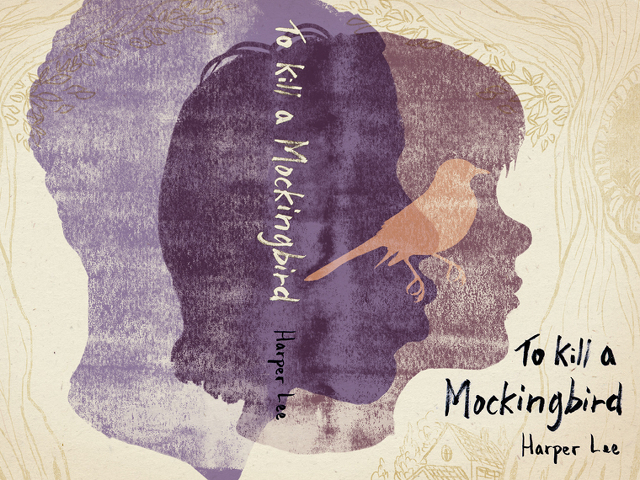
2 To Kill A Mockingbird, by Harper Lee (free eBook)
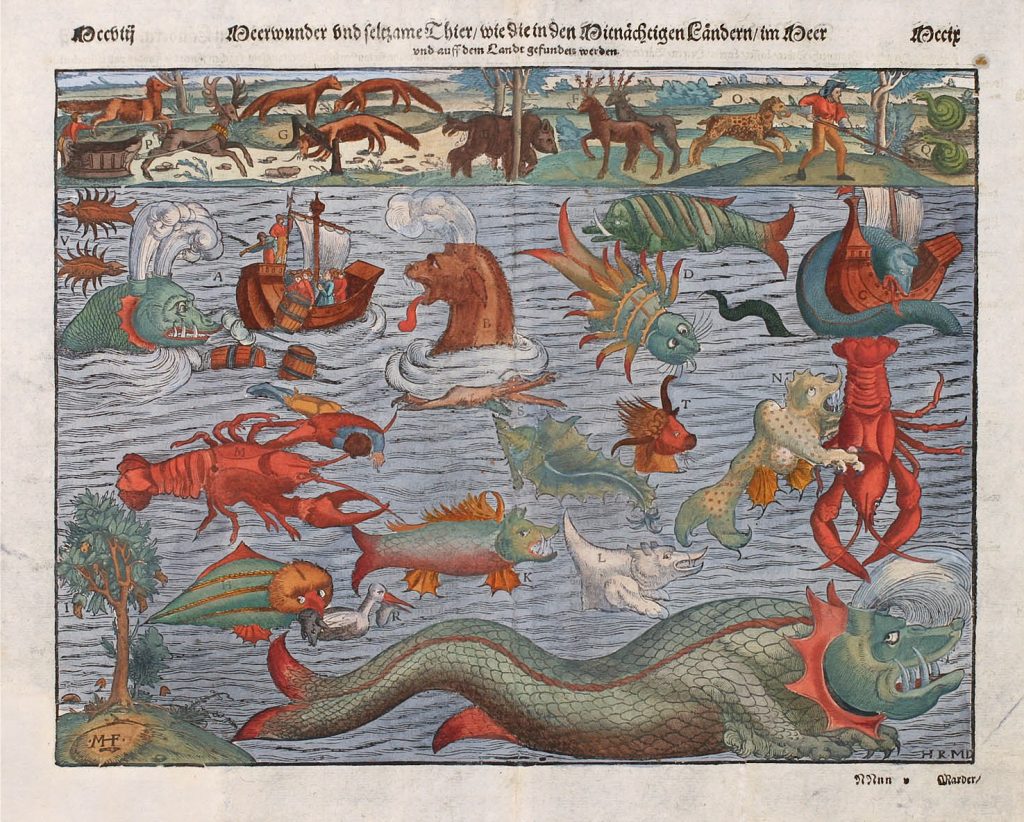
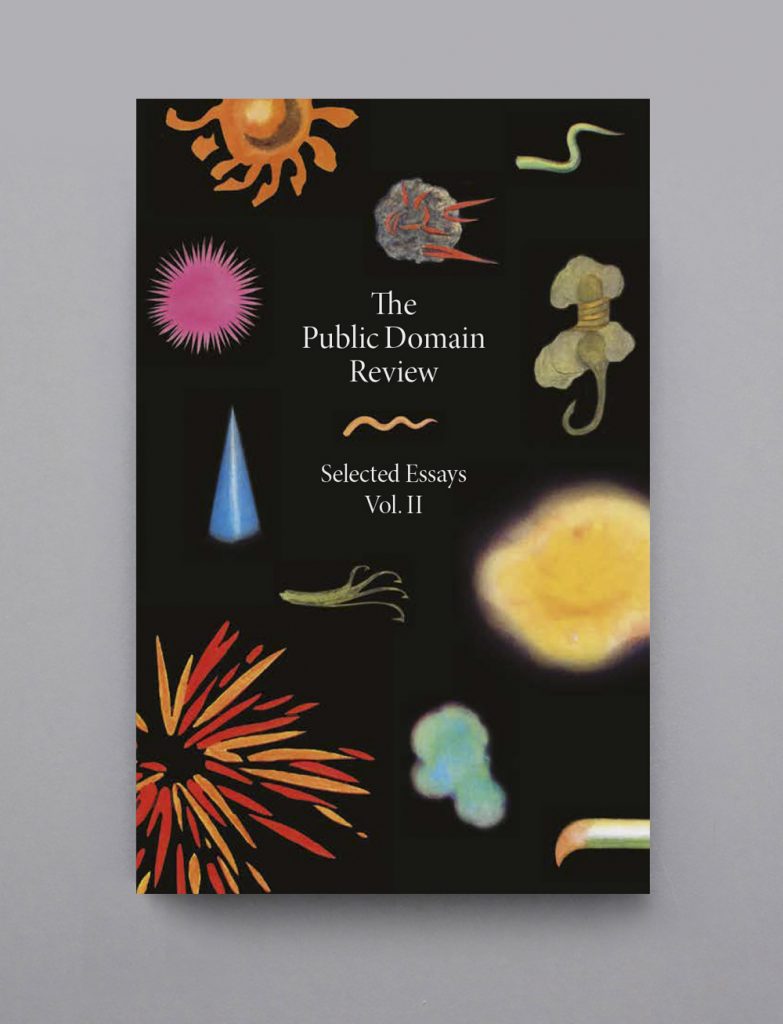
The image above is a version of Sebastian Münster’s 16th-century chart of sea monsters, starring all kinds of fantastical denizens of the deep: from ship-eating serpents and giant lobsters to some kind of seal-octopus hybrid. Featured in the opening essay on the history of sea serpents, the image is one of ninety-nine illustrations to adorn the pages of The Public Domain Review’s wonderful new book of selected essays.
That the collection should begin with this most elusive of snakes is perhaps particularly appropriate. Representing as it does the very idea of terra incognita, the sea serpent is a figure which echoes on in so many of the essays which follow, if we see these “lands unknown” to be not merely geographical but to refer also to the lesser known realms of knowledge. All manner of oft-overlooked histories are explored in the book. We learn of the strange skeletal tableaux of Frederik Ruysch, pay a visit to Humphry Davy high on laughing gas, and peruse the pages of the first ever picture book for children (which includes a wonderful table of Latin animal sounds). There’s also fireworks in art, petty pirates on trial, brainwashing machines, truth-revealing diseases, synesthetic auras, Byronic vampires, and Charles Darwin’s photograph collection of asylum patients. Together the fifteen essays chart a wonderfully curious course through the last five hundred years of history, taking us on a journey through some of the darker, stranger, and altogether more intriguing corners of the past.
You can find out more about the book through The Public Domain Review’s website. If you want it before Christmas (and we think it’d make an excellent present for that history-loving relative!), then make sure to order by midnight on Wednesday 18th November. Orders before this date will also benefit from a special reduced price.
No matter how long I live, the dehumanizing insanity of racism will never fail to astonish and amaze me. Not only does it visit great physical and psychological violence upon its victims, but it leaves those who embrace it unable to feel or reason properly. Contemporary examples abound in excess, but many of the most egregious come from the period in U.S. history when an entire class of people was deemed property, and allowed to be treated any way their owners liked. In such a situation, oddly, many slave masters thought of themselves as humane and benevolent, and thought their slaves well-treated, though they would never have traded places with them for anything.
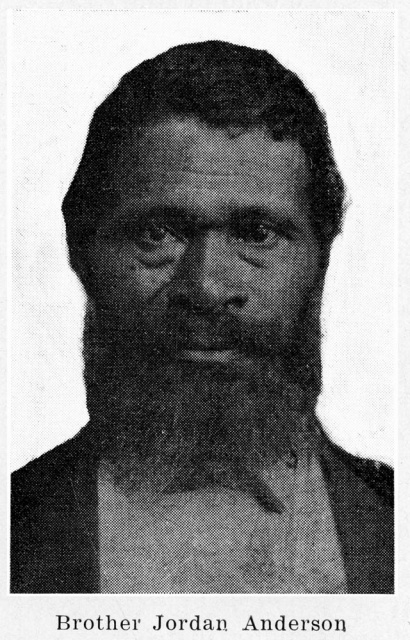
One such example of this bewildering logic comes from a letter written—or dictated, rather—by a man named Jordan Anderson (or sometimes Jourdan Anderson), pictured above: a man enslaved to one Colonel Patrick Henry Anderson in Big Spring, Tennessee. When he was freed from subjection in 1864, Jordan moved to Ohio, found work—was paid for it—and settled down for the next 40 years to raise his children with his wife Amanda. As Allen G. Breed and Hillel Italie write, “he lived quietly and would likely have been forgotten, if not for a remarkable letter to his former master published in a Cincinnati newspaper shortly after the Civil War.”
As did many former slave owners, Colonel Anderson found that he could not keep up his holdings after losing his captive labor force. Desperate to save his property, he had the temerity to write to Jordan and ask him to return and help bring in the harvest. We do not, it seems, have the Colonel’s letter, but we can surmise from Jordan’s response what it contained—promises, as the former slave writes, “to do better for me than anybody else can.” We can also surmise, given Jordan’s sardonic references, that the former master may have shot at him—and that someone named “Henry” intended to shoot him still. We can surmise that the Colonel’s sons may have raped Jordan’s daughters, Matilda and Catherine, given the harrowing description of them “brought to shame by the violence and wickedness of their young masters.”
And, of course, we know for certain that Jordan received no recompense for his many years of hard work: “there was never any pay-day for the negroes,” he writes, “any more than for the horses and cows.” Despite all this—and it is beyond my comprehension why—Colonel Anderson expected that his former slave would return to help prop up the failing plantation. On this score, Jordan proposes a test of the Colonel’s “sincerity.” Tallying up all the wages he and his wife were owed for their combined 52 years of work, less “what you paid for our clothing” and doctor’s visits, he presents his former owner with a bill for “eleven thousand six hundred and eighty dollars” and an address to which he can mail the payment. “If you fail to pay us for faithful labors in the past, we can have little faith in your promises in the future,” he writes. You can read the full letter—which appeared at Letters of Note—below.
Dayton, Ohio,
August 7, 1865
To My Old Master, Colonel P.H. Anderson, Big Spring, Tennessee
Sir: I got your letter, and was glad to find that you had not forgotten Jourdon, and that you wanted me to come back and live with you again, promising to do better for me than anybody else can. I have often felt uneasy about you. I thought the Yankees would have hung you long before this, for harboring Rebs they found at your house. I suppose they never heard about your going to Colonel Martin’s to kill the Union soldier that was left by his company in their stable. Although you shot at me twice before I left you, I did not want to hear of your being hurt, and am glad you are still living. It would do me good to go back to the dear old home again, and see Miss Mary and Miss Martha and Allen, Esther, Green, and Lee. Give my love to them all, and tell them I hope we will meet in the better world, if not in this. I would have gone back to see you all when I was working in the Nashville Hospital, but one of the neighbors told me that Henry intended to shoot me if he ever got a chance.
I want to know particularly what the good chance is you propose to give me. I am doing tolerably well here. I get twenty-five dollars a month, with victuals and clothing; have a comfortable home for Mandy,—the folks call her Mrs. Anderson,—and the children—Milly, Jane, and Grundy—go to school and are learning well. The teacher says Grundy has a head for a preacher. They go to Sunday school, and Mandy and me attend church regularly. We are kindly treated. Sometimes we overhear others saying, “Them colored people were slaves” down in Tennessee. The children feel hurt when they hear such remarks; but I tell them it was no disgrace in Tennessee to belong to Colonel Anderson. Many darkeys would have been proud, as I used to be, to call you master. Now if you will write and say what wages you will give me, I will be better able to decide whether it would be to my advantage to move back again.
As to my freedom, which you say I can have, there is nothing to be gained on that score, as I got my free papers in 1864 from the Provost-Marshal-General of the Department of Nashville. Mandy says she would be afraid to go back without some proof that you were disposed to treat us justly and kindly; and we have concluded to test your sincerity by asking you to send us our wages for the time we served you. This will make us forget and forgive old scores, and rely on your justice and friendship in the future. I served you faithfully for thirty-two years, and Mandy twenty years. At twenty-five dollars a month for me, and two dollars a week for Mandy, our earnings would amount to eleven thousand six hundred and eighty dollars. Add to this the interest for the time our wages have been kept back, and deduct what you paid for our clothing, and three doctor’s visits to me, and pulling a tooth for Mandy, and the balance will show what we are in justice entitled to. Please send the money by Adams’s Express, in care of V. Winters, Esq., Dayton, Ohio. If you fail to pay us for faithful labors in the past, we can have little faith in your promises in the future. We trust the good Maker has opened your eyes to the wrongs which you and your fathers have done to me and my fathers, in making us toil for you for generations without recompense. Here I draw my wages every Saturday night; but in Tennessee there was never any pay-day for the negroes any more than for the horses and cows. Surely there will be a day of reckoning for those who defraud the laborer of his hire.
In answering this letter, please state if there would be any safety for my Milly and Jane, who are now grown up, and both good-looking girls. You know how it was with poor Matilda and Catherine. I would rather stay here and starve—and die, if it come to that—than have my girls brought to shame by the violence and wickedness of their young masters. You will also please state if there has been any schools opened for the colored children in your neighborhood. The great desire of my life now is to give my children an education, and have them form virtuous habits.
Say howdy to George Carter, and thank him for taking the pistol from you when you were shooting at me.
From your old servant,
Jourdon Anderson.
Several historians have researched the authenticity of Jordan’s dictated letter and the historical details of his life in Tennessee and Ohio. As Kottke reported, a man named David Galbraith found information about Jordan’s life after the letter’s publication, including references to him and his wife and family in the 1900 Ohio census. Kottke provides many additional details about Jordan’s post-slavery life and that of his many children and grandchildren, and the Daily Mail has photographs of the former Anderson plantation and Jordan Anderson’s modern-day descendants. They also quote historian Raymond Winbush, who tracked down some of the Colonel’s descendants still living in Big Spring.
Colonel Anderson, it seems, was forced to sell the land after his plea to Jordan failed, and he died not long after at age 44. (Jordan Anderson died in 1907 at age 81.) “What’s amazing,” says Winbush, “is that the current living relatives of Colonel Anderson are still angry at Jordan for not coming back.” Yet another example of how the ignominy of the past, no matter how much we’d prefer to forget it, never seems very far behind us at all.
We're hoping to rely on loyal readers, rather than erratic ads. Please click the Donate button and support Open Culture. You can use Paypal, Venmo, Patreon, even Crypto! We thank you!
Open Culture scours the web for the best educational media. We find the free courses and audio books you need, the language lessons & educational videos you want, and plenty of enlightenment in between.