An Animated Introduction to Anna Freud: The Psychoanalyst (and Daughter of Sigmund) Who Theorized Denial, Projection & Other Defense Mechanisms for Our Egos
Being in denial, engaging in projection, rationalizing or intellectualizing events, regressing into childhood, displacing your anger, retreating into fantasy: who among us hasn’t been subject to accusations of doing these things at one time or another? And even if you haven’t, all of those terms surely sound familiar. They owe their place in the culture in large part to the psychoanalyst Anna Freud, who catalogued these and other “defense mechanisms” in her 1934 book The Ego and Mechanisms of Defense. In her analysis, we engage in these sometimes unpleasant and even embarrassing behaviors to protect our ego — another now-common term that, in Freudian usage, refers to our preferred image of ourselves.
As the daughter of Sigmund Freud, the “father of psychoanalysis,” Anna Freud’s name carried a considerable weight in the psychoanalytical world. We’ve previously featured an animated introduction to the work of Freud père from Alain de Botton’s The School of Life here on Open Culture, and today we have one from the same source on that of Freud fille.
Together they reveal that, though both Sigmund and Anna Freud worked in the same field, and indeed each did more than their part to develop that field, each of their bodies of work on the human mind stands on its own. And though many terms coined by Sigmund Freud — “Oedipus complex,” the “subconscious,” and even “id, ego, and superego” — remain in our lexicon, the names Anna Freud gave the defense mechanisms may well see even more everyday use.
You can hear all those mechanisms explained in the video above or read about them in the accompanying article at The Book of Life. “Anna Freud started from a position of deep generosity towards defense mechanisms,” it says. “We turn to them because we feel immensely threatened. They are our instinctive ways of warding off danger and limiting psychological pain.” Ultimately, her work teaches “a lesson in modesty. For she reveals the extreme probability that defense mechanisms are playing a marked and powerful role in one’s own life – though without it being obvious to oneself that this is so.” In other words, you can’t, for the most part, help it. That explanation may not get you off the hook the next time someone tells you to stop projecting, intellectualizing, or displacing, but bear in mind that when it comes to defending the ego, no one else can help it either.
Related Content:
Sigmund Freud, Father of Psychoanalysis, Introduced in a Monty Python-Style Animation
Sigmund Freud’s Home Movies: A Rare Glimpse of His Private Life
Watch Lucian Freud’s Very Last Day of Painting (2011)
Based in Seoul, Colin Marshall writes and broadcasts on cities and culture. His projects include the book The Stateless City: a Walk through 21st-Century Los Angeles and the video series The City in Cinema. Follow him on Twitter at @colinmarshall or on Facebook.
Read More...Ralph Steadman Creates an Unorthodox Illustrated Biography of Sigmund Freud, the Father of Psychoanalysis (1979)
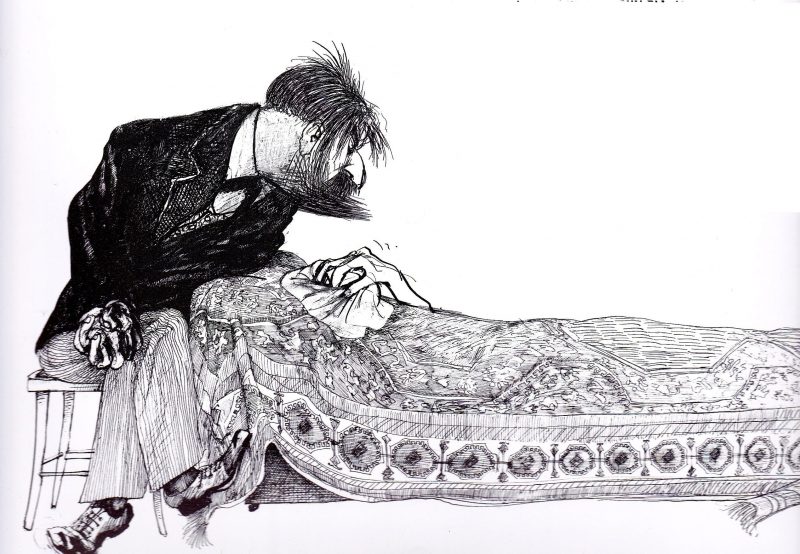
Sigmund Freud died in 1939, and the nearly eight decades since haven’t been kind to his psychoanalytical theories, but in some sense he survives. “For many years, even as writers were discarding the more patently absurd elements of his theory — penis envy, or the death drive — they continued to pay homage to Freud’s unblinking insight into the human condition,” writes the New Yorker’s Louis Menand. He claims that Freud thus evolved, “in the popular imagination, from a scientist into a kind of poet of the mind. And the thing about poets is that they cannot be refuted. No one asks of ‘Paradise Lost’: But is it true? Freud and his concepts, now converted into metaphors, joined the legion of the undead.”
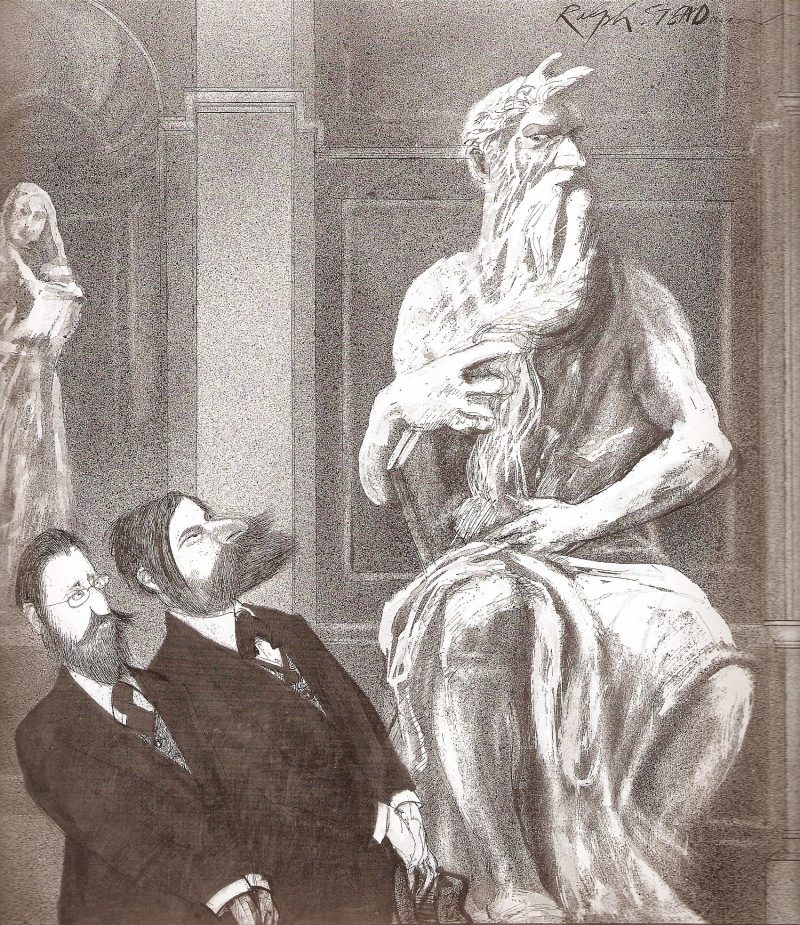
The master of a legion of undead psychological metaphors — who, in the ranks of living illustrators, could be more suited to render such a figure than Ralph Steadman? And how many of us know that he actually did so in 1979, when he produced an “art-biography” of the “Father of Psychoanalysis”?
Sigmund Freud, which has spent long stretches out of print since its first publication, tells the story of Freud’s life, beginning with his childhood in Austria to his death, not long after his emigration in flight from the Nazis, in London. It was there that he met Virginia Woolf, who in her diary describes him as “a screwed up shrunk very old man: with a monkey’s light eyes, paralyzed spasmodic movements, inarticulate: but alert.”
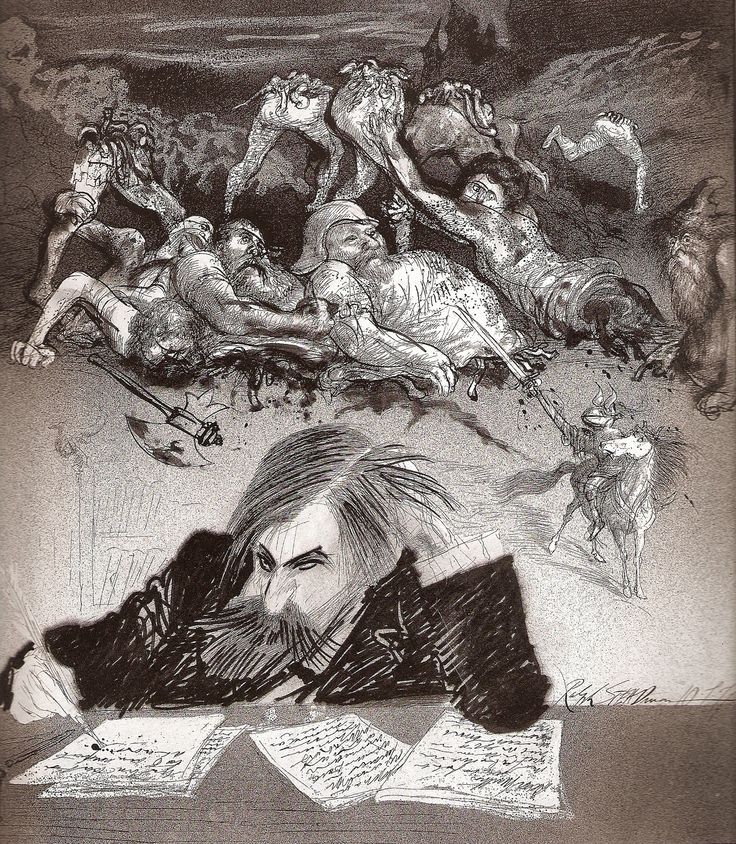
There, again, Freud sounds like one of Steadman’s drawings, sometimes outwardly unappealing but always possessed of an unignorable vitality generated by a solid core of perceptiveness. Earlier chapters of Freud’s life, characterized by intellectual as well as physical vigorousness aided by the 19th-century “miracle drug” of cocaine, also give the illustrator rich material to work with. One can’t help but think of Fear and Loathing in Las Vegas, which forged a permanent cultural link between Steadman’s art and Hunter S. Thompson’s prose. How “true” is the drug-fueled desert odyssey that book recounts? More so, perhaps, than many of Freud’s supposedly scientific discoveries. But as with the work of Freud, so with that of Thompson and Steadman: we return to it not because we want the truth, exactly, but because we can’t turn away from the often grotesque versions of ourselves it shows us.
You can pick up a copy of Steadman’s illustrated Sigmund Freud here.
Related Content:
Sigmund Freud, Father of Psychoanalysis, Introduced in a Monty Python-Style Animation
How a Young Sigmund Freud Researched & Got Addicted to Cocaine, the New “Miracle Drug,” in 1894
Ralph Steadman’s Wildly Illustrated Biography of Leonardo da Vinci (1983)
Gonzo Illustrator Ralph Steadman Draws the American Presidents, from Nixon to Trump
Based in Seoul, Colin Marshall writes and broadcasts on cities and culture. His projects include the book The Stateless City: a Walk through 21st-Century Los Angeles and the video series The City in Cinema. Follow him on Twitter at @colinmarshall or on Facebook.
Read More...Moog This!: Hear a Playlist Featuring 36 Hours of Music Made with the Legendary Analog Synthesizer
Part of what makes electronic music so wide-reaching and sonically far-seeing, so to speak, is its diversity of influences—classical composition, avant-garde theory, punk and funk energy, the sounds of factories and city streets worldwide—and its range of innovative instrumentation. But foremost among those instruments, many classic analogue synthesizers of old are now found in virtual environments, where their pots, keys, patch bays, and pitch wheels get simulated on laptops and MIDI controllers. Something is lost—a certain “aura,” as Walter Benjamin might say. A certain tremulous imprecision that hovers around the edges of synthesizers like those designed by Robert Moog.
Moog’s creations, writes David McNamee “ooze character” and are “the most iconic synthesizers of all time. FACT.” For this reason, Moog’s analog creations still hold market share as modern instruments while remaining legacy items for their transformation of entire genres of popular music since the 1960s, even though the engineer-inventor had no musical training himself and no real interest at first in making particularly usable instruments.
“Massive, fragile and impossible to tune,” a function Moog initially dismissed, once the Moog was made portable and liberated from specialized, wonky domains, it became a primary compositional tool and both a lead and rhythm instrument.
The Moog’s fuzzy, wobbly, warm sounds are unmistakable; they can purr and thunder, and the breadth of their capabilities is surprising given their relative simplicity. We’ve told their story here before and followed it up with a ten-hour playlist of Moog and Moog-inspired classics. Today, we bring you the playlist above, “Moog This!” which takes a leftfield approach to the theme, and will catch even serious electronic music fans off guard with its selections of not only obscure new sounds inspired by legends like Giorgio Moroder and Vangelis—the music of Firechild, for example—but also tracks from these legends that sit just to the left of their most famous compositions.
Rather than the usual, brilliantly futuristic Donna Summer dance track “I Feel Love”—the Spotify curator here goes for the similar-sounding, but much more elaborate instrumental “Chase” (top), the only track here from Moroder. Rather than the era-defining “West End Girls”—the Pet Shop Boys’ perfect downtempo 1984 pop song—we get “Men and Maggots,” from their moody 2005 score for Sergei Eisenstein’s perfect silent film, Battleship Potemkin. That’s not to say there aren’t any vocal tracks here, but they are mostly of the abstract, highly effected variety, like those from Boards of Canada and Air.
All in all, “Moog This!” the playlist shows what the synthesizer is capable of outside the context of mainstream pop, while still capturing the qualities that make it an ideal vehicle for accessible, emotional music, a pleasing tension so well harnessed by the analog synth-obsessed Stranger Things soundtrack, which, like most of the tracks here, manages to sound both like the soundtrack of a much cooler past and of very cool future.
Related Content:
How the Moog Synthesizer Changed the Sound of Music
Josh Jones is a writer and musician based in Durham, NC. Follow him at @jdmagness
Read More...Google’s Free App Analyzes Your Selfie and Then Finds Your Doppelganger in Museum Portraits

Having the ability to virtually explore the history, back stories, and cultural significance of artworks from over a thousand museums generates nowhere near the excitement as a feature allowing users to upload selfies in hopes of locating an Instagram-worthy doppelgänger somewhere in this vast digital collection.
On the other hand, if this low-brow innovation leads great hordes of millennials and iGen-ers to cross the thresholds of museums in over 70 countries, who are we to criticize?
So what if their primary motivation is snapping another selfie with their Flemish Renaissance twin? As long as one or two develop a passion for art, or a particular museum, artist, or period, we’re good.
Alas, some disgruntled users (probably Gen X‑ers and Baby Boomers) are giving the Google Arts & Culture app (iPhone-Android) one-star reviews, based on their inability to find the only feature for which they downloaded it.
Allow us to walk you through.
After installing the app (iPhone-Android) on your phone or tablet, scroll down the homepage to the question “Is your portrait in a museum?”
The sampling of artworks framing this question suggest that the answer may be yes, regardless of your race, though one need not be a Guerilla Girl to wonder if Caucasian users are drawing their matches from a far larger pool than users of color…
Click “get started.” (You’ll have to allow the app to access your device’s camera.)
Take a selfie. (I suppose you could hedge your bets by switching the camera to front-facing orientation and aiming it at a pleasing pre-existing headshot.)

The app will immediately analyze the selfie, and within seconds, boom! Say hello to your five closest matches.
In the name of science, I subjected myself to this process, grinning as if I was sitting for my fourth grade school picture. I and received the following results, none of them higher than 47%:
Victorio C. Edades’ Mother and Daughter (flatteringly, I was pegged as the daughter, though at 52, the resemblance to the mother is a far truer match.)
Gustave Courbet’s Jo, la Belle Irlandaise (Say what? She’s got long red hair and skin like Snow White!)
Henry Inman’s portrait of President Martin Van Buren’s daughter-in-law and defacto White House hostess, Angelica Singleton Van Buren (Well, she looks ….congenial. I do enjoy parties…)
and Sir Anthony van Dyck’s post-mortem painting of Venetia, Lady Digby, on her Deathbed (Um…)
Hoping that a different pose might yield a higher match I channeled artist Nina Katchadourian, and adopted a more painterly pose, unsmiling, head cocked, one hand lyrically resting on my breastbone… for good measure, I moved away from the window. This time I got:
Joseph Stella’s Boy with a Bagpipe (Maybe this wasn’t such a hot idea with regard to my self-image?)
Cipriano Efsio Oppo Portrait of Isabella (See above.)
Adolph Tidemand’s Portrait of Guro Silversdatter Travendal (Is this universe telling me it’s Babushka Time?)
Johannes Christiann Janson’s A Woman Cutting Bread (aka Renounce All Vanity Time?)
and Anders Zorn’s Madonna (This is where the mean cheerleader leaps out of the bathroom stall and calls me the horse from Guernica, right?)
Mercifully, none of these results topped the 50% mark, nor did any of the experiments I conducted using selfies of my teenage son (whose 4th closest match had a long white beard).
Perhaps there are still a few bugs to work out?
If you’re tempted to give Google Arts and Culture’s experimental portrait feature a go, please let us know how it worked out by posting a comment below. Maybe we’re twins, I mean, triplets!
If such folderol is beneath you, please avail yourself of the app’s original features:
- Zoom Views — Experience every detail of the world’s greatest treasures
- Virtual Reality — Grab your Google Cardboard viewer and immerse yourself in arts and culture
- Browse by time and color — Explore artworks by filtering them by color or time period
- Virtual tours — Step inside the most famous museums in the world and visit iconic landmarks
- Personal collection — Save your favorite artworks and share your collections with friends
- Nearby — Find museums and cultural events around you
- Exhibits — Take guided tours curated by experts
- Daily digest — Learn something new every time you open the app
- Art Recognizer — Learn more about artworks at select museums by pointing your device camera at them, even when offline
- Notifications — subscribe to receive updates on the top arts & culture stories
Download Google Arts and Culture or update to Version 6.0.17 here (for Mac) or here (for Android).
Note: We’re getting reports that the app doesn’t seem to be available in every geographical location. If it’s not available where you live, we apologize in advance.
Related Content:
Google Art Project Expands, Bringing 30,000 Works of Art from 151 Museums to the Web
Ayun Halliday is an author, illustrator, theater maker and Chief Primatologist of the East Village Inky zine. Follow her @AyunHalliday.
Read More...Hear Glenn Gould Channel Marshall McLuhan and Create an Experimental Radio Documentary Analyzing the Pop Music of Petula Clark (1967)
Glenn Gould, that intellectually intense, aesthetically austere interpreter of Johann Sebastian Bach, had little time for pop music. He had especially little time for the Beatles: “Theirs is a happy, cocky, belligerently resourceless brand of harmonic primitivism,” he wrote in High Fidelity in 1967, when the Fab Four had reached the top of the zeitgeist. “The indulgent amateurishness of the musical material, though closely rivaled by the indifference of the performing style, is actually surpassed only by the ineptitude of the studio production method,” he declares, likening “Strawberry Fields Forever” to “a mountain wedding between Claudio Monteverdi and a jug band.”
But the Beatle-bashing was incidental to the purpose of the article, a paean to English singer Petula Clark. At first listen, her four singles on which Gould focuses his analysis — 1964’s “Downtown,” 1956’s “My Love,” and 1966’s “A Sign of the Times” and “Who Am I?” — sound like nothing more than adolescent-oriented pop hardly touched by any of that decade’s musical (or indeed social) revolutions. But “this quartet of hits,” in Gould’s view, “was designed to convey the idea that, bound as she might be by limitations of timbre and range, she would not accept any corresponding restrictions of theme and sentiment,” with the result that she came to command an audience “large, constant, and possessed of an enthusiasm which transcends the generations.”
Gould says all this in The Search for Petula Clark, a 23-minute radio documentary that aired on the CBC on December 11, 1967, less than three weeks before his much better-known experimental documentary The Idea of North. He situates his analysis of the singer he calls “Pet Clark,” which gets into not just her songs’ themes and lyrics but their technical qualities as music, in the context of a solo road trip around Lake Superior when “Who Am I?” first hit the airwaves. So compelled did he find himself that he timed his drive to get within range of one of the radio stations scattered across the vastness of his homeland at the top of each hour in order to hear the song over and over again, after 700 miles he got to “know it if not better than the soloist, at least as well, perhaps, as most of the sidemen.”
Though born within two months of each other in 1932 and thereafter living lives dedicated to music, Gould and Clark would seem to have little else in common. While Gould died at 50, Clark, at the age of 85, continues to both record and perform. Gould, as J.D. Connor writes in an essay on The Search for Petula Clark, “stopped performing for live audiences in 1964. Freed from the rigors of the concert circuit, he dove into radio and television at just the moment when he and Canadian state media could parlay his immense musical popularity into something more.” This and the more intricate radio productions that would follow both sprang from and allowed Gould to construct “a media theory of his own. In print, on television, and, most important, on radio, Gould became the great complement to Marshall McLuhan.” And like McLuhan, when Gould obsesses over something that never seemed to merit serious attention, we’d do well to heed the insights he draws from it.
Related Content:
Listen to Glenn Gould’s Shockingly Experimental Radio Documentary, The Idea of North (1967)
Glenn Gould Explains the Genius of Johann Sebastian Bach (1962)
Glenn Gould Gives Us a Tour of Toronto, His Beloved Hometown (1979)
Based in Seoul, Colin Marshall writes and broadcasts on cities and culture. His projects include the book The Stateless City: a Walk through 21st-Century Los Angeles and the video series The City in Cinema. Follow him on Twitter at @colinmarshall or on Facebook.
Read More...100 Years of Cinema: New Documentary Series Explores the History of Cinema by Analyzing One Film Per Year, Starting in 1915
Film has played an integral part in almost all of our cultural lives for decades and decades, but when did we invent it? “We have evidence of man experimenting with moving images from a time when we still lived in caves,” says the narrator of the video series One Hundred Years of Cinema. “Pictures of animals painted on cave walls seemed to dance and move in the flickering firelight.” From there the study of cinema jumps ahead to the work of stop-motion photography pioneer Eadweard Muybridge, Louis Le Prince’s building of the first single-lens movie camera, the invention of the kinetoscope, and the Lumière brothers’ first projection of a motion picture before an audience.
The birth of cinema, historians generally agree, happened when these events did, around the last decade of the nineteenth century and the first decade of the twentieth, and so the first episode of 100 Years of Cinema covers the years 1888 through 1914. But then, in 1915, comes D.W. Griffith’s groundbreaking and still deeply controversial feature The Birth of a Nation, which the narrator calls “one of the most important films in cinema history.”
100 Years of Cinema thus gives The Birth of a Nation its own episode, and in each subsequent episode it moves forward one year but adheres to the same format, picking out one particular movie through which to tell that chapter of the story of film.
For 1916 we learn about 20,000 Leagues Under the Sea, the first picture filmed underwater; for 1917, physical comedian Buster Keaton’s debut The Butcher Boy; for 1918, The Ghost of Slumber Mountain, which dared to integrate live actors with stop-motion clay animation. And so does 100 Years of Cinema tell the story of film’s first century as the story of innovation after innovation after innovation, doing so through obscurities as well as such pillars of the film-studies curriculum as Nanook of the North, Battleship Potemkin, Metropolis, and Man with a Movie Camera.
The series, which began last April, has recently put out about one new episode per month. Its most recent video covers Scarface — not Brian de Palma’s tale of drug-dealing in 1980s Miami whose poster still adorns dorm-room walls today, but the 1932 Howard Hawks picture it remade. Here the original Scarface gets credited as one of the works that defined the American gangster film, leading not just to the version starring Al Pacino and his machine gun but to the likes of The Godfather, Boyz N the Hood, and Reservoir Dogs as well. Cinephiles, place your bets now as to whether 100 Years of Cinema will select any of those films for 1972, 1991, or 1992 — and start considering what each of them might teach us about the development of the cinema we enjoy today.
You can view all of the existing episodes, moving from 1915 through 1931, below. And support 100 Years of Cinema over at this Patreon page.
Related Content:
The 100 Most Memorable Shots in Cinema Over the Past 100 Years
The History of the Movie Camera in Four Minutes: From the Lumiere Brothers to Google Glass
Cinema History by Titles & Numbers
Hollywood, Epic Documentary Chronicles the Early History of Cinema
Based in Seoul, Colin Marshall writes and broadcasts on cities and culture. He’s at work on the book The Stateless City: a Walk through 21st-Century Los Angeles, the video series The City in Cinema, the crowdfunded journalism project Where Is the City of the Future?, and the Los Angeles Review of Books’ Korea Blog. Follow him on Twitter at @colinmarshall or on Facebook.
Read More...Sigmund Freud, Father of Psychoanalysis, Introduced in a Monty Python-Style Animation
Pity the hedgehog. The freezing temperatures of winter compel them to cozy up to others of its kind, but the prickly spines covering their bodies prevent them from sustaining the easy, ongoing intimacy they so crave.
It’s a hell of a metaphor for human relationships, compliments of 19th-century philosopher Arthur Schopenhauer. It certainly spoke to Sigmund Freud, who devoted his life trying to figure out why so many of us resort to petty behaviors, spurning those we love, and sabotaging ourselves at every turn.
Popular representations would have us believe that the father of psychoanalysis was a detached sort of know-it-all, emotionally superior to the basket cases sniveling on his couch. Not so. As he noted in 1897:
I have been through some kind of neurotic experience, curious states… twilight thoughts, veiled doubts… The chief patient I am preoccupied with is myself… my little hysteria… the analysis is more difficult than any other. Something from the deepest depths of my own neurosis sets itself against any advance in understanding neuroses…
We feel ya’, doc, and so does The School of Life, the London-based organization for developing emotional intelligence, co-founded by philosophical essayist, Alain de Botton:
… consulting a psychotherapist should be as accessible and as normal as developing your career, getting help for a physical problem, or going to the gym to get healthy. Just as we take care of our bodies and physical health, a vital element of self-care is devoting focused time and energy to exploring and understanding our thoughts and feelings.
The school puts your money where its mouth is by retaining a roster of licensed psychotherapists who can be booked for in-person or Skype sessions.
It’s not for everyone. There are those who are determined to pursue the path to contentment and self-knowledge solo, impervious to Freud’s belief that “No one who disdains the key will ever be able to unlock the door.”
The therapy-averse can still learn something from the video above. Narrator de Botton charms his way through an easily digested overview of Freud’s personal and professional life, and the resulting tenets of psychoanalysis.
And filmmaker Mad Adam ensures that this brief trip through the infant phases—oral, anal, phallic—will be a jolly one, replete with droll, mostly vintage images.
Release more monsters of the id with the School of Life’s psychotherapy playlist.
Related Content:
What is Love? BBC Philosophy Animations Feature Sartre, Freud, Aristophanes, Dawkins & More
Ayun Halliday is an author, illustrator, theater maker and Chief Primatologist of the East Village Inky zine. Follow her @AyunHalliday.
Read More...What Is Apocalypse Now Really About? An Hour-Long Video Analysis of Francis Ford Coppola’s Vietnam Masterpiece
The distorted sounds of helicopter blades. The drunken punch that shatters the mirror. The “Ride of the Valkyries” attack. “I love the smell of napalm in the morning.” The slaughtering of the water buffalo. “The horror… the horror.” In the nearly three-hour runtime of its original cut, Apocalypse Now delivers these and many more of the most vivid cinematic moments of the 1970s, the era of “New Hollywood”—when young auteurs like its director Francis Ford Coppola swept in and demolished the boundaries of mainstream American cinema—and that of the Vietnam War the film depicts as well.
Yet for all its artistic and cultural impact, the film hasn’t received quite as much scrutiny as you might imagine. Or at least that’s how it looked to professional cinephile Lewis Bond, known for his work on Channel Criswell, when he first took stock of Apocalypse Now’s analytical video essay landscape.
Discussions of Coppola’s Vietnam masterpiece tend to focus on its legendarily arduous production and the one million feet of film famously shot during it, a precedent perhaps set by the 1991 behind-the-scenes documentary Hearts of Darkness: A Filmmaker’s Apocalypse.
These appraisals shy away from one seemingly important question in particular: what is the movie about? On one level, the answer to that question comes easily: a modern adaptation of Joseph Conrad’s 1899 novel Heart of Darkness, Apocalypse Now transplants and transforms Conrad’s story of a journey up the Congo River to the stronghold of an ivory trader into the context of 1969 Vietnam. The river journey remains, now led by a United States Army captain charged with the “termination with extreme prejudice” of an Army Special Forces colonel gone rogue, and probably insane, in Cambodia, surrounded by ex-soldiers and natives who reportedly worship him as a “demigod.”
Bond references the standard interpretation of Apocalypse Now’s river journey as “a metaphor for descent into madness,” but in his two-part, hour-long video essay analyzing the themes of the film, he posits “a more appropriate description of the river” as “a reflection of the characters’ inner journey, showing us the indoctrination of evil.” Along the way, Coppola and his collaborators offer a singular cinematic experience about not one thing but many: “It’s about the destruction of people’s morals. It’s about the way America operated during Vietnam as well as the confused values that America pushed upon the world. It’s about war. It’s about people” — and everything else before which our interpretive instincts ultimately fall powerless.
Related Content:
Apocalypse Now’s “Ride of the Valkyries” Attack: The Anatomy of a Classic Scene
The Making of Apocalypse Now Remixed/Revisited
How Akira Kurosawa’s Seven Samurai Perfected the Cinematic Action Scene: A New Video Essay
Based in Seoul, Colin Marshall writes and broadcasts on cities and culture. He’s at work on a book about Los Angeles, A Los Angeles Primer, the video series The City in Cinema, the crowdfunded journalism project Where Is the City of the Future?, and the Los Angeles Review of Books’ Korea Blog. Follow him on Twitter at @colinmarshall or on Facebook.
Read More...Watch Hannah Arendt’s Diagnosis of the Banality of Evil as an 8‑Bit Video Game
Permit us a couple of great oversimplifications: Hannah Arendt became well-known by writing about evil. Video games, especially classic ones, usually challenge the player to fight some kind of evil. And so we have a suitable, if at first seemingly incongruous, meeting of form and substance in this video, “What is Evil?,” from the 8‑Bit Philosophy series. It casts the 20th-century political theorist as the hero this time around, rendering in vintage video-game aesthetics her quest not simply to fight evil, but to identify evil — a much more troubling enterprise.
“Traditional conceptions of evil focus on the utter monstrosity of evil actions — the complete awe and unthinkability of horror,” says the narrator. “Called pure or radical evil, this is the sort of evil associated with antagonists or villains — is is the antithesis of good.”
It also happens to be just the sort of obvious straight-up evil video games tend to put their players up against: enemy ships you can only shoot down before they shoot you down, mad doctors you can only blow up before they blow the world up, monsters you can can only jump on before they eat you.
Arendt started seeing things differently from this black-and-white (or in the case of eight-bit video games, 64-color) conception after she saw the trial of Adolf Eichmann. “Put on trial for numerous horrors, Eichmann was found guilty of crimes against humanity — especially against the Jewish people, for overseeing the trains that transported people to Nazi death camps.” Sound like a mean piece of work though the guy may, Arendt beheld in the courtroom “an altogether innocuous and seemingly normal little man,” a “stereotypical bureaucrat” who “never stopped to put himself in anyone else’s shoes,” driven by an “unquestioning sense of obligation to authority.”
To put it in video-game terms, Arendt expected the sort of grotesque, cackling big boss that appears in the last stage, and she got the kind of drone who simply stands around waiting to be slain with one hit in the first. This led her to coin her immortal phrase “the banality of evil,” which, she explains in Eichmann in Jerusalem, describes it “only on the strictly factual level. He was not stupid. It was thoughtlessness, something by no means identical to stupidity. Such remoteness from reality can wreak more havoc than all the instincts taken together.” And what kind of sword, laser, or power-up could defeat that?
Related Content:
Hannah Arendt Discusses Philosophy, Politics & Eichmann in Rare 1964 TV Interview
Hannah Arendt’s Original Articles on “the Banality of Evil” in the New Yorker Archive
8‑Bit Philosophy: Plato, Sartre, Derrida & Other Thinkers Explained With Vintage Video Games
Existential Philosophy of Kierkegaard, Sartre, Camus Explained with 8‑Bit Video Games
Based in Seoul, Colin Marshall writes and broadcasts on cities and culture. He’s at work on a book about Los Angeles, A Los Angeles Primer, the video series The City in Cinema, the crowdfunded journalism project Where Is the City of the Future?, and the Los Angeles Review of Books’ Korea Blog. Follow him on Twitter at @colinmarshall or on Facebook.
Read More...An Animated Intro to the Ideas of Jacques Lacan, “the Greatest French Psychoanalyst of the 20th Century”
You may still suffer from painful memories of having had to read Jacques Lacan in school, but look past all that verbiage about, say, desire’s “frenzied mocking of the abyss of the infinite, the secret collusion with which it envelops the pleasure of knowing and of dominating with jouissance,” and you can find real insights into humanity. The animated primer from Alain de Botton’s School of Life just above will give you a clear sense — a much clearer sense than any you might get from Lacan’s own prose — of what “the greatest French psychoanalyst of the 20th century” understood about us all.
This video, as well as Lacan’s entry in The Book of Life, breaks the man’s thought down into three parts. First, identity: following his fascination with the distinctively human experience of recognizing one’s own image, Lacan ultimately suggests that “we accept that other people simply won’t ever experience us the way we experience ourselves; that we will be almost entirely misunderstood – and will in turn deeply misunderstand.” Second, love: though given to grand statements such as “Men and women don’t exist,” Lacan comprehended “the extent to which we don’t truly comprehend our lovers and simply peg a range of fantasies drawn from childhood experiences to their physical forms,” which supports the eminently practical advice “not to be upset when we don’t feel a perfect rapport with someone who initially seemed a soulmate.”
The third part deals with the arena in which Lacan’s writings remain most often considered: politics. He came into his own as an international “intellectual celebrity” in the 1960s, the time of “the sexual revolution, great interest in communism, and lots of protests.” But he actually took a dimmer view of all that agitation than many, telling those student protesters chomping at the bit to remake society that “What you aspire to as revolutionaries is a new master. You will get one.” He saw early on what we still see in every election cycle: that “we desire to have someone else in charge who can make everything OK, someone who is, in a sense, an ideal parent – and we bring this peculiar-sounding bit of our psychological fantasies into the way we navigate politics.”
You can watch Lacan engaging with one particularly rebellious student in a 1972 video we featured a few years ago, and you can see an hourlong lecture he delivered at the Catholic University of Louvain that same year in this video we posted before that. Empowered by the kind of overview of Lacan’s ideas that the School of Life has put together, you can better confront his famously (or infamously) elaborate rhetoric and judge for yourself whether to consider him a thinker who “made some extremely useful additions to our understanding of ourselves” — or, in the judgment of Noam Chomsky, a mere practitioner of empty “posturing.” But then, having lived a life that, as de Botton puts it, mixed “intellectual truth with worldly success,” can’t he be both?
Related Content:
Charismatic Psychoanalyst Jacques Lacan Gives Public Lecture (1972)
Jacques Lacan’s Confrontation with a Young Rebel: Classic Moment, 1972
Jacques Lacan Talks About Psychoanalysis with Panache (1973)
Noam Chomsky Slams Žižek and Lacan: Empty ‘Posturing’
Based in Seoul, Colin Marshall writes and broadcasts on cities, language, and style. He’s at work on a book about Los Angeles, A Los Angeles Primer, the video series The City in Cinema, the crowdfunded journalism project Where Is the City of the Future?, and the Los Angeles Review of Books’ Korea Blog. Follow him on Twitter at @colinmarshall or on Facebook.
Read More...Support Us
We're hoping to rely on loyal readers, rather than erratic ads. Please click the Donate button and support Open Culture. You can use Paypal, Venmo, Patreon, even Crypto! We thank you!

About Us

Open Culture scours the web for the best educational media. We find the free courses and audio books you need, the language lessons & educational videos you want, and plenty of enlightenment in between.
Advertise With Us
FREE UPDATES!
GET OUR DAILY EMAIL
Get the best cultural and educational resources on the web curated for you in a daily email. We never spam. Unsubscribe at any time.
FOLLOW ON SOCIAL MEDIA
Open Culture editor Dan Colman scours the web for the best educational media. He finds the free courses and audio books you need, the language lessons & movies you want, and plenty of enlightenment in between.
Advertise With Us

