The Largest Ever Analysis of Film Dialogue (Over 4 Million Lines in 2,000 Scripts) Reveals Gender Bias Built Into Cinema

By their color palettes, by their dramatic structures, by their shot lengths, by the frequency and variety of their characters’ swearing: film enthusiasts have found ways to analyze just about every aspect of film. But only recently has the world of film analysis seen a large-scale study of dialogue by gender and age — in fact, the largest-scale study of dialogue by gender and age yet — undertaken by a new site called Polygraph, “a publication that explores popular culture with data and visual storytelling.” They wanted to put to the data test part of the notion, widely expressed in opinion pieces, that “white men dominate movie roles.”
“We Googled our way to 8,000 screenplays and matched each character’s lines to an actor,” write Polygraph’s Hannah Anderson and Matt Daniels. “From there, we compiled the number of words spoken by male and female characters across roughly 2,000 films, arguably the largest undertaking of script analysis, ever.” They present their quantitative results with great visual clarity, and you can view them for three distinct areas of cinema territory: just the 2,000 screenplays the study focused on; only high-grossing films at the American box office; and only Disney movies (known, of course, for their abundance of princesses, with or without many lines).
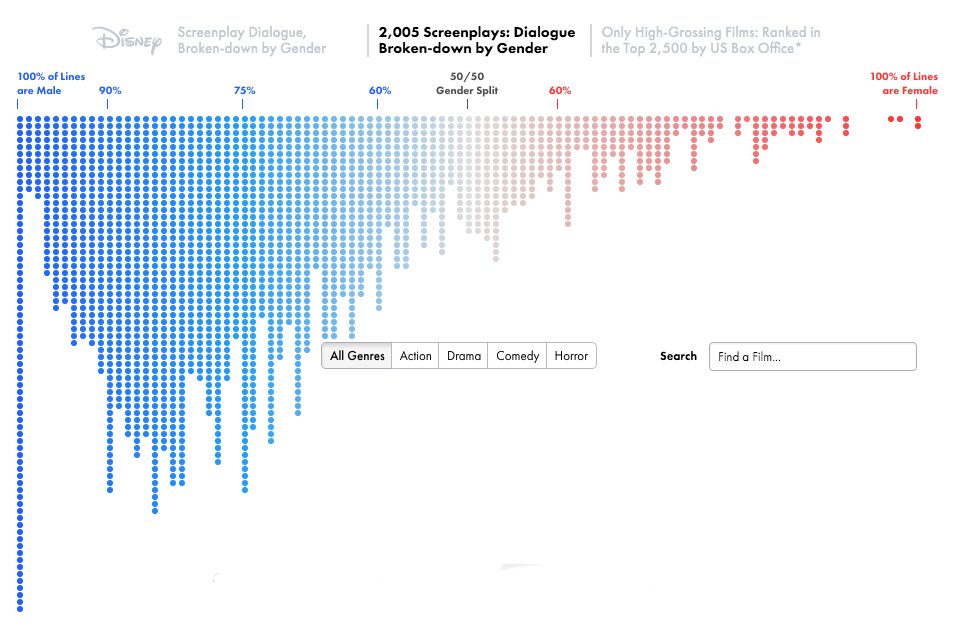
“Across thousands of films in our dataset,” they write, “it was hard to find a subset that didn’t over-index male. Even romantic comedies have dialogue that is, on average, 58% male. For example, Pretty Woman and 10 Things I Hate About You both have lead women (i.e., characters with the most amount of dialogue). But the overall dialogue for both films is 52% male, due to the number of male supporting characters.” And as far as age, “dialogue available to women who are over 40 years old decrease substantially. For men, it’s the exact opposite: there are more roles available to older actors.”
Depending on what kind of films you watch, this may well jibe with your viewing experience: mainstream stories have long tended to favor macho and often mature protagonists, and the antagonists they defeat in man-to-man combat have sometimes reached advanced ages indeed (all the more time, presumably, in which to have mastered the art of villainy, especially of the one-last-grand-speech-before-I-destroy-the-world variety). The women, and usually young women, featured in such pictures, when they appear at all, have to do much of their communication nonverbally.
This all supports a complaint I’ve long had about the movies, mainstream or otherwise: over a century in existence, and they’ve hardly touched the vast creative space available to them. The all-female Ghostbusters coming this summer will surely do its small part to rectify the lack of woman-delivered dialogue on the silver screen, but the depth of the deficiency, as revealed by Polygraph, suggests we could do with a few all-female Glengarry Glen Rosses as well.
Related Content:
An Ambitious List of 1400 Films Made by Female Filmmakers
10 Tips From Billy Wilder on How to Write a Good Screenplay
Based in Seoul, Colin Marshall writes and broadcasts on cities, language, and style. He’s at work on a book about Los Angeles, A Los Angeles Primer, the video series The City in Cinema, the crowdfunded journalism project Where Is the City of the Future?, and the Los Angeles Review of Books’ Korea Blog. Follow him on Twitter at @colinmarshall or on Facebook.
Read More...Scientists Create a New Rembrandt Painting, Using a 3D Printer & Data Analysis of Rembrandt’s Body of Work
All of us who saw Jurassic Park as kids, no matter how much skepticism we’d precociously developed, surely spent at least a moment wondering if science could actually bring dinosaurs back to life by pulling the DNA out of their blood trapped in amber-preserved mosquitoes. It turns out that it can’t — at least not yet! — but even so, we had to admit that Steven Spielberg and his CGI-savvy collaborators (not to mention their huge budget) achieved, on screen, the next best thing. Even so, people have long disagreed about whether to call the visual resurrection of dinosaurs in the service of a blockbuster adventure movie a work of art.
But what if we used the even more powerful data analysis and computer graphics technology now at our disposal specifically for the purpose of generating a masterpiece, or at least a piece by a master — by Rembrandt, say? A project called The Next Rembrandt has aimed to do just that with its attempt “to distill the artistic DNA of Rembrandt” using everything from building and analyzing “an extensive analysis of his paintings [ … ] pixel by pixel,” to performing a demographic study determining his conclusive portrait subject (“a Caucasian male with facial hair, between the ages of thirty and forty, wearing black clothes with a white collar and a hat, facing to the right”), to creating a height map to mimic his physical brush strokes.
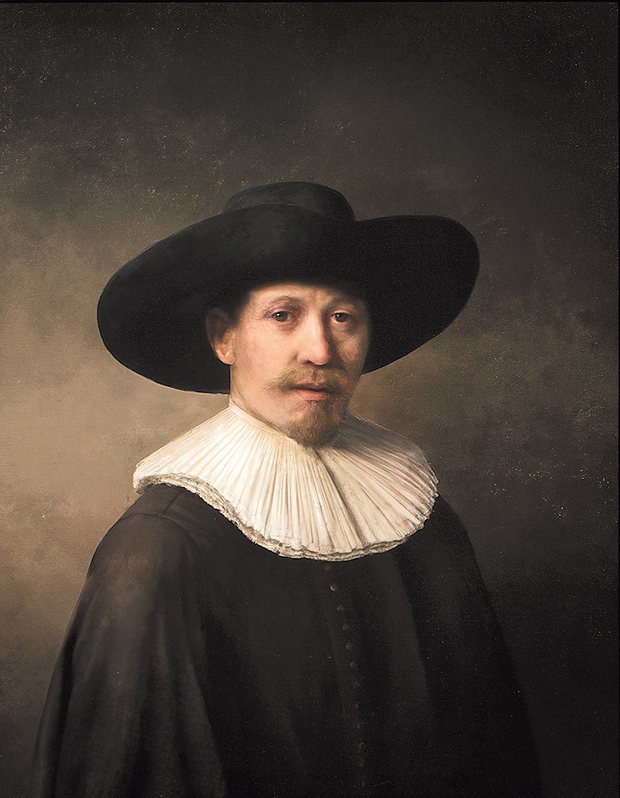
“You could say that we use technology and data like Rembrandt used his paints and his brushes to create something new.” Those bold words come from Ron Augustus, Microsoft’s director of small- and medium-sized business markets, in the promotional video at the top of the post. His employer acts as one of two partners involved in The Next Rembrandt, the other being the Dutch bank ING — hence, presumably, the choice of painter to resurrect. Their combined resources have produced a wholly theoretical, but in a physical sense very real, new “Rembrandt” portrait, meticulously 3D-printed at 148 megapixels in thirteen layers of paint-based UV ink.
Despite its impressive plausibility, nobody expects the fruit of the Next Rembrandt project’s considerable labors, unveiled yesterday in Amsterdam, to hang in the Rijksmuseum next to The Night Watch. But it can, properly considered, teach us all a great deal about what, in the words of ING executive creative director Bas Korsten, “made Rembrandt Rembrandt.” And like any cutting-edge stunt, it also gives us a glimpse into what technology will sooner or later make possible for us all. How long could we possibly have to wait before we can 3D-print, on canvas with oil paint, portraits of ourselves as Rembrandt almost certainly would have painted us — or our very own Night Watch, indistinguishable from the original? Truly, we stand on the cusp of a golden age of forgery.
Related Content:
300+ Etchings by Rembrandt Now Free Online, Thanks to the Morgan Library & Museum
16th-Century Amsterdam Stunningly Visualized with 3D Animation
Flashmob Recreates Rembrandt’s “The Night Watch” in a Dutch Shopping Mall
Based in Seoul, Colin Marshall writes and broadcasts on cities, language, and style. He’s at work on a book about Los Angeles, A Los Angeles Primer, the video series The City in Cinema, the crowdfunded journalism project Where Is the City of the Future?, and the Los Angeles Review of Books’ Korea Blog. Follow him on Twitter at @colinmarshall or on Facebook.
Read More...Bob Dylan Appears in Rare TV Ad: Watch IBM’s Super Computer Offer a Literary Analysis of His Songs
To my knowledge, Bob Dylan has only appeared in a handful of TV commercials over the decades, including most notably a bizarre ad for Victoria’s Secret back in 2004. Now you can add another to the small list. Last night, IBM debuted a new ad with the iconic singer-songwriter. And this time around, Dylan isn’t peddling bras. Rather, it’s IBM’s cognitive system called “Watson,” which promises to analyze data for corporations in all kinds of interesting ways. Says IBM:
Humans create a staggering amount of information. Poetry, equations, films, selfies, diagnoses, discoveries. Data pours from our mobile devices, social networks, from every digitized and connected system we use. 80% of this data is virtually invisible to computers—including nearly all the information captured in language, sight and sound. Until now.
IBM Watson applies its cognitive technologies to help change how we approach and understand all of this information. Everything that is digital has the potential to become cognitive, and, in a sense, be able to “think.”
Watson can bring cognition to everything and everyone. To evolve in this data-driven culture, every business will need to become a cognitive business.
To demonstrate its analytical powers, IBM asked Watson to analyze Dylan’s lyrics, and it concluded that the major themes of Dylan’s songs are “time passes and love fades”. It’s a conclusion, I’m sure, that never dawned on casual or ardent fans of Dylan’s music.
Related Content:
“They Were There” — Errol Morris Finally Directs a Film for IBM
Andy Warhol’s ‘Screen Test’ of Bob Dylan: A Classic Meeting of Egos
Bob Dylan Reads From T.S. Eliot’s Great Modernist Poem The Waste Land
Bob Dylan and The Grateful Dead Rehearse Together in Summer 1987. Listen to 74 Tracks.
Read More...Brooklyn–Based Makers of Artisanal Water Let You Sip From America’s Great Cultural Waters
The Timmy Brothers, based in Brooklyn, create handcrafted water. It’s not just any water. It’s water that lets you travel to different cultural times and places. Want to drink water that evokes memories of Mark Twain’s Mississippi River? Or the great jazz that came out of New Orleans? Well, the Timmy Brothers have just the product for you.
If you’re in Brooklyn, also consider making a side trip to Beacon, NY where David Rees lovingly creates artisanal handcrafted pencils. You’ll never look at pencils the same way again. :-)
Follow us on Facebook, Twitter, Google Plus and LinkedIn and share intelligent media with your friends. And if you want to make sure that our posts definitely appear in your Facebook newsfeed, just follow these simple steps.
Read More...Sigmund Freud’s Psychoanalytic Drawings Show How He First Visualized the Ego, Superego, Id & More
It’s easy to think we know all there is to know about Sigmund Freud. His name, after all, has become an adjective, a sure sign that someone’s legacy has embedded itself in the cultural consciousness. But did you know that the German neurologist we credit with the invention of psychoanalysis, the diagnoses of hysteria, dream interpretation, and the death drive began his career patiently dissecting eels in search of… eel testicles? Perhaps you did know that. Perhaps you only suspected it. There are few things about Freud—who also pioneered both the medical and recreational use of cocaine, joined the august British Royal Society, and unwittingly re-engineered philosophy and literary criticism—that surprise me anymore. Freud was a peculiarly talented individual.
One area in which he excelled may seem modest next to his roster of publications and celebrity acquaintances, and yet, the doctor’s skill as a medical draughtsman and maker of diagrams to illustrate his theories surely deserves some appreciation. Freud’s drawing received a book length treatment in 2006’s From Neurology to Psychoanalysis: Sigmund Freud’s Neurological Drawings and Diagrams of the Mind by Lynn Gamwell and Mark Solms. These are but a small sampling of the many works of medical art found within its covers, taken from a 2006 exhibit at the New York Academy of Medicine of the largest collection of Freud’s drawings ever assembled, in commemoration of his 150th birthday.
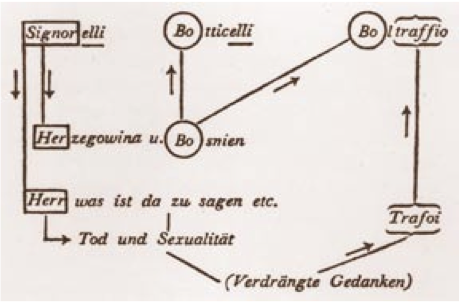
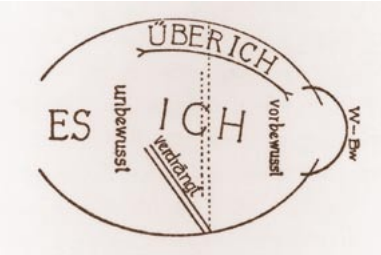
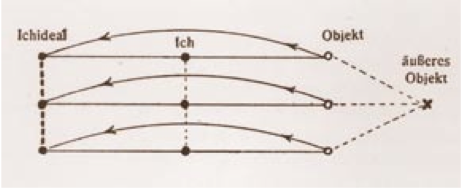
As the title of the book indicates, the drawings literally illustrate the radical shift Freud made from the hard science of neurology to a practice of his own invention. Curator Gamwell writes, “as Freud focused on increasingly complex mental functions such as disorders of language and memory, he put aside any attempt to diagram the underlying physiological structure, such as neurological pathways, and he began making schematic images of hypothetical psychological structures,” i.e. the Ego, Superego, and Id, as represented at the top in a 1933 diagram. Below it, from 1921, see “Group Psychology and the Analysis of the Ego,” a schematic that “attempts to represent relations between the major mental systems (or agencies) in a group of human minds.” And just above, see Freud’s diagram for “The Psychical Mechanism of Forgetfulness” from 1898, depicting “associative links between various conscious, preconscious and unconscious word presentations.”
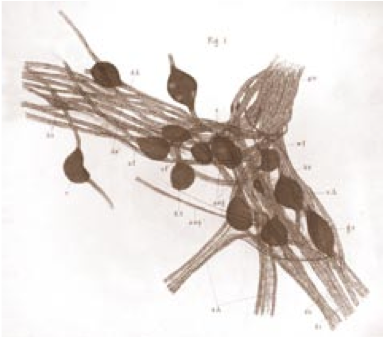
It is in these late nineteenth-century diagrams that we see Freud make the definitive move from empirically observed illustrations of physical structures—like the 1878 “Spinal Ganglia and Spinal Chord of Petromyzom” above—to relations between ideas and “conceptual entities that have no tangible existence in the physical world.” That shift, generally marked by the publication of Studies in Hysteria in 1895, caused Freud some unease. “Looking back over his career 30 years later,” writes Mark Solms, “ his longing for the comfortable respectability of his earlier career is still evident.” Even at the time, Freud would write in Studies in Hysteria that his case histories “lack the serious stamp of science.” Though his studies of eel, lamprey, and human brains involved tangible, observable phenomena, he approached the new discipline of psychoanalysis with no less rigor, stating only that the “the nature of the subject” had changed, not his method.
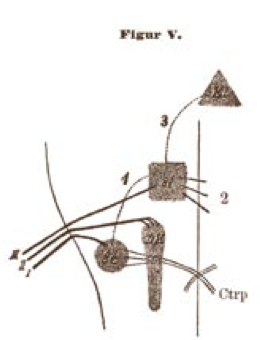
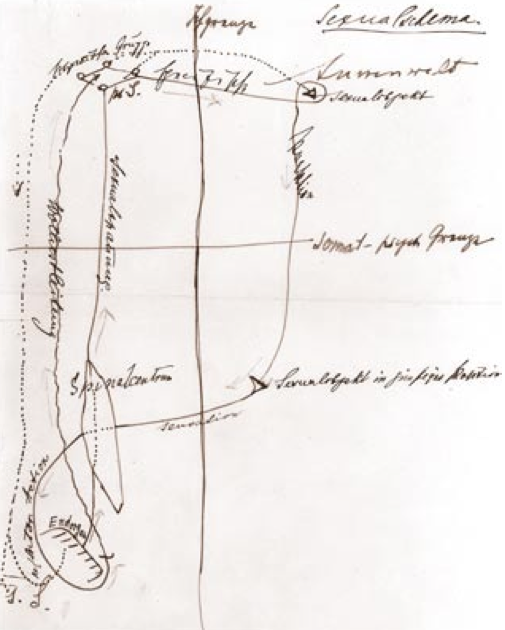
The drawings, writes Benedict Carey in the New York Times, “tell a story in three acts, from biology to psychology, from the microscope to the couch.” As Freud makes the transition, his meticulously detailed medical work, copied from glass slides, gives way to loose outlines. One drawing of the brain’s auditory system from 1886 (above) “is as spare and geometric as a Calder sculpture.” Just a few years later, Freud sketched out the diagram below in 1894, a schematic, writes Solms, of “the relationship between various normal and pathological mood states and sexual physiology.” It’s his first purely psychoanalytic drawing, sketched in a letter to a colleague, Dr. Wilhelm Fleiss.
In the later diagrams, as we see above, his tentative freehand gave way to typescript and a technical draughtsman’s precision, with some drawings resembling, in Carey’s words, “the schematic for an air-conditioning system.” Freud seems to comment on the architectural nature of these diagrams when he writes in The Interpretation of Dreams in 1900, “We are justified, in my view, in giving free reign to our speculations so long as we retain the coolness of our judgment, and do not mistake the scaffolding for the building.” It’s a warning many of Freud’s disciples may not have heeded carefully enough.
Related Content:
How a Young Sigmund Freud Researched & Got Addicted to Cocaine, the New “Miracle Drug,” in 1894
Sigmund Freud Appears in Rare, Surviving Video & Audio Recorded During the 1930s
Free Online Psychology Courses
Josh Jones is a writer and musician based in Durham, NC. Follow him at @jdmagness
Read More...David Rees Presents a Primer on the Artisanal Craft of Pencil Sharpening
How have you been sharpening your pencils? Regardless of your answer, rest assured that you’re doing it wrong.
Lest there be any doubt that I’m geographically situated smack dab in the middle of former cartoonist’s David Rees’ target demographic, I almost didn’t click on the link to the pitch perfect send up above because I believed it was real.
Here in non-Caribbean, non-Southeast-Asian, non-Russian, non-Mexican Brooklyn—think Girls, the Jonathans Ames and Letham, brownstone-dwelling movie stars and the very latest in n’est plus ultra strollers—it’s entirely plausible that a humorless young artisan might take to the Internet to teach us regular schlubs How to Sharpen Pencils.
Just wait ’til he brings out his leather strop. (Misplaced yours? Look in your basement, or your grandfather’s tomb.)
Please note that though the video may be satirical, Rees makes actual money sharpening—and authenticating—customers’ Number Two pencils, using the same techniques demonstrated in the video. (Sorry, holiday shoppers, as per his website, he won’t be taking orders for his live pencil sharpening services until the New Year, but he does have a book out.)
Like you need any more excuse to whip out your knife, place it in your dominant hand, and start carving.
To quote a certain classic Broadway musical, you gotta have a gimmick.
Related Content:
“The Periodic Table Table” — All The Elements in Hand-Carved Wood
Watch The New America, a Stop Motion Animation Starring 800+ Laser Engraved Wood Blocks
Learn to Draw Butts with Just Five Simple Lines
Ayun Halliday can get behind New Ork City public school teachers’ insistence on the Ticonderoga brand. Follow her @AyunHallliday
Read More...Take a Virtual Tour of Venice (Its Streets, Plazas & Canals) with Google Street View
There’s something inherently ridiculous about Google’s Street View cars.
Their roof-mounted 15-lens Trekker cameras constantly blunder across less-than-dignified scenes whilst trawling the roads on behalf of Google Maps (a service that is forever linked in my mind to Lazy Sunday, the preposterous rap video starring comedians Andy Samberg and Chris Parnell.)
The cars themselves are totally goofy-looking. I would imagine that spotting one in real life is something akin to a Weinermobile sighting. No wonder the producers of Arrested Development arranged for George Michael Bluth, the hapless innocent played by Michael Cera, to drive one in the series’ fourth season.

I have a hunch that the Street View Trekker’s backpack model will ultimately prove less mockable than its four-wheeled counterpart. It can go where cars can’t, conferring an extreme sports vibe despite the big, ball-shaped camera apparatus sticking up. A limited pilot program has been recruiting volunteers to wear the backpack in such locales as Bulgaria, Indonesia, and South Africa. The Philippines is another destination where volunteers are sought, and all kidding aside, it would be riveting to see how this technology might document the devastation in Tacloban.
For now, the non-automotive Street View’s greatest triumph lies in recording the canals and cobbled walkways of Venice, Italy, a feat impossible to pull off in a car. To accomplish this, a team of backpackers logged over 375 miles on foot and by boat. Their efforts provide tourists with practical information in a format to which they’ve no doubt grown accustomed, as well as presenting armchair travelers with plenty of non-disappointing eye candy.
Cyber visitors can choose to traverse the Floating City much as actual visitors can — on foot, by vaporetta or by gondola. (I’d advise making a trip to the bathroom even if you’re not actually leaving home. At the very least turn the sound down — the paddling noises accompanying the last option could cause a Pavlovian bladder response.)
In addition to the Street View and standard map, you can explore using a sepia-toned map from the David Rumsey Historical Map Collection, that dates back to 1838.
A lovely escape, all in all. Let us hope it never opens to traffic.
You can start your tour here.
Related Content:
How Venice Works: A Short Film
Google Street View Opens Up a Look at Shackleton’s Antarctic
A Virtual Tour of the Sistine Chapel
Google Street View Takes You on a Panoramic Tour of the Grand Canyon
Ayun Halliday is the author of No Touch Monkey! And Other Travel Lessons Learned Too Late, The Zinesters Guide to NYC and several other books. Follow her @AyunHalliday
Read More...Modern Artists Show How the Ancient Greeks & Romans Made Coins, Vases & Artisanal Glass
Sometimes the old ways work best. That assumption, or at least the assumption that the most centuries-tested techniques can still produce interesting results, underpins many of the Art Institute of Chicago’s Launchpad videos. The series, designed to give visitors context for the artifacts they see there, reveals the process behind the product, and some new products may come out of some very old processes indeed. In the case of the video at the top, we see the creation of an ancient Greek vase — or, rather, a new vase, created as the ancient Greeks did — from the clay purification to the kneading to the shaping to the illustration to the firing.
Just above, you can watch the ancient “free-blown technique” of glassmaking in action. Invented around 40 B.C., glass-blowing gave the glassmakers of the day a faster, cheaper, more controllable way to work, which enabled them to produce for a larger market than ever before. If you’d like to learn more about the method it displaced, the Art Institute also has a video demonstrating the older “core-formed” glassmaking technique. Pottery and glassware have an appealing practicality, and first-rate artisans of those forms could no doubt make a good deal of money, but how did the money itself come into being? The Launchpad video on coin production in Ancient Greece, below, sheds light on minting in antiquity. Serious artistically inclined numismatists will, of course, want to follow it up with its companion piece on coin production in the Roman world.
via Metafilter
Related Content:
How a Baltimore Hairdresser Became a World-Renowned “Hair Archaeologist” of Ancient Rome
Rome Reborn – An Amazing Digital Model of Ancient Rome
Learning Ancient History for Free
Colin Marshall hosts and produces Notebook on Cities and Culture and writes essays on literature, film, cities, Asia, and aesthetics. He’s at work on a book about Los Angeles, A Los Angeles Primer. Follow him on Twitter at @colinmarshall.
Read More...Salvador Dalí Creates a Dream Sequence for Spellbound, Hitchcock’s Psychoanalytic Thriller
Alfred Hitchcock made so many timeless films, but Spellbound, alas, hasn’t held up quite so comfortably. Most of the problem has to do with its theme: psychoanalysis, which enjoyed a trendy moment in the mid-forties and may have attained enough relevance at the time to drive a plot, but now seems a rather weak engine. That era’s therapy craze swept up picture’s producer, old-Hollywood titan David O. Selznick, with such force that he personally asked the director to take it on as a subject. Hitchcock grudgingly agreed, setting the production gears turning on Spellbound. Selznick arranged for his own therapist to both act as the movie’s technical adviser and to cause Hitchcock a number of on-set headaches. So if Spellbound seems faintly un-Hitchcockian, we can chalk it up partly to Selznick’s psychoanalytic zeal, but some of the credit must also go to Salvador Dalí.
Hired to craft a dream sequence, the Spanish surrealist painter and filmmaker reportedly produced over twenty minutes of footage, four and a half minutes of which appear in the clip above. “I can’t make out just what sort of a place it was,” Gregory Peck mutters, reclined on the therapist’s couch, as the shot dissolves into his mind and into Dalí’s imagery. “It seemed to be a gambling house, but there weren’t any walls, just a lot of curtains with eyes painted on them. A man was walking around with a large pair of scissors, cutting all the drapes in half. And then a girl came in with hardly anything on and started walking around the gambling room, kissing everybody.” Surely those days offered no more ideal candidate for the job of realizing such a vision than Dalí. The lightly theremin-ed score comes from Miklós Rózsa, but Hitchcock didn’t like that either. Though the famously controlling auteur may have found his power compromised in its production, Spellbound does end up being a rare thing indeed in the history of cinema: dream sequences compelling enough not to put you to sleep.
Related Content:
Watch 20 Free Hitchcock Movies Online
Alfred Hitchcock Recalls Working with Salvador Dali on Spellbound
A Soft Self-Portrait of Salvador Dali, Narrated by the Great Orson Welles
A Tour Inside Salvador Dalí’s Labyrinthine Spanish Home
Colin Marshall hosts and produces Notebook on Cities and Culture and writes essays on literature, film, cities, Asia, and aesthetics. He’s at work on a book about Los Angeles, A Los Angeles Primer. Follow him on Twitter at @colinmarshall.
Read More...Free: Listen to Dave Grohl’s Soundtrack for New Film Celebrating the Days of Analog Recording
Mark your calendars, music lovers, March 22nd is Dynamic Range Day and March 12th is the day Dave Grohl’s new documentary Sound City Studios gets wide release. What does this mean, you ask, and how are these things related? I’m getting there, hear me out. The digital age has brought us many bountiful rewards, it’s true, but it has also brought us the so-called “Loudness Wars”—basically, for several annoyingly boring technical reasons, digital recordings can be very highly compressed so as to sound subjectively louder than anything analog recording can produce. Sounds like a real bonus, right? Louder is better? Not so, say the organizers of Dynamic Range Day. Not so, say the participants in Dave Grohl’s documentary about the legendary Sound City Studios (trailer above) and his album of recordings using Sound City’s vintage analog Neve console.
See, highly compressed digital recordings basically sound like crappy walls of distorted noise after a while, which is ugly and tiresome. Gone is the dynamic range–the nuance, or light-and-shade, as music people sometimes like to say. This phenomenon—combined with the proliferation of low-grade mp3s and the digital trickery that makes bad singers sound tolerable—is ruining recorded music, and musicians know it, which is why so many great ones were excited to work with Grohl on his film and recording project, celebrating the lost art of live, all-analog recording. Well, that’s not the only reason. Founded in Van Nuys, CA in 1969, the dive‑y Sound City Studios also happens to be where some of the most-loved rock and roll records of all time were made, including Fleetwood Mac’s Rumours, Nirvana’s Nevermind, and Neil Young’s After the Gold Rush. (Rick Rubin also recorded Metallica’s Death Magnetic there—according to the purists and fans alike, one of the worst casualties of the Loudness Wars—but that’s a story for another day).
Now, Sound City Studios is no more, but its history has been documented by Grohl in Sound City, the movie, and Grohl preserved the studio’s beautiful analog gear, now housed in his Studio 606, and recorded a suite of songs with special guests from the film like Stevie Nicks, Paul McCartney, Trent Reznor, Cheap Trick’s Rick Nielsen, Nirvana bassist Krist Novoselic, punk legends Lee Ving and Pat Smear, and Queens of the Stone Age’s Josh Homme. That record, Sound City: Real to Reel is streaming free now on NPR. Listen to its sweet analog goodness above for a limited time (through your digital machine—hey, it is what it is, right?). Then, if you’re so inclined, you can purchase the record (or individual tracks) from iTunes or Amazon. The film will be available shortly on Blu-ray and download too.
Related Content:
Neil Young Reveals the New Killer Gadget That Will Save Music
Josh Jones is a writer, editor, and musician based in Washington, DC. Follow him @jdmagness
Read More...Support Us
We're hoping to rely on loyal readers, rather than erratic ads. Please click the Donate button and support Open Culture. You can use Paypal, Venmo, Patreon, even Crypto! We thank you!

About Us

Open Culture scours the web for the best educational media. We find the free courses and audio books you need, the language lessons & educational videos you want, and plenty of enlightenment in between.
Advertise With Us
FREE UPDATES!
GET OUR DAILY EMAIL
Get the best cultural and educational resources on the web curated for you in a daily email. We never spam. Unsubscribe at any time.
FOLLOW ON SOCIAL MEDIA
Open Culture editor Dan Colman scours the web for the best educational media. He finds the free courses and audio books you need, the language lessons & movies you want, and plenty of enlightenment in between.
Advertise With Us

