Short Documentary, How Do You Solve a Problem Like Lolita?, Psychoanalyzes Vladimir Nabokov
Here’s a flawed but fascinating little film about the life of Vladimir Nabokov, examined through the prism of his most famous book.
How Do You Solve a Problem Like Lolita? first aired on British television in 2009. The host is Stephen Smith, a culture correspondent for BBC Newsnight. We don’t know the rest of Smith’s resume, but in watching the documentary we get the feeling he may have picked up a little of his journalistic sensibility from the British tabloids.
The problem referred to in the title is the sense–at least among Smith’s friends–that there is something “pervy” about Nabokov’s 1955 novel, Lolita, and that this raises certain questions about the author’s own sexual penchants. “Was it a morality play,” Smith asks at the outset, “or the fantasy of a dirty old man?”
It’s a contemptible point of departure. But How Do You Solve a Problem Like Lolita? manages to be worthwhile in spite of itself. It’s filled with interesting old footage of Nabokov talking about himself and his work, as well as contemporary footage of the writer’s old haunts in Russia, America and Switzerland. The film is a kind of travelogue. Watching it is like taking a one-hour tour through a fascinating landscape with an amiable but slightly annoying guide.
Related Content:
Vladimir Nabokov Marvels Over Different “Lolita” Book Covers
Vladimir Nabokov (Channelled by Christopher Plummer) Teaches Kafka at Cornell
Nabokov Reads Lolita, Names the Great Books of the 20th Century
Read More...Hannah Arendt’s Original Articles on “the Banality of Evil” in the New Yorker Archive
We’ve all heard the phrase “the banality of evil.” Some of us even know which political theorist to attribute it to, and among those, a few have even read it in context. Hannah Arendt most memorably employed it in both the subtitle and closing words of Eichmann in Jerusalem: A Report on the Banality of Evil, her book on the trial of Nazi lieutenant-colonel Adolf Eichmann. To Arendt’s mind, Eichmann willingly did his part to organize the Holocaust — and an instrumental part it was — out of neither anti-semitism nor pure malice, but out of a non-ideological, entirely more prosaic combination of careerism and obedience. Readers have argued ever since its publication about this characterization, and those with a special interest in how Arendt arrived there can find in the New Yorker’s online archives the original series of “Eichmann in Jerusalem” articles out of which the book grew: part one, part two, part three, part four, and part five. (Click on the images at the bottom of each page to see Arendt’s writing up close. Then click on them again and maneuver your mouse around to peruse the pages.) Given that Hannah Arendt, a new biopic starring Barbara Sukowa, just gained distribution, you may want to read these articles to stay ahead of the next wave of interest in the thinker and her writings.
In today’s magazines, one reads rather fewer five-part intersections of trial reportage and moral inquiry by figures like Arendt. But the New Yorker hasn’t entirely lost its willingness to confront these matters. Shortly after last year’s massacre in Aurora, Colorado, the magazine ran on its site a piece by Rollo Romig in touch with concerns, broadly speaking, similar to Arendt’s. Romig, too, looks at the nature of evil, but in a reflection suited to our time — brief, startlingly timely, and specifically for the web — rather than Eichmann in Jerusalem’s. “The danger of a word like ‘evil’ is that it is absolute,” he writes. “ ‘Evil’ has become the word we apply to perpetrators who we’re both unable and unwilling to do anything to repair, and for whom all of our mechanisms of justice seem unequal: it describes the limits of what malevolence we’re able to bear. In the end, it’s a word that says more about the helplessness of the accuser than it does the transgressor.”
H/T to Christian F. for flagging the New Yorker articles for us.
Related Content:
The Trial of Adolf Eichmann at 50
55 Free Philosophy Courses
Download Free Courses from Famous Philosophers: From Bertrand Russell to Michel Foucault
Colin Marshall hosts and produces Notebook on Cities and Culture and writes essays on literature, film, cities, Asia, and aesthetics. He’s at work on a book about Los Angeles, A Los Angeles Primer. Follow him on Twitter at @colinmarshall.
Read More...Jacques Lacan Talks About Psychoanalysis with Panache (1973)
Both psychoanalysis and psychotherapy act only through words. Yet they are in conflict. How so? There we have the question posed to psychoanalyst, psychiatrist, and world-famous public intellectual Jacques Lacan in the video above, a clip from a scripted quasi-interview called Television whose answers play like his famous lectures. Watch it, or watch our previously featured video of Lacan giving a talk, and you’ll experience one quality that made him world-famous. Few others could combine such high-flown subject matter with such theatrically emphatic oratorical ability — an ability you can sense even if you don’t understand French. Fortunately, subtitles have been provided, offering Anglophones a chance to understand what connections the man saw between the unconscious, language, Freud, sexual relations, and comedy.
“There are, insofar as the unconscious is implicated, two sides presented by the structure, the structure which is language,” Lacan begins. “The side of meaning, the first side, the side we would identify as that of analysis, which pours out a flood of meaning to float the sexual boat.” These remarks come pre-written in the script of Television, something between a conversation and a play that grew out of Jacques-Alain Miller’s failed attempt to film a traditional interview of the psychoanalytic luminary. “After every cut, when it was time to start up again, Lacan shifted a bit in his discourse,” Miller wrote in Microscopia: An Introduction to the Reading of Television. “Each time he gave an additional twist to his reflections which were unfolding there, under the spotlights, thwarting any chance of bridge-building. We stopped after two hours; I gave him in writing a list of questions; and he wrote [Television] in about two weeks’ time. I saw him every evening and he gave me the day’s manuscript pages; then he read or acted out — with a few improvised variations — the written text. He made a spring-board of this false start.”
Related content:
Jacques Lacan Speaks; Zizek Provides Free Cliffs Notes
Colin Marshall hosts and produces Notebook on Cities and Culture and writes essays on literature, film, cities, Asia, and aesthetics. Follow him on Twitter at @colinmarshall.
Read More...The Enduring Analog Underworld of Gramercy Typewriter
Are typewriters going the way of vinyl?
Note to those cave dwellers who’ve yet to succumb to Mad Men mania, it’s not that same route so traveled by the dodo. For a while it looked like the world’s supply of Underwoods and Olivettis was being requisitioned for hipster jewelry, but their recent comeback is rooted in their intended purpose. These days, they’re near fetish objects for romantic young writers conceived in the shadow of the Mac Classic.
Meanwhile, the likes of Cormac McCarthy and David McCullough, author of 1776, have yet to turn their backs on their beloved, quite likely lucky analog implements.
All due respect to the young Turks seeking to digitize the dinosaur, but the real hero of the typewriter’s post millennial survival is Paul Schweitzer, the ink fingered medicine man at the helm of Gramercy Typewriter. His once-robust competition consigned to the ash heap, Schweitzer has both the stubbornness and expertise to tough it out, in an analog lair that’s the antithesis of sleek.
No one will fault you if your heart lies with your various screens. But let’s not forget where you came from.
Related Content:
Making Paper in L.A., Pianos in Paris: Old Craftsmen Hanging on in a Changing World
- Ayun Halliday is the author of a half dozen some books including the decidedly analog Zinester’s Guide to NYC.
Read More...Leonard Bernstein Explains Modern Music, From Stravinsky to Cage, with Baseball Analogies (1957)
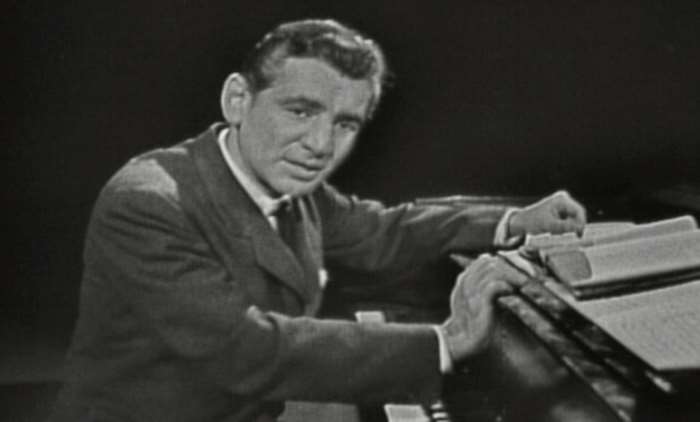
We’ve blogged before about Leonard Bernstein’s appearances on a 1950s television program called Omnibus, “the most successful cultural magazine series in the history of U.S. commercial television,” which featured scientists and artists presenting original ideas and compositions. In this documentary, Bernstein introduces his audience to “modern music,” including such a more or less classical composer as Stravinsky to the avant-garde instrumentation of John Cage’s prepared piano and early electronics of Pierre Henry’s musique concrete. After watching a sextet of “musicians” “playing” transistor radios, Bernstein admits, “Now compared with all these wildest outposts of experimentation… Stravinsky probably sounds tame or more like, well… music.” Bernstein then goes on to make a case for modern, experimental music, hoping to persuade his audience to “hate it less, or hate it more intelligently, or even grow to like it.” He’s a very patient teacher, and he anticipates his students’ first objection to the modernism of his time: “What has happened to beauty?” The beauty of Mozart, say, or Tchaikovsky?
In order to answer this question, Bernstein uses easily visualized analogies to baseball and numerous more or less familiar symphonic passages to explain basic music theory—tonality, harmonics, chord structure, scale patterns, melody, dissonance. By the time he comes to describe the conflict, post-Wagner, between atonal composers and more conservative “tonalists” around the twenty minute mark, you’ve got a pretty good idea of what he’s talking about, even if this debate is entirely new to you. It’s a captivating lecture tracing the history and logic of musical composition, and despite Bernstein’s range of references, he’s never esoteric. He had the patience of a Fred Rogers and media personality of a musical Carl Sagan (and, oddly, some of the mannerisms of Rod Serling). Like Rogers and Sagan, he was part of an age when television presenters could be educators first, entertainers second, and solipsists not at all. Luckily for us, we’ve got him on Youtube.
If you would like to support the mission of Open Culture, consider making a donation to our site. It’s hard to rely 100% on ads, and your contributions will help us continue providing the best free cultural and educational materials to learners everywhere. You can contribute through PayPal, Patreon, and Venmo (@openculture). Thanks!
Related Content:
Leonard Bernstein’s Masterful Lectures on Music (11+ Hours of Video Recorded in 1973)
Glenn Gould and Leonard Bernstein Play Bach
Josh Jones is a doctoral candidate in English at Fordham University and a co-founder and former managing editor of Guernica / A Magazine of Arts and Politics.
Read More...David Rees and His One-Man Artisanal Pencil Sharpening Service
This is for anyone with a love of old school woodworking — luthiers, ébénistes and the rest. In 2009, the humorist David Rees gave up cartooning and opened up his one-man artisanal pencil sharpening service in Beacon, New York, an old factory town along the Hudson River. Just a man, some high quality cedar, a knife, and an occasional pencil sharper revive a bygone era and a disappearing instrument of communication. 400 pencils later, at $15 a pop, Rees has something good going. You can learn more about Rees and his craftsmanship by reading (seriously) his new book, How to Sharpen Pencils, with a forward by John Hodgman.
Note: Rees uses some NSFW language during the video.
Read More...How Venice Works: 124 Islands, 183 Canals & 438 Bridges
3,000,000 tourists move through Venice each year. But when the tourists leave the city, 60,000 year-round residents stay behind, continuing their daily lives, which requires navigating an archipelago made up of 124 islands, 183 canals and 438 bridges. How this complicated city works – how the buildings are defended from water, how the buildings stand on unsteady ground, how the Venetians navigate this maze of a city – is a pretty fascinating story. These techniques have been worked out over Venice’s 1500 year history, and now they’re explored in a captivating 17 minute video produced by a Venetian government agency. You can learn more about the inner life of this great city at Venice Backstage.
via Metafilter
If you would like to support the mission of Open Culture, consider making a donation to our site. It’s hard to rely 100% on ads, and your contributions will help us continue providing the best free cultural and educational materials to learners everywhere. You can contribute through PayPal, Patreon, and Venmo (@openculture). Thanks!
Read More...Charismatic Psychoanalyst Jacques Lacan Gives Public Lecture (1972)
The footage above is from an extremely rare – and unexpectedly entertaining – video of the philosopher and psychoanalyst Jacques Lacan (1901–1981), giving a lecture at The Catholic University of Louvain in 1972. The film is notable for a couple of reasons:
1. In France, Lacan’s rock star status owed much to his popular public seminars. The charismatic iconoclast had been giving free public lectures for decades, and those lectures were usually packed with students, colleagues, skeptics, young radicals … and fans. The video gives you an idea of what the fuss was all about. Even at 70, Lacan still owns the room, and he has the presence of a stage actor, complete with dramatic pauses, ironic self-reflection, and pitch-perfect storms of emotion (see minute 15:07).
2. At minute 21:37, a politically inspired heckler tries to ambush him. It’s a moment right out of a comedy show, if the comedy show were chic and grainy and edited by Jean-Luc Goddard. Note the grace with which Lacan neutralizes the poor guy, lights his cigar and then concludes the lecture, even though the fallout from their encounter is still stuck in his hair.
Lacan’s ideas have fallen a bit out of fashion in the past two decades, particularly in the U.S., where psychoanalysis has been nudged out of the spotlight by neuroscience and post-structuralism has lost ground to post-colonial studies. But Lacan still has his fans, notably the “Elvis of Philosophy,” Slavoj Zizek, who dominates YouTube the way his predecessor once did salons.
Sheerly Avni is a San Francisco-based arts and culture writer. Her work has appeared in Salon, LA Weekly, Variety, Mother Jones, and many other publications. You can follow her on twitter at @sheerly.
Read More...Hear Hours of Lectures by Michel Foucault: Recorded in English & French Between 1961 and 1983
Tucked in the afterward of the second, 1982 edition of Hubert Dreyfus and Paul Rabinow’s Michel Foucault: Beyond Structuralism and Hermeneutics, we find an important, but little-known essay by Foucault himself titled “The Subject and Power.” Here, the French theorist offers what he construes as a summary of his life’s work: spanning 1961’s Madness and Civilization up to his three-volume, unfinished History of Sexuality, still in progress at the time of his death in 1984. He begins by telling us that he has not been, primarily, concerned with power, despite the word’s appearance in his essay’s title, its arguments, and in nearly everything else he has written. Instead, he has sought to discover the “modes of objectification which transform human beings into subjects.”
This distinction may seem abstruse, a needlessly wordy matter of semantics. It is not so for Foucault. In this key critical difference lies the originality of his project, in all its various stages of development. “Power,” as an abstraction, an objective relation of dominance, is static and conceptual, the image of a tyrant on a coin, of Thomas Hobbes’ Leviathan seated on his throne.
Subjection, subjectification, objectivizing, individualizing, on the other hand—critical terms in Foucault’s vocabulary—are active processes, disciplines, and practices, relationships between individuals and institutions that determine the character of both. These relationships can be located in history, as Foucault does in example after example, and they can also be critically studied in the present, and thus, perhaps, resisted and changed in what he terms “anarchistic struggles.”
Foucault calls for a “new economy of power relations,” and a critical theory that takes “forms of resistance against different forms of power as a starting point.” For example, in approaching the carceral state, we must examine the processes that divide “the criminals and the ‘good boys,’” processes that function independently of reason. How is it that a system can create classes of people who belong in cages and people who don’t, when the standard rational justification—the protection of society from violence—fails spectacularly to apply in millions of cases? From such excesses, Foucault writes, come two “‘diseases of power’—fascism and Stalinism.” Despite the “inner madness” of these “pathological forms” of state power, “they used to a large extent the ideas and the devices of our political rationality.”
People come to accept that mass incarceration, or invasive medical technologies, or economic deprivation, or mass surveillance and over-policing, is necessary and rational. They do so through the agency of what Foucault calls “pastoral power,” the secularization of religious authority as integral to the Western state.
This form of power cannot be exercised without knowing the inside of people’s minds, without exploring their souls, without making them reveal their innermost secrets. It implies a knowledge of the conscience and an ability to direct it.
In the last years of Foucault’s life, he shifted his focus from institutional discourses and mechanisms—psychiatric, carceral, medical—to disciplinary practices of self-control and the governing of others by “pastoral” means. Rather than ignoring individuality, the modern state, he writes, developed “as a very sophisticated structure, in which individuals can be integrated, under one condition: that this individuality would be shaped in a new form and submitted to a set of very specific patterns.” While writing his monumental History of Sexuality, he gave a series of lectures at Berkeley that explore the modern policing of the self.
In his lectures on “Truth and Subjectivity” (1980), Foucault looks at forms of interrogation and various “truth therapies” that function as subtle forms of coercion. Foucault returned to Berkeley in 1983 and delivered the lecture “Discourse and Truth,” which explores the concept of parrhesia, the Greek term meaning “free speech,” or as he calls it, “truth-telling as an activity.” Through analysis of the tragedies of Euripides and contemporary democratic crises, he reveals the practice of speaking truth to power as a kind of tightly controlled performance. Finally, in his lecture series “The Culture of the Self,” Foucault discusses ancient and modern practices of “self care” or “the care of the self” as technologies designed to produce certain kinds of tightly bounded subjectivities.
- Four Lectures on Truth and Subjectivity (1980)
- Six Lectures on Discourse and Truth (1983)
- Three Lectures on “The Culture of the Self” (1983)
You can hear parts of these lectures or visit our posts with full audio above. Also, over at Ubuweb, download the lectures as mp3s, and hear several earlier talks from Foucault in French, dating all the way back to 1961.
When he began his final series of talks in 1980, the philosopher was asked in an interview with the Daily Californian about the motivations for his critical examinations of power and subjectivity. His reply speaks to both his practical concern for resistance and his almost utopian belief in the limitless potential for human freedom. “No aspect of reality should be allowed to become a definitive and inhuman law for us,” Foucault says.
We have to rise up against all forms of power—but not just power in the narrow sense of the word, referring to the power of a government or of one social group over another: these are only a few particular instances of power.
Power is anything that tends to render immobile and untouchable those things that are offered to us as real, as true, as good.
Read Foucault’s statement of intent, his essay “The Subject and Power,” and learn more about his life and work in the 1993 documentary below.
Foucault’s lecture series will be added to our collection, 1,700 Free Online Courses from Top Universities.
Note: An earlier version of this post appeared on our site in 2018.
Related Content:
Watch a “Lost Interview” With Michel Foucault: Missing for 30 Years But Now Recovered
Michel Foucault and Alain Badiou Discuss “Philosophy and Psychology” on French TV (1965)
Clash of the Titans: Noam Chomsky & Michel Foucault Debate Human Nature & Power on Dutch TV, 1971
Josh Jones is a writer and musician based in Durham, NC.
Read More...Alfred Hitchcock Wanted Frank Lloyd Wright to Design the North by Northwest House: An Architect Just Built It for $45 Million
Villains who live in opulent, remote modernist houses may have been a cliché since the last century, but given Hollywood’s addiction to the tried and true, they do still turn up now and again. Unsurprisingly, few filmmakers have managed to use them anywhere near as memorably as Alfred Hitchcock did. Think back to North by Northwest, that showcase of both late-fifties high style and unadulterated Hitchcockery, and any number of images come right to mind: the deadly crop duster bearing down on Cary Grant, the hang off the edge of Mount Rushmore, the cheeky cut to the train entering the tunnel. But on the architecturally inclined, the deepest impression is made by not a shot but a set: the house — modernist, opulent, remote — occupied by James Mason’s villain Phillip Vandamm.
“The pioneering decision to feature a modern house as the villain’s lair in North by Northwest arose from both the practical needs of the script and the desire to explore innovation in architectural representation,” writes Christine Madrid French, author of The Architecture of Suspense: The Built World in the Films of Alfred Hitchcock.
The look of the Vandamm House betrays considerable inspiration from the work of Frank Lloyd Wright, especially his “iconic Fallingwater, best known for its astonishing projected porches cantilevered over a running stream.” As the Hollywood story goes, Hitchcock asked Wright himself about the possibility of designing the house, but when the architect asked for ten percent of the film’s entire budget, the job went to production designer Robert F. Boyle.
Despite the highly un-Wrightian steel beams supporting the cantilevered living room (inserted because Grant needed a way to climb in), moviegoers left the theater assuming that they’d witnessed a showdown in one of his houses. In fact, like so many of Hitchcock’s famous built environments, the structure didn’t actually exist: Boyle and his collaborators constructed pieces on sets, completing the rest with matte paintings. Yet their work did, in a sense, bring the Vandamm House into the world. A North by Northwest fan since childhood, architect John Boccardo just this year achieved his $45 million dream of building it for real. Apart from faithfully replicating onscreen details, he also put in an eighteen-seat home theater, possibly on the safe assumption that the buyer will be a fellow cinephile — who, given that the house overlooks Park City, Utah rather than sits atop Mount Rushmore, will surely rue the day Sundance decided to move to Boulder. See photos here.
If you would like to support the mission of Open Culture, consider making a donation to our site. It’s hard to rely 100% on ads, and your contributions will help us continue providing the best free cultural and educational materials to learners everywhere. You can contribute through PayPal, Patreon, and Venmo (@openculture). Thanks!
Related content:
16 Free Hitchcock Movies Online
Alfred Hitchcock Explains the Plot Device He Called the ‘MacGuffin’
1,300 Photos of Famous Modern American Homes Now Online, Courtesy of USC
A Meditative Tour of Fallingwater, Frank Lloyd Wright’s Architectural Masterpiece
Salvador Dalí Creates a Dream Sequence for Spellbound, Hitchcock’s Psychoanalytic Thriller
Based in Seoul, Colin Marshall writes and broadcasts on cities, language, and culture. He’s the author of the newsletter Books on Cities as well as the books 한국 요약 금지 (No Summarizing Korea) and Korean Newtro. Follow him on the social network formerly known as Twitter at @colinmarshall.
Read More...Support Us
We're hoping to rely on loyal readers, rather than erratic ads. Please click the Donate button and support Open Culture. You can use Paypal, Venmo, Patreon, even Crypto! We thank you!

About Us

Open Culture scours the web for the best educational media. We find the free courses and audio books you need, the language lessons & educational videos you want, and plenty of enlightenment in between.
Advertise With Us
FREE UPDATES!
GET OUR DAILY EMAIL
Get the best cultural and educational resources on the web curated for you in a daily email. We never spam. Unsubscribe at any time.
FOLLOW ON SOCIAL MEDIA
Open Culture editor Dan Colman scours the web for the best educational media. He finds the free courses and audio books you need, the language lessons & movies you want, and plenty of enlightenment in between.
Advertise With Us

