Isaac Asimov Laments the “Cult of Ignorance” in the United States (1980)

Rochester Institute of Technology, via Wikimedia Commons
In 1980, scientist and writer Isaac Asimov argued in an essay that “there is a cult of ignorance in the United States, and there always has been.” That year, the Republican Party stood at the dawn of the Reagan Revolution, which initiated a decades-long conservative groundswell. Political strategist Steve Schmidt (who has been regretful about choosing Sarah Palin as John McCain’s running mate in 2008) once pointed to what he called “intellectual rot” as a primary culprit, and a cult-like devotion to irrationality among a certain segment of the electorate.
It’s a familiar contention. There have been critiques of American anti-intellectualism since the country’s founding, though whether or not that phenomenon has intensified, as Susan Jacoby alleged in The Age of American Unreason, may be a subject of debate. Not all of the unreason is partisan, as failures to challenge human- and AI-generated misinformation in political news sources and social media outlets over recent years have shown. But “the strain of anti-intellectualism,” writes Asimov, “has been a constant thread winding its way through our political and cultural life, nurtured by the false notion that democracy means that ‘my ignorance is just as good as your knowledge.’”
Asimov’s primary examples happen to come from the political world. However, he doesn’t name contemporary names but reaches back to take a swipe at Eisenhower (“who invented a version of the English language that was all his own”) and George Wallace. Particularly interesting is Asimov’s take on the “slogan on the part of the obscurantists: ‘Don’t trust the experts!’” This language, along with charges of “elitism,” Asimov wryly notes, is so often used by people who are themselves experts and elites, “feeling guilty about having gone to school.” So many of the American political class’ wounds are self-inflicted, he suggests, but that’s because they are beholden to a largely ignorant electorate:
To be sure, the average American can sign his name more or less legibly, and can make out the sports headlines—but how many nonelitist Americans can, without undue difficulty, read as many as a thousand consecutive words of small print, some of which may be trisyllabic?
Asimov’s examples are less than convincing: road signs “steadily being replaced by little pictures to make them internationally legible” has more to do with linguistic diversity than illiteracy, and accusing television commercials of speaking their messages out loud instead of using printed text on the screen seems to fundamentally misunderstand the nature of the medium. Jacoby in her book-length study of the problem looks at educational policy in the United States, and the resistance to national standards that virtually ensures widespread pockets of ignorance all over the country. Asimov’s very short, pithy essay has neither the space nor the inclination to conduct such analysis.
Instead he is concerned with attitudes. Not only are many Americans badly educated, he writes, but the broad ignorance of the population in matters of “science… mathematics… economics… foreign languages…” has as much to do with Americans’ unwillingness to read as their inability.
There are 200 million Americans who have inhabited schoolrooms at some time in their lives and who will admit that they know how to read… but most decent periodicals believe they are doing amazingly well if they have circulation of half a million. It may be that only 1 per cent—or less—of Americans make a stab at exercising their right to know. And if they try to do anything on that basis they are quite likely to be accused of being elitists.
One might in some respects charge Asimov himself of elitism when he concludes, “We can all be members of the intellectual elite.” Such a blithely optimistic statement ignores the ways in which economic elites actively manipulate education policy to suit their interests, cripple education funding, and oppose efforts at free or low cost higher education. Many efforts at spreading knowledge—like the Chautauquas of the early 20th century, the educational radio programs of the 40s and 50s, and the public television revolution of the 70s and 80s—have been ad hoc and nearly always imperiled by funding crises and the designs of profiteers.
Nonetheless, the widespread (though hardly universal) availability of free resources on the internet has made self-education a reality for many people, and certainly for most Americans. But perhaps not even Isaac Asimov could have foreseen the bitter polarization and disinformation campaigns that technology has also enabled. Needless to say, “A Cult of Ignorance” was not one of Asimov’s most popular pieces of writing. First published on January 21, 1980 in Newsweek, the short essay has never been reprinted in any of Asimov’s collections.
Note: An earlier version of this post appeared on our site in 2016.
Related Content:
Isaac Asimov Predicts the Future on The David Letterman Show (1980)
Isaac Asimov on How Libraries Can Radically Change Your Life (1971)
Isaac Asimov Predicts in 1964 What the World Will Look Like in 2014
Josh Jones is a writer and musician based in Durham, NC.
Read More...Hannah Arendt on “Personal Responsibility Under Dictatorship:” Better to Suffer Than Collaborate

Image by Bernd Schwabe, via Wikimedia Commons
When Eichmann in Jerusalem—Hannah Arendt’s book about Nazi officer Adolf Eichmann’s trial—came out in 1963, it contributed one of the most famous of post-war ideas to the discourse, the “banality of evil.” And the concept at first caused a critical furor. “Enormous controversy centered on what Arendt had written about the conduct of the trial, her depiction of Eichmann, and her discussion of the role of the Jewish Councils,” writes Michael Ezra at Dissent magazine, “Eichmann, she claimed, was not a ‘monster’; instead, she suspected, he was a ‘clown.’”
Arendt blamed victims who were forced to collaborate, critics charged, and made the Nazi officer seem ordinary and unremarkable, relieving him of the extreme moral weight of his responsibility. She answered these charges in an essay titled “Personal Responsibility Under Dictatorship,” published in 1964. Here, she aims to clarify the question in her title by arguing that if Eichmann were allowed to represent a monstrous and inhuman system, rather than shockingly ordinary human beings, his conviction would make him a scapegoat and let others off the hook. Instead, she believes that everyone who worked for the regime, whatever their motives, is complicit and morally culpable.
But although most people are culpable of great moral crimes, those who collaborated were not, in fact, criminals. On the contrary, they chose to follow the rules in a demonstrably criminal regime. It’s a nuance that becomes a stark moral challenge. Arendt points out that everyone who served the regime agreed to degrees of violence when they had other options, even if those might be fatal. Quoting Mary McCarthy, she writes, “If somebody points a gun at you and says, ‘Kill your friend or I will kill you,’ he is tempting you, that is all.”
While this circumstance may provide a “legal excuse,” for killing, Arendt seeks to define a “moral issue,” a Socratic principle she had “taken for granted” that we all believed: “It is better to suffer than do wrong,” even when doing wrong is the law. People like Eichmann were not criminals and psychopaths, Arendt argued, but rule-followers protected by social privilege. “It was precisely the members of respectable society,” she writes, “who had not been touched by the intellectual and moral upheaval in the early stages of the Nazi period, who were the first to yield. They simply exchanged one system of values against another,” without reflecting on the morality of the entire new system.
Those who refused, on the other hand, who even “chose to die,” rather than kill, did not have “highly developed intelligence or sophistication in moral matters.” But they were critical thinkers practicing what Socrates called a “silent dialogue between me and myself,” and they refused to face a future where they would have to live with themselves after committing or enabling atrocities. We must remember, Arendt writes, that “whatever else happens, as long as we live we shall have to live together with ourselves.”
Such refusals to participate might be small and private and seemingly ineffectual, but in large enough numbers, they would matter. “All governments,” Arendt writes, quoting James Madison, “rest on consent,” rather than abject obedience. Without the consent of government and corporate employees, the “leader… would be helpless.” Arendt admits the unlikely effectiveness of active opposition to a one-party authoritarian state. And yet when people feel most powerless, most under duress, she writes, an honest “admission of one’s own impotence” can give us “a last remnant of strength” to refuse.
We have only for a moment to imagine what would happen to any of these forms of government if enough people would act “irresponsibly” and refuse support, even without active resistance and rebellion, to see how effective a weapon this could be. It is in fact one of the many variations of nonviolent action and resistance—for instance the power that is potential in civil disobedience.
We have example after example of these kinds of refusals to participate in a murderous system or further its aims. Arendt was aware these actions can come at great cost. The alternatives, she argues, may be far worse.
Note: An earlier version of this post appeared on our site in 2017.
Related Content:
Hannah Arendt’s Original Articles on “the Banality of Evil” in the New Yorker Archive
Henry David Thoreau on When Civil Disobedience and Resistance Are Justified (1849)
Josh Jones is a writer and musician based in Durham, NC.
Read More...When The Surrealists Expelled Salvador Dalí for “the Glorification of Hitlerian Fascism” (1934)

Image by Carl Van Vechten, via Library of Congress and Wikimedia Commons
We may be conditioned to offering an opinion at the push of a button, but before venturing on the question of whether we can, or should, separate the art from the artist, it seems ever prudent to ask, “Which art and which artist?” There are the usual case studies, in addition to the crop of disgraced celebrities: Ezra Pound, P.G. Wodehouse, and, in philosophy, Martin Heidegger. One case of a very troubling artist, Salvador Dalí, gets less attention, but offers us much material for consideration, especially alongside an essay by George Orwell, who ruminated on the question and called Dalí both “a disgusting human being” and an artist of undeniably “exceptional gifts.”
Like these other figures, Dalí has long been alleged to have had fascist sympathies, a charge that goes back to the 1930s and perhaps originated with his fellow Surrealists, especially André Breton, who put Dalí on “trial” in 1934 for “the glorification of Hitlerian fascism” and expelled him from the movement. The Surrealists, most of whom were communists, were provoked by Dalí’s disdain for their politics, expressed in the likeness of Lenin in The Enigma of William Tell. It’s also true that Dalí seemed to publicly profess an admiration for Hitler. But as with everything he did, it’s impossible to tell how seriously we can take any of his pronouncements.
Another painting, 1939’s The Enigma of Hitler is even more ambiguous than The Enigma of William Tell, a collection of dream images, with the recurring melting objects, crutches, mollusk shells, and food images, set around a tiny portrait of the German dictator. Kamila Kocialkowska suggests that psychoanalytic motifs in the painting, some rather obvious, reflect Hitler’s “fear of impotence, and certain commentators have noted that Hitler’s enthusiastic promotion of nationalistic breeding can further explain the innuendo present in this image.”
The Hitler obsession began years earlier. “I often dreamed of Hitler as a woman,” Dalí supposedly said,
His flesh, which I imagined as whiter than white, ravished me. I painted a Hitlerian wet nurse sitting kneeling in a puddle of water….
There was no reason for me to stop telling one and all that to me Hitler embodied the perfect image of the great masochist who would unleash a world war solely for the pleasure of losing and burying himself beneath the rubble.
The painting Dalí alludes to, The Weaning of Furniture-Nutrition, is the work that first raised Breton’s ire, since “Dalí had originally painted a swastika on the nurse’s armband,” notes art historian Robin Adèle Greeley, “which the Surrealists later forced him to paint out.” Dalí later claimed that his Hitler paintings “subvert fascist ideologies,” Greeley writes: “Breton and company appear not to have appreciated a fellow Surrealist suggesting that there were connections to be made between bourgeois childhoods such as their own and the family life of the Nazi dictator.” Likewise, his creepy dream-language above is hardly more straightforward than the paintings, though he did write in The Unspeakable Confessions of Salvador Dalí, “Hitler turned me on in the highest.”
Other pieces of evidence for Dalí’s politics are also compelling but still circumstantial, such as his friendship with the proudly professed Nazi-sympathizer, Wallis Simpson, the American Duchess of Windsor, and his admiration for Spanish dictator Francisco Franco, whom he called, as Lauren Oyler points out at Vice, “the greatest hero of Spain.” (Dalí painted a portrait of Franco’s daughter). Oyler points out that Dalí’s “wickedness,” as Orwell put it in his scathing review of the artist’s “autobiography” (a spurious category in the case of serial fabricator Dalí), matters even if it were pure provocation rather than genuine commitment.
The claim carries more weight when applied to the artist’s attested sadism in general. Dalí spends a good part of his Confessions delighting in stories of brutal physical and sexual assault and cruelty to animals. (The famous Dalí Atomicus photo, his collaboration with Philippe Halsman, required 28 attempts, Oyler notes, and “each of those attempts involved throwing three cats in the air and flinging buckets of water at them.”) Whether or not Dalí was a genuine Nazi sympathizer or an amoral right-wing troll, Orwell is completely unwilling to give him a pass for generally cruel, abusive behavior.
“In his outlook,” writes Orwell, “his character, the bedrock decency of a human being does not exist. He is as anti-social as a flea. Clearly, such people are undesirable, and a society in which they can flourish has something wrong with it.” But perhaps Dalí means to say exactly that. Allowing for the possibility, Orwell is also unwilling to toss aside Dalí’s work. The artist, he writes “has fifty times more talent than most of the people who would denounce his morals and jeer at his paintings.”
When it comes to the question of Dalí as fascist, some less-than-nuanced views of his work (“Marxist criticism has a short way with such phenomena as Surrealism,” writes Orwell) might miss the mark. The Weaning of Furniture-Nutrition, writes Greeley, seems to reveal “a secret about his own middle-class background” as a nursery for fascism, especially given the “disturbing” fact that “the nurse is a portrait of Dalí’s own, and that she droops hollowly on the shore near the painter’s Catalan childhood home, suggesting that Dalí himself might have had a ‘hitlerian’ upbringing.”
Greeley’s further elaboration on Dalí’s conflict with Breton further weakens the charges against him. “Ten days before the February meeting, he had defended himself to Breton,” she writes, “claiming, ‘I am hitlerian neither in fact nor in intention.’ ” He pointed out that the Nazis would likely burn his work, and chastised leftists for “their lack of insight into fascism.”
The question of Dalí’s fascist sympathies is incoherent without the biography, and the biographical evidence against Dalí seems fairly thin. Nonetheless, he has emerged from history as a violent, vicious, opportunistic person. How much this should matter to our appreciation of his art is a matter you’ll have to decide for yourself.
Note: An earlier version of this post appeared on our site in 2018.
Related Content:
Heidegger’s “Black Notebooks” Suggest He Was a Serious Anti-Semite, Not Just a Naive Nazi
Josh Jones is a writer and musician based in Durham, NC.
Read More...How Can I Know Right From Wrong? Watch Philosophy Animations on Ethics Narrated by Harry Shearer
The history of moral philosophy in the West hinges principally on a handful of questions: Is there a God of some sort? An afterlife? Free will? And, perhaps most pressingly for humanists, what exactly is the nature of our obligations to others? The latter question has long occupied philosophers like Immanuel Kant, whose extreme formulation—the “categorical imperative”—flatly rules out making ethical decisions dependent upon particular situations. Kant’s famous example, one that generally gets repeated with a nod to Godwin, involves an axe murderer showing up at your door and asking for the whereabouts of a visiting friend. In Kant’s estimation, telling a lie in this case justifies telling a lie at any time, for any reason. Therefore, it is unethical.
In the video at the top of the post, Harry Shearer narrates a script about Kant’s maxim written by philosopher Nigel Warburton, with whimsical illustrations provided by Cognitive. Part of the BBC and Open University’s “A History of Ideas” series, the video—one of four dealing with moral philosophy—also explains how Kant’s approach to ethics differs from those of utilitarianism.
In the video above, Shearer describes the most utilitarian of thought experiments, the “Trolley Problem.” As described by philosopher Philippa Foot, this scenario imagines having to sacrifice the life of one for those of many. But there is a twist—the second version involves the added crime of physically murdering one person, up close and personal, to save several. An analogous but converse theory is that of philosopher Peter Singer (below) who proposes that our obligations to people in peril right in front of us equal our obligations to those on the other side of the world.
Finally, the last video surveys one of the thorniest issues in moral philosophical history—the “is/ought” divide, as problematic as the ancient Euthyphro dilemma. How, asked David Hume, are we to deduce moral principles from facts about the world that have no moral dimension? Particularly when those facts are never conclusive, are subject to revision, and when new ones get uncovered all the time? The question introduces a seemingly unbridgeable chasm between facts and values. Moral judgments founded on what is or isn’t “natural” flounder before our terror of much of what nature does, and the very partial and fallible nature of our knowledge of it.
The problem is as startling as Hume’s critique of causality, and in part caused Kant to remark that Hume had awakened him from a “dogmatic slumber.” What may strike viewers of the series is just how abstract these questions and examples are—how divorced from the messiness of real world politics, with the exception, perhaps, of Peter Singer. It may be instructive that political philosophy forms a separate branch in the West. While these problems are certainly difficult enough to trouble the sleep of just about any thoughtful person, in our day-to-day lives, our decision making process seems to be much messier, and much more situational, than we’re probably ever aware of.
Note: An earlier version of this post appeared on our site in 2015.
Related Content:
Free Online Philosophy Courses
What Makes Us Human?: Chomsky, Locke & Marx Introduced by New Animated Videos from the BBC
Josh Jones is a writer and musician based in Durham, NC.
Read More...Meet Héloïse, the Medieval Woman Philosopher Who Turned a Doomed Love Affair into a Meditation on Ethics
The ill-fated romance of Abelard and Héloïse may be a permanent cultural fixture, but it’s worth asking what any of us understand about Abelard or Héloïse themselves. Before the two ever crossed paths, Peter Abelard was already a celebrated philosopher in France whose classes drew large and enthusiastic crowds. This was, bear in mind, a time and place where arguing realism versus conceptualism amounted to a spectator sport. A modern framing might analogize him to a cross between an intellectual athlete and a public intellectual. That he would attract admiring pupils is a given, but none seems to have exuded the sheer allure of Héloïse d’Argenteuil.
That allure, moreover, was of the mind at least as much as of the body. “A prodigy from a young age, Héloïse was fluent in several languages and renowned for her poetry, musical prowess, and fiery wit,” explains the narrator of the new video from Aeon above. ”
As women couldn’t attend university, her uncle and guardian arranged for her to continue her education with a renowned young scholar.” That, of course, was Abelard, who didn’t need too much one-on-one time with his new pupil before deciding to cast off his famously ascetic ways and roll the dice on love. Alas, we all know at least the more dramatic points of how it turned out: castration for Abelard, self-imposed cloistering for the both of them. Yet even that didn’t mark the end of their association.
In her nunhood, Héloïse “came to possess a letter Abelard intended to send to a friend, eulogizing their time together. In response, she initiated a years-long correspondence.” The letters “are steeped in longing, yet they transcend the sighs of star-crossed lovers, weaving heart-wrenching personal sentiment with trailblazing theology and philosophy.” At one point, Héloïse brings her philosophical mind to bear on the problem of their own relationship, arriving at her simultaneous guilt and innocence on the premise that “it is not the deed, but the intention of the doer, which makes the crime.” Here we have an early example of what philosophers today call “intentionalist,” as opposed to “consequentialist,” ethics. How much comfort her argument that “there can be no sin in an action done out of love” provided Abelard is unclear. But surely he appreciated its intellectual merits, given that his mind, at least, was left wholly intact.
Related Content:
The Contributions of Women Philosophers Recovered by the New Project Vox Website
A Short Animated Introduction to Hypatia, Ancient Alexandria’s Great Female Philosopher
An Animated Introduction to the Feminist Philosophy of Simone de Beauvoir
Kierkegaard on Why We All Misunderstand the True Meaning of Love: An Animated Explanation
Based in Seoul, Colin Marshall writes and broadcasts on cities, language, and culture. He’s the author of the newsletter Books on Cities as well as the books 한국 요약 금지 (No Summarizing Korea) and Korean Newtro. Follow him on the social network formerly known as Twitter at @colinmarshall.
Read More...Time Travel Back to 1926 and Watch Wassily Kandinsky Make Art in Some Rare Vintage Video
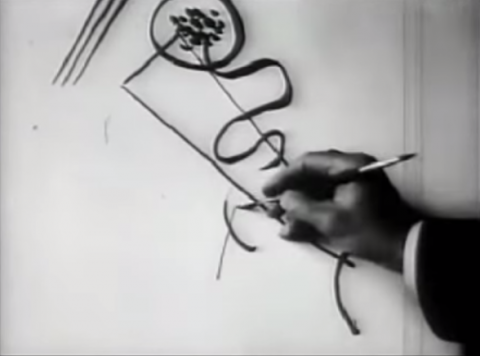
Have you ever wondered what it would be like to travel back in time and look over the shoulder of one of the early 20th century’s greatest artists to watch him work? In this brief film from 1926, we get to see the Russian painter Wassily Kandinsky as he turns a blank canvas into one of his distinctive abstract compositions.
The film was made at the Galerie Neumann-Nierendorf in Berlin by Hans Cürlis, a pioneer in the making of art documentaries. At the time, Kandinsky was teaching at the Bauhaus. It was the same year he published his second major treatise, On Point and Line to Plane. The contrasting straight lines and curves that Kandinsky paints in the movie are typical of this period, when his approach was becoming less intuitive and more consciously geometric.
Kandinsky believed that an artist could reach deeper truths by dispensing with the depiction of external objects and by looking within, and despite his analytic turn at the Bauhaus he continued to speak of art in deeply mystical terms. In On Point and Line to Plane, Kandinsky writes:
The work of Art mirrors itself upon the surface of our consciousness. However, its image extends beyond, to vanish from the surface without a trace when the sensation has subsided. A certain transparent, but defininite glass-like partition, abolishing direct contact from within, seems to exist here as well. Here, too, exists the possibility of entering art’s message, to participate actively, and to experience its pulsating life with all one’s senses.
Note: An earlier version of this post appeared on our site in 2012.
Related content:
Watch Footage of Claude Monet Painting in His Famous Garden at Giverny (1915)
Vintage Film: Watch Henri Matisse Sketch and Make His Famous Cut-Outs (1946)
Read More...When Roald Dahl Wrote a Story Predicting the Rise of ChatGPT and Other AI Large Language Models (1954)
Most of us who know the work of Roald Dahl grew up with it, eventually coming to consider the man a master of imaginative, often grotesque tales for children. A bit later on, when we heard that he’d also written books for adults, with titles like Kiss Kiss and Switch Bitch, some of us sought them out as a kind of forbidden literary fruit. What tends to escape notice is that he also wrote for teenagers — or, in any case, that certain of his stories were packaged for teenagers into the posthumous volume The Great Automatic Grammatizator, whose title story has gained a new relevance in our age of ChatGPT, as explained in the new Tibees video above.
First published in 1954, “The Great Automatic Grammatizator” concerns an enormously complex, wholly analog machine that can generate page after page of text at a then-unimaginable clip. Its inventor, a beaten-down young corporate employee called Adolph Knipe, designs it based on the same principles he’d used to create an electric calculator that pleased his boss, Mr. Bohlen. A frustrated writer of fiction by night, Knipe conceives of the Grammatizator as a tool of revenge against the magazine industry that spurned him. With the company’s backing to build the thing, he tells Bohlen, they could dominate the market for short stories almost without effort — and make their own prestigious names as authors to boot.
“It stands to reason that an engine built along the lines of the electric computer could be adjusted to arrange words (instead of numbers) in their right order according to the rules of grammar,” Dahl writes. “Give it the verbs, the nouns, the adjectives, the pronouns, store them in the memory section as a vocabulary, and arrange for them to be extracted as required. Then feed it with plots and leave it to write the sentences.” Though Bohlen accepts the technical proposition, he at first doubts the commercial one, at least until his employee informs him that magazines like the Saturday Evening Post, Collier’s, and Ladies’ Home Journal will pay for a story “anything up to twenty-five hundred dollars”: nearly $40,000 today.
Of course, 1954 was a different time. Today, the Saturday Evening Post, Collier’s, and Ladies’ Home Journal have all gone, as has the prospect of earning even a meager living through short stories. And a computer of this kind, as Dahl describes it, would have been an enormous, noisy device laden with buttons, dials, pedals, and stops, each of which the “writer” would use to control such variables as theme, style, tension, humor, and passion. “The quality may be inferior,” an increasingly power-mad Knipe admits of the machine’s output, “but that doesn’t matter. It’s the cost of production that counts.” All of us now possess Grammatizators of our own, far faster, cheaper, more versatile, and easier to use than anything Roald Dahl could have imagined. Yet how many of us can hope to be read more than 70 years in the future?
via Metafilter
Related content:
How George Orwell Predicted the Rise of “AI Slop” in Nineteen Eighty-Four (1949)
Based in Seoul, Colin Marshall writes and broadcasts on cities, language, and culture. He’s the author of the newsletter Books on Cities as well as the books 한국 요약 금지 (No Summarizing Korea) and Korean Newtro. Follow him on the social network formerly known as Twitter at @colinmarshall.
Read More...How William S. Burroughs Used the Cut-Up Technique to Shut Down London’s First Espresso Bar (1972)
As we’ve noted before, the English coffeehouse has served as a staging ground for radical, sometimes revolutionary social change. Certainly this was the case during the Enlightenment, as it was with the salons in France. And yet, by the early 20th century it seems, coffee shops in London had grown scarcer and more humdrum. That is until 1953 when the Moka Bar, the UK’s first Italian espresso bar, opened in Soho. On his blog The Great Wen, Peter Watts describes its arrival as “a momentous event”:
London’s first proper coffee shop—one equipped with a Gaggia coffee machine—opened at 29 Frith Street. This was a place where teenagers too young for pubs could come and gather, and it is said by some that the introduction of this coffee bar prompted the youth culture explosion that soon changed social life in Britain forever.
“By 1972,” Watts writes, “coffee bars were everywhere and the teenage revolution was firmly established.” Places like the Moka Bar might seem like the ideal place for countercultural maven William S. Burroughs—a London resident from the late sixties to early seventies—to hobnob with young dissidents and outsiders. Burroughs, who so approvingly refers to the possibly apocryphal anarchist pirate colony of Libertatia in his Cities of the Red Night, would, one might think, appreciate the budding anarchism of British youth culture, which would flower into punk soon enough.

But rather than joining the coffee bar scene, the cantankerous Burroughs had taken to frequenting “plush gentlemen’s shops of the area, not to mention the ‘Dilly Boys,’ young male prostitutes who hustled for clients outside the Regent Palace Hotel.”
And he had grown increasingly disillusioned with London, fuming, writes Ted Morgan in Burroughs’ biography Literary Outlaw, “at what he was paying for his hole-in-the-wall apartment with a closet for a kitchen” and at the rising price of utilities. “Burroughs,” Morgan tells us, “began to feel that he was in enemy territory.” And he thought the Moka coffee bar should pay the price for his indignities.
There, “on several occasions a snarling counterman had treated him with outrageous and unprovoked discourtesy, and served him poisonous cheesecake that made him sick.” Burroughs “decided to retaliate by putting a curse on the place.” He chose a means of attack that he’d earlier employed against the Church of Scientology, “turning up… every day,” writes Watts, “taking photographs and making sound recordings.” Then he would play them back a day or so later on the street outside the Moka. “The idea,” writes Morgan, “was to place the Moka Bar out of time. You played back a tape that had taken place two days ago and you superimposed it on what was happening now, which pulled them out of their time position.”
Burroughs also connected the method to the Watergate recordings, the Garden of Eden, and the theories of Alfred Korzybski. The trigger for the magical operation was, in his words, “playback.” In a very strange essay called “Feedback from Watergate to the Garden of Eden,” from his collection Electronic Revolution, Burroughs described his operation in detail, a disruption, he wrote, of a “control system.”
Now to apply the 3 tape recorder analogy to this simple operation. Tape recorder 1 is the Moka Bar itself it is in pristine condition. Tape recorder 2 is my recordings of the Moka Bar vicinity. These recordings are access. Tape recorder 2 in the Garden of Eden was Eve made from Adam. So a recording made from the Moka Bar is a piece of the Moka Bar. The recording once made, this piece becomes autonomous and out of their control. Tape recorder 3 is playback. Adam experiences shame when his discgraceful behavior is played back to him by tape recorder 3 which is God. By playing back my recordings to the Moka Bar when I want and with any changes I wish to make in the recordings, I become God for this local. I effect them. They cannot affect me.
The theory made perfect sense to Burroughs, who believed in a Magical Universe ruled by occult forces and who experimented heavily with Scientology, Crowley-an Magick, and the orgone energy of Wilhelm Reich. The attack on the Moka worked, or at least Burroughs believed it did. “They are seething in there,” he wrote, “I have them and they know it.” On October 30th, 1972 the establishment closed its doors—perhaps a consequence of those rising rents that so irked the Beat writer—and the location became the Queens Snack Bar.
The audio-visual cut-up technique Burroughs used in his attack against the Moka Bar was a method derived by Burroughs and Brion Gysin from their experiments with written “cut-ups,” and Burroughs applied it to film as well. At the top of the post, see an interpretive “meditation” based on Burroughs’ use of audio/visual “magical weapons” and incorporating his recordings. On YouTube, you can watch “The Cut Ups,” a short film Burroughs himself made in 1966 with cinematographer Antony Balch, a disorienting illustration of the cut up technique.
Not limited to attacking annoying London coffeehouse owners, Burroughs’ supposedly magical interventions in reality were in fact the fullest expression of his creativity. As Ted Morgan writes, “the single most important thing about Burroughs was his belief in the magical universe. The same impulse that led him to put out curses was, as he saw it, the source of his writing.” Read much more about Burroughs’ theory and practice in Matthew Levi Stevens’ essay “The Magical Universe of William S. Burroughs,” and hear the author himself discourse on the paranormal, tape cut-ups, and much more in the lecture below from a writing class he gave in June, 1986.
Note: An earlier version of this post appeared on our site in 2014.
Related Content:
How David Bowie, Kurt Cobain & Thom Yorke Write Songs With William Burroughs’ Cut-Up Technique
When William S. Burroughs Joined Scientology (and His 1971 Book Denouncing It)
How to Jumpstart Your Creative Process with William S. Burroughs’ Cut-Up Technique
Josh Jones is a writer and musician based in Durham, NC.
Read More...The Strange History of Lorem Ipsum: How Cicero’s Words Became the World’s Favorite Placeholder Text
Though seldom heard these days, the term “desktop publishing” once opened a great many eyes to the promise of the personal computer. It meant that one could create a publication without owning a press or contracting with an outfit that did. Indeed, the whole process of writing, design, and printing could take place on one’s desk, provided one had furnished it with the right computer and accessories. From the mid-eighties through the early nineties, that meant an Apple Macintosh equipped with a LaserWriter printer and a copy of Aldus PageMaker. For the first time, ordinary computer users could create newsletters, brochures, and other documents assured that “what you see” onscreen is “what you get,” a feature abbreviated as WYSIWYG.
That’s not the only strange-looking piece of text encountered by early desktop publishers. Since PageMaker enabled users to create a layout before even having the words to fill it, it needed dummy text to occupy the empty spaces in order to provide a reasonable approximation of how the printed result would look. “Lorem ipsum dolor sit amet, consectetur adipiscing elit, sed do eiusmod tempor incididunt ut labore et dolore magna aliqua,” that dummy text begins, and it continues as long as its defined field allows, repeating itself as necessary. It may resemble Latin, but anyone with a decent understanding of that language won’t have to read much before noticing how oddly mangled it is. So where did this mysterious text, still familiar to all layout editors and graphic designers, actually come from?
Pursuing an answer to that question in her new video above, Rabbit Hole creator Emily Zhang talks to individuals with relevant experience including Laura Perry, the former creative director at Aldus (a company named, incidentally, for the fifteenth-century Venetian printer Aldus Manutius). It was she who first made Lorem ipsum digital, having previously used it as a wholly analog graphic designer in the form of rub-off Letraset sheets. She manually entered it straight into PageMaker off one such sheet, making occasional typos along the way. That was just another phase of transformation Lorem ipsum had been undergoing since Cicero’s words were first borrowed — and chopped up, and mixed with fragments of other languages — to create what became the industry-standard dummy text.
In the process of filling the gaps in this story, Zhang also talks to Richard McClintock, a professor of Latin long acknowledged as the premier expert on Lorem ipsum. Ultimately, she unearths a few truths that are new even to him, including an important one about the 1966 meeting at Letraset in which the idea was first floated of a single piece of dummy text that could substitute for most Western languages. It was James Mosley, the highly knowledgeable head librarian at the St. Bride Printing Library, who delivered Letraset the Cicero quotation originally known as Forum ipsum, “which had become garbled by more than one typesetter sitting at his bench since the mid-fifteen-hundreds.” Likely to remain in use as long as humanity puts words on pages — paper, digital, or whatever comes next — Lorem ipsum surely has a few more forms to take.
Related Content:
The Story of Lorem Ipsum: How Scrambled Text by Cicero Became Used by Typesetters Everywhere
Based in Seoul, Colin Marshall writes and broadcasts on cities, language, and culture. He’s the author of the newsletter Books on Cities as well as the books 한국 요약 금지 (No Summarizing Korea) and Korean Newtro. Follow him on the social network formerly known as Twitter at @colinmarshall.
Read More...How Conflict Helped Create Pink Floyd’s “Comfortably Numb” and Its Legendary Guitar Solos
Even among the most acclaimed albums ever recorded, not a single one is perfect. That goes more so for the releases of what I call the “heroic age of the album,” which enjoyed its zenith around the late seventies. Not coincidentally, 1979 was the year that Pink Floyd put out The Wall, a rock opera whose sprawl across two discs deals with themes ranging from the bombings of the Second World War to drug dependency to fascist impulses to the isolation of superstardom. This ambition was repaid: The Wall soon became the best-selling double album of all time, despite having been received with at least a measure of ambivalence over the grandness, or perhaps grandiosity, of the scale of its production and the tone of its narrative.
Yet those few prepared to call The Wall an artistic failure must nevertheless acknowledge how much impressive work it really does contain. Of its popularly appreciated achievements, perhaps the most memorable is David Gilmour’s guitar solo, or rather the guitar solos, on “Comfortably Numb,” a song about being medically revived from a substance-induced stupor moments before giving a concert.
They certainly stuck in my own head in seventh grade, when my music teacher assigned our class term paper analyzing the album, and kept popping back into it over the subsequent decades. “His playing is so lyrical,” says YouTuber David Hartley in his new video about the making of “Comfortably Numb.” “The way he plays each note is in a way that you can almost sing it, and the way he uses phrases is so simple, and so beautiful.”
These solos were recorded in a context of less-than-smooth sailing for the Floyd: as we’ve previously featured here on Open Culture, “Comfortably Numb” was the product of another argument punctuating the long-fraying partnership between Gilmour and lead singer Roger Waters, for whom The Wall was a way of rendering his own life experiences and perceptions in musical form. But as sometimes happens, conflict — in this case, between two competing and starkly different concepts of the song, whose evolution Hartley explains with demo recordings and interview clips — produced a greater result than any one artist’s vision. It all arrives at what Hartley calls “possibly the greatest guitar solo of all time,” which closes out side three, and indeed the most fruitful era of Gilmour and Waters’ collaboration. Even those who can’t take The Wall too seriously have to admit that life isn’t necessarily easy for a rock star, much less for two of them in the same studio.
Related content:
The History of the Electric Guitar Solo: A Seven-Part Series
Oxford Scientist Explains the Physics of Playing Electric Guitar Solos
David Gilmour & David Bowie Sing “Comfortably Numb” Live (2006)
The Evolution of the Rock Guitar Solo: 28 Solos, Spanning 50 Years, Played in 6 Fun Minutes
Based in Seoul, Colin Marshall writes and broadcasts on cities, language, and culture. He’s the author of the newsletter Books on Cities as well as the books 한국 요약 금지 (No Summarizing Korea) and Korean Newtro. Follow him on the social network formerly known as Twitter at @colinmarshall.
Read More...Support Us
We're hoping to rely on loyal readers, rather than erratic ads. Please click the Donate button and support Open Culture. You can use Paypal, Venmo, Patreon, even Crypto! We thank you!

About Us

Open Culture scours the web for the best educational media. We find the free courses and audio books you need, the language lessons & educational videos you want, and plenty of enlightenment in between.
Advertise With Us
FREE UPDATES!
GET OUR DAILY EMAIL
Get the best cultural and educational resources on the web curated for you in a daily email. We never spam. Unsubscribe at any time.
FOLLOW ON SOCIAL MEDIA
Open Culture editor Dan Colman scours the web for the best educational media. He finds the free courses and audio books you need, the language lessons & movies you want, and plenty of enlightenment in between.
Advertise With Us