Leo Tolstoy Calls Shakespeare an ‘Insignificant, Inartistic Writer.’ Then George Orwell Fires Back
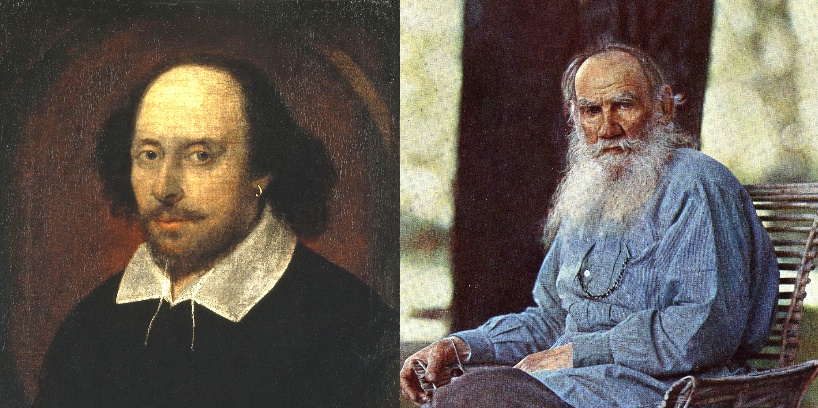
After his radical conversion to Christian anarchism, Leo Tolstoy adopted a deeply contrarian attitude. The vehemence of his attacks on the class and traditions that produced him were so vigorous that certain critics, now mostly obsolete, might call his struggle Oedipal. Tolstoy thoroughly opposed the patriarchal institutions he saw oppressing working people and constraining the spiritual life he embraced. He championed revolution, “a change of a people’s relation towards Power,” as he wrote in a 1907 pamphlet, “The Meaning of the Russian Revolution”: “Such a change is now taking place in Russia, and we, the whole Russian people, are accomplishing it.”
In that “we,” Tolstoy aligns himself with the Russian peasantry, as he does in other pamphlets like the 1909-10 journal, “Three Days in the Village.” These essays and others of the period rough out a political philosophy and cultural criticism, often aimed at affirming the ruddy moral health of the peasantry and pointing up the decadence of the aristocracy and its institutions. In keeping with the theme, one of Tolstoy’s pamphlets, a 1906 essay on Shakespeare, takes on that most hallowed of literary forefathers and expresses “my own long-established opinion about the works of Shakespeare, in direct opposition, as it is, to that established in all the whole European world.”
After a lengthy analysis of King Lear, Tolstoy concludes that the English playwright’s “works do not satisfy the demands of all art, and, besides this, their tendency is of the lowest and most immoral.” But how had all of the Western world been led to universally admire Shakespeare, a writer who “might have been whatever you like, but he was not an artist”? Through what Tolstoy calls an “epidemic suggestion” spread primarily by German professors in the late 18th century. In 21st-century parlance, we might say the Shakespeare-as-genius meme went viral.
Tolstoy also characterizes Shakespeare-veneration as a harmful cultural vaccination administered to everyone without their consent: “free-minded individuals, not inoculated with Shakespeare-worship, are no longer to be found in our Christian society,” he writes, “Every man of our society and time, from the first period of his conscious life, has been inoculated with the idea that Shakespeare is a genius, a poet, and a dramatist, and that all his writings are the height of perfection.”
In truth, Tolstoy proclaims, the venerated Bard is “an insignificant, inartistic writer…. The sooner people free themselves from the false glorification of Shakespeare, the better it will be.”
I have felt with… firm, indubitable conviction that the unquestionable glory of a great genius which Shakespeare enjoys, and which compels writers of our time to imitate him and readers and spectators to discover in him non-existent merits — thereby distorting their aesthetic and ethical understanding — is a great evil, as is every untruth.
What could have possessed the writer of such celebrated classics as War and Peace and Anna Karenina to so forcefully repudiate the author of King Lear? Forty years later, George Orwell responded to Tolstoy’s attack in an essay titled “Lear, Tolstoy and the Fool” (1947). His answer? Tolstoy’s objections “to the raggedness of Shakespeare’s plays, the irrelevancies, the incredible plots, the exaggerated language,” are at bottom an objection to Shakespeare’s earthy humanism, his “exuberance,” or—to use another psychoanalytic term—his jouissance. “Tolstoy,” writes Orwell, “is not simply trying to rob others of a pleasure he does not share. He is doing that, but his quarrel with Shakespeare goes further. It is the quarrel between the religious and the humanist attitudes towards life.”
Orwell grants that “much rubbish has been written about Shakespeare as a philosopher, as a psychologist, as a ‘great moral teacher’, and what-not.” In reality, he says, the playwright, was not “a systematic thinker,” nor do we even know “how much of the work attributed to him was actually written by him.” Nonetheless, he goes on to show the ways in which Tolstoy’s critical summary of Lear relies on highly biased language and misleading methods. Furthermore, Tolstoy “hardly deals with Shakespeare as a poet.”
But why, Orwell asks, does Tolstoy pick on Lear, specifically? Because of the character’s strong resemblance to Tolstoy himself. “Lear renounces his throne,” he writes, “but expects everyone to continue treating him as a king.”
But is it not also curiously similar to the history of Tolstoy himself? There is a general resemblance which one can hardly avoid seeing, because the most impressive event in Tolstoy’s life, as in Lear’s, was a huge and gratuitous act of renunciation. In his old age, he renounced his estate, his title and his copyrights, and made an attempt — a sincere attempt, though it was not successful — to escape from his privileged position and live the life of a peasant. But the deeper resemblance lies in the fact that Tolstoy, like Lear, acted on mistaken motives and failed to get the results he had hoped for. According to Tolstoy, the aim of every human being is happiness, and happiness can only be attained by doing the will of God. But doing the will of God means casting off all earthly pleasures and ambitions, and living only for others. Ultimately, therefore, Tolstoy renounced the world under the expectation that this would make him happier. But if there is one thing certain about his later years, it is that he was NOT happy.
Though Orwell doubts the Russian novelist was aware of it—or would have admitted it had anyone said so—his essay on Shakespeare seems to take the lessons of Lear quite personally. “Tolstoy was not a saint,” Orwell writes, “but he tried very hard to make himself into a saint, and the standards he applied to literature were other-worldly ones.” Thus, he could not stomach Shakespeare’s “considerable streak of worldliness” and “ordinary, belly-to-earth selfishness,” in part because he could not stomach these qualities in himself. It’s a common, sweeping, charge, that a critic’s judgment reflects much of their personal preoccupations and little of the work itself. Such psychologizing of a writer’s motives is often uncalled-for. But in this case, Orwell seems to have laid bare a genuinely personal psychological struggle in Tolstoy’s essay on Shakespeare, and perhaps put his finger on a source of Tolstoy’s violent reaction to King Lear in particular, which “points out the results of practicing self-denial for selfish reasons.”
Orwell draws an even larger point from the philosophical differences Tolstoy has with Shakespeare: “Ultimately it is the Christian attitude which is self-interested and hedonistic,” he writes, “since the aim is always to get away from the painful struggle of earthly life and find eternal peace in some kind of Heaven or Nirvana…. Often there is a seeming truce between the humanist and the religious believer, but in fact their attitudes cannot be reconciled: one must choose between this world and the next.” On this last point, no doubt, Tolstoy and Orwell would agree. In Orwell’s analysis, Tolstoy’s polemic against Shakespeare’s humanism further “sharpens the contradictions,” we might say, between the two attitudes, and between his own former humanism and the fervent, if unhappy, religiosity of his later years.
Note: An earlier version of this post appeared on our site in 2016.
Related Content:
Leo Tolstoy’s 17 “Rules of Life:” Wake at 5am, Help the Poor, & Only Two Brothel Visits Per Month
Leo Tolstoy’s Masochistic Diary: I Am Guilty of “Sloth,” “Cowardice” & “Sissiness” (1851)
Vintage Footage of Leo Tolstoy: Video Captures the Great Novelist During His Final Days
Josh Jones is a writer and musician based in Durham, NC.
Read More...Watch 35 Short Films by Charles and Ray Eames: “Powers of Ten,” the History of the Computer & More
The Pacific Palisades fire of January 25 destroyed much of that coastal Los Angeles neighborhood, but it somehow spared the Charles and Ray Eames house. Anyone who’s paid it a visit, or at least pored over the many photos of it in existence, knows that it’s more than a preserved work of California modernism once inhabited by a famed pair of husband-and-wife designers. In truth, it’s more like a world, or at least a worldview, made domestic. From the outside, one first notices the clean, vaguely Japanese lines, the sharp angles, and the planes of Mondrian color. Once inside, one hardly knows what to look at first: the Isamu Noguchi lamp? The Native American baskets? The kokeshi dolls? The Eames Lounge Chair?
?si=DQ-M1lsNTauOahsy
After a few months’ closure to repair smoke damage, the Eames House re-opened to visitors last summer. But wherever in the world you happen to be, you can tour the place in its prime, and as its makers would have wanted you to see it, through the short film from 1955 at the top of the post.
Titled simply “House: After Five Years of Living,” it briefly animates the title building’s construction process, shows its context in nature and some of the textures to be seen on and around its exterior walls, and soon makes tentative moves— albeit almost entirely with still shots — toward the interior. Shot and edited by the Eames themselves, the film showcases their aesthetic and communicative sensibility as much as does the house itself, or indeed the pieces of furniture inside that they themselves designed.
So, each one in a different way, do the 35 Eames shorts collected on this Youtube playlist. It includes, of course, “Powers of Ten,” an eight-minute-long zoom out from a picnic on Lake Michigan to 100 light years away in outer space, then back again and down to the microscopic scale of “a proton in the nucleus of a carbon atom beneath the skin on the hand of a sleeping man at the picnic.” In addition to stewarding the house, the Charles & Ray Eames Foundation has plans to bring that acclaimed film back out for its 50th anniversary next year. Until then, this playlist will give you a chance to get acquainted with a bit more of their large body of cinematic work, reflecting as it does the Eameses’ signature instinct for modernist creativity and lighthearted pedagogy, but also their proximity to the world that the mid-twentieth century was fast bringing into being.
Take the series of productions they did for IBM, like “A Computer Perspective: Background to the Computer Age” just above, commissioned for an exhibition of the same name. Beginning its story with humanity’s earliest calculating machines, it makes its jazzy visual-historical way up to the postwar decades, during which, as the narrator puts it, “the variety of demands on the computer began to multiply. It was asked to be not only calculator and analyzer, but information storage and retrieval device, instrument of communication, and interlocutor.” If only the Eamses could have lived, we might think, to see how fully the computer would come to occupy that last role. Nor, revisiting “Powers of Ten,” could any of us ignore how much the viewing experience reminds us of our idle explorations on Google Earth, a technological development they surely wouldn’t have found implausible — and surely would have found captivating.
Related Content:
Charles & Ray Eames’ Iconic Lounge Chair Debuts on American TV (1956)
Charles & Ray Eames’ Short Film on the Mexican Day of the Dead (1957)
“They Were There” — Errol Morris Finally Directs a Film for IBM
Based in Seoul, Colin Marshall writes and broadcasts on cities, language, and culture. He’s the author of the newsletter Books on Cities as well as the books 한국 요약 금지 (No Summarizing Korea) and Korean Newtro. Follow him on the social network formerly known as Twitter at @colinmarshall.
Read More...How the CIA Secretly Funded Abstract Expressionism During the Cold War
Considering the possibility of a truly proletarian art, the great English literary critic William Empson once wrote, “the reason an English audience can enjoy Russian propagandist films is that the propaganda is too remote to be annoying.” Perhaps this is why American artists and bohemians have so often taken to the political iconography of far-flung regimes, in ways both romantic and ironic. One nation’s tedious socialist realism is another’s radical exotica.
But do U.S. cultural exports have the same effect? One need only look at the success of our most banal branding overseas to answer in the affirmative. Yet no one would think to add Abstract Expressionist painting to a list that includes fast food and Walt Disney products.
Nevertheless, the work of such artists as Jackson Pollock, Mark Rothko, and Willem de Kooning wound up as part of a secret CIA program during the height of the Cold War, aimed at promoting American ideals abroad.
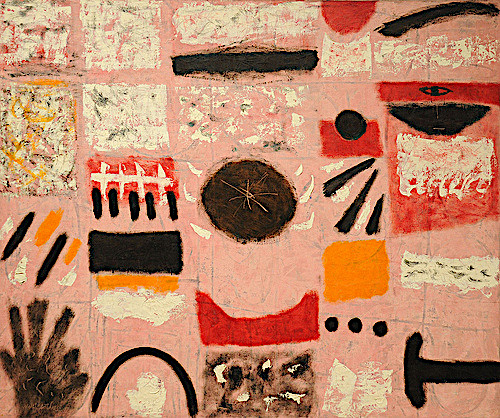
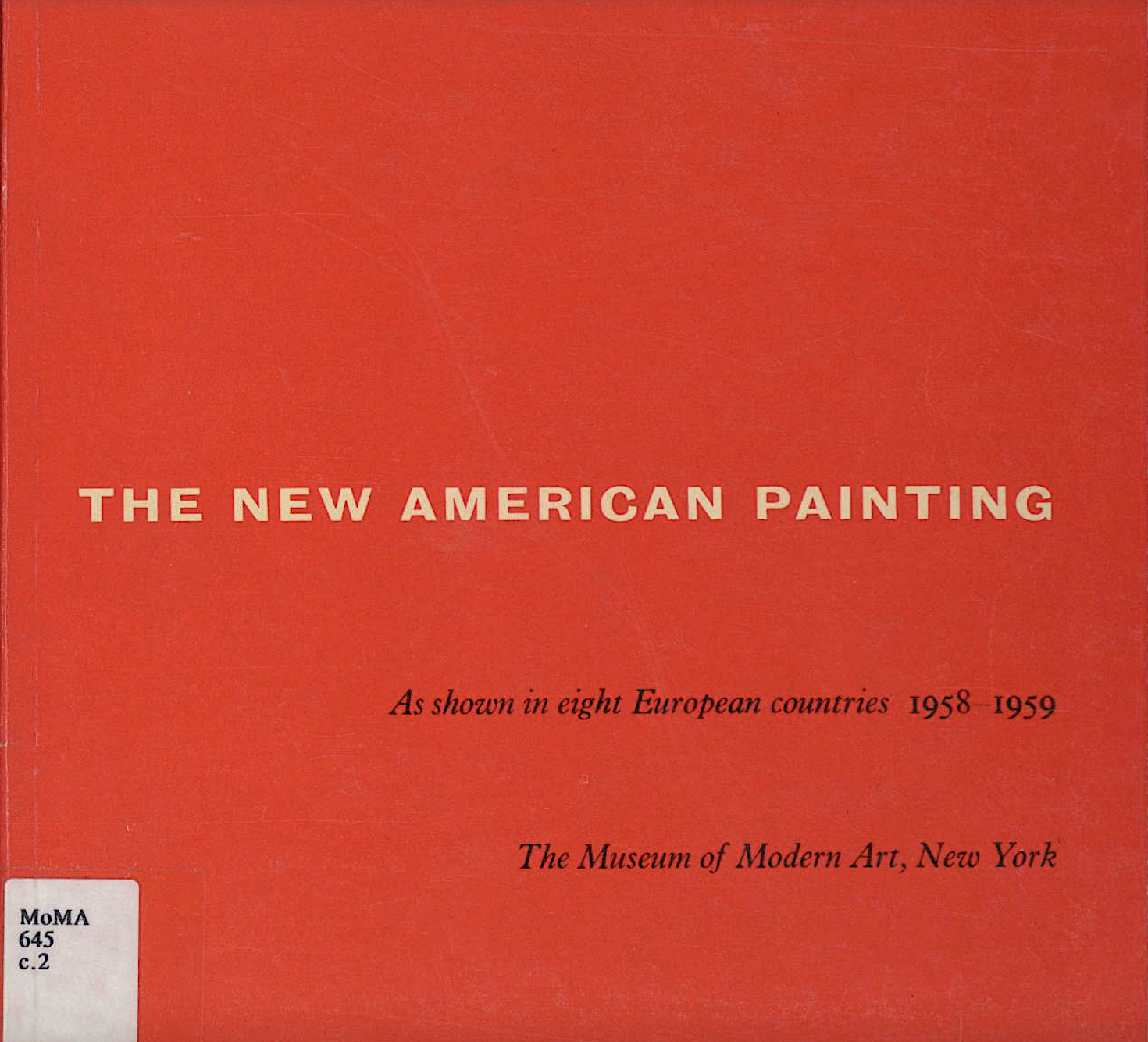
The artists themselves were completely unaware that their work was being used as propaganda. On what agents called a “long leash,” they participated in several exhibitions secretly organized by the CIA, such as “The New American Painting” (see catalog cover at top), which visited major European cities in 1958–59 and included such modern primitive works as surrealist William Baziotes’ 1947 Dwarf (below) and 1951’s Tournament by Adolph Gottlieb above.

Of course what seems most bizarre about this turn of events is that avant-garde art in America has never been much appreciated by the average citizen, to put it mildly. American Main Streets harbor undercurrents of distrust or outright hatred for out-there, art-world experimentation, a trend that filters upward and periodically erupts in controversies over Congressional funding for the arts. A 1995 Independent article on the CIA’s role in promoting Abstract Expressionism describes these attitudes during the Cold War period:
In the 1950s and 1960s… the great majority of Americans disliked or even despised modern art—President Truman summed up the popular view when he said: “If that’s art, then I’m a Hottentot.” As for the artists themselves, many were ex- communists barely acceptable in the America of the McCarthyite era, and certainly not the sort of people normally likely to receive US government backing.
Why, then, did they receive such backing? One short answer:
This philistinism, combined with Joseph McCarthy’s hysterical denunciations of all that was avant-garde or unorthodox, was deeply embarrassing. It discredited the idea that America was a sophisticated, culturally rich democracy.
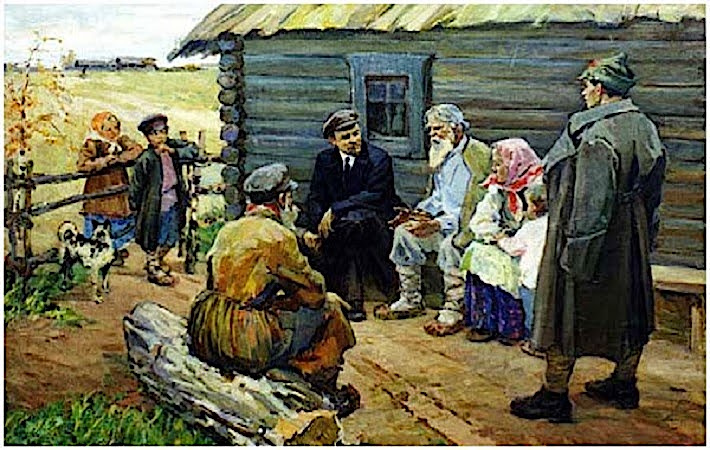
The one-way relationship between modernist painters and the CIA—only recently confirmed by former case officer Donald Jameson—supposedly enabled the agency to make the work of Soviet Socialist Realists appear, in Jameson’s words, “even more stylized and more rigid and confined than it was.” (See Evdokiya Usikova’s 1959 Lenin with Villagers below, for example). For a longer explanation, read the full article at The Independent. It’s the kind of story Don DeLillo would cook up.
William Empson goes on to say that “a Tory audience subjected to Tory propaganda of the same intensity” as Russian imports, “would be extremely bored.” If he is correct, it’s likely that the average true believer socialist in Europe was already bored silly by Soviet-approved art. What surprises in these revelations is that the avant-garde works that so radically altered the American art world and enraged the average congressman and taxpayer were co-opted and collected by suave U.S. intelligence officers like so many Shepard Fairey posters.
Note: An earlier version of this post appeared on our site in 2013.
Related Content:
When the State Department Used Dizzy Gillespie and Jazz to Fight the Cold War (1956)
How “America’s First Drug Czar” Waged War Against Billie Holiday and Other Jazz Legends
The CIA’s Style Manual & Writer’s Guide: 185 Pages of Tips for Writing Like a Spook
Josh Jones is a writer and musician based in Washington, DC.
Read More...How James Cameron Shot Titanic’s Hugely Complex Sinking Scene
The dark arts of “Hollywood accounting” make it difficult to determine film budgets with precision. But according to reasonable reckonings, James Cameron may have directed not just one but several of the most expensive movies of all time. The underwater sci-fi spectacle that was The Abyss necessitated one of the biggest production budgets of the eighties, but it looked straight off Poverty Row when compared to Cameron’s next project just two years later. Terminator 2: Judgment Day was the first film to cost more than $100 million; True Lies, his next Arnold Schwarzenegger vehicle, could have cost as much as $120 million. What challenge remained for Cameron at that point? Why, re-creating the most famous shipwreck in history.
Such an improbable-sounding ambition didn’t come out of nowhere. Fascinated with the Titanic since childhood, Cameron eventually found himself able to make multiple expeditions of his own to its final resting place in deep-sea submersibles. He wasn’t just well placed to gather the information necessary to bring it back to life on screen, but also to implement and indeed develop the techniques to film it believably, powerfully, and with a high degree of historical accuracy.
It perhaps does Cameron a disservice to refer to him only as a filmmaker, since throughout his career he’s displayed just as much the mind of an engineer, characterized by the willingness to make his own technological advancements in the service of bringing his vision to the screen. You can get some insight into that mind at work in the Studio Binder video above on how he directed the Titanic’s sinking scene.
Titanic cost $200 million, more than the ship herself. In 1997, that was an eye-watering sum, but given the movie’s eventual take of $2.264 billion, it seems money well spent. A non-trivial amount of those profits came from viewers who bought a ticket — again and again, in some cases — expressly to see their favorite heartthrob. But Cameron must have known full well that most moviegoers turned up to see the ship go down; everything thus rode on that one hour of the film’s 195-minute runtime. Its unprecedentedly complex shoot involved, among other things, hundreds of stunt performers and extras, the latest in CGI tools, and a 775-foot-long replica of the Titanic installed in a custom-built seaside set in Mexico. The scene, as well as the film that contains it, holds up nearly thirty years later in part due to this combination of digital and analog effects, a fusion of almost experimentally cutting-edge digital technology and old-fashioned, thoroughly analog movie magic — something Cameron understands just as well as he does undersea exploration.
Related content:
The Fascinating Engineering of the Titanic: How the Great Ocean Liner Was Built
Watch 80 Minutes of Never-Released Footage Showing the Wreckage of the Titanic (1986)
Titanic Survivor Interviews: What It Was Like to Flee the Sinking Luxury Liner
Watch the Titanic Sink in Real-Time
How the Titanic Sank: James Cameron’s New CGI Animation
Based in Seoul, Colin Marshall writes and broadcasts on cities, language, and culture. He’s the author of the newsletter Books on Cities as well as the books 한국 요약 금지 (No Summarizing Korea) and Korean Newtro. Follow him on the social network formerly known as Twitter at @colinmarshall.
Read More...How the Hoover Dam Works: A 3D Animated Introduction
When it comes to tourist pilgrimage sites in the United States, the Hoover Dam may not quite rank up there with the Statue of Liberty, the Lincoln Memorial, Mount Rushmore, the Grand Canyon, or Disneyland. But that’s not due to a lack of importance, nor even a lack of impressiveness. Proper appreciation of its man-made majesty, however, requires an understanding of not just the vital function it serves, but the enormous task of its construction. The guides at the Hoover Dam have been trained to explain just that to its many visitors, of course, but all of us could benefit from going in prepared with a little knowledge. Watch the hour-long video on the dam’s design and construction from Animagraffs above, and you may be prepared with enough knowledge to tell the guides a thing or two.
Animagraffs is the YoTtube channel of Jacob O’Neal, which we’ve previously featured here on Open Culture for its acclaimed explanations on a sixteenth-century explorer’s sailing ship and the Golden Gate Bridge, another iconic construction project of the Great Depression. Like those, his Hoover Dam video uses detailed 3D models based on serious research, not least into the project’s original design documents.
This allows O’Neal to show each element of the dam and its complex system of supporting infrastructure in detail and from every angle, as well as in a kind of x‑ray vision. We’ve all seen photographs of the Hoover Dam, and maybe even bought some from its gift shop, but even the most sublime aerial view doesn’t reveal as much about its ambition as a look into its inner workings.
And the ambition of the Hoover Dam is one aspect guaranteed to impress any viewers. It required thousands of workers about five years to re-shape the Nevada and Arizona landscape at a grand enough scale to make possible human control of the mighty — and, more to the point, mightily unpredictable — Colorado River. With its large turbines, the engineering and installation of which O’Neal explains in full, it managed to generate enough electricity to repay its construction cost of more than $811 million in today’s dollars by 1987, just over 50 years after it opened. And in an achievement almost impossible to believe today, it opened more than two years ahead of schedule. We hear a good deal today about the concept of “state capacity,” and how the U.S. could regain it. At the Hoover Dam, we behold state capacity quite literally made concrete.
Related Content:
The Incredible Story of the Hoover Dam
The Genius Urban Design of Amsterdam: Canals, Dams & Leaning Houses
How Medieval Islamic Engineering Brought Water to the Alhambra
The Genius Engineering of Roman Aqueducts
The Brilliant Engineering That Made Venice: How a City Was Built on Water
Based in Seoul, Colin Marshall writes and broadcasts on cities, language, and culture. He’s the author of the newsletter Books on Cities as well as the books 한국 요약 금지 (No Summarizing Korea) and Korean Newtro. Follow him on the social network formerly known as Twitter at @colinmarshall.
Read More...How to Read Books That Challenge Your Mind: Advice from Robert Greene, Author of The 48 Laws of Power
If you’ve fallen out of the habit of reading books, you’re certainly not alone. Consider how often posts circulate on social media (itself a big part of the problem) about studies showing a rapid increase in the number of people who don’t even get one book read per year. How best to get back on the literary wagon? You might try going straight for the hard stuff, as it were, by taking on a novel like Moby-Dick. But that, according to the view articulated in the video above by The 48 Laws of Power author Robert Greene, would be like stepping back into the gym after years away and trying to bench press 300 pounds. Rather than starting with Melville’s masterpiece, build your way up to it — but once you get to it, you’ve got to finish it.
“You want to train yourself to finish books, and not constantly be going from one to another to another,” Greene says, and that holds even for those you may not enjoy. “When I read a book that I hate, that is boring, and I make myself read all the way through, I kind of take angry notes about it: God, this is ridiculous, this is so stupid, I hate this, this guy doesn’t know what he’s talking about. You can react to the book, you can have a dialogue with it, but you want to be able to have the patience to get through a 400- 500, 600-page book.” To return to the weight-training analogy, a shorter book to start could be “kind of easy, and it could be in a subject that interests you,” but upon finishing it, you should “choose something that’s a little bit difficult and a little bit complicated.”
The idea is deliberately to choose books that challenge you, a quality that doesn’t come from length alone. If one gives you an impression that “it’s not how you feel politically about the world, it’s not how you feel spiritually about the world, it’s something that’s a little bit outside what you would normally encounter,” take it as a sign that you should read it. Approaching the matter from the other direction, Greene also advises not to “just choose things that you think are entertaining and fun, because that’s going to make you lazy, and it’s going to make you weak, and it’s going to make you always look for things that are entertaining, fun, and distracting.” An airport-thriller-heavy diet may work for Malcolm Gladwell, but it’s unlikely to work for you.
As an example of a challenging read, Greene points to any of Robert Caro’s four biographical volumes about U.S. President Lyndon B. Johnson, one of which runs to well over 1,000 pages. He could also have suggested Caro’s earlier The Power Broker: Robert Moses and the Fall of New York, one of those books — alongside not just Moby-Dick, but also the Bible, Ulysses, War and Peace, and even Pride and Prejudice — that even many serious readers only pretend to have made it through, or indeed started. Whatever the material you use, Greene says, “I beg you to train your mind like you train your body, to go through something that’s a little more difficult, a little more challenging, that’s going to take some time for you. That’s the way to develop the habit of wanting to read, and to have the patience to read more books.” No pain, no gain, as the bodybuilders say; bear that in mind when you get to Melville’s distilled course on cetology.
Related content:
20 Books People Pretend to Read (and Now Your Confessions?)
5 Books You Can Read Again .… and Again and Again: Here’s Our Picks, Now Yours
7 Tips for Reading More Books in a Year
The Nature of Human Stupidity Explained by The 48 Laws of Power Author Robert Greene
Based in Seoul, Colin Marshall writes and broadcasts on cities, language, and culture. He’s the author of the newsletter Books on Cities as well as the books 한국 요약 금지 (No Summarizing Korea) and Korean Newtro. Follow him on the social network formerly known as Twitter at @colinmarshall.
Read More...How the Long-Lost Body of Richard III Was Found Under a Parking Lot: Solving a 500-Year-Old Mystery
Shakespeare’s The Tragedy of Richard the Third begins with the eponymous character uttering the famous line “Now is the winter of our discontent.” It ends at the Battle of Bosworth Field, by which point his villainous schemes have come to ruin and his desertion by Lord Stanley seems to have sealed his fate. “A horse, a horse, my kingdom for a horse,” he cries out, coining another expression used four centuries later before being slain by the Earl of Richmond, the man who would be Henry VII. Though Shakespeare himself was writing more than 100 years after the historical events he dramatized, he included little after the event of Richard’s death, whose most fascinating mystery was in any case only solved in our own time.
You can see the story of Richard III’s long-unknown whereabouts in the Primal Space video above. According to records, says the narrator, “he was buried unceremoniously beneath the Greyfriars Church in Leicester, and a monument was eventually placed above his grave.” When Henry VIII ordered such houses of worship shut down forty years later, Greyfriars was among the institutions demolished.
Everyone eventually came to believe that, amid this destruction, Richard’s body had been exhumed and tossed off the Bow Bridge. Only in the early two-thousands did a search for his corpse commence in earnest, spearheaded by the Richard III Society. Having determined that the Bow Bridge story had been made up, the society’s members then had to pin down the long-confused former location of Greyfriars Church.
One of them, Philippa Langley, got the hunch to start looking under a Leicester parking lot. Budgetary limitations forced her team to try digging just three trenches across spaces likeliest to cross the church’s footprint. “Amazingly, just six hours into the first day, they came across a skeleton” with skull damage and spinal curvature. Richard was indeed described as a “hunchback” in his lifetime, but in the twenty-first century, only DNA evidence closes the case. Its acquisition necessitated both finding a couple unbroken female lines (the only means of transmitting mitochondrial DNA) from his sister down to living, testable individuals while carbon-dating the skeleton. Sure enough, Richard turned out to have been in eternal repose not just under that parking lot, but near a stenciled letter R — the kind of coincidence from which even the Bard himself might have shied away.
Related content:
Confirmed: The Bones of Richard III (1452–1485) Found Under a UK Parking Lot
How England First Became England: An Animated History
A New Analysis of Beethoven’s DNA Reveals That Lead Poisoning Could Have Caused His Deafness
Based in Seoul, Colin Marshall writes and broadcasts on cities, language, and culture. He’s the author of the newsletter Books on Cities as well as the books 한국 요약 금지 (No Summarizing Korea) and Korean Newtro. Follow him on the social network formerly known as Twitter at @colinmarshall.
Read More...The Futurist Cookbook (1930) Tried to Turn Italian Cuisine into Modern Art
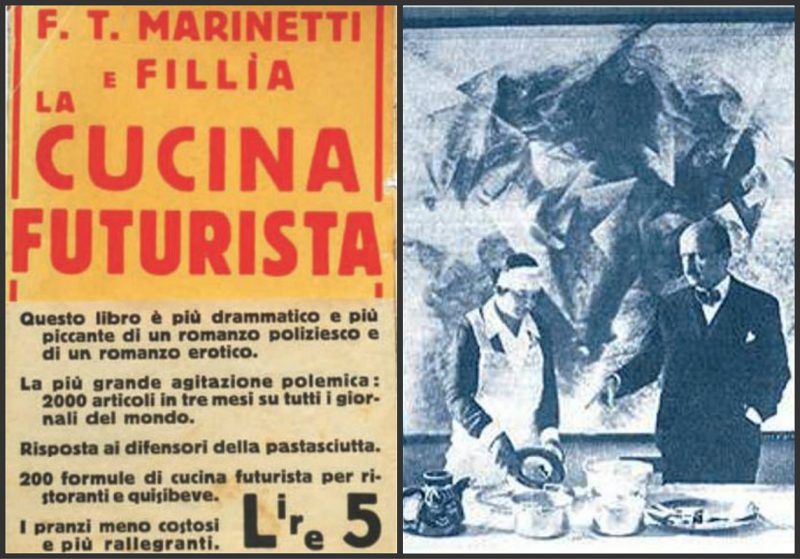
With the savage cuts in arts funding, perhaps we’ll return to a system of noblesse oblige familiar to students of The Gilded Age, when artists needed independent wealth or patronage, and wealthy industrialists often decided what was art, and what wasn’t. Unlike fine art, however, haute cuisine has always relied on the patronage of wealthy donors—or diners. It can be marketed in premade pieces, sold in cookbooks, and made to look easy on TV, but for reasons both cultural and practical, given the nature of food, an exquisitely-prepared dish can only be made accessible to a select few.
Still, we would be mistaken, suggested Futurist poet and theorist F.T. Marinetti (1876–1944), should we neglect to see cooking as an art form akin to all the others in its moral and intellectual influence on us. While hardly the first or the last artist to publish a cookbook, Marinetti’s Futurist Cookbook seems at first glance deadly, even aggressively, serious, lacking the whimsy, impractical weirdness, and surrealist art of Salvador Dali’s Les Diners de Gala, for example, or the eclectic wistfulness of the MoMA’s Artist’s Cookbook.
Just as he had sought with his earlier Futurist Manifesto to revolutionize art, Marinetti intended his cookbook to foment a “revolution of cuisine,” as Alex Revelli Sorini and Susanna Cutini point out. You might even call it an act of war when it came to certain staples of Italian eating, like pasta, which he thought responsible for “sluggishness, pessimism, nostalgic inactivity, and neutralism” (anticipating scads of low and no-carb diets to come).
Believing that people “think, dream and act according to what they eat and drink,” Marinetti formulated strict rules not only for the preparation of food, but also the serving and eating of it, going so far as to call for abolishing the knife and fork. A short excerpt from his introduction shows him applying to food the techno-romanticism of his Futurist theory—an ethos taken up by Benito Mussolini, whom Marinetti supported:
The Futurist culinary revolution … has the lofty, noble and universally expedient aim of changing radically the eating habits of our race, strengthening it, dynamizing it and spiritualizing it with brand-new food combinations in which experiment, intelligence and imagination will economically take the place of quantity, banality, repetition and expense.
In hindsight, the fascist overtones in Marinetti’s language seem glaring. In 1932, when the Futurist Cookbook was published, his Futurism seemed like a much-needed “jolt to all the practical and intellectual activities,” note Sorini and Cutini. “The subject [of cooking] needed a good shake to reawaken its spirit.” And that’s just what it got. The Futurist Cookbook acted as “a preview of Italian-style Nouvelle Cuisine,” with such innovations as “additives and preservatives added to food, or using technological tools in the kitchen to mince, pulverize, and emulsify.”
Yet, for all the high seriousness with which Marinetti seems to treat his subject, “what the media missed” at the time, writes Maria Popova, “was that the cookbook was arguably the greatest artistic prank of the twentieth century.” In an introduction to the 1989 edition, British journalist and historian Lesley Chamberlain called the Futurist Cookbook “a serious joke, revolutionary in the first instance because it overturned with ribald laughter everything ‘food’ and ‘cookbooks’ held sacred.” Marinetti first swept away tradition in favor of creative dining events the Futurists called “aerobanquets,” such as one in Bologna in 1931 with a table shaped like an airplane and dishes called “spicy airport” (Olivier salad) and “rising thunder” (orange risotto). Lambrusco wine was served in gas cans.
It’s performance art worthy of Dali’s bizarre costumed dinner parties, but fueled by a genuine desire to revolutionize food, if not the actual eating of it, by “bringing together elements separated by biases that have no true foundation.” So remarked French chef Jules Maincave, a 1914 convert to Futurism and inspiration for what Marinetti calls “flexible flavorful combinations.” See several such recipes excerpted from the Futurist Cookbook at Brain Pickings, read the full book in Italian here, and, just below, see Marinetti’s rules for the perfect meal, first published in 1930 as the “Manifesto of Futurist Cuisine.”
Futurist cuisine and rules for the perfect lunch
1. An original harmony of the table (crystal ware, crockery and glassware, decoration) with the flavors and colors of the dishes.
2. Utter originality in the dishes.
3. The invention of flexible flavorful combinations (edible plastic complex), whose original harmony of form and color feeds the eyes and awakens the imagination before tempting the lips.
4. The abolition of knife and fork in favor of flexible combinations that can deliver prelabial tactile enjoyment.
5. The use of the art of perfumery to enhance taste. Each dish must be preceded by a perfume that will be removed from the table using fans.
6. A limited use of music in the intervals between one dish and the next, so as not to distract the sensitivity of the tongue and the palate and serves to eliminate the flavor enjoyed, restoring a clean slate for tasting.
7. Abolition of oratory and politics at the table.
8. Measured use of poetry and music as unexpected ingredients to awaken the flavors of a given dish with their sensual intensity.
9. Rapid presentation between one dish and the next, before the nostrils and the eyes of the dinner guests, of the few dishes that they will eat, and others that they will not, to facilitate curiosity, surprise, and imagination.
10. The creation of simultaneous and changing morsels that contain ten, twenty flavors to be tasted in a few moments. These morsels will also serve the analog function […] of summarizing an entire area of life, the course of a love affair, or an entire voyage to the Far East.
11. A supply of scientific tools in the kitchen: ozone machines that will impart the scent of ozone to liquids and dishes; lamps to emit ultraviolet rays; electrolyzers to decompose extracted juices etc. in order to use a known product to achieve a new product with new properties; colloidal mills that can be used to pulverize flours, dried fruit and nuts, spices, etc.; distilling devices using ordinary pressure or a vacuum, centrifuge autoclaves, dialysis machines.
The use of this equipment must be scientific, avoiding the error of allowing dishes to cook in steam pressure cookers, which leads to the destruction of active substances (vitamins, etc.) due to the high temperatures. Chemical indicators will check if the sauce is acidic or basic and will serve to correct any errors that may occur: lack of salt, too much vinegar, too much pepper, too sweet.”
Note: An earlier version of this post appeared on our site in 2017.
Related Content
When Italian Futurists Declared War on Pasta (1930)
Salvador Dalí’s 1973 Cookbook Gets Reissued: Surrealist Art Meets Haute Cuisine
Josh Jones is a writer and musician based in Durham, NC.
Read More...AI Figures Out the Rules of a Mysterious 2,000-Year-Old Board Game from Ancient Rome
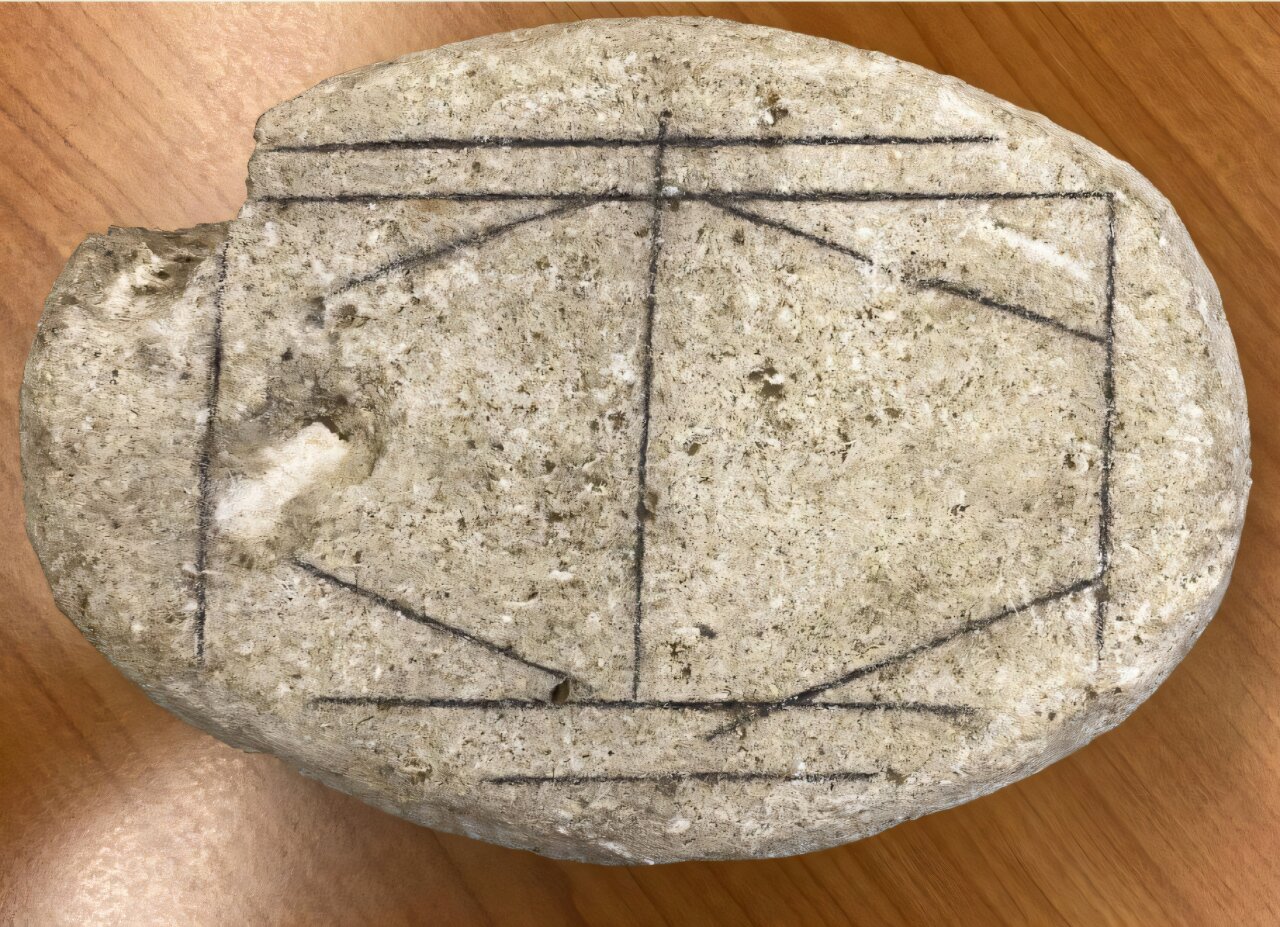
Image by Walter Crist
As far as enthusiasm for board games goes, no continent has yet outdone Europe. Its advantage could lie in the highly developed culture of low-cost leisure evident in quite a few of its societies; it could also owe to the fact that board games seem to have been played there continuously since antiquity. We’ve long had evidence of examples like the “Roman mill game,” better known today as nine men’s morris, which Ovid appears to mention in his Ars Amatoria of the very early first century. Not that modern knowledge of Roman tabletop gaming is complete. In one puzzling case, the stone board above was unearthed in a former Roman town in the Netherlands, but how a game was played on it remained a mystery — until machine learning came along.
“To examine whether the object may have been used as a game board, we performed use-wear analysis to identify evidence for gameplay and we simulated play using artificial intelligence (AI),” write the team of researchers who recently published a paper on the subject in the journal Antiquity. They used a system called Ludii, engineered to analyze board-game rules.
“This software allows for AI-driven playout simulation, where two AI agents play a game against one another, which can generate quantitative data on gameplay. In this instance, we explored whether the rules of a game would produce the wear pattern seen on the stone.” The idea, in other words, was to let the computer play against itself using different rules until it came upon a game that would continue to abrade away the surface of the board in the same fashion as it already was.
This process narrowed it down to games “in which the goal is to block the opponent from moving, and those in which the goal is to place three pieces in a row.” These have a fairly long documented history, from Scandinavia’s haretavl, to Italy’s gioco dell’orso to Spain’s liebre perseguida, to Greece’s kinégi tou lagoú. You can download what the research suggests is the most plausible rule set for this particular Roman board game here, board design included. One player takes the side of the “hunter,” with four pieces, and the other the side of the “prey,” with two. The former tries to trap the latter’s pieces, moving only along the board’s lines; in the next round, the roles reverse. The hunter who does the job in the fewest moves wins. Why not invite friends over to spend an evening playing like a Roman? For a thoroughly ancient good time, first reconstruct as best you can the ambience of the thermopolium at home.
Related content:
Behold the First American Board Game, Travellers’ Tour Through the United States (1822)
Monopoly: How the Original Game Was Made to Condemn Monopolies & the Abuses of Capitalism
Kurt Vonnegut’s Lost Board Game Is Finally for Sale
The Fear and Loathing in Las Vegas Board Game, Inspired by Hunter S. Thompson’s Rollicking Novel
Based in Seoul, Colin Marshall writes and broadcasts on cities, language, and culture. He’s the author of the newsletter Books on Cities as well as the books 한국 요약 금지 (No Summarizing Korea) and Korean Newtro. Follow him on the social network formerly known as Twitter at @colinmarshall.
Read More...Bertrand Russell’s Advice For How (Not) to Grow Old: “Make Your Interests Gradually Wider and More Impersonal”
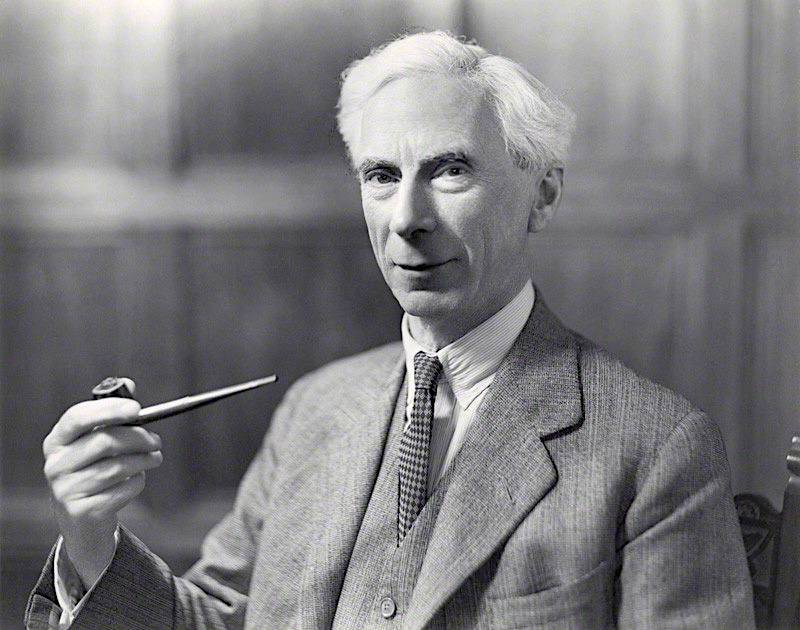
Image by National Portrait Gallery, via Wikimedia Commons
Advice on how to grow old frequently comes from such banal or bloodless sources that we can be forgiven for ignoring it. Public health officials who dispense wisdom may have good intentions; pharmaceutical companies who do the same may not. In either case, the messages arrive in a form that can bring on the despair they seek to avert. Elderly people in well-lit photographs stroll down garden paths, ballroom dance, do yoga. Bulleted lists punctuated by dry citations issue gently-worded guidelines for sensible living. Inoffensive blandness as a prescription for living well.
At the other extreme are profiles of exceptional cases—relatively spry individuals who have passed the century mark. Rarely do their stories conform to the model of abstemiousness enjoined upon us by professionals. But we know that growing old with dignity entails so much more than diet and exercise or making it to a hundred-and-two. It entails facing death as squarely as we face life. We need writers with depth, sensitivity, and eloquence to deliver this message. Bertrand Russell does just that in his essay “How to Grow Old,” written when the philosopher was 81 (sixteen years before he eventually passed away, at age 97).
Russell does not flatter his readers’ rationalist conceits by citing the latest science. “As regards health,” he writes, “I have nothing useful to say…. I eat and drink whatever I like, and sleep when I cannot keep awake.” (We are inclined, perhaps, to trust him on these grounds alone.) He opens with a drily humorous paragraph in which he recommends, “choose your ancestors well,” then he issues advice on the order of not dwelling on the past or becoming a burden to your children.
But the true kernel of his short essay, “the proper recipe for remaining young,” he says, came to him from the example of a maternal grandmother, who was so absorbed in her life, “I do not believe she ever had time to notice she was growing old.” “If you have wide and keen interests and activities in which you can still be effective,” Russell writes. “you will have no reason to think about the merely statistical fact of the number of years you have already lived, still less of the probable shortness of your future.”
Such interests, he argues, should be “impersonal,” and it is this quality that loosens our grip. As Maria Popova puts it, “Russell places at the heart of a fulfilling life the dissolution of the personal ego into something larger.” The idea is familiar; in Russell’s hands it becomes a meditation on mortality as ever-timely as the so-often-quoted passages from Donne’s “Meditation XVII.” Philosopher and writer John G. Messerly calls Russell’s concluding passage “one of the most beautiful reflections on death I have found in all of world literature.”
The best way to overcome it [the fear of death]—so at least it seems to me—is to make your interests gradually wider and more impersonal, until bit by bit the walls of the ego recede, and your life becomes increasingly merged in the universal life. An individual human existence should be like a river: small at first, narrowly contained within its banks, and rushing passionately past rocks and over waterfalls. Gradually the river grows wider, the banks recede, the waters flow more quietly, and in the end, without any visible break, they become merged in the sea, and painlessly lose their individual being. The man who, in old age, can see his life in this way, will not suffer from the fear of death, since the things he cares for will continue. And if, with the decay of vitality, weariness increases, the thought of rest will not be unwelcome. I should wish to die while still at work, knowing that others will carry on what I can no longer do and content in the thought that what was possible has been done.
Read Russell’s “How to Grow Old” in full here. And see many more eloquent meditations on aging and death—from Henry Miller, André Gide, Ursula K. Le Guin, and Grace Paley—at The Marginalian.
Note: An earlier version of this post appeared on our site in 2018.
Related Content:
Simone de Beauvoir’s Philosophy on Finding Meaning in Old Age
Josh Jones is a writer and musician based in Durham, NC.
Read More...Support Us
We're hoping to rely on loyal readers, rather than erratic ads. Please click the Donate button and support Open Culture. You can use Paypal, Venmo, Patreon, even Crypto! We thank you!

About Us

Open Culture scours the web for the best educational media. We find the free courses and audio books you need, the language lessons & educational videos you want, and plenty of enlightenment in between.
Advertise With Us
FREE UPDATES!
GET OUR DAILY EMAIL
Get the best cultural and educational resources on the web curated for you in a daily email. We never spam. Unsubscribe at any time.
FOLLOW ON SOCIAL MEDIA
Open Culture editor Dan Colman scours the web for the best educational media. He finds the free courses and audio books you need, the language lessons & movies you want, and plenty of enlightenment in between.
Advertise With Us



