Archeologists Reconstruct the Faces of 10-Century Medieval Dukes, Using DNA Analysis & 3‑D Models of Skulls
Maybe you’ve sung the Christmas carol “Good King Wenceslas” and wondered who this good king was. The carol wasn’t written until the 19th century, but “Wenceslas was a real person,” writes NPR’s Tom Manoff, the patron saint of the Czechs and “the Duke of Bohemia, a 10th-century Christian prince in a land where many practiced a more ancient religion. In one version of his legend, Wenceslas was murdered in a plot by his brother,” Boleslav, “under the sway of their so-called pagan mother,” Drahomíra.
Wenceslas’ grandmother Ludmilla died a Christian martyr in 921 A.D. Her husband, Bořivoj, ruled as the first documented member of the Přemyslid Dynasty (late 800s-1306), and her two sons Spytihnĕv I (circa 875–915) and Vratislav I (circa 888–921), Wenceslas’ father, ruled after their father’s death. The skeletal remains of these royal Bohemian brothers were identified at Prague Castle in the 1980s by anthropologist Emanuel Vlček. Due to advances in DNA analysis and imaging, we can now see an approximation of what they looked like. (See Spytihnĕv at the top and Vratislav at the bottom in the image below.)
A Czech-Brazillian research team created the reconstructions, making “educated guesses” about the brothers’ hairstyles, beards, and clothing. “The team, which included archaeologists Jiří Šindelář and Jan Frolík, photographer Martin Frouz, and 3‑D technician Cicero André da Costa Moraes,” Isis Davis-Marks writes at Smithsonian, “has previously reconstructed the faces of Zdislava of Lemberk (circa 1220–1252), patron saint of families, and Czech monarch Judita of Thuringia (circa 1135–1174), among others.”
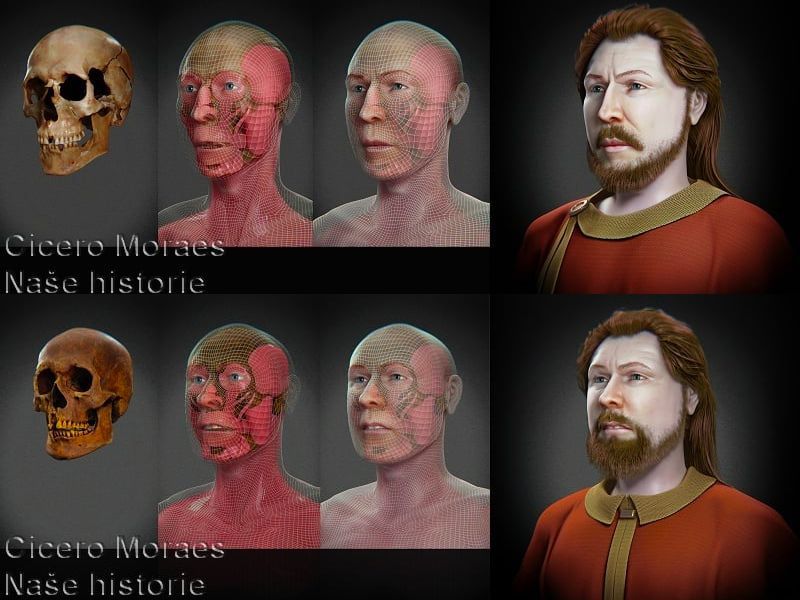
The project proceeded in several stages, with different experts involved along the way. “First,” notes Archaeology, “detailed images of the bones were assembled using photogrammetry to form virtual 3‑D models” of the skulls. Then, facial reconstruction expert Moraes added muscle, tissue, skin, etc., relying on “multiple three-dimensional reconstruction techniques,” Davis-Marks writes, “including anatomical and soft tissue depth methods, to ensure the highest possible level of accuracy.” DNA analysis showed that the brothers likely had blue eyes and reddish-brown hair.
Spytihnĕv and Vratislav’s other features come from the best guess of the researchers based on “miniatures or manuscripts,” says Frolík, “but we don’t really know.” Do they look a bit like video game characters? They look very much, in their digital sheen, like characters in a medieval video game. But perhaps we can anticipate a day when real people from the distant past return as fully animated 3D reconstructions to replay, for our education and amusement, the battles, court intrigues, and fratricides of history as we know it.
Related Content:
20,000 Endangered Archaeological Sites Now Catalogued in a New Online Database
Beer Archaeology: Yes, It’s a Thing
The History of Europe from 400 BC to the Present, Animated in 12 Minutes
Josh Jones is a writer and musician based in Durham, NC. Follow him at @jdmagness.
Read More...Google & Coursera Launch Career Certificates That Prepare Students for Jobs in 6 Months: Data Analytics, Project Management and UX Design

We live in an age of less-than-total agreement as to the purpose of higher education. Should it immerse students in the best that has been thought and said? Provide an environment in which to come of age? Produce “leaders”? Or should it, as increasingly many argue, first and foremost secure professional futures? In the practice of recent decades, higher education has done a bit of each, to the satisfaction of some and the dissatisfaction of others. It has, in other words, become an industry subject to “disruption” by other players offering specialized solutions of their own. Take for example the new Career Certificates offered by Google and the online education platform Coursera.
“Designed to prepare learners for an entry-level role in under six months,” as Coursera CEO Jeff Maggioncalda explains it, these newly-unveiled Career Certificates “don’t have any prerequisites,” which means that most anyone interested in earning them can do so right now. This goes for “new grads landing their first job, front-line workers seeking stable employment, mid-career professionals making a pivot, or parents planning their return to the workforce,” and presumably myriad other walks of life besides.
Available in Data Analytics, Project Management, and User Experience (UX) Design, “each certificate is completely online, self-paced, and costs $39 per month” — significantly less than most existing forms of higher education, even of the most professionally or technologically oriented varieties.
If you’ve dipped into our list of online courses, you’ve probably encountered Coursera, a leading platform for massive online open courses (or MOOCs) used by some of the world’s best-known traditional universities. Its new provision of Google’s Career Certificates should go some way to making more familiar — at least to those us who’ve already learned online — a reimagining of professional education. This program’s “disruptive” potential, due not least to Google’s own consideration of these certificates as equivalent to a four-year degree, has already been well noted. “But while the new programs offer a fast track to new skills and possibly even a new job in a fraction of the time of a degree program,” writes Inc.‘s Justin Bariso, “students shouldn’t expect the courses to be a walk in the park.” And given that they’re unlikely to get easier, anyone interested in earning a Career Certificate would do well to look into it today.
Below, you can find a list of the new Career Certificates.
- User Experience (UX) Design Professional Certificate – UX design jobs are projected to steadily grow over the coming years, with median salaries for an entry-level role around $82,000. This seven-course certificate explores UX principles, UX terms, and industry-standard tools, including Figma and Adobe XD. By the time they complete the program, learners will have three portfolio projects to use in their job applications.
- Data Analytics Professional Certificate – In the U.S., there are nearly 15,000 open entry-level data analytics roles, with an annual median entry-level salary of more than $63,000. This seven-course certificate explores analytical skills, concepts, and tools used in many introductory data analytics roles – including SQL, Tableau, RStudio, and Kaggle.
- Project Management Professional Certificate – Employers will need to fill nearly 2.2 million new project-oriented roles each year through 2027, according to the Project Management Institute. This six-course certificate prepares learners to launch a project management career. It covers industry-standard tools and methods, including the agile project management system, and key soft skills, such as stakeholder management, problem-solving, and influencing.
- IT Support Professional Certificate — Prepare for an entry-level job as an IT support specialist. In this program, you’ll learn the fundamentals of operating systems and networking, and how to troubleshoot problems using code to ensure computers run correctly. This is for you if you enjoy solving problems, learning new tools, and helping others.
- IT Automation Professional Certificate — This is an advanced program for learners who have completed the Google IT Support Professional Certificate. This is for you if you want to build on your IT skills with Python and automation.
The new certificates have been added to our collection, 200 Online Certificate & Microcredential Programs from Leading Universities & Companies.
Note: Open Culture has a partnership with Coursera. If readers enroll in certain Coursera courses and programs, it helps support Open Culture.
Related Content:
Free Online Computer Science Courses
1,500 Free Online Courses from Top Universities
Based in Seoul, Colin Marshall writes and broadcasts on cities, language, and culture. His projects include the Substack newsletter Books on Cities, the book The Stateless City: a Walk through 21st-Century Los Angeles and the video series The City in Cinema. Follow him on Twitter at @colinmarshall or on Facebook.
Read More...How Levi’s 501 Jeans Became Iconic: A Short Documentary Featuring John Baldessari, Henry Rollins, Lee Ranaldo & More
In his memoir Living Carelessly in Tokyo and Elsewhere, the American Japanologist John Nathan remembers evenings in the 1960s spent with Yukio Mishima, whose work he translated into English. “I listened raptly as he recited passages from The Tale of the Heike that revealed the fierceness and delicacy of Japan’s warrior-poets, or showed me the fine calibration of the Chinese spectrum,” Nathan writes. “One night he stood up abruptly from behind his desk, asked me to wait a minute, and left the room. When he came back he had changed into a pair of blue jeans and a thick black leather belt. He explained that he had been sandpapering the jeans to make them identical to the pair Marlon Brando had worn in The Wild One.”
Even a figure like Mishima, who within a few years would die in an ultranationalistic ritual suicide after a hopeless attempted coup, felt the allure of American blue jeans. Though Nathan doesn’t note whether Mishima’s pair were genuine Levi’s 501s, the exacting standards to which Mishima held himself in all respects would seem to demand that measure of authenticity.
“Authenticity,” of course, is a quality from which Levi Strauss & Co. have drawn a great deal of value for their brand, their signature riveted denim product going back as it does nearly a century and a half, to a time when rugged pants were in great demand from the miners of California’s gold rush. But it was in the economically flush and newly media-saturated decades after the Second World War that jeans took their hold on the American imagination, and soon on the world’s.
The pants, the myth, and the legend star in The 501 Jean: Stories of an Original, a three-part series of short documentaries produced by Levi’s themselves and narrated by American folk singer Ramblin’ Jack Elliott. Its gallery of 501-wearers includes such job titles as Musician, Photographer, Garmentologist, Biker, Creative Director, Music/Style Consultant, and Urban Cowboy. Conceptual artist John Baldessari discusses the childhood love of cowboy shows that lodged jeans permanently into his worldview. Album designer Gary Burden brings out his own work, a copy of Neil Young’s After the Gold Rush, to demonstrate the impact of jeans on popular music. That both Burden and Baldessari have passed away since these videos’ production underscores the current fast departure of the generations who took jeans from the realm of the utilitarian into that of the iconic — some of whose members have doubtless chosen to be buried in their 501s.
Related Content:
Based in Seoul, Colin Marshall writes and broadcasts on cities, language, and culture. His projects include the Substack newsletterBooks on Cities, the book The Stateless City: a Walk through 21st-Century Los Angeles and the video series The City in Cinema. Follow him on Twitter at @colinmarshall, on Facebook, or on Instagram.
Read More...A 16th-Century Astronomy Book Featured “Analog Computers” to Calculate the Shape of the Moon, the Position of the Sun, and More
Did your college math textbooks have moving parts? From 1524 on, a famous German cosmography book came with 5 volvelles! Peter Apian (later knighted for a different book), opted for a novel, tactile-visual teaching style for all earthly and heavenly measurements. pic.twitter.com/XgskoGb0Ss
— Atlas Obscura (@atlasobscura) July 3, 2020
If you want to learn how the planets move, you’ll almost certainly go to one place first: Youtube. Yes, there have been plenty of worthwhile books written on the subject, and reading them will prove essential to further deepening your understanding. But videos have the capacity of motion, an undeniable benefit when motion itself is the concept under discussion. Less than twenty years into the Youtube age, we’ve already seen a good deal of innovation in the art of audiovisual explanation. But we’re also well over half a millennium into the age of the book as we know it, a time that even in its early phases saw impressive attempts to go beyond text on a page.
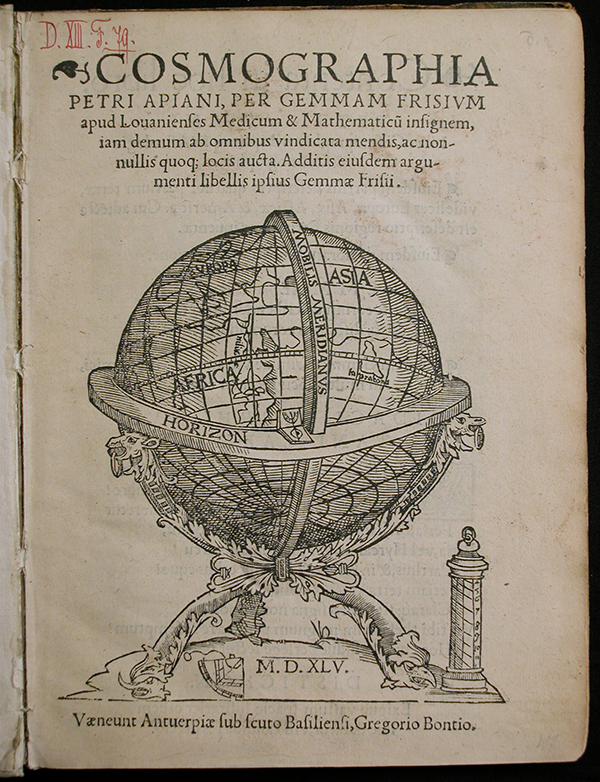
Take, for example, Peter Apian’s Cosmographia, first published in 1524. A 16th-century German polymath, Apian (also known as Petrus Apianus, and born Peter Bienewitz) had a professional interest in mathematics, astronomy and cartography. At their intersection stood the subject of “cosmography” from which this impressive book takes its name, and its project of mapping the then-known universe.
“The treatise provided instruction in astronomy, geography, cartography, navigation, and instrument-making,” writes Frank Swetz at the Mathematical Association of America. “It was one of the first European books to depict and discuss North America and included movable volvelles allowing the readers to interact with and use some of the charts and instrument layouts presented.”
The terrestrial and lunar dials are the most visually complex. The lunar one shows the changing shape of the moon through a cut-out window, but its content had already been preceded in table format by Regiomontanus in 1474. Still, its effect on farming remained vital knowledge. pic.twitter.com/MUuyJYUysQ
— Atlas Obscura (@atlasobscura) July 3, 2020
Pop-up book enthusiasts like Ellen Rubin will know what volvelles are; you and I may not, but if you’ve ever moved a paper wheel or slider on a page, you’ve used one. The volvelle first emerged in the medieval era, not as an amusement to liven up children’s books but as a kind of “analog computer” embedded in serious scientific works. “The volvelles make the practical nature of cosmography clear,” writes Katie Taylor at Cambridge’s Whipple Library, which holds a copy of Cosmographia. “Readers could manipulate these devices to solve problems: finding the time at different places and or one’s latitude, given the height of the Sun above the horizon.”
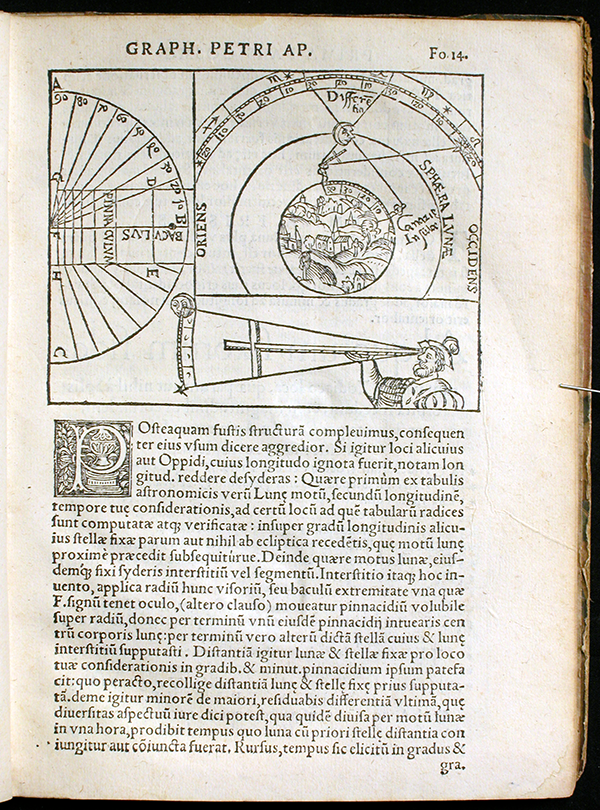
Apian originally included three such volvelles in Cosmographia. Later, his disciple Gemma Frisius, a Dutch physician, instrument maker and mathematician, produced expanded editions that included another. “In all its forms,” writes Swetz, “the book was extremely popular in the 16th century, going through 30 printings in 14 languages.” Despite the book’s success, it’s not so easy to come by a copy in good (indeed working) condition nearly 500 years later. If these descriptions of its pages and their volvelles have piqued your curiosity, you can see these ingenious paper devices in action in these videos tweeted out by Atlas Obscura. As with planets themselves, you can’t fully appreciate them until you see them move for yourself.
Related Content:
When Astronomer Johannes Kepler Wrote the First Work of Science Fiction, The Dream (1609)
Based in Seoul, Colin Marshall writes and broadcasts on cities, language, and culture. His projects include the Substack newsletter Books on Cities, the book The Stateless City: a Walk through 21st-Century Los Angeles and the video series The City in Cinema. Follow him on Twitter at @colinmarshall, on Facebook, or on Instagram.
Read More...A Detailed, Track-by-Track Analysis of the Doctor Who Theme Music

Looking for the definitive guide to the original theme music for the long-running BBC science fiction series Doctor Who, composed in 1963 by Ron Grainer and realised by Delia Derbyshire and the BBC Radiophonic Workshop? Good news, there’s a website that provides just that.
According to BoingBoing, the “writers here — Danny Stewart, Ian Stewart, and Josef Kenny — break down the musical score of each track, pointing out cool details I’d never noticed (like the fact that there are two separate bass tracks that form a nifty counterpoint with each other). They include clips of all the individual tracks isolated so you can hear exactly what they’re describing.” Begin exploring here, and find more Doctor Who Theme Music posts in the Relateds right down below.
If you would like to support the mission of Open Culture, consider making a donation to our site. It’s hard to rely 100% on ads, and your contributions will help us continue providing the best free cultural and educational materials to learners everywhere. You can contribute through PayPal, Patreon, and Venmo (@openculture). Thanks!
via BoingBoing
Related Content:
The Fascinating Story of How Delia Derbyshire Created the Original Doctor Who Theme
Two Documentaries Introduce Delia Derbyshire, the Pioneer in Electronic Music
Read More...An Analysis of Quentin Tarantino’s Films Narrated (Mostly) by Quentin Tarantino
For nearly thirty years, the work of Quentin Tarantino has inspired copious discussion among movie fans. Some of the most copious discussion, as well as some of the most insightful, has come from no less avid a movie fan than Tarantino himself. Every cinephile has long since known that the man who made Reservoir Dogs, Pulp Fiction, and Jackie Brown — and more recently pictures like Django Unchained, The Hateful Eight, and Once Upon a Time… in Hollywood — is one of their own. Now the subject of numerous video essays, Tarantino could, in another life, have become that medium’s foremost practitioner. In the Now You See It video essay above, we have the next best thing: an analysis of Tarantino’s work narrated, for the most part, by the man himself.
“It’s as if a couple of movie-crazy young Frenchmen were in a coffee house, and they’ve taken a banal American crime novel and they’re making a movie out of it based not on the novel, but on the poetry they’ve read between the lines.” So goes New Yorker critic Pauline Kael’s review of Jean-Luc Godard’s Bande à part — as remembered by Tarantino in an interview in the 2000s.
These and other such clips comprise “Quentin Tarantino and the Poetry Between the Lines,” or at least they comprise the parts that don’t come straight from Tarantino’s films or the films that inspired them. From Bande à part Tarantino took not just the name of his production company but also the imperfect style of dancing he had John Travolta and Uma Thurman show off in Pulp Fiction, one of the many acts of cinematic “stealing” to which he gladly cops.
In describing the rule-breaking work of Godard, the first big cinephile-filmmaker, Kael inadvertently bestowed a revelation upon Tarantino: “That’s my aesthetic!” he remembers thinking. “That’s what I want to achieve!” That goal has inspired Tarantino to a number of acts of cultural transposition, and this video essay also brings together the comments several other figures have made about his achievement: Inglourious Basterds star Christoph Waltz remarks on the characteristic way that Tarantino, “the product of the culture that made the Western possible at all,” would “take the genre once removed into the Italian and bring it back to America” as he does in his repatriated spaghetti Western The Hateful Eight. To that picture, and to Quentin Tarantino’s greater cinematic project, applies the observation Gene Siskel made on Pulp Fiction just as it was becoming a cultural phenomenon in its own right: “Like all great films, it criticizes other movies.”
Related Content:
How Quentin Tarantino Steals from Other Movies: A Video Essay
Quentin Tarantino Explains How to Write & Direct Movies
Quentin Tarantino Picks the 12 Best Films of All Time; Watch Two of His Favorites Free Online
The Power of Food in Quentin Tarantino’s Films
Based in Seoul, Colin Marshall writes and broadcasts on cities, language, and culture. His projects include the book The Stateless City: a Walk through 21st-Century Los Angeles and the video series The City in Cinema. Follow him on Twitter at @colinmarshall, on Facebook, or on Instagram.
Read More...The Beauty of Degraded Art: Why We Like Scratchy Vinyl, Grainy Film, Wobbly VHS & Other Analog-Media Imperfection
“Whatever you find weird, ugly, or nasty about a medium will surely become its signature,” writes Brian Eno in his published diary A Year with Swollen Appendices. “CD distortion, the jitteriness of digital video, the crap sound of 8‑bit — all these will be cherished as soon as they can be avoided.” Eno wrote that in 1995, when digital audio and video were still cutting-edge enough to look, sound, and feel not quite right yet. But when DVD players hit the market not long thereafter, making it possible to watch movies in flawless digital clarity, few consumers with the means hesitated to make the switch from VHS. Could any of them have imagined that we’d one day look back on those chunky tapes and their wobbly, muddy images with fondness?
Anyone with much experience watching Youtube has sensed the lengths to which its creators go in order to deliberately introduce into their videos the visual and sonic artifacts of a pre-digital age, from VHS color bleed and film-surface scratches to vinyl-record pops and tape hiss. “Why do we gravitate to the flaws that we’ve spent more than a century trying to remove from our media?” asks Noah Lefevre, creator of the Youtube channel Polyphonic, in his video essay “The Beauty of Degraded Media.” He finds examples everywhere online, even far away from his platform of choice: take the many faux-analog filters of Instagram, an app “built around artificially adding in the blemishes and discolorations that disappeared with the switch to digital photography.”
Lefevre even traces humanity’s love of degraded media to works and forms of art long predating the internet: take now-monochromatic ancient Greek statues, which “were originally painted with bold, bright colors, but as the paints faded, the art took on a new meaning. The pure white seems to carry an immaculate beauty to it that speaks to our perception of Greek philosophies and myths centuries later.” He likens what he and other digital-media creators do today to a kind of reverse kintsugi, the traditional Japanese art of repairing broken pottery with conspicuous gold and silver seams: “Instead of filling in flaws in imperfect objects, we’re creating artificial flaws in perfect objects.” Whether we’re streaming video essays and vaporwave mixes or watching VHS tapes and spinning vinyl records, “we want our media to feel lived in.”
Or as Eno puts it, we want to hear “the sound of failure.” And we’ve always wanted to hear it: “The distorted guitar is the sound of something too loud for the medium supposed to carry it. The blues singer with the cracked voice is the sound of an emotional cry too powerful for the throat that releases it. The excitement of grainy film, of bleached-out black and white, is the excitement of witnessing events too momentous for the medium assigned to it.” This leads into advice for artists, something that Eno — who has made as much use of deliberate imperfection in his role as a producer for acts like U2 and David Bowie as he has in his own music and visual art — has long excelled at giving: “When the medium fails conspicuously, and especially if it fails in new ways, the listener believes something is happening beyond its limits.” It was true of art in the 90s, and it’s even truer of art today.
Related Content:
A Celebration of Retro Media: Vinyl, Cassettes, VHS, and Polaroid Too
Brian Eno Explains the Loss of Humanity in Modern Music
How Computers Ruined Rock Music
How Ancient Greek Statues Really Looked: Research Reveals Their Bold, Bright Colors and Patterns
Based in Seoul, Colin Marshall writes and broadcasts on cities, language, and culture. His projects include the book The Stateless City: a Walk through 21st-Century Los Angeles and the video series The City in Cinema. Follow him on Twitter at @colinmarshall or on Facebook.
Read More...How Venice Works: 124 Islands, 183 Canals & 438 Bridges
3,000,000 tourists move through Venice each year. But when the tourists leave the city, 60,000 year-round residents stay behind, continuing their daily lives, which requires navigating an archipelago made up of 124 islands, 183 canals and 438 bridges. How this complicated city works – how the buildings are defended from water, how the buildings stand on unsteady ground, how the Venetians navigate this maze of a city – is a pretty fascinating story. These techniques have been worked out over Venice’s 1500 year history, and now they’re explored in a captivating 17 minute video produced by a Venetian government agency. You can learn more about the inner life of this great city at Venice Backstage.
If you would like to support the mission of Open Culture, consider making a donation to our site. It’s hard to rely 100% on ads, and your contributions will help us continue providing the best free cultural and educational materials to learners everywhere. You can contribute through PayPal, Patreon, and Venmo (@openculture). Thanks!
Related Content:
Watch City Out of Time, A Short Tribute to Venice, Narrated by William Shatner in 1959
Read More...Movie Accent Expert Analyzes 31 Actors Playing Other Famous People: Jamie Foxx as Ray Charles, Natalie Portman as Jackie Kennedy, Cate Blanchett as Bob Dylan, and More
Well-known figures’ voices are often as distinctive as their thousand-watt smiles and influential hairdos.
While there is some evidence as to the accents and idiosyncratic speech patterns of such historical heavy hitters as Thomas Edison, Florence Nightingale, and Harry Houdini, technological improvements have really upped the ante for those charged with impersonating real life people from the mid 20th-century onward.
Natalie Portman had to sustain her Jackie Kennedy impersonation for an entire feature-length biopic, a performance dialect coach Erik Singer gives high marks, above. Portman, he explains, has truly internalized Jackie’s idiolect, the individual quirks that add yet another layer to such signifiers as class and region.
As evidence, he submits a side-by-side comparison of the First Lady’s famous 1962 televised tour of the White House renovations she had spearheaded, and Portman’s recreation thereof.
Portman has done her homework with regard to breath pattern, pitch, and the refinement that strikes most 21st century ears as a bit stilted and strange. Most impressive to Singer is the way Portman transfers Kennedy’s oddly musical elongation of certain syllables to other words in the script. Tis no mere parrot job.
Jamie Foxx’s Oscar-winning turn as Ray Charles succeeds on copious research and his ability to inhabit Charles’ habitual smile. Obviously, the posture in which an individual holds their mouth has a lot to do with the sound of their voice, and Foxx was blessed with plenty of source material.
The 1982 epic Gandhi provided the versatile Ben Kingsley with the opportunity to showcase not one, but two, idiolects. The adult Gandhi underwent a dramatic and well documented evolution from the British accent he adopted as a young law student in London to a proudly Indian voice better suited to inspiring a nation to unify against its British colonizers.
It’s likely that many of us have never considered the speech-related building blocks Singer scrutinizes while analyzing 29 other performances for the WIRED video, above—epenthesis, tongue positions, relative degrees of emphatic muscularity, and retroflex consonants—but it’s easy to see how they play a part.
Singer invites you to expand his research and teaching library by recording yourself speaking extemporaneously and reading from two sample texts here. Pray that whoever plays you in the biopic gets it right.
Related Content:
Peter Sellers Gives a Quick Demonstration of British Accents
Why Do People Talk Funny in Old Movies?, or The Origin of the Mid-Atlantic Accent
Watch Meryl Streep Have Fun with Accents: Bronx, Polish, Irish, Australian, Yiddish & More
Ayun Halliday is an author, illustrator, theater maker and Chief Primatologist of the East Village Inky zine. See her onstage in New York City through December 20th in the 10th anniversary production of Greg Kotis’ apocalyptic holiday tale, The Truth About Santa, and the book-based variety show, Necromancers of the Public Domain. Follow her @AyunHalliday.
Read More...New Web Site Showcases 700,000 Artifacts Dug Up from the Canals of Amsterdam, Some Dating Back to 4300 BC

Amsterdam has many pleasures to offer, not least boating through its hundred-kilometer network of canals. First laid out in the early 17th century, they constitute a rich history lesson in and of themselves. But Amsterdam is also, of course, a modern city with modern infrastructure, such as a metro system with a new line set to open this month. Amsterdammers have been waiting for that line for fifteen years now, and the reasons for the prolonged construction have to do with the old canals, or rather part of the River Amstel that feeds them.

Boring the tunnels entailed draining the river, and draining the river turned out to offer another history lesson, and a much deeper one than expected. “It is not often that a riverbed, let alone one in the middle of a city, is pumped dry and can be systematically examined,” says the web site Below the Surface. “The excavations in the Amstel yielded a deluge of finds, some 700,000 in all: a vast array of objects, some broken, some whole, all jumbled together.”

The unintended archaeological benefit of draining the river amounts to “a multi-faceted picture of daily life in the city of Amsterdam. Every find is a frozen moment in time, connecting the past and the present. The picture they paint of their era is extremely detailed and yet entirely random due to the chance of objects or remains sinking down into the riverbed and being retrieved from there.” At Below the Surface you can browse the extensive catalog of all these artifacts, the oldest of which date to around 4300 BC, more than five and a half millennia before the founding of Amsterdam itself.

Below the Surface’s collection is organized into ten different categories including “interiors and accessories,” “crafts and industry,” “arms and armor,” “communication and exchange,” and “games and recreation.” On your digitized object-based historical journey there, you’ll encounter objects from all of those realms of human life across time, from 13th-century coins, 15th-century keys, 18th-century tiles, and 20th-century medicine tins. To we humans of the 21st century, in the Netherlands or elsewhere, some of these might look surprisingly contemporary — or at least not nearly as ancient as a mobile phone from the 1990s. Enter Below the Surface here.

Related Content:
The Rijksmuseum Puts 125,000 Dutch Masterpieces Online, and Lets You Remix Its Art
16th-Century Amsterdam Stunningly Visualized with 3D Animation
Flashmob Recreates Rembrandt’s “The Night Watch” in a Dutch Shopping Mall
20,000 Endangered Archaeological Sites Now Catalogued in a New Online Database
Based in Seoul, Colin Marshall writes and broadcasts on cities and culture. His projects include the book The Stateless City: a Walk through 21st-Century Los Angeles and the video series The City in Cinema. Follow him on Twitter at @colinmarshall or on Facebook.
Read More...Support Us
We're hoping to rely on loyal readers, rather than erratic ads. Please click the Donate button and support Open Culture. You can use Paypal, Venmo, Patreon, even Crypto! We thank you!

About Us

Open Culture scours the web for the best educational media. We find the free courses and audio books you need, the language lessons & educational videos you want, and plenty of enlightenment in between.
Advertise With Us
FREE UPDATES!
GET OUR DAILY EMAIL
Get the best cultural and educational resources on the web curated for you in a daily email. We never spam. Unsubscribe at any time.
FOLLOW ON SOCIAL MEDIA
Open Culture editor Dan Colman scours the web for the best educational media. He finds the free courses and audio books you need, the language lessons & movies you want, and plenty of enlightenment in between.
Advertise With Us

