Watch Anthony Bourdain’s Free Show, Raw Craft Where He Visits Craftsmen Making Guitars, Tattoos, Motorcycles & More (RIP)
Why has food become such an object of interest in recent years? One possible explanation is that it represents one of the last pursuits still essentially untouchable by digital culture: for all you can write about and photograph food for the internet, you can’t actually experience it there. Food, in other words, means physicality, dexterity, sensibility, and hand-craftsmanship in a concrete, visceral way that, in the 21st, century, has come to seem increasingly scarce. But another, shorter explanation sums the phenomenon up, just as plausibly, in two words: Anthony Bourdain.
Ever since he first entered the public eye at the end of the 1990s, late chef-writer-traveler-television host taught a reading, and later viewing public to appreciate not just food but all that goes into food: the ingredients, sure, the intense training and labor, of course, but most of all the many and varied cultural factors that converge on a meal. Bourdain found robust cultures everywhere, those that developed cart-filled streets of cities across the world to the kitchens of the most unassuming-looking restaurants and everywhere in between. He deeply respected not just those dedicated to the making and serving of food, but those dedicated to crafts of all kinds.
Bourdain’s natural kinship with all craftsmen and craftswomen made him a natural choice to carry Raw Craft, a web series sponsored by the Balvenie, a popular-premium brand of Scotch whisky. In its fourteen episodes (each of which finds a way to feature a bottle of the Balvenie), Bourdain goes characteristically far and wide to visit the studios and workshops of real people making real suits, shoes, saxophones, drums, guitars, handprinted books, furniture, motorcycles, and “traditionally feminine objects.” That last may break somewhat from Bourdain’s swaggering, masculine-if-not-macho image, but as the series’ host he displays a good deal of enthusiasm for the subject of each episode, including the trip to the sponsor’s own distillery in Dufftown, Scotland.
Naturally, Bourdain can engage on a whole other level in the episodes about food and food-related objects, such as pastries and hot chocolate, kitchen knives, and, in the video at the top of the post, cast-iron skillets. Ever the participatory observer, he finishes that last by preparing steak au poivre with one of the workshop’s own skillets on the flame of its own skillet-forging furnace. He takes it a step further, or several, in the episode with Japanese tattoo artist Takashi where, despite “running out of room” on his own much-tattooed skin, he commissions one more: a magnificent blue chrysanthemum on his shoulder, drawn and inked with only the most time-honored tools and techniques.
We even, during one of Bourdain’s ink-receiving sessions with Takashi, glimpse a true craftsman-to-craftsman conversational exchange. Bourdain asks Takashi about something he’s seen all of the many times he’s been on the tattooing table: a junior artist will approach to watch and learn from the way a senior one works. Takashi, who had to go through a minor ordeal just to convince his own master to take him on as an apprentice, confirms both the universality and the importance of the practice: “If you stop learning, you are pretty much done, you know?” Bourdain, who could only have agreed with the sentiment, lived it to the very end. “I’d like it to last as long as I do,” he says of his Takashi tattoo — “Which ain’t that long,” he adds, “but long enough, I hope.” But surely no amount of time could ever satisfy a culinary, cultural, and intellectual appetite as prodigious as his.
You can watch the complete series of Raw Craft videos here.
Related Content:
20 Mesmerizing Videos of Japanese Artisans Creating Traditional Handicrafts
Japanese Craftsman Spends His Life Trying to Recreate a Thousand-Year-Old Sword
The Making of Japanese Handmade Paper: A Short Film Documents an 800-Year-Old Tradition
Brooklyn–Based Makers of Artisanal Water Let You Sip From America’s Great Cultural Waters
David Rees Presents a Primer on the Artisanal Craft of Pencil Sharpening
Based in Seoul, Colin Marshall writes and broadcasts on cities and culture. His projects include the book The Stateless City: a Walk through 21st-Century Los Angeles and the video series The City in Cinema. Follow him on Twitter at @colinmarshall or on Facebook.
Read More...George Orwell Reveals the Role & Responsibility of the Writer “In an Age of State Control”
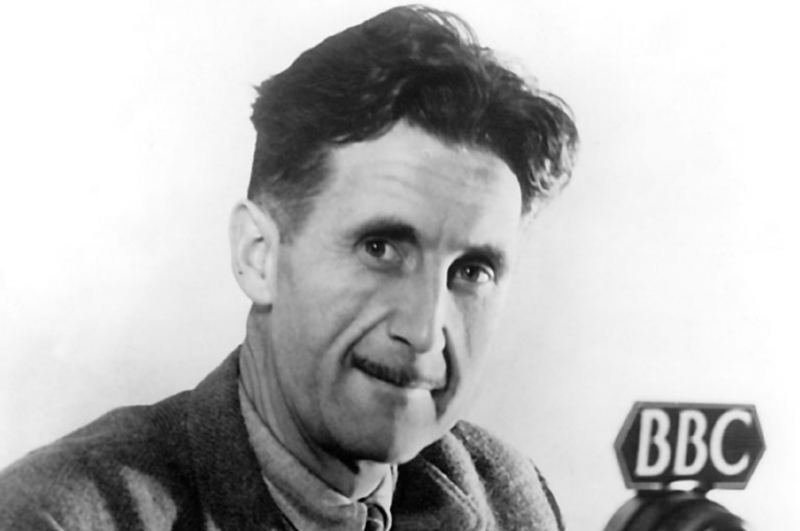
Image by BBC, via Wikimedia Commons
What is the role of the writer in times of political turmoil? Professional athletes get told to “shut up and play” when they speak out—as if they had no vested interest in current events or a constitutional right to speak. But it is generally assumed that writers have a central part to play in public discourse, even when they don’t explicitly write about politics. When writers make controversial statements, it sounds a little ridiculous to tell them to “shut up and write.”
On one view, “it is the responsibility of intellectuals to speak the truth and to expose lies,” as Noam Chomsky declares in “The Responsibility of Intellectuals.” Chomsky deplores those who comfortably accept the consensus and deliberately disseminate untruths out of a “failure of skepticism” and blind belief in the purity of their motives. Faced with obvious lies, outrages, and oppression, “intellectuals”— journalists, academics, artists, even clergy—should “follow the path of integrity, wherever it may lead.”
One such intellectual, George Orwell, is often held up across the political spectrum as a paradigm of intellectual integrity. Orwell, as you might expect, had his own thoughts on what he called “the position of the writer in an age of State control.” He expressed his view in a 1948 essay titled “Writers and the Leviathan.” He accords with Chomsky in most respects, yet in the end does not endorse the view that the political responsibilities of writers are greater than anyone else. Yet Orwell also expresses similar wariness about writers becoming cardboard propagandists, and losing their creative, critical, and ethical integrity.
Orwell begins his argument by claiming that writers bear some responsibility for creating the culture that nurtures politics. “WHAT KIND of State rules over us,” he writes, “must depend partly on the prevailing intellectual atmosphere: meaning, in this context, partly on the attitude of writers and artists themselves.” Moreover, he suggests, it is unrealistic to expect writers, or anyone for that matter, not to have strong political opinions. The “special problem of totalitarianism” infects everything, even literature, making “a purely aesthetic attitude,” like that of Oscar Wilde, “impossible.”
This is a political age. War, Fascism, concentration camps, rubber truncheons, atomic bombs, etc are what we daily think about, and therefore to a great extent what we write about, even when we do not name them openly. We cannot help this. When you are on a sinking ship,
your thoughts will be about sinking ships.
Seventy years after Orwell’s essay, we live in no less a “political age,” burdened by daily thoughts of all the above, plus the deadly effects of climate change and other ills Orwell could not foresee.
We also see our age reflected in Orwell’s description of the “orthodoxies and ‘party lines’” that plague the writer. “A modern literary intellectual,” he writes, “lives and writes in constant dread—not, indeed, of public opinion in the wider sense, but of public opinion within his own group…. At any given moment there is a dominant orthodoxy, to offend against which needs a thick skin and sometimes means cutting one’s income in half for years on end.”
But integrity requires unorthodox thinking. Orwell goes on to analyze a number of “unresolved contradictions” on the left that make a wholesale, uncritical embrace of its political orthodoxy tantamount to “mental dishonesty.” He takes pains to note that this phenomenon is inherent to every political ideology: “acceptance of ANY political discipline seems to be incompatible with literary integrity.” Here is a dilemma. Ignoring politics is irresponsible and impossible. But so is committing to a party line.
Well, then what? Do we have to conclude that it is the duty of every writer to “keep out of politics”? Certainly not! In any case, as I have said already, no thinking person can or does genuinely keep out of politics, in an age like the present one. I only suggest that we should
draw a sharper distinction than we do at present between our political and our literary loyalties, and should recognise that a willingness to DO certain distasteful but necessary things does not carry with it any obligation to swallow the beliefs that usually go with them. When a writer engages in politics he should do so as a citizen, as a human being, but not AS A WRITER. I do not think that he has the right, merely on the score of his sensibilities, to shirk the ordinary dirty work of politics. Just as much as anyone else, he should be prepared to deliver lectures in draughty halls, to chalk pavements, to canvass voters, to distribute leaflets, even to fight in civil wars if it seems necessary. But whatever else he does in the service of his party, he should never write for it. He should make it clear that his writing is a thing apart. And he should be able to act co-operatively while, if he chooses, completely rejecting the official ideology. He should never turn back from a train of thought because it may lead to a heresy, and he should not mind very much if his unorthodoxy is smelt out, as it probably will be.
It might be objected that Orwell himself wrote an awful lot about politics from a definite point of view (which he defined in “Why I Write” as “against totalitarianism and for democratic socialism”). He even cited “political purpose” as one of four reasons that serious writers have for writing. But before accusing him of hypocrisy, we must read on for more nuance. “There is no reason,” he says, that a writer “should not write in the most crudely political way, if he wishes to. Only he should do so as an individual, an outsider, at the most an unwelcome guerilla on the flank of a regular army.” (His position is reminiscent of James Baldwin’s, a political writer who “excoriated the protest novel.”) And if the writer finds some of that army’s positions untenable, “then the remedy is not to falsify one’s impulses, but to remain silent.”
Orwell’s essay characterizes the “almost inevitable nature of the irruption of politics into culture,” argues Enzo Traverso, “Writers were no longer able to shut themselves up in a universe of aesthetic values, sheltered from the conflicts that were tearing apart the old world.” The kind of compartmentalization he recommends might seem cynical, but it represents for him a pragmatic third way between the “ivory tower” and the “party machine,” a way for the writer to act ethically in the world yet retain a “saner self [who] stands aside, records the things that are done and admits their necessity, but refuses to be deceived as to their true nature” and thus become a party mouthpiece, rather than an artist and critical thinker.
Related Content:
George Orwell Creates a List of the Four Essential Reasons Writers Write
George Orwell Explains in a Revealing 1944 Letter Why He’d Write 1984
Josh Jones is a writer and musician based in Durham, NC. Follow him at @jdmagness
Read More...When Pinball Was Deemed Immoral & Outlawed in Major American Cities
I remember the early days of the video arcade, where my friends and I went to have fun and spent our parents’ cash on Galaga, Robotron 2084, or–if you were a really big spender–Dragon’s Lair. Then, when we’d get home, and we would see scare pieces on the national news about the evils of the very arcades we had just visited, dens of drugs and depravity! Where were *those* arcades, we wondered.
Nothing has changed, it seems. Let’s go back nearly 80 years to another moral panic: pinball.
As these two mini docs show, in the 1930s and ‘40s pinball was banned in cities like New York (by mayor and future airport Fiorello LaGuardia) and Chicago because of its association with organized crime, but also the appeal it had to the children of the working class.
They kind of had a point: early pinball machine were purely games of chance, which put it very close to gambling. (A modern pachinko machine is closer to these early versions.) Like a carny game, you paid your money, and you watched as the ball careened down the table, out of your control.
But with the invention of user-controlled flippers that sent the ball back in play, these games of chance became games of skill. But that didn’t stop some moral crusaders.
And, as several pinball fans have found out–like the gentleman in the VICE doc below who wanted to open a pinball museum–antiquated laws remained on the books from those early years and had never been changed for modern times.
Roger Sharpe, known as “The Man Who Saved Pinball,” even went to a Chicago court in 1976 to prove that pinball was a game of skill. In a scene that sounds perfect for a final act in a movie, Sharpe, with his barbershop quartet mustache and groovy outfit, played pinball in front of legislators. Calling shots like a pool player might, he soon convinced the court that skill was everything. Sharpe would go on to become a star witness in similar hearings in Ohio, West Virginia, and Texas over their pinball laws.
Ironically, while video games replaced pinball in most arcades, home systems and computers replaced the need for arcades. It’s now a perfect time for these purely analog and tactile machines to make a comeback. Hell, a rock band might even make a musical about it one day.
Related Content:
Orson Welles Teaches Baccarat, Craps, Blackjack, Roulette, and Keno at Caesars Palace (1978)
Ted Mills is a freelance writer on the arts who currently hosts the artist interview-based FunkZone Podcast and is the producer of KCRW’s Curious Coast. You can also follow him on Twitter at @tedmills, read his other arts writing at tedmills.com and/or watch his films here.
Read More...You Can Now Airbnb the Home of F. Scott and Zelda Fitzgerald, Where the Author Wrote Tender Is the Night
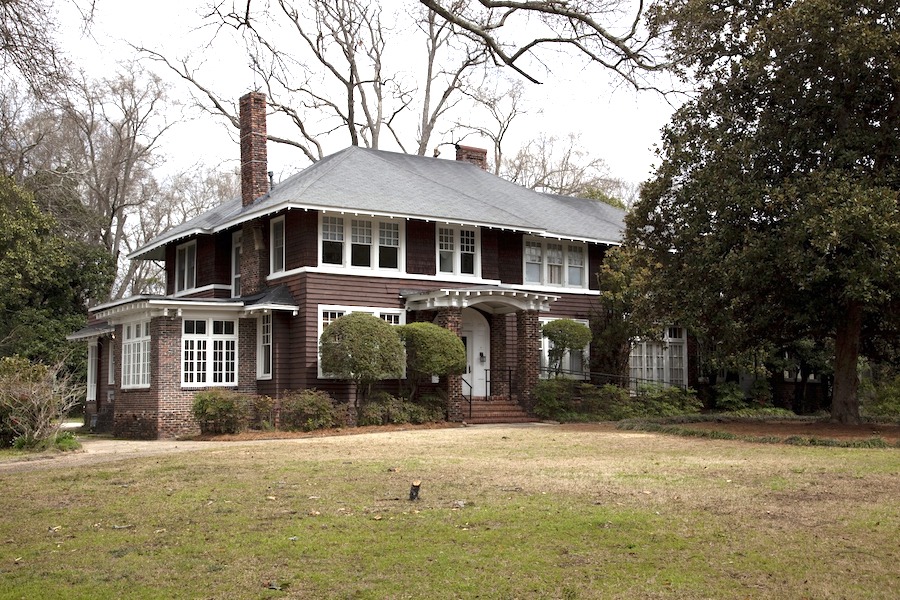
Photo by George F. Landegger, via Wikimedia Commons
F. Scott Fitzgerald started writing in earnest at Princeton University, several of whose literary and cultural societies he joined after enrolling in 1913. So much of his time did he devote to what would become his vocation that he eventually found himself on academic probation. Still, he kept on writing novels even after dropping out and joining the Army in 1917. He wrote hurriedly, with the prospect of being shipped out to the trenches hanging over his head, but that grim fate never arrived. Instead the Army transferred him to Camp Sheridan outside Montgomery, Alabama, at one of whose country clubs young Scott met a certain Zelda Sayre, the “golden girl” of Montgomery society.
With his sights set on marriage, Scott spent several years after the war trying to earn enough money to make a credible proposal. Only the publication of This Side of Paradise, his debut novel about a literarily minded student at Princeton in wartime, convinced Zelda that he could maintain the lifestyle to which she had become accustomed. Between 1921, when they married, and 1948, by which time both had died, F. Scott and Zelda Fitzgerald lived an occasionally productive, often miserable, and always intensely compelling life together. The story of this early cultural “power couple” has an important place in American literary history, and Fitzgerald enthusiasts can now use Airbnb to spend the night in the home where one of its chapters played out.
The rentable apartment occupies part of the F. Scott Fitzgerald Museum in Montgomery, an operation run out of the house in which the Fitzgeralds lived in 1931 and 1932. For the increasingly troubled Zelda, those years constituted time in between hospitalizations. She had come from the Swiss sanatorium that diagnosed her with schizophrenia. She would afterward go to Johns Hopkins Hospital in Baltimore, where she would write an early version of her only novel Save Me the Waltz, a roman à clef about the Fitzgerald marriage. For Scott’s part, the Montgomery years came in the middle of his work on Tender is the Night, the follow-up to The Great Gatsby for which critics had been waiting since that book’s publication in 1925.
“The house dates to 1910,” writes the Chicago Tribune’s Beth J. Harpaz. “The apartment is furnished in casual 20th century style: sofa, armchairs, decorative lamps, Oriental rug, and pillows embroidered with quotes from Zelda like this one: ‘Those men think I’m purely decorative and they’re fools for not knowing better.’ ” Evocative features include “a record player and jazz albums, a balcony, and flowering magnolia trees in the yard.” It may not offer the kind of space needed to throw a Gatsby-style bacchanal — to the endless relief, no doubt, of the museum staff — but at $150 per night as of this writing, travelers looking to get a little closer to these defining literary icons of the Jazz Age might still consider it a bargain. It also comes with certain modern touches that the Fitzgeralds could hardly have imagined, like wi-fi. But then, given the well-documented tendency toward distraction they already suffered, surely they were better off without it.
You can book your room at Airbnb here.
Related Content:
Free: The Great Gatsby & Other Major Works by F. Scott Fitzgerald
Rare Footage of Scott and Zelda Fitzgerald From the 1920s
Winter Dreams: F. Scott Fitzgerald’s Life Remembered in a Fine Film
The Evolution of F. Scott Fitzgerald’s Signature: From 5 Years Old to 21
Based in Seoul, Colin Marshall writes and broadcasts on cities and culture. His projects include the book The Stateless City: a Walk through 21st-Century Los Angeles and the video series The City in Cinema. Follow him on Twitter at @colinmarshall or on Facebook.
Read More...The Map of Philosophy: See All of the Disciplines, Areas & Subdivisions of Philosophy Mapped in a Comprehensive Video
In the introduction to his sweeping History of Western Philosophy, Bertrand Russell wastes no time getting to a definition of his subject. “The conceptions of life and the world which we call ‘philosophical,’” he writes in the first sentence, “are a product of two factors: one, inherited religious and ethical conceptions; the other, the sort of investigation which may be called ‘scientific,’ using the word in its broadest sense. … Philosophy, as I shall understand the word, is something intermediate between theology and science.” (Russell makes a similar argument, in slightly different terms, in the essay “Mysticism and Logic.”)
Although this distinction between broadly “theological” and broadly “scientific” thinking may not map directly onto the modern schism between “Continental” and “Analytic” philosophy, a comparison still seems highly relevant. Though some continental thinkers may not wish to admit it, their categories and modes of reasoning—or intuiting, reflecting, speculating, etc.—derive from theological thought denuded of its specific religious content or beliefs. Or as philosopher Thomas R. Wells writes at his blog The Philosopher’s Beard, the continental proceeds from a “direct concern with the human condition, its ambition, its reflexivity, its concern with the media as well as the message.”
The analytic, on the other hand, strives for “universal scope, clarity and public accountability…. It tries to systematize knowledge” and approximate scientific methods of inquiry (which also once mixed freely with the theological). Both approaches can move too close to the poles Russell identifies—can move too far away, that is, from philosophy and toward the obscure and purely mystical or the inhumanely, unreflectively rational. Perhaps one way of thinking about the history of philosophy is as a dance between this play of opposites, with each approach offering a corrective to the other’s excesses, sometimes within the same thinker’s body of work.
But before applying such abstractions, we should consider the ways philosophy developed as a discipline distinct from the hard sciences and theology—and from art, psychology, anthropology, physics, mathematics, linguistics, economics, etc. “Once upon a time,” notes the video at the top—a comprehensive “map of philosophy” made by Carneades.org— “Philosophy was anything you can study. Everything in the realm of study was a type of philosophy.” The breaking off of other fields into their own domains happened over the course of several hundred years. Nonetheless, “philosophy still had its fingers in all of those other pies.”
One can think philosophically about anything—philosophy can “put different disciplines on the same playing field to talk to each other.” It is, the video’s introduction declares, “the glue that holds all of academia together” (hence, the top academic degree, the Ph.D., or “doctor of philosophy”). For reasons of his own training, the video’s creator, who simply goes by the pseudonym “Carneades,” leans more heavily on the analytic side of things, neglecting or only lightly touching on much of the continental thought that flourished in the wake of Heidegger, Hegel, Nietzsche, Kierkegaard, Sartre, and others. (Further up, you can see a video focused on one specific school of moral philosophy—Consequentialism. See more such videos at the Carneades.org YouTube channel.)
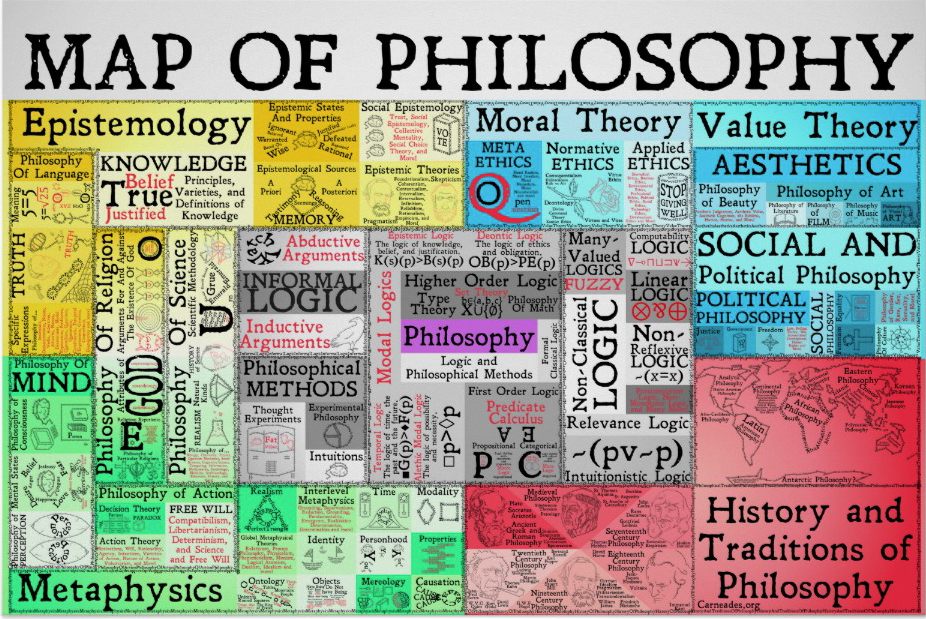
Carneades admits his biases and blind spots and welcomes corrections from those better versed in other traditions. To his credit, he includes Native American, African, Latin American, Afro-Caribbean, Polynesian, Japanese, Islamic, Tibetan, and many other global philosophical traditions in his extensive map—traditions that are usually completely ignored or deemed “unphilosophical” in other such surveys. His sensitivity to global thought may have something to do with the fact that he is not based in a Western academic department, but in West Africa, where he does humanitarian work.
See a complete table of contents, with links to specific sections, for the lengthy “Map of Philosophy” just below, and an image of the full map just above (purchase a hard copy here). Carneades’ intention to bring “these ideas back to the modern agora from the Ivory Tower” is a noble one. If you agree, and find these videos informative and intellectually stimulating, you can donate to or become a patron of his efforts at the Carneades.org Patreon page.
Table of Contents:
00:00 Introduction
01:44 Logic and Philosophical Methods
02:14 Formal Classical Logic
04:55 Non-Classical Logic
06:35 Informal Logic
08:00 Philosophical Methods
10:20 The History of Philosophy
13:30 Philosophical Traditions Around the World
20:55 Aesthetics
22:35 Political Philosophy
23:34 Social Philosophy
25:00 Moral Theory & Ethics
28:08 Epistemology
30:34 Metaphysics
34:13 Philosophy of Science
37:35 Philosophy of Religion
40:17 Philosophy of Language
41:58 Philosophy of Mind
43:49 Philosophy of Action
44:57 Full Map
Related Content:
Free Online Philosophy Courses
The History of Philosophy … Without Any Gaps
350 Animated Videos That Will Teach You Philosophy, from Ancient to Post-Modern
A History of Philosophy in 81 Video Lectures: From Ancient Greece to Modern Times
Josh Jones is a writer and musician based in Durham, NC. Follow him at @jdmagness
Read More...All of the Rulers of Europe Over the Past 2,400 Years Presented in a Timelapse Map (400 B.C. to 2017 A.D.)
Theories of power, from Machiavelli and Hobbes to Locke and Jefferson, have drawn their lessons from the towering figure of the Sovereign, the principle actor in dramas of old European statecraft. One philosopher advises cunning, another fear and awe. When we come to ideas of civil society based in property rights, we see theorists arguing with proponents of monarchical divine right, or struggling, constitutionally, militarily, with a mad king.
Maybe this survey seems banal, passé, boring, blah.
It can be difficult for post-post-moderns to fully appreciate the Sovereign’s once-crushing weight. (See John Milton’s many defenses of regicide and revolution, for example.) Maybe, schooled in the work of Gilles Deleuze, Michel Foucault, George Orwell, Hannah Arendt, Theodor Adorno, etc., we have learned to think of power—whether from below or above—as diffuse, interrelated, networked, spread across classes, impersonal bureaucracies, institutional practices.
The word “despot,” for example, sounds so exotic, an ossified term from antiquity. Studying the video above could bring it to life again, if discourses around current events haven’t. Sprinting through two-thousand, four-hundred, and seventeen years of history, this dramatic presentation names the names of every ruler in Europe, from 400 B.C.E. to 2017.
Despite its Eurocentric association with the East (as in the stereotype of the “Oriental Despot”), Western history offers hundreds of examples of despotism. Put simply, “despotism,” says Foucault in his lecture series The Birth of Biopolitics, “refers any injunction made by the public authorities back to the sovereign’s will, and to it alone.”
Despotism, he argues, stands in contrast to the police state, or absolute rule by administrators and enforcers, and to the Rule of Law, in which rulers and ruled are both ostensibly bound by external charters and legal codes.
Watch the procession of emperors, kings, usurpers, tyrants…. Do we know the names of any of their functionaries? Do we need to? If Claudius or Constantine decreed, what does it matter who carried out the order? When and where do those terms change—when do the names become a kind of synecdoche, standing in for administrations, parties, juntas, etc. rather than the singular will of individuals, benevolent, enlightened, or otherwise?
How many of these rulers’ names are unfamiliar to us? Why haven’t we heard them? At what period in history does Europe become predominantly ruled by other forms of government? Does despotism ever disappear? Does it reappear in the 20th century (were Lenin, Franco, or Marshall Tito despots?), or must we use another rubric to describe dictators and autocrats? (Does it make any sense to call contemporary figureheads like Elizabeth II “rulers of Europe”?)
Pick your own mode of analysis, explore the outer edges and obscure interiors of empires, and you might find yourself getting very interested in European history (learn more here), or curious about how “despotism” divided, metamorphosed, and metastasized into whatever various forms of rule the names “Merkel,” “Macron,” “Putin,” “Poroshenko,” or “Erdogan,” for example, represent today.
Related Content:
Free Online History Courses
The History of Europe: 5,000 Years Animated in a Timelapse Map
Watch the History of the World Unfold on an Animated Map: From 200,000 BCE to Today
Josh Jones is a writer and musician based in Durham, NC. Follow him at @jdmagness
Read More...The Ups & Downs of Ancient Rome’s Economy–All 1,900 Years of It–Get Documented by Pollution Traces Found in Greenland’s Ice
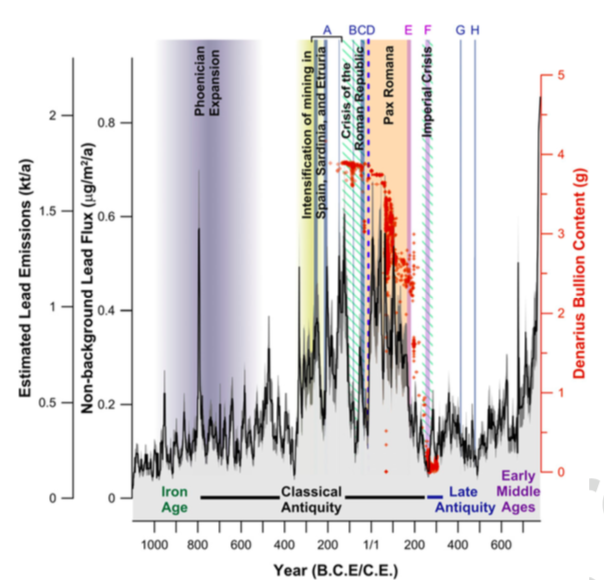
When we see stories pop up involving scientific findings in glacier ice, we might brace for unpleasant environmental news about the future. But a paper published just recently in Proceedings of the National Academy of Sciences instead reveals fascinating findings about the distant past—the history of ancient Rome between 1100 B.C.E. to 800 C.E. Historians know this 1,900-year period through archaeological and literary evidence. Now climate scientists have provided a treasury of new data to help substantiate or revise scholarly understandings of Rome’s economic rises and falls, by measuring the stratifications of lead pollution in a roughly 400-meter ice core from Greenland.
Why lead? “It’s a proxy for coin production,” says Seth Bernard, professor of ancient history at the University of Toronto. Roman currency, the denarius, was made from silver, mined primarily on the Iberian Peninsula. “But these mines didn’t excavate pure silver,” notes Robinson Meyer at The Atlantic. “Instead, they unearthed an ore of silver, lead, and copper that had to be smelted into silver. This process filled the air with lead pollution,” which eventually made its way on air currents to Greenland, where “storms deposited lead-tainted snow or sleet over the Arctic island.” New layers formed upon the old, each one preserved for posterity.
In the mid-1990s, scientists began drilling Greenland’s ice sheet in the North Greenland Ice core Project (NGRIP). At the time, a team attempted a similar analysis on the lead levels and their correspondence to ancient coinage, “which used a similar but rudimentary technique,” Meyer writes. But this study only drew from 18 data points. By contrast, the new research “made 25,000 different measurements of the ice core.” Improved technology has refined the measurement process, allowing researchers to detect “the presence of 35 different elements and chemicals at once,” and to tie their observations to specific years, or fairly close to it, anyway. The chart above shows the fluctuations in lead emissions over the almost 2000-year span.
One of the study’s authors, Joseph McConnell, estimates the margin of error as within one or two years. “That’s pretty good,” he says, “a lot better than what archaeologists are used to, I can tell you that.” This allows the team of climate scientists, archaeologists, and historians to match their observations about lead levels to known historical events. As The New York Times reports, “lead emissions rose in periods of peace and prosperity, such as the Pax Romana, which ran from 27 BC to 180 A.D. and dropped during the civil wars that preceded the Pax and the rise of the emperor Augustus. There were also dramatic drops that coincided with the Antonine plague of 165–180 A.D., thought to have been small pox, and the Cyprian plague, cause uncertain, of 250–270 A.D.”
The data, notes The Economist, “provide a new window onto the workings of the ancient economy…. Not all of the lead trapped in the glacier comes from silver minding, but much of it does,” and scientists can make informed guesses about just how much. Many unanswered questions remain. “What we’d love to have is a document that says Rome had a state monetary policy,” says Bernard. The empire’s specific economic policies are largely a mystery, but the ice core samples provide a wealth of new evidence for the increase and decrease in currency production, and ever-more refined technologies will allow for even more data to emerge from the pollutants trapped in glacial ice in the near future.
Related Content:
The Rise & Fall of the Romans: Every Year Shown in a Timelapse Map Animation (753 BC ‑1479 AD)
Josh Jones is a writer and musician based in Durham, NC. Follow him at @jdmagness
Read More...It’s the End of the World as We Know It: The Apocalypse Gets Visualized in an Inventive Map from 1486
When will the world end?
We can find serious scientific answers to this question, depending on what we mean by “world” and “end.” If civilization as we currently know it, climate scientists’ worst-case scenario points toward somewhere around 2100 as the beginning of the end. (New York magazine points out that it “probably won’t kill all of us”). It’s possible, but not inevitable.
If we mean the end of all life on earth, the forecast looks quite a bit rosier: we’ve probably got about a billion years, writes astrophysicist Jillian Scudder, before the sun becomes “hot enough to boil our oceans.” Still not a cheerful thought, but perhaps many more creatures will take after the tardigrade by then. That’s not even to mention nuclear war or the epidemics, zombie and otherwise, that could take us out.
But of course, for a not inconsiderable number of people—including a few currently occupying key positions of power in the U.S.—the question of the world’s end has nothing to do with science at all but with eschatology, that branch of theological thought concerned with the Apocalypse.
Theological thinkers have written about the Apocalypse for hundreds of years, and the world’s end was frequently perceived as just around the corner for many of the same reasons modern secular people feel apocalyptic dread: disease, natural disasters, wars, rumors of wars, imperial power struggles, uncomfortably shifting demographics….
Take 15th-century Europe, when “the Apocalypse weighed heavily on the minds of the people,” as Betsy Mason and Greg Miller write at the National Geographic blog All Over the Map: “Plagues were rampant. The once-great capital of the Roman empire, Constantinople, had fallen to the Turks. Surely, the end was nigh.”
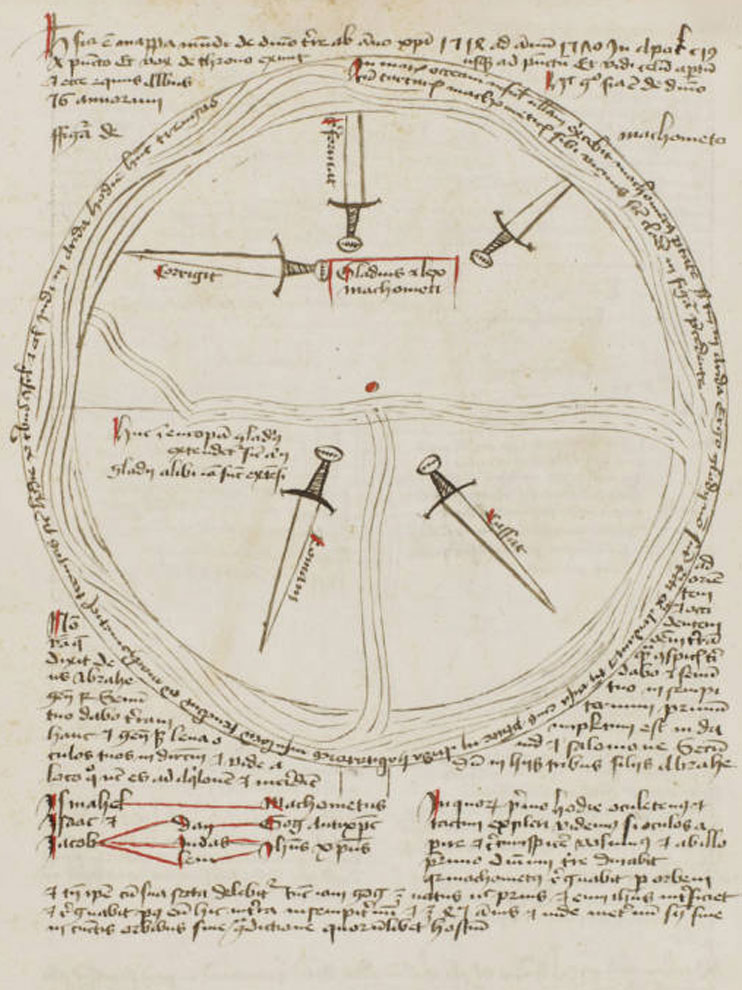
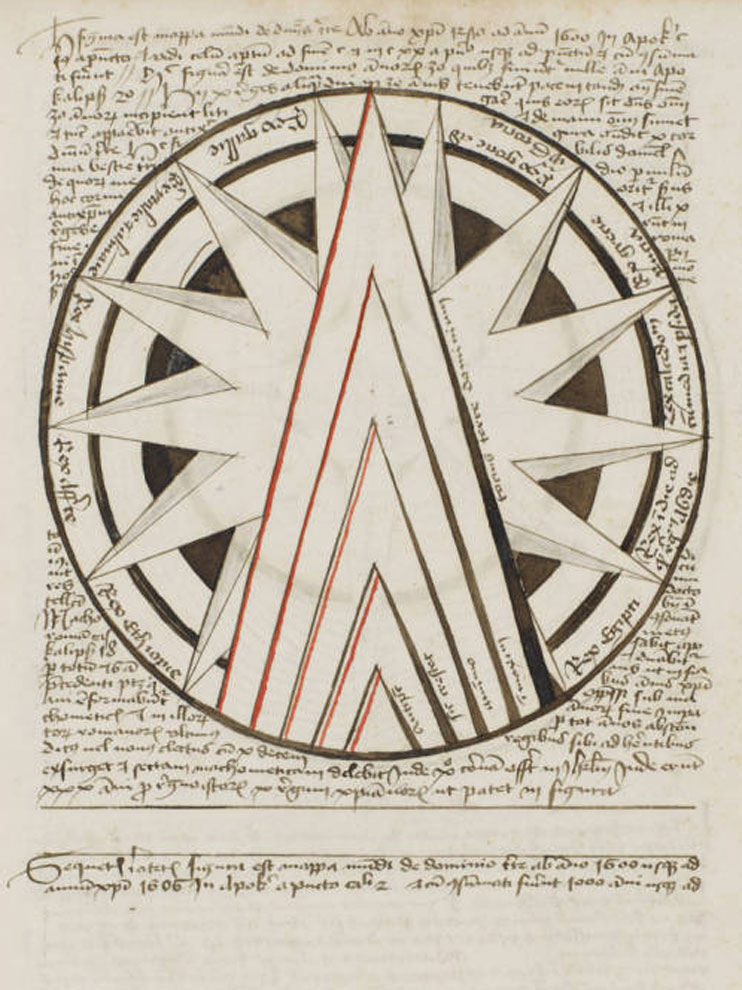
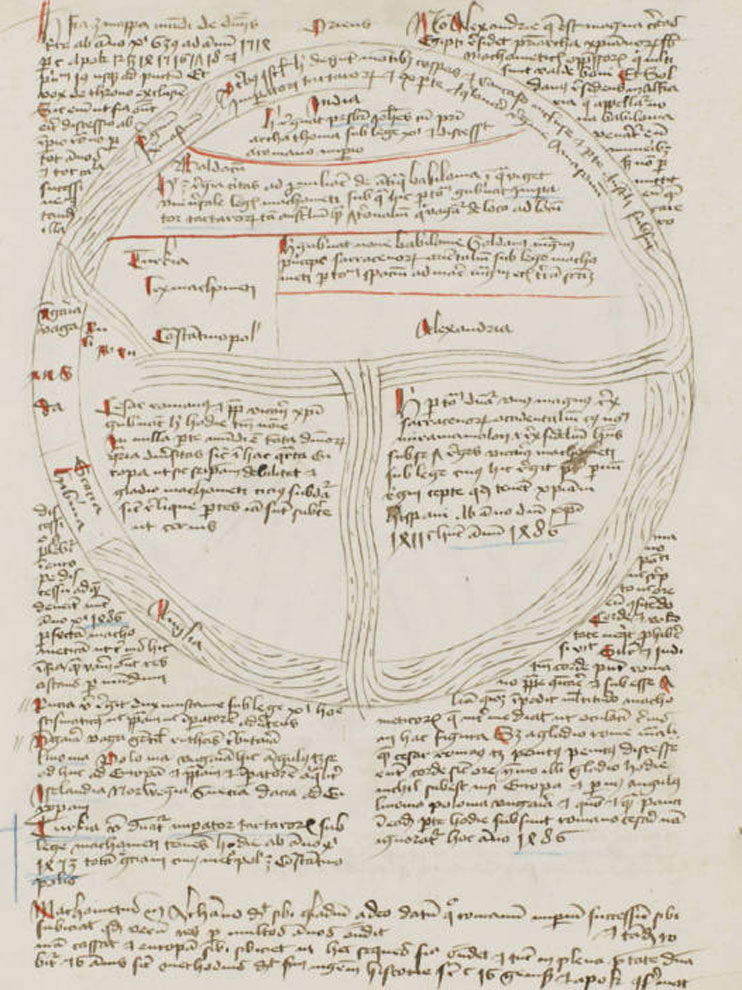
While a niche publishing market in the nascent print era produced “dozens of printed works” describing the “coming reckoning in gory detail… one long-forgotten manuscript depicts the Apocalypse in a very different way—through maps.” As you can see here, these maps convey the unfolding of worse-to-worser scenarios in a number of visual registers: temporal, symbolic, geographic, thematic, etc.
At the top, the nested triangles depict the rise of the Antichrist between the years 1570 and 1600. The central concern for this author was the supposed global threat of Islam. Thus, the next map, its “T” shape a common Medieval world map device, shows the world before the Apocalypse, the text around it explaining that “Islam is on the rise from 639 to 1514.”
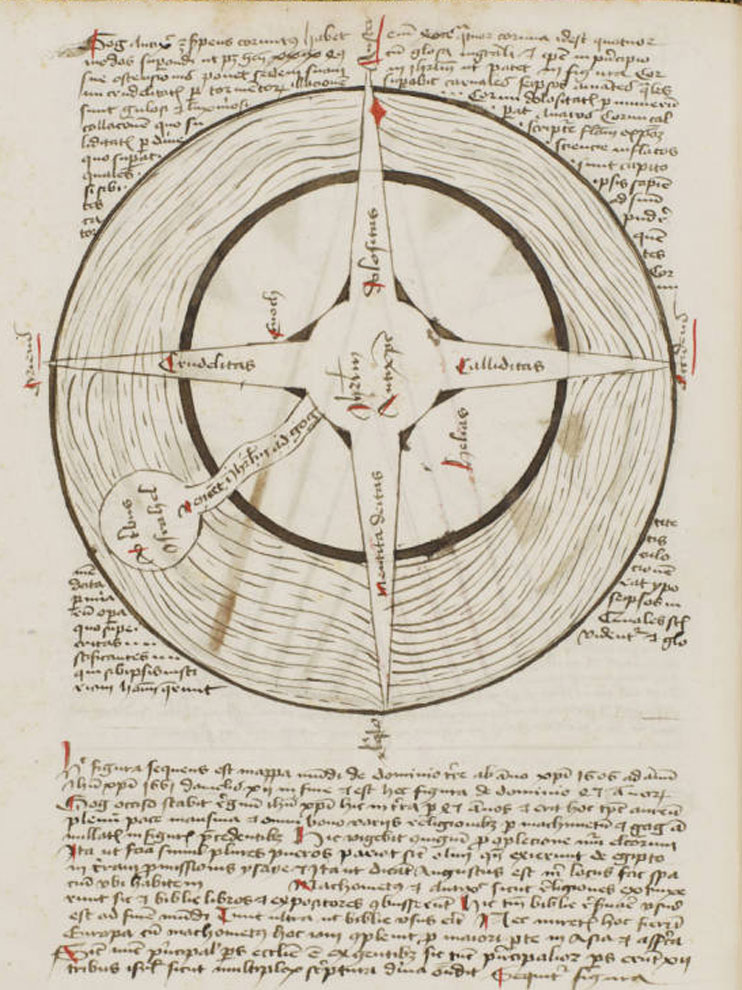
Then, we have a circular map with five swords pointing at the edges of the known world, illustrating the author’s contention that Islamic armies would reach the edges of the earth. The other maps depict the “four horns of the Antichrist,” above, Judgement Day, below, (the black eye at the bottom is the “black abyss that leads to hell”), and, further down, a diagram describing “the relative diameters of Earth and Hell.”
Made in Lübeck, Germany sometime between 1486 and 1488, the manuscript is written in Latin, “but it’s not as scholarly as other contemporary manuscripts,” write Mason and Miller, “and the penmanship is fairly poor.” Historian of cartography Chet Van Duzer explains that “it’s aimed at the cultural elite, but not the pinnacle of the cultural elite.”
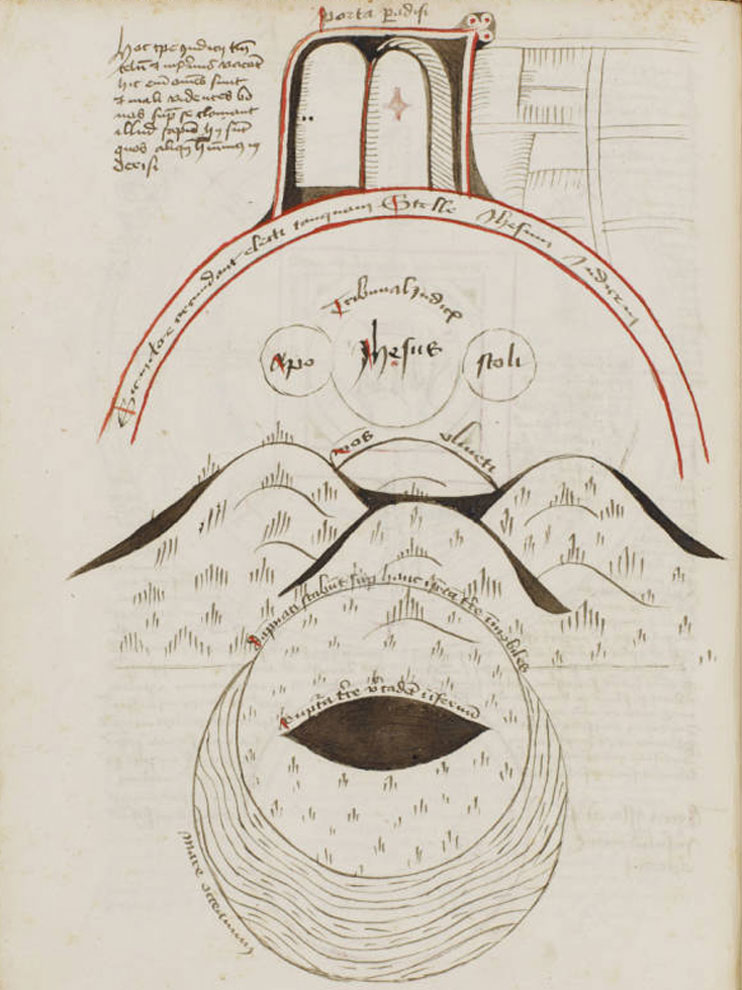
Pointing out the obvious, Van Duzer says, “there’s no way to escape it, this work is very anti-Islamic,” a widespread sentiment in medieval Europe, when the “clash of civilizations” narrative spread its roots deep in certain strains of Western thinking. This particular text also “includes a section on astrological medicine and a treatise on geography that’s remarkably ahead of its time.”
Van Duzer and Ilya Dines have studied the rare manuscript for its insightful passages on geography and cartography and published their research in a book titled Apocalyptic Cartography. For all its theological alarmism, the manuscript is surprisingly thoughtful when it comes to analyzing its own formal properties and perspectives.
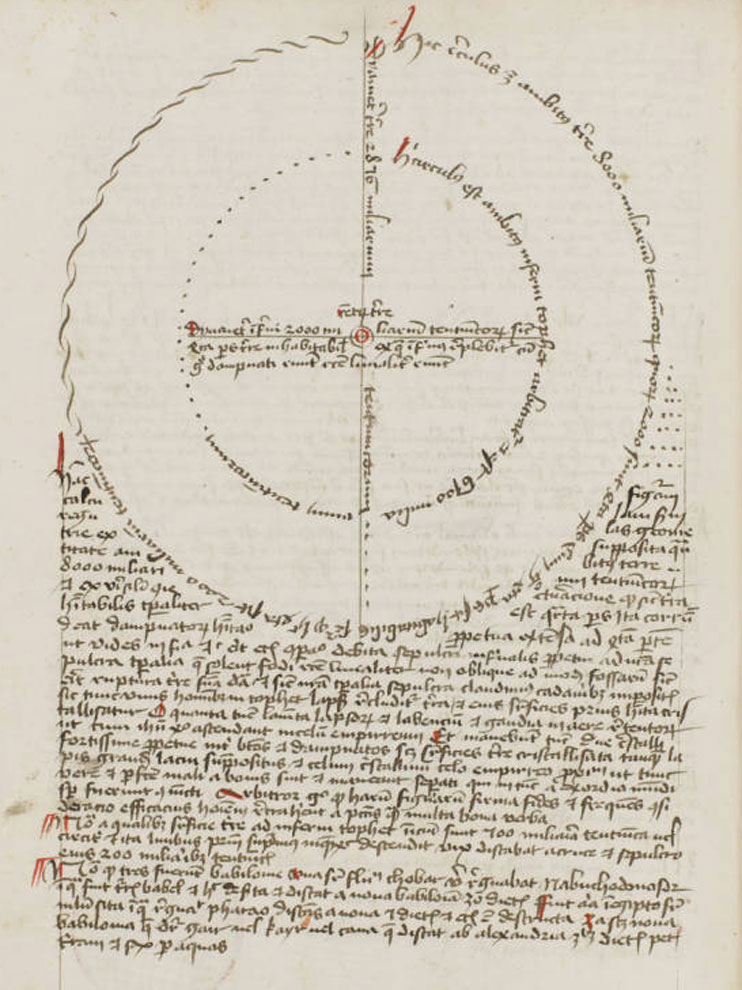
Mason and Miller note that “the author outlines an essentially modern understanding of thematic maps as a means to illustrate characteristics of the people or political organization of different regions.” As Van Duzer puts it, “this is one of the most amazing passages, to have someone from the 15th century telling you their ideas about what maps can do.” This marks the work, he claims in the introduction to Apocalyptic Cartography, as that “of one of the most original cartographers of the period.”
The Apocalypse Map now resides at the Huntington Library in Los Angeles.
Related Content:
In 1704, Isaac Newton Predicts the World Will End in 2060
Josh Jones is a writer and musician based in Durham, NC. Follow him at @jdmagness
Read More...
Muhammad Ali & Sly Stone Get Into a Heated Debate on Racism & Reparations on The Mike Douglas Show (1974)
Ah, the 70s… an American president was impeached for criminal activity; a congressman, Wayne Hays, resigned for sleeping with his secretary, after divorcing his wife to marry a different secretary; another congressman, Bud Shuster—who described Hays as “the meanest man in the house”—called for an investigation of Watergate special prosecutor Archibald Cox, after Cox was fired by the soon-to-be impeached president… ‘twas a different time, children, a simpler time….
Well, at any rate, they sure wore funny suits back then, eh? Those lapels…. But just like today, politics mixed freely with sports and entertainment in controversial and televisual ways. Boxers got ratings, singers got ratings, politicians like “meanest man in the house” Wayne Hays got ratings, even before his sex scandal, when he appeared on TV with boxers and singers—appeared, that is, on The Mike Douglas Show in 1974 with Muhammad Ali and Sly Stone. Actor and activist Theodore Bikel was there too, though you might blink and miss him in the fracas just above.
First, Hays offers some banal opinions on the subject of campaign financing, another one of those bygone 70s issues. But when Douglas poses the question to Ali of whether or not he’d ever run for office, things pick up, to say the least. Ali refuses to play the entertainer. He launches flurry after flurry of jabs at white America, and at Hays, who does his best to stay upright under the onslaught. “Ali is unyielding,” writes Dangerous Minds, “intense and brilliant.”
Ali takes on a serious question facing Black nationalists of the 60s and 70s, from the Panthers to the Nation of Islam, whose views Ali embraced at the time, along with, perhaps, some of their ugly anti-Semitism. (The following year he converted to Sunni Islam, and later became a Sufi.) Should Black activists participate in the oppressive systems of the U.S. government? Can anyone do good from inside the halls of imperialist power?
Hays makes an integrationist case, and champions Black leaders like congresswoman Barbara Jordan. Ali is relentlessly combative, calling for reparations. Sly slides in to clarify and pacify, playing mediator and referee. Douglas gets off the applause line, “isn’t it time we all tried to live together.” Ali refuses to gloss over racism and economic inequality. No peace, he says in effect, without justice. Aren’t we glad, forty-four years later, that we’ve ironed all this out? See the full show here for much more heavyweight commentary from Ali and sometimes fuzzy counterpoint from Sly. They go back and forth with Douglas for ten minutes before Hays and Bikel join.
Related Content:
Muhammad Ali Gives a Dramatic Reading of His Poem on the Attica Prison Uprising
James Baldwin Bests William F. Buckley in 1965 Debate at Cambridge University
Josh Jones is a writer and musician based in Durham, NC. Follow him at @jdmagness
Read More...How David Bowie Turned His “Adequate” Voice into a Powerful Instrument: Hear Isolated Vocal Tracks from “Life on Mars,” “Starman,” “Modern Love” “Under Pressure” & More
Believe it or not, the odds were against David Bowie becoming an international pop superstar. When it seemed he’d finally arrived, with the release of Ziggy Stardust and the Spiders from Mars in 1972, “we didn’t realize,” says Jarvis Cocker in a 2012 documentary, “that he’d been trying to be successful for 10 years.” Bowie was 24, a ripe old age in pop star years, and already had four albums under his belt as a solo artist, the first a total commercial failure, and the second notable for its one hit, “Space Oddity,” which seemed like it might have been the artist’s big break in 1969, but somehow wasn’t.
He had played in several bands and tried performing under his given name, Davy Jones, which he just happened to share with one of the biggest pop stars of the day. Had he not persisted, changed his name and style, and, crucially, invented his Martian glam persona, he might have remained a one-hit-wonder, his excellent The Man Who Sold the World and Hunky Dory revered as underrated cult favorites among fans in the know.
In addition to the difficulty Bowie had finding his niche, he was not a naturally gifted singer and was a reluctant performer. Drawn early to “movement and music” classes in school, Bowie’s teachers called his idiosyncratic style “vividly artistic,” but only rated his voice as “adequate.” As voice coach Lisa Popeil writes, “though vocally agile as an adult, Bowie was never known for great pitch accuracy.”
Such things matter less these days, what with pitch correction software. In the old days of analog, singers couldn’t lean on digital wizardry to make them sound better than they were. Bowie wasn’t “particularly fond” of his own voice, he revealed in an interview, and unlike most hungry, young would-be stars, he didn’t set out to put himself in the spotlight—not at first.
“I thought that I wrote songs and wrote music and that was sort of what I thought I was best at doing. And because nobody else was ever doing my songs, I felt, you know, I had to go out and do them.”
So the shy, retiring Bowie charged ahead. “With his theatrical bent and fearlessness,” Popeil writes, his “ability to create memorable and emotional vocal stylings was of the highest order.” This, we might say, is almost an understatement. Aspiring singers and musicians can learn much from Bowie’s career, perhaps foremost the lesson that one needn’t be a prodigy or a bubbly extrovert to follow a musical passion. Bowie honed his vocal skills and achieved mastery over his haunting baritone, while also learning to move into a powerful tenor range.
Witness these isolated vocal tracks from throughout this career. At the top, the vocal mix from “Life on Mars” shows, as Classic fM writes, that “while unpolished, his tremulous voice has real quality and range.” Further down, we hear Bowie goofing around a bit in the vocal booth before launching into his first hit, “Space Oddity,” his voice a bit thin in the verse, then hitting its full stride in the chorus. Three years later, on “Starman” from Ziggy Stardust, we hear more confidence and control in the vocal track. Then, ten years after Ziggy, Bowie belts it out on “Modern Love,” above, having already kept pace with arguably the greatest rock singer of all time on “Under Pressure,” further up.
On “Golden Years,” above, Bowie explores his full range, from deepest baritone to falsetto. His voice inevitably waned with age and the sickness of his final years, but he never lost the ability to imbue a song with maximal emotional range, making the ragged vocals on his last album, especially its chilling single “Lazarus,” some of the most gripping in his entire body of work. The video below from The Last Five Years documentary strips away the instrumentation, leaving us with the image of an aged, blinded Bowie in bed, singing “Look up here man, I’m in danger/I’ve got nothing left to lose.” His breathing is audibly labored, giving the recording a poignant immediacy. But the forever-distinctive Bowie vocal style is as deeply moving as ever.
Related Content:
The Story of Ziggy Stardust: How David Bowie Created the Character that Made Him Famous
Hear Freddie Mercury’s Vocals Soar in the Isolated Vocal Track for “Somebody to Love”
Josh Jones is a writer and musician based in Durham, NC. Follow him at @jdmagness
Read More...Support Us
We're hoping to rely on loyal readers, rather than erratic ads. Please click the Donate button and support Open Culture. You can use Paypal, Venmo, Patreon, even Crypto! We thank you!

About Us

Open Culture scours the web for the best educational media. We find the free courses and audio books you need, the language lessons & educational videos you want, and plenty of enlightenment in between.
Advertise With Us
FREE UPDATES!
GET OUR DAILY EMAIL
Get the best cultural and educational resources on the web curated for you in a daily email. We never spam. Unsubscribe at any time.
FOLLOW ON SOCIAL MEDIA
Open Culture editor Dan Colman scours the web for the best educational media. He finds the free courses and audio books you need, the language lessons & movies you want, and plenty of enlightenment in between.
Advertise With Us


