Learn the History of Indian Philosophy in a 62 Episode Series from The History of Philosophy Without Any Gaps: The Buddha, Bhagavad-Gita, Non Violence & More

The belief in a singular, coherent “Western tradition” in philosophy has led to a very insular, Eurocentric view in philosophy departments, as Jay L. Garfield and Bryan W. Van Norden write in a New York Times op-ed. “No other humanities discipline demonstrates this systemic neglect of most of the civilizations in its domain,” they argue, “The present situation is hard to justify morally, politically, epistemically or as good educational and research training practice.” In his follow-up book Taking Back Philosophy Van Norden argues that educational institutions should “live up to their cosmopolitan ideals” by expanding the canon and teaching non-Western philosophical traditions.
One philosophy educator, Peter Adamson, professor of philosophy at the LMU in Munich and King’s College London, has taken up the challenge of teaching global philosophical traditions through his popular podcast The History of Philosophy Without Any Gaps, with series on the Islamic World, Africana, and India. With expert co-authors and guests, Adamson’s podcasts help us navigate cultural and historical differences without watering down the substance of diverse bodies of thought.
These surveys of non-Western traditions aim to be as exhaustive as the podcast’s coverage of Classical, Later Antiquity, and Medieval periods in Europe. We’ve featured Adamson’s podcasts on Islamic and Indian philosophy in an earlier post. Now we revisit his series on Indian philosophy, which has grown substantially in the interval, from thirty-two to sixty-two episodes, divided into three categories—“Origins,” “Age of the Sutra,” and “Buddhists and Jains.”
Very broadly, much Indian philosophy can be understood as a centuries-long conflict between the six orthodox Vedic schools (astika) and the heterodox (nastika) schools, including Buddhism, Jainism, and Carvaka, a materialist philosophy that denied all metaphysical doctrines. While some strains among these schools of thought can be associated with individual names, like Kanada, Patañjali, or Nagarjuna, much ancient Indian philosophy “is represented by a mass of texts,” as Luke Muehlhauser writes in his short guide, “for which the authors and dates of composition are mostly unknown.”
Adamson’s free podcast survey of Indian philosophy makes for entertaining, informative listening. You can download every episode in .zip form at the links above. Or find links to the individual episodes right below. To keep up with trends in the study of Indian philosophy in English, be sure to follow the Indian Philosophy Blog. And for an excellent list of “Readings on the Less Commonly Taught Philosophies (LCTP),” see this post by Bryan Van Norden here.
Related Content:
Free Online Philosophy Courses
Josh Jones is a writer and musician based in Durham, NC. Follow him at @jdmagness
Read More...When Jean-Paul Sartre Had a Bad Mescaline Trip and Then Hallucinated That He Was Being Followed by Crabs
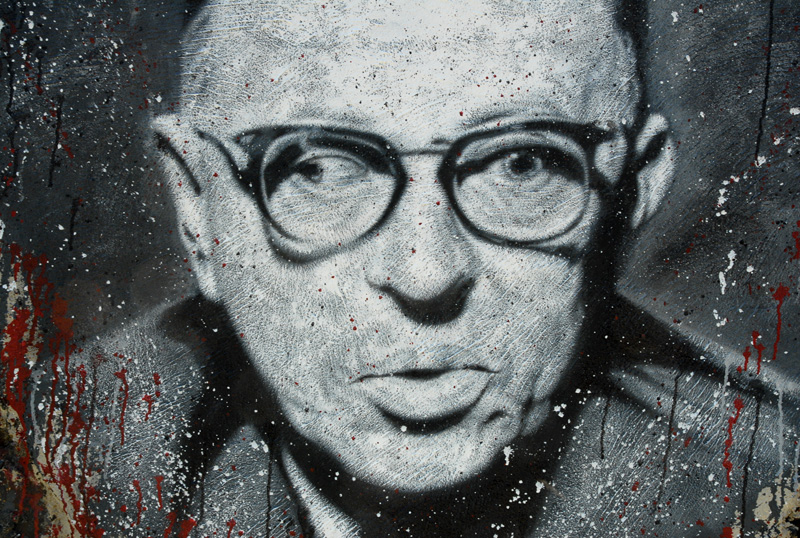
Image by Thierry Ehrmann via Flickr Commons
Sometimes when confronted with strange new ideas, people will exclaim, “you must be on drugs!”—a charge often levied at philosophers by those who would rather dismiss their ideas as hallucinations than take them seriously. But, then, to be fair, sometimes philosophers are on drugs. Take Jean-Paul Sartre. “Before Hunter S. Thompson was driving around in convertibles stocked full of acid, cocaine, mescaline and tequila,” notes Critical Theory, Sartre almost approached the gonzo journalist’s habitual intake.
According to Annie Cohen-Solal, who wrote a biography of Sartre, his daily drug consumption was thus: two packs of cigarettes, several tobacco pipes, over a quart of alcohol (wine, beer, vodka, whisky etc.), two hundred milligrams of amphetamines, fifteen grams of aspirin, a boat load of barbiturates, some coffee, tea, and a few “heavy” meals (whatever those might have been).
These details should not unduly influence our reading of Sartre’s work. Like Thompson, no matter how physically debilitating the booze and drugs might have been for him, they didn’t seem to cramp his productivity or intellectual vigor. But his one and only experience with mescaline almost sent him careening over the edge, and certainly contributed to an important motif in his work afterward.
While working on a book about the imagination, Sartre sought to have an hallucinatory experience. He got the chance in 1935 when an old friend, Dr. Daniel Lagache, invited him into an experiment at Sainte-Anne’s hospital in Paris, where he was injected with mescaline and observed under controlled conditions. “Sartre does not appear to have had a bad trip in the classic sense of suffering a major and prolonged panic attack,” Gary Cox writes in his Sartre biography. “But it was not a good trip and he did not enjoy it.”
The most ill effects came afterward: “His visual faculties remained distorted for weeks.” Sartre saw houses with “leering faces, all eyes and jaws.” Clock faces took on the features of owls. He confided in his partner Simone de Beauvoir that “he feared that one day he would no longer know” whether or not these were hallucinations. They were, however, not the worst aftereffects. As Sartre told political science professor John Gerassi in a 1971 interview, crabs began to follow him around. He described the experience as “a nervous breakdown.” The crabs followed him “all the time,” he said, “I mean they followed me in the streets, into class.”
I got used to them. I would wake up in the morning and say, “Good morning, my little ones, how did you sleep?” I would talk to them all the time, or I would say, “OK guys, we’re going into class now, so we have to be still and quiet,” and they would be there, around my desk, absolutely still, until the bell rang.
This went on for a year before Sartre went to see his friend Jacques Lacan for psychoanalysis. “We concluded, “ he says, “that it was a fear of becoming alone.” While he had previously confessed a fear of sea creatures, especially crabs, that went back to his childhood, after the mescaline trip, crabs featured prominently in his work, as Peter Royle shows at Philosophy Now.
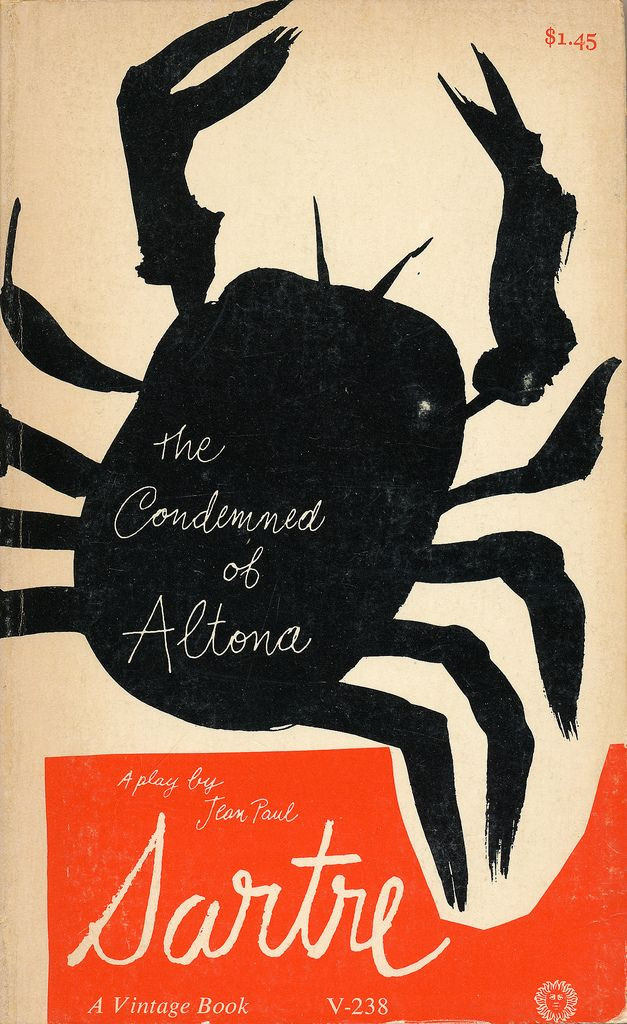
We find several references to crabs in his short story collection The Wall and in his famous essay “Existentialism is a Humanism.” Samir Chopra quotes crab passages in Sartre’s first novel Nausea. (“At first I avoided them by writing about them,” he told Gerassi, “in effect, by defining life as nausea.”) “In one of his short stories, ‘Erostratus,’” notes Royle, “Sartre creates a character, Paul Hilbert, who looks down on human beings from a height and sees them as crabs.” The most striking use of the “crab motif” comes from his 1959 play The Condemned of Altona, in which the protagonist Frantz imagines that by the Thirtieth Century, humans have become crabs sitting in judgment of the people of the Twentieth.
Crab images, Royle argues, “point to important philosophical ideas,” including “the possibility of ignominy inherent in the concept of freedom itself” and the “reprehensible ‘crabs’ who decline to assume their freedom” and thus scuttle around mindlessly in groups. Crustaceans continued to haunt the philosopher. While the effects of the mescaline eventually dissipated, “when he was feeling down,” writes Cox, Sartre would get the “recurrent feeling, the delusion, that he was being pursued by a giant lobster, always just out of sight… perpetually about to arrive.”
One of the “great, darkly comic features of Sartre folklore,” the huge, invisible lobster invites much speculation about Sartre’s mental health. But perhaps it was only the monstrous embodiment of his own feelings of mauvaise foi, given vivid form by a lingering psychotropic hangover and a daily diet of uppers and downers—a reminder of the “anxiety, anguish, dread, apprehension, fear of pain, fear of death… [and] fundamental absurdity of existence.” As Royle writes, Sartre, always fond of puns, “could only have been intrigued” by the French word for lobster, homard, which sounds like “homme-ard,” a coinage that might suggest something like “a bad man.”
Related Content:
The Drawings of Jean-Paul Sartre
Josh Jones is a writer and musician based in Durham, NC. Follow him at @jdmagness
Read More...The Famous Break Up of Sigmund Freud & Carl Jung Explained in a New Animated Video
Making friends with similar interests can be a challenge for anyone. But imagine you are the founder of an entirely new discipline, with its own peculiar jargon, set of practices, and conceptual categories. Imagine, for example, that you are Sigmund Freud, who in 1896 made his break with medicine to pursue the work of psychoanalysis. Drawing on clinical experience with patients, his own self-analysis, cocaine-induced reveries, and an idiosyncratic reading of Greek mythology, Freud invented his strange psychosexual theories within the confidence of a very small circle of acquaintances and admirers.
One of his close relationships during those productive and turbulent years, with eccentric ear, nose, and throat doctor Wilhelm Fliess—a collaborator, influence, “confessor and moral supporter”—ended badly in 1906. It was in that same year that Freud met the much-younger Carl Jung. At their first meeting, the two “talked nonstop for 13 hours,” the Aeon video above, animated by Andrew Khosravani, tells us. Thus began the intense and now-legendary six-year friendship between the psychiatrists, a “passionate and surpassingly weird relationship, which, given the people involved, perhaps shouldn’t come as a surprise.” Freud settled upon Jung as his protege and successor, the “Joshua to my Moses,” overjoyed to have found a friend who seemed to understand his ideas intimately.
They traveled to the US to give joint lectures and analyzed each other’s dreams. Freud wrote to propose that Jung should think of their relationship as between “father and son,” an odd proposal in any friendship, but especially when the “father” invented the Oedipal complex; “this did not go unnoticed by Freud, and he freaked out a little.” The unsettling dynamic already presented a shaky basis for a long term bond, but it was their wildly divergent ideas that ultimately drove them apart. Jung took issue with Freud’s obsession with libido as the primary driver of human behavior. Freud cast a withering eye on Jung’s keen interest in religion, mysticism, and the paranormal as expressions of a collective unconscious.
As he had divorced himself from Wilhelm Fleiss in 1906, Freud similarly, abruptly, broke off his friendship with Jung in 1913, sending a rather nasty break-up letter to sever their “emotional tie.” Jung, he wrote, “while behaving abnormally keeps shouting that he is normal,” giving rise to “the suspicion that he lacks insight into his illness. Accordingly, I propose that we abandon our personal relations entirely.” The video ends by declaring Freud the winner of this “feud,” such as it was, though the personal conflict seems rather one-sided. As Jung would later relate, he “soon discovered that when [Freud] had thought something, then it was settled.” After Freud broke it off, Jung wrote in his diary, “the rest is silence.”
As for the legacies of both men, these seem settled as well. They both had significant influence on writers and artists of all kinds, on literary theorists, new age mystics, and philosophers. But Jung is hardly taken seriously in the mainstream of psychiatry, and Freud’s ideas have largely been abandoned, save for one: as millions who still reveal themselves weekly on therapists’ couches can attest, the talking cure of psychoanalysis is alive and well.
Related Content:
Animated Video Tells the Story of Jean-Paul Sartre & Albert Camus’ Famous Falling Out (1952)
The Famous Letter Where Freud Breaks His Relationship with Jung (1913)
Carl Jung Explains Why His Famous Friendship with Sigmund Freud Fell Apart in Rare 1959 Audio
How a Young Sigmund Freud Researched & Got Addicted to Cocaine, the New “Miracle Drug,” in 1894
Josh Jones is a writer and musician based in Durham, NC. Follow him at @jdmagness
Read More...Discover an Archive of Taped New York City-Area Punk & Indie Concerts from the 80s and 90s: The Pixies, Sonic Youth, The Replacements & Many More
“For decades now,” John Coulthart writes at Dangerous Minds, “Hoboken has been on an implacable course of gentrification… to the point that scruffy and legendary music venues can’t hack it there anymore.” One could replace “Hoboken” with the name of virtually any US city that once hosted a seminal live venue. You live long enough, you see the world completely change, and all the punk and indie clubs shut down or moved to Brooklyn. The 21st century has given us cities few indie artists or their fans can afford, even as it also gives us high-speed internet, huge servers, cheap web hosting, and hard drives that can hold terabytes of digital music.
But at least the club shows of the past can live on in incredibly awesome archives like The McKenzie Tapes, “a collection of live audio recordings from some of the New York City-area’s most prominent music venues of the 1980s and 1990s.”
Recorded by David McKenzie, a former employee of legendary Hoboken venue Maxwell’s and consummate concert-goer, the taped gigs come from such venues as The Ritz, Tramps, Irving Plaza, The Roxy, the Cat Club, Bowery Ballroom, CBGB’s, the Knitting Factory, and, of course, Maxwell’s.
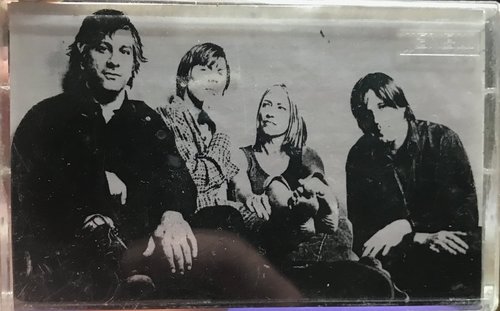
Too many legendary bands to list in full show up here: some major highlights include The Replacements at the Ritz in 1986, right after the release of Tim. (See them at the top in a soundcheck at Maxwell’s that same year); the Pixies at Maxwell’s in 1988, playing songs from their just-released watershed Surfer Rosa; Sonic Youth on back-to-back nights at CBGB’s in 88, playing Daydream Nation the month before recording the album. Hüsker Dü, Wire, John Spencer Blues Explosion, The Fall, The Feelies, Afghan Whigs, Mudhoney, Violent Femmes, Mojo Nixon—the shows are a who’s who of punk and indie from the last two decades of the century, with appearances from 70s legends like Patti Smith and Tom Verlaine.
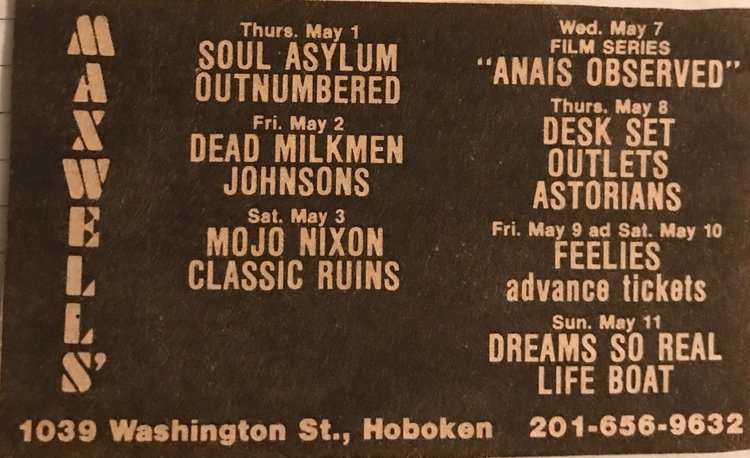
Sprinkled throughout are surprises like a 1989 performance from Sun Ra and his Intergalactic Arkestra at Maxwell’s and gigs by blues stalwarts T Model Ford and R.L. Burnside, as well as the occasional outlier show abroad. The project is the work of Jersey City record collector, archivist, event producer, and podcaster Tom Gallo, friend of David McKenzie, and he has done an excellent job of preserving not only the music from McKenzie’s tapes, but images of the tapes themselves—with hand-written band names and song titles and black-and-white Xeroxed covers—as well as Village Voice listings of the gigs and occasional ticket stubs, setlists, and live photos.
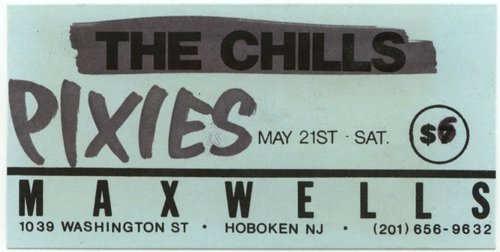
Don’t expect much in the way of sound quality—that’s part of the charm of a taped show. These are raw documents of the cassette age, a time come and gone, never to come again. We might not mourn its passing, but something—a spirit of experimental, noisy, tuneful, angry, raucous, lo-fi, analog indie fun—seems to have disappeared along with it. All of these digitized tapes are downloadable. Put ’em on your phone and relive the glory days, or discover these treasures from the recent past for the first time at The McKenzie Tapes here.
Related Content:
A Massive 800-Track Playlist of 90s Indie & Alternative Music, in Chronological Order
Stream a Massive Collection of Indie, Noise Industrial Mixtapes from the 80s and 90s
Josh Jones is a writer and musician based in Durham, NC. Follow him at @jdmagness
Read More...The Simpsons Take on Ayn Rand: See the Show’s Satire of The Fountainhead and Objectivist Philosophy
Say what you will about the tenets of Objectivism—to take a fan favorite line from a little film about bowling and white Russians. At least it’s an ethos. As for Ayn Rand’s attempts to realize her “absurd philosophy” in fiction, we can say that she was rather less successful, in aesthetic terms, than literary philosophers like Albert Camus or Simone de Beauvoir. But that’s a high bar. When it comes to sales figures, her novels are, we might say, competitive.
Atlas Shrugged is sometimes said to be the second best-selling book next to the Bible (with a significant degree of overlap between their readerships). The claim is grossly hyperbolic. With somewhere around 7 million copies sold, Rand’s most popular novel falls behind other capitalist classics like Think and Grow Rich. Still, along with The Fountainhead and her other ostensibly non-fictional works, Rand sold enough books to make her comfortable in life, even if she spent her last years on the dole.
Since her death, Rand’s books have grown in popularity each decade, with a big spike immediately after the 2008 financial crisis. That popularity isn’t particularly hard to explain as an appeal to adolescent selfishness and grandiosity, and it has made her works ripe targets for satire—especially since they almost read like self-parody already. And who better to take on Rand than The Simpsons, reliable pop satirists of great American delusions since 1989?
The show’s take on The Fountainhead, above, has baby Maggie in the role of architect Howard Roark, the book’s genius individualist whose extraordinary talent is stifled by a critic named Ellsworth Toohey (a cardboard caricature of British theorist and politician Harold Laski). In this version, Toohey is a vicious preschool teacher in tweed, who insists on educating his charges in banality (“mediocrity rules!”) and knocks down Maggie’s block cathedral with a snide “welcome to the real world.”
In response to Toohey’s abuse, Maggie delivers a pompous soliloquy about her own greatness, as Rand’s heroes are wont to do. She is again subjected to preschool repression in the clip just above—this time not at the hands of a socialist critic but from the headmistress of the Ayn Rand School for Tots. The domineering disciplinarian tells Marge her aim is to “develop the bottle within” and dissuade her students from becoming “leeches,” a dig at Rand’s tendency—one sadly parroted by her acolytes—to dehumanize recipients of social benefits as parasites.
Readers of Roald Dahl will be reminded of Matilda’s Miss Trunchbull, and the barracks-like daycare, its walls lined with Objectivist slogans, becomes a site for some Great Escape capers. These sly references hint at a deeper critique—suggesting that the libertarian philosophy of hyper-individualism contains the potential for tyranny and terror as brutal as that of the most dogmatically collectivist of utopian schemes.
Related Content:
Flannery O’Connor: Friends Don’t Let Friends Read Ayn Rand (1960)
When Ayn Rand Collected Social Security & Medicare, After Years of Opposing Benefit Programs
Josh Jones is a writer and musician based in Durham, NC. Follow him at @jdmagness
Read More...A Brief, Visual Introduction to Surrealism: A Primer by Doctor Who Star Peter Capaldi
Surrealism, according to this short Unlock Art video from the Tate, began in Paris, at the cafe Les Deux Magots, in 1924. You can still go there, but among its habitués you won’t find the fellow on whom the camera zooms in: André Breton, author of the Surrealist Manifesto. That influential text drew inspiration from the work of Sigmund Freud, father of psychoanalysis, specifically his book The Interpretation of Dreams.
“Breton believed art and literature could represent the unconscious mind,” says the video’s narrator Peter Capaldi, well known as one of the Doctors of Doctor Who. He then names some artists who agreed with Breton on this point, such as Salvador Dalí, Max Ernst, Joan Miró, and Rene Magritte — just a few of the Surrealists. “Surreal,” as an adjective, has perhaps fallen victim to debasement by overuse in the past 84 years. But Breton had specific ideas about Surrealism’s potential effects, its sources of power, and its methods.
Desire, for instance, “was central to the Surrealist vision of love, poetry, and liberty. It was the key to understanding human beings.” Surrealist artistic practices included putting objects “that were not normally associated with one another together, to make something that was playful and disturbing at the same time in order to stimulate the unconscious mind.” Think of Dalí’s 1936 Lobster Telephone, made out of those very objects. “It’s about food and sex,” Capaldi pronounces. The Surrealist vision also extended to more complicated endeavors, such as elaborate paintings and films that still fascinate today.
You can catch up on Surrealist film here on Open Culture, beginning with Luis Buñuel & Salvador Dalí’s nightmarish 1929 short Un Chien Andalou, continuing on to the Surrealist feature Dreams That Money Can Buy (a collaboration by the likes of Man Ray, Marcel Duchamp, Alexander Calder, Fernand Léger and Hans Richter), and the history of Surrealist cinema as presented by David Lynch, a filmmaker widely considered one of the movement’s modern heirs. Whether Breton would recognize the Surrealist sensibility in its current manifestations will remain a matter of debate, but who could watch this Unlock Art primer and fail to sense the fascination its basic ideas — or basic compulsions, perhaps — still hold today?
Related Content:
David Lynch Presents the History of Surrealist Film (1987)
Restored Version of Un Chien Andalou: Luis Buñuel & Salvador Dalí’s Surreal Film (1929)
30 Hours of Doctor Who Audio Dramas Now Free to Stream Online
Based in Seoul, Colin Marshall writes and broadcasts on cities and culture. His projects include the book The Stateless City: a Walk through 21st-Century Los Angeles and the video series The City in Cinema. Follow him on Twitter at @colinmarshall or on Facebook.
Read More...What Makes Taxi Driver So Powerful? An In-Depth Study of Martin Scorsese’s Existential Film on the Human Condition
The field jacket, the mohawk, the “real rain” that will “wash all this scum off the streets,” the virtuoso tracking shot over the aftermath of a massacre, “You talkin’ to me?”: so many elements of Taxi Driver have found permanent places in cinematic culture, and almost as many have found permanent places in the culture, period. Thanks to its wide-ranging influence as well as its presence that endures more than forty years on, even those who’ve never seen the movie in some sense already know it.
What makes Taxi Driver so powerful? Lewis Bond, video essayist and creator of Channel Criswell, sets out to answer that question in the two-part, feature-length analysis above. Martin Scorsese’s fifth film, and the second of his collaborations with Robert de Niro, Taxi Driver came out in 1976.
Adapting the film noir tradition for an even more cynical post-Vietnam era, it ostensibly mounted a grim critique of America. Audiences of the 1970s, especially audiences of New Yorkers, might have readily identified with the judgments of moral, social and urban decay bitterly aired by de Niro as Travis Bickle.
But before long, those first viewers surely realized that they were watching a work of art both more complex and more universal than that. Bond’s reading of the film gets right to the study at its heart of isolation, hypocrisy, purity, corruption, desire, and vengeance, characteristics found in but hardly unique to the human experience in 70s New York City. “Martin Scorsese’s 1976 film is a film that does not grow dated, or over-familiar,” writes Roger Ebert in a 2004 appreciation. “I have seen it dozens of times. Every time I see it, it works; I am drawn into Travis’ underworld of alienation, loneliness, haplessness and anger.”
Ebert understands, as Bond does, that “utter aloneness is at the center of Taxi Driver, one of the best and most powerful of all films, and perhaps it is why so many people connect with it even though Travis Bickle would seem to be the most alienating of movie heroes. We have all felt as alone as Travis. Most of us are better at dealing with it.” Yet over the past four decades, even as New York has emerged from near-bankruptcy to become one of the most expensive and glamorous of all cities, real-life Travis Bickles have visited their violent, misbegotten vengeance all over America. Making Taxi Driver, Scorsese and his collaborators thought they were capturing the dying gasp of a city. Instead, they captured an aspect of the human condition that haunts us more than ever today.
Related Content:
Revisit Martin Scorsese’s Hand-Drawn Storyboards for Taxi Driver
Robert De Niro’s Taxi Cab License Used to Prepare for Taxi Driver (1976)
Martin Scorsese Teaches His First Online Course on Filmmaking: Features 30 Video Lessons
The Essential Elements of Film Noir Explained in One Grand Infographic
Based in Seoul, Colin Marshall writes and broadcasts on cities and culture. His projects include the book The Stateless City: a Walk through 21st-Century Los Angeles and the video series The City in Cinema. Follow him on Twitter at @colinmarshall or on Facebook.
Read More...Barack Obama Shares a List of Enlightening Books Worth Reading

Photo by Pete Souza via obamawhitehouse.archive.gov
Whatever historians have to say about his political legacy, Barack Obama will be remembered as charming, diplomatic, thoughtful, and very well-read. He honed these personal qualities not only as a politician but as a scholar, writer, and teacher, roles that require intellectual curiosity and openness to other points of view. The former president was something of a dream come true for teachers and librarians, who could point to him as a shining example of a world leader who loves to read, talk about books, and share books with others. All kinds of books: from novels and poetry to biography, philosophy, sociology, and political and scientific nonfiction; books for children and books for young adults.
It is refreshing to look back at his tenure as a reliable recommender of quality books during his eight years in office. (See every book he recommended during his two terms here.) Reading gave him the ability to “slow down and get perspective,” he told Michiko Kakutani last year. He hoped to use his office, he said, “to widen the audience for good books. At a time when so much of our politics is trying to manage this clash of cultures brought about by globalization and technology and migration, the role of stories to unify—as opposed to divide, to engage rather than to marginalize—is more important than ever.”
While many people have been hoping he would weigh in on deeply disturbing current events, he “has been relatively quiet on social media of late,” notes Thu-Huong Ha at Quartz. But he has continued to use his platform to recommend good books, suggesting that the perspectives we gain from reading are as critical as ever. “In a Facebook post published on Saturday, Obama recommended some of the nonfiction he’s read recently, focused on government, inequality, and history, with one book that addresses immigration. Together the recommendations are an intellectual antidote to the current US president, who eschews reading,” says Ha.
The list below includes Obama’s brief commentary on each book and article.
Futureface: A Family Mystery, an Epic Quest, and the Secret to Belonging, by Alex Wagner (2018)
Journalist Alex Wagner investigates a potential new twist in her family’s history. “What she came up with,” Obama writes, “is a thoughtful, beautiful meditation on what makes us who we are—the search for harmony between our own individual identities and the values and ideals that bind us together as Americans.”
The New Geography of Jobs, by Enrico Moretti (2012)
Economist Enrico Moretti argues that there are three Americas: brain-hub cities like Austin and Boston; cities once dominated by traditional manufacturing; and the cities in between. “Still a timely and smart discussion of how different cities and regions have made a changing economy work for them,” writes Obama, “and how policymakers can learn from that to lift the circumstances of working Americans everywhere.”
Why Liberalism Failed, by Patrick J. Deneen (2018)
Political scientist Patrick J. Deneen argues that liberalism is not the result of the natural state of politics and lays out the ideology’s inherent contradictions. “In a time of growing inequality, accelerating change, and increasing disillusionment with the liberal democratic order we’ve known for the past few centuries,” says the former president, “I found this book thought-provoking.”
“The 9.9 Percent Is the New American Aristocracy,” by Matthew Stewart (June 2018)
In The Atlantic, Matthew Stewart, author of The Management Myth, defines a “cognitive elite,” a “9.9%” of Americans who value meritocracy and, he argues, are complicit in the erosion of democracy. “Another thought-provoking analysis, this one about how economic inequality in America isn’t just growing, but self-reinforcing,” says Obama.
In the Shadow of Statues: A White Southerner Confronts History, by Mitch Landrieu (2018)
Mitch Landrieu, the former mayor of New Orleans, Louisiana, writes in his memoir of the personal history and reckoning with race that led him to take down four Confederate statues in 2017. “It’s an ultimately optimistic take from someone who believes the South will rise again not by reasserting the past, but by transcending it,” writes Obama.
“Truth Decay: An Initial Exploration of the Diminishing Role of Facts and Analysis in American Public Life,” by Jennifer Kavanagh and Michael D. Rich, RAND Corporation (2018)
This report for the nonprofit RAND Corporation, available as a free ebook, attempts to study the erosion of fact-based policy making and discourse in the US. “A look at how a selective sorting of facts and evidence isn’t just dishonest, but self-defeating,” says Obama.
While the former president no longer has the power to sway policy, he can still inspire millions of people to read—essential for staying balanced, informed, and reflective in our perilous times.
Related Content:
The 5 Books on President Obama’s 2016 Summer Reading List
The Obama “Hope” Poster & The New Copyright Controversy
Josh Jones is a writer and musician based in Durham, NC. Follow him at @jdmagness
Read More...An Introduction to Ivan Ilyin, the Philosopher Behind the Authoritarianism of Putin’s Russia & Western Far Right Movements
Fascism had been creeping back into European and North American politics for many years before the word regained its currency in mainstream discourse as an alarming description of present trends. In 2004, historian Enzo Traverso wrote of the “unsettling phenomenon” of “the rise of fascist-inspired political movements in the European arena (from France to Italy, from Belgium to Austria).” Many of those far-right movements have come very close to winning power, as in Austria and France’s recent elections, or have done so, as in Italy’s.
And while the sudden rise of the far right came as a shock to many in the US, political commentators frequently point out that the erosion of democratic civil rights and liberties has been a decades-long project, coinciding with the financialization of the economy, the privatization of public goods and services, the rise of the mass surveillance state, and the extraordinary war powers assumed, and never relinquished, by the executive after 9/11, creating a permanent state of exception and weakening checks on presidential power.
This is not even to mention the autocratic regimes of Turkey’s Recep Tayyip Erdoğan and Russia’s Vladimir Putin, which are tied to other anti-democratic movements across the West not only geopolitically but also philosophically, a subject that gets far less press than it deserves. When analysis of the philosophical underpinnings of neo-fascism comes up, it often focuses on Russian academic Alexander Dugin, “who has been called,” notes Salon’s Conor Lynch, “everything from ‘Putin’s brain’ to ‘Putin’s Rasputin.’” (Bloomberg calls Dugin “the one Russian linking Putin, Erdogon and Trump.”)
Dugin’s fusion of Heideggerian postmodernism and apocalyptic mysticism plays a significant role in the ideology of the globalized far right. But Yale historian Timothy Snyder—who has written extensively on both Soviet Russia and Nazi Germany—points to an earlier Russian thinker whom he says exercises considerable influence on the ideology of Vladimir Putin, the fascist philosopher Ivan Ilyin.
Anton Barbashin and Hannah Thoburn called Ilyin “Putin’s philosopher” in a Foreign Affairs profile. Ilyin was “a publicist, a conspiracy theorist, and a Russian nationalist with a core of fascistic leanings.” David Brooks identified Ilyin as one of a trio of nationalist philosophers Putin quotes and recommends. Snyder defines Ilyin’s philosophy as explicitly “Russian Christian fascism,” describing at the New York Review of Books the Russian thinker’s prolific writing before and after the Russian Revolution, a hodgepodge of German idealism, psychoanalysis, Italian fascism, and Christianity.
In brief, Ilyin’s theoretical works argued that “the world was corrupt; it needed redemption from a nation capable of total politics; that nation was unsoiled Russia.” Ilyin’s, and Putin’s, Russian nationalism has had a paradoxically global appeal among a wide swath of far right political parties and movements across the West, as Snyder writes in his latest book The Road to Unfreedom: Russia, Europe, America. “What these ways of thinking have in common,” write The Economist in their review of Snyder’s book, “is a quasi-mystical belief in the destiny of nations and rulers, which sets aside the need to observe laws or procedures, or grapple with physical realities.”
Snyder summarizes Ilyin’s ideas in the Big Think video above in ways that make clear how his thought appeals to far right movements across national borders. Ilyin, he says, is “probably the most important example of how old ideas”—the fascism of the 20s, 30s, and 40s—“can be brought back in the 21st century for a postmodern context.” Those ideas can be summarized in three theses, says Snyder, the first having to do with the conservative reification of social hierarchies. “Social advancement was impossible because the political system, the social system, is like a body… you have a place in this body. Freedom means knowing your place.”
“A second idea,” says Snyder, relates to voting as a ratification, rather than election, of the leader. “Democracy is a ritual…. We only vote in order to affirm our collective support for our leader. The leader’s not legitimated by our votes or chosen by our votes.” The leader, instead, emerges “from some other place.… In fascism the leader is some kind of hero, who emerges from myth.” The third idea might immediately remind US readers of Karl Rove’s dismissal of the “reality-based community,” a chilling augur of the fact-free reality of today’s politics.
Ilyin thought that “the factual world doesn’t count. It’s not real.” In a restatement of gnostic theology, he believed that “God created the world but that was a mistake. The world was a kind of aborted process,” because it lacks coherence and unity. The world of observable facts was, to him, “horrifying…. Those facts are disgusting and of no value whatsoever.” These three ideas, Snyder argues, underpin Putin’s rule. They also define American political life under Trump, he concludes in his New York Review of Books essay.
Ilyin “made of lawlessness a virtue so pure as to be invisible,” Snyder writes, “and so absolute as to demand the destruction of the West. He shows us how fragile masculinity generates enemies, how perverted Christianity rejects Jesus, how economic inequality imitates innocence, and how fascist ideas flow into the postmodern. This is no longer just Russian philosophy. It is now American life.” There are more than enough homegrown sources for American authoritarianism and inequality, one can argue. But Snyder makes a compelling case for the obscure Russian thinker as an indirect, and insidious, influence.
Related Content:
Umberto Eco Makes a List of the 14 Common Features of Fascism
George Orwell’s Final Warning: Don’t Let This Nightmare Situation Happen. It Depends on You!
Josh Jones is a writer and musician based in Durham, NC. Follow him at @jdmagness
Read More...Rapping, Deconstructed: How Some of the Greatest Rappers Make Their Rhymes
If high school English teachers can challenge skeptical students to cultivate an appreciation for Shakespeare and poetry with rap-based assignments, might the reverse also hold true?
Many aficionados of high culture turn up their noses at rap, believing it to be a simple form, requiring more braggadocio than talent.
Estelle Caswell, rap fan and producer of Vox’s Earworm series, may get them to rethink that position with the above video, showcasing how great rappers assemble rhymes.
Caswell uses visual graphing to explain the progress from the A‑A-B‑B scheme of early rapper Kurtis Blow’s “The Breaks” (1980) to the complex and surprising holorimes of her personal favorite, MF DOOM.
To appreciate her visual breakdowns, you must understand that raps can be scored like traditional music. Here the bar reigns supreme—each bar consisting of four beats. The further out we go from rap’s origins, the more its practitioners play with placement and rhyme.

Above are some lyrics from Eric B. and Rakim’s 1986 cut, “Eric B. Is President,” featuring internal rhymes highlighted in yellow and multi-syllabic rhymes picked out in pink. You’ll also find them escaping the tyranny of the bar line, continuing the rhyme on the first beat of the next bar.
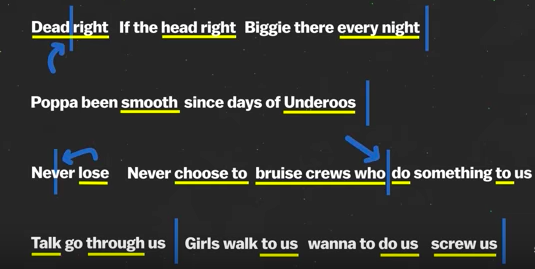
Caswell is so intent on examining the late Notorious B.I.G.‘s “Hypnotize,” that she overlooks a rather sizable elephant in the room, the misogynistic POV behind those en and oo sounds.
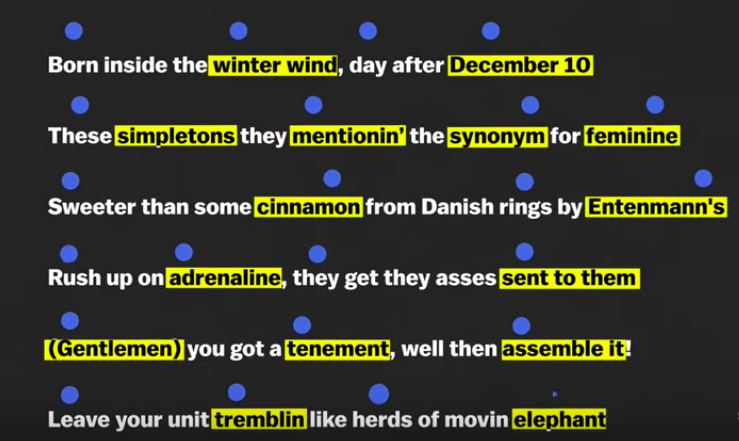
Shortly thereafter, Mos Def ups both the rhyming game and the feminist accountability, by stuffing his compositions with multi-syllabic words and phrases that sort of rhyme—cinnamon, Entenmann’s, adrenaline and “sent to them.”

Meanwhile, Andre 3000 is playing with varying the accent of his rhymes, relative to the beat and bar, rather than committing to a predictable thudding.
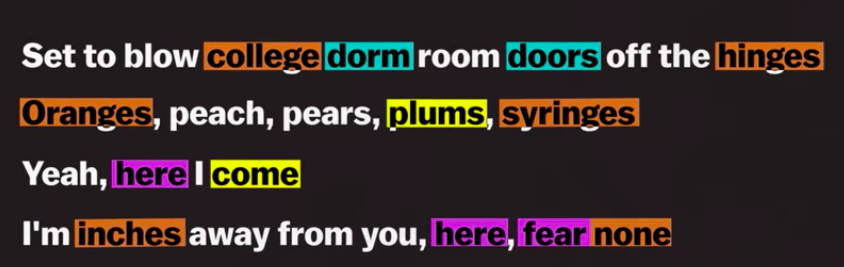
Eminem, who has the distinction of penning the first rap to win an Academy Award, places a premium on narrative, and refuses to concede that nothing rhymes with orange.
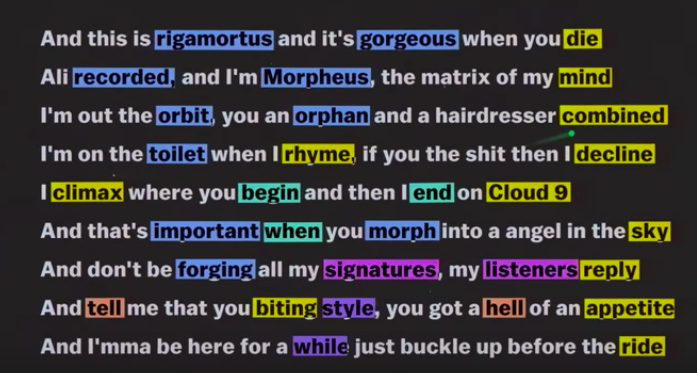
Current chart topper Kendrick Lamar’s galloping “Rigamortis” establishes a musical motif that Caswell compares to Beethoven’s famous fifth.

MF DOOM kicks the ball further down the court with double entendres, wordplay and a willingness to steer clear of the expected “b word.”
Listen to a Spotify playlist of the songs referenced in the video.
Delve further into the subject by reading the thoughts of rap analyst Martin Connor, whom Caswell credits as a sort of beacon.
Related Content:
Ayun Halliday is an author, illustrator, theater maker and Chief Primatologist of the East Village Inky zine. Follow her @AyunHalliday.
Read More...Support Us
We're hoping to rely on loyal readers, rather than erratic ads. Please click the Donate button and support Open Culture. You can use Paypal, Venmo, Patreon, even Crypto! We thank you!

About Us

Open Culture scours the web for the best educational media. We find the free courses and audio books you need, the language lessons & educational videos you want, and plenty of enlightenment in between.
Advertise With Us
FREE UPDATES!
GET OUR DAILY EMAIL
Get the best cultural and educational resources on the web curated for you in a daily email. We never spam. Unsubscribe at any time.
FOLLOW ON SOCIAL MEDIA
Open Culture editor Dan Colman scours the web for the best educational media. He finds the free courses and audio books you need, the language lessons & movies you want, and plenty of enlightenment in between.
Advertise With Us

