How Leonard Cohen Wrote a Love Song
So many songs take love as their topic, almost by default, that we hardly even think of the “love song” as a distinct type of musical work anymore. And when we do, we often do it out of a desire for alternatives: lyrics and compositions of a more complex, cerebral, and iconic nature, escapes from the simple paeans to infatuation, romance, and couplehood with which we can easily feel fed up. Few singer-songwriters in recent history would seem more capable of providing such escapes than Leonard Cohen, who never shied away from looking at life (and when the time came, death) straight on, refusing to shrink from its infinite emotional chiaroscuro.
But Leonard Cohen, too, wrote love songs now and again. In “How Leonard Cohen Writes a Love Song,” the video essay from Polyphonic above, we learn just how he tackled that most common of all musical subjects without abandoning his inimitable sensibility. It first examines Cohen’s song “Suzanne,” which has its origins in a poem he wrote in 1966 and appeared on his debut album Songs of Leonard Cohen the following year. Unlike almost all love songs, “Suzanne” deals with a Platonic relationship, in this case the one between Cohen and a woman with whom he regularly drank tea and took walks around his native Montreal.
From “Suzanne” the analysis moves on to “Famous Blue Raincoat” from Cohen’s 1971 album Songs of Love and Hate. The necessary balance between those forces implied in the album’s title reflects Cohen’s worldview, which in the 1970s led him into an involvement with Buddhism. But he’d also looked into Scientology, which explains the song’s then-cryptic question “Did you ever go clear?” That counts as only one of the many cultural references with which Cohen layers “Famous Blue Raincoat,” as he layered so much of his work; even a song ostensibly about love was also about much else in the world besides love.
After an unpromising initial release in 1984, “Hallelujah,” would go on to become Cohen’s signature song. (Malcolm Gladwell tells the story on his podcast Revisionist History). Despite the religious themes on its surface, “Hallelujah” has a deeper meaning, so the video reveals, as a love song, albeit a love song of a multivalent kind. Last comes “I’m Your Man,” the title track from Cohen’s uncharacteristically synthesizer-heavy 1988 album, and itself an uncharacteristically love song-like love song. But, in the words of Pitchfork’s Dorian Lynksey, it takes its “sentimental clichés — I’m addicted to love, I’ll do anything for love — to brutal extremes.” Though Cohen ultimately had to admit his inability to fully understand, much less tame, the forces of love, never did he give up trying to master it in song, approaching it in all the ways typical love songs teach us never to expect.
Related Content:
How Leonard Cohen & David Bowie Faced Death Through Their Art: A Look at Their Final Albums
Hear Leonard Cohen’s Final Interview: Recorded by David Remnick of The New Yorker
Listen to Nick Cave’s Lecture on the Art of Writing Sublime Love Songs (1999)
Based in Seoul, Colin Marshall writes and broadcasts on cities and culture. His projects include the book The Stateless City: a Walk through 21st-Century Los Angeles and the video series The City in Cinema. Follow him on Twitter at @colinmarshall or on Facebook.
Read More...Hear Singers from the Metropolitan Opera Record Their Voices on Traditional Wax Cylinders
Vinyl is back in a big way.
Music lovers who booted their record collections during the compact disc’s approximately 15 year reign are scrambling to replace their old favorites, even in the age of streaming. They can’t get enough of that warm analog sound.
Can a wax cylinder revival be far behind?
A recent wax cylinder experiment by Metropolitan Opera soprano Susanna Phillips and tenor Piotr Beczala, above, suggests no. This early 20th-century technology is no more due for a comeback than the zoetrope or the steam powered vibrator.
Beczala initiated the project, curious to know how his voice would sound when captured by a Thomas Edison-era device. If it yielded a faithful reproduction, we can assume that the voice modern listeners accept as that of a great such as Enrico Caruso, whose output predated the advent of the electrical recording process, is fairly identical to the one experienced by his live audiences.
Working together with the New York Public Library’s Rodgers and Hammerstein Archives of Recorded Sound and the Thomas Edison National Historical Park, the Met was able to set up a session to find out.
The result is not without a certain ghostly appeal, but the facsimile is far from reasonable.
As Beczala told The New York Times, the technological limitations undermined his intonation, diction, or performance of the quieter passages of his selection from Verdi’s Luisa Miller. In a field where craft and technique are under constant scrutiny, the existence of such a recording could be a liability, were it not intended as a curiosity from the get go.
Phillips, ear turned to the horn for playback, insisted that she wouldn’t have recognized this recording of “Per Pieta” from Mozart’s Così fan tutte as her own.
Learn more about wax cylinder recording technology and preservation here.
Related Content:
Tchaikovsky’s Voice Captured on an Edison Cylinder (1890)
Ayun Halliday is an author, illustrator, theater maker and Chief Primatologist of the East Village Inky zine. Follow her @AyunHalliday.
Read More...See Ancient Greek Music Accurately Reconstructed for the First Time
Imagine trying to reconstruct the music of the Beatles 2,500 years from now, if nothing survived but a few fragments of the lyrics. Or the operas of Mozart and Verdi if all we had were pieces of the librettos. In a 2013 BBC article, musician and classics professor at Oxford Armand D’Angour used these comparisons to illustrate the difficulty of reconstructing ancient Greek song, a task to which he has set himself for the past five years.
The comparison is not entirely apt. Scholars have long had clues to help them interpret the ancient songs that served as vehicles for Homeric and Sapphic verse or the later drama of Aeschylus, almost all of which was sung with musical accompaniment. In a recent article at The Conversation, D’Angour points out that many literary texts of antiquity “provide abundant and highly specific details about the notes, scales, effects, and instruments used,” the latter including the lyre and the aulos, “two double-reed pipes played simultaneously by a single performer.”
But these musical instructions have proved elusive; “the terms and notations found in ancient sources—mode, enharmonic, diesis, and so on—are complicated and unfamiliar,” D’Angour writes. Nonetheless, using recreations of ancient instruments, close analysis of poetic meter, and careful interpretation of ancient texts that discuss melody and harmony, he claims to have accurately deciphered the sound of ancient Greek music.
D’Angour has worked to turn the “new revelations about ancient Greek music” that he wrote of five years ago into performances that reconstruct the sound of Euripides and other ancient literary artists. In the video at the top, see a choral and aulos performance of Athanaeus’ “Paean” from 127 BC and Euripides Orestes chorus from 408 BC. D’Angour and his colleagues break in periodically to talk about their methodology.
In the 2017 interview above from the Greek television channel ERT1, D’Angour discusses his research into the music of ancient Greek verse, from epic, to lyric, to tragedy, to comedy, “all of which,” he says, “was sung music, either entirely or partly.” Central to the insights scholars have gained in the past five years are “some very well preserved auloi,” he notes, that “have been reconstructed by expert technicians” and which “provide a faithful guide to the pitch range of ancient music, as well as to the instruments’ own pitches, timbres, and tunings.”
Determining tempo can be tricky, as it can with any music composed before “the invention of mechanical chronometers,” when “tempo was in any case not fixed, and was bound to vary between performances.” Here, he relies on poetic meter, which gives indications through the patterns of long and short syllables. “It remains for me to realize,” D’Angour writes, “in the next few years, the other few dozen ancient scores that exist, many extremely fragmentary, and to stage a complete drama with historically informed music in an ancient theater such as that of Epidaurus.” We’ll be sure to bring you video of that extraordinary event.
Related Content:
What Ancient Greek Music Sounded Like: Hear a Reconstruction That is ‘100% Accurate’
Hear Homer’s Iliad Read in the Original Ancient Greek
Josh Jones is a writer and musician based in Durham, NC. Follow him at @jdmagness
Read More...What Made Robin Williams a Uniquely Expressive Actor: A Video Essay Explores a Subtle Dimension of His Comic Genius
“He had admirers but no imitators,” writes Dave Itzkoff in Robin, his new biography of Robin Williams. “No one combined the precise set of talents he had in the same alchemical proportions.” Though Itzkoff’s book has received a great deal of acclaim, many fans may still feel that important elements of Williams’ particular genius remain less than fully understood. Scholars of comedy will surely continue to scrutinize the beloved comic’s persona for decades to come, just as they have over the past four years since his death. The cinema-analyzing video essay series Every Frame a Painting produced one of the first such examinations of Williams’ technique, “Robin Williams — In Motion,” and its insight still holds up today.
“Few actors could express themselves as well through motion,” narrator Tony Zhou says of Williams, “whether that motion was big or small. Even when he was doing the same movement in two different scenes, you could see the subtle variations he brought to the arc of the character.” This goes for Williams’ manic, impression laden performances as well as his low-key, slow-burning ones. “To watch his work,” Zhou says over a montage of entertaining examples, “is to see the subtle thing that an actor can do with his hands, his mouth, his right leg, and his facepalm. Robin Williams’ work is an encyclopedia of ways that an actor can express himself through movement, and he was fortunate to work with filmmakers who used his talents to their fullest.”
Those filmmakers included Barry Levinson (Good Morning Vietnam, Toys, Man of the Year), Peter Weir (Dead Poets Society), Terry Gilliam (The Adventures of Baron Munchausen, The Fisher King), and Gus Van Sant (Good Will Hunting). Zhou credits them and others with letting Williams “play it straight through” rather than adhering to the more common stop-start shooting method that only permits a few seconds of acting at a time; they gave him “something physical to do,” without which his skill with motion couldn’t come through in the first place; they used “blocking,” meaning the arrangement of the actors in the space of the scene, “to tell their story visually”; they “let him listen,” a little-acknowledged but nonetheless important part of a performance, especially a Williams performance.
Finally, these directors “didn’t let perfection get in the way of inspiration.” While the quality of the individual works in Williams’ impressively large filmography may vary, his performances in them are almost all unfailingly compelling. Even during his lifetime Williams was described as a comic genius, and he showed us that comic geniuses have to take risks. And even though every risk he took might not have paid off, his body of work, taken as a whole, teaches us a lesson: “Be open. This was a man who improvised many of his most iconic moments. Maybe he was on to something.” Or as Williams himself put it on an Inside the Actors Studio interview, “When the stuff really hits you, it’s usually something that happened, and it happened then. That’s what film is about: capturing a moment.”
Related Content:
Robin Williams Uses His Stand-Up Comedy Genius to Deliver a 1983 Commencement Speech
Robin Williams & Bobby McFerrin Sing Fun Cover of The Beatles’ “Come Together”
Based in Seoul, Colin Marshall writes and broadcasts on cities and culture. His projects include the book The Stateless City: a Walk through 21st-Century Los Angeles and the video series The City in Cinema. Follow him on Twitter at @colinmarshall or on Facebook.
Read More...Frank Zappa’s 1980s Appearances on The David Letterman Show
I’ve never been a huge fan of Frank Zappa’s music and gravitated more toward the bizarre yet bluesy sonic world of his sometime collaborator and lifelong frenemy Captain Beefheart. But I get the appeal of Zappa’s wildly virtuoso catalog and his sardonic, even caustic, personality. The phrase may have devolved into cliché, but it’s still worth saying of Zappa: he was a real original, a truly independent musician who insisted on doing things his way. Most admirably, he had the talent, vision, and strength of will to do so for decades in a business that legendarily chews up and spits out artists with even the toughest of constitutions.
Zappa, notes the Rock and Roll Hall of Fame in its profile, “was rock and roll’s sharpest musical mind and most astute social critic… the most prolific composer of his age,” who “bridged genres—rock, jazz, classical, avant-garde and even novelty music—with masterful ease.” Recording “over sixty albums’ worth of material in his fifty-two years,” he famously discovered, nurtured, and collaborated with some of the most technically proficient and accomplished of players. He was indie before indie, and “confronted the corrupt politics of the ruling class” with ferocious wit and unsparing satire, holding “the banal and decadent lifestyles of his countrymen to unforgiving scrutiny.”
Needless to say, Zappa himself was not prone to banality or decadence. He stood apart from his contemporaries with both his utter hatred of trends and his commitment to sobriety, which meant that he was never less than totally lucid, if never totally clear, in interviews and TV appearances. Unsurprisingly, David Letterman, champion of other fiercely talented musical oddballs like Warren Zevon, was a Zappa fan. Between 1982 and 83, Zappa came on Letterman three times, the first, in August of 82, with his daughter Moon (or “Moon Unit,” who almost ended up with the name “Motorhead,” he says).
The younger Zappa inherited her father’s deadpan. “When I was little,” she says, “I wanted to change my name to Beauty Heart. Or Mary.” But Zappa, the “musical and a sociological phenomenon,” as Letterman calls him, gets to talk about more than his kids’ weird names. In his June, 83 appearance, further up, he promotes his London Symphony Orchestra album. As he explains, the experience of working with cranky classical musicians on a very tight schedule tested his perfectionistic (some might say controlling) temperament. The album gave rise, writes Eduardo Rivadavia at Allmusic, “to his well-documented love/hate (mostly hate) relationship with symphony orchestras thereafter.”
But no matter how well or badly a project went, Zappa always moved right along to the next thing. He was never without an ambitious new album to promote. (In his final Letterman appearance, on Halloween, above, he had a musical, which turned into album, the triple-LP Thing-Fish.) Since he never stopped working for a moment, one set of ideas generating the next—he told Rolling Stone in answer to a question about how he looked back on his many records—“It’s all one album.” See a supercut below of all of Zappa’s 80s visits to the Letterman set, with slightly better video quality than the individual clips above.
Related Content:
Frank Zappa Explains the Decline of the Music Business (1987)
Hear the Musical Evolution of Frank Zappa in 401 Songs
Hunter S. Thompson’s Many Strange, Unpredictable Appearances on The David Letterman Show
Josh Jones is a writer and musician based in Durham, NC. Follow him at @jdmagness
Read More...Italian Street Musician Plays Amazing Covers of Pink Floyd Songs, Right in Front of the Pantheon in Rome
Before Pink Floyd, rock and roll was all about attitude. After Pink Floyd, it could be all atmosphere. Though perfectly suited for headphones and hi-fis, their sound is architectural, and almost requires the grandest of settings for its full realization. The bombast of the band’s stadium shows, with all their theatrical excesses, seems entirely justified by the music, unlike the Spinal Tap-like pretensions of many other arena rock bands. In 1989, Pink Floyd (sans Roger Waters) played for 20,000 Italian fans from a massive stage floating in the canals of Venice, a fascinating contrast to a 1972 performance, when the band played for no one but a film crew, in an amphitheater in the ruined city of Pompeii.
Invoking these magical moments, a street musician named Serin plays the music of Pink Floyd in the streets of Rome, parking himself right in front of the Pantheon. With pre-recorded backing tracks and a black Stratocaster reminiscent of David Gilmour’s signature instrument, Serin not only nails the songs, he gets the atmosphere just right, an achievement no doubt aided by his choice of setting. At the top, see him play “Shine on You Crazy Diamond,” just above, “Comfortably Numb” and, below, an excellent rendition of “Time” (on a white Strat this time). For comparison’s sake, watch Pink Floyd themselves play “Echoes” at Pompeii, further down. (Stream more clips of their Pompeii concert film here).
For another version of the one-man-Pink Floyd-cover band concept, see 19-year-old Ewan Cunningham cover “Echoes,” “Comfortably Numb” and other songs, multitracking himself on every instrument.
via Laughing Squid
Related Content:
Josh Jones is a writer and musician based in Durham, NC. Follow him at @jdmagness
Read More...A New Series About A Young Crime-Fighting Sigmund Freud Is Coming to Netflix
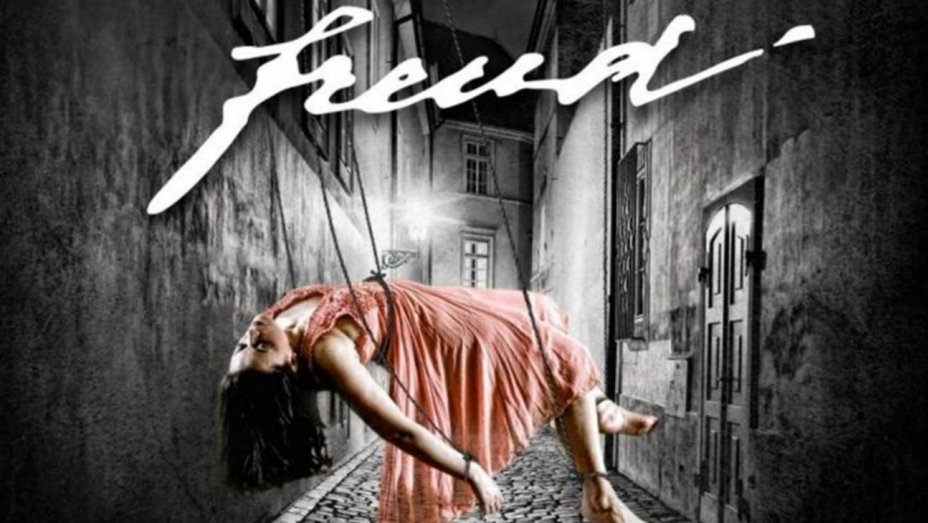
A recently announced, as-yet-uncast Netflix series centering on the exploits of young, crimefighting Sigmund Freud, tracking a serial killer in 19th-century Vienna, has been causing great excitement.
Though as Chelsea Steiner points out in the Mary Sue, Freud’s equation of clitoral orgasms with sexual immaturity and mental illness could put a damper on any sex scene in which a female character takes an active role.
Perhaps the youthful Father of Psychology won’t be hooking up with his female sidekick—a medium (always so helpful in cases involving serial killers!)
Perhaps instead the real love interest will be the intriguingly named Kiss, a testy war veteran cop. As Freud wrote in a 1935 letter:
Homosexuality is assuredly no advantage, but it is nothing to be ashamed of, no vice, no degradation; it cannot be classified as an illness; we consider it to be a variation of the sexual function, produced by a certain arrest of sexual development. Many highly respectable individuals of ancient and modern times have been homosexuals, several of the greatest men among them. (Plato, Michelangelo, Leonardo da Vinci, etc). It is a great injustice to persecute homosexuality as a crime –and a cruelty, too. If you do not believe me, read the books of Havelock Ellis.
The eight-part German-language series will be directed by a Marvin Kren, who seems, in the translated press release, as if he might be equal to the task.
I more or less grew up underneath Sigmund Freud’s original sofa, meaning: in the same district in Vienna where he had his office. The difference: When I was born the world already profited from Sigmund Freud’s groundbreaking discoveries for almost a century. We, the modern human beings, live in post-Freudian times. It is very appealing and challenging for me to imagine a world in this series in which the ‘self’ was just a blind spot on the map of cognition, a world that hasn’t seen Sigmund Freud yet. I would like to emerge with ‘Freud’ into Vienna’s dark alleys before the turn of the century, to discover the reflection of the labyrinth of the human soul inspiring his life’s work. Abysmal, dubious and dangerous!
The series will debut on Austrian television. Netflix will control international streaming rights. Production is due to begin this fall.
Related Content:
Sigmund Freud, Father of Psychoanalysis, Introduced in a Monty Python-Style Animation
Sigmund Freud Speaks: The Only Known Recording of His Voice, 1938
Ayun Halliday is an author, illustrator, theater maker and Chief Primatologist of the East Village Inky zine. Follow her @AyunHalliday.
Read More...The 10 Rules for Students and Teachers Popularized by John Cage: “Nothing Is a Mistake,” “Consider Everything an Experiment” & More
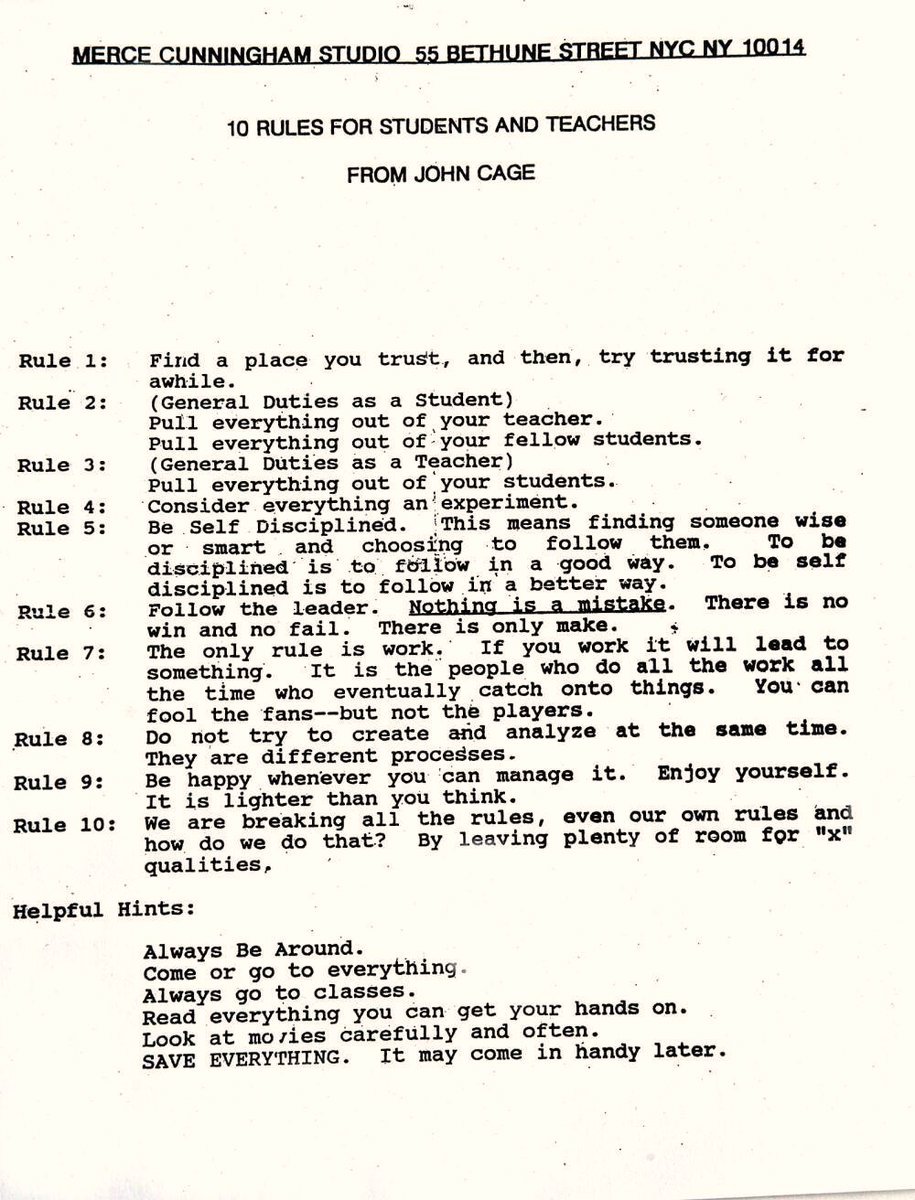
The Brian Eno archive More Dark than Shark recently posted on its Twitter account a list of twelve rules for students and teachers used by John Cage. Though much has been written about the artistic affinities between Eno and Cage, both of whose compositions have pushed the boundaries of how we think about music itself, they also both have a deep connection to the idea of using rules to enhance the experience of creation. Where Eno has his deck of creative process-enhancing Oblique Strategies cards, Cage had this list of rules first composed by an educator, silkscreen artist, and nun named Sister Corita Kent.
Kent came up with the list, writes Brainpickings’ Maria Popova, “as part of a project for a class she taught in 1967–1968. It was subsequently appropriated as the official art department rules at the college of LA’s Immaculate Heart Convent, her alma mater, but was commonly popularized by Cage, whom the tenth rule cites directly.”
That tenth rule, more of a meta-rule, reminds the reader that “we’re breaking all the rules” by “leaving plenty of room for X quantities.” But one can easily imagine how the previous nine, having as much to do with the enjoyment of the work of learning, teaching, and creating as with its rigorous performance, might appeal to Cage as well. The complete list runs as follows:
RULE ONE: Find a place you trust, and then try trusting it for a while.
RULE TWO: General duties of a student: Pull everything out of your teacher; pull everything out of your fellow students.
RULE THREE: General duties of a teacher: Pull everything out of your students.
RULE FOUR: Consider everything an experiment.
RULE FIVE: Be self-disciplined: this means finding someone wise or smart and choosing to follow them. To be disciplined is to follow in a good way. To be self-disciplined is to follow in a better way.
RULE SIX: Nothing is a mistake. There’s no win and no fail, there’s only make.
RULE SEVEN: The only rule is work. If you work it will lead to something. It’s the people who do all of the work all of the time who eventually catch on to things.
RULE EIGHT: Don’t try to create and analyze at the same time. They’re different processes.
RULE NINE: Be happy whenever you can manage it. Enjoy yourself. It’s lighter than you think.
RULE TEN: We’re breaking all the rules. Even our own rules. And how do we do that? By leaving plenty of room for X quantities.
HINTS: Always be around. Come or go to everything. Always go to classes. Read anything you can get your hands on. Look at movies carefully, often. Save everything. It might come in handy later.
Some of the rules on Kent’s list, which has now exerted its influence for half a century, sound faintly like the Oblique Strategies Eno and the painter Peter Schmidt would come up with in the 1970s. Take rule number six, “Nothing is a mistake,” which brings to mind the Oblique Strategy “Honor thy error as a hidden intention.” But we’re all on the same field when it comes to techniques to move our minds in worthwhile new directions, as Cage, Kent, Eno, Schmidt, and most other serious students, teachers, and creators might agree. They’d certainly agree that, all rules aside, everything ultimately comes down to doing the work itself, day in and day out. “Craft,” as Eno once said,” is what enables you to be successful when you’re not inspired.”
Related Content:
An Impressive Audio Archive of John Cage Lectures & Interviews: Hear Recordings from 1963–1991
How to Get Started: John Cage’s Approach to Starting the Difficult Creative Process
Jump Start Your Creative Process with Brian Eno’s “Oblique Strategies” Deck of Cards (1975)
Based in Seoul, Colin Marshall writes and broadcasts on cities and culture. His projects include the book The Stateless City: a Walk through 21st-Century Los Angeles and the video series The City in Cinema. Follow him on Twitter at @colinmarshall or on Facebook.
Read More...David Foster Wallace Explains How David Lynch’s Blue Velvet Taught Him the True Meaning of Avant Garde Art
Imagine you’re a “hypereducated avant-gardist in grad school learning to write.” But at your grad school, “all the teachers are realists. They’re not at all interested in postmodern avant-garde stuff.” They take a dim view of your writing, you assume because “they just don’t happen to like this kind of aesthetic,” but actually because your writing isn’t very good. Amid all this, with you “hating the teachers but hating them for exactly the wrong reasons,” David Lynch’s Blue Velvet comes out. Not only does it belong to “an entirely new and original kind of surrealism,” it shows you that “what the really great artists do is they’re entirely themselves. They’ve got their own vision, their own way of fracturing reality, and that if it’s authentic and true, you will feel it in your nerve endings.”
This happened to David Foster Wallace, as he says in the clip above from his 1997 appearance on Charlie Rose, one of his very few interviews on video. He went on the show, seemingly under duress, to promote his collection A Supposedly Fun Thing I’ll Never Do Again, which among its long-form essays on the cruise ship experience, the Illinois State Fair, and professional tennis contains a piece on the man who made Blue Velvet.
“Lynch has remained remarkably himself throughout his filmmaking career,” Wallace writes in the version of the article that first ran in Premiere. Whether “Lynch hasn’t compromised or sold out” or whether “he hasn’t grown all that much,” the fact remains that he has “held fast to his own intensely personal vision and approach to filmmaking, and that he’s made significant sacrifices in order to do so.”
Elsewhere in the piece, Wallace describes the adjective “Lynchian” as “referring to a particular kind of irony where the very macabre and the very mundane combine in such a way as to reveal the former’s perpetual containment within the latter.” When Rose asks Wallace about the meaning of the word, Wallace explains that “a regular domestic murder is not Lynchian. But if the police come to the scene and see the man standing over the body and the woman’s 50s bouffant is undisturbed and the man and the cops have this conversation about the fact that the man killed the woman because she persistently refused to buy, say, for instance, Jif peanut butter rather than Skippy, and how very, very important that is, and if the cops found themselves somehow agreeing that there were major differences between the brands and that a wife who didn’t recognize those differences was deficient in her wifely duties, that would be Lynchian.”
A few years ago Youtube channel Dom’s Sketch Cast turned Wallace’s vision of an ideally Lynchian scene into the animation above. Lynch’s visions exist, Wallace says to Rose, at “this weird confluence of very dark, surreal, violent stuff and absolute, almost Norman Rockwell-banal American stuff, which is terrain he’s been working for quite a while — I mean, at least since Blue Velvet.” Though Lynch may owe certain stylistic debts — “to Hitchcock, to Cassavetes, to Robert Bresson and Maya Deren and Robert Wiene” — nothing like the Lynchian existed in any tradition before he came along. Lynch has his detractors, but “if you think about the outrageous kinds of moral manipulation we suffer at the hands of most contemporary directors, it will be easier to convince you that something in Lynch’s own clinically detached filmmaking is not only refreshing but redemptive” — and, as a young David Foster Wallace found in the theater that spring of 1986, revelatory.
Related Content:
What Makes a David Lynch Film Lynchian: A Video Essay
The Surreal Filmmaking of David Lynch Explained in 9 Video Essays
David Foster Wallace on What’s Wrong with Postmodernism: A Video Essay
David Foster Wallace’s Surprising List of His 10 Favorite Books, from C.S. Lewis to Tom Clancy
30 Free Essays & Stories by David Foster Wallace on the Web
Based in Seoul, Colin Marshall writes and broadcasts on cities and culture. His projects include the book The Stateless City: a Walk through 21st-Century Los Angeles and the video series The City in Cinema. Follow him on Twitter at @colinmarshall or on Facebook.
Read More...Noam Chomsky Defines The Real Responsibility of Intellectuals: “To Speak the Truth and to Expose Lies” (1967)

Image by Andrew Rusk, via Wikimedia Commons
The novel medium of social media—and the novel use of Twitter as the official PR platform for public figures—allows not only for endless amounts of noise and disinformation to permeate our newsfeeds; it also allows readers the opportunity to refute statements in real time. Whether corrections register or simply get drowned in the sea of information is perhaps a question for a 21st century Marshall McLuhan to ponder.
Another prominent theorist of older forms of media, Noam Chomsky, might also have an opinion on the matter. In his 1988 book Manufacturing Consent, written with Edward Herman, Chomsky details the ways in which governments and media collude to deliberately mislead the public and socially engineer support for wars that kill millions and enrich a handful of profiteers.
Moreover, in mass media communications, those wars, invasions, “police actions,” regime changes, etc. get conveniently erased from historical memory by public intellectuals who serve the interests of state power. In one recent example on the social medium of record, Twitter, Richard N. Haas, President of the Council on Foreign Relations, expressed dismay about the disturbingly cozy state of affairs between the U.S. Administration and Putin’s Russia by claiming that “International order for 4 centuries has been based on non-interference in the international affairs of others and respect for sovereignty.”
One recent critique of foreign policy bodies like CFR would beg to differ, as would the history of hundreds of years of colonialism. In a very Chomsky-like rejoinder to Haas, journalist Nick Turse wrote, “This might be news to Iraqis and Afghans and Libyans and Yemenis and Vietnamese and Cambodians and Laotians and Koreans and Iranians and Guatemalans and Chileans and Nicaraguans and Mexicans and Cubans and Dominicans and Haitians and Filipinos and Congolese and Russians and….”
Genuine concerns about Russian election tampering notwithstanding, the list of U.S. interventions in the “affairs of others” could go on and on. Haas’ initial statement offers an almost perfect example of what Chomsky identified in another essay, “The Responsibility of Intellectuals,” as not only a “lack of concern for truth” but also “a real or feigned naiveté about American actions that reaches startling proportions.”
“It is the responsibility of intellectuals to speak the truth and to expose lies,” wrote Chomsky in his 1967 essay. “This, at least, may seem enough of a truism to pass over without comment. Not so, however. For the modern intellectual, it is not at all obvious.” Chomsky proceeds from the pro-Nazi statements of Martin Heidegger to the distortions and outright falsehoods issued routinely by such thinkers and shapers of foreign policy as Arthur Schlesinger, economist Walt Rostow, and Henry Kissinger in their defense of the disastrous Vietnam War.
The background for all of these figures’ distortions of fact, Chomsky argues, is the perpetual presumption of innocence on the part of the U.S., a feature of the doctrine of exceptionalism under which “it is an article of faith that American motives are pure, and not subject to analysis.” We have seen this article of faith invoked in hagiographies of past Administrations whose domestic and international crimes are conveniently forgotten in order to turn them into foils, stock figures for an order to which many would like to return. (As one former Presidential candidate put it, “America is great, because America is good.”)
Chomsky would include the rhetorical appeal to a nobler past in the category of “imperialist apologia”—a presumption of innocence that “becomes increasingly distasteful as the power it serves grows more dominant in world affairs, and more capable, therefore, of the unconstrained viciousness that the mass media present to us each day.”
We are hardly the first power in history to combine material interests, great technological capacity, and an utter disregard for the suffering and misery of the lower orders. The long tradition of naiveté and self-righteousness that disfigures our intellectual history, however, must serve as a warning to the third world, if such a warning is needed, as to how our protestations of sincerity and benign intent are to be interpreted.
For those who well recall the events of even fifteen years ago, when the U.S. government, with the aid of a compliant press, lied its way into the second Iraq war, condoning torture and the “extraordinary rendition” of supposed hostiles to black sites in the name of liberating the Iraqi people, Chomsky’s Vietnam-era critiques may sound just as fresh as they did in the mid-sixties. Are we already in danger of misremembering that recent history? “When we consider the responsibility of intellectuals,” Chomsky writes, the issue at hand is not solely individual morality; “our basic concern must be their role in the creation and analysis of ideology.”
What are the ideological features of U.S. self-understanding that allow it to recreate past errors again and again, then deny that history and sink again into complacency, perpetuating crimes against humanity from the Cambodian bombings and My Lai massacre, to the grotesque scenes at Abu Ghraib and the drone bombings of hospitals and weddings, to supporting mass killings in Yemen and murder of unarmed Palestinian protestors, to the kidnapping and caging of children at the Mexican border?
The current ruling party in the U.S. presents an existential threat, Chomsky recently opined, on a world historical scale, displaying “a level of criminality that is almost hard to find words to describe.” It is the responsibility of intellectuals, Chomsky argues in his essay—including journalists, academics, and policy makers and shapers—to tell the truth about events past and present, no matter how inconvenient those truths may be.
Read Chomsky’s full essay, “The Responsibility of Intellectuals,” at The New York Review of Books.
Related Content:
Noam Chomsky Defines What It Means to Be a Truly Educated Person
Josh Jones is a writer and musician based in Durham, NC. Follow him at @jdmagness
Read More...Support Us
We're hoping to rely on loyal readers, rather than erratic ads. Please click the Donate button and support Open Culture. You can use Paypal, Venmo, Patreon, even Crypto! We thank you!

About Us

Open Culture scours the web for the best educational media. We find the free courses and audio books you need, the language lessons & educational videos you want, and plenty of enlightenment in between.
Advertise With Us
FREE UPDATES!
GET OUR DAILY EMAIL
Get the best cultural and educational resources on the web curated for you in a daily email. We never spam. Unsubscribe at any time.
FOLLOW ON SOCIAL MEDIA
Open Culture editor Dan Colman scours the web for the best educational media. He finds the free courses and audio books you need, the language lessons & movies you want, and plenty of enlightenment in between.
Advertise With Us


