The Deeply Meditative Electronic Music of Avant-Garde Composer Eliane Radigue
Among a number of influential women in electronic music whom we’ve profiled here before, French avant-garde composer Eliane Radigue stands out for her single-minded dedication to “a certain music that I wished to make,” as she says in the video portrait above, “this particular music and no other.” Her compositions are haunting and meditative, “prefiguring the concept of ‘deep listening,’ expressed by Pauline Oliveros some years later,” as Red Bull Academy notes in an extensive profile of Radigue.
Using feedback, tape loops, field recordings, and, beginning in the 70s, the ARP 2500 modular synthesizer, Radigue “developed soundscapes… an interweaving of electronic drones, subsequently assimilated to what would later be called drone music.” But she has rejected the term as too static, stressing the variations and constant change in her music:
In Radigue’s work, sounds interact with each other like the cells of an organism, progressing in glissando in an extremely slow and subtle way. “I had found my own vocabulary. For me, maintaining the sound did not interest me as such; it was primarily a means to bring out the overtones, harmonics and subharmonics. This is what made it possible to develop this inner richness of sound.”
Radigue seems particularly self-assured, possessed of an intuitive sense of her work’s directions from the beginning. “I cannot start a piece if I don’t have an idea of what it would become, but what I would call the spirit,” she says in an interview with Electronic Beats.
“The spirit of what I wanted to do should be there… And I keep that spirit, that theme in mind, quite often several months before I start to do something. So, when I come to make the sounds it’s already there.”
But her career took many turns on a path through the compositional centers of mid-century avant-garde music. After studying traditional music theory as a child, she left her home in Nice at 19 and married the artist Arman. She was swept into an “exciting bohemian life” that would soon take her, in 1955, into the orbit of musique concrete pioneers Pierre Schaeffer and Pierre Henry.
While working as an intern for the composers (“If I claimed to be more, I don’t think they would have accepted me, because they were both the damndest machos!”), Radigue learned their methods and collaborated on their compositions. In 1967, she worked with Henry on L’Apocalypse de Jean, a piece designed to last for 24 hours. She ended her (unpaid) apprenticeship that year and began focusing on her own work, like Vice Versa (1970, excerpted further up) and Geerlriandre (1972, above) and Triptych (1978, below).
You can hear more of Radigue’s work at Ubuweb, including a more recent synthesizer piece recorded in 1992, as well as a 1980 interview for program The Morning Concert with Charles Amirkhanian. That same year, she became a convert to Tibetan Buddhism, and her work—like the Adnos series, below—was inspired by the religion’s history, her own meditation practice, and texts like the Bardo Thodol.
As the pulsing, droning, humming compositions she created throughout the late 20th century have become integral to the sound of the 21st, Radique has moved on, since 2001, to writing work for acoustic instruments. She made her last electronic piece, I’lle-Re-sonante, in 2000. The move came in part from requests she received from musicians, but it also represents a deliberate turn away from modern technology. “There’s always something missing with digital,” she says, even if it is somehow cleaner and clearer.”
Radigue has always favored the absorption of analogue sound, intent on taming its unpredictability as a meditator tames the darting, leaping, busy mind. “My music is always changing,” she says, “It comes from the first access I had to electronic sounds which was the wild sounds coming from feedback,” the noise of a microphone and a speaker getting too close to each other. “If you find the right place, which is very narrow, then you can move it very slowly and it changes but that requires a lot of patience.”
The word could define her entire approach, one radically opposed to instant gratification and quick fixes, focused singularly on outcomes while also fully present for the process.
Related Content:
Hear Seven Hours of Women Making Electronic Music (1938- 2014)
Josh Jones is a writer and musician based in Durham, NC. Follow him at @jdmagness
Read More...What Makes The Night Watch Rembrandt’s Masterpiece
When you think of Rembrandt, do you think first of The Philosopher in Meditation? Or The Syndics of the Drapers’ Guild? How about Anatomy Lesson of Dr. Nicolaes Tulp? Those paintings may well come to mind, and others besides, but only one demands a great effort indeed not to think of: Militia Company of District II under the Command of Captain Frans Banninck Cocq, better known as The Night Watch. Famous for the enormous dimensions that make its figures nearly life-size, and make the painting a showcase for the artist’s mastery of shadow and light more fully than any other, it stands not just for Rembrandt’s body of work but for the 17th century’s Dutch Golden Age of painting as well.
But what, exactly, makes The Night Watch Rembrandt’s masterpiece? Walter Benjamin once said that every great work either dissolves a genre or founds a new one, but this painting fits neatly in an established tradition: the civic guard portrait, civic guards being the groups of wealthy citizens who pledged to defend a city should it come under threat. As Dutch painting moved away from religious subject matter toward commissioned portraiture, civic guards made fine clients, possessed as they were of both the desire and budget for large and expensive group scenes. But even within the genre, everyone involved must have suspected that, when Amsterdam mayor Frans Banninck Cocq hired Rembrandt van Rijn to paint him and his civic guard in the late 1630s, something impressive would result.
“What hits me right away is the balance that Rembrandt strikes between chaos and unity,” says Evan Puschak, the video essayist known as the Nerdwriter, in his analysis of The Night Watch above. “He clearly wanted to create a canvas with a lot of movement, but the challenge was to make that movement — people lurching in different directions, performing a variety of actions — cohere into a unified whole.” Therein lies the secret to The Night Watch’s transcendence of its genre, a transcendence achieved through a quality we might now call dynamism. Rembrandt also makes use of visual techniques more closely associated with cinema, such as a “depth of field” achieved by rendering Cocq and his lieutenant with the utmost clarity and gradually reducing that clarity in the figures behind.
As with any masterpiece, the more you look at The Night Watch, the more you notice. You may even start to sense a joke: “The Night Watch is capturing the moments before the company sets out to its collective purpose,” says Puschak, “but the painting almost makes us doubt that they’ll ever get there.” By the time of the painting’s completion in 1642, he notes, civic guards had less to do with actual defense than with ceremony, “and at a certain point these companies became clubs for men to play with their weapons and chip in with fancy group portraits. It’s not inconceivable that Rembrandt may have been secretly making fun of them.” Maybe masterpiece status doesn’t absolutely necessitate creating or destroying a genre. Nor, perhaps, does it absolutely demand a sense of humor, but surely the works that have one, like The Night Watch, stand a better chance of attaining it.
Related Content:
300+ Etchings by Rembrandt Now Free Online, Thanks to the Morgan Library & Museum
Late Rembrandts Come to Life: Watch Animations of Paintings Now on Display at the Rijksmuseum
Flashmob Recreates Rembrandt’s “The Night Watch” in a Dutch Shopping Mall
Based in Seoul, Colin Marshall writes and broadcasts on cities and culture. His projects include the book The Stateless City: a Walk through 21st-Century Los Angeles and the video series The City in Cinema. Follow him on Twitter at @colinmarshall or on Facebook.
Read More...In 1900, a Photographer Had to Create an Enormous 1,400-Pound Camera to Take a Picture of an Entire Train
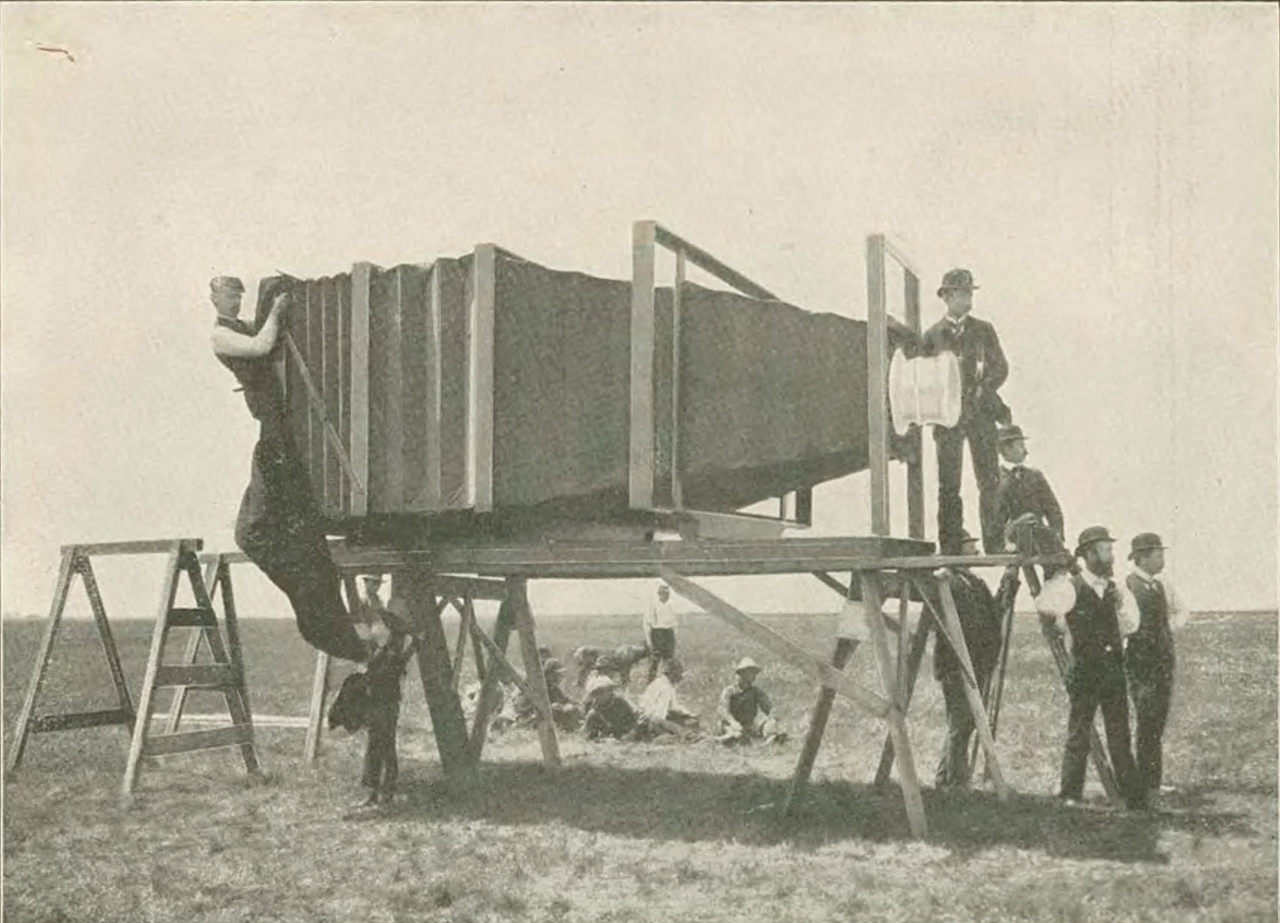
Cameras are small, and getting smaller all the time. This development has helped us all document our lives, sharing the sights we see with an ease difficult to imagine even twenty years ago. 120 years ago, photography faced an entirely different set of challenges, but then as now, much of the motivation to meet them came from commercial interests. Take the case of Chicago photographer George R. Lawrence and his client the Chicago & Alton Railway, who wanted to promote their brand-new Chicago-to-St. Louis express service, the Alton Limited. This product of the golden age of American train travel demanded some respectable photography, a technology then still in its thrilling, possibility-filled emergence.
A truly elegant piece of work, the Alton Limited would, during its 72-year lifespan, boast such features as a post office, a library, a Japanese tea-room, and a striking maroon-and-gold color scheme that earned it the nickname “the Red Train.”
Even from a distance, the Alton Limited looked upon its introduction in 1899 like nothing else on the railroads, with its six identical Pullman cars all designed in perfect symmetry — the very aspect that so challenged Lawrence to capture it in a photograph. Simply put, the whole train wouldn’t fit in one picture. While he could have shot each car separately and then stitched them together into one big print, he rejected that technique for its inability to “preserve the absolute truthfulness of perspective.”
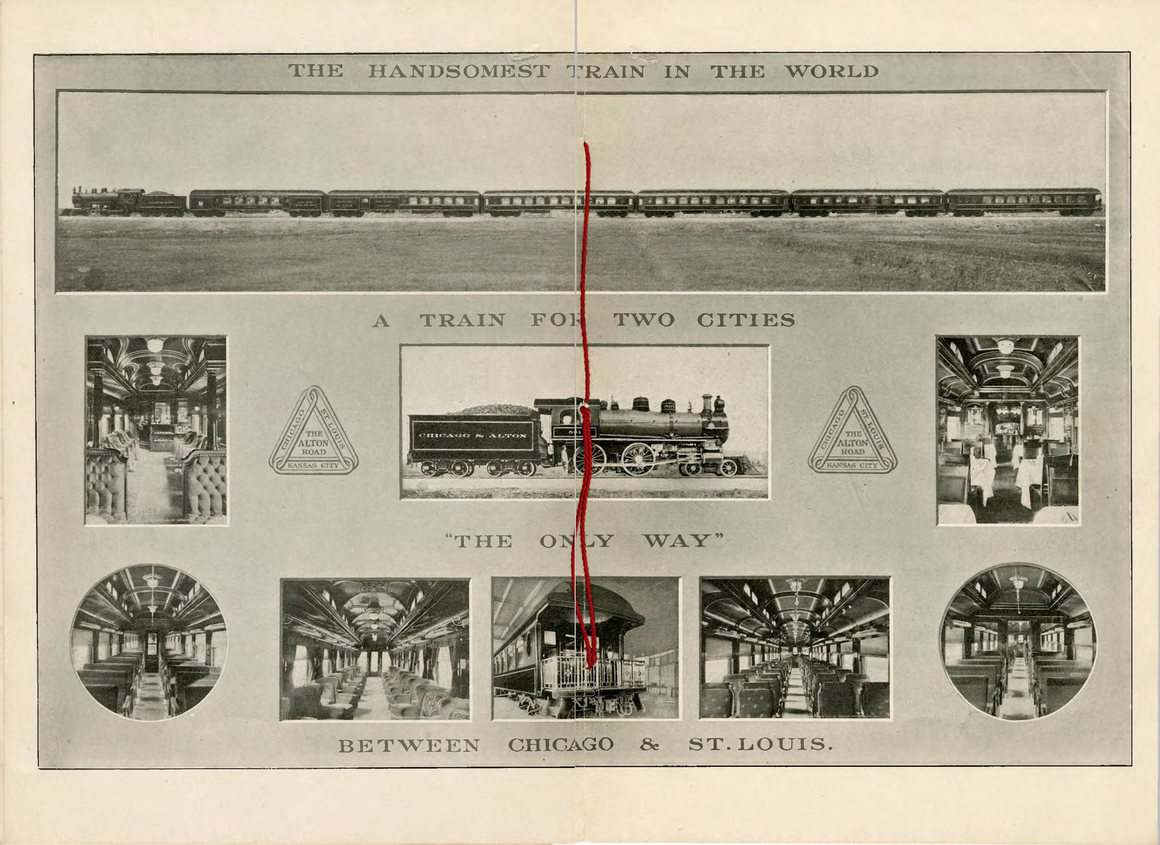
Only a much bigger camera, Lawrence knew, could capture the whole train. And so, in the words of Atlas Obscura’s Anika Burgess, he “quickly went to work designing a camera that could hold a glass plate measuring 8 feet by 4 1/2 feet. It was constructed by the camera manufacturer J.A. Anderson from natural cherry wood, with bespoke Carl Zeiss lenses (also the largest ever made). The camera alone weighed 900 pounds. With the plate holder, it reached 1,400 pounds. According to an August 1901 article in the Brooklyn Daily Eagle, the bellows was big enough to hold six men, and the whole camera took a total of 15 workers to operate.” Transporting the camera to Brighton Park, “an ideal vantage point from which to shoot the waiting train,” required another team of men, and developing the eight-foot long photo took ten gallons of chemicals.
The advertisements in which Lawrence’s photograph appeared practically glowed with pride in the Alton Limited, billing it as “a train for two cities,” as “the only way between Chicago and St. Louis,” as “the handsomest train in the world.” The whole-train picture beggared belief: though it went on to win Lawrence the Grand Prize for World Photographic Excellence at the 1900 Paris Exposition, Burgess notes, it looked so impossible that both the photographer and Chicago & Alton “had to submit affidavits to verify that the photograph had been made on one plate.” We in the 21st century, of course, have no reason to doubt its authenticity, or even to marvel at its ingenuity until we know the story of the immense custom camera with which Lawrence shot it. Today, what awes us are all those smaller shots of the Alton Limited’s interior, exuding a luxuriousness that has long vanished from America’s railroads. If we were to find ourselves on such a train today, we’d surely start Instagramming it right away.
via Atlas Obscura
Related Content:
Behold a Beautiful Archive of 10,000 Vintage Cameras at Collection Appareils
19-Year-Old Student Uses Early Spy Camera to Take Candid Street Photos (Circa 1895)
See the First Photograph of a Human Being: A Photo Taken by Louis Daguerre (1838)
The History of Photography in Five Animated Minutes: From Camera Obscura to Camera Phone
Based in Seoul, Colin Marshall writes and broadcasts on cities and culture. His projects include the book The Stateless City: a Walk through 21st-Century Los Angeles and the video series The City in Cinema. Follow him on Twitter at @colinmarshall or on Facebook.
Read More...Why Should You Read Edgar Allan Poe? An Animated Video Explains
His gloomy, haunted visage adorns the covers of collected works, publications of whose like he would never see in his lifetime. Edgar Allan Poe died in penury and near-obscurity, and might have been forgotten had his work not been turned into sensationalized, abridged, adaptations posthumously, a fate he might not have wished on his most hated literary rival.
But Poe survived caricature to become known as one of the greatest of American writers in any genre. A pioneer of psychological horror and science fiction, founder of the detective story, poet of loss and mourning, and incisive literary critic whose principles informed his own work so closely that we can use essays like his 1846 “The Philosophy of Composition” as keys to unlock the formal properties of his stories and narrative poems.
In the short TED-Ed video above, scripted by Poe scholar Scott Peeples of the College of Charleston, we are introduced to many of the qualities of form and style that make Poe distinctive, and that made him stand out among a crowd of popular horror writers of the time. There are his principles, elaborated in his essay, which state that one should be able to read a story in one sitting, and that every word in the story must count.
These rules produced what Poe called the “Unity of Effect,” which “goes far beyond fear. Poe’s stories use violence and horror to explore the paradoxes and mysteries of love, grief, and guilt, while resisting simple interpretations or clear moral messages. And while they often hint at supernatural elements, the true darkness they explore is the human mind.”
This observation leads to an analysis of Poe’s unreliable narrators, particularly in stories like The Tell-Tale Heart. But there is another aspect to Poe—one which makes his unreliable voices so compelling. Even when the stories seem incredible, the events bizarre, the narrators maniacal, we believe them wholeheartedly. And this has much to do with the framing conventions Poe uses to draw readers in and implicate them, forcing them to identify with the stories’ tellers.
For example, “Ms. Found in a Bottle,” the very first story in Poe’s posthumous collection, Tales of Mystery and Imagination, opens with an epigraph from French librettist Quinault’s opera Atys, an adaption of one of Ovid’s stories. The lines translate to “He who has but a moment to live has no longer anything to dissemble.”
We are invited into a confidence through the doorway of this device—a classical, and neoclassical, reference to truth-telling, a sober, learned literary stamp of authority. As the nameless narrator introduces himself, he makes sure to place himself in another ancient tradition, Pyrrhonism, a skeptical philosophy concerned with epistemology, or how it is we can know what we know.
The narrator assures us that “no person could be less liable than myself to be led away from the severe precincts of truth by the ignes fatui of superstition.” Though we may doubt this bold assertion, and the person making it, we might also be convinced of our own unshakeable rationality and skepticism. These are the moves, to put it plainly, of stage magicians, mountebanks, and confidence men, and Poe was one of the greatest of them all.
He flatters his readers’ intelligence, draws them close enough to see his hands moving, then picks their comfortable assumptions from their pockets. Poe understood what many of his peers did not: readers love to be conned by a juicy yarn, but it must be really good—it must show us something we did not see before, and that we could, perhaps, only look at it indirectly, through a pleasing act of aesthetic (self) deception.
Related Content:
Download The Complete Works of Edgar Allan Poe on His Birthday
7 Tips from Edgar Allan Poe on How to Write Vivid Stories and Poems
Josh Jones is a writer and musician based in Durham, NC. Follow him at @jdmagness
Read More...Sigmund Freud Speaks: Hear the Only Known Recording of His Voice, 1938
On December 7, 1938, a BBC radio crew visited Sigmund Freud at his new home at Hampstead, North London. Freud had moved to England only a few months earlier to escape the Nazi annexation of Austria. He was 81 years old and suffering from incurable jaw cancer. Every word was an agony to speak.
Less than a year later, when the pain became unbearable, Freud asked his doctor to administer a lethal dose of morphine. The BBC recording is the only known audio recording of Freud, the founder of psychoanalysis and one of the towering intellectual figures of the 20th century. (Find works by Freud in our collection of 800 Free eBooks.) In heavily accented English, he says:
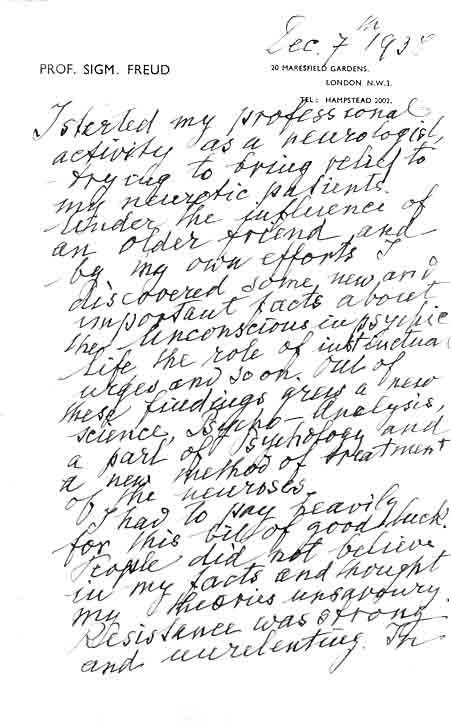
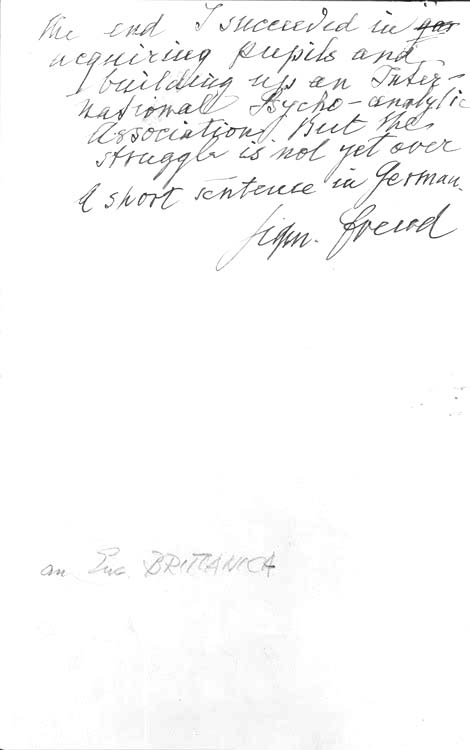
I started my professional activity as a neurologist trying to bring relief to my neurotic patients. Under the influence of an older friend and by my own efforts, I discovered some important new facts about the unconscious in psychic life, the role of instinctual urges, and so on. Out of these findings grew a new science, psychoanalysis, a part of psychology, and a new method of treatment of the neuroses. I had to pay heavily for this bit of good luck. People did not believe in my facts and thought my theories unsavory. Resistance was strong and unrelenting. In the end I succeeded in acquiring pupils and building up an International Psychoanalytic Association. But the struggle is not yet over. –Sigmund Freud.
Note: An earlier version of this post appeared on our site back in May, 2012.
Related Content:
Sigmund Freud, Father of Psychoanalysis, Introduced in a Monty Python-Style Animation
The Famous Break Up of Sigmund Freud & Carl Jung Explained in a New Animated Video
Read More...Nirvana Refuses to Fake It on Top of the Pops, Gives a Big “Middle Finger” to the Tradition of Bands Miming on TV (1991)
The better-safe-than-sorry approach to musicians pretending to play on TV while viewers hear a pre-recorded track seems like the antithesis of rock and roll. Yet since the earliest days of The Ed Sullivan Show, audiences have accepted the convention without complaint. When the fakery unintentionally fails, reactions tend toward mockery, not outrage. Critics rail, the UK’s Musician’s Union has often balked, but bands and fans play along, everyone operating under the presumption that the banal charade is harmless.
Leave it to those spoilsports Nirvana to refuse this pleasant fiction on their Top of the Pops appearance in 1991.
Like American counterparts from American Bandstand to Soul Train, Britain’s Top of the Pops had a long tradition: “For over 40 years,” writes Rolling Stone, “everyone from the Rolling Stones to Madonna to Beyoncé stopped by… to perform their latest single as either a lip-sync or sing along with a prerecorded backing track.” All musicians were expected to mime playing their instruments, a comical sight, for instance, in appearances by The Smiths, in which viewers hear Johnny Marr’s multiple overdubbed guitars but see him playing unaccompanied.
The Smiths approached their Top of the Pops appearances with tongue-in-cheek irreverence. At their 1983 debut performance, Morrissey mimed “This Charming Man” using a fern as a microphone. Still, the band gamely pretended to play, like everyone else did. But when Nirvana hit the TOTP stage, with Cobain singing to a backing track of “Smells Like Teen Spirit,” they wouldn’t observe any of the niceties. YouTube channel That Time Punk Rocked writes:
Cobain opts for slow, exaggerated strums during the few times he touches his guitar, sings an octave lower (he later confirmed he was imitating Morrisey from The Smiths), and attempts to eat his microphone at one point. He also changes some of the lyrics, exchanging the opening line “load up on guns, bring your friends,” for “load up on drugs, kill your friends.” Dave Grohl hits cymbals and skins at random, doing more dancing than drumming. Krist Novoselic even swings his bass above his head. And despite these ridiculous antics, the crowd goes absolutely insane.
Maybe the crowd went wild because of those ridiculous antics, or maybe no one even noticed, as when a crowd of thousands in Argentina hardly seemed to notice when Nirvana openly mocked them after the audience abused their opening act. This may be one burden of stardom Cobain came to know too well—protests register as performance and sticking it the man onstage just makes the man more money. But the video remains “one of the greatest middle fingers” to musical miming captured on camera—recommended viewing for every salty young band preparing for their first TV gig.
Related Content:
The First Live Performance of Nirvana’s “Smells Like Teen Spirit” (1991)
Josh Jones is a writer and musician based in Durham, NC. Follow him at @jdmagness
Read More...Japanese Musicians Turn Obsolete Machines Into Musical Instruments: Cathode Ray Tube TVs, Overhead Projectors, Reel-to-Reel Tape Machines & More
In the 1940s and 50s, experimental composers like Halim El-Dabh, Pierre Schaeffer, and Pierre Henry began making experimental compositions that Schaeffer would call musique concrete. They used tape recorders, phonographs, microphones and other analog electro-acoustic devices to create music, as Henry put it, from “non-musical sounds.” These techniques became mainstays of more familiar audio art, such as the radio and television sound designs of the BBC’s Radiophonic Workshop. With the advent of synthesizers, electronic music overtook these sound experiments, just as other new technologies replaced the playback and recording devices used to make them.
A Japanese group called Open Reel Ensemble recalls this legacy of musique concrete, deploying reel-to-reel tape machines, cathode ray tube TVs, overhead projectors, and other analog technology to make 21st century music with “non-musical sounds.” Headed by programmer-turned-composer Ei Wada, the group embraces a very different compositional philosophy than the experimental electro-acoustic composers of the past, who worked in reaction to European classical music, opposing “concrete” sounds to abstract musical ideas. Wada, on the other hand, was first inspired by hearing a gamelan ensemble at a performance in Indonesia as a very small child.
Given a collection of 70s reel-to-reel recorders by a family friend, he attempted to re-create the polyphony of those traditional Javanese gong ensembles. He has, writes Motherboard, “been on a quest to reproduce otherworldly sounds with tech that nobody wants.” But he freely combines these outdated machines with contemporary mixers, amplifiers, light shows, beats, and tempos. Formed with friends Haruka Yoshida and Masaru Yoshida, Wada’s Open Reel Ensemble might be compared to both the avant-garde experiments of composers like John Cage and the popular experiments of hip hop turntablists, both of whom used analog technology in innovative, unconventional ways.
Some of the group’s work is a kind of experimental dance music, as you can see in the live performance further up; some is more ambient sound art, as in Wada’s solo ventilation fan performance above, with implicit commentary on Japan’s economy and the disposable nature of consumer technology. “All these tech objects are a symbol of Japan’s economic growth,” says Wada. “but they also get thrown away in great numbers. It’s good to not just say bye to things that are thrown away but to instill old things with new meaning, and celebrate their unique points.”
The detourning of technology that would otherwise end up as landfill requires some ingenuity, given the increasing rarity of such instruments. In the performance above, we see Wada play with invented devices his group calls in English the “Exhaust Fancillator” and in Japanese a kankisenthizer, a neologism formed from the word for ventilation fan. “We used laser cutters and 3D printers to design the ventilation fans,” he says. This willingness to improvise, invent, and repurpose whatever works makes for some fascinating experiments that are as much performance art as sound composition.
In the Wada performance above from 2010, he uses old tube TVs as drums, hitting the screens to trigger both sound and light effects and bringing to mind not only the sound art of the early 20th century, but also the 1980s video installations of Nam June Paik, fully immersive experiences that foreground their technological artifice even as they produce an inexplicable kind of magic.
Related Content:
Hear the One Night Sun Ra & John Cage Played Together in Concert (1986)
Josh Jones is a writer and musician based in Durham, NC. Follow him at @jdmagness
Read More...Conserve the Sound, an Online Museum Preserves the Sounds of Past Technologies–from Typewriters, Electric Shavers and Cassette Recorders, to Cameras & Classic Nintendo
The unmistakable zip and whirr of a rotary phone, the ungodly squeal of dial-up modems, the satisfying thunk of a cartridge in a classic Nintendo console, a VCR rewinding, the click-clack sound of a Walkman’s buttons…. I date myself in saying that these sounds immediately send me back to various moments in my childhood with Proustian immersion. The sense of smell is most closely linked to memory, but hearing cannot be far behind given how sound embeds itself in time, and most especially the sounds of technologies, which are by nature fated for obsolescence. A museum-quality aura surrounds the Walkman and the first iPods. These are triumphs of consumer design, but only one of them makes distinctive mechanical noises.
As analog recedes, it can seem that noisy tech in general becomes more and more dated. It is hard to hear the rubbing of thumbs and fingers across screens and touchpads. Voice commands make buttons and switches redundant. How much tech from now will one day feature in Conserve the Sound, the “online museum for vanishing and endangered sounds”?
Its collection gives the impression of a bygone age, quaint in its dozens of examples of mechanical ingenuity. The visual juxtaposition of handheld film cameras, typewriters, car window handles, electric shavers, boom boxes, stopwatches, and so on has the effect of making these things seem all of a piece, assorted artifacts in a great hall of wonders called “the Sound the 20th Century.”
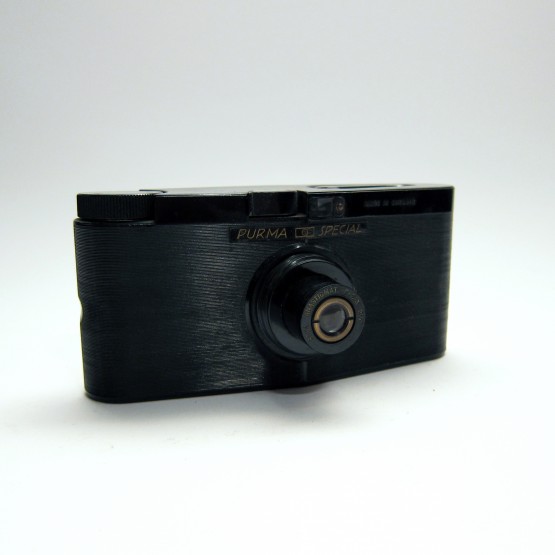
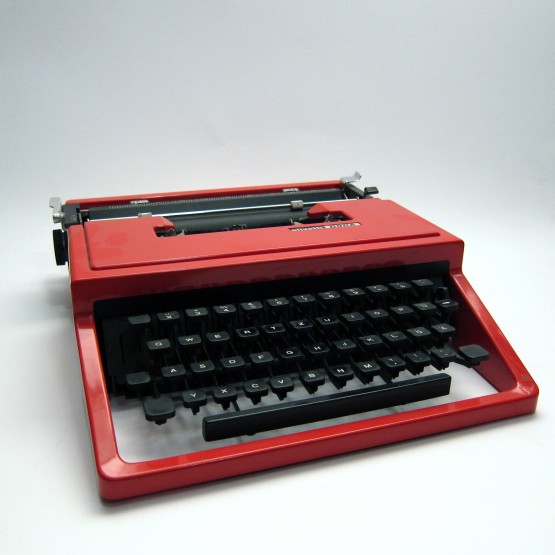
At the top of the site’s “Sound” page, timeline navigation allows users to visit every decade from the 1910s to the 2000s, a category that contains only two objects. Other displays are more plentiful, and colorful. The 1960s, for example showcases the incredibly sexy red Schreibmaschine Olivetti Dora further up. It sounds as sleek and sophisticated as it looks. The virtual display case of the 30s holds the sounds of a twin-engine propeller plane and a handful of beautiful moving and still cameras, like the Fotokamera Purma Special above. It also features the humble and enduring library stamp, a sound I pine for as I slide books under the self-checkout laser scanner at my local branch.

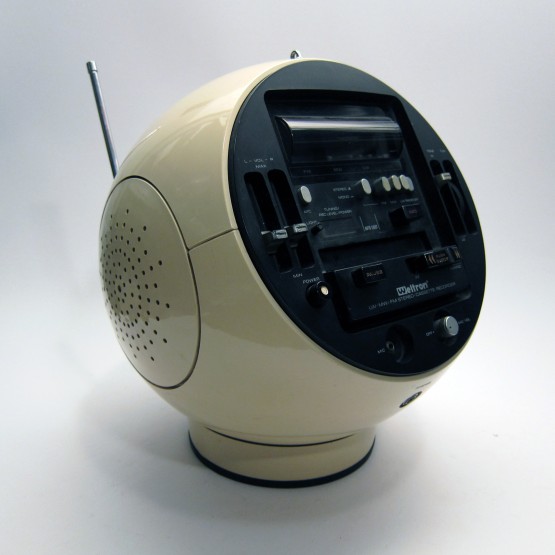
Given just the few images here, you can already see that Conserve the Sound is as much a feast for the eyes as for the ears, each object lovingly photographed against an austere white background. In order for the full nostalgic effect to work, however, you need to visit these pages and hit “play.” It even magically works with objects from before our times, given how prominently their sounds feature in film and audio recordings that define the periods. You’ve likely also noticed how many of these products are of European origin, and many of them, like the robotic head of the Kassettenrekorder Weltron Model 2004, are perhaps unfamiliar to many consumers from elsewhere in the world.
Conserve the Sound is a European project, funded by the Film & Medienstiftung NRW in Germany, thus its selection skews toward European-made products. But the sound of a fan or an adding machine in Germany is the sound of a fan or adding machine in Chile, China, Kenya, or Nebraska. See a trailer for the project at the top of the post, and below, one of the many interviews in which German public figures, scholars, librarians, technicians, and students answer questions about their mnemonic associations with technological sound. In this interview, radio presenter Bianca Hauda describes one of her favorite old sounds from a favorite old machine, a 1970s portable cassette recorder.
via WFMU
Related Content:
Brian Eno Once Composed Music for Windows 95; Now He Lets You Create Music with an iPad App
Josh Jones is a writer and musician based in Durham, NC. Follow him at @jdmagness
Read More...This Is Your Kids’ Brains on Internet Algorithms: A Chilling Case Study Shows What’s Wrong with the Internet Today
Multimedia artist and writer James Bridle has a new book out, and it’s terrifying—appropriately so, I would say—in its analysis of “the dangers of trusting computers to explain (and, increasingly, run) the world,” as Adi Robertson writes at The Verge. Summing up one of his arguments in his New Dark Age: Technology and the End of the Future, Bridle writes, “We know more and more about the world, while being less and less able to do anything about it.” As Bridle tells Robertson in a short interview, he doesn’t see the problems as irremediable, provided we gain “some kind of agency within these systems.” But he insists that we must face head-on certain facts about our dystopian, sci-fi-like reality.
In the brief TED talk above, you can see Bridle do just that, beginning with an analysis of the millions of proliferating videos for children, with billions of views, on YouTube, a case study that quickly goes to some disturbing places. Videos showing a pair of hands unwrapping chocolate eggs to reveal a toy within “are like crack for little kids,” says Bridle, who watch them over and over. Autoplay ferries them on to weirder and weirder iterations, which eventually end up with dancing Hitlers and their favorite cartoon characters performing lewd and violent acts. Some of the videos seem to be made by professional animators and “wholesome kid’s entertainers,” some seem assembled by software, some by “people who clearly shouldn’t be around children at all.”
The algorithms that drive the bizarre universe of these videos are used to “hack the brains of very small children in return for advertising revenue,” says Bridle. “At least that what I hope they’re doing it for.” Bridle soon bridges the machinery of kids’ YouTube with the adult version. “It’s impossible to know,” he says, who’s posting these millions of videos, “or what their motives might be…. Really it’s exactly the same mechanism that’s happening across most of our digital services, where it’s impossible to know where this information is coming from.” The children’s videos are “basically fake news for kids. We’re training them from birth to click on the very first link that comes along, regardless of what the source is.”
High school and college teachers already deal with the problem of students who cannot judge good information from bad—and who cannot really be blamed for it, since millions of adults seem unable to do so as well. In surveying YouTube children’s videos, Bridle finds himself asking the same questions that arise in response to so much online content: “Is this a bot? Is this a person? Is this a troll? What does it mean that we can’t tell the difference between these things anymore?” The language of online content is a hash of popular tags meant to be read by machine algorithms, not humans. But real people performing in an “algorithmically optimized system” seem forced to “act out these increasingly bizarre combinations of words.”
Within this culture, he says, “even if you’re human, you have to end up behaving like a machine just to survive.” What makes the scenario even darker is that machines replicate the worst aspects of human behavior, not because they’re evil but because that’s what they’re taught to do. To think that technology is neutral is a dangerously naïve view, Bridle argues. Humans encode their historical biases into the data, then entrust to A.I. such critical functions as not only children’s entertainment, but also predictive policing and recommending criminal sentences. As Bridle notes in the short video above, A.I. inherits the racism of its creators, rather than acting as a “leveling force.”
As we’ve seen the CEOs of tech companies taken to task for the use of their platforms for propaganda, disinformation, hate speech, and wild conspiracy theories, we’ve also seen them respond to the problem by promising to solve it with more automated machine learning algorithms. In other words, to address the issues with the same technology that created them—technology that no one really seems to understand. Letting “unaccountable systems” driven almost solely by ads control global networks with ever-increasing influence over world affairs seems wildly irresponsible, and has already created a situation, Bridle argues in his book, in which imperialism has “moved up to infrastructure level” and conspiracy theories are the most “powerful narratives of our time,” as he says below.
Bridle’s claims might themselves sound like alarmist conspiracies if they weren’t so alarmingly obvious to most anyone paying attention. In an essay on Medium he writes a much more in-depth analysis of YouTube kids’ content, developing one of the arguments in his book. Bridle is one of many writers and researchers covering this terrain. Some other good popular books on the subject come from scholars and technologists like Tim Wu and Jaron Lanier. They are well worth reading and paying attention to, even if we might disagree with some of their arguments and prescriptions.
As Bridle himself argues in his interview at The Verge, the best approach to dealing with what seems like a nightmarish situation is to develop a “systemic literacy,” learning “to think clearly about subjects that seem difficult and complex,” but which nonetheless, as we can clearly see, have tremendous impact on our everyday lives and the society our kids will inherit.
Related Content:
How Information Overload Robs Us of Our Creativity: What the Scientific Research Shows
Josh Jones is a writer and musician based in Durham, NC. Follow him at @jdmagness
Read More...Did Lennon or McCartney Write the Beatles 1965 Song “In My Life”? A Math Professor, Using Statistics, Solves the Decades-Old Mystery
In 2009, guitarist Randy Bachman of the Guess Who and Bachman-Turner Overdrive had the rare opportunity to hear the individual tracks that make up that mythic opening chord in the Beatles’ “A Hard Day’s Night,” an enigma that has baffled musicians for decades. Bachman found that it’s actually made up of a combination of different chords played all at once by George, John, and Paul. The discovery made for a great story, and Bachman told it the following year on his CBC radio show. Unbeknownst to him, it seems, another Canadian Beatles lover, Dalhousie University math professor Jason Brown, claimed he had cracked the code the previous year, without setting foot in Abbey Road.
Instead, Brown used what is called a Fourier Analysis, based on work done in the 1820s by French scientist Joseph Fourier, which reduces sounds into their “constituent sine or cosine waves.” The problem with Bachman’s explanation, as Eliot Van Buskirk notes at Wired, is that the chord “contains a note that would be impossible for the Beatles’ two guitarists and bassist to play in one take.” Since there was no overdubbing involved, something else must have been happening. Through his mathematical analysis, Brown determined that something else to have been five notes played on the piano, apparently by George Martin, “who is known to have doubled on piano George Harrison’s solo on the track.”
After ten years of work, Brown has returned with the solution to another longtime Beatles mystery, this time with a little help from his colleagues, Harvard mathematicians Mark Glickman and Ryan Song. The problem: who wrote the melody for “In My Life,” Rubber Soul’s nostalgic ballad? The song is credited to the crack team of Lennon-McCartney, but while the two agreed that Lennon penned the lyrics, both separately claimed in interviews to have written the music. Brown and his collaborators used statistical methods to determine that it was, in fact, Lennon who wrote the whole song.
They present their research in a paper titled “Assessing Authorship of Beatles Songs from Musical Content: Bayesian Classification Modeling from Bags-Of-Words Representations.” In the NPR Weekend Edition interview above, you can hear Stanford mathematician Keith Devlin break down the terms of their project, including that odd phrase “bags-of-words representations,” which “actually goes back to the 1950s,” he says. “Bags-of-words”—like the word clouds we now see on websites—take text, “ignore the grammar” and word order and produce a collection of words. The method was used to generate the first spam filters. Rather than use words, however, the mathematicians decontextualized snippets of sound.
In an analysis of “about 70 songs from Lennon and McCartney… they found there were 149 very distinct transitions between notes and chords.” These are unique to one or the other songwriters. “When you do the math,” Devlin says, it turns out “the probability that McCartney wrote it was .o18—that’s essentially zero.” Why might Paul have misremembered this—even saying specifically in a 1984 Playboy interview that he recalled “going off for half an hour and sitting with a Mellotron… writing the tune”? Who knows. Mashable has reached out to McCartney’s publicist for comment. But in the final analysis, says Devlin, “I would go with mathematics” over faulty human memory.
Related Content:
Guitarist Randy Bachman Demystifies the Opening Chord of The Beatles’ “A Hard Day’s Night”
Artificial Intelligence Program Tries to Write a Beatles Song: Listen to “Daddy’s Car”
The Beatles “While My Guitar Gently Weeps” Gets a Dreamy New Music Video from Cirque du Soleil
Josh Jones is a writer and musician based in Durham, NC. Follow him at @jdmagness
Read More...Support Us
We're hoping to rely on loyal readers, rather than erratic ads. Please click the Donate button and support Open Culture. You can use Paypal, Venmo, Patreon, even Crypto! We thank you!

About Us

Open Culture scours the web for the best educational media. We find the free courses and audio books you need, the language lessons & educational videos you want, and plenty of enlightenment in between.
Advertise With Us
FREE UPDATES!
GET OUR DAILY EMAIL
Get the best cultural and educational resources on the web curated for you in a daily email. We never spam. Unsubscribe at any time.
FOLLOW ON SOCIAL MEDIA
Open Culture editor Dan Colman scours the web for the best educational media. He finds the free courses and audio books you need, the language lessons & movies you want, and plenty of enlightenment in between.
Advertise With Us

