How the Inca Used Intricately-Knotted Cords, Called Khipu, to Write Their Histories, Send Messages & Keep Records
Those of us who learned to write in a (mostly) phonetic language learned to take it for granted that writing should correspond (roughly) to sound. Then we learned of the pictographs, ideographs, and logograms of the Chinese alphabet, or of Ancient Egyptian or Mayan, or of other non-phonemic orthographies, and we were forced to revise earlier assumptions. Those who pursue the study of symbolic systems even further will eventually come to meet khipu, the Incan system of record-keeping that uses intricately knotted rope.
Khipu, long thought an abacus-like means of bookkeeping, has recently been acknowledged as much more than that, countering a scholarly view Daniel Cossins summarizes at New Scientist as the belief that the Incas, despite their technological and political “sophistication… never learned to write.” This European logocentrism (in the Derridean sense), persisted for centuries despite some evidence to the contrary four hundred years ago.
For example, the poet Garcilaso de la Vega, son of an Incan princess and Spanish conquistador, wrote in 1609 that the Incas “recorded on knots everything that could be counted, even mentioning battles and fights, all the embassies that had come to visit the Inca, and all the speeches and arguments they had uttered.” There may be some hyperbole here. In any case, the point “was moot,” notes Cossins, “because no one could read any of them.”
Like mostly illiterate cultures in the West and East that relied on scribes for record-keeping, Incan civilization relied on khipumayuq, “or the keepers of the khipus, a specially trained caste who could tie and read the cords.” As explorer Alejandro Chu and Patricia Landa, Conservator of the Incahuasi Archeological Project, explain in the National Geographic video at the top, these specialists died, or were killed off, before they could pass their knowledge to the next generations.
But the linguistic code, it seems, may have been cracked—by an undergraduate freshman economics major at Harvard named Manny Medrano. As Atlas Obscura reported last year, Medrano, working under his professor of Pre-Columbian studies, Gary Urton, spent his spring break matching a set of six khipu against a colonial-era Spanish census document. He was able to confirm what scholars had long assumed, that khipu kept track of census and other administrative data.
Moreover, though, Medrano “noticed that the way each cord was tied onto the khipu seemed to correspond to the social status of the 132 people recorded in the census document. The colors of the strings also appeared to be related to the people’s first names.” (Now a senior, Medrano’s findings have been published in the journal Ethnohistory; he is first author on the paper, “indicating that he contributed the bulk of the research”).
This research shows how khipu can tell stories as well as record data sets. Medrano built upon decades of work done by Urton and other scholars, which Cossins summarizes in more detail. Other ethnographers like St. Andrews’ Sabine Hyland have had similar epiphanies. Hyland chanced upon a woman in Lima who pointed her to khipus in the village of San Juan de Collata. The villagers “believe them to be narrative epistles,” writes Cossins, “created by local chiefs during a rebellion against the Spanish in the late 18th century.”
After careful analysis, Hyland found that the khipus’ pendant cords “came in 95 different combinations of colour, fibre type and direction of ply. That is within the range of symbols typically found in syllabic writing systems.” She has since hypothesized that khipu “contain a combination of phonetic symbols and ideographic ones, where a symbol represents a whole word.”
Hyland grants it’s possible that later khipus made after contact with the Spanish may have absorbed an alphabet from Spanish writing. Nevertheless, these findings should make us wonder what other artifacts from around the world preserve a language Western scholars have never learned how to read.
Attempts to decipher khipus use all sorts of comparative methods, from comparing them with each other to comparing them with contemporary Spanish documents. But one innovative method at MIT began by comparing Incan khipu with student attempts to create their own rope language, in a 2007 course led by the “Khipu Research Group,” a collection of scholars, including Urton, from archeology, electrical engineering, and computer science.
“To gain insight into this question” of how the code might work, the syllabus notes, “this class will explore how you would record language with knots in rope.” Maybe you’d rather skip the guesswork and learn how to make a khipu the way the Inca may have done? If so, see the series of six videos above by Harvard Ph.D. student in archeology, Jon Clindaniel. And to learn as much about khipu as you might ever hope to know, check out the Khipu Database Project at Harvard, whose goal is to collect “all known information about khipu into one centralized repository.”
Related Content:
Take a Virtual Tour of Machu Picchu, One of the New 7 Wonders of the World
Trigonometry Discovered on a 3700-Year-Old Ancient Babylonian Tablet
Josh Jones is a writer and musician based in Durham, NC. Follow him at @jdmagness
Read More...The Exhilarating Filmmaking of Robert Bresson Explored in Eight Video Essays
“Who’s afraid of Robert Bresson?” New Yorker film critic Anthony Lane once asked. “Me, for a start.” But he didn’t mean that he dreaded screenings of Au hasard Balthazar, Diary of a Country Priest, A Man Escaped, The Devil, Probably, or any other acclaimed work in the auteur’s filmography. “It’s not that I don’t look forward to a Bresson picture,” Lane clarified. “It’s just that as I shuffle into the theatre I feel like a pupil approaching the principal’s door, wondering what crimes I may have committed and how I must answer for them.”
Even now, 35 years after his final picture, Bresson intimidates with his rigor — rigor of the moral variety, certainly, but even more so of the aesthetic variety — often described (not least by the likes of Andrei Tarkovsky) in the terms of asceticism. Nevertheless, Indiewire offers a brief and friendly introduction to his cinema in the three-minute video essay at the top of the post.
Just above, in “Robert Bresson: The Essence of Cinema,” A‑BitterSweet-Life gets deeper into the Bressonian sensibility by showing clips of his films alongside clips of him working and speaking, all narrated with his own words.
“I always like to see and hear the film before I shoot it, to come up with things by working on my own, things from my memory or imagination, even if I don’t end up filming them,” Bresson says in one piece of interview footage. “These are often things I can’t come up with on the set, so I believe it’s important to create a solid groundwork, a set of constraints within which the film will take shape. Because I’m aware of these constraints, I can ask my actors, nonprofessional actors, to surprise me. Unlimited surprises but within a limited context.”
Those worlds will sound familiar to anyone who has read Notes sur le cinématographe (variously translated as Notes on Cinematography or Notes on the Cinematographer), Bresson’s collection of maxims laying out his view of his art. If observations like “To set up a film is to bind persons to each other and to objects by looks,” “Empty the pond to get the fish,” and “Be sure of having used to the full all that is communicated by immobility and silence” seem abstract on the page, Filmscalpel’s “Notes on Pickpocket” illustrates their enormous relevance to the effectiveness of Bresson’s work by weaving them directly into scenes of one of his best-known works.
Film scholar David Bordwell examines the same movie, but takes a much less aphoristic and much more technical tack, in “Constructive Editing in Robert Bresson’s Pickpocket,” which contextualizes Bresson’s technique of constructive editing, or building a space while showing only small pieces of it at a time, as opposed to “analytical editing” that first establishes the entire space and then moves within it. Just above, critic and well-known Bresson enthusiast James Quant breaks down the much later L’Argent — or at least its use of reflections and repetition, just the R in the longer “L’Argent, A to Z” video essay Quandt created for the Criterion Collection’s release of the film.
The video essayist Kogonada, now a respected filmmaker in his own right, has so far put out two tributes to Bresson: “Hands of Bresson” just above, which concentrates on the director’s use of those body parts, and “Once There Was Everything,” about the great cinematic effect to which he put doors all throughout his career. “Why shouldn’t I put ten times more doors in my films if I feel like it?” the essay quotes him as saying. But then, the true fan knows that Bresson could hardly have countenanced using even one more door than absolutely necessary — or one more of anything else, for that matter.
In Bresson’s world, to put it in drastically reduced terms, less is more: Julian Palmer’s short video essay above even takes that phrase as its title. Bresson’s work has many virtues, few as nameable as their simplicity, but for the man himself it always had to be just the right kind of simplicity. In Notes sur le cinématographe he identifies two types: “The bad: simplicity as starting-point, sought too soon. The good: simplicity as end-product, recompense for years of effort.” Or, as he he writes elsewhere, “It is with something clean and precise that you will force the attention of inattentive eyes and ears.” A cinema that has forgotten these lessons of Bresson’s — now there’s a truly frightening proposition.
Related Content:
Andrei Tarkovsky Reveals His Favorite Filmmakers: Bresson, Antonioni, Fellini, and Others
An Introduction to Jean-Luc Godard’s Innovative Filmmaking Through Five Video Essays
The Surreal Filmmaking of David Lynch Explained in 9 Video Essays
Based in Seoul, Colin Marshall writes and broadcasts on cities, language, and culture. His projects include the book The Stateless City: a Walk through 21st-Century Los Angeles and the video series The City in Cinema. Follow him on Twitter at @colinmarshall or on Facebook.
Read More...157 Animated Minimalist Mid-Century Book Covers
Graphic and motion designer Henning M. Lederer can’t get enough of those minimalist midcentury book covers.
Apparently, the over-the-top pulp scenarios that inspire fellow period cover enthusiast Todd Alcott leave Lederer cold.
He’s drawn to the stark, the geometric, the abstract. No heaving bosoms, no forbidden love, though there’s no denying that sex was a topic of great clinical interest to several of the authors featured above, including psychiatrists Charles Rycroft, H. R. Beech, and R.D. Laing.
Visually, the psycho-analytic titles appear interchangeable with the more straightforward texts in this, Lederer’s third in a series of lightly animated period book covers:
The Intelligent Woman’s Guide to Atomic Radiation
Medical Complications During Pregnancy
Generalized Thermodynamics
Pinwheels, ripples, and scrolling harlequin patterns abound. Stare at them long enough if you want to cure your insomnia or become one with the universe.
Tilman Grundig’s soundtrack ensures that the playing field will stay level. No title is singled out for extra sonic attention.
That said, Noise by Rupert Taylor, an expert consultant in acoustics and noise control, stands apart for the humor and narrative sensibility of its visual representation.
Perhaps that’s why Lederer saved it for last.
To date, he’s animated 157 covers. Enjoy them all above.
Related Content:
The Art of Sci-Fi Book Covers: From the Fantastical 1920s to the Psychedelic 1960s & Beyond
French Bookstore Blends Real People’s Faces with Book Cover Art
Ayun Halliday is an author, illustrator, theater maker and Chief Primatologist of the East Village Inky zine. Join her in NYC on Monday, November 12 for another monthly installment of her book-based variety show, Necromancers of the Public Domain. Follow her @AyunHalliday.
Read More...36 Artists Give Advice to Young Creators: Wim Wenders, Jonathan Franzen, Lydia Davis, Patti Smith, David Byrne, Umberto Eco & More
“Whatever you do, nobody else can do that better than you. You have to find what you can do better than anyone else, what you have in yourself that nobody else has in them. Don’t do anything that you know, deep in your heart, that somebody else can do better, but do what nobody else can do except for you.” That sounds like fine advice, but when receiving advice we should always consider the source. In this case we could hardly do better: the source is Wim Wenders, director of Alice in the Cities, Paris, Texas, Wings of Desire, and many other films besides, an auteur seldom accused of making movies anyone else could make.
Wenders’ interview clip and the others here come from “Advice to the Young,” a video series created by the Louisiana Museum in Denmark (which has quite an impressive gift shop, incidentally, if you happen to need advice on gift-shopping). Jonathan Franzen, author of novels like The Corrections, Freedom, and Purity, admits to feeling embarrassment about “giving advice to the young writer,” but he still has valuable words for creators in any domain: “The most important advice I have is to have fun, to try to create something that is fun to work on.”
And by fun he means fun like you have on a tennis court, where “you’re not just messing around, you’re not just hitting the ball wherever you want — you are focused on having a game, and once you are in it you are having fun. That’s the kind of focused fun I’m talking about, and if you are having that kind of focused fun, there’s a good chance that the reader will too.”
The range of writers from which Louisiana Museum has sought advice also includes Lydia Davis, whose sensibility may differ from Franzen’s but who has garnered an equal (or even greater) degree of respect from her readership. “You learn from models and you analyze them, you study them, you analyze them very closely, one thing at a time,” she says, beginning her more expansive advice based on her own method. “You don’t just sort of read the paragraph and say, ‘Oh, that really flows, you know? That’s good.’ You say, ‘What kind of adjectives? How many? What kind of nouns? How long are the sentences? What’s the rhythm?’ You know, you pick it apart, and that’s very helpful.” Her other suggestions include to “be very patient, even patient with chaos” and to keep a notebook (“it takes some of the tension and the worry away, because if you write it down, it may just be a note. It doesn’t have to be the beginning of anything”).
“Do what you want to do,” Davis concludes, “and don’t worry if it’s a little odd or doesn’t fit the market.” That bit of guidance seems to have worked for her, and in the great variety of forms it can take seems to have worked for seemingly every other artist. Take Ed Ruscha, for instance, whose canvasses of gas stations, corporate signage, and other icons of American blankness must hardly have seemed geared toward any particular “market” when first he painted them. For the young he has only one piece of advice, received second-hand and briefly delivered: “No one could ever beat this thing that Max Ernst said. They asked him what a young artist should do, and he said, ‘cut off an ear.’ That’s good advice to follow. You can’t beat that.”
Other artists featured in the video playlist include Laurie Anderson, David Byrne, Umberto Eco, Patti Smith & more.
Related Content:
Brian Eno’s Advice for Those Who Want to Do Their Best Creative Work: Don’t Get a Job
John Cleese’s Advice to Young Artists: “Steal Anything You Think Is Really Good”
Ursula Le Guin Gives Insightful Writing Advice in Her Free Online Workshop
Based in Seoul, Colin Marshall writes and broadcasts on cities, language, and culture. His projects include the book The Stateless City: a Walk through 21st-Century Los Angeles and the video series The City in Cinema. Follow him on Twitter at @colinmarshall or on Facebook.
Read More...A Data Visualization of Modern Philosophy, 1950–2018
Those of us who think of ourselves as philosophy enthusiasts remain free to read and think about whatever we like, no matter how obscure, marginal, or out-of-fashion the ideas. But the academy presents a different picture, one fraught with political maneuvering, funding issues, and fretting about tenure. Does professionalization do philosophy a disservice by codifying the kinds of problems we should be thinking and writing about? Or do we need professional philosophy for exactly this reason? It depends on who you ask.
One argument against the academy consists in pointing out that many, if not most, of history’s influential philosophers have been amateurs in one sense or another: grinding away at day jobs, for example, like Baruch Spinoza, or living on family money, like Ludwig Wittgenstein, two radical philosophical outsiders whose Ethics and Tractatus, respectively, have been turned into data visualizations by Maximilian Noichl. It’s interesting to speculate about how these thinkers, both so visually-inclined, would respond to the treatment.
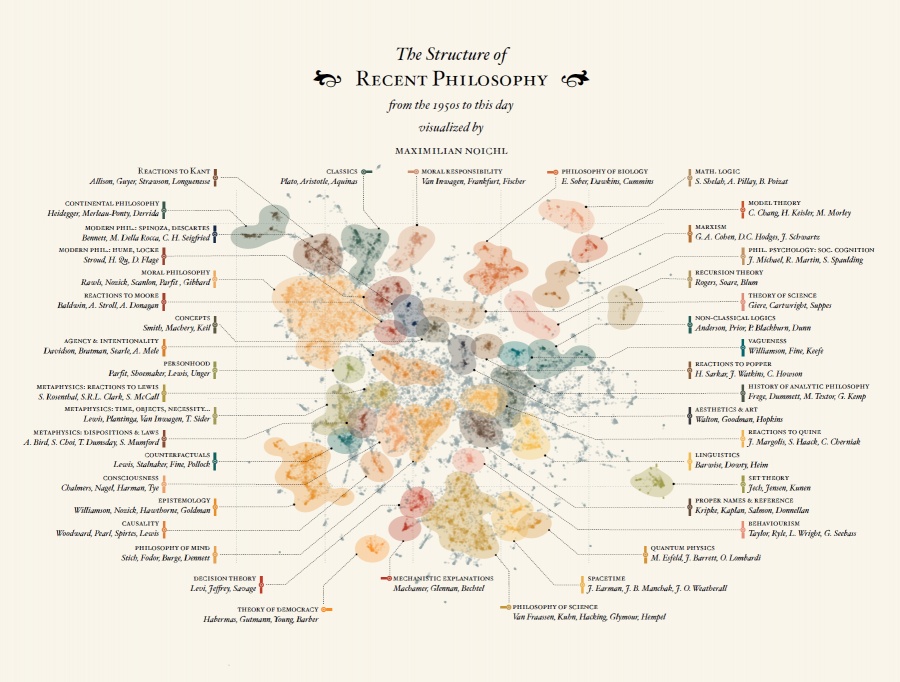
Noichl’s latest project, now in its third and, so far, final iteration, involves tracing “The Structure of Recent Philosophy from the 1950s to this day.” Clearly implied, but unstated in his description is that these maps chart only the specialized interests of academic philosophy, but the omission highlights the fact that contemporary philosophical work outside the academy receives no recognition in the literature and, therefore, hardly qualifies as philosophy at all under current strictures.
To construct the map at the top (click here to see the full infographic, then click it again for a high resolution version), Noichl aggregated over 50,000 articles “from various philosophy journals.” The journals all come from Clarivate Analytics Web of Science collection, which skews the selection. Noichl began with a “snow-ball-sampling (a few thousand papers),” then extended his sample by “repeatedly looking at the most cited publications.” The resulting papers were then “spatially distributed according to their citation-patterns.”
Every point on the graphic represents one article. Noichl used two different algorithms to sort and group the data, and his explanatory text on the original graphic at his site explains the technical details. The clusters are “a bit heterogenic in their nature,” he writes.
While some are thematic, others are determined strongly by specific persons or eras, which seems in itself to be an interesting observation about the structure of the literature….. [T]here is… a remarkable cleft between theory of science and epistemology. And the ways various historical clusters group themselves around moral philosophy suggests an internal relation. We can also observe that continental philosophy seems to split into two halves…
The exercise presents us with a summary image of some of the field’s most persistent concerns for the past 60 years or so. I can imagine historians of philosophy—and maybe critics of academic philosophy—making excellent use of this colorfully organized data. Noichl vaguely mentions a possible use of the map as a “reality check for some debates.” The question of what it contributes to philosophical thinking remains open. And we might ask whether big data does philosophy a disservice by algorithmically reproducing certain existing conditions, rather than critically interrogating them as philosophers have always done.
Yet it’s clear that data visualizations are now standard tools for teaching and learning any number of subjects, and in many cases, they offer helpful shorthand, as does another of Noichl’s interactive graphics, “Relationships Between Philosophers, 600 B.C.-160 B.C.,” a “delightful depiction,” writes Justin Weinberg at Daily Nous, “of the interrelation of the ideas of ancient philosophers over time.” See Noichl’s site for the three versions of “The Structure of Recent Philosophy” and other philosophy data visualizations.
And at the links below, see how others have used data visualization tools to organize the history of philosophy in different ways.
via Daily Nous
Related Content:
The History of Philosophy Visualized in an Interactive Timeline
The History of Philosophy Visualized
Josh Jones is a writer and musician based in Durham, NC. Follow him at @jdmagness
Read More...How an 18th-Century Monk Invented the First Electronic Instrument
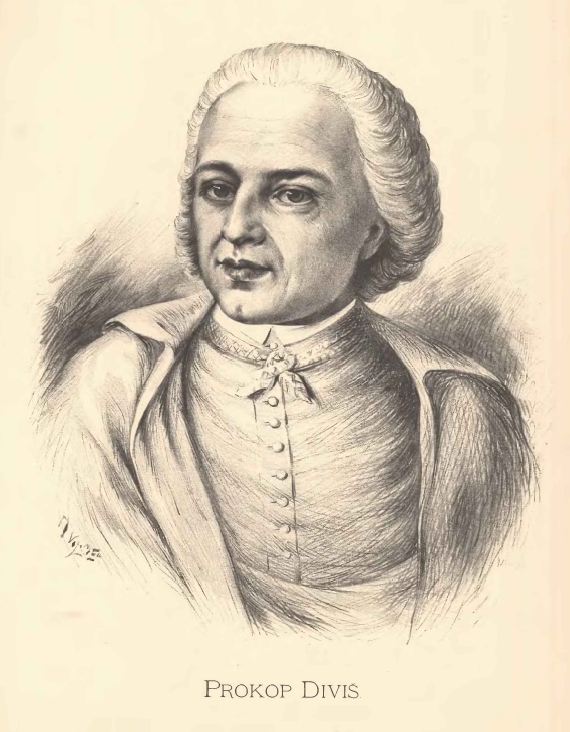
We tend to think of electronic music as a modern phenomenon, dating back only to the 20th century, but the invention of the first instrument made to use electricity occurred a couple centuries deeper than that. The man pictured above, Czech theologian and scientist Václav Prokop Diviš, “is now regarded as the earliest visionary of electronic music,” writes Motherboard’s Becky Ferreira, owing to the fact that “his dual interests in music and electricity had merged into a single obsession with creating an electrically enhanced musical instrument.” Around the year 1748, that obsession produced the “Denis d’or,” or “Golden Dionysus,” a “keyboard-based instrument outfitted with 790 iron strings that were positioned to be struck like a clavichord rather than plucked like a guitar.” Through the electromagnetic excitation of the piano strings, the monk could “imitate the sounds of a whole variety of other instruments.”
“Diviš was an interesting character, having also invented the lightning rod at the same time as, but independently of, Benjamin Franklin,” says the Cambridge Introduction to Electronic Music. He designed the Denis d’or with “an ingenious and complex system of stops” that reportedly allowed it to “imitate an astonishing array of instruments, including, it was claimed, aerophones.” The same applied to “chordophones such as harpsichords, harps and lutes, and even wind instruments.”
The term aerophone (which denotes any musical instrument that makes a body of air vibrate) might not sound familiar to many of us, but the functionality of Diviš’ invention will. Don’t we all remember the thrill of sitting down to our first synthesizer and discovering how many different instrumental sounds it could make, vague though the sonic approximation might have been?
Whether the Denis d’or counts as the founding instrument of all electronic music or a mere early curiosity, you can learn more about it at 120 Years of Electronic Music and Electrospective Music. The pre-history of electronic music (since its history proper begins around 1800) has remembered it as a practical-joke device as much as an instrument. “Diviš devised a novel method of temporarily charging the strings with electricity in order to ‘enhance’ the sound,” says the Cambridge Introduction. “What effect this had is unclear (unfortunately only one instrument was made and this did not survive), but it apparently allowed Diviš to deliver an electric shock to the performer whenever he desired.” Nobody ever said a polymath couldn’t also be a prankster.
via Motherboard
Related Content:
The History of Electronic Music in 476 Tracks (1937–2001)
Based in Seoul, Colin Marshall writes and broadcasts on cities, language, and culture. His projects include the book The Stateless City: a Walk through 21st-Century Los Angeles and the video series The City in Cinema. Follow him on Twitter at @colinmarshall or on Facebook.
Read More...Learn Anatomy Through a Pictorial History of James Bond 007
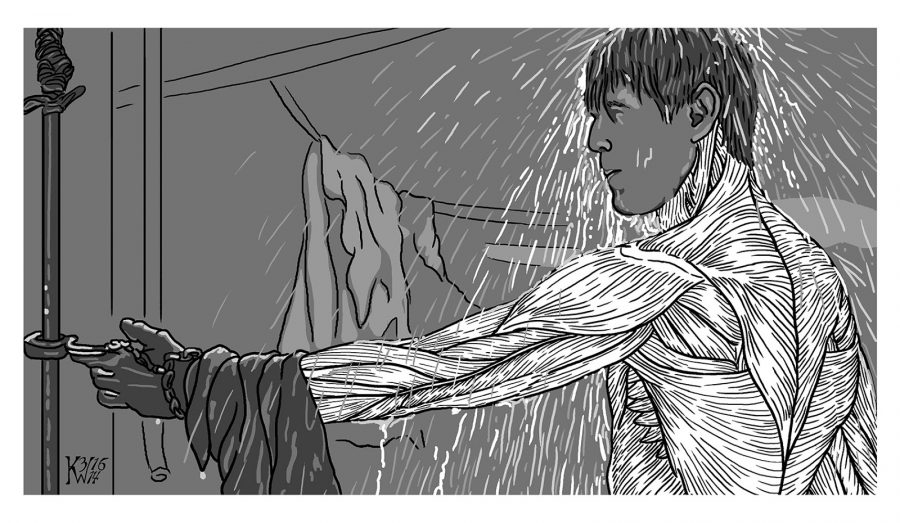
Remember the scene in Tomorrow Never Dies when sexy double agent Wai Lin handcuffs James Bond to the shower and leaves him there?
Alternately, remember “Table 9” from anatomist Bernard Siegfried Albinus’ 1749 Tabulae sceleti et musculorum corporis humani?
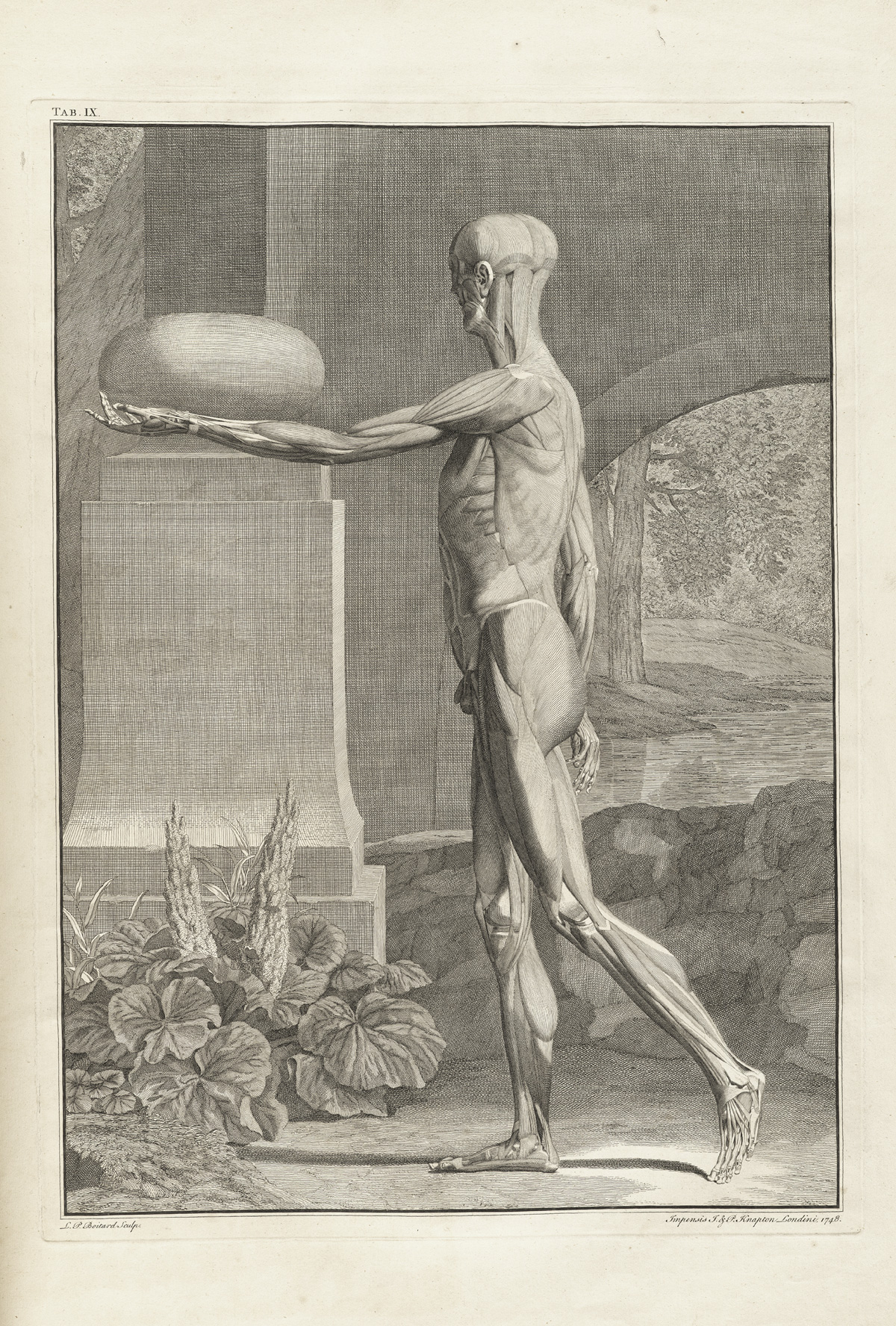
Kriota Willberg, an educator, massage therapist at Memorial Sloan Kettering Cancer Center, and author of Draw Stronger: Self-Care For Cartoonists and Other Visual Artists, is sufficiently steeped in both Bond and Albinus to identify striking visual similarities.
That shower scene is just one iconic moment that Willberg included in her mini-comic, Pictorial Anatomy of 007.
Agent Bond’s sartorial sense is a crucial aspect of his appeal, but Willberg, a Bond fan who’s seen every film in the canon at least five times, digs below that celebrated surface, peeling back skin to expose the structures that lie beneath.
Sean Connery’s Bond exhibits a veteran artist’s model’s stillness waiting for the right time to make his move against Dr. No’s “eight-legged assassin.” Even before Willberg got involved, it was an excellent showcase for his pecs, delta, and sternocleitomastoid muscles.
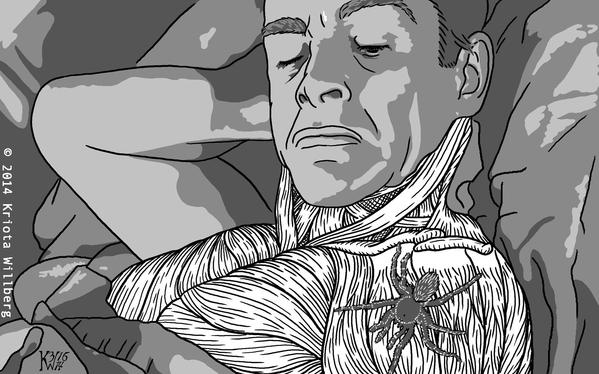
Leaving her flayed Bonds in their cinematic settings are a way of paying tribute to the antique anatomical illustrations Willberg admires for their dynamism:
…sitting in a chair, taking a stroll, holding its skin or organs out of the way so that the reader can get a better look at deeper structures. Some of the cadavers are very flirty. The pictures remind us that we are the organs we see on the page. They do stuff!
The New York Academy of Medicine selected Willberg as its first Artist in Residence, because of the way she explores the intersections between body sciences and artistic practices. (Other projects include an intricate needlepoint X‑Ray of her own root canal and Stitchin’ Time!, a fictional encounter in which Aulus Cornelius Celsus (c. 25 BCE – c. 50 CE), author of De Medicina, and surgeon Aelius Galenus (129 – c. 200 CE) team up to repair a disemboweled gladiator.
Is there a squeamish bone in this artist’s body?
All signs point to no.
Asked to pick a favorite Bond movie, she names Goldfinger for the mythology concerning the infamous scene wherein a beautiful woman is painted gold, but also 2006’s Casino Royale for keeping the torture scene from the book:
I didn’t think they’d have the balls! Sorry! Poor taste but I couldn’t resist. Although Timothy Dalton physically resembled Bond as described in the books, most of the movies make Bond out to be smarter than Fleming wrote him. I think Judy Dench called Daniel Craig, Casino Royale’s Bond, a “blunt instrument” which is pretty much how he’s written. He’s tough and lucky and that’s why he’s survived. Plus the machete fight is great.
Sometimes people get too prissy about the body. I am meat and liver and sausage and so are you. Your body is inescapable while you live. You should get to know it. Think about it in different contexts. It’s fun!
When From Russia With Love’s Rosa Klebb punches master assassin, Red Grant, in the stomach, she is squishing a living liver through living abdominal muscles.
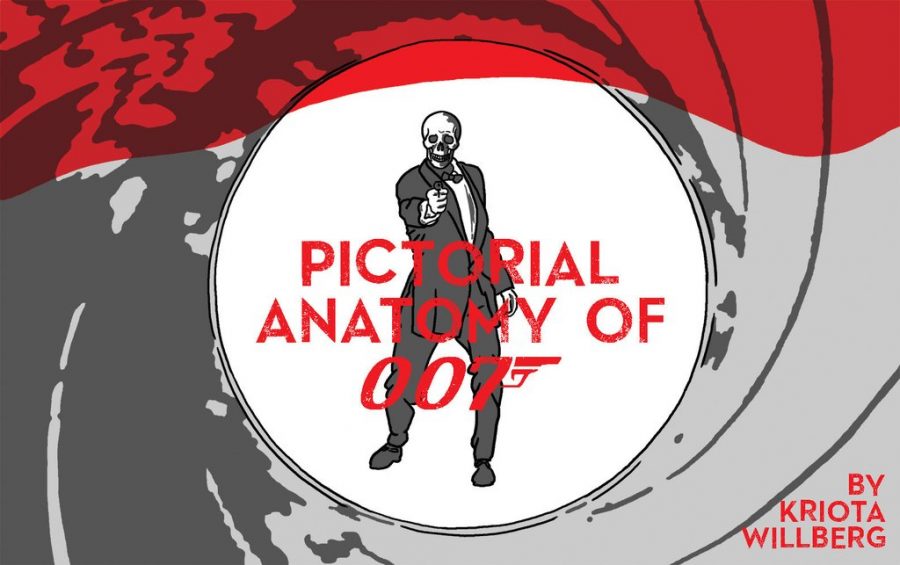
Hard copies of Kriota Willberg’s anatomy-based comics, including Pictorial Anatomy of 007, are available from Birdcage Bottom Books.
Listen to an hour-long interview with Comics Alternative in which Willberg discusses her New York Academy of Medicine residency, anatomical research, and the ways in which humor informs her approach here.
Related Content:
The Spellbinding Art of Human Anatomy: From the Renaissance to Our Modern Times
Free Online Biology Courses
Ayun Halliday is an author, illustrator, theater maker and Chief Primatologist of the East Village Inky zine. Her latest script, Fawnbook, is available in a digital edition from Indie Theater Now. Follow her @AyunHalliday.
Read More...The 10 Commandments of Chindōgu, the Japanese Art of Creating Unusually Useless Inventions
Back in the 1990s I’d often run across volumes of the Unuseless Japanese Inventions series at bookstores. Each one features about a hundred ostensibly real Japanese devices, photographed and described with a disarming straightforwardness, that mash up other consumer products in outwardly bizarre ways: chopsticks whose attached miniature electric fan cools ramen noodles en route to the mouth; a plastic zebra crossing to unroll and lay across a street at the walker’s convenience; an inverted umbrella attached to a portable tank for rainwater collection on the go. Such things, at once plausible and implausible, turn out to have their own word in the Japanese language: chindōgu (珍道具), or “curious tool.”
“There’s an essence to chindōgu that can’t be ignored,” writes Michael Richey at Tofugu, where you can view an extensive gallery of examples. “They need to be useful, but only just so. Something people could use, but probably won’t because of shame,” a famously powerful force in Japanese society.
They also adhere to a set of principles laid down by Kenji Kawakami, former editor of the country housewife-targeted magazine Mail Order Life, who first revealed chindōgu to Japan by showing off his prototypes in the back pages. These ten commandments of chindōgu are as follows:
- A Chindōgu Cannot be for Real Use — They must be, from a practical point of view, useless.
- A Chindōgu Must Exist — A Chindōgu must be something that you can actually hold, even if you aren’t going to use it.
- There must be the Spirit of Anarchy in Every Chindōgu — Chindōgu inventions represent the freedom to be (almost) useless and challenge the historical need for usefulness.
- Chindōgu Tools are for Everyday Life — Chindōgu must be useful (or useless) to everyone around the world for everyday life.
- Chindōgu are Not for Sale — Chindōgu cannot be sold, as this would go against the spirit of the art form.
- Humor is Not the Sole Reason for Creating a Chindōgu — Even if Chindōgu are inherently quirky and hilarious, the main reason they are created is for problem solving.
- Chindōgu are Not Propaganda — Chindōgu are, however, innocent and made with good intentions. They should only be created to be used (or not used).
- Chindōgu are Never Taboo — Chindōgu must adhere to society’s basic standards.
- Chindōgu Cannot be Patented — Chindōgu cannot be copyrighted or patented, and are made to be shared with the rest of the world.
- Chindōgu Are Without Prejudice — Everyone should have an equal chance to enjoy every Chindōgu.
These principles resulted in the kind of inventions that drew great fascination and amusement in their home country — you can watch a short Japanese television broadcast showing Kawakami demonstrate a few chindōgu above — but not only there. The Unuseless Japanese Inventions books came out in the West at just the right time, a historical moment that saw Japan’s image shift from that of a fearsome innovator and economic powerhouse to that of an inward-looking but often charming nation of obsessives and eccentrics. Of course such people, so Western thinking went, would come up with fashionable earrings that double as earplugs, a cup holder that slots into a jacket pocket, and shoes with toe-mounted brooms and dustpans.
Kawakami has continued to invent and exhibit chindōgu in recent years, and even now his work remains as analog as ever. “There’s always some process in analog products, and these processes themselves can be their purpose,” he told the Japan Times in a 2001 interview. “If you look at digital products, they all isolate people and leave them in their own small world, depriving them of the joy of communicating with others… I can’t deny that they make life more exciting and convenient, but they also make human relationships more shallow and superficial.” Those wise words look wiser all the time — but then, you’d expect that degree of insight into 21st-century life from the man who may well have invented the selfie stick.
via Messy Nessy
Related Content:
Discover the Japanese Museum Dedicated to Collecting Rocks That Look Like Human Faces
Based in Seoul, Colin Marshall writes and broadcasts on cities, language, and culture. His projects include the book The Stateless City: a Walk through 21st-Century Los Angeles and the video series The City in Cinema. Follow him on Twitter at @colinmarshall or on Facebook.
Read More...Wendy Carlos’ Switched on Bach Turns 50 This Month: Learn How the Classical Synth Record Introduced the World to the Moog
When the Moog synthesizer appeared in the late 60s, musicians didn’t know what it was for, so they found some very creative uses for it, including making novelty tracks like “Pop Corn,” a huge hit for Gershom Kingsley from the 1969 album Music to Moog By. But the Moog was more than a quirky new toy. It was a revelation for what synthesized sound could do, of a technology that seemed like it might have unlimited possibility if harnessed by the right hands. The Moog showed up in 1967 on albums by the Doors, the Monkees, the Byrds—psychedelic bands who understood its futuristic promise.
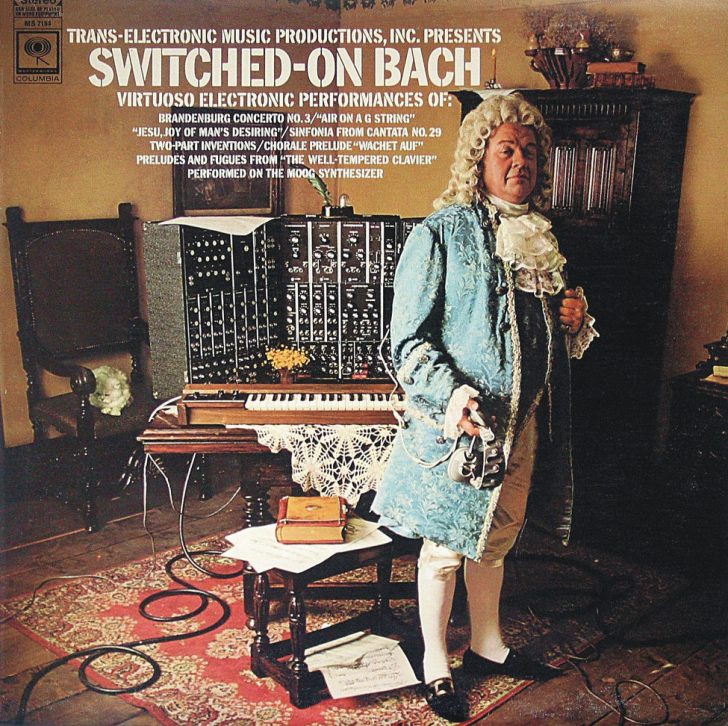
Yet it also entered the homes of millions of listeners through a classical album. In 1968, the Moog featured solo on the highest-selling classical album of all time, Switched on Bach, by electronic composer and pianist Wendy Carlos, known for her work with Stanley Kubrick on the scores of films like Clockwork Orange and The Shining. Carlos met Moog in 1964 at a conference for the Audio Engineering Society and had the chance to investigate one of his early modular synths. “It was a perfect fit,” she says, “he was a creative engineer who spoke music: I was a musician who spoke science. It felt like a meeting of simpatico minds.”
Carlos helped Moog develop his designs, he helped her find her voice, the fuzzy, buzzing, droning, humming sound of an analog synth, which somehow made a perfect fit for selections from Bach’s Well-Tempered Clavier and Two-Part Inventions. When Carlos released Switched on Bach, her first studio album, it was “an immediate success,” as Moog himself said. “We witnessed the birth of a new genre of music”—fully synthesized keyboard music, without any acoustic instruments involved whatsoever. The Moog proved itself, and Carlos impressed both pop fans and the classical community, many of whom fully embraced the phenomenon.
A recording of Switched on Bach premiered at Carnegie Hall, Leonard Bernstein presented an arrangement of Bach’s “Little” Fugue in G minor arranged for Moog, organ, and orchestra at one of his Young People’s Concerts, and no less a Bach authority than Glenn Gould praised the album, noting that it had “made electronic music mainstream” even as it introduced entire new audiences to Bach. Carlos has since preserved her mystique through intense personal privacy and strict control of her copyright. You’ll find precious little of her music on the internet: a snippet here and there, but no Switched on Bach streaming online.
It is well worth paying for the pleasure (I’d recommend doing so by tracking down an original vinyl pressing.) Carlos released a follow-up the next year, The Well-Tempered Synthesizer, then another interpretation of Switched on Bach for the album’s 25th anniversary. This year it turns 50. You can celebrate not only by listening to the original, but checking out its equally majestic follow-up albums, the Special Edition Box Set, and a recent “spiritual successor” to Carlos’ original, Craig Leon’s 2015 Bach to Moog, a re-interpretation of Bach using the very same synthesizer Carlos did those many years ago. Almost.
The System 55, the collection of large, clunky banks of patch bays, oscillators, filters, envelopes, etc. that Carlos used, was reissued three years ago. In the short documentary above, you can see producer and composer Leon talk about Carlos’ contributions to modern, and classical, music and his own hybrid use of the early synthesizer with midi and a string section. He demonstrates how radically the distinctive Moog sound can be shaped by its wonky dials and switches, but also how it can subtly color the sound of other instruments without imposing itself. Such a revolutionary instrument required a truly revolutionary album to announce it to the world.
Related Content:
Hear Seven Hours of Women Making Electronic Music (1938- 2014)
The History of Electronic Music in 476 Tracks (1937–2001)
Josh Jones is a writer and musician based in Durham, NC. Follow him at @jdmagness
Read More...How the Ancient Mayans Used Chocolate as Money
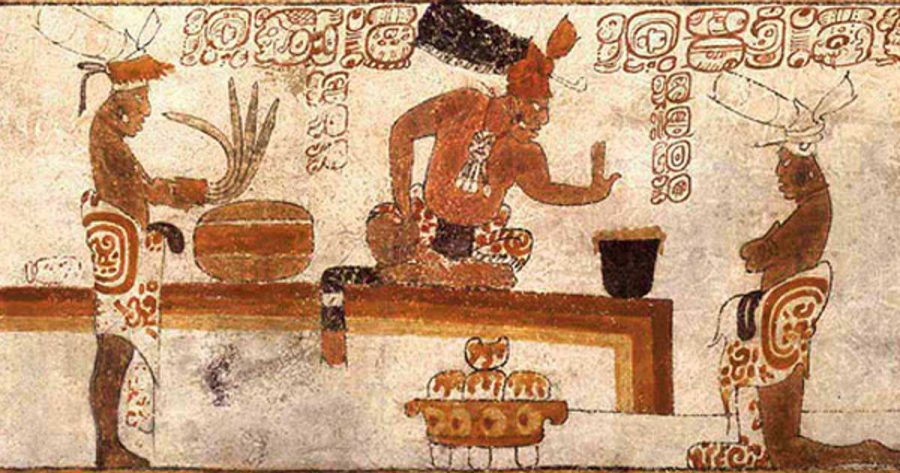
We’ve had hundreds and hundreds of years to get used to money in the form of coins and bills, though exactly how long we’ve used them varies quite a bit from region to region. Of course, some spots on the globe have yet to adopt them at all, as anyone who’s heard the much-told story of the Yap islanders and their huge limestone discs knows. But the history of money is, in essence, the history of bartering — trading something you have for something you want — becoming more and more abstract; now, with digital crypto-currencies like Bitcoin, it looks like money will ascend one level of abstraction higher. But to imagine what a truly non-abstract currency looks like, just look at the ancient Mayan civilization, the members of which paid their debts with chocolate.
“The ancient Maya never used coins as money,” writes Science’s Joshua Rapp Learn. “Instead, like many early civilizations, they were thought to mostly barter, trading items such as tobacco, maize, and clothing.” Thanks to the work of archaeologist Joanne Baron, a scholar of murals, ceramic paintings, carvings and other objects depicting life in the Classic Maya period which ran from around 250 BC to 900 AD, we’ve now begun to learn how chocolate took on a major, money-like role in the Maya’s economy.
Some images depict cups of chocolate itself, which the Mayans usually enjoyed in the form of a hot drink, being accepted as payment, and others show chocolate traded in the coin-like form of “fermented and dried cacao beans.” In many scenes, Maya leaders receive their tributes (or taxes) most often in the form of “pieces of woven cloth and bags labeled with the quantity of dried cacao beans they contain.”
Cacao beans eventually became such a valuable currency “that it was evidently worth the trouble to counterfeit them,” writes Smithsonian’s Josie Garthwaite in an article about the early history of chocolate (a subject about which you can learn more in the TED-ed video above). “At multiple archaeological sites in Mexico and Guatemala,” she quotes anthropologist Joel Palka as saying, “researchers have come across remarkably well-preserved ‘cacao beans’ ” that turn out to be made of clay. “Some scholars believe drought led to the downfall of the Classic Maya civilization,” Learn notes, and according to Baron, “the disruption of the cacao supply which fueled political power may have led to an economic breakdown in some cases.” That may sound strangely familiar to those of us who — even here in the 21st century, among the many who have gone nearly cashless and may soon not even need a credit card — have breakdowns of our own when we can’t get our chocolate.
Related Content:
The Marvelous Health Benefits of Chocolate: A Curious Medical Essay from 1631
Making Chocolate the Traditional Way, From Bean to Bar: A Short French Film
Modern Artists Show How the Ancient Greeks & Romans Made Coins, Vases & Artisanal Glass
Bitcoin, the New Decentralized Digital Currency, Demystified in a Three Minute Video
Based in Seoul, Colin Marshall writes and broadcasts on cities, language, and culture. His projects include the book The Stateless City: a Walk through 21st-Century Los Angeles and the video series The City in Cinema. Follow him on Twitter at @colinmarshall or on Facebook.
Read More...Support Us
We're hoping to rely on loyal readers, rather than erratic ads. Please click the Donate button and support Open Culture. You can use Paypal, Venmo, Patreon, even Crypto! We thank you!

About Us

Open Culture scours the web for the best educational media. We find the free courses and audio books you need, the language lessons & educational videos you want, and plenty of enlightenment in between.
Advertise With Us
FREE UPDATES!
GET OUR DAILY EMAIL
Get the best cultural and educational resources on the web curated for you in a daily email. We never spam. Unsubscribe at any time.
FOLLOW ON SOCIAL MEDIA
Open Culture editor Dan Colman scours the web for the best educational media. He finds the free courses and audio books you need, the language lessons & movies you want, and plenty of enlightenment in between.
Advertise With Us