19th Century Atlas Creatively Visualizes the Expansion of Geographical Knowledge Over 4000 Years of World History: From the Biblical Flood to the Industrial Revolution
The age of the “universal history” has come and gone. The genre flourished in times when it seemed possible to assume a vantage point outside of time—to see purpose and pattern in thousands of years of human action. “It might be possible,” wrote Immanuel Kant, “to have a history with a definite natural plan for creatures who have no plan of their own.” The view assumed by such a history tends to exclude the circumscribed perspective of the viewer, or—in Ralph Waldo Emerson’s famous, and oft-parodied, phrasing, “all mean egotism vanishes. I become a transparent eyeball; I am nothing; I see all; the currents of the Universal Being circulate through me; I am part and parcel of God.”
Few historians today assume such a gods-eye-view, for better or worse, but without it, we would never have seen the development of its visual analogue: the timeline map, an infographic form especially popular in the 18th to the early 20th centuries, when thinkers from Schiller to Herder to Kant to Hegel to Marx to Weber produced universal accounts of human history that, to varying degrees, purported to account for vast historical developments as the movement of impersonal forces toward some definite goal.
From the perspective of the timeline map, civilizations grow naturally from each other like branches from a tree, or flow one into another like a river’s tributaries, or produce, as in John B. Sparks “Histomap,” colorful puzzles in which every piece has its neatly-assigned place….
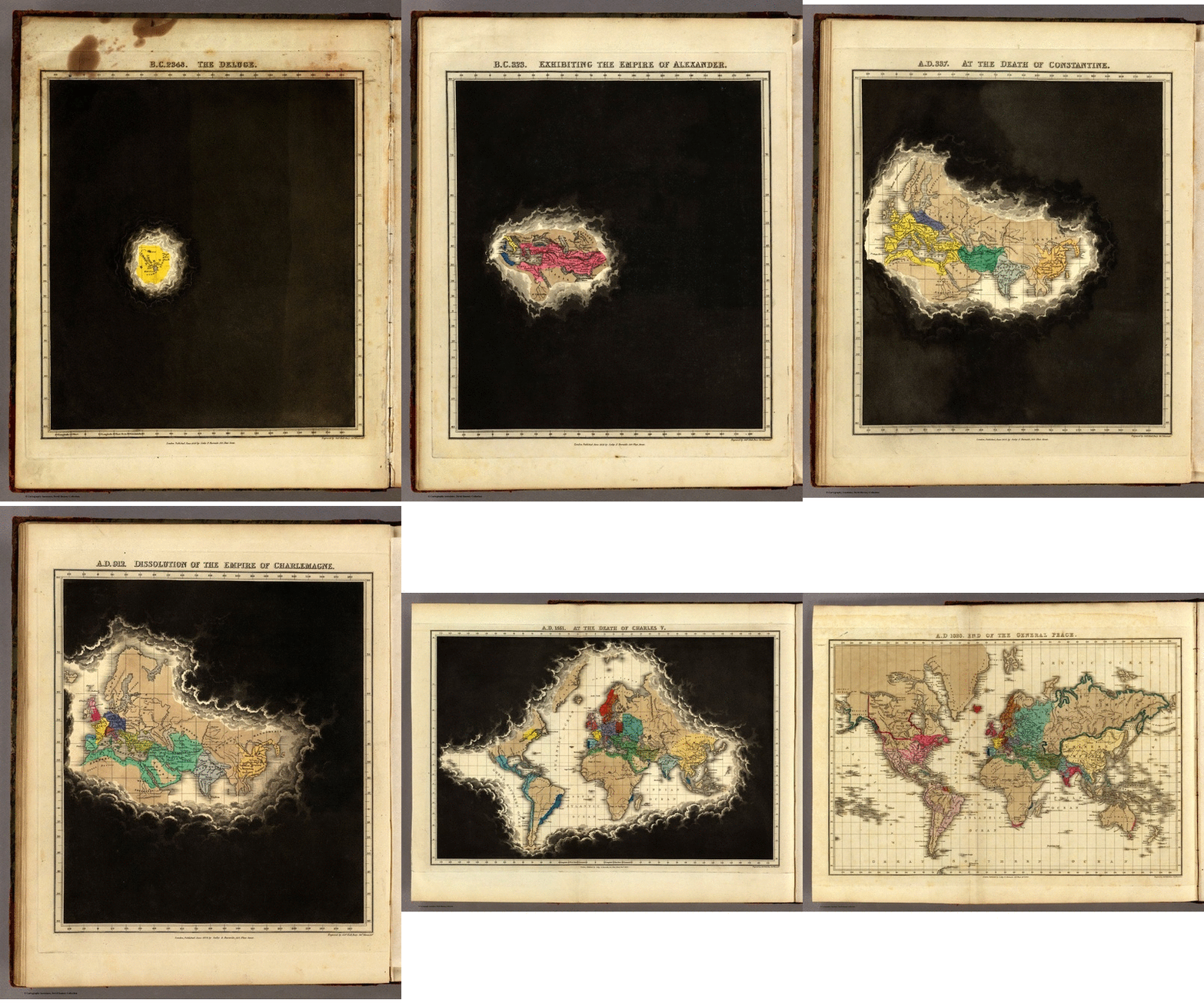
We’ve featured several such maps here, like the Histomap and Eugene Pick’s 1858 Tableau De L’Histoire Universelle, both from the extensive map collection of David Rumsey. In the version you see here, we have a very unusual variation on the theme—rather than a historical timeline map, Edward Quin produced in 1830 An Historical Atlas; In a Series of Maps of the World as Known at Different Periods.
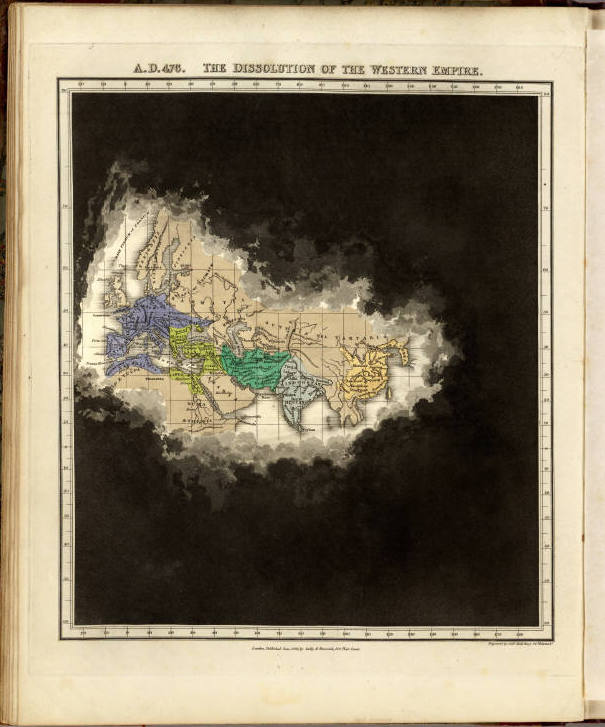
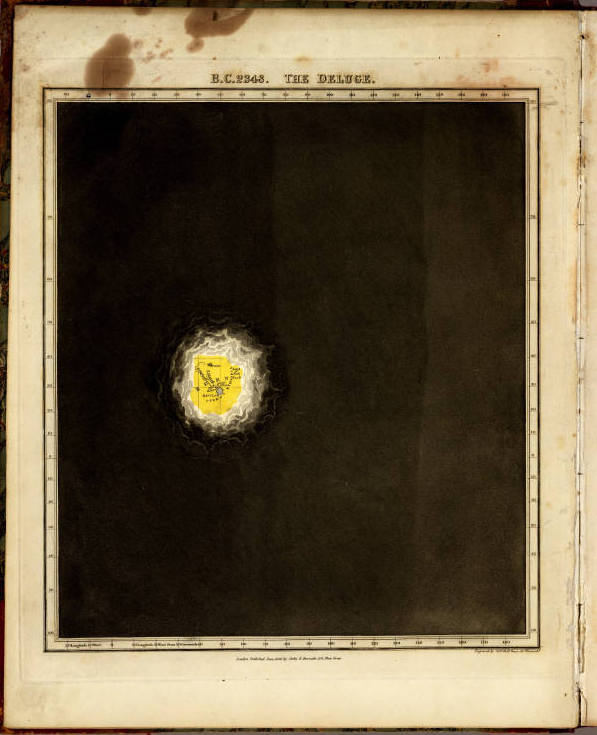
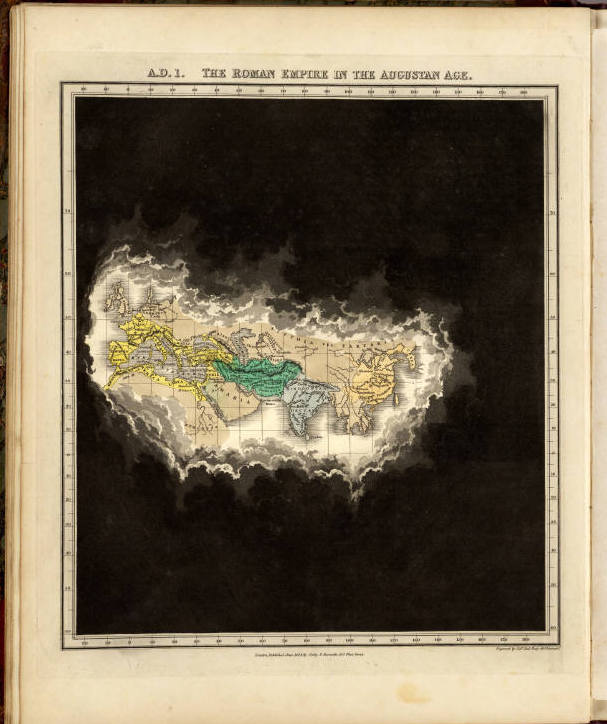
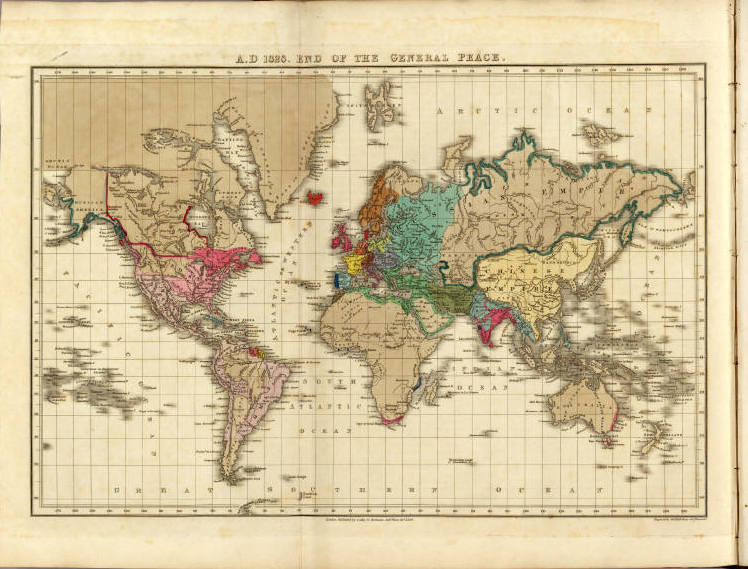
The question, “as known by whom?” seems entirely relevant. The perspective of Quin’s atlas is godlike, gazing down at the world through the clouds, but unlike Emerson’s transparent view, it does not “see all”—those clouds occlude the vision, restricting it to indicate, as the Rumsey collection notes, “the expansion of geographical knowledge over time.” You’ll have to read Quin’s text—available here—to understand how he accounts for the chronology and perspective.
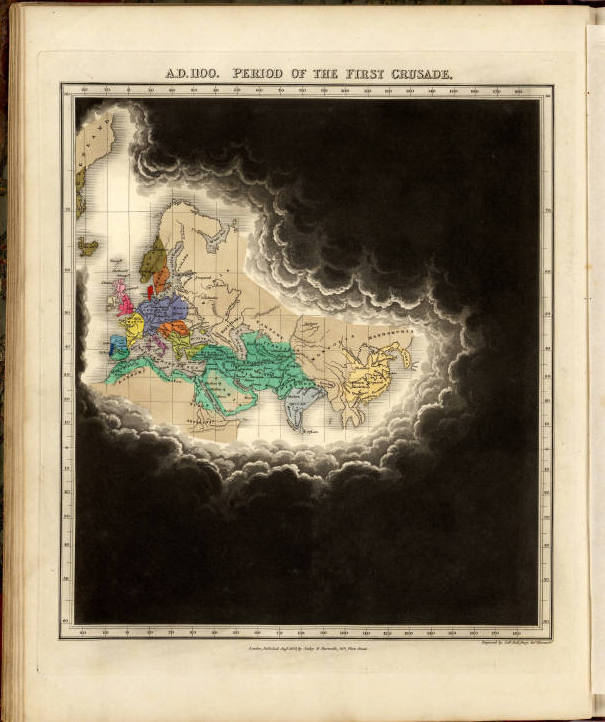
The atlas begins in 2348 B.C. with “the Deluge,” the mythical Biblical flood. Biblical history inexplicably gives way to the secular. In a description of the atlas by Donald A. Head rare books, this strange document “intended to cartographically depict political change from the time of creation to the year 1828,” when it reveals “the enlightened world in the midst of the Industrial Revolution…. Divided into twenty-one periods… the clouds fully disappear at the nineteenth period: ‘A.D. 1783 at the separation of the United States of America, from England.” In his preface, Quin explains his project in the typical terms of universal history, as illustrating “by the changes of colour the empires which succeed each other.”
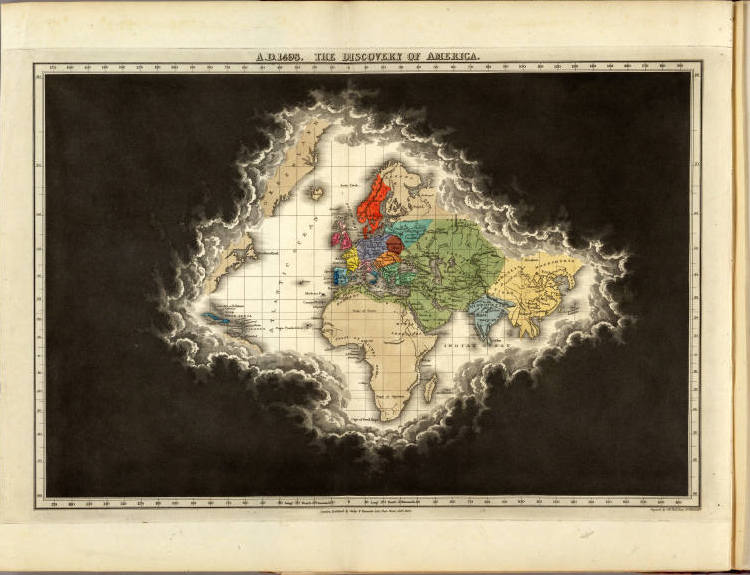
Quin’s description of the unchanging perspective he adopts might remind some modern readers of certain comic book characters as much as of the vision of a god or a transparent, detached eye: “Like the watchman on some beacon-tower, he views the hills and peopled valleys around him, always the same in situation and in form, but every changing aspect of the hours and seasons….” View Quin’s complete Historical Atlas, scanned in high resolution detail, at the David Rumsey Map Collection.
On our page here, see individual pages from the Historical Atlas. Or, up top, see an animated gif that lets you view all 21 maps in the atlas in chronological order.
Related Content:
4000 Years of History Displayed in a 5‑Foot-Long “Histomap” (Early Infographic) From 1931
Groundbreaking Map from 1858 Colorfully Visualizes 6,000 Years of World History
10 Million Years of Evolution Visualized in an Elegant, 5‑Foot Long Infographic from 1931
Josh Jones is a writer and musician based in Durham, NC. Follow him at @jdmagness
Read More...Hear a 12-Hour Playlist of Experimental Symphonic Noise Rock by Avant-Garde Guitarist and Composer Glenn Branca (RIP)
Glenn Branca died on Monday at age 69. In tributes from august publications like The Guardian and The New York Times, the guitarist and composer’s name is mentioned by and alongside minimalist luminaries like Steve Reich and John Cage. Branca himself cited composers like Olivier Messiaen and György Ligeti as influences. He belongs in the company of these avant-garde pioneers, but many who might recognize their names may not have heard the name Glenn Branca.
Branca worked in a much more anarchic milieu, namely the downtown New York noise rock scene that came to be called No Wave. “My real influence was punk,” he told Pitchfork in 2016. “I must have listened to the first Patti Smith album 300 times.” In turn, the composer influenced the next generation of underground New York artists, nurturing the talents of Sonic Youth’s Thurston Moore and Lee Ranaldo, who honed their art-rock chops—the drone notes, odd tunings, etc.—in the early ‘80s while playing in one of Branca’s notoriously noisy guitar ensembles.
Branca released Sonic Youth’s first two albums on his record label, tutored abrasive noise pioneers Swans’ guitarist Norman Westberg, and inspired essential downtown figures like Lounge Lizards’ John Lurie, who described seeing the composer’s band Theoretical Girls in 1979 as a life-changing event. Minimalist post-rock masterminds like Godspeed You! Black Emperor owe much to Branca’s innovations. Given that he occupied such a seminal place at such a key musical moment, giving birth to such seminal bands, why isn’t Branca’s work better known?
Perhaps this is because, while he drew from classical avant-garde, jazz, and punk rock, he refused to settle comfortably into any particular camp or to clearly define the boundaries of his work. Branca created a template all his own. Reich described him as “an absolute original,” which made him a very inspirational figure, but a difficult one to slot into a genre bin.
His treatment of rock instruments in orchestral settings made for intense, and for some unlistenable, music that thoroughly defied the conventions of rock and orchestral music, with ensembles of up to 100 electric guitars playing at once. (John Cage objected to Branca’s overwhelming performances on “political” grounds, saying they “resembled fascism.”)
But while Branca’s music has never had mass appeal, the few who love it, love it passionately. Of his classic 1981 album The Ascension (hear the title track at the top), Allmusic’s Brian Olewnick writes, “if one chooses to categorize the music on this recording as ‘rock,’ this is surely one of the greatest rock albums ever made.” One hears in The Ascension and Branca’s work in general the genesis of a muscular, noisy, orchestral post-rock sound now familiar in, say, the soundtrack work of artists like Radiohead’s Jonny Greenwood.
Despite his contention, as he told the NYT, that “I don’t change,” his work has evolved over time, developing new depths and complexity. In the Spotify playlist further up, hear Branca’s development as a composer in 66 tracks (or 12 hours) of symphonic experimental noise rock, and in the interview just above with the Louisiana Channel, see Branca describe (and demonstrate) his unusual guitar techniques and his breadth of musical influences.
Related Content:
The Music of Avant-Garde Composer John Cage Now Available in a Free Online Archive
Josh Jones is a writer and musician based in Durham, NC. Follow him at @jdmagness
Read More...Erich Fromm’s Six Rules of Listening: Learn the Keys to Understanding Other People from the Famed Psychologist
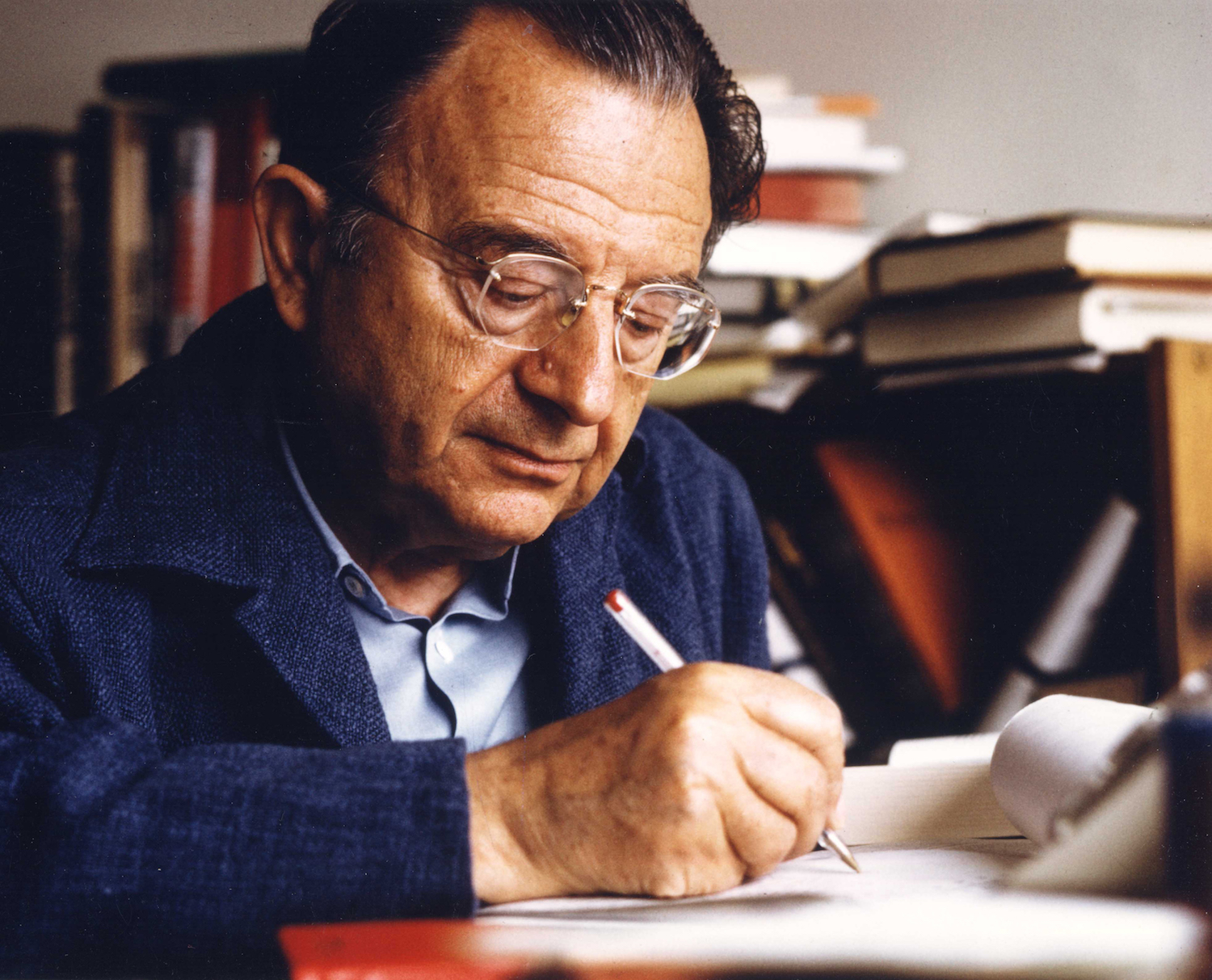
Photo by Müller-May/Rainer Funk, via Wikimedia Commons
The social psychologist and philosopher Erich Fromm lived through just about the first 80 years of the 20th century, beginning in Germany, ending in Switzerland, and spending periods in between in places like New York, Mexico City, and Lansing, Michigan. But his intellectual experience exceeded even his clearly formidable historical and cultural experience: he engaged in not just psychoanalytic theory and practice but theological scholarship, political critique, and what he called a kind of “mysticism.”
To the wider public, which first got to know him through his 1956 bestseller The Art of Loving: An Enquiry into the Nature of Love, Fromm — who had already experienced so much of humanity — was an authority on human relationships. Before one can love, one must, in a broad sense, be able to listen, and he treats that subject at length in The Art of Listening, a posthumously published book adapted from a 1974 seminar in Switzerland.
Speaking in terms of psychoanalysis, Fromm objects to framing listening as a “technique,” since that word applies “to the mechanical, to that which is not alive, while the proper word for dealing with that which is alive is ‘art.’ ” And so if “psychoanalysis is a process of understanding man’s mind, particularly that part which is conscious… it is an art like the understanding of poetry.” He then provides six basic rules for this art as follows:
- The basic rule for practicing this art is the complete concentration of the listener.
- Nothing of importance must be on his mind, he must be optimally free from anxiety as well as from greed.
- He must possess a freely-working imagination which is sufficiently concrete to be expressed in words.
- He must be endowed with a capacity for empathy with another person and strong enough to feel the experience of the other as if it were his own.
-
The condition for such empathy is a crucial facet of the capacity for love. To understand another means to love him — not in the erotic sense but in the sense of reaching out to him and of overcoming the fear of losing oneself.
-
Understanding and loving are inseparable. If they are separate, it is a cerebral process and the door to essential understanding remains closed.
Fromm’s rules apply not just outside his profession but independently of era or culture: wherever you are or whenever it happens to be, you can always practice freeing your mind so as to concentrate as completely as possible on the person talking to you, honing your imagination so as to vividly experience in your mind what they have to verbally communicate. Of course, to love, in Fromm’s sense, remains a particular challenge in this process, and for humans may well stand as the challenge of existence. But whether or not you credit psychoanalysis itself, the fact remains that we all must, to the greatest extent possible, understand one another’s minds as our own; the very survival of humanity has always depended on it.
via Brain Pickings
Related Content:
The Power of Empathy: A Quick Animated Lesson That Can Make You a Better Person
We Are Wired to Be Kind: How Evolution Gave Us Empathy, Compassion & Gratitude
How to Listen to Music: A Free Course from Yale University
Learn 48 Languages Online for Free: Spanish, Chinese, English & More
Based in Seoul, Colin Marshall writes and broadcasts on cities and culture. His projects include the book The Stateless City: a Walk through 21st-Century Los Angeles and the video series The City in Cinema. Follow him on Twitter at @colinmarshall or on Facebook.
Read More...How the Mysteries of the Vatican Secret Archives Are Being Revealed by Artificial Intelligence

Somewhere within the Vatican exists the Vatican Secret Archives, whose 53 miles of shelving contains more than 600 collections of account books, official acts, papal correspondence, and other historical documents. Though its holdings date back to the eighth century, it has in the past few weeks come to worldwide attention. This has brought about all manner of jokes about the plot of Dan Brown’s next novel, but also important news about the technology of manuscript digitization. It seems a project to get the contents of the Vatican Secret Archives digitized and online has made great progress cracking a problem that once seemed impossibly difficult: turning handwriting into computer-searchable text.
In Codice Ratio is “developing a full-fledged system to automatically transcribe the contents of the manuscripts” that uses not the standard method of optical character recognition (OCR), which looks for the spaces between words, but a new way that can handle connected cursive and calligraphic letters. Their method, in the lingo of the field, “is to govern imprecise character segmentation by considering that correct segments are those that give rise to a sequence of characters that more likely compose a Latin word. We have designed a principled solution that relies on convolutional neural networks and statistical language models.”
This is a job, in other words, for artificial intelligence, but in partnership with human intelligence, a seldom-tapped source of which the scientists behind In Codice Ratio have harnessed: that of high-school students. Their special OCR software, writes the Atlantic’s Sam Kean, works by “dividing each word into a series of vertical and horizontal bands and looking for local minimums—the thinner portions, where there’s less ink (or really, fewer pixels). The software then carves the letters at these joints.” But the software “needs to know which groups of chunks represent real letters and which are bogus,” and so “the team recruited students at 24 schools in Italy to build the projects’ memory banks,” manually separating the letters the system had properly recognized from those over which it had stumbled.
And so the students became the system’s “teachers,” improving its ability to extract the content of handwriting, and not just handwriting but vast quantities of archaic handwriting, with every click they made. The encouraging results thus far mean that it probably won’t be long before large portions of the Vatican Secret Archives (which, contrary to its awkwardly translated name, is such a non-secret it even has its own official web site) will finally become easy to browse, search, copy, paste, and analyze. So they may, in the fullness of time, prove a fruitful resource indeed to writers of Catholicism-centric thrillers like Brown — who, after all, has already gone public with his enthusiasm for manuscript digitization.
Related Content:
Based in Seoul, Colin Marshall writes and broadcasts on cities and culture. His projects include the book The Stateless City: a Walk through 21st-Century Los Angeles and the video series The City in Cinema. Follow him on Twitter at @colinmarshall or on Facebook.
Read More...A New Scientific Study Supports Putting Two Spaces After a Period … and a Punctuation War Ensues
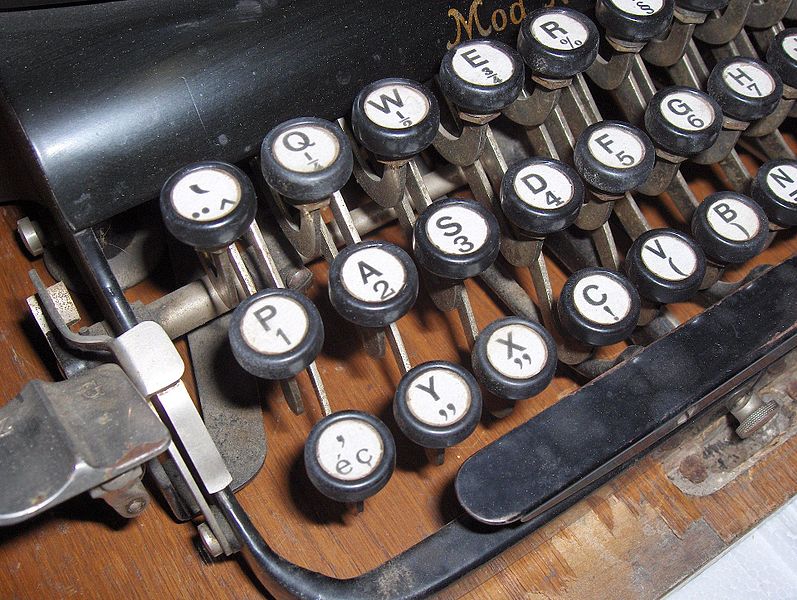
Photo via Wikimedia Commons
In former ages, wars erupted over the finer points of religious doctrine, a historical phenomenon that can seem perplexing to modern secularists. We’re past such things, we think. But then let someone bring up the Oxford comma or the number of spaces one should put after a period, and you may see writers, editors, and teachers pick sides and maybe come to blows in their defense of seemingly trivial grammatical and typographical standards. These debates approach the vehemence of Medieval arguments over transubstantiation.
I exaggerate, but maybe only slightly. There have been times, I confess, when I’ve felt I would fight for the serial comma. I grind my teeth and feel a rush of rage when I see two spaces instead of one after the end of sentences. Irrational, perhaps, but such is the human devotion to orthodoxy in the details. And so, when Skidmore College researchers Rebecca Johnson, Becky Bui, and Lindsay Schmitt published a paper last month in Attention, Perception, & Psychophysics claiming scientific support for a two-space period, they virtually lobbed a bomb into offices everywhere.
Angela Chen at The Verge parried with an article calling two spaces a “horrible habit.” The practice “remains bad,” she writes, “it’s ugly, it doesn’t help when it comes to what matters most (reading comprehension), and the experiment that supports its benefits uses an outdated font style.” (Don’t get me started on the font wars.) What was the experiment? The paper itself hides behind a redoubtable paywall, but Ars Technica’s Sean Gallagher gets to the gist of the study on a cohort of 60 Skidmore students.
Having identified subjects’ proclivities, the researchers then gave them 21 paragraphs to read (including one practice paragraph) on a computer screen and tracked their eye movement as they read using an Eyelink 1000 video-based eye tracking system. “Chin and forehead rests were used to minimize the reader’s head movements,” the Skidmore researchers wrote in their paper.
After the tracking, the researchers “evaluated the reading speed for each of the paragraph types presented in words per minute.… [they] found that two spaces at the end of a period slightly improved the processing of text during reading.” The study’s attempt to quantify the benefits of two spaces came after the American Psychological Association Manual’s most recent edition, which, for some reason, has changed camps to two spaces.
Gallagher explains the space debate as stemming from the major technological shift in word processing: “For anyone who learned their keyboarding skills on a typewriter rather than a computer… the double-space after the period is a deeply ingrained truth.” Speaking as such a person, it isn’t, but he’s right to note that typing teachers insisted on two spaces. Such was the standard until computers with variable-width fonts fully phased out typewriters.
So the Skidmore researchers raised the ire of Chen and others with their use of Courier New, a “fixed-width font that resembles typewritten text—used by hardly anyone for documents.” The blog Practical Typography analyzed the two space paper and remains unimpressed: “In sum—a small difference, limited to a certain category of test subjects, with numerous caveats attached. Not much to see here, I’m afraid.” (This description might accurately describe thousands of published studies.)
This war will rage on—the study fueling these recent skirmishes does not seem to justify two-spacers claiming victory. And anyway, good luck getting the rest of us to abandon faith in the one true space.
via The Verge
Related Content:
Cormac McCarthy’s Three Punctuation Rules, and How They All Go Back to James Joyce
Theodor Adorno’s Philosophy of Punctuation
Josh Jones is a writer and musician based in Durham, NC. Follow him at @jdmagness
Read More...Cornell Creates a Database of Fugitive Slave Ads, Telling the Story of Those Who Resisted Slavery in 18th & 19th Century America
While the value of slaves in the U.S. from the colonial period to the Civil War rose and fell like other market goods, for the most part, enslaved people constituted the most valuable kind of property, typically worth even more than land and other highly valued resources. In one study, three University of Kansas historians estimate that during most of the 18th century in South Carolina, slaves “made up close to half of the personal wealth recorded in probate inventory in most decades.” By the 19th century, slaveholders had begun taking out insurance policies on their slaves as Rachel L. Swarns documents at The New York Times.
“Alive,” Swarns writes, “slaves were among a white man’s most prized assets. Dead, they were considered virtually worthless…. By 1847, insurance policies on slaves accounted for a third of the policies in a firm”—New York Life—“that would become one of the nation’s Fortune 100 companies.” Given the huge economic incentives for perpetuating the system of chattel slavery, the fact that people did not want to be held in forced labor for life—and to condemn their children and grandchildren to the same—presented slaveholders with a serious problem.
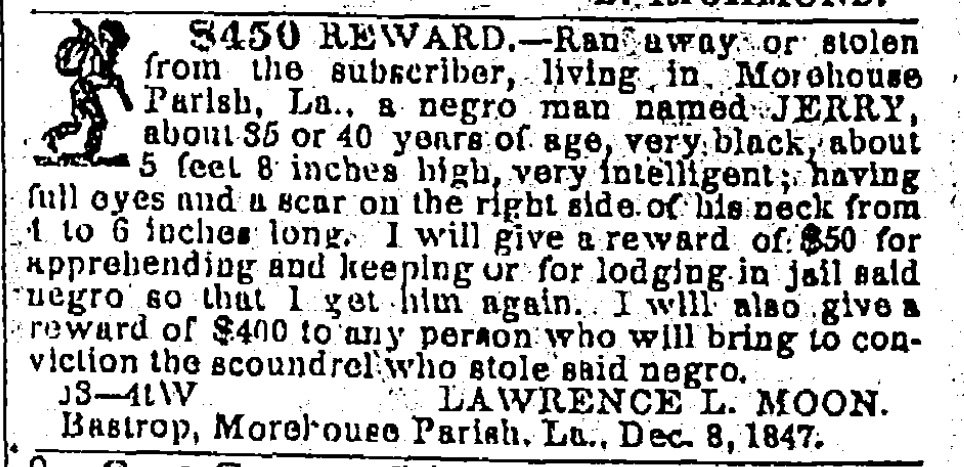
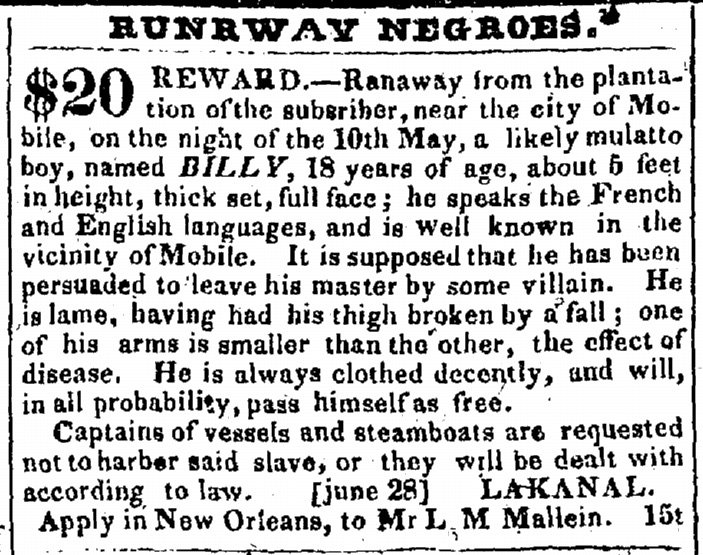
For over 250 years, countless numbers of enslaved people attempted to escape to freedom. And thousands of slaveowners ran newspaper ads to try and recover their investments. These ads are likely familiar from textbooks and historical articles on slavery; they have long been used singly to illustrate a point, “but they have never been systematically collected,” notes Cornell University’s Freedom on the Move project, which intends to “compile all North American slave runaway ads and make them available for statistical, geographical, textual, and other forms of analysis.” While the database is still in progress, examples of the ads are being shared on the @fotmproject Twitter account.
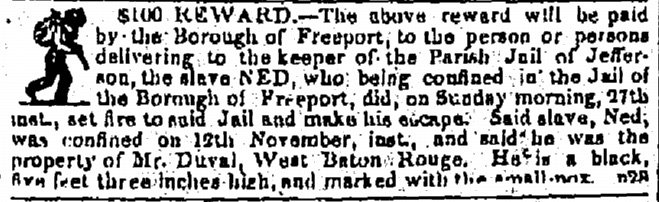
The ongoing project presents a tremendous opportunity for historical scholars of the period. “If we could collect and collate all of these ads,” the project’s researchers write, “we would create what might be the single richest source of data possible for understanding the lives of the approximately eight million people who were enslaved in the U.S.” It is estimated that 100,000 or more such ads survive “from the colonial and pre-Civil War U.S.,” though they might represent a fraction of those published, and of the number of attempted, and successful, escapes.
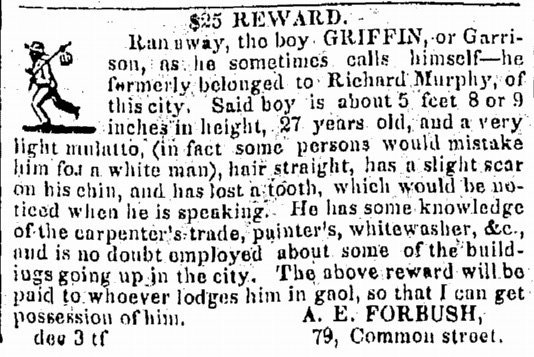
Many of the ads casually reveal evidence of brutal treatment, listing scars and brands, missing fingers, speech impediments, and halting walks. They show many of the escaped slaves to have been skilled in several trades and speak multiple languages. A large number of the escapees are children. As University of New Orleans historian Mary Niall Mitchell tells Hyperallergic, “ironically, in trying to retrieve their property—the people they claimed as things—enslavers left us mounds of evidence about the humanity of the people they bought and sold.” (Mitchell is one of the projects three lead researchers, along with University of Alabama’s Joshua Rothman and Cornell’s Edward Baptist, author of The Half Has Never Been Told.)
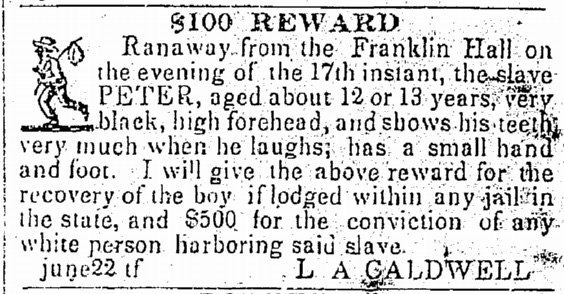
The slaveholders who ran ads also left evidence of what they made themselves believe in order to hold people as property. One ad describes a runaway slave named Billy as having been “persuaded to leave his master by some villain,” as though Billy must surely have been contented with his lot. In the overwhelming majority of cases, we will never know with certainty what most people thought about being enslaved. Yet the fact that hundreds of thousands attempted to escape at great personal risk, often without any help—to such a degree that extreme, inflammatory measures like the Fugitive Slave Act were eventually deemed necessary—should offer sufficient testament, if the relatively few written narratives aren’t enough. “For some” of the people in the ads, says Mitchell, “this may be the only place something about them survives, in any detail, in the written record,”
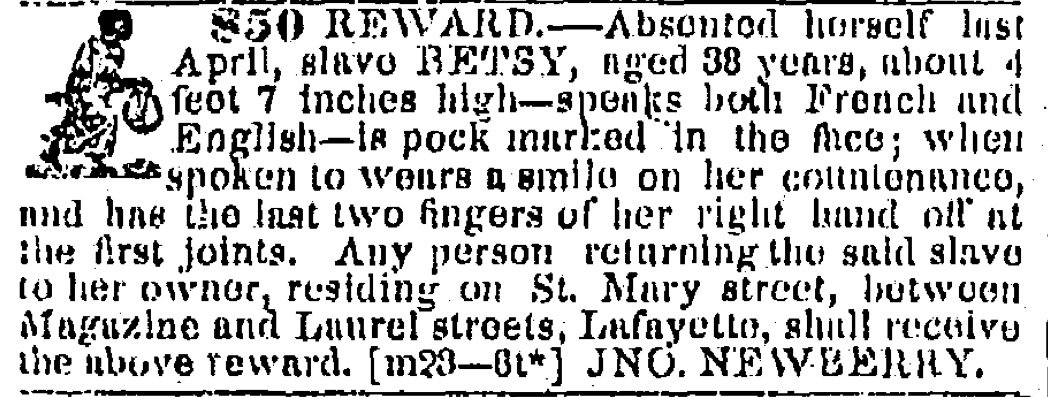
Freedom on the Move, writes Hyperallergic’s Allison Meier, “expands on the history of resistance against slavery in the 18th and 19th centuries.” It offers a compelling picture of two intolerably irresolvable views—those of slaveholders who viewed enslaved people as proprietary investments; and those of the enslaved who refused to be reduced to objects for others’ pleasure and profit.
Visit Freedom on the Move and find out more.
Related Content:
Josh Jones is a writer and musician based in Durham, NC. Follow him at @jdmagness
Read More...Eminent Philosophers Name the 43 Most Important Philosophy Books Written Between 1950–2000: Wittgenstein, Foucault, Rawls & More
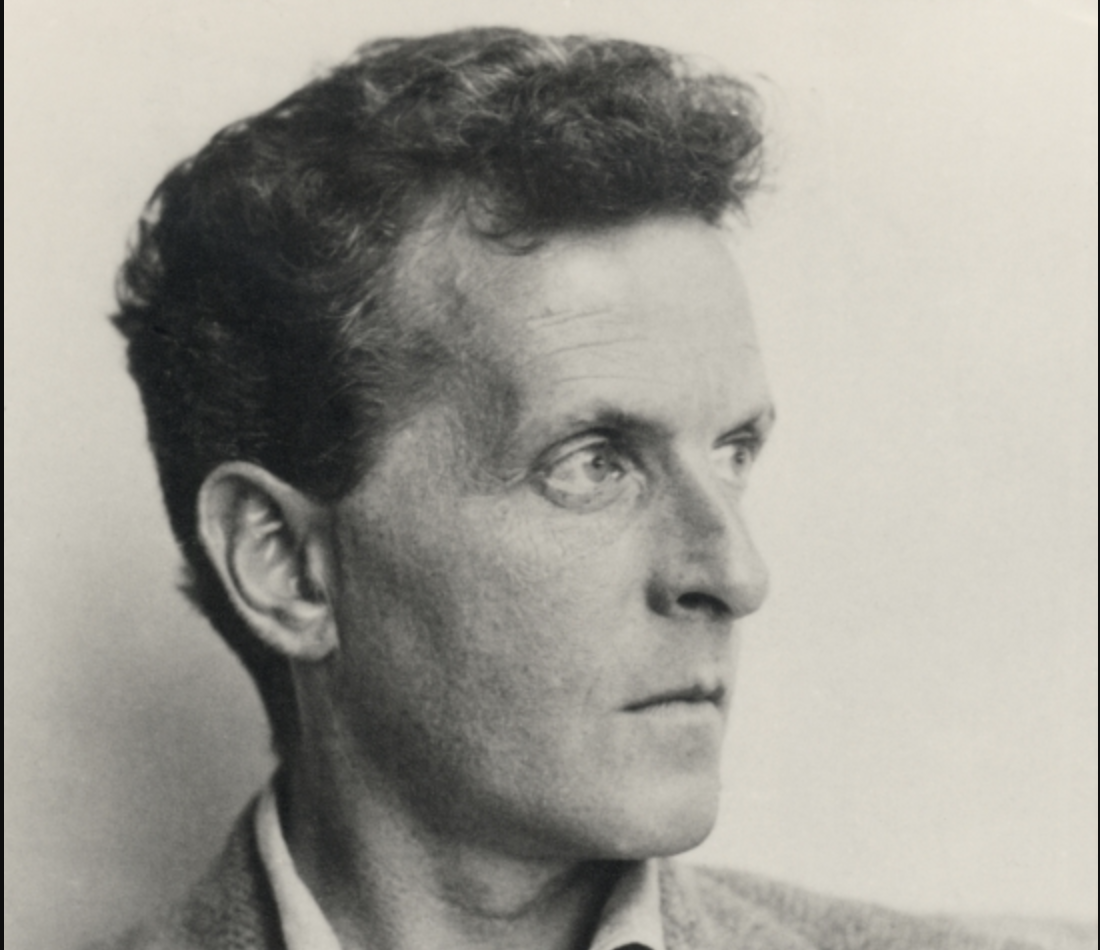
Image by Austrian National Library, via Wikimedia Commons
Faced with the question, “who are the most important philosophers of the 20th century?,” I might find myself compelled to ask in turn, “in respect to what?” Ethics? Political philosophy? Philosophy of language, mind, science, religion, race, gender, sexuality? Phenomenology, Feminism, Critical theory? The domains of philosophy have so multiplied (and some might say siloed), that a number of prominent authors, including eminent philosophy professor Robert Solomon, have written vehement critiques against its entrenchment in academia, with all of the attendant pressures and rewards. Should every philosopher of the past have had to run the gauntlet of doctoral study, teaching, tenure, academic politics and continuous publication, we might never have heard from some of history’s most luminous and original thinkers.
Solomon maintains that “nothing has been more harmful to philosophy than its ‘professionalization,’ which on the one hand has increased the abilities and techniques of its practitioners immensely, but on the other has rendered it an increasingly impersonal and technical discipline, cut off from and forbidding to everyone else.” He championed “the passionate life” (say, of Nietzsche or Camus), over “the dispassionate life of pure reason…. Let me be outrageous and insist that philosophy matters. It is not a self-contained system of problems and puzzles, a self-generating profession of conjectures and refutations.” I am sympathetic to his arguments even as I might object to his wholesale rejection of all academic thought as “sophisticated irrelevancy.” (Solomon himself enjoyed a long career at UCLA and the University of Texas, Austin.)
But if forced to choose the most important philosophers of the late 20th century, I might gravitate toward some of the most passionate thinkers, both inside and outside academia, who grappled with problems of everyday personal, social, and political life and did not shy away from involving themselves in the struggles of ordinary people. This need not entail a lack of rigor. One of the most passionate of 20th century thinkers, Ludwig Wittgenstein, who worked well outside the university system, also happens to be one of the most difficult and seemingly abstruse. Nonetheless, his thought has radical implications for ordinary life and practice. Perhaps non-specialists will tend, in general, to accept arguments for philosophy’s everyday relevance, accessibility, and “passion.” But what say the specialists?
One philosophy professor, Chen Bo of Peking University, conducted a survey along with Susan Haack of the University of Miami, at the behest of a Chinese publisher seeking important philosophical works for translation. As Leiter Reports reader Tracy Ho notes, the two professors emailed sixteen philosophers in the U.S., England, Australia, Germany, Finland, and Brazil, asking specifically for “ten of the most important and influential philosophical books after 1950.” “They received recommendations,” writes Ho, “from twelve philosophers, including: Susan Haack, Donald M. Borchert (Ohio U.), Donald Davidson, Jurgen Habermas, Ruth Barcan Marcus, Thomas Nagel, John Searle, Peter F. Strawson, Hilary Putnam, and G.H. von Wright.” (Ho was unable to identify two other names, typed in Chinese.)
The results, ranked in order of votes, are as follows:
1. Ludwig Wittgenstein, Philosophical Investigations
2. W. V. Quine, Word and Object
3. Peter F. Strawson, Individuals: An Essay in Descriptive Metaphysics
4. John Rawls, A Theory of Justice
5. Nelson Goodman, Fact, Fiction and Forecast
6. Saul Kripke, Naming and Necessity
7. G.E.M. Anscombe, Intention
8. J. L. Austin, How to do Things with Words
9. Thomas Kuhn, The Structure of Scientific Revolutions
10. M. Dummett, The Logical Basis of Metaphysics
11. Hilary Putnam, The Many Faces of Realism
12. Michel Foucault, The Order of Things: An Archaeology of the Human Sciences
13. Thomas Nagel, The View From Nowhere
14. Robert Nozick, Anarchy, State and Utopia
15. R. M. Hare, The Language of Morals and Freedom and Reason
16. John R. Searle, Intentionality and The Rediscovery of the Mind
17. Bernard Williams, Ethics and the Limits of Philosophy, Descartes: The Project of Pure Enquiry and Moral Luck: Philosophical Papers 1973–1980
18. Karl Popper, Conjecture and Refutations
19. Gilbert Ryle, The Concept of Mind
20. Donald Davidson, Essays on Action and Event and Inquiries into Truth and Interpretation
21. John McDowell, Mind and World
22. Daniel C. Dennett, Consciousness Explained and The Intentional Stance
23. Jurgen Habermas, Theory of Communicative Action and Between Facts and Norm
24. Jacques Derrida, Voice and Phenomenon and Of Grammatology
25. Paul Ricoeur, Le Metaphore Vive and Freedom and Nature
26. Noam Chomsky, Syntactic Structures and Cartesian Linguistics
27. Derek Parfitt, Reasons and Persons
28. Susan Haack, Evidence and Inquiry
29. D. M. Armstrong, Materialist Theory of the Mind and A Combinatorial Theory of Possibility
30. Herbert Hart, The Concept of Law and Punishment and Responsibility
31. Ronald Dworkin, Taking Rights Seriously and Law’s Empire
As an addendum, Ho adds that “most of the works on the list are analytic philosophy,” therefore Prof. Chen asked Habermas to recommend some additional European thinkers, and received the following: “Axel Honneth, Kampf um Anerkennung (1992), Rainer Forst, Kontexte der Cerechtigkeit (1994) and Herbert Schnadelbach, Kommentor zu Hegels Rechtephilosophie (2001).”
The list is also overwhelmingly male and pretty exclusively white, pointing to another problem with institutionalization that Solomon does not acknowledge: it not only excludes non-specialists but can also exclude those who don’t belong to the dominant group (and so, perhaps, excludes the everyday concerns of most of the world’s population). But there you have it, a list of the most important, post-1950 works in philosophy according to some of the most eminent living philosophers. What titles, readers, might get your vote, or what might you add to such a list, whether you are a specialist or an ordinary, “passionate” lover of philosophical thought?
via Leiter Reports
Related Content:
A History of Philosophy in 81 Video Lectures: From Ancient Greece to Modern Times
Oxford’s Free Introduction to Philosophy: Stream 41 Lectures
Introduction to Political Philosophy: A Free Yale Course
Free Online Philosophy Courses
44 Essential Movies for the Student of Philosophy
Josh Jones is a writer and musician based in Durham, NC. Follow him at @jdmagness
Read More...Stream David Bowie’s Complete Discography in a 19-Hour Playlist: From His Very First Recordings to His Last
I wish a had a better answer to the question “where were you when David Bowie died?” than, “sitting at my desk, staring dumbly at the computer screen.” While the ideal place to read every instant online tribute and RIP, it was hardly a memorable location to get the news that one of our era’s most brilliant creative lights had gone out, leaving in his wake millions of broken-hearted fans and a discography unequaled in modern music.
But, like millions of other Bowie lovers at their computers, I could meditate on his music videos—from the painfully ill-conceived to the harrowing and profound; contemplate his film work; and call up with a mouse click my favorite songs. It’s beyond cliché to point out Bowie’s exuberant embrace of change, but it bears repeating that his embrace of technology was a key component in the evolution of his many personae.
Bowie was as adaptable to the age of YouTube as he was to the analog days of glam. Several lesser albums notwithstanding, the major Bowie upgrades inspired adoration from new generations of fans in every decade of his career since the 70s. Always “willing to take risks and do something different,” writes Nicholas Pell at L.A. Weekly, “what he was not willing to do is become an oldies act.”
Pell also advances an “unpopular opinion” sure to irritate many a Bowie fan. Bowie, he argues, “wasn’t an innovator,” but “an early adopter of what the real vanguard artists were doing.” Skipping the strange, unsuccessful late 60s recordings and “standard, psychedelic-tinged folk” cribbed largely from Donovan, Pell begins by noting that Ziggy Stardust and Aladdin Sane were basically variations on T. Rex’s Marc Bolan, “a pretty specific form of inspiration, not exactly imitation.”
The Thin White Duke period was a take on Roxy Music’s Bryan Ferry, and Bowie recorded his most lauded work—the Berlin Trilogy—with Roxy Music’s keyboardist, Brian Eno, without whose sound and vision those albums could hardly have been made. In the nineties, he pulled from Nine Inch Nails and drum and bass; in his swan song Black Star, from Kendrick Lamar.
But so what? In each incarnation, “influence, not imitation” is the least one can say about what he did with others’ styles. The proper word, perhaps, is transmutation—Bowie turned glam rock into mesmerizing musical theater, combining Bolan’s flamboyant swagger with mime, dada, modern dance, and sci-fi absurdity.
He took Bryan Ferry’s art rock, smooth, romantic moves, and suits and turned them into dark, Teutonic, brooding soundscapes and haunting Cold War anthems like the utterly perfect “Heroes.” Into the frenetic clatter of drum and bass he injected paranoia, alienation, and unsettling narratives of personal fragmentation. If these aren’t innovations, I don’t know what the word means. Every artist copies; Bowie was at his best when he stole from the best.
The more forgettable albums show him in uncertain phases, lacking the right muses and collaborators to make him shine. But his catalog is enormous and still full of surprises, even in records critics pan or mostly ignore. In the 19-hour playlist above, you can follow it all from start to finish, “from glam to folk, dance to rock and roll,” as Stereogum’s Aaron Lariviere sums it up in his exhaustive ranking of Bowie albums from worst to best, “heavy metal, musical theater, art-rock, soul, electronica, industrial, ambient, all of it.”
Lean back in your desk chair, click play and “relive it all—album by album… turn by left-turn,” influence by influence. Bowie was a collector of sounds new and old who never let himself become a museum piece.
Related Content:
In 1999, David Bowie Predicts the Good and Bad of the Internet
Josh Jones is a writer and musician based in Durham, NC. Follow him at @jdmagness
Read More...The 1,700+ Words Invented by Shakespeare*
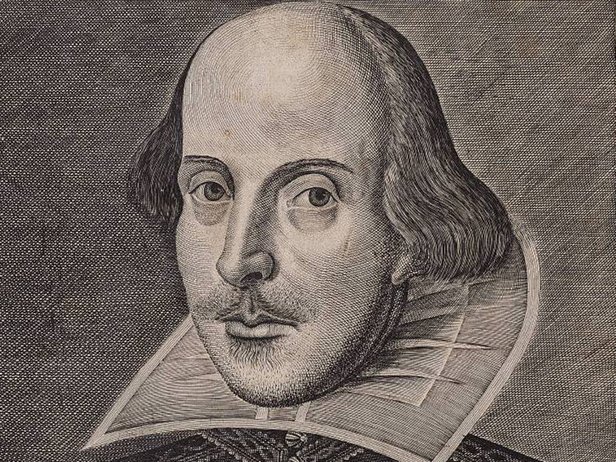
One of the favorite reference books on my shelves isn’t a style guide or dictionary but a collection of insults. And not just any collection of insults, but Shakespeare’s Insults for Teachers, an illustrated guide through the playwright’s barbs and put-downs, designed to offer comic relief to the beleaguered educator. (Books and websites about Shakespeare’s insults almost constitute a genre in themselves.) I refer to this slim, humorous hardback every time discussions of Shakespeare get too ponderous, to remind myself at a glance that what readers and audiences have always valued in his work is its lightning-fast wit and inventiveness.
While perusing any curated selection of Shakespeare’s insults, one can’t help but notice that, amidst the puns and bawdy references to body parts, so many of his wisecracks are about language itself—about certain characters’ lack of clarity or odd ways of speaking. From Much Ado About Nothing there’s the colorful, “His words are a very fantastical banquet, just so many strange dishes.” From The Merchant of Venice, the sarcastic, “Goodly Lord, what a wit-snapper you are!” From Troilus and Cressida, the derisive, “There’s a stewed phrase indeed!” And from Hamlet the subtle shade of “This is the very coinage of your brain.”
Indeed, it can often seem that Shakespeare—if we grant his historicity and authorship—is often writing self-deprecating notes about himself. “It is often said,” writes Fraser McAlpine at BBC America, that Shakespeare “invented a lot of what we currently call the English language…. Something like 1700 [words], all told,” which would mean that “out of every ten words,” in his plays, “one will either have been new to his audience, new to his actors, or will have been passingly familiar, but never written down before.” It’s no wonder so much of his dialogue seems to carry on a meta-commentary about the strangeness of its language.
We have enough trouble understanding Shakespeare today. The question McAlpine asks is how his contemporary audiences could understand him, given that so much of his diction was “the very coinage” of his brain. Lists of words first used by Shakespeare can be found aplently. There’s this catalog from the exhaustive multi-volume literary reference The Oxford English Dictionary, which lists such now-everyday words as “accessible,” “accommodation,” and “addiction” as making their first appearance in the plays. These “were not all invented by Shakespeare,” the list disclaims, “but the earliest citations for them in the OED” are from his work, meaning that the dictionary’s editors could find no earlier appearance in historical written sources in English.
Another shorter list links to an excerpt from Charles and Mary Cowden Clarke’s The Shakespeare Key, showing how the author, “with the right and might of a true poet… minted several words” that are now current, or “deserve” to be, such as the verb “articulate,” which we do use, and the noun “co-mart”—meaning “joint bargains”—which we could and maybe should. At ELLO, or English Language and Linguistics Online, we find a short tutorial on how Shakespeare formed new words, by borrowing them from other languages, or adapting them from other parts of speech, turning verbs into nouns, for example, or vice versa, and adding new endings to existing words.
“Whether you are ‘fashionable’ or ‘sanctimonious,’” writes National Geographic, “thank Shakespeare, who likely coined the terms.” He also apparently invented several phrases we now use in common speech, like “full circle,” “one fell swoop,” “strange bedfellows,” and “method in the madness.” (In another BBC America article, McAlpine lists 45 such phrases.) The online sources for Shakespeare’s original vocabulary are multitude, but we should note that many of them do not meet scholarly standards. As linguists and Shakespeare experts David and Ben Crystal write in Shakespeare’s Words, “we found very little that might be classed as ‘high-quality Shakespearean lexicography’” online.
So, there are reasons to be skeptical about claims that Shakespeare is responsible for the 1700 or more words for which he’s given sole credit. (Hence the asterisk in our title.) As noted, a great many of those words already existed in different forms, and many of them may have existed as non-literary colloquialisms before he raised their profile to the Elizabethan stage. Nonetheless, it is certainly the case that the Bard coined or first used hundreds of words, writes McAlpine, “with no obvious precedent to the listener, unless you were schooled in Latin or Greek.” The question, then, remains: “what on Earth did Shakespeare’s [mostly] uneducated audience make of this influx of newly-minted language into their entertainment?”
McAlpine brings those potentially stupefied Elizabethans into the present by comparing watching a Shakespeare play to watching “a three-hour long, open air rap battle. One in which you have no idea what any of the slang means.” A good deal would go over your head, “you’d maybe get the gist, but not the full impact,” but all the same, “it would all seem terribly important and dramatic.” (Costuming, props, and staging, of course, helped a lot, and still do.) The analogy works not only because of the amount of slang deployed in the plays, but also because of the intensity and regularity of the boasts and put-downs, which makes even more interesting one data scientist’s attempt to compare Shakespeare’s vocabulary with that of modern rappers, whose language is, just as often, the very coinage of their brains.
Related Content:
Do Rappers Have a Bigger Vocabulary Than Shakespeare?: A Data Scientist Maps Out the Answer
What Shakespeare’s English Sounded Like, and How We Know It
Josh Jones is a writer and musician based in Durham, NC. Follow him at @jdmagness.
Read More...Read and Hear Tristan Tzara’s “Dada Manifesto,” the Avant-Garde Document Published 100 Years Ago (March 23, 1918)
Dada demands explanation, yet it somehow also demands not to be explained. In the nearly 102 years since its inception, many attempts at summary and analysis of that early 20th-century European avant-garde movement have emerged; as you can see in the related links at the bottom of the post, we’ve featured a fair few of them here on Open Culture. But to truly understand Dada, you must, to the extent possible, get inside the heads of its founders, and one shortcut to that artistically rich destination takes the form of something any movement worth its salt — especially any early 20th-century European avant-garde movement — will have drawn up: its manifesto.
“The magic of a word – Dada – which has brought journalists to the gates of a world unforeseen, is of no importance to us,” wrote Romanian-French essayist, poet, and performance artist Tristan Tzara almost exactly a century ago.
To put out a manifesto you must want: ABC
to fulminate against 1, 2, 3
to fly into a rage and sharpen your wings to conquer and disseminate little abcs and big ABCs, to sign, shout, swear, to organize prose into a form of absolute and irrefutable evidence, to prove your non plus ultra and maintain that novelty resembles life just as the latest-appearance of some whore proves the essence of God. His existence was previously proved by the accordion, the landscape, the wheedling word. To impose your ABC is a natural thing — hence deplorable.
In this Dada Manifesto of March 23, 1918 (read it online here), Tzara goes on to define “Dada” as “a word that throws up ideas so that they can be shot down; every bourgeois is a little playwright, who invents different subjects and who, instead of situating suitable characters on the level of his own intelligence, like chrysalises on chairs, tries to find causes or objects (according to whichever psychoanalytic method he practices) to give weight to his plot, a talking and self-defining story.” And further down, just in case you haven’t quite got the picture: “DADA DOES NOT MEAN ANYTHING.”
Different translations of Tzara’s words, of which you can hear readings in the videos at the top of the post and just above, put it somewhat differently: “Dada means nothing,” says another. But whatever it means, exactly — or doesn’t mean, exactly — Dada burned brightly enough during its brief heyday to produce not just one manifesto, but two. “As in every human endeavor when two strong personalities meet, opinions may clash and an argument often ensues,” writes Eli Anapur at Widewalls. The German writer Hugo Ball actually wrote his own Dada manifesto before Tzara did, in 1916. “Both Manifestos are explanations of the Dada movement and its goals, but the content differs as long as the modes of spreading the movement throughout Europe and ultimately world, were concerned.”
Ball begins by describing Dada as “a new tendency in art. One can tell this from the fact that until now nobody knew anything about it, and tomorrow everyone in Zurich will be talking about it.” For the word itself he cites several dictionary definitions: “In French it means ‘hobby horse.’ In German it means ‘good-by,’ ‘Get off my back,’ ‘Be seeing you sometime.’ In Romanian: ‘Yes, indeed, you are right, that’s it. But of course, yes, definitely, right.’ ” Yet what a useful word it can be:
How does one achieve eternal bliss? By saying dada. How does one become famous? By saying dada. With a noble gesture and delicate propriety. Till one goes crazy. Till one loses consciousness. How can one get rid of everything that smacks of journalism, worms, everything nice and right, blinkered, moralistic, europeanized, enervated? By saying dada. Dada is the world soul, dada is the pawnshop. Dada is the world’s best lily-milk soap. Dada Mr. Rubiner, dada Mr. Korrodi. Dada Mr. Anastasius Lilienstein.
One hundred years on, the tenets of Dada may not look like an obvious route to eternal bliss, fame, or the excision of bothersome elements of life. But something about the notion at the movement’s core — of moving radically beyond sense as a response to the state of the world — still resonates today. The Europe of 1918 found itself in a bad spot, to put it mildly, but most of us in the early 21st century also feel, at least occasionally, surrounded by a reality that has lost its own sense. How much could it hurt to heed Ball and Tzara’s words and just say dada?
You can read Tzara’s manifesto at this University of Pennsylvania website.
Related Content:
The ABCs of Dada Explains the Anarchic, Irrational “Anti-Art” Movement of Dadaism
Based in Seoul, Colin Marshall writes and broadcasts on cities and culture. His projects include the book The Stateless City: a Walk through 21st-Century Los Angeles and the video series The City in Cinema. Follow him on Twitter at @colinmarshall or on Facebook.
Read More...Support Us
We're hoping to rely on loyal readers, rather than erratic ads. Please click the Donate button and support Open Culture. You can use Paypal, Venmo, Patreon, even Crypto! We thank you!

About Us

Open Culture scours the web for the best educational media. We find the free courses and audio books you need, the language lessons & educational videos you want, and plenty of enlightenment in between.
Advertise With Us
FREE UPDATES!
GET OUR DAILY EMAIL
Get the best cultural and educational resources on the web curated for you in a daily email. We never spam. Unsubscribe at any time.
FOLLOW ON SOCIAL MEDIA
Open Culture editor Dan Colman scours the web for the best educational media. He finds the free courses and audio books you need, the language lessons & movies you want, and plenty of enlightenment in between.
Advertise With Us



.jpg)
