Stream Joni Mitchell’s Complete Discography: A 17-Hour Playlist Moving from Song to a Seagull (1968) to Shine (2007)
In “Fear of a Female Genius,” a recent essay on Joni Mitchell, Lindsay Zoladz explains why “one of the greatest living artists in popular music still isn’t properly recognized.” If you’re thinking that has something to do with gender bias, it does. But there’s so much more to Mitchell’s complex story. Those who fully embrace her are an eclectic group with leanings, like Mitchell, toward folk, jazz, classical, and instrumental music worldwide: sometimes all at once. Despite occasional breezy plainspokenness, she never makes for easy listening.
Her albums take us on winding journeys through peculiarly evocative lyrical tableaus, rich with unexpected, even jarring, images. Even the most accessible songs—for example, Court and Spark’s Burt Bacharach-like “Help Me”—spin like vertigo-inducing roller coasters, little gyres powered by boundless creative energy. Her most popular tunes glow with a worldly-wise intensity all their own. Hear them all, from 1968’s Song to a Seagull to 2007’s Shine, in the 18-hour Spotify playlist below. Or access it directly here.
The idiosyncratic beauty of Mitchell’s music, woven from shimmering tonal patterns, shifting polyrhythms, and odd timings and tunings, defies the labels we might apply. “I think when you listen to Court and Spark,” says Barney Hoskyns, editor of a new anthology of writing about Mitchell, “you can’t really sit there and say, ‘Well this is just pop music.’ You have to think of it on a level with the greatest art that’s been done in the last hundred years.” If Bob Dylan “is sort of Shakespeare,” Hoskyns says, “then Joni Mitchell is Milton… or Dante,” two writers whose labyrinthine verse often poses significant challenges for readers.
These kinds of “crass analogies,” as Hoskyns terms it, might seem off-putting and pretentious. But if it seems like Mitchell’s name appears more in the company of famous men than women, it’s an association she made herself. “Most of my heroes are monsters, unfortunately,” she has said, “and they are men.” Pablo Picasso, Miles Davis, Charles Mingus, whose surname Mitchell took for the title of her tenth album…. “This kind of male-hero worship,” writes Zoladz, “has made Mitchell a difficult figure to some feminist critics.”
Indeed, there is something “internet-proof” about Mitchell—her “unruliness” and unwillingness to remain in one place, to play the roles assigned her, to adopt hip stances, pander, or deny herself the freedom to move in unfamiliar artistic directions, making discoveries and risking missteps more cautious artists would avoid.
Chuck Mitchell, the estranged ex-husband and musical partner who seemed to resent her incredible talent, called her odd tunings “mystical.” But she resists the characterization of her playing as strange. “How can there be weird chords?” she asks; “these chords that I heard inside that suited me—they feel like my feelings.” As much as her work has emerged from her admiration of male heroes and collaborators, it has also been defined by escape from the restrictions men in her life might place on her, from Mitchell to Graham Nash, whose marriage proposal she declined. “As much as I loved and cared for Graham,” she remembered later, “I just thought, I’m gonna end up like my grandmother, kicking the door off the hinges, you know what I mean? It’s like, I better not.”
Albums like Hejira—her version of an Arabic word meaning something like “journey to a better place”—and The Hissing of Summer Lawns, with its nightmare vision of domesticity, document Mitchell’s release from the snares of marriage. But it has been difficult for the 21st century to come to terms with her for other reasons. Her casual appropriation of cultural tropes and her decision to appear in literal blackface, not only at a Halloween party but on the cover of 1977’s Don Juan’s Reckless Daughter, have been called marks of poor taste, at best. Her albums became increasingly experimental in the late 70s, showcasing a pastiche of influences and guest musicians overlaying her already unusual musicality, and alienating many of her fans.
As she left behind the “confessional” voice of albums like 1971’s critically-vaunted Blue and headed into weirder territory, she lost listeners and critics, who savaged abstract projects like The Hissing of Summer Lawns, only to find, forty years later, that these were essential works of art pushed aside by the weight of expectation. Mitchell had been pushing against that weight her entire life. Like some other uniquely talented guitarists—Django Reinhardt, Tony Iommi—her style developed around a disability, in her case a left hand weakened by the polio she had as a child in Canada. “So she invented her own way of playing,” writes Zoladz, and invented her own way of being in the music business and the world at large. “For good and at times for ill, Joni Mitchell believes she is a genius.” Spend some time with her discography and you may find it hard to disagree with her.
Related Content:
Vintage Video of Joni Mitchell Performing in 1965 — Before She Was Even Named Joni Mitchell
Josh Jones is a writer and musician based in Durham, NC. Follow him at @jdmagness
Read More...Hallelujah!: You Can Stream Every Leonard Cohen Album in a 22-Hour Chronological Playlist (1967–2016)
Everybody knows the war is over. Everybody knows the good guys lost.
Perhaps no one since Thomas Hardy has matched Leonard Cohen in the dogged persistence of literary bleakness. Cohen’s entry into a Zen monastery in 1996 was a “response to a sense of despair that I’ve always had,” he said in an interview that year. Ten years later, Cohen told Terry Gross on NPR’s Fresh Air, “I had a great sense of disorder in my life of chaos, of depression, of distress. And I had no idea where this came from. And the prevailing psychoanalytic explanations at the time didn’t seem to address the things I felt.”
Only a handful of people on the planet have experienced the “life of chaos” Leonard Cohen lived as an acclaimed poet, novelist, singer, and one of the most beloved songwriters of the last several decades. But millions identify with his emotional turmoil. Cohen’s expressions of despair—and of reverence, defiance, love, hatred, and lust—speak across generations, telling truths few of us confess but, just maybe, everybody knows. Cohen’s death last year brought his career back into focus. And despite the mournful occasion for revisiting his work, he may be just the songwriter many of us need right now.
The great themes in Cohen’s work come together in his most famous song, “Hallelujah,” which has, since he first recorded it in 1984 to little notice, become “everybody’s ‘Hallelujah,’” writes Ashley Fetters at The Atlantic, in a succession of covers and interpretations from Jeff Buckley and Rufus Wainwright to Shrek and The X Factor. It is here that the depths of despair and heights of transcendence meet, the sexual and the spiritual reach an accord: “This world is full of conflicts and full of things that cannot be reconciled,” Cohen has said of the song. “But there are moments when we can… reconcile and embrace the whole mess, and that’s what I mean by ‘Hallelujah.’”
Everybody knows it’s a mess. But it often takes a Leonard Cohen to convince us that—at least sometimes—it’s a beautiful one. If you feel you need more Leonard Cohen in your life, we bring you the playlist above, a complete chronological discography available on Spotify—from the sparse, haunting folk melodies of Cohen’s first album, 1967’s The Songs of Leonard Cohen to last year’s gripping swan song, You Want It Darker. In-between the legendary debut and masterful summation are several live albums, the classics Songs from a Room, Songs of Love and Hate, and others, as well as that odd 1988 album I’m Your Man, in which Cohen set his grim ironies and universal truths to the sounds of eighties synth-pop, intoning over slap bass and drum machine the indelible, gently mocking lyrics he co-wrote with frequent collaborator Sharon Robinson:
Everybody knows that the boat is leaking
Everybody knows that the captain lied
Everybody got this broken feeling
Like their father or their dog just died
Everybody talking to their pockets
Everybody wants a box of chocolates
And a long-stem rose
Everybody knows
Related Content:
Hear Leonard Cohen’s Final Interview: Recorded by David Remnick of The New Yorker
Josh Jones is a writer and musician based in Durham, NC. Follow him at @jdmagness
Read More...Hear 1,500+ Genres of Music, All Mapped Out on an Insanely Thorough Interactive Graph
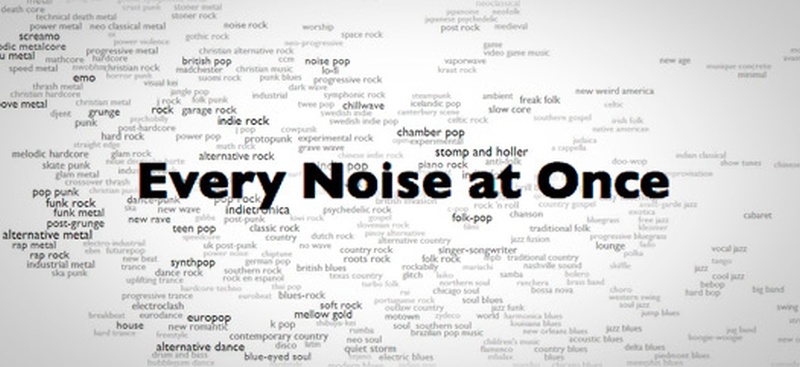
If you are ready for a time-suck internet experience that will also make you feel slightly old and out of step with the culture, feel free to dive into Every Noise at Once. A scatter-plot of over 1,530 musical genres sourced from Spotify’s lists and based on 35 million songs, Every Noise at Once is a bold attempt at musical taxonomy. The Every Noise at Once website was created by Glenn McDonald, and is an offshoot of his work at Echo Nest (acquired by Spotify in 2014).
McDonald explains his graph thus:
This is an ongoing attempt at an algorithmically-generated, readability-adjusted scatter-plot of the musical genre-space, based on data tracked and analyzed for 1,536 genres by Spotify. The calibration is fuzzy, but in general down is more organic, up is more mechanical and electric; left is denser and more atmospheric, right is spikier and bouncier.
It’s also egalitarian, with world dominating “rock-and-roll” given the same space and size as its neighbors choro (instrumental Brazilian popular music), cowboy-western (Conway Twitty, Merle Haggard, et. al.), and Indian folk (Asha Bhosle, for example). It also makes for some strange bedfellows: what factor does musique concrete share with “Christian relaxitive” other than “reasons my college roommate and I never got along.” Now you can find out!
Click on any of the genres and you’ll hear a sample of that music. Double click and you’ll be taken to a similar scatter-plot graph of its most popular artists, this time with font size denoting popularity and a similar sample of their music.
I’ve been spending most of my time exploring up in the top right corner where all sorts of electronic dance subgenres hang out. I’m not too sure what differentiates “deep tech house” from “deep deep house” or “deep minimal techno” or “tech house” or even “deep melodic euro house” but I now know where to come for a refresher course.
Spotify and other services depend on algorithms and taxonomies like this to deliver consistent listening experiences to its users, and they were attracted to Echo Nest for its work with genres. Echo Nest was originally based on the dissertation work of Tristan Jehan and Brian Whitman at the MIT Media Lab, who over a decade ago were trying to understand the “fingerprints” of recorded music. Now when you listen to Spotify’s personalized playlists, Echo Nest’s research is the engine working in the background.
McDonald says in this 2014 Daily Dot article this isn’t about a machine guessing our taste.
“No, the machines don’t know us better than we do. But they can very easily know more than we do. My job is not to tell you what to listen to, or to pass judgment on things or ‘make taste.’ It’s to help you explore and discover. Your taste is your business. Understanding your taste and situating it in some intelligible context is my business.”
If you’d like a more passive journey through the ever expanding music genre universe, there’s a Spotify playlist of one song from each genre (all 1,500+) above. See you in the deep, deep house!
via Kottke.org
Related Content:
Ted Mills is a freelance writer on the arts who currently hosts the FunkZone Podcast. You can also follow him on Twitter at @tedmills, read his other arts writing at tedmills.com and/or watch his films here.
Read More...Napoleon’s Kindle: See the Miniaturized Traveling Library He Took on Military Campaigns

Every piece of technology has a precedent. Most have several different types of precedents. You’ve probably used (and may well own) an eBook reader, for instance, but what would have afforded you a selection of reading material two or three centuries ago? If you were a Jacobean Englishman of means, you might have used the kind of traveling library we featured in August, a handsome portable case custom-made for your books. (If you’re Tom Stoppard in the 21st century, you still do.) If you were Napoleon, who seemed to love books as much as he loved military power — he didn’t just amass a vast collection of them, but kept a personal librarian to oversee it — you’d take it a big step further.
“Many of Napoleon’s biographers have incidentally mentioned that he […] used to carry about a certain number of favorite books wherever he went, whether traveling or camping,” says an 1885 Sacramento Daily Union article posted by Austin Kleon, “but it is not generally known that he made several plans for the construction of portable libraries which were to form part of his baggage.” The piece’s main source, a Louvre librarian who grew up as the son of one of Napoleon’s librarians, recalls from his father’s stories that “for a long time Napoleon used to carry about the books he required in several boxes holding about sixty volumes each,” each box first made of mahogany and later of more solid leather-covered oak. “The inside was lined with green leather or velvet, and the books were bound in morocco,” an even softer leather most often used for bookbinding.
To use this early traveling library, Napoleon had his attendants consult “a catalogue for each case, with a corresponding number upon every volume, so that there was never a moment’s delay in picking out any book that was wanted.” This worked well enough for a while, but eventually “Napoleon found that many books which he wanted to consult were not included in the collection,” for obvious reasons of space. And so, on July 8, 1803, he sent his librarian these orders:
The Emperor wishes you to form a traveling library of one thousand volumes in small 12mo and printed in handsome type. It is his Majesty’s intention to have these works printed for his special use, and in order to economize space there is to be no margin to them. They should contain from five hundred to six hundred pages, and be bound in covers as flexible as possible and with spring backs. There should be forty works on religion, forty dramatic works, forty volumes of epic and sixty of other poetry, one hundred novels and sixty volumes of history, the remainder being historical memoirs of every period.
In sum: not only did Napoleon possess a traveling library, but when that traveling library proved too cumbersome for his many and varied literary demands, he had a whole new set of not just portable book cases but even more portable books made for him. (You can see how they looked packed away in the image tweeted by Cork County Library above.) This prefigured in a highly analog manner the digital-age concept of recreating books in another format specifically for compactness and convenience — the kind of compactness and convenience now increasingly available to all of us today, and to a degree Napoleon never could have imagined, let alone demanded. It’s always good to be the Emperor, but in many ways, it’s better to be a reader in the 21st century.
Related Content:
Discover the Jacobean Traveling Library: The 17th Century Precursor to the Kindle
Napoleon: The Greatest Movie Stanley Kubrick Never Made
Vintage Photos of Veterans of the Napoleonic Wars, Taken Circa 1858
Based in Seoul, Colin Marshall writes and broadcasts on cities and culture. His projects include the book The Stateless City: a Walk through 21st-Century Los Angeles and the video series The City in Cinema. Follow him on Twitter at @colinmarshall or on Facebook.
Read More...Alan Watts Explains the Meaning of the Tao, with the Help of the Greatest Nancy Panel Ever Drawn
A Nancy panel is an irreducible concept, an atom, and the comic strip is a molecule. — comics theorist Scott McCloud
A little over ten years ago, cartoonist Jim Woodring isolated a single image from Ernie Bushmiller’s long-running and deeply polarizing Nancy comic strip, celebrating it on his blog, the Woodring Monitor, as “the greatest Nancy panel ever drawn.”
What makes this panel the greatest? Woodring declined to elaborate, though his readers eagerly shared theories—and some befuddlement—in the comments section:
Sluggo has reached the perfect state of no-effort, the satori-like denial of the “small mind” and all of the suffering that comes with it.
… it’s the comic equivalent of a koan—something designed to tie our rational mind in knots so that we can glimpse enlightenment.
Sluggo smiles because he knows a secret. He says no because he rejects consensus reality. He floats along because he doesn’t fight life—he sees the maintenance of the harmony and is one with that harmony. He knows all paths lead away from home. Instead he goes within and knows freedom.
“I am content. I need nothing, I will do nothing, I am fine as I am.”
Another fan, Glyph Jockey’s Lex 10, took it one step further, removing the speech bubble before taking Sluggo on an animated trip through the cosmos, narrated by philosopher Alan Watts:
In the state of being in accordance with the Tao, there is a certain feeling of weightlessness, parallel to the weightlessness that people feel when they get into outer space or when they go deep into the ocean.
Gabby Pahinui’s “Pu’uanahulu” and Ramayana imagery bestow added hypnotic appeal.
Revisit this strange little animated gem the next time your head’s about to explode from stress. Don’t question or get too hung up on meanings, just go with the flow, like Sluggo and Watts.
Could other Nancy panels serve as vehicles for Taoist enlightenment? Mayhaps:
Bushmiller’s strong point was never the content of his comic strip’s jokey plots—a friend once described him as ‘a moron on an acid trip.’ In fact, the gags were even simpler than was necessary for a ‘children’s’ strip. That’s because they were just a vehicle for the controlled and brilliant manipulation of repetition and variety that gave the strip its unique visual rhythm and composition. Bushmiller choreographed his familiar formal elements inside the tightest frame of any major strip, and that helped make it the most beautiful, as a whole, of any in the papers.” — Tom Smucker, The Village Voice, 1982
Recently, Bushmiller’s Nancy has been enjoying a renaissance. The strip that many casual readers of the funny pages dismissed as boring or dumb is revered by many celebrated cartoonists, including Bill Griffith, Daniel Clowes, and Art Spiegelman.
This month sees the publication of Paul Karasik and Mark Newgarden’s How to Read Nancy, a book length analysis of one single strip, which also functions as a how-to and history of the comic medium. This hotly anticipated volume has in turn given rise to a lively online How To Read Nancy Reading Group, a hotbed of fan art, altered panels, and Nancy strips from around the world.
Invite your pals over to play comic theorist Scott McCloud’s Dadaist game Five Card Nancy or take the online version for a solo spin.
And for those who require context, here is the original strip from which the floating Sluggo panel is drawn.
Apparently the key to the Tao is a plastic hammock…
Related Content:
The Wisdom of Alan Watts in Four Thought-Provoking Animations
Download Over 22,000 Golden & Silver Age Comic Books from the Comic Book Plus Archive
Ayun Halliday is an author, illustrator, theater maker and Chief Primatologist of the East Village Inky zine. Follow her @AyunHalliday.
Read More...The Philosophy & Music of Devo, the Avant-Garde Art Project Dedicated to Revealing the Truth About De-Evolution
The chief difficulty for anyone wanting to make an assault on our municipal theatre… is that there can be no question of revealing a mystery. He cannot just point a stumpy finger at the theatre’s ongoings and say, “You may have thought this amounted to something, but let me tell you, it’s a sheer scandal; what you see before you proves your absolute bankruptcy; it’s your own stupidity, your mental laziness and your degeneracy that are being publically exposed.” No, the poor man can’t say that, for it’s no surprise to you; you’ve known it all along; nothing can be done about it.
–Berthold Brecht, “A Reckoning”
Have you ever felt like Network’s Howard Beale? Ranting to anyone who’ll listen about how mad as hell you are? “I don’t have to tell you things are bad. Everybody knows things are bad.”
Or maybe agreed with the weary cynicism of his boss, Max Schumacher? “All of life is reduced to the common rubble of banality.”
Faced with the cruel, stupid theater of mass politics and culture, we begin to feel a blanket of overwhelming futility descend. All of the possible moves have been made and absorbed into the programming—including the outraged critic pointing his finger at the stage.
Avant-garde artists since the late 19th century have correctly sized up this depressing reality. But rather than seize up in fits of rage or succumb to cynicism, they made new forms of theater: Jarry, Dada, Debord, Artaud, Brecht—all had designs to disrupt the oppressive banality of modern stage- and state-craft with mockery, sadism, and shock.
And so too did DEVO, the authors of “Whip It.”
Their 80s New Wave antics seemed like a juvenile art-school prank. Behind it lay theoretical sophistication and serious political intent. “When we first started Devo,” says Mark Mothersbaugh in the “California Inspires Me” video above, “we were artists who were working in a number of different media. We were around for the shootings at Kent State. And it affected us. We were thinking, like, ‘What are we observing?’ And we decided we weren’t observing evolution, we were observing de-evolution.”
Wondering how to change things, the band looked to Madison Avenue for inspiration—intent on taking the techniques of mass persuasion to subvert the enchantments of mass persuasion, “reporting the good news of De-Evolution” in a joyous theater of mockery. The philosophy itself evolved over time, first taking shape in 1970 when Mothersbaugh and Gerald Casale met at Kent State. Casale had already coined the term “De-Evolution”; Mothersbaugh introduced him to its mascot, Jocko-Homo, the 1924 creation of anti-evolution fundamentalist pamphleteer B.H. Shadduck.
Fascinated by Shadduck’s bizarre, proto-Jack Chick, illustrated freak-outs, Mothersbaugh and his bandmates adopted the character for the first single from their 1978 debut album (top). Are We Not Men? We Are Devo! announced their carnivalesque gospel of human stupidity. Devo proved nothing we didn’t already know. Instead, they showed us the elevation of idiocy to the status of a civil religion. (Later in the 80s, they would expressly parody the national religion with their Evangelical satire DOVE.)
The theater of Devo was weirdly compelling then and is wierdly compelling now, since the banality and casual violence of late-capitalism that threatened to swallow up everything in the twentieth century has, if anything, only become more bloated and grotesque. “As far as Devo was concerned,” writes Ray Padgett at The New Yorker, “Devo wasn’t a band at all but, rather, an art project… inspired by the Dadaists and the Italian Futurists, Devo’s members were also creating satirical visual art, writing treatises, and filming short videos.”
One of those videos, “In the Beginning Was the End: The Truth About De-Evolution,” featured their “first ever cover”—Johnny Rivers’ “Secret Agent Man”—before they re-invented (or “corrected,” as they put it), the Rolling Stones’ “Satisfaction.” They would screen the 9‑minute film, with its footage of two men in monkey masks spanking a housewife, before gigs.
The concepts are aggressively wink-nudge adolescent, reflecting not only Devo’s take on the regressive state of the culture, but also Casale’s belief that “high-school kids know everything already.” But amidst the synths and shiny suits, we still hear Howard Beale’s cri de coeur, “I’m a human being dammit! My life has value!” Only in Devo’s hands it turns to dark comedy—as in the title of a song from their 2010 comeback record Something for Everybody, taken from words printed on the back of a hunter’s safety vest that call back to the band’s beginnings at Kent State: “Don’t Shoot, I’m a Man.”
Related Content:
The Mastermind of Devo, Mark Mothersbaugh, Shows Off His Synthesizer Collection
Josh Jones is a writer and musician based in Durham, NC. Follow him at @jdmagness
Read More...Stream Online The Vietnam War, the New Documentary by Ken Burns & Lynn Novick
Right now, PBS is in the midst of airing The Vietnam War, a ten-part, 18-hour documentary film series directed by Ken Burns and Lynn Novick. The “immersive 360-degree narrative” tells “the epic story of the Vietnam War,” using never-before-seen footage and interviews. If you’re not watching the series on the TV, you can also view it on the web and through PBS apps for smartphones, tablets, Apple TV, Roku and Amazon Fire TV. Episode 1 appears above. Find all of them here.
Note: If these videos don’t stream outside of the US, we apologize in advance. Sometimes PBS geo-restricts their videos. Also, these videos likely won’t stay online forever. If you’re interested in watching the series, I’d get going sooner than later.
If you would like to support the mission of Open Culture, consider making a donation to our site. It’s hard to rely 100% on ads, and your contributions will help us continue providing the best free cultural and educational materials to learners everywhere. You can contribute through PayPal, Patreon, and Venmo (@openculture). Thanks!
Related Content:
Read More...Behold the “Book Wheel”: The Renaissance Invention Created to Make Books Portable & Help Scholars Study Several Books at Once (1588)
Devotees of print may object, but we readers of the 21st century enjoy a great privilege in our ability to store a practically infinite number of digitized books on our computers. What’s more, those computers have themselves shrunk down to such compactness that we can carry them around day and night without discomfort. This would hardly have worked just forty years ago, when books came only in print and a serious computer could still fill a room. The paper book may remain reasonably competitive even today with the convenience refined over hundreds and hundreds of years, but its first handmade generations tended toward lavish, weighty decoration and formats that now look comically oversized.

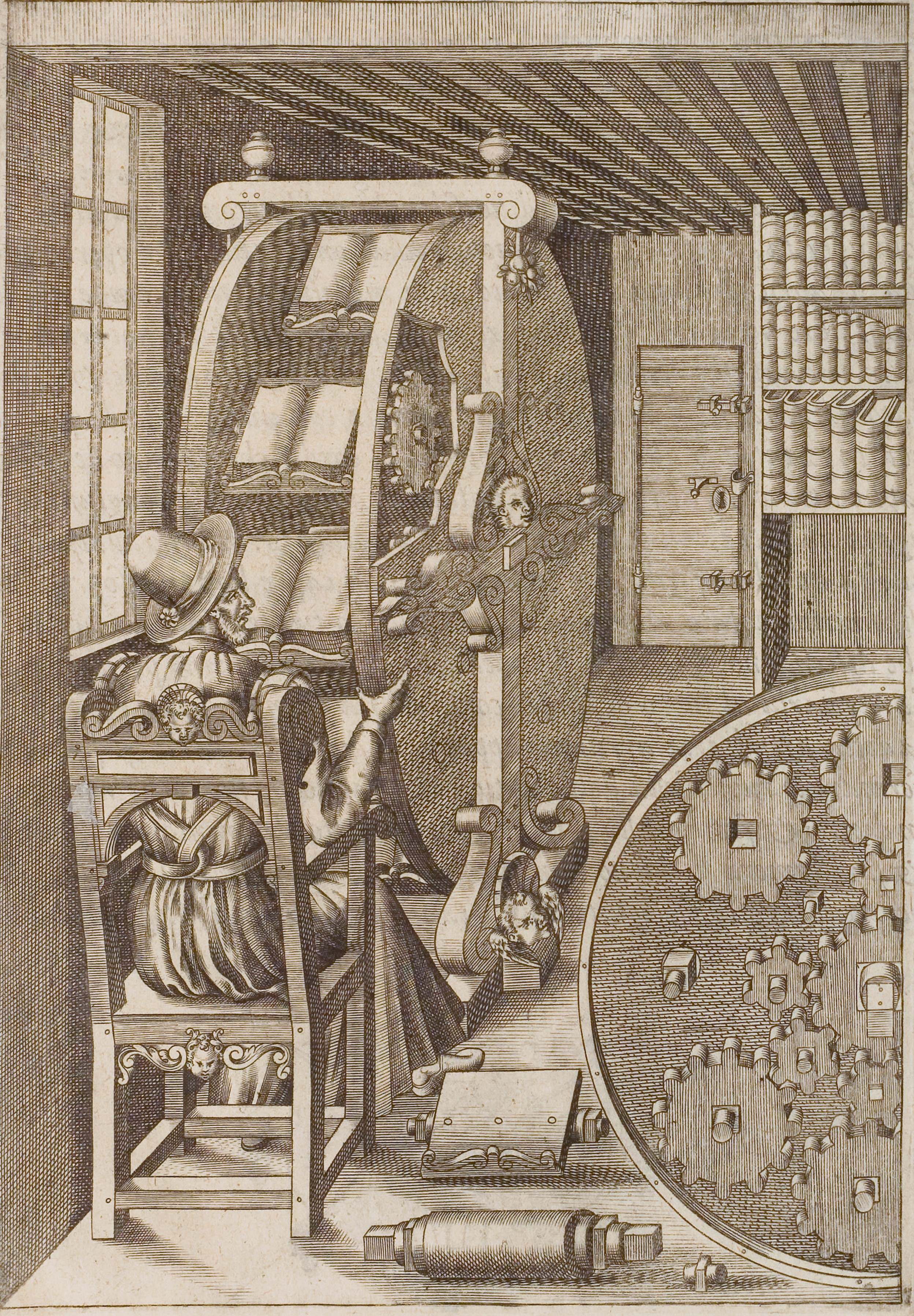
These posed real problems of unwieldiness, one solution to which took the unlikely form of the bookwheel. In 1588’s The Various and Ingenious Machines of Captain Agostino Ramelli, the Italian engineer of that name “outlined his vision for a wheel-o-books that would employ the logic of other types of wheel (water, Ferris, ‘Price is Right’, etc.) to rotate books clockwork-style before a stationary user,” writes the Atlantic’s Megan Garber.
The design used “epicyclic gearing — a system that had at that point been used only in astronomical clocks — to ensure that the shelves bearing the wheel’s books (more than a dozen of them) would remain at the same angle no matter the wheel’s position. The seated reader could then employ either hand or foot controls to move the desired book pretty much into her (or, much more likely, his) lap.” This rotating bookcase gave 16th century readers the ability to read heavy books in place, with far greater ease.
In his 1588 book, Ramelli added:
This is a beautiful and ingenious machine, very useful and convenient for anyone who takes pleasure in study, especially those who are indisposed and tormented by gout. For with this machine a man can see and turn through a large number of books without moving from one spot. Moveover, it has another fine convenience in that it occupies very little space in the place where it is set, as anyone of intelligence can clearly see from the drawing.
Inventors all over Europe created their own versions of the bookwheel during the 17th and 18th centuries, fourteen examples of which still exist. (The one pictured in the middle of the post, built around 1650, now resides in Leiden.) Even architect Daniel Libeskind has built one, based on Ramelli’s design and exhibited in his homeland at the 1986 Venice Biennale. Alas, after it went to Geneva for an exhibition at the Palais Wilson, it fell victim to a terrorist fire bombing. Innovation, it seems, will always have its enemies.
Related Content:
Discover the Jacobean Traveling Library: The 17th Century Precursor to the Kindle
The Art of Making Old-Fashioned, Hand-Printed Books
Wonderfully Weird & Ingenious Medieval Books
Wearable Books: In Medieval Times, They Took Old Manuscripts & Turned Them into Clothes
800 Free eBooks for iPad, Kindle & Other Devices
Based in Seoul, Colin Marshall writes and broadcasts on cities and culture. He’s at work on the book The Stateless City: a Walk through 21st-Century Los Angeles, the video series The City in Cinema, the crowdfunded journalism project Where Is the City of the Future?, and the Los Angeles Review of Books’ Korea Blog. Follow him on Twitter at @colinmarshall or on Facebook.
Read More...Hear What Happens When Avant-Garde Composer Pierre Boulez Conducts Three Frank Zappa Songs
Was Frank Zappa a musical genius? A modernist, avant-garde composer who just happened to work in an idiomatic pastiche of jazz, classical, progressive rock and juvenile shock tactics? The question can be a deeply divisive one. Zappa tends to inspire either intense devotion or intense dislike. But whatever one’s opinion of the man or his music, it’s safe to say that when he wasn’t working alone, Zappa worked in the company of some incredibly talented musicians. And he attracted, as John Rockwell wrote in 1984 at The New York Times, “a tiny following among classical avant-gardists.”
That year, one of his more genteel fans, Pierre Boulez—former music director of the New York Philharmonic and “widely regarded,” notes Rockwell, “as one of the great composers of the [20th] century”—decided to conduct a suite of Zappa songs. Zappa hoped the resulting album, The Perfect Stranger, would help him realize his ambition of having his music taken seriously in classical circles. (“A brief collaboration in 1970 with Zubin Mehta,” writes April Peavey at PRI, “went nowhere.”)
Boulez conducts his own ensemble for three tracks on the album, “The Perfect Stranger,” “Naval Aviation in Art?” and “Dupree’s Paradise.” The remaining four songs are performed by “The Barking Pumpkin Digital Gratification Consort,” a Zappaism for the Synclavier, Zappa’s favorite electronic instrument. For all the high seriousness the collaboration implies, Zappa couldn’t help inserting his surreally sardonic sense of humor; always “a compulsive musical comedian,” wrote Rockwell, he wears here “the defensive mask of irony, again.”
Each of the songs has an accompanying scenario. “The Perfect Stranger” imagines that “a door-to-door salesman, accompanied by his faithful gypsy-mutant industrial vacuum cleaner, cavorts licentiously with a slovenly housewife.” In “Love Story,” Zappa wants us to picture “an elderly Republican couple attempting sex while breakdancing.” Many people have had trouble getting past the sophomoric posturing and seeing Zappa’s music as serious art. He often seemed intent on alienating exactly such people.
But perhaps Zappa did not need the pedigree Boulez lent to his work. When listening, for example, to the Mothers of Invention play Zappa’s original arrangement of “Dupree’s Paradise” (top), one has to admit, he created brilliantly complex, rhythmically exciting music and, in the final analysis, represented “a particularly appealing type of quintessentially American composer—genuinely defiant of established categories and divisions that others routinely accept.” Listen to the Boulez/Zappa collaboration The Perfect Stranger in the Spotify playlist above, or access it directly on Spotify here.
Related Content:
Hear the Musical Evolution of Frank Zappa in 401 Songs
Frank Zappa’s Amazing Final Concerts: Prague and Budapest, 1991
Josh Jones is a writer and musician based in Durham, NC. Follow him at @jdmagness
Read More...An Animated Introduction to Rene Descartes & His Philosophy of Radical Doubt
Early Enlightenment French philosopher and mathematician René Descartes invented a new genre of philosophy, we might say, one that would dominate the century to come. Before Locke, Leibniz, or Kant, Descartes stood out as a “theist rationalist.” Rather than trusting in revelation, he leaned solely on logic and reason, creating a set of “rules for the direction of the mind,” the title of one of his books. He believed we might think our way—solely unaided by unreliable external sources—to belief in God and “all the knowledge that we may need for the conduct of life.”
Descartes’ proofs of God may not sound so convincing to modern ears, slipping as they do into the language of faith when convenient. But in other respects, he seems distinctly contemporary, or at least like a contemporary of Ludwig Wittgenstein. He believed that philosophy suffered from improper definitions and lacked clarity of thought. And like the early 20th-century logical positivists, he put tremendous store in logic and mathematics as analytic tools for acquiring knowledge about the world. These, along with the scientific method Descartes championed, were indeed the sole means of acquiring such knowledge.
Descartes, then, has become known for introducing the radical “method of doubt,” which supposedly strips away all prejudice and preconception, every article of belief, to get at the most fundamentally ascertainable core of knowledge. Upon doing this in his 1637 Discourse on Method, the French philosopher famously found that the only thing he could say for certain was that he must exist because he could see himself doubting his existence—cogito ergo sum, “I think therefore I am.” The process involved casting aside all authority and tradition, which made Descartes a hero to French Revolutionists. His freethinking also made him very much the enemy of many in the Catholic church.
Describing in Discourse on Method how he had abandoned all reliance on other texts and resolved to derive the answers to his questions from experience and reason, he seemed to dismiss the authority not only of church hierarchy and dogma but of scripture itself. Rather than fixing God at the center of the universe, Descartes used the “Archimedean point” of his own certain existence to anchor “an epistemologically unsteady world.” Nonetheless, he was committed to keeping faith intact, even as he seemingly demolished the foundations of its existence, including—for Catholics—the cherished idea that priests could turn bread into flesh.
It might have been an attempt at self-preservation or appeasement, but it seems more to reflect sincere belief: in the Meditations on First Philosophy, Descartes sought to prove the existence of God in much the same way as he had proved his own existence, through circular reasoning and arguments that split mind and matter into two distinct camps. Descartes created a dualist view of the world that became a major problem in his philosophy. At the time, many of his critics were less concerned with this ontological puzzle than they were with the possibility of his heretical thought interfering in world affairs.
Descartes’ radical doubt threatened not only church doctrine but also church politics. One scholar claims to have found evidence that a Catholic priest—fearing the French freethinker would jeopardize the conversion of Sweden’s Queen Christina to Catholicism—murdered Descartes with an arsenic-laced communion wafer. If so, it would have been a cruelly ironic death, perhaps by design, for the man who dared to write in the Meditations that transubstantiation—one of the Church’s central supernatural teachings—should be “rejected by theologians as irrational, incomprehensible and hazardous for the faith,” and to hope for a time when “my theory will be accepted in its place as certain and indubitable.”
Related Content:
Free Online Philosophy Courses
The Philosophy of The Matrix: From Plato and Descartes, to Eastern Philosophy
History of Modern Philosophy: A Free Online Course
Josh Jones is a writer and musician based in Durham, NC. Follow him at @jdmagness
Read More...Support Us
We're hoping to rely on loyal readers, rather than erratic ads. Please click the Donate button and support Open Culture. You can use Paypal, Venmo, Patreon, even Crypto! We thank you!

About Us

Open Culture scours the web for the best educational media. We find the free courses and audio books you need, the language lessons & educational videos you want, and plenty of enlightenment in between.
Advertise With Us
FREE UPDATES!
GET OUR DAILY EMAIL
Get the best cultural and educational resources on the web curated for you in a daily email. We never spam. Unsubscribe at any time.
FOLLOW ON SOCIAL MEDIA
Open Culture editor Dan Colman scours the web for the best educational media. He finds the free courses and audio books you need, the language lessons & movies you want, and plenty of enlightenment in between.
Advertise With Us



