The Robots of Your Dystopian Future Are Already Here: Two Chilling Videos Drive It All Home
A year ago, Boston Dynamics released a video showing its humanoid robot “Atlas” doing, well, rather human things–opening doors, walking through a snowy forest, hoisting cardboard boxes, and lifting itself off of the ground. Rarely has something so banal seemed so peculiar.
What is “Atlas” doing these days? As shown in this newly-released video above, it’s jumping to new heights, twisting in the air, and doing backflips with uncanny ease. Standing six feet tall and weighing 180 pounds, Atlas was designed to take care of mundane problems–like assisting emergency services in search and rescue operations and “operating powered equipment in environments where humans could not survive.” But that’s not where the applications of Atlas end. Seeing that the Pentagon has helped finance and design Atlas, you can easily see the humanoid fighting on the battlefield. Stay tuned for that clip in 2018.
Which brings us to our next video. The new short film, “Slaughterbots,” comes from the Campaign to Stop Killer Robots and it follows this plot:
A military firm unveils a tiny drone that hunts and kills with ruthless efficiency. But when the technology falls into the wrong hands, no one is safe. Politicians are cut down in broad daylight. The machines descend on a lecture hall and spot activists, who are swiftly dispatched with an explosive to the head.
According to UC Berkeley AI expert Stuart Russell, “Slaughterbots” looks like science fiction. But it’s not. “It shows the results of integrating and miniaturizing technologies that we already have.” It is “simply an integration of existing capabilities… In fact, it is easier to achieve than self-driving cars, which require far higher standards of performance.” Recently shown at the United Nations’ Convention on Conventional Weapons, “Slaughterbots” comes on the heels of an open letter signed by 116 robotics and AI scientists (including Tesla’s Elon Musk), urging the UN to ban the development and use of killer robots. It reads:
Lethal autonomous weapons threaten to become the third revolution in warfare. Once developed, they will permit armed conflict to be fought at a scale greater than ever, and at timescales faster than humans can comprehend. These can be weapons of terror, weapons that despots and terrorists use against innocent populations, and weapons hacked to behave in undesirable ways. We do not have long to act. Once this Pandora’s box is opened, it will be hard to close.
If we already have military drones taking out enemies across the world (in places like Yemen, Somalia, Iraq, Syria, Libya and Afghanistan), the mental leap to deploying Slaughterbots doesn’t seem too great. Do you trust our leaders to make finer distinctions and keep a lid on Pandora’s Box? Or could you see them tearing Pandora’s Box open like a gift on Christmas day? Yeah, me too. The robots of your dystopian future are now here.
If you would like to support the mission of Open Culture, consider making a donation to our site. It’s hard to rely 100% on ads, and your contributions will help us continue providing the best free cultural and educational materials to learners everywhere. You can contribute through PayPal, Patreon, and Venmo (@openculture). Thanks!
Related Content:
Artificial Intelligence: A Free Online Course from MIT
Read More...A Digital Archive of 1,800+ Children’s Books from UCLA
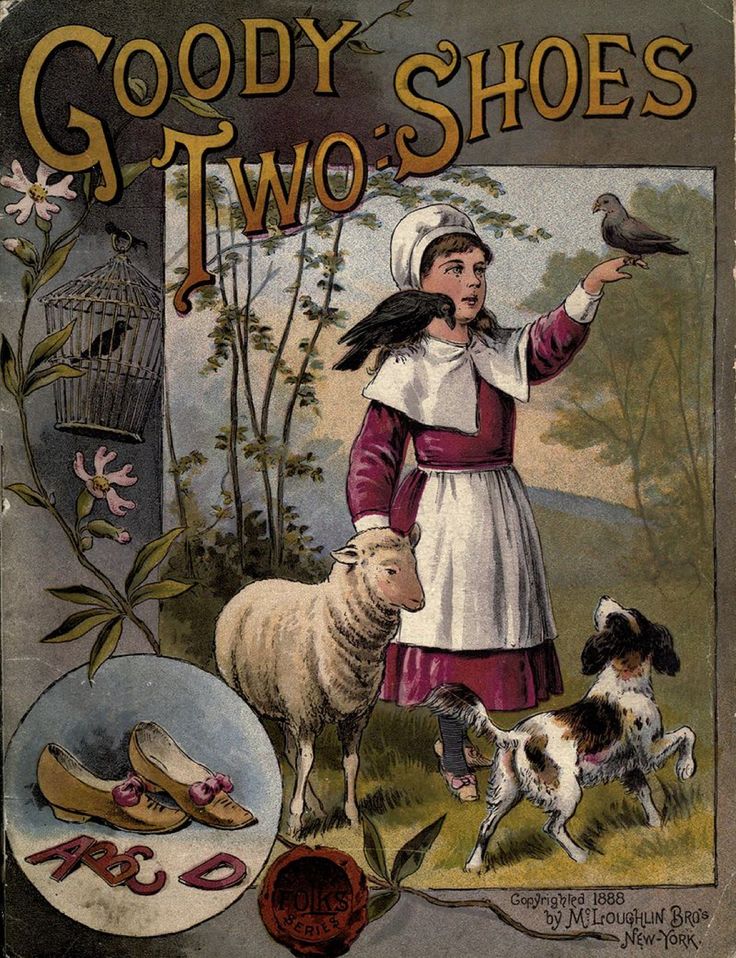
In the early 18th century, the novel was seen as a frivolous and trivial form at best, a morally corrupting one at worst. Given that the primary readers of novels were women, the belief smacks of patriarchal condescension and a kind of thought control. Fiction is a place where readers can imaginatively live out fantasies and tragedies through the eyes of an imagined other. Respectable middle-class women were expected instead to read conduct manuals and devotionals.
English novelist Samuel Richardson sought to bring respectability to his art in the form of Pamela in 1740, a novel which began as a conduct manual and whose subtitle rather bluntly states the moral of the story: “Virtue Rewarded.”
This moralizing expressed itself in another literary form as well. Children’s books, such as there were, also tended toward the moralistic and didactic, in attempts to steer their readers away from the dangers of what was then called “enthusiasm.”
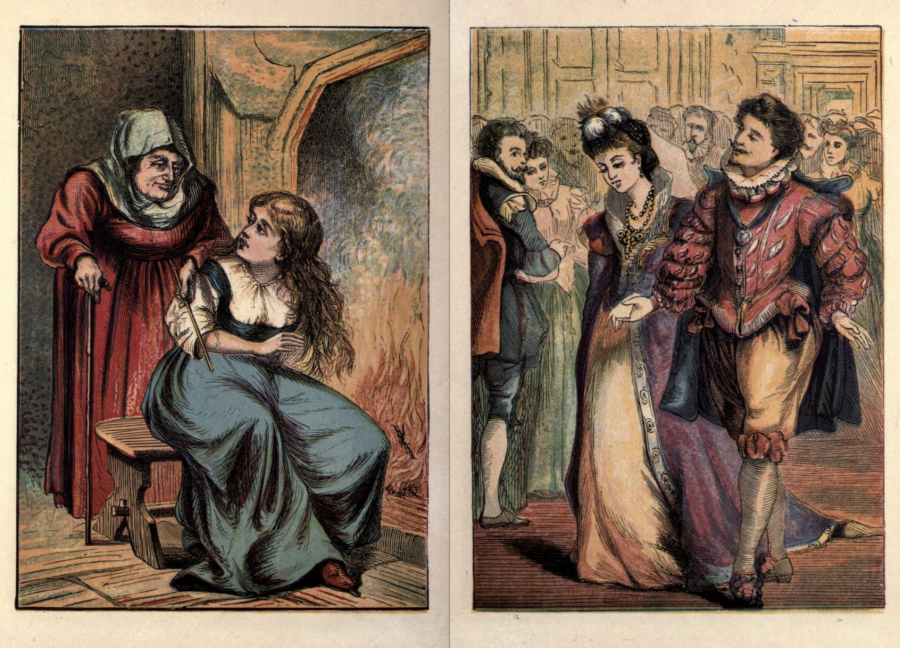
“Prior to the mid-eighteenth century,” notes the UCLA Children’s Book Collection—a digital repository of over 1800 children’s books dating from 1728 to 1999—“books were rarely created specifically for children, and children’s reading was generally confined to literature intended for their education and moral edification rather than for their amusement. Religious works, grammar books, and ‘courtesy books’ (which offered instruction on proper behavior) were virtually the only early books directed at children.” But a change was in the making in the middle of the century.
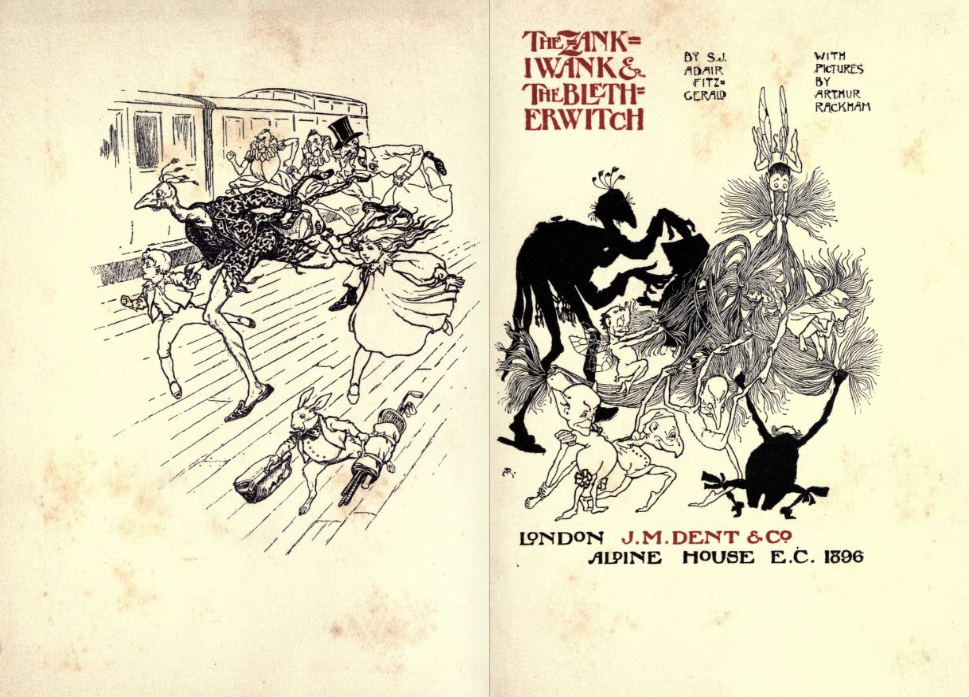
Pamela attracted a ribald, even pornographic, response—most notably in Henry Fielding’s satire An Apology for the Life of Mrs. Shamela Andrews and the Marquis de Sade’s Justine Meanwhile, the world of children’s literature also underwent a radical shift. “The notion of pleasure in learning was becoming more widely accepted.” Illustrations, previously “consisting of small woodcut vignettes,” slowly began to move to the fore, and “innovations in typography and printing allowed greater freedom in reproducing art.”
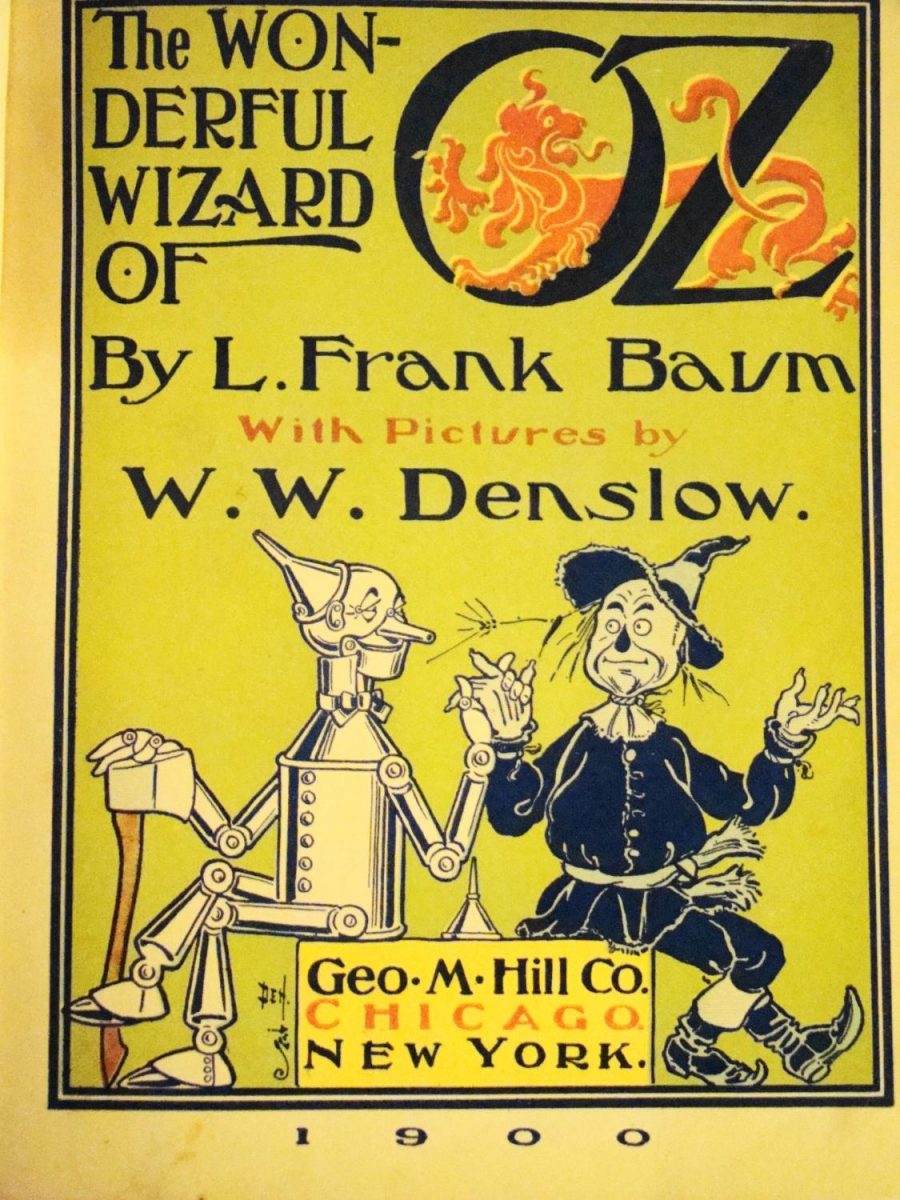
That’s not to say that the didactic attitude was dispelled—we see codes of conduct and overt religious themes embedded in children’s literature throughout the 19th century. But as we pointed out in a post on another children’s book archive from the University of Florida, the more staid and traditional books increasingly competed with adventure stories, works of fantasy, and what we call today Young Adult literature like that of Mark Twain and Louisa May Alcott. You can see this tension in the UCLA collection, between pleasure and duty, leisure and work, and education as moral and social training and as a means of achieving personal freedom.
Of the adult literary imagination of the time, Leo Bersani writes in A Future for Astyanax that “the confrontation in nineteenth-century works between a structured, socially viable and verbally analyzable self and the wish to shatter psychic and social structures produces considerable stress and conflict.” I think we can see a similar conflict, expressed much more playfully, in books for children of the past two hundred years or so. Enter the UCLA collection, which includes not only historic children’s books but present-day exhibit catalogs and more, here.
Related Content:
Enter an Archive of 6,000 Historical Children’s Books, All Digitized and Free to Read Online
The First Children’s Picture Book, 1658’s Orbis Sensualium Pictus
The Anti-Slavery Alphabet: 1846 Book Teaches Kids the ABCs of Slavery’s Evils
Josh Jones is a writer and musician based in Durham, NC. Follow him at @jdmagness
Read More...60-Second Introductions to 12 Groundbreaking Artists: Matisse, Dalí, Duchamp, Hopper, Pollock, Rothko & More
Some art historians dedicate their entire careers, and indeed lives, to the work of a single artist. But what about those of us who only have a minute to spare? Addressing the demand for the briefest possible primers on the creators of important art, paintings and otherwise, of the past century or so, the Royal Academy of Arts’ Painters in 60 Seconds series has published twelve episodes so far. Of those informationally dense videos, you see here the introductions to Salvador Dalí, Marcel Duchamp, Edward Hopper, Jackson Pollock, and Mark Rothko.
Though short, these crash courses do find their way beyond the very basics. “There’s more to Dalí,” says the Royal Academy of the Arts’ Artistic Director Tim Marlow, than “skillfully rendered fever dreams of sex and decay.
He painted one of the twentieth century’s great crucifixions, but it’s more about physics than religion, and he was as influenced by philosophy as he was by Sigmund Freud.” Duchamp’s unorthodox and influential ideas “came together in one of the most ambitious works of the 20th century, The Large Glass, an endlessly analyzed work of machine-age erotic symbolism, science, alchemy, and then some.”
In the seemingly more staid Depression-era work of Edward Hopper, Marlow points to “a profound contemplation of the world around us. Hopper slows down time and captures a moment of stillness in a frantic world,” painted in a time of “deep national self-examination about the very idea of Americanness.” Hopper painted the famous Nighthawks in 1942; the next year, and surely on the very other end of some kind of artistic spectrum, Hopper’s countryman and near-contemporary Jackson Pollock painted Mural, which shows “the young Pollock working through Picasso, continuing to fracture the architecture of cubism” while “at the same time taking on the lessons of the Mexican muralists like Siqueiros and Orozco.”
Yet Mural also “starts to proclaim an originality that is all Pollock’s,” opening the gateway into his heroic (and well-known) “drip period.” Rothko, practicing an equally distinctive but entirely different kind of abstraction, ended up producing “some of the most moving paintings in all of the 20th century: saturated stains of color.” Making reference to classical architecture — going back, even, to Stonehenge — his work becomes “a kind of threshold into which you, the viewer, project yourself,” but its soft edges also give it a sense of “breathing, pulsating, and sometimes, of dying.”
If you happen to have more than a minute available, how could you resist digging a bit deeper into the life and work of an artist like that? Or perhaps you’d prefer to get introduced to another: Henri Matisse or Grant Wood, say, or Kazimir Malevich or Joan Mitchell. You may just find one about whom you want to spend the rest of your years learning.
See all videos, including new ones down the road, at the Painters in 60 Seconds series playlist.
Related Content:
Edward Hopper’s Iconic Painting Nighthawks Explained in a 7‑Minute Video Introduction
Jackson Pollock 51: Short Film Captures the Painter Creating Abstract Expressionist Art
Hear Marcel Duchamp Read “The Creative Act,” A Short Lecture on What Makes Great Art, Great
Walk Inside a Surrealist Salvador Dalí Painting with This 360º Virtual Reality Video
An Introduction to 100 Important Paintings with Videos Created by Smarthistory
Based in Seoul, Colin Marshall writes and broadcasts on cities and culture. His projects include the book The Stateless City: a Walk through 21st-Century Los Angeles and the video series The City in Cinema. Follow him on Twitter at @colinmarshall or on Facebook.
Read More...What Made Freddie Mercury the Greatest Vocalist in Rock History? The Secrets Revealed in a Short Video Essay
I wasn’t always a Queen fan. Having cut my music fan teeth on especially downbeat, miserable bands like Joy Division, The Cure, and The Smiths, I couldn’t quite dig the unabashed sentimentality and operatic bombast. Like one of the “Kids React to Queen” kids, I found myself asking, “What is this?” What turned me around? Maybe it was the first time I heard Queen’s theme song for Flash Gordon. The 1980 space opera is most remarkable for Max von Sydow’s turn as Ming the Merciless, and for those bursts of Freddie Mercury and his mates’ multi-tracked voices, explosions of syncopated angel song, announcing the coming of the eighties with all the high camp of Rocky Horror and the rock confidence of Robert Plant.
As a frontman Mercury had so much more than the perfect style and stance—though he did own every stage he set foot on. He had a voice that commanded attention, even from mopey new wave teenagers vibrating on Ian Curtis’s frequency. What makes Mercury’s voice so compelling—as most would say, the greatest vocalist in all of rock history? One recent scientific study concluded that Mercury’s physical method of singing resembled that of Tuvan throat singers.
He was able to create a faster vibrato and several more layers of harmonics than anyone else. The video above from Polyphonic adds more to the explanation, quoting opera soprano Montserrat Caballé, with whom Mercury recorded an album in 1988. In addition to his incredible range, Mercury “was able to slide effortlessly from a register to another,” she remarked. Though Mercury was naturally a baritone, he primarily sang as a tenor, and had no difficulty, as we know, with soprano parts.
Mercury was a great performer—and he was a great performative vocalist, meaning, Caballé says, that “he was selling the voice…. His phrasing was subtle, delicate and sweet or energetic and slamming. He was able to find the right colour or expressive nuance for each word.” He had incredible discipline and control over his instrument, and an underrated rhythmic sensibility, essential for a rock singer to convincingly take on rockabilly, gospel, disco, funk, and opera as well as the blues-based hard rock Queen so easily mastered. No style of music eluded him, except perhaps for those that call for a certain kind of vocalist who can’t actually sing.
That’s the rub with Queen—they were so good at everything they did that they can be more than a little overwhelming. Watch the rest of the video to learn more about how Mercury’s superhuman vibrato produced sounds almost no other human can make; see more of Polyphonic’s music analysis of one-of-a-kind musicians at our previous posts on Leonard Cohen and David Bowie’s final albums and John Bonham’s drumming; and just below, hear all of those Mercury qualities—the vibrato, the perfect timing, and the expressive performativity—in the isolated vocal track from “I Want to Break Free” just below.
Related Content:
Watch Behind-the-Scenes Footage From Freddie Mercury’s Final Video Performance
Queen Documentary Pays Tribute to the Rock Band That Conquered the World
Josh Jones is a writer and musician based in Durham, NC. Follow him at @jdmagness
Read More...Research Finds That Intellectual Humility Can Make Us Better Thinkers & People; Good Thing There’s a Free Course on Intellectual Humility
We may have grown used to hearing about the importance of critical thinking, and stowed away knowledge of logical fallacies and cognitive biases in our argumentative toolkit. But were we to return to the philosophical sources of informal logic, we would find that we only grasped at some of the principles of reason. The others involve questions of what we might call virtue or character—what for the Greeks fell into the categories of ethos and pathos. The principle of charity, for example, in which we give our opponents a fair hearing and respond to the best version of their arguments as we understand them. And the principle, exemplified by Plato’s Socrates, of intellectual humility. Or as one punk band put it in their Socratic tribute. “All I know is that I don’t know. All I know is that I don’t know nothing.”
Intellectual humility is not, contrary to most popular appearances, reflexively according equal weight to “both sides” of every argument or assuming that everyone’s opinion is equally valid. These are forms of mental laziness and ethical abdication. It is, however, believing in our own fallibility and opening ourselves up to hearing arguments without immediately forming a judgment about them or the people who make them. We do not abandon our reason and values, we strengthen them, argues Mark Leary, by “not being afraid of being wrong.” Leary, professor of psychology and neuroscience at Duke University, is the lead author of a new study on intellectual humility that found “essentially no difference between liberals and conservatives or between religious and nonreligious people” when it comes to intellectual humility.
The study challenges many ideas that can prevent dialogue. “There are stereotypes about conservatives and religiously conservative people being less intellectually humble about their beliefs,” says Leary. But he and his colleagues “didn’t find a shred of evidence to support that.” This doesn’t necessarily mean that such people have high degrees of intellectual humility, only that all of us, perhaps equally, possess fairly low levels of the trait. I’ll be the first to admit that it is not an easy one to develop, especially when we’re on the defensive for some seemingly good reasons—and when we live in a culture that encourages us to make decisions and take actions on the strength of an image, some minimal text, and a few buttons that lead us right to our bank accounts. (To quote Operation Ivy again, “We get told to decide. Just like as if I’m not gonna change my mind.”)
But in the Duke study, reports Alison Jones at Duke Today, “those who displayed intellectual humility did a better job of evaluating the quality of evidence.” They took their time to make careful considerations. And they were generally more charitable and “less likely to judge a writer’s character based on his or her views.” By contrast, “intellectually arrogant” people gave writers with whom they disagreed “low scores in morality, honesty, competence, and warmth.” As a former teacher of rhetoric, I wonder whether the researchers accounted for the quality and persuasiveness of the writing itself. Nonetheless, this observation underscores the problem of conflating an author’s work with his or her character. Moral judgment can inhibit intellectual curiosity and open-mindedness. Intellectually arrogant people often resort to insults and personal attacks over thoughtful analysis.
The enormous number of assumptions we bring to almost every conversation with people who differ from us can blind us to our own faults and to other people’s strengths. But intellectual humility is not genetically determined—it is a skill that can be learned, Leary believes. Big Think recommends a free MOOC from the University of Edinburgh on intellectual humility (see an introduction to the concept at the top and a series of lectures here). “Faced with difficult questions,” explains course lecturer Dr. Ian Church, “people often tend to dismiss and marginalize dissent…. The world needs more people who are sensitive to reasons both for and against their beliefs, and are willing to consider the possibility that their political, religious and moral beliefs might be mistaken.” The course offers three different levels of engagement, from casual to quite involved, and three separate class sections at Coursera: Theory, Practice, and Science.
It’s likely that many of us need some serious preparation before we’re willing to listen to those who hold certain views. And perhaps certain views don’t actually deserve a hearing. But in most cases, if we can let our guard down, set aside feelings of hostility, and become willing to learn something even from those with whom we disagree, we might be able to do what so many psychologists continue to recommend. As Cindy Lamothe writes at New York Magazine’s Science of Us blog, “we have to be willing to expose ourselves to opposing perspectives in the first place—which means that, as daunting as it may seem, listening to friends and family with radically different views can be beneficial to our long-term intellectual progress.” The holidays are soon upon us. Let the healing—or at least the charitable tolerance if you can manage it—begin.
Related Content:
Stephen Fry Identifies the Cognitive Biases That Make Trump Tick
32 Animated Videos by Wireless Philosophy Teach You the Essentials of Critical Thinking
Why We Need to Teach Kids Philosophy & Safeguard Society from Authoritarian Control
Josh Jones is a writer and musician based in Durham, NC. Follow him at @jdmagness
Read More...What Makes a David Lynch Film Lynchian: A Video Essay
As soon as it began airing on ABC in the early 1990s, Twin Peaks got us wondering where its distinctively resonant oddness, never before felt on the airwaves of prime-time television, could have come from. Some viewers had already seen co-creator David Lynch’s films Eraserhead and Blue Velvet and may thus have had a more developed feel for it, but for everyone else the nature and origin of the “Lynchian” — as critics soon began labeling it — remained utterly mysterious. Now, with the long-awaited Twin Peaks: The Return having completed its own run, we’ve started thinking about it once again.
What does the Lynchian look like from the vantage of the 21st century? David Foster Wallace, in an essay on Lynch’s Lost Highway twenty years ago, defined the term “Lynchian” as referring to “a particular kind of irony where the very macabre and the very mundane combine in such a way as to reveal the former’s perpetual containment within the latter.” Lewis Bond, the video essayist who runs the Youtube channel Channel Criswell, goes a bit deeper in “David Lynch — The Elusive Subconscious.” What is it, he asks, that denotes the style of Lynch? “The same way a hallway sinking into darkness is Lynchian, so is a white picket fence in a slice of Americana.”
These and the enormous variety of other things Lynchian must “exude elusiveness, and the enigma of what signifies Lynchian sensibilities lies in producing unfamiliarity in that which was once familiar.“At first glance, that statement may seem as obscure as some of Lynch’s creative choices do when you first witness them. But spend a few minutes with Bond’s wide-ranging video essay, taking in Lynch’s images at the same time as the analysis, and you’ll get a clearer sense of what both of them are going for. After examining Lynch’s use of the subconscious in his films from several different angles, Bond arrives at Pauline Kael’s description of the filmmaker as “the first populist surrealist.”
“Although his work is puzzling, and more often than not intended to be so,” says Bond, Lynch “still manages to strike a chord with the way we feel.” Lynch, in other words, puts dreams on the screen, but instead of simply relating the inventions of his own subconscious — hearing someone retell their dreams being, after all, a byword for an agonizingly boring experience — he somehow gets all of us to dream them ourselves. What haunts us when we wake up after a particularly harrowing night also haunts us when we come out of a Lynch movie, but the artistry of the latter has a way of making us want to plunge right back into the nightmare again.
Related Content:
Watch an Epic, 4‑Hour Video Essay on the Making & Mythology of David Lynch’s Twin Peaks
An Animated David Lynch Explains Where He Gets His Ideas
What Does “Kafkaesque” Really Mean? A Short Animated Video Explains
What “Orwellian” Really Means: An Animated Lesson About the Use & Abuse of the Term
Based in Seoul, Colin Marshall writes and broadcasts on cities and culture. His projects include the book The Stateless City: a Walk through 21st-Century Los Angeles and the video series The City in Cinema. Follow him on Twitter at @colinmarshall or on Facebook.
Read More...
MIT Is Digitizing a Huge Archive of Noam Chomsky’s Lectures, Papers and Other Documents & Will Put Them Online

Image by Andrew Rusk, via Wikimedia Commons
If you’re a linguist, you’ve read Noam Chomsky—no way of getting around that. There may be reasons to disagree with Chomsky’s linguistic theories but—as Newton’s theories do in physics—his breakthroughs represent a paradigmatic shift in the study of language, an implicit or explicit reference point for nearly every linguistic analysis in the past few decades.
If you’re on the political left, you’ve read Chomsky, or you should. Even if there are significant reasons to disagree with whatever controversial stance he’s taken over the years, few political theorists have approached their subject with the degree of doggedness, intellectual integrity, and erudition as he has. Chomsky began his second career as a political activist and philosopher in the late sixties, speaking out in opposition to the Vietnam war. Since then, he’s written majorly influential works on mass media propaganda, Cold War politics and interventionist war, economic imperialism, anarchism, etc.
Now an emeritus professor from MIT, where he began teaching in 1955, and a laureate professor at the University of Arizona, Chomsky has reached that stage in every public intellectual’s career when archivists and curators begin consolidating a documentary legacy. Librarians at MIT started doing so a few years ago when, in 2012, the MIT Libraries Institute Archives received over 260 boxes of Chomsky’s personal papers. You can hear the man himself discuss the archive’s importance in the short interview at the top. And at the MIT Library site unBox Chomsky Archive, you’ll find slideshow previews of its contents.
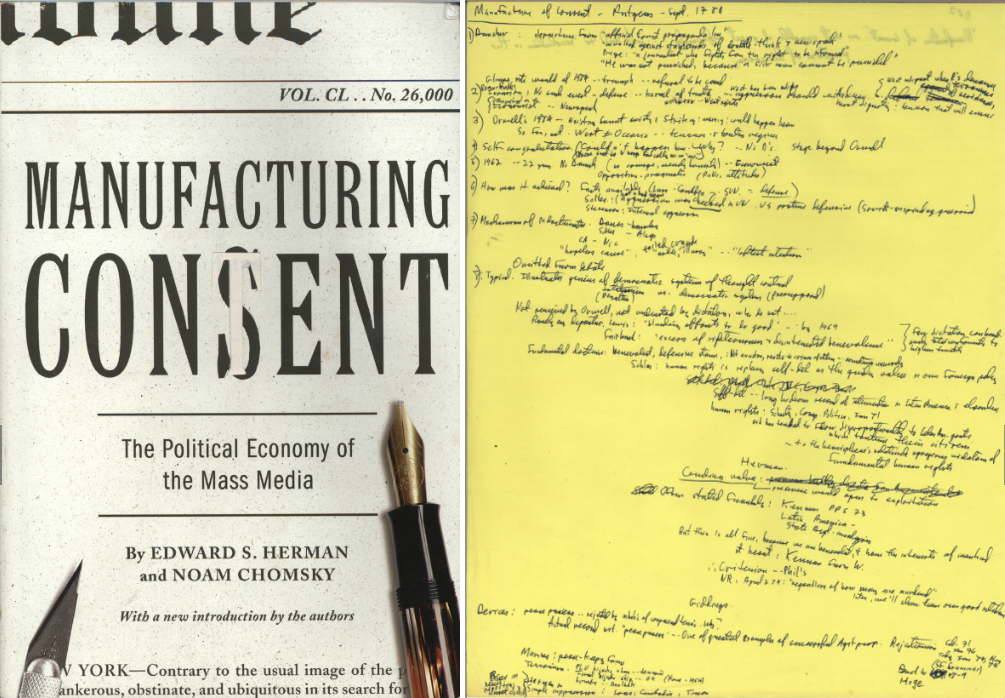
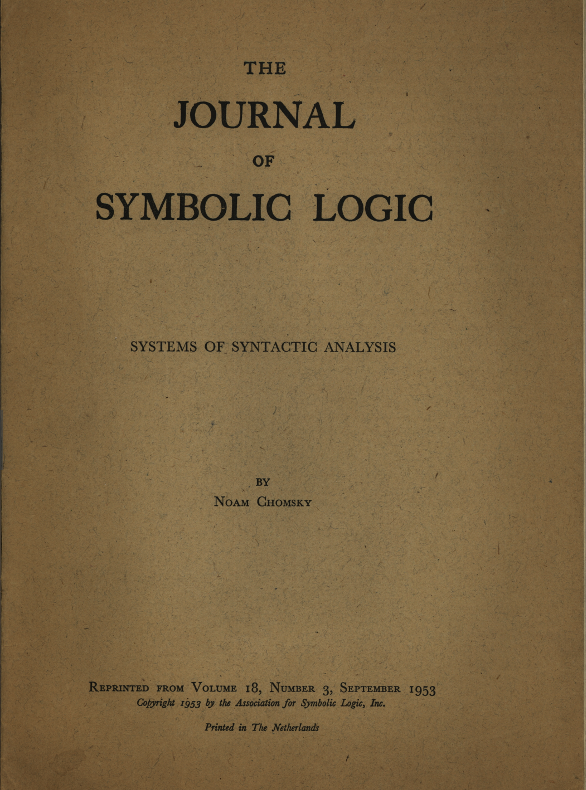
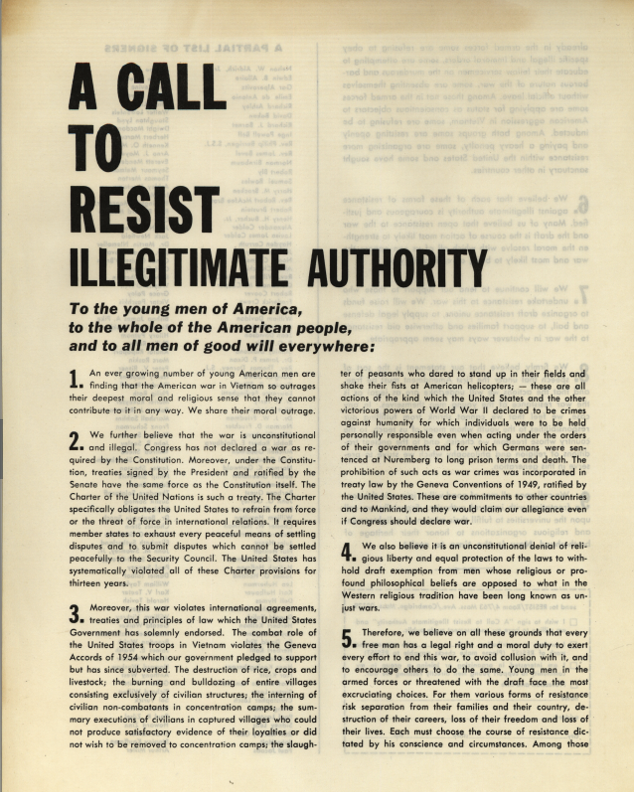
Those contents include the 1953 paper “Systems of Syntactic Analysis,” which “appears to be Chomsky’s first foray in print of what would become transformational generative grammar.” Also archived are notes from a 1984 talk on “Manufacturing Consent” given at Rutgers University, outlining the ideas Chomsky and Edward S. Herman would fully explore in the 1988 book of the same name on “the political economy of the mass media.” And in the category of “activism,” we find materials like the newsletter below, published by an anti-war organization Chomsky co-founded in the 60s called RESIST.
MIT hopes to “digitize the hundreds of thousands of pieces” in the collection, “to make it accessible to the public.” Such a massive undertaking exceeds the library’s budget, so they have asked for financial support. At unBoxing the Chomsky Archive, you can make a donation, or just peruse the slideshow previews and consider the legacy of one of the U.S.’s most formidable living scientific and political thinkers.
Related Content:
Read 9 Free Books By Noam Chomsky Online
Josh Jones is a writer and musician based in Durham, NC. Follow him at @jdmagness
Read More...The Philosophy of Rick and Morty: What Everyone’s New Favorite Cartoon Has in Common with Albert Camus
“Nobody exists on purpose, nobody belongs anywhere, everybody’s gonna die.” So, in one episode of Rick and Morty, says the fourteen-year-old Morty Smith, one of the show’s titular co-protagonists. With the other, a mad scientist by the name of Rick Sanchez, who also happens to be Morty’s grandfather, he constitutes the animated team that has entertained thousands and thousands of viewers — and made insatiable fans of seemingly all of them — over the past four years. To those few who haven’t yet seen the show, it may just look like a silly cartoon, but the true fans understand that underneath all of the memorable gags and quotable lines lies an unusual philosophical depth.
“The human desire to fulfill some special existential purpose has existed throughout history,” says video essayist Will Schoder in his analysis of the philosophy of Rick and Morty. But the titular duo’s adventures through all possible realities of the “multiverse” ensure that they experience firsthand the utter meaninglessness of each individual reality.
When Morty breaks that bleak-sounding news to his sister Summer with the now oft-quoted line above, he actually delivers a “comforting message”: once you confront the randomness of the universe, as Rick and Morty constantly do, “the only option is to find importance in the stuff right in front of you,” and their adventures show that “friends, family, and doing what we enjoy are far more important than any unsolvable questions about existence.”
Schoder, also the author of a video essay on Rick and Morty co-creator Dan Harmon’s mythological storytelling technique as well as one we’ve previously featured about David Foster Wallace’s critique of postmodernism, makes the clear philosophical connection to Albert Camus. The philosopher and author of The Stranger wrote and thought a great deal about the “contradiction between humans’ desire to find meaning in life and the meaninglessness of the universe,” and the absurdity that results, a notion the cartoon has dramatized over and over again, with an ever-heightening absurdity. We must, like Sisyphus eternally pushing his rock uphill, recognize the true nature of our situation yet defiantly continue “to explore and search for meaning.” Morty, as any fan well knows, offers Summer another solution to her despair: “Come watch TV.”
Related Content:
David Foster Wallace on What’s Wrong with Postmodernism: A Video Essay
The Philosophy of The Matrix: From Plato and Descartes, to Eastern Philosophy
The Philosophy of Bill Murray: The Intellectual Foundations of His Comedic Persona
Based in Seoul, Colin Marshall writes and broadcasts on cities and culture. His projects include the book The Stateless City: a Walk through 21st-Century Los Angeles and the video series The City in Cinema. Follow him on Twitter at @colinmarshall or on Facebook.
Read More...The Colors of Mister Rogers’ Hand-Knit Sweaters from 1979 to 2001: A Visual Graph Created with Data Science
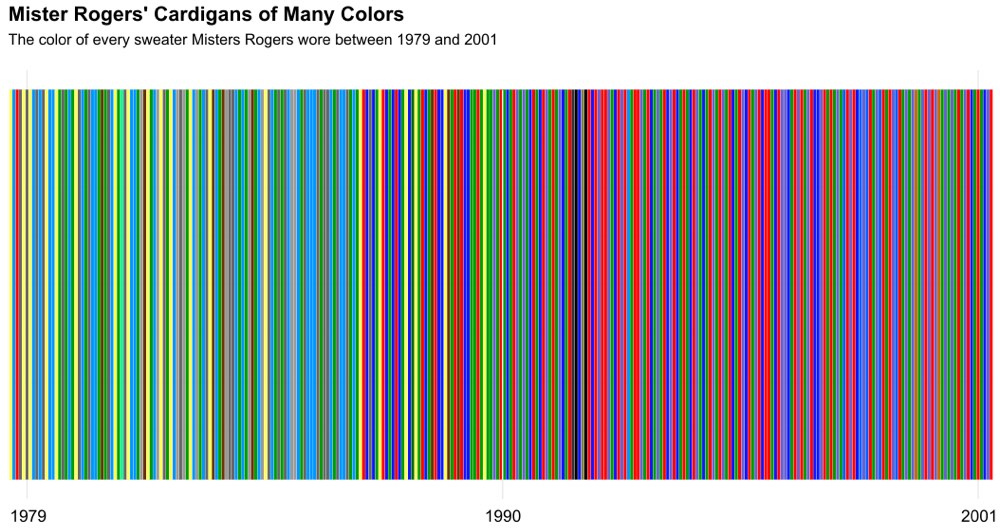
Writer Owen Phillips may be a solid data analyst, but I suspect he’s not much of a knitter.
The software he used to run a scientific analysis of 22 years worth of Fred Rogers’ sweaters ultimately reduces the beloved children’s television host’s homey zip-front cardigans to a slick graphic of colorful bars.
A knitter would no doubt prioritize other types of patterns — stitch numbers, wool weight, cable variations…the sort of information Mister Rogers’ mother, Nancy, would have had at her fingertips.
As Mister Rogers reveals in the story of his sweaters, his mom was the knitter behind many of the on-air sweaters Phillips crunched with R code. Whether their subtly shifting palette reflects an adventurous spirit on the part of the maker or the recipient’s evolving taste is not for us to know.
After Mrs. Rogers’ death, producers had to resort to buying similar models. Many of her originals had worn through or been donated to charity events.
“Not an easy challenge in the 80’s and 90s,” Margy Whitmer, a producer of Mister Rogers’ Neighborhood told Rewire. “It certainly wasn’t in style! But we found a company who made cotton ones that were similar, so we bought a bunch and dyed them.”
(A moment of silent gratitude that no one tried to shoehorn Fred Rogers into a Cosby Show sweater…)
It would be interesting to see what Phillips’ code could do with faulty viewer memories.
His input for the Mister Rogers’ Cardigans of Many Colors project was a chart on super fan Tim Lybarger’s Neighborhood Archive detailing the hue of every sweater Mister Rogers changed into on-camera from 1979 to 2001.
Without samples of the actual sweaters, Lybarger’s color chart could only be approximate, but unlike viewers’ fading memories, it’s rooted in his own visual observations of distinct episodes. Aging fans tend to jettison Rogers’ spectral reality in favor of a single shade, the bright red in which he greeted Wicked Witch of the West Margaret Hamilton in 1975, say, or the pleasant mouse-colored number he sported for a 1985 breakdancing session with a visiting 12-year-old.
For those who’d rather code than purl, Phillips shares MrRogers.R, the program he used to scrape the Neighborhood Archive for Mister Rogers daily sweater colors.
Then have a look at Rogers’ sweaters as rendered by Phillips’ fellow data geek, Alan Joyce, who tinkered with Phillips’ code to produce a gradient image.
Related Content:
Mr. Rogers Takes Breakdancing Lessons from a 12-Year-Old (1985)
Ayun Halliday is an author, illustrator, theater maker and Chief Primatologist of the East Village Inky zine. Her current project is Theater of the Apes Sub-Adult Division’s fast approaching production of Animal Farm at the Tank in New York City. Follow her @AyunHalliday.
Read More...Every Academy Award Winner for Best Cinematography in One Supercut: From 1927’s Sunrise to 2016’s La La Land
A list of chronological Oscar winners often tells you more about the state of the culture than the state of the art. That is very true when it comes to Best Picture, with musicals and epics taking home the Academy Award during one decade, but being largely forgotten the next. So too is the award for Best Cinematography, as seen in the seven-minute supercut above. Showing every Academy Award winning cinematographer and their films, the supercut’s choices for the one or two shots that sum up a brilliantly lit picture do make the Academy’s decision at least justified. But it is surprising how quickly so many of these films have slipped from the public’s consciousness. (Like 2003’s Master and Commander–when’s the last time you thought about that film?)
When the Academy first started giving awards for cinematography, it went to the person first, not the picture and the person involved. So when Karl Struss and Charles Rosher were nominated for–ostensibly–their work on F.W. Murnau’s classic Sunrise–they also got credited for the five other films they had shot that year.
The current system was worked out in 1931, although up to 1967 awards went–and I think rightly so!–to color and black and white separately. (And, to further complicate things, the color award was considered a “special achievement” award for a while until Gone with the Wind pretty much necessitated a change in priorities.) After 1967, the only black and white film to win was Schindler’s List.
Somebody with way more viewing experience should weigh in on what makes a lot of these films Oscar-worthy in their cinematography, but it does seem that at least through the 1960s, the Academy loved bold use of saturated colors for one category, and an almost abstract use of high contrast shadow and light for the other.
Other notables: Alfred Hitchcock’s To Catch a Thief (a rather minor work) and Rebecca (a much better one) were his only two films to get the nod, with awards going to Robert Burks (but not for his work on Vertigo, Rear Window, North by Northwest) and George Barnes respectively. Stanley Kubrick has had two of his films win, with Russell Metty for Spartacus and John Alcott for Barry Lyndon. (But not Gilbert Taylor for Dr. Strangelove!)
Stanley Kubrick has done slightly better, with Russell Metty for Spartacus and John Alcott for Barry Lyndon. (But not Gilbert Taylor for Dr. Strangelove!) Martin Scorsese’s Hugo and The Aviator both earned statues for Robert Richardson (who also won for Oliver Stone’s JFK). Roger Deakins has never won, though he’s been nominated 13 times, twice in 2007 for both No Country for Old Men and The Assassination of Jesse James by the Coward Robert Ford.
And the most awarded cinematographer? That’s a tie at four Oscars each for Leon Shamroy (The Black Swan, Wilson, Leave Her to Heaven, and the studio-destroying bomb Cleopatra); and Joseph Ruttenberg (The Great Waltz, Mrs. Miniver, Somebody Up There Likes Me, and Gigi).
Make of this list what you will. (And feel free to do so in the comments!)
Related Content:
Signature Shots from the Films of Stanley Kubrick: One-Point Perspective
The History of the Movie Camera in Four Minutes: From the Lumiere Brothers to Google Glass
Ted Mills is a freelance writer on the arts who currently hosts the artist interview-based FunkZone Podcast and is the producer of KCRW’s Curious Coast. You can also follow him on Twitter at @tedmills, read his other arts writing at tedmills.com and/or watch his films here.
Read More...Support Us
We're hoping to rely on loyal readers, rather than erratic ads. Please click the Donate button and support Open Culture. You can use Paypal, Venmo, Patreon, even Crypto! We thank you!

About Us

Open Culture scours the web for the best educational media. We find the free courses and audio books you need, the language lessons & educational videos you want, and plenty of enlightenment in between.
Advertise With Us
FREE UPDATES!
GET OUR DAILY EMAIL
Get the best cultural and educational resources on the web curated for you in a daily email. We never spam. Unsubscribe at any time.
FOLLOW ON SOCIAL MEDIA
Open Culture editor Dan Colman scours the web for the best educational media. He finds the free courses and audio books you need, the language lessons & movies you want, and plenty of enlightenment in between.
Advertise With Us


