Watch an Episode of TV-CBGB, the First Rock ‘n’ Roll Sitcom Ever Aired on Cable TV (1981)
For a good long while, or at least a few decades, the best things on TV in the U.S. happened outside the major broadcast and national cable networks. And like a great many other cultural happenings of the previous century, you would have to live in New York to experience them. I mean, of course, the weird, wonderful world of Manhattan public access cable TV. Here you could watch, for example, Glenn O’Brien’s TV Party, created by the titular host as “a drug-fueled re-interpretation of Hugh Hefner’s Playboy After Dark”—as we noted in a recent post—and featuring the most cutting-edge artists and musicians of the day.
Around the same time, Andy Warhol conducted his version of a celebrity interview show on local cable, and as the banal infotainment of daytime talk show and 24-hour-cable news developed on mainstream TV, a dozen bizarre, hilarious, raunchy, and ridiculous interview and call-in shows took hold on New York cable access in the years to follow (some of them still exist).
I happened to catch the tail end of this golden era, which tapered off in the nineties as the internet took over for the communities these shows served. But oh, what it must have been like to watch the thriving downtown scene document itself on TV from week-to-week, alongside the legendarily flamboyant Manhattan subcultures that found their voices on cable access?
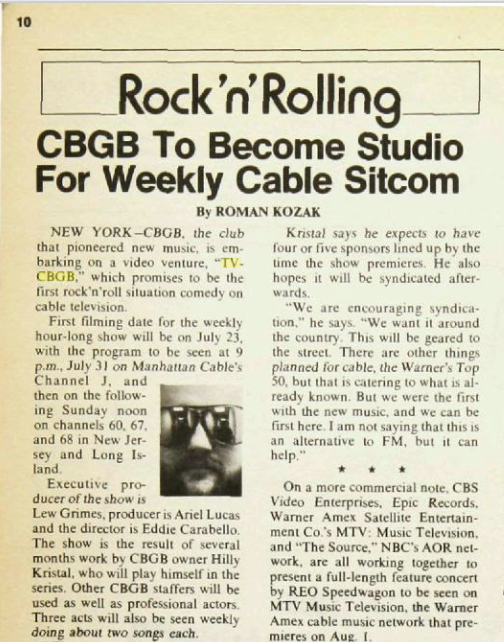
Quite a few people remember it well, and were thrilled when the video at the top emerged from obscurity: an episode of TV-CBGB shot in 1981, “an odd glimpse,” writes Martin Schneider at Dangerous Minds, “of a CBGB identity that never took shape, as a cable access mainstay.” It is unclear how many episodes of the show were shot, or aired, or still exist in some form, but what we do have above seems representative, according to two Billboard articles describing the show. The first, from July 11, 1981, called the project “the first rock’n’roll situation comedy on cable television.”
Created by CBGBs owner, Hilly Kristal, the show aimed to give viewers slices of life from the Bowery institution, which was already famous, according to Billboard, as “the club that pioneered new music.” Kristal told the trade magazine, “There will always be a plot, though a simple plot. It will be about what happens in the club, or what could happen.” He then goes on to describe a series of plot ideas which, thankfully, didn’t dominate the show—or at least what we see of it above. The episode is “90% performance,” though “not true concert footage,” Schneider writes.
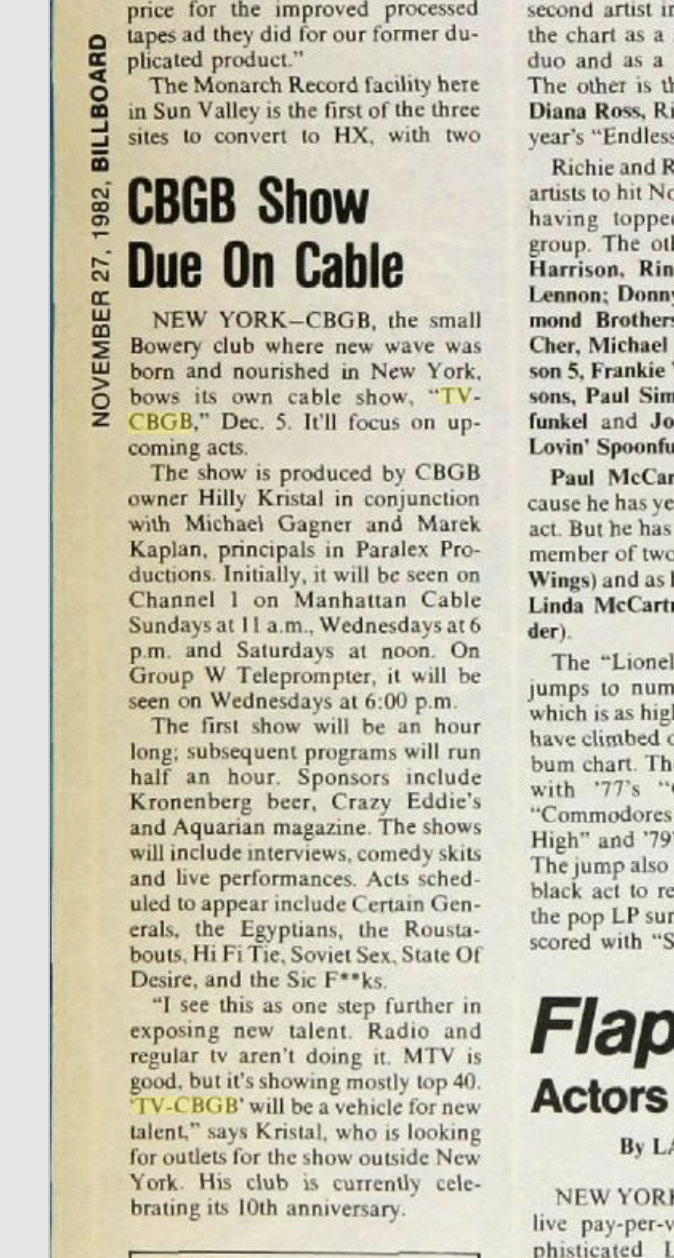
After an odd opening intro, we’re thrown into a song from Idiot Savant. Other acts include The Roustabouts, The Hard, Jo Marshall, Shrapnel, and Sic Fucks. While not among the best or most well-known to play at the club, these bands put on some excellent performances. By November of the following year, it seems the first episode had still not yet aired. Billboard quotes Kristal as calling TV-CBGB “one step further in exposing new talent. Radio and regular tv aren’t doing it. MTV is good, but it’s showing mostly top 40.”
Had the show migrated to MTV, Schneider speculates, it might have become a “national TV icon,” fulfilling Kristal’s vision for a new means of bringing obscure downtown New York musicians to the world at large. It might have worked. Though the sketches are lackluster, notable as historical curiosities, the music is what makes it worthwhile, and there’s some really fun stuff here—vital and dramatic. While these bands may not have had the mass appeal of, say, Blondie or the Ramones, they were stalwarts of the early 80s CBGB scene.
The awkward, strangely earnest, and often downright goofy skits portraying the goings-on in the lives of club regulars and employees are both somehow touching and tedious, but with a little polish and better direction, the whole thing might have played like a punk rock version of Fame—which maybe no one needed. As it stands, given the enthusiasm of several YouTube commenters who claim to have watched it at the time or been in the club themselves, the episode constitutes a strange and rare document of what was, if not what could have been.
Related Content:
Take a Virtual Tour of CBGB, the Early Home of Punk and New Wave
CBGB is Reborn … As a Restaurant in Newark Airport
When Glenn O’Brien’s TV Party Brought Klaus Nomi, Blondie & Basquiat to Public Access TV (1978–82)
Josh Jones is a writer and musician based in Durham, NC. Follow him at @jdmagness
Read More...Free, Open Source Modular Synth Software Lets You Create 70s & 80s Electronic Music—Without Having to Pay Thousands for a Real-World Synthesizer
In the past decade or so, the analog modular synth—of the kind pioneered by Robert Moog and Don Buchla—has made a comeback, creating a booming niche market full of musicians chasing the sounds of the 70s and 80s. These inscrutable racks of patchbays, oscillators, filters, etc. look to the non-initiated more like telephone operator stations of old than musical instruments. But the sounds they produce are sublime and otherworldly, with a saturated warmth unparalleled in the digital world.
But while analog technology may have perfected certain tones, one can’t beat the convenience of digital recording, with its nearly unlimited multi-tracking capability, ability to save settings, and the ease of editing and arranging in the computer. Digital audio workstations have become increasingly sophisticated, able to emulate with “plug-ins” the capabilities of sought-after analog studio gear of the past. It has taken a bit longer for virtual instruments to meet this same standard, but they may be nearly there.

Only the most finely-tuned ears, for example, can hear the difference between the highest-quality digitally modeled guitar amplifiers and effects and their real-world counterparts in the mix. Even the most high-end modeling packages don’t cost as much as their real life counterparts, and many also come free in limited versions. So too the wealth of analog synth software, modeled to sound convincingly like the old and newly reissued analog boxes that can run into the many thousands of dollars to collect and connect.
One such collection of synths, the VCV Rack, offers open-source virtual modular synths almost entirely free, with only a few at very modest prices. The standalone virtual rack works without any additional software. Once you’ve created an account and installed it, you can start adding dozens of plug-ins, including various synthesizers, gates, reverbs, compressors, sequencers, keyboards, etc. “It’s pretty transformative stuff,” writes CDM. “You can run virtual modules to synthesize and process sounds, both those emulating real hardware and many that exist only in software.”
The learning curve is plenty steep for those who haven’t handled this perplexing technology outside the box. A series of YouTube tutorials, a few of which you can see here, can get you going in short order. Those already experienced with the real-world stuff will delight in the expanded capabilities of the digital versions, as well as the fidelity with which these plug-ins emulate real equipment—without the need for a roomful of cables, unwieldly racks, and soldiering irons and spare parts for those inevitable bad connections and broken switches and inputs.
You can download the virtual rack here, then follow the instructions to load as many plug-ins as you like. CDM has instructions for the developer version (find the source code here), and a YouTube series called Modular Curiosity demonstrates how to install the rack and use the various plugins (see their first video further up and find the rest here). Modular System Beginner Tutorial is another YouTube guide, with five different videos. See number one above and the rest here. The longer video at the top of the post offers a “first look and noob tutorial.”
VCV Rack is only the latest of many virtual modular synths, including Native Instruments’ Reaktor Blocks and Softube’s Modular. “But these come with a hefty price tag,” notes FACT magazine. “VCV Rack can be downloaded for free on Linux, Mac and Windows platform.” And if you’re wondering how it stacks up against the real-life boxes it emulates, check out the video below.
Related Content:
How the Moog Synthesizer Changed the Sound of Music
The Mastermind of Devo, Mark Mothersbaugh, Shows Off His Synthesizer Collection
Josh Jones is a writer and musician based in Durham, NC. Follow him at @jdmagness.
Read More...Watch Every Episode of Bob Ross’ The Joy Of Painting Free Online: 403 Episodes Spanning 31 Seasons
Whether your New Year’s resolution involves taking up painting, managing stress, cultivating a more positive outlook, or building a business empire, the late television artist Bob Ross can help you stick it out.
Like Fred Rogers’ Mr Rogers’ Neighborhood, Ross’ long-running PBS show, The Joy of Painting, did not disappear from view following its creator’s demise. For over twenty years, new fans have continued to seek out the half-hour long instructional videos, along with its mesmerizingly mellow, easily spoofed host.
Now all 403 episodes have been made available for free on Ross’ official Youtube channel. That covers all 31 seasons.
It’s said that 90% of the regular viewers tuning in to watch Ross crank out his signature “wet-on-wet” landscapes never took up a brush, despite his belief that, with a bit of encouragement, anyone can paint.
Perhaps they preferred sad clowns or big-eyed children to scenic landscapes of the sort that would not have looked out of place in a 1970’s motel.… Or perhaps Ross, himself, was the big draw.
Like Mister Rogers, Ross spoke softly, using direct address to create an impression of intimacy between himself and the viewer. Twenty years in the military had soured him on barked-out, rigid instructions. Instead, Ross reassured less experienced painters that the 16th-century ”Alla Prima” technique he brought to the masses could never result in mistakes, only “happy accidents.” He was patient and kind and he didn’t take his own abilities too seriously, though he seemed like he would certainly have taken pleasure in yours.
Ross’ Land of Make Believe was a character-free natural world, in which many of the same elements appear over and over. According to Five Thirty Eight culture editor Walt Hickey’s statistical analysis, trees reigned supreme. The real life landscapes he observed as first sergeant of the U.S. Air Force Clinic at Eielson Air Force Base in Alaska became his lifelong subject, and by extension, that of untold numbers of home viewers.
His devotees may be content just seeing “happy little trees” and “pretty little mountains” bloom on canvas, but in an interview with NPR, Ross’ business partner, Annette Kowalski, suggests that he would not have been.
The gentle, forest-and-cloud-loving host was also an ambitious and highly focused businessman, who used TV as the medium for his success. Every folksy comment was rehearsed before filming and he stuck with the permed hairdo he loathed, rather than scrapping what had become a highly visual brand identifier.
Where there’s a will, there’s a way.
Watch all 31 seasons of Bob Ross’ The Joy of Painting here, or right here on this page. Official Bob Ross painting kits are widely available online, or source your own using a cobbled together supply list.
Season Three
Season Four
Season Five
Season Six
We will continuing adding seasons to this list as they become available.
Season Seven
Season Eight
Season Nine
Season Ten
Season 11
Season 12
Season 13
Season 14
Season 15
Season 16
Season 17
Season 18
Season 19
Season 20
Season 21
Season 22
Season 23
Season 24
Season 25
Season 26
Season 27
Season 28
Season 29
Season 30
Season 31
Related Content:
Watch Bob Ross’ The Joy of Painting, Seasons 1–3, Free Online
Mr. Rogers Goes to Congress and Saves PBS: Heartwarming Video from 1969
Stream 23 Free Documentaries from PBS’ Award-Winning American Experience Series
Ayun Halliday is an author, illustrator, theater maker and Chief Primatologist of the East Village Inky zine. Her resolution is to spend less time online, but you can still follow her @AyunHalliday.
Read More...The 10 Most Popular Courses on Coursera in 2017 (and 2,000 Courses You Can Take for Free in January, 2018)
Back in 2012, Coursera started offering MOOCS (Massive Open Online Courses) to the world at large. And they’ve since amassed some 28 million registered users, a catalogue of 2,000 courses, and reams of data about what people want to learn. In the waning days of December, Coursera published a list of their 1o most popular courses of 2017. (Find below, and enroll in any of these courses for free.) From this list, it drew some larger conclusions about trends in education and technology.
The list shows, writes Nikhil Sinha, Coursera’s Chief Content Officer, that “cutting-edge tech skills continue to be the most sought after in online education.” Artificial intelligence–encompassing Machine Learning, Neural Networks and Deep Learning–topped the list of courses. Meanwhile “Blockchain has also burst onto the scene, putting Princeton’s Bitcoin and Cryptocurrency course at number five on the list.” But, Sinha adds, it’s “not just technology skills that are trending.” The “basic learning and information-retention skills taught in our popular Learning How to Learn course are extremely sought-after by people of all ages.” The same applies to the problem-solving skills taught by Stanford’s Introduction to Mathematical Thinking.
You can review the Top 10 list below, and enroll in any of those regularly-offered courses.
- Machine Learning: A primer from Stanford University on getting computers to act without being explicitly programmed.
- Neural Networks and Deep Learning: Building on the course above, this course will teach you to feed a computer system a lot of data, which it can then use to make decisions about other data.
- Learning How to Learn: Powerful Mental Tools to Help You Master Tough Subjects: The most popular MOOC ever, this course developed by Dr. Barbara Oakley gives you access to the invaluable learning techniques used by experts in art, music, literature, math, science, sports, and many other disciplines.
- Introduction to Mathematical Thinking: Stanford University will teach you a style of thinking that will help you think outside the box and solve real problems in the everyday world.
- Bitcoin and Cryptocurrency Technologies: From Princeton University comes a course that explains what is special about Bitcoin, and how it works at a technical level.
- Programming for Everybody (Getting Started with Python): The University of Michigan offers a course everyone should take–a primer on the basics of programming computers, using Python.
- Algorithms, Part I: Princeton’s course covers “essential information that every serious programmer needs to know about algorithms and data structures, with emphasis on applications and scientific performance analysis of Java implementations.”
- English for Career Development: Created by the University of Pennsylvania, this course is for non-native English speakers “interested in advancing their careers in the global marketplace.” Along the way, you’ll learn about the job search, application, and interview process in the U.S., and also explore your own global career path.
- Neural Networks for Machine Learning: The University of Toronto gives you the chance to “learn about artificial neural networks and how they’re being used for machine learning, as applied to speech and object recognition, image segmentation, modeling language and human motion, etc.”
- Financial Markets: Created by Yale’s Robert Shiller (winner of the Nobel Prize in Economics), this course offers an overview of the financial markets, which allow human society to manage risks and foster enterprise. It includes an introduction to risk management and behavioral finance principles underlying the securities, insurance, and banking industries.
Note: Open Culture has a partnership with Coursera. If readers enroll in certain Coursera courses, it helps support Open Culture.
Related Content:
Learning How to Learn: The Most Popular MOOC of All Time
Read More...Invisible Cities Illustrated: Artist Illustrates Each and Every City in Italo Calvino’s Classic Novel

If you want to read a book about cities, you still can’t do much better than a slim, plotless work of fiction by Italo Calvino wherein the explorer Marco Polo tells the emperor Kublai Khan of what he’s seen in his travels across the world. Originally published in Italian in 1972, Invisible Cities has inspired generations of readers, hailing from all across the world themselves, to think in entirely new ways not just about cities but about travel, place, perception, reality, myth, and literature itself. Though very much a work concerned with what’s seen only in the imagination, the book has also inspired artists to try their hand at rendering the 55 fictitious cities Polo describes within.

A few years ago we featured “Seeing Calvino,” a joint effort by artists Matt Kish, Leighton Connor, Joe Kuth to illustrate, among other elements of the Calvino canon, each and every one of Invisible Cities’ fantastical, often impossible collections of structures, lives, and, ideas. More recently, the Peru-based architect and artist Karina Puente has, with her Invisible Cities Project, put herself to work on a similar endeavor. Each of Puente’s intricate renderings takes about a week to produce, and as she tells Archdaily, “they are not only drawn – I use different types of paper and draw on each one before cutting them out with exacto knives. All the drawings are composed of layers of paper which are cut out and glued.”
At the top we have Puente’s city of Dorotea where, bearing in mind the rules of its infrastructural division by gates, drawbridges, and canals and those of the marriages between the trading families that reside there, “you can then work from these facts until you learn everything you wish about the city in the past, present, and future.” In the middle is Isaura, a city built on a deep subterranean lake whose gods, “according to some people, live in the depths,” and to others live in the associated buckets, pump handles, windmill blades, pipes, and every other built element of this “city that moves entirely upward.”

Just above you can see Zobeide, laid out according to a series of dreams of “a woman running at night through an unknown city,” pursued but never found, altered to conform to each dream until new arrivals “could not understand what drew these people to Zobeide, this ugly city, this trap.” While at first Polo’s descriptions of the cities all across Khan’s empire may strike readers as completely fantastical, they’ll soon hear echoes of the places they live in in these metaphorical metropolises. And if they take a look at Puente’s illustrations as they read, they’ll see them as well.
Visit Puente’s Invisible Cities Project here.
via Archdaily
Related Content:
Invisible Cities Illustrated: Three Artists Paint Every City in Italo Calvino’s Classic Novel
Italo Calvino Offers 14 Reasons We Should Read the Classics
Based in Seoul, Colin Marshall writes and broadcasts on cities and culture. His projects include the book The Stateless City: a Walk through 21st-Century Los Angeles and the video series The City in Cinema. Follow him on Twitter at @colinmarshall or on Facebook.
Read More...How the Japanese Practice of “Forest Bathing”—Or Just Hanging Out in the Woods—Can Lower Stress Levels and Fight Disease
When the U.S. media began reporting on the phenomenon of “forest bathing” as a therapy for mental and physical health, the online commentariat—as it will—mocked the concept relentlessly as yet another pretentious, bourgeois repackaging of something thoroughly mundane. Didn’t we just used to call it “going outside”?
Well, yes, if all “forest bathing” means is “going outside,” then it does sound like a grandiose and unnecessary phrase. The term, however, is not an American marketing invention but a translation of the Japanese shinrin-yoku. “Coined by the Japanese Ministry of Agriculture, Forestry and Fisheries in 1982,” writes Meeri Kim at The Washington Post, “the word literally translates to ‘taking in the forest atmosphere’ or ‘forest bathing’ and refers to the process of soaking up the sights, smells and sounds of a natural setting to promote physiological and psychological health.”
So what? We already have the examples of thousands years of Buddhist monks (and Thich Nat Hanh), of Henry David Thoreau, and the saints of the Sierra Club. But the oldest and most useful ideas and practices can get carelessly discarded in the frantic pursuit of innovation at all costs. The pushing of hi-tech outdoor gear, wearable activity trackers, and health apps that ask us to log every movement can make going outside feel like a daunting, expensive chore or a competitive event.
Forest bathing involves none of those things. “Just be with the trees,” as Ephrat Livni describes the practice, “no hiking, no counting steps on a Fitbit. You can sit or meander, but the point is to relax rather than accomplish anything.” You don’t have to hug the trees if you don’t want to, but at least sit under one for a spell. Even if you don’t attain enlightenment, you very well may reduce stress and boost immune function, according to several Japanese studies conducted between 2004 and 2012.
The Japanese government spent around four million dollars on studies conducted with hundreds of people “bathing” on 48 designated therapy trails. In his work, Qing Li, associate professor at Nippon Medical School in Tokyo, found “significant increases in NK [natural killer] cell activity in the week after a forest visit… positive effects lasted a month following each weekend in the woods.” Natural killer cells fight viruses and cancers, and are apparently stimulated by the oils that trees themselves secrete to ward off germs and pests. See the professor explain in the video above (he translates shinrin-yoku as taking a “forest shower,” and also claims to have bottled some of the effects).
Additionally, experiments conducted by Japan’s Chiba University found that forest bathing lowered heart rate and blood pressure and brought down levels of cortisol, the stress hormone that can wreak havoc on every system when large amounts circulate through the body. Then there are the less tangible psychological benefits of taking in the trees. Subjects in one study “showed significantly reduced hostility and depression scores” after a walk in the woods. These findings underscore that spending time in the forest is a medical intervention as well as an aesthetic and spiritual one, something scientists have long observed but haven’t been able to quantify.
In their review of a book called Your Brain on Nature, Mother Earth News quotes Franklin Hough, first chief of the U.S. Division of Forestry, who remarked in a 19th century medical journal that forests have “a cheerful and tranquilizing influence which they exert upon the mind, more especially when worn down by mental labor.” Hough’s hypothesis has been confirmed, and despite what might sound to English speakers like a slightly ridiculous name, forest bathing is serious therapy, especially for the ever-increasing number of urbanites and those who spend their days in strip malls, office complexes, and other overbuilt environments.
What is a guided forest bathing experience like? You can listen to NPR’s Alison Aubrey describe one above. She quotes Amos Clifford, founder of the Association of Nature & Forest Therapy, the certifying organization, as saying that a guide “helps you be here, not there,” sort of like a meditation instructor. Clifford has been pushing health care providers to “incorporate forest therapy as a stress-reduction strategy” in the U.S., and there’s no question that more stress reduction tools are sorely needed.
But, you may wonder, do you have to call it “forest bathing,” or pay for a certified guide, join a group, and buy some fancy outerwear to get the benefits hanging out with trees? I say, consider the words of John Muir, the indefatigable 19th naturalist, “father of the National Park System,” and founding saint of the Sierra Club: In the eternal youth of Nature you may renew your own. Go quietly, alone; no harm will befall you. The quote may underestimate the amount of risk or overstate the benefits, but you get the idea. Muir was not one to get tangled up in semantics or overly detailed analysis. Nonetheless, his work inspired Americans to step in and preserve so much of the country’s forest in the 19th and 20th centuries. Maybe the preventative medicine of “forest bathing” can help do the same in the 21st.
Related Content:
Josh Jones is a writer and musician based in Durham, NC. Follow him at @jdmagness
Read More...Underground Cartoonist Robert Crumb Creates an Illustrated Introduction to Franz Kafka’s Life and Work
The use of an author’s name as an adjective to describe some kind of general style can seem, well, lazy, in a wink-wink, “you know what I mean,” kind of way. One must leave it to readers to decide whether deploying a “Baldwinian” or a “Woolfian,” or an “Orwellian” or “Dickensian,” is justified. When it comes to “Kafkaesque,” we may find reason to consider abandoning the word altogether. Not because we don’t know what it means, but because we think it means what Kafka meant, rather than what he wrote. Maybe turning him into shorthand, “a clever reference,” writes Chris Barsanti, prepares us to seriously misunderstand his work.
The problem motivated author David Zane Mairowitz and underground comics legend Robert Crumb to create a graphic biography, first published in 1990 as Kafka for Beginners. “The book,” writes Barsanti of a 2007 Fantographics edition called Kafka, “states its case rather plain: ‘No writer of our time, and probably none since Shakespeare, has been so widely over-interpreted and pigeon holed… [Kafkaesque] is an adjective that takes on almost mythic proportions in our time, irrevocably tied to fantasies of doom and gloom, ignoring the intricate Jewish Joke that weaves itself through the bulk of Kafka’s work.’” Or, as Maria Popova puts it, “Kafka’s stories, however grim, are nearly always also… funny.”
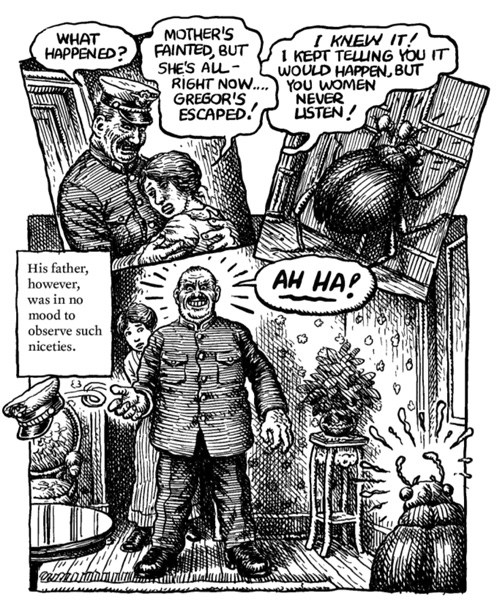
Much of that humor derives from “the author’s coping mechanisms amid Prague’s anti-Semitic cultural climate.” Mairowitz describes Kafka’s Jewish humor as “healthy anti-Semitism.… but sooner or later, even the most hateful of Jewish self-hatreds has to turn around and laugh at itself.” Crumb provides graphic illustrations of Kafka’s especially mordant, absurdist humor in adaptations of The Metamorphosis, A Hunger Artist, In the Penal Colony, and The Judgement and brief sketches from The Trial, The Castle, and Amerika. These illustrations draw out the grotesque nature of Kafka’s humor from the start, Barstanti notes, “with a gruesome graphic rendering of Kafka’s nightmares of his own death.”
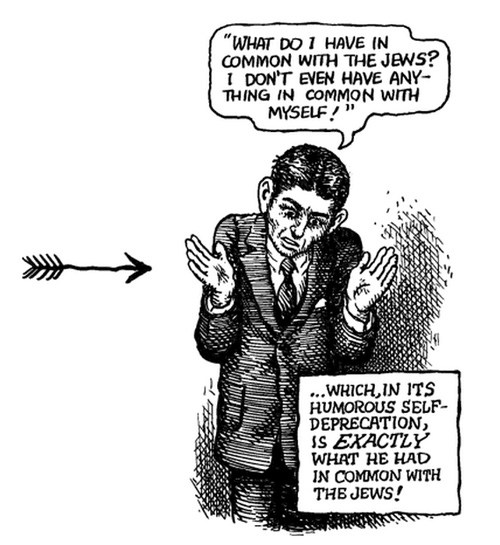
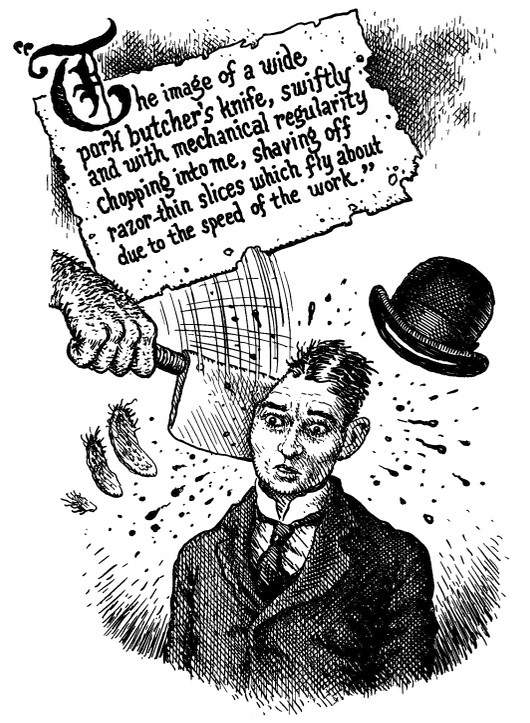
Kafka’s self-violence leaps out at us in its incredible specificity, which can produce horrors, like the ghoulish execution of “In the Penal Colony,” and darkly funny fantasies like a “pork butcher’s knife” sending thin slices of Kafka flying around the room, “due to the speed of the work.” Turned into cold cuts, as it were. Crumb’s illustration (top), imagines this grisly joke with exquisite glee—halo of blood spurts like squiggly exclamation marks and bowler hat taking flight. Along with Mairowitz’s literary analysis and biographical detail, Crumb’s finely rendered illustrations make Kafka an “invaluable book,” Barsanti writes, one that gives Kafka “back his soul.”
One only wishes they had paid more attention to Kafka’s weird animal stories, some of the funniest he ever wrote. Stories like “Investigations of a Dog” and “In Our Synagogue” express with more vivid imagination and wicked humor Kafka’s profoundly ambivalent relationship to Judaism and to himself as a “tortured, gentle, cruel, and brilliant,” and yet very funny, outsider.
Related Content:
What Does “Kafkaesque” Really Mean? A Short Animated Video Explains
Robert Crumb Illustrates Philip K. Dick’s Infamous, Hallucinatory Meeting with God (1974)
Josh Jones is a writer and musician based in Durham, NC. Follow him at @jdmagness
Read More...How Scientology Works: A Primer Based on a Reading of Paul Thomas Anderson’s Film, The Master
Paul Thomas Anderson’s The Master focuses, with almost unbearable intensity, on two characters: Joaquin Phoenix’s impulsive ex-sailor Freddie Quell, and Philip Seymour Hoffman’s Lancaster Dodd, “the founder and magnetic core of the Cause — a cluster of folk who believe, among other things, that our souls, which predate the foundation of the Earth, are no more than temporary residents of our frail bodily housing,” writes The New Yorker’s Anthony Lane in his review of the film. “Any relation to persons living, dead, or Scientological is, of course, entirely coincidental.”
Before The Master came out, rumor built up that the film mounted a scathing critique of the Church of Scientology; now, we know that it accomplishes something, par for the course for Anderson, much more fascinating and artistically idiosyncratic.
Few of its gloriously 65-millimeter-shot scenes seem to have much to say, at least directly, about Scientology or any other system of thought. But perhaps the most memorable, in which Dodd, having discovered Freddie stown away aboard his chartered yacht, offers him a session of “informal processing,” does indeed have much to do with the faith founded by L. Ron Hubbard — at least if you believe the analysis of Evan Puschak, better known as the Nerdwriter, who argues that the scene “bears an unmistakable reference to a vital activity within Scientology called auditing.”
Just as Dodd does to Freddie, “the auditor in Scientology asks questions of the ‘preclear’ with the goal of ridding him of ‘engrams,’ the term for traumatic memory stored in what’s called the ‘reactive mind.’ ” By thus “helping the preclear relive the experience that caused the trauma,” the auditor accomplishes a goal that, in a clip Puschak includes in the essay, Hubbard lays out himself: to “show a fellow that he’s mocking up his own mind, therefore his own difficulties; that he is not completely adrift in, and swamped by, a body.” Scientological or not, such notions do intrigue the desperate, drifting Freddie, and although the story of his and Dodd’s entwinement, as told by Anderson, still divides critical opinion, we can say this for sure: it beats Battlefield Earth.
Related Content:
When William S. Burroughs Joined Scientology (and His 1971 Book Denouncing It)
Space Jazz, a Sonic Sci-Fi Opera by L. Ron Hubbard, Featuring Chick Corea (1983)
Based in Seoul, Colin Marshall writes and broadcasts on cities and culture. His projects include the book The Stateless City: a Walk through 21st-Century Los Angeles and the video series The City in Cinema. Follow him on Twitter at @colinmarshall or on Facebook.
Read More...The Vibrant Color Wheels Designed by Goethe, Newton & Other Theorists of Color (1665–1810)
Maybe it’s the cloistered headiness of Rene Descartes, or the rigorous austerity of Isaac Newton; maybe it’s all the leathern breaches, gray waistcoats, sallow faces, and powdered wigs… but we tend not to associate Enlightenment Europe with an explosion of color theory. Yet, philosophers of the late 17th and 18th centuries were obsessed with light and sight. Descartes wrote a treatise on optics, as did Newton.
Newton first described in his 1672 Opticks the “revolutionary new theory of light and colour,” the University of Cambridge Whipple Library writes, “in which he claimed that experiments with prisms proved that white light was comprised of light of seven distinct colours.” Scientists debated Newton’s theory “well into the 19th century.”
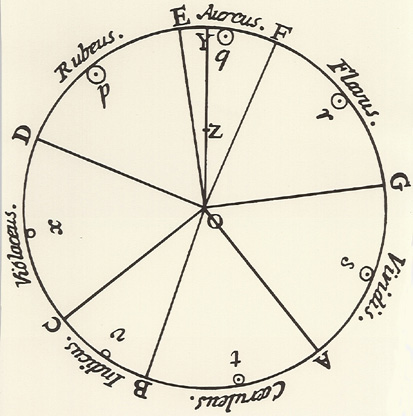
One early opponent famously illustrated his rebuttal. Poet, writer, and scientist Johann Wolfgang von Goethe published Theory of Colors (see here), with its carefully hand-drawn and colored diagrams and wheels, in 1809. From Newton’s time onward, color theorists elaborated prevailing concepts with color wheels, the first attributed to Newton in 1704 (and drawn in black and white, above).
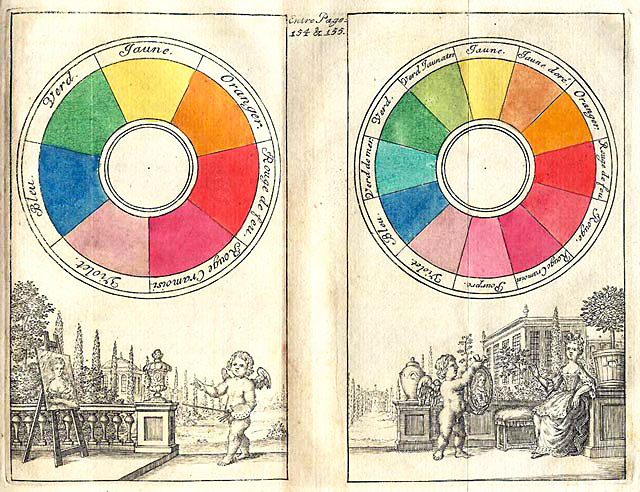
Newton’s wheel “arranged red, orange, yellow, green, blue, indigo, and violet into a natural progression on a rotating disk.” Four years later, painter Claude Boutet made his 7‑color and 12-color circles (top), based on Newton’s theories. Artists, chemists, mapmakers, poets, even entomologists… everyone seemed to have a pet theory of color, generally accompanied by elaborate colored charts and diagrams.
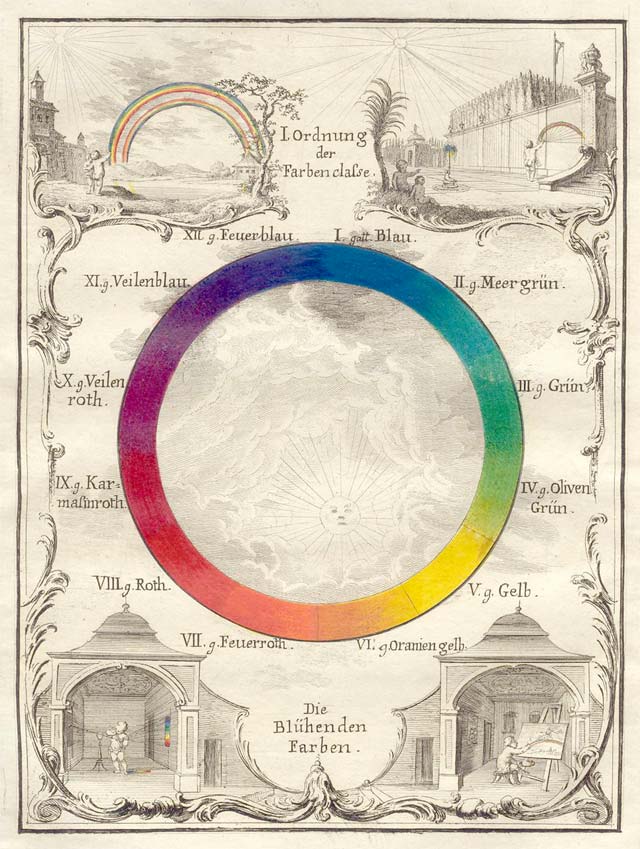
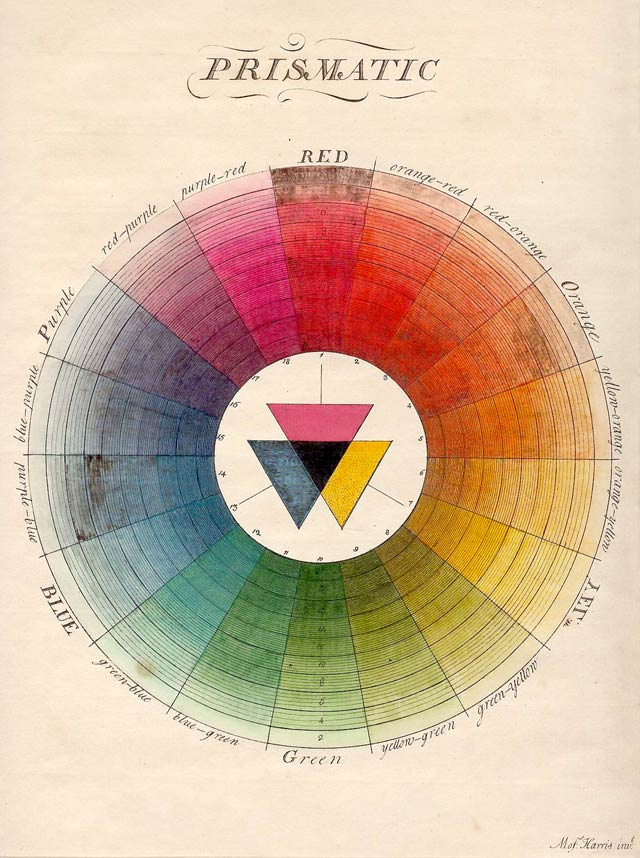
The color wheel was one among many forms—which often presented contrasting theories, like that of Jacques-Fabien Gautier, who argued that black and white were primary colors. But the wheel, and Newton’s basic ideas about it, have endured almost unchanged. The wheel further up (third one from top) by British entomologist Moses Harris from 1776 shows Newton’s 7‑color scheme simplified to the 6 primary and secondary colors we usually see, arranged in the complementary and analogous scheme, with tertiary gradations between them. Another entomologist, Ignaz Schiffermüller, drew the 12-color wheel right above.
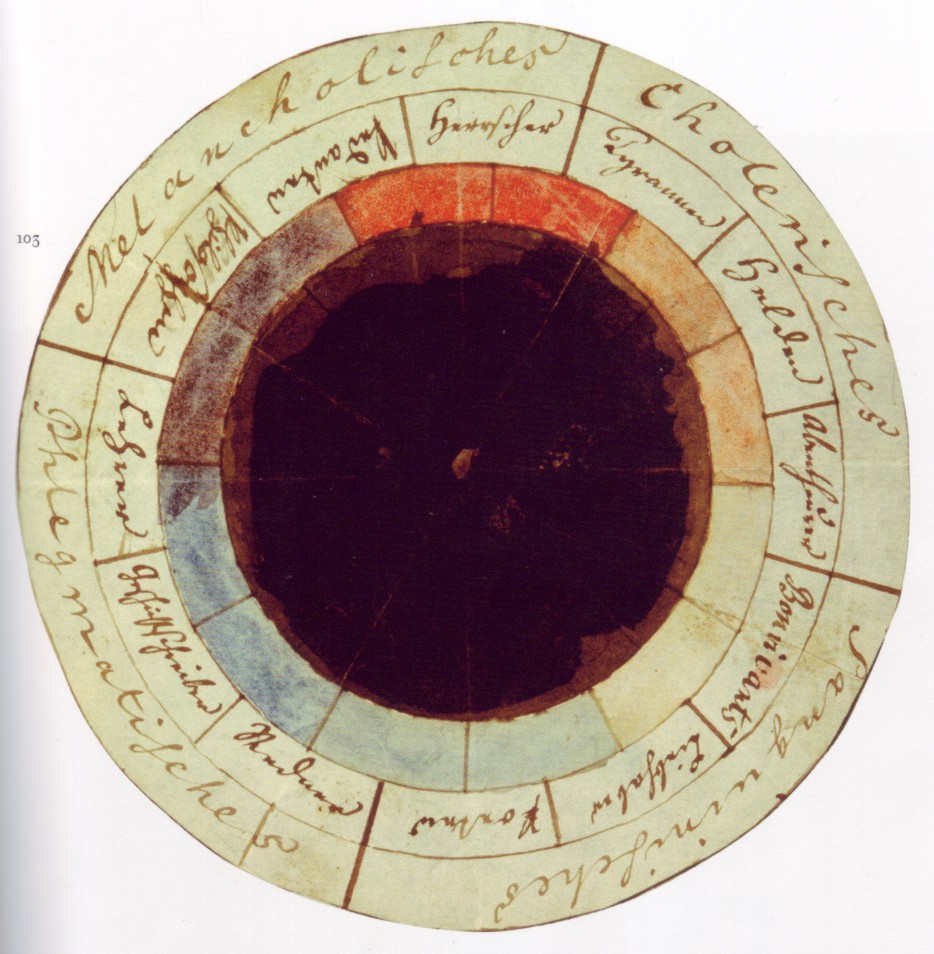
Color is always representative. Newton’s original wheel included “musical notes correlated with color.” By the end of the 18th century, color theory had become increasingly tied to psychological theories and typologies, as in the wheel above, the “rose of temperaments,” made by Goethe and Friedrich Schiller in 1789 to illustrate “human occupations and character traits,” the Public Domain Review notes, including “tyrants, heroes, adventurers, hedonists, lovers, poets, public speakers, historians, teachers, philosophers, pedants, rulers,” grouped into the four temperaments of humoral theory.
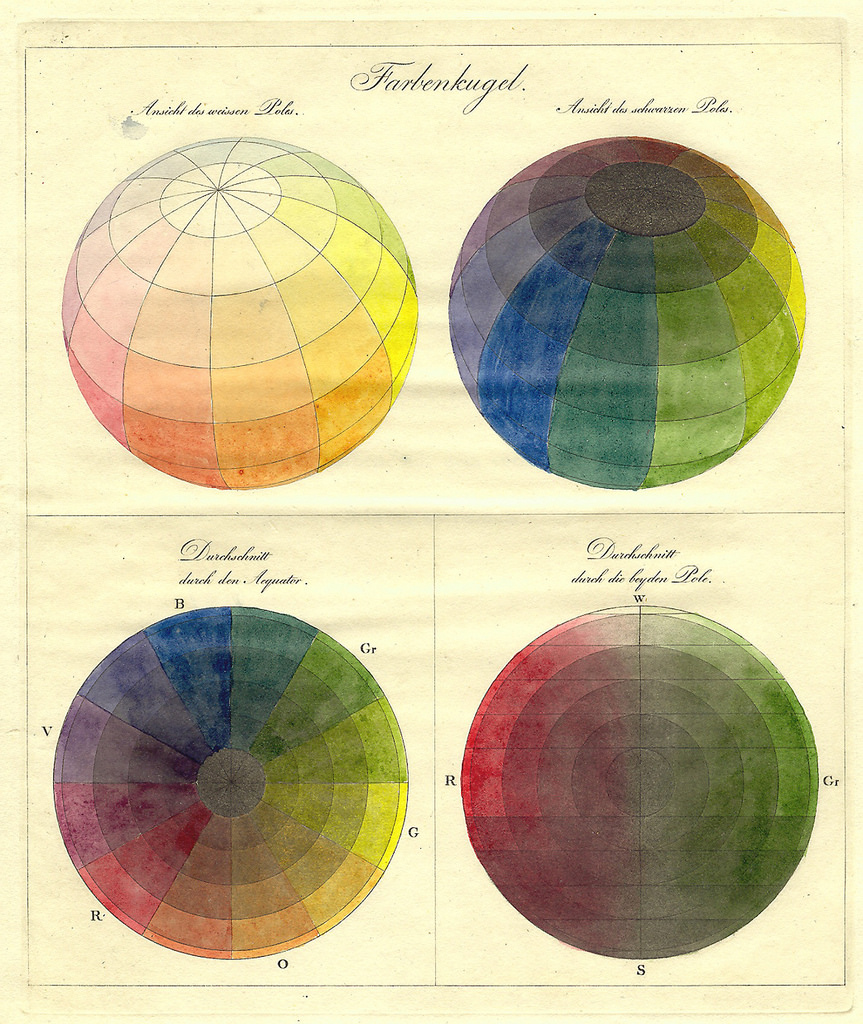
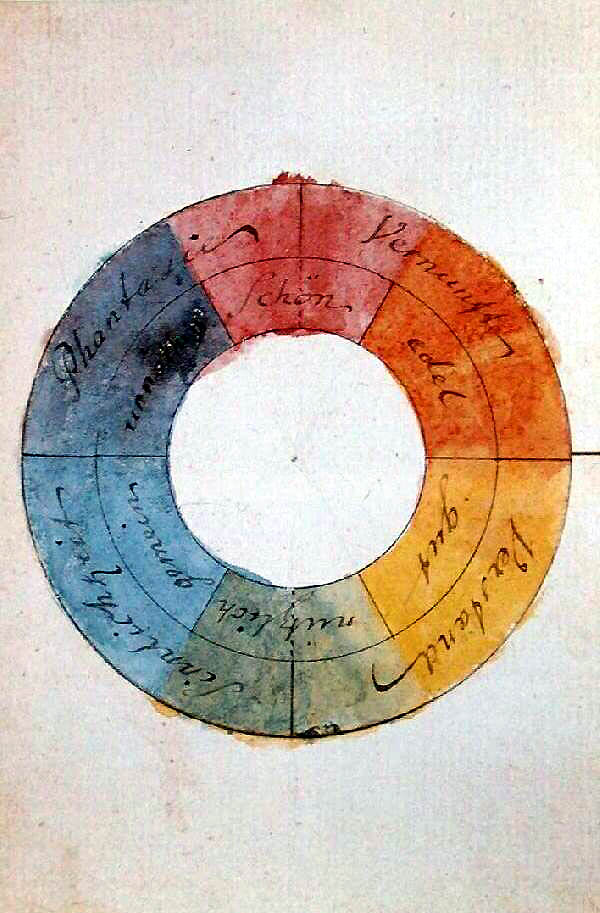
It’s a fairly short leap from these psychologies of color to those used by advertisers and commercial designers in the 20th century—or from the artists and scientists’ color theories to abstract expressionism, the Bauhaus school, and the chemists and photographers who recreated the colors of the world on film. (Goethe’s color wheel, below, from Theory of Color, illustrates his chapter on “Allegorical, symbolic, and mystical use of colour.”) See more early color wheels, like Philipp Otto Runge’s 1810 Farbenkugel, as well as other conceptual color schemes, at the Public Domain Review.
Related Content:
A Pre-Pantone Guide to Colors: Dutch Book From 1692 Documents Every Color Under the Sun
Sir Isaac Newton’s Papers & Annotated Principia Go Digital
Josh Jones is a writer and musician based in Durham, NC. Follow him at @jdmagness
Read More...Mister Rogers, Sesame Street & Jim Henson Introduce Kids to the Synthesizer with the Help of Herbie Hancock, Thomas Dolby & Bruce Haack
Does your child have a musical instrument? That’s good. Taken a few music lessons? Even better. If they’re so inclined, learning music is one of the best things kids can do for their developing brains, whether or not they make a career of the endeavor. But one doesn’t need classical training or jazz chops to make music, or even to become a musician. Those skills have served many an electronic musician, sure, but many others have created moving, complex music with ingenuity, finely-tuned ears, tech smarts, and wildly experimental attitudes.
Then there are electronic artists, like Bruce Haack, Herbie Hancock, and Thomas Dolby, who combined fine musicianship with all of the above qualities and made people stop and wonder, people who were not necessarily fans of electronic music, and who didn’t know very much about it.
None of these artists felt it beneath them to bring their art further down to earth, to the level of the kids who watched Mister Rogers’ Neighborhood or Sesame Street. On the contrary, they’re natural educators, with a performer’s instinct for timing and audience and a geek’s instinct for highlighting the coolest technical bits. But leave it to Mister Rogers himself, above, to celebrate the music and the playfulness of synthesized sound in his mild-mannered Cole Porter-ish way, to the accompaniment of a good-old fashioned piano and one of his mother’s signature handknit sweaters, in green.
Above, we have the weird wonky Haack, a musical prodigy who studied at Juilliard, and who loved nothing more than making children’s records with his partner, children’s dancer Esther Nelson, and creating musical instruments from household objects and handwired circuitry that was activated by human touch. Fred Rogers was so taken with Haack’s playfulness that he had the composer and Nelson on a long segment of his show. You may or may not know that Haack’s work was inspired by peyote and that he recorded a rock opera called The Electric Lucifer about a war between heaven and hell, but you’ll probably sense there’s more to him than meets the eye. Rogers and the kids are mesmerized (see Part 2 of the segment here.)
Herbie Hancock’s appearance on Sesame Street operates much more on a get to know you level than the gestalt dance therapy performance art of Haack and Nelson. He jams out; charms future Fresh Prince of Bel-Air star Tatyana Ali by turning her name into high-pitched chorus of voices; and explains the many functions of his Fairlight CMI, a digital synthesizer born in the same year as the young actress. The technology isn’t nearly as interesting as Haack’s homemade curios, given that every one of the Fairlight functions can be fit into an app these days. The joy lies in watching the kids warm to Hancock and the then-new technology.
When it comes to Thomas Dolby’s appearance on the Jim Henson Company’s The Ghost of Faffner Hall program, we are in the position of the child audience. Dolby, with his peculiar English intensity, plays a mad scientist character who stares into the camera as he demonstrates his collection of synthesizers, analog and digital, for viewers. Dolby’s performance might have been aided by some real kids to play off of, but his “fly in a matchbox” example will easily help you and your young ones understand the basic principles at work in synthesizing sound. These playful tutorials were made for kids in 1968, 83, and 89 respectively, and maybe they can still work magic on young 21st century minds. But, as Fred Rogers says, “grownups like to play too, sure. And if you look and listen carefully through this world, you’ll find lots of things that are playful.” Few grownups have been better authorities on the subject.
Related Content:
How the Moog Synthesizer Changed the Sound of Music
The History of Electronic Music in 476 Tracks (1937–2001)
Two Documentaries Introduce Delia Derbyshire, the Pioneer in Electronic Music
Josh Jones is a writer and musician based in Durham, NC. Follow him at @jdmagness.
Read More...Support Us
We're hoping to rely on loyal readers, rather than erratic ads. Please click the Donate button and support Open Culture. You can use Paypal, Venmo, Patreon, even Crypto! We thank you!

About Us

Open Culture scours the web for the best educational media. We find the free courses and audio books you need, the language lessons & educational videos you want, and plenty of enlightenment in between.
Advertise With Us
FREE UPDATES!
GET OUR DAILY EMAIL
Get the best cultural and educational resources on the web curated for you in a daily email. We never spam. Unsubscribe at any time.
FOLLOW ON SOCIAL MEDIA
Open Culture editor Dan Colman scours the web for the best educational media. He finds the free courses and audio books you need, the language lessons & movies you want, and plenty of enlightenment in between.
Advertise With Us



