Hear Hours of Lectures by Michel Foucault: Recorded in English & French Between 1961 and 1983
Tucked in the afterward of the second, 1982 edition of Hubert Dreyfus and Paul Rabinow’s Michel Foucault: Beyond Structuralism and Hermeneutics, we find an important, but little-known essay by Foucault himself titled “The Subject and Power.” Here, the French theorist offers what he construes as a summary of his life’s work: spanning 1961’s Madness and Civilization up to his three-volume, unfinished History of Sexuality, still in progress at the time of his death in 1984. He begins by telling us that he has not been, primarily, concerned with power, despite the word’s appearance in his essay’s title, its arguments, and in nearly everything else he has written. Instead, he has sought to discover the “modes of objectification which transform human beings into subjects.”
This distinction may seem abstruse, a needlessly wordy matter of semantics. It is not so for Foucault. In key critical difference lies the originality of his project, in all its various stages of development. “Power,” as an abstraction, an objective relation of dominance, is static and conceptual, the image of a tyrant on a coin, of Thomas Hobbes’ Leviathan seated on his throne.
Subjection, subjectification, objectivizing, individualizing, on the other hand—critical terms in Foucault’s vocabulary—are active processes, disciplines and practices, relationships between individuals and institutions that determine the character of both. These relationships can be located in history, as Foucault does in example after example, and they can also be critically studied in the present, and thus, perhaps, resisted and changed in what he terms “anarchistic struggles.”
Foucault calls for a “new economy of power relations,” and a critical theory that takes “forms of resistance against different forms of power as a starting point.” For example, in approaching the carceral state, we must examine the processes that divide “the criminals and the ‘good boys,’” processes that function independently of reason. How is it that a system can create classes of people who belong in cages and people who don’t, when the standard rational justification—the protection of society from violence—fails spectacularly to apply in millions of cases? From such excesses, Foucault writes, come two “’diseases of power’—fascism and Stalinism.” Despite the “inner madness” of these “pathological forms” of state power, “they used to a large extent the ideas and the devices of our political rationality.”
People come to accept that mass incarceration, or invasive medical technologies, or economic deprivation, or mass surveillance and over-policing, are necessary and rational. They do so through the agency of what Foucault calls “pastoral power,” the secularization of religious authority as integral to the Western state.
This form of power cannot be exercised without knowing the inside of people’s minds, without exploring their souls, without making them reveal their innermost secrets. It implies a knowledge of the conscience and an ability to direct it.
In the last years of Foucault’s life, he shifted his focus from institutional discourses and mechanisms—psychiatric, carceral, medical—to disciplinary practices of self-control and the governing of others by “pastoral” means. Rather than ignoring individuality, the modern state, he writes, developed “as a very sophisticated structure, in which individuals can be integrated, under one condition: that this individuality would be shaped in a new form and submitted to a set of very specific patterns.” While writing his monumental History of Sexuality, he gave a series of lectures at Berkeley that explore the modern policing of the self.
In his lectures on “Truth and Subjectivity” (1980), Foucault looks at forms of interrogation and various “truth therapies” that function as subtle forms of coercion. Foucault returned to Berkeley in 1983 and delivered the lecture “Discourse and Truth,” which explores the concept of parrhesia, the Greek term meaning “free speech,” or as he calls it, “truth-telling as an activity.” Through analysis of the tragedies of Euripides and contemporary democratic crises, he reveals the practice of speaking truth to power as a kind of tightly controlled performance. Finally, in his lecture series “The Culture of the Self,” Foucault discusses ancient and modern practices of “self care” or “the care of the self” as technologies designed to produce certain kinds of tightly bounded subjectivities.
- Four Lectures on Truth and Subjectivity (1980)
- Six Lectures on Discourse and Truth (1983)
- Three Lectures on “The Culture of the Self” (1983)
You can hear parts of these lectures above or visit our posts with full audio above. Also, over at Ubuweb, download the lectures as mp3s, and hear several earlier talks from Foucault in French, dating all the way back to 1961.
When he began his final series of talks in 1980, the philosopher was asked in an interview with the Daily Californian about the motivations for his critical examinations of power and subjectivity. His reply speaks to both his practical concern for resistance and his almost utopian belief in the limitless potential for human freedom. “No aspect of reality should be allowed to become a definitive and inhuman law for us,” Foucault says.
We have to rise up against all forms of power—but not just power in the narrow sense of the word, referring to the power of a government or of one social group over another: these are only a few particular instances of power.
Power is anything that tends to render immobile and untouchable those things that are offered to us as real, as true, as good.
Read Foucault’s statement of intent, his essay “The Subject and Power,” and learn more about his life and work in the 1993 documentary below.
Foucault’s lecture series will be added to our collection, 1,700 Free Online Courses from Top Universities.
Related Content:
Watch a “Lost Interview” With Michel Foucault: Missing for 30 Years But Now Recovered
Michel Foucault and Alain Badiou Discuss “Philosophy and Psychology” on French TV (1965)
Clash of the Titans: Noam Chomsky & Michel Foucault Debate Human Nature & Power on Dutch TV, 1971
Josh Jones is a writer and musician based in Durham, NC. Follow him at @jdmagness
Read More...Artificial Intelligence May Have Cracked the Code of the Voynich Manuscript: Has Modern Technology Finally Solved a Medieval Mystery?
What is it about the Voynich Manuscript—that cryptic, illustrated 15th century text of unknown origin and meaning—that has so fascinated and obsessed scholars for centuries? Written in what appears to be an invented language, with bizarre illustrations of otherworldly botany, mysterious cosmology, and strange anatomy, the book resembles other proto-scientific texts of the time, except for the fact that it is totally indecipherable, “a certain riddle of the Sphinx,” as one alchemist described it. The 240-page enigma inspires attempt after attempt by cryptologists, linguists, and historians eager to understand its secrets—that is if it doesn’t turn out to be a too-clever Medieval joke.
One recent try, by Nicholas Gibbs, has perhaps not lived up to the hype. Another recent attempt by Stephen Bax, who wrote the short TED Ed lesson above, has also come in for its share of criticism. Given the investment of scholars since the 17th century in cracking the Voynich code, both of these efforts might justifiably be called quite optimistic. The Voynich may forever elude human understanding, though it was, presumably, created by human hands. Perhaps it will take a machine to finally solve the puzzle, an artificial brain that can process more data than the combined efforts of every scholar who has ever applied their talents to the text. Computer scientists at the University of Alberta think so and claim to have cracked the Voynich code with artificial intelligence (AI).
Computer science professor Greg Kondrak and graduate student Bradley Hauer began their project by feeding a computer program 400 different languages, taken from the “Universal Declaration of Human Rights.” While “they initially hypothesized that the Voynich manuscript was written in [ancient] Arabic,” reports Jennifer Pascoe, “it turned out that the most likely language was [ancient] Hebrew.” (Previous guesses, the CBC notes, “have ranged from a type of Latin to a derivation of Sino-Tibetan.”) The next step involved deciphering the manuscript’s code. Kondrak and Hauer discovered that “the letters in each word… had been reordered. Vowels had been dropped.” The theory seemed promising, but the pair were unable to find any Hebrew scholars who would look at their findings.
Without human expertise to guide them, they turned to another AI, whose results, we know, can be notoriously unreliable. Nonetheless, feeding the first sentence into Google translate yielded the following: “She made recommendations to the priest, man of the house and me and people.” It’s at least grammatical, though Kondrak admits “it’s a kind of strange sentence to start a manuscript.” Other analyses of the first section have turned up several other words, such as “farmer,” “light,” “air,” and “fire”—indeed the scientists have found 80 percent of the manuscript’s words in ancient Hebrew dictionaries. Figuring out how they fit together in a comprehensible syntax has proven much more difficult. Kondrak and Hauer admit these results are tentative, and may be wrong. Without corroboration from Hebrew experts, they are also unlikely to be taken very seriously by the scholarly community.
But the primary goal was not to translate the Voynich but to use it as a means of creating algorithms that could decipher ancient languages. “Importantly,” notes Gizmodo, “the researchers aren’t saying they’ve deciphered the entire Voynich manuscript,” far from it. But they might have discovered the keys that others may use to do so. Or they may—as have so many others—have been led down another blind alley, as one commenter at IFL Science suggests, sarcastically quoting the wise Bullwinkle Moose: “This time for sure!”
You can find the Voynich Manuscript scanned at Yale’s Beinecke Rare Book & Manuscript Library. Copies can be purchased in book format as well.
Related Content:
1,000-Year-Old Illustrated Guide to the Medicinal Use of Plants Now Digitized & Put Online
Josh Jones is a writer and musician based in Durham, NC. Follow him at @jdmagness
Read More...MIT’s New Master’s Program Admits Students Without College and High School Degrees … and Helps Solve the World’s Most Pressing Problems

One of the central problems of inequality is that it perpetuates itself by nature. The inherent social capital of those born in certain places and classes grants access to even more social capital. Questions of merit can seem marginal when the credentials required by elite institutions prove inaccessible to most people. In an admirable effort to break this cycle globally, MIT is now admitting students to a graduate program in economics, without GRE scores, without letters of recommendation, and without a college degree.
Instead students begin with something called a “MicroMasters” program, which is like “a method used in medicine… randomized control trials,” reports WBUR. This entryway removes many of the usual barriers to access by allowing students to first “take rigorous courses online for credit, and if they perform well on exams, to apply for a master’s degree program on campus”—a degree in data, economics and development policy (DEDP), which focuses on methods for reducing global inequality.

Enrollment in the online MicroMasters courses began in February of last year (the next round starts on February 6, 2018), and the DEDP master’s program will start in 2019. “The world of development policy has become more and more evidence-based over the past 10–15 years,” explains MIT professor of economics Ben Olken, who co-created the program with economics professors Esther Duflo and Abhijit Banerjee. “Development practitioners need to understand not just development issues, but how to analyze them rigorously using data. This program is designed to help fill that gap.”
Duflo, co-founder of MIT’s Abdul Latif Jameel Poverty Action Lab (J‑PAL), explains the innovation of MicroMasters’ radically open admissions. (For anyone with access to the internet, that is, still a huge barrier for millions worldwide): “Anybody could do that. At this point, you don’t need to have gone to college. For that matter, you don’t need to have gone to high school.” Students who are accepted after their initial online course work will move into a “blended” program that combines their prior work with a semester on MIT’s campus.
MicroMasters courses are priced on a sliding scale (from $100 to $1,000), according to what students can afford, and costs are nowhere near what traditional students pay—after having already paid, or taken loans, for a four-year degree, various testing regimens, admissions costs, living expenses, etc. The current program might feasibly be scaled up to include other fields in the future. Thus far, over 8,000 students in the world have enrolled in the MicroMasters program. “In total,” Duflo says, “there are 182 countries represented,” including ten percent from China, a large group from India, and “even some from the U.S.”
Students enrolled in these courses design their own evaluations of initiatives around the globe that address disparities in healthcare, education, and other areas. Co-designed by the Poverty Action Lab and the Department of Economics, MicroMasters asks students to “grapple with some of the world’s most pressing problems,” including the problem of access to higher education. You can view the requirements and enroll at the MITx MicroMasters’ site. Read frequently asked questions and learn about the instructors here. And here, listen to WBUR’s short segment on this fascinating educational experiment.
Find more MicroMasters subjects in our collection: Online Degrees & Mini Degrees: Explore Masters, Mini Masters, Bachelors & Mini Bachelors from Top Universities
Related Content:
Artificial Intelligence: A Free Online Course from MIT
Introduction to Computer Science and Programming: A Free Course from MIT
Josh Jones is a writer and musician based in Durham, NC. Follow him at @jdmagness
Read More...Read the Shortest Academic Article Ever Written: “The Unsuccessful Self-Treatment of a Case of ‘Writer’s Block’ ”
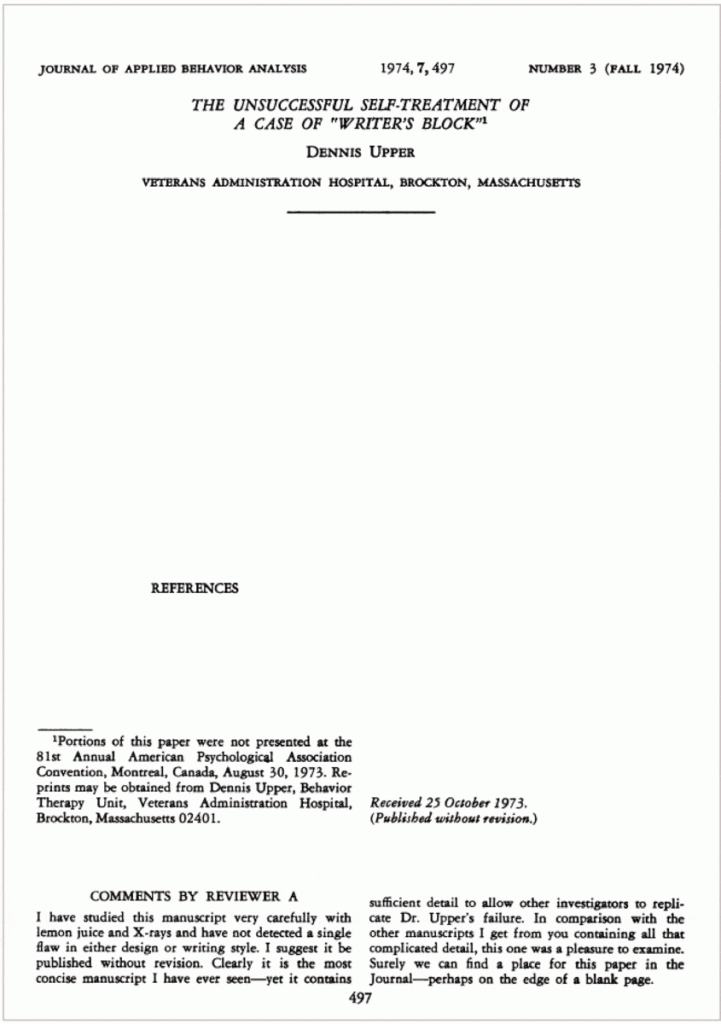
We’ve featured impressively short academic papers here on Open Culture before, like John Nash’s 26-page PhD thesis and this two-sentence “Counterexample to Euler’s Conjecture on Sums and Like Powers,” but if you’ve set your sights on writing one shorter still, don’t get your hopes up. The almost certainly unbeatable example of a short academic paper appeared more than forty years ago, in the fall 1974 issue of the Journal of Applied Behavior Analyses, its main text coming in at exactly zero words. You can read it, if indeed “read” is the word, above or at the National Center for Biotechnology Information.
Written, or at least thought up, by psychologist Dennis Upper, “The Unsuccessful Self-Treatment of a Case of ‘Writer’s Block’ ” has nothing but its title, one footnote (indicating that “portions of this paper were not presented at the 81st annual American Psychological Association Convention”), and the fulsome comments of a reviewer: “I have studied this manuscript very carefully with lemon juice and X‑rays and have not detected a single flaw in either design or writing style. I suggest it be published without revision. Clearly it is the most concise manuscript I have ever seen — yet it contains sufficient detail to allow other investigators to replicate Dr. Upper’s failure. In comparison with the other manuscripts I get from you containing all that complicated detail, this one was a pleasure to examine.”
Some describe writer’s block, whether in science or literature or any other field requiring the proper arrangement of words, as a fear of the blank page. If looking at Upper’s void-like paper frightens you, consider having a look at the Louisiana Channel series we featured in 2016 wherein writers like Margaret Atwood, Jonathan Franzen, Joyce Carol Oates, and David Mitchell talk about how they deal with the blank page themselves. Atwood finds that it “beckons you in to write something on it,” that “it must be filled,” but if you don’t hear the same call, you’ll have to come up with an approach of your own. Just don’t try titling, footnoting, and turning in the empty sheet — it’s been done.
Related Content:
The Shortest-Known Paper Published in a Serious Math Journal: Two Succinct Sentences
When a Cat Co-Authored a Paper in a Leading Physics Journal (1975)
Based in Seoul, Colin Marshall writes and broadcasts on cities and culture. His projects include the book The Stateless City: a Walk through 21st-Century Los Angeles and the video series The City in Cinema. Follow him on Twitter at @colinmarshall or on Facebook.
Read More...Watch “Bells of Atlantis,” an Experimental Film with Early Electronic Music Featuring Anaïs Nin (1952)
For decades, outside of feminist scholarship and readerships, French-Cuban-American diarist, novelist, and essayist Anaïs Nin was primarily known through her famous friends—most notably the experimental novelist Henry Miller, but also psychoanalyst Otto Rank. She had affairs with both men, and inspired some of their work, but Nin has always deserved much wider appreciation as an artist in her own right, whose surrealist explorations of sexuality, and sexual abuse, and posthumous collections of erotica rival Miller’s body of work—and for many readers far surpass his talents.
Now Nin’s expressive face and oracular quotations have taken over the Tumblr-sphere, such that she has been called the “patron saint of social media” and compared to Lena Dunham. Whether one finds these terms flattering or not comes down to matters of taste and, probably even more so, of age. But those who wish for a short introduction to Nin outside of the world of memes and macros will surely take an interest in the 1952 film above, “Bells of Atlantis,” shot and edited by her then-husband Ian Hugo (also known as banker High Guiler), with Nin in the starring role as the queen of Atlantis. Coilhouse offers this succinct description:
Over cascading experimental footage, Nin reads aloud from her novella House of Incest. We catch glimpses of her nude form swinging in a hammock, and we see her shadow undulating over sheer fabric blowing in the wind, but for the most part, the imagery, captured by Nin’s husband Ian Hugo, remains very abstract.
But it is not only the rare, hazy glimpses of Nin and the snippets of her reading that should draw our attention, but also the burbling, whistling, hypnotic electronic score, composed and created by the husband-and-wife-hobbyist team of Louis and Bebe Barron. Over a decade before Delia Derbyshire wowed audiences with her Dr. Who theme, the Barrons were making unheard-of experimental sounds using the technology available at the time—tape machines, oscillators, microphones, and other such low-tech analog devices.
“The Barrons were true pioneers of electronic music,” writes Messy Nessy, “and one of the crown jewels of their auditory collection is the soundtrack for the 1956 thriller sci-fi film, Forbidden Planet,” the first major motion picture with an all-electronic score. “Bells of Atlantis” breaks ground as an even earlier example of the form, and its hallucinatory visual journey recalls the surrealist filmmaking of decades past and looks forward to the psychedelic 60s.
Both the sounds the Barrons produced and the visions of Hugo turn out to be, in my humble opinion, the perfect setting for a brief introduction to Nin’s voice. After watching “Bells of Atlantis,” put on some more early electronica, and read Nin’s 1947 House of Incest for yourself, a hallucinatory prose-poem about, in Nin’s description, the “escape from a woman’s season in hell.”
Related Content:
Hear Anaïs Nin Read From Her Celebrated Diary: A 60-Minute Vintage Recording (1966)
Henry Miller Makes a List of “The 100 Books That Influenced Me Most”
Josh Jones is a writer and musician based in Durham, NC. Follow him at @jdmagness
Read More...Massive New Database Will Finally Allow Us to Identify Enslaved Peoples and Their Descendants in the Americas
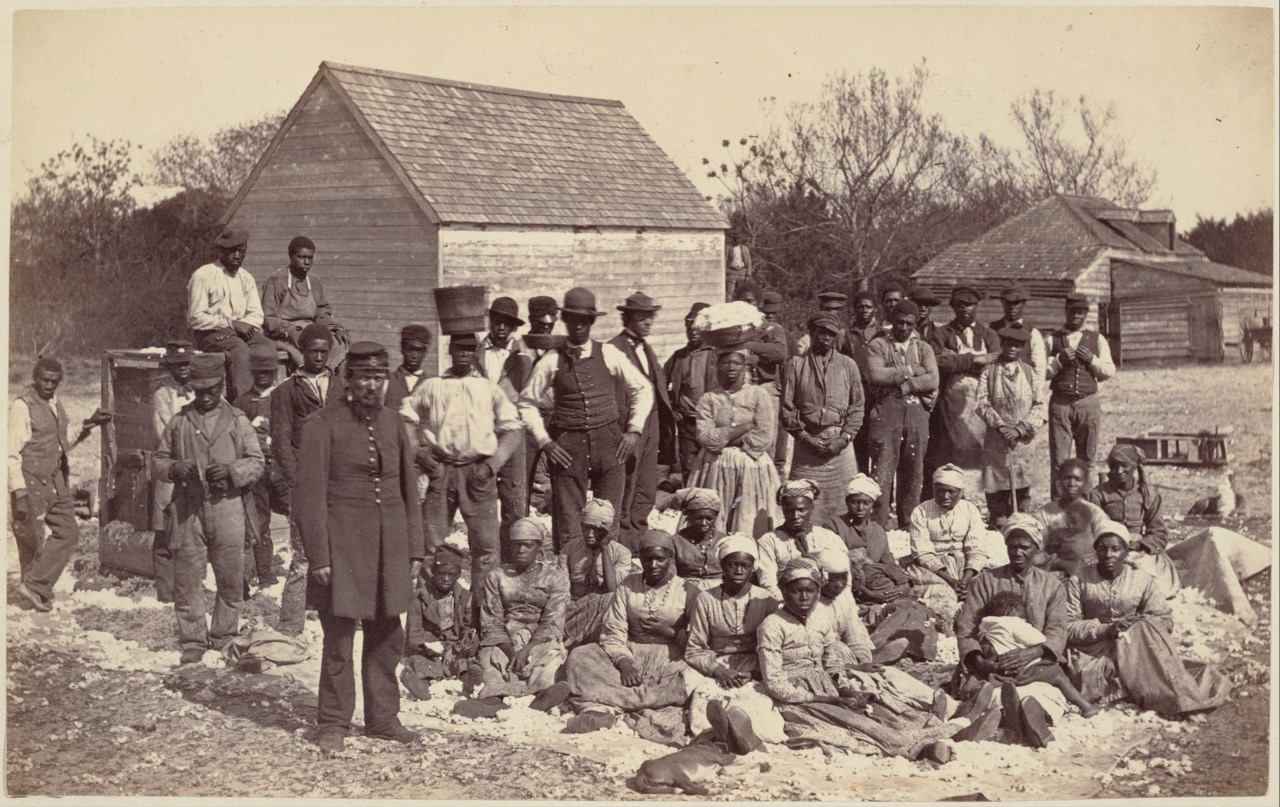
Throughout the history of the so-called “New World,” people of African descent have faced a yawning chasm where their ancestry should be. People bought and sold to labor on plantations lost not only their names but their connections to their language, tradition, and culture. Very few who descend from this painful legacy know exactly where their ancestors came from. The situation contributes to what Toni Morrison calls the “dehistoricizing allegory” of race, a condition of “foreclosure rather than disclosure.” To compound the loss, most descendants of slaves have been unable to trace their ancestry further back than 1870, the first year in which the Census listed African Americans by name.
But the recent work of several enterprising scholars is helping to disclose the histories of enslaved people in the Americas. For example, The Freedman’s Bureau Project has made 1.5 million documents available to the public, in a searchable database that combines traditional scholarship with digital crowdsourcing.
And now, a just-announced Michigan State University project—supported by a $1.5 million grant from the Mellon Foundation—will seek to “change the way scholars and the public understand African slavery.” Called “Enslaved: The People of the Historic Slave Trade,” the multi-phase endeavor is expected to take 18 months to complete an “online hub,” reports Smithsonian, linking together dozens of databases from all over the world.
“By linking data collections from multiple universities,” writes MSU Today, the resulting website “will allow people to search millions of pieces of slave data to identify enslaved individuals and their descendants from a central source. Users can also run analyses of enslaved populations and create maps, charts and graphics.” The project is headed by MSU’s Dean Rehberger, director of Matrix: The Center for Digital Humanities and Social Sciences at MSU; Ethan Watrall, assistant professor of anthropology; and Walter Hawthorne, professor and chair of MSU’s history department and a specialist in African and African American history.
In addition to publishing several books on the Atlantic slave trade, Hawthorne has worked on previous digital history projects like the website Slave Biographies, which compiles information on the “names, ethnicities, skills, occupations, and illnesses” of enslaved individuals in Maranhão, Brazil and colonial Louisiana. In the video above, you can see him describe this latest project, which coincides with MSU’s “Year of Global Africa,” an 18-month celebration of the university’s many partnerships on the continent and “throughout the African Diaspora.”
Digital history projects like those spearheaded by Hawthorne and other researchers help not only scholars but also the general public develop a much more nuanced understanding of the history of slavery. These tools provide a wealth of information, but they cannot truly capture the emotional and psychological impact of the history. For such an understanding, Morrison said in the first of her 2016 Harvard Norton lectures, “I look to literature for guidance.”
Related Content:
African-American History: Modern Freedom Struggle (A Free Course from Stanford)
The Anti-Slavery Alphabet: 1846 Book Teaches Kids the ABCs of Slavery’s Evils
Josh Jones is a writer and musician based in Durham, NC. Follow him at @jdmagness
Read More...How a Virtual Reality Model of Auschwitz Helped Convict an SS Concentration Camp Guard: A Short Documentary on a High Tech Prosecution
In 2016, Reinhold Hanning, a former SS guard at the Auschwitz concentration camp, was tried and convicted for being an accessory to at least 170,000 deaths. In making their case, prosecutors did something novel–they relied on a virtual reality version of the Auschwitz concentration camp, which helped undermine Hanning’s claim that he wasn’t aware of what happened inside the camp. The virtual reality headset let viewers see the camp from almost any angle, and established that “Hanning would have seen the atrocities taking place all around him.”
The high-tech prosecution of Hanning gets well documented in “Nazi VR,” the short documentary above. It comes from MEL Films, and will be added to our collection of online documentaries.
If you would like to support the mission of Open Culture, consider making a donation to our site. It’s hard to rely 100% on ads, and your contributions will help us continue providing the best free cultural and educational materials to learners everywhere. You can contribute through PayPal, Patreon, and Venmo (@openculture). Thanks!
Related Content:
Watch World War II Rage Across Europe in a 7 Minute Time-Lapse Film: Every Day From 1939 to 1945
Read More...Smartify, a Shazam for Art, Lets You Use Your Phone to Scan, Identify & Learn About Major Works of Art
Not so long ago, art museums were known as temples of quiet contemplation, despite daily invasions by raucous school groups.
Now, the onus is on the museums to bring the mountain to Mohammed. Those kids have smartphones. How long can a museum hope to stay relevant—nay, survive—without an app?
Many of the museums who’ve already partnered up with Smartify—an app (Mac-Android) that lets you take a picture of artwork with your phone and instantly access information about them—have existing apps of their own in place: the Metropolitan Museum of Art in New York, the Hermitage in St. Petersburg, Amsterdam’s Rijksmuseum, to name a few.
These institutional apps provide visitors with an expanded view of the sort of information one commonly finds on a museum card, in addition to such practicalities as gallery layouts and calendars of events. More often than not, there’s an option to “save” an artwork the visitor finds captivating—no word on what this feature is doing to postcard sales in museum shops, so perhaps print isn’t dead yet.
Given all the museum apps free for the downloading, for whom is Smartify, a “Shazam for art,” intended?
Perhaps the globetrotting museum hopper eager to consolidate? Its developers are adamant that it’s intended to complement, not replace, in-person visits to the institutions where the works are housed, so armchair museum goers are advised to look elsewhere, like Google Arts & Culture.
Perhaps the biggest beneficiaries will be the smaller galleries and museums ill equipped to launch freestanding apps of their own. Smartify’s website states that it relies on “annual membership from museum partners, in-app transactions, advertising and data sales to relevant arts organisations.”
Early adopters complained that while the app (Mac-Android) had no trouble identifying famous works of art, it came up empty on the lesser-known pieces. That’s a pity as these are the works visitors are most likely to seek further information on.
One of the developers compared the Smartify experience to visiting a museum in the company of “an enthusiastic and knowledgeable friend telling you more about a work of art.”
Maybe better to do just that, if the option exists? Such a friend would not be hampered by the copyright laws that hamper Smartify with regard to certain works. A friend might even stand you a hot chocolate or some pricey scone in the museum cafe.
At any rate, the app (Mac-Android) is now available for visitors to take for a spin in 22 different museums and galleries in the UK, US, and Europe, with the promise of more to come.
Those whose knowledge of art history is vast are likely to be underwhelmed, but it could be a way for those visiting with kids and teens to keep everyone engaged for the duration. As one enthusiastic user wrote:
As a childhood Pokemon fan and avid art fan, this is a dream come true. This is like a Pokedex for art lol. If you ever watched the anime, Ash Ketchum would scan a Pokemon with his Pokedex and get the details of its name, type, habits, etc. This app does that but instead of scanning monsters, it scans and analyzes art work then gives you the load (sic) down about it.
Those with Internet privacy concerns may choose to heed, instead, the user who wrote:
Be aware, they want to gather as a “side effect” your private art collection. I just wanted to try it out with some of my art pieces (Günther Förg, Richter, etc) but it doesn’t work if you don’t give them your location data. Be careful!
Museums and Galleries Whose Images/Art Appear in Smartify as of January 2018
USA:
J. Paul Getty Museum
Los Angeles County Museum of Art (LACMA)
Laguna Art Museum
Museum of Contemporary Photography
Freer | Sackler GalleriesThe Metropolitan Museum of Art
The Met Cloisters
UK:
The Bowes Museum
Middlesbrough Institute of Modern Art
Ben Uri Gallery
The Wallace Collection
Royal Academy of Arts
National Gallery
Sculpture in the City
Europe:
Rijksmuseum
Rijksmuseum Twenthe
Little Beaux-Arts
Museo Correr
Museo San Donato (MPSArt)
The State Hermitage Museum
The Pushkin Museum of Fine Arts
Download Smartify for Mac or Android.
via Dezeen
Related Content:
Google’s Free App Analyzes Your Selfie and Then Finds Your Doppelganger in Museum Portraits
1.8 Million Free Works of Art from World-Class Museums: A Meta List of Great Art Available Online
Ayun Halliday is an author, illustrator, theater maker and Chief Primatologist of the East Village Inky zine. Follow her @AyunHalliday.
Read More...A Brief History of Making Deals with the Devil: Niccolò Paganini, Robert Johnson, Jimmy Page & More
When the term “witch hunt” gets thrown around in cases of powerful men accused of harassment and abuse, historians everywhere bang their heads against their desks. The history of persecuting witches—as every schoolboy and girl knows from the famous Salem Trials—involves accusations moving decidedly in the other direction.
But we’re very familiar with men supposedly selling out to Satan, dealing—or just dueling—with the devil. They weren’t called witches for doing so, or burned at the stake. They were blues pioneers, virtuoso fiddlers, and guitar gods. From the devilishly dashing Niccolò Paganini, to Robert Johnson at the Crossroads, to Jimmy Page’s black magic, to “The Devil Went Down to Georgia,” to the omnipresence of Satan in metal…. The devil “seems to have quite the interest in music,” notes the Polyphonic video above.
Before musicians came to terms with the dark lord, power-hungry scholars used demonology to summon Luciferian emissaries like Mephistopheles. The legend of Faust dates back to the late 16th century and a historical alchemist named Johann Georg Faust, who inspired many dramatic works, like Christopher Marlowe’s The Tragical History of Doctor Faustus, Johann Goethe’s Faust, Thomas Mann’s Doctor Faustus, Mikhail Bugakov’s The Master and Margarita, and F.W. Murnau’s 1926 silent film.
The Faust legend may be the sturdiest of such stories, but it is not by any means the origin of the idea. Medieval Catholic saints feared the devil’s enticements constantly. Medieval occultists often saw things differently. If we can trace the notion of women consorting with the devil to the Biblical Eve in the Garden, we find male analogues in the New Testament—Christ’s temptations in the desert, Judas’s thirty pieces of silver, the possessed vagrant who sends his demons into a herd of pigs. But we might even say that God made the first deal with the devil, in the opening wager of the book of Job.
In most examples—Charlie Daniels’ triumphal folk tale aside—the deal usually goes down badly for the mortal party involved, as it did for Robert Johnson when the devil came for his due, and convened the morbidly fascinating 27 Club. Goethe imposes a redemptive happy ending onto Faust that seems to wildly overcompensate for the typical fate of souls in hell’s pawn shop. Kierkegaard took the idea seriously as a cultural myth, and wrote in Either/Or that “every notable historical era will have its own Faust.”
Modern-day Fausts in the popular genre of the day, the conspiracy theory, are famous entertainers, as you can see in the unintentionally humorous supercut above from a YouTube channel called “EndTimeChristian.” As it happens in these kinds of narratives, the cultural trope gets taken far too literally as a real event. The Faust legend shows us that making deals with the devil has been a literary device for hundreds of years, passing into popular culture, then the blues—a genre haunted by hell hounds and infernal crossroads—and its progeny in rock and roll and hip hop.
Those who talk of selling their souls might really believe it, but they inherited the language from centuries of Western cultural and religious tradition. Selling one’s soul is a common metaphor for living a carnal life, or getting into bed with shady characters for worldly success. But it’s also a playful notion. (A misunderstood aspect of so much metal is its comic Satanic overkill.) Johnson himself turned the story of selling his soul into an iconic boast, in “Crossroads” and “Me and the Devil Blues.” “Hello Satan,” he says in the latter tune, “I believe it’s time to go.”
Chilling in hindsight, the line is the bluesman’s grimly casual acknowledgment of how life on the edge would catch up to him. But it was worth it, he also suggests, to become a legend in his own time. In the short, animated video above from Music Matters, Johnson meets the horned one, a slick operator in a suit: “Suddenly, no one could touch him.” Often when we talk these days about people selling their souls, they might eventually end up singing, but they don’t make beautiful music. In any case, the moral of almost every version of the story is perfectly clear: no matter how good the deal seems, the devil never fails to collect on a debt.
Related Content:
The Story of Bluesman Robert Johnson’s Famous Deal With the Devil Retold in Three Animations
Josh Jones is a writer and musician based in Durham, NC. Follow him at @jdmagness
Read More...How Reading Increases Your Emotional Intelligence & Brain Function: The Findings of Recent Scientific Studies

Image by Sheila Sund, via Flickr Commons
Reading “availeth much,” to borrow an old phrase from the King James Bible. To read is to experience more of the world than we can in person, to enter into the lives of others, to organize knowledge according to useful schemes and categories…. Or, at least it can be. Much recent research strongly suggests that reading improves emotional and cognitive intelligence, by changing and activating areas of the brain responsible for these qualities.
Is reading essential for the survival of the species? Perhaps not. “Humans have been reading and writing for only about 5000 years—too short for major evolutionary changes,” writes Greg Miller in Science. We got by well enough for tens of thousands of years before written language. But neuroscientists theorize that reading “rewires” areas of the brain responsible for both vision and spoken language. Even adults who learn to read late in life can experience these effects, increasing “functional connectivity with the visual cortex,” some researchers have found, which may be “the brain’s way of filtering and fine-tuning the flood of visual information that calls for our attention” in the modern world.
This improved communication between areas of the brain might also represent an important intervention into developmental disorders. One Carnegie Mellon study, for example, found that “100 hours of intensive reading instruction improved children’s reading skills and also increased the quality of… compromised white matter to normal levels.” The findings, says Thomas Insel, director of the National Institute of Mental Health, suggest “an exciting approach to be tested in the treatment of mental disorders, which increasingly appear to be due to problems in specific brain circuits.”
Reading can not only improve cognition, but it can also lead to a refined “theory of mind,” a term used by cognitive scientists to describe how “we ascribe mental states to other persons”—as the Internet Encyclopedia of Philosophy notes—and “how we use the states to explain and predict the actions of those other persons.” Improved theory of mind, or “intuitive psychology,” as it’s also called, can result in greater levels of empathy and perhaps even expanded executive function, allowing us to better “hold multiple perspectives in mind at once,” writes Brittany Thompson, “and switch between those perspectives.”
Improved theory of mind comes primarily from reading narratives, research suggests. One meta-analysis published by Raymond A. Mar of Toronto’s York University reviews many of the studies demonstrating the effect of story comprehension on theory of mind, and concludes that the better we understand the events in a narrative, the better we are able to understand the actions and intentions of those around us. The kinds of narratives we read, moreover, might also make a difference. One study, conducted by psychologists David Comer Kidd and Emanuele Castano of the New School for Social Research, tested the effect of differences in writing quality on empathy responses, randomly assigning 1,000 participants excerpts from both popular bestsellers and literary fiction.
To define the difference between the two, the researchers referred to critic Roland Barthes’ The Pleasure of the Text. As Kidd explains:
Some writing is what you call ‘writerly’, you fill in the gaps and participate, and some is ‘readerly’, and you’re entertained. We tend to see ‘readerly’ more in genre fiction like adventure, romance and thrillers, where the author dictates your experience as a reader. Literary [writerly] fiction lets you go into a new environment and you have to find your own way.
The researchers used two theory of mind tests to measure degrees of empathy and found that “scores were consistently higher for those who had read literary fiction than for those with popular fiction or non-fiction texts,” notes Liz Bury at The Guardian. Other research has found that descriptive language stimulates regions of our brains not classically associated with reading. “Words like ‘lavender,’ ‘cinnamon’ and ‘soap,’ for example,” writes Annie Murphy Paul at The New York Times, citing a 2006 study published in NeuroImage, “elicit a response not only from the language-processing areas of our brains, but also those devoted to dealing with smells.”
Reading, in other words, can effectively simulate reality in the brain and produce authentic emotional responses: “The brain, it seems, does not make much of a distinction between reading about an experience and encountering it in real life”—that is, if the experience is written about in sensory language. The emotional brain also does not seem to make a tremendous distinction between reading the written word and hearing it recited or read. When study participants in a joint German and Norwegian experiment, for example, heard poetry read aloud, they experienced physical sensations and “about 40 percent showed visible goose bumps.”
But different kinds of texts elicit different kinds of responses. We can read or listen to a novel, for example, and, instead of only experiencing sensations, can “live several lives while reading,” as William Styron once wrote. The authors of a 2013 Emory University study published in Brain Connectivity conclude that reading novels can rewire areas of the brain, causing “transient changes in functional connectivity.” These biological changes were found to last up to five days after study participants read Robert Harris’ 2003 novel Pompeii. The heightened connectivity in certain regions “corresponded to regions previously associated with perspective taking and story comprehension.”
So what? asks a skeptical Ian Steadman at New Statesman. Reading may create changes in the brain, but so does everything else, a phenomenon well-known by now as “neuroplasticity.” Much of the reporting on the neuroscience of reading, Steadman argues, overinterprets the research to support an “[x] ‘rewires’ the brain” myth both common and “mistaken.” Steadman’s critiques of the Brain Connectivity study are perhaps well-placed. The small sample size, lack of a control group, and neglect of questions about different kinds of writing make its already tentative conclusions even less impressive. However, more substantive research, taken together, does show that the “rewiring” that happens when we read—though perhaps temporary and in need of frequent refreshing—really does make us more cognitively and socially adept. And that the kind of reading—or even listening—that we do really does matter.
via BigThink/The Guardian/Harvard
Related Content:
This Is Your Brain on Jane Austen: The Neuroscience of Reading Great Literature
900 Free Audio Books: Download Great Books for Free
7 Tips for Reading More Books in a Year
Josh Jones is a writer and musician based in Durham, NC. Follow him at @jdmagness
Read More...Support Us
We're hoping to rely on loyal readers, rather than erratic ads. Please click the Donate button and support Open Culture. You can use Paypal, Venmo, Patreon, even Crypto! We thank you!

About Us

Open Culture scours the web for the best educational media. We find the free courses and audio books you need, the language lessons & educational videos you want, and plenty of enlightenment in between.
Advertise With Us
FREE UPDATES!
GET OUR DAILY EMAIL
Get the best cultural and educational resources on the web curated for you in a daily email. We never spam. Unsubscribe at any time.
FOLLOW ON SOCIAL MEDIA
Open Culture editor Dan Colman scours the web for the best educational media. He finds the free courses and audio books you need, the language lessons & movies you want, and plenty of enlightenment in between.
Advertise With Us

