20 Free Business MOOCs (Massive Open Online Courses) That Will Advance Your Career
Art, philosophy, literature and history–that’s mainly what we discuss around here. We’re about enriching the mind. But we’re not opposed to helping you enrich yourself in a more literal way too.
Recently, Business Insider Italy asked us to review our longer list of 1600 MOOCs (Massive Open Online Courses) and create a short list of 20 courses that can help you advance your career. And, with the help of Coursera and edX, the two top MOOC providers, we whittled things down to the following list.
Above, you’ll find the introductory video for Design Thinking for Innovation, a course from the University of Virginia. Other courses come from such top institutions as Yale, MIT, the University of Michigan and Columbia University. Topics include everything from business fundamentals, to negotiation and decision making, to corporate finance, strategy, marketing and accounting.
One tip to keep in mind. If you want to take a course for free, select the “Full Course, No Certificate” or “Audit” option when you enroll. If you would like an official certificate documenting that you have successfully completed the course, you will need to pay a fee. Here’s the list:
- Business Foundations — University of British Columbia
- Influencing People — University of Michigan
- Introduction to Negotiation: A Strategic Playbook for Becoming a Principled and Persuasive Negotiator — Yale University
- Selling Ideas: How to Influence Others, and Get Your Message to Catch On — University of Pennsylvania/Wharton Business School
-
Effective Problem Solving and Decision Making — University of California-Irvine
- Design Thinking for Innovation — University of Virginia
- Project Management: The Basics for Success — University of California-Irvine
- Work Smarter, Not Harder: Time Management for Personal & Professional Productivity — University of California-Irvine
- Becoming an Entrepreneur — MIT
- Competitive Strategy — Ludwig-Maximilians-Universität München (LMU)
-
Financial Markets — Yale University (taught by Nobel Prize Winning Economist Robert Shiller)
-
Finance for Non-Financial Professionals — University of California-Irvine
-
Introduction to Corporate Finance — University of Pennsylvania/Wharton Business School
-
Introduction to Financial Accounting — University of Pennsylvania/Wharton Business School
-
Introduction to Marketing — University of Pennsylvania/Wharton Business School
- Managing the Value of Customer Relationships — University of Pennsylvania/Wharton Business School
- Marketing in a Digital World — University of Illinois at Urbana-Champaign
- Analytics in Python — Columbia University
- Introduction to User Experience — University of Michigan
- Data Science Essentials — MIT & Microsoft
If you would like to support the mission of Open Culture, consider making a donation to our site. It’s hard to rely 100% on ads, and your contributions will help us continue providing the best free cultural and educational materials to learners everywhere. You can contribute through PayPal, Patreon, and Venmo (@openculture). Thanks!
Read More...An Animated Introduction to Ludwig Wittgenstein & His Philosophical Insights on the Problems of Human Communication
In the recorded history of philosophy, there may be no sharper a mind than Ludwig Wittgenstein. A bête noire, enfant terrible, and all other such phrases used to describe affronts to order and decorum, Wittgenstein also represented an anarchic force that disturbed the staid discipline. His teacher Bertrand Russell recognized the existential threat Wittgenstein posed to his profession (though not right away). When Wittgenstein handed Russell the compact, cryptic Tractatus Logico-Philosophicus, he admitted his student had gone beyond his own analytic insights in the pursuit of absolute clarity. Wittgenstein’s longtime mentor and friend, famed logician and mathematician Gottlob Frege, expressed criticism. Some have suggested he did so in part because he saw that Wittgenstein had rendered much of his work irrelevant.
Alain de Botton gives a brief but fascinating sketch of Wittgenstein’s ideas and incredibly odd biography in the School of Life video above. The eccentric Austrian savant, he asserts, “can help us with our communication problems” through his penetrating, though often impenetrable, claims about language. That may be so. But we may need to redefine what we mean by “communication.” According to Wittgenstein in the Tractatus, an overwhelming percentage of what we obsess about on a daily basis—political and religious abstractions, for example—is so totally incoherent and muddled that it means nothing at all. He revised this opinion dramatically in his later thought.
Though he published nothing after the Tractatus and soon became a near-recluse after his startling entry into analytic philosophy, notes from his students were collected and published as well as a posthumous book called Philosophical Investigations. This version of Wittgenstein’s approach to the problems of communication involves a development of the “ostensive”—or demonstrative—role of language. Wittgenstein made an argument that language can only serve a social, rather than a personal, subjective, function. To make the point, he introduced his “Beetle in a Box” analogy, which you can see explained above in an animated BBC video written by Nigel Warburton and narrated by Aidan Turner.
The analogy uses the idea of each of us claiming to have a beetle in a box as a stand in for our individual, private experiences. We all claim to have them (we can even observe brain states), but no one can ever see inside the theater of our minds to verify. We simply have to take each other’s word for it. We play “language games,” which only have meaning in respect to their context. That such games can be mutually intelligible among individuals who are otherwise opaque to each other has to do with our shared environment, abilities, and limitations. Should we, however, meet a lion who could speak—in perfectly intelligible English—we would not, Wittgenstein asserted, be able to understand a single word. The vastly different experiences of human versus lion would not translate through any medium.
Just above, we have an explanation of this thought experiment from an unlikely source, Ricky Gervais, in an attempted explanation to his comic foil Karl Pilkington, who takes things in his own peculiar direction. Though Wittgenstein used the idea for a different purpose, his observation about the unbridgeable chasm between humans and lions anticipates Thomas Nagel’s provocative claims in the 1974 essay “What is it like to be a bat?” We cannot inhabit the subjective states of beings so different from us, and therefore cannot say much of anything about their consciousness. Maybe it isn’t like anything to be a bat. Luckily for humans, we do have the ability to imagine each other’s experiences, in indirect, imperfect, roundabout, ways, and we all have enough shared context that we can, at least theoretically, use language to produce more clarity of thought and greater social harmony.
Related Content:
Hear Wittgenstein’s Tractatus Logico-Philosophicus Sung as a One-Woman Opera
In Search of Ludwig Wittgenstein’s Secluded Hut in Norway: A Short Travel Film
Ludwig Wittgenstein’s Short, Strange & Brutal Stint as an Elementary School Teacher
Wittgenstein and Hitler Attended the Same School in Austria, at the Same Time (1904)
Josh Jones is a writer and musician based in Durham, NC. Follow him at @jdmagness
Read More...Hear What Music Sounds Like When It’s Created by Synthesizers Made with Artificial Intelligence
When synthesizers like the Yamaha DX7 became consumer products, the possibilities of music changed forever, making available a wealth of new, often totally unfamiliar sounds even to musicians who’d never before had a reason to think past the electric guitar. But if the people at Project Magenta keep doing what they’re doing, they could soon bring about a wave of even more revolutionary music-making devices. That “team of Google researchers who are teaching machines to create not only their own music but also to make so many other forms of art,” writes the New York Times’ Cade Metz, work toward not just the day “when a machine can instantly build a new Beatles song,” but the development of tools that allow artists “to create in entirely new ways.”
Using neural networks, “complex mathematical systems allow machines to learn specific behavior by analyzing vast amounts of data” (the kind that generated all those disturbing “DeepDream” images a while back), Magenta’s researchers “are crossbreeding sounds from very different instruments — say, a bassoon and a clavichord — creating instruments capable of producing sounds no one has ever heard.”
You can give one of the results of these experiments a test drive yourself with NSynth, described by its creators as “a research project that trained a neural network on over 300,000 instrument sounds.” Think of Nsynth as a synthesizer powered by AI.
Fire it up, and you can mash up and play your own sonic hybrids of guitar and sitar, piccolo and pan flute, hammer dulcimer and dog. In the video at the top of the post you can hear “the first tangible product of Google’s Magenta program,” a short melody created by an artificial intelligence system designed to create music based on inferences drawn from all the music it has “heard.” Below that, we have another piece of artificial intelligence-generated music, this one a polyphonic piece trained on Bach chorales and performed with the sounds of NSynth.
If you’d like to see how the creation of never-before-heard instruments works in a bit more depth, have a look at the demonstration just above of the NSynth interface for Ableton Live, one of the most DJ-beloved pieces of audio performance software around, just above. Hearing all this in action brings to mind the moral of a story Brian Eno has often told about the DX7, from which only he and a few other producers got innovative results by actually learning how to program: as much as the prospect of AI-powered music technology may astound, the music created with it will only sound as good as the skills and adventurousness of the musicians at the controls — for now.
Related Content:
Artificial Intelligence Program Tries to Write a Beatles Song: Listen to “Daddy’s Car”
Based in Seoul, Colin Marshall writes and broadcasts on cities and culture. He’s at work on the book The Stateless City: a Walk through 21st-Century Los Angeles, the video series The City in Cinema, the crowdfunded journalism project Where Is the City of the Future?, and the Los Angeles Review of Books’ Korea Blog. Follow him on Twitter at @colinmarshall or on Facebook.
Read More...How to Win at Texas Hold ‘Em: A Free MIT Course
In 2015, we featured a short MIT course called Poker Theory and Analytics, which introduced students to poker strategy, psychology, and decision-making in eleven lectures. Now comes a new course, this one more squarely focused on Texas Hold ‘Em. Taught by MIT grad student Will Ma, the course “covers the poker concepts, math concepts, and general concepts needed to play the game of Texas Hold’em on a professional level.” Here’s a quick overview of the topics the course delves into in the 7 lectures above (or find them here on YouTube).
- Poker Concepts: preflop ranges, 3‑betting, continuation betting, check-raising, floating, bet sizing, implied odds, polarization, ICM theory, data mining in poker
- Math Concepts: probability and expectation, variance and the Law of Large Numbers, Nash Equilibrium
- General Concepts: decisions vs. results, exploitative play vs. balanced play, risk management
You can find the syllabus, lecture slides and assignments on this MIT website. How to Win at Texas Hold ‘Em will be added to our collection, 1,700 Free Online Courses from Top Universities.
If you would like to support the mission of Open Culture, consider making a donation to our site. It’s hard to rely 100% on ads, and your contributions will help us continue providing the best free cultural and educational materials to learners everywhere. You can contribute through PayPal, Patreon, and Venmo (@openculture). Thanks!
Related Content:
MIT’s Introduction to Poker Theory: A Free Online Course
150 Free Online Business Courses
Learn Python with a Free Online Course from MIT
Read More...Long Before Photoshop, the Soviets Mastered the Art of Erasing People from Photographs — and History Too

Adobe Photoshop, the world’s best-known piece of image-editing software, has long since transitioned from noun to verb: “to Photoshop” has come to mean something like “to alter a photograph, often with intent to mislead or deceive.” But in that usage, Photoshopping didn’t begin with Photoshop, and indeed the early masters of Photoshopping did it well before anyone had even dreamed of the personal computer, let alone a means to manipulate images on one. In America, the best of them worked for the movies; in Soviet Russia they worked for a different kind of propaganda machine known as the State, not just producing official photos but going back to previous official photos and changing them to reflect the regime’s ever-shifting set of preferred alternative facts.
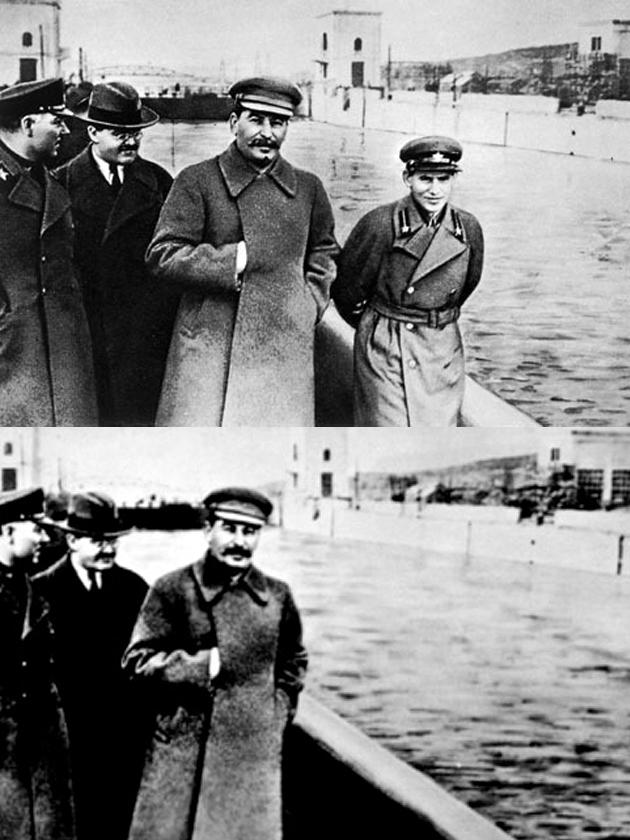
“Like their counterparts in Hollywood, photographic retouchers in Soviet Russia spent long hours smoothing out the blemishes of imperfect complexions, helping the camera to falsify reality,” writes David King in the introduction to his book The Commissar Vanishes: The Falsification of Photographs and Art in Stalin’s Russia. “Stalin’s pockmarked face, in particular, demanded exceptional skills with the airbrush. But it was during the Great Purges, which raged in the late 1930s, that a new form of falsification emerged. The physical eradication of Stalin’s political opponents at the hands of the secret police was swiftly followed by their obliteration from all forms of pictorial existence.”
Using tools that now seem impossibly primitive, Soviet proto-Photoshoppers made “once-famous personalities vanish” and crafted photographs representing Stalin “as the only true friend, comrade, and successor to Lenin, the leader of the Bolshevik Revolution and founder of the USSR.”
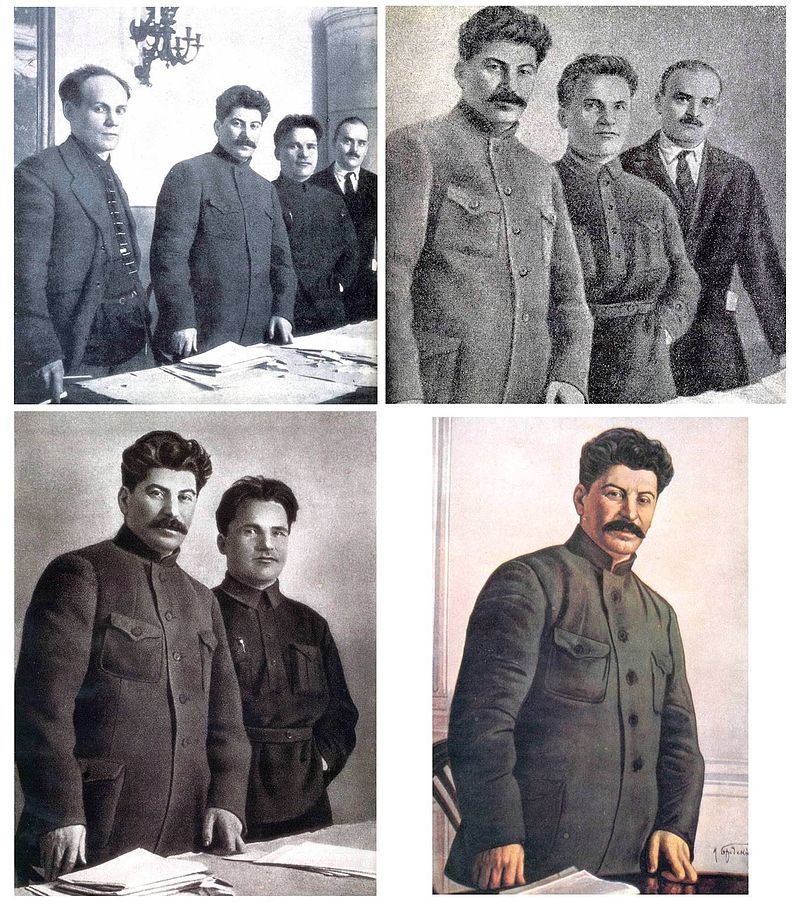
This quasi-artisanal work, “one of the more enjoyable tasks for the art department of publishing houses during those times,” demanded serious dexterity with the scalpel, glue, paint, and airbrush. (Some examples, as you can see in this five-page gallery of images from The Commissar Vanishes, evidenced more dexterity than others.) In this manner, Stalin could order written out of history such comrades he ultimately deemed disloyal (and who usually wound up executed as) as Naval Commissar Nikolai Yezhov, infamously made to disappear from Stalin’s side on a photo taken alongside the Moscow Canal, or People’s Commissar for Posts and Telegraphs Nikolai Antipov, commander of the Leningrad party Sergei Kirov, and Chairman of the Presidium of the Supreme Soviet Nikolai Shvernik — pictured, and removed one by one, just above.
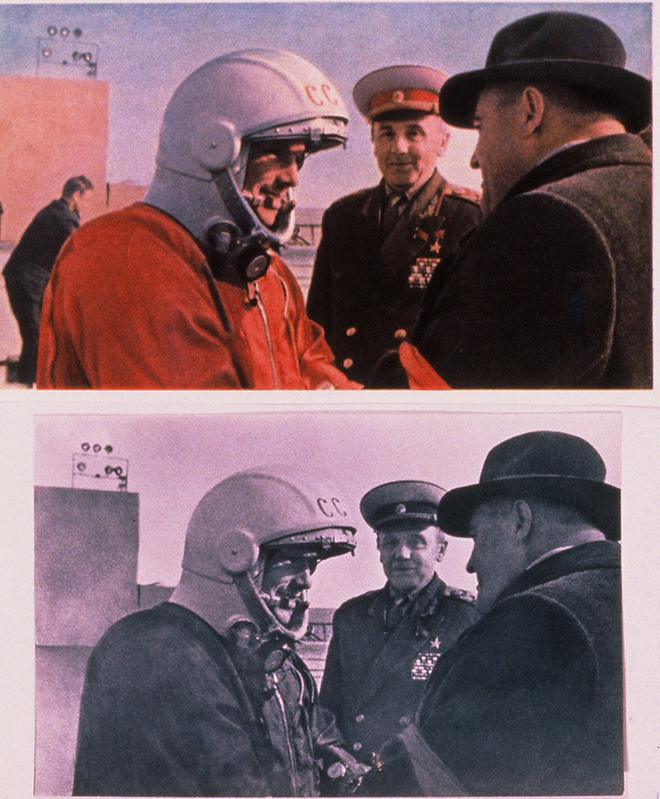
This practice even extended to the materials of the Soviet space program, writes Wired’s James Oberg. Cosmonauts temporarily erased from history include Valentin Bondarenko, who died in a fire during a training exercise, and the especially promising Grigoriy Nelyubov (pictured, and then not pictured, at the top of the post), who “had been expelled from the program for misbehavior and later killed himself.” Yuri Gagarin, the cosmonaut who made history as the first human in outer space, did not, of course, get erased by the proud authorities, but even his photos, like the one just above where he shakes hands with the Soviet space program’s top-secret leader Sergey Korolyov, went under the knife for cosmetic reasons, here the removal of the evidently distracting workman in the background — hardly a major historical figure, let alone a controversial one, but still a real and maybe even living reminder that while the camera may lie, it can’t hold its tongue forever.
Related Content:
Joseph Stalin, a Lifelong Editor, Wielded a Big, Blue, Dangerous Pencil
Leon Trotsky: Love, Death and Exile in Mexico
Based in Seoul, Colin Marshall writes and broadcasts on cities and culture. He’s at work on the book The Stateless City: a Walk through 21st-Century Los Angeles, the video series The City in Cinema, the crowdfunded journalism project Where Is the City of the Future?, and the Los Angeles Review of Books’ Korea Blog. Follow him on Twitter at @colinmarshall or on Facebook.
Read More...Artist Draws 9 Portraits While on LSD: Inside the 1950s Experiments to Turn LSD into a “Creativity Pill”
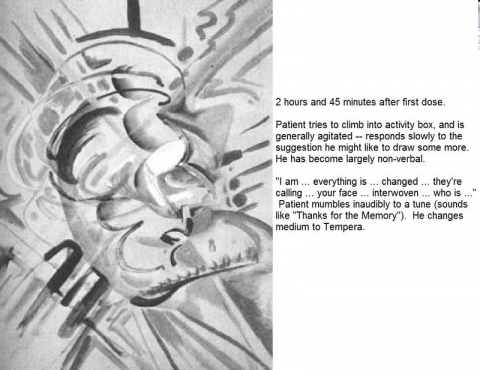
LSD was first synthesized in 1938 by chemist Albert Hoffman in a Swiss laboratory but only attained infamy almost two decades later, when it became part of a series of government experiments. At the same time, a UC Irvine psychiatrist, Oscar Janiger (“Oz” to his friends), conducted his own studies under very different circumstances. “Unlike most researchers, Janiger wanted to create a ‘natural’ setting,” writes Brandy Doyle for MAPS (the Multidisciplinary Association for Psychedelic Studies). He reasoned that “there was nothing especially neutral about a laboratory or hospital room,” so he “rented a house outside of LA, in which his subjects could have a relatively non-directed experience in a supportive environment.”
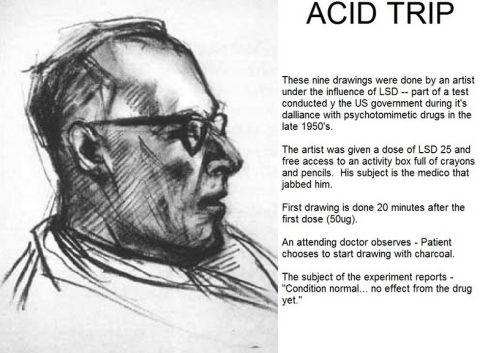
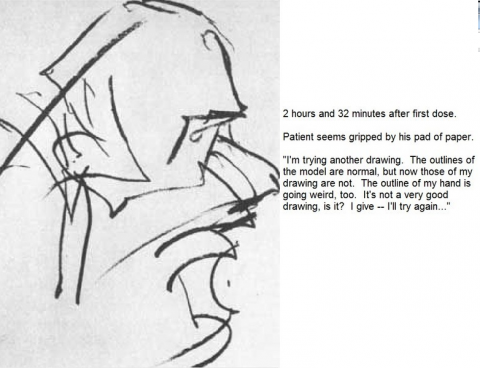
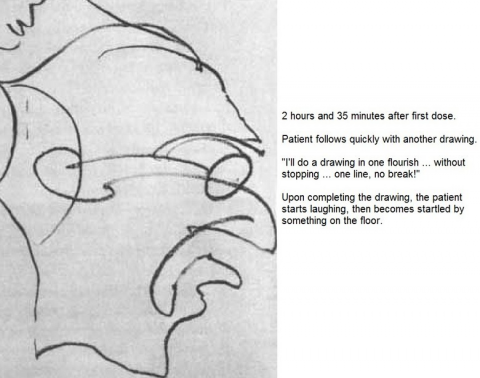
Janiger wanted his subjects to make creative discoveries in a state of heightened consciousness. The study sought, he wrote, to “illuminate the phenomenological nature of the LSD experience,” to see whether the drug could effectively be turned into a creativity pill. He found, over a period lasting from 1954 to 1962 (when the experiments were terminated), that among his approximately 900 subjects, those who were in therapy “had a high rate of positive response,” but those not in therapy “found the experience much less pleasant.” Janiger’s findings have contributed to the research that organizations like MAPS have done on psychoactive drugs in therapeutic settings. The experiments also produced a body of artwork made by study participants on acid.
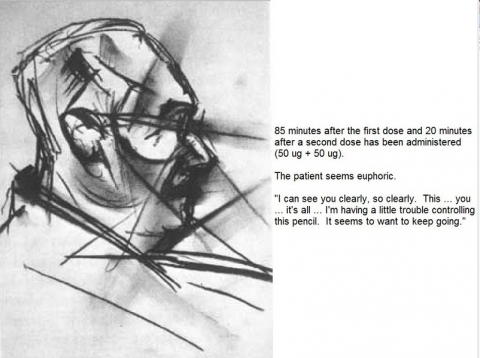
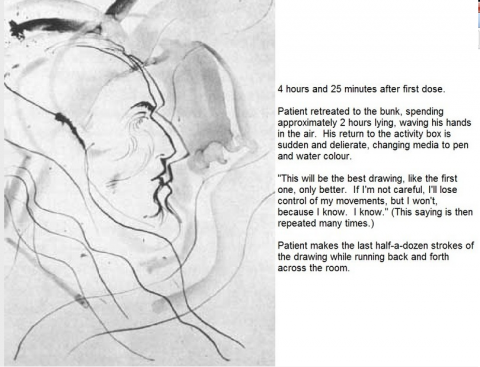
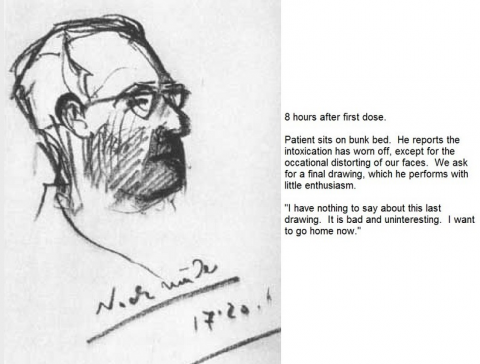
Janiger invited over 100 professional artists into the study and had them produce over 250 paintings and drawings. The series of eight drawings you see here most likely came from one of those artists (though “the records of the identity of the principle researcher have been lost,” writes LiveScience). In the psych-rock-scored video at the top see the progression of increasingly abstract drawings the artist made over the course of his 8‑hour trip. He reported on his perceptions and sensations throughout the experience, noting, at what seems to be the drug’s peak moment at 2.5 and 3 hours in, “I feel that my consciousness is situated in the part of my body that’s active—my hand, my elbow, my tongue…. I am… everything is… changed… they’re calling… your face… interwoven… who is….”
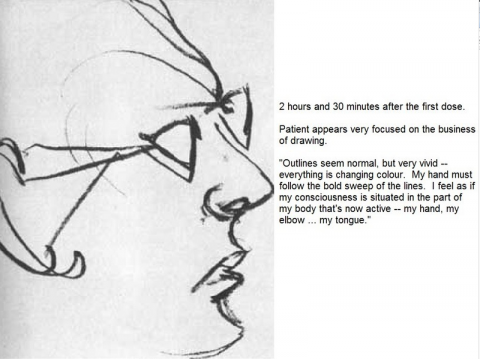
Trippy, but there’s much more to the experiment than its immediate effects on artists’ brains and sketches. As Janiger’s colleague Marlene Dobkin de Rios writes in her definitive book on his work, “all of the artists who participated in Janiger’s project said that LSD not only radically changed their style but also gave them new depths to understand the use of color, form, light, or the way these things are viewed in a frame of reference. Their art, they claimed, changed its essential character as a consequence of their experiences.” Psychologist Stanley Krippner made similar discoveries, and “defined the term psychedelic artist” to describe those who, as in Janiger’s studies “gained a far greater insight into the nature of art and the aesthetic idea,” Dobkin de Rios writes.
Artistic productions—paintings, poems, sketches, and writings that stemmed from the experience—often show a radical departure from the artist’s customary mode of expression… the artists’ general opinion was that their work became more expressionistic and demonstrated a vastly greater degree of freedom and originality.
The work of the unknown artist here takes on an almost mystical quality after a while. The project began “serendipitously” when one of Janiger’s volunteers in 1954 insisted on being able to draw during the dosing. “After his LSD experience,” writes Dobkin de Rios, “the artist was very emphatic that it would be most revealing to allow other artists to go through this process of perceptual change.” Janiger was convinced, as were many of his more famous test subjects.
Janiger reportedly introduced LSD to Cary Grant, Anais Nin, Jack Nicholson, and Aldous Huxley during guided therapy sessions. Still, he is not nearly as well-known as other LSD pioneers like Ken Kesey and Timothy Leary, in part because, writes the psychoactive research site Erowid, “his data remained largely unpublished during his lifetime,” and he was not himself an artist or media personality (though he was a cousin of Allen Ginsberg).
Janiger not only changed the consciousness of unnamed and famous artists with LSD, but also experimented with DMT with Alan Watts and fellow psychiatrist Humphry Osmond (who coined the word “psychedelic”), and conducted research on peyote with Dobkin de Rios. To a great degree, we have him to thank (or blame) for the explosion of psychedelic art and philosophy that flowed out of the early sixties and indelibly changed the culture. At LiveScience, you can see a slideshow of these drawings with commentary from Yale physician Andrew Sewell on what might be happening in the tripping artist’s brain.
Note: IAI Academy has just released a short course called The Science of Psychedelics. You can enroll in it here.
Related Content:
Hofmann’s Potion: 2002 Documentary Revisits History of LSD
Ken Kesey Talks About the Meaning of the Acid Tests
Aldous Huxley’s Most Beautiful, LSD-Assisted Death: A Letter from His Widow
Josh Jones is a writer and musician based in Durham, NC. Follow him at @jdmagness
Read More...Rebecca Solnit Picks 13 Songs That Will Remind Us of Our Power to Change the World, Even in Seemingly Dark Times

Image by Shawn, via Flickr Commons
Apocalypses have always been popular as mass belief and entertainment. Maybe it’s a collective desire for retribution or redemption, or a kind of vertigo humans experience when staring into the abyss of the unknown. Better to end it all than live in neurotic uncertainty. Maybe we find it impossible to think of a future world existing hundreds, thousands, millions of years after our deaths. As Rebecca Solnit observes in Hope in the Dark: Untold Histories, Wild Possibilities, “people have always been good at imagining the end of the world, which is much easier to picture than the strange sidelong paths of change in a world without end.” What if the world never ends, but goes on forever, changing and evolving in unimaginable ways?
This is the bailiwick of science fiction, but also the domain of history, a hindsight view of centuries past when wars, tyrannical conquests, famines, and diseases nearly wiped out entire populations—when it seemed to them a near certainty that nothing would or could survive the present horror. And yet it did.
This may be no consolation to the victims of violence and plague, but the world has gone on for the living, people have adapted and survived, even under the current, very real threats of nuclear war and catastrophic climate change. And throughout history, both small and large groups of people have changed the world for the better, though it hardly seemed possible at the time. Solnit’s book chronicles these histories, and last year, she released a playlist as a companion for the book.
Hope in the Dark makes good on its title through a collection of essays about “everything,” writes Alice Gregory at The New York Times, “from the Zapatistas to weather forecasting to the fall of the Berlin Wall.” The book is “part history of progressive success stories, part extended argument for hope as a catalyst for action.” Solnit wrote the book in 2004, during the reelection of George W. Bush—a time when progressives despaired of ever seeing the end of chickenhawk sabre-rattling, wars for profit, privatization of the public sphere, environmental degradation, theocratic political projects, curtailing of civil rights, or the disaster capitalism the administration wholeheartedly embraced (as Naomi Klein’s The Shock Doctrine detailed). Plus ça change.…
In March of last year, Haymarket Books reissued Hope in the Dark, and on November 10th, Solnit posted a link to a free download of the book on Facebook. It was downloaded over 30,000 times in one week. Along with other progressive intellectuals like Klein and Richard Rorty, Solnit—who became internationally known for the term “mansplaining” in her essay, then book, Men Explain Things to Me—has now been cast as a “Cassandra figure of the left,” Gregory writes. But she rejects the disastrous futility inherent in that analogy:
If you think of a kind of ecology of ideas, there are more than enough people telling us how horrific and terrible and bad everything is, and I don’t really need to join that project. There’s a whole other project of trying to counterbalance that — sometimes we do win and this is how it worked in the past. Change is often unpredictable and indirect. We don’t know the future. We’ve changed the world many times, and remembering that, that history, is really a source of power to continue and it doesn’t get talked about nearly enough.
If we don’t hear enough talk about hope, maybe we need to hear more hopeful music, Solnit suggests in her Hope in the Dark playlist. Thirteen songs long, it moves between Beyoncé and The Clash, Iggy Pop and Stevie Nicks, Black Flag and Big Freedia.
While the selections speak for themselves, she offers brief commentary on each of her choices in a post at Powell’s. Beyoncé’s “Formation,” Solnit writes, “reformulates, digging deep into the past of sorrow and suffering and injustice and pulling us all with her into a future that could be different.” Patti Smith’s anthem “People Have the Power” feels like hope, Solnit says: “it’s right about the power we have, which obliges us to act, and which many duck by pretending we’re helpless.” Maybe that’s what apocalypses are all about—making us feel small and powerless in the face of impending doom. But there are other kinds of religion, like that of Lee Williams’ “Steal My Joy.” It’s a “gorgeous gospel song,” writes Solnit. “Joystealers are everywhere. Never surrender to them.” That sounds like an ideal exhortation to imagine and fight for a better future.
Related Content:
89 Essential Songs from The Summer of Love: A 50th Anniversary Playlist
The History of Punk Rock in 200 Tracks: An 11-Hour Playlist Takes You From 1965 to 2016
Josh Jones is a writer and musician based in Durham, NC. Follow him at @jdmagness
Read More...The Secret Rhythm Behind Radiohead’s “Videotape” Now Finally Revealed
“Videotape” ends Radiohead’s 2007 album In Rainbows, and like many of their albums, it tends towards the funereal. (Think of the drunken “Life in a Glasshouse” from Amnesiac or “Motion Picture Soundtrack” from Kid A). And at first, it does sound very simple, four plaintive descending chords and Thom Yorke’s high melody over the top of it.
But in this 10 minute video essay from Vox Pop: Earworm, the song’s structure is peeled back to reveal a secret–that the chord sequence is not on the downbeat, but shifted a half-beat earlier. Hence, it is a heavily syncopated song that removes all clues to its syncopation.
Advanced musicians out there might not be blown away by any of this, but for fans of Radiohead and those just coming to music theory, the video is a good introduction to complex rhythm ideas. The fun comes from the backwards way in which Vox and Warren Lain–who devoted a whole 30 minutes to exploring the song–came across the secret.
It starts with video of Thom Yorke trying to play a live version along to a click track, and then to Phil Selway’s drums. For some reason Yorke can’t do it. And that’s because his brain is wanting to put the chords on the downbeat, the most natural, obvious choice. To play off beat, without further rhythmic information, shows the band “fighting against not just their own musical instincts, but their own brainwaves” as the Vox host explains.
There is much discussion in the YouTube comments over whether these 10 minutes are worth the analysis. It’s not that Radiohead invented anything new here–check out the off-beat opening of something like XTC’s “Wake Up”–but more that the band goes through the whole song (at least in the recorded version) without revealing the real rhythm, like playing in a certain key and never touching the root note.
To sum up: Radiohead push themselves in the studio and take those experiments into the live experience and challenge themselves. Which is way more than the majority of rock bands ever do. And bless ‘em, Yorke and co., for doing so.
Related Content:
The Hidden Secrets in “Daydreaming,” Paul Thomas Anderson’s New Radiohead Music Video
Eight Radiohead Albums Reimagined as Vintage Paperback Books
Ted Mills is a freelance writer on the arts who currently hosts the artist interview-based FunkZone Podcast and is the producer of KCRW’s Curious Coast. You can also follow him on Twitter at @tedmills, read his other arts writing at tedmills.com and/or watch his films here.
Read More...Free: A Crash Course in Design Thinking from Stanford’s Design School
If you ask a few of today’s youngsters what they want to do when they grow up, the word “design” will almost certainly come up more than once. Ask them what design itself means to them, and you’ll get a variety of answers from the vaguely general to the ultra-specialized. The concept of design — and of designing, and of being a designer — clearly holds a strong appeal, but how to define it in a useful way that still applies in as many cases as possible?
One set of answers comes from the 90-minute “Crash Course in Design Thinking” above, a production of Stanford University’s Hasso Plattner Institute of Design, or d.school. The Interaction Design Foundation defines design thinking as “an iterative process in which we seek to understand the user, challenge assumptions we might have, and redefine problems in an attempt to identify alternative strategies and solutions that might not be instantly apparent with our initial level of understanding.” In a brief history of the subject there, Rikke Dam and Teo Siang write that “business analysts, engineers, scientists and creative individuals have been focused on the methods and processes of innovation for decades.”
Stanford comes into the picture in the early 1990s, with the formation of the Design Thinking-oriented firm IDEO and its ” design process modelled on the work developed at the Stanford Design School.” In other words, someone using design thinking, on the job at IDEO or elsewhere, knows how to approach new, vague, or otherwise tricky problems in various sectors and work step-by-step toward solutions. D.school, with their mission to “build on methods from across the field of design to create learning experiences that help people unlock their creative potential and apply it to the world,” aims to instill the principles of design thinking in its students. And this crash course, through an activity called “The Gift-Giving Project,” offers a glimpse of how they do it.
You can just watch the video and get a sense of the “design cycle” as d.school teaches it, or you can get hands-on by assembling the simple required materials and a group of your fellow design enthusiasts (make sure you add up to an even number). Youngster or otherwise, you may well emerge from the experience, a mere hour and a half later, with not just new problem-solving habits of mind but a newfound zeal for design, however you define it.
“Crash Course in Design Thinking” will be added to our collection, 1,700 Free Online Courses from Top Universities. You can find a number of MOOCS on design thinking and design at Coursera.
Related Content:
Download 20 Free eBooks on Design from O’Reilly Media
Saul Bass’ Advice for Designers: Make Something Beautiful and Don’t Worry About the Money
Bauhaus, Modernism & Other Design Movements Explained by New Animated Video Series
Abstract: Netflix’s New Documentary Series About “the Art of Design” Premieres Today
Based in Seoul, Colin Marshall writes and broadcasts on cities and culture. He’s at work on the book The Stateless City: a Walk through 21st-Century Los Angeles, the video series The City in Cinema, the crowdfunded journalism project Where Is the City of the Future?, and the Los Angeles Review of Books’ Korea Blog. Follow him on Twitter at @colinmarshall or on Facebook.
Read More...The Roland TR-808, the Drum Machine That Changed Music Forever, Is Back! And It’s Now Affordable & Compact
You don’t have to be a gearhead to instantly recognize the sound of the Roland TR-808. Introduced in 1980, the legendary drum machine is all over the 80s, 90s, and the retro 2000s, from dance progenitors like Afrika Bambaataa’s “Planet Rock” to formative Def Jam releases like Run DMC’s debut and the Beastie Boy’s Licensed to Ill (one of the original machines used on such classics recently went on sale). The 808 provides the backbeat for Marvin Gaye’s “Sexual Healing,” New Order’s “Shellshock,” and LL Cool J’s “Going Back to Cali”… track after era-defining track pulses with the iconic drum machine’s deep, thudding kick drum and comically synthetic congas, claves, maracas, handclaps, and cowbells.
The 808 inspired a tribute celebration around the world on August 8th (8/08) and stars in its own full-length documentary, “a nerdy love letter” to the electric instrument, writes Slate. You can buy 808 Adidas that actually play beats, play with a virtual TR-808 in your browser, and enjoy the sounds of Kanye West’s oddly influential 2008 album 808s and Heartbreak. With all this renewed attention, you might think it’s a good time for Japan’s Roland to bring the device back into production, just as Moog briefly reissued its Minimoog Model D (since discontinued) amidst a swirl of renewed mainstream interest in analog synthesizers.
Roland has obviously felt the pop cultural winds blowing its way. Yesterday, on 808 Day, the company announced a new iteration, now called the TR-08, as part of its Boutique line. (A previous revival, the TR‑8, saw Roland combine the 808 with the classic 909, renowned in rave circles.) The video at the top features some of the 808’s original adopters—producer Jimmy Jam, rapper Marley Marl, and DJs Jazzy Jeff and Juan Atkins—marveling over the new product. Just above, in case you’ve somehow forgotten, we have a demonstration of famous TR-808 beats from tracks like “Planet Rock” and Cybotron’s “Clear,” songs that made innovative use of samples and which themselves became choice material for dozens of sample-based productions.
The 808 was the choice of drum machine for tinkerers. Its sound was “crowd-sourced,” writes Chris Norris, “with artists building on one another’s modifications of the device. One of the first major innovations came about in 1984,” with the “fine tuning of the 808’s low frequencies and further widening of its bass kick drum to create the sound of an underground nuke test” heard on producer Strafe’s club hit “Set it Off.” The new TR-08 has a much smaller footprint and expands the machine’s capabilities with contemporary features like an LED screen, controls over gain and tuning, battery or USB power, and audio or MIDI through a USB connection.
Arguably “one of the most impactful pieces of modern music hardware,” writes The Verge, upon its debut the 808 “received mixed reviews and was considered a commercial failure as its analog circuitry didn’t create the ‘traditional’ drum sounds” most producers expected. This meant that 808s could be picked up relatively cheaply by bedroom producers and local DJs. As a result, “the trembling feeling of that sound,” Norris writes, “booming down boulevards in Oakland, the Bronx, and Detroit are part of America’s cultural DNA, the ghost of Reagan-era blight” and the renaissance of creativity born in its midst. To get a sense of the breadth of the 808’s musical contributions, listen to the playlist above, with everyone from Talking Heads to 2 LIVE CREW, Phil Collins, and Whitney Houston putting in an appearance.
Related Content:
All Hail the Beat: How the 1980 Roland TR-808 Drum Machine Changed Pop Music
The “Amen Break”: The Most Famous 6‑Second Drum Loop & How It Spawned a Sampling Revolution
Josh Jones is a writer and musician based in Durham, NC. Follow him at @jdmagness
Read More...Support Us
We're hoping to rely on loyal readers, rather than erratic ads. Please click the Donate button and support Open Culture. You can use Paypal, Venmo, Patreon, even Crypto! We thank you!

About Us

Open Culture scours the web for the best educational media. We find the free courses and audio books you need, the language lessons & educational videos you want, and plenty of enlightenment in between.
Advertise With Us
FREE UPDATES!
GET OUR DAILY EMAIL
Get the best cultural and educational resources on the web curated for you in a daily email. We never spam. Unsubscribe at any time.
FOLLOW ON SOCIAL MEDIA
Open Culture editor Dan Colman scours the web for the best educational media. He finds the free courses and audio books you need, the language lessons & movies you want, and plenty of enlightenment in between.
Advertise With Us

