25,000+ 78RPM Records Now Professionally Digitized & Streaming Online: A Treasure Trove of Early 20th Century Music
Every recording medium works as a metonym for its era: the term “LP” conjures up associations with a broad musical period of classic rock ‘n’ roll, soul, doo-wop, R&B, funk, jazz, disco etc.; we talk of the “CD era,” dominated by dance music and hip-hop; the 45 makes us think of jukeboxes, diners, and sock-hops; and the cassette, well… at least one subgenre of music, what John Peel called “shambling,” jangly, lo-fi pop, came to be known by the name “C86,” the title of an NME compilation, short for “Cassette, 1986.” (Readers of the magazine had to clip coupons and send money by postal mail to receive a copy of the tape.)
Soon, however, fewer and fewer people will remember the age of the 78rpm record, the preferred vehicle for the music of the early 20th century. From classical and opera to blues, bluegrass, swing, ragtime, gospel, Hawaiian, and holiday novelties the 78 epitomizes the sounds of its heyday as much as any of the media mentioned above.
While cassettes recently made a nostalgic comeback, and turntables are found in every big box store, we’re generally not equipped to play back 78s. These are brittle records made from shellac, a resin secreted by beetles. They were often played on appliances that doubled as quality parlor furniture.
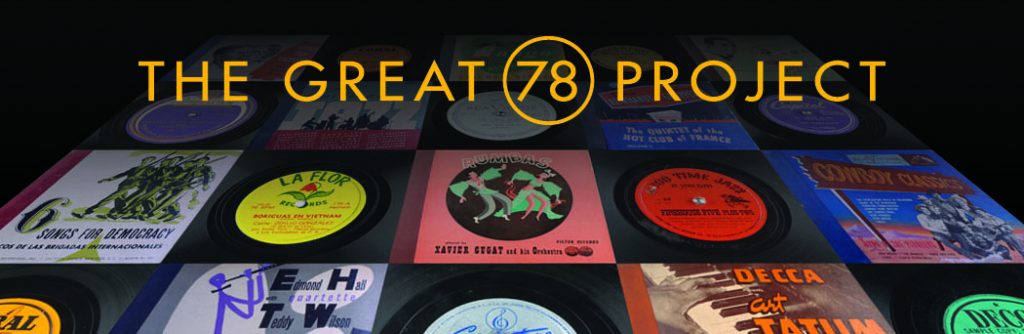
Thanks now to the Internet Archive, that stalwart of digital cataloguing and curation, we can play twenty five thousand 78s and immerse ourselves in the early 20th century, whether for research purposes or pure enjoyment. Previous efforts at preservation have “restored or remastered… commercially viable recordings” on LP or CD, writes The Great 78 Project, the archive’s volunteer program to digitize musical history. The current effort seeks to go beyond popularity and collect everything, from the rarest and strangest to the already historic. “I want to know what the early 20th century sounded like,” writes Internet Archive founder Brewster Kahle, “Midwest, different countries, different social classes, different immigrant communities and their loves and fears.”
You can hear several selections here, and thousands more at this archive of 78s uploaded by audio-visual preservation company, George Blood, L.P. Other 78rpm archives from volunteer collectors and the ARChive of Contemporary Music are being digitized and uploaded as well. You’ll note the recordings are often submerged in crackle and hiss, and generally lack bass and treble (most playback systems of the time could not reproduce the lower and higher ends of the audible spectrum). “We have preserved the often very prominent surface noise and imperfections,” the Archive writes, “and included files generated by different sizes and shapes of stylus to facilitate different kinds of analysis.” Different playback systems could produce markedly different sounds, and the recordings were not always strictly 78rpm.
These conditions of the transfer ensure that we roughly hear what the first audiences heard, though the records’ age and our penchant for 7 speaker audio systems introduce some new variables. None of these recordings were even made in stereo. The 78 period, notes Yale Library, lasted between 1898 and the late 1950s, when the 33 1/2 rpm long-playing record fully edged out the older model. For approximately fifty years, these records carried recorded music, sound, and speech into homes around the world. “What is this?” Kahle asks of this formidable digitization project. “A reference collection? A collector’s dream? A discovery radio station? The soundtrack of the early 20th century?” All of the above. To learn more about The Great 78 Project, including the technical details of the transfer and how you can carefully package up and mail in your own 78rpm records, visit their Preservation page.
Related Content:
BBC Launches World Music Archive
DC’s Legendary Punk Label Dischord Records Makes Its Entire Music Catalog Free to Stream Online
Josh Jones is a writer and musician based in Durham, NC. Follow him at @jdmagness
Read More...How Information Overload Robs Us of Our Creativity: What the Scientific Research Shows

Flickr Commons photo by J Stimp
Everyone used to read Samuel Johnson. Now it seems hardly anyone does. That’s a shame. Johnson understood the human mind, its sadly amusing frailties and its double-blind alleys. He understood the nature of that mysterious act we casually refer to as “creativity.” It is not the kind of thing one lucks into or masters after a seminar or lecture series. It requires discipline and a mind free of distraction. “My dear friend,” said Johnson in 1783, according to his biographer and secretary Boswell, “clear your mind of cant.”
There’s no missing apostrophe in his advice. Inspiring as it may sound, Johnson did not mean to say “you can do it!” He meant “cant,” an old word for cheap deception, bias, hypocrisy, insincere expression. “It is a mode of talking in Society,” he conceded, “but don’t think foolishly.” Johnson’s injunction resonated through a couple centuries, became garbled into a banal affirmation, and was lost in a graveyard of image macros. Let us endeavor to retrieve it, and ruminate on its wisdom.
We may even do so with our favorite modern brief in hand, the scientific study. There are many we could turn to. For example, notes Derek Beres, in a 2014 book neuroscientist Daniel Levitin brought his research to bear in arguing that “information overload keeps us mired in noise.… This saps us of not only willpower (of which we have a limited store) but creativity as well.” “We sure think we’re accomplishing a lot,” Levitin told Susan Page on The Diane Rehm Show in 2015, “but that’s an illusion… as a neuroscientist, I can tell you one thing the brain is very good at is self-delusion.”
Johnson’s age had its own version of information overload, as did that of another curmudgeonly voice from the past, T.S. Eliot, who wondered, “Where is the wisdom we have lost in knowledge? Where is the knowledge we have lost in information?” The question leaves Eliot’s readers asking whether what we take for knowledge or information really are such? Maybe they’re just as often forms of needless busyness, distraction, and overthinking. Stanford researcher Emma Seppälä suggests as much in her work on “the science of happiness.” At Quartz, she writes,
We need to find ways to give our brains a break.… At work, we’re intensely analyzing problems, organizing data, writing—all activities that require focus. During downtime, we immerse ourselves in our phones while standing in line at the store or lose ourselves in Netflix after hours.
Seppälä exhorts us to relax and let go of the constant need for stimulation, to take longs walks without the phone, get out of our comfort zones, make time for fun and games, and generally build in time for leisure. How does this work? Let’s look at some additional research. Bar-Ilan University’s Moshe Bar and Shira Baror undertook a study to measure the effects of distraction, or what they call “mental load,” the “stray thoughts” and “obsessive ruminations” that clutter the mind with information and loose ends. Our “capacity for original and creative thinking,” Bar writes at The New York Times, “is markedly stymied” by a busy mind. “The cluttered mind,” writes Jessica Stillman, “is a creativity killer.”
In a paper published in Psychological Science, Bar and Baror describe how “conditions of high load” foster unoriginal thinking. Participants in their experiment were asked to remember strings of arbitrary numbers, then to play word association games. “Participants with seven digits to recall resorted to the most statistically common responses (e.g., white/black),” writes Bar, “whereas participants with two digits gave less typical, more varied pairings (e.g. white/cloud).” Our brains have limited resources. When constrained and overwhelmed with thoughts, they pursue well-trod paths of least resistance, trying to efficiently bring order to chaos.
“Imagination,” on the other hand, wrote Dr. Johnson elsewhere, “a licentious and vagrant faculty, unsusceptible of limitations and impatient of restraint, has always endeavored to baffle the logician, to perplex the confines of distinction, and burst the enclosures of regularity.” Bar describes the contrast between the imaginative mind and the information processing mind as “a tension in our brains between exploration and exploitation.” Gorging on information makes our brains “’exploit’ what we already know,” or think we know, “leaning on our expectation, trusting the comfort of a predictable environment.” When our minds are “unloaded,” on the other hand, which can occur during a hike or a long, relaxing shower, we can shed fixed patterns of thinking, and explore creative insights that might otherwise get buried or discarded.
As Drake Baer succinctly puts in at New York Magazine’s Science of Us, “When you have nothing to think about, you can do your best thinking.” Getting to that state in a climate of perpetual, unsleeping distraction, opinion, and alarm, requires another kind of discipline: the discipline to unplug, wander off, and clear your mind.
For another angle on this, you might want to check out Cal Newport’s 2016 book, Deep Work: Rules for Focused Success in a Distracted World.
Related Content:
The Neuroscience & Psychology of Procrastination, and How to Overcome It
Why You Do Your Best Thinking In The Shower: Creativity & the “Incubation Period”
Josh Jones is a writer and musician based in Durham, NC. Follow him at @jdmagness
Read More...How Leonard Cohen & David Bowie Faced Death Through Their Art: A Look at Their Final Albums
When Leonard Cohen released You Want it Darker in late 2016, some suspected that it would be his last album. When the 82-year-old singer-songwriter died nineteen days later, it felt like a reprise of David Bowie’s passage from this mortal coil at the beginning of that year in which we lost so many important musicians: just two days after the release of his album Blackstar, Bowie shocked the world by dying of an illness he’d chosen not to make public. Both Cohen and Bowie’s fans immediately doubled down their scrutiny of what turned out to be their final works, finding in both of them artistic interpretations of the confrontation with death.
The title track of You Want It Darker, says the narrator of the Polyphonic video essay above, “is not just any song, but the culmination of many meditations on Cohen’s own mortality. The result is a hauntingly accusatory song towards his own god.”
This analysis focuses on lines, delivered by Cohen’s gravelier-than-ever singing voice, like “If you are the dealer, I’m out of the game / If you are the healer, that means I’m broken and lame” and “If thine is the glory, then mine must be the shame / You want it darker, we kill the flame.” Cohen also uses phrases taken from a Jewish mourner’s prayer as a way of “facing up to his god and submitting.”
The non-religious Bowie took a different tack. “Just take a look at Bowie’s costume,” says the essay’s narrator. “He’s bandaged, frail, and maniacal in the ‘Blackstar’ video. While the bandage serves to represent wounds, it can also be taken as a blindfold,” historically “worn by those condemned to execution.” Using Christian imagery, Bowie frames his song “in the post-paradise world of mortal life,” in a sense referencing what Cohen once described as “our blood myth,” the crucifixion. And so Bowie’s song “is using our cultural vocabulary to explore our relationship with death.” And yet, “in the midst of this dark song, Bowie offers optimism” in the form of the titular Blackstar, a “newly inspired being” that emerges from death.
“While mankind can’t cheat death, we can still find immortality in the way people remember us, the legacy that they carry on.” And despite recognizing their basic humanity, many of us carriers of the legacy still struggle to process the deaths of high-profile, sui generis performing artists. Maybe it has to do with their status as icons, and icons, strictly speaking, can’t die — but nor can they live. Leonard Cohen and David Bowie, the men, may have finished their days, and what days they were, but Leonard Cohen and David Bowie, the cultural phenomena, will surely outlast us all.
You can listen to Cohen and Bowie’s final albums above. If you need Spotify’s free software, get it here.
Related Content:
Leonard Cohen Has Passed at Age 82: His New and Now Final Album Is Streaming Free Online
Hear Leonard Cohen’s Final Interview: Recorded by David Remnick of The New Yorker
David Bowie Sings “Changes” in His Last Live Performance, 2006
Dave: The Best Tribute to David Bowie That You’re Going to See
Death: A Free Philosophy Course from Yale
Based in Seoul, Colin Marshall writes and broadcasts on cities and culture. He’s at work on the book The Stateless City: a Walk through 21st-Century Los Angeles, the video series The City in Cinema, the crowdfunded journalism project Where Is the City of the Future?, and the Los Angeles Review of Books’ Korea Blog. Follow him on Twitter at @colinmarshall or on Facebook.
Read More...People Who Swear Are More Honest Than Those Who Don’t, Finds a New University Study
I’ve heard it said many times: “I don’t trust people who don’t swear.” It’s not an empirical statement. Just an intuition, that people who shy away from salty language might also shy away from certain truths—may even be, perhaps, a little delusional. Few people characterize teetotalers of swearing with more bite than Stephen Fry, who believes “the sort of twee person who thinks swearing is in any way a sign of a lack of education or of a lack of verbal interest is just a fucking lunatic.” George Carlin would approve. A comically exaggerated view. No, swearing isn’t necessarily a sign of mental illness. But it does correlate strongly with truthtelling.
It seems all the suspicious salts out there may have happened upon a measurable phenomenon. A study published last year with the cheeky title “Frankly, We Do Give a Damn: The Relationship Between Profanity and Honesty,” notes, “the consistent findings across the studies suggest that the positive relation between profanity and honesty is robust, and that relationship found at the individual level indeed translates to the society level.” It’s true, some research shows that people who swear may be likely to violate other social norms, god bless ‘em, but they are also less likely to lie during police interrogations.
After reviewing the literature, the researchers, led by Maastricht University Psychologist Gilad Feldman, describe the results of their own experiments. They asked 276 people to report on their swearing habits (or not) in detail. Those people then took a psychological test that measured their levels of honesty. Next, the team analyzed 70,000 social media interactions, and reported that “profanity and honesty were found to be significantly and positively correlated, indicating that those who used more profanity were more honest in their Facebook status updates.” They did not say whether high levels of honesty on Facebook is desirable.
Finally, Feldman and his colleagues widened their scope to 48 U.S. states, and were able to correlate social media data with measures of government accountability. States with higher levels of swearing had a higher integrity score according to a 2012 index published by the Center for Public Integrity. (Believe or not, New Jersey had some of the highest scores.) All three of their studies yielded similar results. “At both the individual and society level,” they conclude, “we found that a higher rate of profanity use was associated with more honesty.” This does not mean, as Ephrat Livni writes at Quartz, that “people who curse like sailors” won’t “commit serious ethical crimes—but they won’t pretend all’s well online.”
As to the question of whether swearing betrays a lack of education and an impoverished vocabulary, we might turn to linguist, psychologist, and neuroscientist Steven Pinker, who has made a learned defense of foul language, in drily humorous talks, books, and essays. “When used judiciously,” he writes in a 2008 Harvard Brain article, “swearing can be hilarious, poignant, and uncannily descriptive.” His is an argument that relies not only on data but on philosophical reflection and literary appreciation. “It’s a fact of life that people swear,” he says, and so, it’s a fact of art. Shakespeare invented dozens of swears and was never afraid to work blue. Perhaps that’s why we find his representations of humanity so perennially honest.
You can read “Frankly, We Do Give a Damn: The Relationship Between Profanity and Honesty” here. In addition to Gilad Feldman, the research paper was also written by Huiwen Lian (The Hong Kong University of Science and Technology,) Michal Kosinski (Stanford), and David Stillwell (Cambridge).
Related Content:
Stephen Fry, Language Enthusiast, Defends The “Unnecessary” Art Of Swearing
Steven Pinker Explains the Neuroscience of Swearing (NSFW)
George Carlin Performs His “Seven Dirty Words” Routine: Historic and Completely NSFW
Free Online Psychology & Neuroscience Courses
Josh Jones is a writer and musician based in Durham, NC. Follow him at @jdmagness
Read More...How Aristotle Invented Computer Science

In popular conceptions, we take the computer to be the natural outcome of empirical science, an inheritance of the Enlightenment and subsequent scientific revolutions in the 19th and 20th centuries. Of course, modern computers have their ancient precursors, like the Antikythera Mechanism, a 2,200-year-old bronze and wood machine capable of predicting the positions of the planets, eclipses, and phases of the moon. But even this fascinating artifact fits into the narrative of computer science as “a history of objects, from the abacus to the Babbage engine up through the code-breaking machines of World War II.” Much less do we invoke the names of “philosopher-mathematicians,” writes Chris Dixon at The Atlantic, like George Boole and Gottlob Frege, “who were themselves inspired by Leibniz’s dream of a universal ‘concept language,’ and the ancient logical system of Aristotle.” But these thinkers are as essential, if not more so, to computer science, especially, Dixon argues, Aristotle.
The ancient Greek thinker did not invent a calculating machine, though they may have existed in his lifetime. Instead, as Dixon writes in his recent piece, “How Aristotle Created the Computer,” Aristotle laid the foundations of mathematical logic, “a field that would have more impact on the modern world than any other.”
The claim may strike historians of philosophy as somewhat ironic, given that Enlightenment philosophers like Francis Bacon and John Locke announced their modern projects by thoroughly repudiating the medieval scholastics, whom they alleged were guilty of a slavish devotion to Aristotle. Their criticisms of medieval thought were varied and greatly warranted in many ways, and yet, like many an empiricist since, they often overlooked the critical importance of Aristotelian logic to scientific thought.
At the turn of the 20th century, almost three hundred years after Bacon sought to transcend Aristotle’s Organon with his form of natural philosophy, the formal logic of Aristotle could still be “considered a hopelessly abstract subject with no conceivable applications.” But Dixon traces the “evolution of computer science from mathematical logic” and Aristotelian thought, beginning in the 1930s with Claude Shannon, author of the groundbreaking essay “A Symbolic Analysis of Switching and Relay Circuits.” Shannon drew on the work of George Boole, whose name is now known to every computer scientist and engineer but who, in 1938, “was rarely read outside of philosophy departments.” And Boole owed his principle intellectual debt, as he acknowledged in his 1854 The Laws of Thought, to Aristotle’s syllogistic reasoning.
Boole derived his operations by replacing the terms in a syllogism with variables, “and the logical words ‘all’ and ‘are’ with arithmetical operators.” Shannon discovered that “Boole’s system could be mapped directly onto electrical circuits,” which hitherto “had no systematic theory governing their design.” The insight “allowed computer scientists to import decades of work in logic and mathematics by Boole and subsequent logicians.” Shannon, Dixon writes, “was the first to distinguish between the logical and the physical layer of computers,” a distinction now “so fundamental to computer science that it might seem surprising to modern readers how insightful it was at the time.” And yet, the field could not move forward without it—without, that is, a return to ancient categories of thought.
Since the 1940s, computer programming has become significantly more sophisticated. One thing that hasn’t changed is that it still primarily consists of programmers specifying rules for computers to follow. In philosophical terms, we’d say that computer programming has followed in the tradition of deductive logic, the branch of logic discussed above, which deals with the manipulation of symbols according to formal rules.
Dixon’s argument for the centrality of Aristotle to modern computer science takes many turns—through the quasi-mystical thought of 13th-century Ramon Llull and, later, his admirer Gottfried Leibniz. Through Descartes, and later Frege and Bertrand Russell. Through Alan Turing’s work at Bletchley Park. Nowhere do we see Aristotle, wrapped in a toga, building a circuit board in his garage, but his modes of reasoning are everywhere in evidence as the scaffolding upon which all modern computer science has been built. Aristotle’s attempts to understand the laws of the human mind “helped create machines that could reason according to the rules of deductive logic.” The application of ancient philosophical principles may, Dixon concludes, “result in the creation of new minds—artificial minds—that might someday match or even exceed our own.” Read Dixon’s essay at The Atlantic, or hear it read in its entirety in the audio above.
Related Content:
Free Online Computer Science Courses
The Books on Young Alan Turing’s Reading List: From Lewis Carroll to Modern Chromatics
How Arabic Translators Helped Preserve Greek Philosophy … and the Classical Tradition
Josh Jones is a writer and musician based in Durham, NC. Follow him at @jdmagness
Read More...
Renaissance Knives Had Music Engraved on the Blades; Now Hear the Songs Performed by Modern Singers
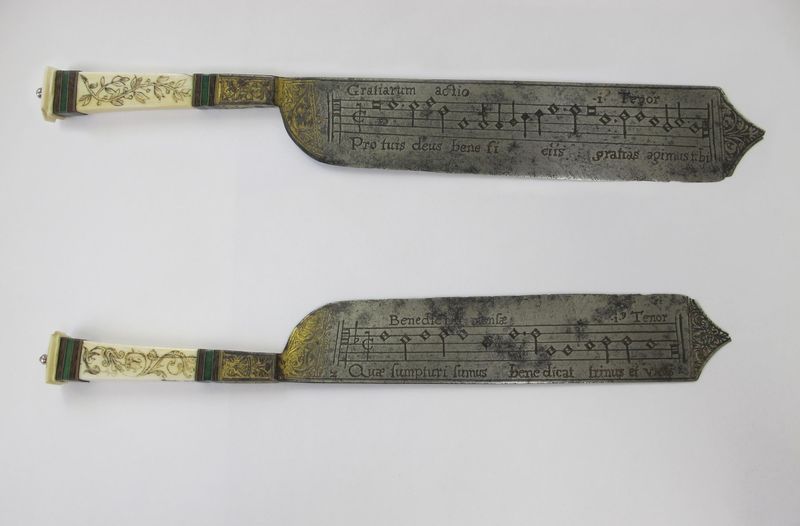
Image courtesy of The Victoria and Albert Museum
On any given weekend, in any part of the state where I live, you can find yourself standing in a hall full of knives, if that’s the kind of thing you like to do. It is a very niche kind of experience. Not so in some other weapons expos—like the Arms and Armor galleries at the Metropolitan Museum of Art, where everyone, from the most warlike to the staunchest of pacifists, stands in awe at the intricate ornamentation and incredibly deft craftsmanship on display in the suits of armor, lances, shields, and lots and lots of knives.
We must acknowledge in such a space that the worlds of art and of killing for fame and profit were never very far apart during Europe’s late Medieval and Renaissance periods. Yet we encounter many similar artisanal instruments from the time, just as finely tuned, but made for far less belligerent purposes.
As Maya Corry of the Fitzwilliam Museum in Cambridge—an institution with its own impressive arms and armor collection—comments in the video above (at 2:30), one unusual kind of 16th century knife meant for the table, not the battlefield, offers “insight into that harmonious, audible aspect of family devotions,” prayer and song.
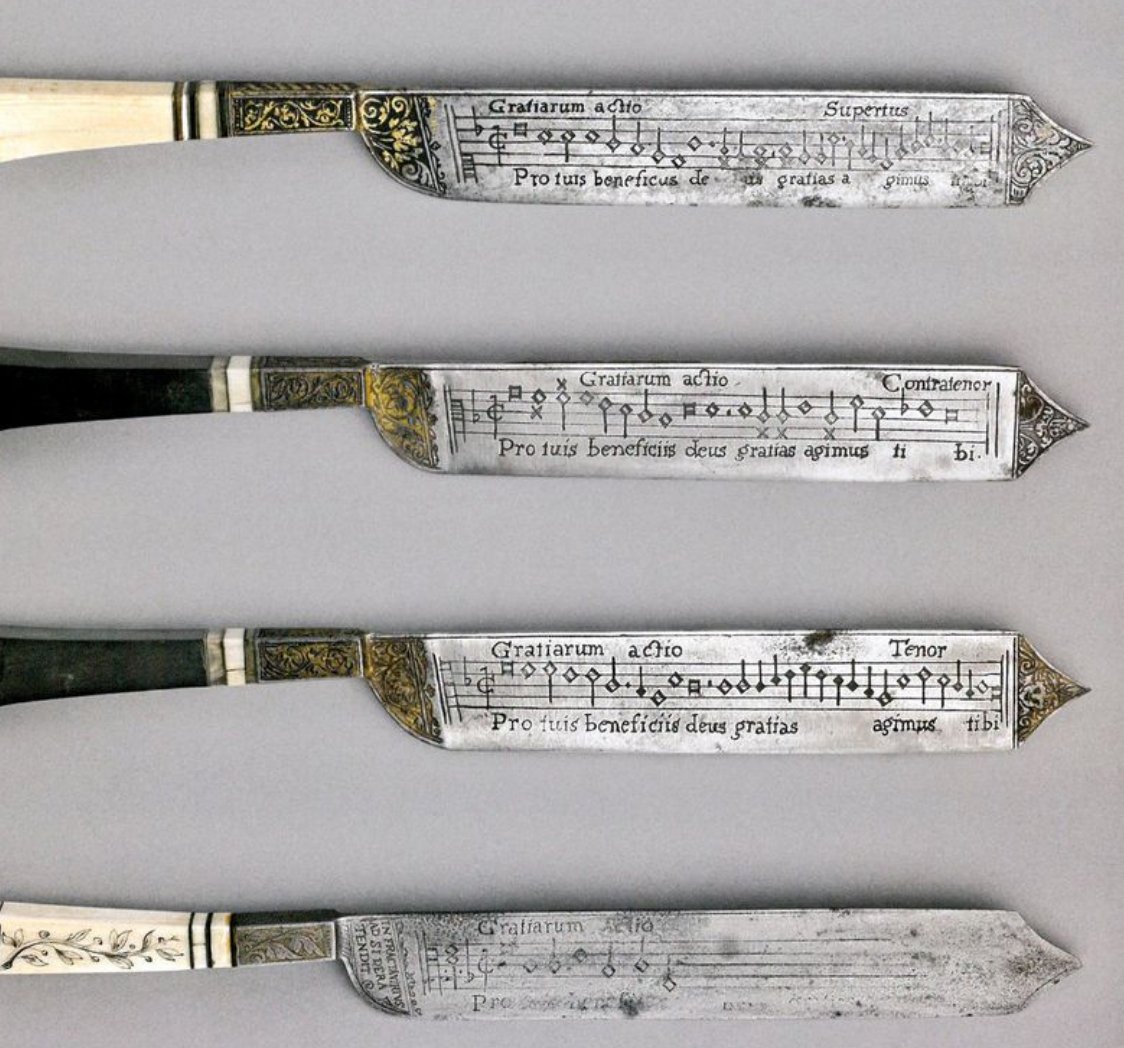
From the collection of the Fitzwilliam Museum, in Cambridge. (Johan Oosterman )
These knives, which have musical scores engraved in their blades, brought a table together in singing their prayers, and may have been used to carve the lamb or beef in their “striking balance of decorative and utilitarian function.” At least historians think such “notation knives,” which date from the early 1500s, were used at banquets. “The sharp, wide steel would have been ideal for cutting and serving meat,” writes Eliza Grace Martin at the WQXR blog, “and the accentuated tip would have made for a perfect skewer.” But as Kristen Kalber, curator at the Victoria and Albert Museum, which houses the knives at the top of the post, tells us “diners in very grand feasts didn’t cut their own meat.” It’s unlikely they would have sung from the bloody knives held by their servants.
The knives’ true purpose “remains a mystery,” Martin remarks, like many “rituals of the Renaissance table.” Victoria and Albert Museum curator Kirstin Kennedy admits in the video above that “we are not entirely sure” what the “splendid knife” she holds was used for. But we do know that each knife had a different piece of music on each side, and that a set of them together contained different harmony parts in order to turn a roomful of diners into a chorus. One set of blades had the grace on one side, with the inscription, “the blessing of the table. May the three-in-one bless that which we are about to eat.” The other side holds the benediction, to be sung after the dinner: “The saying of grace. We give thanks to you God for your generosity.”
Common enough verbiage for any household in Renaissance Europe, but when sung, at least by a chorus from the Royal College of Music, who recreated the music and made the recordings here, the prayers are superbly graceful. Above, hear one version of the Grace and Benediction from the Victoria and Albert Museum knives; below, hear a second version. You can hear a captivating set of choral prayers from the Fitzwilliam Museum knives at WQXR’s site, recorded for the Fitzwilliam’s “Madonnas & Miracles” exhibit. We are as unlikely now to encounter singing kitchen knives as we are to run into a horse and rider bearing 100 pounds of finely-wrought wearable steel sculpture. Such strange artifacts seem to speak of a strange people who valued beauty whether carving up the main course or cutting down their enemies.
Related Content:
An Ancient Philosophical Song Reconstructed and Played for the First Time in 1,000 Years
See The Guidonian Hand, the Medieval System for Reading Music, Get Brought Back to Life
Josh Jones is a writer and musician based in Durham, NC. Follow him at @jdmagness
Read More...How Ada Lovelace, Daughter of Lord Byron, Wrote the First Computer Program in 1842–a Century Before the First Computer
I’ve never quite understood why the phrase “revisionist history” became purely pejorative. Of course, it has its Orwellian dark side, but all knowledge has to be revised periodically, as we acquire new information and, ideally, discard old prejudices and narrow frames of reference. A failure to do so seems fundamentally regressive, not only in political terms, but also in terms of how we value accurate, interesting, and engaged scholarship. Such research has recently brought us fascinating stories about previously marginalized people who made significant contributions to scientific discovery, such as NASA’s “human computers,” portrayed in the book Hidden Figures, then dramatized in the film of the same name.
Likewise, the many women who worked at Bletchley Park during World War II—helping to decipher encryptions like the Nazi Enigma Code (out of nearly 10,000 codebreakers, about 75% were women)—have recently been getting their historical due, thanks to “revisionist” researchers. And, as we noted in a prior post, we might not know much, if anything, about film star Hedy Lamarr’s significant contributions to wireless, GPS, and Bluetooth technology were it not for the work of historians like Richard Rhodes. These few examples, among many, show us a fuller, more accurate, and more interesting view of the history of science and technology, and they inspire women and girls who want to enter the field, yet have grown up with few role models to encourage them.
We can add to the pantheon of great women in science the name Ada Byron, Countess of Lovelace, the daughter of Romantic poet Lord Byron. Lovelace has been renowned, as Hank Green tells us in the video at the top of the post, for writing the first computer program, “despite living a century before the invention of the modern computer.” This picture of Lovelace has been a controversial one. “Historians disagree,” writes prodigious mathematician Stephen Wolfram. “To some she is a great hero in the history of computing; to others an overestimated minor figure.”
Wolfram spent some time with “many original documents” to untangle the mystery. “I feel like I’ve finally gotten to know Ada Lovelace,” he writes, “and gotten a grasp on her story. In some ways it’s an ennobling and inspiring story; in some ways it’s frustrating and tragic.” Educated in math and music by her mother, Anne Isabelle Milbanke, Lovelace became acquainted with mathematics professor Charles Babbage, the inventor of a calculating machine called the Difference Engine, “a 2‑foot-high hand-cranked contraption with 2000 brass parts.” Babbage encouraged her to pursue her interests in mathematics, and she did so throughout her life.
Widely acknowledged as one of the forefathers of computing, Babbage eventually corresponded with Lovelace on the creation of another machine, the Analytical Engine, which “supported a whole list of possible kinds of operations, that could in effect be done in arbitrarily programmed sequence.” When, in 1842, Italian mathematician Louis Menabrea published a paper in French on the Analytical Engine, “Babbage enlisted Ada as translator,” notes the San Diego Supercomputer Center’s Women in Science project. “During a nine-month period in 1842–43, she worked feverishly on the article and a set of Notes she appended to it. These are the source of her enduring fame.” (You can read her translation and notes here.)
In the course of his research, Wolfram pored over Babbage and Lovelace’s correspondence about the translation, which reads “a lot like emails about a project might today, apart from being in Victorian English.” Although she built on Babbage and Menebrea’s work, “She was clearly in charge” of successfully extrapolating the possibilities of the Analytical Engine, but she felt “she was first and foremost explaining Babbage’s work, so wanted to check things with him.” Her additions to the work were very well-received—Michael Faraday called her “the rising star of Science”—and when her notes were published, Babbage wrote, “you should have written an original paper.”
Unfortunately, as a woman, “she couldn’t get access to the Royal Society’s library in London,” and her ambitions were derailed by a severe health crisis. Lovelace died of cancer at the age of 37, and for some time, her work sank into semi-obscurity. Though some historians have seen her as simply an expositor of Babbage’s work, Wolfram concludes that it was Ada who had the idea of “what the Analytical Engine should be capable of.” Her notes suggested possibilities Babbage had never dreamed. As the Women in Science project puts it, “She rightly saw [the Analytical Engine] as what we would call a general-purpose computer. It was suited for ‘developping [sic] and tabulating any function whatever… the engine [is] the material expression of any indefinite function of any degree of generality and complexity.’ Her Notes anticipate future developments, including computer-generated music.”
In a recent episode of the BBC’s In Our Time, above, you can hear host Melvyn Bragg discuss Lovelace’s importance with historians and scholars Patricia Fara, Doron Swade, and John Fuegi. And be sure to read Wolfram’s biographical and historical account of Lovelace here.
Related Content:
The Contributions of Women Philosophers Recovered by the New Project Vox Website
Real Women Talk About Their Careers in Science
Josh Jones is a writer and musician based in Durham, NC. Follow him at @jdmagness
Read More...
Google Uses Artificial Intelligence to Map Thousands of Bird Sounds Into an Interactive Visualization
If you were around in 2013, you may recall that we told you about Cornell’s Archive of 150,000 Bird Calls and Animal Sounds, with Recordings Going Back to 1929. It’s a splendid place for ornithologists and bird lovers to spend time. And, it turns out, the same also applies to computer programmers.
Late last year, Google launched an experiment where, drawing on Cornell’s sound archive, they used machine learning (artificial intelligence that lets computers learn and do tasks on their own) to organize thousands of bird sounds into a map where similar sounds are placed closer together. And it resulted in this impressive interactive visualization. Check it out. Or head into Cornell’s archive and do your own old-fashioned explorations.
Note: You can find free courses on machine learning and artificial intelligence in the Relateds below.
If you would like to support the mission of Open Culture, consider making a donation to our site. It’s hard to rely 100% on ads, and your contributions will help us continue providing the best free cultural and educational materials to learners everywhere. You can contribute through PayPal, Patreon, and Venmo (@openculture). Thanks!
Related Content:
Neural Networks for Machine Learning: A Free Online Course
A Free Course on Machine Learning & Data Science from Caltech
Read More...Carl Sagan Sent Music & Photos Into Space So That Aliens Could Understand Human Civilization (Even After We’re Gone)
A popular thought experiment asks us to imagine an advanced alien species arriving on Earth, not in an H.G. Wells-style invasion, but as advanced, bemused, and benevolent observers. “Wouldn’t they be appalled,” we wonder, “shocked, confused at how backward we are?” It’s a purely rhetorical device—the secular equivalent of taking a “god’s eye view” of human folly. Few people seriously entertain the possibility in polite company. Unless they work at NASA or the SETI program.
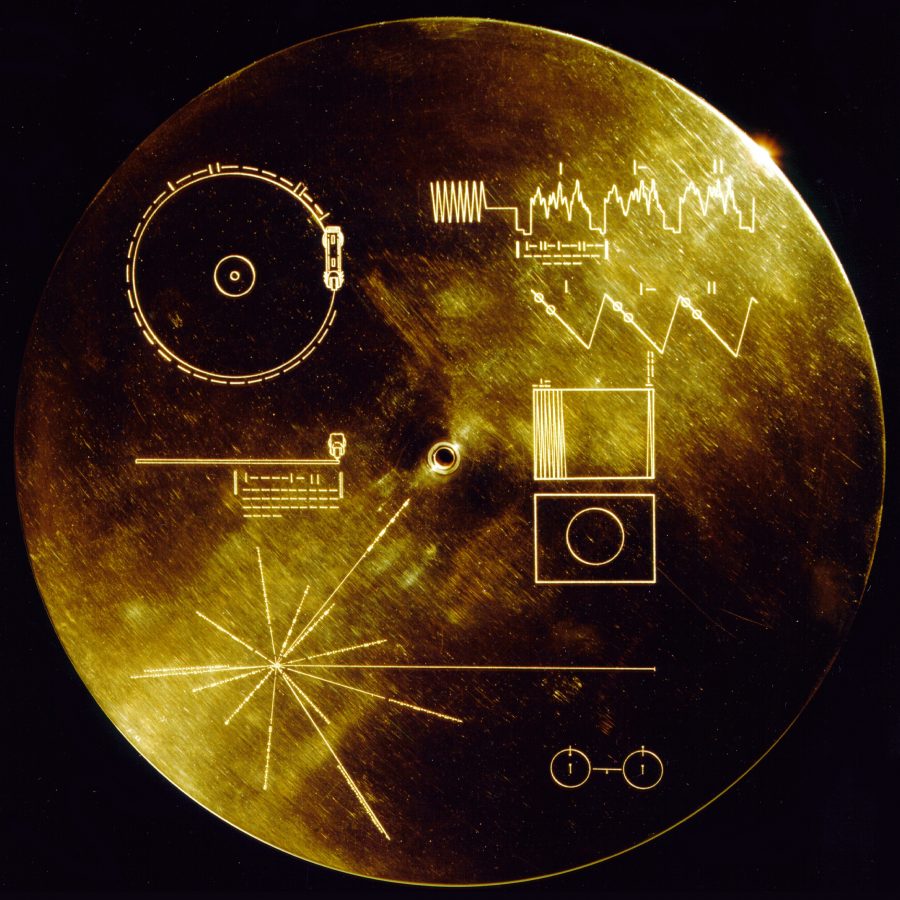
In 1977, upon the launching of Voyager 1 and Voyager 2, a committee working under Carl Sagan produced the so-called “Golden Records,” actual phonographic LPs made of copper containing “a collection of sounds and images,” writes Joss Fong at Vox, “that will probably outlast all human artifacts on Earth.” While they weren’t preparing for a visitation on Earth, they did—relying not on wishful thinking but on the controversial Drake Equation—fully expect that other technological civilizations might well exist in the cosmos, and assumed a likelihood we might encounter one, at least via remote.
Sagan tasked himself with compiling what he called a “bottle” in “the cosmic ocean,” and something of a time capsule of humanity. Over a year’s time, Sagan and his team collected 116 images and diagrams, natural sounds, spoken greetings in 55 languages, printed messages, and musical selections from around the world–things that would communicate to aliens what our human civilization is essentially all about. The images were encoded onto the records in black and white (you can see them all in the Vox video above in color). The audio, which you can play in its entirety below, was etched into the surface of the record. On the cover were etched a series of pictographic instructions for how to play and decode its contents. (Scroll over the interactive image at the top to see each symbol explained.)
Fong outlines those contents, writing, “any aliens who come across the Golden Record are in for a treat.” That is, if they are able to make sense of it and don’t find us horribly backward. Among the audio selections are greetings from then-UN Secretary General Kurt Waldheim, whale songs, Bach’s Brandenberg Concerto No. 2 in F, Senegalese percussion, Aborigine songs, Peruvian panpipes and drums, Navajo chant, Blind Willie Johnson’s “Dark Was the Night” (playing in the Vox video), more Bach, Beethoven, and “Johnny B. Goode.” Challenged over including “adolescent” rock and roll, Sagan replied, “there are a lot of adolescents on the planet.” The Beatles reportedly wanted to contribute “Here Comes the Sun,” but their record company wouldn’t allow it, presumably fearing copyright infringement from aliens.
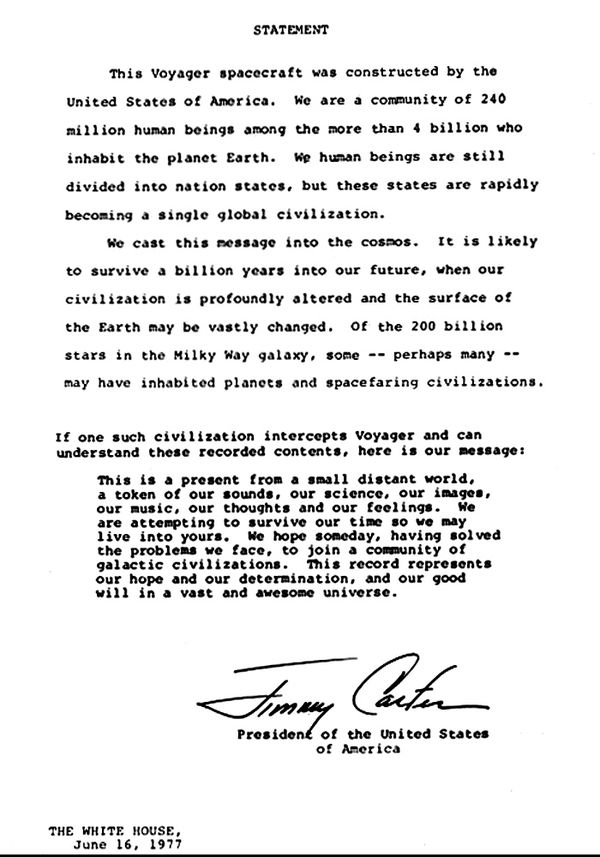
Also contained in the spacefaring archive is a message from then-president Jimmy Carter, who writes optimistically, “We are a community of 240 million human beings among the more than 4 billion who inhabit planet Earth. We human beings are still divided into nation states, but these states are rapidly becoming a single global civilization.” The messages on Voyagers 1 and 2, Carter forecasts, are “likely to survive a billion years into our future, when our civilization is profoundly altered and the surface of the Earth may be vastly changed.” The team chose not to include images of war and human cruelty.
We only have a few years left to find out whether either Voyager will encounter other beings. “Incredibly,” writes Fong, the probes “are still communicating with Earth—they aren’t expected to lose power until the 2020s.” It seems even more incredible, forty years later, when we consider their primitive technology: “an 8‑track memory system and onboard computers that are thousands of times weaker than the phone in your pocket.”
The Voyagers were not the first probes sent to interstellar space. Pioneer 10 and 11 were launched in 1972 and 1973, each containing a Sagan-designed aluminum plaque with a few simple messages and depictions of a nude man and woman, an addition that scandalized some puritanical critics. NASA has since lost touch with both Pioneers, but you may recall that in 2006, the agency launched the New Horizons probe, which passed by Pluto in 2015 and should reach interstellar space in another thirty years.
Perhaps due to the lack of the departed Sagan’s involvement, the latest “bottle” contains no introductions. But there is time to upload some, and one of the Golden Record team members, Jon Lomberg, wants to do just that, sending a crowdsourced “message to the stars.” Lomberg’s New Horizon’s Message Initiative is a “global project that brings the people of the world together to speak as one.” The limitations of analog technology have made the Golden Record selections seem quite narrow from our data-saturated point of view. The new message might contain almost anything we can imagine. Visit the project’s site to sign the petition, donate, and consider, just what would you want an alien civilization to hear, see, and understand about the best of humanity circa 2017?
Related Content:
NASA’s New Online Archive Puts a Wealth of Free Science Articles Online
Josh Jones is a writer and musician based in Durham, NC. Follow him at @jdmagness
Read More...The 10 Most Depressing Radiohead Songs According to Data Science: Hear the Songs That Ranked Highest in a Researcher’s “Gloom Index”
One of my favorite music-themed comedy sketches of recent years features a support group of Radiohead fans flummoxed and disappointed by the band’s post-Ok Computer output. The scenario trades on the perplexity that met Radiohead’s abrupt change of musical direction with the revolutionary Kid A as well as on the fact that Radiohead fans tend toward, well… if not PTSD or severe mood disorders, at least a heightened propensity for generalized depression.
“Much of Radiohead’s music is undeniably sad,” writes Analytics Specialist and Radiohead fan Charlie Thompson. Rather than play something “less depressing,” however, as many an acquaintance has asked him over the years, Thompson decided “to quantify that sadness, concluding in a data-driven determination of their most depressing song.”
Now, purely subjectively, I’d place “How to Disappear Completely” in the top spot, followed closely by Amnesia’s “Pyramid Song.” But my own associations with these songs are personal and perhaps somewhat arbitrary. I might make a case for them based on lyrical interpretations, musical arrangement, and instrumentation. But the argument would still largely depend on matters of taste and acculturation.
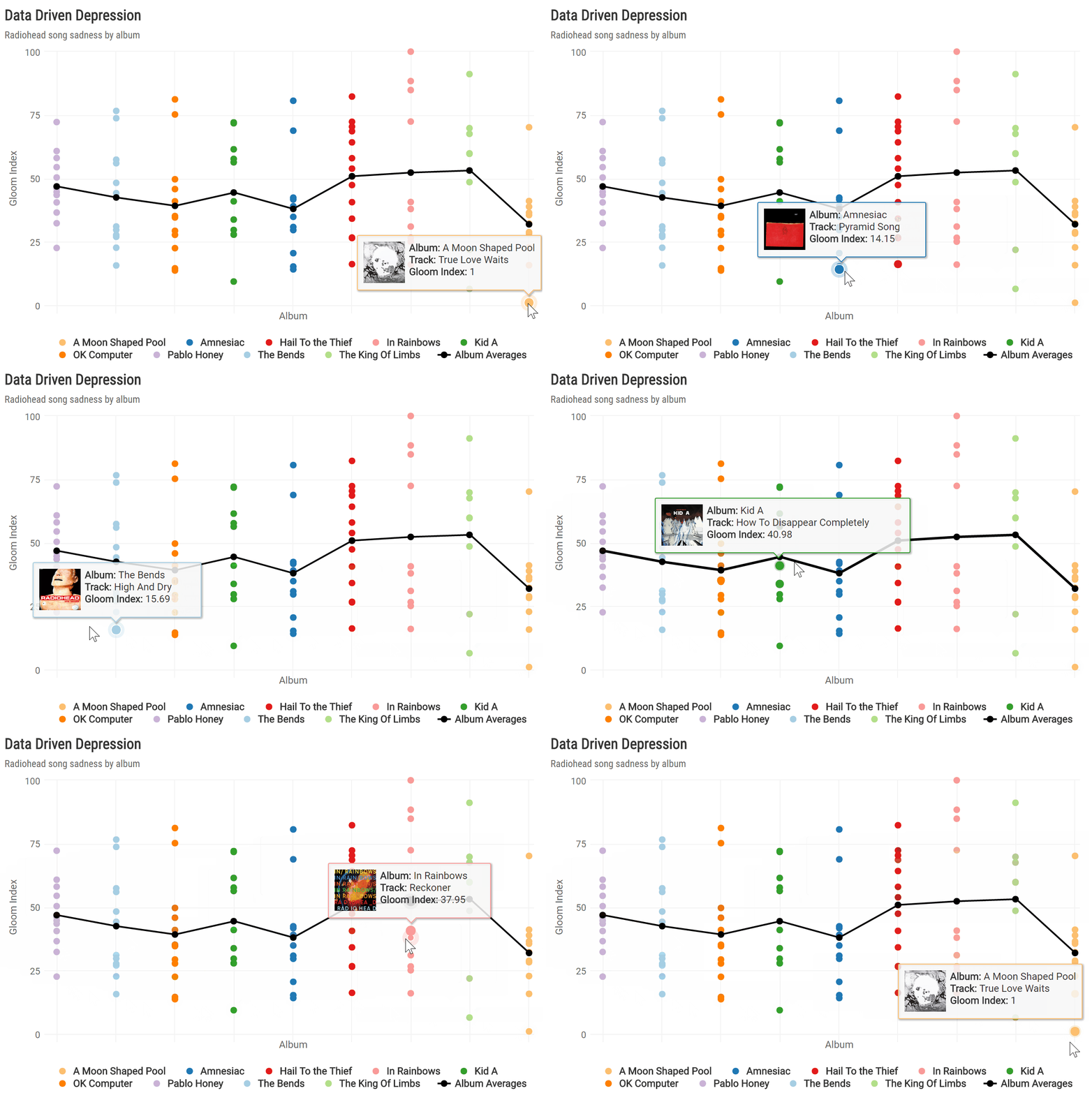
Thompson, on the other hand, believes in “quantifying sentiment.” To that end, he created a “gloom index,” which he used to measure each song in the band’s catalog. Rather than listening to them all, one after another, he relied on data from two online services, first pulling “detailed audio statistics” from Spotify’s Web API. One metric in particular, called “valence,” measures a song’s “positivity.” These scores provide an index “of how sad a song sounds from a musical perspective.” (It’s not entirely clear what the criteria are for these scores).

Next, Thompson used the Genius Lyrics API to examine “lyrical density,” specifically the concentration of “sad words” in any given song. To combine these two measures, he leaned on an analysis by a fellow data scientist and blogger, Myles Harrison. You can see his resulting formula for the “Gloom Index” above, and if you understand the programing language R, you can see examples of his analysis at his blog, RCharlie. (Read a less data-laden summary of Thompson’s study at the analytics blog Revolutions.) Thompson also plotted sadness by album, in the interactive graph further up.
So, which song rated highest on the “Gloom Scale”? Well, it’s “True Love Waits” from their most recent album A Moon Shaped Pool (hear a live acoustic version up above.). It’s a damned sad song, I’ll grant, as are the nine runners-up, all of which you can hear in the YouTube and Spotify playlists above). “Pyramid Song” appears at number 5, but “How to Disappear Completely” doesn’t even rank in the top ten. From a purely subjective standpoint, this makes me suspicious of the whole operation. But you tell us, readers, what do you think of Thompson’s experiment in “quantifying sentiment” in music?
Here’s the top 10:
1. True Love Waits
2. Give Up The Ghost
3. Motion Picture Soundtrack
4. Let Down
5. Pyramid Song
6. Exit Music (For a Film)
7. Dollars & Cents
8. High And Dry
9. Tinker Tailor Soldier …
10. Videotape
via Kottke
Related Content:
Radiohead’s “Creep” Played on the Gayageum, a Korean Instrument Dating Back to the 6th Century
A Free Course on Machine Learning & Data Science from Caltech
Josh Jones is a writer and musician based in Durham, NC. Follow him at @jdmagness
Read More...Support Us
We're hoping to rely on loyal readers, rather than erratic ads. Please click the Donate button and support Open Culture. You can use Paypal, Venmo, Patreon, even Crypto! We thank you!

About Us

Open Culture scours the web for the best educational media. We find the free courses and audio books you need, the language lessons & educational videos you want, and plenty of enlightenment in between.
Advertise With Us
FREE UPDATES!
GET OUR DAILY EMAIL
Get the best cultural and educational resources on the web curated for you in a daily email. We never spam. Unsubscribe at any time.
FOLLOW ON SOCIAL MEDIA
Open Culture editor Dan Colman scours the web for the best educational media. He finds the free courses and audio books you need, the language lessons & movies you want, and plenty of enlightenment in between.
Advertise With Us

