What Did Old English Sound Like? Hear Reconstructions of Beowulf, The Bible, and Casual Conversations
What is the English language? Is it Anglo-Saxon? It is tempting to think so, in part because the definition simplifies a linguistic history that defies linear summary. Over the course of 1000 years, the language came together from extensive contact with Anglo-Norman, a dialect of French; then became heavily Latinized and full of Greek roots and endings; then absorbed words from Arabic, Spanish, and dozens of other languages, and with them, arguably, absorbed concepts and pictures of the world that cannot be separated from the language itself.
Shakespeare and other writers filled in the gaps (and still do), inventing words where they were lacking. Why do we then refer to the long-dead Anglo-Saxon language as “Old English,” if it is only a distant ancestor, and one, you’ll note, no English speaker today understands? There are many technical reasons for this, but to put it in plain terms: if English were a body, Anglo-Saxon might be the bones and ligaments: not only for the hardness of its consonants and its blunt, unadorned poetry, but because it contains the most common words in the language, the structural bits that hold together all those pan-linguistic borrowings.
Observe the piece of verse known as Cædmon’s Hymn, below. Amidst the tangle of unfamiliar phonemes and extinct letters like the “þ,” you cannot miss such bedrock words as “and,” “his,” “or,” “He,” and “to.” In other texts, you’ll find recognizable equivalents of “father,” “mother,” “husband,” “wife,” “good,” “god,” and many other common household words.
Nu sculon herian heofonrices Weard,
Metodes mihte and his modgeþanc,
weorc Wuldorfæder, swa he wundra
gehwæs
ece Dryhten, or onstealde.
He ærest scop eorþan bearnum
heofon to hrofe halig Scieppend.
þa middangeard mancynnes Weard
ece Dryhten, æfter teode
firum foldan Frea ælmihtig.
Despite sharing many words with modern English, however, Anglo Saxon is another language, from an entirely different world long disappeared. No one living, of course, knows exactly what it sounded like, so scholars make their best educated guesses using internal evidence in the scant literature, secondary sources in other languages from the time, and similarities to other, living languages. Now that you’ve seen what Old English looks like, hear how it sounds to modern ears.
In the video at the top, student of the language Stephen Roper reenacts a casual conversation with an Anglo-Saxon speaker, one who can understand but cannot speak contemporary English. The other examples here come from literary contexts. Further up, Justin A. Jackson, Professor of English at Hillsdale College, reads the opening lines of Beowulf, and just above, hear an unnamed narrator read the epic poem’s full Prologue.
Just below—backed by a dramatic, droning score and recited over footage of misty English moors—a reading of “The Lord’s Prayer” in 11th century Old English. In this text, you’ll pick out quite a few more familiar words, though the fact that most readers know the modern English equivalent probably doesn’t hurt. But if you feel confident after listening to these speculative reconstructions of the language, enough to take a crack at reading it aloud yourself, head over this University of Glasgow collection of Old English readings.
Related Content:
Hear Beowulf Read In the Original Old English: How Many Words Do You Recognize?
Josh Jones is a writer and musician based in Durham, NC. Follow him at @jdmagness
Read More...136 Maps Reveal Where Tourists & Locals Take Photos in Major Cities Across the Globe
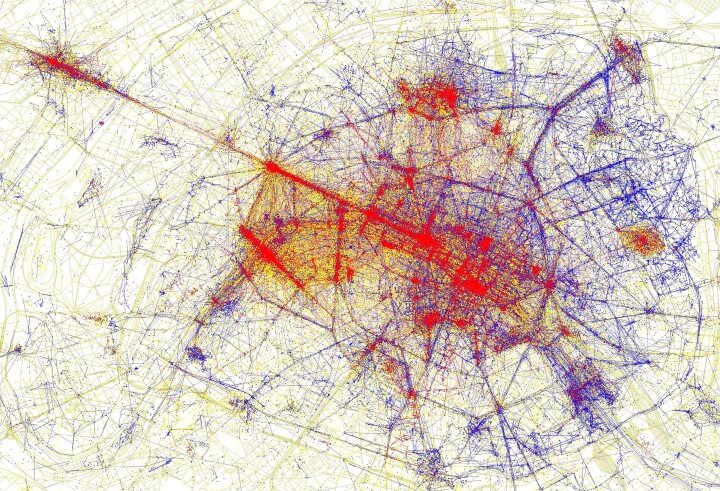
How to tell the tourists in a city from the locals? Potentially reliable indicators include the language they speak, the terms they use, the way they dress, the way they walk, and whether they’re standing in the middle of the sidewalk squinting at a map. But few factors draw the line between tourist and local more starkly than where they go and don’t go: no matter the city, one will sooner or later hear talk of places locals know that tourists don’t, places locals don’t go because tourists do know about them, places tourists go when they want to act like locals, places locals go when they want to act like tourists, and so on.

In his project “Tourists and Locals,” Eric Fischer has found one way of quantifying this great divide: where do the members of each group take the photos they upload to the internet? You can view the results in 136 different city maps or explore a whole world map, both of which use the same color coding: “The red bits indicate photos taken by tourists,” says Brilliant Maps, “while the blue bits indicate photos taken by locals and the yellow bits might be either.”
Using “MapBox and Twitter data from Gnip to create the maps,” Fischer defined locals as “those who tweeted from the same location for at least a month” and tourists as “those who were considered local in another city but were tweeting in a different location.”

Here, from the top of the post down, we have Fischer’s maps of Paris, Tokyo, Dublin, and San Francisco, all cities with varying degrees of overlap between the realm of the local and that of the tourist. Parisian attractions like the Parc de Belleville and the Bassin de la Villette show a relatively healthy tourist-local balance, whereas outsiders dominate in places like La Défense with its highly photographable skyscrapers, and of course the Louvre (to say nothing of the red-saturated Versailles, not pictured in this segment of the map). Compare that with Tokyo, which of course has world-famous spots — the quaintly historic Asakusa, the sublimely urban Shibuya Crossing — but whose form doesn’t encourage quite as strict a physical separation of tourist and local.

The path a tourist takes through Dublin might overlap a great deal with the one Leopold Bloom took on June 16, 1904, but less so with the paths an average Dubliner takes in the 2010s. The Irish capital also offers a host of must-sees apart from the Ulysses tour — the Guinness Storehouse, Trinity College’s Old Library, home of The Book of Kells— but visitors would do well to follow the example of Dublin’s locals and get a bit more distance from the city center. They could do the same in San Francisco, a city of iconic tourist attractions on which, before the tech boom, its very survival seemed to depend. But do true travelers, as opposed to tourists, need this kind of data processing and information design to know their time would be better spent somewhere other than Fisherman’s Wharf?
See 136 different city maps here.
via Brilliant Maps
Related Content:
Take a Visual Journey Through 181 Years of Street Photography (1838–2019)
The Shifting Power of the World’s Largest Cities Visualized Over 4,000 Years (2050 BC-2050 AD)
How Leonardo da Vinci Drew an Accurate Satellite Map of an Italian City (1502)
James Joyce’s Dublin Captured in Vintage Photos from 1897 to 1904
An Online Gallery of Over 900,000 Breathtaking Photos of Historic New York City
A Wonderful Archive of Historic Transit Maps: Expressive Art Meets Precise Graphic Design
Based in Seoul, Colin Marshall writes and broadcasts on cities, language, and culture. His projects include the book The Stateless City: a Walk through 21st-Century Los Angeles and the video series The City in Cinema. Follow him on Twitter at @colinmarshall, on Facebook, or on Instagram.
Read More...Hear the Song That Two Teenage Musicians, Frank Zappa and Captain Beefheart, Recorded Together in 1958
Rock and roll needs its outsiders, its prodigious weirdos, tricksters and pastiche artists to reinvigorate moribund genres and put things together no one thought would go. No two people fit the description better than Frank Zappa and Captain Beefheart (Don Van Vliet), sometime collaborators, frenemies, and parallel evil geniuses with crack teams of musical henchmen at the ready—Zappa the genre-hopping virtuoso and music business supervillain; Beefheart the mad bluesman with a Beat poet’s heart and Merry Prankster’s sense of humor….
Their intense on-again-off-again musical relationship threatened to come apart for good during the recording of Beefheart’s Zappa-produced weirdo masterpiece Trout Mask Replica. These troubled stages of their association are what we often talk about when we talk about Zappa/Beefheart, when they discovered, writes Ultimate Classic Rock, “that their creative processes and work habits—Zappa was disciplined and exacting, while Beefheart preferred to be spontaneous and freeform—couldn’t have been more at odds.”
A little over a decade earlier, before either of them had musical careers necessitating work habits, the two began recording together in “either late 1958 or early 1959,” notes Dangerous Minds. They had known each other since high school in Lancaster, California, where their shared sensibilities brought them together: “The two found they had a similar taste in music, and quickly bonded over a shared love of blues, doo-wop, and R&B records.”
Presaging all of the ways they would go on to warp, cannibalize, and mash up these genres, “Lost in a Whirlpool,” with music by Zappa and lyrics by Van Vliet, was one of several songs they had begun writing while still teenagers. Zappa tells the story of the recording in a 1989 interview:
“Lost in a Whirlpool” was taped on one of those tape recorders that you have in a school in the audio/visual department. We went into this room, this empty room at the junior college in Lancaster, after school, and got this tape recorded, and just turned it on. The guitars are me and my brother (Bobby Zappa) and the vocal is Don Vliet.
The story of “Lost in a Whirlpool” goes back even farther. When I was in high school in San Diego in ‘55, there was a guy who grew up to be a sports writer named Larry Littlefield. He, and another guy named Jeff Harris, and I used to hang out, and we used to make up stories, little skits and stuff, you know, dumb little teenage things. One of the plots that we cooked up was about a person who was skindiving—San Diego’s a surfer kind of an area—skindiving in the San Diego sewer system [laughter], and talking about encountering brown, blind fish. [laughter] It was kind of like the Cousteau expedition of its era. [laughter] So, when I moved to Lancaster from San Diego, I had discussed this scenario with Vliet, and that’s where the lyrics come from. It’s like a musical manifestation of this other skindiving scenario.
Scatological skindiving seems like such a perfect conceptual summary of the shared Zappa/Beefheart ethos it’s a wonder they didn’t use the title themselves. Despite their growing creative differences and incompatible temperaments, they collaborated into the mid-70s.
In 1975, twenty years after cooking up the story of skindiving in the San Diego sewers, they “regaled their fans with the amusingly titled (mostly) live album, Bongo Fury,” Ultimate Classic Rock writes, “a historic ceasefire in their otherwise turbulent relationship that would sadly prove all too fleeting.” The record is the result of an “intensive, 30-date tour” in which “Beefheart contributed harmonica, occasional sax, and numerous displays of his eccentric poetry and one-of-a-kind vocals to the [Zappa] ensemble’s repertoire.” Above, hear Bongo Fury’s “Advance Romance,” as classic a slice of Zappa/Beefheart oddball blues as their very first recordings from the late 50s.
via Dangerous Minds/Ultimate Classic Rock
Related Content:
The Night Frank Zappa Jammed With Pink Floyd … and Captain Beefheart Too (Belgium, 1969)
Hear a Rare Poetry Reading by Captain Beefheart (1993)
Josh Jones is a writer and musician based in Durham, NC. Follow him at @jdmagness.
Read More...Todd Rundgren’s Advice to Young Artists: Be Free and Fearless, Make Art That Expresses Your True Self, and Never Mind the Critics
The Internet has redeemed graduation season for those of us whose commencement speakers failed to inspire.
One of the chief digital pleasures of the season is truffling up words of wisdom that seem ever so much wiser than the ones that were poured past the mortarboard into our own tender ears.
Our most-recently found pearls come from the mouth of one of our favorite dark horses, musician, producer, and multimedia pioneer Todd Rundgren, one of Berklee College of Music’s 2017 commencement speakers.
Rundgren claims he never would have passed the prestigious institution’s audition. He barely managed to graduate from high school. But he struck a blow for lifelong learners whose pursuit of knowledge takes place outside the formal setting by earning honorary degrees from both Berklee, and DePauw University, where the newly anointed Doctor of Performing Arts can be seen below, studying his honoris causa as the school band serenades him with a student-arranged version of his song, All the Children Sing.
Rundgren’s outsider status played well with Berklee’s Class of 2017, as he immediately ditched his ceremonial headdress and conferred some cool on the sunglasses dictated by his failing vision.
But it wasn’t all opening snark, as he praised the students’ previous night’s musical performance, telling them that they were a credit to their school, their families and themselves.
His was a different path.
Rundgren, an experienced public speaker, claims he was stumped as to how one would go about crafting commencement speeches. Rejecting an avalanche of advice, whose urgency suggested his speech could only result in “universal jubilation or mass suicide if (he) didn’t get it right,” he chose instead to spend his first 10 minutes at the podium recounting his personal history.
It’s interesting stuff for any student of rock n roll, with added cool points owing to the Rock n’ Roll Hall of Fame’s failure to acknowledge this musical innovator.
Whether or not the Class of 17 were familiar with their speaker prior to that day, it’s probable most of them were able to do the math and realize that the self-educated Rundgren would have been their age in 1970, when his debut album, Runt, was released, and only a couple of years older when his third album, 1972’s two disc, Ritalin-fueled Something/Anything shot him to fame.
After which, this proud iconoclast promptly thumbed his nose at commercial success, detouring into the sonic experiments of A Wizard, a True Star, whose disastrous critical reception belies the masterpiece reputation it now enjoys.
Rolling Stone called it a case of an artist “run amok.”
Patti Smith, whose absolutely mandatory Creem review reads like beat poetry, was a rare admirer.
Did a shiver of fear run through the parents in the audience, as Rundgren regaled their children with tales of how this deliberate trip into the unknown cost him half his fanbase?
How much is Berklee’s tuition these days, anyway?
Autobiographical urges from the commencement podium run the risk of coming off as inappropriate indulgence, but Rundgren’s personal story is supporting evidence of his very worthy message to his younger fellow artists :
- Don’t self-edit in an attempt to fit someone else’s image of who you should be as an artist. See yourself.
- Use your art as a tool for vigorous self-exploration.
- Commit to remaining free and fearless, in the service of your defining moment, whose arrival time is rarely published in advance.
- Don’t view graduation as the end of your education. Think of it as the beginning. Learn about the things you love.
Related Content:
John Waters’ RISD Graduation Speech: Real Wealth is Never Having to Spend Time with A‑Holes
The First 10 Videos Played on MTV: Rewind the Videotape to August 1, 1981
Ayun Halliday is an author, illustrator, theater maker and Chief Primatologist of the East Village Inky zine. Join her in New York City this June for the next installment of her book-based variety show, Necromancers of the Public Domain. Follow her @AyunHalliday.
Read More...Graduation Highlight: Billionaire Robert F. Smith Announces That He’ll Pay Off the Student Loans of Morehouse’s Class of 2019
Robert F. Smith, the billionaire CEO of Vista Equity Partners, received an honorary degree from Morehouse College on Sunday. And he gave something back–a grant to retire the student loans of Morehouse’s 2019 graduating class. Like that an estimated $40 million in debt was gone.
Meanwhile, in other news, a titan of industry spent $90 million this week on a Jeff Koons rabbit statue. And now it will likely serve as an ornament piece in a walled-off mansion somewhere. Imagine how that money could have been put to more productive use…
If you would like to support the mission of Open Culture, consider making a donation to our site. It’s hard to rely 100% on ads, and your contributions will help us continue providing the best free cultural and educational materials to learners everywhere. You can contribute through PayPal, Patreon, and Venmo (@openculture). Thanks!
Related Content:
John Waters’ RISD Graduation Speech: Real Wealth is Never Having to Spend Time with A‑Holes
Meryl Streep Gives Graduation Speech at Barnard
Jim Carrey Commencement Speech: It’s Better to Fail at What You Love Than Fail at What You Don’t
‘This Is Water’: Complete Audio of David Foster Wallace’s Kenyon Graduation Speech (2005)
Read More...Learn Philosophy with a Wealth of Free Courses, Podcasts and YouTube Videos
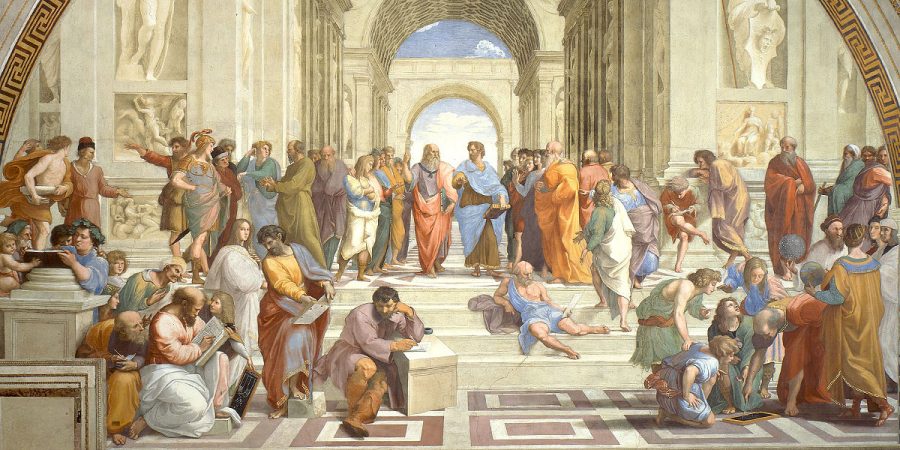
Used to be, a few thousand years ago, if you wanted to learn philosophy, you’d hang out in the agora, the public space in ancient Greece whose name turned into verbs meaning both “to shop” and “to speak in public.” Politics and metaphysics mingled freely with commerce. If a Socrates-like sage took a liking to you, you might follow him around. If not, you might pay a sophist—a word meaning wise teacher before it became a term of abuse that Plato lobbed at rivals who charged for their services. Only certain people had the means and leisure for these pursuits. Nonetheless, philosophy was a public activity, not one sequestered in libraries and seminar rooms.
Even though philosophy moved indoors—to monasteries, colleges, and the libraries of aristocrats—it did not stay cooped up for long. With the modern age arrived new public squares, centered around coffeehouses where all sorts of people gathered, rubbed elbows, formed discussion groups. Philosophy may not have been the public spectacle it seemed to have been in antiquity, but neoclassical thinkers tried to recreate its character of free and open inquiry in public spaces.
Widespread literacy and publishing brought philosophy to the masses in new ways. Philosophical works trickled down in affordable editions to the intellectually curious, who might read and discuss them with like-minded laypeople. But philosophy also became a professional discipline, governed by associations, conferences, journals, and arcane vocabularies. Outside of France, philosophers rarely acted as public intellectuals addressing public issues. They were academics whose primary audiences were other academics.
The culture suffered immensely, one might argue, in the withdrawal of philosophy from public life.
The broad outline above does not pretend to be a history of philosophy, but rather a sketch of some of the ways Western culture has engaged with philosophy, treating it as a public good and resource, or a domain of specialists and an activity divorced from ordinary life. Unfortunately for us in the 21st century, dreams of a digital agora have collapsed in the dystopian surveillance schemes of social media and the toxic sludge of comments sections. But the internet has also, in a way, returned philosophy to the public square.
Philosophers can once again share knowledge freely and openly, and anyone with access can stream and download hundreds of lessons, courses, entertaining explainers, interviews, podcasts, and more. We have featured many of these resources over the years in hopes that more people will discover the art of thinking deeply and critically. Today, we gather them in a master list, below.
Learn the in-depth history of philosophy from Peter Adamson’s acclaimed series The History of Philosophy… Without Any Gaps; listen in on roundtable discussions on famous thinkers and theories with the Partially Examined Life podcast, or “repave the Agora with the rubble of the Ivory Tower!” with the accessible, comprehensive philosophy videos of Carneades. These are but a few of the many quality resources you’ll find below. Technology may never recreate the early atmosphere of public philosophy—for that you’ll need to get out and mingle. But it can deliver more philosophy than anyone has ever had before, literally right into the palms of our hands.
Courses
187 Free Philosophy Courses: In a neat, handy list, we’ve amassed a collection of free philosophy courses recorded at great universities. Pretty much every facet of philosophy gets covered here.
YouTube
Wireless Philosophy: Learn about philosophy with professors from Yale, Stanford, Oxford, MIT, and more. 130+ animated videos introduce people to the practice of philosophy. The videos are free, entertaining, interesting and accessible to people with no background in the subject.
School of Life: This collection of 35 animated videos offers an introduction to major Western philosophers—Wittgenstein, Foucault, Camus and more. The videos were made by Alain de Botton’s School of Life.
Gregory Sadler’s Philosophy Videos: After a decade in traditional academic positions, Gregory Sadler started bringing philosophy into practice, making complex classic philosophical ideas accessible for a wide audience of professionals, students, and life-long learners. His YouTube channel includes extensive lecture series on Kierkegaard, Sartre, Hegel and more.
A History of Philosophy in 81 Video Lectures: Watch 81 video lectures tracing the history of philosophy moving from Ancient Greece to modern times. Arthur Holmes presented this influential course at Wheaton College for decades and now it’s online for you.
Carneades: Repave the Agora with the rubble of the Ivory Tower! Put your beliefs to the test! Learn something about philosophy! Doubt something you thought you knew before. Find on this channel 400 videos on the subjects of philosophy and skepticism.
What the Theory?: This collection provides short introductions to theories and theoretical approaches in cultural studies and the wider humanities. Covers semiotics, phenomenology, postmodernism, marxist literary criticism, and much more.
Crash Course Philosophy: In 46 episodes, Hank Green will teach you philosophy. This course is based on an introductory Western philosophy college level curriculum. By the end of the course, you will be able to examine topics like the self, ethics, religion, language, art, death, politics, and knowledge. And also craft arguments, apply deductive and inductive reasoning, and identify fallacies.
Podcasts:
Partially Examined Life: Philosophy, philosophers and philosophical texts. This podcast features an informal roundtable discussion, with each episode loosely focused on a short reading that introduces at least one “big” philosophical question, concern, or idea. Recent episodes have focused on Nietzsche, Sartre and Aldous Huxley, and featured Francis Fukuyama as a guest.
Hi-Phi-Nation: Created by Barry Lam (Associate Professor of Philosophy at Vassar College), Hi-Phi Nation is a philosophy podcast “that turns stories into ideas.” Consider it “the first sound and story-driven show about philosophy, bringing together narrative storytelling, investigative journalism, and soundtracking.”
The History of Philosophy … Without Any Gaps: Created by Peter Adamson, Professor of Ancient and Medieval Philosophy at King’s College London, this podcast features more than 300 episodes, each about 20 minutes long, covering the PreSocratics (Pythagoras, Zeno, Parmenides, etc) and then Socrates, Plato, Aristotle, and much more.
Philosophy Bites: David Edmonds (Uehiro Centre, Oxford University) and Nigel Warburton (freelance philosopher/writer) interview top philosophers on a wide range of topics. Two books based on the series have been published by Oxford University Press. There are over 400 podcasts in this collection.
In Our Time: Philosophy: In Our Time is a live BBC radio discussion series exploring the history of ideas, presented by Melvyn Bragg since October 1998. It is one of BBC Radio 4’s most successful discussion programmes, acknowledged to have “transformed the landscape for serious ideas at peak listening time.’”
Related Content:
Free Courses in Ancient History, Literature & Philosophy
Introduction to Indian Philosophy: A Free Online Course
Josh Jones is a writer and musician based in Durham, NC. Follow him at @jdmagness
Read More...Introduction to Philosophy: A Free Course
In the playlist above, Gregory Sadler presents a 67-lecture course, “Introduction to Philosophy.” Presented at Marist College, the course goes in historical order–from Plato to Kierkegaard. Watch the playlist above, or find the video on YouTube here.
“Introduction to Philosophy” has been added to our list of Free Philosophy Courses, a subset of our collection, 1,700 Free Online Courses from Top Universities.
If you would like to support the mission of Open Culture, consider making a donation to our site. It’s hard to rely 100% on ads, and your contributions will help us continue providing the best free cultural and educational materials to learners everywhere. You can contribute through PayPal, Patreon, and Venmo (@openculture). Thanks!
Related Content:
Oxford’s Free Introduction to Philosophy: Stream 41 Lectures
Oxford’s Free Course Critical Reasoning For Beginners Teaches You to Think Like a Philosopher
32 Animated Videos by Wireless Philosophy Teach You the Essentials of Critical Thinking
Introduction to Philosophy: A Free Online Course
Read More...Ethics: A Free Online Course
Taught at Marist College by Gregory Sadler, this course on Ethics starts “with discussing Emotivism and contrasting it with a Natural Law and Virtue Ethics Perspective, then move[s] into Virtue Ethics, Egoism, Might Makes Right, and Contractarian moral theory as depicted in Plato’s dialogues. After that we discuss ancient Hedonist and Stoic theories, then move into Utilitarianism with Bentham and Mill, followed by Deontology with Kant and Ross. Ethics of Care follows, as well as a return to Virtue Ethics with in-depth study of Aristotle, finishing with study of Thomas Aquinas’ Natural Law moral theory.”
Ethics has been added to our list of Free Philosophy Courses, a subset of our collection, 1,700 Free Online Courses from Top Universities. Watch the 32 lectures above, or on YouTube here.
If you would like to support the mission of Open Culture, consider making a donation to our site. It’s hard to rely 100% on ads, and your contributions will help us continue providing the best free cultural and educational materials to learners everywhere. You can contribute through PayPal, Patreon, and Venmo (@openculture). Thanks!
Related Content:
Journalistic Ethics: A Free Online Course from UCLA
Do Ethicists Behave Any Better Than the Rest of Us?: Here’s What the Research Shows
Professional Ethics: A Free Online Course
Read More...Steve Jobs Shares a Secret for Success: Don’t Be Afraid to Ask for Help
In 1994—the year Apple co-founder Steve Jobs filmed an interview with The Silicon Valley Historical Association in which he encouraged people to go for what they want by enlisting others’ assistance—there was no social media, no Kickstarter, no GoFundMe, no Patreon… email was just becoming a thing.
Back then, asking for help meant engaging in a face-to-face or voice-to-voice real time interaction, something many people find intimidating.
Not so young Jobs, an electronics nut who related more easily to the adult engineers in his Silicon Valley neighborhood than to kids his own age.
As he recounts above, his desire to build a frequency counter spurred him to cold call Bill Hewlett (of Hewlett-Packard), to see if he’d give him some of the necessary parts.
(In light of the recent college admissions scandal, let us recognize the 12-year-old Jobs not only had the gumption to make that call, he also appears to have had no parental assistance looking up Hewlett’s number in the Palo Alto White Pages.)
Hewlett agreed to the young go-getter’s request for parts. Jobs’ chutzpah also earned him a summer job on a Hewlett Packard assembly line, putting screws into frequency counters. (“I was in heaven,” Jobs said of this entry level position.)
Perhaps the biggest lesson for those in need of help is to ask boldly.
Ask like it’s 1994.
No, ask like it’s 1968, and you’re a self-starter like Steve Jobs hellbent on procuring those specialty parts to build your frequency counter.
(Let’s further pretend that lying around waiting for Mom to order you a DIY frequency counter kit on Amazon is not an option…)
Need an extra push?
Psychologist Adam Grant’s bestselling Give and Take makes an effective case for human interaction as the pathway to success, whether you’re the kid placing the call, or the big wig with the power to grant the wish.
Social psychologist Heidi Grant’s book, Reinforcements: How to Get People to Help You, explains how to ask without sniveling, self-aggrandizing, or putting the person on the receiving end in an awkward position.
And that shy violet Amanda Fucking Palmer, author of The Art of Asking and no stranger to the punk rock barter economy, details how her “ninja master-level fan connection” has resulted in her every request being met—from housing and meals to practice pianos and a neti pot hand delivered by an Australian nurse.
Just don’t forget to say “please” and, eventually, “thank you.”
Related Content:
Steve Jobs on Life: “Stay Hungry, Stay Foolish”
A Young Steve Jobs Teaches a Class at MIT (1992)
Steve Jobs Narrates the First “Think Different” Ad (Never Aired)
Ayun Halliday is an author, illustrator, theater maker and Chief Primatologist of the East Village Inky zine. Join her in New York City this May for the next installment of her book-based variety show, Necromancers of the Public Domain. Follow her @AyunHalliday.
Read More...A Short Animated Film Explores the Fluidity of Gender in the Thought of Simone de Beauvoir and Judith Butler
In hindsight, it seems like a very different world when I first read Judith Butler’s Gender Trouble in college in the 90s. (Mash together all your stereotypes about college campuses in the 90s and you’ve pretty much got the picture.) For one thing, columnists in major national newspapers and magazines weren’t writing controversial, or simply explanatory, articles about gender fluidity. The concept did not exist in the mainstream press. It seemed both hip and rarified, confined to theory discussion groups, academic seminars, and punk zines.
As radical as Butler’s ideas about gender seemed, she acknowledged that she did not originate the critique. She found it first articulated in Simone de Beauvoir’s The Second Sex, in which the French existentialist feminist wrote, “one is not born a woman, but rather becomes one.”
In the short film above, Devenir (To Become), by French filmmaker Géraldine Charpentier-Basille, Butler describes her reaction to reading the passage. “I wrote something about this problem of becoming. And I wanted to know: does one ever become one? Or is that to be a woman is a mode of becoming… that has no goal…. You could say the same of gender more generally.”
As the images illustrating this extract from a 2006 interview with Butler show, the goalposts of feminine and masculine identities move all the time, from year to year, from culture to culture. Gender is a pastiche of representations we inhabit. It is produced, performative, Butler thought, but we can never get it “right” because there is no true referent. The idea descends from the existentialist insights of de Beauvoir, who wrote about and dramatized similar problems of the personal and social self.
De Beauvoir extended Sartre’s claim that “existence precedes essence” in her pioneering feminist work—we come into the world, then acquire identities through acculturation, social conditioning, and coercion. Butler extended the argument further. “For her, writes Aeon’s Will Fraker, “gender wasn’t predetermined by nature or biology, nor was it simply ‘made up’ by culture. Rather, Butler insisted that gender resides in repeated words and actions, words and actions that both shape and are shaped by the bodies of real, flesh-and-blood human beings. And crucially, such repetitions are rarely performed freely.”
From our earliest years, we are trained how to behave as a gender, just as we are taught to perform other identities—trained by the expectations of parents, teachers, religious leaders, advertisers, and the bullying and social pressure of our peers. Hear Butler explain further how gender, in her theory, functions as “a phenomenon that is produced and is being reproduced all the time…. Nobody really is a gender from the start. I know it’s controversial,” she says. “But that’s my claim.” It is one that poses complicated questions more broadly, notes Aeon, about “the pursuit of the ‘authentic’ self” as a meaningful idea—questions Western philosophers have been asking for well over half a century.
via Aeon
Related Content:
Simone de Beauvoir Explains “Why I’m a Feminist” in a Rare TV Interview (1975)
Josh Jones is a writer and musician based in Durham, NC. Follow him at @jdmagness
Read More...Support Us
We're hoping to rely on loyal readers, rather than erratic ads. Please click the Donate button and support Open Culture. You can use Paypal, Venmo, Patreon, even Crypto! We thank you!

About Us

Open Culture scours the web for the best educational media. We find the free courses and audio books you need, the language lessons & educational videos you want, and plenty of enlightenment in between.
Advertise With Us
FREE UPDATES!
GET OUR DAILY EMAIL
Get the best cultural and educational resources on the web curated for you in a daily email. We never spam. Unsubscribe at any time.
FOLLOW ON SOCIAL MEDIA
Open Culture editor Dan Colman scours the web for the best educational media. He finds the free courses and audio books you need, the language lessons & movies you want, and plenty of enlightenment in between.
Advertise With Us

