The Coddling of the American Mind: Malcolm Gladwell Leads a Conversation with Jonathan Haidt, Greg Lukianoff & Lenore Skenazy
From the 92nd Street Y in New York City comes a wide-ranging conversation featuring Malcolm Gladwell, Jonathan Haidt (NYU), Greg Lukianoff (Foundation for Individual Rights in Education), and Lenore Skenazy (founder of the Free-Range Kids movement). Here’s a quick summary of the ground they cover:
Civil discourse is in decline, with potentially dire results for American democracy.
On college campuses across America, visiting speakers are disinvited, or even shouted down, while professors, students, and administrators are afraid to talk openly, for fear that someone will take offense. Political discussion on social media and television has devolved into a wave of hyper-partisan noise. A generation of overprotective parents are reluctant to let their children play outside without supervision. How did we get here? And how can we change the way that we engage with one another?
Greg Lukianoff and Jonathan Haidt’s The Coddling of the American Mind sounds the depths of this generational crisis. Join us for a lively discussion with the authors, president of the non-profit Let Grow and founder of the Free-Range Kids movement Lenore Skenazy, and #1 New York Times bestseller Malcolm Gladwell on how we as citizens can engage with one another across the political spectrum.
If it’s not already clear, the conversation is based on Lukianoff and Haidt’s book The Coddling of the American Mind: How Good Intentions and Bad Ideas Are Setting Up a Generation for Failure. Skenazy is the author of Free-Range Kids, How to Raise Safe, Self-Reliant Children (Without Going Nuts with Worry). If you sign up for a free trial with Audible, you can download copies of both books.
If you would like to support the mission of Open Culture, consider making a donation to our site. It’s hard to rely 100% on ads, and your contributions will help us continue providing the best free cultural and educational materials to learners everywhere. You can contribute through PayPal, Patreon, and Venmo (@openculture). Thanks!
Read More...The Creepy 13th-Century Melody That Shows Up in Movies Again & Again: An Introduction to “Dies Irae”
The number of iconic scenes in cinema history can and do fill textbooks hundreds of pages long. Doubtless most of us have seen enough of these scenes to know the basic grammar of feature film, and to recognize the hundreds of references in movies and TV to classic cuts and compositions from Hitchcock, Kubrick, or Kurosawa.
Visual and narrative allusions might leap out at us, but music tends to work in subtler ways, prompting emotional responses without engaging the parts of our brain that make comparisons. Case in point, the videos here from Vox and Berklee College of Music professor Alex Ludwig demonstrate the widespread use of a musical motif of four notes from the “Dies Irae,” or “day of wrath,” a 13th century Gregorian requiem, or Catholic mass traditionally sung at funerals.
Of course, we know these notes from the iconic, oft-parodied Amadeus scene of Mozart composing the “Dies Irae” movement of his Requiem in his sickbed, as ultimate frenemy Salieri furiously transcribes. Once you hear the magisterially ominous sequence of notes, you might immediately think of Wendy Carlos’ themes for The Shining and A Clockwork Orange. But did you notice these four notes in Disney’s The Lion King, Star Wars: Episode IV—A New Hope, or It’s a Wonderful Life?
What about Harry Potter and the Chamber of Secrets, Close Encounters of the Third Kind, or Home Alone? Both Vox and Ludwig show how the “dies irae” theme appears over and over, cueing us to peril or tragedy ahead, orienting us to the terror and unease we see onscreen. For almost 800 years, these four notes have signified all of the above for Catholic Europe, as well as, Vox notes, soundtracking the supposed future day when “God will judge the living and the dead and send them to heaven or hell.”
The “dies irae” has permeated narrative cinema for almost as long as film has existed. The oldest example in Ludwig’s compilation comes from a 1927 score written by Gottfried Huppertz for Fritz Lang’s silent Metropolis. Ludwig also brings his musicological expertise to bear in Vox’s exploration of “dies irae” references. He sums up the net effect as creating a “sense of dread,” bestowed upon modernity by hundreds of years of Christian theology as expressed in music.
Film composers were only the latest to pick up the cultural thread of fear and threat in “Dies Irae.” Their work stands on the shoulders of Mozart and later composers like Hector Berlioz, who lifted the melody in his 1830 Symphonie fantastique to tell a story of obsessive love and murder, and a nightmare of a witch’s sabbath. Later came Franz Liszt’s 1849 Totentanz (Dance of the Dead) and Giuseppe Verdi’s 1874 Messa da Requiem, a very recognizable piece of music that has made its appearance in no small number of movies, TV shows, commercials, and temp scores.
Vox and Ludwig show the “dies irae” phenomenon in film to be a slow cultural evolution from the ornate, sacred pomp of medieval Catholic rites to the ornate, secular pomp of Hollywood film production, by way of classical composers who seized on the theme’s “sense of dread” but remained at least ambivalent about happy endings on the day of wrath.
Related Content:
All of the Music from Martin Scorsese’s Movies: Listen to a 326-Track, 20-Hour Playlist
Josh Jones is a writer and musician based in Durham, NC. Follow him at @jdmagness
Read More...What Would Michel Foucault Think of Social Media, Fake News & Our Post Truth World?
During the late 70s, Michel Foucault gave a series of lectures at the College de France in which he defined the concept of biopolitics, an idea Rachel Adams calls “political rationality which takes the administration of life and populations as its subject.” These ideas have come to have even more resonance in the spread of biometric identification systems and militarized population control policies.
Foucault begins his lecture series on biopolitics with an account of the birth of Neoliberalism, the engineered privatization of public goods and services and the concentration of capital and power into the hands of a few. “Everything I do,” he once said, “I do in order that it might be of use.” What would he have to say about the current situation? asks the BBC video above, a political landscape permeated by fake news, accusations of fake news, and the general admission that we are now “post truth”?
In some sense, Foucault, argued, we have always lived in such a world—not one in which real news and actual truth did not exist, but in which we are conditioned through language to adopt ideological perspectives that may have little to do with fact. What counts as knowledge, Foucault showed, gets authenticated to serve the interests of power. Later in his career, he saw more space for resistance and self-transformation emerge in power relations—and he would have seen such spaces in social media too, the video claims.
After his infamous acid trip in Death Valley, Foucault reportedly (and self-reportedly) returned a changed man, with a much less gloomy, claustrophobic outlook. The earlier Foucault may have emphasized the totalizing mechanisms of surveillance and control in social media, perhaps to the exclusion of any potential for liberation. The video doesn’t make these distinctions between early and late or give us much in the way of a history of his thought, though it acknowledges how critically important history was to Foucault himself.
We can’t know that he would say any of the things attributed to him here. He was a contrarian thinker, who “didn’t believe in all-embracing theories to explain the world,” the narrator admits. Perhaps he would have seen social media as technical elaboration of biopower: harvesting personal data, tracking everyone’s location, getting us all to watch each other. Or as a version of Jeremy Bentham’s panopticon, in which we never know when someone’s watching us, so we internalize the control system. These are some of the prisons, Foucault might say, that appear under regimes of “security, territory, population.”
The video features Angie Hobbs, Professor of Public Understanding of Philosophy at the University of Sheffield.
Related Content:
Michel Foucault and Noam Chomsky Debate Human Nature & Power on Dutch TV (1971)
An Animated Introduction to Michel Foucault, “Philosopher of Power”
Hear Hours of Lectures by Michel Foucault: Recorded in English & French Between 1961 and 1983
Josh Jones is a writer and musician based in Durham, NC. Follow him at @jdmagness
Read More...The Paul McCartney is Dead Conspiracy Theory, Explained
Hoaxes used to be fun, I imagine, before the internet turned them into weapons of mass disinformation. One shudders to think what kind of lunacy might have resulted had the Paul McCartney-is-dead-and-has-been-replaced-by-a-lookalike hoax first spread on Facebook instead of college newspapers, local radio stations, and good-old word of mouth. The hoax is emblematic not only of how misinformation spread differently fifty years ago, but also how the counterculture figured out information warfare, and used it to produce reams of satirical proto-viral content.
Whether the author of the original 1969 article—“Is Beatle Paul McCartney Dead?,” from the Drake University student newspaper the Times-Delphic—intended to fool the public hardly matters. His speculation reads like parody, like a star chart crossed with lurid tabloid gossip that, through a strange twist of fate created a network of people who believed that Paul was killed in a 1966 car crash and the band found an imposter named Billy Shears to replace him.
It should be noted that Paul McCartney is very much alive and has not been played by an impersonator for fifty years. There are no “two sides” to this story. There is the life of Paul McCartney and there is a strange and amusing rumor that never harmed anyone, except the Paul McCartney of its imagination. “Paul is Dead” ranks highly among “music’s most WTF conspiracy theories,” also the title of the Rolling Stone video above, which aims to explain “the original insane rock n’ roll conspiracy theory.”
The Beatles had a lot of fun with the conspiracy, doubly hoaxing their fans by playing along occasionally. McCartney responded with his classic wit: “If I were dead, I’d be the last to know it.” But publicly confirming or denying Paul McCartney’s body snatching didn’t matter. Like those who claimed Stanley Kubrick staged the moon landing and left clues in The Shining, true believers found evidence everywhere they looked.
The cover of Sgt. Pepper’s supposedly represents Paul’s funeral; his doppelgänger allegedly wears a patch with the letters O.P.D.—officially pronounced dead.” (It’s actually O.P.P., “Ontario Provincial Police.”); lyrics played backwards spell it out: “Paul is Dead.” As with most crackpot theories, there is one crucial missing element: motive. Why would the band not only cover up Paul’s death but leave trails of breadcrumbs on every subsequent record?
Why does the villain explain their entire plan to the hero as soon as they get the upper hand? Why do killers leave detailed, incriminating documents called “The Plan” on their hard drives on Dateline? Who can say? In the world of weird conspiracy theories, conspirators are compelled to place cryptic but decipherable clues all over the place. It’s like they want to be caught, or it’s like conspiracy fans desperately want to believe they do. Either way, as far as conspiracy theories go, “Paul is Dead” earns its “WTF” status. It also bears the distinction of never actually having involved anyone’s death.
Related Content:
The Band Everyone Thought Was The Beatles: Revisit the Klaatu Conspiracy of 1976
Stanley Kubrick’s Daughter Vivian Debunks the Age-Old Moon Landing Conspiracy Theory
Josh Jones is a writer and musician based in Durham, NC. Follow him at @jdmagness
Read More...How Marion Stokes, an Activist Librarian, Recorded 30 Years of TV News on 70,000 Video Tapes: It’s All Now Being Digitized and Put Online
“Nothing is more important than television,” said J.D. Salinger (as impersonated, that is, in an episode of Bojack Horseman). A passive, pacifying medium—“cool,” as Marshall McLuhan called it—TV has also long been an easy target for punditry, for many decades before the perpetrator du jour, video games. Television spread ignorance, was “the drug of the nation,” said Michael Franti, peddled fake heroes on “channel zero,” said Public Enemy, and would lead to an “electrical re-tribalization of the West,” McLuhan predicted (and further explained in this interview).
Marion Stokes set out to do more than any of the men above who made pronouncements about television. She dedicated her life to preserving the evidence, taping television news for over 33 years, from 1979 “until the day she died,” writes the Internet Archive, who now hold Stokes’ “unique 71k+ video cassette collection” and intend to digitize all of it. Stokes “was a fiercely private African American social justice champion, librarian, political radical, TV producer, feminist, Apple Computer super-fan and collector like few others.”
She “questioned the media’s motivations and recognized the insidious intentional spread of disinformation…. Ms. Stokes was alarmed. In a private herculean effort, she took on the challenge of independently preserving the news record of her times in its most pervasive and persuasive form—TV.” She also preserved three decades of televised critiques of television. She began making her archive at the beginning of the Iran Hostage Crisis on November 14, 1979. “She hit record and never stopped,” her son Michael Metelits says in Recorder: The Marion Stokes Project, “a newly released documentary,” reports Atlas Obscura, “about [Stokes] and the archival project that became her life’s work.”
In one remarkable example of TV critique, at the top, we see William Davidon, professor of Physics at Haverford College, decrying television for spreading ignorance, social irresponsibility, and passive consumption, making people unable to participate in the political process. The roundtable discussion took place on a 1968 episode of Input. A little over a year later, writes the Internet Archive, Davidon “would take an action of great social consequence,” breaking into an FBI field office with seven others and stealing the evidence that “revealed COINTELPRO.” (They were never caught, and Davidon’s role only came out posthumously.)
Then known as Marion Metelits, Stokes co-produced Input, a local Philadelphia Sunday morning talk show, with her future husband John S. Stokes Jr., and both of them appear on the program above (both credited as representing the Wellsprings Ecumenical Center). The conversation ranges widely, with Ms. Metelits and Davidon spiritedly defending “human potential” against too-rigid systems of classification and manipulation. There are a few dozen more episodes of Input currently at the Internet Archive, with panels featuring academics, activists, and clergy (such as the episode explaining, sort of, the “Wellsprings Ecumenical Center.”)
It’s a hard-hitting, controversial show for a local broadcast, and it gives us a detailed view of a range of both popular and radical positions of the time, including Stokes’, which we can learn more about in the journals, notes, lists, newspaper and magazine clippings, pamphlets, leaflets, handbills, and more she collected since 1960, many of which have also been digitized at the Internet Archive. Stokes backed her views with action. She was “surveilled by the government for her early political activism,” Atlas Obscura writes, and “attempted to defect to Cuba” with her first husband Melvin Metelits. She kept her recording project private, “eschewed Tivo” and “never sent an email in her life.”
She also made a small fortune in Apple stock, which funded her project and “the massive storage space she required as the sole force behind it.” Stokes left us no doubt as to why she documented thirty years of TV news. But those documents get to speak for themselves—or they will, at least. Stokes recorded far more than her own program, three decades more. And the Internet Archive is currently “endeavoring to help make sure” the entire collection “is digitized and made available online to everyone, forever, for free.”
If television had, and maybe still has, the power ascribed to it by its many astute critics, then Marion Stokes’ painstaking archive offers an invaluable means of understanding how we got to where we are, if not how to change course. Stokes’ collection, and the documentary about her life, show “how the news was going to evolve into an addiction,” as Owen Gleiberman writes at Variety. The project took over her life and fractured her relationships. “Even if you’re obsessed with the inaccuracy of TV news, it has still entrapped you, like a two-way mirror that won’t let you see the other side.” If the medium is the message, the other side might always be more television.
via Atlas Obscura
Related Content:
Hear Marshall McLuhan’s The Medium is the Massage (1967)
Josh Jones is a writer and musician based in Durham, NC. Follow him at @jdmagness
Read More...Philosopher Portraits: Famous Philosophers Painted in the Style of Influential Artists
Ludwig Wittgenstein/Piet Mondrian:

What do the Austrian-British philosopher Ludwig Wittgenstein and the Dutch painter Piet Mondrian have in common? For philosopher and artist Renée Jorgensen Bolinger, the two have similar beliefs about the logic of space.
“Many of Mondrian’s pieces explore the relationships between adjacent spaces,” says Bolinger “and in particular the formative role of each on the boundaries and possibilities of the other. I based this painting [see above] off of Wittgenstein’s Tractatus, in which he develops a theory of meaning grounded in the idea that propositions have meaning only insofar as they constrain the ways the world could be; a meaningful proposition is thus very like one of Mondrian’s color squares, forming a boundary and limiting the possible configurations of the adjacent spaces.”
An Assistant Professor at Princeton, Bolinger studied painting a Biola University before making philosophy her second major. “I actually came to philosophy quite late in my college career,” Bolinger says, “only adding the major in my junior year. I was fortunate to have two particularly excellent and philosophic art teachers, Jonathan Puls and Jonathan Anderson, who convinced me that my two passions were not mutually exclusive, and encouraged me to pursue both as I began my graduate education.”
Bolinger now works primarily on the philosophy of language, with side interests in logic, epistemology, mind and political philosophy. She continues to paint. We asked her how she reconciles her two passions, which seem to occupy opposite sides of the mind. “I do work in analytic philosophy,” she says, “but it’s only half true that philosophy and painting engage opposite sides of the mind. The sort of realist drawing and painting that I do is all about analyzing the relationships between the lines, shapes and color tones, and so still very left-brain. Nevertheless, it engages the mind in a different way than do the syllogisms of analytic philosophy. I find that the two types of mental exertion complement each other well, each serving as a productive break from the other.”
Bolinger has created a series of philosopher portraits, each one pairing a philosopher with an artist, or art style, in an intriguing way. In addition to Wittgenstein, she painted ten philosophers in her first series, many of them by request. They can all be seen on her web site, where high quality prints can be ordered.
G.E.M. Anscombe/Jackson Pollock:
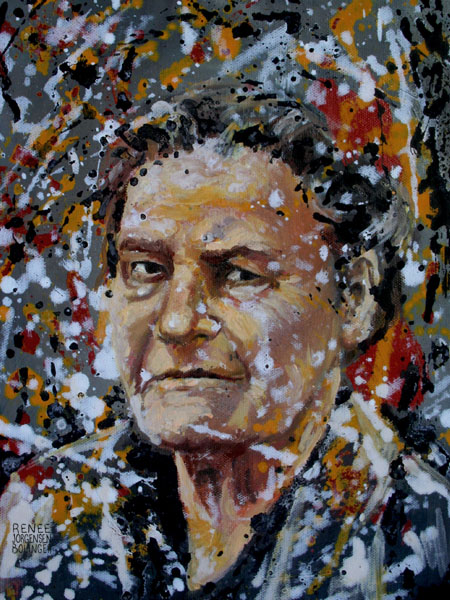
Bolinger says she paired the British analytic philosopher Elizabeth Anscombe with the American abstract painter Jackson Pollock for two reasons: “First, the loose style of Pollock’s action painting fits the argumentative (and organizational) style of Wittgenstein’s Philosophical Investigations, which Anscombe helped to edit and was instrumental in publishing. Second, her primary field of work, in which she wrote a seminal text, is philosophy of action, which has obvious connections to the themes present in any of Pollock’s action paintings.”
Gottlob Frege/Vincent Van Gogh:
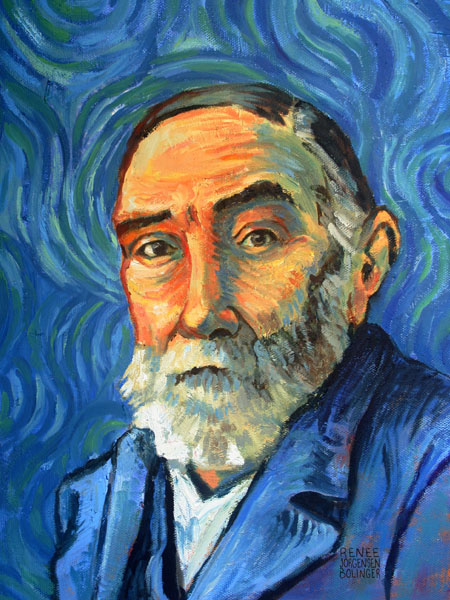
Bolinger paired the German logician, mathematician and philosopher Gottlob Frege with the Dutch painter Vincent Van Gogh as a tongue-in-cheek reference to Van Gogh’s famous painting The Starry Night and Frege’s puzzle concerning identity statements such as “Hesperus is Phosphorus,” or “the evening star is identical to the morning star.”
Bertrand Russell/Art Deco:

Bolinger painted the British logician and philosopher Bertrand Russell in the Art Deco style. “This pairing is a bit more about the gestalt, and a bit harder to articulate,” says Bolinger. “The simplification of form and reduction to angled planes that takes place in the background of this Art Deco piece are meant to cohere with Russell’s locial atomism (the reduction of complex logical propositions to their fundamental logical ‘atoms’).”
Kurt Gödel/Art Nouveau:
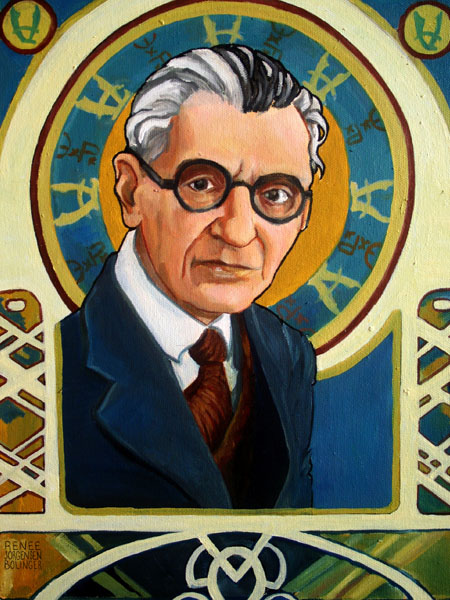
Bolinger paired the Austrian logician Kurt Gödel with Art Nouveau. “The Art Nouveau movement developed around the theme of mechanization and the repetition of forms,” says Bolinger, “and centrally involves a delicate balance between organic shapes — typically a figure that dominates the portrait — and schematized or abstracted patterns, often derived from organic shapes, but made uniform and repetitive (often seen in the flower motifs that ornament most Art Nouveau portraits). I paired this style with Kurt Gödel because his work was dedicated to defining computability in terms of recursive functions, and using the notion to prove the Completeness and Incompleteness theorems.”
To see more of Renée Jorgensen Bolinger’s philosopher portraits, click here to visit her site.
Note: This post originally appeared on our site back in 2013.
If you would like to support the mission of Open Culture, consider making a donation to our site. It’s hard to rely 100% on ads, and your contributions will help us continue providing the best free cultural and educational materials to learners everywhere. You can contribute through PayPal, Patreon, and Venmo (@openculture). Thanks!
Related Content:
A History of Philosophy in 81 Video Lectures: From Ancient Greece to Modern Times
Photography of Ludwig Wittgenstein Released by Archives at Cambridge
180+ Free Philosophy Courses
Read More...The Therapeutic Benefits of Ambient Music: Science Shows How It Eases Chronic Anxiety, Physical Pain, and ICU-Related Trauma
“In forty years of medical practice,” wrote Dr. Oliver Sacks near the end of his famous career, “I have found only two types of non-pharmaceutical ‘therapy’ to be vitally important for patients with chronic neurological diseases: music and gardens.” The comment might not surprise us, coming from such an unorthodox thinker as Sacks. But we might be surprised by the considerable amount of traditional scientific research linking music and mental health.
Sixty years ago, when Sacks was still in medical school, avant-garde jazz bandleader Sun Ra had a very Sacks-like experience when he played for an audience of patients in a mental hospital, and inspired a catatonic woman who hadn’t spoken for years to stand up and say ‘Do you call that music?’” The gig, booked by his manager, constituted a fringe experiment in alternative medicine at the time, not a serious subject of study among medical doctors and neuroscientists.
How things have changed in the last half-century.
Several recent studies, for example, have linked drumming, the oldest and most universal form of music-making, to reduced anxiety, pain relief, improved mood, and improved learning skills in kids with autism. Listening to and playing jazz and other forms of syncopated music, have been shown in study after study to promote creativity, enhance math skills, and support mental and emotional well-being.
But what about ambient music, a genre often characterized by its lack of syncopation, and almost certain to feature as background music in guided meditation and stress reduction recordings; in slow, relaxing yoga videos; and thousands of YouTube videos promoting supposedly stress-reducing frequencies and stereo effects? Ambient seems purpose-built to combat tension and dis-ease, and in a sense, it was.
Brian Eno, the artist who named the genre and often gets credit for its invention, wrote in the liner notes to Ambient 1: Music for Airports, “[this record is] designed to induce calm and space to think.” Whether he meant to make a scientific claim or only an artistic statement of purpose, research has validated his inferences about the salutary effects of long, slow, atmospheric music.
Noisey Associate Editor Ryan Bassil, a longtime sufferer of anxiety and panic attacks, found the statement to be true in his own life, as he explains in the video above (illustrated by Nathan Cowdry). Music from ambient composers like Eno, William Bassinski, and Fennesz helped him “ground” himself during extremely anxious moments, bringing him back into sensory contact with the present.
When Bassil looked into the reasons why ambient music had such a calming effect on his over-stimulated nervous system, he found research from artist and academic Luke Jaaniste, who described an “ambient mode,” a “pervasive all-around field, without anything being prioritized into foreground and background.” Immersion in this space, writes Bassil, “can help the listener put aside what’s on their mind and use their senses to focus on their surroundings.”
We may not—and should not—ask music to be a useful tool, but ambient has shown itself particularly so when treating serious neurological and psychological conditions. Forensic psychiatrist Dr. John Tully of London’s Institute of Psychiatry, Psychology and Neuroscience traces the form back to Bach and Chopin, and especially Erik Satie, who “was the first to express the idea of music specifically as background sound,” and who had no qualms about music serving a specialized purpose.
The purpose of what we broadly call ambient has evolved and changed as classical, minimalist avant-garde, and electronic musicians have penned compositions for very different audiences. But no matter the intent, or where we draw the genre boundaries, all kinds of atmospheric, instrumental music has the therapeutic power not only to reduce anxiety, but also to ease pain in surgical patients and reduce agitation in those suffering with dementia.
When he performed with his group Darkroom at the Critical Care Unit at University College London Hospital, writer and psychologist Charles Fernyhough found out that ambient music had significant benefits for patients trapped in what he calls “a suburb of hell”: the ICU. Stays in intensive care units correlate closely with later PTSD and what was once called “ICU psychosis” in the midst of traumatic emergency room experiences. Sedation turns out to be a major culprit. But music, especially ambient music, brought patients back to themselves.
Hear the 2016 Darkroom performance at the University College London Hospital ICU further up, and read more about Fernyhough’s research and performance at Aeon. The science of how and why ambient works the way it does is hardly settled. Where Fernyhough found that patients benefited from a lack of predictability and an ability to “escape the present moment,” Bassil’s research and experience uncovered the opposite—a sense of safe predictability and enhanced sensory awareness.
Physiological responses from person to person will vary, as will their tastes. “One person’s easy listening is another’s aural poison,” Fernyhough admits. But for a significant number of people suffering severe anxiety and trauma, the droning, minimal, wordless soundscapes of ambient are more effective than any medication.
Related Content:
The “True” Story Of How Brian Eno Invented Ambient Music
The 50 Best Ambient Albums of All Time: A Playlist Curated by Pitchfork
Stream 72 Hours of Ambient Sounds from Blade Runner: Relax, Go to Sleep in a Dystopian Future
This is Your Brain on Jazz Improvisation: The Neuroscience of Creativity
Josh Jones is a writer and musician based in Durham, NC. Follow him at @jdmagness.
Read More...The Jane Austen Fiction Manuscript Archive Is Online: Explore Handwritten Drafts of Persuasion, The Watsons & More
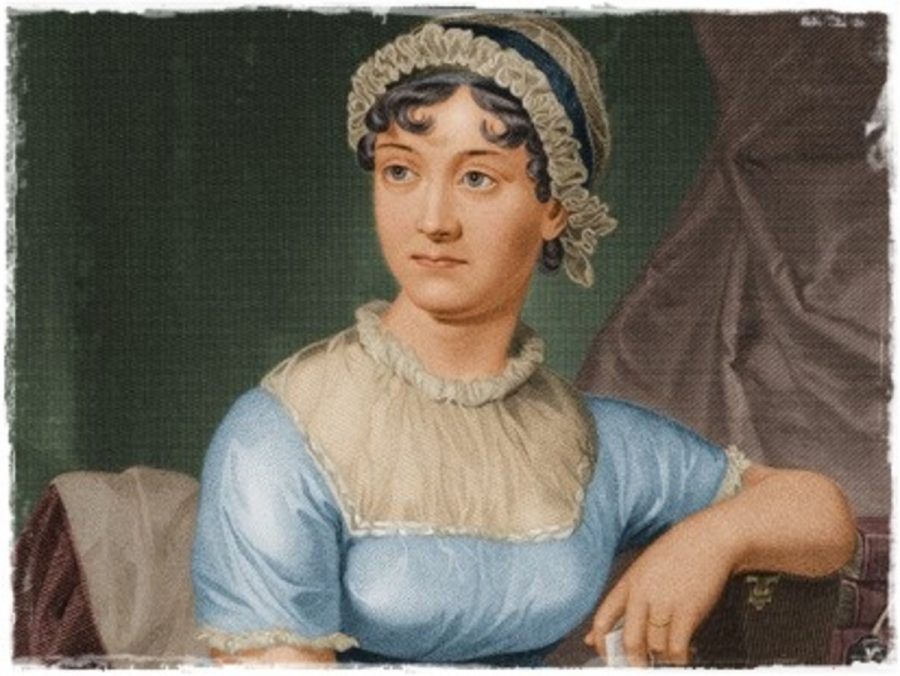
I first came to Jane Austen prepared to dislike her, reared as I had been to think of good fiction as socially transgressive, experimental, full of heavy, life-or-death moral conflicts and existentialist anti-heroes; of extremes of dread and sorrow or alienated extremes of their lack. Austen’s characters seemed too perky and perfect, too circumscribed and wholesome, too untroubled by inner despair or outer calamity to offer much in the way of interest or example.
This is an opinion shared by more perceptive readers than myself, including Charlotte Brontë, who called Pride and Prejudice “an accurate daguerreotype portrait of a commonplace face.” Brontë “disliked [Austen] exceedingly,” writes author Mary Stolz in an introduction to Emma. The author of Jane Eyre pronounced that “Miss Austen is only shrewd and observant,” where a novelist like George Sand is “sagacious and profound.”
A cursory reading of Austen can seem to confirm Brontë’s faint praise. Consider the first description of her heroine matchmaker, Emma:
Emma Woodhouse, handsome, clever, and rich, with a comfortable home and happy disposition, seemed to unite some of the best blessings of existence, and had lived nearly twenty-one years in the world with very little to distress or vex her.
No great, shocking disasters befall Emma. She is buffeted neither by war nor poverty, crime, disease, oppression or any other essentially dramatic conflict. She ends the novel joining hands in marriage with charming gentleman farmer Mr. Knightly, content, maybe ever-after, in “perfect happiness.”
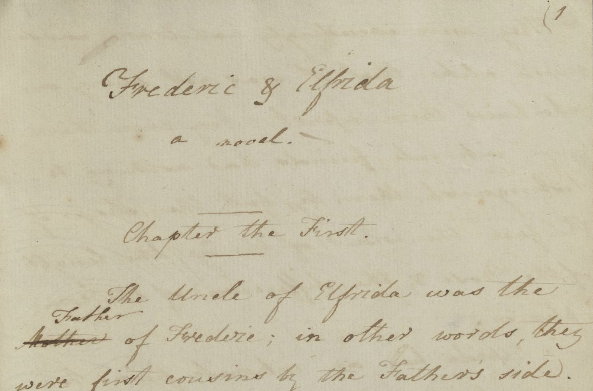
Rarely if ever in Austen do we find the torments, spiritual strivings, sublime and grotesque imaginings, proto-science-fiction, and world-historical consciousness of contemporaries like William Blake, Samuel Taylor Coleridge, or Mary Shelley. Austen is “famous,” writes Stolz, “for having lived through the period of the French Revolution without ever mentioning it in her writings.”
To see this as a critique, however, is to seriously misjudge her. “She did not deal in revolutions of this order. Not a traveled woman, she wrote only of what she knew”: life in English country villages, the travails of “love and money,” as she put it, the everyday longings, courtesies, and discourtesies that make up the majority of our everyday lives.
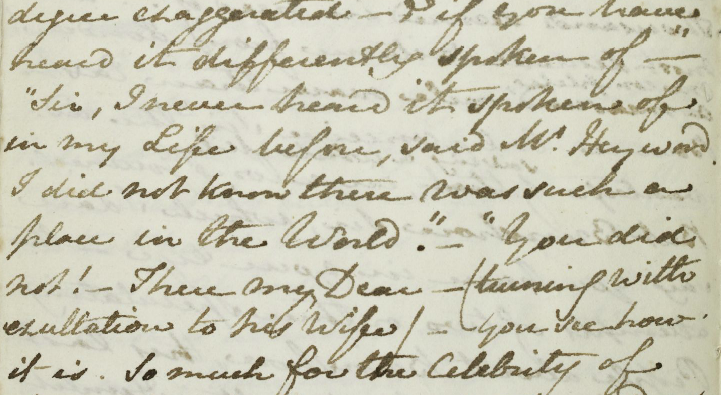
We can see Austen doing just that in her own hand at the Jane Austen’s Fiction Manuscripts Digital Edition. A collection of scanned manuscripts from the Bodleian, British Library, Pierpont Morgan Library, private collectors, and King’s College, Cambridge, this project “represents every stage of her writing career and a variety of physical states: working drafts, fair copies, and handwritten publications for private circulation.”
This is primarily a resource for scholars; much of this work has been published in printed editions, including the Juvenilia (read some of that writing here) and unfinished drafts like The Watsons and her last, uncompleted, novel, Sanditon. (One still-in-print 1975 edition collects the three unfinished novels found at the digital collection). Each digital edition of the manuscript includes a head note on the textual history, provenance, and physical structure, as well as a transcription of the text. There is also an option to view a “diplomatic edition” that transcribes the text with all of Austen’s corrections and additions.
Yet any Austen fan will appreciate seeing her witty, incisive style change and take shape in her own neat script. In an age of superheroes, historical and fantasy epics, and dystopian fantasies, we are beset by “the big Bow-Wow strain,” as Walter Scott self-effacingly called his own novels. In Austen’s writing, we find what Scott described as an “exquisite touch which renders commonplace things and characters interesting from the truth of the description and the sentiment.” She wraps her truths in wicked irony and a satirical voice, but they are truths we recognize as wise and compassionate in her domestic dramas and our own.
Austen knew well that her settings and characters were limited. She made no apologies for it and clearly needn’t have. “Three or four families in a country village,” she wrote to her niece Anna, “is the very thing to work on.” She also knew well the universal tendencies that blind us to the variety found within the everyday, whether our everyday is a sleepy country village life or a tech-laden, 21st-century city.
She almost seems to sigh wearily in Emma when she observes, “human nature is so well disposed toward those who are in interesting situations” … so much so that we fail to notice what’s going on all around us all the time. She wrote neither for money nor fame, and her work wasn’t even published with her name until after her death in July 1817, but she has since become fiercely beloved for the very qualities Brontë disparaged.
Austen didn’t miss a thing, which makes her novels as canny and insightful (and big-screen and fan-fiction adaptable) as when they were first written over two-hundred years ago. Enter the Jane Austen’s Fiction Manuscripts Digital Edition here.
Related Content:
An Animated Introduction to Jane Austen
Download the Major Works of Jane Austen as Free eBooks & Audio Books
Jane Austen Used Pins to Edit Her Manuscripts: Before the Word Processor & White-Out
Josh Jones is a writer and musician based in Washington, DC. Follow him at @jdmagness
Read More...The First Museum Dedicated Exclusively to Poster Art Opens Its Doors in the U.S.: Enter the Poster House
How times have changed since our late 80s college days. Undergrads do research online, upload assignments to a server, stream music, download affirmative sexual consent contracts, and turn to Facebook when it’s time to find a ride home for the holidays.
But one aspect of the collegiate lifestyle remains unchanged.
They still festoon their dorm rooms with posters—the actual paper article, affixed to the walls with blue putty, a carefully curated collection of taste and aspiration.
As Cait Munro writes in Refinery 29:
Freshman, already scrambling to find and loudly articulate an identity, can leave the poster sale with two or three plastic tubes housing scrolls that represent the very essence of their new, parent-free, on-campus selves. Posters become an affordable, demonstrable expression of who they are as a person — or, in the tradition of people eager to leave behind their hometown selves, who they want to be.
Legions of style blogs have decreed that these posters should be given the heave-ho along with the plastic milk crate shelving, come graduation.
Personally, I would rather gaze upon the tattered reproduction of the first painting that spoke to me at the Art Institute of Chicago than anything the design experts float as an acceptably grown up alternative.
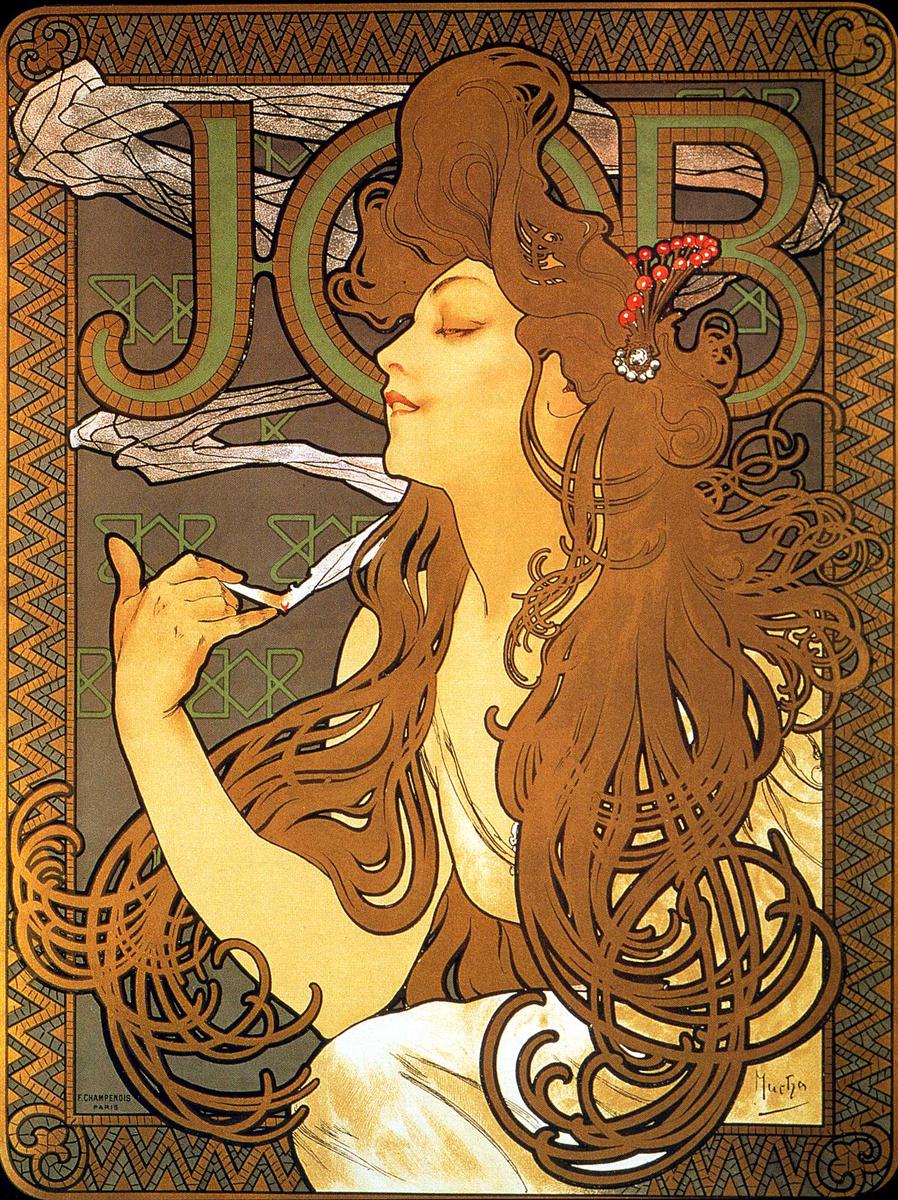
Is Alphonse Mucha’s Byzantine 1896 ad for Job rolling papers somehow unworthy because legions of dewy eyed undergrads have given it a perennial place of unframed honor?
The driving forces behind the newly opened Poster House in New York City would say no. The first American museum dedicated exclusively to poster art, its curators cast a wide net through the form’s 160 year history, whether the end goal of the work was war bond sales, public health education, or straight-up box office sales. As the Poster House writes:
For a poster to succeed, it must communicate. By combining the power of images and words, posters speak to audiences quickly and persuasively. Blending design, advertising, and art, posters clearly reflect the place and time in which they were made.

What did the best-selling poster of actress Farrah Fawcett in a red tank suit say to—and about—teenage boys in 1976? What did it say about American values and gender norms in that Bicentennial year? Why no posters of Betsy Ross?

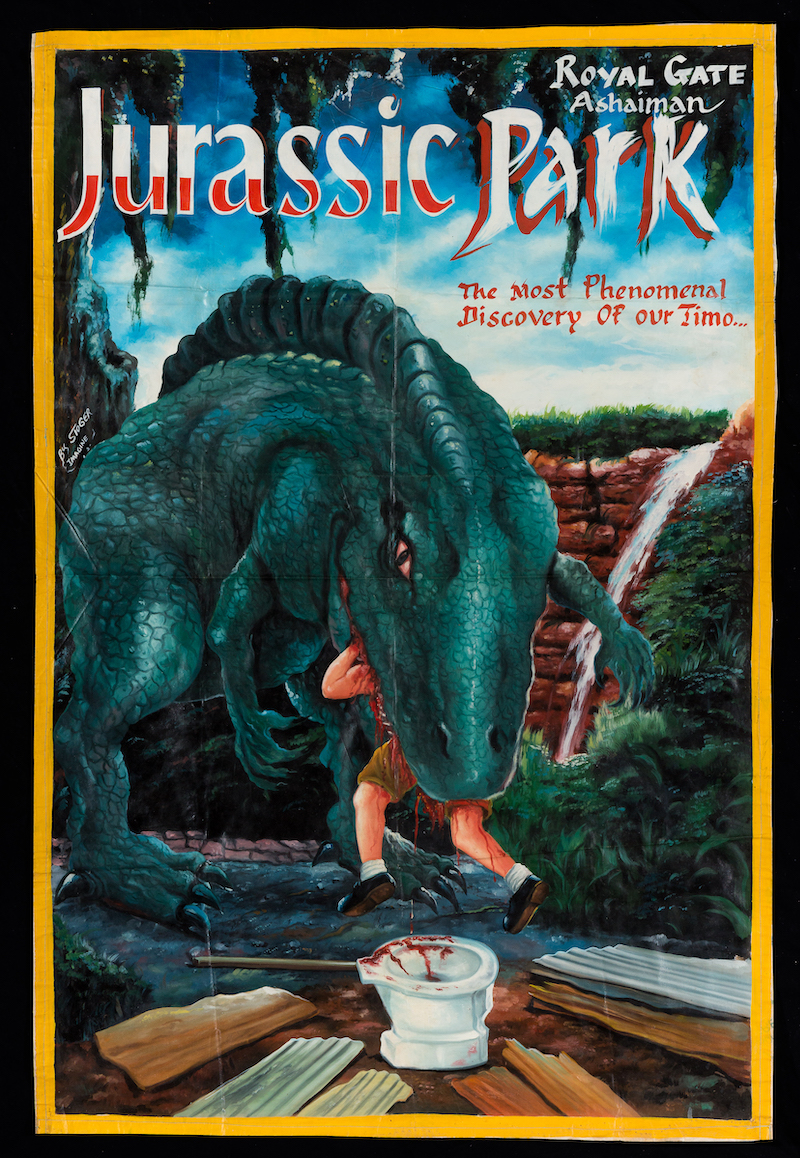
How does the official poster for Jurassic Park, above, compare to the hand-painted, presumably unauthorized image used to market it to audiences in Ghana?
(Endless gratitude to illustrator and monster movie fan Aeron Alfrey for bringing this and other Ghanian spins on American film releases to our attention.)

Some posters have remarkable staying power, reappearing in a number of guises. Witness Rosie the Riveter and James Montgomery Flagg’s Uncle Sam-themed WWI recruitment poster, to say nothing of the Barack Obama “Hope” poster by Shepard Fairey, the poster that launched a thousand parodies, mostly digital, but even so.

To learn more about visiting Poster House, its inaugural Alphonse Mucha exhibit and upcoming events such as Drink and Draw, click here.
via Hyperallergic
Related Content:
The Film Posters of the Russian Avant-Garde
Chilling and Surreal Propaganda Posters from the NSA Are Now Declassified and Put Online
Vintage 1930s Japanese Posters Artistically Market the Wonders of Travel
100 Greatest Posters of Film Noir
Ayun Halliday is an author, illustrator, theater maker and Chief Primatologist of the East Village Inkyzine. Follow her @AyunHalliday.
Read More...
Queen Guitarist Brian May Is Also an Astrophysicist: Read His PhD Thesis Online

Photo by ESO/G. Huedepohl, via Wikimedia Commons
Queen couldn’t possibly have been Queen without Freddie Mercury, nor could it have been Queen without Brian May. Thanks not least to the recent biopic, Bohemian Rhapsody, the band’s already larger-than-life lead singer has become even larger still. But its guitarist, despite the film’s surface treatment of his character, is in his own way an equally implausible figure. Not only did he show musical promise early, forming his first group while still at school, he also got his A Levels in physics, mathematics, and applied mathematics, going on to earn a Bachelor of Science in Physics with honors at Imperial College London.
Naturally, May then went for his PhD, continuing at Imperial College where he studied the velocity of, and light reflected by, interplanetary dust in the Solar System. He began the program in 1970, but “in 1974, when Queen was but a princess in its infancy, May chose to abandon his doctorate studies to focus on the band in their quest to conquer the world.” So wrote The Telegraph’s Felix Lowe in 2007, the year the by-then 60-year-old (and long world-famous) rocker finally handed in his thesis. “The 48,000-word tome, Radial Velocities in the Zodiacal Dust Cloud, which sounds suspiciously like a Spinal Tap LP, was stored in the loft of his home in Surrey.” You can read it online here.
According to its abstract, May’s thesis “documents the building of a pressure-scanned Fabry-Perot Spectrometer, equipped with a photomultiplier and pulse-counting electronics, and its deployment at the Observatorio del Teide at Izaña in Tenerife, at an altitude of 7,700 feet (2567 m), for the purpose of recording high-resolution spectra of the Zodiacal Light.” Space.com describes the Zodiacial Light as “a misty diffuse cone of light that appears in the western sky after sunset and in the eastern sky before sunrise,” one that has long tricked casual observers into “seeing it as the first sign of morning twilight.” Astronomers now recognize it as “reflected sunlight shining on scattered space debris clustered most densely near the sun.”
In his abstract, May also notes the unusually long period of study as 1970–2007, made possible in part by the fact that little other research had been done in this particular subject area during Queen’s reign on the charts and thereafter. Still, he had catching up to do, including observational work in Tenerife (as much of a hardship posting as that isn’t). Since being awarded his doctorate, May’s scientific activities have continued, as have his musical ones and other pursuits besides, such as animal-rights activism and stereography. (Sometimes these intersect: the 2017 photobook Queen in 3‑D, for example, uses a VR viewing device of May’s own design.) The next time you meet a youngster dithering over whether to go into astrophysics or found one of the most successful rock bands of all time, point them to May’s example and let them know doing both isn’t without precedent.
Related Content:
Guitarist Brian May Explains the Making of Queen’s Classic Song, ‘Bohemian Rhapsody’
Brian May’s Homemade Guitar, Made From Old Tables, Bike and Motorcycle Parts & More
Based in Seoul, Colin Marshall writes and broadcasts on cities, language, and culture. His projects include the book The Stateless City: a Walk through 21st-Century Los Angeles and the video series The City in Cinema. Follow him on Twitter at @colinmarshall, on Facebook, or on Instagram.
Read More...Support Us
We're hoping to rely on loyal readers, rather than erratic ads. Please click the Donate button and support Open Culture. You can use Paypal, Venmo, Patreon, even Crypto! We thank you!

About Us

Open Culture scours the web for the best educational media. We find the free courses and audio books you need, the language lessons & educational videos you want, and plenty of enlightenment in between.
Advertise With Us
FREE UPDATES!
GET OUR DAILY EMAIL
Get the best cultural and educational resources on the web curated for you in a daily email. We never spam. Unsubscribe at any time.
FOLLOW ON SOCIAL MEDIA
Open Culture editor Dan Colman scours the web for the best educational media. He finds the free courses and audio books you need, the language lessons & movies you want, and plenty of enlightenment in between.
Advertise With Us


