The 10 Rules for Students and Teachers Popularized by John Cage: “Nothing Is a Mistake,” “Consider Everything an Experiment” & More
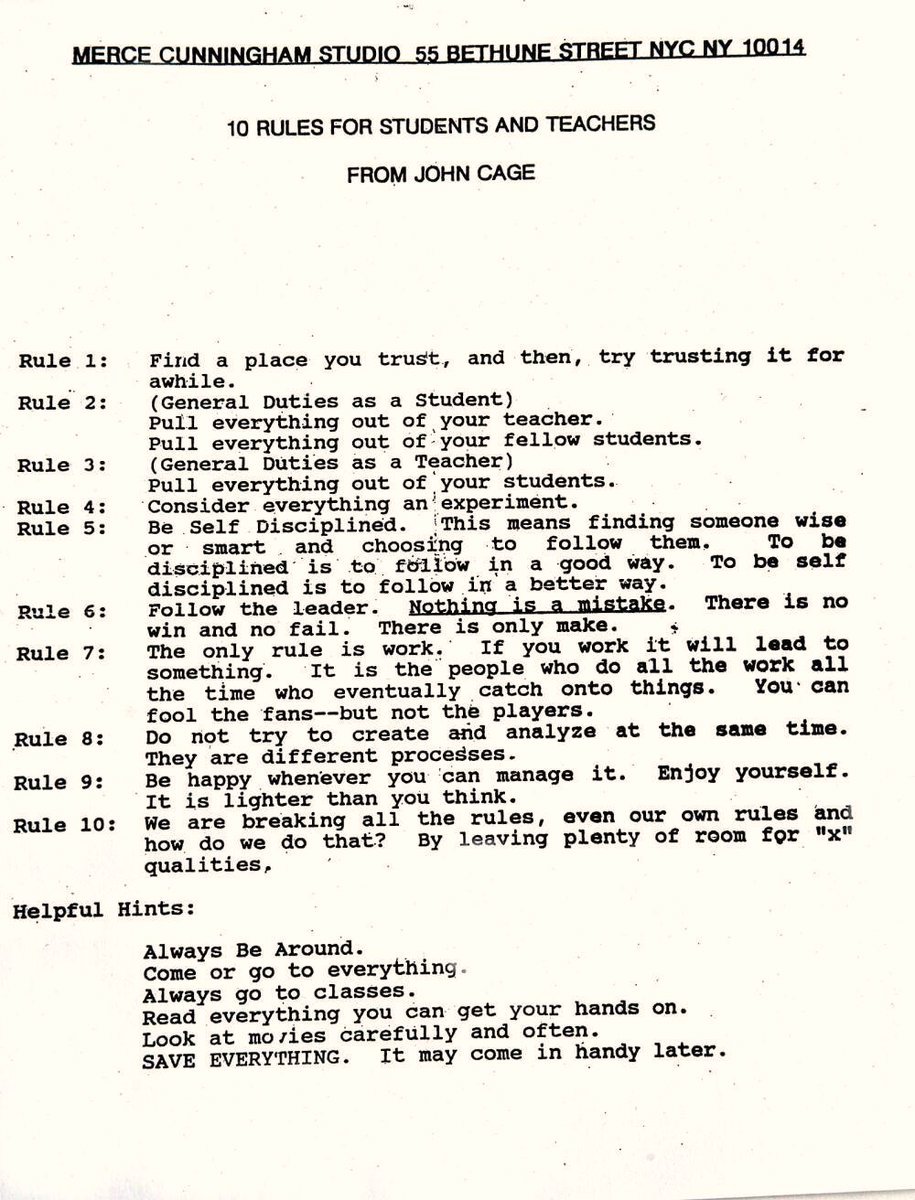
The Brian Eno archive More Dark than Shark recently posted on its Twitter account a list of twelve rules for students and teachers used by John Cage. Though much has been written about the artistic affinities between Eno and Cage, both of whose compositions have pushed the boundaries of how we think about music itself, they also both have a deep connection to the idea of using rules to enhance the experience of creation. Where Eno has his deck of creative process-enhancing Oblique Strategies cards, Cage had this list of rules first composed by an educator, silkscreen artist, and nun named Sister Corita Kent.
Kent came up with the list, writes Brainpickings’ Maria Popova, “as part of a project for a class she taught in 1967–1968. It was subsequently appropriated as the official art department rules at the college of LA’s Immaculate Heart Convent, her alma mater, but was commonly popularized by Cage, whom the tenth rule cites directly.”
That tenth rule, more of a meta-rule, reminds the reader that “we’re breaking all the rules” by “leaving plenty of room for X quantities.” But one can easily imagine how the previous nine, having as much to do with the enjoyment of the work of learning, teaching, and creating as with its rigorous performance, might appeal to Cage as well. The complete list runs as follows:
RULE ONE: Find a place you trust, and then try trusting it for a while.
RULE TWO: General duties of a student: Pull everything out of your teacher; pull everything out of your fellow students.
RULE THREE: General duties of a teacher: Pull everything out of your students.
RULE FOUR: Consider everything an experiment.
RULE FIVE: Be self-disciplined: this means finding someone wise or smart and choosing to follow them. To be disciplined is to follow in a good way. To be self-disciplined is to follow in a better way.
RULE SIX: Nothing is a mistake. There’s no win and no fail, there’s only make.
RULE SEVEN: The only rule is work. If you work it will lead to something. It’s the people who do all of the work all of the time who eventually catch on to things.
RULE EIGHT: Don’t try to create and analyze at the same time. They’re different processes.
RULE NINE: Be happy whenever you can manage it. Enjoy yourself. It’s lighter than you think.
RULE TEN: We’re breaking all the rules. Even our own rules. And how do we do that? By leaving plenty of room for X quantities.
HINTS: Always be around. Come or go to everything. Always go to classes. Read anything you can get your hands on. Look at movies carefully, often. Save everything. It might come in handy later.
Some of the rules on Kent’s list, which has now exerted its influence for half a century, sound faintly like the Oblique Strategies Eno and the painter Peter Schmidt would come up with in the 1970s. Take rule number six, “Nothing is a mistake,” which brings to mind the Oblique Strategy “Honor thy error as a hidden intention.” But we’re all on the same field when it comes to techniques to move our minds in worthwhile new directions, as Cage, Kent, Eno, Schmidt, and most other serious students, teachers, and creators might agree. They’d certainly agree that, all rules aside, everything ultimately comes down to doing the work itself, day in and day out. “Craft,” as Eno once said,” is what enables you to be successful when you’re not inspired.”
Related Content:
An Impressive Audio Archive of John Cage Lectures & Interviews: Hear Recordings from 1963–1991
How to Get Started: John Cage’s Approach to Starting the Difficult Creative Process
Jump Start Your Creative Process with Brian Eno’s “Oblique Strategies” Deck of Cards (1975)
Based in Seoul, Colin Marshall writes and broadcasts on cities and culture. His projects include the book The Stateless City: a Walk through 21st-Century Los Angeles and the video series The City in Cinema. Follow him on Twitter at @colinmarshall or on Facebook.
Read More...Watch “The Hangman,” a Classic Animated Film That Explores What Happens When No One Dares to Stand Up to Evil
Last Friday, I was downtown at an open air cinema to watch a collection of animated shorts. It was also a beastly hot night with roaring sundowners, a very present danger of being clocked in the head by falling palm fronds, and an existential danger of fire in the hills. The other existential danger was that of the authoritarian turn of this country that, at that moment, seemed so far away from our picnic baskets and wine in a can.
In the middle of the program of well made but light and fluffy shorts came the above animated film, “The Hangman.” The version above is not the restored version we saw, but it’s pretty much the same, give or take a scratch. Les Goldman and Paul Julian’s 1964 short delivers a moral message along the same lines as anti-Nazi pastor Martin Niemöller’s “First they came for the Socialists” statement–currently a meme you’ve probably seen pass through your social feed. And though the narrative, based on the poem by Maurice Ogden, is easy to suss out as it trundled towards its mortal conclusion, it did not stop the fact that the rambunctious Friday night audience fell dead silent upon its conclusion. You may too.
The poem first appeared in a 1954 issue of Masses and Mainstream, a monthly Marxist publication that continued publishing through the worst excesses of the McCarthy hearings to an understandably vanishing readership. The poem has occasionally been taught in the context of the Holocaust, but any kind of creeping fascism will do. Not much is really known about Ogden, who wrote the poem under the pseudonym Jack Denoya in its original publication. (He is possibly the same man who taught at Coast Community College in Costa Mesa, CA, and ministered at Orange Coast Unitarian Universalist Church.)
The animated version, with its modernist look influenced by UPA’s animation studio, came out one year after Masses and Mainstream folded. During that Friday night viewing, I suspected the narrator to be Ken Nordine, who recorded a vocal jazz album around that time. But actually the voice belongs to Herschel Bernardi, a film and theater actor who would have been known to Broadway fans for his starring role in Fiddler on the Roof but to television fans as Charlie Tuna in the Starkist commercials. Before all that, however, he was a victim of the Hollywood blacklist, which made him a perfect choice to narrate “The Hangman.”
Director Paul Julian illustrated much of the background art used in Warner Bros. cartoons, and his claim to pop culture fame is providing the “beep beep” sound for the Road Runner cartoons by the same studio. Producer Les Goldman went on to produce several other influential animated shorts, such as “The Dot and the Line” and “The Phantom Tollbooth.”
However, “The Hangman” is serious food for thought in these fraught times, and it’s good to see it back in circulation, thanks to curator Ron Diamond. Here’s to hoping history doesn’t repeat itself.
Related Content:
A Short Animated Introduction to Karl Marx
The Best Animated Films of All Time, According to Terry Gilliam
Ted Mills is a freelance writer on the arts who currently hosts the artist interview-based FunkZone Podcast and is the producer of KCRW’s Curious Coast. You can also follow him on Twitter at @tedmills, read his other arts writing at tedmills.com and/or watch his films here.
Read More...Why Med Schools Are Requiring Students to Take Art Classes, and How It Makes Med Students Better Doctors
I have followed several debates recently about the lack of arts and humanities education in STEM programs. One argument runs thus: scientists, engineers, and programmers often move into careers designing products for human use, without having spent much time learning about other humans. Without required courses, say, in psychology, philosophy, sociology, literature, etc., students can end up unthinkingly reproducing harmful biases or overlooking serious ethical problems and social inequities.
Technological malpractice is bad enough. Medical malpractice can have even more immediately harmful, or fatal, effects. We might take for granted that a doctor’s “bedside manner” is purely a matter of personality, but many medicals schools have decided they need to be more proactive when it comes to training future doctors in compassionate listening. And some have begun using the arts to foster creative thinking and empathy and to improve doctor-patient communication. The verbally-abusive Dr. House aside, the best diagnosticians actually have sympathetic ears.
As Dr. Michael Flanagan of Penn State’s College of Medicine puts it, “Our job is to elicit information from our patients. By communicating more effectively and establishing rapport with patients so they are more comfortable telling you about their symptoms, you are more likely to make the diagnosis and have higher patient satisfaction.” From the patient side of things, an accurate diagnosis can mean more than “satisfaction”; it can mean the difference between life and death, long-term suffering or rapid recovery.
Can impressionist painting make that difference? Dr. Flanagan thinks it’s a start. His seminar “Impressionism and the Art of Communication” asks fourth-year medical students to engage with the work of Vincent van Gogh and Claude Monet, in exercises “ranging from observation and writing activities to painting in the style of said artists,” notes Artsy. “Through the process, they learn to better communicate with patients by developing insights on subjects like mental illness and cognitive bias.” Why not just study these subjects in psychology courses?
One answer comes from Penn State associate professor of art history Nancy Locke, who presents to Flanagan’s classes. “Art can make people see their lives differently,” she says, “Doctors will see people regularly with certain problems.” And they can begin to schematize their patients the way they schematize diseases and disorders. “But a painting can continue to be challenging, and there are always new questions to ask.” Impressionist painting represents only one road, among many others, to the ambiguities of the human mind.
Another Penn State professor, Dr. Paul Haidet, director of medical education research, offered a seminar on jazz and medical communications to fourth-year students in 2014 and 2015. As he mentions in the video above, Flanagan himself took the course. “Just as one jazz musician provides space to another to improvise,” he tells Penn State News, “as physicians we need to provide space to our patients to communicate in their own style. It was a transformational experience, unlike anything I ever had in medical school myself.” He was inspired thereafter to introduce his painting course.
One could imagine classes on the Victorian novel, modernist poetry, or improvisational dance having similar effects. Other medical schools have certainly agreed. Dr. Delphine Taylor, associate professor of medicine at Columbia University Medical Center, “emphasizes that arts-focused activities are important in training future doctors to be present and aware,” Artsy writes, “which is more and more difficult today given the pervasiveness of technology and media.” Arts programs have also been adopted in the medical schools at Yale, Harvard, and UT Austin.
The precedents for incorporating the arts into a science education abound—many a famous scientist has also had a passion for literature, photography, painting, or music. (Einstein, for example, wouldn’t be parted from his violin.) As the arts and sciences grew further apart, for reasons having to do with the structure of higher education and the dictates of market economies, it became far less common for scientists and doctors to receive a liberal arts education. On the other hand, todays liberal arts students might benefit from more required STEM courses, but that’s a story for another day.
via Artsy
Related Content:
Your Brain on Art: The Emerging Science of Neuroaesthetics Probes What Art Does to Our Brains
The Musical Mind of Albert Einstein: Great Physicist, Amateur Violinist and Devotee of Mozart
Josh Jones is a writer and musician based in Durham, NC. Follow him at @jdmagness
Read More...Jimmy Page Visits Oxford University & Tells Students How He Went from Guitar Apprentice to Creating Led Zeppelin
It’s maybe a cultural truism that iconoclasts who live long enough eventually become icons. So I suppose it shouldn’t surprise us much to see a rock ‘n’ roll hero like Jimmy Page standing behind the podium at the Oxford Union, for a lecture and Q&A series put on by the famed debating society. But as he tells his audience, it isn’t his first time at Oxford—he made an appearance at 16, accompanying beat poet and novelist Royston Ellis on guitar. (It was Ellis, Page notes, who suggested the quirky spelling of the Beatles to John Lennon.) This story leads to Page’s autobiographical sketch of how he became a musician by listening to “the music coming over from America” and the skiffle versions of the same by English musician Lonnie Donegan.
It’s a story familiar to fans not only of Page but of every British invasion band inspired by the American blues and R&B. But it’s always interesting, especially for Americans, to hear it told. Homegrown traditional music we take for granted sounded to the young Page like “it was coming from Mars.”
He describes the influence of Donegan as a “portal” to the blues and rock ‘n’ roll, which bands like the Yardbirds picked up in the early sixties. Mention of that seminal English band leads Page to recount his second time at Oxford, to see the Yardbirds at Queen’s College, a fateful night that ended with Page joining the band on bass after Paul Samwell-Smith quit. By that time, he had served what he calls a “three-year apprenticeship” as a studio musician, arranger, and composer.
These reminisces set the tenor for Page’s short address, a series of vignettes from his venerable career, full of fascinating digressions and asides. At around 13 minutes in, he concludes that his “lifetime achievement” was to “do something which was initially my hobby, turn that into something which was a very professional process, but still a very creative one… and to inspire young musicians.” After his short speech, the program transitions to an interview format, and Page expands on and clarifies many of his comments. His affable humility and desire to share his wisdom and experience make this very enjoyable viewing for anyone interested in Page’s life and work, or in the history of rock ‘n’ roll more generally, which cannot be told without him, and for which he is a very able chronicler.
Related Content:
13-Year-Old Jimmy Page Plays Guitar on TV in 1957, an Early Moment in His Spectacular Career
Jimmy Page Tells the Story of “Kashmir”
Josh Jones is a writer and musician based in Durham, NC. Follow him at @jdmagness
Read More...Learn the History of Indian Philosophy in a 62 Episode Series from The History of Philosophy Without Any Gaps: The Buddha, Bhagavad-Gita, Non Violence & More

The belief in a singular, coherent “Western tradition” in philosophy has led to a very insular, Eurocentric view in philosophy departments, as Jay L. Garfield and Bryan W. Van Norden write in a New York Times op-ed. “No other humanities discipline demonstrates this systemic neglect of most of the civilizations in its domain,” they argue, “The present situation is hard to justify morally, politically, epistemically or as good educational and research training practice.” In his follow-up book Taking Back Philosophy Van Norden argues that educational institutions should “live up to their cosmopolitan ideals” by expanding the canon and teaching non-Western philosophical traditions.
One philosophy educator, Peter Adamson, professor of philosophy at the LMU in Munich and King’s College London, has taken up the challenge of teaching global philosophical traditions through his popular podcast The History of Philosophy Without Any Gaps, with series on the Islamic World, Africana, and India. With expert co-authors and guests, Adamson’s podcasts help us navigate cultural and historical differences without watering down the substance of diverse bodies of thought.
These surveys of non-Western traditions aim to be as exhaustive as the podcast’s coverage of Classical, Later Antiquity, and Medieval periods in Europe. We’ve featured Adamson’s podcasts on Islamic and Indian philosophy in an earlier post. Now we revisit his series on Indian philosophy, which has grown substantially in the interval, from thirty-two to sixty-two episodes, divided into three categories—“Origins,” “Age of the Sutra,” and “Buddhists and Jains.”
Very broadly, much Indian philosophy can be understood as a centuries-long conflict between the six orthodox Vedic schools (astika) and the heterodox (nastika) schools, including Buddhism, Jainism, and Carvaka, a materialist philosophy that denied all metaphysical doctrines. While some strains among these schools of thought can be associated with individual names, like Kanada, Patañjali, or Nagarjuna, much ancient Indian philosophy “is represented by a mass of texts,” as Luke Muehlhauser writes in his short guide, “for which the authors and dates of composition are mostly unknown.”
Adamson’s free podcast survey of Indian philosophy makes for entertaining, informative listening. You can download every episode in .zip form at the links above. Or find links to the individual episodes right below. To keep up with trends in the study of Indian philosophy in English, be sure to follow the Indian Philosophy Blog. And for an excellent list of “Readings on the Less Commonly Taught Philosophies (LCTP),” see this post by Bryan Van Norden here.
Related Content:
Free Online Philosophy Courses
Josh Jones is a writer and musician based in Durham, NC. Follow him at @jdmagness
Read More...Teaching Tolerance to Activists: A Free Course Syllabus & Anthology
The waters of academia have grown choppy of late, and many veteran sailors have found themselves ill-equipped to navigate the brave new world student activists are forging at a breakneck pace.
Trigger warnings. Safe spaces. Curricula restructured with an eye toward identity. Swift judgments for those who fail to comply.
Admissions brochures and campus tours make frequent mention of their institution’s commitment to social justice. They have to—many high schoolers share the undergrads’ beliefs.
Those of us whose college years are but a distant memory shouldn’t depend on our school’s alumni mag to paint an accurate picture of the battles that may be raging within. Sustainability, preferred pronouns, and inclusive bathroom facilities may get a mention, but the official organ’s unlikely to peek into the abyss where tolerance goes to die.
Cultural scholar Frances Lee, a queer trans person of color recovering from a forced conversion to evangelical Christianity, took a hard look at the problem of intolerance within activist circles as a second year Masters student in Cultural Studies at the University of Washington.
Published exactly one year ago, their essay, Kin Aesthetics: Excommunicate Me from the Church of Social Justice, was plainspoken about the negative side effects of social progress in activist circles, and by extension, on campus:
Telling people what to do and how to live out their lives is endemic to religious and to dogmatic activism. It’s not that my comrades are the bosses of me, but that dogmatic activism creates an environment that encourages people to tell other people what to do. This is especially prominent on Facebook. Scrolling through my news feed sometimes feels Iike sliding into a pew to be blasted by a fragmented, frenzied sermon. I know that much of the media posted there means to discipline me to be a better activist and community member. But when dictates aren’t followed, a common procedure of punishment ensues. Punishments for saying/doing/believing the wrong thing include shaming, scolding, calling out, isolating, or eviscerating someone’s social standing. Discipline and punishment have been used for all of history to control and destroy people. Why is it being used in movements meant to liberate all of us? We all have made serious mistakes and hurt other people, intentionally or not. We get a chance to learn from them when those around us respond with kindness and patience. Where is our humility when examining the mistakes of others? Why do we position ourselves as morally superior to the lowly un-woke?
The essay’s viral success gives extra oomph to “Woker Than Thou: Leftist Activist Identity Formations,” a community course Lee designed and taught earlier this year.
Intended for community leaders, political activists, and organizers, Lee welcomed anyone with any interest in the subject, provided they were willing “to stay open to dissenting or unpopular ideas for the sake of discussion, instead of foreclosing certain topics or ideas by judging them as not worthy of attention.”
The 10-week syllabus delved into such relevant topics as Call-out Culture, the False Promises of Empathy, and of course “wokeness,” a term Lee takes care to attribute to Black culture.
While not all of the required readings can be found online, Lee provides a wealth of links to those that can.
Titles include University of San Francisco Professor Rhonda Magee’s “Addressing Social Injustice with Compassion,” author Andrea Smith’s “The Problem with Privilege,” Trauma Stewardship Institute founder Laura van Dernoot Lipsky’s TEDx Talk on systematic oppression and liberation theory.
There’s even a Sufjan Stevens song that evolved from cheap shots at skater Tonya Harding’s expense to something that considered the “wholeness of the person… with dignity and grace.”
Following Lee’s course materials seems a much more rational way to confront the current social climate than binging on confessional essays by liberal arts professors who feel hamstrung by not-unfounded fears that their students could cost them their jobs … and the good reputation required to secure another.
For further reading, Lee offers free downloads of Toward An Ethics of Activism: A Community Investigation of Humility, Grace and Compassion in Movements for Justice, an anthology that “seeks to disrupt dogmatic, exclusionary activist culture with kindness and connection.”
Find Frances Lee’s “Woker Than Thou” syllabus here.
Download a PDF of the anthology Toward An Ethics of Activism here. (A screen reader accessible version is also available.)
Related Content:
Slavoj Žižek Calls Political Correctness a Form of “Modern Totalitarianism”
Ayun Halliday is an author, illustrator, theater maker and Chief Primatologist of the East Village Inky zine. Follow her @AyunHalliday.
Read More...The Iconic Urinal & Work of Art, “Fountain,” Wasn’t Created by Marcel Duchamp But by the Pioneering Dada Artist Elsa von Freytag-Loringhoven
In the introduction to her book Broad Strokes, writer and art history scholar Bridget Quinn describes her discovery of Lee Krasner, accomplished abstract expressionist painter who just happened to have been married to Jackson Pollock. That biographical detail warranted Krasner a footnote, but little more, in the art books Quinn studied in college. Learning of Krasner sent Quinn on a quest to find other women left behind by art history. “My fixation with these artists went beyond feminism,” she writes, “if it had anything to do with it at all. I identified with these painters and sculptors the way my friends identified with Joy Division or The Clash or Hüsker Dü.”
Much has changed since 1987, when Quinn’s fandom began, but Krasner is still one of the few female artists to have ever had a retrospective show at New York’s Museum of Modern Art. And one artist every student of art history should know, Baroness Elsa von Freytag-Loringhoven, remains almost completely obscure. What’s so important about von Freytag-Loringhoven? She was a pioneering Dada artist and poet—well-known in the 1910s and 20s. “Her work was championed by Ernest Hemingway and Ezra Pound,” writes John Higgs at the Independent (she appears in Pound’s Canto XCV). She “is now recognized as the first American Dada artist, but it might be equally true to say she was the first New York punk, 60 years too early.”
Von Freytag-Loringhoven also deserves the credit, it seems, for one of the most groundbreaking art objects to ever appear in a gallery: Fountain, the urinal signed “R. Mutt” that Marcel Duchamp claimed as his own and which has made him a legend in the history of art. The story, I imagine, might seem depressingly familiar to every woman who has ever had a male boss publish her work with his name on it. Even more frustratingly, the “glaring truth has been known for some time in the art world,” according to the blog of art magazine See All This. Yet, “each time it has to be acknowledged, it is met with indifference and silence.”
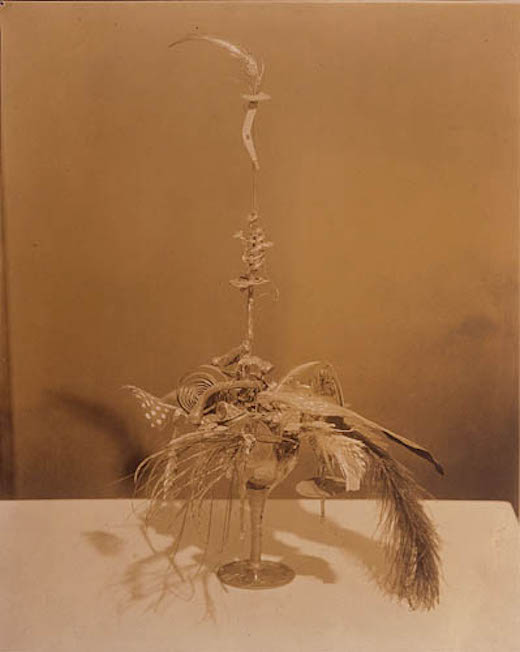
The truth first emerged in a letter from Duchamp to his sister—discovered in 1982 and dated April 11th, 1917, a few days before the exhibit in which Fountain first appeared—in which he “wrote that a female friend using a male alias had sent it in for the New York exhibition.” The name, “Richard Mutt,” was a pseudonym chosen by Freytag-Loringhoven, who was living in Philadelphia at the time and whom Duchamp knew well, once pronouncing that “she is not a Futurist. She is the future.” (See her Portrait of Marcel Duchamp, above, in a 1920 photograph by Charles Sheeler.)
Why did she never claim Fountain as her own? “She never had the chance,” notes See All This. The urinal was rejected by the exhibition organizers (Duchamp resigned from their board in protest), and it was probably, subsequently thrown away; nothing remained but a photograph by Alfred Stieglitz. Von Freytag-Loringhoven died ten years later in 1927.
It was only in 1935 that surrealist André Breton brought attention back to Fountain, attributing it to Duchamp, who accepted authorship and began to commission replicas. The 1917 piece “was destined to become one of the most iconic works of modern art. In 2004, some five hundred artists and art experts heralded Fountain as the most influential piece of modern art, even leaving Picasso’s Les Demoiselles d’Avignon behind.”
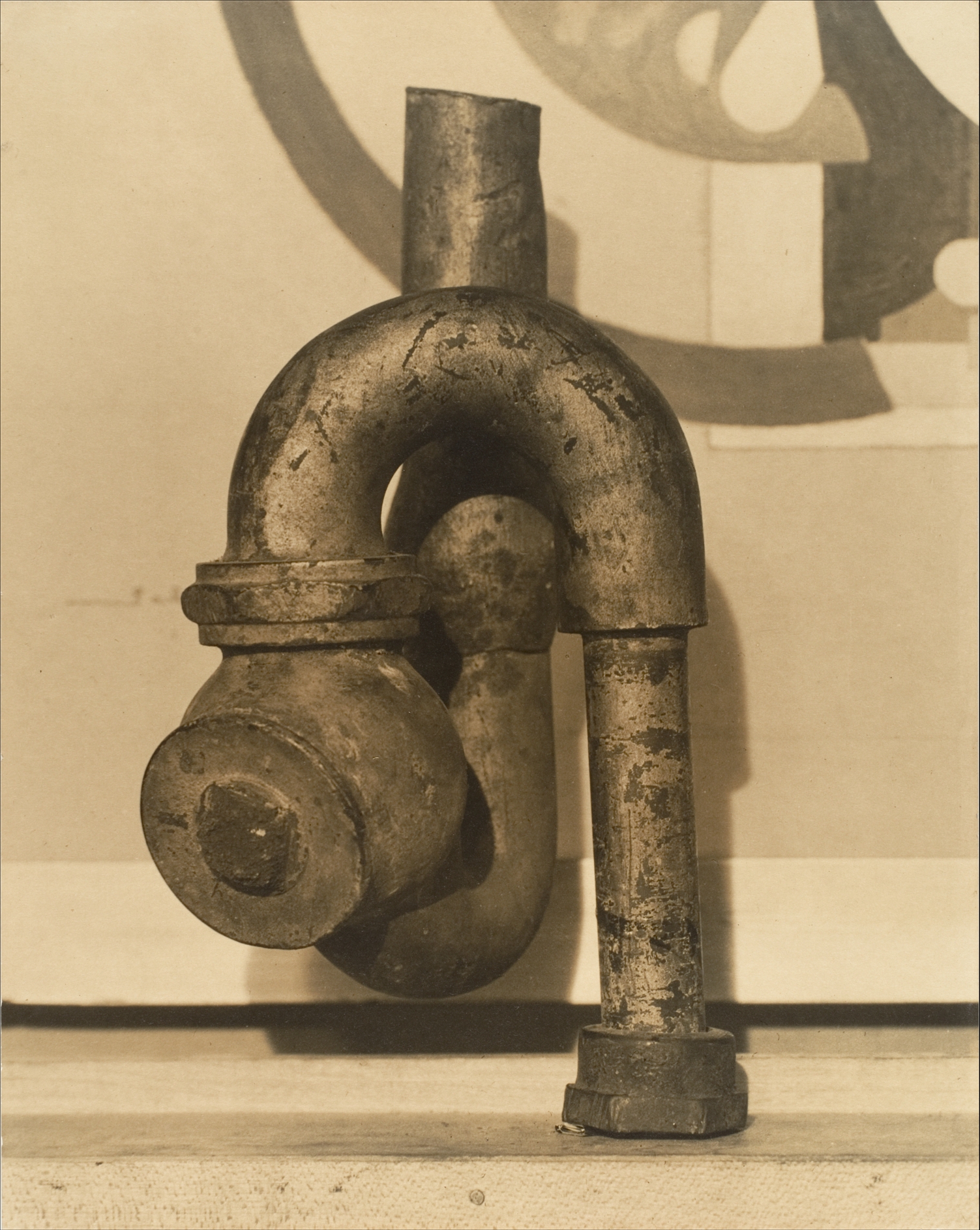
Duchamp’s letter is not the only reason historians have for thinking of Fountain as von Freytag-Loringhoven’s work. “Baroness Elsa had been finding objects in the street and declaring them to be works of art since before Duchamp hit upon the idea of ‘readymades,’” writes Higgs. One such work, a “cast-iron plumber’s trap attached to a wooden box, which she called God” (above), was also misattributed, “assumed to be the work of an artist called Morton Livingston Schaumberg, although it is now accepted that his role in the sculpture was limited to fixing the plumber’s trap to its wooden base.”
“Fountain is base, crude, confrontational and funny,” writes Higgs, “Those are not typical aspects of Duchamp’s work, but they summarize the Baroness and her art perfectly.” Duchamp later claimed to have bought the urinal himself, but later research has shown this to be unlikely. Higgs’ book Stranger Than We Can Imagine explores the issues in more depth, as does an article in Dutch published in the See All This summer issue. What would it mean for the art establishment to acknowledge von Freytag-Loringhoven’s authorship? “To attribute Fountain to a woman and not a man,” the magazine writes, “has obvious, far-reaching consequences: the history of modern art has to be rewritten. Modern art did not start with a patriarch, but with a matriarch.”
Learn more about Elsa von Freytag-Loringhoven at The Art Story.
via See All This
Related Content:
Hear Marcel Duchamp Read “The Creative Act,” A Short Lecture on What Makes Great Art, Great
Josh Jones is a writer and musician based in Durham, NC. Follow him at @jdmagness
Read More...The 100 Best One-Hit Wonder Songs: A Streamable Playlist Curated by Consequence of Sound
So Consequence of Sound has posted a list of The 100 Best One-Hit Wonder Songs, and before we dive in, we should point out that they’ve really tried to do their best in the face of history. I’m sure there are those out there who have been outraged some way or another at the arbitrary nature of the “one-hit wonder” designation over the years. I know I have thrown a fit to see Madness’ “Our House” called a one-hit-wonder in the States without mentioning their 30 or so Top 40 hits in the UK.
If American chart success is a judge, the CoS writers says, Beck would be a one-hit-wonder along with Radiohead. No, what we’re really gunning for are artists who really only have one bona fide hit to their name, and afterwards pretty much disappeared into the ether.
The Vapors’ “Turning Japanese” is definitely one of those. Released in a flood of new wave/post-punk fervor, it’s a catchy earworm that would both define the band and then entrap them. They never had another hit and ironically had chosen this as their second single, worried that they might become a one-hit-wonder. Whoops!
And while the ‘70s and ‘80s are seen as the height of the one-hit-wonder, the 1990s sure are worth reconsidering. We didn’t know it then, but the music industry was just about to collapse with the arrival of Napster and the Internet, and the rise of electronica brought with it a cornucopia of one-off downtempo/triphop tracks, college-rock/post-grunge anthems, and this single from Toronto’s finest, Len:
(Ah, 1999. Just before the world imploded.)
You can listen to Consequence of Sound’s list on Spotify, if you so choose:
So what happened to the one-hit-wonder? YouTube. Where else can you find novelty hits, parody songs, and pop cultural touchstones these days? The major labels certainly aren’t releasing them. That might be good for users, but it’s gonna be hell for pop historians attempting to assemble a comparable list in the future.
Related Content:
A History of Rock ‘n’ Roll in 100 Riffs
Ted Mills is a freelance writer on the arts who currently hosts the artist interview-based FunkZone Podcast and is the producer of KCRW’s Curious Coast. You can also follow him on Twitter at @tedmills, read his other arts writing at tedmills.com and/or watch his films here.
Read More...Robert Rauschenberg’s 34 Illustrations of Dante’s Inferno (1958–60)
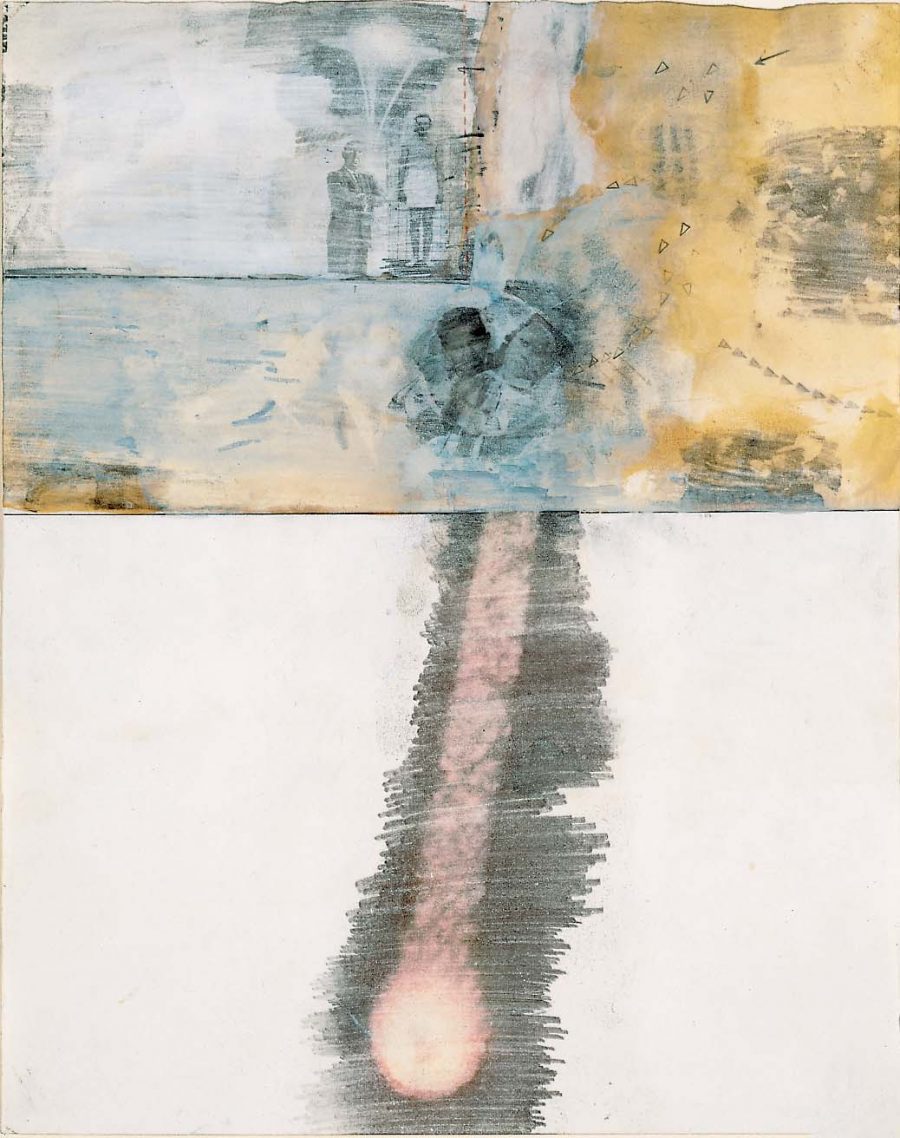
Perhaps more than any other postwar avant-garde American artist, Robert Rauschenberg matched, and maybe exceeded, Marcel Duchamp’s puckish irreverence. He once bought a Willem de Kooning drawing just to erase it and once sent a telegram declaring that it was a portrait of gallerist Iris Clert, “if I say so.” Rauschenberg also excelled at turning trash into treasure, repurposing the detritus of modern life in works of art both playful and serious, continuing to “address major themes of worldwide concern,” wrote art historian John Richardson in a 1997 Vanity Fair profile, “by utilizing technology in ever more imaginative and inventive ways…. Rauschenberg is a painter of history—the history of now rather than then.”
What, then, possessed this artist of the “history of now” to take on a series of drawings between 1958 and 1960 illustrating each Canto of Dante’s Inferno? “Perhaps he sensed a kindred spirit in Dante,” writes Gregory Gilbert at The Art Newspaper, “that encouraged his vernacular interpretations of the classical text and his radical mixing of high and low cultures.”
Critic Charles Darwent reads Rauschenberg’s motivations through a Freudian lens, his Inferno series a sublimation of his homosexuality and repressive childhood: “The young Rauschenberg… came to see Modernist art as a variant of his Texan parents’ fundamental Christianity.”
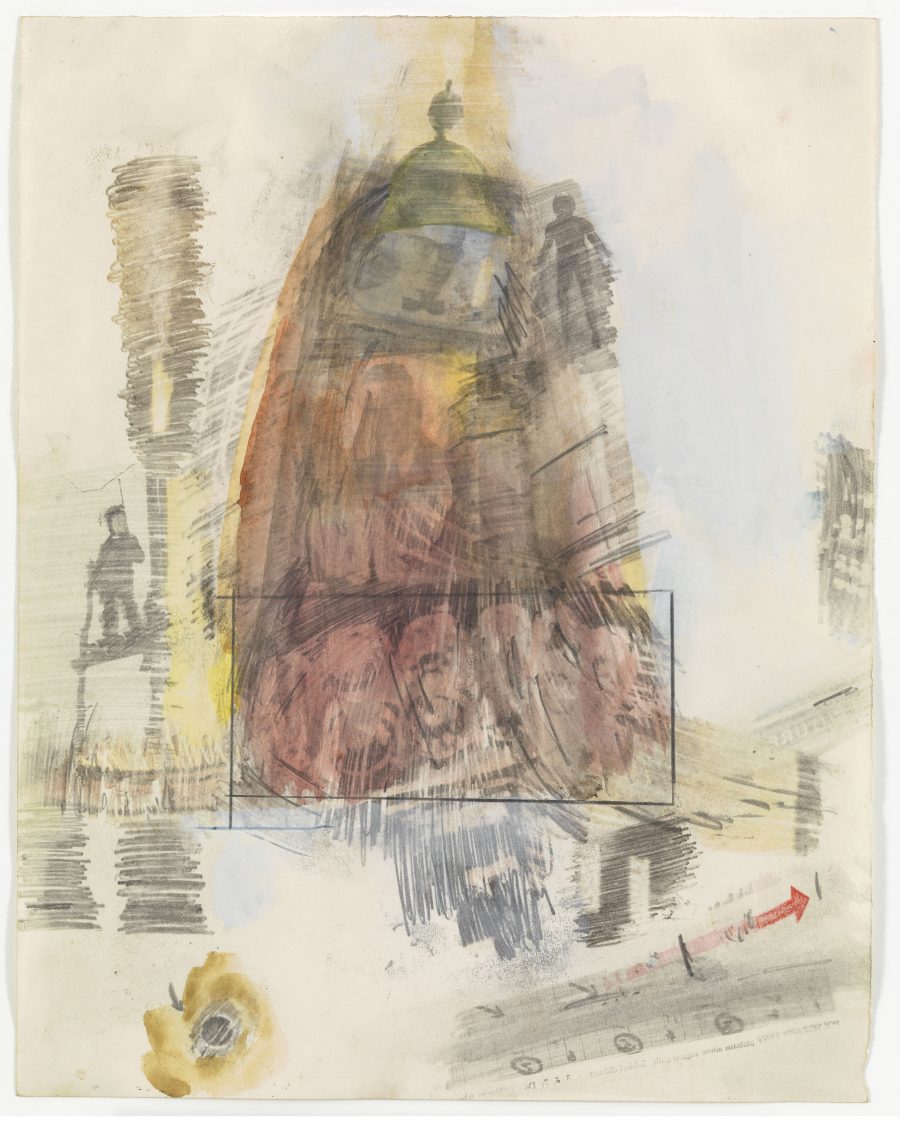
The most straightforward account has Rauschenberg conceiving the project in order to be taken more seriously as an artist. Such biographical explanations tell us something about the work, but we learn as much or more from looking at the work itself, which happens to be very much a history of now at the end of the 1950s. Though Rauschenberg based the illustrations on John Ciardi’s 1954 translation of the Divine Comedy, they were not meant to accompany the text but to stand on their own, the Italian epic—or its famous first third—providing a backdrop of ready-made ironic commentary on images Rauschenberg ripped from newspapers and magazines such as Life and Sports Illustrated.
“To create these collages,” explains MIT’s List Visual Arts Center, “he would use a solvent to adhere the images to his drawing surface, then overlay them with a variety of media, including pen, gouache (an opaque watercolor), and pencil.” Steeped in a Cold War atmosphere, the illustrations incorporate figures like John F. Kennedy and Richard Nixon, who, in the 50s, Gilbert writes, “served as one of Joseph McCarthy’s political henchmen during the Red Scare.” We see in Rauschenberg’s collage drawings allusions to the Civil Rights movement and the decade’s anti-Communist paranoia as well its reactionary sexual politics. “Political and sexual content… needed to be coded,” Gilbert claims, in such an “ultraconservative era.”
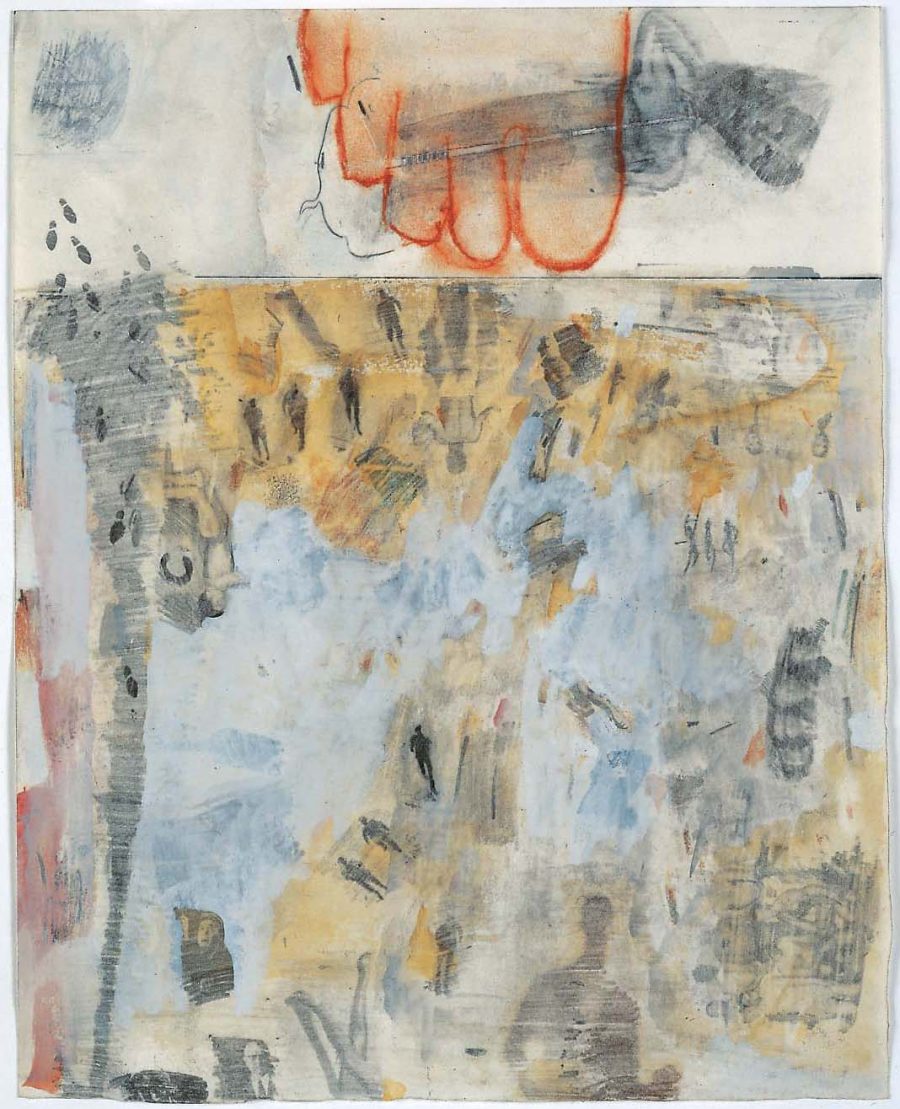
For example, we see a likely reference to the artist’s gay identity in the Canto XIV illustration, above. The text “describes the punishment of the Sodomites, who are condemned for eternity to walk across burning sand. Rauschenberg depicts the theme through a homoerotic image of a male nude… juxtaposed with a red tracing of the artist’s own foot.” Maybe Darwent is right to suppose that had Dante’s poem not existed, Rauschenberg “would have been the man to invent it”—or to invent its mid-20th century visual equivalent. He draws attention to the poem’s autobiographical center, its subversive humor, and its density of references to contemporary 15th century Italian politics, adapting all of these qualities for modernity.
But the illustration of Canto XIV—depicting “The Violent Against God, Nature, and Art”—also encodes Rauschenberg’s violent trampling of artistic convention. Many critics see this series as the artist’s reaction against Abstract Expressionism (like that of De Kooning). And while he “may have felt a creative kinship with Dante,” writes Gilbert, “he also admitted to the art critic Calvin Tomkins his impatience with the poet’s self-righteous morality, a statement likely directed against this Canto.” Like his 1953 Erased de Kooning Drawing, Rauschenberg’s Inferno drawings also perform an act of erasure—or the creation of a palimpsest, with Dante’s poem scratched over by the artist’s wild, childlike strokes.
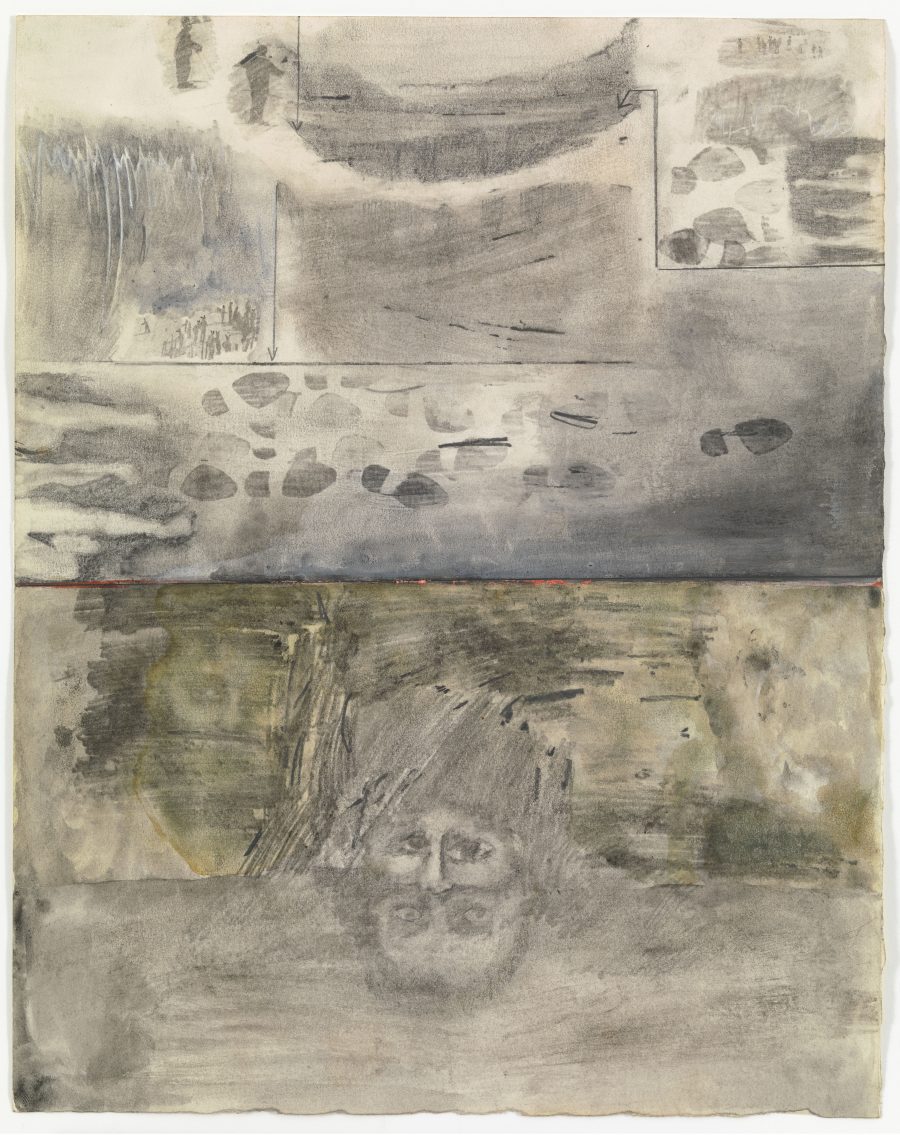
In recognition of the way these illustrations repurpose, rather than accompany, the Inferno, MoMA recently commissioned an edition of Rauschenberg’s 34 drawings, accompanied not by the straight translation by Ciardi but poems by Kevin Young and Robin Coste Lewis, whose portion of the book is titled “Dante Comes to America: 20 January 17: An Erasure of 17 Cantos from Ciardi’s Inferno, after Robert Rauschenberg.” Rather than viewing the illustrations against Dante’s work itself, we can read their particular American proto-pop art character against literary “erasures” like Lewis’s “Canto XXIII,” below. See the full series of Rauschenberg’s 34 illustrations at the Rauschenberg Foundation website here.
Canto XXIII.
by Robin Coste Lewis“I Go with The Body That Was Always Mine”
Silent, one following the other,
the Fable hunted us down.
O weary mantle of eternity,
turn left, reach us down
into that narrow way in silence.College of Sorry Hypocrites, I go
with the body that was always mine,
burnished like counterweights to keep
the peace. One may still see the sort of peacewe kept. Marvel for a while over that:
the cross in Hell’s eternal exile.
Somewhere there is some gap in the wall,
pit through which we may climbto the next brink without the need
of summoning the Black Angels
and forcing them to raise us from this sink.
Nearer than hope, there is a bridgethat runs from the great circle, that crosses
every ditch from ridge to ridge.
Except—it is broken—but with care.
Related Content:
A Free Course on Dante’s Divine Comedy from Yale University
Hear Dante’s Inferno Read Aloud by Influential Poet & Translator John Ciardi (1954)
Josh Jones is a writer and musician based in Durham, NC. Follow him at @jdmagness
Read More...A New Scientific Study Supports Putting Two Spaces After a Period … and a Punctuation War Ensues
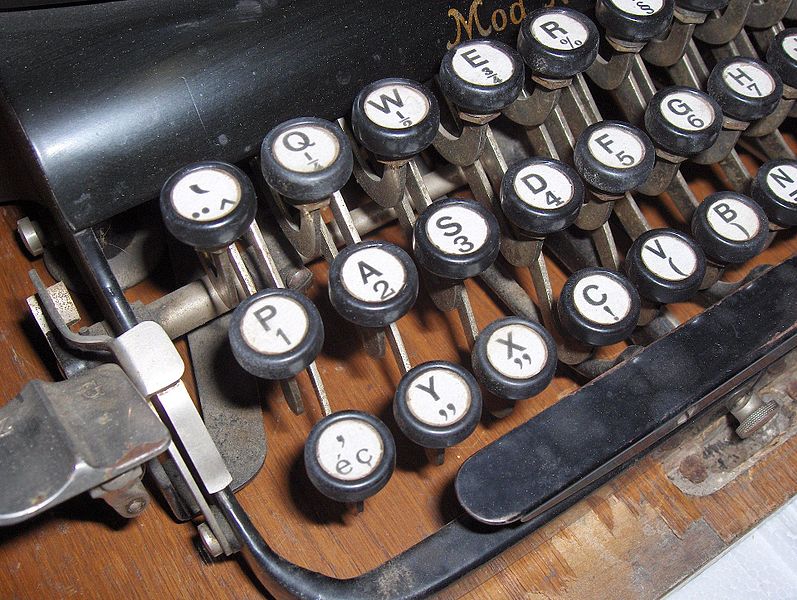
Photo via Wikimedia Commons
In former ages, wars erupted over the finer points of religious doctrine, a historical phenomenon that can seem perplexing to modern secularists. We’re past such things, we think. But then let someone bring up the Oxford comma or the number of spaces one should put after a period, and you may see writers, editors, and teachers pick sides and maybe come to blows in their defense of seemingly trivial grammatical and typographical standards. These debates approach the vehemence of Medieval arguments over transubstantiation.
I exaggerate, but maybe only slightly. There have been times, I confess, when I’ve felt I would fight for the serial comma. I grind my teeth and feel a rush of rage when I see two spaces instead of one after the end of sentences. Irrational, perhaps, but such is the human devotion to orthodoxy in the details. And so, when Skidmore College researchers Rebecca Johnson, Becky Bui, and Lindsay Schmitt published a paper last month in Attention, Perception, & Psychophysics claiming scientific support for a two-space period, they virtually lobbed a bomb into offices everywhere.
Angela Chen at The Verge parried with an article calling two spaces a “horrible habit.” The practice “remains bad,” she writes, “it’s ugly, it doesn’t help when it comes to what matters most (reading comprehension), and the experiment that supports its benefits uses an outdated font style.” (Don’t get me started on the font wars.) What was the experiment? The paper itself hides behind a redoubtable paywall, but Ars Technica’s Sean Gallagher gets to the gist of the study on a cohort of 60 Skidmore students.
Having identified subjects’ proclivities, the researchers then gave them 21 paragraphs to read (including one practice paragraph) on a computer screen and tracked their eye movement as they read using an Eyelink 1000 video-based eye tracking system. “Chin and forehead rests were used to minimize the reader’s head movements,” the Skidmore researchers wrote in their paper.
After the tracking, the researchers “evaluated the reading speed for each of the paragraph types presented in words per minute.… [they] found that two spaces at the end of a period slightly improved the processing of text during reading.” The study’s attempt to quantify the benefits of two spaces came after the American Psychological Association Manual’s most recent edition, which, for some reason, has changed camps to two spaces.
Gallagher explains the space debate as stemming from the major technological shift in word processing: “For anyone who learned their keyboarding skills on a typewriter rather than a computer… the double-space after the period is a deeply ingrained truth.” Speaking as such a person, it isn’t, but he’s right to note that typing teachers insisted on two spaces. Such was the standard until computers with variable-width fonts fully phased out typewriters.
So the Skidmore researchers raised the ire of Chen and others with their use of Courier New, a “fixed-width font that resembles typewritten text—used by hardly anyone for documents.” The blog Practical Typography analyzed the two space paper and remains unimpressed: “In sum—a small difference, limited to a certain category of test subjects, with numerous caveats attached. Not much to see here, I’m afraid.” (This description might accurately describe thousands of published studies.)
This war will rage on—the study fueling these recent skirmishes does not seem to justify two-spacers claiming victory. And anyway, good luck getting the rest of us to abandon faith in the one true space.
via The Verge
Related Content:
Cormac McCarthy’s Three Punctuation Rules, and How They All Go Back to James Joyce
Theodor Adorno’s Philosophy of Punctuation
Josh Jones is a writer and musician based in Durham, NC. Follow him at @jdmagness
Read More...Support Us
We're hoping to rely on loyal readers, rather than erratic ads. Please click the Donate button and support Open Culture. You can use Paypal, Venmo, Patreon, even Crypto! We thank you!

About Us

Open Culture scours the web for the best educational media. We find the free courses and audio books you need, the language lessons & educational videos you want, and plenty of enlightenment in between.
Advertise With Us
FREE UPDATES!
GET OUR DAILY EMAIL
Get the best cultural and educational resources on the web curated for you in a daily email. We never spam. Unsubscribe at any time.
FOLLOW ON SOCIAL MEDIA
Open Culture editor Dan Colman scours the web for the best educational media. He finds the free courses and audio books you need, the language lessons & movies you want, and plenty of enlightenment in between.
Advertise With Us


.jpg)