Neil deGrasse Tyson Demonstrates the Physics-Defying Rattleback
The rattleback–it’s been intriguing us since prehistoric times. Seeming to defy the laws of physics, it spins in one direction, “rattles” to a stop, and then changes direction, as Neil deGrasse Tyson demonstrates above. How does the rattleback work? To get into that, watch this technical video from William Case, a professor at Grinnell College. Or review the resources on this web page. In either case, you will need to wear your thinking cap.
If you would like to support the mission of Open Culture, consider making a donation to our site. It’s hard to rely 100% on ads, and your contributions will help us continue providing the best free cultural and educational materials to learners everywhere. You can contribute through PayPal, Patreon, and Venmo (@openculture). Thanks!
Related Content:
Read More...How a Liberal Arts Education Helped Derek Black, the Godson of David Duke, Break with the White Nationalist Movement
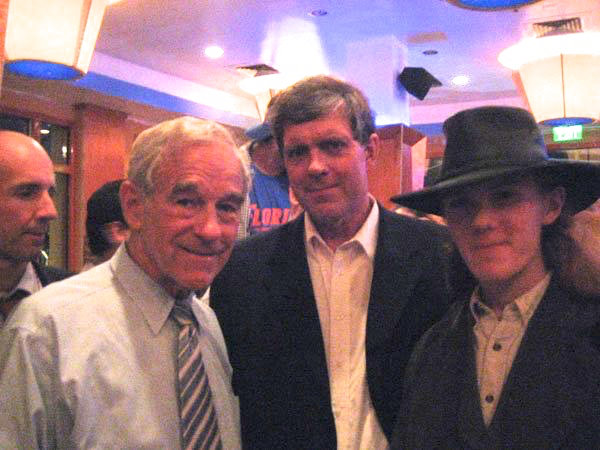
Image of Ron Paul, Don Black, Derek Black (right), via Wikimedia Commons
A native of West Palm Beach, Florida, Derek Black grew up in one of the most prominent white nationalist families in the United States. He’s the son of Don Black, a former grand wizard of the Ku Klux Klan. And he’s the godson of David Duke, “the most recognizable figure of the American radical right, a neo-Nazi, longtime Klan leader and now international spokesman for Holocaust denial” (per the Southern Poverty Law Center). In short, Derek Black had every reason to grow up a racist, and remain a racist from cradle to grave. But things didn’t turn out that way.
Below, you can hear Black explain how, as a young adult, he broke with white nationalism, leaving behind his family, friends and community. What laid the groundwork for that break? Going to a small liberal arts college, encountering new ideas, and meeting different people. In this recorded interview, he tells Michael Barbaro of The New York Times:
In 2010, I moved across the state and started college at this little liberal arts college in Florida, which was about three and a half hours from home and it was the first time that I had lived away from home. Nobody knew who I was and I did not volunteer who I was or anything about my background, I made friends, hung out with people and played my guitar on my balcony in my dorm. It was nice to come back from class and be able to talk about history or philosophy or whatever other subject and be around other people.…
I had a friend on campus who I had gotten to know during my first semester when nobody knew who I was, he was an observant Jew who had Shabbat dinners pretty regularly whenever he was in town on Friday night and he would invite people of atheists and all sorts of different religions. It was just a nice dinner. And so he actually invited me to one of the Shabbats, and I knew him, and so I brought wine…
He had read my posts on Stormfront [a white nationalist website created by Don Black] going back years — even the stuff when I was a teenager — and he doubted that he was going to convince me of anything, he just wanted to let me see a Jewish community thing so that if I was going to keep saying these anti-Semitic things that at least I had seen real Jews.
It was ultimately in private conversations with a person I met at the Shabbat dinners … we would talk about things. Not only white nationalism, but eventually white nationalism. And I would say, “This is what I believe about I.Q. differences, I have 12 different studies that have been published over the years, here’s the journal that’s put this stuff together, I believe that this is true, that race predicts I.Q. and that there were I.Q. differences in races.” And they would come back with 150 more recent, more well researched studies and explain to me how statistics works and we would go back and forth until I would come to the end of that argument and I’d say, Yes that makes sense, that does not hold together and I’ll remove that from my ideological toolbox but everything else is still there. And we did that over a year or two on one thing after another until I got to a point where I didn’t believe it anymore.
As you stream the interview below, spend some time thinking about the transformative power of a liberal arts education. Yes, more than an expedient business degree, it can change hearts and save lives.
Also pay attention to Black’s final thoughts on what Trump’s response to the Charlottesville drama did for the White nationalist movement: “I think Tuesday was the most important moment in the history of the modern white nationalist movement.” Trump “said there were good people in the white nationalist rally and he salvaged their message.”
If you would like to support the mission of Open Culture, consider making a donation to our site. It’s hard to rely 100% on ads, and your contributions will help us continue providing the best free cultural and educational materials to learners everywhere. You can contribute through PayPal, Patreon, and Venmo (@openculture). Thanks!
Read More...Discover the Paintings, Drawings & Collages of Sylvia Plath: Now on Display at the Smithsonian National Portrait Gallery
Sylvia Plath was a study in contrasts. Her popularization as a confessional poet, feminist literary icon, and tragic casualty of major depression; her middle-class Boston background and tortured marriage to poet Ted Hughes—these are the highlights of her biography, and, in many cases, all many people get to know about her. But “she was much more than that,” Dorothy Moss tells Mental Floss. As Vanessa Willoughby puts it in a stunning essay about her own encounters with Plath’s work, “this woman was not the sum of a gas oven and two sleeping children nestled in their beds.”
Moss, a curator at the Smithsonian National Portrait Gallery has organized an exhibit featuring many more sides of the poet’s divided, yet purposeful self, including her work as a visual artist. Readers of Plath’s poetry may not be surprised to learn she first intended to become an artist. Her visual sense is so keen that fully-formed images seem to leap out of poems like “Blackberrying,” and into the reader’s hands; like the “high green meadows” she describes, her lines are “lit from within” by a deep appreciation for color, texture, and perspective.
Blackberries / Big as the ball of my thumb, and dumb as eyes / Ebon in the hedges, fat / With blue-red juices. These they squander on my fingers.
The blackberries come alive not only in their personification but through the kind of vivid language that could only come from someone with a painterly way of looking at things. Plath “drew and painted and sketched constantly as a child,” says Moss, and first enrolled at Smith College as an art major.
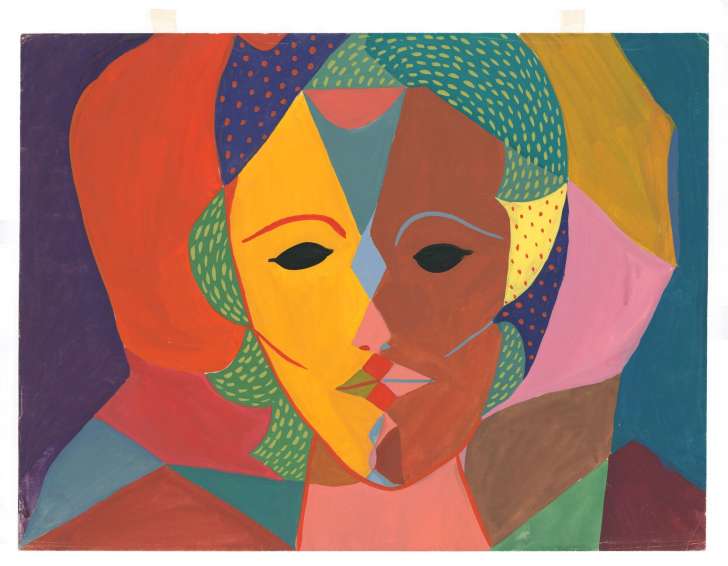
The exhibition, the National Portrait Gallery writes, “reveals how Plath shaped her identity visually as she came of age as a writer in the 1950s.” Unsurprisingly, her most frequent subject is herself. Her visual art, like her poetry, notes Mental Floss, “is often preoccupied with themes of self-identity.” But as in her eloquently-written letters and journals, as well as her published literary work, she is never one self, but many—and not all of them variations on the sly, yet brooding intellectual we see staring out at us from the well-known photographs.
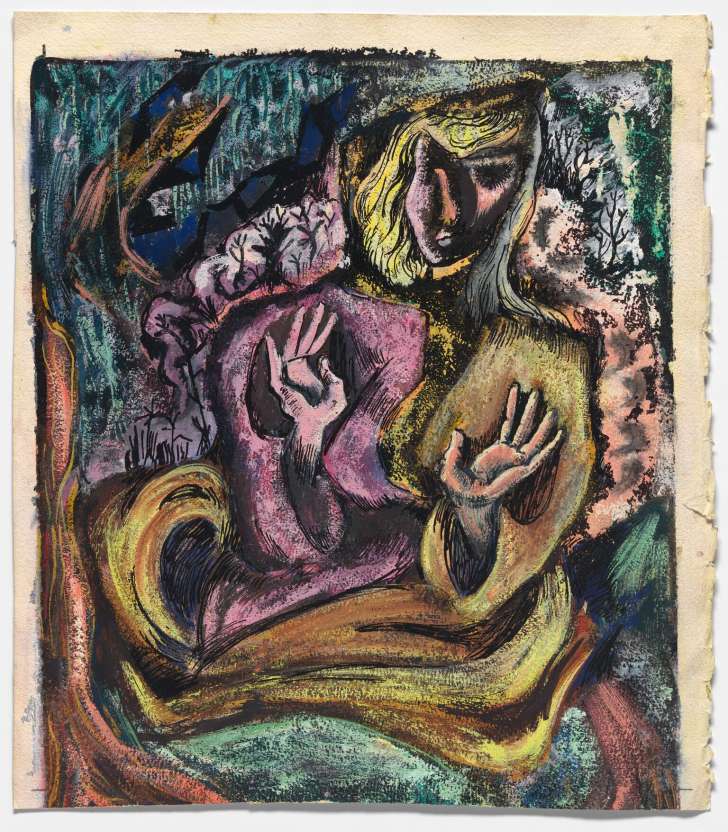
We’ve previously featured some of Plath’s drawings and self-portraits here, but the Smithsonian exhibit offers a considerably richer selection than has been available online. The ink and gouache portrait at the top, for example, seems to draw from Marc Chagall in its materials and swirling lines and colors. It also recalls language in a diary entry from 1953:
Look at that ugly dead mask here and do not forget it. It is a chalk mask with dead dry poison behind it, like the death angel. It is what I was this fall, and what I never want to be again.
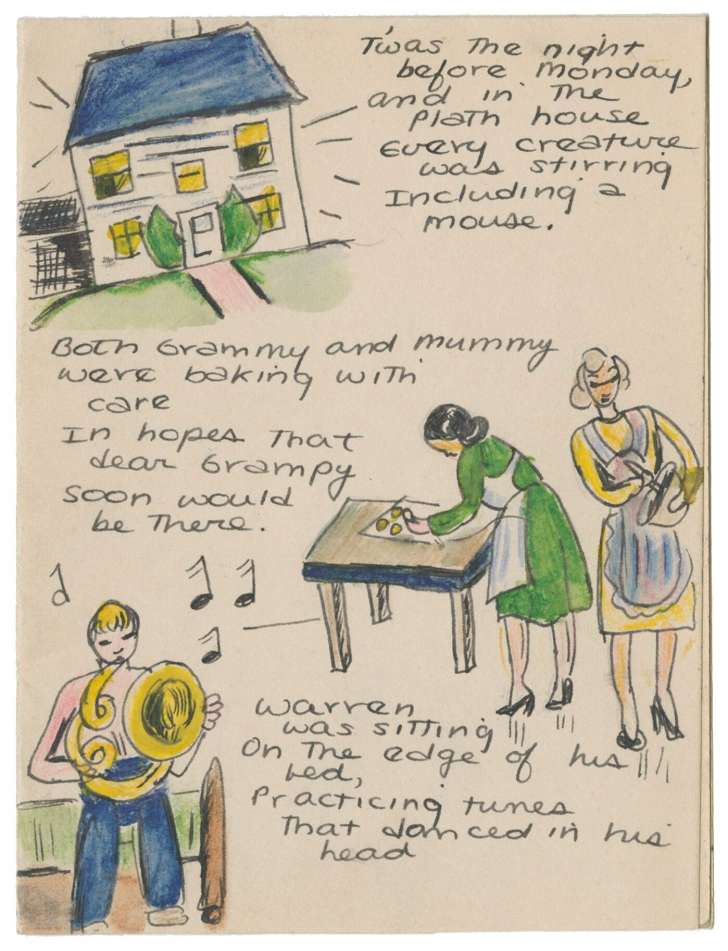
The hands thrown up in defense or surrender, the black lifeless eyes… Plath emerges from the ring of dead trees behind her like a suffering saint. Another portrait, further up also resembles a mask, calling to mind the ancient origins of the word persona. But the style has totally changed, the tumult of brushstrokes smoothed out into clean geometric lines and uniform patches of color. Three masks combine into one face, a trinity of Plaths. The poet always had a sense of herself as divided, referring to two distinct personalities as her “brown-haired” and “platinum” selves. The brown-haired young girl made several charming sketches of her family, with humorous commentary. (Her troubling father is tellingly, perhaps, absent.)
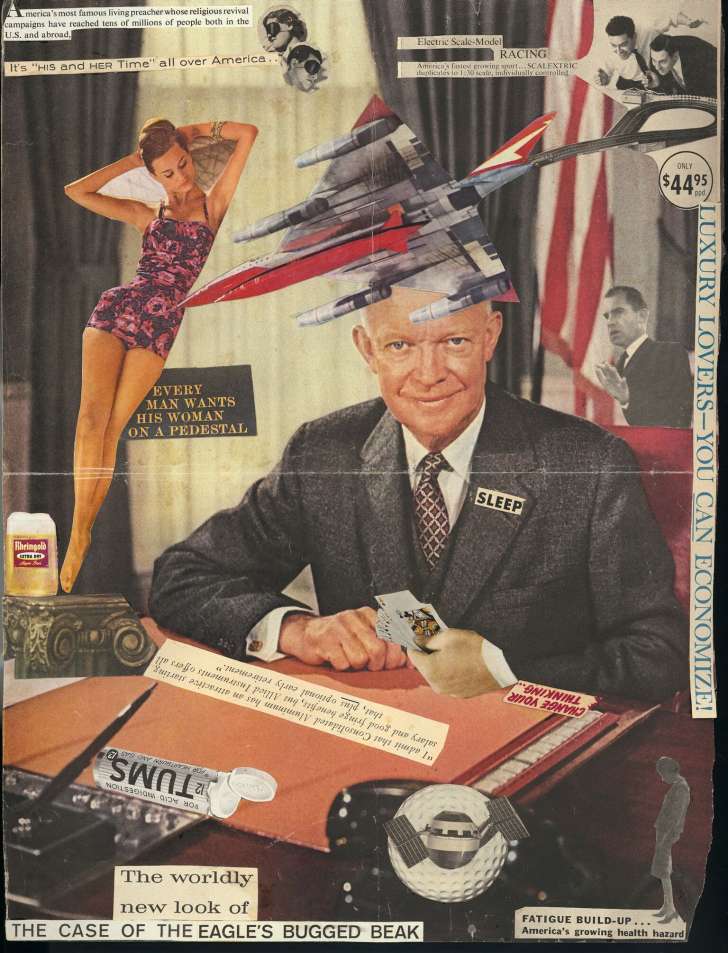
Hers was an epitome of standard-issue 50s white, middle class American childhood, the kind of supposedly idyllic upbringing which no small number of people still remember today in a glowing, nostalgic haze. In Plath’s excavations of the identities that she cultivated herself and those she had pushed upon her, she gazed with radical intensity at America’s patriarchal social fictions, and the violence and entitlement that lay beneath them. The collage above from 1960 presents us with the kind of layered, cut-up, hybrid text that William Burroughs had begun experimenting with not long before. You can see more highlights from the Plath exhibit, “One Life: Sylvia Plath,” at the National Portrait Gallery. Also featured are Plath’s family photos, books, letters, her typewriter—and, in general, several more dimensions of her life than most of us know.
“One Life: Sylvia Plath” runs from June 30, 2017 through May 20, 2018.
Related Content:
The Art of Sylvia Plath: Revisit Her Sketches, Self-Portraits, Drawings & Illustrated Letters
Hear Sylvia Plath Read 15 Poems From Her Final Collection, Ariel, in 1962 Recording
Sylvia Plath’s 10 Back to School Commandments (1953)
Josh Jones is a writer and musician based in Durham, NC. Follow him at @jdmagness
Read More...What’s a Scientifically-Proven Way to Improve Your Ability to Learn? Get Out and Exercise

Wikimedia Commons Image by the U.S. Navy
The benefit, nay necessity, of physical exercise is undeniable. The medical community has identified sedentary lifestyles as an epidemic, sometimes called “sitting disease” (or as people like to say, “sitting is the new smoking”). Prolonged sitting has been established as a cause of all sorts of chronic illnesses including heart disease, diabetes, and even certain cancers. Combine this problem with the steady stream of processed foods in more and more diets and we have a full-blown public health crisis on our hands that requires some serious intervention on the part of doctors, dieticians, physical therapists, and scientists.
And as more and more researchers are finding out, a poor diet and lack of exercise can also have seriously harmful effects on the brain. Conversely, as a recent University of California study shows, exercise boosts brain function; it “enhances learning and memory, improves executive function” and “counteracts… mental decline.” To put the theory of enhanced learning to the test, researchers have conducted several experiments and found that physical activity can improve the ability to learn new things at nearly any age.
Studies have “found correlations between children’s aerobic fitness and their brain structure,” reports The New York Times, and kids who exercise before math and reading tests show consistently higher scores than their sedentary peers. Likewise, a study conducted with college students in Ireland found that participants performed significantly better on memory tests after 30 minutes of cycling. One likely explanation is that exercise increases the production of BDNF (Brain-Derived Neurotropic Factor), a protein that promotes nerve health. And in a new paper published by researchers from Italy, China, and Thailand, we find that that exercise can specifically improve the ability to learn new languages.
The study tested 40 college-age Chinese students who are learning English. One group remained sedentary, while another rode exercise bikes at a moderate pace both before and during study sessions. The students who biked performed better on 8 separate vocabulary tests and were better able to recognize correct English sentences. These results are similar to those of a recent German study which found that a group of young women riding exercise bikes, at slow and moderate paces, performed much better on vocabulary tests than another group who didn’t exercise.
Though The New York Times points to a different study with contrasting results, the evidence seems largely on the side of exercise-enhances-learning proponents. “In recent years,” the Times notes, “a wealth of studies in both animals and people have shown that we learn differently if we also exercise.” You’ll find many of those studies summarized at the BBC, The Guardian, and elsewhere, along with several possible explanations for the phenomenon. Psychologist Justin Rhodes notes that “aerobic exercise can actually reverse hippocampal shrinkage,” increasing gray matter in an area of the brain associated with memory and emotion. His contention is backed by recent research on mice and humans.
In any case, although it appears that more vigorous exercises like cycling and running create the most improvement, taking a brisk walk before a class or study session can also help with retention and alertness. Whatever kind of exercise one does, a simple “take-home message,” says one researcher, “may be that instruction should be flanked by physical activity. Sitting for hours and hours without moving is not the best way to learn.” Having trouble getting motivated to run or bike before you study for that math test or start a new language course? Take some advice from Harvard Medical School on how to start slowly, find something you like doing, and turn everyday activities into exercise.
Related Content:
Why Sitting Is The New Smoking: An Animated Explanation
Josh Jones is a writer and musician based in Durham, NC. Follow him at @jdmagness
Read More...Noam Chomsky Explains the Best Way for Ordinary People to Make Change in the World, Even When It Seems Daunting
The threat of widespread violence and unrest descends upon the country, thanks again to a collection of actors viciously opposed to civil rights, and in many cases, to the very existence of people who are different from them. They have been given aid and comfort by very powerful enablers. Veteran activists swing into action. Young people on college campuses turn out by the hundreds week after week. But for many ordinary people with jobs, kids, mortgages, etc. the cost of participating in constant protests and civil actions may seem too great to bear. Yet, given many awful examples in recent history, the cost of inaction may be also.
What can be done? Not all of us are Rosa Parks or Howard Zinn or Martin Luther King, Jr. or Thich Nat Hanh or Cesar Chavez or Dolores Huerta, after all. Few of us are revolutionaries and few may wish to be. Not everyone is brave enough or talented enough or knowledgeable enough or committed enough or, whatever.
The problem with this kind of thinking is a problem with so much thinking about politics. We look to leaders—men and women we think of as superior beings—to do everything for us. This can mean delegating all the work of democracy to sometimes very flawed individuals. It can also mean we fundamentally misunderstand how democratic movements work.
In the video above, Noam Chomsky addresses the question of what ordinary people can do in the face of seemingly insurmountable injustice. (The clip comes from the 1992 documentary Manufacturing Consent.) “The way things change,” he says, “is because lots of people are working all the time, and they’re working in their communities or their workplace or wherever they happen to be, and they’re building up the basis for popular movements.”
In the history books, there’s a couple of leaders, you know, George Washington or Martin Luther King, or whatever, and I don’t want to say that those people are unimportant. Martin Luther King was certainly important, but he was not the Civil Rights Movement. Martin Luther King can appear in the history books ‘cause lots of people whose names you will never know, and whose names are all forgotten and who may have been killed and so on were working down in the South.
King himself often said as much. For example, in the Preface of his Stride Toward Freedom he wrote—referring to the 50,000 mostly ordinary, anonymous people who made the Montgomery Bus Boycott happen—“While the nature of this account causes me to make frequent use of the pronoun ‘I,’ in every important part of the story it should be ‘we.’ This is not a drama with only one actor.”
As for public intellectuals like himself engaged in political struggle, Chomsky says, “people like me can appear, and we can appear to be prominent… only because somebody else is doing the work.” He defines his own work as “helping people develop courses of intellectual self-defense” against propaganda and misinformation. For King, the issue came down to love in action. Responding in a 1963 interview above to a critical question about his methods, he counters the suggestion that nonviolence means sitting on the sidelines.
I think of love as something strong and that organizes itself into powerful, direct action…. We are not engaged in a struggle that means we sit down and do nothing. There’s a great deal of difference between nonresistance to evil and nonviolent resistance. Nonresistance leaves you in a state of stagnant passivity and deadening complacency, whereas nonviolent resistance means that you do resist in a very strong and determined manner.
Both Chomsky, King, and every other voice for justice and human rights would agree that the people need to act instead of relying on movement leaders. Whatever actions one can take—whether it’s engaging in informed debate with family, friends, or coworkers, writing letters, making donations to activists and organizations, documenting injustice, or taking to the streets in protest or acts of civil disobedience—makes a difference. These are the small individual actions that, when practiced diligently and coordinated together in the thousands, make every powerful social movement possible.
Related Content:
Noam Chomsky Defines What It Means to Be a Truly Educated Person
Henry David Thoreau on When Civil Disobedience and Resistance Are Justified (1849)
Saul Alinsky’s 13 Tried-and-True Rules for Creating Meaningful Social Change
Josh Jones is a writer and musician based in Durham, NC. Follow him at @jdmagness
Read More...When J.M. Coetzee Secretly Programmed Computers to Write Poetry in the 1960s
Before J.M. Coetzee became perhaps the most acclaimed novelist alive, he worked as a programer. That may not sound particularly notable these days, but bear in mind that the Nobel laureate and two-time Booker-winning author of Waiting for the Barbarians, Disgrace, and Elizabeth Costello held that day job first at IBM in the early 1960s — back, in other words, when nobody had a computer on their desk. And back when IBM was IBM: that mighty American corporation had brought the kind of computing power it alone could command to branch offices in cities around the world, including London, where Coetzee landed after leaving his native South Africa after graduating from the University of Cape Town.
The years Coetzee spent “writing machine code for computers,” he once wrote in a letter to Paul Auster, saw him “getting so deeply sucked into the process that I sometimes felt I was descending into a madness in which the brain is taken over by mechanical logic.” This must have caused some distress to a literarily minded young man who heard his true calling only from poetry.
“I was very heavily under the influence, in my teens and early twenties, of, first, T.S. Eliot, but then, more substantially, Ezra Pound, and later of German poetry, of Rilke in particular,” he says to Peter Sacks in the interview above, remembering the years before he put poetry aside as a craft in favor of the novel.
“Under the shadowless glare of the neon lighting, he feels his very soul to be under attack,“Coetzee writes, in the autobiographical novel Youth, of the protagonist’s time as a programmer. “The building, a featureless block of concrete and glass, seems to give off a gas, odourless, colourless, that finds its way into his blood and numbs him. IBM, he can swear, is killing him, turning him into a zombie.” Only in the evening can he “leave his desk, wander around, relax. The machine room downstairs, dominated by the huge memory cabinets of the 7090, is more often than not empty; he can run programs on the little 1401 computer, even, surreptitiously, play games on it.”
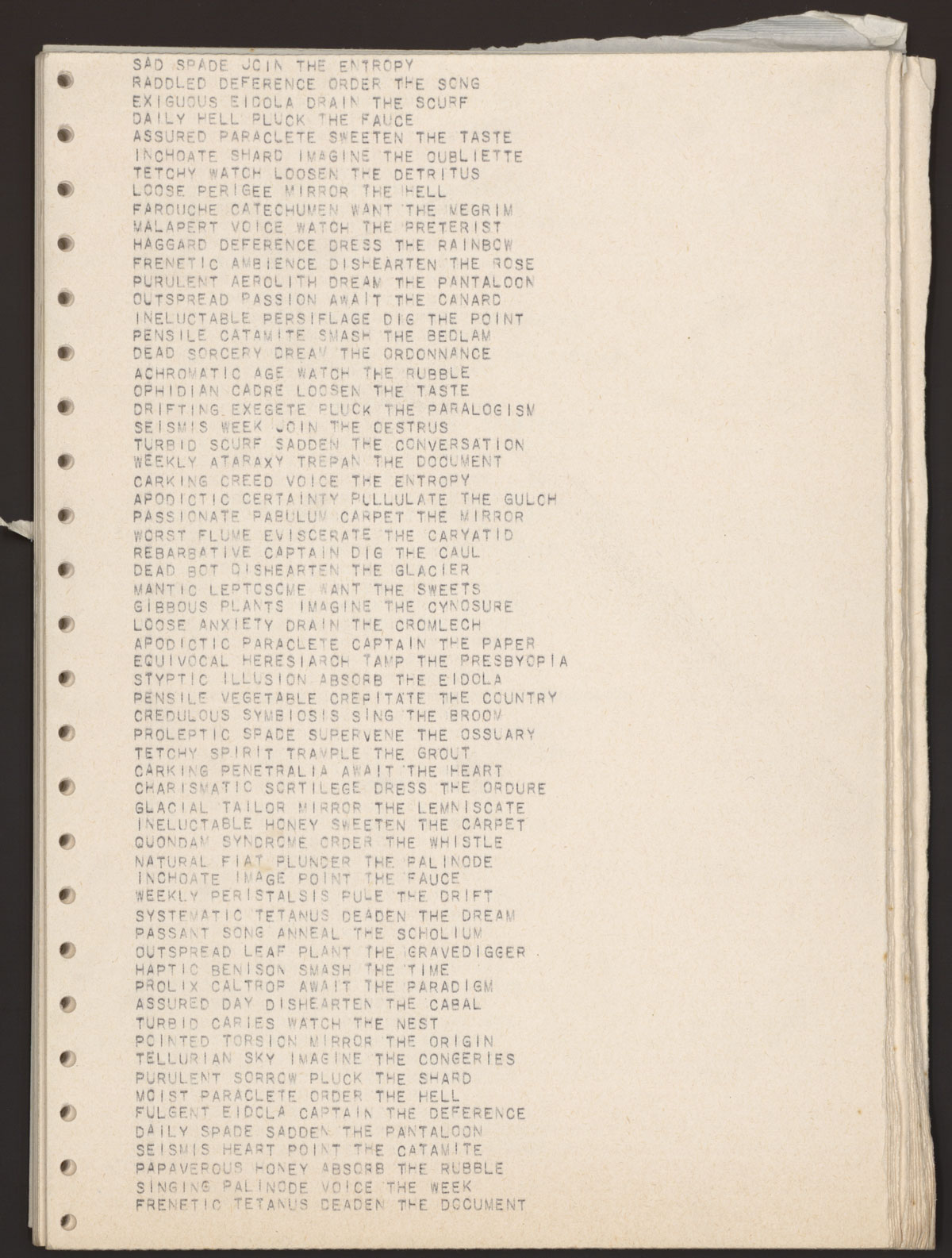
He could also use these clunky, punchcard-operated computers to write poetry. “In the mid 1960s Coetzee was working on one of the most advanced programming projects in Britain,” writes King’s College London researcher Rebecca Roach. “During the day he helped to design the Atlas 2 supercomputer destined for the United Kingdom’s Atomic Energy Research Establishment at Aldermaston. At night he used this hugely powerful machine of the Cold War to write simple ‘computer poetry,’ that is, he wrote programs for a computer that used an algorithm to select words from a set vocabulary and create repetitive lines.”
These lines, as seen here in one page of the print-outs held at the Coetzee archive at the University of Texas at Austin’s Harry Ransom Center, include “INCHOATE SHARD IMAGINE THE OUBLIETTE,” “FRENETIC AMBIENCE DISHEARTEN THE ROSE,” “PASSIONATE PABULUM CARPET THE MIRROR,” and “FRENETIC TETANUS DEADEN THE DOCUMENT.” Though he never published these results, writes Roach, he “edited and included phrases from them in poetry that he did publish.” Is this a curious chapter in the early life of a prominent man of letters, or was this realm of “flat metallic surfaces” an ideal forge for the sensibilities of a writer now known, as John Lanchester so aptly put it, for his “unusual quality of passionate coldness” — a kind of brilliant austerity that hardly deadens any of his documents.
Related Content:
J.M. Coetzee on the Pleasures of Writing: Total Engagement, Hard Thought & Productiveness
New Jorge Luis Borges-Inspired Project Will Test Whether Robots Can Appreciate Poetry
Based in Seoul, Colin Marshall writes and broadcasts on cities and culture. He’s at work on the book The Stateless City: a Walk through 21st-Century Los Angeles, the video series The City in Cinema, the crowdfunded journalism project Where Is the City of the Future?, and the Los Angeles Review of Books’ Korea Blog. Follow him on Twitter at @colinmarshall or on Facebook.
Read More...James Franco Hosts Philosophy Time, a New Videos Series Created to Help Philosophy Reach a Wider Audience
How do you get ordinary people interested in philosophy? If we are to believe the accounts of Plato, this wasn’t so difficult in ancient Athens. One simply lounged around the Acropolis harassing passersby, a tactic sure to fail in most city centers, town squares, and strip malls today. Podcasts and YouTube videos grab their share of eyes and ears, though many in their audiences also sing in the choir. Former Python John Cleese has done his part to popularize philosophical thinking. As someone who has moved between the worlds of academia and popular culture, Cleese has both credibility and visibility on his side. Some younger audiences (I write with apologies to Cleese) may be inclined to tune him out.
How about another actor with both fame and higher ed cred? Someone “very appealing to a younger demographic”? Someone like… James Franco—currently a doctoral student at Yale, and formerly a lecturer and/or student/graduate of UCLA, Columbia, NYU, Brooklyn College, Warren Wilson College, and the Rhode Island School of Design? This might seem like the resume either of an academic dilettante, or of a lifelong student and lover of knowledge.
Given Franco’s commitment to teaching, writing, and developing and starring in literary films like As I Lay Dying, The Sound and the Fury, The Broken Tower, and Howl, we might give him the benefit of the doubt. Not everyone’s a fan, but he does bring a good deal of academic enthusiasm to the role of philosophy popularizer.
Franco also brings along an actual philosopher, Eliot Michaelson, of King’s College, a former teacher of his. He proposed the idea of their project, “Philosophy Time,” while the two were at UCLA together, Michaelson as a grad student and Franco as an undergrad finishing his English degree after taking a hiatus from college to become a star. “We had somehow ended up becoming friends,” writes Michaelson, “In part, probably because I had no idea who he was.” Their long-gestating idea—an attempt to widen philosophy’s audience—has finally come to fruition. In the short episodes here, you can see the two in conversation with Rutgers University’s Andy Egan, at the top (on beauty), Princeton’s Liz Harmon, further up (on the fraught topic of abortion), and Rutgers’ Liz Camp, above and below (on imagination and metaphor).
Michaelson is a moderating influence. Franco’s laid back presentation will remind you of his performances in stoner comedy Pineapple Express, the 83rd Academy Awards ceremony, and the 2008 High Times Stoner of the Year event (though he swears he doesn’t touch the stuff anymore). Squiggly, animated word and thought bubbles add another comic touch. But whether or not viewers are charmed by his persona, they’ll find that he lets his guests do most of the talking, and they each make it plain that philosophy can be fascinating and imminently relevant to our ordinary modern lives. The kinds of questions Socrates needled hapless Athenians with—about beauty, ethics, and language—are just as pressing now as they were 2400 years ago.
You can find the emerging trove of “Philosophy Time” videos on YouTube here.
via Leiter Reports
Related Content:
James Franco Reads a Dreamily Animated Version of Allen Ginsberg’s Epic Poem ‘Howl’
James Franco Reads 6 Short Poems from His New Collection
140+ Free Online Philosophy Courses
The Partially Examined Life: A Philosophy Podcast
Josh Jones is a writer and musician based in Durham, NC. Follow him at @jdmagness
Read More...The Strange Story of Wonder Woman’s Creator William Moulton Marston: Polyamorous Feminist, Psychologist & Inventor of the Lie Detector
Most young male fans from my generation failed to appreciate the gender imbalance in comic books. After all, what were the X‑Men without powerful X‑women Storm, Rogue, and, maybe the most powerful mutant of all, Jean Grey? Indie comics like Love and Rockets revolved around strong female characters, and if the legacy golden age Marvel and DC titles were nearly all about Great Men, well… just look at the time they came from. We shrugged it off, and also failed to appreciate how the hypersexualization of women in comics made many of the women around us uncomfortable and hyperannoyed.
Had we been curious enough to look, however, we would have found that golden age comics weren’t just innocent “products of their time”—they reflected a collective will, just as did the comics of our time. And the character who first challenged golden age attitudes about women—Wonder Woman, created in 1941—began her career as perhaps one of the kinkiest superheroes in mainstream comic books. What’s more, she was created by a psychologist William Moulton Marston, who first published under a pseudonym, due in part to his unconventional personal life. Marston, writes NPR, “had a wife—and a mistress. He fathered children with both of them, and they all secretly lived together in Rye, N.Y.”
The other woman in Marston’s polyamorous threesome, one of his former students, happened to be the niece of Margaret Sanger, and Marston just happened to be the creator of the lie detector. The details of his life are as odd and prurient now as they were to readers in the 1940s—partly an index of how little some things have changed. And now that Marston’s creation has finally received her blockbuster due, his story seems ripe for the Hollywood telling. Such it has received, it appears, in Professor Marston & the Wonder Women, the upcoming biopic by Angela Robinson. It’s unfair to judge a film by its trailer, but in the clips above we see much more of Marston’s dual romance than we do of the invention of his famous heroine.
Yet as political historian Jill Lepore tells it, the cultural history of Wonder Woman is as fascinating as her creator’s personal life, though it may be impossible to fully separate the two. A press release accompanying Wonder Woman’s debut explained that Marston aimed “to set up a standard among children and young people of strong, free, courageous womanhood; to combat the idea that women are inferior to men, and to inspire girls to self-confidence in athletics, occupations and professions monopolized by men.” It went on to express Marston’s view that “the only hope for civilization is the greater freedom, development and equality of women in all fields of human activity.”
The language sounds like that of many a modern-day NGO, not a World War II-era popular entertainment. But Marston would go further, saying, “Frankly, Wonder Woman is the psychological propaganda for the new type of woman who should, I believe, rule the world.” His interest in domineering women and S&M drove the early stories, which are full of bondage imagery. “There are a lot of people who get very upset at what Marston was doing…,” Lepore told Terry Gross on Fresh Air. “’Is this a feminist project that’s supposed to help girls decide to go to college and have careers, or is this just like soft porn?’” As Marston understood it, the latter question could be asked of most comics.
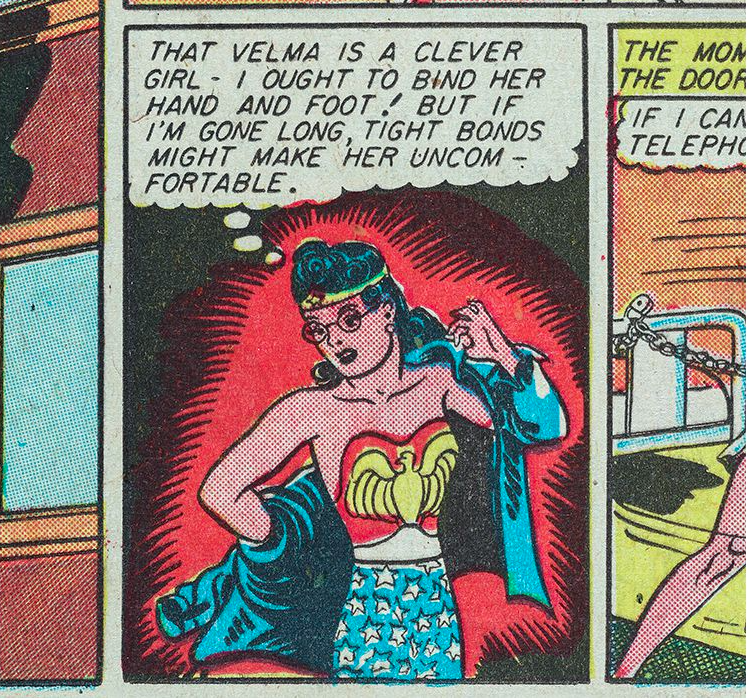
When writer Olive Richard—pen name of Marston’s mistress Olive Byrne—asked him in an interview for Family Circle whether some comics weren’t “full of torture, kidnapping, sadism, and other cruel business,” he replied, “Unfortunately, that is true.” But “the reader’s wish is to save the girl, not to see her suffer.” Marston created a “girl”—or rather a superhuman Amazonian princess—who saved herself and others. “One of the things that’s a defining element of Wonder Woman,” says Lepore, “is that if a man binds her in chains, she loses all of her Amazonian strength. So in almost every episode of the early comics, the ones that Marston wrote… she’s chained up or she’s roped up.” She has to break free, he would say, “in order to signify her emancipation from men.” She does her share of roping others up as well, with her lasso of truth and other means.
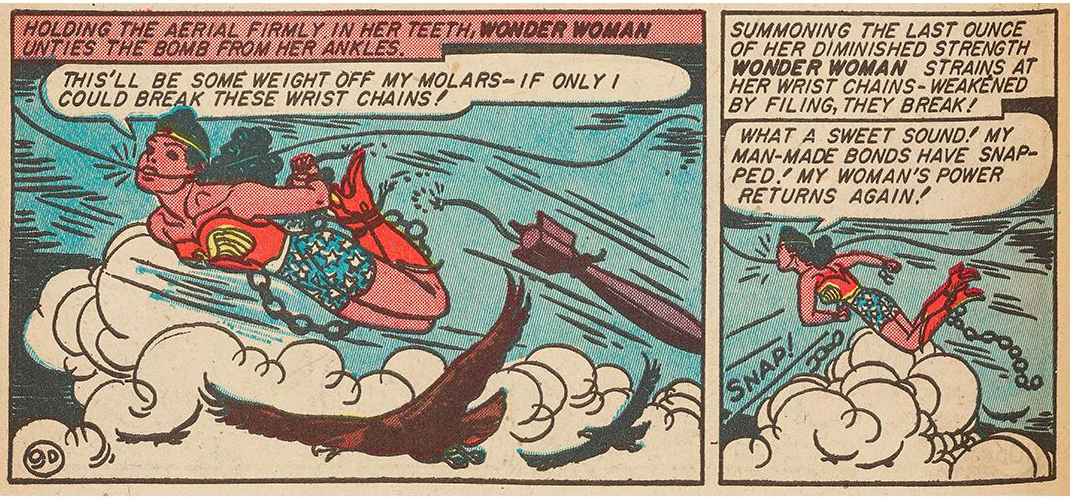
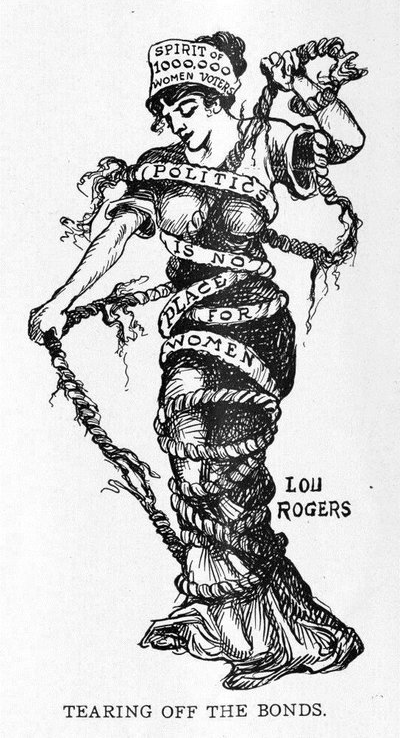
The seemingly clear bondage references in all those ropes and chains also had clear political significance, Lepore explains. During the fight for suffrage, women would chain themselves to government buildings. In parades, suffragists “would march in chains—they imported that iconography from the abolitionist campaigns of the 19th century that women had been involved in… Chains became a really important symbol,” as in the 1912 drawing below by Lou Rogers. Wonder Woman’s mythological origins also had deeper signification than the male fantasy of a powerful race of well-armed dominatrices. Her story, writes Lepore at The New Yorker, “comes straight out of feminist utopian fiction” and the fascination many feminists had with anthropologists’ speculation about an Amazonian matriarchy.
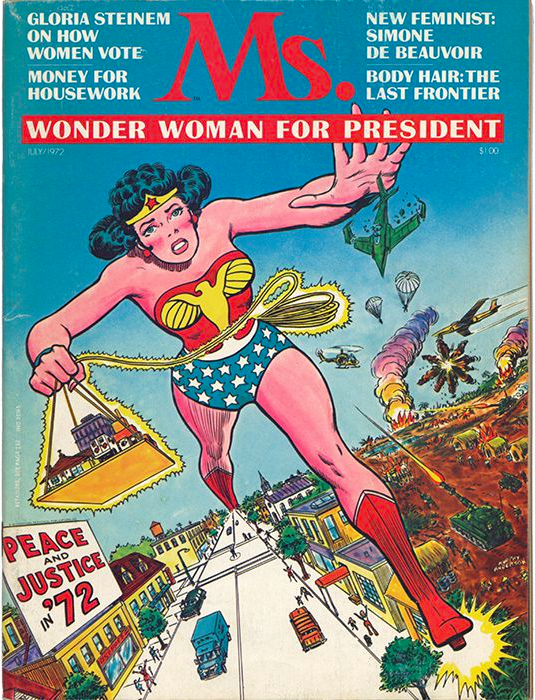
The combination of feminist symbols have made the character a redoubtable icon for every generation of activists—as in her appearance on 1972 cover of Ms. magazine, further up, an issue headlined by Gloria Steinem and Simone de Beauvoir. Marston translated the feminist ideas of the suffrage movement, and of women like Margaret Sanger, Elizabeth Cady Stanton, his wife, lawyer Elizabeth Holloway Marston, and his mistress Olive Byrne, into a powerful, long-revered superhero. He also translated his own ideas of what Havelock Ellis called “the erotic rights of women.”
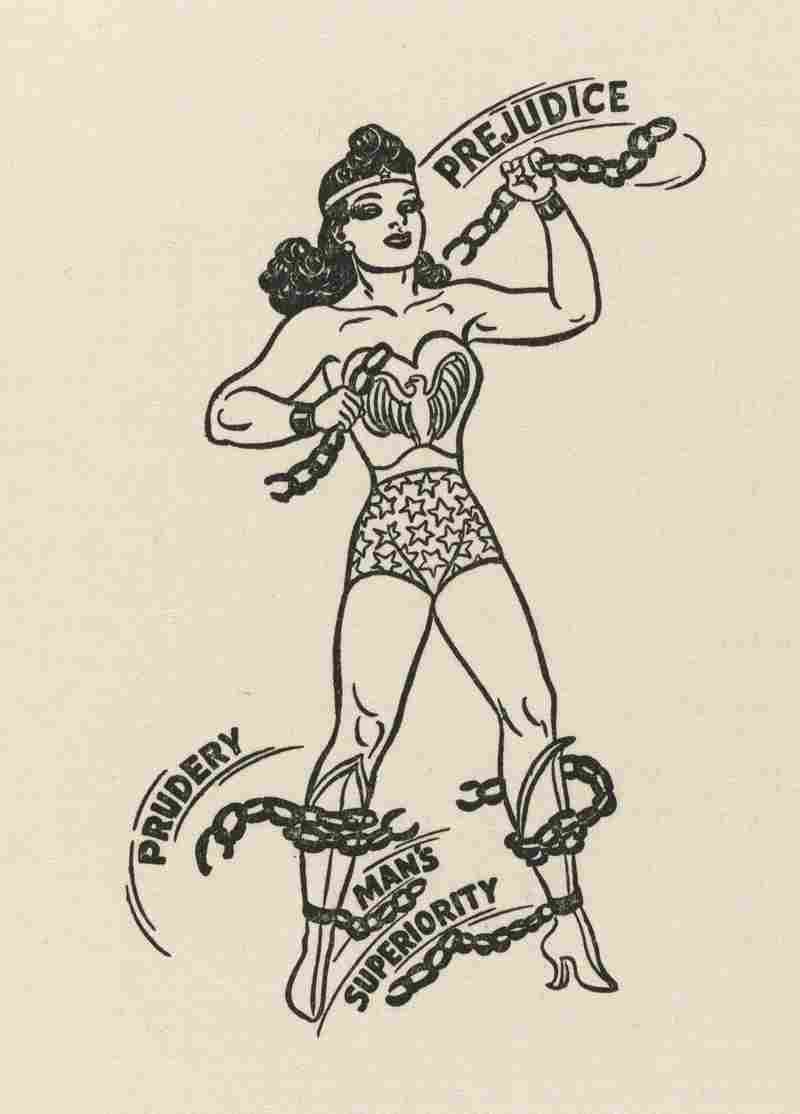
Marston’s version of Wonder Woman (he stopped writing the comic in 1947) had as much agency—sexual and otherwise—as any male character of the time. (See her breaking the bonds of “Prejudice,” “Prudery,” and “Man’s Superiority” in a drawing, below, from Marston’s 1943 article “Why 100,000 Americans Read Comics.”) The character was undoubtedly kinky, a quality that largely disappeared from later iterations. But she was not created, as were so many women in comics in the following decades, as an object of teenage lust, but as a radically liberated feminist hero. Read more about Marston in Lepore’s essays at Smithsonian and The New Yorker and in her book, The Secret History of Wonder Woman.
Related Content:
Download Over 22,000 Golden & Silver Age Comic Books from the Comic Book Plus Archive
Free Comic Books Turns Kids Onto Physics: Start With the Adventures of Nikola Tesla
Josh Jones is a writer and musician based in Durham, NC. Follow him at @jdmagness
Read More...Hunter S. Thompson Chillingly Predicts the Future, Telling Studs Terkel About the Coming Revenge of the Economically & Technologically “Obsolete” (1967)
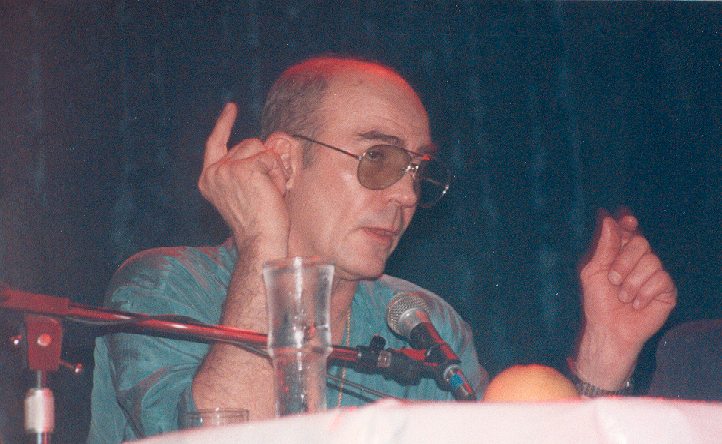
Image via Wikimedia Commons
Half a century ago, Hunter S. Thompson got his big journalistic break with a book called Hell’s Angels: The Strange and Terrible Saga of the Outlaw Motorcycle Gangs. In it he provided a curious and fearful public with a look into the inner workings of one of the most outwardly menacing social movements of the day, based on knowledge gained not by merely observing the Hell’s Angels but by getting on a hog and spending a year as a quasi-member himself. This gave him opportunity both to develop what would become his style of “gonzo journalism” in the long form and to catch an early glimpse of bigger trouble ahead in America.
“To see the Hell’s Angels as caretakers of the old ‘individualist’ tradition ‘that made this country great’ is only a painless way to get around seeing them for what they really are,” Thompson writes in that book, calling them “the first wave of a future that nothing in our history has prepared us to cope with. The Angels are prototypes. Their lack of education has not only rendered them completely useless in a highly technical economy, but it has also given them the leisure to cultivate a powerful resentment… and to translate it into a destructive cult which the mass media insists on portraying as a sort of isolated oddity” destined for extinction.
Studs Terkel, after reading that passage out loud in a 1967 interview with Thompson (stream it online here), calls it “the key” to the entire book. “Here we have technology, we have the computer, we have labor-saving devices,” he says to Thompson, but we also “have the need for more and more college education for almost any kind of job, and we have this tremendous mass of young who find themselves obsolete.” But Thompson replies that the real consequences have only started to manifest: “The people who are being left out and put behind won’t be obvious for years. Christ only knows what’ll happen in, say, 1985 — a million Hell’s Angels. They won’t be wearing the colors; they’ll be people who are just looking for vengeance because they’ve been left behind.”
The Angels, wrote Susan McWilliams in a much-circulated Nation piece late last year, “were clunky and outclassed and scorned, just like the Harley-Davidsons they chose to drive.” And “just as there was no rational way to defend Harleys against foreign-made choppers, the Angels saw no rational grounds on which to defend their own skills or loyalties against the emerging new world order of the late 20th century.” The result? An “ethic of total retaliation. The Angels, rather than gracefully accepting their place as losers in an increasingly technical, intellectual, global, inclusive, progressive American society, stuck up their fingers at the whole enterprise. If you can’t win, you can at least scare the bejeesus out of the guy wearing the medal.”
Six years later, Terkel invited Thompson back into his studio for another interview (click here to listen) that followed straight on from the first. Ostensibly there to talk about Thompson’s book Fear and Loathing on the Campaign Trail ’72 (which followed his best-known work, Fear and Loathing in Las Vegas), the two, having cracked open a beer, get into what the Studs Terkel Radio Archive blog describes as “the sense of surrealism in ‘real’ life,” which becomes “a very serious conversation about the direction in which our country was heading. After Thompson recounted his experience of talking to Richard Nixon about football” — the only subject permitted — “Studs responds, ‘Isn’t this what we’re faced with now? … That fantasy and fact become one.’ ”
What’s a reporter to do in such an environment? Terkel seems to see in Thompson the perfect kind of “subjective” journalist, one “who can make literal what is psychic in our lives,” for a time that has lost its own objectivity. “Has there ever been any such thing as objective journalism?” he asks. “It’s probably the highest kind of journalism, if you can do it.” Thompson replies. “Nobody I know has ever done it, and I don’t have time to learn it.” But the distinctive suite of journalistic skills he did possess primed him to perceive certain realities — and perceive them with a distinctive vividness — that have only become more real in the decades since. What, for instance, did he learn from covering the 1972 presidential campaign? “Power corrupts… but it’s also a fantastic high.”
Related Content:
Hunter S. Thompson Gets Confronted by The Hell’s Angels: Where’s Our Two Kegs of Beer? (1967)
Read 18 Lost Stories From Hunter S. Thompson’s Forgotten Stint As a Foreign Correspondent
Read 11 Free Articles by Hunter S. Thompson That Span His Gonzo Journalist Career (1965–2005)
Based in Seoul, Colin Marshall writes and broadcasts on cities and culture. He’s at work on the book The Stateless City: a Walk through 21st-Century Los Angeles, the video series The City in Cinema, the crowdfunded journalism project Where Is the City of the Future?, and the Los Angeles Review of Books’ Korea Blog. Follow him on Twitter at @colinmarshall or on Facebook.
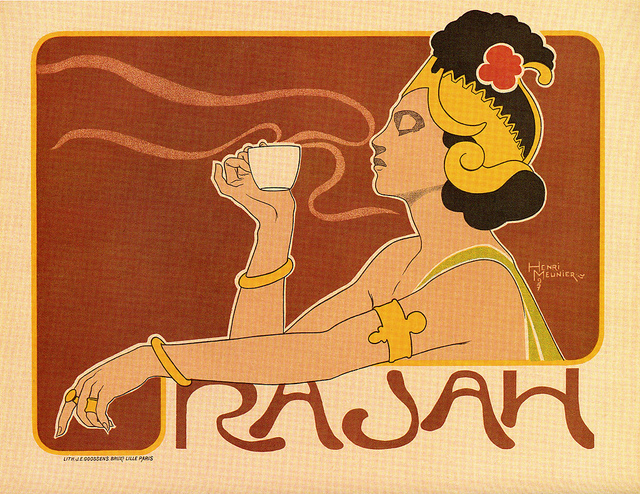
Read More...Download 200+ Belle Époque Art Posters: An Archive of Masterpieces from the “Golden Age of the Poster” (1880–1918)
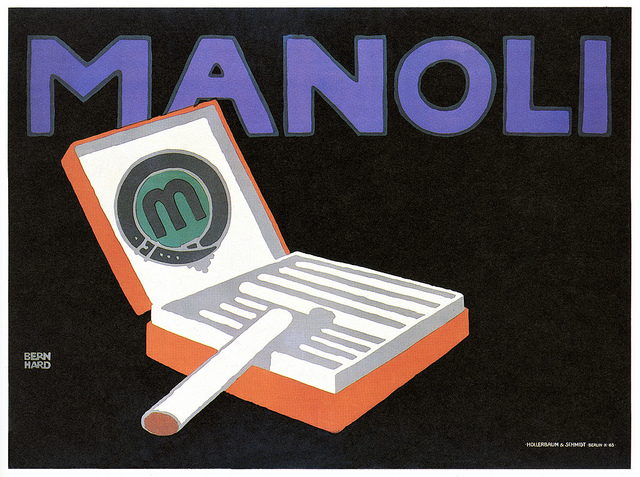
Europe at the end of the nineteenth century and beginning of the twentieth: what a time and place to be alive. Or rather, what a time and place to be alive for people in the right countries and, more importantly, of the right classes, those who saw a new world taking shape around them and partook of it with all possible heartiness. The period between the end of the Franco-Prussian War in 1871 and the outbreak of World War I in 1914, best known by its French name La Belle Époque, saw not just peace in Europe and empires at their zenith, but all manner of technological, social, and cultural innovations at home as well.
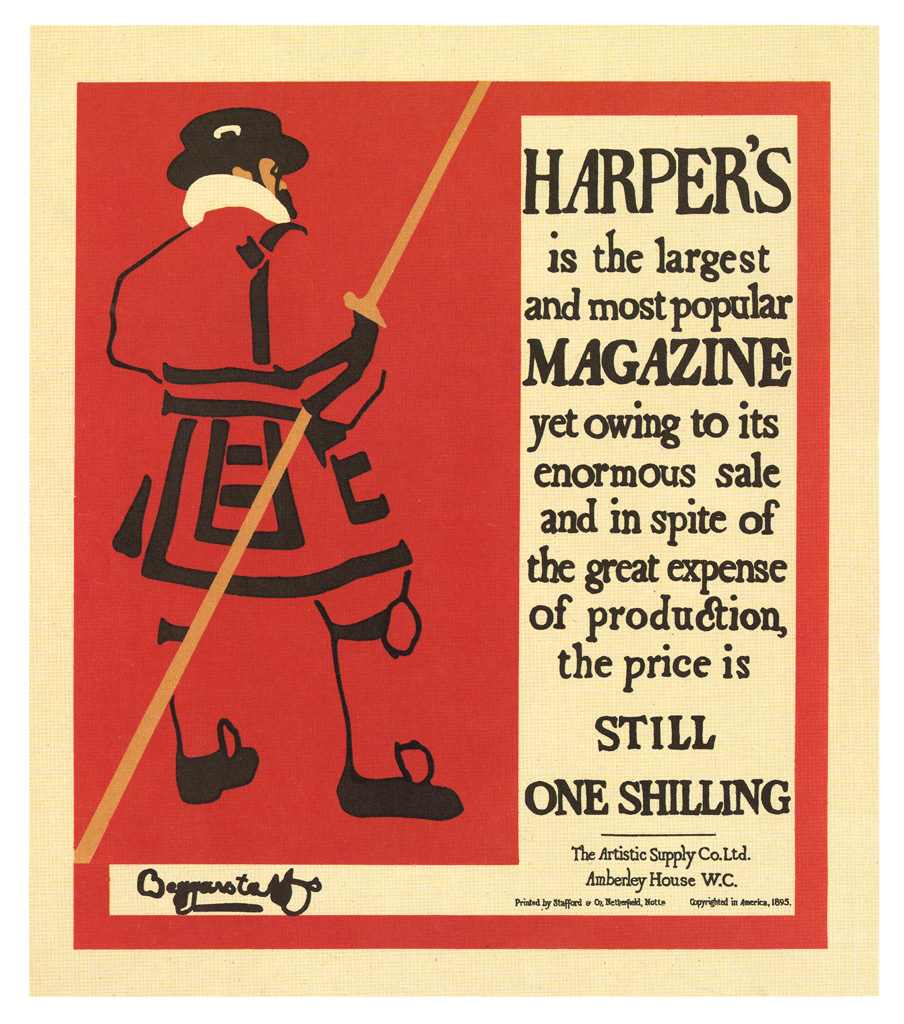
We here in the 21st century have few ways of tasting the life of that time as rich as its posters, more than 200 of which you can view in high resolution and download from “Art of the Poster 1880–1918,” a Flickr collection assembled by the Minneapolis College of Art and Design.
“In the late nineteenth century, lithographers began to use mass-produced zinc plates rather than stones in their printing process,” says the accompanying text. “This innovation allowed them to prepare multiple plates, each with a different color ink, and to print these with close registration on the same sheet of paper. Posters in a range of colors and variety of sizes could now be produced quickly, at modest cost.”
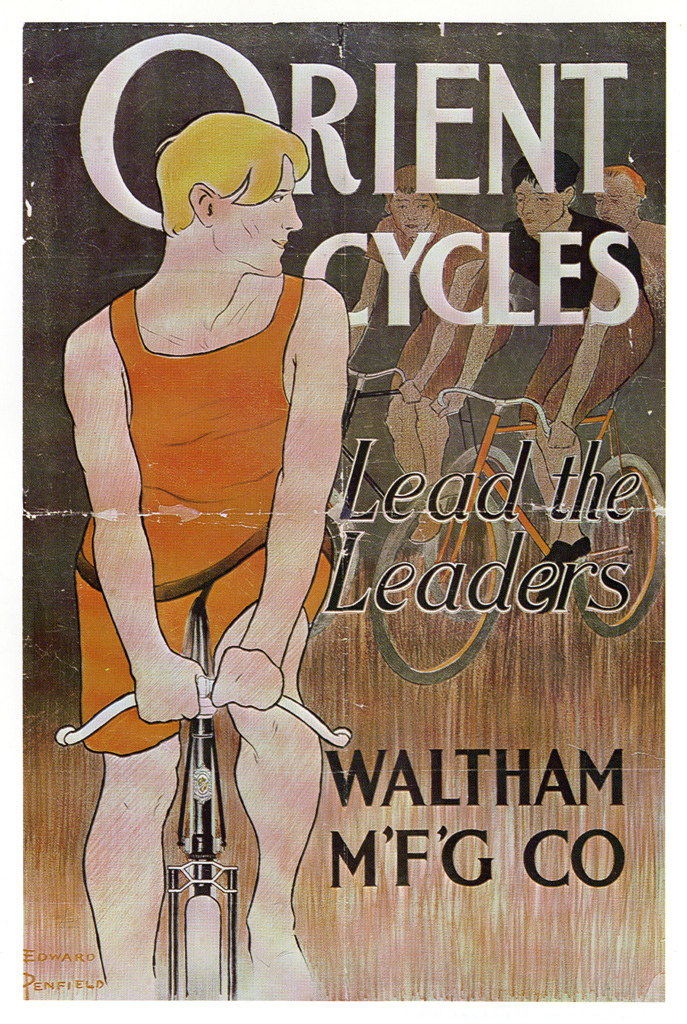
Like other of the most fruitful technological advancements of the era, this leap forward in poster-printing drew the attention, and soon the efforts, of artists: well-regarded illustrators and graphic designers like Alphonse Mucha, Jules Chéret, Eugène Grasset, and Henri de Toulouse-Lautrec took to the new method, and “The ‘Golden Age of the Poster’ was the spectacular result.” While many of the best-remembered posters of that Golden Age come from France, it touched the streets of every major city in western Europe as well as those of England and America, all places whose well-heeled populations found themselves newly and avidly interested in art, photography, motion pictures, magazines, bicycles, automobiles, absinthe, coffee, cigarettes, and world travel.
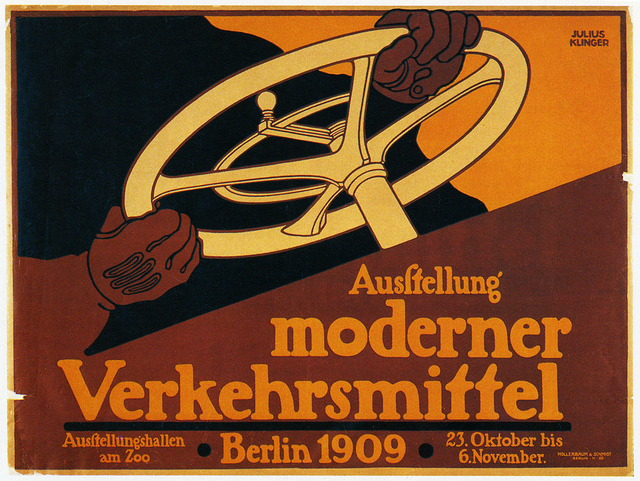
The companies behind all those exciting things had, of course, to advertise, but unlike in earlier times, they couldn’t settle for getting the word out; they had to use images, and the most vivid ones possible at that. They had to use them in such a way as to associate what they had to offer with the abundant spirit of the time, whether they called that time La Belle Époque, the Wilhelmine period, the late Victorian and Edwardian era, or the Gilded Age. All those names, of course, were applied only in retrospect, after it became clear how bad times could get in the twentieth century. But then, none of us ever realize we’re living through a golden age before it comes to its inevitable end; until that time, best just to enjoy it. You can enter the poster archive here.
Related Content:
René Magritte’s Early Art Deco Advertising Posters, 1924–1927
A Gallery of Visually Arresting Posters from the May 1968 Paris Uprising
Glorious Early 20th-Century Japanese Ads for Beer, Smokes & Sake (1902–1954)
The Strange and Wonderful Movie Posters from Ghana: The Matrix, Alien & More
Based in Seoul, Colin Marshall writes and broadcasts on cities and culture. He’s at work on the book The Stateless City: a Walk through 21st-Century Los Angeles, the video series The City in Cinema, the crowdfunded journalism project Where Is the City of the Future?, and the Los Angeles Review of Books’ Korea Blog. Follow him on Twitter at @colinmarshall or on Facebook.
Read More...Support Us
We're hoping to rely on loyal readers, rather than erratic ads. Please click the Donate button and support Open Culture. You can use Paypal, Venmo, Patreon, even Crypto! We thank you!

About Us

Open Culture scours the web for the best educational media. We find the free courses and audio books you need, the language lessons & educational videos you want, and plenty of enlightenment in between.
Advertise With Us
FREE UPDATES!
GET OUR DAILY EMAIL
Get the best cultural and educational resources on the web curated for you in a daily email. We never spam. Unsubscribe at any time.
FOLLOW ON SOCIAL MEDIA
Open Culture editor Dan Colman scours the web for the best educational media. He finds the free courses and audio books you need, the language lessons & movies you want, and plenty of enlightenment in between.
Advertise With Us



