What Makes The Death of Socrates a Great Work of Art?: A Thought-Provoking Reading of David’s Philosophical & Political Painting
When we think of political propaganda, we do not typically think of French Neoclassical painter Jacques-Louis David. There’s something debased about the term—it stinks of insincerity, staginess, emotional manipulation, qualities that cannot possibly belong to great art. But let us put aside this prejudice and consider David’s 1787 The Death of Socrates. Created two years before the start of the French Revolution, the painting “gave expression to the principle of resisting unjust authority,” and—like its source, Plato’s Phaedo—it makes a martyr of its hero, who is the soul of reason and a thorn in the side of dogma and tradition.
Nonetheless, as Evan Puschak, the Nerdwriter, shows us in the short video above, The Death of Socrates situates itself firmly within the traditions of European art, drawing heavily on classical sculptures and friezes as well as the greatest works of the Renaissance. There are echoes of da Vinci’s Last Supper in the number of figures and their placement, and a distinct reference of Raphael’s School of Athens in Socrates’ upward-pointing finger, which belongs to Plato in the earlier painting. Here, David has Plato, already an old man, seated at the foot of the bed, the scene arranged behind him as if “exploding from the back of his head.”
Socrates, says Puschak, “has been discussing at length the immortality of the soul, and he doesn’t even seem to care that he’s about to take the implement of his death in hand. On the contrary, Socrates is defiant… David idealizes him… he would have been 70 at the time and somewhat less muscular and beautiful than painted here.” He is a “symbol of strength over passion, of stoic commitment to an abstract ideal,” a theme David articulated with much less subtlety in an earlier painting, The Oath of the Horatii, with its Roman salutes and bundled swords—a “severe, moralistic canvas,” with which the artist “effectively invented the Neoclassical style.”
In The Death of Socrates, David refines his moralistic tendencies, and Puschak ties the composition loosely to a sense of prophecy about the coming Terror after the storming of the Bastille. The Nerdwriter summation of the painting’s angles and influences does help us see it anew. But Puschak’s vague historicizing doesn’t quite do the artist justice, failing to mention David’s direct part in the wave of bloody executions under Robespierre.
David was an active supporter of the Revolution and designed “uniforms, banners, triumphal arches, and inspirational props for the Jacobin Club’s propaganda,” notes a Boston College account. He was also “elected a Deputy form the city of Paris, and voted for the execution of Louis XVI.” Historians have identified over “300 victims for whom David signed execution orders.” The severity of his earlier classical scenes comes into greater focus in The Death of Socrates around the central figure, a great man of history, one whose heroic feats and tragic sacrifices drive the course of all events worth mentioning.
Indeed, we can see David’s work as a visual precursor to philosopher and historian Thomas Carlyle’s theories of “the heroic in history.” (Carlyle also happened to write the 19th century’s definitive history of the French Revolution.) In 1793, David took his visual great man theory and Neoclassical style and applied them for the first time to a contemporary event, the murder of his friend Jean-Paul Marat, Swiss Jacobin journalist, by the Girondist Charlotte Corday. (Learn more in the Khan Academy video above.) This is one of three canvases David made of “martyrs of the Revolution”—the other two are lost to history. And it is here that we can see the evolution of his political painting from classical allegory to contemporary propaganda, in a canvas widely hailed, along with The Death of Socrates, as one of the greatest European paintings of the age.
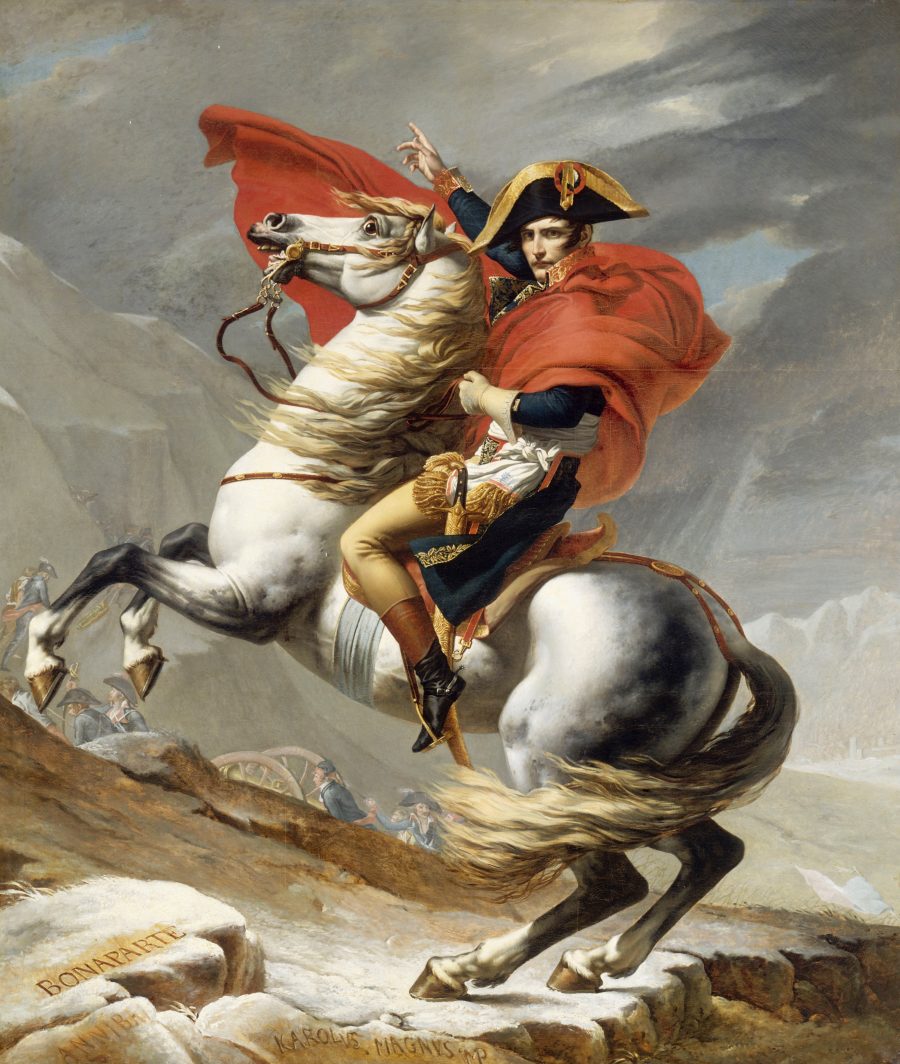
We can look to David for both formal mastery and didactic intent. But we should not look to him for political constancy. He was no John Milton—the poet of the English Revolution who was still devoted to the cause even after the restoration of the monarch. David, on the other hand, “could easily be denounced as a brilliant cynic,” writes Michael Glover at The Independent. Once Napoleon came to power and began his rapid ascension to the self-appointed role of Emperor, David quickly became court painter, and created the two most famous portraits of the ruler.
We’re quite familiar with The Emperor Napoleon in His Study at the Tuileries, in which the subject stands in an awkward pose, his hand thrust into his waistcoat. And surely know Napoleon at the Saint-Bernard Pass, above. Here, the finger pointing upward takes on an entirely new resonance than it has in The Death of Socrates. It is the gesture not of a man nobly prepared to leave the world behind, but of one who plans to conquer and subdue it under his absolute rule.
Related Content:
The Art of Restoring a 400-Year-Old Painting: A Five-Minute Primer
The MoMA Teaches You How to Paint Like Pollock, Rothko, de Kooning & Other Abstract Painters
Josh Jones is a writer and musician based in Durham, NC. Follow him at @jdmagness
Read More...The Art of Explaining Hard Ideas: Scientists Try to Explain Gene Editing & Brain Mapping to Young Kids & Students
If you’ve seen Bong Joon-ho’s film Okja, about an Agribusiness-engineered gargantuan mutant pig and her young Korean girl sidekick, you may have some very specific ideas about CRISPR, the science used to edit and manipulate genes. In fact, the madcap fictional adventure’s world may not be too far off, though the science seems to be moving in the other direction. Just recently, Chinese scientists have reported the creation of 12 pigs with 24 percent less body fat than the ordinary variety. It may not be front-page news yet, but the achievement is “a big issue for the pig industry,” says the lead researcher.
There’s much more to CRISPR than bioengineering lean bacon. But what is it and how does it work? I couldn’t begin to tell you. Let biologist Neville Sanjana explain. In the Wired video above, he undertakes the ultimate challenge for science communicators—explaining the most cutting-edge science to five different people: a 7‑year-old, 14-year-old, college student, grad student, and—to really put him on the spot—a CRISPR expert. CRISPR is “a new area of biomedical science that enables gene editing,” Sanjana begins in his short intro for viewers, “and it’s helping us understand the basis of many genetic diseases like autism and cancer.”
That’s all well and good, but does he have anything to say about the pig business? Watch and find out, beginning with the adorable 7‑year-old Teigen River, who may or may not have been primed with perfect responses. Play it for your own kids and let us know how well the explanation works. Sanjara runs quickly through his other students to arrive, halfway through the video, at Dr. Matthew Canver, CRISPR expert.
From there on out you may wish to refer to other quick references, such as the Harvard and MIT Broad Institute’s short guide and video intro above from molecular biologist Feng Zhang, who explains that CRISPR, or “Clustered Regularly Intersperced Short Palindromic Repeats,” is actually the name of DNA sequences in bacteria. The gene editing technology itself is called CRISPR-Cas9. Just so you know how the sausage is made.
Enough of pig puns. Let’s talk about brains, with neuroscientist Dr. Bobby Kasthuri of the Argonne National Laboratory. He faces a similar challenge above—this time explaining high concept science to a 5‑year-old, 13-year-old, college student, grad student, and a “Connectome entrepreneur.” A what? Connectome is the product of the NIH’s Human Connectome Project, which set out to “provide an unparalleled compilation of neural data” and “achieve never before realized conclusions about the living human brain.” This brain-mapping science has many objectives, one of which, in the 5‑year-old version, is “to know where every cell in your brain is, and how it can talk to every other cell.”
To this astonishing explanation you may reply like Daniel Dodson, 5‑year-old, with a stunned “Oh.” And then you may think of Philip K. Dick, or Black Mirror’s “San Junipero” episode. Especially after hearing from “Connectome Entrepreneur” Russell Hanson, founder and CEO of a company called Brain Backups, or after listening to Sebastian Seung—“leader in the field of connectomics”—give his TED talk, “I am my connectome.” Want another short, but grown-up focused, explanation of the totally science-fiction but also completely real Connectome? See Kasthuri’s 2‑minute animated video above from Boston University.
Related Video:
Richard Feynman Creates a Simple Method for Telling Science From Pseudoscience (1966)
125 Great Science Videos: From Astronomy to Physics & Psychology
Josh Jones is a writer and musician based in Durham, NC. Follow him at @jdmagness
Read More...Why Should You Read James Joyce’s Ulysses?: A New TED-ED Animation Makes the Case
There may be innumerable moral and philosophical reasons why we should read certain books, hear certain symphonies, see certain paintings…. Those reasons are mostly intangible, which makes them nobler, I suppose, than the reasons we should buy a luxury car or vacation home. Nevertheless, the salesmanship of high culture can sometimes feel of a piece, making subtle, or not so subtle, appeals to safety, status, and investment value. What of pure enjoyment? The immersion in a work of art because it simply feels good? To allow for pleasure alone to guide our aesthetic tastes, some might feel, would be amoral; would cheapen culture and elevate some supposedly vulgar products to the status of high art. Can’t have that.
Of course, how much high art was once considered a hazard to good taste and public morality? Modernism puffs out its chest with pride for having fostered many creative works that shocked and titillated their first mass audiences. James Joyce’s Ulysses ranks quite highly upon that list. The novel’s initial reputation as highbrow smut seems at odds with Sam Slote’s characterization of it in the TED-Ed video above as “both a literary masterpiece and one of the hardest works of literature to read.” But it can be all those things and more. Inside the dense experimental epic is a charmingly detailed travelogue of Dublin, a theological treatise on heresy, a series of Freudian jokes with the kinds of sophomoric punchlines “stately, plump Buck Mulligan” would appreciate….
Not for nothing has Joyce inspired a cult following, if not something of a downright cult, whose members gather all over the world on June 16th for “Bloomsday”—the single day on which the novel takes place, and on which Joyce met his lifelong partner Nora Barnacle in 1904. Dressed in period costume, Joyce fans read the novel aloud, and hundreds make the pilgrimage to Dublin to follow the perambulations of protagonists Leopold Bloom and Stephen Dedalus. “What is it,” asks Slote, an Associate Professor at Trinity College Dublin’s School of English, “about this famously difficult novel that inspires so many people?” Professor Slote is no dilettante but an expert who has published six books on Joyce and an annotated edition of Ulysses. He admits “there’s no one simple answer to that question.”
Nevertheless, the answers Slote does provide in the six-minute animated intro to Ulysses relate not to the novel’s moral, social, psychological, or political virtues, but to those qualities that give readers enjoyment. Each chapter is written in a different style,” a play, a “cheesy romance novel,” an imitation of music. Ulysses is a modern parody of Homer’s Odyssey and a virtuoso medley of technical performances, including a chapter which “reproduces the evolution of English literary prose style, from its beginnings in Anglo Saxon right up to the 20th century.” The final chapter, Molly Bloom’s stream-of-consciousness soliloquy, is a tour-de-force, capping off the “narrative gymnastic routines.” The shifting styles are augmented by “some of the most imaginative uses of language you’ll find anywhere.”
As for the novel’s frequent passages of “impenetrable” density? Well, Slote admits that “it’s up to the reader to let their eyes skim over them or grab a shovel and dig in.” In the remaining few minutes, he may have you convinced that the pleasure is worth the effort.
Related Content:
James Joyce: An Animated Introduction to His Life and Literary Works
James Joyce Reads From Ulysses and Finnegans Wake In His Only Two Recordings (1924/1929)
Read Joyce’s Ulysses Line by Line, for the Next 22 Years, with Frank Delaney’s Podcast
Josh Jones is a writer and musician based in Durham, NC. Follow him at @jdmagness
Read More...The Films of Christopher Nolan Explored in a Sweeping 4‑Hour Video Essay: Memento, The Dark Knight, Interstellar & More
Cameron Beyl does not play by the rules when it comes to video essays. Instead of short, under-10 minute explorations we’ve come to expect from the ever-increasing coterie of YouTube essayists, Beyl, in his Directors Series on Vimeo, devotes hours to exploring the filmographies of some of cinema’s great auteurs. We’ve already introduced you in previous posts to his extended hagiographies of Stanley Kubrick, the Coen Brothers, David Fincher, and Paul Thomas Anderson.
Now comes his latest work, a multi-part exploration of Christopher Nolan’s oeuvre, covering his hardscrabble years all the way through his Hollywood blockbusters and ending with Interstellar. (This writer, having thought higher of Dunkirk than his previous works, will just have to wait a few years until the next chapter.)
In the video above, Beyl starts off with some prehistory about Christopher and his brother Jonathan, his early years making Super 8 movies, his time spent at University College London, and the very rare first films, “Tarantella” and “Larceny,” the single-gag short “Doodlebug,” and how that crew–including his lead actor Jeremy Theobald and his producer-soon-to-be-wife Emma Thomas–stayed with him through his $6000 debut feature Following and its thematic and stylistic cousin Memento, made for $4.5 million.
Part 2 shows Nolan navigating the studio system. Given a chance by executive producers George Clooney and Steven Soderbergh to remake the Norwegian thriller Insomnia, he indulged in his love of Michael Mann by working with Al Pacino, who plays a character not unlike his role in 1995’s Heat. Then Nolan takes on a moribund comic book franchise and reboots it into Batman Begins, a move that studio execs have since done over and over to rethink various properties with different directors. He ends with a less enthusiastic examination of 2006’s The Prestige.
Part 3 takes on both The Dark Knight and Inception, two huge blockbusters and one that took Nolan into the pantheon of critical and popular acclaim. If undecided on Nolan, Beyl’s obsequious tone might put one off: “Simply put, the late 2000s saw Nolan operating at the height of his powers, locked in sync with the cultural zeitgeist to such a degree that his efforts were actively steering it.” (Please have that debate in the comments.) However, Beyl makes some nice comparisons between The Dark Knight and Heat here.
Part Four shows Nolan concluding his Batman trilogy, failing to top The Dark Knight, but then going all Kubrick with Interstellar. He’s a director who has gladly played with all the toys multi-million dollar Hollywood productions have at their disposal, and he’s never been afraid of being epic. Beyl leaves off, noting that after expanding into the universe with Interstellar, Nolan has nowhere to turn but inward. So far that has resulted in the historical Dunkirk. But whether Nolan can return to more modest work has yet to be seen.
Related Content:
Discover the Life & Work of Stanley Kubrick in a Sweeping Three-Hour Video Essay
Ted Mills is a freelance writer on the arts who currently hosts the artist interview-based FunkZone Podcast and is the producer of KCRW’s Curious Coast. You can also follow him on Twitter at @tedmills, read his other arts writing at tedmills.com and/or watch his films here.
Read More...An Animated Introduction to Michel de Montaigne
Considered the first great humanist essayist, Michel de Montaigne was also the first to use the word “essay” for the casual, often meandering, frequently first-person explorations that now constitute the most prevalent literary form of our day. “Anyone who sets out to write an essay,” notes Anthony Gottlieb in The New York Times, “for a school or college class,” a magazine, newspaper, Tumblr, or otherwise, “owes something” to Montaigne, the French “magistrate and landowner near Bordeaux who retired temporarily from public life in 1570 to spend more time with his library and to make a modest memento of his mind.”
Montaigne’s resulting book, called the Essais—“trials” or “attempts”—exemplifies the classical and Christian preoccupations of the Renaissance; he dwelt intently on questions of character and virtue, both individual and civic, and he constantly refers to ancient authorities, the companions of his book-lined fortress of solitude. “Somewhat like a link-infested blog post,” writes Gottlieb, “Montaigne’s writing is dripping with quotations.” But he was also a distinctly modern writer, who skewered the overconfidence and blind idealism of ancients and contemporaries alike, and looked with amusement on faith in reason and progress.
For all his considerable erudition, Montaigne was “keen to debunk the pretensions of learning,” says Alain de Botton in his introductory School of Life video above. An “extremely funny” writer, he shares with countryman François Rabelais a satirist’s delight in the vulgar and taboo and an honest appraisal of humanity’s checkered relationship with the good life. Though we may call Montaigne a moralist, the description should not imply that he was strictly orthodox in any way—quite the contrary.
Montaigne’s ethics often defy the dogma of both the Romans and the Christians. He strenuously opposed colonization, for example, and made a sensible case for cannibalism as no more barbarous a practice than those engaged in by 16th century Europeans.
In a contrarian essay, “That to Study Philosophy is to Learn to Die”—its title a quotation from Cicero’s Tusculan Disputations—Montaigne threads the needle between memento mori high seriousness and offhand witticism, writing, “Let the philosophers say what they will, the main thing at which we all aim, even in virtue itself, is pleasure. It amuses me to rattle in their ears this word, which they so nauseate to hear.” But in the next sentence, he avows that we derive pleasure “more due to the assistance of virtue than to any other assistance whatever.”
The greatest benefit of practicing virtue, as Cicero recommends, is “the contempt of death,” which frees us to live fully. Montaigne attacks the modern fear and denial of death as a paralyzing attitude. Instead, “we should always, as near as we can, be booted and spurred, and ready to go,” he breezily suggests. “The deadest deaths are the best.… I want death to find me planting cabbages.” The irreverence he brought to the gravest of subjects—making, for example, a list of sudden and ridiculous deaths of famous people—serves not only to entertain but to edify, as de Botton argues above in an episode of his series “Philosophy: A Guide to Happiness.”
Montaigne “seemed to understand what makes us feel bad about ourselves, and in his book tries to make us feel better.” He endeavors to show, as he wrote in his first essay, “that men by various means arrive at the same end.” Like later first-person philosophical essayists Kierkegaard and Nietzsche, Montaigne addresses our feelings of inadequacy by reminding his readers how thoroughly we are governed by the same irrational passions, and subject to the same fears, conceits, and ailments. There is much wisdom and comfort to be found in Montaigne’s essays. Yet he is beloved not only for what he says, but for how he says it—with a style that makes him seem like an eloquent, brilliant, practical, and self-deprecatingly sympathetic friend.
Related Content:
An Animated Introduction to Goethe, Germany’s “Renaissance Man”
Josh Jones is a writer and musician based in Durham, NC. Follow him at @jdmagness
Read More...Why Should We Read Virginia Woolf? A TED-Ed Animation Makes the Case
Virginia Woolf dissuaded readers from playing the critic in her essay “How Should One Read a Book?” But in addition to her novels, she is best known for her literary criticism and became a foundational figure in feminist literary theory for her imaginative polemic “A Room of One’s Own,” an essay that takes traditional criticism to task for its presumptions of male literary superiority.
Women writers like herself, she argues, had always been a privileged few with the means and the freedom to pursue writing in ways most women couldn’t. These conditions were so rare for women throughout literary history that innumerable artists may have gone unnoticed and unheralded for their lack of opportunity. Her observation would have put her readers in mind of Thomas Gray’s revered “Elegy Written in a Country Churchyard,” with its famous line about a pauper’s grave: “Some mute inglorious Milton here may rest.”
Woolf alludes to the poem, writing of “some mute and inglorious Jane Austen,” and makes a case that would-have-been women writers were exceptionally marginalized by gender—by its intersections with power and privilege and their lack. She famously constructed a scenario—brought into pop culture by The Smiths and Bananarama singer Siobhan Fahey—involving Shakespeare’s fictional sister Judith, whose talent and ambition are squashed for the sake of her brother’s education. It is hardly a far-fetched idea. We might remember Mozart’s sister Nannerl, who was also a child prodigy, whose career ended with her childhood, and who disappeared in her brother’s shadow.
In the TED-Ed video at the top, Woolf scholar and doctoral candidate at the University of Wisconsin Iseult Gillespie describes the import of Woolf’s thought experiment. Shakespeare’s sister stands in for every woman who is pushed into domestic labor and marriage while the men in her family pursue their goals unhindered. “Woolf demonstrates the tragedy of genius restricted,” just as Langston Hughes would do a couple decades later. Her particular genius, says Gillespie, lies in her ability to portray “the internal experience of alienation…. Her characters frequently live inner lives that are deeply at odds with their external existence.”
The video outlines Woolf’s own biography: her inclusion in the “Bloomsbury Group”—a social circle including E.M. Forster and Virginia’s soon-to-be husband Leonard Woolf. And it sketches out the innovative literary techniques of her novels. Woolf thought of herself, as Alain de Botton says in his short introduction above, as a “distinctively modernist writer at odds with a raft of the staid and complacent assumptions of 19th century English literature.” One such assumption, as she writes in “A Room of One’s Own,” includes an opinion that “the best woman was intellectually the inferior of the worst man.”
Woolf’s own modernist breakthroughs rival those of her contemporaries James Joyce and Ezra Pound. Her favorite women writers rank as highly as men in the same canon in any serious study; but this is of course beside the point. It wasn’t the truth or falsehood of claims about women’s inferiority that determined their power, but rather the social power of those who made such claims.
Domineering fathers, spotlight-stealing brothers, moralizing clergymen, the gatekeeping intellectuals of “Oxbridge”—Woolf’s portmanteau for the snobbery and chauvinism of Oxford and Cambridge dons: it was such men who determined not only whether or not a woman might pursue her writing, but whether she lived or died in penury, mute and inglorious. Woolf knew much of what she wrote, having grown up surrounded by the cream of 19th-century literary society, and having had to “steal an education from her father’s study,” as de Botton notes, while her brothers went off to Cambridge. She was nonetheless well aware of her privilege and used it not only to create new forms of writing, but to open new literary spaces for women writers to come.
Related Content:
An Animated Introduction to Virginia Woolf
The Steamy Love Letters of Virginia Woolf and Vita Sackville-West (1925–1929)
Josh Jones is a writer and musician based in Durham, NC. Follow him at @jdmagness
Read More...Hear 1,500+ Genres of Music, All Mapped Out on an Insanely Thorough Interactive Graph
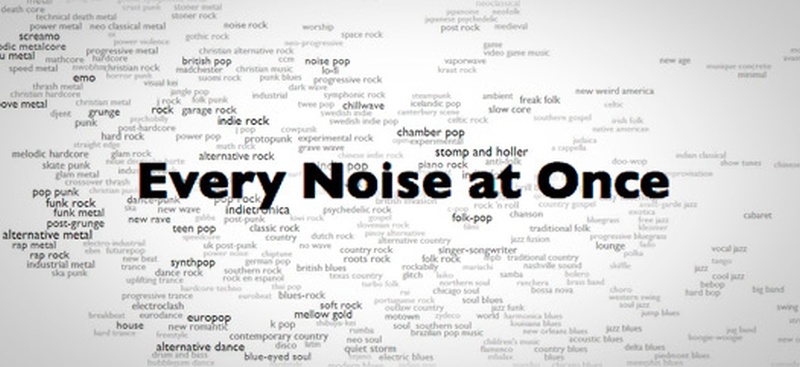
If you are ready for a time-suck internet experience that will also make you feel slightly old and out of step with the culture, feel free to dive into Every Noise at Once. A scatter-plot of over 1,530 musical genres sourced from Spotify’s lists and based on 35 million songs, Every Noise at Once is a bold attempt at musical taxonomy. The Every Noise at Once website was created by Glenn McDonald, and is an offshoot of his work at Echo Nest (acquired by Spotify in 2014).
McDonald explains his graph thus:
This is an ongoing attempt at an algorithmically-generated, readability-adjusted scatter-plot of the musical genre-space, based on data tracked and analyzed for 1,536 genres by Spotify. The calibration is fuzzy, but in general down is more organic, up is more mechanical and electric; left is denser and more atmospheric, right is spikier and bouncier.
It’s also egalitarian, with world dominating “rock-and-roll” given the same space and size as its neighbors choro (instrumental Brazilian popular music), cowboy-western (Conway Twitty, Merle Haggard, et. al.), and Indian folk (Asha Bhosle, for example). It also makes for some strange bedfellows: what factor does musique concrete share with “Christian relaxitive” other than “reasons my college roommate and I never got along.” Now you can find out!
Click on any of the genres and you’ll hear a sample of that music. Double click and you’ll be taken to a similar scatter-plot graph of its most popular artists, this time with font size denoting popularity and a similar sample of their music.
I’ve been spending most of my time exploring up in the top right corner where all sorts of electronic dance subgenres hang out. I’m not too sure what differentiates “deep tech house” from “deep deep house” or “deep minimal techno” or “tech house” or even “deep melodic euro house” but I now know where to come for a refresher course.
Spotify and other services depend on algorithms and taxonomies like this to deliver consistent listening experiences to its users, and they were attracted to Echo Nest for its work with genres. Echo Nest was originally based on the dissertation work of Tristan Jehan and Brian Whitman at the MIT Media Lab, who over a decade ago were trying to understand the “fingerprints” of recorded music. Now when you listen to Spotify’s personalized playlists, Echo Nest’s research is the engine working in the background.
McDonald says in this 2014 Daily Dot article this isn’t about a machine guessing our taste.
“No, the machines don’t know us better than we do. But they can very easily know more than we do. My job is not to tell you what to listen to, or to pass judgment on things or ‘make taste.’ It’s to help you explore and discover. Your taste is your business. Understanding your taste and situating it in some intelligible context is my business.”
If you’d like a more passive journey through the ever expanding music genre universe, there’s a Spotify playlist of one song from each genre (all 1,500+) above. See you in the deep, deep house!
via Kottke.org
Related Content:
Ted Mills is a freelance writer on the arts who currently hosts the FunkZone Podcast. You can also follow him on Twitter at @tedmills, read his other arts writing at tedmills.com and/or watch his films here.
Read More...Trigonometry Discovered on a 3700-Year-Old Ancient Babylonian Tablet
One presumption of television shows like Ancient Aliens and books like Chariots of the Gods is that ancient people—particularly non-western people—couldn’t possibly have constructed the elaborate infrastructure and monumental architecture and statuary they did without the help of extra-terrestrials. The idea is intriguing, giving us the hugely ambitious sci-fi fantasies woven into Ridley Scott’s revived Alien franchise. It is also insulting in its level of disbelief about the capabilities of ancient Egyptians, Mesopotamians, South Americans, South Sea Islanders, etc.
We assume the Greeks perfected geometry, for example, and refer to the Pythagorean theorem, although this principle was probably well-known to ancient Indians. Since at least the 1940s, mathematicians have also known that the “Pythagorean triples”—integer solutions to the theorem—appeared 1000 years before Pythagoras on a Babylonian tablet called Plimpton 322. Dating back to sometime between 1822 and 1762 B.C. and discovered in southern Iraq in the early 1900s, the tablet has recently been re-examined by mathematicians Daniel Mansfield and Norman Wildberger of Australia’s University of New South Wales and found to contain even more ancient mathematical wisdom, “a trigonometric table, which is 3,000 years ahead of its time.”
In a paper published in Historia Mathematica the two conclude that Plimpton 322’s Babylonian creators detailed a “novel kind of trigonometry,” 1000 years before Pythagoras and Greek astronomer Hipparchus, who has typically received credit for trigonometry’s discovery. In the video above, Mansfield introduces the unique properties of this “scientific marvel of the ancient world,” an enigma that has “puzzled mathematicians,” he writes in his article, “for more than 70 years.” Mansfield is confident that his research will fundamentally change the way we understand scientific history. He may be overly optimistic about the cultural forces that shape historical narratives, and he is not without his scholarly critics either.
Eleanor Robson, an expert on Mesopotamia at University College London has not published a formal critique, but she did take to Twitter to register her dissent, writing, “for any historical document, you need to be able to read the language & know the historical context to make sense of it. Maths is no exception.” The trigonometry hypothesis, she writes in a follow-up tweet, is “tediously wrong.” Mansfield and Wildberger may not be experts in ancient Mesopotamian language and culture, it’s true, but Robson is also not a mathematician. “The strongest argument” in the Australian researchers’ favor, writes Kenneth Chang at The New York Times, is that “the table works for trigonomic calculations.” As Mansfield says, “you don’t make a trigonomic table by accident.”
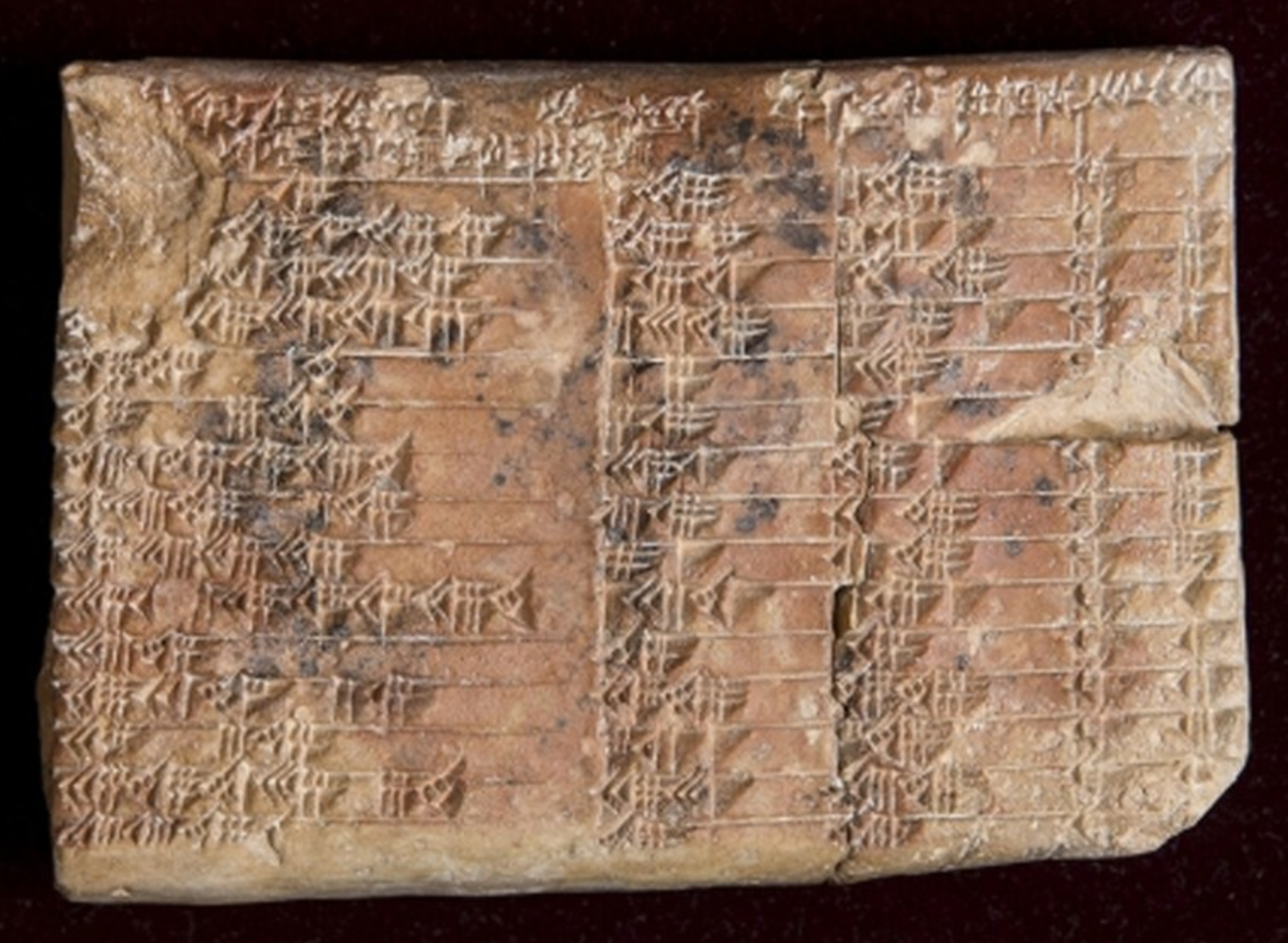
Plimpton 322 uses ratios rather than angles and circles. “But when you arrange it such a way so that you can use any known ratio of a triangle to find the other side of a triangle,” says Mansfield, “then it becomes trigonometry. That’s what we can use this fragment for.” As for what the ancient Babylonians used it for, we can only speculate. Robson and others have proposed that the tablet was a teaching guide. Mansfield believes “Plimpton 322 was a powerful tool that could have been used for surveying fields or making architectural calculations to build palaces, temples or step pyramids.”
Whatever its ancient use, Mansfield thinks the tablet “has great relevance for our modern world… practical applications in surveying, computer graphics and education.” Given the possibilities, Plimpton 322 might serve as “a rare example of the ancient world teaching us something new,” should we choose to learn it. That knowledge probably did not originate in outer space.
Related Content:
How the Ancient Greeks Shaped Modern Mathematics: A Short, Animated Introduction
Hear The Epic of Gilgamesh Read in the Original Akkadian and Enjoy the Sounds of Mesopotamia
Josh Jones is a writer and musician based in Durham, NC. Follow him at @jdmagness
Read More...A Free Trial Offer for The Great Courses Plus: A Special Deal for Open Culture Readers
We’ve told you about the Great Courses Plus (now called Wondrium) before–a new video subscription service that lets you watch free courses (about 8,000 lectures in total) across a wide range of subjects, all taught by some of the best lecturers in the country. The topics cover everything from History, Philosophy, Literature, and Economics, to Math, Science, Professional Development, Cooking, and Photography. And you can binge-watch entire college courses in a matter of days by watching videos on your TV, tablet, laptop and smart phone, with the help of apps designed for Apple, Google Play, Kindle Fire, and Roku.
Interested in trying out this service? Right now, the Great Courses Plus/Wondrium is offering a special deal for Open Culture readers. If you click here, and sign up for a free trial, you can use this service for 30 days … for free. And then, if you would like, you can continue to subscribe and pay their normal prices. If you have time on your hands, this is a great way to keep your mind engaged and stream what PC Magazine has called “an excellent library of college-level lectures.”
Note: The Great Courses is a partner with Open Culture. So if you sign up for a free trial, it benefits not just you and Great Courses Plus. It benefits Open Culture too. So consider it win-win-win.
Read More...Figures from Hieronymus Bosch’s “The Garden of Earthly Delights” Come to Life as Fine Art Piñatas
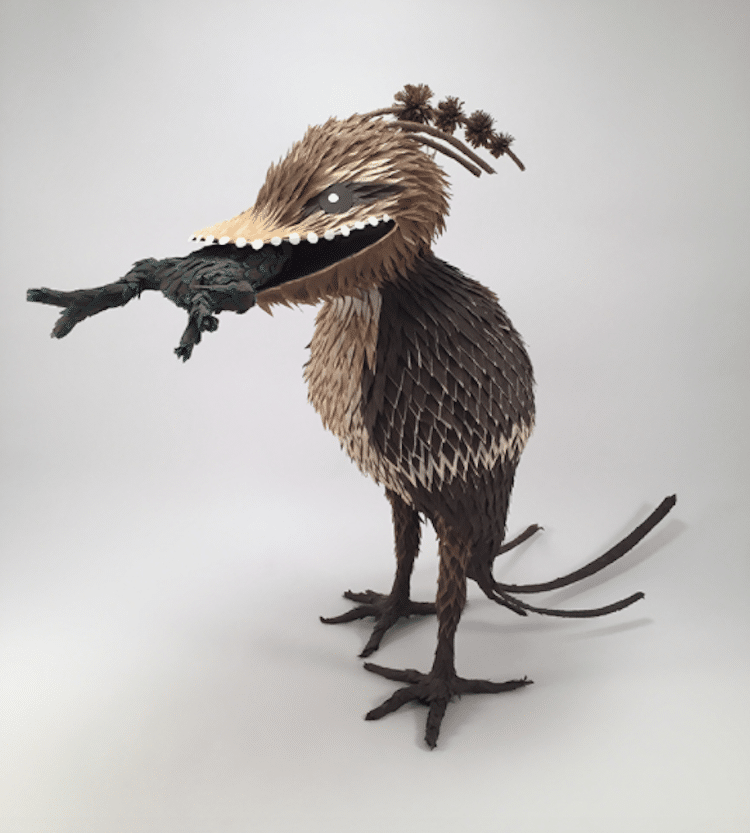
Oh sure, they look festive, but seriously, think twice before arming a blindfolded child (or a beer guzzling adult guest) with a sturdy stick and encouraging him to swing wildly.
There’s no need to worry, however, about anyone taking a bat to the intricate Hieronymus Bosch-inspired piñatas of Roberto Benavidez, a self-described half-breed, South Texan, queer figurative sculptor.
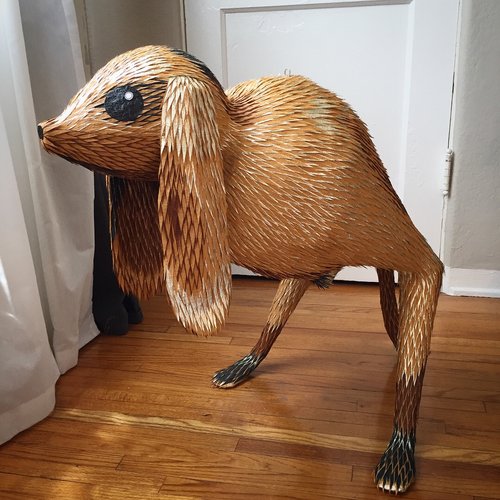
Even if you filled them with candy, the exteriors would be far more valuable than any treasures contained within.

Bosch, of course, excelled at scenarios far more nightmarish than anything one might encounter in a backyard party. Benavidez seems less drawn to that aspect than the beauty of the fantastical creatures populating The Garden of Earthly Delights.
In fact, the majority of his papier-mâché homages are drawn from the paradisiacal left panel of the famous triptych.
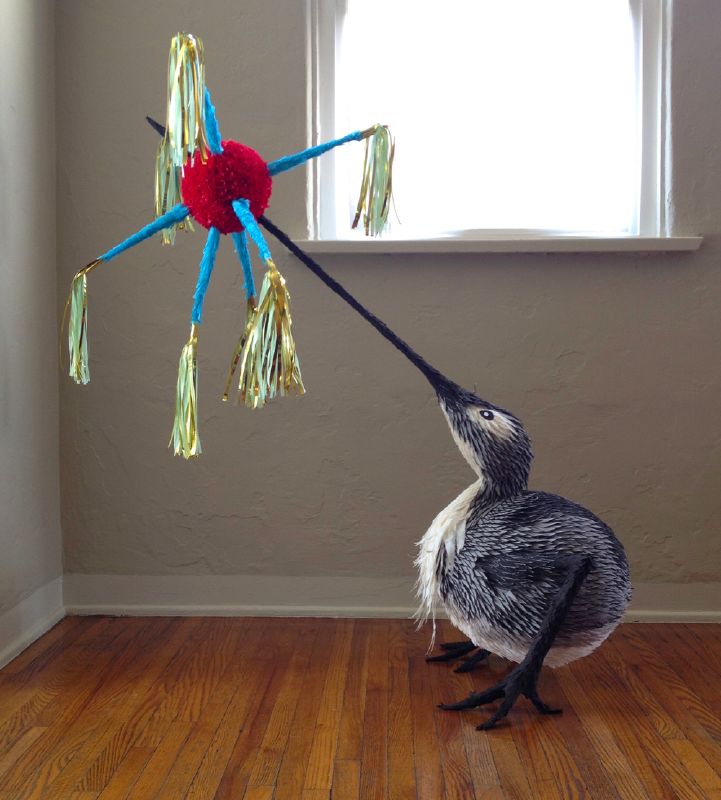
Not so the first in the series, 2013’s superbly titled Piñata of Earthly Delights #1, above
In the original, a misshapen waterbird uses its long beak to spear a cherry with which it tempts a passel of weak-willed mortals, crowded together inside a spiky pink blossom.
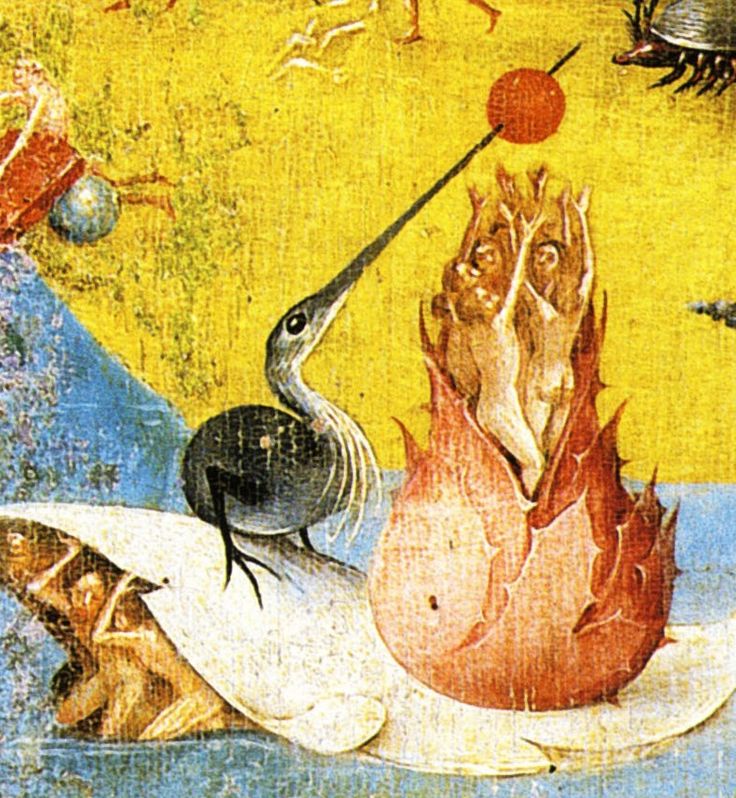
In Benavidez’s version the lack of naked humans allows us to focus on the creature, whose beak now pierces a simple star-shaped piñata of its own.
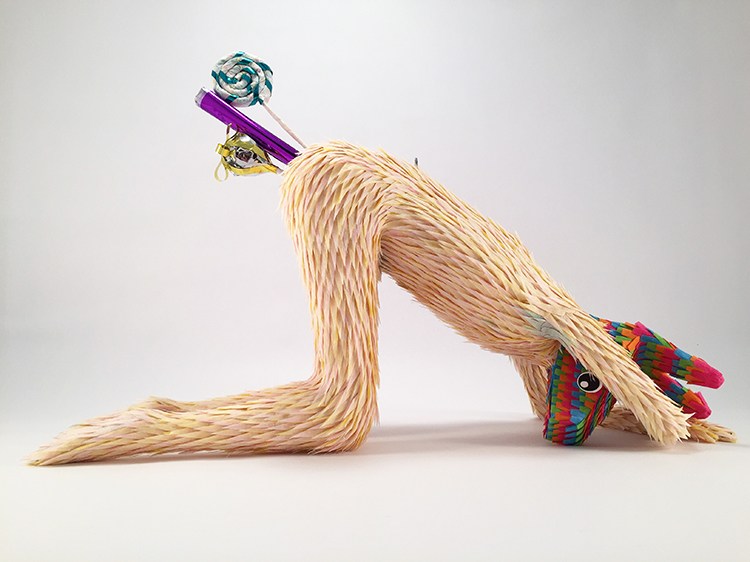
Those with a fascination for the antics of Bosch’s party people are invited to play a variation of Where’s Waldo, scouring the painting for the inspiration behind Candy Ass Bottom, above.
(Hint: if you’re gravitating toward those posteriors serving as vessels for flutes, flocks of blackbirds, or red hot pokers, you’re getting colder…)
While little is known about Bosch’s artistic training, Benavidez majored in acting, before returning to his childhood fascination for sculpting, taking classes in drawing, painting, and bronze casting at Pasadena City College. Thrift and portability led him to begin exploring paper as his primary medium.
As he remarked on the blog of the crepe paper manufacturer Cartotecnica Rossi:
I was intrigued by the idea of taking the piñata form, something seen as cheap and disposable, and moving it into the arena of fine art. I feel that my sculptural forms and fringing techniques set my work apart from what most people think of as a typical piñata and the themes are more complex than is typical.
Definitely.
View more of Roberto Benavidez’ fine art piñatas, including those inspired by Hieronymus Bosch on his website or Instagram feed.
Related Content:
Ayun Halliday is an author, illustrator, theater maker and Chief Primatologist of the East Village Inky zine. Follow her @AyunHalliday.
Read More...Support Us
We're hoping to rely on loyal readers, rather than erratic ads. Please click the Donate button and support Open Culture. You can use Paypal, Venmo, Patreon, even Crypto! We thank you!

About Us

Open Culture scours the web for the best educational media. We find the free courses and audio books you need, the language lessons & educational videos you want, and plenty of enlightenment in between.
Advertise With Us
FREE UPDATES!
GET OUR DAILY EMAIL
Get the best cultural and educational resources on the web curated for you in a daily email. We never spam. Unsubscribe at any time.
FOLLOW ON SOCIAL MEDIA
Open Culture editor Dan Colman scours the web for the best educational media. He finds the free courses and audio books you need, the language lessons & movies you want, and plenty of enlightenment in between.
Advertise With Us



