George Eliot’s Middlemarch Gets Reborn as a 21st Century Web Series: Watch It Online
In 1856, novelist George Eliot—real name Mary Anne Evans—issued a vicious critique of other women English writers in language we would expect from the most self-satisfied of misogynists, a group of people with an unqualified monopoly on the culture, but who had very little new to say on the subject. But Eliot certainly did, in “Silly Novels by Lady Novelists.” Though she couches many of her critical observations in the condescending vocabulary of a male antagonist, the language only serves to make her argument more effective. The essay, writes Kathryn Schulz, “does a remarkable number of things deftly and all at once.”
Although she is an uncommonly compassionate writer, Eliot has knife skills when she needs them, and the most obvious thing she does here is chiffonade the chick lit of her day. Yet even while castigating some women, she manages to champion women as a whole. Her chief objection to silly novels is that they misrepresent women’s real intellectual capacity; and the chief blame for them, she argues, lies not with their authors but with the culture that produced them—through inadequate education, low expectations, patronizing critics, and fear of the real deal.
The fault, she asserted, lies with the gatekeepers, the tastemakers, the lazy thinkers. Though an accomplished essayist and translator, Eliot would only publish her first novel in 1859, at the age of 37. But “Silly Novels by Lady Novelists,” writes Schulz, “traces out in negative space, the contours of a truly great novel”—one that wouldn’t arrive until fourteen years later: Middlemarch: a study of provincial life. (Read online or download in various formats here.)
The book’s first chapter introduces Dorothea Brooke, a well-off 19-year old orphan—who, writes Pamela Erens, “has dreams of doing some great work in the world” but gives her life instead to “dry humorless pedant” Casaubon—with an ironic quote from the licentious Jacobean play The Maid’s Tragedy: “Since I can do no good because a woman, / Reach constantly at something that is near it.”
As with the pen name she adopted, Eliot appropriated the armor of a male-dominated culture to bring into being some of the most staggeringly insightful writing of the time, and a beacon to other great women writers. “What do I think of Middlemarch?,” wrote Emily Dickinson, “What do I think of glory?—except that in a few instances ‘this mortal has already put on immortality.’” Virginia Woolf pronounced the book “one of the few English novels written for grown-up people.” Number twenty-one on The Guardian’s list of “The 100 Best Novels,” Middlemarch, writes Robert McCrum, exerts “an almost hypnotic power over its readers…. Today it stands as perhaps the greatest of many great Victorian novels.”
Do we have the time or the attention to read Eliot’s sprawling 900-page realist epic in the 21st century? Given that Karl Ove Knausgaard’s 3,600 page, six-part autobiographical novel, My Struggle, is one of the most lauded literary works of the past few years, perhaps we do. More specifically, in the language of many a condescending critic of today, do “Millennials” have the time and attention to read Middlemarch? At least a certain contingent of young readers has not only read the novel, but has adapted it into a seventy-episode web drama, Middlemarch: The Series—an “attempt worth watching,” writes Rebecca Mead at The New Yorker, “for its ambition as well as its charm.”
Written and directed by Yale undergraduate film student Rebecca Shoptaw, the series stars several of Shoptaw’s peers “as students at Lowick College, in the fictional town of Middlemarch, Connecticut,” and it transcribes the novel’s form into that most 21st century of mediums, the vlog. You can see the official teaser at the top of the post; watch the first episode just above, introducing Yale student Mia Fowler as Dot Brooke; and see the full series, thus far, down below. (The show has already won awards and recognition from several film festivals. See “air dates” and more on its busy Tumblr page.)
Up to now, notes Mead, Eliot’s fiction has resisted the kind of treatment given to Charlotte Brontë and Jane Austen in adaptations like “a chapter book for tweens called Jane Airhead” and the Austen-inspired Bridget Jones’s Diary and Clueless (not to mention Pride and Prejudice and Zombies). And yet, despite the daunting size, scope, and seriousness of Eliot’s novel, Middlemarch: the Series continues in this tradition of light-hearted, pop-cultural modernizations, using the same device as the award-winning Austen vlog adaptation The Lizzie Bennet Diaries and Brontë vlog adaptation “The Autobiography of Jane Eyre.”
Though it is “an impossibly tall order,” writes Mead, “to expect a Web series to approach the nuance of a nineteenth-century novel—of the nineteenth-century novel,” adaptations like Shoptaw’s don’t even attempt to do this. They express “a winning affection” for their source material, and a sense of how it still informs the very different gender identities and sexual relationships of the present. In that sense, it may be useful to think of them as, in part, working in a similar vein as another very 21st century medium: fan fiction. Would the knives-out critic Eliot approve? Impossible to say. But I dare say she might admire the ambition, creative impulses, and narrative ingenuity of Shoptaw and her cast perhaps as much as they admire her greatest work.
via The New Yorker
Related Content:
Hear Jane Austen’s Pride and Prejudice as a Free Audio Book
Read Jane Austen’s Fiction Manuscripts Free Online
Josh Jones is a writer and musician based in Durham, NC. Follow him at @jdmagness
Read More...
Renaissance Knives Had Music Engraved on the Blades; Now Hear the Songs Performed by Modern Singers
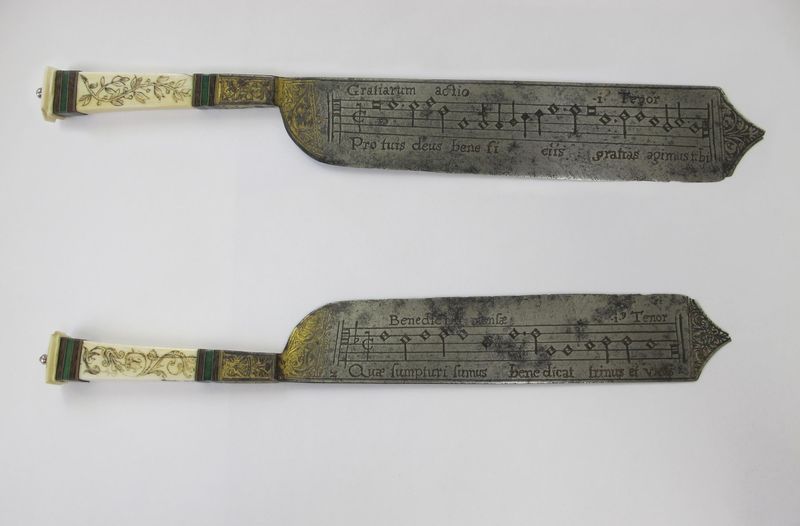
Image courtesy of The Victoria and Albert Museum
On any given weekend, in any part of the state where I live, you can find yourself standing in a hall full of knives, if that’s the kind of thing you like to do. It is a very niche kind of experience. Not so in some other weapons expos—like the Arms and Armor galleries at the Metropolitan Museum of Art, where everyone, from the most warlike to the staunchest of pacifists, stands in awe at the intricate ornamentation and incredibly deft craftsmanship on display in the suits of armor, lances, shields, and lots and lots of knives.
We must acknowledge in such a space that the worlds of art and of killing for fame and profit were never very far apart during Europe’s late Medieval and Renaissance periods. Yet we encounter many similar artisanal instruments from the time, just as finely tuned, but made for far less belligerent purposes.
As Maya Corry of the Fitzwilliam Museum in Cambridge—an institution with its own impressive arms and armor collection—comments in the video above (at 2:30), one unusual kind of 16th century knife meant for the table, not the battlefield, offers “insight into that harmonious, audible aspect of family devotions,” prayer and song.
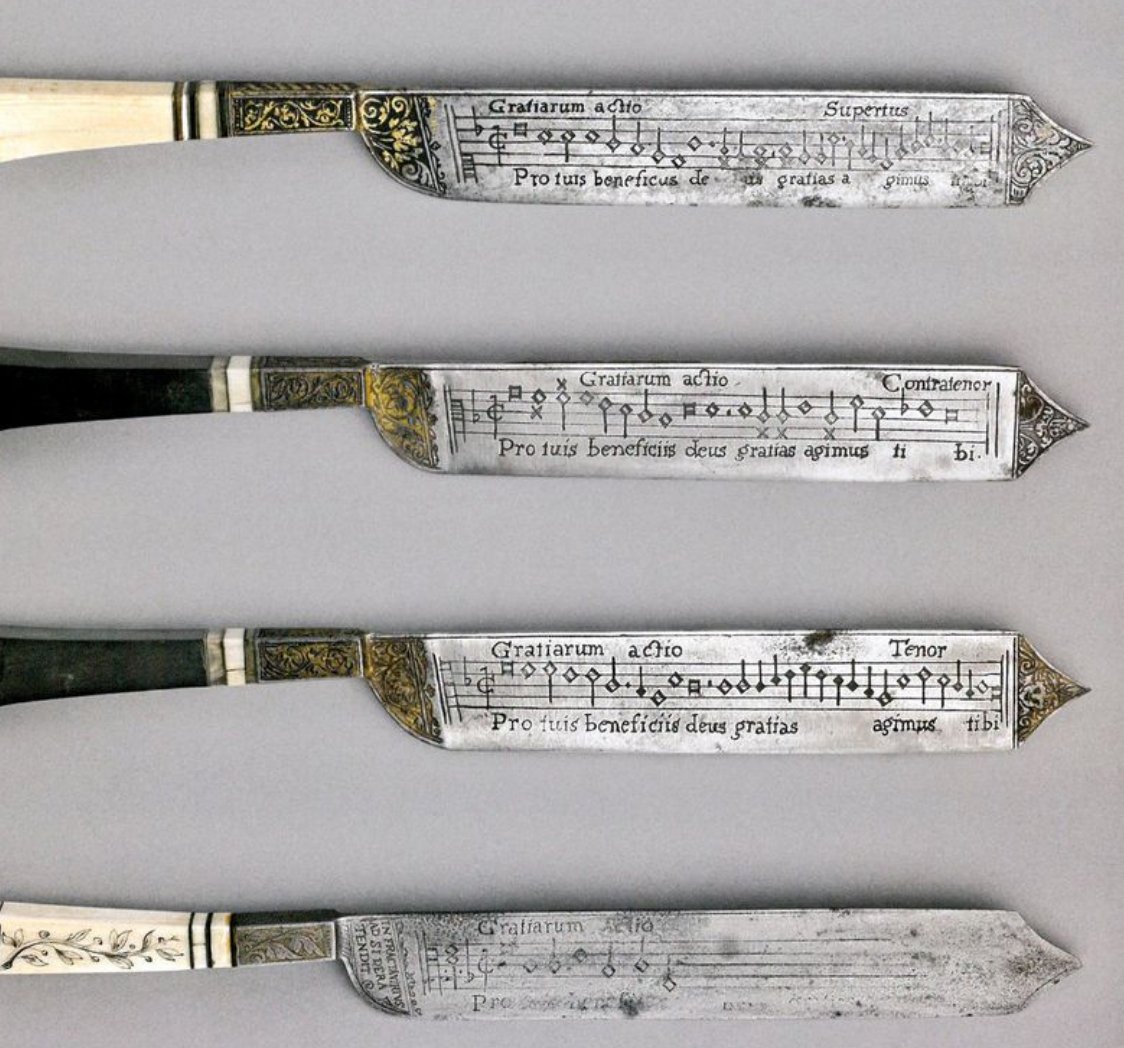
From the collection of the Fitzwilliam Museum, in Cambridge. (Johan Oosterman )
These knives, which have musical scores engraved in their blades, brought a table together in singing their prayers, and may have been used to carve the lamb or beef in their “striking balance of decorative and utilitarian function.” At least historians think such “notation knives,” which date from the early 1500s, were used at banquets. “The sharp, wide steel would have been ideal for cutting and serving meat,” writes Eliza Grace Martin at the WQXR blog, “and the accentuated tip would have made for a perfect skewer.” But as Kristen Kalber, curator at the Victoria and Albert Museum, which houses the knives at the top of the post, tells us “diners in very grand feasts didn’t cut their own meat.” It’s unlikely they would have sung from the bloody knives held by their servants.
The knives’ true purpose “remains a mystery,” Martin remarks, like many “rituals of the Renaissance table.” Victoria and Albert Museum curator Kirstin Kennedy admits in the video above that “we are not entirely sure” what the “splendid knife” she holds was used for. But we do know that each knife had a different piece of music on each side, and that a set of them together contained different harmony parts in order to turn a roomful of diners into a chorus. One set of blades had the grace on one side, with the inscription, “the blessing of the table. May the three-in-one bless that which we are about to eat.” The other side holds the benediction, to be sung after the dinner: “The saying of grace. We give thanks to you God for your generosity.”
Common enough verbiage for any household in Renaissance Europe, but when sung, at least by a chorus from the Royal College of Music, who recreated the music and made the recordings here, the prayers are superbly graceful. Above, hear one version of the Grace and Benediction from the Victoria and Albert Museum knives; below, hear a second version. You can hear a captivating set of choral prayers from the Fitzwilliam Museum knives at WQXR’s site, recorded for the Fitzwilliam’s “Madonnas & Miracles” exhibit. We are as unlikely now to encounter singing kitchen knives as we are to run into a horse and rider bearing 100 pounds of finely-wrought wearable steel sculpture. Such strange artifacts seem to speak of a strange people who valued beauty whether carving up the main course or cutting down their enemies.
Related Content:
An Ancient Philosophical Song Reconstructed and Played for the First Time in 1,000 Years
See The Guidonian Hand, the Medieval System for Reading Music, Get Brought Back to Life
Josh Jones is a writer and musician based in Durham, NC. Follow him at @jdmagness
Read More...How Richard Linklater (Slacker, Dazed and Confused, Boyhood) Tells Stories with Time: Six Video Essays
The ever more critically acclaimed, ever more resolutely Austin-based auteur Richard Linklater grounds each of his movies in a particular place, but even more so in a particular time. His second feature Slacker, which broke him into the world of American independent film in 1991, takes place not just in Austin, but in a single day in Austin. Its much bigger-budget but also Austin-set follow-up Dazed and Confused takes place on May 28, 1976, the last day before graduation for its high-school-age characters. 1995’s Before Sunrise began a trilogy of films released every nine years, each of which continues the story of the central couple by following them in near-real time around a different place: first in Vienna, then in Paris, then in Greece.
Linklater has maintained his penchant for temporal specificity, setting last year’s Everybody Wants Some!! in southeast Texas in 1980, specifically on the day before the beginning of college for its characters. Before that, his low-key epic Boyhood made cinema history by having been shot over a period of twelve years, demonstrating definitively that the director’s interest in time goes well beyond simply evoking periods or replicating the real flow of events.
“It’s a big element, isn’t it, of our medium?” he asks in “On Cinema & Time,” the video essay made by “kogonada” for the British Film Institute at the top of the post. “The manipulation of time, the perception of time, the control of time — kind of the building blocks of cinema.”
“What I’ll say is, like, ‘Carve out something of real time,’ you know?” says Linklater, with his characteristic delivery of artistic insight in a highly casual, Texas-inflected locution, in the Film Radar video essay “Richard Linklater and Time” (not viewable in all regions). “Some kind of hyperreality, you know? Trying to make sense of the world in a movie way, of just how people live or think or interact.” But would his time-carving, expertly though he does it, strike us as powerfully without he and his collaborators’ equally high skill at crafting images (whether live-action or, occasionally, in animation, as in the rotoscoping of the philosophical dialogue-driven Waking Life, or his Philip K. Dick adaptation A Scanner Darkly, examined in Siobhan Cavanagh’s “Form and Function”)?
You can see that skill on display in the video essays “Cinematography in the films of Richard Linklater” and “Silent Connections” just above. In the latter, frequent Linklater collaborator Ethan Hawke quotes the director: “I’ve never been in a gunfight. I’ve never been involved in espionage. I’ve never been involved in a helicopter crash. And yet I feel like my life has been full of drama, and the most dramatic thing that’s ever happened to me is, really, connecting with another human being. When you really connect, you feel like your life is different, and I want to make a movie about that connection.” In a sense, Linklater has spent most of his career taking different approaches to making that movie, always drawing on his vast breadth of film knowledge; the video essay “Real Time and New Wave Heritage” just above looks at just a few of the parallels between his work and that of his predecessors in cinema.
“It’s funny, the way memory works,” Linklater says in a ten-minute Independent Film Channel featurette on the making of Boyhood. “I’m kind of obsessed with that.” You can see a younger Linklater speak about his life as a filmmaker, then only just beginning, in the 1991 Austin public-access television clip just above. “I don’t get work,” he says. “For me, filmmaking’s not even a job, it’s not a career, it’s just something I’m doing. For the first time it looks like I should be making money at it, but we’ll see.” Now we’ve seen what Linklater can do, though he’ll surely surprise and impress us for decades to come with the ways he can dig, cinematically, into his obsessions — and the obsessions his films have let us share. To quote a 23-year-old Hawke in Before Sunrise, quoting Dylan Thomas reading W.H. Auden: “ ‘All the clocks in the city began to whirr and chime. Oh, let not time deceive you; you cannot conquer time. In headaches and in worry, vaguely life leaks away, and time will have its fancy tomorrow or today.’ Somethin’ like that.”
Related Content:
Based in Seoul, Colin Marshall writes and broadcasts on cities and culture. He’s at work on the book The Stateless City: a Walk through 21st-Century Los Angeles, the video series The City in Cinema, the crowdfunded journalism project Where Is the City of the Future?, and the Los Angeles Review of Books’ Korea Blog. Follow him on Twitter at @colinmarshall or on Facebook.
Read More...Behold Lewis Carroll’s Original Handwritten & Illustrated Manuscript for Alice’s Adventures in Wonderland (1864)
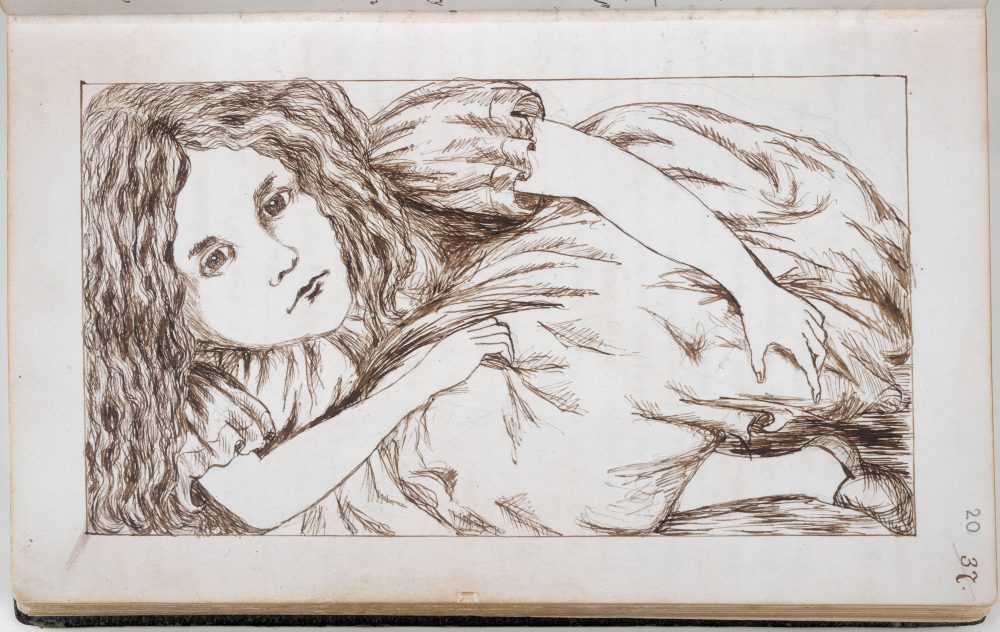
Almost exactly 155 years ago, Lewis Carroll told three young sisters a story. He’d come up with it to enliven a long boat trip up the River Thames, and one of the children aboard, a certain Alice Liddell, enjoyed it so much that she insisted that Carroll commit it to paper. Thus, so the legend has it, was Alice’s Adventures in Wonderland born, although Lewis Carroll, then best known as Oxford mathematics tutor Charles Lutwidge Dodgson, hadn’t taken up his famous pen name yet, and when he did write down Alice’s Adventures in Wonderland, it took its first form as Alice’s Adventures Under Ground. You can read that handwritten manuscript, complete with illustrations.
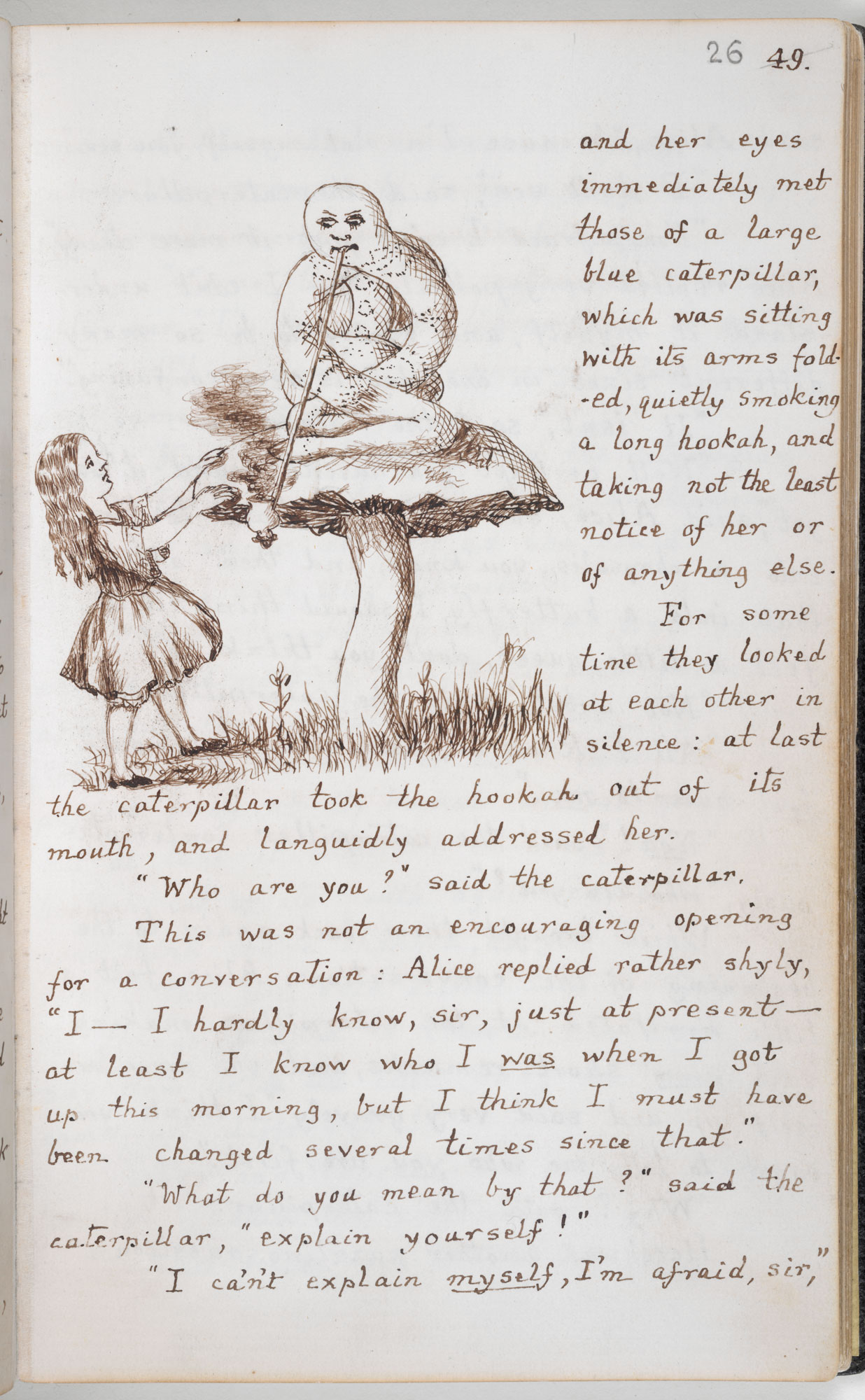
Carroll presented the fictional Alice’s namesake with the manuscript, according to the British Library, as an early Christmas present in 1864. When his friends encouraged him to publish it, he performed a few revisions, “removing some of the family references included for the amusement of the Liddell children,” adding a couple of chapters (the beloved Cheshire Cat and the Mad Hatter’s tea party being among their new material), and enlisting John Tenniel, a Punch magazine cartoonist known for his illustrations of Aesop’s Fables, to create professional art to accompany it. The result, retitled Alice’s Adventures in Wonderland, came out in 1865 and has never gone out of print.
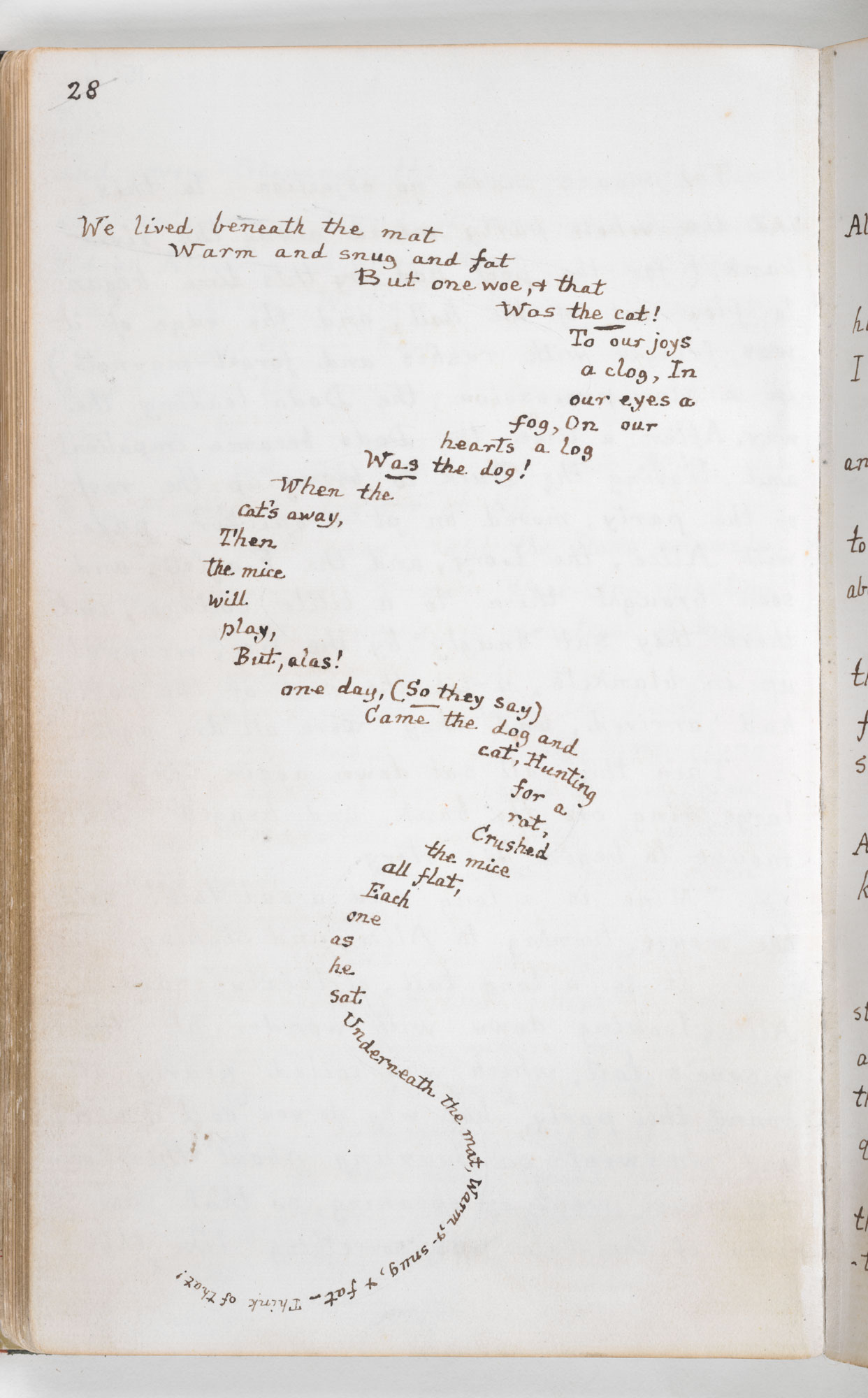
Though Tenniel’s vivid renderings of Alice and the eccentric characters she encounters have remained definitive, plenty of other artists, including Salvador Dalí and Ralph Steadman, have attempted the surely almost irresistible challenge of illustrating Carroll’s highly imaginative story. But today, says Skidmore College professor Catherine J. Golden at The Victorian Web, “critics have reevaluated Carroll’s caricature-style illustration. Carroll expertly intertwines his handwritten text with his pictures to advance the growth motif. His conception of the mouse’s ‘tale’ shaped like an actual mouse’s ‘tail’ is an excellent example of emblematic verse.”
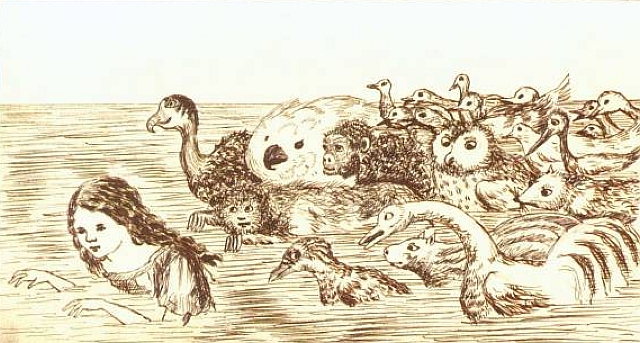
Tenniel, Golden argues, “essentially refashioned with realism and improved upon many of Carroll’s sketchy or anatomically incorrect illustrations, adding domestic interiors and landscapes that appealed to middle-class consumers of the 1860s.” Even “late twentieth-century graphic novel adaptations of Alice in Wonderland recall many of Carroll’s inventive designs as well as those of Tenniel,” which gives Carroll’s original manuscript more claim to having provided the visual basis, not just the textual one, for the following century and a half of sequels official and unofficial, as well as adaptations, reenvisionings, and reimaginings of this “Christmas gift to a dear child in memory of a summer day.”
You can view Carroll’s original manuscript, complete with illustrations, here.
Related Content:
Lewis Carroll’s Photographs of Alice Liddell, the Inspiration for Alice in Wonderland
Photo of the Real Alice in Wonderland Circa 1862
The First Film Adaptation of Alice in Wonderland (1903)
Lewis Carroll’s Classic Story, Alice’s Adventures in Wonderland, Told in Sand Animation
When Aldous Huxley Wrote a Script for Disney’s Alice in Wonderland
Based in Seoul, Colin Marshall writes and broadcasts on cities and culture. He’s at work on the book The Stateless City: a Walk through 21st-Century Los Angeles, the video series The City in Cinema, the crowdfunded journalism project Where Is the City of the Future?, and the Los Angeles Review of Books’ Korea Blog. Follow him on Twitter at @colinmarshall or on Facebook.
Read More...Sylvia Plath, Ted Hughes & Peter Porter Read Their Poetry: Free Audio
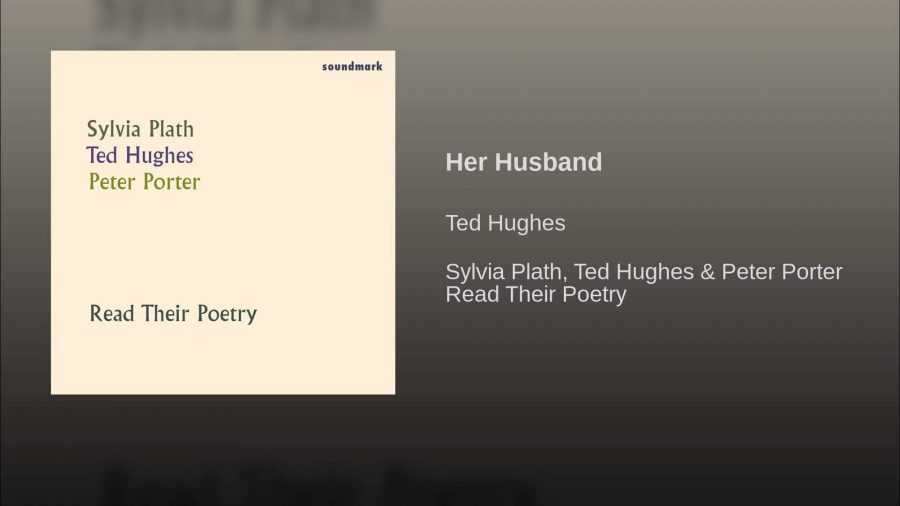
Sylvia Plath, Ted Hughes & Peter Porter Read Their Poetry was released December 04, 2013 on the Soundmark label. All 21 tracks can be heard free on Spotify. Stream the tracks below. If you need Spotify’s free software, download it here.
Sylvia Plath, Ted Hughes & Peter Porter Read Their Poetry will be added to our collection, 1,000 Free Audio Books: Download Great Books for Free.
Hear Sylvia Plath’s Barely-Known Radio Play, Three Women
Hear Sylvia Plath Read 50+ of Her Dark, Compelling Poems
Hear Sylvia Plath Read Fifteen Poems From Her Final Collection, Ariel, in 1962 Recording
The Art of Sylvia Plath: Revisit Her Sketches, Self-Portraits, Drawings & Illustrated Letters
Sylvia Plath, Girl Detective Offers a Hilariously Cheery Take on the Poet’s College Years
Read More...David Sedaris Breaks Down His Writing Process: Keep a Diary, Carry a Notebook, Read Out Loud, Abandon Hope
When did you first hear David Sedaris? Normally in the case of a writer, let alone one of the most famous and successful writers alive, the question would be when you first read him, but Sedaris’ writing voice has never really existed apart from his actual voice. He first became famous in 1992 when National Public Radio aired his reading of the “Santaland Diaries,” a piece literally constructed from diaries kept while he worked in Santaland, the Christmas village at Macy’s, as an elf. Though that break illustrates the importance of what we might call two pillars of Sedaris’ writing process, nobody in his enormous fanbase-to-be gave it much thought at the time — they just wanted to hear more of his hilarious storytelling.
A quarter-century later, Sedaris has released more diaries — many more diaries — to his adoring public in the form of Theft by Finding, a hefty volume of selected entries written between 1977 and 2002. They give additional insight into not just the events and characters involved in the personal essays compiled in bestselling books like Naked, Me Talk Pretty One Day, and Dress Your Family in Corduroy and Denim, but also into his writing process itself. “A woman on All Things Considered wrote a book of advice called If You Want to Write and mentioned the importance of keeping a diary,” a 26-year-old Sedaris writes in an entry from 1983. “After a while you’d stop being forced and pretentious and become honest and unafraid of your thoughts.”
Obviously he didn’t need that advice at the time, since even then keeping a diary had already become the first pillar of the David Sedaris writing process. “I started writing one afternoon when I was twenty, and ever since then I have written every day,” he once told the New Yorker, also a publisher of his stories. “At first I had to force myself. Then it became part of my identity, and I did it without thinking.” Most of what he writes in his diary each and every morning he describes as “just whining,” but “every so often there’ll be something I can use later: a joke, a description, a quote.”
The entries later cohere, along with other ideas and experiences, into his widely read stories. One such piece began, Sedaris told Fast Company’s Kristin Hohenadel, as “a diary entry from a trip to Amsterdam. He met a college kid who told him he’d learned that the first person to reach the age of 200 had already been born.” Then, Sedaris said, “I speculated that the first person to reach the age of 200 would be my father. And then I attached it to something else that had been in my diary, that all my dad talks about is me getting a colonoscopy. So I connected the 200-year-old man to my father wanting me to get a colonoscopy, and that became the story.”
Only connect, as E.M. Forster said, but you do need material to connect in the first place. Hence the second pillar of the process: carrying a notebook. To the Missouri Review Sedaris described himself as less funny than observant, adding that “everybody’s got an eye for something. The only difference is that I carry around a notebook in my front pocket. I write everything down, and it helps me recall things,” especially for later inclusion in his diary. When he publicly opened his notebook at the request of a redditor while doing an AMA a few years ago, he found the words, “Illegal metal sharks… white skin classy… driver’s name is free Time… rats eat coconuts… beautiful place city, not beautiful…”
These cryptic lines, he explained, were “notes I wrote in the Mekong delta a few weeks ago. A Vietnamese woman was giving me a little tour, and this is what I jotted down in my notebook.” For instance, “I was asking about all the women whom I saw on motor scooters wearing opera gloves, and masks that covered everything but their eyes. And the driver told me they were trying to keep their skin white, because it’s just classier. Tan skin means you’re a farmer. So that’s something I remembered from our conversation, so when I transcribe my notebook into my diary, I added all of that.” And one day his readers may well see this fragment of life that caught his attention appear again, but as part of a coherent, polished narrative whole.
The better part of that polishing happens through the practice of reading, and revising, in front of an audience. “During his biannual multicity lecture tours, Sedaris says he routinely notices imperfections in the text simply through the act of reading aloud to other people,” writes Hohenadel. “He circles accidental rhymes or closely repeated words, or words that sound alike — like night and nightlife — in the same sentence, rewriting after each reading and trying out revisions during the next stop on his tour.” When a passage gets laughs from the audience, he pencils in a check mark beside it; when one gets coughs (which he likens to “a hammer driving a nail into your coffin”), he draws a skull. “On the page it seems like I’m trying too hard, and that’s one of the things I can usually catch when I’m reading out loud,” he says, whether his writing “sounds a little too obvious” or “like somebody who’s just straining for a laugh.”
Related Content:
20 Free Essays & Stories by David Sedaris: A Sampling of His Inimitable Humor
Be His Guest: David Sedaris at Home in Rural West Sussex, England
Ray Bradbury on Zen and the Art of Writing (1973)
Stephen King’s Top 20 Rules for Writers
Seven Tips From Ernest Hemingway on How to Write Fiction
John Updike’s Advice to Young Writers: ‘Reserve an Hour a Day’
The Daily Habits of Famous Writers: Franz Kafka, Haruki Murakami, Stephen King & More
Based in Seoul, Colin Marshall writes and broadcasts on cities and culture. He’s at work on the book The Stateless City: a Walk through 21st-Century Los Angeles, the video series The City in Cinema, the crowdfunded journalism project Where Is the City of the Future?, and the Los Angeles Review of Books’ Korea Blog. Follow him on Twitter at @colinmarshall or on Facebook.
Read More...The First Bloomsday: See Dublin’s Literati Celebrate James Joyce’s Ulysses in Drunken Fashion (1954)
Here’s a fascinating glimpse of the very first Bloomsday celebration, filmed in Dublin in 1954.
The footage shows the great Irish comedic writer Brian O’Nolan, better known by his pen name Flann O’Brien, appearing very drunk as he sets off with two other renowned post-war Irish writers, Patrick Kavanagh and Anthony Cronin, and a cousin of James Joyce, a dentist named Tom Joyce, on a pilgrimage to visit the sites in James Joyce’s epic novel Ulysses.
The footage was taken by John Ryan, an artist, publisher and pub owner who organized the event. The idea was to retrace the steps of Leopold Bloom and other characters from the novel, but as Peter Costello and Peter van de Kamp explain in this humorous passage from their book, Flann O’Brien: An Illustrated Biography, things began to go awry right from the start:
The date was 16 June, 1954, and though it was only mid-morning, Brian O’Nolan was already drunk.
This day was the fiftieth anniversary of Mr. Leopold Bloom’s wanderings through Dublin, which James Joyce had immortalised in Ulysses.
To mark this occasion a small group of Dublin literati had gathered at the Sandycove home of Michael Scott, a well-known architect, just below the Martello tower in which the opening scene of Joyce’s novel is set. They planned to travel round the city through the day, visiting in turn the scenes of the novel, ending at night in what had once been the brothel quarter of the city, the area which Joyce had called Nighttown.
Sadly, no-one expected O’Nolan to be sober. By reputation, if not by sight, everyone in Dublin knew Brian O’Nolan, otherwise Myles na Gopaleen, the writer of the Cruiskeen Lawn column in the Irish Times. A few knew that under the name of Flann O’Brien, he had written in his youth a now nearly forgotten novel, At Swim-Two-Birds. Seeing him about the city, many must have wondered how a man with such extreme drinking habits, even for the city of Dublin, could have sustained a career as a writer.
As was his custom, he had been drinking that morning in the pubs around the Cattle Market, where customers, supposedly about their lawful business, would be served from 7:30 in the morning. Now retired from the Civil Service, on grounds of “ill-health”, he was earning his living as a free-lance journalist, writing not only for the Irish Times, but for other papers and magazines under several pen-names. He needed to write for money as his pension was a tiny one. But this left little time for more creative work. In fact, O’Nolan no longer felt the urge to write other novels.
The rest of the party, that first Bloomsday, was made up of the poet Patrick Kavanagh, the young critic Anthony Cronin, a dentist named Tom Joyce, who as Joyce’s cousin represented the family interest, and John Ryan, the painter and businessman who owned and edited the literary magazine Envoy. The idea of the Bloomsday celebration had been Ryan’s, growing naturally out of a special Joyce issue of his magazine, for which O’Nolan had been guest editor.
Ryan had engaged two horse drawn cabs, of the old fashioned kind, which in Ulysses Mr. Bloom and his friends drive to poor Paddy Dignam’s funeral. The party were assigned roles from the novel. Cronin stood in for Stephen Dedalus, O’Nolan for his father, Simon Dedalus, John Ryan for the journalist Martin Cunningham, and A.J. Leventhal, the Registrar of Trinity College, being Jewish, was recruited to fill (unkown to himself according to John Ryan) the role of Leopold Bloom.
Kavanagh and O’Nolan began the day by deciding they must climb up to the Martello tower itself, which stood on a granite shoulder behind the house. As Cronin recalls, Kavanagh hoisted himself up the steep slope above O’Nolan, who snarled in anger and laid hold of his ankle. Kavanagh roared, and lashed out with his foot. Fearful that O’Nolan would be kicked in the face by the poet’s enormous farmer’s boot, the others hastened to rescue and restrain the rivals.
With some difficulty O’Nolan was stuffed into one of the cabs by Cronin and the others. Then they were off, along the seafront of Dublin Bay, and into the city.
In pubs along the way an enormous amount of alcohol was consumed, so much so that on Sandymount Strand they had to relieve themselves as Stephen Dedalus does in Ulysses. Tom Joyce and Cronin sang the sentimental songs of Tom Moore which Joyce had loved, such as Silent, O Moyle. They stopped in Irishtown to listen to the running of the Ascot Gold Cup on a radio in a betting shop, but eventually they arrived in Duke Street in the city centre, and the Bailey, which John Ryan then ran as a literary pub.
They went no further. Once there, another drink seemed more attractive than a long tour of Joycean slums, and the siren call of the long vanished pleasures of Nighttown.
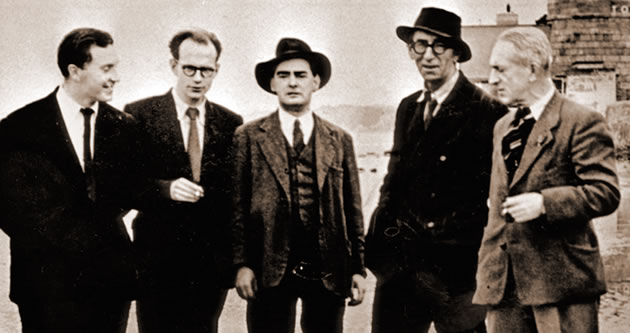
Celebrants of the first Bloomsday pause for a photo in Sandymount, Dublin on the morning of June 16, 1954. From left are John Ryan, Anthony Cronin, Brian O’Nolan (a.k.a. Flann O’Brien), Patrick Kavanagh and Tom Joyce, cousin of James Joyce.
Note: This post originally appeared on our site in 2013–likely before many of you started to frequent our site. So it’s time to bring it back.
Related content:
Vladimir Nabokov Creates a Hand-Drawn Map of James Joyce’s Ulysses
On Bloomsday, Hear James Joyce Read From his Epic Ulysses, 1924
Stephen Fry Explains His Love for James Joyce’s Ulysses
Henri Matisse Illustrates 1935 Edition of James Joyce’s Ulysses
James Joyce, With His Eyesight Failing, Draws a Sketch of Leopold Bloom (1926)
Read More...Take Free Philosophy Courses from The Institute of Art and Ideas: From “The Meaning of Life” to “Heidegger Meets Van Gogh”
Back in 2014, we told you about how The Institute of Art and Ideas (IAI) launched IAI Academy — an online educational platform that features free courses from world-leading scholars “on the ideas that matter.” They have since put online a number of philosophy courses, many striving to address questions that affect our lives today. We’ve listed a number of them below, and added them to our list of 150+ Free Online Philosophy courses. For a complete list of IAI Academy courses, visit this page.
- Heidegger Meets Van Gogh: Art, Freedom and Technology — Web video — Simon Glendinning, London School of Economics
- Dark Matter of the Mind — Web video — Daniel Everett, Bentley University
- Fear and Trembling in the 21st Century — Web video — Clare Carlisle, King’s College London
- Knowledge and Rationality — Web Video — Corine Besson, University of Sussex
- Life, Meaning and Morality — Web video — Christopher Hamilton, King’s College, London
- Minds, Morality and Agency — Web video — Mark Rowlands, University of Miami
- On Romantic Love — Web video — Berit Brogaard, University of Miami
- The Human Compass — Web video — Janne Teller
- The Meaning of Life — Web video — Steve Fuller, University of Warwick
- The Universe As We Find It — Web video — John Heil, Washington University in St Louis
- Unveiling Reality — Web video — Bryan Roberts, London School of Economics
- Why the World Does Not Exist — Web video — Markus Gabriel, Freiburg Institute of Advanced Study.
Note: The courses are all free. However, to take a course you will need to create a user account.
If you would like to support the mission of Open Culture, consider making a donation to our site. It’s hard to rely 100% on ads, and your contributions will help us continue providing the best free cultural and educational materials to learners everywhere. You can contribute through PayPal, Patreon, and Venmo (@openculture). Thanks!
Related Content:
Take First-Class Philosophy Courses Anywhere with Free Oxford Podcasts
The Great War and Modern Philosophy: A Free Online Course
Søren Kierkegaard: A Free Online Course on the “Father of Existentialism”
Introduction to Political Philosophy: A Free Yale Course
1,700 Free Online Courses from Top Universities Read More...Allen Ginsberg’s Howl Manuscripts Now Digitized & Put Online, Revealing the Beat Poet’s Creative Process
Somehow you have to imagine that, from its very opening — “I saw the best minds of my generation destroyed by madness, starving hysterical naked, dragging themselves through the negro streets at dawn looking for an angry fix” — Allen Ginsberg’s poem “Howl” simply emerged fully formed and launched itself permanently into American culture. But deep down we all know that no work, poetic or otherwise, actually does that, no matter how widely read it becomes, no matter how vividly it captures a time and a place, no matter how many generations look to it as an example. Ginsberg had to work on “Howl,” and now, thanks to Stanford Libraries, we have an up-close way to see some of that work in progress.
“From its first public reading at the Six Gallery in San Francisco in October 1955 to the notorious obscenity trial that followed in the wake of its first publication in 1956,” writes Stanford Curator for American and British Literature Rebecca Wingfield, “the poem is indelibly tied to the Beat Generation and their critique of the staid morals and customs of Eisenhower-era America.”
Before all that, it began with a seven-page first draft written in Ginsberg’s North Beach apartment, gained a second section before that now-legendary Six Gallery reading, and finally, after Ginsberg tried out different compositional techniques and followed different suggestions in search of a way to capture America as he saw it, evolved into a long poem comprising three sections and a footnote, published alongside other works by City Lights Books as the paperback that made him famous.
“The ‘Howl’ manuscripts and typescripts in the Allen Ginsberg Papers,” which you can view online at Stanford Libraries, “document the formal development of the poem, tracing Ginsberg’s experiments with different structures and wording in each of the poem’s sections.” These pre-“Howl” “Howl“s, manuscripts and typescripts both, retain the corrections and annotations that reveal details about Ginsberg’s distinctive creative process. But given the most well-known aspect of the poem’s construction, that each line lasts as long as exactly one breath, a full understanding can only come from hearing it as well as reading it. You can hear Ginsberg’s earliest recorded performance of the poem, at Portland’s Reed College (alma mater of Ginsberg’s Beat colleague Gary Snyder) in 1956, at the top of the post, and a later reading on record here. (The text of the completed poem can be viewed here.) Look and listen closely, and you’ll find that a cri de coeur, especially as Ginsberg cried it, demands deliberate craftsmanship.
See the Howl manuscripts online here.
via Stanford News/Boing Boing
Related Content:
The First Recording of Allen Ginsberg Reading “Howl” (1956)
Allen Ginsberg Reads His Famously Censored Beat Poem, “Howl” (1959)
James Franco Reads a Dreamily Animated Version of Allen Ginsberg’s Epic Poem ‘Howl’
Allen Ginsberg Recordings Brought to the Digital Age. Listen to Eight Full Tracks for Free
Allen Ginsberg’s Handwritten Poem For Bernie Sanders, “Burlington Snow” (1986)
Based in Seoul, Colin Marshall writes and broadcasts on cities and culture. He’s at work on a book about Los Angeles, A Los Angeles Primer, the video series The City in Cinema, the crowdfunded journalism project Where Is the City of the Future?, and the Los Angeles Review of Books’ Korea Blog. Follow him on Twitter at @colinmarshall or on Facebook.
Read More...Lou Reed Creates a List of the 10 Best Records of All Time
If you want to write, most every writer will tell you, you’ve got to read, read, read, and read. “Read more than you write,” advises Teju Cole. Even great filmmakers like Werner Herzog and Akira Kurasawa cite copious reading as a prerequisite for their primarily visual medium. But what about music? What advice might we hope to receive about the art of writing memorable, culturally significant songs? Listen, listen, listen, and listen, perhaps.
One of the greatest of rock and roll greats, Lou Reed, had overt literary ambitions, formed during his years as an English major at Syracuse University, where he studied under poet Delmore Schwartz. “Hubert Selby, William Burroughs, Allen Ginsberg and Delmore Schwartz,” he once told Spin, “To be able to achieve what they did, in such little space, using such simple words. I thought if you could do what those writers did and put it to drums and guitar, you’d have the greatest thing on earth.”
Thematically, Reed accomplished this, bringing the same violence, tenderness, and streetwise decadence to his work as his literary heroes did to theirs. But formally, he drew on another battery of influences: classic soul, doo wop, rhythm and blues, folk, jazz, and early rock and roll. Cribbing from all these genres during his long career, Reed displayed a seemingly effortless mastery of archetypal American pop music.
Unlike Leonard Cohen—another literary songwriter drawn to life’s darker themes—Reed did not leave college and start publishing poetry. In 1964, he moved to New York to begin work as an in-house songwriter for Pickwick Records, soaking up the music around him through his pores, transmuting it into his own warped take on early hits like his dance craze, “The Ostrich,” which included the line “put your head on the floor and have somebody step on it.”
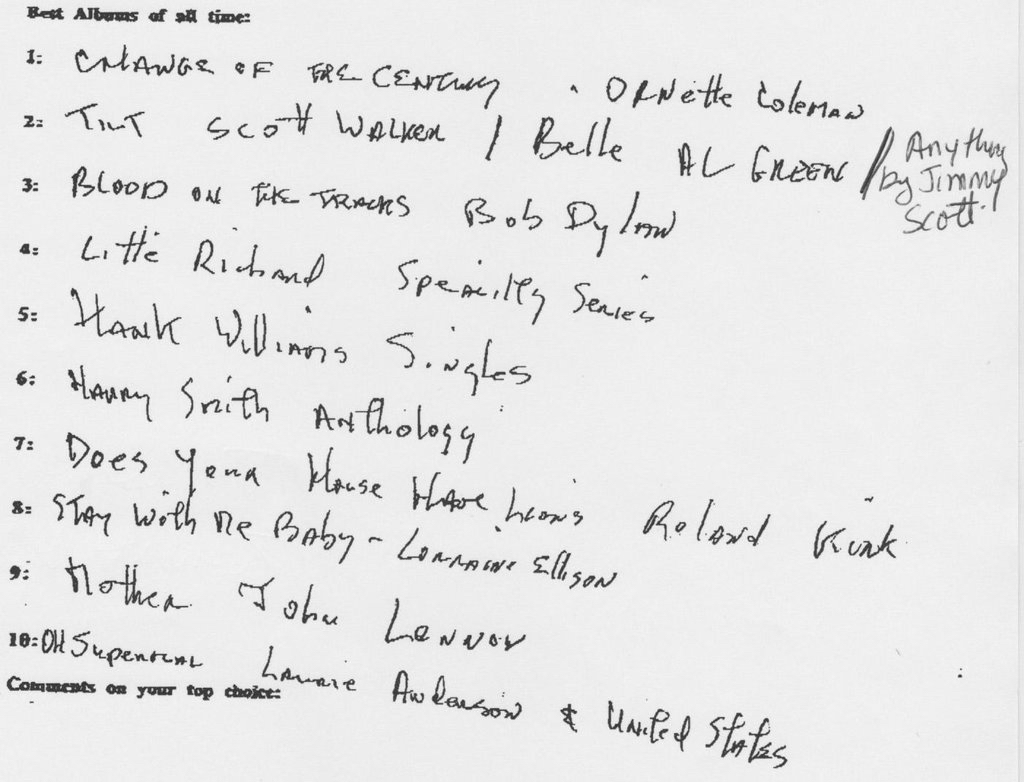
As weird as Reed was even then, he wrote immensely catchy tunes and eventually inspired several thousand punk, post-punk, alternative, and indie songwriters with the novel idea that one could make dangerous, shocking music with simple, catchy—even bubblegum—melodies. Perhaps no one had as great an effect on post-60s rock, but Reed’s own influences drew solidly from the fifties and before, as partially evidenced in his own hand, in a scrawled list of “best albums of all time,” which he submitted for a 1999 magazine interview.
1. Change of the Century—Ornette Coleman
2. Tilt—Scott Walker / Belle—Al Green / Anything by Jimmy Scott
3. Blood on the Tracks—Bob Dylan
4. Little Richard’s Specialty Series
5. Hank Williams’ Singles
6. Harry Smith Anthology
7. Does Your House Have Lions—Roland Kirk
8. “Stay with Me Baby”—Lorraine Ellison
9. “Mother”—John Lennon
10.“Oh Superman”—Laurie Anderson & United States
The list, transcribed above, includes the three-volume Specialty Sessions at number 4, a comprehensive omnibus of Little Richard hits. Below it is Hank Williams’ 3‑disc singles collection, and further down, at twice the size, Harry Smith’s enormous Anthology of American Folk Music. By far, the bulk of Reed’s suggestions saw release before he ever put pen to paper and came up with “The Ostrich.” We’re just peeking into the sixties with Ornette Colemans’ Change of the Century, at number one.
But you’ll also note that, tied at number two with Al Green’s Belle and “Anything by Jimmy Scott” (making his list of ten come out to 13), we have Scott Walker’s bizarre, experimental 1995 masterpiece Tilt (hear “Farmer in the City” further up), a return from oblivion for the reclusive sixties crooner and an album, writes Allmusic, “on a plateau somewhere between Nico’s Marble Index and Lou Reed’s Metal Machine Music.” Ever modest (he once claimed, “my bullshit is worth more than other people’s diamonds”), Reed was acutely aware of his own pivotal place in 20th century music, though he does refrain from listing one of his own records. He ends instead with the pulsing, trance-like single “Oh Superman,” by his romantic and musical partner, Laurie Anderson.
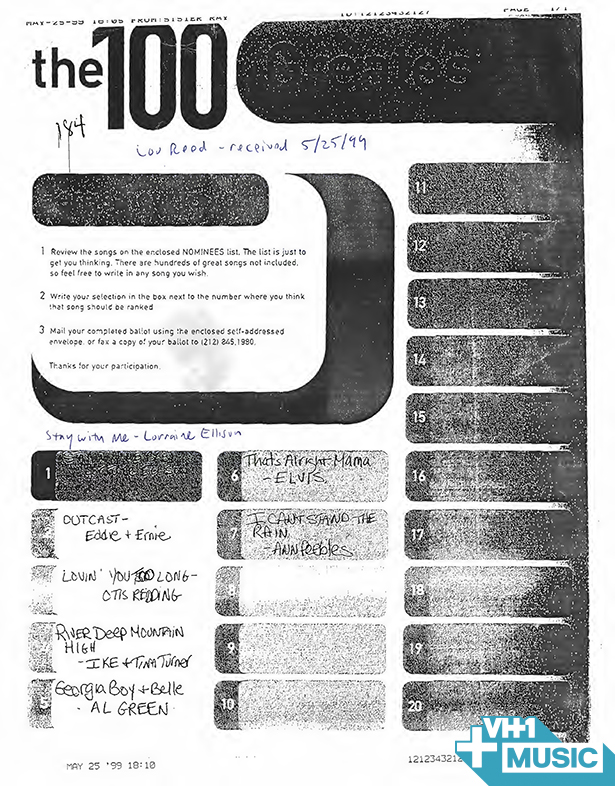
Who knows how seriously Reed took this assignment, given how much he could be “circumspect about the materials and methods of his art” in his often confrontational public statements. That same year, VH1 polled several journalists and “esteemed musicians,” writes the music channel, on their choice of the 100 greatest songs of rock and roll. “Naturally we approached Reed, who sent his choices back via fax. In true iconoclast form, instead of listing out his 100 favorite songs, he picked just eight.” Only two of the artists from his top ten appear here: Lorraine Ellison and Al Green. See his hand-written ballot above, and the eight songs listed below.
1. “Stay With Me” by Lorraine Ellison
2.“Outcast” by Eddie and Ernie
3. “Lovin’ You Too Long” by Otis Redding
4. “River Deep Mountain High” by Ike & Tina Turner
5. + 6. “Georgia Boy” and “Belle” by Al Green
7. “That’s Alright Mama” by Elvis Presley
8. “I Can’t Stand the Rain” by Ann Peebles
Related Content:
Hear Ornette Coleman Collaborate with Lou Reed, Which Lou Called “One of My Greatest Moments”
Lou Reed Reads Delmore Schwartz’s Famous Story “In Dreams Begin Responsibilities”
Josh Jones is a writer and musician based in Durham, NC. Follow him at @jdmagness
Read More...Support Us
We're hoping to rely on loyal readers, rather than erratic ads. Please click the Donate button and support Open Culture. You can use Paypal, Venmo, Patreon, even Crypto! We thank you!

About Us

Open Culture scours the web for the best educational media. We find the free courses and audio books you need, the language lessons & educational videos you want, and plenty of enlightenment in between.
Advertise With Us
FREE UPDATES!
GET OUR DAILY EMAIL
Get the best cultural and educational resources on the web curated for you in a daily email. We never spam. Unsubscribe at any time.
FOLLOW ON SOCIAL MEDIA
Open Culture editor Dan Colman scours the web for the best educational media. He finds the free courses and audio books you need, the language lessons & movies you want, and plenty of enlightenment in between.
Advertise With Us

