Hear 2,000 Recordings of the Most Essential Jazz Songs: A Huge Playlist for Your Jazz Education
If you were to ask me “What is jazz?” I wouldn’t presume to know the answer, and I’m not sure any single composition exists to which one could point to as an ideal type. Maybe the only thing I’m certain of when it comes to jazz is—to quote Wallace Stevens—“it must change.”
Of course, there’s an incredibly rich history of jazz, broadly known, especially to those who have seen Ken Burns’ expansive documentary. I’d also recommend the excellent jazz writing of Amiri Baraka, Stanley Crouch, or Philip Larkin. For the young, we might consult Langston Hughes’ illustrated jazz history. And maybe everyone should read Charles Mingus’ Grammy-nominated essay “What is a Jazz Composer?” in which the contrarian genius writes, “each jazz musician is supposed to be a composer. Whether he is or not, I don’t know.”
Mingus the iconoclast argued for tearing up the text even as he sought a classical pedigree for jazz. His wish was partly granted by the influence of jazz on composers like Leonard Bernstein, who sought to answer the question “What is Jazz?” in a 1956 spoken-word LP. The tension between jazz as a compositional or wholly improvisational art seems to resound throughout the form, in all of its many guises and variations. But one thing I think every jazz musician knows is this: Standards, a common compendium of songs in the tradition.
You’ve got to know the rulebook (or the fakebook, at the least), before you can throw it out the window. Even some of the most innovative jazz artists who more or less invented their own scales, modes, and harmonies—like Cecil Taylor and Ornette Coleman—either studied at conservatory or paid their dues as sidemen playing other people’s songs. Jazz—Coleman once told Jacques Derrida—is “a conversation with sounds.” Its underlying grammar comes from the Standards.
Until fairly recently, the only way one could get a proper education in the standards was on the job. Critic, jazz historian, and pianist Ted Gioia writes as much in his comprehensive 2012 reference, The Jazz Standards: A Guide to the Repertoire. Gioia’s “education in this music was happenstance and hard earned.” He writes, “aspiring musicians today can hardly imagine how opaque the art form was just a few decades ago—no school I attended had a jazz program or even offered a single course on jazz.”
How times have changed. These days, if you can get in, you can take graduate-level classes taught by the greats, such as Herbie Hancock and Wayne Shorter at UCLA. Hundreds more less-famous jazz musician professors stand at the ready in music departments worldwide or at the renowned Berklee College of Music.
But for those autodidacts out there, Gioia—who has served on the faculty at Stanford University and been called “one of the outstanding music historians in America”—offers an exceptional guide to the Standards, one we can not only read, but also, thanks to Jim Higgins of the Journal Sentinel, listen to, in the Spotify playlist above. (If you need Spotify’s free software, download it here.) In a companion essay, Higgins describes the process of compiling “as many of the performances [Gioia] recommended” in his commentary on 250 jazz standards.
Gioia names over 2,000 different performances of those 250 standards, and the playlist contains nearly all of them. You’ll find, for example, “several different recordings of ‘In a Sentimental Mood’ by the composer (including one with John Coltrane), as well as versions by Sonny Rollins, Art Tatum, McCoy Tyner, Abdullah Ibrahim and Buddy Tate, and Chris Potter.” While the playlist is “not a complete reflection of Gioia’s recommendations,” given that certain artists’ work cannot be streamed, “there’s a lot of music here”—a whole lot—“spanning a century.”
The experience of listening to this incredible library will not be complete without some context. Gioia’s book contains a “short historical and musical essay” on each of the 250 songs and he isn’t shy about offering incisive critical commentary. Other than going to music school or joining a touring band, I can’t think of a better way to learn the Standards.
Related Content:
Hear What is Jazz?: Leonard Bernstein’s Introduction to the Great American Art Form (1956)
Langston Hughes Presents the History of Jazz in an Illustrated Children’s Book (1955)
Josh Jones is a writer and musician based in Durham, NC. Follow him at @jdmagness.
Read More...Japanese Computer Artist Makes “Digital Mondrians” in 1964: When Giant Mainframe Computers Were First Used to Create Art
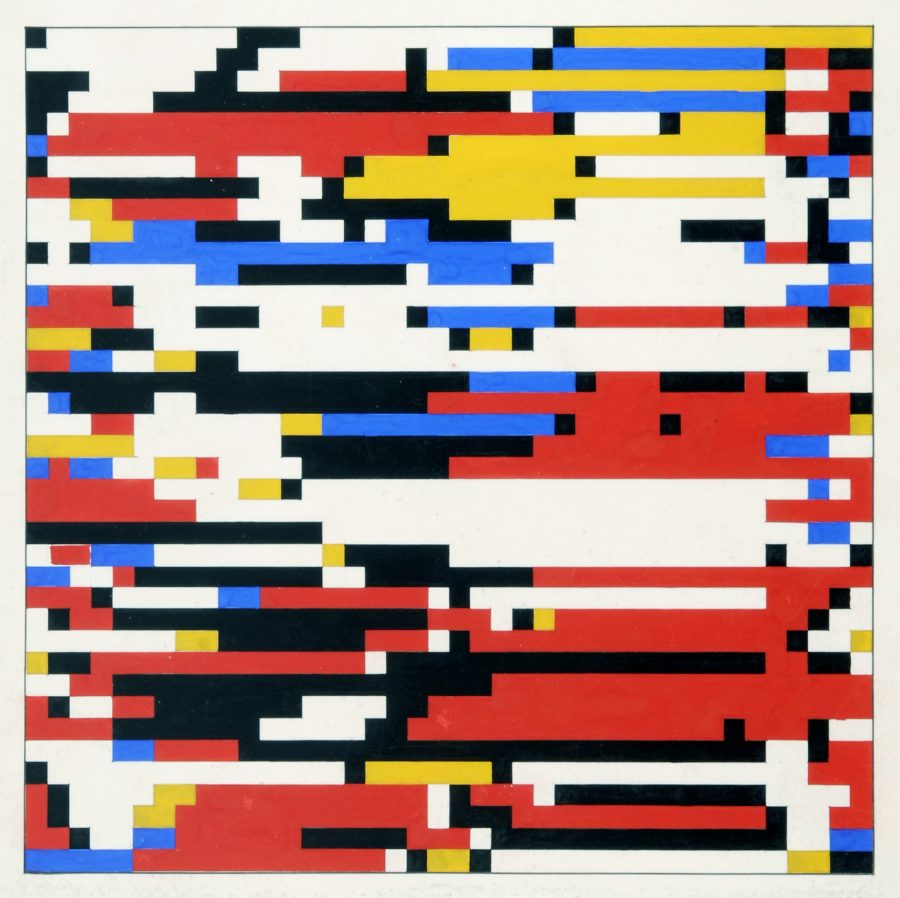
In the 21st century, most of us have tried our hand at making some kind of digital art or another — even if only touching up cellphone photos of ourselves — but imagine the task of producing it 50 years ago. To make digital art before the world had barely heard the term “digital” required access to a mainframe computer, those hugely expensive hulks that filled rooms and printed out reams and reams of paper data, and the considerable technical know-how to operate it.
But the achievement also, to go by the very early example of Hiroshi Kawano, required a background in philosophy. A graduate of the University of Tokyo majoring in aesthetics and the philosophy of science before becoming a research assistant at that school and then a lecturer at the Tokyo Metropolitan College of Air-Technology, Kawano marshaled his knowledge and experience to create these “digital Mondrians,” so described because of their computer-generated resemblance to that Dutch painter’s most rigorously angular, solidly colored work.

Kawano had drawn inspiration, according to a Deutsche Welle article on his donation of his archives to Germany’s Center for Media Art, from “the writings of the German philosopher Max Bense, who proposed (among other things) the idea of measuring beauty using scientific rules. At the same time, Kawano heard that scientists were using computers to create music. Putting the two together, he decided to explore the possibility of using a computer to program beauty.”
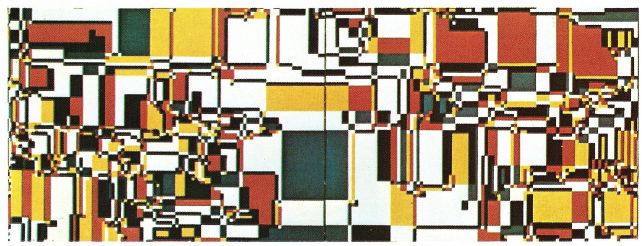
Doing so required “writing programs in complex computer languages, then laboriously punching these programs into hundreds of cards before feeding them into the machine.” And “while the design of his works produced during the 1960s might look simple — they’re not. They are the result of complex mathematical algorithms programmed so that, although Kawano sets the rules for how the picture could look, he can’t determine exactly what will appear on the printer.”
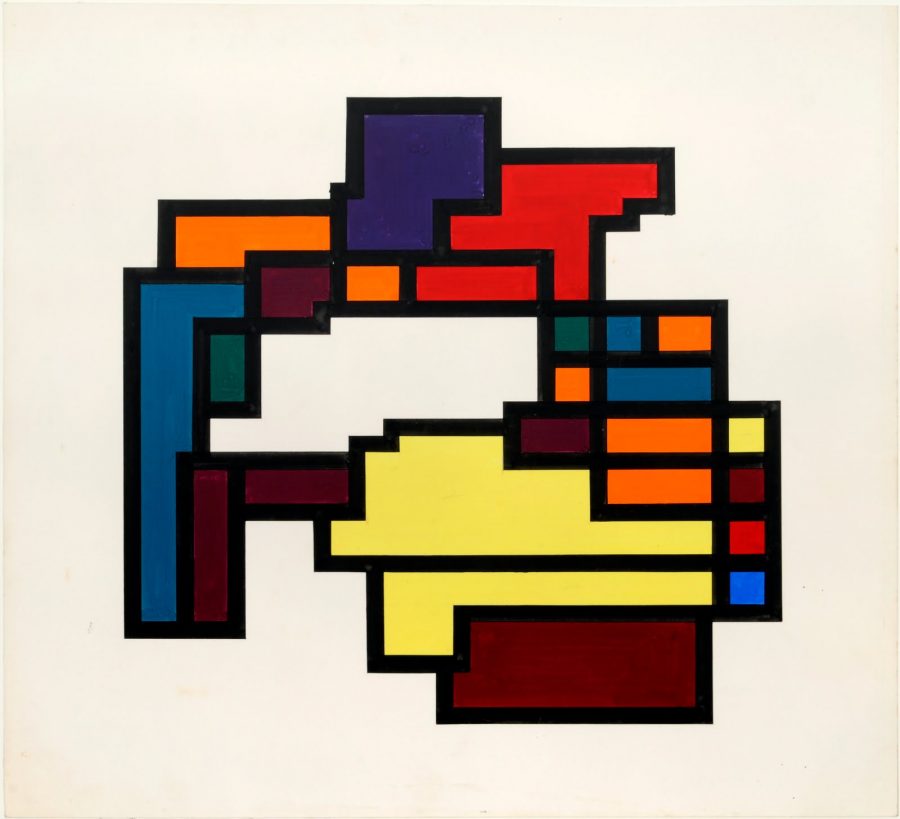
Just before Kawano passed away in 2012, the ZKM (or Center for Art and Media Karlsruhe), celebrated his pioneering digital art with the exhibition “The Philosopher at the Computer,” some of which you can see in this German-language video clip. “The retrospective emphasizes Kawano’s special role in the circle of pioneers in ‘computer art,’ ” says its introduction. “He was neither artist, who discovered the computer as a new production medium and theme, nor engineer who came to art via the new machine, but a philosopher, who left his desk for the computer center to experiment with theoretical models.”
Can computers create art? Can they even be used to create art? These questions now have practically obvious answers in the affirmative, but back in 1964 when Kawano produced the first of these pieces, working through trial and error with the advice of the curious staff of his university’s computer center, the questions must have sounded impossibly philosophical. Today, writes Overhead Compartment’s Claudio Rivera, Kawano’s digital Mondrians “suggest themselves as an oddly ephemeral transition in the nexus of technology and art. The familiar colors and forms are flash-frozen in crystalline pixelation, almost as if seized up in the final, overheated throes of a suddenly-too-old computer.”
Related Content:
Andy Warhol’s Lost Computer Art Found on 30-Year-Old Floppy Disks
Watch the Dutch Paint “the Largest Mondrian Painting in the World”
Based in Seoul, Colin Marshall writes and broadcasts on cities and culture. He’s at work on a book about Los Angeles, A Los Angeles Primer, the video series The City in Cinema, the crowdfunded journalism project Where Is the City of the Future?, and the Los Angeles Review of Books’ Korea Blog. Follow him on Twitter at @colinmarshall or on Facebook.
Read More...Dan Rather Introduces Rastafarianism to the U.S. in a 60 Minutes Segment Featuring Bob Marley (1979)
Like many people, I learned the basic tenets of Rastafarianism from Bob Marley and the Wailers, Peter Tosh, Steel Pulse, and later adopters Bad Brains. Marley’s worldwide fame not only spread the religion from Kingston to London to New York, but it also inspired no small number of non-Rastafarians to wear the Pan-African colors of red, green, and gold, grow dreadlocks, and sing about “Babylon” and “I and I.” The irony of suburban Americans in college dorms adopting the trappings of a postcolonial religion with an unabashedly anti-Western, Afrocentric core predates most recent controversies over “cultural appropriation,” but one rarely sees a better example of the phenomenon.
Consumers of Jamaican Rastafarian culture in the past few decades, however, have rarely had to go very far to find it, and to find it appealing. Since the 1960s, the struggling island nation has relied on “Brand Jamaica,” writes Lucy McKeon at The New York Review of Books, “a global brand often associated with protest music, laid-back, ‘One Love’ positivity, and a pot-smoking counterculture.” The themes most non-Rasta fans of Bob Marley derive from his music also drive a lucrative tourism industry. Both tourists and casual listeners tend to ignore the music’s esoteric theology. But reggae as party and protest music is only part of the story.
Those who dig deeper into the music’s belief system usually find it quite odd—by the standards of older religious cultures whose own oddness has long been naturalized. Rastafarians revere a recent historical figure, Ethiopian Emperor Haile Selassie (born Ras Tafari), as the messiah, based on a supposed prophecy made by influential Pan-Africanist Marcus Garvey (who also inspired the founding of the Nation of Islam). Rastafarianism is also integral not only to reggae, but to what began in the 1930s as “a fight for justice by disenfranchised Jamaicans, peasant laborers and the urban underemployed alike, in what was then a British colony.”
You will gather a little bit of this history from the video above, “The Rastafarians,” a 15-minute 60 Minutes segment from 1979 with Dan Rather. But you get it through a condescendingly prejudicial network news filter, a sensibility appalled by the movement’s blackness and poverty. Rather describes Rastafarianism’s origins among the “black masses” in “the ghetto, the slums of Kingston.” In the “squalor of these slums,” he tells his audience, poor residents found solace in the words of Garvey, “a Jamaican slumdweller.” Rather represents a view deeply concerned with the movement’s “criminal element” among “true believers” and “ghetto hustlers” alike. This rather compulsively one-note presentation hardly captures the rich history of Rastafarianism, which began not in the “slums,” but in a mountain settlement called Pinnacle in the 1930s.
In 1940—a decade into the settlement’s founding and growth into a colony of hundreds, sometimes thousands of people—a reporter named John Carradine observed, “The Rastafarians are not essentially a religious sect.… They are rather an economic community.” Founder of the Pinnacle community Leonard Percival Howell promoted what he “reportedly called ‘a socialistic life’ based on principles of communalism and economic independence from the colonial system.” Under Garvey’s tutelage, Howell had absorbed Marxist and socialist doctrine, but the religion was his own peculiar invention. Garvey dismissed it as a “cult,” and amidst its nationalism, it harbors several anti-Semitic and anti-Catholic teachings.
Like all zealous nationalist-religious movements, Rastafarians have defined themselves as much by the perceived Babylon they stand against as by the promised land they hope to inherit. Rastafarianism may have been transformed into a nationalist product, both by its most successful musicians and the tourist industry, but its association with Garvey’s ideas also links it with a Pan-Africanism that called for people of the African diaspora in Europe, the U.S., and the Caribbean to secede from oppressive colonial systems and either emigrate or form alternative, self-sufficient economies. The first Rastafarians did just that by growing ganja, and their community thrived into the mid-fifties, when government crackdowns and pressure from Winston Churchill drove them from their land and into the capital city.
The spread of the religion in Kingston coincided with an anti-colonial movement that eventually won independence in 1962, and with the blending of rural and urban musical styles happening in the midst of social and political change. All of these threads are inseparable from the burgeoning reggae scene that eventually conquered every beach town and resort across the word. As for the theology, we might say that Ethiopia’s Emperor encouraged his elevation to the role of Jah on Earth with his own creative revisionism. At his lavish and widely-publicized coronation, Rather reports, the new monarch was “crowned King of Kings, Lord of Lords, Conquering Lion of the Tribe of Judah.” Quite a bid for god-on-earthhood. And for a struggling Jamaican underclass, quite an inspiration for visions of a glorious future in a renewed African kingdom.
Related Content:
Johnny Cash & Joe Strummer Sing Bob Marley’s “Redemption Song” (2002)
Josh Jones is a writer and musician based in Durham, NC. Follow him at @jdmagness
Read More...The Pioneering Physics TV Show, The Mechanical Universe, Is Now on YouTube: 52 Complete Episodes from Caltech
In December, Caltech announced that the critically acclaimed TV series, The Mechanical Universe… And Beyond, has been made available in its entirety on YouTube. Created at Caltech and aired on PBS from 1985–86, the 52-episode series offers an introduction to college-level physics, covering everything from the scientific revolution begun by Copernicus, to quantum theory. A university web page offers more details on the production:
The series was based on the Physics 1a and 1b courses developed by David Goodstein, the Frank J. Gilloon Distinguished Teaching and Service Professor and Professor of Physics and Applied Physics, Emeritus.
Each episode opens and closes with Goodstein lecturing to his freshman physics class in 201 E. Bridge, providing philosophical, historical, and often humorous insight into the day’s topic. The show also contains hundreds of computer animation segments, created by JPL computer graphics engineer James F. Blinn, as the primary tool of instruction. Dynamic location footage and historical re-creations are also used to stress the fact that science is a human endeavor…
Although the series was designed as a college-level course, “thousands of high school teachers across the US came to depend on it for instructional and inspirational use,” Goodstein says. “The level of instruction in the US was, and remains, abysmally low, and these 52 programs filled a great void.”
You can stream all 52 episodes above. Or find them on Youtube and DailyMotion. They will also be added to our collection of Free Online Physics Courses, a subset of our collection, 1,700 Free Online Courses from Top Universities.
Visit this Caltech website to get more information on the show.
If you would like to support the mission of Open Culture, consider making a donation to our site. It’s hard to rely 100% on ads, and your contributions will help us continue providing the best free cultural and educational materials to learners everywhere. You can contribute through PayPal, Patreon, and Venmo (@openculture). Thanks!
Related Content:
The Famous Feynman Lectures on Physics: The New Online Edition (in HTML5)
Read More...John F. Kennedy Explains Why Artists & Poets Are Indispensable to American Democracy (October 26th, 1963)
The Greek word poesis did not confine itself to the literary arts. Most broadly speaking, the word meant “to make”—as in, to create anything, godlike, out of the stuff of ideas. But the English word “poetry” has always retained this grander sense, one very present for poets steeped in the classics, like Percy Shelley, who famously called poets the “unacknowledged legislators of the world” in his essay “A Defence of Poetry.” Shelley argued, “If no new poets should arise to create afresh the associations which have been thus disorganized, language will be dead to all the nobler purposes of human intercourse.”
It can feel at times, watching certain of our leaders speak, that language may be dying for “nobler purposes.” But certain poets would seek to convince us otherwise. As Walt Whitman wrote of his countrymen in an introduction to Leaves of Grass, “presidents shall not be their common referee so much as their poets shall.”
Whitman lived in a time that valued rhetorical skill in its leaders. So too did another of the country’s revered national poets, Robert Frost, who accepted the request of John F. Kennedy to serve as the first inaugural poet in 1961 with “his signature elegance of wit,” comments Maria Popova. Frost, 86 years old at the time, read his poem “The Gift Outright” from memory and offered Kennedy some full-throated advice on joining “poetry and power.”
Kennedy, an “arts patron in chief,” as the L.A. Times’ Mark Swed describes him, was so moved that two years later, after the poet’s death, he delivered an eloquent eulogy for Frost at Amherst College that picked up the poet’s theme, and acknowledged the power of poetry as equal to, and perhaps surpassing, that of politics. “Our national strength matters,” he began, “but the spirit which informs and controls our strength matters just as much.” That animating spirit for Kennedy was not religion, civil or supernatural, but art. Frost’s poetry, he said, “brought an unsparing instinct for reality to bear on the platitudes and pieties of society.”
His sense of the human tragedy fortified him against self-deception and easy consolation… it is hardly an accident that Robert Frost coupled poetry and power, for he saw poetry as the means of saving power from itself. When power leads men towards arrogance, poetry reminds him of his limitations. When power narrows the areas of man’s concern, poetry reminds him of the richness and diversity of his existence. When power corrupts, poetry cleanses. For art establishes the basic human truth which must serve as the touchstone of our judgment.
The tragedy of hubris and celebration of diversity, however, we can see not only in Frost, but in Shelley, Whitman, and perhaps every other great poet whose “personal vision… becomes the last champion of the individual mind and sensibility against an intrusive society and an officious state.” Kennedy’s short speech, with great clarity and concision, makes the case for using the country’s resources to “reward achievement in the arts as we reward achievement in business or statecraft.” But just as importantly, he argues against any kind of state imposition on an artist’s vision: “If art is to nourish the roots of our culture, society must set the artist free to follow his vision wherever it takes him. We must never forget that art is not a form of propaganda; it is a form of truth.”
You can hear Kennedy deliver the speech in the audio above, read a full transcript in English here and in 12 other languages here. In the audience at Amherst sat poet and critic Archibald MacLeish, who, in his “Ars Poetica,” had suggested that poetry should not be stripped of its sounds and images and turned into a didactic tool. Kennedy agrees. “In free society art is not a weapon and it does not belong to the spheres of polemic and ideology.” Yet poetry is not a luxury, but a necessity if a body politic is to flourish. “The nation which disdains the mission of art,” Kennedy warned, “invites the fate of Robert Frost’s hired man, the fate of having ‘nothing to look backward to with pride, and nothing to look forward to with hope.’”
Kennedy’s is a point of view, perhaps, that might get under a lot of people’s skin. It’s worth considering, as a less optimistic critic argued at the time, whether an overabundance of didactic political statements in art may be as culturally damaging as the absence of art in politics. Or whether art like Frost’s is ever “disinterested,” in Kennedy’s phrasing, or apolitical, or can operate independently as a check to power. Frost himself may express ambivalence in his embrace of “human tragedy.” But in his doubt he fulfills the poet’s role, entering into the kind of critical dialectic Kennedy claims for poetry and democracy.
Related Content:
Josh Jones is a writer and musician based in Durham, NC. Follow him at @jdmagness
Read More...Inspiration from Charles Bukowski: You Might Be Old, Your Life May Be “Crappy,” But You Can Still Make Good Art
Now more than ever, there’s tremendous pressure to make it big while you’re young.
Pity the 31-year-old who fails to make it onto a 30-under-30 list…
The soon-to-graduate high schooler passed over for YouTube stardom…
The great hordes who creep into middle age without so much as a TED Talk to their names…
Social media definitely magnifies the sensation that an unacceptable number of our peers have been granted first-class cabins aboard a ship that’s sailed without us. If we weren’t so demoralized, we’d sue Instagram for creating the impression that everyone else’s #VanLife is leading to book deals and profiles in The New Yorker.
Don’t despair, dear reader. Charles Bukowski is about to make your day from beyond the grave.
In 1993, at the age of 73, the late writer and self-described “spoiled old toad,” took a break from recording the audiobook of Run With the Hunted to reflect upon his “crappy” life.
Some of these thoughts made it into Drew Christie’s animation, above, a reminder that the smoothest road isn’t always necessarily the richest one.
In service of his ill-paying muse, Bukowski logged decades in unglamorous jobs —dishwasher, truckdriver and loader, gas station attendant, stock boy, warehouseman, shipping clerk, parking lot attendant, Red Cross orderly, elevator operator, and most notoriously, postal carrier and clerk. These gigs gave him plenty of material, the sort of real world experience that eludes those upon whom literary fame and fortune smiles early.
(His alcoholic misadventures provided yet more material, earning him such honorifics as the ”poet laureate of L.A. lowlife” and “enfant terrible of the Meat School poets.”)
One might also take comfort in hearing a writer as prodigious as Bukowski revealing that he didn’t hold himself to the sort of daily writing regimen that can be difficult to achieve when one is juggling day jobs, student loans, and/or a family. Also appreciated is the far-from-cursory nod he accords the therapeutic benefits that are available to all those who write, regardless of any public or financial recognition:
Three or four nights out of seven. If I don’t get those in, I don’t act right. I feel sick. I get very depressed. It’s a release. It’s my psychiatrist, letting this shit out. I’m lucky I get paid for it. I’d do it for nothing. In fact, I’d pay to do it. Here, I’ll give you ten thousand a year if you’ll let me write.
Related Content:
4 Hours of Charles Bukowski’s Riotous Readings and Rants
Hear 130 Minutes of Charles Bukowski’s First-Ever Recorded Readings (1968)
Ayun Halliday is an author, illustrator, theater maker and Chief Primatologist of the East Village Inky zine. Follow her @AyunHalliday.
Read More...Rick Wakeman’s Prog-Rock Opera Adaptation of George Orwell’s 1984
We’ve seen sales of George Orwell’s dystopian nightmare scenario 1984 peak in recent months. Millions of readers seek to understand the brave new world we live in through Orwell’s vision. Parallels abound. We might reasonably ascribe to the ruling party in the U.S. and its media apparatus the slogan “IGNORANCE IS STRENGTH.” But our experience of reality never fails to validate that old saw about truth and fiction. As Case Western Reserve professor of history John Broich writes, “2017 is stranger than Orwell imagined.”
The state doesn’t need a Ministry of Truth to censure the information that reaches us. We are simply overwhelmed with “alternative authorities and realities” who delegitimize the facts and accelerate “the decline in standards of evidence and reasoning in the US electorate.” A sad state of affairs. But in every decade since the publication of Orwell’s novel, critics, journalists, and pundits have seen evidence of his dire forecast. In the titular year itself, Manhattan College professor Edmond van den Bossche summed up the general tenor in The New York Times: “In our 1984… the warnings of George Orwell are more than ever relevant.”
Van den Bossche wrote of NATO and the UN. But he might have written about MTV and CNN— both in their infancy—who birthed 24-hour cable news and reality TV. What Orwell understood about state power, later thinkers like Guy DeBord, Roland Barthes, and Jean Baudrillard built careers writing about: the importance not only of surveillance, but also of spectacle that blurs the lines of truth and fiction as it overwhelms our senses. It’s largely this key theme, I’d argue, that has rendered 1984 so attractive to some of the most spectacular of musicians, including David Bowie—whose attempts to make an Orwell concept album formed part of his Diamond Dogs—and Rick Wakeman, the virtuoso prog-rock keyboardist of Yes fame.
After releasing as a solo artist such rock-literary adaptations as 1974’s Journey to the Center of the Earth and the following year’s The Myths and Legends of King Arthur and the Knights of the Round Table, Wakeman turned Orwell’s classic into a rock opera. The 1981 production is an extravaganza of musical excess, with lyrics and vocals by Tim Rice, riveting performances by Chaka Khan (above) and Wakeman’s former Yes bandmate Jon Anderson, and eclectic orchestral instrumentation woven in with Wakeman’s battery of keyboards and synthesizers. The record has become a fan favorite and Allmusic describes it as one of Wakeman’s “most well-rounded albums.”
The perfectionistic Wakeman himself looks back on his 1984 with embarrassment. “In retrospect, a mistake,” he has said. “The wrong album at the wrong time, with all the wrong people around at the time…. I formed the wrong band, (the worst I have ever had), the deal for the stage show fell through and all in all I listen back to the music with my head in my hands.” Luckily, we are not bound to respect an artist’s assessment of his work. Wakeman’s music and Rice’s lyrics take the leaden, gray world of Winston Smith and Julia and turn it into a carnival, moving from soaring ballads to rockers with the sneering vaudevillian satire of The Rocky Horror Picture Show. (See especially “The Proles,” above, the penultimate number before the final title track.)
Orwell’s novel is not what one would call an entertaining book; it is gloomy—though not without its own kind of dark humor—and its monochromatic tone was perfectly captured by Michael Radford’s 1984 film adaptation. But it heavily suggested the world to come, one constantly illuminated and obscured by mass media, with screens in every home and pocket, forever broadcasting some colorful distraction. In the videos above, you’ll see excerpts from the movie mixed with dazzling live performance footage of Wakeman and band playing their 1984 live, synced to the studio recordings, courtesy of Youtuber ROLT (Ronaldo Lopes Teixeira.) Watch his full project at the top of the post. The mash-up suitably shows how these very different interpretations—the more straightforwardly dour and the prog-rock operatic—somehow both do justice to Orwell’s prescient novel. Just above, you can hear Wakeman’s full album on Spotify (whose software you can download for free here).
Related Content:
George Orwell’s 1984 Staged as an Opera: Watch Scenes from the 2005 Production in London
Josh Jones is a writer and musician based in Durham, NC. Follow him at @jdmagness
Read More...Discover the Creative, New Philosophy Podcast Hi-Phi Nation: The First Story-Driven Show About Philosophy
Let me call your attention to a new and quite different philosophy podcast. Created by Barry Lam (Associate Professor of Philosophy at Vassar College), Hi-Phi Nation is a philosophy podcast “that turns stories into ideas.” Consider it “the first sound and story-driven show about philosophy, bringing together narrative storytelling, investigative journalism, and soundtracking.”
Above you can watch a trailer that introduces Hi-Phi Nation, which is now available on iTunes, Google Play, Soundcloud and this website. Below, hear Episode 9 of Season 1, called “The Ashes of Truth.” Among other things, it features filmmaker Errol Morris.
The first season of Hi-Phi Nation has been made possible by the National Endowment for the Humanities, The Center for Documentary Studies at Duke University, the Humanities-Writ Large Fellowship, and other institutions. Learn more about the show by reading these write-ups by Vassar and Princeton.
If you would like to support the mission of Open Culture, consider making a donation to our site. It’s hard to rely 100% on ads, and your contributions will help us continue providing the best free cultural and educational materials to learners everywhere. You can contribute through PayPal, Patreon, and Venmo (@openculture). Thanks!
Related Content:
Free Online Philosophy Courses
The History of Philosophy … Without Any Gaps
A History of Philosophy in 81 Video Lectures: From Ancient Greece to Modern Times
The History of Philosophy Visualized
Read More...How Henry David Thoreau Revolutionized the Pencil
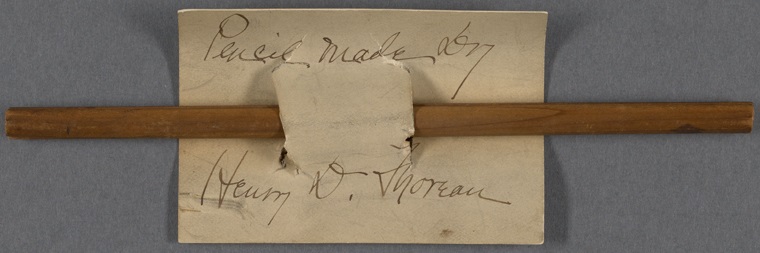
Last Thursday was National Pencil Day, which commemorates, according to The New York Public Library (NYPL), “the day in 1858 when Philadelphia immigrant Hymen Lipman patented his invention for a pencil with an eraser on top, creating the conveniently-designed pencil we know and love.”
Of course, Lipman’s invention didn’t take place in a vacuum. Throughout the 18th and 19th centuries, American inventors were hard at work, trying to find ways to make improvements to the pencil, whose history traces back to 1564. During those early days of our republic, “American pencil-making was in sorry shape,” writes NYPL. “Poor materials made domestic pencils smudgy and frail, in comparison to their superior British counterparts, which were made of purer graphite.” So the pressing question became: how to improve the quality of the graphite? Enter Henry David Thoreau, America’s great essayist, poet, philosopher, abolitionist, naturalist and tax resister. And apparently innovator too:
Seeking employment after studying at Harvard, [Thoreau] worked at his father’s pencil factory, which Edward Emerson — son of Ralph Waldo Emerson — recalled as being somewhat better than the typical American pencil factory at the time. Still, Henry David Thoreau aspired to improve the family business, so he hit the books at the Harvard College library to find out more.
…Having no knowledge of chemistry, Henry David nevertheless came up with a formula to make a pencil rivaling that made in Europe. It was the first of its kind in America.
Soon, Thoreau pencils were taking over the market, and the family’s business grew and grew. Thoreau pencils were awarded twice by Mechanic Associations and gained a local reputation in Boston for their quality. Ralph Waldo Emerson himself praised them. News of Thoreau’s pencils spread quickly, and soon, Petroski writes, they were “without peer in this country.”
Add an eraser to Thoreau’s pencil, and you’ve got Hymen Lipman’s patent for the pencil you’re pretty much using today. You can see pictures of Thoreau’s pencil over at The New York Public Library.
If you would like to support the mission of Open Culture, consider making a donation to our site. It’s hard to rely 100% on ads, and your contributions will help us continue providing the best free cultural and educational materials to learners everywhere. You can contribute through PayPal, Patreon, and Venmo (@openculture). Thanks!
Related Content:
Henry David Thoreau on When Civil Disobedience and Resistance Are Justified (1849)
David Rees Presents a Primer on the Artisanal Craft of Pencil Sharpening
David Rees and His One-Man Artisanal Pencil Sharpening Service
Read More...Harvard Students Launch a Free Course on How to Resist: Now You Can Watch the Lectures
NOTE: As of July 22, we updated this post to include the videos from the class sessions. Watch the playlist of lectures above.
I have my doubts about whether we should call regular acts of civic duty “resistance,” rather than Constitutionally-protected democratic freedoms. Yesterday we remembered Martin Luther King, Jr. on the 49th anniversary of his assassination (and the 50th anniversary of his speech opposing the Vietnam War). As King and countless other civil rights and anti-war campaigners have demonstrated—some at the cost of their lives—civil disobedience is very often required and morally justified when legal appeals for justice fail. But for better or worse, “The Resistance” has become a catch-all media term for a loose and very often fractious collection of mainstream Democrats, progressives, and radicals of all stripes, whose tactics range from polite phone lobbying to brawling with white supremacists in the streets.
Millions of people who formerly had little to no involvement in politics have thrown themselves into activism, and veteran organizers have been overwhelmed with new recruits. Just as quickly, those organizers have met the challenge by disseminating guides for lobbying representatives, running for office, and participating in more direct forms of action.
Every movement has its resident scholars and educators, whether they be erudite laypeople, professional academics, or enterprising college students. A group from the latter category, “progressive students,” writes CNN, from Harvard’s Kennedy School of Government, begin today what they’re calling “Resistance School,” a “4‑week course in anti-Trump activism… open to people across the country and the world.” (You can watch the video from the course above.)
At their site, the students bill “Resistance School” as a series of “practical skills for taking back America” and open their online syllabus with a quote spuriously attributed to Thomas Jefferson: “When injustice becomes law, resistance becomes duty.” It’s possible that whoever said it had bloodier things in mind. Resistance School sticks to peaceful means, with four sessions that teach, in order, “How to Communicate our Values in Political Advocacy,” “How to Mobilize and Organize our Communities,” “How to Structure and Build Capacity for Action,” and “How to Sustain the Resistance Long-Term.” Instructors are drawn from the ranks of academia, labor organizing, and the Obama administration, and you can stream the sessions on the school’s site or on Facebook, or attend in person.
The Resistance School is sure to attract criticism, not only from the expected sources but from more anti-establishment factions on the left. But that may be unlikely to deter the more than 10,000 people who have registered for the first class. Organizers have encouraged people to attend in groups, and currently have about 3,000 groups enrolled. “Some are coming with groups of 700 people,” says co-founder Shanoor Seervai, “some are smaller groups, potlucks, gathering in people’s kitchens.”
Servaai and fellow Kennedy School students have been taken aback and are now, writes CNN, “grappling with questions of scale.” How, they wonder, will such large numbers of people coordinate; how to measure the impact of the program?.… questions, perhaps, they will resolve by the fourth session, “How to Sustain the Resistance Long-Term.” But they’re certainly not alone in trying to steer a massive surge of new interest in activism and electoral politics. As the millions now planning and participating in civil actions across the country attest, people have begun to take to heart sentiments recently expressed by organizer Alice Marshall: “If we wait for some great leader to save us we are lost. We have to save ourselves.”
Related Content:
Henry David Thoreau on When Civil Disobedience and Resistance Are Justified (1849)
Josh Jones is a writer and musician based in Durham, NC. Follow him at @jdmagness
Read More...Support Us
We're hoping to rely on loyal readers, rather than erratic ads. Please click the Donate button and support Open Culture. You can use Paypal, Venmo, Patreon, even Crypto! We thank you!

About Us

Open Culture scours the web for the best educational media. We find the free courses and audio books you need, the language lessons & educational videos you want, and plenty of enlightenment in between.
Advertise With Us
FREE UPDATES!
GET OUR DAILY EMAIL
Get the best cultural and educational resources on the web curated for you in a daily email. We never spam. Unsubscribe at any time.
FOLLOW ON SOCIAL MEDIA
Open Culture editor Dan Colman scours the web for the best educational media. He finds the free courses and audio books you need, the language lessons & movies you want, and plenty of enlightenment in between.
Advertise With Us

