Watch a 2‑Year-Old Solve Philosophy’s Famous Ethical “Trolley Problem” (It Doesn’t End Well)
“A runaway train is heading towards five workers on a railway line. There’s no way of warning, but you’re standing near a lever that operates some points. Switch the points, and the train goes down a spur. Trouble is, there’s another worker on that bit of track too, but it’s one fatality instead of five. Should you do that?” Here we have the trolley problem, which since its first articulation in 1967 by Philippa Foot has become the classic example of an ethical dilemma as well as perhaps the best known thought experiment in all of philosophy.
This explanation of the trolley problem comes from one of the Harry Shearer-narrated BBC- and Open University-made animations previously featured here on Open Culture. The short video above takes a different approach, not just using a children’s train set to illustrate it but then putting the famous question to the child himself.
“Uh oh, Nicholas,” says the two-year-old’s father from behind the camera, “this train is going to crash into these five people! Should we move the train to go this way, or should we let it go that way?” The elegance of the toddler’s solution, implemented without hesitation, must be seen to be appreciated.
The father, E. J. Masicampo of Wake Forest University, researches “the effortful mental processes that seem to separate humans from other animals: resisting temptations and impulses, reasoning and decision making, thinking about and simulating non-present events, and making plans for the future.” Among his professional goals, he lists working toward “a theory of the human consciousness” by uncovering “how conscious thought contributes to human functioning in light of its apparent limitations.” He’s taken on a problem even harder than the one with the trolleys; perhaps young Nicholas, what with his demonstrated gift of “thinking outside the box,” invaluable in the philosophical disciplines, can offer some assistance.
Related Content:
Free Online Philosophy Courses
9‑Year-Old Philosopher Ponders the Meaning of Life and the Universe
Are You a Psychopath? Take the Test (And, If You Fail, It’s Not All Bad News)
The Epistemology of Dr. Seuss & More Philosophy Lessons from Great Children’s Stories
Based in Seoul, Colin Marshall writes and broadcasts on cities and culture. He’s at work on a book about Los Angeles, A Los Angeles Primer, the video series The City in Cinema, the crowdfunded journalism project Where Is the City of the Future?, and the Los Angeles Review of Books’ Korea Blog. Follow him on Twitter at @colinmarshall or on Facebook.
Read More...From Caligari to Hitler: A Look at How Cinema Laid the Foundation for Tyranny in Weimar Germany
When I first got into film criticism and was finally in a college town with a decent used bookshop, Siegfried Kracauer’s From Caligari to Hitler: A Psychological History of the German Film was in that first huge batch of books I bought to place on my shelf. I had just watched The Cabinet of Dr. Caligari (watch it online here) for the first time, and had seen the book referenced often. Alas, it also sat on my shelf unread, along with some other thick critical tomes.
But needless to say, I guess I’m okay with that now, for Kyle Kallgren’s 16 minute distillation of Kracauer’s influential 1947 book does an amazing job of explaining the critic’s main thesis–that the kinds of heroes and villains, along with the kind of stories that were successful in Weimar-era Germany, were laying the psychological groundwork for the rise of fascism and Hitler. Because films are a mass medium that take a mass of people to make and consume, they reveal the subconscious mind of its society. Kracauer wasn’t saying that the creators were anti-Semitic or Nazi sympathizers. In fact, Weimar’s best known directors fled the Nazis and made films in America. But there was something in the air, so to speak, that in retrospect made Hitler seem like an inevitable real-world outcome of these various forces.
Kracauer’s thesis was influenced by the writers and philosophers of the Frankfurt School, who posited that a “culture industry” of mass-produced art helped reinforce a stamping out of identity. Anti-Marxists may call this passé, but we still talk about these ideas whenever there’s a think piece about violence in the movies reflecting a violent culture—but usually the wrong way around, suggesting that violent movies create violent people. Or look at how each version of Batman is seen as reflecting concerns of the time in which it is made.
As Kallgren says in his brief video description, “I felt a strong need to make this one.” After he sums up Kracauer’s work he tracks the paths of those directors and stars of Weimar Germany—I forgot that the sleepwalking Cesare of Caligari was played by the same actor who plays the Nazi major in Casablanca—he turns to America, circa 2016, in particular post-election. This is not explicitly to compare a certain person to Hitler, going full Godwin. But rather, Kallgren looks to our own blockbusters, our stories, our own culture industry to see what greater narrative is going on here. The contradictions come thick and fast at the end, and will provide much to debate.
As a side note, Kallgren’s work shows the power of video essays to bring alive and resuscitate major works of cultural criticism. We hope he and others start to adapt other works in the future.
Many of the films referenced in this video essay– like Caligari, Nosferatu and Metropolis–can be found in our collection, 4,000+ Free Movies Online: Great Classics, Indies, Noir, Westerns, Documentaries & More.
Related Content:
Metropolis: Watch Fritz Lang’s 1927 Masterpiece
Watch Nosferatu, the Seminal Vampire Film, Free Online (1922)
Watch The Cabinet of Dr. Caligari, the Influential German Expressionist Film (1920)
How German Expressionism Influenced Tim Burton: A Video Essay
Where Horror Film Began: The Cabinet of Dr. Caligari
Ted Mills is a freelance writer on the arts who currently hosts the FunkZone Podcast. You can also follow him on Twitter at @tedmills, read his other arts writing at tedmills.com and/or watch his films here.
Read More...The Birth Control Handbook: The Underground Student Publication That Let Women Take Control of Their Bodies (1968)
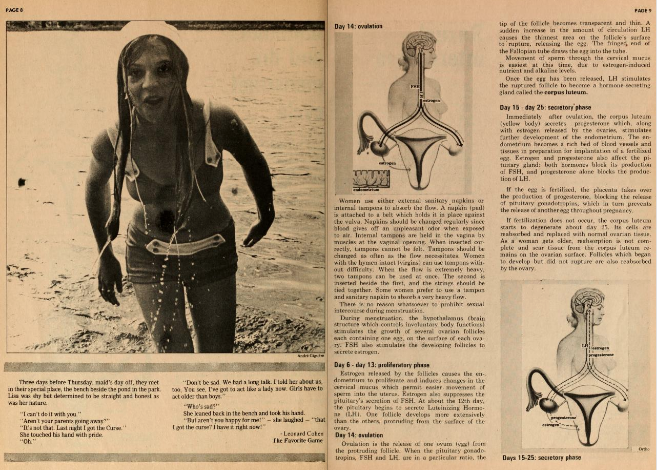
Central to Michel Foucault’s theory of “governmentality” is what he calls “biopower,” an “explosion of numerous and diverse techniques for achieving the subjugations of bodies and the control of populations.” Where debates over abortion and contraception generally coalesce around questions of religion and rights, the French theorist of power saw these issues as part of the bio-political struggle between “governing the self” and “governing others.”
Those who resist repressive biopower seize on the former definition of government. Take a very pointed example of both restrictive government biopower and creative resistance to the same: the 1968 Birth Control Handbook you see here, printed illegally by undergraduate students at Montreal’s McGill University. At the time of this text’s creation, notes Atlas Obscura, “under Canada’s Criminal Code, the dissemination, sale, and advertisement of birth control methods were all illegal, and abortion was punishable by life imprisonment.”
Despite facing the possible consequences of up to two years in prison, the McGill Student Society “sold millions of copies” of The Birth Control Handbook, writes Amanda Edgley, “in Canada and internationally.” Maya Koropatnitsky describes the tremendous social impact of the handbook:
Students at McGill as well as other Quebec campuses snapped up the first run of 17,000 copies. Due to its major success, the committee came out with a second issue of the handbook in 1969. This handbook is seen to be a major player in women’s liberation because it gave young women the knowledge and the ability to control reproductive functions.
The handbook furthermore “mobilized women into forming meetings and groups to talk about consciousness-raising issues.” This informal education was invaluable for millions of women, who were “desperate for this information,” writes author Laura Kaplan, “so starved for information. You wanted it, in as much detail as you could get it, as graphic as it could be made.”
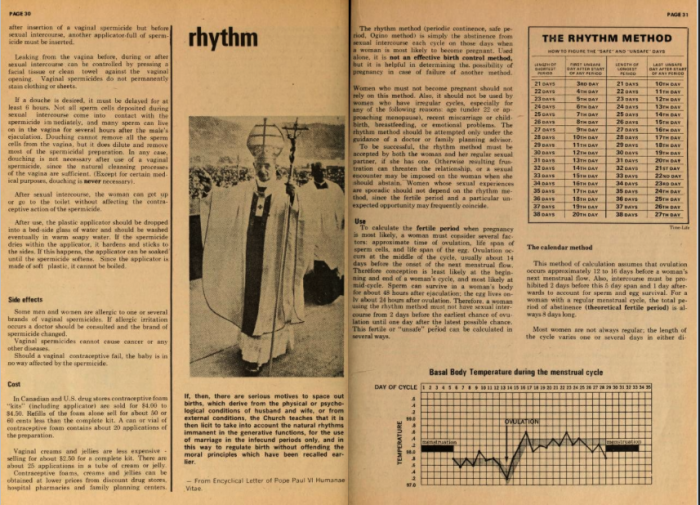
What the Canadian, and U.S., governments saw as sexually explicit will look to us like standard biology textbook illustrations, mundane charts and graphs, ordinary pictures of the birth experience, and tasteful, rather tame nude photos. Original authors Allan Feingold and Donna Cherniak “pored through books in the medical library,” Atlas Obscura writes, “and consulted medical advisors, compiling detailed information on topics like sexual intercourse, menstrual cycles, surgical abortion techniques (accompanied by prices and statistics), and how, exactly, to contact abortion providers.”
Illustrating another Foucauldian insight into the relationship between knowledge and power, not only were birth control methods under the strict control of mostly male doctors (and only available with permission from a husband), but even basic information on reproduction and birth control was difficult for most women to access. “To have all the information on the various methods of birth control in one place,” says Kaplan, “with pros and cons and what you needed to know about them, was a revelation.” Cherniak later remembered, “We joked that after the Bible, we were probably one of the most widely distributed publications in Canada.”
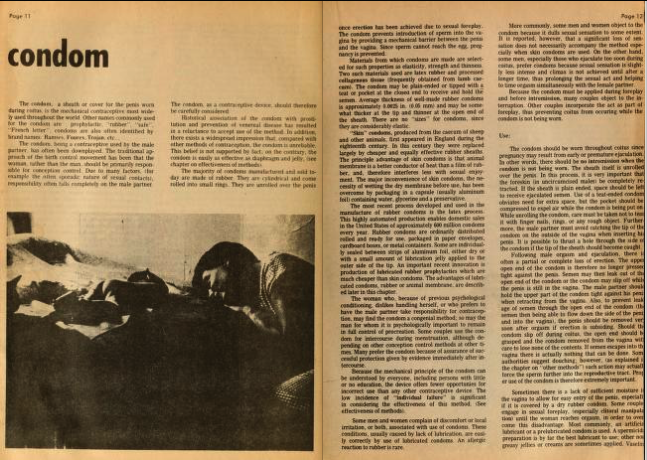
Both editions of the handbook addressed the controversial topic of abortion, citing the Canadian criminal code along the way. “Concerned with the problem of illegal abortion,” writes University of Ottowa professor Christabelle Sethna, “the council mandated the publication” of the handbook, which also “contained editorial commentary that took Western population-control experts to task for their racism and that supported women’s reproductive rights as a function of women’s liberation.” Sethna situates The Birth Control Handbook within a much larger Canadian movement, just “one of the ways,” writes Edgeley, “Canadians took control over their own bodies.” Its creators saw it as a means of changing the world. “Those were the years,” Cherniak says, “in which you thought you could do anything.”
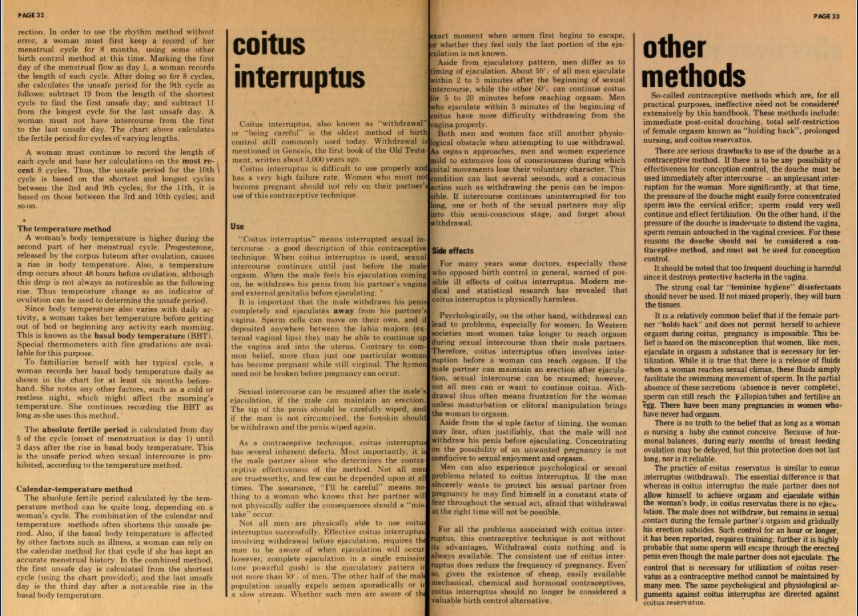
Two years after the first print run of The Birth Control Handbook, the ur-text of feminist bio-politics, Our Bodies, Ourselves, was published by the Boston Women’s Health Book Collective. This book “became its own widely circulated women’s health text,” Atlas Obscura writes, “translated into 29 languages.” But while Our Bodies, Ourselves remains famous for its key role in spreading much-needed information about reproductive health, “its Canadian counterpart has been mostly forgotten.” The Birth Control Handbook gave millions of women the information they needed to govern their own lives. Rediscover the complete text of the first, 1968 edition and second, 1969 edition at the Internet Archive, where you can see a scan, read transcribed full text, and download PDF, Kindle, and other formats.
via Atlas Obscura
Related Content:
Download All 239 Issues of Landmark UK Feminist Magazine Spare Rib Free Online
Simone de Beauvoir Explains “Why I’m a Feminist” in a Rare TV Interview (1975)
The Story Of Menstruation: Watch Walt Disney’s Sex Ed Film from 1946
Watch Family Planning, Walt Disney’s 1967 Sex Ed Production, Starring Donald Duck
Josh Jones is a writer and musician based in Durham, NC. Follow him at @jdmagness
Read More...Tim Robbins’ Improv Classes Transform Prisoners’ Lives & Lower Recidivism Rates
If a 20‑something, Yale-educated New Yorker reporter feels nervous stepping in to her first ever improv class, imagine the stakes for your average inmate, whose survival depends on a successfully monolithic projection of toughness and control.
Control is actually something the Actors’ Gang Prison Project seeks to cultivate in its incarcerated participants. The Actors’ Gang’s Artistic Director, Tim Robbins, who founded the radically experimental ensemble fresh out of college, notes a well-documented connection between an inability to control one’s emotions and criminal activity.
Unchecked rage may have put these players behind bars, but exploring a wide variety of emotions behind the safety of the Actors’ Gang’s mask-like white pancake make-up has proven liberating.
The dull prison routine leaves prisoners favorably inclined toward any diverting activity, particularly those that allow for creative expression. Shakespeare has made an impact on this population. Why not commedia dell’arte-influenced improv?
It’s a truly therapeutic fit, as Actors Gang ensemble member Sabra Williams, the founder of the Prison Project, explains in her TED Talk, below.
Participants are subjected and held to the rigorous physicality and emotional honesty at the core of this group’s aesthetic. Personal connection to the visitors is limited to whatever may transpire in-the-moment, but within the prison population, relationships blossom. Both guards and prisoners speak of newfound empathy.
The emotional insights arising from these spontaneous explorations teach participants how to diffuse aggressive situations, present a more positive face to the world, and interact generously with others. In between classes, participants write in journals, with a goal of sharing aloud.
Gang signs, mimed weapons, and bodily contact are out of bounds. Wild invention often carries the day.
Participants have zero recidivism, and a waiting list in the hundreds attests to the program’s popularity.
You can learn more about the Actors’ Gang ten-year-old Prison Project here.
Related Content:
B.B. King Plays Live at Sing Sing Prison in One of His Greatest Performances (1972)
Inmates in New York Prison Defeat Harvard’s Debate Team: A Look Inside the Bard Prison Initiative
What Prisoners Ate at Alcatraz in 1946: A Vintage Prison Menu
Ayun Halliday is an author, illustrator, theater maker and Chief Primatologist of the East Village Inky zine. Her play Zamboni Godot is opening in New York City in March 2017. Follow her @AyunHalliday.
Read More...Hear a 20 Hour Playlist Featuring Recordings by Electronic Music Pioneer Pauline Oliveros (RIP)
We can all surely recite some version of the difference between listening and hearing. It’s usually explained by a parent or guardian, with the intent of making us better at following instructions. On the whole, it’s for our own good as children that we pay heed to our elders. But genuine, critical listening is about so much more than perceiving gestures of authority. The avant-garde composer Pauline Oliveros, who died this past Thursday at 84, would argue that true listening, what she called “deep listening,” opens us up in radical ways to the world around us, and frees us from the sociopolitical constraints that hem in our senses. “Take a walk at night,” says one Oliveros’ 1974 “Sonic Meditations,” a set of 25 instructions for deep listening, “Walk so silently that the bottom of your feet become ears.”
“Sonic Meditations” emerged after “a period of intense introspection prompted by the Vietnam War,” writes Steve Smith in a New York Times obituary, during which Oliveros “changed creative course” to begin favoring improvisatory works. “All societies admit the power of music or sound,” she wrote in the preface.
“Sonic Meditations,” wrote Oliveros, “are an attempt to return the control of sound to the individual alone, and within groups especially for humanitarian purposes; specifically healing.” Her approach represented the composer giving up control and the primacy of authorship in order to play other roles: healer, guide, and teacher, a role she inhabited for decades as a college professor and author of several books of musical theory.
As you can see in her TEDx lecture at the top of the post, Oliveros always returned from her sonic explorations—such as the 1989 recording titled Deep Listening (hear an excerpt below)—with lessons for us in how to become better, more engaged and empowered listeners, rather than distracted consumers, of music and sound. Even before the 70s, and her turn to music as a meditative discipline informed by Buddhism and Native American ritual, Oliveros’ work disrupted the usual hierarchies of sound. An early adopter of technology, she “was quickly at the vanguard of electronics,” wrote Tom Service in a 2012 Guardian profile, but her “relationship with technology is philosophically ambivalent” given the role of research and development in creating weapons of war.
In early compositions like 1965’s “Bye Bye Butterfly,“ the composer “manipulated a recording of Puccini’s opera ‘Madama Butterfly’ on a turntable,” Smith writes, “augmenting its sounds with oscillators and tape delay.” In the beautifully moving results, further up, she aimed for a critique that “bids farewell not only to the music of the 19th century,” she wrote, “but also to the system of polite morality of that age and its attendant institutionalized oppression of the female sex.” Music has always been produced and consumed within the social constructions of gender binaries, Oliveros maintained. In a 1970 New York Times essay “And Don’t Call Them ‘Lady’ Composers,” she observed that “unless she is super-excellent, the woman in music will always be subjugated, while men of the same or lesser talent will find places for themselves.”
Throughout her long career, Oliveros created a place for herself, with as much theoretical rigor, playfulness, elegance, and sophistication as her friend and contemporary John Cage. That her substantial body of work has received a fraction of the attention as his may offer an instructive gloss on her contentions of persistent bias. But Oliveros’ work was not reactive; it was constructive, such that her concepts gave rise to what she called a Deep Listening Institute, an “ever-growing community of musicians, artists, scientists, and certified Deep Listening practitioners,” who strive “for a heightened consciousness of the world of sound and the sound of the world.”
But you don’t need specialized certification or training to experience the meditative, consciousness-expanding techniques of Oliveros’ music. On the contrary, she sought to foster “creative innovation across boundaries and across abilities, among artists and audience, musicians and nonmusicians, healers and the physically or cognitively challenged, and children of all ages.” In the Spotify playlist above, hear—or rather listen to—20 hours of Oliveros compositions, many featuring her early experiments with analog electronics, her “expanded instrument system,” and her signature instrument, a digitally-enhanced accordion.
As in the orchestral movement of Deep Listening, the album, Oliveros frequently dialogues with musical traditions, but she refused to allow them any particularly elevated authority over her work. “I’m not dismissive of classical music and the Western canon,” she said in 2012, “It’s simply that I can’t be bound by it. I’ve been jumping out of categories all my life.” As listeners, and readers, of her work, we can all learn to do the same.
Related Content:
The Music of Avant-Garde Composer John Cage Now Available in a Free Online Archive
Josh Jones is a writer and musician based in Durham, NC. Follow him at @jdmagness
Read More...An Animated Introduction to George Orwell
When his short and (by his own account) often miserable life came to an end in 1950, could the English political writer Eric Arthur Blair have known that he would not just become a household name, but remain one well over half a century later? Given his adoption of the memorable nom de plume George Orwell, we might say he had an inkling of his literary legacy’s potential. Still, he claimed to choose it for no grander reason than that it sounded like “a good round English name,” and would have loathed the pretense he sensed in the use of the phrase “nom de plume,” or, for that matter, any other of conspicuously foreign provenance.
The attitudes that shaped the author of Animal Farm and 1984 come out in this animated introduction to Orwell’s life and work, newly published by Alain de Botton’s School of Life. In explaining the motivations of this “most famous English language writer of the 20th century,” de Botton quotes from the essay “Why I Write,” wherein Orwell, with characteristic clarity, lays out his mission “to make political writing into an art. My starting point is always a feeling of partisanship, a sense of injustice. When I sit down to write a book, I do not say to myself, ‘I am going to produce a work of art.’ I write it because there is some lie that I want to expose, some fact to which I want to draw attention, and my initial concern is to get a hearing.”
Orwell hated his fellow intellectuals, whom he accused of “a range of sins: a lack of patriotism, resentment of money and physical vigor, concealed sexual frustration, pretension, and dishonesty.” He loved “the ordinary person” and the lives led by those “not especially blessed by material goods, people who work in ordinary jobs, who don’t have much of an education, who won’t achieve greatness, and who nevertheless love, care for others, work, have fun, raise children, and have large thoughts about the deepest questions in ways Orwell thought especially admirable.” Though raised middle-class and educated at Eton, Orwell eschewed university and believed that “the average pub in a coal-mining village contained more intelligence and wisdom than the British Cabinet or the high table of an Oxbridge college.”
One might want to call such an intellectual a poseur or even a sort of fetishist, but Orwell backed up his pronouncements about the superiority of the working class with his years spent living and working in it, and, with books like Down and Out in Paris and London and The Road to Wigan Pier, writing about it. He praised newspaper comics, country walks, dancing, Charles Dickens, and straightforward language, all of which informed the attacks on ideology and authoritarianism that would keep his writing meaningful for future generations. The holiday season now upon us makes another work of Orwell’s especially relevant: his Christmas pudding recipe, one blow in his lesser-known struggle to, as the London-based de Botton puts it, write “bravely in defense of English cooking” — a project which would, by itself, qualify him as a champion of the underdog.
Related Content:
George Orwell Explains in a Revealing 1944 Letter Why He’d Write 1984
For 95 Minutes, the BBC Brings George Orwell to Life
George Orwell’s Final Warning: Don’t Let This Nightmare Situation Happen. It Depends on You!
What “Orwellian” Really Means: An Animated Lesson About the Use & Abuse of the Term
Try George Orwell’s Recipe for Christmas Pudding, from His Essay “British Cookery” (1945)
Based in Seoul, Colin Marshall writes and broadcasts on cities and culture. He’s at work on a book about Los Angeles, A Los Angeles Primer, the video series The City in Cinema, the crowdfunded journalism project Where Is the City of the Future?, and the Los Angeles Review of Books’ Korea Blog. Follow him on Twitter at @colinmarshall or on Facebook.
Read More...Download Ralph Ellison’s Invisible Man as a Free Audiobook (Available for a Limited Time)
When Ralph Ellison published his first novel, Invisible Man, in 1952, it took the literary world by storm. Orville Prescott, a literary critic at The New York Times, wrote in April of ’52:
Ralph Ellison’s first novel, “The Invisible Man,” is the most impressive work of fiction by an American Negro which I have ever read. Unlike Richard Wright and Willard Motley, who achieve their best effects by overpowering their readers with documentary detail, Mr. Ellison is a finished novelist who uses words with great skill, who writes with poetic intensity and immense narrative drive. “Invisible Man” has many flaws. It is a sensational and feverishly emotional book. It will shock and sicken some of its readers. But, whatever the final verdict on “Invisible Man” may be, it does mark the appearance of a richly talented writer.
Invisible Man won the U.S. National Book Award for Fiction the following year. And the belief that Ellison wrote something special hasn’t diminished since. Case in point: When Modern Library created a list of the 100 best English-language novels of the 20th century, they placed Invisible Man at number 19.
As Don Katz tells us above, the book touched him deeply during his college years at NYU. Now the founder and CEO of Audible.com, he’s letting you download Invisible Man as a free audiobook. The free download is available at Audible and at Amazon until December 31st. (Audible is an Amazon subsidiary). Please note that you’ll need to create an account to get the download. But apparently no payment/credit card info is required.
Separately, I should also mention that Audible offers a free 30-day trial program, where they let you download two professionally-read audiobooks. At the end of 30 days, you can decide whether to become an Audible subscriber or not. Either way, you can keep the two free audiobooks. Find more information on that free trial program here.
Again, the links to download Invisible Man are here: Audible — Amazon. And remember, we have more free audiobooks in our collection, 1,000 Free Audio Books: Download Great Books for Free. Mostly classics.
If you would like to support the mission of Open Culture, consider making a donation to our site. It’s hard to rely 100% on ads, and your contributions will help us continue providing the best free cultural and educational materials to learners everywhere. You can contribute through PayPal, Patreon, and Venmo (@openculture). Thanks!
Related Content
Ralph Ellison Reads from His Novel-in-Progress,Juneteenth, in Rare Video Footage (1966)
Flannery O’Connor Reads ‘A Good Man is Hard to Find’ in Rare 1959 Audio
Read More...Philosopher Richard Rorty Chillingly Predicts the Results of the 2016 Election … Back in 1998
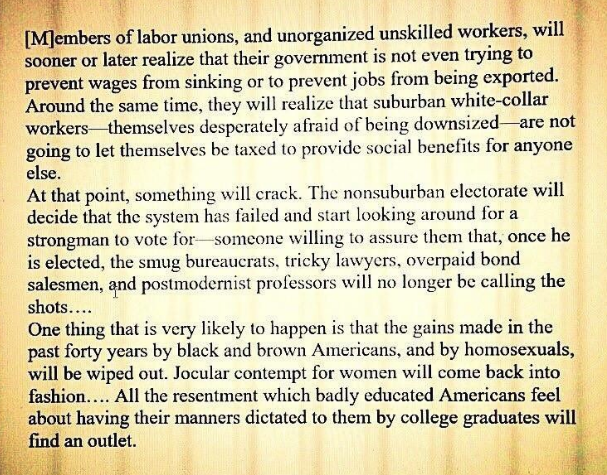
Twenty years ago a strong academic left in universities all over the world spoke to political culture the way that a globalized nationalist far-right seems to now. Among public intellectuals in the U.S., Richard Rorty’s name held particular sway. Yet in his contrarian 1998 book Achieving Our Country, Rorty argued against the participation of philosophy in politics. A member of the so-called “Old Left,” or what he called the “reformist left,” Rorty took on the “Cultural Left” in ways we now hear in (often bitter) debates between similar camps. In the course of his attacks, he made the uncanny prediction above.
The cultural left, wrote Rorty, had come “to give cultural politics preference over real politics, and to mock the very idea that democratic institutions might once again be made to serve social justice.” He foresaw cultural politics on the left as contributing to a tidal wave of resentment that would one day result in a time when “all the sadism which the academic left has tried to make unacceptable to its students will come flooding back.”
As democratic institutions fail, he writes in the quote above:
[M]embers of labor unions, and unorganized unskilled workers, will sooner or later realize that their government is not even trying to prevent wages from sinking or to prevent jobs from being exported. Around the same time, they will realize that suburban white-collar workers—themselves desperately afraid of being downsized—are not going to let themselves be taxed to provide social benefits for anyone else.
At that point, something will crack. The nonsuburban electorate will decide that the system has failed and start looking around for a strongman to vote for—someone willing to assure them that, once he is elected, the smug bureaucrats, tricky lawyers, overpaid bond salesmen, and postmodernist professors will no longer be calling the shots. A scenario like that of Sinclair Lewis’ novel It Can’t Happen Here may then be played out. For once a strongman takes office, nobody can predict what will happen. In 1932, most of the predictions made about what would happen if Hindenburg named Hitler chancellor were wildly overoptimistic.
One thing that is very likely to happen is that the gains made in the past forty years by black and brown Americans, and by homosexuals, will be wiped out. Jocular contempt for women will come back into fashion. The words [slur for an African-American that begins with “n”] and [slur for a Jewish person that begins with “k”] will once again be heard in the workplace. All the sadism which the academic Left has tried to make unacceptable to its students will come flooding back. All the resentment which badly educated Americans feel about having their manners dictated to them by college graduates will find an outlet.
He also then argues, however, that this sadism will not solely be the result of “economic inequality and insecurity,” and that such explanations would be “too simplistic.” Nor would the strongman who comes to power do anything but worsen economic conditions. He writes next, “after my imagined strongman takes charge, he will quickly make his peace with the international superrich.”
Rorty blamed the Marxist New Left for “retreating from pragmatism into theory,” wrote The New York Times in its review of Achieving Our Country. He felt the cultural left had abandoned the “American experiment as secular, anti-authoritarian and infinite in possibilities,” such as “Whitman idealized as loving relationships and Dewey as good citizenship.” The Times wrote then that Rorty’s predictions above were a form of “intellectual bullying.” We can take our dystopian futures from sci-fi novelists and filmmakers, but when philosophers “haruspicate or scry,” as T.S. Eliot wrote in “The Dry Salvages,” we tend to dismiss it as the “usual / Pastimes and drugs, and features of the press.”
The eminent Stanford professor exhorted his contemporaries to leave behind “semiconscious anti-Americanism” and embrace pragmatic civil engagement, and did so by offering up examples from American literature and philosophy that all had fierce activist strains. Excoriating one kind of life of the mind, Rorty can’t help but offer another. “What does Rorty offer as a solution?” asked the Times review, “Not really very much.” Perhaps not to politicians. But to the postmodern academics and writers he accused, he offers up as counter examples Walt Whitman, John Dewey, and—as Rorty noted in an interview—James Baldwin, whose “use of the phrase… achieving our country” inspired his book’s title, Achieving Our Country.
Related Content:
John Searle on Foucault and the Obscurantism in French Philosophy
Huxley to Orwell: My Hellish Vision of the Future is Better Than Yours (1949)
Josh Jones is a writer and musician based in Durham, NC. Follow him at @jdmagness.
Read More...Say Goodbye to Leonard Cohen Through Some of His Best-Loved Songs: “Hallelujah,” “Suzanne” and 235 Other Tracks
Another epitaph for another fallen star, another beloved icon, another brilliant musician who was also a brilliant human being. I do not want to tell you what you already know, that Leonard Cohen died last night at age 82. Cohen, it seems, accepted it, just as David Bowie accepted his death, and both poured their acceptance into one final record. Will we talk about You Want It Darker in the same awed tones as David Bowie’s Blackstar—as a knowing last letter of mixed hope and despair, a cryptic time capsule that opens a little bit more as the months ahead wear on?
If you are the dealer, I’m out of the game
If you are the healer, it means I’m broken and lame
If thine is the glory then mine must be the shame
You want it darker
We kill the flame
.… I’m ready, my lord
No matter what he had in mind, we cannot but see these lines now as a last testament. Cohen not only faced his own mortality, but this year lost his longtime lover and muse Marianne Ihlen to cancer. “I think I will follow you soon,” he wrote to her just before her death. “You Want It Darker” ties together the personal, the political, the spiritual, and the literary in a prophetic lament, weaving his struggle into all of ours. There are no answers, but “There’s a lullaby for suffering,” Cohen writes, then warns, “And a paradox to blame.” The compression of these lines belies a tremendous depth of religious and philosophical sentiment, the weight—it feels in Cohen’s last album—of the world.
But then this describes the music he made 30 years ago. And 50 years ago. “Cohen’s songs are death-haunted,” writes David Remnick, “but then they have been since his earliest verses.” He released his first album in 1967, followed two years later by Songs from a Room, the hallowed document of some of his best-loved songs: “Bird on the Wire,” “Story of Isaac,” “Tonight Will Be Fine,” and “The Partisan.” Cohen did not write that last one, and yet, though he “is often incorrectly credited as the composer of the song,” writes Alex Young at Consequence of Sound, “he is certainly responsible for its survival.”
Cohen universalizes the original French version; “the English lyrics contain no references to France or the Nazi occupation.” It spoke directly to the broken partisans in both France and the U.S. post-1968, a year very much like this one, wracked with violence, upheaval, tragedy, and resistance. Few songwriters have been able to consistently address the irrational passion, violence, and almost crushing determination of so much human experience with as much wisdom as Cohen, even if he downplayed what Remnick calls “the mysteries of creation” in his work, telling the New Yorker editor in one of his final interviews last month, “I have no idea what I am doing.”
Yet, almost no songwriter has inspired so much volubility from Bob Dylan, who spoke to Remnick at length about the fine intricacies of Cohen’s “counterpoint lines.” “His gift or genius,” said Dylan, “is in his connection to the music of the spheres.” Cohen’s lyrical sophistication charted his heterodox embrace of Judaism and Zen Buddhism, and his fascination with Christianity. But before he arrived in New York as a “musical novice” at thirty-two and became a mystical folk troubadour, he was a highly-regarded and controversial poet and novelist, a “bohemian with a cushion” from a Montreal Jewish family “both prominent and cultivated.” He even had a documentary about him made in 1965.
Cohen began publishing poetry in college and put out his first collection at 22, then moved to the Greek island of Hydra, where he met Marianne and published several more collections and two novels. Later while living in London, he wrote to his publisher about his desire to write for “inner-directed adolescents, lovers in all degree of anguish, disappointed Platonists, pornography-peepers, hair-handed monks and Popists.” (His onetime lover Joni Mitchell dismissed him as a “boudoir poet.”) Cohen more than achieved this aim as a songwriter, doing as much, perhaps, as Nico—whom he once pined for and maybe partly imitated—to inspire 80s Goths and New Romantics.
The dark eroticism in his work did not recede when, “frustrated by poor book sales,” writes Rolling Stone, “Cohen visited New York in 1966 to investigate the city’s robust folk-rock scene.” There, under the encouragement of Judy Collins, he “quickly became the songwriter’s songwriter of choice for artists like Collins, James Taylor, Willie Nelson and many others.” His first hit, “Suzanne,” above, vividly imagines Renaissance love scenes and echoes with the refrain “her perfect body,” while also imbuing its fleeting moments with the depth of sadness Cohen’s spacious baritone contained. Later albums like the Phil Spector-produced (and uncharacteristically loud) Death of a Ladies’ Man treat with sneering irony his “unbridled sexuality and brutal voyeurism.”
Cohen looked unflinchingly and with monkish intensity at his own excesses and weakness, and at ours, and saw them, tragic and beautiful, as our only strengths. “There is a crack in everything,” he sang in 1992’s “Anthem”—live in London below—“that’s how the light gets in.” No tribute can leave out his most beloved and most covered song—one of the most covered and beloved songs ever written— “Hallelujah.” From its best-known Jeff Buckley version in 1994 to Rufus Wainwright’s and countless others, the song instantly conjures gravitas and stirs deep wells of emotion in the secular and religious alike. First released in 1984 on Cohen’s album Various Positions, it attracted little attention at first.
His version lacks the high gospel drama of many interpretations, despite the backing gospel choir, but his loping barroom delivery and lounge-pop backing music work in hypnotic dissonance. It’s a song that took him five years to write. (Malcolm Gladwell has a whole podcast dedicated to the writing of the song.) “He drafted dozens of verses,” writes Remnick, around 80, “and then it was years before he settled on a final version.” Dylan performed the song in the late eighties, “as a roughshod blues.” In conversation with Remnick, Dylan paused his very detached evaluation of Cohen’s technical genius to remark it’s “the point-blank I‑know-you-better-than-you-know-yourself aspect of the song [that] has plenty of resonance for me.” I think we’ll find that to be true of Leonard Cohen the more we unpack his austere, sensual, profoundly lyrical-in-the-most-ancient-of-ways body of work.
Related Content:
Ladies and Gentlemen… Mr. Leonard Cohen: The Poet-Musician Featured in a 1965 Documentary
Leonard Cohen Recounts “How I Got My Song,” or When His Love Affair with Music Began
The Poetry of Leonard Cohen Illustrated by Two Short Films
Rufus Wainwright and 1,500 Singers Sing Leonard Cohen’s “Hallelujah”
Leonard Cohen Reads The Great World War I Poem, “In Flanders Fields”
Josh Jones is a writer and musician based in Durham, NC. Follow him at @jdmagness
Read More...An Immersive Audio Tour of the East Village’s Famed Poetry Scene, Narrated by Jim Jarmusch
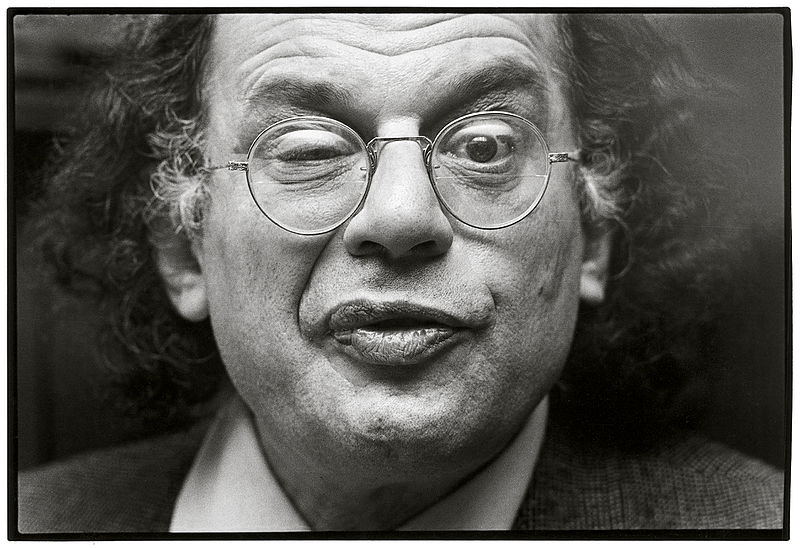
Image by Michiel Hendryckx, via Wikimedia Commons
A peek at the photos on a realtor’s listing for a New York City one bedroom apartment formerly occupied by Beat poet Allen Ginsberg is a dispiriting reminder of how much the East Village has changed.
And that listing is over six years old!
Daniel Maurer, the editor of Bedford + Bowery, and a Ginsberg fan whom history has compelled to take over a portion of his hero’s formerly sprawling digs, wrote amusingly of shoddy renovations and his upstairs neighbor, punk rock icon Richard Hell:
Orlovsky’s name is still on the mailbox – which is just about the only thing still around from his day. After his death, the place was gut renovated with luxurious modern amenities like a mini fridge that comes up to mid-thigh and a stove that’s so tiny and ineffectual I just use it for cookbook storage. Soon after I moved in I took a trip to Ikea and recognized my kitchen cabinets there.
That’s why I was amused to read a piece in the Wall Street Journal … in which my upstairs neighbor, Richard Hell, talked about his rent-stabilized two-bedroom apartment and its “funkiness that you don’t find in Manhattan much anymore.”
Hell describes his “worn unvarnished wood floors that groan when you walk on them, cracks in the plaster walls, sagging original moldings.” That’s exactly what I was looking for in an apartment two years ago.
Maurer is far from alone in the desire to edge closer to a bygone cultural moment. Radio producer Pejk Malinovski spent three years crafting Passing Stranger, a site-specific audio tour of the East Village poetry scene, below.
A Dane who relocated to New York in 2003, Malinovski was intrigued by the scene-related anecdotes of his friend, poet Ron Padgett, who pointed out his former haunts on strolls about the neighborhood. His interest piqued, Malinovski immersed himself in Daniel Kane’s All Poets Welcome, The Lower East Side Poetry Scene in the 1960’s, another history that comes fortified with archival audio clips.
Filmmaker Jim Jarmusch, a longtime Lower East Side resident who studied with poet Kenneth Koch in his youth, was tapped to provide the audio tour’s narration, with music compliments of composer John Zorn, the artistic director of The Stone, an experimental East Village performance space. Below, Jarmusch explains what attracted him to the project:
No matter if geographic constraints prevent you from downloading Malinovski’s tour for a two mile, 90 minute amble around the much-changed East Village. In some ways, the virtual tour is better. Rather than trying to take it all in in a single, pre-plotted session, you’re free to wander at will, enjoying such interactive features as maps and photos, in addition to interviews, readings, and reminiscences.
The 10th stop on the tour deposits you across the street from 437 East 12th Street, Ginsberg’s aforementioned former residence, on the steps of a church that no longer exists. Mary Help of Christians Roman Catholic Church was demolished shortly after Passing Stranger hit the streets, but its memory lives on thanks to its celebrated appearance in Ginsberg’s work:
Fourth Floor, Dawn, Up All Night Writing Letters
Pigeons shake their wings on the copper church roof
out my window across the street, a bird perched on the cross
surveys the city’s blue-grey clouds. Larry Rivers
‘ll come at 10 AM and take my picture. I’m taking
your picture, pigeons. I’m writing you down, Dawn.
I’m immortalizing your exhaust, Avenue A bus.
O Thought, now you’ll have to think the same thing forever!
- Allen Ginsberg, New York, June 7, 1980
Ginsberg himself is brought to vivid life by his secretary and fellow poet, Bob Rosenthal, who recalls how visitors would call up from the street, then wait for Ginsberg to toss down keys, wrapped in a dirty sock. He also name checks Mr. Buongiorno, the 437 East 12th St neighbor who served as Mary Help of Christians’ bell ringer.
You can hear those bells in the background of your Passing Stranger tour, though producer Malinovski uses ambient sound sparingly, to avoid overwhelming those using the tour on the noisy streets of the actual East Village.
You can download the full walking tour of Passing Stranger—named for Walt Whitman’s opening salutation in “To a Stranger”—here.
Explore Passing Stranger’s trivia-filled interactive website—featuring audio from Amiri Baraka, Hettie Jones, Eileen Myles, and Jack Kerouac, among others—here.
Poems included on the Passing Stranger audio tour of the East Village, in order of appearance:
Kenneth Koch, “To my Audience” (excerpt)
Frank O’Hara, Ode to Joy (To hell with it) (excerpt)
Ted Berrrigan “Dear Margie, Hello”
Ron Padgett “Poema del City from Toujours l’amour”
Walt Whitman, “To a Stranger”
Taylor Mead, “Motorcycles”
Bernadette Mayor, “Sonnet (You jerk, you didn’t call me up)”
Diane Di Prima, “Revolutionary Letters” (excerpt)
Galway Kinnell, “The Avenue Bearing the Initial of Christ” (excerpt)
Miquel Piñero, “A Lower East Side Poem” (excerpt)
Jack Kerouac, “American Haiku” (excerpt)
Bill Berkson / Frank O’Hara, “Song Heard Around St. Bridget’s”
John Ashbery, “Just Walking Around, from A Wave”
Joe Brainard, “I Remember” (excerpt)
Alice Notley, “10 Best Comic Books”
WH Auden, “September 1, 1939” (excerpt)
Anne Waldman, “Fast Speaking Woman” (excerpt)
Lewis Warsh, “Eye Contact” (excerpt)
Dick Gallup / Ted Berrigan, “80th Congress”
Abraham Lincoln, “My Childhood-Home I See Again” (excerpt)
Leroi Jones, “Bang, bang, outishly” (excerpt)
Hettie Jones, “Ode to My Kitchen Sink”
Brenda Coultas, “A Handmade Museum” (excerpt)
ee cummings, ”i was sitting in mcsorley’s…”
Related Content:
Iggy Pop Conducts a Tour of New York’s Lower East Side, Circa 1993
Ayun Halliday is an author, illustrator, theater maker and Chief Primatologist of the East Village Inky zine. Her play Zamboni Godot is opening in New York City in March 2017. Follow her @AyunHalliday.
Read More...Support Us
We're hoping to rely on loyal readers, rather than erratic ads. Please click the Donate button and support Open Culture. You can use Paypal, Venmo, Patreon, even Crypto! We thank you!

About Us

Open Culture scours the web for the best educational media. We find the free courses and audio books you need, the language lessons & educational videos you want, and plenty of enlightenment in between.
Advertise With Us
FREE UPDATES!
GET OUR DAILY EMAIL
Get the best cultural and educational resources on the web curated for you in a daily email. We never spam. Unsubscribe at any time.
FOLLOW ON SOCIAL MEDIA
Open Culture editor Dan Colman scours the web for the best educational media. He finds the free courses and audio books you need, the language lessons & movies you want, and plenty of enlightenment in between.
Advertise With Us


