“We Suck” — When Yale Pranked Harvard at the 2004 Big Football Game
On a completely lighter note.
The blurb to the Youtube video above reads as follows: “In 2004, 24 enterprising Yale students created the non-existent “Harvard Pep Squad” for the big Harvard-Yale football game. As the Pep Squad pumped up the Harvard fans, they distributed 1800 pieces of red and white construction papers with the understanding that when all the cards were held up, it would spell “GO HARVARD” See what happens next!”
To get more of the backstory on what happened that day, read this account by the mastermind of the prank as well as this account from a 2005 edition of Yale Daily News.
Related Content:
Princeton v. Yale, 1903: The Oldest College Football Game on Film
The Harvard Classics: Download All 51 Volumes as Free eBooks
Yale Launches an Archive of 170,000 Photographs Documenting the Great Depression
Read More...Watch Helen Keller & Teacher Annie Sullivan Demonstrate How Helen Learned to Speak (1930)
Knowing the transformative effect an inspired teacher can have on an “unreachable” student, one can only hope that geography and luck will conspire to bring the two together at an early point in the child’s development.
Helen Keller, author, activist, and poster girl for surmounting near-impossible odds, certainly lucked out in the teacher department. Rendered deaf and blind by a fever contracted at 19 months, Keller earned a reputation as a holy terror in a family ill-equipped to understand what her wild rages might signify.
Her well-connected parents consulted various experts, including soon-to-be-friend, inventor Alexander Graham Bell, a trail that ultimately led to the Perkins School for the Blind and the 20-year-old Annie Sullivan.
Within a few short months of her arrival at the Keller family home, Sullivan led the nearly-seven-year-old Keller to her famous breakthrough at the water pump.
In a more conventional arrangement, the student would eventually leave her teacher for further educational pursuits, but Keller depended on Sullivan to translate other teachers’ lectures and classroom interactions. Sullivan accompanied her to Perkins School for the Blind, the Wright-Humason School for the Deaf, the Cambridge School for Young Ladies, and finally Radcliffe College, where Keller earned her BA.
The unusual boundaries of their teacher-student bond meant Keller lived with Sullivan and her husband in their Forest Hills home, a move that hastened the marriage’s unofficial but permanent end, according to Sullivan’s biographer, Kim Nielsen. It likely thwarted Keller’s single attempt at romance, with her temporary secretary, writer Peter Fagan, too.
For better and worse, their lives were forever entwined, each made more extraordinary by the presence of the other.
Their appearance in the 1930 Vitaphone newsreel, above, highlights the mandatory physical closeness they shared, as they demonstrate the process by which Keller learned to speak. Having learned to communicate via letters Sullivan finger spelled into her palm, Keller placed her fingers against Sullivan’s lips, throat and nose, to feeling the vibrations made when these familiar letters were spoken aloud.
Sullivan died six years after the newsreel was filmed, at which point, Polly Thomson, originally engaged as the ladies’ housekeeper, took over, serving as Keller’s interpreter and traveling companion for the next twenty years.
Related Content:
Helen Keller Had Impeccable Handwriting: See a Collection of Her Childhood Letters
Helen Keller Speaks About Her Greatest Regret — Never Mastering Speech
Ayun Halliday is an author, illustrator, theater maker and Chief Primatologist of the East Village Inky zine. Her play Zamboni Godot is opening in New York City in March 2017. Follow her @AyunHalliday.
Read More...Great Courses Plus Now Offers a 30-Day Free Trial: 7,000 Video Lectures Covering Philosophy, Photography & More
We’ve told you about the Great Courses Plus (now called Wondrium) before–a new video subscription service that lets you watch free courses (about 8,000 lectures in total) across a wide range of subjects, all taught by some of the best lecturers in the country. The topics cover everything from History, Philosophy, Literature, and Economics, to Math, Science, Professional Development, Cooking, and Photography. And you can binge-watch entire college courses in a matter of days by watching videos on your TV, tablet, laptop and smart phone, with the help of apps designed for Apple, Google Play, Kindle Fire, and Roku.
Interested in trying out this service? Right now, the Great Courses Plus/Wondrium is offering a special deal for Open Culture readers. If you click here, and sign up for a free trial, you can use this service for 30 days … for free. And then, if you would like, you can continue to subscribe and pay their normal prices. If you have time on your hands, this is a great way to keep your mind engaged and stream what PC Magazine has called “an excellent library of college-level lectures.”
Note: The Great Courses is a partner with Open Culture. So if you sign up for a free trial, it benefits not just you and Great Courses Plus. It benefits Open Culture too. So consider it win-win-win.
Read More...Hear Sylvia Plath’s Barely-Known Radio Play, Three Women
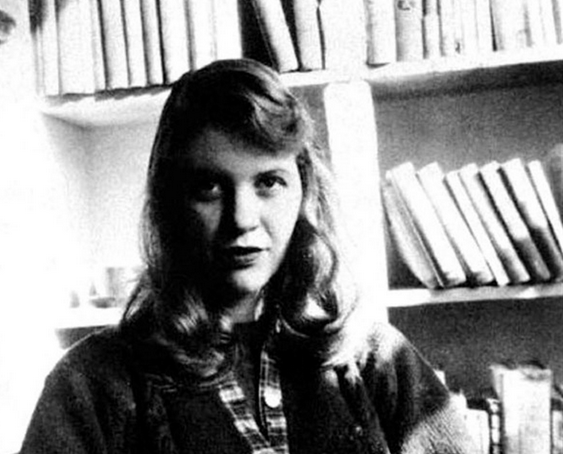
Image via Wikimedia Commons
Over the years, we’ve let you hear Sylvia Plath reading many of her poems, all written before she took her life at the age of 30. What you likely haven’t heard — until today — is Three Women, one of Plath’s lesser-known pieces of writing. “Originally written as a radio verse drama for three voices,” notes The Guardian, the play “was broadcast in 1962 on the BBC Third Programme and later included in Winter Trees, a poetry collection first published in 1971.” “With its themes of pregnancy, birth, miscarriage and adoption, it perfectly encapsulates the experience of becoming — or not becoming — a mother, including all the ecstasy and terror of childbirth.” Below you can hear a recording with actress Judith Binder as the wife, Ann Bernstein as the secretary, and Rachelle Towers as the girl. The program is made available on Archive.org by Pacifica Radio Archives. Find more Sylvia Plath audio in our collection, 1,000 Free Audio Books: Download Great Books for Free.
If you would like to support the mission of Open Culture, consider making a donation to our site. It’s hard to rely 100% on ads, and your contributions will help us continue providing the best free cultural and educational materials to learners everywhere. You can contribute through PayPal, Patreon, and Venmo (@openculture). Thanks!
Related Content
Hear Sylvia Plath Read 50+ of Her Dark, Compelling Poems
Hear Sylvia Plath Read Fifteen Poems From Her Final Collection, Ariel, in 1962 Recording
The Art of Sylvia Plath: Revisit Her Sketches, Self-Portraits, Drawings & Illustrated Letters
Sylvia Plath, Girl Detective Offers a Hilariously Cheery Take on the Poet’s College Years
Read More...David Byrne & Neil deGrasse Tyson Explain the Importance of an Arts Education (and How It Strengthens Science & Civilization)
Unless you’re a policy geek or an educator, you may never have heard of the “STEM vs. STEAM” debate. STEM, of course, stands for the formula of “science, technology, engineering, and mathematics” as a baseline for educational curriculum. STEAM argues for the necessity of the arts, which in primary and secondary education have waxed and waned depending on prevailing theory and, perhaps more importantly, political will. Andrew Carnegie may have donated handsomely to higher education, but he frowned on the study of “dead languages” and other useless pursuits. Industrialist Richard Teller Crane opined in 1911 that no one with “a taste for literature has the right to be happy” because “the only men entitled to happiness… are those who are useful.”
It’s a long way from thinking of poets as “the unacknowledged legislators of the world,” as Percy Shelley wrote in his “Defence of Poetry” 90 years earlier, but Shelley’s essay shows that even then the arts needed defending. By the time we get to STEM thinking, the arts have disappeared entirely from the conversation, become an afterthought, as venture capitalists, rather than wealthy industrialists, decide to trim them away from public policy and private investment. The situation may be improving, as more educators embrace STEAM, but “there’s tension,” as Neil DeGrasse Tyson says in the excerpt above from his StarTalk interview show on Nat Geo. In the kinds of funding crises most school districts find themselves in, “school boards are wondering, do we cut the art, do we keep the science?”
The choice is a false one, argues former Talking Heads frontman and sometimes Cassandra-like cultural theorist David Byrne. “In order to really succeed in whatever… math and the sciences and engineering and things like that,” Byrne tells Tyson above, “you have to be able to think outside the box, and do creative problem solving… the creative thinking is in the arts. A certain amount of arts education…” will help you “succeed more and bring more to the world… bringing different worlds together has definite tangible benefits. To kind of cut one, or separate them, is to injure them and cripple them.”
The idea goes back to Aristotle, and to the creation of universities, when medieval thinkers touted the Liberal Arts—the Trivium (grammar, rhetoric, and logic) and Quadrivium (arithmetic, geometry, music, and astronomy)—as models for a balanced education. Tyson agrees that the arts and sciences should not be severed: “Suppose they did that back in Renaissance Europe? What would Europe be without the support and interest in art?” He goes even further, saying, “We measure the success of a civilization by how well they treat their creative people.”
It’s a bold statement that emerges from a longer conversation Tyson has with Byrne, which you can hear in the StarTalk Radio podcast above. Tyson is joined by co-host Maeve Higgins and neuroscientist and concert pianist Dr. Mónica López-González—and later by Professor David Cope, who taught a computer to write music, and Bill Nye. Byrne makes his case for the equal value of the arts and sciences with personal examples from his early years in grade school and art college, and by building conceptual bridges between the two ways of thinking. One theme he returns to is the interrelationship between architecture and music as an example of how art and engineering co-evolve (a subject on which he previously delivered a fascinating TED talk).
You won’t find much debate here among the participants. Everyone seems to readily agree with each other, and I can’t say I’m surprised. Speaking anecdotally, all of the scientists I know affirm the value of the arts, and a high percentage have a creative avocation. Likewise, I’ve rarely met an artist who doesn’t value science and technology. We find example after example of scientist-artists—from Albert Einstein to astrophysicist Stephon Alexander, who sees physics in Coltrane. The central question may not be whether artists and scientists can mutually appreciate each other—they generally already do—but whether school boards, politicians, voters, and investors can see things their way.
Related Content:
David Byrne: How Architecture Helped Music Evolve
The Musical Mind of Albert Einstein: Great Physicist, Amateur Violinist and Devotee of Mozart
Josh Jones is a writer and musician based in Durham, NC. Follow him at @jdmagness
Read More...Hear Jane Austen’s Pride and Prejudice as a Free Audio Book
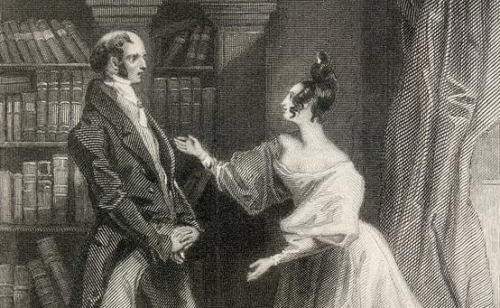
First published in 1813, Jane Austen’s Pride and Prejudice has become one of the most widely read books in English literature. When the BBC conducted a massive poll in 2003, trying to determine the “UK’s Best-Loved Book,” Pride and Prejudice came in second, right behind The Lord of the Rings. And all told, some 20 million copies of the book have been sold. Through the links below, you can download free audiobook (and ebook) versions of Pride and Prejudice.
Audio Book: Librivox version – Free iTunes – Free MP3
Audio Book: Spotify version read by Wendy Ellison Mullen — Spotify
eBook: iPad/iPhone – Kindle + Other Formats – Read Online Now
Looking for free, professionally-read audio books from Audible.com? Here’s a great, no-strings-attached deal. If you start a 30 day free trial with Audible.com, you can download two free audio books of your choice. Get more details on the offer here.
Related Content:
As Pride and Prejudice Turns 200, Read Jane Austen’s Manuscripts Online
This Is Your Brain on Jane Austen: The Neuroscience of Reading Great Literature
700 Free Audio Books: Download Great Books for Free
Jane Austen Used Pins to Edit Her Abandoned Manuscript, The Watsons
800 Free eBooks for iPad, Kindle & Other Devices
Read More...Hear 21 Hours of Lectures & Talks by Howard Zinn, Author of the Bestselling A People’s History of the United States
Regularly in these pressure cooker days we hear plausible arguments from liberals and conservatives about how democratic institutions have recently failed us, and how uniquely polarized we have become as a people. We also hear often highly implausible claims about how current contenders intend to restore some kind of justice or fairness. Readers of Howard Zinn’s A People’s History of the United States will have a different perspective, one in which supposedly democratic institutions were never designed to work for the majority of the country’s inhabitants. And in which, by design, certain minorities have always remained at the bottom of the hierarchy.
“There is not a country in world history,” writes Zinn in his famous radical history, “in which racism has been more important, for so long a time, as the United States.” Far from a flawed yet exceptional form of government, the U.S. system, Zinn argued, began as a means by which the founders seized the prerogatives of the British for themselves, with no intention of expanding these liberties widely. On the contrary. As Zinn puts it in a chapter called “Tyranny is Tyranny”:
Around 1776, certain important people in the English colonies made a discovery that would prove enormously useful for the next two hundred years. They found that by creating a nation, a symbol, a legal unity called the United States, they could take over land, profits, and political power from favorites of the British Empire. In the process, they could hold back a number of potential rebellions and create a consensus of popular support for the rule of a new, privileged leadership.
The American Revolution swapped out one rule by elites for another, in other words, and one empire for another. Or as Zinn wrote in his memoir, there is “something rotten at the root.” Those who object to Zinn’s work may find flaws in his scholarly methodology. Accusations of bias, however—even couched in polite pejoratives like “polemical” and “revisionist”—are pretty much moot. Zinn, who died in 2010, would agree. The necessity of taking a position, after all, was integral to the historian and activist’s entire ethos, such that he titled his autobiography You Can’t Be Neutral on a Moving Train. “The state and its police were not neutral referees in a society of contending interests,” wrote Zinn, “They were on the side of the rich and powerful.” He always made it plain whose side he took, an approach by nature controversial.
Was he a liberal partisan? Hardly. After taking a beating by police at a protest, Zinn writes, “I was no longer a liberal, a believer in the self-correcting character of American democracy. I was a radical, believing that something fundamental was wrong in this country.” A Communist? “Marx,” wrote Zinn, “was often wrong, often dogmatic… too insistent that the industrial working class must be the agent of revolution.” Zinn admired Marx. He wrote a play about him, Marx in Soho, and describes in the forward how his early reading of Marx, while growing up in working-class Brooklyn, greatly influenced his view of the world.
But after “growing evidence of the horrors of Stalinism” and his experience with the grassroots “participatory democracy” of the Student Nonviolent Coordinating Committee (SNCC), Zinn became drawn to anarchism. Decidedly leftist and fundamentally egalitarian, Zinn’s analysis has proven broad enough to warrant admiration from several different political persuasions: from modern liberals to Marxists to libertarian communists to free market libertarians like Reason’s Thaddeus Russell, who pronounced him “no better exemplar of that thoroughgoing, anti-statist left.”
Like another famous anarchist intellectual of the radical campus left, Noam Chomsky, Zinn first came to national prominence in the 60s while organizing protests against the Vietnam War—and like Chomsky, he debated conservative standard-bearer William F. Buckley. Zinn previously protested segregation with SNCC while he taught at Spelman College, writing an influential history of the organization. His tireless activism continued until the very end of his life, and he delivered notable speeches and lectures throughout his involvement in the civil rights, anti-war, environmental, and economic justice movements.
In the Spotify playlist above, you can hear 22 of those talks for a total of 21 hours of Zinn, including that historic Buckley debate, which you can also hear in full at the top of the post. (If you need Spotify’s free software, download it here.) After their Tufts University meeting, notes Ed Welchel, Zinn reflected, “I found it curious that Buckley did not seem to understand that unsparing criticism of government is an essential element of a democratic society.”
The playlist of Zinn lectures and talks will be added to our collection, 1,000 Free Audio Books: Download Great Books for Free.
Related Content:
Illustrated Video: Howard Zinn’s “What the Classroom Didn’t Teach Me About the American Empire”
Adorn Your Garden with Howard the Zinn Monk
Noam Chomsky vs. William F. Buckley, 1969
Josh Jones is a writer and musician based in Durham, NC. Follow him at @jdmagness
Read More...What Makes Vertigo the Best Film of All Time? Four Video Essays (and Martin Scorsese) Explain
Vertigo is the greatest motion picture of all time. Or so say the results of the latest round of respected film magazine Sight & Sound’s long-running critics poll, in which Alfred Hitchcock’s James Stewart- and Kim Novak- (and San Francisco-) starring psychological thriller unseated Citizen Kane from the top spot. For half a century, Orson Welles’ directorial debut seemed like it would forever occupy the head of the cinematic table, its status disputed only by the unimpressed modern viewers who, having attended a revival screening or happened across it on television, complain that they don’t understand all the critical fuss. The new champion has given them a different question to ask: what makes Vertigo so great, anyway?
Like Citizen Kane in 1941, Vertigo flopped at the box office in 1958, but Hitchcock’s film drew more negative reviews, its critics sounding baffled, dismissive, or both. Even Welles reportedly disliked it, and Hitchcock kept it out of circulation himself between 1973 and his death in 1980, a period when cinephiles — and cinephile-filmmakers, such as a certain well-known Vertigo enthusiast called Martin Scorsese — regarded it as a sacred document. Only in 1984 did Vertigo re-emerge, by which point it badly needed an extensive audiovisual restoration. It received just that in 1996, speeding up its ascent to acclaim, in progress at least since it first appeared on the Sight & Sound poll, in eighth place, in 1982.
“Why, after watching Vertigo more than, say, 30 times, are we confident that there are things to discover in it — that some aspects remain ambiguous and uncertain, unfathomably complex, even if we scrutinize every look, every cut, every movement of the camera?” asks critic Miguel Marías in an essay on the film at Sight & Sound. He lists many reasons, and many more exist than that. But nobody can appreciate a work with so many purely cinematic strengths without actually watching it, which perhaps makes the video essay a better form for examining the power of what we have come to recognize as Hitchcock’s masterpiece.
“Only one film had been capable of portraying impossible memory — insane memory,” says the narrator of Chris Marker’s essay film Sans Soleil: “Alfred Hitchcock’s Vertigo.” B. Kite and Alexander Points-Zollo’s three-part “Vertigo Variations” at the Museum of the Moving Image uses Marker’s interpretation, as well as many others, to see from as many angles as possible Hitchcock’s “impossible object: a gimcrack plot studded with strange gaps that nonetheless rides a pulse of peculiar necessity, a field of association that simultaneously expands and contracts like its famous trick shot, a ghost story whose spirits linger even after having been apparently explained away, and a study of obsession that becomes an obsessive object in its own right.”
The popular explainer known as the Nerdwriter looks at how Hitchcock blocks a scene by breaking down the visit by Stewart’s traumatized, retired police detective protagonist to the office of a former college classmate turned shipbuilding magnate. The conversation they have sets the story in motion, and Hitchcock took the placement of his actors and his camera in each and every shot as seriously as he took every other aspect of the film. Color, for instance: another video essayist, working under the banner of Society of Geeks, identifies Hitchcock’s use of rich Technicolor as a mechanism to heighten the emotions, with, as critic Jim Emerson writes it, “red suggesting Scottie’s fear/caution/hesitancy when it comes to romance, and its opposite green, suggesting the Edenic bliss (and/or watery oblivion) of his infatuation.” Ava Burke isolates another of Hitchcock’s visual devices in use: the mirroring that fills the viewing experience with visual echoes both faint and loud.
When he got to work on Vertigo, Hitchcock had already made more than forty films in just over three decades as a filmmaker. Though often labeled a “master of suspense” during his lifetime, he instinctively learned and deeply internalized a vast range of filmmaking techniques that film scholars, as well as his successors in filmmaking, continue to take apart, scrutinize, and put back together again. This most re-watchable of his pictures (and one that, according to several of the critics and video essayists here, transforms utterly upon the second viewing) makes use of the full spectrum of Hitchcock’s mastery as well as the full spectrum of his fixations. Whether or not you consider it the greatest motion picture of all time, if you love the art of cinema, you by definition love Vertigo.
Related Content:
22 Free Hitchcock Movies Online
Alfred Hitchcock’s Seven-Minute Editing Master Class
Watch 25 Alfred Hitchcock Trailers, Exciting Films in Their Own Right
Martin Scorsese Reveals His 12 Favorite Movies (and Writes a New Essay on Film Preservation)
The 10 Greatest Films of All Time According to 846 Film Critics
Based in Seoul, Colin Marshall writes and broadcasts on cities and culture. He’s at work on a book about Los Angeles, A Los Angeles Primer, the video series The City in Cinema, the crowdfunded journalism project Where Is the City of the Future?, and the Los Angeles Review of Books’ Korea Blog. Follow him on Twitter at @colinmarshall or on Facebook.
Read More...An Animated Introduction to French Philosopher Jacques Derrida
Since the bold arrival of his book Of Grammatology in 1967, French philosopher Jacques Derrida has been understood—or misunderstood—as many things: a radical relativist who ”rejects all of metaphysical history,” a fashionable intellectual playing language games, a brilliant phenomenologist of language…. One association he vehemently rejected was with the kind of ironic, laissez faire postmodernism represented by Seinfeld. But when it came to clarifying his work for puzzled readers and onlookers, Derrida could seem as willfully, frustratingly evasive in person as he was on the page. His work, writes Williams College professor Mark C. Taylor, can “seem hopelessly obscure… to people addicted to sound bites and overnight polls.”
Most people familiar with some of Derrida’s work know a few key terms of his thought: différance, trace, aporia, pharmakon. Those who’ve only heard the name probably know only one: Deconstruction, a “way of doing philosophy,” says Alain de Botton in his video introduction to Derrida above, that “fundamentally altered our understanding of many academic fields, especially literary studies.” But what exactly is “Deconstruction”? Rather than a method, Derrida himself described it as a process already occurring within a written work, one we can observe when we “do not assume that what is conditioned by history, institutions, or society is natural.”
Derrida’s meditations on the inability of language to contain or communicate natural or metaphysical truth developed in unique life circumstances. Born into a Jewish family in French colonial Algeria in 1930, the philosopher grew up very conscious of “having been in an inferior position at the nexus of three different religions, Judaism, Christianity, and Islam, all of which claimed to speak the truth,” says de Botton. Upon arriving in Paris to study in 1949, Derrida found himself even further on the social margins. “Though Derrida was not an autobiographical writer, it’s hard not to read his work as a response to bigotry and exclusion.”
The claim that the philosopher—whose name has almost become synonymous with post-modernism, for good or ill—was not an autobiographical writer may seem strange to some. One of his most-read books in college courses, Monolingualism of the Other, proceeds from an investigation into his fraught relationship with the French language because of his upbringing as a religious minority in a European colony. Later, Derrida delivered a ten-hour address to a conference called The Autobiographical Animal, published posthumously (and excerpted here).
Nonetheless, Derrida would not have made much of his place as the author, this being only a rhetorical occasion for analysis. Derrida, writes Nazenin Ruso at Philosophy Now, argued that “once the text is written, the author’s input loses its significance.” The person of the author—his or her physical presence, biographical experiences, emotions, desires, and intentions—becomes irretrievable for readers, one of many absences in the text that we mistake for presence.
It’s hard to see, then, how we can speak of what Derrida’s “hope” was for his readers’ self-improvement, as de Botton says in his video introduction. This being the School of Life, we are treated to a rather utilitarian reading of the philosopher, one he would perhaps reject. But Derrida bristled at the idea that language could suffice to tell us how and who to be in the world. His suspicion of logocentrism, “an over-hasty, naïve devotion to reason, logic, and clear definition,” says de Botton, means he felt that “many of the most important things we feel can never be expressed in words.” To hear Derrida talk about the problem of privileging language over other means of expression with an artist who uniquely agreed with his position, read his interview with jazz great Ornette Coleman.
Related Content:
140 Free Online Philosophy Courses
Jacques Derrida on Seinfeld: “Deconstruction Doesn’t Produce Any Sitcom”
Josh Jones is a writer and musician based in Durham, NC. Follow him at @jdmagness
Read More...
The History of Russia in 70,000 Photos: New Photo Archive Presents Russian History from 1860 to 1999
Back in college, I took a survey class on Russian history, taught by one of these people who take up the profession in their active retirement after a career spent working in the field. This particular professor had gone to work for the State Department after graduate school and served in various posts in Soviet Russia for several decades. The format of his class seemed unremarkable on paper. One standard syllabus, one bulky, expensive textbook. But the classes themselves consisted of long, fascinating stories about personal encounters with Brezhnev and Gorbachev, or journeys into ancient Kiev, or to the outer reaches of the Steppes.
All that was missing from those vivid recollections was a comparable photo essay to tell the story visually. This has been remedied and then some by the “The History of Russia,” an enormous joint archive project from Moscow’s Multimedia Art Museum and Yandex, Russia’s largest search engine. The archive contains over 70,000 photos, gathered from “more than 40 institutions and collections,” writes Hyperallergic, and representing “over 150 years of photographs capturing all sorts of scenes of Russian life.”
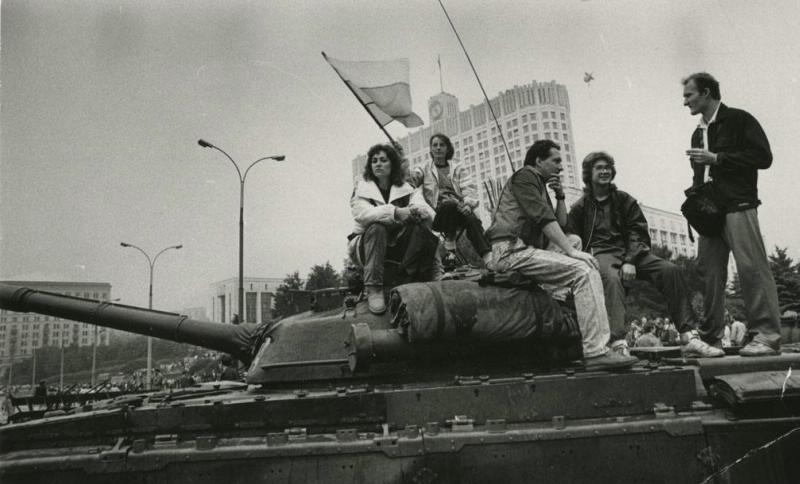
Non-Russian speakers can load the site in Google Chrome and have it translated into English. Additionally, “a timeline allows you to browse by date, a map enables location-based searches, and preset categories filter the images by theme.” Russian speakers can enter specific keywords into the site’s search engine. Currently, the archive features an exhibition on the August Putsch, the 1991 coup attempt on the presidency of Mikhail Gorbachev, staged by hard-line Communist Party Members opposed to reform. See one iconic photo of that historical event above, and many more at the virtual exhibition.
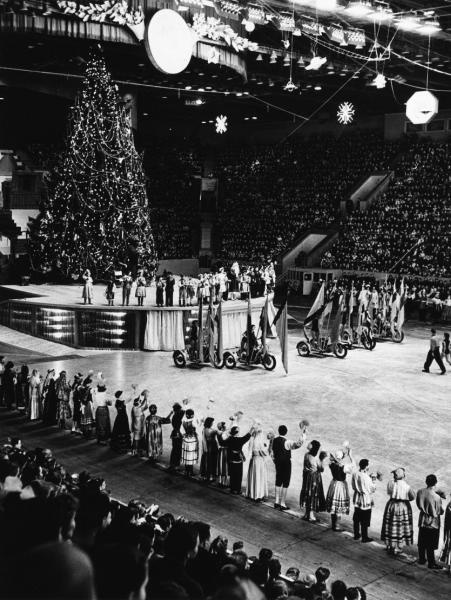
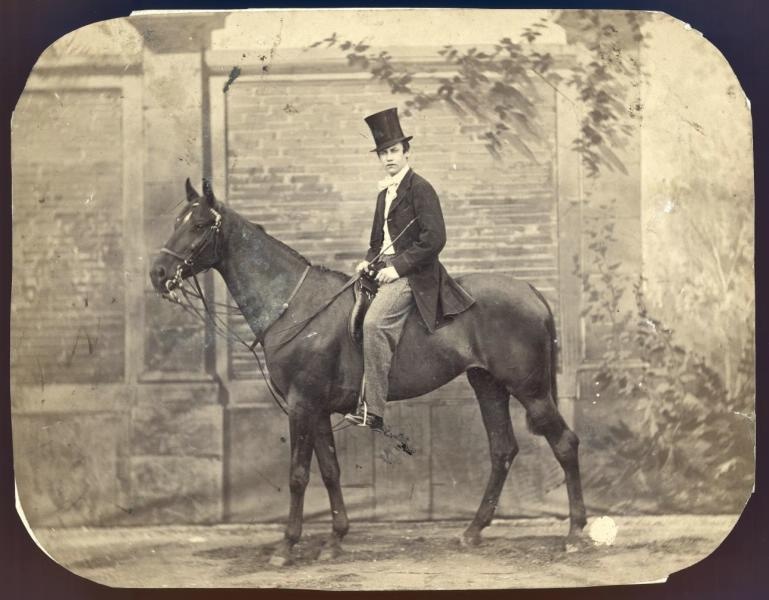
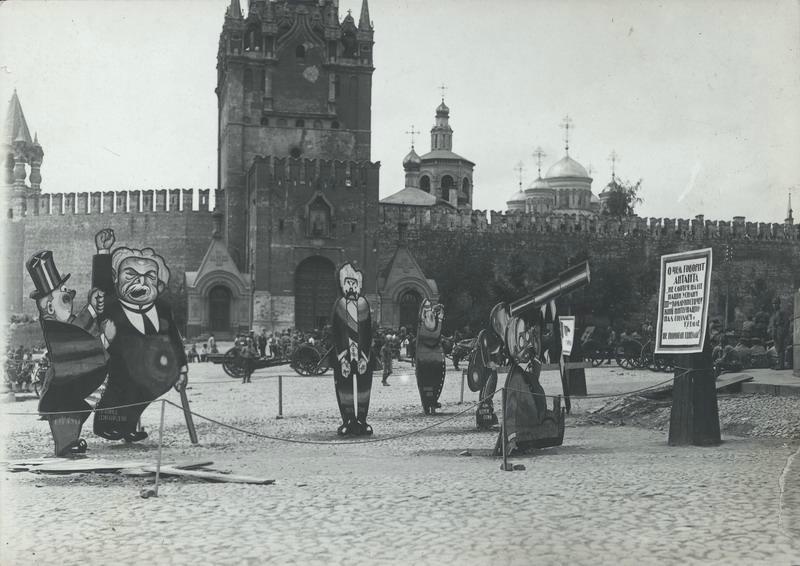
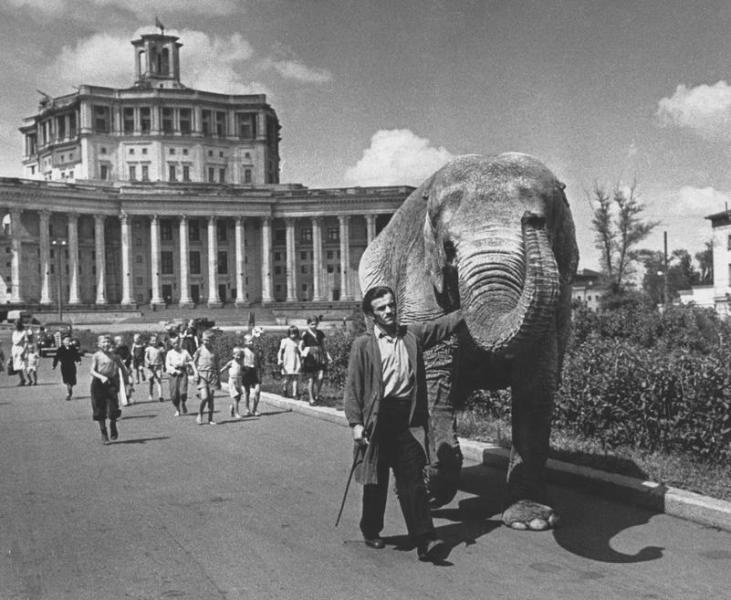
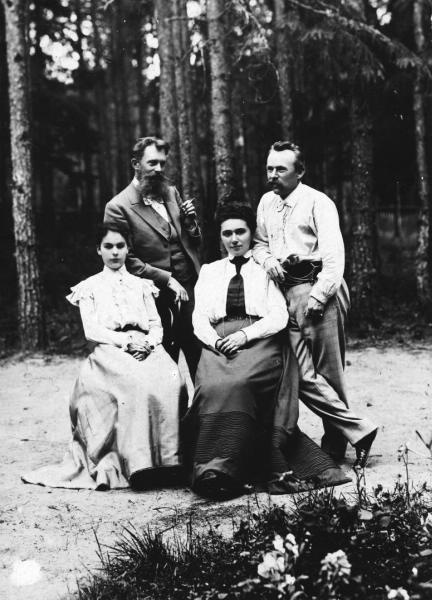
The late 1980s and 90s may be a period of particular interest for students and writers of Russian history, like David Remnick, and for good reason. But every decade in the archive holds its own fascination. Stately portraits from the 1860s, like that at the top of the post, show us the society of Tolstoy in the decade he serialized War and Peace. Photos from the 20s, like the satirical display in Red Square, further down, show us the days of Lenin’s rule and the early years of the Soviet Union. Images from the 50s give us unique insider views—often impossible at the time—of ordinary Soviet life at the height of the Cold War, such as the Christmas tree in the Luzhniki Stadium, above, or the man leading an elephant from the Red Army Theater, below.
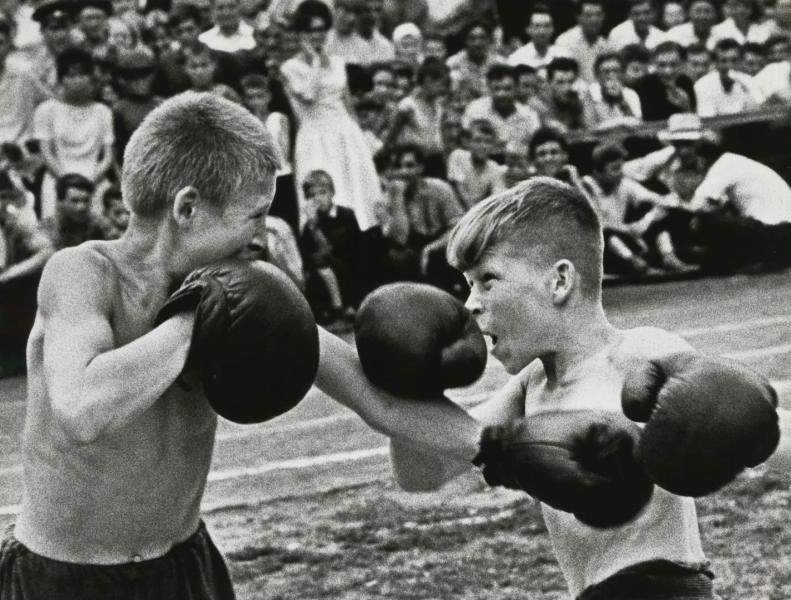
The 60s in particular look like a Life magazine spread, with dramatic photos of Olympic athletes in training, statesmen posed with wives and children, and hundreds of arresting pictures from everyday life, like that of two boys boxing below. The huge galleries can be a little cumbersome to navigate and require some patience on the part of the non-Russian-speaking user. But that patience is richly rewarded with photograph after photograph of a country we rarely hear spoken of in less than inflammatory terms. We encounter, of course, the odd portrait of Stalin and other well-worn propaganda images, but for the most part, the photos look and feel candid, and for good reason.
“According to a release,” Hyperallergic writes, “many of the photographs are published here for the first time, partly because the portal invites users to upload, describe, and tag images from personal archives. It has the feel of a museum collection”—and also of a family photo album stretching back generations. “The History of Russia” archive offers occasional context in addition to the dates, names, and locations of subjects. But informative text appears rarely, and in nearly unreadable translations for us non-speakers. Nonetheless, a few hours lost in these galleries feel like a near total immersion in Russian history. You can enter the archive here.
Related Content:
Download 650 Soviet Book Covers, Many Sporting Wonderful Avant-Garde Designs (1917–1942)
Josh Jones is a writer and musician based in Durham, NC. Follow him at @jdmagness
Read More...Support Us
We're hoping to rely on loyal readers, rather than erratic ads. Please click the Donate button and support Open Culture. You can use Paypal, Venmo, Patreon, even Crypto! We thank you!

About Us

Open Culture scours the web for the best educational media. We find the free courses and audio books you need, the language lessons & educational videos you want, and plenty of enlightenment in between.
Advertise With Us
FREE UPDATES!
GET OUR DAILY EMAIL
Get the best cultural and educational resources on the web curated for you in a daily email. We never spam. Unsubscribe at any time.
FOLLOW ON SOCIAL MEDIA
Open Culture editor Dan Colman scours the web for the best educational media. He finds the free courses and audio books you need, the language lessons & movies you want, and plenty of enlightenment in between.
Advertise With Us


