Hunter S. Thompson Talks with Keith Richards in a Very Memorable and Mumble-Filled Interview (1993)
Here’s a variation on the parlor game question, “what famous person would you most like to have dinner with, and why?” What two famous people would you like to stick in a room together for ten minutes, and why? I imagine a fair number of readers might think of Hunter S. Thompson and Keith Richards, and the why is pretty obvious. Both impress us, writes Flavorwire, for “having remained alive” for oh so many years “after all those drugs” and crazed exploits. If Thompson was gonzo, Thompson plus Richards equals “double gonzo.”
Well, your wish is granted, in the almost ten-minute video above, in which Thompson and Richards have a mumble-off, discussing such subjects as J. Edgar Hoover’s reincarnation (he would return as “a fart,” Keith says), the Hell’s Angels, The Beatles, drugs, blood transfusions, and that Altamont incident.
In the first minute of tape, we have a rambling solo introduction from Thompson, and he assures us that he and Keith “have a sense of history you don’t.” Having put the viewer in their place (or the cameraman—more on that anon), Thompson promptly segues to the interview, which took place at the Ritz Carleton in Aspen.
Unfortunately, no one has thought to add subtitles to this bizarre exchange, which has circulated on Youtube for some time now. That was where the man who shot the interview, Wayne Ewing, first saw the grainy video of footage he shot for a 1993 ABC series called “In Concert.” The project was fraught from the beginning. The original plan was to have the two meet in New York, then have MTV shoot the interview and Ewing shoot the whole scene with a third camera “while Keith and Hunter emptied the mini-bar and chatted.” Instead, Thompson “came down with a virulent flu,” and the producers had to later lure Richards to Colorado.
So remembers Ewing in a 2009 introduction to notes he took down the day after the March 15th shoot. The journal reveals Thompson’s agitated state of mind in the week leading up to the shoot, as he lashed out at his staff, at Ewing, and at “college sophomores on ski vacations demanding autographs… holding out soiled napkins with pens for a record of their momentary brush with fame.” He’s clearly nervous about Richards’ arrival, obsessing over the state of the local shooting range, and when Ewing suggested “goofy ideas for the video with Keith,” Thompson growled, “it’s not your movie! It’s Keith’s!” Ewing’s notes are both amusing and a little distressing, given the position of Thompson’s beleaguered assistants.
Both of these figures represent the epitome of our tendency to romanticize writer/musician-addicts, but the effects on those around them don’t generally make for great stories (just ask their kids). And in Thompson’s case especially here, we can see the toll his drinking had taken on him at this stage in his life. But Richards is surprisingly lucid, as he continues to oftentimes be, remembering specific dates and details, and the whole interview is an interesting exercise in following the free-associative logic of two addled, but still brilliant and always entertaining personalities. No need to say more. Watch the tape.
Related Content:
Hunter S. Thompson Gets Confronted by The Hell’s Angels (1967)
Hunter S. Thompson’s Harrowing, Chemical-Filled Daily Routine
Chuck Berry Takes Keith Richards to School, Shows Him How to Rock (1987)
Josh Jones is a writer and musician based in Durham, NC. Follow him at @jdmagness
Read More...Jacques Derrida on Seinfeld: “Deconstruction Doesn’t Produce Any Sitcom”
Jacques Derrida could enjoy a good movie like anyone else. In a 2002 interview with TIME, he declared “I have watched The Godfather 10 times. I must watch it whenever it’s on.” Who couldn’t?
Coppola films were one thing. Apparently sitcoms quite another. In another 2002 interview, a journalist asked the French philosopher whether, in so many words, deconstruction shared anything in common with Seinfeld and the ironic/parodic way it looks at the world. This was taking things too far. “Deconstruction, as I understand it,” said Derrida, “doesn’t produce any sitcom. If sitcom is this, and people who watch this think deconstruction is this, the only advice I have to give them is just stop watching sitcom, do your homework, and read.” The cringeworthy scene originally appeared in the documentary, Derrida, directed by Kirby Dick and Amy Ziering Hoffman.
Related Content:
130+ Free Online Philosophy Courses
Read More...Discover Europeana Collections, a Portal of 48 Million Free Artworks, Books, Videos, Artifacts & Sounds from Across Europe
“Where is the wisdom we have lost in knowledge? Where is the knowledge we have lost in information?,” asked T.S. Eliot in lines from his play “The Rock.” His prescient description of the dawning information age has inspired data scientists and their dissenters for decades. Thirty-six years after Eliot’s prophetic lament over “Endless invention, endless experiment,” futurist Alvin Toffler described the effects of information overload in his book Future Shock, and though many of his predictions haven’t aged well, his “prognosis,” writes Fast Company, “was more accurate than not.” Among his many “Tofflerisms” is one I believe Eliot would appreciate: “The illiterate of the future will not be the person who cannot read. It will be the person who does not know how to learn.”
Indeed, the exponential accumulation of data and information, and the incredible amount of ready access would make both men’s heads spin. Internet archives grow vaster and vaster, their contents an embarrassing richness of the world’s treasures, and a perhaps even greater store of its obscurities. Each week, it seems, we bring you news of one or two more open access databases filled with images, texts, films, recorded music. It can indeed be dizzying. And of all the archives I’ve surveyed, used in my own research, and presented to Open Culture readers, none has seemed to me vaster than Europeana Collections, a portal of “48,796,394 artworks, artefacts, books, videos and sounds from across Europe,” sourced from well over 100 institutions such as The European Library, Europhoto, the National Library of Finland, University College Dublin, Museo Galileo, and many, many more, including contributions from the public at large. Where does one begin?
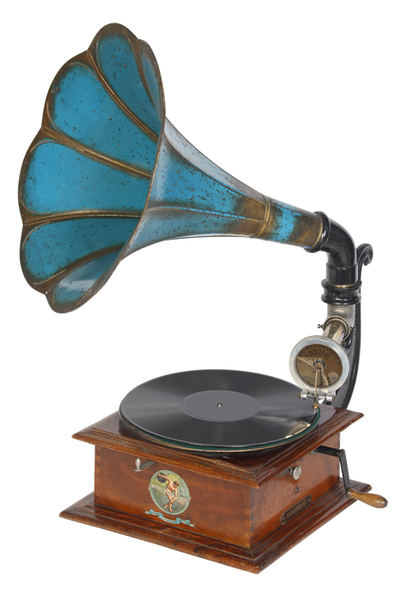
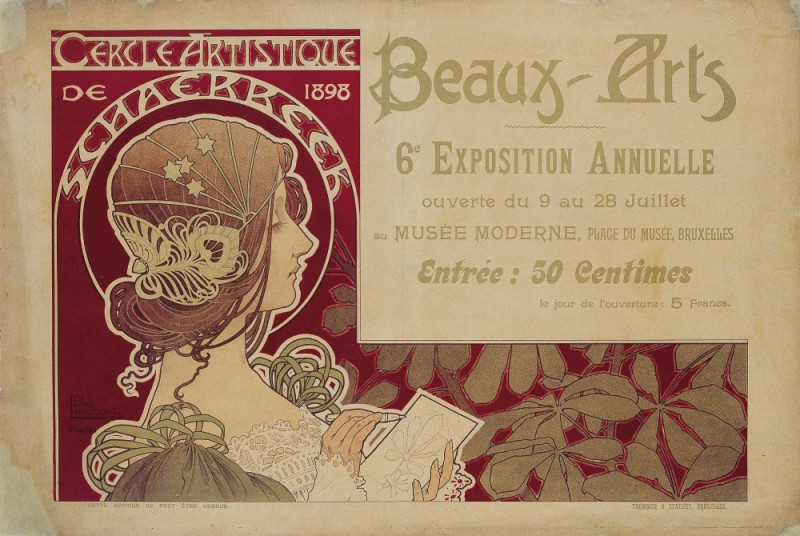
In such an enormous warehouse of cultural history, one could begin anywhere and in an instant come across something of interest, such as the stunning collection of Art Nouveau posters like that fine example at the top, “Cercle Artstique de Schaerbeek,” by Henri Privat-Livemont (from the Plandiura Collection, courtesy of Museu Nacional d’Art de Catalynya, Barcelona). One might enter any one of the available interactive lessons and courses on the history of World War I or visit some of the many exhibits on the period, with letters, diaries, photographs, films, official documents, and war propaganda. One might stop by the virtual exhibit, “Photography on a Silver Plate,” a fascinating history of the medium from 1839–1860, or “Recording and Playing Machines,” a history of exactly what it sounds like, or a gallery of the work of Swiss painter Jean Antoine Linck. All of the artifacts have source and licensing information clearly indicated.
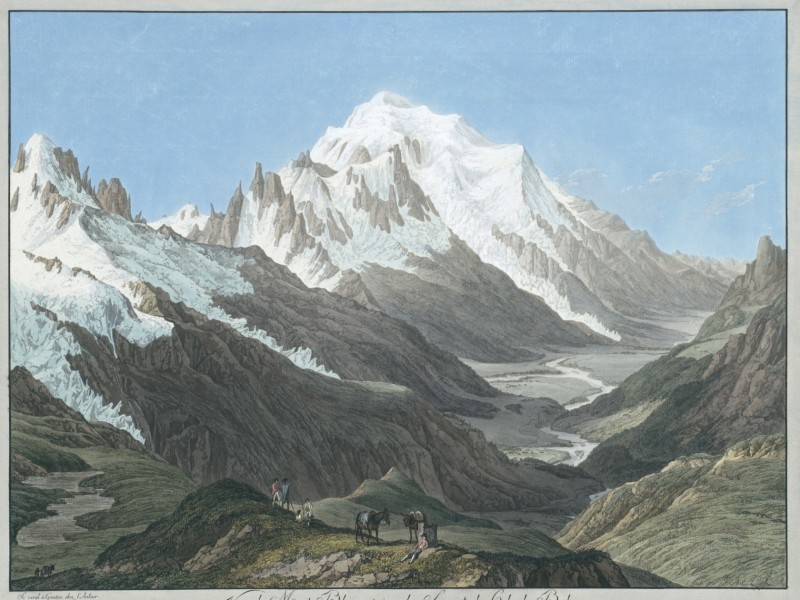
The possibilities may literally be endless, as the collection continues to expand at a rate far beyond the ability of any one person, or team of people, or entire research institute of people to match. It is easy to feel adrift in such a database as this, which stretches on like a Borgesian library, offering room after endless room of visual splendor, documentation, and interpretation. It is also easy to make discoveries, to meet people, stumble upon art, hear music, see photographs, learn histories you would never have encountered if you knew what you were looking for and knew exactly how to find it. Eliot warned us—and rightly so—of the dangers of information overload. But he neglected, in his puritanical way, to describe the pleasures, the minor epiphanies, the happy chance occurrences afforded us by the ever-expanding sea of information in which we swim. One can learn to navigate it, one can drift aimlessly, and one can, simultaneously, feel immensely overwhelmed.
Related Content:
Yale Launches an Archive of 170,000 Photographs Documenting the Great Depression
Josh Jones is a writer and musician based in Durham, NC. Follow him at @jdmagness
Read More...David Bowie Sings Impressions of Bruce Springsteen, Lou Reed, Iggy Pop, Tom Waits & More In Studio Outtakes (1985)
We knew David Bowie could pretty much do it all—glam rock, jazz, funk, Philly soul, cabaret, pop, drum and bass, folk, avant-garde, you name it. In front of the camera, he could stretch himself into the beautiful but wounded alien in The Man Who Fell to Earth, the scary-sexy-cool Goblin King of Labyrinth, the mystical genius Tesla in The Prestige. Nothing he attempted seemed beyond his grasp, including, as you can hear above, off-the-cuff, mostly spot-on impressions of friends and fellow singers like Iggy Pop, Lou Reed, Tom Waits, and Bruce Springsteen.
The audio clip you hear comes from outtakes producer Mark Saunders happened to capture on tape during the 1985 sessions for the Absolute Beginners film soundtrack (“a better soundtrack than it was a movie!” Saunders remarks).
While recording a lead vocal, Saunders writes, Bowie “broke into the impersonations and I realized that these might get erased at some point, so I quickly put a cassette in and hit ‘record.’” You can read his full recollections at The Talkhouse in a short essay he wrote to accompany the audio—introduced by Zach Staggers of indie band the So So Glos, who writes:
Bowie goes through a handful of sung impressions, including but not limited to, Bruce Springsteen, Iggy Pop, Tom Waits, Loud Reed and Anthony Newly, who was such a big influence on the iconic singer that the impersonation almost sounds like Bowie mimicking himself. Between takes you can hear Bowie having fun and going back and forth with the engineers. Jokes.
Bowie also does what sounds like Bob Dylan (or Tom Petty, or Marc Bolan as some have speculated?) in the second take and a passable Neil Young in the last. His Springsteen, Reed, and Pop are excellent (Bowie called the Iggy impression “difficult, he’s somewhere between all of them.”) He closes the impromptu performance with “That’s it, night night.”
Bowie did indeed have jokes, though anyone who followed him over the decades knows of his comedic talents, whether playing straight man to Ricky Gervais’ obnoxious superfan or displaying impeccable timing in his deadpan delivery of “Bowie Secrets” from Late Night With Conan O’Brien in 2002.
Despite the kiss-off he gives Gervais in their comedy bit, those who knew and worked with Bowie all testify that he never took himself too seriously or, as Saunders remembers, threw his weight around by “using a big rock star ‘Hey, I’m David Bowie and I want it done my way.” He may have seemed to many like an alien or a god, but he was apparently in person a pretty humble, and very funny, guy.
Related Content:
David Bowie (RIP) Sings “Changes” in His Last Live Performance, 2006
Josh Jones is a writer and musician based in Durham, NC. Follow him at @jdmagness
Read More...The 20 Most Influential Academic Books of All Time: No Spoilers
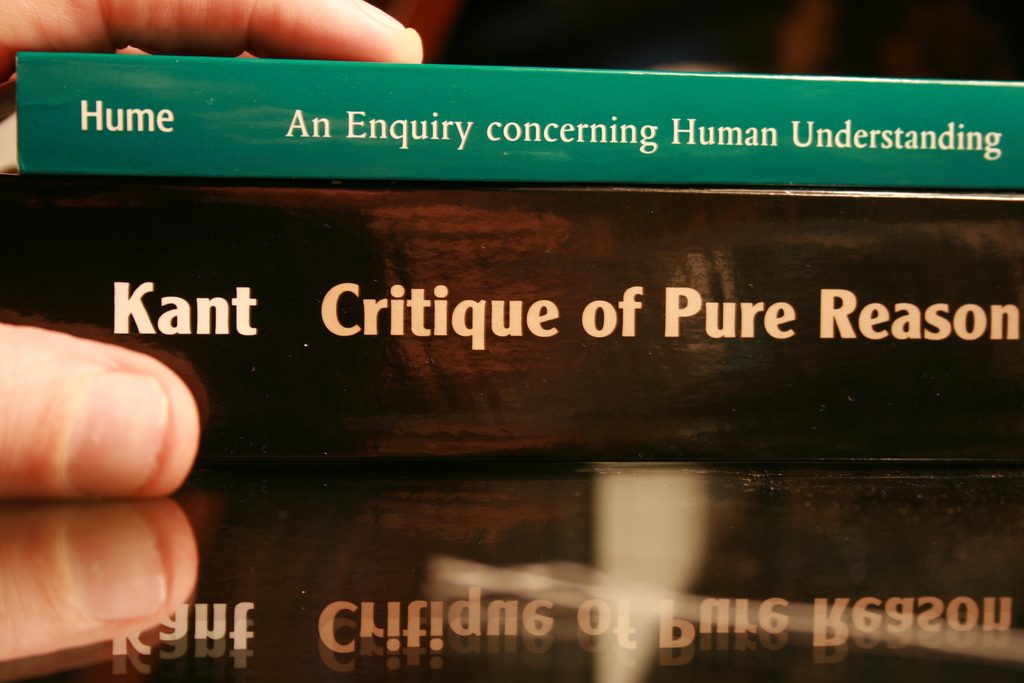
Image by Let Ideas Compete, via Flickr Commons
Sometimes I’ll meet someone who mentions having written a book, and who then adds, “… well, an academic book, anyway,” as if that didn’t really count. True, academic books don’t tend to debut at the heights of the bestseller lists amid all the eating, praying, and loving, but sometimes lightning strikes; sometimes the subject of the author’s research happens to align with what the public believes they need to know. Other times, academic books succeed at a slower burn, and it takes readers generations to come around to the insights contained in them — a less favorable royalty situation for the long-dead writer, but at least they can take some satisfaction in the possibility.
History has shown, in any case, that academic books can become influential. “After a list of the top 20 academic books was pulled together by expert academic booksellers, librarians and publishers to mark the inaugural Academic Book Week,” writes The Guardian’s Alison Flood, “the public was asked to vote on what they believed to be the most influential.” The shortlist of these most important academic books of all time runs as follows (and you can read many of them free by following the links from our meta list of Free eBooks):
- A Brief History of Time by Stephen Hawking
-
A Vindication of the Rights of Woman by Mary Wollstonecraft
-
Nineteen Eighty-Four by George Orwell
-
On the Origin of Species by Charles Darwin
- Orientalism by Edward Said
- Silent Spring by Rachel Carson
- The Communist Manifesto by Karl Marx and Friedrich Engels
- The Complete Works of William Shakespeare
- The Female Eunuch by Germaine Greer
- The Making of the English Working Class by EP Thompson
- The Meaning of Relativity by Albert Einstein
- The Naked Ape by Desmond Morris
- The Prince by Niccolò Machiavelli
- The Republic by Plato
- The Rights of Man by Thomas Paine
- The Second Sex by Simone de Beauvoir
- The Uses of Literacy by Richard Hoggart
- The Wealth of Nations by Adam Smith
- Ways of Seeing by John Berger
The top spot went to Darwin’s On the Origin of Species, which Flood quotes the University of Glasgow’s Andrew Prescott as calling “the supreme demonstration of why academic books matter,” one that “changed the way we think about everything – not only the natural world, but religion, history and society. Every researcher, no matter whether they are writing books, creating digital products or producing artworks, aspires to produce something as significant in the history of thought as Origin of Species.”
Kant’s Critique of Pure Reason placed a still impressive fifth, given its status, in the words of philosopher Roger Scruton, as “one of the most difficult works of philosophy ever written,” — but one which aims to “show the limits of human reasoning, and at the same time to justify the use of our intellectual powers within those limits. The resulting vision, of self-conscious beings enfolded within a one-sided boundary, but always pressing against it, hungry for the inaccessible beyond, has haunted me, as it has haunted many others since Kant first expressed it.”
So you want to write an academic book this influential? You may have a tough time doing it deliberately, but it couldn’t hurt to steep yourself in the materials we’ve previously featured related to the creation of this top twenty, including 16,000 pages of Darwin’s writing on evolution (as well as the man’s personal library), Orwell’s letter revealing why he would write 1984, as well as Marx and Kant’s rigorous work habits — and Kant’s even more rigorous coffee habit, though if there exists any 21st-century academic in need of encouragement to drink more coffee, I have yet to meet them.
Related Content:
800 Free eBooks for iPad, Kindle & Other Devices
Read 700 Free eBooks Made Available by the University of California Press
The 10 Greatest Books Ever, According to 125 Top Authors (Download Them for Free)
28 Important Philosophers List the Books That Influenced Them Most During Their College Days
Life-Changing Books: Your Picks
Darwin: A 1993 Film by Peter Greenaway
Darwin’s Personal Library Goes Digital: 330 Books Online
16,000 Pages of Charles Darwin’s Writing on Evolution Now Digitized and Available Online
George Orwell Explains in a Revealing 1944 Letter Why He’d Write 1984
The Daily Habits of Highly Productive Philosophers: Nietzsche, Marx & Immanuel Kant
Philosophers Drinking Coffee: The Excessive Habits of Kant, Voltaire & Kierkegaard
Based in Seoul, Colin Marshall writes and broadcasts on cities and culture. He’s at work on a book about Los Angeles, A Los Angeles Primer, the video series The City in Cinema, the crowdfunded journalism project Where Is the City of the Future?, and the Los Angeles Review of Books’ Korea Blog. Follow him on Twitter at @colinmarshall or on Facebook.
Read More...Nietzsche Lays Out His Philosophy of Education and a Still-Timely Critique of the Modern University (1872)
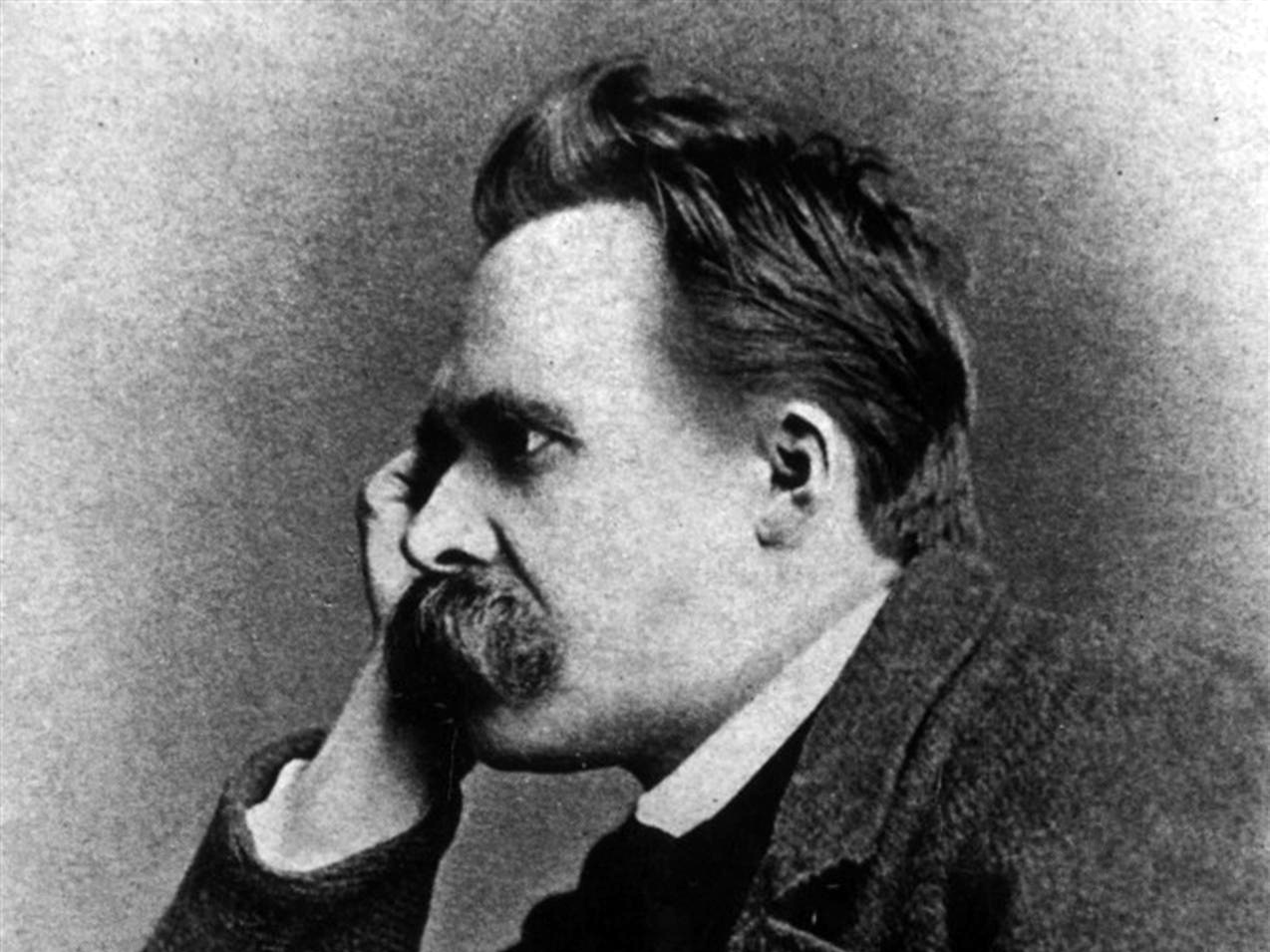
In a recent entry in the New York Times’ philosophy blog “The Stone,” Robert Frodeman and Adam Briggle locate a “momentous turning point” in the history of philosophy: its institutionalization in the research university in the late 19th century. This, they argue, is when philosophy lost its way—when it became subject to the dictates of the academy, placed in competition with the hard sciences, and forced to prove its worth as an instrument of profit and progress. Well over a hundred years after this development, we debate a wider crisis in higher education, as universities (writes Mimi Howard in the Los Angeles Review of Books) “increasingly resemble global corporations with their international campuses and multibillion dollar endowments. Tuition has skyrocketed. Debt is astronomical. The classrooms themselves are more often run on the backs of precarious adjuncts and graduate students than by real professors.”
It’s a cutthroat system I endured for many years as both an adjunct and graduate student, but even before that, in my early undergraduate days, I remember well watching public, then private, colleges succumb to demand for leaner operating budgets, more encroachment by corporate donors and trustees, and less autonomy for educators. Universities have become, in a word, high-priced, high-powered vocational schools where every discipline must prove its value on the open market or risk massive cuts, and where students are treated, and often demand to be treated, like consumers. Expensive private entities like for-profit colleges and corporate educational companies thrive in this environment, often promising much but offering little, and in this environment, philosophy and the liberal arts bear a crushing burden to demonstrate their relevance and profitability.
Howard writes about this situation in the context of her review of Friedrich Nietzsche’s little-known, 1872 series of lectures, On the Future of Our Educational Institutions, published in a new translation by Damion Searls with the pithy title Anti-Education. Nietzsche, an academic prodigy, had become a professor of classical philology at the University of Basel at only 24 years of age. By 27, when he wrote his lectures, he was already disillusioned with teaching and the strictures of professional academia, though he stayed in his appointment until illness forced him to retire in 1878. In the lectures, Nietzsche excoriates a bourgeois higher education system in terms that could come right out of a critical article on the higher ed of our day. In a Paris Review essay, his translator Searls quotes the surly philosopher on what “the state and the masses were apparently clamoring for”:
as much knowledge and education as possible—leading to the greatest possible production and demand—leading to the greatest happiness: that’s the formula. Here we have Utility as the goal and purpose of education, or more precisely Gain: the highest possible income … Culture is tolerated only insofar as it serves the cause of earning money.
Perhaps little has changed but the scale and the appearance of the university. However, Nietzsche did admire the fact that the school system “as we know it today… takes the Greek and Latin languages seriously for years on end.” Students still received a classical education, which Nietzsche approvingly credited with at least teaching them proper discipline. And yet, as the cliché has it, a little knowledge is a dangerous thing; or rather, a little knowledge does not an education make. Though many pursue an education, few people actually achieve it, he believed. “No one would strive for education,” wrote Nietzsche, “if they knew how unbelievably small the number of truly educated people actually was, or ever could be.” For Nietzsche, the university was a scam, tricking “a great mass of people… into going against their nature and pursuing an education” they could never truly achieve or appreciate.
While it’s true that Nietzsche’s critiques are driven in part by his own cultural elitism, it’s also true that he seeks in his lectures to define education in entirely different terms than the utilitarian “state and masses”—terms more in line with classical ideals as well as with the German concept of Bildung, the term for education that also means, writes Searls, “the process of forming the most desirable self, as well as the end point of the process.” It’s a resonance that the English word has lost, though its Latin roots—e ducere, “to lead out of” or away from the common and conventional—still retain some of this sense. Bildung, Searls goes on, “means entering the realm of the fully formed: true culture is the culmination of an education, and true education transmits and creates culture.”
Nietzsche the philologist took the rich valence of Bildung very seriously. In the years after penning his lectures on the educational system, he completed the essays that would become Untimely Meditations (including one of his most famous, “On the Use and Abuse of History for Life”). Among those essays was “Schopenhauer as Educator,” in which Nietzsche calls the gloomy philosopher Arthur Schopenhauer his “true educator.” However, writes Peter Fitzsimons, the “image” of Schopenhauer “is more a metaphor for Nietzsche’s own self-educative process.” For Nietzsche, the process of a true education consists not in rote memorization, or in attaining cultural signifiers consistent with one’s class or ambitions, or in learning a set of practical skills with which to make money. It is, Fitzsimons observes, “rather an exhortation to break free from conventionality, to be responsible for creating our own existence, and to overcome the inertia of tradition and custom”—or what Nietzsche calls the universal condition of “sloth.” In “Schopenhauer as Educator,” Nietzsche defines the role of the educator and explicates the purpose of learning in deliberately Platonic terms:
…for your true nature lies, not concealed deep within you, but immeasurably high above you, or at least above that which you usually take yourself to be. Your true educators and formative teachers reveal to you what the true basic material of your being is, something in itself ineducable and in any case difficult of access, bound and paralysed: your educators can be only your liberators.
As in Plato’s notion of innate knowledge, or anamnesis, Nietzsche believed that education consists mainly of a clearing away of “the weeds and rubbish and vermin” that attack and obscure “the real groundwork and import of thy being.” This kind of education, of course, cannot be formalized within our present institutions, cannot be marketed to a mass audience, and cannot serve the interests of the state and the market. Hence it cannot be obtained by simply progressing through a system of grades and degrees, though one can use such systems to obtain access to the liberatory materials one presumably needs to realize one’s “true nature.”
For Nietzsche, in his example of Schopenhauer, achieving a true education is an enterprise fraught with “three dangers”—those of isolation, of crippling doubt, and of the pain of confronting one’s limitations. These dangers “threaten us all,” but most people, Nietzsche thinks, lack the fortitude and vigor to truly brave and conquer them. Those who acquire Bildung, or culture, those who realize their “true selves,” he concludes “must prove by their own deed that the love of truth has itself awe and power,” though “the dignity of philosophy is trodden in the mire,” and one will likely receive little respite, recompense, or recognition for their labors.
Related Content:
The Digital Nietzsche: Download Nietzsche’s Major Works as Free eBooks
What is the Good Life? Plato, Aristotle, Nietzsche, & Kant’s Ideas in 4 Animated Videos
Download Walter Kaufmann’s Lectures on Nietzsche, Kierkegaard, Sartre & Modern Thought (1960)
Josh Jones is a writer and musician based in Durham, NC. Follow him at @jdmagness
Read More...How a Good Night’s Sleep — and a Bad Night’s Sleep — Can Enhance Your Creativity
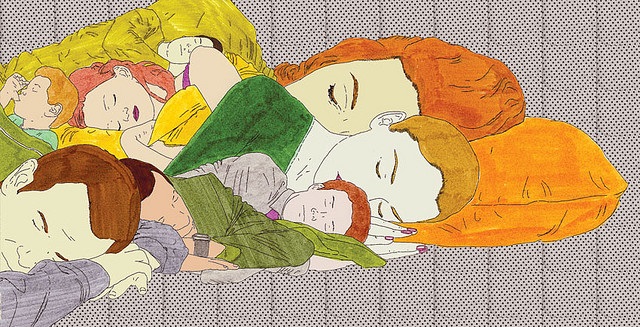
Creative Commons image, “Sleep,” by Masha Krasnova-Shabaeva
You decide you need some medical advice, so you take to the internet. Whoops! There’s your first mistake. Now you are bombarded with contradictory opinions from questionable sources and you begin to develop symptoms you never knew existed. It’s all downhill from there. So I’ll say this upfront: I have no medical qualifications authorizing me to dispense information about sleep disorders. The only advice I’d venture, should you have such a problem, is to go see a doctor. It might help, or not. I can certainly sympathize. I am a chronic insomniac.
The downside to this condition is obvious. I never get enough sleep. Whenever I consult the internet about this, I learn that it’s probably very dire and that I may lose my mind or die young(ish). The upside—which I learned to master after years of trying and failing to sleep like normal people—is that the nights are quiet and peaceful, and thus a fertile time creatively.
Medical issues aside, what do we know about sleep, insomnia, and creativity? Let us wade into the fray, with the proviso that we will likely reach few conclusions and may have to fall back on our own experience to guide us. In surveying this subject, I was pleased to have my experience validated by an article in Fast Company. Well, not pleased, exactly, as the author, Jane Porter, cites a study in Science that links a lack of sleep to Alzheimer’s and the accumulation of “potentially neurotoxic waste products.”
And yet, in praise of sleeplessness, Porter also recommends turning insomnia into a “productivity tool,” naming famous insomniacs like Margaret Thatcher, Bill Clinton, Charles Dickens, Marcel Proust, and Madonna (not all of whom I’d like to emulate). She then quotes psychologist Tomas Chamorro-Premuzic of University College London, who made the dubious-sounding claim in Psychology Today that “insomnia is to exceptional achievement what mental illness is to creativity.” Everything about this analogy sounds suspect to me.
But there are more substantive views on the matter. Another study, published in Creativity Research Journal, suggests insomnia may be a symptom of “notable creative potential,” though the authors only go as far as saying the two phenomenon are “associated.” The arrow of causality may point in either direction. Perhaps the most pragmatic view on the subject comes from Michael Perlis, psychology professor at the University of Pennsylvania, who says, “What is insomnia, but the gift of more time?”
Dennis Drabelle at The Washington Post, also an insomniac, refers to a recent study (as of 2007) from the University of Canterbury that suggests “insomnia and originality may go hand in hand.” He also points out that the notion of sleeplessness as productive, though “counterintuitive,” has plenty of precedent. Drabelle mentions many more famous cases, from W.C. Fields to Theodore Roosevelt to Franz Kafka. The list could go on and on.
Actor and musician Matt Berry tells The Guardian how, after years of tossing and turning, he finally harnessed his sleepless hours to write and record an album, Music for Insomniacs. “I knew that this was dead time,” says Berry, “and I could be doing something instead of sitting worrying about not being asleep.” Another musician, Dave Bayley of band Glass Animals, “owes his career in music to insomnia,” The Guardian writes, then notes a phenomenon sleep researchers call—with some skepticism—“creative insomnia.” Other musicians like Chris Martin, Moby, Tricky, and King Krule have all suffered the condition and turned it to good account.
The Guardian also notes that each of these poor souls has found “sleepless nights inspiring as well as tormenting.” Insomnia is not, in fact a gift or talent, but a painful condition that Porter and Drabelle both acknowledge can be associated with depression, addiction, and other serious medical conditions. One might make good use of the time—but perhaps only for a time. A site called Sleepdex—-which offers “resources for better sleep”—puts it this way:
Occasional insomnia appears to help some people produce new art and work, but is a detriment to others. It is perhaps true that more people find it a detriment than find it useful. Long-term insomnia and the accompanying sleep debt are almost surely negative for creativity.
This brings us to the subject of sleep—good, restful sleep—and its relationship to creativity. Sleepdex cites several research studies from Swiss and Italian universities, UC San Diego, and UC Davis. The general conclusion is that REM sleep—that period during which dreams “are the most narratively coherent of any during the night”—is also an important stimulus for creativity. There are the numerous anecdotes from artists like Salvador Dali, Paul McCartney, and countless others about famous works of art taking shape in dream states (Keith Richards says he heard the riff from “Satisfaction” in a dream).
And there are the experimental data, purportedly confirming that REM sleep enhances “creative problem solving.” European scientists have found that people were more likely to have creative insights after a long period of restful sleep, when the right brain gets a boost. Likewise, Tom Stafford at the BBC describes the “post-sleep, dreamlike mental state—known as sleep inertia or the hypnopompic state” that infuses our “waking, directed thoughts with a dusting of dreamworld magic.” It isn’t that insomniacs don’t experience this, of course, but we have less of it, as periods of REM sleep can be shorter and often interrupted by the need to scramble out of bed and get to work or get the kids to school not long after hitting the pillow.
Stafford points us toward a UC Berkeley study (apparently the University of California has some sort of monopoly on sleep research) “that helps illustrate the power of sleep to foster unusual connections, or ‘remote associates’ as psychologists call them.” Like nearly all of the scientific literature on sleep, this study expresses little doubt about the importance of sleep to memory function and problem solving. Big Think collects several more studies that confirm the findings.
On the whole, when it comes to the links between sleep—or sleeplessness—and creativity, the data and the stories point in different directions. This is hardly surprising given the slipperiness of that thing we call “creativity.” Like “love” it’s an abstract quality everyone wants and no one knows how to make in a laboratory. If it’s extra time you’re after—and very quiet time at that—I can’t recommend insomnia enough, though I wouldn’t recommend it at all as a voluntary exercise. If it’s the special creative insights only available in dream states, well, you’d best get lots of sleep. If you can, that is. Creative insomniacs—like those wandering in the confines of a dream world—know all too well they don’t have much choice in the matter.
Related Content:
Why You Do Your Best Thinking In The Shower: Creativity & the “Incubation Period”
David Lynch Explains How Meditation Enhances Our Creativity
Josh Jones is a writer and musician based in Durham, NC. Follow him at @jdmagness
Read More...Shot-By-Shot Breakdowns of Spielberg’s Filmmaking in Jaws, Scorsese’s in Cape Fear, and De Palma’s in The Untouchables
This past summer, we featured a shot-by-shot breakdown of several sequences in Andrei Tarkovsky’s Solaris by filmmaker and video essayist Antonios Papantoniou. Solaris, as well as the rest of Tarkovsky’s oeuvre, has given and will continue to give detail-oriented cinephiles a seemingly infinite amount of material to break down, scrutinize, and explain the genius of.
But what of big Hollywood films? Do they have nothing of interest to offer? Papantoniou clearly doesn’t think so: his other Shot by Shot video essays include looks, and very close looks indeed, at Brian De Palma’s The Untouchables, Martin Scorsese’s remake of Cape Fear, and even the mother of all blockbusters, Steven Spielberg’s Jaws.
These three auteurs, all of the same generation, came up in the 1970s cohort of filmmakers who brought about the “New Hollywood,” a movement wherein young directors like Spielberg, De Palma, and Scorsese (as well as Francis Ford Coppola, George Lucas, Paul Schrader, and many others) changed the rules of classical cinema, introducing a host of subjects and techniques previously unheard of in mainstream American films. Yet they still did make mainstream American films, which required a kind of hybridization of cutting-edge sensibilities with silver-screen expectations. Papantoniou specifically examines how these directors accomplish it through the kind of shots they capture and how they cut them together.
Papantoniou’s analyses identify the visual evidence of Spielberg’s “appetite for nonstop dynamic filmmaking,” De Palma’s “own unique post-modern style” expressed through techniques like point-of-view-shots, and of how “Scorsese distincts [sic] himself by adopting more rebellious techniques.” You might get the sense of a slight awkwardness in the language here, but the images selected speak for themselves — and besides, if you took film studies classes in college, you no doubt had at least one or two professors who compensated for their odd turns of phrase with their rigorous love of cinema, and from whom you ultimately learned a great deal. Video essays like these have increasingly made it possible for anyone, without going back to college or even going in the first place, to do that kind of learning — and, whether watching Tarkovsky or Spielberg, to never watch them inattentively again.
Related Content:
Andrei Tarkovsky’s Solaris Shot by Shot: A 22-Minute Breakdown of the Director’s Filmmaking
Spielberg Reacts to the 1975 Oscar Nominations: ‘Commercial Backlash!’
Watch Steven Spielberg’s Rarely Seen 1968 Film, Amblin’
Martin Scorsese Makes a List of 85 Films Every Aspiring Filmmaker Needs to See
Revisit Martin Scorsese’s Hand-Drawn Storyboards for Taxi Driver
The 10 Hidden Cuts in Rope (1948), Alfred Hitchcock’s Famous “One-Shot” Feature Film
Chaos Cinema: A Breakdown of How 21st-Century Action Films Became Incoherent
Learn the Elements of Cinema: Spielberg’s Long Takes, Scorsese’s Silence & Michael Bay’s Shots
Signature Shots from the Films of Stanley Kubrick: One-Point Perspective
Based in Seoul, Colin Marshall writes and broadcasts on cities and culture. He’s at work on a book about Los Angeles, A Los Angeles Primer, the video series The City in Cinema, the crowdfunded journalism project Where Is the City of the Future?, and the Los Angeles Review of Books’ Korea Blog. Follow him on Twitter at @colinmarshall or on Facebook.
Read More...Hear Flannery O’Connor’s Short Story, “Revelation,” Read by Legendary Historian & Radio Host, Studs Terkel
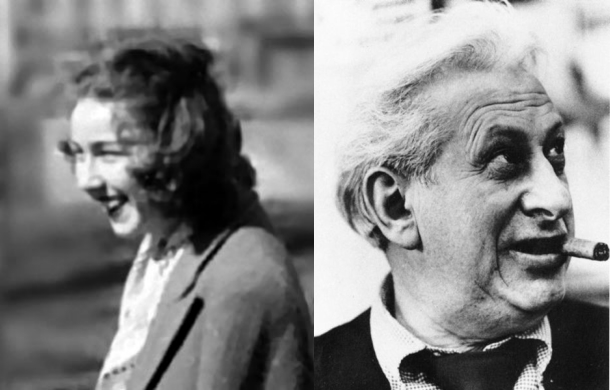
Images via Wikimedia Commons
Flannery O’Connor’s surgical satire has the ability to strip away the pretensions of not only those characters we are already predisposed to dislike, but also those with whom we may sympathize—that is, educated people with broadly humanist views who think they see right through the self-important prejudices and provincialism of people like Mrs. Hopewell in “Good Country People” or Mrs. Chestny in “Everything that Rises Must Converge.” Both stories dramatize generational tensions in the form of mother/child pairs at odds. In the former, superficial, condescending Mrs. Hopewell and her daughter Joy—a miserable, graduate-educated amputee who prefers to call herself Hulga—battle over their conflicting moral philosophies, only to both be taken in by a devious bumpkin posing as a Bible salesman.
In the latter story—also the title of O’Connor’s most widely read collection, published posthumously in 1965—a mother and son pair present us with two kinds of intolerance. Mrs. Chestny is an overt bigot whose self-importance depends on her sense of herself as a descendent of a proud, if decayed, Southern aristocracy. Julian, her unemployed son, a despairing recent college-grad with designs of becoming a writer but with no real prospects, thinks himself above his mother’s ugly racism and desires nothing more than that she learn her lesson: “The old world is gone,” he says, “You aren’t who you think you are.” When she finally gets her comeuppance at the end of the story (on the way, comically, to a “reducing class”) it may have come, to Julian’s dismay, at the cost of her life. Though we are inclined to sympathize at first with the bitterly ironic son, as the story progresses, the narrator reveals his motivations as hardly more elevated than his mother’s hate and fear.
These are not characters we fall in love with, but we never forget them either. Through them we come to see that none of us is who we think we are, that the human capacity for self-deception is boundless. This is the lesson common to each of O’Connor’s stories, one she offers anew with wit and variety each time, and each time through a kind of revelation. Her stories draw us into points of view that reveal themselves—through sudden epiphanies and gradual unfoldings—to be inadequate, deluded, profoundly limited. And though O’Connor’s Southern Catholic pessimism has astonishingly universal reach, the regional grounding of her stories and novels present us with particularly American versions of the petty meanness and conceit common to the human species.
In “Revelation,” another story from Everything Rises Must Converge—read above by Studs Terkel—O’Connor lays bare some particularly American race and class biases in the character of Mrs. Turpin, another older Southern lady whose prejudices are more vicious and spiteful than both Mrs. Hopewell and Mrs. Chestny put together. The story achieves a subtle examination of some very unsubtle attitudes, and the reading by Terkel, in his Chicago-accented radio voice, does it justice indeed. Terkel read the story on his radio show, The Studs Terkel Program, in 1965, the year of its publication and a little over a year after O’Connor’s death. See a complete transcript of the broadcast at the Terkel show’s Pop Up Archive. The audio above has been kindly enhanced for us by sound designer Berrak Nil.
As an added treat, hear “Everything that Rises Must Converge” read above by Academy Award-winning actress Estelle Parsons, who became known in her later years for playing an overbearing mother like the story’s Mrs. Chestny in the TV sitcom Roseanne. Despite the quaintness of O’Connor’s characterizations, we are not far at all from the world she depicted, given the stubborn persistence of human bigotry, selfishness, and blind self-regard. For more classic O’Connor, hear the sharp-tongued writer, who died too soon of complications from her lupus at age 39, read her story “A Good Man is Hard to Find” here.
The reading above can be found in our collection, 1,000 Free Audio Books: Download Great Books for Free.
Related Content:
Studs Terkel Interviews Bob Dylan, Shel Silverstein, Maya Angelou & More in New Audio Trove
Rare 1959 Audio: Flannery O’Connor Reads ‘A Good Man is Hard to Find’
Flannery O’Connor’s Satirical Cartoons: 1942–1945
Josh Jones is a writer and musician based in Durham, NC. Follow him at @jdmagness
Read More...Marcel Marceau Mimes the Progression of Human Life, From Birth to Death, in 4 Minutes
What do you think of when you hear the word “mime.”
A cheeky, stripe-shirted, invisible ladder-climbing public nuisance?
The solitary practitioner Dustin Hoffman wordlessly toppled in the 1982 film Tootsie?
Or Marcel Marceau?
Ah ha, and what does the name “Marcel Marceau” bring to mind?
The cheeky, stripe shirted, butterfly chasing Bip (who maybe causes you to cringe a little, despite his creator’s reputation as a great artist)?
I was surprised to learn that he was a former French Resistance fighter, whose first review was printed in Stars and Stripes after he accepted an American general’s spur of the moment invitation to perform for 3,000 GIs in 1945 Frankfurt.
The film above documents a 1965 performance of his most celebrated piece, Youth, Maturity, Old Age, and Death, given at 42, the exact midpoint of his life. In four abstract minutes, he progresses through the seven ages of man, relying on nuances of gait and posture to convey each stage.
He performed it countless times throughout his extraordinary career, never straying from his own precisely rendered choreography. The playing area is just a few feet in diameter.
Observe the 1975 performance that filmmaker John Barnes captured for his series Marcel Marceau’s Art of Silence, below. Nothing left to chance there, from the timing of the smallest abdominal isolations to the angle of his head in the final tableau.
Time’s effects may have provided the subject for the piece, but its perennially lithe author claimed not to concern himself with age, telling the New York Times in 1993 that his focus was on “life-force and creation.”
Later in the same interview, he reflected:
When I started, I hunted butterflies. Later, I began to remember the war and I began to dig deeper, into misery, into solitude, into the fight of human souls against robots.
This would seem to support the theory that maturity is a side effect of age.
His alter ego Bip’s legacy may be the infernal invisible ropes and glass cages that are a mime’s stock in trade, but distilling human experience to its purest expression was the basis of Marceau’s silent art.
In a recent appreciation published in the Paris Review, author Mave Fellowes considers the many stages of Marceau, from the formative effects of childhood encounters with Charlie Chaplin films to his death at 84:
He feels his advancing age and fears that the art of mime will die with him. It’s a transitory, ephemeral art, he explains, as it exists only in the moment. As an old man, he works harder than ever, performing three hundred times a year, teaching four hours a day. He is named the UN Ambassador for Aging. Five nights a week he smears the white paint over his face, draws in the red bud at the center of his lips, follows the line of his eyelid with a black pencil. And then takes to the stage, his sideburns frayed, his hair dyed chestnut and combed forward, looking like a toupee.
His body is as elastic as ever, but the old suit of Bip hangs loose on him now. Beneath the whitened jawline is a baggy, sinewy neck. With each contortion of his face, the white paint reveals deep lines. At the end of his show, he folds in a deep bow and the knobs of his spine show above the low cut of Bip’s Breton top.
Related Content:
Édith Piaf’s Moving Performance of ‘La Vie en Rose’ on French TV, 1954
David Bowie Launches His Acting Career in the Avant-Garde Play Pierrot in Turquoise (1967)
Klaus Nomi: The Brilliant Performance of a Dying Man
Ayun Halliday is an author, illustrator, and Chief Primatologist of the East Village Inky zine. In college, she earned a hundred dollars for appearing as a mime before a convention of hungover glassware salesmen, an experience briefly recalled in her memoir, Job Hopper. Follow her @AyunHalliday
Read More...
Support Us
We're hoping to rely on loyal readers, rather than erratic ads. Please click the Donate button and support Open Culture. You can use Paypal, Venmo, Patreon, even Crypto! We thank you!

About Us

Open Culture scours the web for the best educational media. We find the free courses and audio books you need, the language lessons & educational videos you want, and plenty of enlightenment in between.
Advertise With Us
FREE UPDATES!
GET OUR DAILY EMAIL
Get the best cultural and educational resources on the web curated for you in a daily email. We never spam. Unsubscribe at any time.
FOLLOW ON SOCIAL MEDIA
Open Culture editor Dan Colman scours the web for the best educational media. He finds the free courses and audio books you need, the language lessons & movies you want, and plenty of enlightenment in between.
Advertise With Us



