Mapping the Sounds of Greek Byzantine Churches: How Researchers Are Creating “Museums of Lost Sound”
Unless you’re an audio engineer, you’ll have little reason to know what the term “convolution reverb” means. But it’s a fascinating concept nonetheless. Technicians bring high-end microphones, speakers, and recording equipment to a particularly resonant space—a grain silo, for example, or famous concert hall. They capture what are called “impulse responses,” signals that contain the acoustic characteristics of the location. The technique produces a three dimensional audio imprint—enabling us to recreate what it would sound like to sing, play the piano or guitar, or stage an entire concert in that space. As Adrienne LaFrance writes in The Atlantic, “you can apply [impulse responses] to a recording captured in another space and make it sound as though that recording had taken place in the original building.”
This kind of mapping, writes Allison Meier at Hyperallergic, allows researchers to “build an archive of a building’s sound, with all its nuances, echoes, and ricochets, that could survive even if the building fell.” And that is precisely what researchers have been doing since 2014 in ancient Greek Byzantine churches. The project began when Sharon Gerstel, Professor of Byzantine Art History and Archeology at UCLA, and Chris Kyriakakis, director of the Immersive Audio Laboratory at the University of Southern California, met to discuss their mutual interest in capturing the sound of these spaces.
(Hear them both explain the genesis of the project in the CBC interview above.) The two researchers traveled to Thessaloniki, coincidentally, Kyriakakis’ hometown, and began, as Gerstel puts it, to “measure the churches.” LaFrance’s Atlantic article gives us a detailed description of the measurement process, which involves playing and recording a tone that sweeps through the audible frequency spectrum. You’ll hear it in the video at the top of the post as a “chirp”—bouncing off the various architectural surfaces as the voices of singers would have hundreds of years ago.
In that video and in the audio recording above, chanters in a studio had the audio characteristics of these churches applied to their voices, recreating the sounds that filled the spaces in the early Christian centuries. As another member of the team, James Donahue—Professor of Music Production and Engineering at Berklee College of Music—discovered, the churches had been acoustically designed to produce specific sound effects. “It wasn’t just about the architecture,” says Donahue, “they had these big jugs that were put up there to sip certain frequencies out of the air… They built diffusion, a way to break up the sound waves… They were actively trying to tune the space.” In addition, the builders “discovered something that we call slap echo. [In the ancient world], they described it as the sound of angels’ wings.”
The project not only allows art historians to enter the past, but it also preserves that past far into the future, creating what LaFrance calls a “museum of lost sound.” After all, the churches themselves will eventually recede into history. “Some of these buildings may not exist later,” says Kyriakakis, “Some of these historic buildings are being destroyed.” With immersive video and audio technology, we will still be able to experience much of their grandeur long after they’re gone.
Related Content:
David Byrne: How Architecture Helped Music Evolve
The History of Western Architecture: From Ancient Greece to Rococo (A Free Online Course)
Josh Jones is a writer and musician based in Durham, NC. Follow him at @jdmagness
Read More...American History: An Off-Kilter 1992 Student Film from South Park Creator Trey Parker
Here’s a little exercise:
Spend five minutes recording yourself recapping everything you know about Japanese history.
(International Studies majors and Japanese citizens, please sit this one out.)
Most of us will wind up with a pastiche that’s heavy on pop culture and relatively recent events. The average Japanese schoolchild should have no difficulty identifying the glaring holes and factual errors in our narratives.
If this idea amuses you, you’ll likely enjoy American History, above, South Park creator Trey Parker’s early animated short, a 1993 Student Academy Award silver medalist.
Parker’s Japanese-born University of Colorado classmate, Junichi Nishimura, provided the narration, beginning with Christopher Columbus in 1492 and ending with the “Japan bashing” 41st president, George H.W. Bush. Highlights along the way include the Salem Witch Trials, the Boston Tea Party, the assassinations of Presidents Lincoln and Kennedy, Leave It to Beaver, and that time Bush barfed at a state dinner hosted by Japanese Prime Minister Kiichi Miyazawa.
He also remembers the Alamo, proving one Reddit wag’s hypothesis: If there’s one thing people remember about the Alamo, it is to remember the Alamo…
And then….
Parker and another classmate, Chris Graves, his soon-to-be DP on Cannibal: The Musical, animated the results using the most rudimentary of paper cut outs. It’s easy to spot the fledgling South Park style, as well as Python animator Terry Gilliam’s influence. This may be American history, but the anonymous top hatted hordes bear an awfully close resemblance to South Park’s resident Canadians, Terrance and Phillip.
If the phonetic spellings of non-native speaker Nishimura’s pronunciation makes you uncomfortable, it’s worth noting that he not only worked as an animator on South Park, but also represented his country by playing “President” Hirohito on the extremely funny (and NSFW) “Chinpokomon” episode.
American History will be added to the Animation section of our collection,
Related Content:
The Zen Wisdom of Alan Watts Animated by the Creators of South Park, Trey Parker and Matt Stone
John Green’s Crash Course in U.S. History: From Colonialism to Obama in 47 Videos
Ayun Halliday is an author, illustrator, and Chief Primatologist of the East Village Inky zine. Read her most recent drama-in-real comic on Narratively. Follow her @AyunHalliday
Read More...Nina Simone’s Live Performances of Her Poignant Civil Rights Protest Songs
When armored troops and tanks arrived in the St. Louis suburb of Ferguson, advancing on civilians with guns drawn and launching tear gas canisters into the crowd, more than a few people watching it happen exclaimed, “Missouri Goddam!” After the Charleston, SC massacre last summer, many exclaimed, “South Carolina Goddam!” The phrases directly reference an earlier, all too similar, time in the violent history of civil rights struggles, 1964, when Nina Simone wrote and performed “Mississippi Goddam” (above in Holland). It was “a song that would change her career,” writes Matt Staggs at Signature, “complicating her relationship with the white establishment while cementing her allegiance with the civil rights movement.”
After her ambitions as a concert pianist were frustrated, Simone rose to fame as a brilliantly talented performer of classical, jazz, folk, blues, and cabaret music. She “did not so much interpret songs,” writes Adam Shatz in the New York Review of Books, “as take possession of them.” But her most famous remains her own composition, “Mississippi Goddam,” a passionate response to the murder of Medgar Evers, the Sixteenth Street Church bombing in Birmingham, and other shocking acts of brutality by members of the White Citizens Council and the Ku Klux Klan, as well as the retaliatory police violence and mass arrests at Tennessee sit-ins.
After her first performance of the song at a 1964 Carnegie Hall concert (during which she shouted at the shocked audience, “You’re all gonna die!”), it would become “a civil rights anthem.” The performance itself was a sly bait-and-switch; “determined to bring a taste of the era’s injustice to her mostly white audience,” Simone introduced the song as a “show tune, but the show hasn’t been written for it yet.” And indeed it sounds like one, “at least for a few moments.” The song, writes Shatz, “represented a revolution in black political oratory.”
Now, many people born long after Simone’s that first bombshell performance of “Mississippi Goddam” are discovering her life and work through the Oscar-nominated Netflix documentary What Happened, Miss Simone!, as well as the controversy surrounding a two-year-old unreleased biopic (so heated even its star disavowed the film). Released on the day of murdered pastor and State Senator Clementa Pinckney’s funeral, the documentary renews the focus on Simone’s role as a fierce activist on and off the stage. In songs like “Backlash Blues,” written by Langston Hughes (above, in a live 1968 Paris recording session), Simone protested “second class houses / and second class schools” as well as the Vietnam War draft and frozen wages.
In “I Wish I Knew How It Would Feel to Be Free,” above in a 1976 performance, she expresses profound longing to “share / All the love that’s in my heart” and “Remove all the bars / That keep us apart.” As Shatz tells us, Simone once defined what freedom meant to her when an interviewer asked in 1968: “I’ll tell you what freedom is to me: no fear. I mean really, no fear!” She seemed to embody fearlessness onstage as she devoted her career to activism.
And yet, writes Claudia Roth Pierpont in The New Yorker, she “had been hesitant at first.” It was playwright Lorraine Hansberry who pushed her into speaking, though she “only started a process that events in American quickly accelerated.” After the Birmingham bombing, Simone recalled wanting to “go out and kill someone… I could identify as being in the way of my people.” Instead she took her outrage to the stage, and she memorialized Hansberry after her friend’s death at age 34 with a song she called “the Black national anthem,” also the title of Hansberry’s posthumous autobiography, “To Be Young, Gifted and Black.” Before the performance above, at a Morehouse College recording session in 1969, Simone emotionally describes the genesis of the song in an interview. The song itself hints broadly at the pain of her own childhood, and that of so many others, then concludes with pride, hope, and affirmation.
Young, gifted and black
How I long to know the truth
There are times when I look back
And I am haunted by my youthOh but my joy of today
Is that we can all be proud to say
To be young, gifted and black
Is where it’s at
Related Content:
Nina Simone Sings Her Breakthrough Song, ‘I Loves You Porgy,’ in 1962
Watch a New Nina Simone Animation Based on an Interview Never Aired in the U.S. Before
Josh Jones is a writer and musician based in Durham, NC. Follow him at @jdmagness
Read More...Crash Course Philosophy: Hank Green’s Fast-Paced Introduction to Philosophy Gets Underway on YouTube
Vlogbrothers and “Nerdfighter” online personalities Hank and John Green set about conquering the world of educational media a few years ago—while also writing bestselling novels, recording popular albums, and creating startups and charitable organizations on the side. They’ve almost succeeded, with their “Crash Course” video series steamrolling its way through U.S. History, World History, and the History of Everything Else, as well as Psychology, Literature, the Sciences, and, now, Philosophy, just above, with Hank taking on the professorial duties. “It’s gonna be hard,” he says in the intro video above, “and enlightening, and frustrating, and if I do my job properly it’s going to stick with you long after you and I have parted ways.”
Hank begins where we generally do, in ancient Greece, and introduces the three main branches of philosophy: metaphysics, epistemology, and ethics. Next up, in episode two above, he dives into logic and argumentation, subjects dear to the heart of an internet-based educator, whose audience is quite familiar with the contentious online commentariat. Hank’s style, like his brother’s, is hip, fast-paced, and full of witty editorial asides, enhanced by clever editing, pop-culture references, and animated visual aids. In short, he’s exactly what you wish your college professors were like in the classroom.
Is taking one of the Green’s “crash courses” the equivalent of a college intro course? I guess it would depend on the college, the class, and the instructor. Your mileage may vary with any educational experience, and everyone has their own way of learning. If you’re comfortable having information delivered at the speed of advertising—which I do not mean as an insult, but as an accurate description of their pacing—then you may find that the Green’s methods work perfectly well. If you need to mull things over, take careful notes, hear in-depth explanations, etc., you may consider these videos as fun ways to get your feet wet. Then when you’re ready to dive in, consider taking one of the many free online philosophy courses we feature on the site, and supplementing with podcasts, free eBooks, and other resources.
If you follow this playlist, you can find more Crash Course Philosophy videos as they become available.
Related Content:
Download 100 Free Online Philosophy Courses & Start Living the Examined Life
Learn The History of Philosophy in 197 Podcasts (With More to Come)
Josh Jones is a writer and musician based in Durham, NC. Follow him at @jdmagness
Read More...David Foster Wallace Reads Franz Kafka’s Short Story “A Little Fable” (and Explains Why Comedy Is Key to Kafka)
Just last night I was out with a novelist friend, one of whose books a reviewer described as “the funny version of Kafka.” While he surely appreciated the praise, my friend had an objection: “But Kafka is already comedy!” Casual readers, many of whom haven’t set eyes on Franz Kafka since college, might carry with them a mental image of the early 20th-century Austria-Hungary-born writer as a craftsman of pure bleakness: of frustratingly inaccessible castles, of persecution for unexplained crimes, of hopeless battles with bureaucracy, of salesmen transformed into giant bugs. But Kafka enthusiasts know well the humor from which all that springs, and their ranks have always contained quite a few other novelists willing to point it out.
None of them have done it quite so eloquently as David Foster Wallace, who delivered a ten-minute speech on the subject at the 1998 symposium “Metamorphosis: A New Kafka,” which later appeared in print in Harper’s Magazine, where he acted as contributing editor. He begins, by way of illustrating Kafka’s comedy, with the shorter-than-short 1920 story “A Little Fable”:
“Alas,” said the mouse, “the whole world is growing smaller every day. At the beginning it was so big that I was afraid, I kept running and running, and I was glad when I saw walls far away to the right and left, but these long walls have narrowed so quickly that I am in the last chamber already, and there in the corner stands the trap that I must run into.”
“You only need to change your direction,” said the cat, and ate it up.
He also mentions that he’d already given up teaching the story in literature classes (one of whose syllabi we’ve previously featured), which leads him to explain the “signal frustration in trying to read Kafka with college students,” that “it is next to impossible to get them to see that Kafka is funny… nor to appreciate the way funniness is bound up with the extraordinary power of his stories.” Part of the problem arises from the fact that “Kafka’s humor has almost none of the particular forms and codes of contemporary U.S. amusement,” especially to “children whom our culture has trained to see jokes as entertainment and entertainment as reassurance.” So what kind of jokes can we find in Kafka’s stories, if we know how to get them?
Therein, Wallace argues, lies another part of the problem: “It’s not that students don’t ‘get’ Kafka’s humor but that we’ve taught them that humor is something you get — the same way we’ve taught them that a self is something you just have,” all of which gets in the way of perceiving “the really central Kafka joke — that the horrific struggle to establish a human self results in a self whose humanity is inseparable from that horrific struggle.” Of course, as Wallace adds in one of his signature footnotes, since “most of us Americans come to art essentially to forget ourselves — to pretend for a while that we’re not mice and all walls are parallel and the cat can be outrun — it’s no accident that we’re going to see ‘A Little Fable’ as not all that funny.” But read enough Kafka, preferably outside the walls of a classroom, and you’ll get a much more expansive sense of humor itself.
Related Content:
David Foster Wallace’s 1994 Syllabus
Franz Kafka’s Kafkaesque Love Letters
Vladimir Nabokov Makes Editorial Tweaks to Franz Kafka’s Novella The Metamorphosis
The Art of Franz Kafka: Drawings from 1907–1917
The Animated Franz Kafka Rock Opera
Based in Seoul, Colin Marshall writes and broadcasts on cities, language, and style. He’s at work on a book about Los Angeles, A Los Angeles Primer, the video series The City in Cinema, the crowdfunded journalism project Where Is the City of the Future?, and the Los Angeles Review of Books’ Korea Blog. Follow him on Twitter at @colinmarshall or on Facebook.
Read More...Museum of Modern Art (MoMA) Launches Free Course on Looking at Photographs as Art
Not content with banning selfie sticks, the Museum of Modern Art (MoMA) is bringing visual literacy to the masses via its first foray into the world of MOOCs (aka “massive open online courses”).
Curator Sarah Meister will be drawing on MoMA’s expansive photography collection for the free 6‑session, self-paced Seeing Through Photographs class on Coursera.
You won’t learn how to make duck lips in a mirror, but by the course’s end, you should be able to cast a critical eye, with a new appreciation for the “diverse ideas, approaches, and technologies” that inform a photograph’s making.
The first week’s assignments include a video interview with Marvin Heiferman, author of Photography Changes Everything, below. Yes, there will be a quiz.
Expect assigned readings from John Szarkowski’s Introduction to The Photographer’s Eye, and MoMA’s Chief Curator of Photography, Quentin Bajac.
There’s a lot of ground to cover, obviously. Meister has lined up quite a hit parade: Ansel Adams, NASA’s moon photography, Dorothea Lange’s “Migrant Mother,” Susan Meiselas’ “Carnival Strippers” project, Cindy Sherman’s “Untitled Film Stills,” and Nicholas Nixon’s 40-year documentation of the Brown sisters.
Prove your knowledge at the end of the six weeks with a final 30-minute project in which you’ll select an image that would be a good addition to one of the course’s themes, below:
Seeing Through Photographs
One Subject, Many Perspectives
Documentary Photography
Pictures of People
Constructing Narratives and Challenging Histories
Ocean of Images: Photography and Contemporary Culture
Enroll in this fascinating free course here.
Related Content:
Take a Free Online Course on Making Animations from Pixar & Khan Academy
MOOCs from Great Universities (Many With Certificates)
Ayun Halliday is an author, illustrator, and Chief Primatologist of the East Village Inky zine. Follow her @AyunHalliday
Read More...The 120 Minutes Archive Compiles Clips & Playlists from 956 Episodes of MTV’s Alternative Music Show (1986–2013)
In the first couple years after MTV’s 1981 debut, the fledgling cable network more or less reproduced the 70’s album-oriented rock radio format with video accompaniment, to the exclusion of a number of emerging popular artists (a fact David Bowie bemoaned in ’83). In the mid-80s, the network diversified: Michael Jackson’s “Billie Jean” broke the color barrier in 1984, and in the following years, the network moved toward edgier music with shows like Headbanger’s Ball in ’85 (originally Heavy Metal Mania) and, a few years later, Yo! MTV Raps.
In 1986, another show appeared that solidified MTV’s status—for a few years at least—as a genuine source for new, “alternative” music, before that term became an empty marketing word. Tucked away in a midnight to 2 A.M. slot, 120 Minutes initially “guided viewers through the late ‘80s college rock landscape, which was largely inspired by trends happening in the UK at the time.”
So writes Tyler at Tylerc.com, who hosts the hugely impressive 120 Minutes Archive, a recreation of the 27-year run of the two-hour music video, news, and interview show that broke many an “alternative” artist in the U.S. and gave many more a platform to promote their music, causes, and personalities. Enter the archive here.
I well remember staying up late, the volume turned down as low as possible so as not to wake the family, and catching videos for the Pixies’ “Here Comes Your Man” (above) and R.E.M.’s “It’s the End of the World (As We Know It),” among so many other bands art-pop, new wave, post-punk, industrial, etc. The show was like a video analogue to Trouser Press—and browsing the online database of that “’bible’ of alternative rock” will give you a good sense of 120 Minutes’ breadth. Though it featured a very healthy mix of hardcore, electronic, and new wave music from both sides of the pond, the show often seemed to be dominated by British bands like the Cure (whose Robert Smith once guest hosted), Depeche Mode, the Psychedelic Furs, and (second from top) Big Audio Dynamite, Mick Jones’ post-Clash project, which Lou Reed discusses briefly in the clip at the top from his 1986 stint as a guest host. (See several more clips of his hosting here.)
In the 90s, 120 Minutes became a showcase for much more homegrown product as the “blender of post-punk, goth, industrial, and jangle-rock gave way… to a coalesced grunge movement” after the seismic debut of Nirvana’s “Smells Like Teen Spirit” in 1991, with the likes of Mudhoney, Soundgarden, the Dandy Warhols, and the Smashing Pumpkins taking over for much of the British new wave. Those who came of age in the 90s will remember the show’s host Matt Pinfield’s obsessive, rock critic’s approach to “the rise and fall of alternative rock.” Soon, the show became a heavily eclectic mix: Brit pop arrived (along with the baggy Madchester of the Happy Mondays, Stone Roses, etc.), and “post-grunge bands, left of center singer-songwriters, west coast ska-inspired bands, and alternative hip hop acts” joined the playlist.
The mid-nineties seem like golden years in retrospect. Flush with cash, record companies threw money at anything vaguely Nirvana-shaped, which enabled a number of excellent bands and artists to break out of their local scenes and into larger studios and stages like the traveling circus of Lollapalooza. (The situation also produced a drag of derivative, dumbed-down awfulness.) Scroll through the playlists Tyler C has compiled for 1994, for example, a year I fondly, mostly, remember, to get a sense of the range of artists and genres the show embraced by this time—from the hammering industrial-metal of Ministry (above) to the hazy, ethereal psych-folk of Mazzy Star (below). Post-Nirvana “alternative rock” went so mainstream that the network eventually ran a companion show every weeknight called Alternative Nation, so named despite the fact that “alternative” came to mean precisely the opposite of the outsider status it had once described.
The boom times couldn’t last. As the millennium waned, so did the heyday of alt-rock music videos. Reality TV and bubblegum pop took over. “In the era of TRL,” writes Tyler C, “the future of 120 Minutes on MTV was uncertain.” As MTV relegated music videos—once its raison d’etre—to the margins, 120 Minutes became MTV’s “de facto rock show,” then moved to MTV 2, then off the air altogether in 2003 after a 17-year run. Then, as indie rock ascended to popularity, the show was revived for a 2003–2011 run as Subterranean and again as 120 Minutes until 2013.
Though Tyler C’s exhaustive archive contains few actual clips from the show, it does document 120 Minutes’ entire history, from its underground late 80s inception, through the mainstream 90s, and into the subdued 2000’s, with playlists from each episode and, writes Buzzfeed, “histories of what bands played, descriptions of tours the show appeared on, and anecdotes where possible.” You can watch full episodes of the show’s last couple years with Matt Pinfield on MTV Hive (Many, like this one, broadcast from New York’s Cake Shop).
The archive, Tyler told Buzzfeed, resonates with Gen X’ers because “it’s all about nostalgia”—and I can certainly testify to that effect—and appeals to younger people “because that era of music in the ’90s was so important. It was the age of EVERYTHING alternative.” For those of us who lived through the decade, and who aged out of MTV’s demographic around the time that Tyler aged in, it’s also an opportunity to catch up with later seasons of the show we probably missed. They may be as essential someday—in their own way—as the ones we so wistfully recall.
Related Content:
The First Live Performance of Nirvana’s “Smells Like Teen Spirit” (1991)
Jim Jarmusch’s Anti-MTV Music Videos for Talking Heads, Neil Young, Tom Waits & Big Audio Dynamite
The First 10 Videos Played on MTV: Rewind the Videotape to August 1, 1981
Josh Jones is a writer and musician based in Durham, NC. Follow him at @jdmagness
Read More...Celebrate Valentine’s Day with a Charming Stop Motion Animation of an E.E. Cummings’ Love Poem
Valentine’s Day draws nigh, and we can only assume our readers are desperately wondering how to declaim love poetry without looking like a total prat.
Set it to music?
Go for it, but let’s not forget the fate of that soulful young fellow on the stairs of Animal House when his sweet airs fell upon the ears of John Belushi.
Sarah Huff, a young and relentlessly crafty blogger, hit upon a much better solution when animating E.E. Cummings’ 1952 poem [i carry your heart with me(i carry it in] for an American Literature class’ final project at Sinclair Community College.
Her construction paper cutouts are charming, but what really makes her rendering sing is the way she takes the pressure off by setting it to an entirely different love song. (Echoes of Cummings’ goat-footed balloon man in Terra Schneider’s Balloon (a.k.a. The Beginning)?)
Released from the potential perils of a too sonorous interpretation, the poet’s lines gambol playfully throughout the proceedings, spelled out in utilitarian alphabet stickers.
It’s pretty puddle-wonderful.
Watch it with your Valentine, and leave the read aloud to the punctuation-averse Cummings, below.
[i carry your heart with me(i carry it in]
i carry your heart with me(i carry it in
my heart)i am never without it(anywhere
i go you go,my dear;and whatever is done
by only me is your doing,my darling)
i fear
no fate(for you are my fate,my sweet)i want
no world(for beautiful you are my world,my true)
and it’s you are whatever a moon has always meant
and whatever a sun will always sing is you
here is the deepest secret nobody knows
(here is the root of the root and the bud of the bud
and the sky of the sky of a tree called life;which grows
higher than soul can hope or mind can hide)
and this is the wonder that’s keeping the stars apart
i carry your heart(i carry it in my heart
Related Content:
E.E. Cummings Recites ‘Anyone Lived in a Pretty How Town,’ 1953
The Mystical Poetry of Rumi Read By Tilda Swinton, Madonna, Robert Bly & Coleman Barks
Read More...Take a Free Online Course on Making Animations from Pixar & Khan Academy
It’s a good month for nurturing your creativity: the California College of the Arts just launched a free course on making comics. And now comes another free course that will teach you the basics of animation. Pixar and Khan Academy have teamed up to create “Pixar in a Box,” a free online curriculum that shows how Pixar artists use computer science and math concepts to create their innovative films. Topic include Rigging (how characters are brought to life with controls), Rendering (how pixels are painted using algebra ), Character Modeling (how clay models are transformed into digital characters using weighted averages) and more. Enter the self-paced series of lessons, each filled with instructive videos, here.
If you would like to support the mission of Open Culture, consider making a donation to our site. It’s hard to rely 100% on ads, and your contributions will help us continue providing the best free cultural and educational materials to learners everywhere. You can contribute through PayPal, Patreon, and Venmo (@openculture). Thanks!
Related Content:
Pixar’s 22 Rules of Storytelling … Makes for an Addictive Parlor Game
Download 15,000+ Free Golden Age Comics from the Digital Comic Museum
1150 Free Online Courses from Top Universities
Read More...Hear Strung Out in Heaven, a Gorgeous Tribute to David Bowie by Amanda Palmer & Jherek Bischoff’s, Made with Help from Neil Gaiman
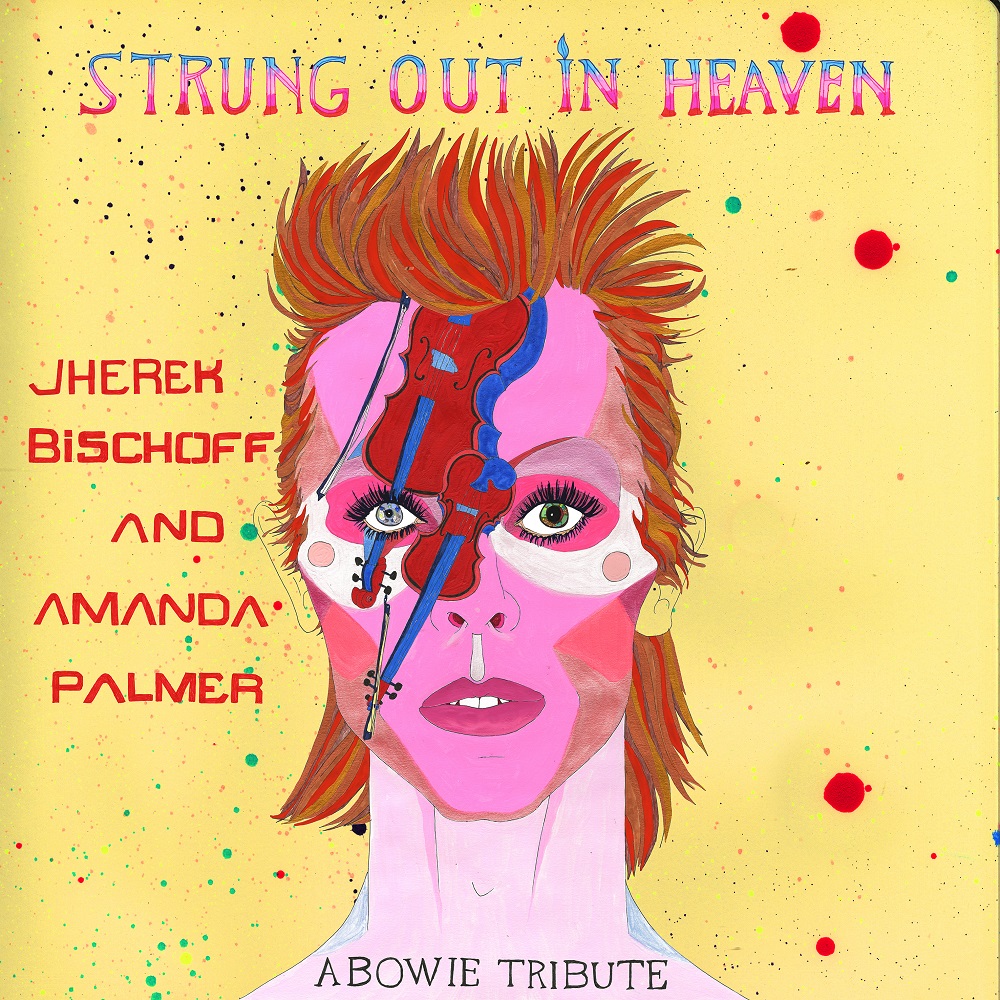
The last four weeks have seen thousands of tributes to rocker David Bowie.
Strung Out In Heaven: A Bowie String Quartet Tribute by Amanda Palmer and her Theatre is Evil collaborator, pop polymath Jherek Bischoff, is both gorgeous and ambitious.
It came together quickly. Bischoff arranged the album’s five tracks and spent three and a half hours recording the strings (Serena McKinney and Alyssa Park on violin, Ben Ullery on viola, and Jacob Braun on cello).
Meanwhile new mother Palmer lined up three days worth of babysitting in order to dive back into the studio. She also tapped some famous friends, who contributed in smaller ways.
The recording, coordination, guest appearances… and babysitting were financed by a stockpile from Palmer’s 7000-some supporters on the crowdfunding site Patreon.
It doesn’t sound like a whip out.
Here’s Palmer’s husband, author Neil Gaiman, counting down to lift-off on “Space Oddity:
And writer/director John Cameron Mitchell, who recorded the “Heroes” call and response on an iPhone in his apartment…
…and channeled Hedwig for the German version:
Gaiman questioned Palmer’s choice to lead with the title track of Bowie’s final album, but as she told New Musical Express, a lot of freshly minted millennial Bowie fans among her Patreon supporters listed “Blackstar” as a favorite. Singer Anna Calvi duets and plays guitar on this stripped down version:
Each tune is matched to a Bowie-centric image by a visual artist. On Palmer’s Patreon blog,“Blackstar” artist, elementary school teacher, and cancer survivor Cassandra Long writes about discussing Bowie’s death with a roomful of kindergarteners. Palmer plans to provide a similar platform to the other participating artists in the days to come.
The finished product is both professional and a labor of love.
Music is the binding agent of our mundane lives. It cements the moments in which we wash the dishes, type the resumes, go to the funerals, have the babies. The stronger the agent, the tougher the memory, and Bowie was NASA-grade epoxy to a sprawling span of freaked-out kids over three generations. He bonded us to our weird selves…Bowie worked on music up to the end to give us a parting gift. So this is how we, as musicians, mourn: keeping Bowie constantly in our ears and brains.
— Amanda Palmer
The complete tracklist is below. You can listen for free, but an ante-up will help Palmer cover 9¢ in licensing fees every time one of the songs is streamed. Any leftover proceeds from sales through March 5th will be donated to Tufts Medical Center’s cancer research wing in memory of David Bowie.
01 “Blackstar” featuring Anna Calvi
02 “Space Oddity” featuring Neil Gaiman
03 “Ashes to Ashes”
04 “Heroes” featuring John Cameron Mitchell
05 Helden” featuring John Cameron Mitchell
06 “Life on Mars?”
Related Content:
David Bowie (RIP) Sings “Changes” in His Last Live Performance, 2006
Amanda Palmer Animates & Narrates Husband Neil Gaiman’s Unconscious Musings
Ayun Halliday is an author, illustrator, and Chief Primatologist of the East Village Inky zine. Follow her @AyunHalliday
Read More...Support Us
We're hoping to rely on loyal readers, rather than erratic ads. Please click the Donate button and support Open Culture. You can use Paypal, Venmo, Patreon, even Crypto! We thank you!

About Us

Open Culture scours the web for the best educational media. We find the free courses and audio books you need, the language lessons & educational videos you want, and plenty of enlightenment in between.
Advertise With Us
FREE UPDATES!
GET OUR DAILY EMAIL
Get the best cultural and educational resources on the web curated for you in a daily email. We never spam. Unsubscribe at any time.
FOLLOW ON SOCIAL MEDIA
Open Culture editor Dan Colman scours the web for the best educational media. He finds the free courses and audio books you need, the language lessons & movies you want, and plenty of enlightenment in between.
Advertise With Us

