The Internet Archive is Saving Classic Flash Animations & Games from Extinction: Explore Them Online
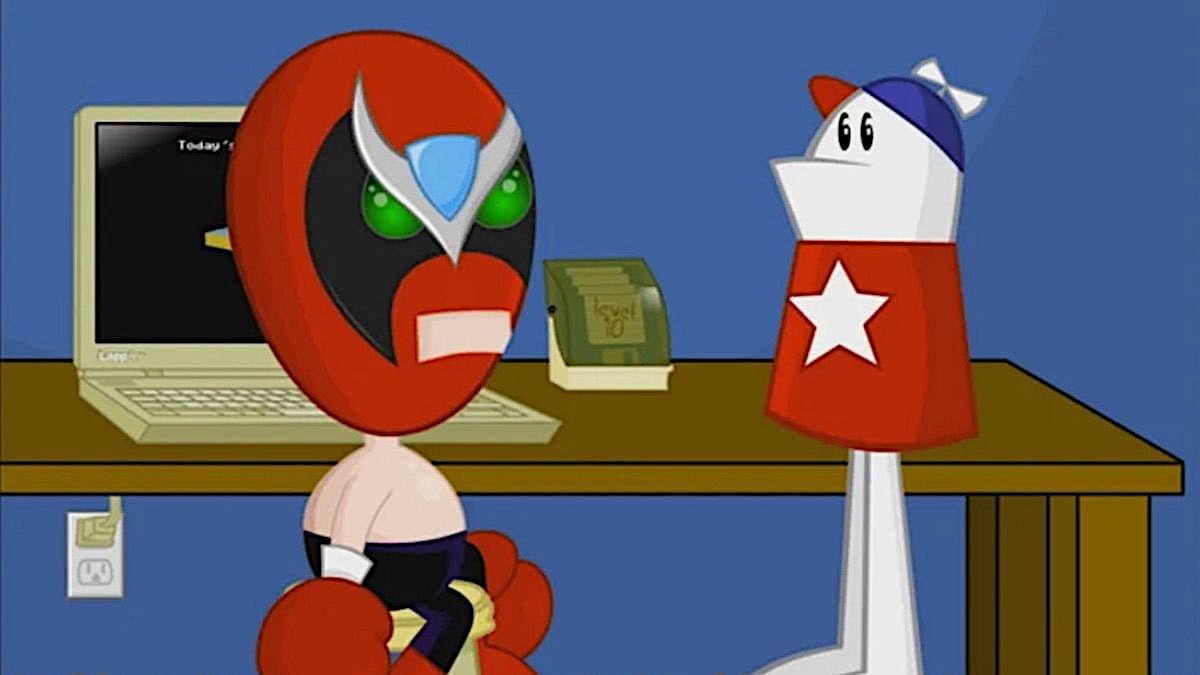
Flash is finally dead, and the world… does not mourn. Because the announcement of its end actually came three years ago, “like a guillotine in a crowded town square,” writes Rhett Jones at Gizmodo. It was a slow execution, but it was just. So useful in Web 1.0 days for making animations, games, and serious presentations, Flash had become a vulnerability, a viral carrier that couldn’t be patched fast enough to keep the hackers out. “Adobe’s Flash died many deaths, but we can truly throw some dirt on its grave and say our final goodbyes because it’s getting the preservation treatment.” Like the animated GIF, Flash animations have their own online library.

All those lovely Flash memes—the dancing badgers and the snake, peanut butter and jelly time—will be saved for perplexed future generations, who will use them to decipher the runes of early 2000’s internet-speak. However silly they may seem now, there’s no denying that these artifacts were once central constituents of pop culture.
Flash was much more than a distraction or frustrating browser crasher. It provided a “gateway,” Jason Scott writes at the Internet Archive blog, “for many young creators to fashion near-professional-level games and animation, giving them the first steps to a later career.” (Even if it was a career making “advergames.”)
A single person working in their home could hack together a convincing program, upload it to a huge clearinghouse like Newgrounds, and get feedback on their work. Some creators even made entire series of games, each improving on the last, until they became full professional releases on consoles and PCs.
Always true to its purpose, the Internet Archive has devised a way to store and play Flash animations using emulators created by Ruffle and the BlueMaxima Flashpoint Project, who have already archived tens of thousands of Flash games. All those adorable Homestar Runner cartoons? Saved from extinction, which would have been their fate, since “without a Flash player, flash animations don’t work.” This may seem obvious, but it bears some explanation. Where image, sound, and video files can be converted to other formats to make them accessible to modern players, Flash animations can only exist in a world with Flash. They are like Edison’s wax cylinders, without the charming three-dimensions.

Scott goes into more depth on the rise and fall of Flash, a history that begins in 1993 with Flash’s predecessor, SmartSketch, which became FutureWave, which became Flash when it was purchased by Macromedia, then by Adobe. By 2005, it started to become unstable, and couldn’t evolve along with new protocols. HTML5 arrived in 2014 to issue the “final death-blow,” kind of.… Will Flash be missed? It’s doubtful. But “like any container, Flash itself is not as much of a loss as all the art and creativity it held.” The Archive currently hosts over 1,500 Flash animations from those turn-of-the-millennium internet days, and there are many more to come. Enter the Archive’s Flash collection here.

Related Content:
36,000 Flash Games Have Been Archived and Saved Before Flash Goes Extinct: Play Them Offline
What the Entire Internet Looked Like in 1973: An Old Map Gets Found in a Pile of Research Papers
Josh Jones is a writer and musician based in Durham, NC. Follow him at @jdmagness
Read More...88 Philosophy Podcasts to Help You Answer the Big Questions in Life
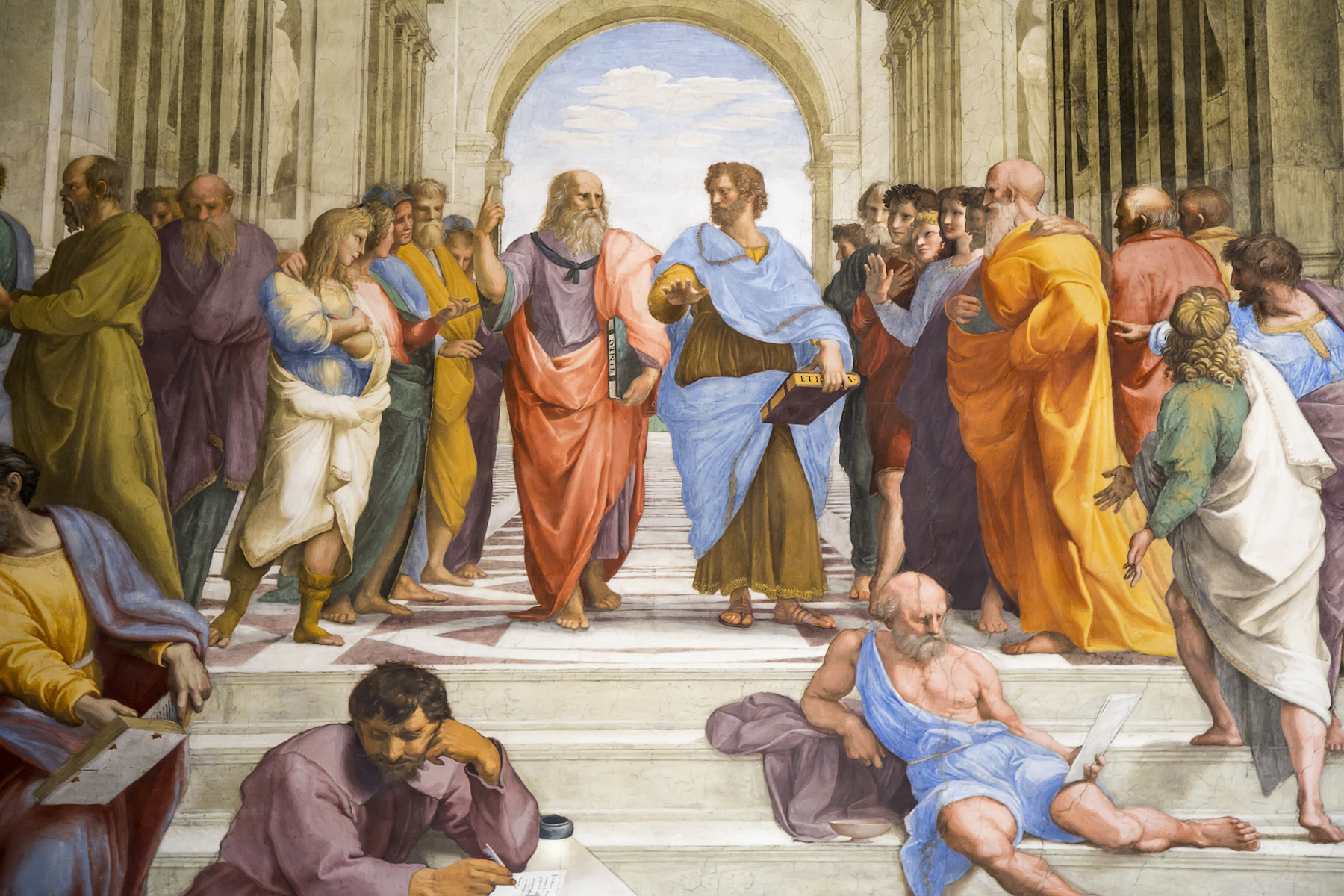
The big questions of philosophy, simmering since antiquity, still press upon us as they did the Athenians of old (and all ancient people who have philosophized): what obligations do we really owe to family, friends, or strangers? Do we live as free agents or beings controlled by fate or the gods (or genes or a computer simulation)? What is a good life? How do we create societies that maximize freedom and happiness (or whatever ultimate values we hold dear)? What is language, what is art, and where did they come from?
These questions may not be answered with a brute appeal to facts, though without science we are groping in the dark. Religion takes big questions seriously but tells converts to take its supernatural answers on faith. “Between theology and science there is a No Man’s Land,” writes Bertrand Russell, “exposed to attack from both sides; this No Man’s Land is philosophy.” Philosophy reaches beyond certainty, to “speculations on matters as to which definite knowledge has, so far, been unascertainable.” And yet, like science, “it appeals to human reason rather than authority.”
The concerns of philosophy have narrowed since Russell’s time, not to mention the time of Socrates, put to death for leading the youth astray. But professors of philosophy still raise the ire of the public, accused of seducing students from the safe spaces of sacred dogma and secular utility. “To study philosophy,” wrote Cicero, “is nothing but to prepare oneself to die.” It is a poetic turn of phrase, and yes, we must confront mortality, but philosophy also asks us to confront the limits of human knowledge and power in the face of the unknown. Dangerous indeed.
Should you decide to embark on this journey yourself, you will meet with no small number of fellow travelers along the way. Bring some earphones, you can hear them in the trove of 88 philosophy podcasts compiled on the philosophy website Daily Nous. “How many philosophy podcasts are there?” asks Daily Nous, who brings us this list. “Over 80, and they take a variety of forms.” See 15 below, with descriptions, see the rest at Daily Nous, and enjoy your sojourn into “no man’s land.”
- 5 Questions (interviews about philosophers themselves w/ Kieran Setiya)
- Embrace the Void (conversations w/ Aaron Rabinowitz)
- Getting Ethics to Work (interviews and discussion w/ Andy Cullison and Kate Berry
- Hi-Phi Nation (edited narratives w/ Barry Lam)
- The History of Philosophy without any Gaps (mix of monologues and interviews w/ Peter Adamson)
- New Books in Philosophy (interviews w/ Carrie Figdor, Alexus McLeod, Marshall Poe, & Robert Talisse)
- Partially Examined Life (“reading group” discussions w/ Mark Linsenmayer, Seth Paskin, Wes Alwan, & Dylan Casey)
- Philosophy Bites (short interviews w/ David Edmonds & Nigel Warburton)
- Philosophy Talk (conversations w/ Stanford Faculty incl. John Perry, formerly Ken Taylor, Ray Briggs, Debra Satz, Josh Landy, et al.)
- Political Philosophy Podcast (interviews w/ Tobias Buckle)
- Philosophers On Medicine (interviews w/ Jonathan Fuller)
- Reductio (edited narratives w/ Andrew Lavin)
- SCI PHI (interviews w/ Nick Zautra)
- Unmute (interviews w/ Myisha Cherry)
- Very Bad Wizards (conversations w/ Tamler Sommers & David Pizarro)
See the full list here. And explore our collection of 200 Free Online Philosophy Courses here.
Related Content:
Free Online Philosophy Courses
Learn Philosophy with a Wealth of Free Courses, Podcasts and YouTube Videos
Oxford’s Free Introduction to Philosophy: Stream 41 Lectures
Josh Jones is a writer and musician based in Durham, NC. Follow him at @jdmagness
Read More...Nikon Offers Free Online Photography Courses During the Holidays

A quick heads up. From November 23rd through December 31st, you can stream for free all classes offered by Nikon School Online. Normally priced at $15-$50 per course, this 10-course offering covers Fundamentals of Photography, Dynamic Landscape Photography, Macro Photography, Photographing Children and Pets, and more.
Finding the courses on the Nikon site is not very intuitive. To access the courses, click here and then scroll down the page until you see a yellow button that says “Watch Full Version.” From there you will get a prompt that allows you to sign up for the courses…
If you would like to support the mission of Open Culture, consider making a donation to our site. It’s hard to rely 100% on ads, and your contributions will help us continue providing the best free cultural and educational materials to learners everywhere. You can contribute through PayPal, Patreon, and Venmo (@openculture). Thanks!
Related Content:
Annie Leibovitz Teaches Photography in Her First Online Course
Take a Free Course on Digital Photography from Stanford Prof Marc Levoy
Learn Digital Photography with Harvard University’s Free Course
1,700 Free Online Courses from Top Universities Read More...Kevin Allison (The State, RISK!) Discusses Confessional Comedy on Pretty Much Pop: A Culture Podcast #70
Kevin was in the infamous, NYU-based sketch comedy group The State which had a show for a season on MTV and seemed like it was going to get picked up by CBS, but no. After several years getting over this disappointment, Kevin discovered a new outlet for his energies: He delivers, curates, and coaches personal stories (bordering on too personal, thus the “risk”) for his stage show and podcast RISK!
Kevin joins your hosts Mark Linsenmayer, Erica Spyres, and Brian Hirt to discuss this idiosyncratic form: Do the stories have to be funny? Can you change things? What’s the relation to autobiographical, humorous essays a la David Sedaris? What might be too personal or actually indicating trauma to actually share on RISK? This seems like something anyone can do, so what’s the role of craft and story-telling history?
Listen to RISK at risk-show.com, and watch many stories on the RISK! YouTube channel. Also: kevinallison.net, thestorystudio.org, and @thekevinallison. Kevin’s story about prostituting himself is about 14 minutes into this episode. Hear Kevin on Marc Maron’s WTF! Listen to that audio guide Kevin mentions, “What Every RISK! Storyteller Should Know.” Read about the four lies of storytelling.
Hear more of this podcast at prettymuchpop.com. This episode includes bonus discussion you can access by supporting the podcast at patreon.com/prettymuchpop. This time, the hosts tell (or at least outline) their own RISK!-like stories, and the result is predictably too personal for our public feed.
This podcast is part of the Partially Examined Life podcast network.
Pretty Much Pop: A Culture Podcast is the first podcast curated by Open Culture. Browse all Pretty Much Pop posts.
Read More...Watch How to Be at Home, a Beautiful Short Animation on the Realities of Social Isolation in 2020
I think, as social primates, we want to feel a strong sense of belonging either in a relationship or to a community—or both. But also intrinsic to our humanity is a feeling that we are truly alone.
—Filmmaker Andrea Dorfman, 2010
When they first became friends, poet Tanya Davis and filmmaker Andrea Dorfman talked a lot about the pleasures and hardships of being alone. Davis had just gone through a break up, and Dorfman was just embarking on a relationship after four years of flying solo.
These conversations led to a collaboration, 2010’s How to Be At Alone (see below), a whimsical videopoem that combines live action and animation to consider some of solitude’s sweeter aspects, like sitting on a bench as signal to the universe that one is available for impromptu conversation with a stranger.
That bench reappears in their 2020 follow up, How to Be At Home, above. Now it is cordoned off with black and yellow caution tape, a familiar public health measure in 2020.
As with the earlier project, a large part of Davis’ purpose was to reflect and reassure, both herself, and by extension, others.
Although she has become a poster child for the joys of solitude, she also relishes human contact, and found herself missing it terribly while sheltering alone in the early days of the pandemic. Writing the new poem gave her “an anchor” and a place to put her anxiety.
Dorfman notes that the project, which was commissioned by the National Film Board of Canada as part of a short film collection about Canadians navigating life during the pandemic, was “essentially catalyzed by COVID.”
As she embarked on the project, she wondered if the pandemic would be over by the time it was complete. As she told the CBC’s Tom Power:
There was this feeling that this could go away in a month, so this better be finished soon, so it’s still relevant. So as an artist, as a filmmaker, I thought, “I have to crank this out” but there’s no fast and easy way to do animation. It just takes so long and as I got into it and realized that this was going to be a marathon, not a sprint, the images just kept coming to me and I really just made it up as I went along. I’d go into my studio every day not knowing what lay ahead and I’d think, “Okay, so, what do we have up next? What’s the next line? And I’d spend maybe a week on a line of the poem, animating it.
It appears to have been an effective approach.
Dorfman’s painted images ripple across the fast turning pages of an old book. The titles change from time to time, and the choices seem deliberate—The Lone Star Ranger, Le Secret du Manoir Hanté, a chapter in The Broken Halo—“Rosemary for Remembrance.”
“It’s almost as though the way the poem is written there are many chapters in the book. (Davis) moves from one subject to another so completely,” Dorfman told the University of King’s College student paper, The Signal.
In the new work, the absence of other people proves a much heavier burden than it does in How To Be Alone.
Davis flirts with many of the first poem’s settings, places where a lone individual might have gone to put themselves in proximity to other humans as recently as February 2020:
Public transportation
The gym
A dance club
A description from 2010:
The lunch counter, where you will be surrounded by chow-downers, employees who only have an hour and their spouses work across town, and they, like you, will be alone.
Resist the urge to hang out with your cell phone.
In 2020, she struggles to recreate that experience at home, her phone serving as her most vital link to the outside world, as she scrolls past images of a Black Lives Matter protests and a masked essential worker:
I miss lunch counters so much I’ve been eating [pickles and] toasted sandwiches while hanging unabashedly with my phone.
See How to Be at Home and the 29 other films that comprise The Curve, the National Film Board of Canada series about life in the era of COVID-19 here.
How to be at Home
By Tanya Davis
If you are, at first, really fucking anxious, just wait. It’ll get worse, and then you’ll get the hang of it. Maybe.
Start with the reasonable feelings – discomfort, lack of focus, the sadness of alone
you can try to do yoga
you can shut off the radio when it gets to you
you can message your family or your friends or your colleagues, you’re not supposed to leave your home anyway, so it’s safe for you
There’s also the gym
you can’t go there but you could pretend to
you could bendy by yourself in your bedroom
And there’s public transportation
probably best to avoid it
but there’s prayer and meditation, yes always
employ it
if you have pains in your chest ‘cause your anxiety won’t rest
take a moment, take a breath
Start simple
things you can handle based on your interests
your issues and your triggers
and your inner logistics
I miss lunch counters so much I’ve been eating [pickles and] toasted sandwiches while hanging unabashedly with my phone
When you are tired, again of still being alone
make yourself a dinner
but don’t invite anybody over
put something green in it, or maybe orange
chips are fine sometimes but they won’t keep you charged
feed your heart
if people are your nourishment, I get you
feel the feelings that undo you while you have to keep apart
Watch a movie, in the dark
and pretend someone is with you
watch all of the credits
because you have time, and not much else to do
or watch all of the credits to remember
how many people come together
just to tell a story
just to make a picture move
And then, set yourself up dancing
like it’s a club where everyone knows you
and they’re all gonna hold you
all night long
they’re gonna dance around you and with you and on their own
it’s your favourite song
with the hardest bass and the cathartic drums
your heart pumps along/hard, you belong
you put your hands up to feel it
With the come down comes the weeping
those downcast eyes and feelings
the truth is you can’t go dancing, not right now
not at any club or party in any town
The heartbreak of this astounds you
it joins old aches way down in you
you can visit them, but please don’t stay there
Go outside if you’re able, breathe the air
there are trees for hugging
don’t be embarrassed
it’s your friend, it’s your mother, it’s your new crush
lay your cheek against the bark, it’s a living thing to touch
Sadly, leave all benches empty
appreciate the kindness in the distance of strangers
as you pine for company and wave at your neighbours
savour the depths of your conversations
the layers uncovered
in this strange space and time
Society is afraid of change
and no one wants to die
not now, from a tiny virus
not later from the world on fire
But death is a truth we all hate to know
we all get to live, and then we all have to go
In the meantime, we’re surrounded, we’re alone
each a thread woven in the fabric, unravelling in moments though
each a solo entity spinning on its axis, forgetting that the galaxy includes us all
Herein our fall
from grace from each other from god whatever, doesn’t matter
the disaster is that we believe we’re separate
we’re not
As evidenced by viruses taking down societies
as proven by the loneliness inherent in no gatherings
as palpable as the vacancy in the space of one person hugging
If this disruption undoes you
if the absence of people unravels you
if touch was the tether that held you together
and now that it’s severed you’re fragile too
lean into loneliness and know you’re not alone in it
lean into loneliness like it is holding you
like it is a generous representative of a glaring truth
oh, we are connected
we forget this, yet we always knew.
How to Be at Home will be added to the Animation section of our collection, 4,000+ Free Movies Online: Great Classics, Indies, Noir, Westerns, Documentaries & More.
Related Content:
Watch “Ryan,” Winner of an Oscar and 60 Other Awards
Ayun Halliday is an author, illustrator, theater maker and Chief Primatologist of the East Village Inky zine. Follow her @AyunHalliday.
Read More...Experience the Bob Ross Experience: A New Museum Open in the TV Painter’s Former Studio Home
Bob Ross is as renowned for the gentle encouragement of his voice as for his speedy technique: indeed, these very qualities are synonymous with the name “Bob Ross.” His revival in recent years has as much to do with the de-stressing effects of his permed onscreen persona as with our awe, ironic or otherwise, at his kitschy picture-perfect landscapes in under an hour. He’s become as much a saint of public television as Mr. Rogers and even more of an internet icon.
But unlike most other fandoms, the devoted lovers of Bob Ross have had no place to call their own. They might show up in Bob Ross cosplay at comic con. Yet no Bob Ross Con has made the scene. Leave it to Ross’s original Joy of Painting studio to fill the gap with a museum dedicated to the painting instructor. The Bob Ross Experience is part of a larger campus of buildings called Minnetrista in Muncie, Indiana, founded by the Ball family of Ball mason jars. It’s an “immersive exhibit,” featuring “original paintings and artifacts” and “inspiring visitors with Bob’s message of fearless creativity.”
What more could you want from a Bob Ross museum? Well, maybe a fully-online experience these days. For now, you’ll have to make the trip to Muncie, where locals pay $8 a ticket (kids $6, 3 & under are free) and non-residents shell out $15 ($12 per kid, etc). There may be nowhere else you can see Ross’s happy little trees in person. As Ayun Halliday wrote here recently, “sales of his work hover around zero.” Almost all of his paintings, save a few owned by the Smithsonian and a few private individuals, reside in storage in Northern Virginia, where an exhibit came and went last year.

Ross himself, who honed his method during short breaks in the Air Force, hardly ever exhibited in his lifetime; he was a made-for-TV painter with a small merchandising empire to match. Now, fans can make the pilgrimage to his creative TV home at the Lucius L. Ball house. Swoon over personal relics like his keys and hair pick and, of course, “the artist’s palette knife, easel, and brushes,” writes Colossal. “Many of the artifacts are free to touch.” A current exhibition at the Experience, “Bob Ross at Home” through August 15, 2021, showcases “a few dozen of the artist’s canvases, many on loan from Muncieans who got the works directly from Ross.”
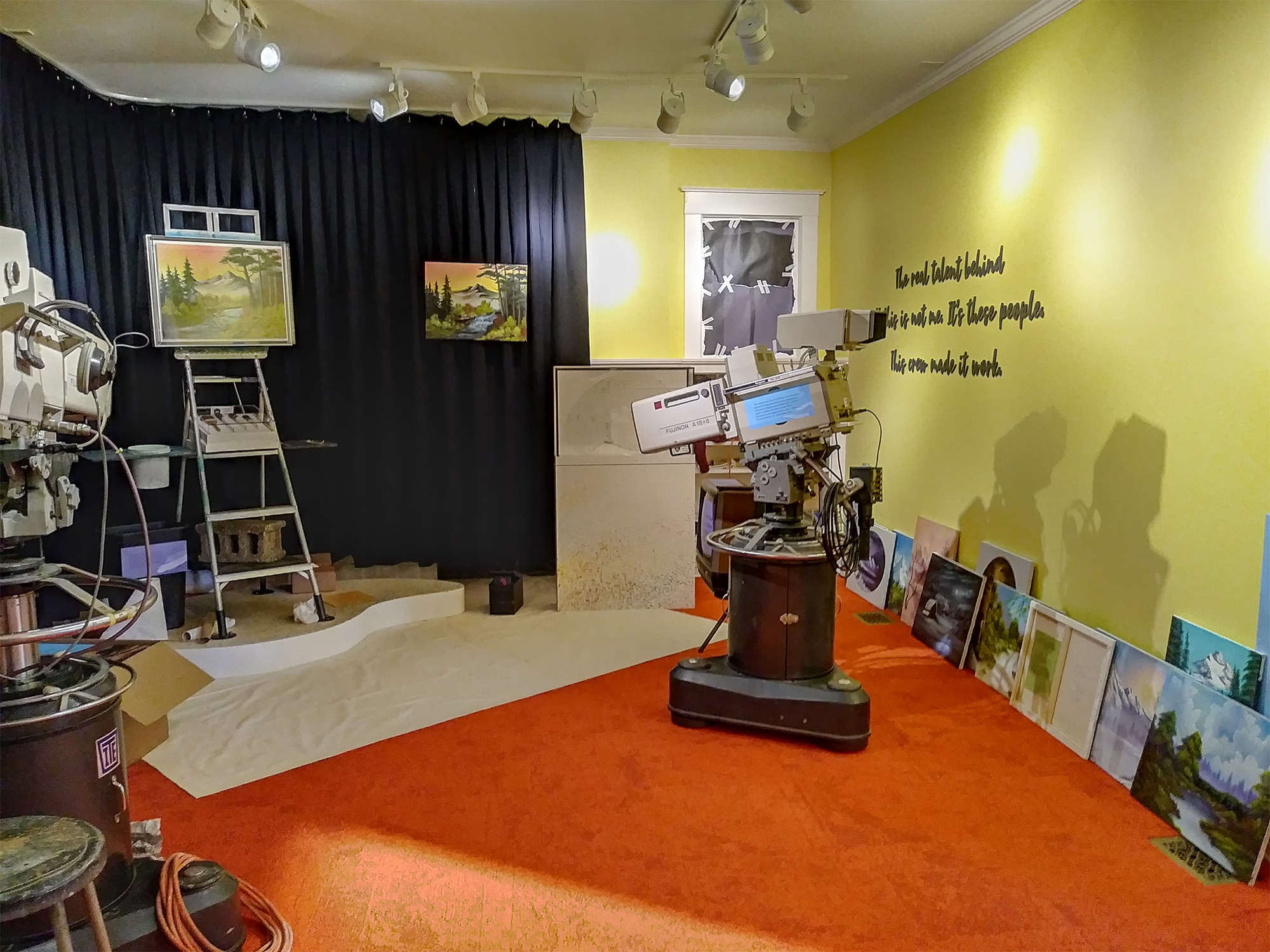
Not only can you hang out on set and view Ross’s paintings and personal effects, but you can also, Artnet reports, “sign up for $70 master classes with certified Bob Ross instructors.” That’s $70 more than it costs to watch the master himself on YouTube, but if you’ve already made the trip…. One only hopes the instructors can channel what George Buss, vice president of the Experience, calls Ross’s best quality, his gentle fearlessness: “He takes what looks like a mistake and turns it into something beautiful.” And that, friends, is the true joy of the Bob Ross experience.
via Colossal
Related Content:
What Happened to the 1200 Paintings Painted by Bob Ross? The Mystery Has Finally Been Solved
Josh Jones is a writer and musician based in Durham, NC. Follow him at @jdmagness
Read More...The Plastic Bag Store: A Pop Art Installation with a Whimsical But Deadly Serious Environmental Message
When COVID-19 exploded in New York City last March, it erased everything on the calendar, including:
All live theater…
The city’s freshly implemented ban on single use plastic bags…
And The Plastic Bag Store, a pop-up installation that was preparing to open in Times Square.
The theaters remain dark, but the ban is back on, as of October 19th. The 7‑month pause was hastened by the pandemic, but also by an unsuccessful lawsuit brought by flexible packing manufacturer Poly-Pak Industries.
The Plastic Bag Store was allowed to open, too, albeit in an altered format from the hybrid art installation-adult puppet show creator Robin Frohardt has been working on for several years.
She has long intended for the project’s New York premiere to coincide with the ban.
Not because she hoped to get rich selling bags to citizens accustomed to getting them free with purchase.
There’s nothing to buy in this “store.”

It’s a performance of sorts, but there’s no admission charge.
It’s definitely an education, and a meditation on how history can be doomed to repeat itself, in one way or another.
The Plastic Bag Store just ended its sold out 3‑week run, playing to crowds of ticket holders now capped at 12 audience members per performance. The live elements have morphed into a trio of short films that are projected after ticket holders—customers if you will—have had a chance to look around.
There’s plenty to see.
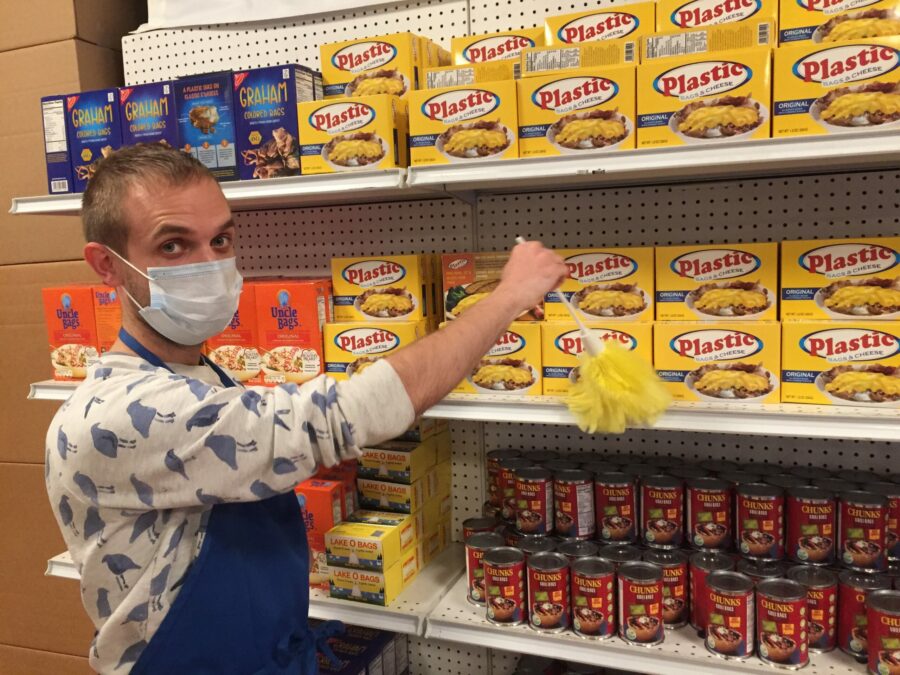
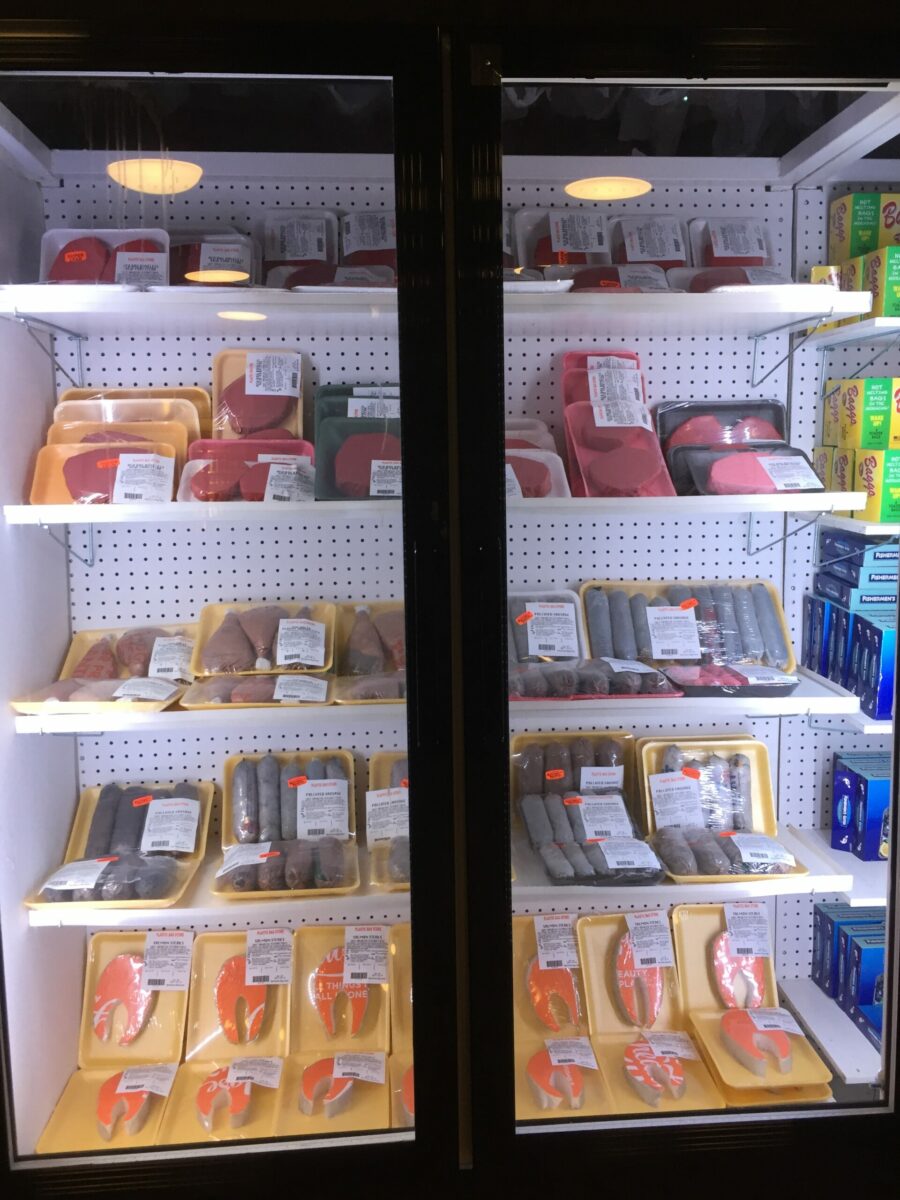
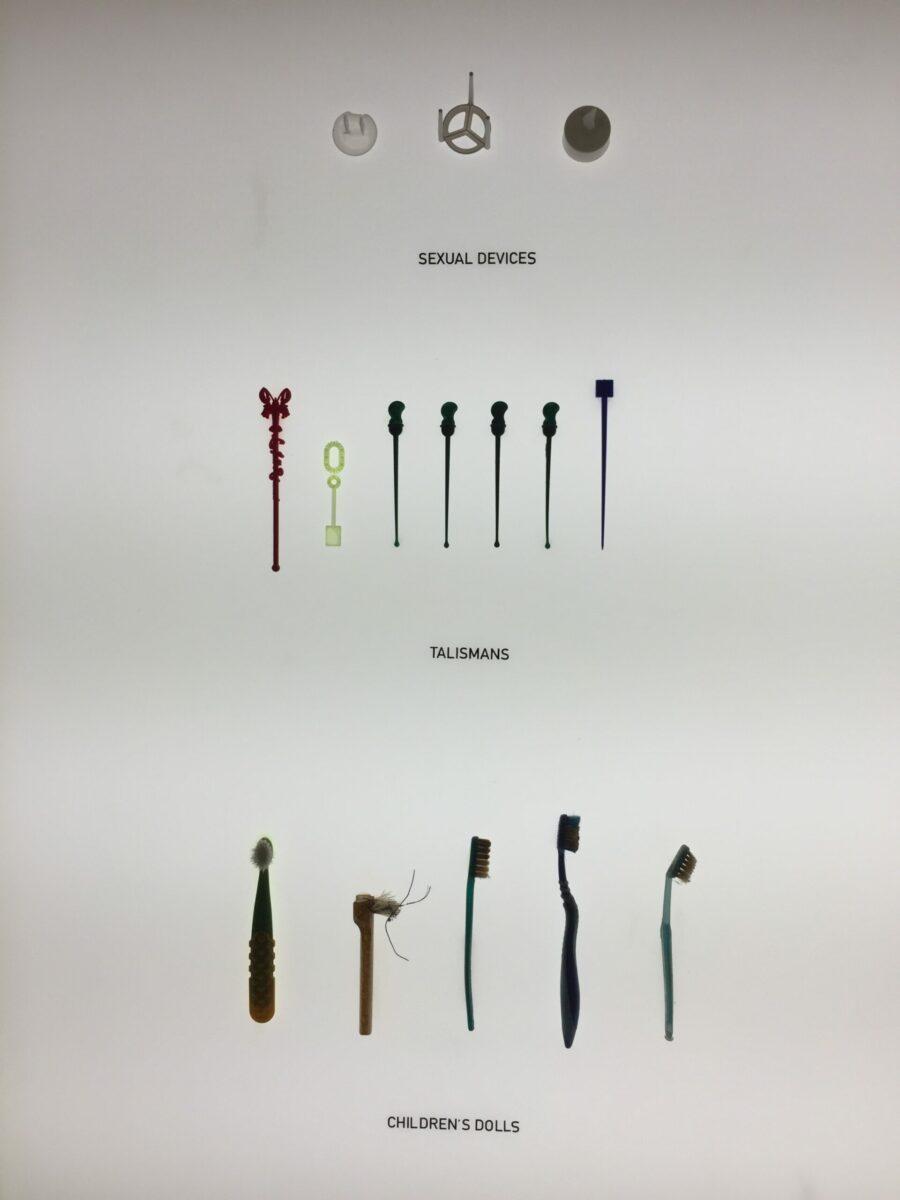
The Times Square installation space has been kitted out to resemble a roomy bodega stocked with produce, baked goods, sushi rolls on plastic trays, shrink wrapped meat, and other familiar, if slightly skewed items.
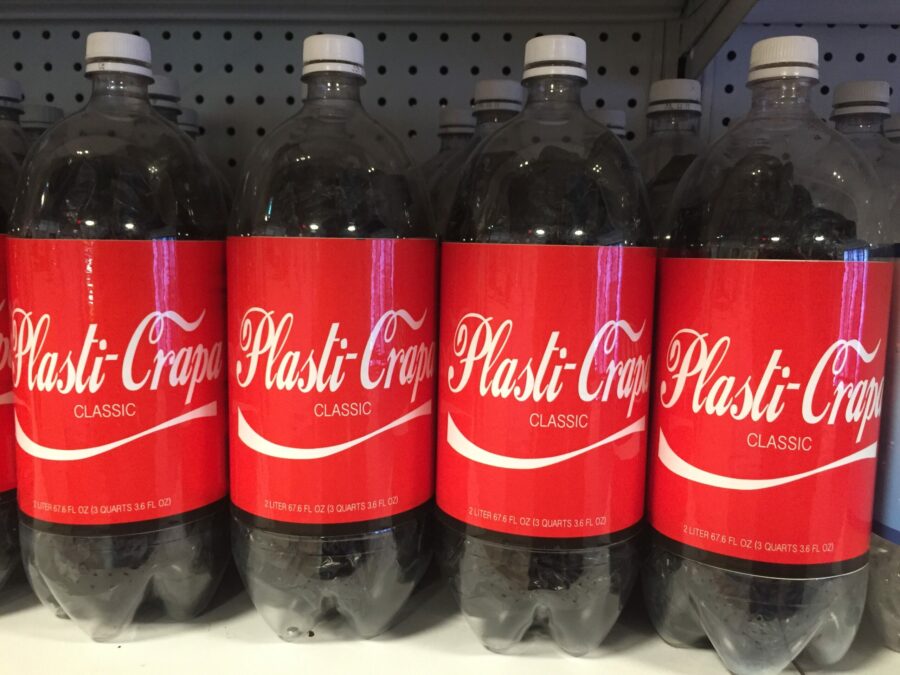
Rows of 2 liter soda bottles with iconic red labels are shelved across from the magazine rack. Tubs of Bag & Jerry’s Mint Plastic Chip are in the freezer case.
The original plan allowed for customers to handle the goods as they wanted. Now such interactions are prohibited.
Prior to March, New Yorkers were pretty handsy with produce, unabashedly pressing thumbs into avocados and holding tomatoes and melons to nostrils to determine ripeness.
The pandemic curbed that habit.
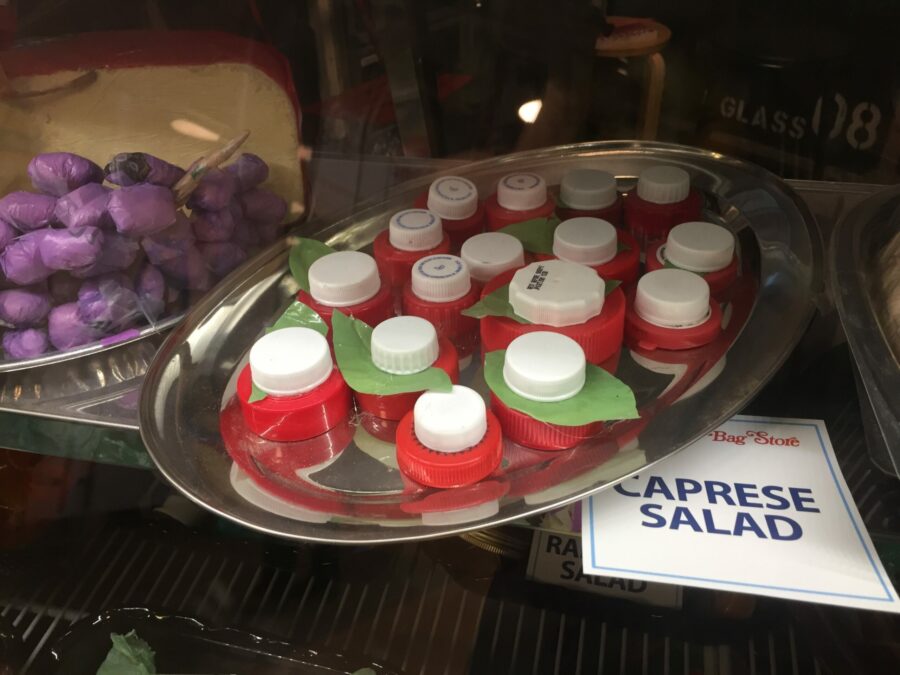
No matter. Nothing is ripe in the Plastic Bag Store, where any item not contained in a can or cardboard box has been constructed from the thousands of plastic bags Frohardt has collected over the years.
The facsimiles are shockingly adroit.
“I hunt plastic bags on the streets of New York,” she said in an interview with cultural funder Creative Capital:
I’m a real connoisseur now. There are certain colors I’m really attracted to. Certain bags are harder to find. I definitely look at trash differently than most people. I’m always looking for reds and oranges and greens. Sometimes I find a really interesting color that I haven’t seen before, like salmon or lavender. That’s always exciting.

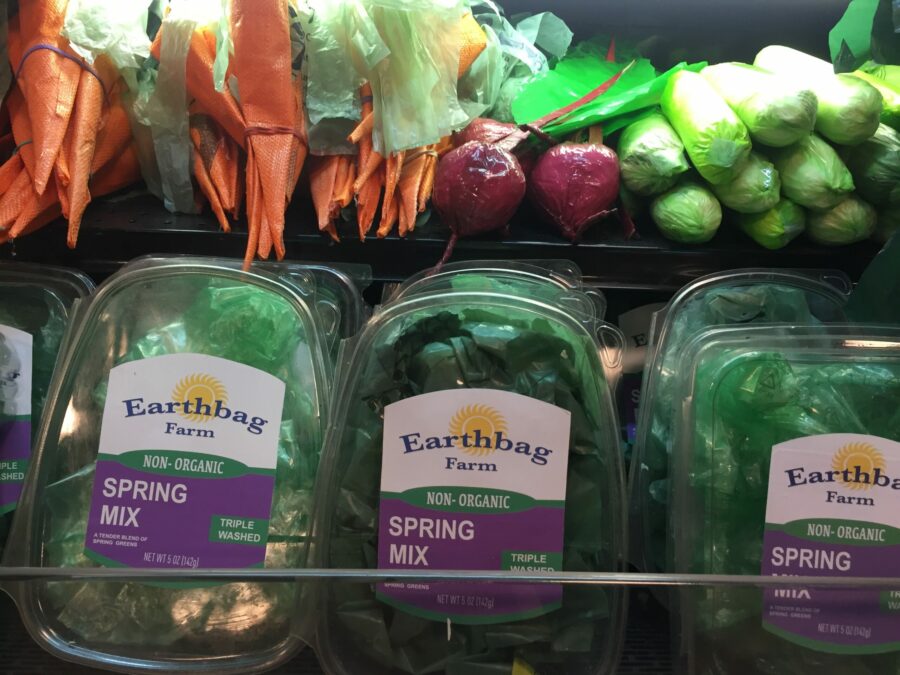
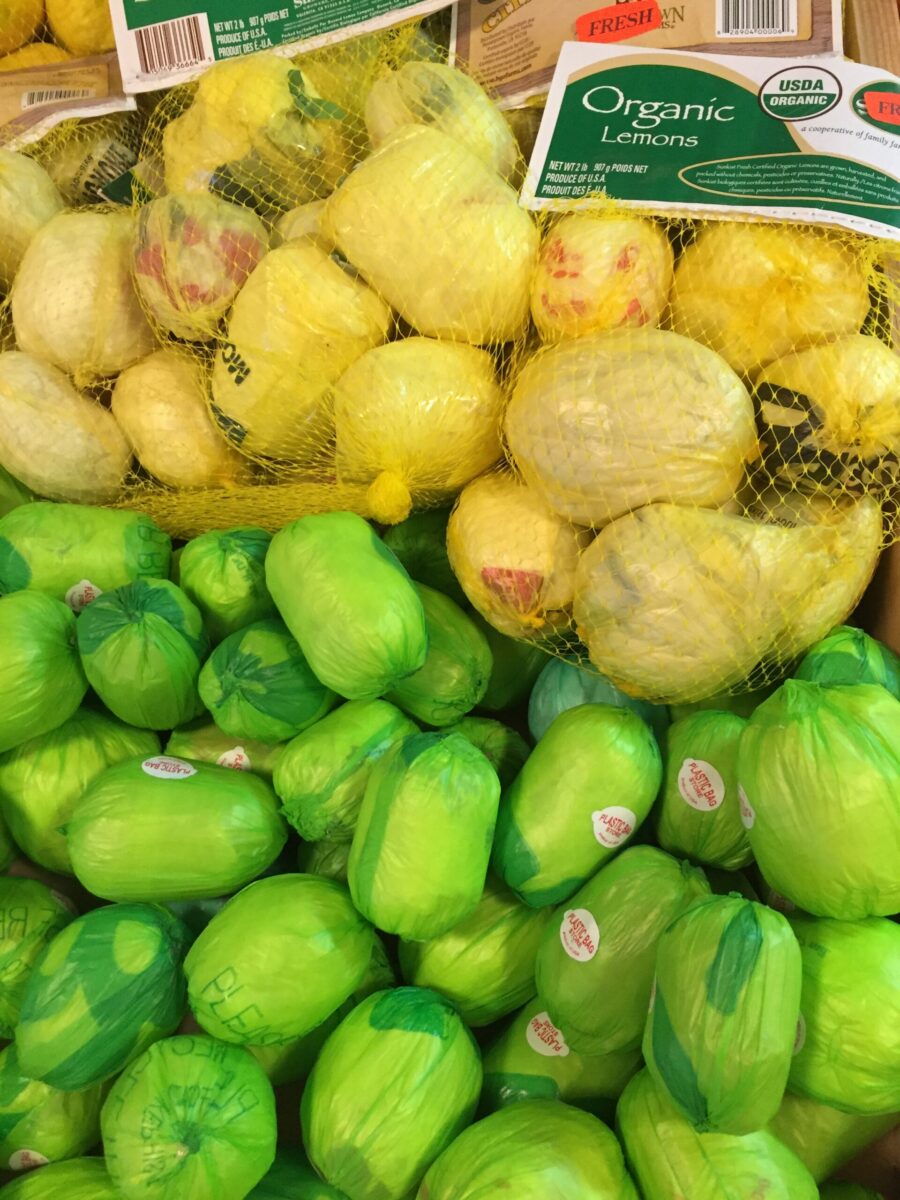
This diversity of materials helps with visual verisimilitude, most impressive in the produce section.
The product labels been richly fortified with satirical commentary.
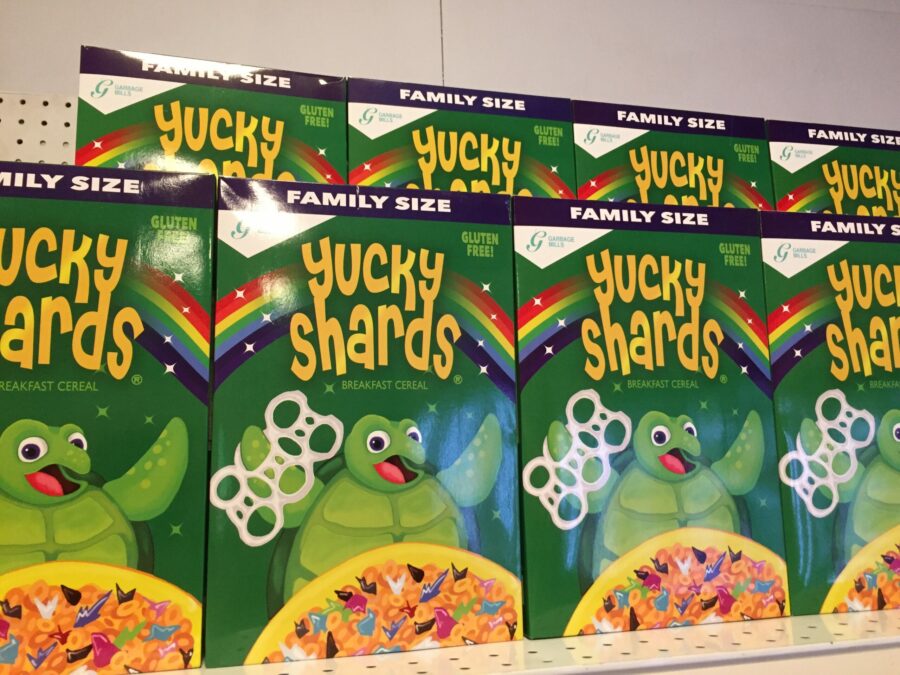
A family sized package of Yucky Shards appeals to children with sparkles, a rainbow, and a bright eyed cartoon mascot who doesn’t seem to mind the 6‑pack yoke that’s attached itself to its person.
Everything about the “non-organic, triple-washed Spring Green Mix” from “Earthbag Farm” looks familiar, including the plastic container.
Packages of Sometimes feminine pads promise “super protection” that will “literally last forever.”
The cupcakes on display in the bakery section are topped with such festive embellishments as a “disposable” lighter and flossing pick.

The tone is not scolding but rather comic, as Frohardt uses her spoofs to delight attendees into serious consideration of the “foreverness” of plastic and its environmental impact:
There is great humor to be found in the pitfalls of capitalism, and I find that humor and satire can be powerful tools for social criticism especially with issues that feel too sad and overwhelming to confront directly.
It’s really easy to turn away from images of turtles choking on straws. That stuff comes up in my Instagram feed all the time, and I’m like “Whoa! Swipe on past” because it’s too hard to look at. So what I’m trying to do is to make something that’s fun to look at, and fun to engage with, so you can think about it. Instead of just saying, “That’s fucked up! Ok on to the next thing.”
The Plastic Bag Store’s film segments also wield comedy to get their message across.
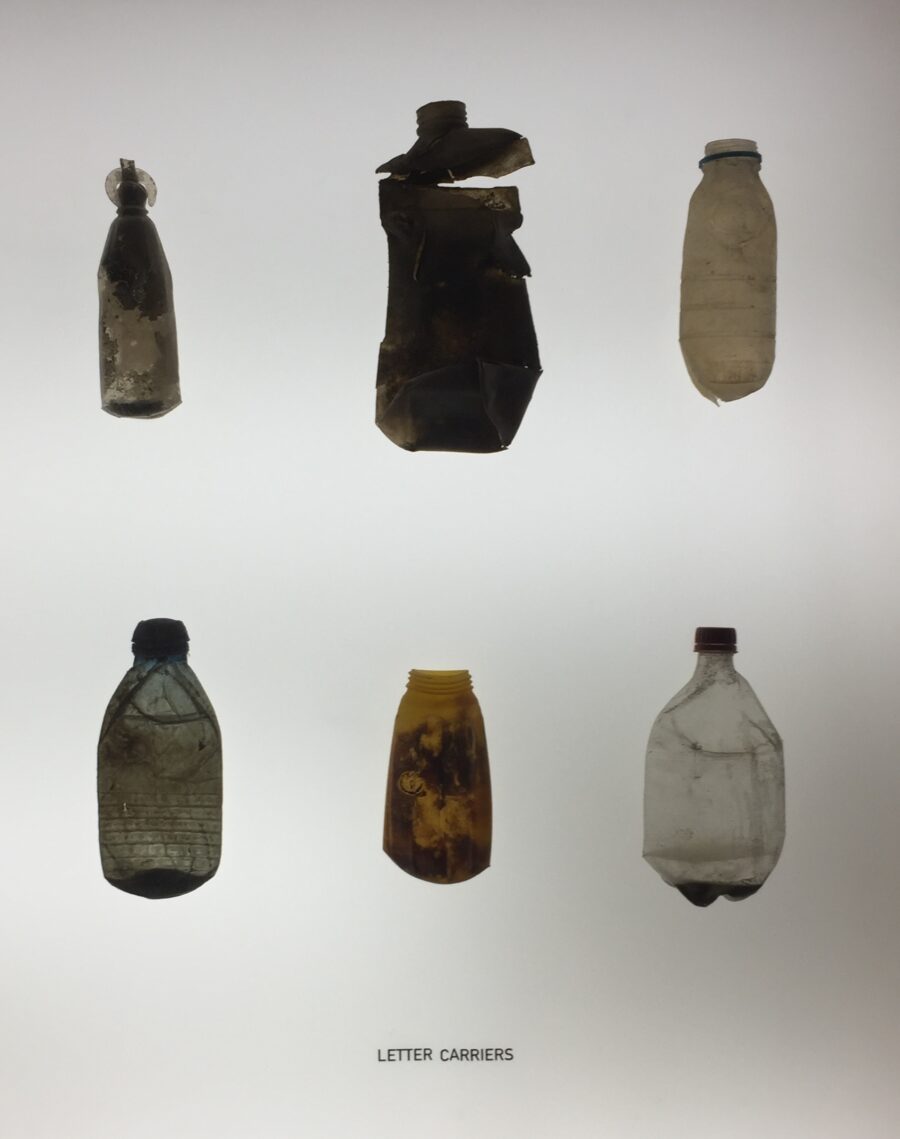
From the stiff shadow puppet Ancient Greeks who are seduced by the self-flattering slogan of a new product, Knowledge Water, which comes in single use vessels, to the recipient of a message in a plastic bottle, discovered so far into the future that he can only admire its craftsmanship, having no clue as to its purpose. (Letter carrier is his best guess. Eventually, other letter carriers are discovered in the freezing equatorial ocean, and housed in a museum alongside other hilariously mislabeled relics of a long dead civilization.)

Related Content:
Take a Virtual Tour of the Mütter Museum and Its Many Anatomically Peculiar Exhibits
Ayun Halliday is an author, illustrator, theater maker and Chief Primatologist of the East Village Inky zine. Follow her @AyunHalliday.
Read More...Neil Young Releases a Never-Before-Heard Version of His 1979 Classic, “Powderfinger”: Stream It Online
If Neil Young proved anything in his feud with Lynyrd Skynyrd (actually “more like a spirited debate between respectful friends,” writes Ultimate Classic Rock), it’s that Canadians could play southern rock just as well as the Southern Man, an argument more or less also won at the same time by The Band’s Music from Big Pink. Young’s songwriting contributions to the tradition are just as well recognized as “The Weight.” Foremost among them, we must place “Powderfinger,” covered by everyone from Band of Horses to Cowboy Junkies (below) to Rusted Root to Phish, and which Young sent to Ronnie Van Zant, who might have recorded it for the next Skynyrd album had he not died in 1977.
Southern rock stalwarts Drive-By Truckers, who’ve covered “Powderfinger” frequently, often sound like the sonic equivalent of the Young-Skynyrd debate (they even wrote a song about it), channeling their Alabama roots and Skynyrd obsessions through the sensitive, sharply observed, character-driven narratives Young wrote so well. “Powderfinger” was penned during the Zuma era, when Young and Crazy Horse redefined psychedelic Americana with barroom weepers like “Don’t Cry No Tears” and “Barstool Blues,” and wandering guitar epics like “Cortez the Killer” and “Danger Bird.”
The combination of beautifully loose, shambling guitars, loping rhythms, and “bizarre and brilliant” twists on Americana themes defined what many consider to be Young’s greatest period. “Between 1969’s Everybody Knows This is Nowhere and 1978’s Rust Never Sleeps Young reached a level of genius that few songwriters have ever topped,” Rolling Stone writes.
“Powderfinger” routinely tops best-of-Neil-Young lists. Though intended for Zuma, the song did not actually appear until four years later, opening the electric side of the live classic Rust Never Sleeps. Now we can celebrate the unreleased version at the top, recorded during the Zuma sessions and just posted to the Neil Young Archives Instagram page.
Not only does “Powderfinger” show Neil Young and Crazy Horse at their dueling guitar best; it is a lyrical masterpiece of literary compression, with a narrative fans have often struggled to piece together, and have seen as representing everything from the Civil War to Vietnam. But the general interpretation of the folk-poetic verses goes something like this, notes Rolling Stone:
It’s about a family of bootleggers (or some other kind of backwoods criminals) somewhere up in the mountains. They’ve been through many tragedies, and now the authorities are moving in on them – explaining why the approaching boat has “numbers on the side.” The 22-year-old son has been forced to deal with the situation because “Daddy’s gone,” “brother’s out hunting in the mountains” and “Big John’s been drinking since the river took Emmy-Lou.” The young man is standing on the dock with a rifle in his hand when the boat begins firing, so he raises the gun to return fire – but it backfires and blows his head off.
It’s a cinematic, darkly comic scene conveyed with haunting pathos and confused urgency. The track will appear on Disc 8, Dume, of the upcoming box set Neil Young Archives Volume II, which covers the prolific period between 1972 and 1976. “This 1975 version of the song was produced by Young and David Briggs,” Brock Theissen writes at Exclaim!, and features all the original members of Crazy Horse. You can also stream the unreleased early “Powderfinger” at the Neil Young Archives site. Further up, see an animated video for an acoustic version of the classic Neil Young track and hear the original live recording from Rust Never Sleeps below.
Related Content:
Neil Young Performs Classic Songs in 1971 Concert: “Old Man,” “Heart of Gold” & More
The Time Neil Young Met Charles Manson, Liked His Music, and Tried to Score Him a Record Deal
Josh Jones is a writer and musician based in Washington, DC. Follow him @jdmagness
Read More...The Meticulous, Elegant Illustrations of the Nature Observed in England’s Countryside
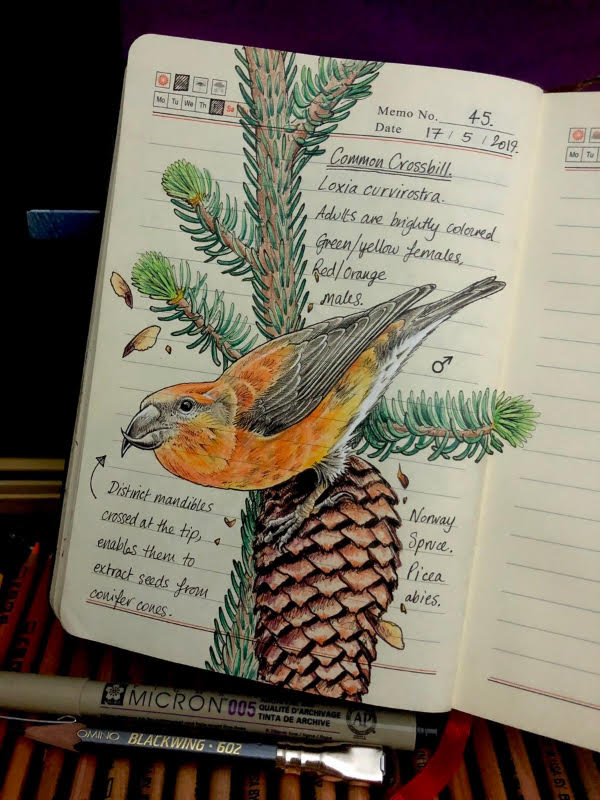
If you happen to have grown up in the English countryside, you probably retain a certain sensitivity to and affinity for nature. This can express itself in any number of ways, most often by a compulsion to garden, no matter how urban the setting in which you now live. But Jo Brown has shown how to base a career on it: an artist and illustrator — and “birder wildlifer mushroomer,” according to her Twitter bio — she has long kept a “nature journal” documenting the flora and fauna encountered in the countryside around her home in Devon.
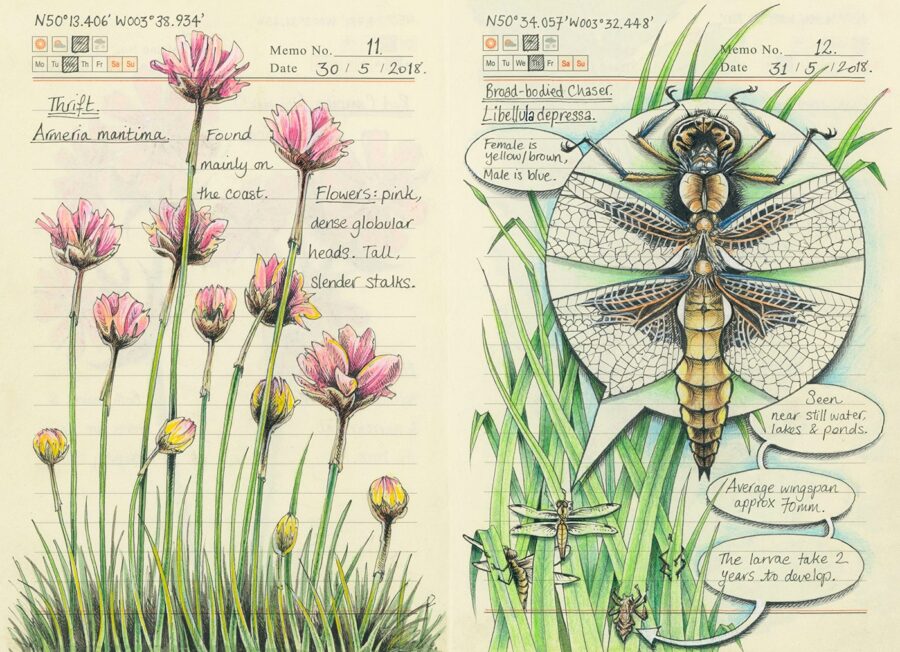
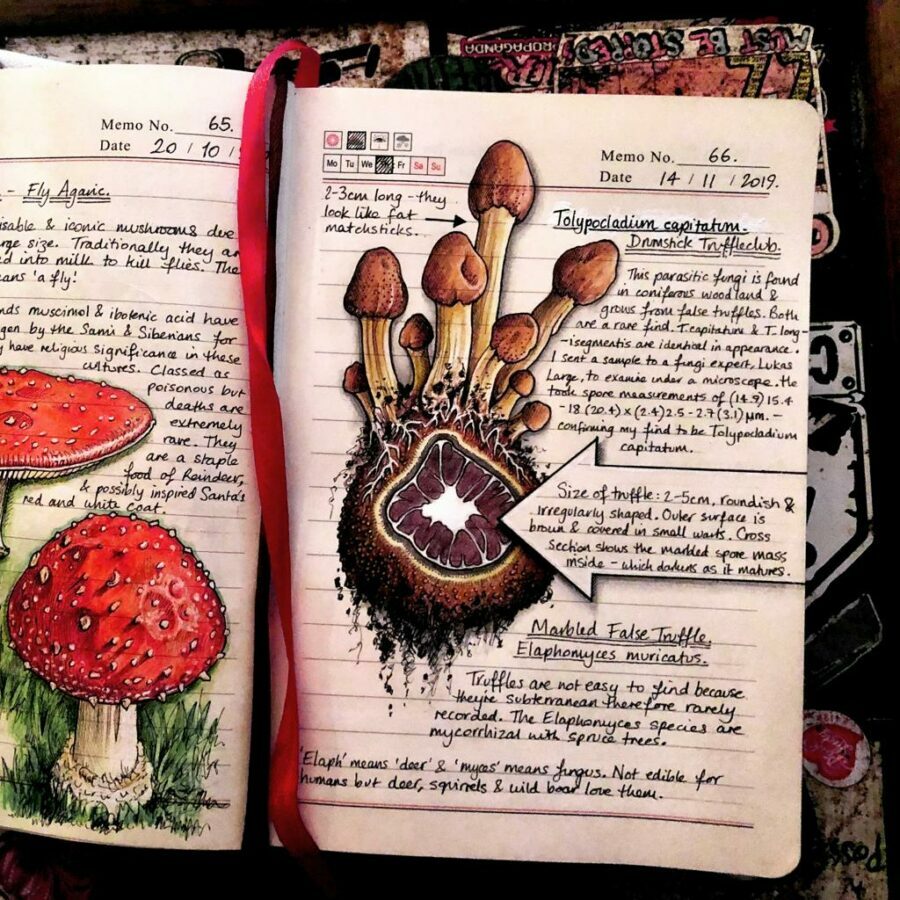
“At the end of April 2019, Jo posted a video of her journal so far on Twitter,” says her web site. “It went viral and her followers jumped from 9K followers to 20K followers in two days.” A glance at any given page reveals what so impressed them. “Each page of Brown’s notebook contains a pen and colored pencil drawing that begins at the pages’ edges, appearing to grow from the corner or across the paper,” writes Colossal’s Grace Ebert.
“Sometimes captured through close-ups that mimic scientific illustrations, the delicate renderings depict the detail of a buff-tailed bumblebee’s fuzzy torso and the red tendrils of a round-leaved sundew. Brown notes the common and Latin names for each species and common characteristics, in addition to where and when she spotted it.”
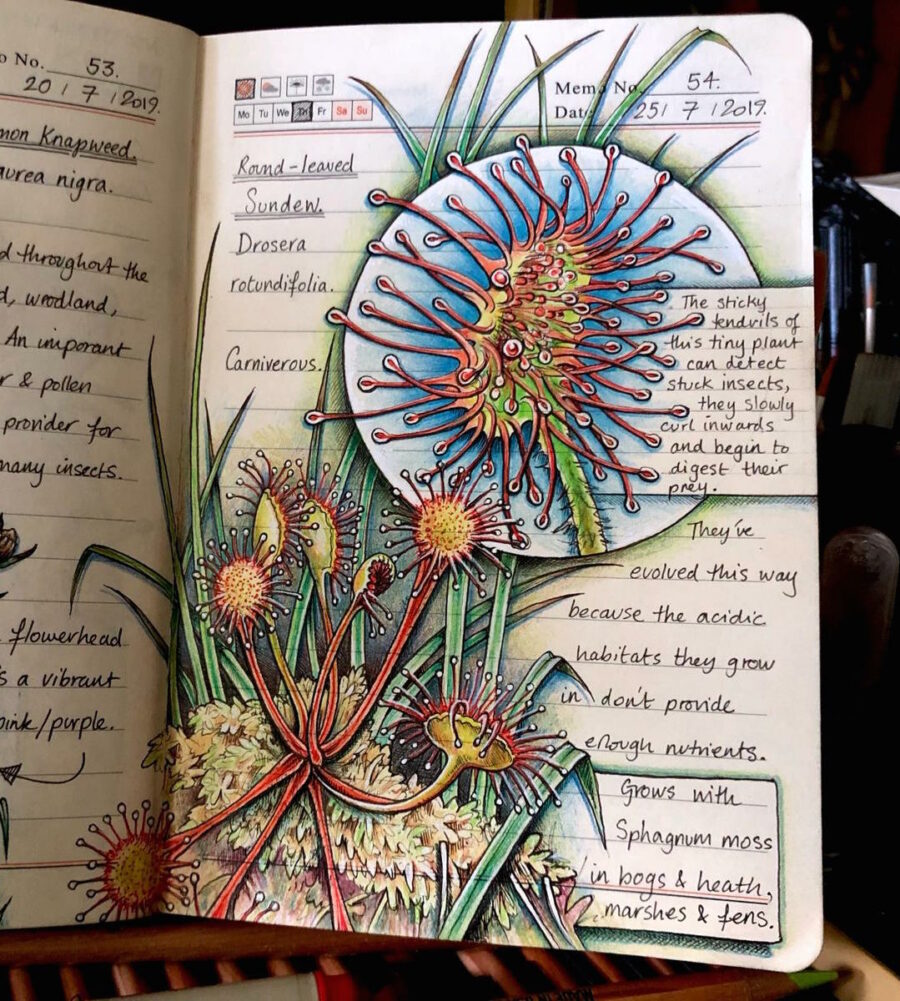
In other words, the nature journal showcases at once its creator’s keen eye, well-trained hand, and formidable knowledge of the natural world. It also stands as a prime example of the art of notebooking.
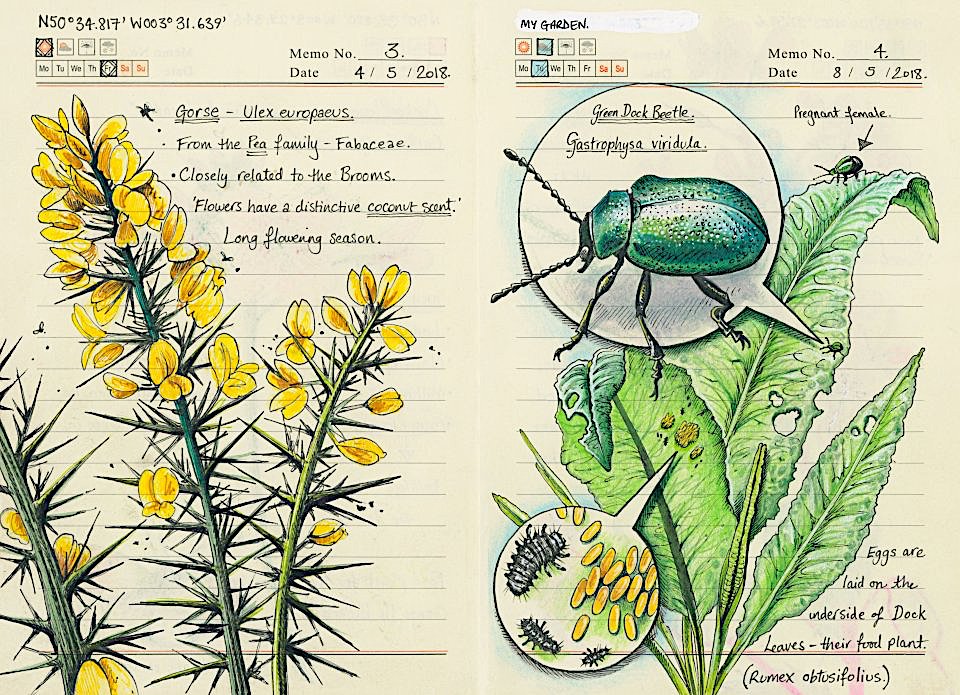
Using to its fullest advantage her ruled Moleskine notebook (the brand of choice for those invested in doing their jotting and sketching on the go for a couple of decades now), Brown effectively delivers a master class in the vivid, legible, and elegant — dare we say organic? — organization of both visual and textual information in the space of a small page.
You can take a closer look at how she does it on her web site as well as her feeds on both Twitter and Instagram. More recently, her journal has been published in book form as Secrets of a Devon Wood. Few nature-lovers, perhaps, can equal Jo Brown as an artist, but everyone can enjoy the gloriously varied realm of life that surrounds them just as much as she does. “All that’s required,” she says, “is a little patience and quiet observation.”
Related Content:
Two Million Wondrous Nature Illustrations Put Online by The Biodiversity Heritage Library
Based in Seoul, Colin Marshall writes and broadcasts on cities, language, and culture. His projects include the Substack newsletter Books on Cities, the book The Stateless City: a Walk through 21st-Century Los Angeles and the video series The City in Cinema. Follow him on Twitter at @colinmarshall, on Facebook, or on Instagram.
Read More...A Glass Floor in a Dublin Grocery Store Lets Shoppers Look Down & Explore Medieval Ruins
In South Korea, where I live, many recent buildings — the new Seoul City Hall, Zaha Hadid’s Dongdaemun Design Plaza — have incorporated the century-upon-century old ruins discovered on their sites. This makes literally visible, often through clear glass floors, the “5,000 years of unbroken history” about which one often hears boasts in Korea. But nor is Europe historically impoverished, and there the window-onto-the-past architectural technique has been applied in even less likely places: a new Dublin location, for instance, of German chain discount supermarket Lidl.
“Architects discovered the remains of an 11th-century house during the development of the site on Aungier Street,” says the video from Irish broadcaster RTÉ above. “The sunken-floored structure has been preserved and is displayed beneath the glass.” Archaeological site director Paul Duffy described the discovery as potentially having “functioned as many things, as a house or an extra space for the family. It’s a domestic structure, so you have to imagine that there would have been a suburb here of Hiberno-Norse Dubliners, who were effectively the ancestors of the Vikings.”
We’re a long way indeed from James Joyce’s Dubliners of 900 years later. But the new Lidl has put more than one formerly buried era of the city’s past on display: “A second glass panel near the checkout tills allows shoppers to glimpse an 18th-century ‘pit trap’ from the stage of the old Aungier Street Theatre,” writes Irish Central’s Shane O’Brien, pit traps being devices “used to bring an actor on stage as if by magic. Another working area under the building preserves “the foundations of the medieval parish church of St. Peter, which served parishioners for more than 600 years between 1050 AD and 1650 AD.”
In the RTÉ video, Dublin City Archaeologist Ruth Johnson frames this as a challenge to the speed-oriented construction model — “put up a hoarding, excavate a site, and then put up a development” — prevalent during Ireland’s recent “Celtic Tiger” period of economic growth. That and other factors have made the built environment of Dublin, a city of many charms, less interesting than it could be. In his recent book Trans-Europe Express’ chapter on Dublin, critic Owen Hatherley writes that “contemporary Irish architecture is marked by a striking parsimony, a cheapness and carelessness in construction.” Looking to the past isn’t always the answer, of course, but in this case Lidl has done well to take it literally.
Related Content:
Magnificent Ancient Roman Mosaic Floor Unearthed in Verona, Italy
James Joyce’s Dublin Captured in Vintage Photos from 1897 to 1904
Based in Seoul, Colin Marshall writes and broadcasts on cities, language, and culture. His projects include the Substack newsletter Books on Cities, the book The Stateless City: a Walk through 21st-Century Los Angeles and the video series The City in Cinema. Follow him on Twitter at @colinmarshall, on Facebook, or on Instagram.
Read More...Support Us
We're hoping to rely on loyal readers, rather than erratic ads. Please click the Donate button and support Open Culture. You can use Paypal, Venmo, Patreon, even Crypto! We thank you!

About Us

Open Culture scours the web for the best educational media. We find the free courses and audio books you need, the language lessons & educational videos you want, and plenty of enlightenment in between.
Advertise With Us
FREE UPDATES!
GET OUR DAILY EMAIL
Get the best cultural and educational resources on the web curated for you in a daily email. We never spam. Unsubscribe at any time.
FOLLOW ON SOCIAL MEDIA
Open Culture editor Dan Colman scours the web for the best educational media. He finds the free courses and audio books you need, the language lessons & movies you want, and plenty of enlightenment in between.
Advertise With Us

