Two Peter Gabriel Albums ‘Scratch My Back … And I’ll Scratch Yours,’ Streaming Free for a Limited Time
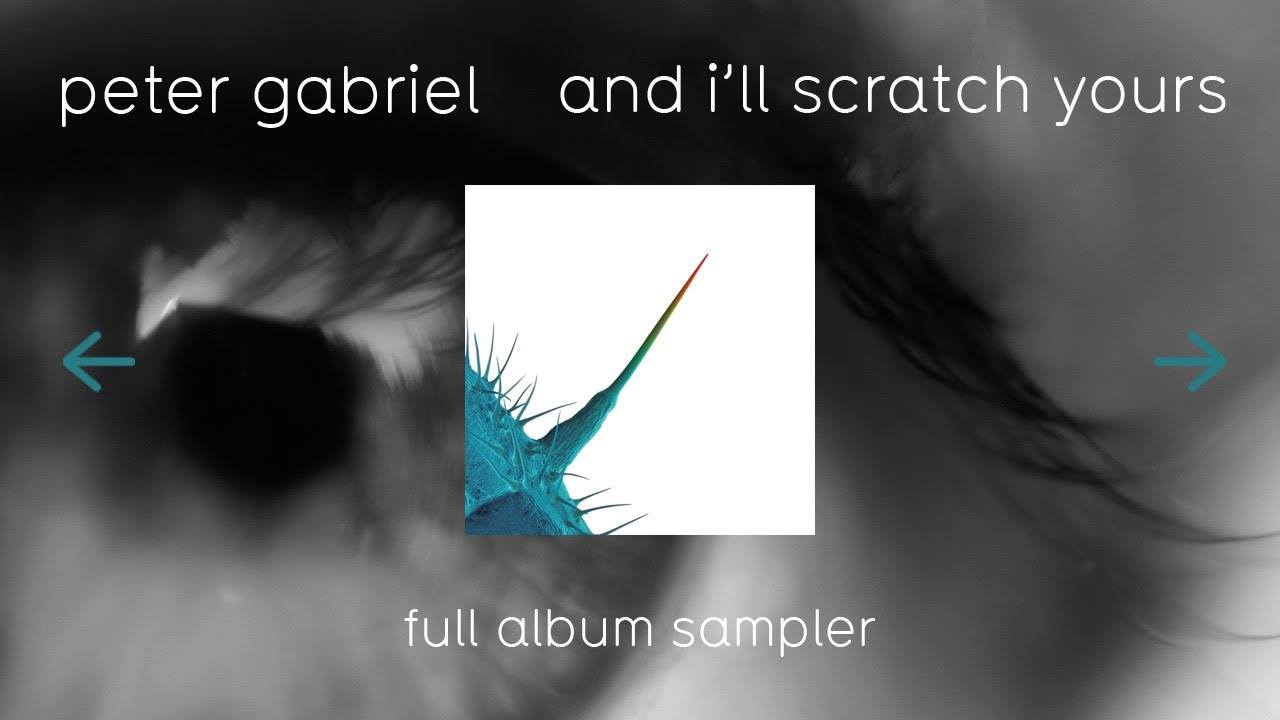
Peter Gabriel’s cover album, Scratch My Back, came out in early 2010, and it featured Gabriel’s quite original remakes of songs by David Bowie, Lou Reed, David Byrne, Regina Spektor and other major artists. Now comes the follow-up: Set to be released on January 6, the new album, And I’ll Scratch Yours, flips the concept of the previous album. This time around, artists like Bon Iver, Arcade Fire, Lou Reed, Paul Simon and Feist record some of Peter Gabriel’s biggest hits — songs like “Games Without Frontiers,” “Mercy Street” and “Biko.” The albums can be purchased together here, but, happily, you can stream them online for free — but only for a a limited time — on NPR’s First Listen site. Enjoy.
Don’t miss anything from Open Culture in 2014. Sign up for our Daily Email or RSS Feed. And we’ll send cultural curiosities your way, every day.
Related Content:
Peter Gabriel and Genesis Live on Belgian TV in 1972: The Full Show
Peter Gabriel Plays Full Concert in Modena, Italy (1994)
Peter Gabriel and His Big Orchestra Play Live at the Ed Sullivan Theater
Read More...The 15 Most Popular Posts from Open Culture in 2013

In 2013, we published 1300+ posts on a wide range of cultural subjects. Looking back through our logs we were able to identify the 15 posts that resonated most widely with our readers. We hope you enjoy this recap, and share some of the items with friends. And we look forward to seeing you in 2014. Happy New Year to you all.
Noam Chomsky Slams Žižek and Lacan: Empty ‘Posturing’: A little spat broke out between Chomsky and Žižek this summer. Chomsky got the debate going after he accused Jacques Lacan of being a “total charlatan” and Slavoj Žižek of posturing rather than offering real intellectual substance. Žižek replied sharply. Chomsky rebutted. Žižek countered again. Some scored it a draw.
The 10 Greatest Films of All Time According to 846 Film Critics: Throughout the year, our resident film scholar Colin Marshall revisited the favorite films of some of the greatest filmmakers — Stanley Kubrick, Martin Scorsese, Woody Allen, and Quentin Tarantino, to name a few. But it also made sense to take a more global view of things, to survey the films loved by 800+ directors and film critics. That’s what you can find here.
Listen to Freddie Mercury and David Bowie on the Isolated Vocal Track for the Queen Hit ‘Under Pressure,’ 1981: In 2013, we featured a series of isolated tracks that offer unique insights into classic songs. You might recall Kurt Cobain’s Vocals From ‘Smells Like Teen Spirit,’ Eric Clapton’s Isolated Guitar Track From ‘While My Guitar Gently Weeps’, and Merry Clayton’s Haunting Background Vocals on the Rolling Stones’ ‘Gimme Shelter’. But your favorite was Freddie Mercury and David Bowie’s unforgettable performance on Queen’s Under Pressure. You have good taste. Bowie fans should also check his list of his Top 100 Books.
Read 18 Short Stories From Nobel Prize-Winning Writer Alice Munro Free Online: When Alice Munro won the Nobel Prize on the strength of her many short stories, Josh Jones gathered for you 18 free short stories written by the now 82-year-old author. They’re all free to read online. During the year, we also put together collections of 10 Free Stories by George Saunders, 10 Free Articles by Hunter S. Thompson, Four Stories by Jennifer Egan, and 30 Free Essays & Stories by David Foster Wallace. Be sure to enjoy them as well.
Free: The Metropolitan Museum of Art and the Guggenheim Offer 474 Free Art Books Online: Art catalogues from museums can be downright expensive. That’s why we were excited when The Met and the Guggenheim put an archive of art catalogues online for free. For no cost, you can read highly visual introductions to the work of Alexander Calder, Edvard Munch, Francis Bacon, Gustav Klimt & Egon Schiele, Wassily Kandinsky, Georgia O’Keeffe, Frank Lloyd Wright and many other influential artists.
The British Library Puts 1,000,000 Images into the Public Domain, Making Them Free to Reuse & Remix: Some of the world’s great libraries are also opening access to our cultural heritage. Take for example the British Library, which announced this month that it has released over a million images onto Flickr Commons for anyone to use, remix and repurpose. Culled from the pages of 17th, 18th and 19th century books, the images include a dizzying array of “maps, geological diagrams, beautiful illustrations, comical satire, illuminated and decorative letters, colorful illustrations, landscapes, wall-paintings” and more.
John Coltrane’s Handwritten Outline for His Masterpiece A Love Supreme: To celebrate Trane’s birthday, we featured a rare document from the Smithsonian’s National Museum of American History: Coltrane’s handwritten outline of his groundbreaking jazz composition A Love Supreme. In terms of popularity, this post was just about tied with another great (but very different) jazz document: Thelonious Monk’s List of Tips for Playing a Gig.
The Genius of J.S. Bach’s “Crab Canon” Visualized on a Möbius Strip: Bach wrote his “Crab Canon” in such a way that it could be played backwards as well as forwards. But prepare yourself for the mind-blowing coup de grâce when mathematical image-maker Jos Ley lays the piece out on a Möbius strip.
Seven Tips From Ernest Hemingway on How to Write Fiction: Hemingway never wrote a treatise on the art of writing fiction. He did, however, leave behind a great many passages in letters, articles and books with opinions and advice on writing. Some of the best of those were assembled in 1984 by Larry W. Phillips into a book, Ernest Hemingway on Writing. We’ve selected seven of our favorite quotations from the book and placed them, along with our own commentary, on this page. Readers will also want to peruse these related posts: 18 (Free) Books Ernest Hemingway Wished He Could Read Again for the First Time and Hemingway Creates a Reading List for a Young Writer, 1934, plus F. Scott Fitzgerald Creates a List of 22 Essential Books, 1936.
Pink Floyd’s David Gilmour Sings Shakespeare’s Sonnet 18: In the early 2000s, Pink Floyd guitarist and singer David Gilmour recorded a musical interpretation of William Shakespeare’s “Sonnet 18″ at his home studio aboard the historic, 90-foot houseboat the Astoria. This video of Gilmour singing the sonnet was released as an extra on the 2002 DVD David Gilmour in Concert, and it’s pretty sublime.
Learn to Code with Harvard’s Intro to Computer Science Course And Other Free Tech Classes: These days, it could never hurt to make sure you have some good tech chops. Many of you understand that, and that’s why you jumped on Harvard’s free, introductory computer science course. Taught by David Malan, the introductory course covers “abstraction, algorithms, encapsulation, data structures, databases, memory management, security, software development, virtualization, and websites. Languages include C, PHP, and JavaScript plus SQL, CSS, and HTML.” You can always find the course listed in the Computer Science section of our collection of 800 Free Courses Online.
Michelangelo’s Illustrated 16th-Century Grocery List: Very few of Michelangelo’s papers survive today, but we do oddly have the grocery lists that he had his servant bring to the food market. “Because the servant he was sending to market was illiterate,” writes the Oregonian‘s Steve Duin, “Michelangelo illustrated the shopping lists — a herring, tortelli, two fennel soups, four anchovies and ‘a small quarter of a rough wine’ — with rushed … caricatures in pen and ink.” It’s a unique historical item, certainly worth checking out.
Prize-Winning Animation Lets You Fly Through 17th Century London: Six students from De Montfort University created a stellar 3D representation of 17th century London, as it existed before The Great Fire of 1666. The three-minute video provides a realistic animation of Tudor London, and particularly a section called Pudding Lane where the fire started. Grab a small handful of popcorn, and sit back and enjoy.
Hermann Rorschach’s Original Rorschach Test: What Do You See?: In honor of Hermann Rorschach’s birthday in November, we highlighted the original images used in his famous psychology test back in 1921. And we invited you to say what you saw in these images. The answers were often amusing, sometimes perplexing.
Simone de Beauvoir Explains “Why I’m a Feminist” in a Rare TV Interview (1975): In a 1975 interview, Simone de Beauvoir picked up on ideas she explored in The Second Sex. This revealing clip can be watched alongside other 2013 posts featuring de Beauvoir and her partner Jean-Paul Sartre. See Lovers and Philosophers — Jean-Paul Sartre & Simone de Beauvoir Together in 1967 and Philosophy’s Power Couple, Jean-Paul Sartre and Simone de Beauvoir, Featured in 1967 TV Interview.
Bonus: Fill Your New Kindle, iPad, iPhone, eReader with Free eBooks, Movies, Audio Books, Online Courses & More: Just last week, we told you where to load up your new iPads, Kindles, and other devices with free intelligent media. If you missed it the first time around, it’s not too late to circle back.
Don’t miss anything from Open Culture in 2014. Sign up for our Daily Email or RSS Feed. And we’ll send cultural curiosities your way, every day.
Read More...Sherlock Holmes Is Now in the Public Domain, Declares US Judge

Chief Judge Rubén Castillo of the United States District Court of the Northern District of Illinois has ruled that the characters and story lines used in 50 Sherlock Holmes texts published by Arthur Conan Doyle before Jan. 1, 1923 “are no longer covered by United States copyright law and can be freely used by creators without paying any licensing fee to the Conan Doyle estate,” reports The New York Times. This gives contemporary authors the ability to write their own Sherlock Holmes mystery stories and keep contributing to a rich tradition of detective fiction. It would also seemingly put pre-1923 texts firmly in the public domain. (You can find The Adventures of Sherlock Holmes and other related stories in our Free eBooks and Free Audio Books collections. ) Leslie S. Klinger, the editor of The Complete Annotated Sherlock Holmes, who filed the civil suit, praised the judge’s decision, saying “People want to celebrate Holmes and Watson, and now they can do that without fear.” Now it’s time for them to write something that can hold a candle to what Conan Doyle created those many years ago.
Don’t miss anything from Open Culture. Sign up for our Daily Email or RSS Feed. And we’ll send cultural curiosities your way, every day.
via Arts Beat
Related Content:
Arthur Conan Doyle Discusses Sherlock Holmes and Psychics in a Rare Filmed Interview (1927)
Arthur Conan Doyle Fills Out the Questionnaire Made Famous By Marcel Proust (1899)
Read More...The Rolling Stones “Shattered” Covered by Eddie Vedder & Julie Andrews (Ok, It’s Really Jeanne Tripplehorn)
Pearl Jam frontman Eddie Vedder and actress Jeanne Tripplehorn (Basic Instinct, The Firm, Big Love) performed this delightful cover of The Rolling Stones’ 1978 hit “Shattered” at a recent fundraiser for a non-profit called Heal EB. EB stands for Epidermolysis Bullosa, a disease that causes blisters (sometimes potentially fatal ones) to erupt on the skin after the mildest trauma. You can listen to The Rolling Stones’ original recording here, and follow along with the lyrics here. Or, better yet, you can close your eyes and simply imagine Julie Andrews singing these risqué lines. Yeah, on second thought, do that. H/T Marc
Don’t miss anything from Open Culture. Sign up for our Daily Email or RSS Feed. And we’ll send cultural curiosities your way, every day.
Related Content:
The Rolling Stones Jam With Their Idol, Muddy Waters
The Rolling Stones Sing Jingle for Rice Krispies Commercial (1964)
Read More...Download 100 Free Philosophy Courses and Start Living the Examined Life

The Philosophy section of our big Free Online Courses collection just went through another update, and it now features 100 courses. Enough to give you a soup-to-nuts introduction to a timeless discipline. You can start with one of several introductory courses.
- Philosophy for Beginners – iTunes – Web Video – Marianne Talbot, Oxford
- Critical Reasoning for Beginners - iTunes Video – iTunes Audio – Web Video – Oxford
- A Romp through Ethics for Complete Beginners — iTunes Video – Web Video – Oxford
- Introduction to Political Philosophy – YouTube – iTunes – Web Video — Steven B. Smith, Yale
- The Art of Living — Web Video – Stanford
- The History of Philosophy Without Any Gaps - Multiple Formats– Peter Adamson, King’s College London
Then, once you’ve found your footing, you can head off in some amazing directions. As we mentioned many moons ago, you can access courses and lectures by modern day legends – Michel Foucault, Bertrand Russell, John Searle, Walter Kaufmann, Leo Strauss, Hubert Dreyfus and Michael Sandel. Then you can sit back and let them introduce you to the thinking of Aristotle, Socrates, Plato, Hobbes, Hegel, Heidegger, Kierkegaard, Kant, Nietzsche, Sartre and the rest of the gang. The courses listed here are generally available via YouTube, iTunes, or the web.
Explore our collection, 1,700 Free Online Courses from Top Universities, to find topics in many other disciplines — History, Literature, Physics, Computer Science and beyond. As we like to say, it’s the most valuable single page on the web.
Don’t miss anything from Open Culture. Sign up for our Daily Email or RSS Feed. And we’ll send quality culture your way, every day.
Related Content:
Michel Foucault: Free Lectures on Truth, Discourse & The Self
Take First-Class Philosophy Lectures Anywhere with Free Oxford Podcasts
Walter Kaufmann’s Lectures on Nietzsche, Kierkegaard and Sartre (1960)
Leo Strauss: 15 Political Philosophy Courses Online
Read More...Teacher Helps His Student Overcome Stuttering and Read Poetry, Using the Sound of Music
Musharaf Asghar, a student at Thornhill Academy in northeast England, overcame an acute stammer when his teacher, Matthew Burton, borrowed an idea from The King’s Speech. The teacher asked his student to put on some headphones playing the music of Ben Howard, and to start reciting a poem called ‘The Moment.’ Suddenly, for the first time, the words began to flow. All of this was captured in a documentary series, Educating Yorkshire, that aired on the BBC. The segment above concludes with Mushy, as he’s known, giving a short talk in front of his class, at what looks like a graduation ceremony. It didn’t take long for his fellow students to break down in tears.
Writing recently in The Guardian, the student recalls. “My nerves over speaking in assembly were TERRIBLE though. I didn’t realise how big 200 people looks like. I was sweating and I had a little wobble but eventually, I managed to get through it. I was excited, if nervous, about the whole thing going out. But I’m really happy and proud to be on telly as I hope it gives other people with a stammer the confidence to have a go at public speaking. My speech is getting better every week. Everyone at college gives me time, but I’m getting quicker anyway so they don’t miss their bus while they are listening to me. I still won’t be applying for any call-centre jobs yet though.” Find more information on how music therapy can help people overcome stuttering here.
Don’t miss anything from Open Culture. Sign up for our Daily Email or RSS Feed. And we’ll send quality culture your way, every day.
via @courosa
Read More...French Café Adds Extra Charge for Rude Customers

A couple of days ago, we highlighted a delightfully Illustrated Etiquette Guide Explaining How to Ride the Paris Metro in a Civilized Way. It comes to you courtesy of the RATP, the government organization that makes the subways and trains run in Paris (sometimes on time).
Let’s now head 600 miles south, to the Riviera city of Nice, where some café owners opted for another way to keep bad behavior in check. At the Petite Syrah, they’ve implemented a simple pricing scheme that works like this:
If you ask for “a coffee” (it’s most likely an espresso), it will run you 7 euros, or $9.50.
If you ask for a “coffee please,” the charge drops to €4.25/$5.80.
But if you start your order by saying “Hello, may I have a coffee, please,” the bill becomes a manageable €1.40.
Now, truth be told, the pricing scheme is more carrot than stick. The café’s manager readily admits that he has never actually charged any of the punitive higher prices. But that’s not to say that the scheme doesn’t work. According to manager/owner Fabrice Pepino, regular customers quickly took note of the sign and began to “say, ‘Hello, your highness, will you serve me one of your beautiful coffees.” Eh voilà, no more coffee jerks.
Don’t miss anything from Open Culture. Sign up for our Daily Email orRSS Feed. And we’ll send quality culture your way, every day.
Related Content:
Illustrated Etiquette Guide Explains How to Ride the Paris Metro in a Civilized Way
Men In Commercials Being Jerks About Coffee: A Mashup of 1950s & 1960s TV Ads
The (Beautiful) Physics of Adding Cream to Your Coffee
Read More...New Art Edition of James Joyce’s Ulysses Features All 265,000 Words Written by Hand on Big Wooden Poles
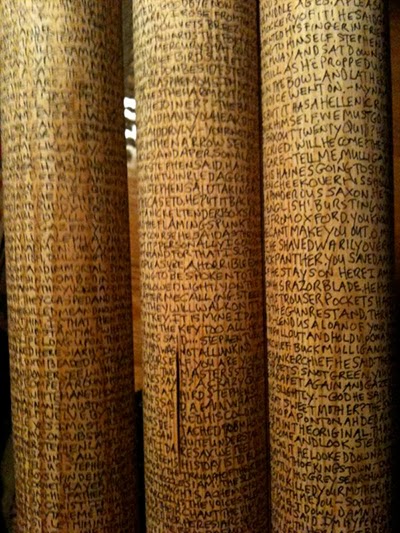
This week, Stephen Gertz, the editor of Book Tryst, has on display an Incredible Art Edition of James Joyce’s Ulysses. Here’s how he describes the ambitious project:
James Joyce completed his novel, Ulysses, on October 30, 1921. Ninety years later, on October 30, 2011, Charlene Matthews, the Los Angeles-based book artist and bookbinder recently the subject of a profile in Studios magazine, began work on an extraordinary edition of the book, based upon Sylvia Beach’s true first edition with all its typos included.
Two years later, on October 30, 2013, she completed it: the entire text of Ulysses — all of its approximately 265,000 words in eighteen episodes — transcribed by hand onto thirty-eight seven-foot tall, two-inch diameter poles: Ulysses as a landscape to physically move through; the novel as literary grove, Ulysses as trees of of life with language as fragrant, hallucinatory bark, and trunks reaching toward the sky.
Head over to Booktryst to look over a gallery of images and learn more about Matthews’ grand undertaking. And if you’d like a nice introduction to Ulysses, please see some of the instructive material we’ve listed below.
Don’t miss anything from Open Culture. Sign up for our Daily Email orRSS Feed. And we’ll send quality culture your way, every day.
Related Content:
James Joyce’s Ulysses: Download the Free Audio Book
Read Joyce’s Ulysses Line by Line, for the Next 22 Years, with Frank Delaney’s Podcast
Hear James Joyce Read a Passage From Ulysses, 1924
The Very First Reviews of James Joyce’s Ulysses: “A Work of High Genius” (1922)
Vladimir Nabokov Creates a Hand-Drawn Map of James Joyce’s Ulysses
Read More...Watch Kids’ Priceless Reactions to Hearing the Timeless Music of The Beatles
Yesterday, John McMillian, assistant professor of history at Georgia State University, appeared on KQED’s Forum in San Francisco (listen here) to talk about his new book Beatles vs. Stones. It offers a new look at how the two British bands co-existed, often helped one another, and strategically defined themselves against each other. The Beatles were everyman’s band. Wholesome, clean-cut, witty, the Fab Four appealed to the young and the old, the rich and the poor. The Stones, trying to make a name for themselves in the wake of Beatlemania, positioned themselves as the anti-Beatles. As the journalist Tom Wolfe once wrote, “The Beatles want to hold your hand, but the Stones want to burn down your town.”
50 years later, The Beatles still have a nearly universal appeal. The Boomers and their now middle-aged children haven’t let dust gather on The Beatles’ discography. And, if you plunk the grandchildren in front of old Beatles’ videos, they’ll love what they see. Just watch above.
Don’t miss anything from Open Culture. Sign up for our Daily Email or RSS Feed. And we’ll send quality culture your way, every day.
Related Content:
The Beatles: Unplugged Collects Acoustic Demos of White Album Songs (1968)
Flashmob Performs The Beatles’ ‘Here Comes the Sun’ in Madrid Unemployment Office
The Beatles Perform in a Spoof of Shakespeare’s A Midsummer Night’s Dream, 1964
A Short Film on the Famous Crosswalk From the Beatles’ Abbey Road Album Cover
Read More...How to Follow Open Culture Posts: Daily Email & RSS Are Gold, Twitter Is an Option, Forget About Facebook
 Readers often ask us, “What’s the best way to make sure that I don’t miss any of your posts?” The answer, right now, is pretty clear: Sign up for our daily email. Each day, you will receive an email that tidily wraps up everything we’ve featured on the site over a 24 hour period. Faithfully it will appear in your inbox each day. The other great option is our trusty RSS feed: http://feeds.feedburner.com/OpenCulture
You can always follow us on Twitter (or Google Plus), where we highlight our daily posts, plus many other cultural curiosities found on the web. The only downside is that a river of material flows through Twitter, so you’ll have to keep a pretty close eye on things to spot our posts.
Finally there’s Facebook, but you can almost forget about that. Although nearly a quarter million people have liked our Facebook page, Facebook has historically shown our posts to a fraction of that audience (something they’re candid about). And because of a new algorithm change, the fraction is getting substantially smaller. The unfortunate bottom line is that you can’t rely on Facebook to give you what you want. But you can rely on our daily email and our feed. They’re 100% guaranteed. Now back to our regularly scheduled program.
Read More...Support Us
We're hoping to rely on loyal readers, rather than erratic ads. Please click the Donate button and support Open Culture. You can use Paypal, Venmo, Patreon, even Crypto! We thank you!

About Us

Open Culture scours the web for the best educational media. We find the free courses and audio books you need, the language lessons & educational videos you want, and plenty of enlightenment in between.
Advertise With Us
FREE UPDATES!
GET OUR DAILY EMAIL
Get the best cultural and educational resources on the web curated for you in a daily email. We never spam. Unsubscribe at any time.
FOLLOW ON SOCIAL MEDIA
Open Culture editor Dan Colman scours the web for the best educational media. He finds the free courses and audio books you need, the language lessons & movies you want, and plenty of enlightenment in between.
Advertise With Us

