Google’s Moving Ad About 1947 Partition of India & Pakistan Tops 10 Million Views
Recently, Wired writer Steve Silberman (aka @stevesilberman) shot us a note on Twitter, saying, “@openculture, do not miss this brilliant ad. Most touching movie (in 3 mins!) I’ve seen in years.” Released on November 13th, the video has already clocked over 10 million views. But chances are you haven’t seen it. And that’s because it’s targeted to the web-enabled middle class of India and Pakistan. As The Dawn, Pakistan’s oldest English newspaper, describes it, the Google-created ad entitled “Reunion” “portrays two childhood friends, now elderly men, who haven’t seen each other since they were separated by the 1947 partition that created India and Pakistan from the old British empire in South Asia. Partition sparked a mass exodus as millions of Muslims and Hindus fled across the new borders amid religious violence.” Now Google search products are helping to bring old friends and neighbors back together.
Cynics may be quick to judge this a saccharine, manipulative ad. But others are seeing in it something else — a sign that “personal connections between Indians and Pakistanis run deep.” Even if their governments gain something from keeping the conflict alive, everyday people in India and Pakistan are increasingly ready to put history aside.
Note: If you click CC at the bottom of the video, you can use captions to translate the film into nine languages, including French, Malayalam and Urdu. It is preset to English.
Don’t miss anything from Open Culture. Sign up for our Daily Email orRSS Feed. And we’ll send quality culture your way, every day.
Read More...Turn Your Bike into an Electric Hybrid with MIT’s “Copenhagen Wheel”
Bonaverde’s “Roast-Grind-Brew Coffee Machine” seemed like one of the cooler inventions I’ve recently stumbled upon. But then I came across this: The Copenhagen Wheel. Originally created by researchers at MIT, the Copenhagen Wheel “transforms ordinary bicycles quickly into hybrid e‑bikes.” It allows bike riders to “capture the energy dissipated while cycling and braking and save it for when you need a bit of a boost” — like climbing a hill in San Francisco. The wheel also feeds data to your iPhone, allowing you to monitor pollution levels, traffic congestion, and road conditions in real-time. After spending several years in development, the wheel can now be pre-ordered online and it will ship next spring. It retails for $699.
Get more background information on The Copenhagen Wheel via this MIT web site.
Related Content:
Science Behind the Bike: Four Videos from the Open University on the Eve of the Tour de France
Brussels Express: The Perils of Cycling in Europe’s Most Congested City
David Byrne: From Talking Heads Frontman to Leading Urban Cyclist
Read More...
Two Viral Videos Push Against Stereotypical Messages Girls Get From the Media (Mildly NSFW)
The first of two videos circulating on the internet, “Girls Who Read” by UK poet and “Rogue Teacher” Mark Grist (above) hits back at the lad culture that objectifies women according to certain “bits” named above in some mildly NSFW language. In his video performance piece above, Grist, asked which bits he prefers by a lad in a pub, and faced with a looming cadre of both male and female peers putting on the pressure, answers haltingly, “I like a girl… who … reads.” Then, his confidence up, he elaborates:
I like a girl who reads,
Who needs the written word
And who uses the added vocabulary
She gleans from novels and poetry
To hold lively conversation
In a range of social situations
The ideal girl close to Grist’s heart “ties back her hair as she’s reading Jane Eyre” and “feeds her addiction for fiction with unusual poems and plays.” In his infectious slam cadences, Grist’s impassioned paean to female readers offers a charming alternative to the ladmag gaze, though one might argue that he still does a little bit of projecting his fantasies onto an unsuspecting lone female at the bar (who turns out to be not so alone). Maybe “Girl Who Reads” is a trope, like “Manic Pixie Dream Girl,” an idealization that says more about Grist’s desires than about any particular, actual girl, but it’s still a refreshing challenge to the leering of his pubmates, one that communicates to girls that there are men out there, even in the pubs, who value women for their minds.
The video above, for a new line of toys called GoldiBlox, designed by Stanford-educated engineer Debbie Sterling, upends another adolescent male cultural touchstone—this time a by-now classic American one—the Beastie Boys gleefully misogynistic anthem “Girls.” While the original still likely scores many a frat party, it now must compete with the rewrite performed by “Raven.” The re-appropriated “Girls” plays over video of a trio of young girls, bored to death with stereotypical pink tea sets and the like, who build a complicated Rube Goldberg machine from Goldiblox, which resemble plastic tinker toys. I foresee snippets of the updated lyrics (below) making their way onto playgrounds around the country. Hear the original Beastie Boys song, with lyrics, below.
Girls.
You think you know what we want, girls.
Pink and pretty it’s girls.
Just like the 50’s it’s girls.
You like to buy us pink toys
and everything else is for boys
and you can always get us dolls
and we’ll grow up like them… false.
It’s time to change.
We deserve to see a range.
‘Cause all our toys look just the same
and we would like to use our brains.
We are all more than princess maids.
Girls to build the spaceship,
Girls to code the new app,
Girls to grow up knowing
they can engineer that.
Girls.
That’s all we really need is Girls.
To bring us up to speed it’s Girls.
Our opportunity is Girls.
Don’t underestimate Girls.
As with all kids advertising, this is aimed as much at parents—who remember the Beastie Boys’ song—as their kids, who couldn’t possibly. And unlike Grist’s video, which only sells, perhaps, himself, the Goldiblox video aims to get kids hooked on plastic toys as much as any of the ads for products it displaces. Nonetheless, I’ll play it for my daughter in a few years, because lines like “we are all more than princess maids” constitute the perfect retort to the seemingly endless cultural slotting of girls into ridiculously subservient and fantasy roles.
Related Content:
“Science: It’s a Girl Thing!” OMG, Seriously?! The Botched Video by the EU
Christopher Hitchens Creates a Reading List for Eight-Year-Old Girl
Radiohead’s Thom Yorke Gives Teenage Girls Endearing Advice About Boys (And Much More)
Josh Jones is a writer and musician based in Durham, NC. Follow him at @jdmagness
Read More...The 100 Best Novels: A Literary Critic Creates a List in 1898
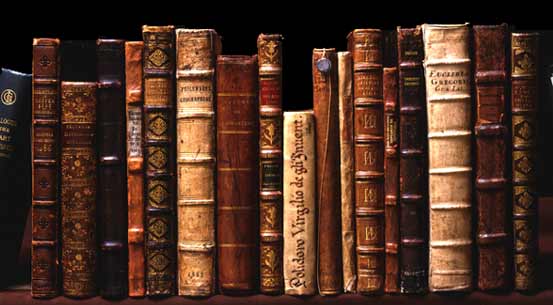 Book lists, despite what younger readers born into Buzzfeed’s ruthless listsicle monopoly may think, have always been popular. Some, like David Bowie’s Top 100 Books, give us a sense of the artist’s development. Others, like Joseph Brodsky’s List of 84 Books for Basic Conversation, provide a Nobel prize-winning benchmark for knowledge. Even though the books are within the reach of most readers, systematically digesting such lists often tries one’s patience. Despite the lack of will or interest in working through someone else’s literary education, however, glancing through such personal anthologies provides us with a glimpse into the maker’s life—be it their private tastes, or their social mores.
In late October, The Times Literary Supplement’s Michael Caines unearthed another Top 100 list; this one, however, has the distinction of hailing from 1898. At the turn of the 20th century, a journalist and author of numerous books on the Brontë sisters named Clement K. Shorter tried his hand at compiling the 100 Best Novels for a journal called The Bookman. The ground rules were simple: the list could feature only one novel per novelist, and living authors were excluded. Today, Shorter’s compendium looks somewhat hit-or-miss. There are some indisputable classics (many of which can be found in our Free eBooks and Free Audio Books collections) and some other texts that have faded into oblivion. Still—one can’t help but experience a certain historical frisson at a 19th century listsicle. Here it goes:
1. Don Quixote — 1604 — Miguel de Cervantes
2. The Holy War — 1682 — John Bunyan
3. Gil Blas — 1715 — Alain René le Sage
4. Robinson Crusoe — 1719 — Daniel Defoe
5. Gulliver’s Travels — 1726 — Jonathan Swift
6. Roderick Random — 1748 — Tobias Smollett
7. Clarissa — 1749 — Samuel Richardson
8. Tom Jones — 1749 — Henry Fielding
9. Candide — 1756 — Françoise de Voltaire
10. Rasselas — 1759 — Samuel Johnson
11. The Castle of Otranto — 1764 — Horace Walpole
12. The Vicar of Wakefield — 1766 — Oliver Goldsmith
13. The Old English Baron — 1777 — Clara Reeve
14. Evelina — 1778 — Fanny Burney
15. Vathek — 1787 — William Beckford
16. The Mysteries of Udolpho — 1794 — Ann Radcliffe
17. Caleb Williams — 1794 — William Godwin
18. The Wild Irish Girl — 1806 — Lady Morgan
19. Corinne — 1810 — Madame de Stael
20. The Scottish Chiefs — 1810 — Jane Porter
21. The Absentee — 1812 — Maria Edgeworth
22. Pride and Prejudice — 1813 — Jane Austen
23. Headlong Hall — 1816 — Thomas Love Peacock
24. Frankenstein — 1818 — Mary Shelley
25. Marriage — 1818 — Susan Ferrier
26. The Ayrshire Legatees — 1820 — John Galt
27. Valerius — 1821 — John Gibson Lockhart
28. Wilhelm Meister — 1821 — Johann Wolfgang von Goethe
29. Kenilworth — 1821 — Sir Walter Scott
30. Bracebridge Hall — 1822 — Washington Irving
31. The Epicurean — 1822 — Thomas Moore
32. The Adventures of Hajji Baba — 1824 — James Morier (“usually reckoned his best”)
33. The Betrothed — 1825 — Alessandro Manzoni
34. Lichtenstein — 1826 — Wilhelm Hauff
35. The Last of the Mohicans — 1826 — Fenimore Cooper
36. The Collegians — 1828 — Gerald Griffin
37. The Autobiography of Mansie Wauch — 1828 — David M. Moir
38. Richelieu — 1829 — G. P. R. James (the “first and best” novel by the “doyen of historical novelists”)
39. Tom Cringle’s Log — 1833 — Michael Scott
40. Mr. Midshipman Easy — 1834 — Frederick Marryat
41. Le Père Goriot — 1835 — Honoré de Balzac
42. Rory O’More — 1836 — Samuel Lover (another first novel, inspired by one of the author’s own ballads)
43. Jack Brag — 1837 — Theodore Hook
44. Fardorougha the Miser — 1839 — William Carleton (“a grim study of avarice and Catholic family life. Critics consider it the author’s finest achievement”)
45. Valentine Vox — 1840 — Henry Cockton (yet another first novel)
46. Old St. Paul’s — 1841 — Harrison Ainsworth
47. Ten Thousand a Year — 1841 — Samuel Warren (“immensely successful”)
48. Susan Hopley — 1841 — Catherine Crowe (“the story of a resourceful servant who solves a mysterious crime”)
49. Charles O’Malley — 1841 — Charles Lever
50. The Last of the Barons — 1843 — Bulwer Lytton
51. Consuelo — 1844 — George Sand
52. Amy Herbert — 1844 — Elizabeth Sewell
53. Adventures of Mr. Ledbury — 1844 — Elizabeth Sewell
54. Sybil — 1845 — Lord Beaconsfield (a. k. a. Benjamin Disraeli)
55. The Three Musketeers — 1845 — Alexandre Dumas
56. The Wandering Jew — 1845 — Eugène Sue
57. Emilia Wyndham — 1846 — Anne Marsh
58. The Romance of War — 1846 — James Grant (“the narrative of the 92nd Highlanders’ contribution from the Peninsular campaign to Waterloo”)
59. Vanity Fair — 1847 — W. M. Thackeray
60. Jane Eyre — 1847 — Charlotte Brontë
61. Wuthering Heights — 1847 — Emily Brontë
62. The Vale of Cedars — 1848 — Grace Aguilar
63. David Copperfield — 1849 — Charles Dickens
64. The Maiden and Married Life of Mary Powell — 1850 — Anne Manning (“written in a pastiche seventeenth-century style and printed with the old-fashioned typography and page layout for which there was a vogue at the period …”)
65. The Scarlet Letter — 1850 — Nathaniel Hawthorne
66. Frank Fairleigh — 1850 — Francis Smedley (“Smedley specialised in fiction that is hearty and active, with a strong line in boisterous college escapades and adventurous esquestrian exploits”)
67. Uncle Tom’s Cabin — 1851 — H. B. Stowe
68. The Wide Wide World — 1851 — Susan Warner (Elizabeth Wetherell)
69. Nathalie — 1851 — Julia Kavanagh
70. Ruth — 1853 — Elizabeth Gaskell
71. The Lamplighter — 1854 — Maria Susanna Cummins
72. Dr. Antonio — 1855 — Giovanni Ruffini
73. Westward Ho! — 1855 — Charles Kingsley
74. Debit and Credit (Soll und Haben) — 1855 — Gustav Freytag
75. Tom Brown’s School-Days — 1856 — Thomas Hughes
76. Barchester Towers — 1857 — Anthony Trollope
77. John Halifax, Gentleman — 1857 — Dinah Mulock (a. k. a. Dinah Craik; “the best-known Victorian fable of Smilesian self-improvement”)
78. Ekkehard — 1857 — Viktor von Scheffel
79. Elsie Venner — 1859 — O. W. Holmes
80. The Woman in White — 1860 — Wilkie Collins
81. The Cloister and the Hearth — 1861 — Charles Reade
82. Ravenshoe — 1861 — Henry Kingsley (“There is much confusion in the plot to do with changelings and frustrated inheritance” in this successful novel by Charles Kingsley’s younger brother, the “black sheep” of a “highly respectable” family)
83. Fathers and Sons — 1861 — Ivan Turgenieff
84. Silas Marner — 1861 — George Eliot
85. Les Misérables — 1862 — Victor Hugo
86. Salammbô — 1862 — Gustave Flaubert
87. Salem Chapel — 1862 — Margaret Oliphant
88. The Channings — 1862 — Ellen Wood (a. k. a. Mrs Henry Wood)
89. Lost and Saved — 1863 — The Hon. Mrs. Norton
90. The Schönberg-Cotta Family — 1863 — Elizabeth Charles
91. Uncle Silas — 1864 — Joseph Sheridan Le Fanu
92. Barbara’s History — 1864 — Amelia B. Edwards (“Confusingly for bibliographers, she was related to Matilda Betham-Edwards and possibly to Annie Edward(e)s …”)
93. Sweet Anne Page — 1868 — Mortimer Collins
94. Crime and Punishment — 1868 — Feodor Dostoieffsky
95. Fromont Junior — 1874 — Alphonse Daudet
96. Marmorne — 1877 — P. G. Hamerton (“written under the pseudonym Adolphus Segrave”)
97. Black but Comely — 1879 — G. J. Whyte-Melville
98. The Master of Ballantrae — 1889 — R. L. Stevenson
99. Reuben Sachs — 1889 — Amy Levy
100. News from Nowhere — 1891 — William Morris
In addition to the canon, Shorter—unable to heed his own cautious counsel and throwing the door open to the winds of literary passion—included 8 books by living novelists whom he called “writers whose reputations are too well established for their juniors to feel towards them any sentiments other than those of reverence and regard:”
An Egyptian Princess — 1864 — Georg Ebers
Rhoda Fleming — 1865 — George Meredith
Lorna Doone — 1869 — R. D. Blackmore
Anna Karenina — 1875 — Count Leo Tolstoi
The Return of the Native — 1878 — Thomas Hardy
Daisy Miller — 1878 — Henry James
Mark Rutherford — 1881 — W. Hale White
Le Rêve — 1889 — Emile Zola
via The Times Literary Supplement
Related Content:
David Bowie’s List of Top 100 Books
Christopher Hitchens Creates a Reading List for Eight-Year-Old Girl
See Nobel Laureate Joseph Brodsky’s Reading List For Having an Intelligent Conversation
Ilia Blinderman is a Montreal-based culture and science writer. Follow him at @iliablinderman
Read More...Prize-Winning Animation Lets You Fly Through 17th Century London
Six students from De Montfort University have created a stellar 3D representation of 17th century London, as it existed before The Great Fire of 1666. The three-minute video provides a realistic animation of Tudor London, and particularly a section called Pudding Lane where the fire started. As Londonist notes, “Although most of the buildings are conjectural, the students used a realistic street pattern [taken from historical maps] and even included the hanging signs of genuine inns and businesses” mentioned in diaries from the period.
For their efforts, the De Montfort team was awarded first prize in the Off the Map contest, a competition run by The British Library and video game developers GameCity and Crytek.
Commenting on the video, one judge from the esteemed British Library had this to say:
Some of these vistas would not look at all out of place as special effects in a Hollywood studio production. The haze effect lying over the city is brilliant, and great attention has been given to key features of London Bridge, the wooden structure of Queenshithe on the river, even the glittering window casements. I’m really pleased that the Pudding Lane team was able to repurpose some of the maps from the British Library’s amazing map collection – a storehouse of virtual worlds – in such a considered way.
You can find more information about how the animation came together over at the animators’ blog, plus at The British Library’s Digital Scholarship blog.
Follow Open Culture on Facebook and Twitter and share intelligent media with your friends. Or better yet, sign up for our daily email and get a daily dose of Open Culture in your inbox. And if you want to make sure that our posts definitely appear in your Facebook newsfeed, just follow these simple steps.
Related Content:
History: Free Online Courses
Rome Reborn – An Amazing Digital Model of Ancient Rome
How the Egyptian Pyramids Were Built: A New Theory in 3D Animation
A Digital Reconstruction of Washington D.C. in 1814
What Ancient Greek Music Sounded Like: Hear a Reconstruction That is ‘100% Accurate’
Read More...Watch Red Shirley, Lou Reed’s Short Documentary on His Fascinating 100-Year-Old Cousin (2010)
From fronting the Velvet Underground to putting out four solid sides of feedback noise to collaborating with Metallica on a semi-spoken word album based on the plays of Frank Wedekind, the late avant-rocker Lou Reed had a way of never working on quite what you’d expect him to. Easier said than done, of course, but Reed managed to sustain a long, always-interesting career and position in the culture by exercising that strength not just in music but in other forms as well. Above we have Red Shirley, a half-hour documentary film he made with Ralph Gibson in 2010. (Score provided by “the Metal Machine Trio”.) We get the premise up front, onscreen: “On the eve of her 100th birthday, Lou sat down with his cousin Shirley for a tête-à-tête.” Most nearly-100-year-olds have, presumably, seen a lot; Shirley Novick has seen even more.
“During World War I she emerged unscathed from Poland after her family’s house was hit by a dud shell,” writes the Wall Street Journal’s Nicolas Rapold in an article that also includes Reeds own’s reflections on his cousin and her thoroughly historical life. “At 19, she journeyed to Canada without her parents, thus escaping the fate of relatives during World War II. (‘Hitler took care of them,’ she curtly remarks in the film.)
Leaving Canada, which she deemed ‘too provincial,’ Ms. Novick joined thousands of immigrants in New York City’s garment industry. There, over the course of 47 years, her debate skills came in handy as an outspoken activist during union scraps. She would later join the 1963 civil rights march on Washington.” Snagfilms tags Red Shirley with the apt label “fascinating people,” but for a solid documentary, you also need a fascinated interviewer, and Reed fills that role. “The only other thing I would like to do is make a movie about martial arts,” Reed told Rapold. “Like, travel around to different teachers and tournaments, compare techniques and training.” That we’ll never see it now fills me with regret.
The film should be viewable in most all geographies, or so our Twitter followers tell us. (Our apologies if you’re not in one of them.) You can find Red Shirley permanently housed in our collection of 575 Free Movies Online.
Related content:
Lou Reed — Velvet Underground Frontman, Influential Solo Musician — Dead at 71
Warhol’s Screen Tests: Lou Reed, Dennis Hopper, Nico, and More
Colin Marshall hosts and produces Notebook on Cities and Culture and writes essays on literature, film, cities, Asia, and aesthetics. He’s at work on a book about Los Angeles, A Los Angeles Primer. Follow him on Twitter at @colinmarshall.
Read More...The Best Writing Advice Pico Iyer Ever Received

One can work with language all day, I have found—write, teach, blog and tweet incessantly—and still succumb to all the worst habits of lazy writers: indulging strings of clichés and abstractions, making it impossible for a reader to, as they say, “locate herself” in time and space. Travel writer and essayist Pico Iyer found this out on the job. Though he had written his way through graduate school and the pages of Time magazine, he still needed to hear the advice of his editor at Knopf, Charles Elliott. “The reader wants to travel beside you,” said Elliott, “looking over your shoulder.”
Such a simple notion. Essential even. But Elliott’s advice is not limited to the dogma of “show, don’t tell” (maybe a limited way to think of writing). More pointedly he stresses the connection of abstract ideas to concrete, specific descriptions that anchor events to a reality outside the author’s head, one the reader wants see, hear, touch, etc. The “best writing advice” Iyer ever received is a useful precept especially, I think, for people who write all of the time, and who need to be reminded, like Iyer, to keep it fresh. Read his full description at The American Scholar.
Related Content:
Jack Kerouac Lists 9 Essentials for Writing Spontaneous Prose
Cormac McCarthy’s Three Punctuation Rules, and How They All Go Back to James Joyce
Toni Morrison Dispenses Writing Wisdom in 1993 Paris Review Interview
Josh Jones is a writer and musician based in Durham, NC. Follow him at @jdmagness
Read More...The Hunger Strikes at Guantánamo Bay Prison Revealed in Poignant Animated Video
In late September, the US military declared the hunger strikes at Guantánamo Bay over. “At its peak,” writes Charlie Savage in The New York Times, “106 of the 166 prisoners … were listed as participants” in the strike. That number has now dropped to 19, they say, and they’re all being given “the appropriate level of care.” What exactly does that mean? You can get an idea from this animated video created by The Guardian. In 6 minutes, you’ll get introduced to the world of people who have spent years in prison. They’ve never been charged with a crime nor given access to the legal system. Despite being cleared for release, many remain stuck in limbo year after year. When they lose hope and go on hunger strike, they have tubes and food crammed down their noses. Poignant as it may be, the colorful animation may dull your reaction to what’s actually happening in Guantánamo. Perhaps it’s better to look at these color photos to fully appreciate the Kafkaesque system the government has put in place.
Related Content:
The Odd Collection of Books in the Guantanamo Prison Library
Read More...What Happens When Everyday People Get a Chance to Conduct a World-Class Orchestra
Here’s what ImprovEverywhere did. They:
put a Carnegie Hall orchestra in the middle of New York City and placed an empty podium in front of the musicians with a sign that read, “Conduct Us.” Random New Yorkers who accepted the challenge were given the opportunity to conduct this world-class orchestra. The orchestra responded to the conductors, altering their tempo and performance accordingly.
Improv Everywhere is “a New York City-based prank collective that causes scenes of chaos and joy in public places. Created in August of 2001 by Charlie Todd, the organization “has executed over 100 missions involving tens of thousands of undercover agents.” Find more of their “work” on YouTube.
Follow Open Culture on Facebook and Twitter and share intelligent media with your friends. Or better yet, sign up for our daily email and get a daily dose of Open Culture in your inbox. And if you want to make sure that our posts definitely appear in your Facebook newsfeed, just follow these simple steps.
via Devour
Related Content:
Beethoven’s “Ode to Joy” Movingly Flashmobbed in Spain
Copenhagen Philharmonic Plays Ravel’s Bolero at Train Station
Flashmob Recreates Rembrandt’s “The Night Watch” in a Dutch Shopping Mall
Read More...James Joyce’s “Dirty Letters” to His Wife (1909)
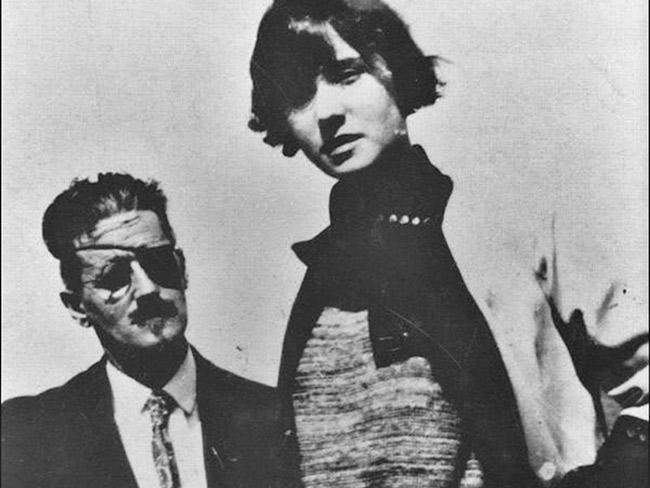
Writer and artist Alistair Gentry once proposed a lecture series he called “One Eyed Monster.” Central to the project is what Gentry calls “the cult of James Joyce,” an exemplar of a larger phenomenon: “the vulture-like picking over of the creative and material legacies of dead artists.” “Untalented and noncreative people,” writes Gentry, “are able to build lasting careers from what one might call the Talented Dead.” Gentry’s judgment may seem harsh, but the questions he asks are incisive and should give pause to scholars (and bloggers) who make their livings combing through the personal effects of dead artists, and to everyone who takes a special interest, prurient or otherwise, in such artifacts. Just what is it we hope to find in artists’ personal letters that we can’t find in their public work? I’m not sure I have an answer to that question, especially in reference to James Joyce’s “dirty letters” to his wife and chief muse, Nora.
The letters are by turns scandalous, titillating, romantic, poetic, and often downright funny, and they were written for Nora’s eyes alone in a correspondence initiated by her in November of 1909, while Joyce was in Dublin and she was in Trieste raising their two children in very straitened circumstances. Nora hoped to keep Joyce away from courtesans by feeding his fantasies in writing, and Joyce needed to woo Nora again—she had threatened to leave him for his lack of financial support. In the letters, they remind each other of their first date on June 16, 1904 (subsequently memorialized as “Bloomsday,” the date on which all of Ulysses is set). We learn quite a lot about Joyce’s predilections, much less about Nora’s, whose side of the correspondence seems to have disappeared. Declared lost for some time, Joyce’s first reply letter to Nora in the “dirty letters” sequence was recently discovered and auctioned off by Sotheby’s in 2004.
I do not excerpt here any of the language from Joyce’s subsequent letters, not for modesty’s sake but because there is far too much of it to choose from. If those prudish censors of Ulysses had read this exchange, they might have dropped dead from grave wounds to their sense of decorum. As far as I can ascertain, the letters exist in publication only in the out-of-print Selected Letters of James Joyce, edited by pre-eminent Joyce biographer Richard Ellmann, and in a somewhat truncated form on this site. Alistair Gentry has done us the favor of transcribing the letters as they appear in Ellmann’s Selected Letters on his site here. Of our interest in them, he asks:
Does anyone have the right to read things that were clearly meant only for two specific people…? Now that they have been exposed to the world’s gaze, albeit in a fairly limited fashion, does anybody except these two (who are dead) have any right to make objections about or exercise control over the manner in which these private documents and records of intimacy are used?
Questions worth considering, if not answered easily. Nevertheless, despite his critical misgivings, Gentry writes: “These letters stand on their own as brilliant and, dare I say, arousing Joycean writing. In my opinion they’re definitely worth reading.” I must say I agree. Joyce’s brother Stanislaus once wrote in a diary entry: “Jim is thought to be very frank about himself but his style is such that it might be contended that he confesses in a foreign language—an easier confession than in the vulgar tongue.” In the “dirty letters,” we get to see the great alchemist of ordinary language and experience practically revel in the most vulgar confessions.
Related Content:
James Joyce Plays the Guitar, 1915
On Bloomsday, Hear James Joyce Read From his Epic Ulysses, 1924
James Joyce, With His Eyesight Failing, Draws a Sketch of Leopold Bloom (1926)
James Joyce’s Ulysses: Download the Free Audio Book
Josh Jones is a writer and musician based in Durham, NC. Follow him at @jdmagness
Read More...Support Us
We're hoping to rely on loyal readers, rather than erratic ads. Please click the Donate button and support Open Culture. You can use Paypal, Venmo, Patreon, even Crypto! We thank you!

About Us

Open Culture scours the web for the best educational media. We find the free courses and audio books you need, the language lessons & educational videos you want, and plenty of enlightenment in between.
Advertise With Us
FREE UPDATES!
GET OUR DAILY EMAIL
Get the best cultural and educational resources on the web curated for you in a daily email. We never spam. Unsubscribe at any time.
FOLLOW ON SOCIAL MEDIA
Open Culture editor Dan Colman scours the web for the best educational media. He finds the free courses and audio books you need, the language lessons & movies you want, and plenty of enlightenment in between.
Advertise With Us

