“The Autobiography of Jane Eyre” Adapts Brontë’s Heroine for Vlogs, Tumblr, Twitter & Instagram
Lest you remain unaware, Jane Eyre has a vlog. And though I would fain speak well of it, the truth must out. I prefer my Jane with bonnet strings knotted firmly beneath her chin. This Jane, as embodied by project co-creator, Alysson Hall, often seems like a fan putting together a homemade audition tape for Girls.
I suspect that’s the demographic most likely to appreciate Charlotte Brontë’s reinvented heroine. Like The Lizzie Bennet Diaries, a self-declared “online modernized adaptation” of Pride and Prejudice, The Autobiography of Jane Eyre takes a transmedia approach, serializing across multiple digital platforms.
In addition to the YouTube channel, Jane tweets to over 1500 followers, and uploads photos to Instagram. Her video diary might not be my cup of tea, but I must confess, I do rather enjoy her tumblr. Perhaps not as much as I’d enjoy rereading the novel (find it in our collection Free eBooks and Free Audio Books collections), but it’s not a bad way to while away a minute or two.
Put another way, anyone who likes reading Brontë is probably amenable to pictures of tea cups, dead trees, and Tim Burton’s animated dolls.
Jane’s embrace of social media is shared by many in her orbit, including Mr. Rochester’s employee, Grace Poole, and his 8‑year-old daughter, Adele, whose (illegal) Twitter feed will appeal to any precocious little smartypants eager for random facts regarding Bernese Mountain Dogs and Uranus’ moons.
The veil is lifted somewhat on the series’ Facebook page, where the creators interact with fans out-of-character and address modern technical difficulties, such as software issues and audio glitches.
Related Content:
20 Books People Pretend to Read (and Now Your Confessions?)
Ayun Halliday was gobsmacked to learn that her second book, No Touch Monkey! has been made available in ebook form. Follow her @AyunHalliday
Read More...The 10 Greatest Films of All Time According to 846 Film Critics
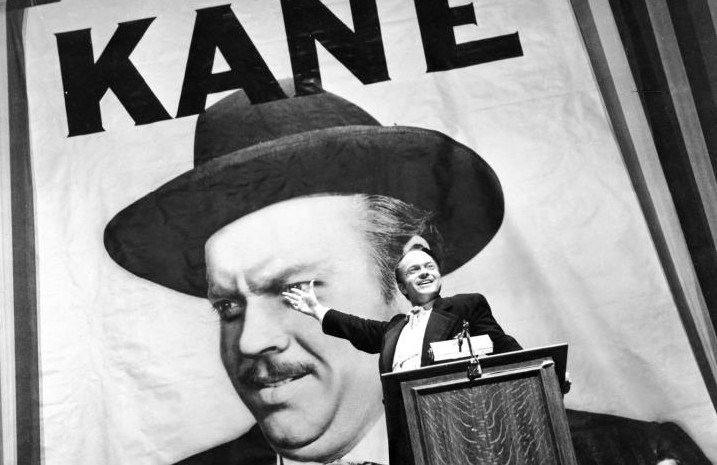
We’ve recently featured the all-time-greatest-film-selections from such celebrated directors as Stanley Kubrick, Martin Scorsese, Woody Allen, and Quentin Tarantino. Some of these lists came from the grand poll put on last year by Sight & Sound, the British Film Institute’s well-respected cinema journal. While scrutinizing the voting records in the directors’ division yields no small pleasure for the cinephile, to focus too closely on that would ignore the big picture. By that, I mean the overall standings in this most painstaking critical effort to determine “the Greatest Films of All Time”:
- Vertigo (Alfred Hitchcock, 1958)
- Citizen Kane (Orson Welles, 1941)
- Tokyo Story (Yasujirô Ozu, 1953)
- La Règle du jeu (Jean Renoir, 1939)
- Sunrise (F.W. Murnau, 1927)
- 2001: A Space Odyssey (Stanley Kubrick, 1968)
- The Searchers (John Ford, 1956)
- Man with a Movie Camera (Dziga Vertov, 1929)
- The Passion of Joan of Arc (Carl Theodor Dreyer, 1928)
- 8½ (Federico Fellini, 1963)
These results came out with a bang — the sound, of course, of Vertigo displacing Citizen Kane. How many who watched the young Orson Welles’ debut during its financially inauspicious original run could have guessed it would one day stand as a byword for the height of cinematic craftsmanship?
But Citizen Kane just flopped, drawing a good deal of critical acclaim even as it did so, whereas, seventeen years later, Hitchcock’s Vertigo not only flopped, but did so into a fog of mixed reviews, tumbling unceremoniously from there into obscurity. Prints became scarce, and the ones Hitchcock aficionados could later track down had seen better days. It would take a kind of obsession — not to mention a thorough restoration — to return Vertigo to the zeitgeist.
We ignored Vertigo at our peril, and if we now ignore Citizen Kane because of its new second-chair status, we do that at our peril as well. The 90-minute documentary, The Complete Citizen Kane, originally aired in 1991 as an episode of the BBC’s Arena. It looks at Welles’ masterpiece from every possible angle, even bringing in New Yorker critic Pauline Kael, whose essay “Raising Kane” took a controversial anti-auteurist position about this most seemingly auteur-driven of all American films.
Follow us on Facebook, Twitter, Google Plus and LinkedIn and share intelligent media with your friends. And if you want to make sure that our posts definitely appear in your Facebook newsfeed, just follow these simple steps.
Related Content:
Martin Scorsese Reveals His 12 Favorite Movies (and Writes a New Essay on Film Preservation)
Stanley Kubrick’s List of Top 10 Films (The First and Only List He Ever Created)
Orson Welles Explains Why Ignorance Was the Genius Behind Citizen Kane
Colin Marshall hosts and produces Notebook on Cities and Culture and writes essays on literature, film, cities, Asia, and aesthetics. He’s at work on a book about Los Angeles, A Los Angeles Primer. Follow him on Twitter at @colinmarshall.
Don’t miss anything from Open Culture in 2014. Sign up for our Daily Email or RSS Feed. And we’ll send cultural curiosities your way, every day.
Read More...Synchronized, Timelapse Video Shows Train Traveling from London to Brighton in 1953, 1983 & 2013
In 1953, the BBC filmed a train journey from London to Brighton, “squeezed into just four minutes.” 30 years later, in 1983, they recorded the same journey again. And then for a third time in 2013. Above, you can watch all three journeys side by side. The videos are perfectly in sync, which makes it particularly easy to see what has changed — and what hasn’t — over the course of 60 years. You will see similarities and differences in the landmarks along the routes. But the biggest contrast? It’s the people who get off of the train at the end. Enjoy the ride.
Follow us on Facebook, Twitter and now Google Plus and share intelligent media with your friends! They’ll thank you for it. If you want a daily email digest of our posts, you can sign up here.
Raymond Chandler Denounces Strangers on a Train in Sharply-Worded Letter to Alfred Hitchcock
Images via Wikimedia Commons
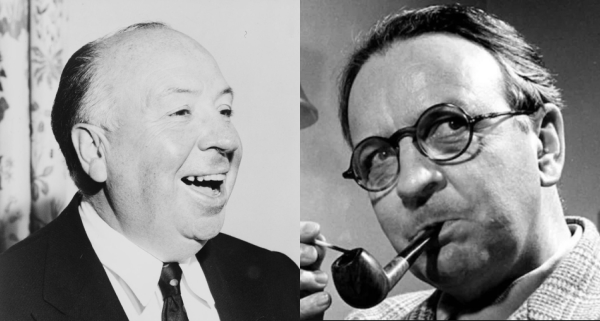
Alfred Hitchcock, like several other of the twentieth century’s best-known auteurs, made some of his most widely seen work by turning books into movies. Or rather, he hired other writers to turn these books into screenplays, which he then turned into movies — which, the way these things go, often bore little ultimate resemblance to their source material. In the case of his 1951 picture Strangers on a Train, based upon The Talented Mr. Ripley author Patricia Highsmith’s first novel of the same name, Hitchcock burned through a few such hired hands. First he engaged Whitfield Cook, whose treatment bolstered the novel’s homoerotic subtext. Then he importuned a series of the brightest living lights of American literature — Thornton Wilder, John Steinbeck, Dashiell Hammett — to have a go at the full screenplay, none of whom could bring themselves sign on to the job. Then along came the only respected “name” writer who could rise — or, given that many at first thought Highsmith’s novel tawdry, sink — to the job: Philip Marlowe’s creator, Raymond Chandler.
The Big Sleep author wrote and submitted a first draft of Strangers on a Train. Then a second. He would hear no feedback from the director except the message informing him of his firing. Hitchcock pursued “Shakespeare of Hollywood” Ben Hecht to come up with the next draft, but Hecht offered his young assistant Czenzi Ormonde instead. Together with Hitchcock’s wife and associate producer, Ormonde completely rewrote the script in less than three weeks. When Chandler later got hold of the film’s final script, he sent Hitchcock his assessment, as featured on Letters of Note:
December 6th, 1950
Dear Hitch,
In spite of your wide and generous disregard of my communications on the subject of the script of Strangers on a Train and your failure to make any comment on it, and in spite of not having heard a word from you since I began the writing of the actual screenplay—for all of which I might say I bear no malice, since this sort of procedure seems to be part of the standard Hollywood depravity—in spite of this and in spite of this extremely cumbersome sentence, I feel that I should, just for the record, pass you a few comments on what is termed the final script. I could understand your finding fault with my script in this or that way, thinking that such and such a scene was too long or such and such a mechanism was too awkward. I could understand you changing your mind about the things you specifically wanted, because some of such changes might have been imposed on you from without. What I cannot understand is your permitting a script which after all had some life and vitality to be reduced to such a flabby mass of clichés, a group of faceless characters, and the kind of dialogue every screen writer is taught not to write—the kind that says everything twice and leaves nothing to be implied by the actor or the camera. Of course you must have had your reasons but, to use a phrase once coined by Max Beerbohm, it would take a “far less brilliant mind than mine” to guess what they were.
Regardless of whether or not my name appears on the screen among the credits, I’m not afraid that anybody will think I wrote this stuff. They’ll know damn well I didn’t. I shouldn’t have minded in the least if you had produced a better script—believe me. I shouldn’t. But if you wanted something written in skim milk, why on earth did you bother to come to me in the first place? What a waste of money! What a waste of time! It’s no answer to say that I was well paid. Nobody can be adequately paid for wasting his time.
(Signed, ‘Raymond Chandler’)
Note that Chandler, ever the writer, points out his own “extremely cumbersome sentence” even as he summons so much vitriol for what he considers a lifeless script. As a longtime resident of Los Angeles by this point, and one who had already worked on the screenplays for The Blue Dahlia and Double Indemnity, he knew well the procedures of “the standard Hollywood depravity.” But nothing, to his mind, could excuse such “clichés,” “faceless characters,” and dialogue that “says everything twice and leaves nothing to be implied.” We could all, no matter what sort of work we do, learn from Chandler’s unwavering attention to his craft, and we’d do especially well to bear in mind his preemptive objection to the argument that, hey, at least he got a big check: “Nobody can be adequately paid for wasting his time.”
Whatever your own opinion on Hitchcock, don’t forget our collection of 20 Free Hitchcock Movies Online, nor, of course, our big collection, 4,000+ Free Movies Online: Great Classics, Indies, Noir, Westerns, Documentaries & More.
Related Content:
Raymond Chandler: There’s No Art of the Screenplay in Hollywood
Watch Raymond Chandler’s Long-Unnoticed Cameo in Double Indemnity
Alfred Hitchcock: The Secret Sauce for Creating Suspense
Colin Marshall hosts and produces Notebook on Cities and Culture and writes essays on literature, film, cities, Asia, and aesthetics. He’s at work on a book about Los Angeles, A Los Angeles Primer. Follow him on Twitter at @colinmarshall.
Read More...The Getty Puts 4600 Art Images Into the Public Domain (and There’s More to Come)
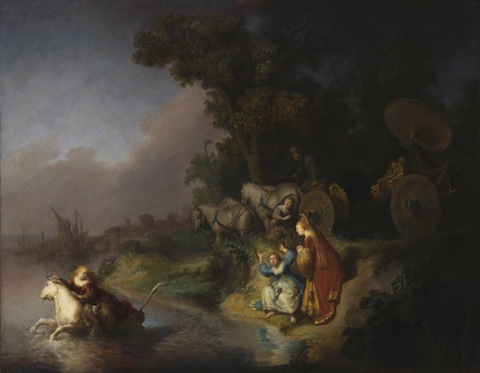
Not long ago, I went over to the Getty to see the J. Paul Getty Trust’s President and CEO James Cuno in live conversation with Pico Iyer, one of his favorite writers as well as one of mine. Cuno, himself the author of books like Whose Culture?: The Promise of Museums and the Debate over Antiquities and Museums Matter: In Praise of the Encyclopedic Museum, impressed me not only with his choice of interlocutors but with the open, forward-thinking nature he revealed during the talk. On Monday, he demonstrated it again by publishing another piece of writing, very brief but undeniably important: his announcement of the Getty’s Open Content Program, which has just made available over 4600 high-resolution images of the museum’s collection freely available in the public domain. You can download them, modify them, distribute them — do what you please with them.
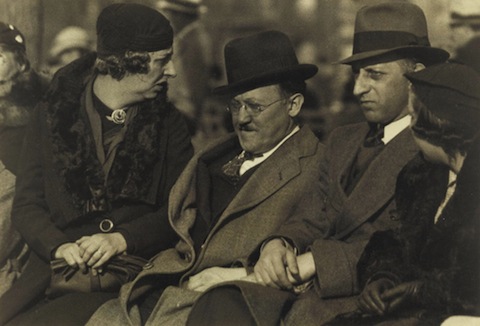
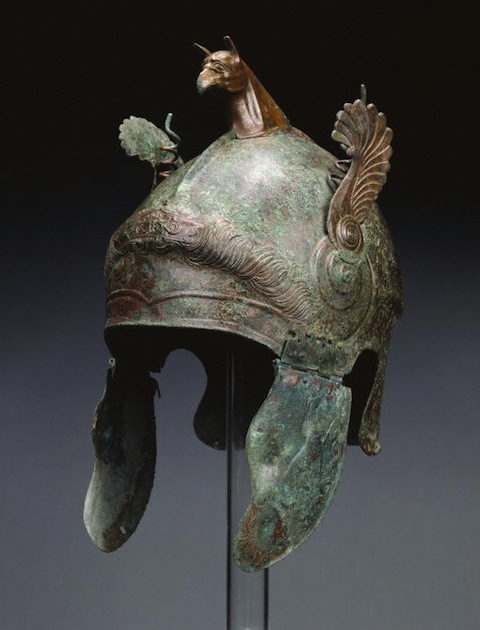
“Why open content? Why now?” Cuno writes. “The Getty was founded on the conviction that understanding art makes the world a better place, and sharing our digital resources is the natural extension of that belief. This move is also an educational imperative. Artists, students, teachers, writers, and countless others rely on artwork images to learn, tell stories, exchange ideas, and feed their own creativity.” If you enjoy engaging in any of these pursuits — which, as an Open Culture habitué, I assume you do — begin by browsing all the Open Content Program’s currently available images, or check for download links on individual Getty collection pages. This post includes three images straight from the Getty: Rembrandt’s The Abduction of Europa, Walker Evans’ A Bench in the Bronx on Sunday, and a helmet of Chalcidian type circa 350–300 B.C. Cuno promises many more images to come, and material from other sources like the Getty’s international field projects. He’s got my anticipation.
Related Content:
40,000 Artworks from 250 Museums, Now Viewable for Free at the Redesigned Google Art Project
LA County Museum Makes 20,000 Artistic Images Available for Free Download
The Rijksmuseum Puts 125,000 Dutch Masterpieces Online, and Lets You Remix Its Art
Art.sy Rolls Out Huge Archive of Fine-Art Images and an Intelligent Art Appreciation Guide
Free: The Metropolitan Museum of Art and the Guggenheim Offer 474 Free Art Books Online
Colin Marshall hosts and produces Notebook on Cities and Culture and writes essays on literature, film, cities, Asia, and aesthetics. He’s at work on a book about Los Angeles, A Los Angeles Primer. Follow him on Twitter at @colinmarshall.
Read More...Jimi Hendrix Live at Woodstock: Historic Concert Captured on Film
By the time Jimi Hendrix arrived onstage at the Woodstock Festival on the morning of August 18, 1969, the crowd of nearly 500,000 people had dwindled to fewer than 40,000. Much of Max Yasgur’s farm looked desolate. Litter was strewn everywhere and — hard as it may be to imagine — scores of people were streaming out as Hendrix played.
The festival was billed as “3 Days of Peace & Music,” but rain and other problems delayed Hendrix’s festival-closing performance until 8:30 on the morning of the fourth day, a Monday. The people who remained were exhausted and wet and just waking up. As festival organizer Michael Lang writes in The Road to Woodstock:
The massive stage was sparsely populated compared to how packed it had been all weekend with musicians, crew, and friends. Jimi, a red scarf around his head and wearing a white fringed and beaded leather shirt, looked almost like a mystical holy man in meditation. His eyes closed, his head back, he’d merged with his music, his Strat — played upside down since he’s a lefty — his magic wand. Though he was surrounded by his band, he projected the feeling he was all alone.
As he almost reverently started the national anthem, the bedraggled audience, worn out and muddy, moved closer together. Those of us who’d barely slept in three days were awakened, exhilarated by Jimi’s song. One minute he was chording the well-worn melody, the next he was reenacting “bombs bursting in air” with feedback and distortion. It was brilliant. A message of joy and love of country, while at the same time an understanding of all the conflict and turmoil that’s torn America apart.
The Jimi Hendrix Experience had broken up a few weeks earlier, with the departure of bassist Noel Redding. At the festival, Hendrix and drummer Mitch Mitchell were joined by two musicians Hendrix had worked with before he was famous — bassist Billy Cox and guitarist Larry Lee — along with conga players Juma Sultan and Jerry Velez. The group had rehearsed for less than two weeks in Hendrix’s rented house near Woodstock. They called themselves “Gypsy Sun & Rainbows,” or “Band of Gypsys” for short.
Hendrix’s psychedelic performance of “The Star-Spangled Banner” was immortalized in Michael Wadleigh’s Academy Award-winning 1970 film, Woodstock. A two-disc DVD capturing most of Hendrix’s nearly two-hour set, called Jimi Hendrix Live at Woodstock, was released in 1999. The 57-minute film above is an abridged version. It begins with an excerpt from “Message to Love” (the song Hendrix opened with) played over general scenes of the festival. It goes on to show Hendrix onstage, playing the following songs:
- “Fire”
- “Izabella”
- “Red House”
- “Jam Back at the House”
- “Voodoo Child (Slight Return)”
- “Star-Spangled Banner”
- “Purple Haze”
- “Woodstock Improvisation”
- “Villanova Junction”
The songs in the film are not presented in the order Hendrix played them in, and some have been omitted. Second guitarist Larry Lee (who can be heard soloing in “Jam Back at the House”) sang lead vocals on “Mastermind” and “Gypsy Woman/Aware of Love,” but those songs have been cut from this version. Also left out are “Spanish Castle Magic,” “Hear My Train a Comin’,” “Lover Man,” “Foxy Lady,” “Stepping Stone,” and an encore of “Hey Joe.” Despite the omissions, this abridged version of Jimi Hendrix Live at Woodstock is a fascinating and enjoyable look at one of the great moments in rock and roll history.
Related Content:
In 1969 Telegram, Jimi Hendrix Invites Paul McCartney to Join a Super Group with Miles Davis
See Jimi Hendrix’s First TV Appearance, and His Last as a Backing Musician (1965)
Watch Jimi Hendrix’s ‘Voodoo Chile’ Performed on a Gayageum, a Traditional Korean Instrument
Read More...What Prisoners Ate at Alcatraz in 1946: A Vintage Prison Menu
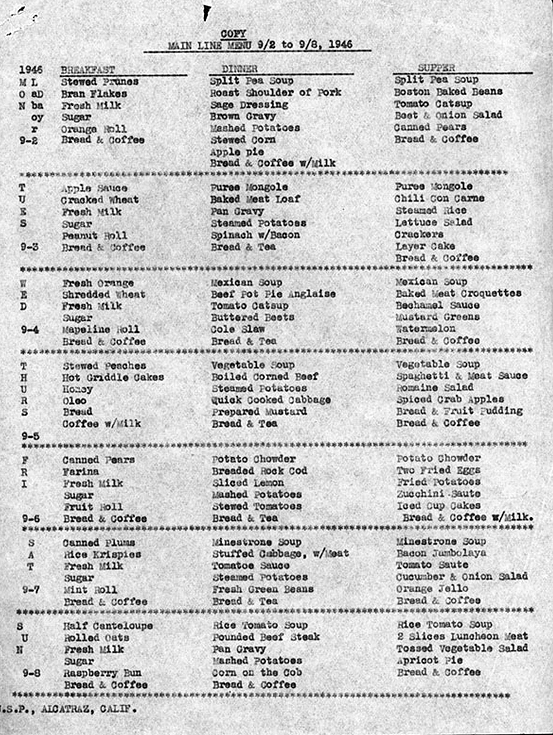 Why would you want to escape from Alcatraz when you could eat Beef Pot Pie Anglaise for lunch on Tuesday, Baked Meat Croquettes on Wednesday, and Bacon Jambalaya on Saturday? On second thought, why wouldn’t you want to escape.
Above, we have the actual menu for the meals served at Alcatraz during one week in September, 1946. (View it in a slightly larger format here.) Alcatraz was, of course, a high security federal prison that operated off of the coast of San Francisco from 1933 until 1963. Some of America’s more notorious criminals spent time dining there — good fellows like Al Capone, George “Machine Gun” Kelly, Bumpy Johnson, and James “Whitey” Bulger.
As you may know, Bulger is now back on trial in Boston. After being released from prison during the 1960s, he allegedly re-immersed himself in the world of organized crime, before eventually spending 16 years living as a fugitive, largely in California. While on the lam, he amazingly had the chutzpah to visit Alcatraz (now a tourist site) and pose for a picture where he donned a striped suit and stood behind mock prison bars. I have to wonder whether he had some Puree Mongole for old times’ sake?
via SF Gate and Laughing Squid
Related Content:
The Odd Collection of Books in the Guantanamo Prison Library
See a Peruvian Prison Seized with Dance Fever as They Try to Break a Guinness World Record
Philosophy in Prison: Weighty Conversations about Right and Wrong
Read More...10 Tips From Billy Wilder on How to Write a Good Screenplay
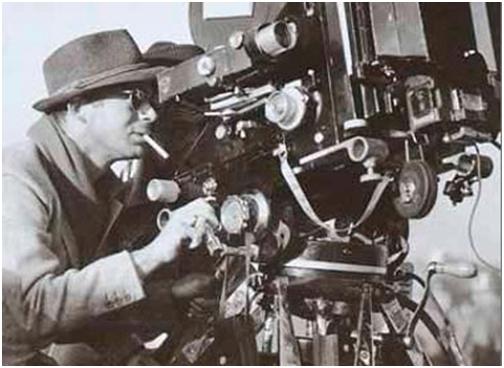
There’s an old story — Orson Welles called it “the greatest Hollywood one-liner ever made” — that when someone attending the 1958 funeral of Harry Cohn, the fearsome president of Columbia Pictures, asked how it was possible that such a huge crowd would show up for Cohn’s funeral, Billy Wilder quipped: “Well, give the people what they want.”
The story is almost certainly apocryphal. The line may have been spoken by someone else, at a different Hollywood mogul’s funeral. But the fact that it is so often attributed to Wilder says something about his reputation as a man with a razor-sharp wit and a firm grasp of the imperatives of popular movie-making. In films like Sunset Boulevard, Some Like it Hot, Double Indemnity and Sabrina, Wilder used his formidable craft as a director to tell stories in a clear and efficient way. It was an ethic he picked up as a screenwriter.
Wilder was born in Austria-Hungary and moved as a young man to Germany, where he worked as a newspaper reporter. In the late 1920s he began writing screenplays for the German film industry, but he fled the country soon after Adolf Hitler became chancellor in 1933. Wilder made his way to Hollywood, where he continued to write screenplays. He co-wrote a number of successful films in the 30s, including Ninotchka, Hold Back the Dawn and Ball of Fire. In the early 40s he got his first chance to direct a Hollywood movie, and a long string of hits followed. In 1960 he won three Academy Awards for producing, writing and directing The Apartment.
Wilder was 90 years old when the young director Cameron Crowe approached him in 1996 about playing a small role in Jerry Maguire. Wilder said no, but the two men formed a friendship. Over the next several years they talked extensively about filmmaking, and in 1999 Crowe published Conversations with Wilder. One of the book’s highlights is a list of ten screenwriting tips by Wilder. “I know a lot of people that have already Xeroxed that list and put it by their typewriter,” Crowe said in a 1999 NPR interview. “And, you know, there’s no better film school really than listening to what Billy Wilder says.”
Here are Wilder’s ten rules of good filmmaking:
1: The audience is fickle.
2: Grab ’em by the throat and never let ’em go.
3: Develop a clean line of action for your leading character.
4: Know where you’re going.
5: The more subtle and elegant you are in hiding your plot points, the better you are as a writer.
6: If you have a problem with the third act, the real problem is in the first act.
7: A tip from Lubitsch: Let the audience add up two plus two. They’ll love you forever.
8: In doing voice-overs, be careful not to describe what the audience already sees. Add to what they’re seeing.
9: The event that occurs at the second act curtain triggers the end of the movie.
10: The third act must build, build, build in tempo and action until the last event, and then — that’s it. Don’t hang around.
Note: Readers might also be interested in Wilder’s 1996 Paris Review interview. It’s called The Art of of Screenwriting.
Don’t miss anything from Open Culture. Sign up for our Daily Email or RSS Feed. And we’ll send quality culture your way, every day.
via Gotham Writers’ Workshop
Related Content:
Tarkovsky’s Advice to Young Filmmakers: Sacrifice Yourself for Cinema
Watch Raymond Chandler’s Long-Unnoticed Cameo in Double Indemnity
Filmmaking Advice from Quentin Tarantino and Sam Raimi (NSFW)
Read More...Andy Warhol Shoots “Screen Tests” of Nico, Bob Dylan & Salvador Dalí
Just the other day, I had a chat with a well-known poet who laid out for me his theory that Andy Warhol invented our conception of modern America. When we think about this country, the poet explained, we think about this country broadly in the way that Warhol (and thus his disciples) envisioned it. We here at Open Culture have covered several of the forms in which the artist promulgated his distinctive brand of Americana, and today, for the 85th anniversary of his birth, we’ve rounded up a few of his famous “screen tests,” the short films he made between 1963 and 1968 that offer portraits of hundreds of figures, famous and otherwise, who happened to pass through his studio/social club/subcultural hot zone, The Factory. Just above, you can watch Warhol’s screen test with Nico, the German singer who would become an integral part of the Factory-formed band the Velvet Underground.
Little-heard at the time but ultimately highly influential, the Velvet Underground’s sound shaped much American popular music — and given popular music’s centrality back then, much of American culture to come. You may not necessarily buy that argument, but surely you can’t argue against the influence of a certain singer-songwriter by the name of Bob Dylan, Warhol’s screen test with whom appears just above.
Coming from a Polish immigrant family, and seemingly dedicated to the cultivation of his own outsider status his entire life, Warhol understood the importance of foreigners to the vitality of American culture. Naturally, he didn’t miss his chance to shoot a screen test with Salvador Dalí, below, when the Spanish surrealist came to the Factory.
See also our previous post on Warhol’s screen tests with Lou Reed, Dennis Hopper, Edie Sedgwick, and others. When you’ve watched them all, consider continuing your celebration of life in Andy Warhol’s 85th birthday with the EarthCam and The Warhol Museum’s collaboration Figment. It offers live camera feeds of not only his grave but the church where he was baptized. Comparisons to the viewing experience of Empire are encouraged.
If you would like to support the mission of Open Culture, consider making a donation to our site. It’s hard to rely 100% on ads, and your contributions will help us continue providing the best free cultural and educational materials to learners everywhere. You can contribute through PayPal, Patreon, and Venmo (@openculture). Thanks!
Related Content:
Three “Anti-Films” by Andy Warhol: Sleep, Eat & Kiss
Andy Warhol’s One Minute of Professional Wrestling Fame (1985)
Roy Lichtenstein and Andy Warhol Demystify Their Pop Art in Vintage 1966 Film
The film Andy Warhol: A Mirror of the Sixties has been added to our list of 550 Free Movies Online.
Colin Marshall hosts and produces Notebook on Cities and Culture and writes essays on literature, film, cities, Asia, and aesthetics. He’s at work on a book about Los Angeles, A Los Angeles Primer. Follow him on Twitter at @colinmarshall.
Read More...Photos of Toni Morrison, Haruki Murakami, J.D. Salinger, and Virginia Woolf As Youngsters
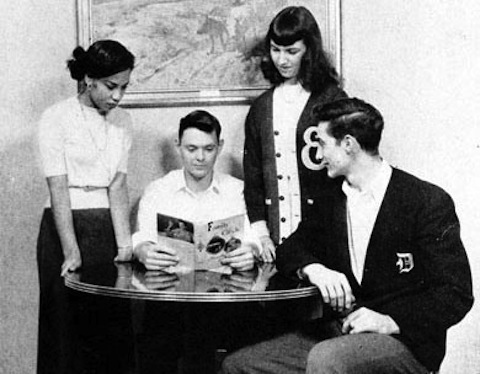
Ah, the Buzzfeed listicle. Gawker’s Tom Scocca recently described the dreaded online publishing phenom as “aggressively designed to ‘go viral’ within a specific microtargeted population and to be worthless to every other reader on the planet.” Maybe something of an exaggeration. Then again, it seems that “17 Things Bears Are Better at Than You” may reach a minor contingent of readers, and “7 Fantastic Needlepoint Fashion Magazine Covers” may indeed have limited appeal. Of course, the listicle precedes the internet, and drives content beyond Buzzfeed. A staple of Cosmo, it’s always been a narrow form, except when it comes to such irresistible clickbait as “before they were famous” lists, such as this selection of awkward photos of TV personalities.
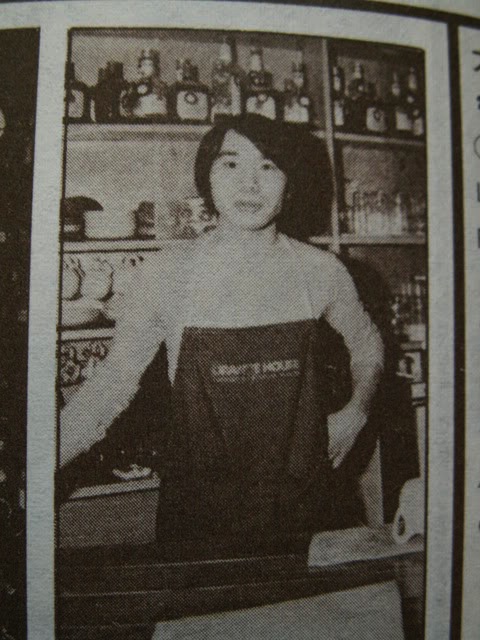
But sometimes even Buzzfeed takes the high road. A recent spread, for instance, showcased 24 photos of famous authors as young, anonymous men and women. Take, for example, the pic at the top of a teenage Toni Morrison (then Chloe Wofford) from 1949. Taken at Ohio’s Lorraine High School, we see senior class treasurer Morrison posed with serious intent, gazing at some sort of magazine with three of her classmates. Buzzfeed pilfered this photo from another literary listicle, Flavorwire’s “20 Famous Authors’ Adorable School Photos.” Not a Morrison fan? No worries. You may be enlightened or amused by the photo above, of a young Haruki Murakami, working in his Tokyo jazz bar, the Peter Cat, before writing his first novel, Hear the Wind Sing, in 1979.
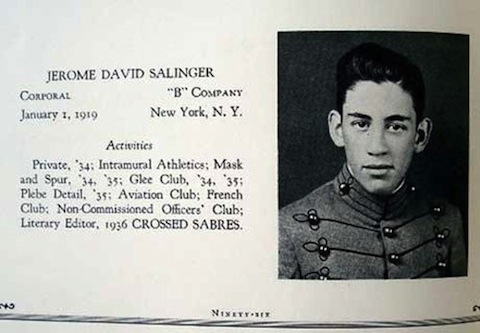
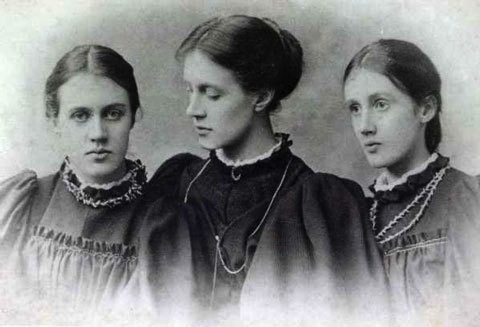
Then we have the famous recluse J.D. Salinger above, from his 1936 yearbook photo from Valley Forge Military Academy. We learn that the future Franny and Zooey author was a corporal who put in time in the glee club, the aviation and French clubs, and served as the literary editor for the yearbook (called Crossed Sabres.) A copy of the yearbook, signed by Salinger, went up for auction last year for $2,400. Also from the Buzzfeed list, below, (and also lifted from Flavorwire), we have the tender portrait of a 14-year-old Virginia Woolf (nee Stephen—on the right), circa 1896, posed with her sisters Stella and Vanessa (left and center).
There are several more photos floating around out there of famous authors as awkward or very intense young men and women. They may not give us the same thrill as seeing the latest hot young thing as an acne-plagued goofball with braces, but they provide us with visual windows on the stages of our favorite writers’ development as real people in real life.
Related Content:
Author Flannery O’Connor Captured on Film at Age 5, with Her Chickens
Writers’ Houses Gives You a Virtual Tour of Famous Authors’ Homes
Photos of Famous Writers (and Rockers) with their Dogs
Josh Jones is a writer and musician based in Washington, DC. Follow him at @jdmagness
Read More...Support Us
We're hoping to rely on loyal readers, rather than erratic ads. Please click the Donate button and support Open Culture. You can use Paypal, Venmo, Patreon, even Crypto! We thank you!

About Us

Open Culture scours the web for the best educational media. We find the free courses and audio books you need, the language lessons & educational videos you want, and plenty of enlightenment in between.
Advertise With Us
FREE UPDATES!
GET OUR DAILY EMAIL
Get the best cultural and educational resources on the web curated for you in a daily email. We never spam. Unsubscribe at any time.
FOLLOW ON SOCIAL MEDIA
Open Culture editor Dan Colman scours the web for the best educational media. He finds the free courses and audio books you need, the language lessons & movies you want, and plenty of enlightenment in between.
Advertise With Us



