How Film Was Made in 1958: A Kodak Nostalgia Moment
Before pixels there were silver halide crystals, and before memory cards, film. Little yellow boxes cluttered the lives of photographers everywhere, and the Eastman Kodak Company was virtually synonymous with photography.
Things have really changed. With the recent news that Kodak is teetering on the brink of Chapter 11 bankruptcy, many are feeling nostalgia for those little yellow boxes and the rolls of silver gelatin film inside. To indulge this nostalgia–and perhaps learn something new about an old technology–we offer a fascinating 1958 documentary from Kodak entitled How Film is Made.
The documentary is in Dutch, but members of the Analog Photography Users Group launched a project to create English subtitles. You can read more about the project on Dutch member Marco Boeringa’s website. And you can watch the 18-minute film starting above and concluding below.
Follow Open Culture on Facebook and Twitter and share intelligent media with your friends. Or better yet, sign up for our daily email and get a daily dose of Open Culture in your inbox. And if you want to make sure that our posts definitely appear in your Facebook newsfeed, just follow these simple steps.
Read More...Fellini’s Fantastic TV Commercials
Last month we brought you some little-known soap commercials by Ingmar Bergman. Today we present a series of lyrical television advertisements made by the great Italian filmmaker Federico Fellini during the final decade of his life.
In 1984, when he was 64 years old, Fellini agreed to make a miniature film featuring Campari, the famous Italian apéritif. The result, Oh, che bel paesaggio! (“Oh, what a beautiful landscape!”), shown above, features a man and a woman seated across from one another on a long-distance train.
The man (played by Victor Poletti) smiles, but the woman (Silvia Dionisio) averts her eyes, staring sullenly out the window and picking up a remote control to switch the scenery. She grows increasingly exasperated as a sequence of desert and medieval landscapes pass by. Still smiling, the man takes the remote control, clicks it, and the beautiful Campo di Miracoli (“Field of Miracles”) of Pisa appears in the window, embellished by a towering bottle of Campari.
“In just one minute,” writes Tullio Kezich in Federico Fellini: His Life and Work, “Fellini gives us a chapter of the story of the battle between men and women, and makes reference to the neurosis of TV, insinuates that we’re disparaging the miraculous gifts of nature and history, and offers the hope that there might be a screen that will bring the joy back. The little tale is as quick as a train and has a remarkably light touch.”
Also in 1984, Fellini made a commercial titled Alta Societa (“High Society”) for Barilla rigatoni pasta (above). As with the Campari commercial, Fellini wrote the script himself and collaborated with cinematographer Ennio Guarnieri and musical director Nicola Piovani. The couple in the restaurant were played by Greta Vaian and Maurizio Mauri. The Barilla spot is perhaps the least inspired of Fellini’s commercials. Better things were yet to come.
In 1991 Fellini made a series of three commercials for the Bank of Rome called Che Brutte Notti or “The Bad Nights.” “These commercials, aired the following year,” writes Peter Bondanella in The Films of Federico Fellini, “are particularly interesting, since they find their inspiration in various dreams Fellini had sketched out in his dream notebooks during his career.”
In the episode above, titled “The Picnic Lunch Dream,” the classic damsel-in-distress scenario is turned upside down when a man (played by Paolo Villaggio) finds himself trapped on the railroad tracks with a train bearing down on him while the beautiful woman he was dining with (Anna Falchi) climbs out of reach and taunts him. But it’s all a dream, which the man tells to his psychoanalyst (Fernando Rey). The analyst interprets the dream and assures the man that his nights will be restful if he puts his money in the Banco di Roma.
The other commercials, which are currently not available online, are called “The Tunnel Dream” and “The Dream of the Lion in the Cellar.” (You can watch Roberto Di Vito’s short, untranslated film of Fellini and his crew working on the project here.)
The bank commercials were the last films Fellini ever made. He died a year after they aired, at age 73. In Kezich’s view, the deeply personal and imaginative ads amount to Fellini’s last testament, a brief but wondrous return to form. “In Federico’s life,” he writes, “these three commercial spots are a kind of Indian summer, the golden autumn of a patriarch of cinema who, for a moment, holds again the reins of creation.”
Follow Open Culture on Facebook and Twitter and share intelligent media with your friends. Or better yet, sign up for our daily email and get a daily dose of Open Culture in your inbox. And if you want to make sure that our posts definitely appear in your Facebook newsfeed, just follow these simple steps.
Read More...The Best of Open Culture 2011

Before we rush headlong into a new year, it’s worth pausing, ever so briefly, to consider the ground we covered in 2011. What topics resonated with you … and jazzed us? Today, we’re highlighting 10 thematic areas (and 46 posts) that captured the imagination. Chances are you missed a few gems here. So please join us on our brief journey back into time. Tomorrow, we start looking forward again.
1) Universities Offer More Free Courses, Then Start Pushing Toward Certificates: The year started well enough. Yale released another 10 stellar open courses. (Find them on our list of 400 Free Courses). Then other universities started pushing the envelope on the open course format. This fall, Stanford launched a series of free courses that combined video lectures with more dynamic resources — short quizzes; the ability to pose questions to Stanford instructors; feedback on your overall performance; a statement of accomplishment from the instructor, etc. A new round of free courses will start in January and February. (Get the full list and enroll here.) Finally, keep your eyes peeled for this: In 2012, MIT will offer similar courses, but with one big difference. Students will get an official certificate at the end of the course, all at a very minimal charge. More details here.
2) Cultural Icons at Occupy Wall Street: OWS was a big national story, and we were always intrigued by its cultural dimension — by the cultural figures who championed the movement. You can revisit performances/speeches by: Philip Glass & Lou Reed; Willie Nelson, Pete Seeger, and Arlo Guthrie; David Crosby and Graham Nash; Joseph Stiglitz and Lawrence Lessig; Noam Chomsky; and Slavoj Zizek. Also check out: 8 Lectures from Occupy Harvard and Artistic Posters From Occupy Wall Street.
3) Books Intelligent People Should Read: Neil deGrasse Tyson’s list “8 (Free) Books Every Intelligent Person Should Read” ended up generating far more conversation and controversy than we would have expected. (Users have left 83 comments at last count.) No matter what you think of his rationale for choosing these texts, the books make for essential reading, and they’re freely available online.
Tyson’s list dovetails fairly nicely with another list of essential texts — The Harvard Classics, a 51 volume set that’s available online. According to Charles W. Eliot, the legendary Harvard president, if you were to spend just 15 minutes a day reading these books, you could give yourself a proper liberal education. And that could partly apply to another list we pulled together: 20 Popular High School Books Available as Free eBooks & Audio Books — the great literary classics taught in classrooms all across America, all free…
4) Christopher Hitchens and Stephen Fry: Christopher Hitchens left us this past month. And, until his last day, Hitchens was the same old Hitch — prolific, incisive, surly and defiant, especially when asked about whether he’d change his position on religion, spirituality and the afterlife. All of this was on display when he spoke at the American Jewish University in Los Angeles last February. We covered his comments in a post called, No Deathbed Conversion for Me, Thanks, But it was Good of You to Ask. And even from the grave, Hitchens did more of the same, forcing us to question the whole modern meaning of Christmas.
During Hitch’s final days, Stephen Fry emceed a large tribute to his friend in London, an event that brought together Richard Dawkins, Christopher Buckley, Salman Rushdie, Lewis Lapham, Martin Amis, poet James Fenton and actor Sean Penn. It’s well worth a watch. But you also shouldn’t miss some other great videos featuring the wisdom of Mr. Fry — his introduction to the strange world of nanoscience, his animated debate on the virtues (or lack thereof) of the Catholic Church, and his thoughtful reflection, What I Wish I Had Known When I Was 18.
5) Four for the Fab Four: John, Paul, Ringo and George. We sneak them in whenever we can. A sprinkling here and there. This year, we served up an ever-popular post, Guitarist Randy Bachman Demystifies the Opening Chord of ‘A Hard Day’s Night’, and a no less popular freebie: Download The Beatles’ Yellow Submarine as a Free, Interactive eBook. Trailing right behind are two other good Beatles picks: All Together Now: Every Beatles Song Played at Once and The Beatles’ Rooftop Concert: The Last Gig.
6) Wisdom from Great Philosophers: Want the chance to take courses from great philosophers? Here’s your opportunity. Our meta post brought together courses/lectures from Bertrand Russell, Michel Foucault, John Searle, Walter Kaufmann, Leo Strauss, Hubert Dreyfus, and Michael Sandel. You could get lost in this for days. Also while you’re at it, you should check out The History of Philosophy … Without Any Gaps, an ongoing podcast created by Peter Adamson (King’s College London) that moves from the Ancients to the Moderns. Plus we’d encourage you to revisit: Noam Chomsky & Michel Foucault Debate Human Nature & Power in 1971.
7) Vintage Film Collections: Scouring the web for vintage films. It’s something we love to do. In 2011, we brought you 22 films by Alfred Hitchcock, 25 Westerns with John Wayne, 32 Film Noir classics, and a series of films by the great Russian director Andrei Tarkovsky. All are listed in our big collection of Free Movies Online.
8) Back to the Future: We had fun going back — way back — and seeing how past generations imagined the future. Arthur C. Clarke Predicted the Future in 1964 … And Pretty Much Nailed It. Before that, American fashion designers looked roughly 70 years into the future and guessed how women might dress in Year 2000. Turns out fashion designers aren’t the best futurists. And, even before that (circa 1922), we get to see the world’s first mobile phone in action. Seriously!
9) Animated Films: 2011 started off on exactly the right note. On January 1, we featured Shel Silverstein’s animated version of The Giving Tree. Then some other gems followed: Destino, the Salvador Dalí – Disney collaboration that started in 1946 and finished in 1999; Spike Jonze’s Auprès de Toi (To Die By Your Side), a short stop motion film set inside the famous Parisian bookstore, Shakespeare and Company; John Turturro narrating an animated version of Italo Calvino’s fairy tale, “The False Grandmother;” and a series of animated films featuring the voice of Orson Welles. Also let’s not forget these splendid animation concepts for The Amazing Adventures of Kavalier and Clay and, just for good measure, Terry Gilliam’s vintage primer on making your own cut-out animation.
10) New Archives & Art on the Web: Last but not least — 2011’s new archival projects that brought great culture to the web.
- Google “Art Project” Brings Great Paintings & Museums to You
- Royal Society Opens Online Archive; Puts 60,000 Papers Online
- Google Puts The Dead Sea Scrolls Online (in Super High Resolution)
- The Smithsonian Launches Wildlife Photo Archive
- Sir Isaac Newton’s Papers & Annotated Principia Go Digital
And now onward into 2012.…
Read More...John Cage Performs Water Walk on “I’ve Got a Secret” (1960)
In 1952, John Cage composed his most controversial piece, 4′33,″ a four-and-a-half minute reflection on the sound of silence. Now fast forward eight years. It’s February, 1960, and we find the composer teaching his famous Experimental Composition courses at The New School in NYC, and paying a visit to the CBS game show “I’ve Got a Secret.” The TV show offered Cage something of a teachable moment, a chance to introduce the broader public to his brand of avant-garde music. Cage’s piece is called Water Walk (1959), and it’s all performed with unconventional instruments, save a grand piano. A water pitcher, iron pipe, goose call, bathtub, rubber duckie, and five unplugged radios — they all make the music. And the audience doesn’t quite know how to react, except with nervous laughter. It wasn’t particularly courteous. But, as one scholar has noted, it’s equally remarkable that prime time TV gave ten minutes of uninterrupted airtime to avant-garde music. You take the good with the bad.
via Biblioklept/WFMU
Read More...Free Audio: Download the Complete Chronicles of Narnia by C.S. Lewis
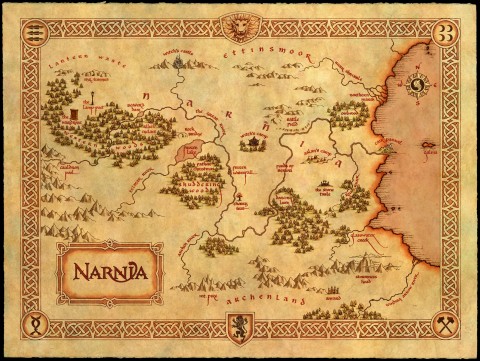 Before the days of Harry Potter, generations of young readers let their imaginations take flight with The Chronicles of Narnia, a series of seven fantasy novels written by C. S. Lewis. Like his friend J.R.R. Tolkien, Lewis served on the English faculty at Oxford University and took part in the Inklings, an Oxford literary group dedicated to fiction and fantasy.
Published between 1950 and 1956, The Chronicles of Narnia has sold over 100 million copies in 47 languages, delighting younger and older readers worldwide. The seven volumes in the series include:
- The Lion, the Witch and the Wardrobe
- Prince Caspian: The Return to Narnia
- The Voyage of the Dawn Treader
- The Silver Chair
- The Horse and His Boy
- The Magician’s Nephew
- The Last Battle
Now, with the apparent blessing of the C.S. Lewis estate, the seven volume series is available in a free audio format. There are 101 audio recordings in total, each averaging 30 minutes and read by Chrissi Hart. Download the complete audio via the web or RSS Feed. Or start listening to the opening chapters of The Lion, The Witch, and The Wardrobe right below.
We have added The Chronicles of Narnia recordings to our collection of Free Audio Books, where you will find many other great classics. h/t metafilter
Related Content:
Free: Download Copy of New Steve Jobs Biography
Free Audio: Download George Orwell’s 1984 and Animal Farm for Free
Download 20 Popular High School Books Available as Free eBooks & Audio Books
Read More...Sir Isaac Newton’s Papers & Annotated Principia Go Digital
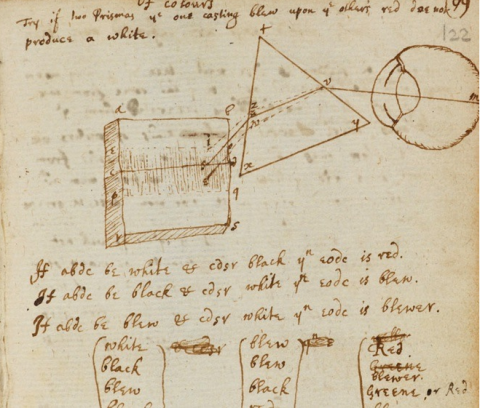 Cambridge University has had many famous graduates, but perhaps none is more famous than Isaac Newton (class of 1665). This week, Cambridge continues to honor Newton by opening a digital archive of Newton’s personal papers, which includes an annotated copy of the Principia, the landmark work where the physicist developed his laws of motion and gravity. The initial archive features 4,000 pages of scanned materials (roughly 20% of the complete Newton archive), and eventually Cambridge will add material from Charles Darwin, another famous alum, and other scientific figures.
In October, The Royal Society opened its historical archives to the public, bringing 60,000 peer-reviewed papers to the web, including Isaac Newton’s first published research paper. You can dive into this parallel digital archive here.
Bonus: If you’re looking to bone up on Physics, you can find many free physics courses in our big collection of Free Online Courses. Leonard Susskind’s class on Classical Mechanics may be of particular interest here.
via The Guardian / ht @eugenephoto
Read More...Jean-Paul Sartre Breaks Down the Bad Faith of Intellectuals
How many of the great philosophers have you actually heard speak? This clip comes from the 1976 documentary Sartre by Himself, which features discussions with Jean-Paul Sartre and his near-equally famous partner Simone de Beauvoir, among others. The film was released with English subtitles in 1979, a year before Sartre died.
In this clip, Sartre criticizes modern intellectuals as “specialist workers in practical knowledge,” who apply “universal notions and practices” to particular purposes determined by a political establishment. This can cause a conflict of conscience: Sartre gives the example of scientists working on the atomic bomb, but also professors whose efforts solely benefit a small group of prosperous students. Sartre thinks intellectuals use this kind of conflict to feel better about themselves–they may sign petitions, side with the working class, etc.–while still not seriously questioning themselves. Intellectuals rage against the machine but are still playing their assigned role in it. “[They are] very pleased to have an unhappy conscience, because that is what allows [them] to denounce.”
This is an example of his famous notion of “bad faith,” where we disassociate ourselves from our actions, or more commonly where we claim to have more limited choices than we actually do. Bad faith is possible because of the nature of the self, according to Sartre: there is no predetermined “human nature” or “true you,” but instead you are something built over time, by your own freely chosen actions, too often using the roles and characteristics others assign to you.
Early in his career, he constructed a theory of consciousness and the self that makes this plausible. The work in which he did this, “The Transcendence of the Ego,” is the subject of the most recent episode of The Partially Examined Life philosophy podcast, profiled in this earlier Open Culture post. The podcast has since taken off: it’s currently featured on the main podcast page in the iTunes store and has broken the top 40 in “top audio podcasts,” reaching #1 in the philosophy category.
Visit the Partially Examined Life web page, get the episodes on iTunes, and subscribe to the PEL blog feed.
Mark Linsenmayer hosts The Partially Examined Life and fronts a band called New People.
Read More...Conformity Isn’t a Recipe for Excellence: Wisdom from George Carlin & Steve Jobs (NSFW)
During the 1960s, George Carlin had something of an epiphany. Confronted by the counterculture, the young comedian realized that he wasn’t staying true to himself — that he was trying to be Danny Kaye, a very mainstream star, when he was really an outlaw and a rebel at heart. (Watch him on The Tonight Show in 1966). Eventually, Carlin learned “not to give a shit,” to break with milquetoast conventions that restrained other comedians, and that’s when his comic genius bloomed. Note that some of Carlin’s comments here are … not surprisingly … not safe for work.
Steve Jobs, another child of the counterculture, didn’t learn Carlin’s lesson over time. As Walter Isaacson makes clear in his new biography, Jobs understood from the beginning that excellence is rarely achieved by walking down the path of conformity. In a 1995 interview, Jobs boiled down his basic approach to life. The mastermind behind the legendary Think Different television campaign (watch the version narrated by Jobs himself) said:
When you grow up, you tend to get told the world is the way it is, and your life is just to live your life inside the world. Try not to bash into the walls too much. Try to have a nice family, have fun, save a little money.
That’s a very limited life. Life can be much broader once you discover one simple fact: Everything around you that you call life was made up by people that were no smarter than you and you can change it, you can influence it, you can build your own things that other people can use. Once you learn that, you’ll never be the same again.
You can find more pearls of wisdom from Jobs over at BrainPickings, and we’ll leave you below with more cultural figures meditating on life:
Stephen Fry: What I Wish I Had Known When I Was 18
Paulo Coelho: Success Never Happens Without Taking Risks
One of the Biggest Risks is Being Too Cautious…
Bono Tells Graduates “Pick a Fight, Get in It” (2004)
Conan O’Brien: Through Disappointment You Can Gain Clarity
J.K. Rowling Tells Harvard Graduates What They Need to Know
Read More...Stanford Launching 14 Free Online Courses in January/February: Enroll Today
 Two weeks ago, we mentioned that Stanford will be rolling out seven new courses in its experiment with online learning. Fast forward to today, and yet another seven courses have been added to the winter lineup, bringing the total to 14.
Immediately below, you’ll find the latest additions. All of these courses feature interactive video clips; short quizzes that provide instant feedback; the ability to pose high value questions to Stanford instructors; and feedback on your overall performance in the class.
Courses start in January and February. Enroll today for free. And, if something doesn’t pique your interest below, don’t miss our big list of 400 Free Online Courses.
Newly added:
Technology Entrepreneurship
Making Green Buildings
Anatomy
Information Theory
Design and Analysis of Algorithms I
The Lean Launchpad
Cryptography
Originally mentioned:
Computer Science 101
Software Engineering for SaaS
Human Computer Intereaction
Natural Language Processing
Game Theory
Probabilistic Graphical Models
Machine Learning
More Free Courses from Top Universities
Yale Rolls Out 10 New Courses – All Free
MIT Introduces Complete Courses to OpenCourseWare Project
Harvard Presents Free Courses with the Open Learning Initiative
Read More...Stanford Opens Seven New Online Courses for Enrollment (Free)

This fall, Stanford launched a highly-publicized experiment in online learning. The university took three of its most popular computer science courses and made them freely available to the world. Each course features interactive video clips; short quizzes that provide instant feedback; and the ability to pose high value questions to Stanford instructors. The response? It has been nothing short of amazing. One course alone (Introduction to Artificial Intelligence) pulled in more than 58,000 enrollments.
Starting in January and February 2012, Stanford will offer seven new courses, and they’re all open for enrollment today. Here’s the new list (and don’t forget to browse through our collection of 400 Free Online Courses):
Computer Science 101
Software Engineering for SaaS
Human Computer Interfaces
Natural Language Processing
Game Theory
Probabilistic Graphical Models
Machine Learning
Another seven courses have recently been added. Find the updated list here.
Related Content:
Create iPhone/iPad Apps in iOS 5 with Free Stanford Course
MIT Introduces Complete Courses to OpenCourseWare Project
Read More...Support Us
We're hoping to rely on loyal readers, rather than erratic ads. Please click the Donate button and support Open Culture. You can use Paypal, Venmo, Patreon, even Crypto! We thank you!

About Us

Open Culture scours the web for the best educational media. We find the free courses and audio books you need, the language lessons & educational videos you want, and plenty of enlightenment in between.
Advertise With Us
FREE UPDATES!
GET OUR DAILY EMAIL
Get the best cultural and educational resources on the web curated for you in a daily email. We never spam. Unsubscribe at any time.
FOLLOW ON SOCIAL MEDIA
Open Culture editor Dan Colman scours the web for the best educational media. He finds the free courses and audio books you need, the language lessons & movies you want, and plenty of enlightenment in between.
Advertise With Us

