When Salvador Dalí Met Alice Cooper & Turned Him into a Hologram: The Meeting of Two Kings of Camp (1973)
Kings of camp Alice Cooper and Salvador Dalí made a natural pair when they met in New York City in April of 1973. “A mind-melding of sorts took place,” writes Super Rad Now. “Over the course of about two weeks” Cooper and Dalí “ate together, drank together, and basked in the glow of each other’s exceptional uniqueness.” Then Dalí decided to turn Cooper into a hologram, the First Cylindric Chromo-Hologram Portrait of Alice Cooper’s Brain.
How did this come about? It was only a matter of time before Dalí sought out the “godfather of shock rock.” The Surrealist prankster “knew how to promote himself and others,” notes historian and writer Sophia Deboick in a fantastic understatement. Dalí had been shocking audiences decades before Vincent Furnier, lead singer of the band Alice Cooper—who took the name for himself in 1975—was born, making transgressive films like Un Chien Andalou and getting tossed out of the Surrealists for possible fascist sympathies and unabashedly commercial aspirations.
Dalí used his connections to the world of pop music to meet “figures such as Brian Jones, Bryan Ferry and David Bowie” in the late 60s and early 70s. He came calling at Cooper’s door after the 1972 “rapier-waving performance of ‘School’s Out’ on Top of the Pops [drew] the opprobrium of Mary Whitehouse… and a truck carrying a billboard image of Alice wearing only a snake… mysteriously ‘broke down’ on Oxford Circus the same summer, causing chaos.”
Cooper’s schtick was catnip to Dalí, but as usual, the artist had something more sophisticated in mind when he staged what looked like a typically bizarre publicity stunt. Cooper was invited to Dalí’s studio to pose with “an ant-covered plaster brain topped with a chocolate éclair.” This Dalí placed behind Cooper’s head on a red velvet cushion as Alice “sat on a rotating turntable wearing over a million dollars-worth of diamonds from the famous Harry Winston jewelers on Fifth Avenue (Cooper remembers it in the short video clip at the top as 4 million dollars worth), holding a fragmented Venus de Milo as a microphone.”

For Cooper and the band, the collaboration helped bring their own particular artistic vision to fruition, lending them the imprimatur of the most popular shock artist of the century. “Five of the original band members were art majors,” he later recalled, “and we worshipped Dalí: we thought of ourselves as surrealists.” (He also named one of his boa constrictors Dalí.)
For Dalí, the resulting holographic image fulfilled a longstanding exploration of new ideas and a new medium—as well as a deliberate movement away from his devotion to Freudian psychoanalysis.
Throughout the 1970s Dalí worked with optical illusions and stereoscopic images… but his interest in working in the third and fourth dimensions dated back further. His 1958 Anti-Matter Manifesto proclaimed his intent to abandon his exploration of the interior world for a focus on “the exterior world and that of physics [which] has transcended the one of psychology,” saying he had swapped Freud for Heisenberg. The tesseract cross of his Crucifixion (Corpus Hypercubus) (1954) was inspired by the diverse influences of mathematical theory, cubism, and works of Philip II’s architect Juan de Herrera and Catalan mystic Ramon Llull. The Alice hologram may have taken an emerging popular icon as its subject, but the medium was one which fulfilled Dalí’s artistic ambitions at the end of his career to embrace science and break out of the two dimensional.
The attention may have gone to Cooper’s head. He attended the unveiling of the hologram without his band members, then went on to record 1975’s Welcome to My Nightmare without them and promoted “an ABC television special starring Vincent Price” that same year, again with a new band. His star fell over the decade, but his essential place in rock and roll history had already been fully secured.
Alice Cooper’s (the band) gender-bending had influenced David Bowie and the New York Dolls. The Sex Pistol’s John Lydon breathlessly proclaimed them his favorite and sang (“or at least mimed to”) their “I’m Eighteen” at his audition. “The direct line between Alice Cooper and every possible genre of metal is obvious,” Deboick writes.
Like the Surrealist master, Cooper became something of a parody of his earlier incarnation in later years, and in sobriety, the preacher’s son from Detroit reappeared as a “golf-playing born-again Christian.” But however else he is remembered, the man born Vincent Furnier will also always be the only rock star to have his ant-covered brain turned into a hologram by Salvador Dalí, who knew a kindred spirit when he saw one. See a video of the hologram, which resides in Spain, just above.
Related Content:
Salvador Dalí & Walt Disney’s Short Animated Film, Destino, Set to the Music of Pink Floyd
Salvador Dalí Explains Why He Was a “Bad Painter” and Contributed “Nothing” to Art (1986)
Josh Jones is a writer and musician based in Durham, NC. Follow him at @jdmagness
Read More...How John Woo Makes His Intense Action Scenes: A Video Essay
The world does not lack action movies, but well-made ones have for most of cinema history been few and far between. Despite long understanding that action sells, Hollywood seldom manages to get the most out of the genre’s master craftsmen. Hence the excitement in the early 1990s when fans of Hong Kong gangster pictures learned that John Woo, that country’s preeminent action auteur, was coming stateside. His streak of Hong Kong hits at that point included A Better Tomorrow, The Killer, Bullet in the Head, and Hard Boiled, most of which starred no less an action icon than Chow Yun-fat. For Woo’s American debut Hard Target, starring a Belgian muscleman called Jean-Claude Van Damme, it would prove a hard act to follow.
Hard Target, Evan Puschak (better known as the Nerdwriter) drily puts it in the video essay above, is “not quite a masterpiece.” Woo “battled a mediocre script, studio pressure, and a star who couldn’t really act,” and then “the studio re-edited a lot of the movie to get an R rating, and to make it more palatable for American moviegoers, diluting Woo’s signature style in the process.”
But despite being a weak spot in Woo’s filmography, it makes for an illuminating case study in his cinematic style. Puschak calls its action scenes “absurdly creative” in a way that has “grown more impressive over time”: in them Woo employs slow motion — a signature technique “he weaves it into his highly kinetic sequences like an expert composer” — and other forms of time dilation to “heighten the experience of impact.”
Like most action movies, Hard Target offers a great many impacts: punches, kicks, improbable leaps, gunshots, and explosions aplenty. Under Woo’s direction they feel even more plentiful than they are, given that he “often repeats things two or three times so that the impact has an echoing effect.” Yet unlike in run-of-the mill examples of the genre, we feel each and every one of those impacts, owing to such relatively subtle editing strategies as presenting the firing of a gun and the bullet hitting its target as “two distinct moments.” (Several such gunshots, as Puschak shows us using deleted footage, were among the studio-mangled sequences.) “This is unlike any traditional films in the States,” Woo later said of Hard Target’s disappointing performance, “so the audience didn’t understand what’s going on with these techniques.” More than a quarter-century later, Western audiences have more of a grasp of Woo’s cinematic language, but few other filmmakers have come close to mastering it.
Related Content:
The Dark Knight: Anatomy of a Flawed Action Scene
Why Is Jackie Chan the King of Action Comedy? A Video Essay Masterfully Makes the Case
How One Simple Cut Reveals the Cinematic Genius of Yasujirō Ozu
Based in Seoul, Colin Marshall writes and broadcasts on cities, language, and culture. His projects include the book The Stateless City: a Walk through 21st-Century Los Angeles and the video series The City in Cinema. Follow him on Twitter at @colinmarshall, on Facebook, or on Instagram.
Read More...The Map of Quantum Physics: A Colorful Animation Explains the Often Misunderstood Branch of Science
In our time, few branches of science have taken as much public abuse as quantum physics, the study of how things behave at the atomic scale. It’s not so much that people dislike the subject as they see fit to draft it in support of any given notion: quantum physics, one hears, proves that we have free will, or that Buddhist wisdom is true, or that there is an afterlife, or that nothing really exists. Those claims may or may not be true, but they do not help us at all to understand what quantum physics actually is. For that we’ll want to turn to Dominic Walliman, a Youtuber whose channel Domain of Science features clear visual explanations of scientific fields including physics, chemistry, mathematics, as well as the whole domain of science itself — and who also, as luck would have it, is a quantum physics PhD.
With his knowledge of the field, and his modesty as far as what can be definitively said about it, Wallman has designed a map of quantum physics, available for purchase at his web site. In the video above he takes us on a guided tour through the realms into which he has divided up and arranged his subject, beginning with the “pre-quantum mysteries,” inquiries into which led to its foundation.
From there he continues on to the foundations of quantum physics, a territory that includes such potentially familiar landmarks as particle-wave duality, Heisenberg’s uncertainty principle, and the Schrödinger equation — though not yet his cat, another favorite quantum-physics reference among those who don’t know much about quantum physics.
Alas, as c explains in the subsequent “quantum phenomena” section, Schrödinger’s cat is “not very helpful, because it was originally designed to show how absurd quantum mechanics seems, as cats can’t be alive and dead at the same time.” But then, this is a field that proceeds from absurdity, or at least from the fact that its observations at first made no sense by the traditional laws of physics. There follow forays into quantum technology (lasers, solar panels, MRI machines), quantum information (computing, cryptography, the prospect teleportation), and a variety of subfields including condensed matter physics, quantum biology, and quantum chemistry. Though detailed enough to require more than one viewing, Walliman’s map also makes clear how much of quantum physics remains unexplored — and most encouragingly of all, leaves off its supposed philosophical, or existential implications. You can watch Walliman’s other introduction to Quantum Physics below.
Related Content:
The Map of Physics: Animation Shows How All the Different Fields in Physics Fit Together
The Map of Chemistry: New Animation Summarizes the Entire Field of Chemistry in 12 Minutes
The Map of Mathematics: Animation Shows How All the Different Fields in Math Fit Together
Based in Seoul, Colin Marshall writes and broadcasts on cities, language, and culture. His projects include the book The Stateless City: a Walk through 21st-Century Los Angeles and the video series The City in Cinema. Follow him on Twitter at @colinmarshall, on Facebook, or on Instagram.
Read More...Revisit Scenes of Daily Life in Amsterdam in 1922, with Historic Footage Enhanced by Artificial Intelligence
Welkom in Amsterdam… 1922.
Neural network artist Denis Shiryaev describes himself as “an artistic machine-learning person with a soul.”
For the last six months, he’s been applying himself to re-rendering documentary footage of city life—Belle Epoque Paris, Tokyo at the start of the the Taishō era, and New York City in 1911—the year of the Triangle Shirtwaist Fire.
It’s possible you’ve seen the footage before, but never so alive in feel. Shiryaev’s renderings trick modern eyes with artificial intelligence, boosting the original frames-per-second rate and resolution, stabilizing and adding color—not necessarily historically accurate.
The herky-jerky bustling quality of the black-and-white originals is transformed into something fuller and more fluid, making the human subjects seem… well, more human.
This Trip Through the Streets of Amsterdam is truly a blast from the past… the antithesis of the social distancing we must currently practice.
Merry citizens jostle shoulder to shoulder, unmasked, snacking, dancing, arms slung around each other… unabashedly curious about the hand-cranked camera turned on them as they go about their business.
A group of women visiting outside a shop laugh and scatter—clearly they weren’t expecting to be filmed in their aprons.
Young boys looking to steal the show push their way to the front, cutting capers and throwing mock punches.
Sorry, lads, the award for Most Memorable Performance by a Juvenile goes to the small fellow at the 4:10 mark. He’s not hamming it up at all, merely taking a quick puff of his cigarette while running alongside a crowd of men on bikes, determined to keep pace with the camera person.
Numerous YouTube viewers have observed with some wonder that all the people who appear, with the distant exception of a baby or two at the end, would be in the grave by now.
They do seem so alive.
Modern eyes should also take note of the absences: no cars, no plastic, no cell phones…
And, of course, everyone is white. The Netherlands’ population would not diversify racially for another couple of decades, beginning with immigrants from Indonesia after WWII and Surinam in the 50s.
With regard to that, please be forewarned that not all of the YouTube comments have to do with cheeky little boys and babies who would be pushing 100…
The footage is taken from the archival collection of the EYE filmmuseum in Amsterdam, with ambient sound by Guy Jones.
See more of Denis Shiryaev’s upscaled vintage footage in the links below.
Related Content:
Watch Vintage Footage of Tokyo, Circa 1910, Get Brought to Life with Artificial Intelligence
Ayun Halliday is an author, illustrator, theater maker and Chief Primatologist of the East Village Inky zine. Follow her @AyunHalliday.
Read More...Watch Metropolis’ Cinematically Innovative Dance Scene, Restored as Fritz Lang Intended It to Be Seen (1927)
When it came out in 1927, Fritz Lang’s Metropolis showed audiences the kind of wholly invented reality, hitherto beyond imagination, that could be realized in motion pictures. Its vision of a society bisected into colossal skyscrapers and underground warrens, an industrial Art Deco dystopia, continues to influence filmmakers today. This despite — or perhaps because of — the simple story it tells, in which Freder, the scion of the city of Metropolis, rebels against his father after following Maria, a good-hearted maiden from the underclass, into the infernal lower depths.
In the role of Maria was a then-unknown 18-year-old actress named Brigitte Helm. “For all the steam and special effects,” writes Robert McG. Thomas Jr. in Helm’s New York Times obituary, “for many who have seen the movie in its various incarnations, including a tinted version and one accompanied by music, the most compelling lingering image is neither the towers above nor the hellish factories below. It is the startling transformation of Ms. Helm from an idealistic young woman into a barely clad creature performing a lascivious dance in a brothel.”
Halfway through the film, Maria gets kidnapped by the villainous inventor Rotwang and cloned as a robot. It is this robot, not the real Maria, who takes the stage in the scene in question, practically nude by the standards of silent-era cinema. Lang used the sequence to push not just the bounds of propriety, but the aesthetic capabilities of his art form: viewers would never have seen anything like the frame-filling field of eyeballs into which the slavering crowd of tuxedoed men dissolve. Here we have a medium demonstrating decisively and powerfully what sets it apart from all others, in just one of the scenes restored only recently to its original form.
When Thomas alluded to the many extant cuts of Metropolis in his 1996 obituary for Helm, the now-definitive version of the picture that made her a star still lay in the future. 2010’s The Complete Metropolis includes material rediscovered just two years before, on a 16-millimeter reduction negative stored at Buenos Aires’ Museo del Cine and long forgotten thereafter. Now, just as Lang intended us to, we can behold his cinematic vision of rulers employing the highest technology to keep even the elite mesmerized by titillating spectacles — a fantastical scenario that has nothing at all to do, of course, with the future as it actually turned out.
Related Content:
Metropolis: Watch a Restored Version of Fritz Lang’s Masterpiece (1927)
Read the Original 32-Page Program for Fritz Lang’s Metropolis (1927)
Fritz Lang Invents the Video Phone in Metropolis (1927)
H.G. Wells Pans Fritz Lang’s Metropolis in a 1927 Movie Review: It’s “the Silliest Film”
10 Great German Expressionist Films: From Nosferatu to The Cabinet of Dr. Caligari
Watch After the Ball, the 1897 “Adult” Film by Pioneering Director Georges Méliès (Almost NSFW)
Based in Seoul, Colin Marshall writes and broadcasts on cities, language, and culture. His projects include the book The Stateless City: a Walk through 21st-Century Los Angeles and the video series The City in Cinema. Follow him on Twitter at @colinmarshall, on Facebook, or on Instagram.
Read More...New Digital Archive Opens Access to Thousands of Digitized African American Funeral Programs (1886–2019)

Funeral rites, burials, and other rituals are held near-universally sacred, not only due to religious and cultural beliefs about death: We preserve our connection to our ancestors through the records of their births and deaths. For many Black Americans in the U.S. south, grief and loss have been compounded by centuries of violence and tragedy, but funerals have still tended to be “celebrations of life” rather than mournful events, says Derek Mosley, archivist at the Auburn Avenue Research Library on African American Culture and History.” African American “funeral programs tend to reflect that,” and therefore offer a wealth of information for historians and genealogists as well as family members.
Mosley is a contributor to a new digital archive that “currently boasts more than 11,500 digitized pages and is expected to grow as more programs are contributed.” These historical documents date from between 1886 to 2019, though “most of the programs are from services during the late twentieth and early twenty-first centuries,” notes the Digital Library of Georgia, who houses the collection. “A majority of the programs are from churches in the Atlanta, Georgia area, with a few programs from other states such as South Carolina, Tennessee, Florida, Michigan, New Jersey, and New York, among others.”
The archive offers an incredible resource for people looking for information about relatives. For researchers “these documents also represent a gold mine of archival information,” Nora McGreevy writes at Smithsonian, including “birth and death dates, photos, lists of relatives, nicknames, maiden names, residences, church names, and other clues that can help reveal the stories of the deceased.”
In many cases, those stories were lost when Jim Crow, poverty, and redevelopment displaced families and erased burial sites. The collection, says Mosley, offers “a public space for legacy.”
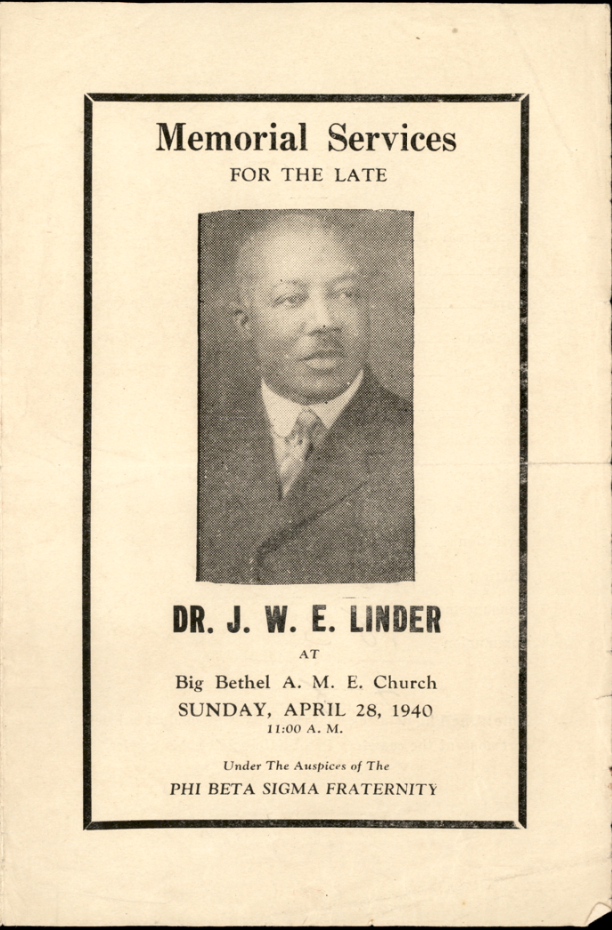
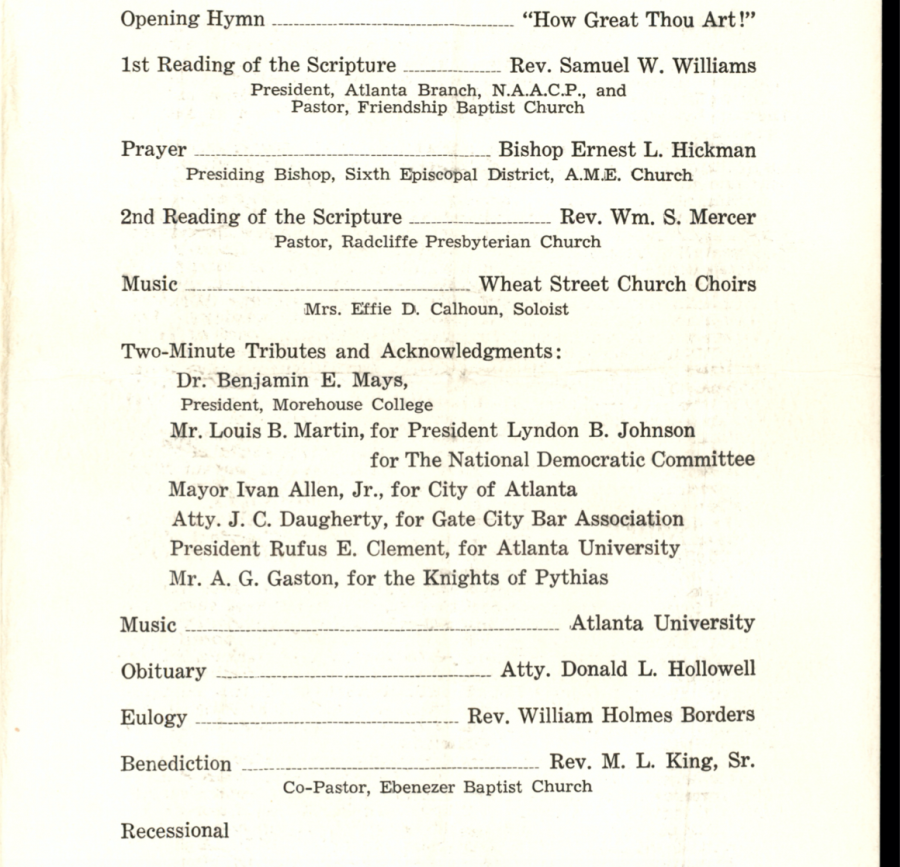
It is a way for local historians to recover important community figures. One program, for Dr. J.W.E. Linder, “who died in 1939,” Atlas Obscura’s Matthew Taub writes, “and whose memorial service was held in 1940” informs us that the deceased was the son of “Congressman George W. Linder, of the Georgia House of Representatives during the Reconstruction Period.” In the program for Judge Austin Thomas Walden, who died in 1965, we learn that he served as the first municipal judge in Georgia since Reconstruction. His benediction was delivered by the Reverend Martin Luther King Sr. and he received tributes from the Mayor of Atlanta, the President of Morehouse College, and the office of President Johnson.
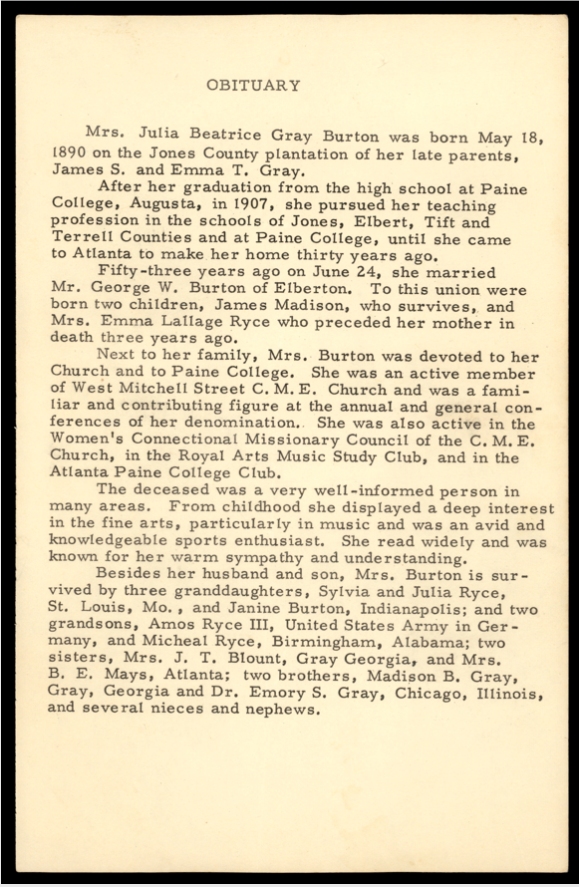
Such pillars of the community can be found among a host of programs memorializing ordinary, everyday people. The descriptions in the funeral literature open fascinating windows onto their lives and their extended family connections. Mrs. Julia Burton’s program from 1960, for example, tells us she was born on the plantation where her parents were likely enslaved. Her obituary not only describes her many clubs and her character as “a well-informed person in many areas,” but also lists the names of her husband and son, three granddaughters, two grandsons, two sisters, and two brothers—invaluable information for people searching for relatives.
“The challenge for African American genealogy and family research continues to be the lack of free access to historical information that can enable us to the tell the stories of those who have come before us,” remarks Tammy Ozier, president of the Atlanta Chapter of the Afro-American Historical and Genealogical Society. “This monumental collection helps to close the gap.” As it grows, it will likely come to represent greater geographical areas around the country. For now, the roughly 3300 digitized funeral programs, some a single page, some elaborate, full-color productions, focus on an area to which thousands of families around the country can trace their lineage, and to which many may find their way back through public archives like this one.

via Atlas Obscura
Related Content:
Josh Jones is a writer and musician based in Durham, NC. Follow him at @jdmagness
Read More...Comedians Speaking Truth to Power: Lenny Bruce, George Carlin & Richard Pryor (NSFW)
No matter how strenuously people claim to support free speech, hardly anyone believes we should get to say whatever we want, however we want, wherever we want. We all just draw the lines differently between speech we find tolerable and that we find beyond the pale. There are reasonable arguments for establishing legal boundaries, but comedy—goes one line of thought—should never be subject to constraints. Anything goes in stand-up, since the comic’s role is to say the unsayable, to shock and surprise, to speak truth to power, etc.
Rising comic John Early (“the left’s funniest comedian,” The Nation proclaims) finds all this gravitas a little absurd. “It’s just a weird, weird, time to be a comedian,” he says in a recent interview. “I feel there’s no greater testament to the fact that our public institutions have failed us than the fact that comedians are somehow moral authorities of this moment. We give so much power to comedians and their platforms, and I’m absolutely horrified by it.” To expect people who tell jokes for a living to have the best handle on what power needs to hear may be expecting too much. “Please don’t ever listen to me,” says Early.
Another argument goes that since comedians are just entertainers, they can say whatever they want, no matter how vicious or demeaning, because it’s “just a joke.” Whatever the merits of this position, when we look back to the greatest comics who shocked, surprised, spoke truths, etc., we see that they took jokes seriously—and that the targets of their humor were institutions that actually held power. This was maybe a prerequisite for how enduringly funny they still are, and how relevant, even if some specific references are lost on us now.
Before Early, Lenny Bruce went on TV to tell viewers of his 1959 jazz special that all entertainers, himself included, are liars. It’s just the nature of the business, he says, then goes through a bit where he shows—with real newspaper headlines all printed on the same day—how news media also exaggerates, embellishes, and lies to sensationalize crime. In under two minutes he rips through the cherished illusion of journalistic objectivity; just as Carlin, who also built a career on saying the unsayable, tears up the U.S.’s most cherished beliefs, above.
The American Dream is a scam, Carlin says. Argue over free speech all you like, but politics is a distraction. “Forget the politicians. The politicians are put there to give you the idea that you have freedom of choice. You don’t.” (One is reminded of Devo.) In a scathing rant, Carlin goes after the biggest game, the corporate owners who control the politicians, the land, and “all the big media companies, so they control just about all of the news and information you get to hear.” He delivers his most famous line: “It’s a big club, and you ain’t in it,” and the audience applauds with recognition of a truth they already know.
Leave it to Richard Pryor, the comedy standard of speaking shocking truths to power, to bring these observations together in the interview clip above that takes digs at his own integrity as a TV entertainer, the slippery nature of television executives, and why they feared the kinds of truths he had to tell. “What do you think [they’re] afraid you’re going to do to America?” he’s asked (meaning specifically white America). He responds in all seriousness, “probably stop some racism.” If people can laugh at hard truths, they can recognize and talk about them. This is a problem for those in power.
“If people don’t hate each other, and start talking to each other, they find out who’s the problem,” Pryor says. “Greedy people.” Racism is a strategy, like sensationalist crime headlines or promises of a better life, to keep people distracted and divided. Those who promote it don’t need personal reasons to do so. “It’s part of capitalism to promote racism,” Pryor says. It’s how the system works. “That separates people. And if you keep people separated it keeps them from thinking about the real problem.” Maybe we are free to say what we want, but Pryor has a warning for those who emulate people in power, even if they think they have the best of intentions. The interview segment ends with the sounds of dueling cesspools.
Related Content:
George Carlin Performs His “Seven Dirty Words” Routine: Historic and Completely NSFW
Lenny Bruce: Hear the Performances That Got Him Arrested (NSFW)
Josh Jones is a writer and musician based in Durham, NC. Follow him at @jdmagness
Read More...Hear the Cristal Baschet, an Enchanting Organ Made of Wood, Metal & Glass, and Played with Wet Hands
Playing a musical instrument with wet hands usually falls somewhere between a bad idea and a very bad idea indeed. The Cristal Baschet, however, requires its players to keep their hands wet at all times, and that’s hardly the only sense in which it’s an exceptional musical instrument. Have a listen to the performance above, Erik Satie’s Gnossienne No. 1 by Marc Antoine Millon and Frédéric Bousquet, and you’ll understand at once how exceptional it sounds. Both ideally suited to Satie’s composition and like nothing else in the history of music — a history which may ultimately remember it as, among other things, one of the most French musical devices ever created.
“It was invented in France, so perhaps that’s why I have one,” says composer Marc Chouarain as he prepares to demonstrate his Cristal Baschet in the video above. “I put water on my finger and I have to put pressure on the glass rods, and the sound is amplified.” That amplification happens, like every other process within the instrument, without the involvement of electricity. Despite being fully acoustic, the Cristal Baschet produces sounds so loud and otherworldly that few could hear them without instinctively imagining a sci-fi movie to go along with the soundtrack.
Perhaps it’s no coincidence that Chouarain is a film composer, nor that the Cristal Baschet was invented in the early 1950s, when the cinematic visions of the future as we know them began to take shape. That era also saw the dawn of musique concrète (1964), with its use of recorded sounds as compositional elements, and the influence of the early Moog synthesizer, which would go on to change the sound of music forever. What influence the brothers Bernard and François Baschet expected of the Cristal Baschet when they invented it is unclear, but it has surely left more of a legacy than their other creations like the inflatable guitar and aluminum piano.
“Ravi Shankar, Damon Albarn (Gorillaz), Daft Punk, Radiohead, Tom Waits, and Manu Dibango are among the musical acts who have used the Cristal Baschet,” writes Colossal’s Andrew Lasane, citing the official Baschet Sound Structures Association brochure. The instrument also continues to get respect from adventurous film composers like Cliff Martinez, who tickles the glass rods in the video above. According to an interview at Vulture, Martinez first encountered the instrument when composing for the Steven Soderbergh remake of Andrei Tarkovsky’s Solaris. He seems to have become a serious Cristal Baschet fan since: the video’s notes mentions that he now “incorporates the instrument in all of his scores,” for more pictures by Soderbergh, as well as by Nicolas Winding Refn — another director of possessed of distinctive visions, and thus always in need of sounds to match.
via Colossal
Related Content:
Hear a 9,000 Year Old Flute—the World’s Oldest Playable Instrument—Get Played Again
How the Moog Synthesizer Changed the Sound of Music
Based in Seoul, Colin Marshall writes and broadcasts on cities, language, and culture. His projects include the book The Stateless City: a Walk through 21st-Century Los Angeles and the video series The City in Cinema. Follow him on Twitter at @colinmarshall, on Facebook, or on Instagram.
Read More...Why Fleetwood Mac’s Peter Green (RIP) Was the Most Underrated Guitarist in British Blues
Debates about whether a guitarist is underrated often involve a lot of posturing and needless name-dropping—they don’t tend to go anywhere, in other words. This is not the case with Peter Green, founder and former singer, songwriter, and guitarist for Fleetwood Mac, who died this past weekend. He is, probably most definitely, “the most underrated guitarist in British Blues,” argues the Happy Bluesman, or at least he became so in the last decades of his life.
Green experienced a tragic end to his career with Fleetwood Mac when his mental health declined precipitously in 1970, and he was eventually diagnosed with schizophrenia. His legend lived long among musicians (and fans of the band who preferred their early work), but Green more or less disappeared from public view, even after releasing a handful of solo albums in a period of recovery.
Fleetwood Mac, the group he founded and carried to its first years of major stardom became, of course, “a household name, widely recognized as one of the best soft rock bands ever for hits like ‘The Chain,’ ‘Go Your Own Way,’ and ‘Everywhere’”—songs Peter Green had nothing to do with, though he had the soft rock chops, as the melancholy “Man of the World” beautifully demonstrates. Hear him in some of his other finest moments in the band, including a phenomenal “Black Magic Woman” at the top, before Carlos Santana made the song his signature.
The argument for Green’s most underrated-ness as a blues guitarist is more than compelling, with endorsements from B.B. King—who said Green had “the sweetest tone I ever heard”—and John Mayall, who said he was better than Clapton when Green joined the Bluesbreakers at age 20. After founding Fleetwood Mac, Green wrote “Black Magic Woman,” sent a guitar instrumental, “Albatross,” to the top of the British Charts in 1969 and, that same year, recorded at Chess Records with, among other blues legends, Willie Dixon and Buddy Guy.
Was he the “best” British blues guitarist? He was “the only one who gave me the cold sweats,” King confessed, which sure is something, even if you prefer Clapton or Jeff Beck. Is he the most underrated? Probably most definitely. “Within a few short years, Peter Green had achieved greater commercial success than two of the world’s most famous bands,” selling more records in 1969 than “both The Rolling Stones and The Beatles, combined.” Then he disappeared.
Green is receiving the recognition in death that eluded him in his last years, though fame never seemed to truly motivate him at any time in his life. Fellow musicians have spared no superlatives in online memorials, including Metallica’s Kirk Hammett, not known for going anywhere near an early Fleetwood Mac sound. But Green was a consummate musician’s musician (he named his band after the rhythm section!), and he earned the respect of serious rock artists and serious blues artists and serious metal artists.
A longtime friend and admirer, Hammett owns Green’s ’59 Gibson Les Paul (nicknamed “Greeny”). He recently covered Green’s last Fleetwood Mac song—“The Green Manalishi (With the Two Prong Crown)”—live onstage and was collaborating on new material with his idol. “Our loss is total,” Hammett wrote in tribute, perhaps the most succinct and devastating tribute among so many. Fleetwood Mac would never have existed without him. And his influence on the British Blues and beyond goes even deeper. See Green revisit his lovely “Man of the World” in a more recent performance, just below. He steps back from the fiery leads, playing subtle rhythm parts, but he still has the old magic in his fingers.
Related Content:
The Thrill is Gone: See B.B. King Play in Two Electric Live Performances
Josh Jones is a writer and musician based in Durham, NC. Follow him at @jdmagness
Read More...A Free Stanford Course on How to Teach Online: Watch the Lectures Online
Earlier this month, Stanford’s Online High School offered (in partnership with Stanford Continuing Studies) a free, five-day course “Teach Your Class Online: The Essentials.” With many schools starting the next academic year online, this course found a large audience. 7,000 teachers signed up. Aimed at middle and high school teachers, the course covered “general guidelines for adapting your course to an online format, best practices for varied situations, common pitfalls in online course design, and how to troubleshoot student issues online.”
The videos from “Teach Your Class Online: The Essentials” are all now available online. You can watch them in sequential order, moving from top to bottom, here. Or watch them on this Stanford hosted page. Day 1 (above) provides a general introduction to teaching online. See topics covered in Days 2–5 below.
Please feel free to share these videos with any teachers. And if anyone watches these lectures and takes good class notes (ones other teachers can use), please let us know. We would be happy to help share them with other teachers.
Finally, just to give you a little background, Stanford’s Online High School has operated as a fully-online, independent, accredited high school since 2006. Stanford Continuing Studies provides open enrollment courses to adults worldwide. All of its courses are currently online. For anyone interested, Coursera also offers a specialization (a series of five courses) on online learning called the Virtual Teacher. It can be explored here.
Day 2
- Getting Specific: Situations and Tools
- Science: Labs in Online Pedagogy
Day 3
- Online Classroom Example Clips
- Building and Maintaining a Classroom
Community
Day 4
- Review of Submitted Sample Lesson Drafts
- Troubleshooting Obstacles to Success in the Online Environment
Day 5
- Math: Using Writing Tablets and Whiteboards
- Modern Languages: Tips for Highly Interactive Class During Which Students Actively Speak and Write in the Target Language
- Humanities: Productive Classroom Conversations About Challenging Subjects
- Closing Thoughts
Related Content:
1,700 Free Online Courses from Top Universities.
“I Will Survive,” the Coronavirus Version for Teachers Going Online
Read More...Support Us
We're hoping to rely on loyal readers, rather than erratic ads. Please click the Donate button and support Open Culture. You can use Paypal, Venmo, Patreon, even Crypto! We thank you!

About Us

Open Culture scours the web for the best educational media. We find the free courses and audio books you need, the language lessons & educational videos you want, and plenty of enlightenment in between.
Advertise With Us
FREE UPDATES!
GET OUR DAILY EMAIL
Get the best cultural and educational resources on the web curated for you in a daily email. We never spam. Unsubscribe at any time.
FOLLOW ON SOCIAL MEDIA
Open Culture editor Dan Colman scours the web for the best educational media. He finds the free courses and audio books you need, the language lessons & movies you want, and plenty of enlightenment in between.
Advertise With Us

