Discover the First Horror & Fantasy Magazine, Der Orchideengarten, and Its Bizarre Artwork (1919–1921)
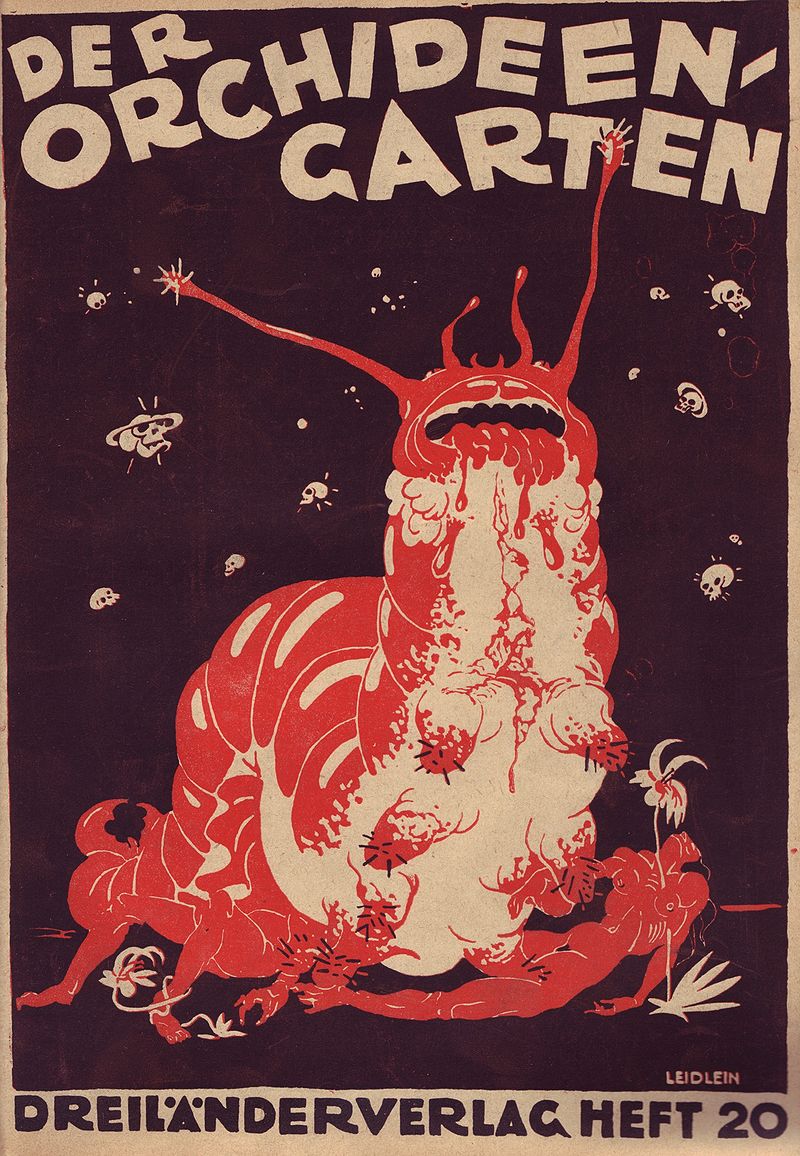
From the 18th century onward, the genres of Gothic horror and fantasy have flourished, and with them the sensually visceral images now commonplace in film, TV, and comic books. These genres perhaps reached their aesthetic peak in the 19th century with writers like Edgar Allan Poe and illustrators like Gustave Dore. But it was in the early twentieth century that a more populist subgenre truly came into its own: “weird fiction,” a term H.P. Lovecraft used to describe the pulpy brand of supernatural horror codified in the pages of American fantasy and horror magazine Weird Tales—first published in 1923. (And still going strong!)
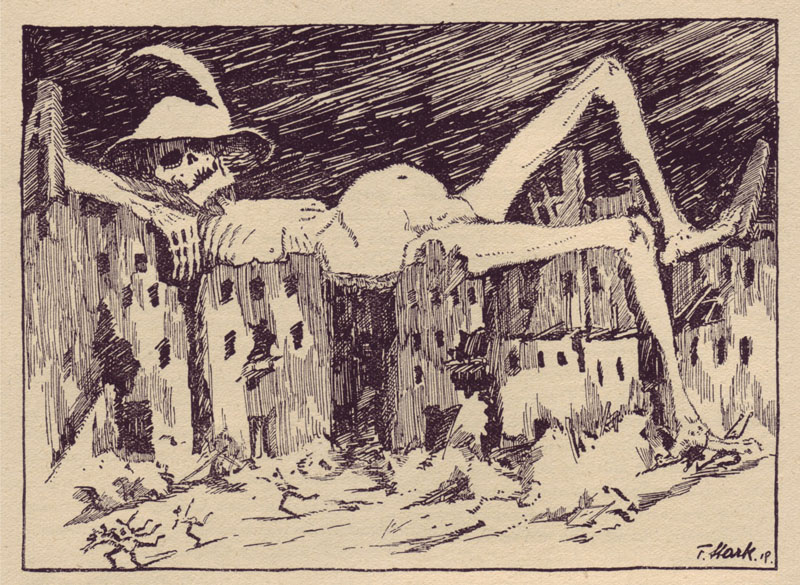
A precursor to EC Comics’ many lurid titles, Weird Tales is often considered the definitive early twentieth century venue for weird fiction and illustration.
But we need only look back a few years and to another continent to find an earlier publication, serving German-speaking fans—Der Orchideengarten (“The Garden of Orchids”), the very first horror and fantasy magazine, which ran 51 issues from January 1919 to November 1921.
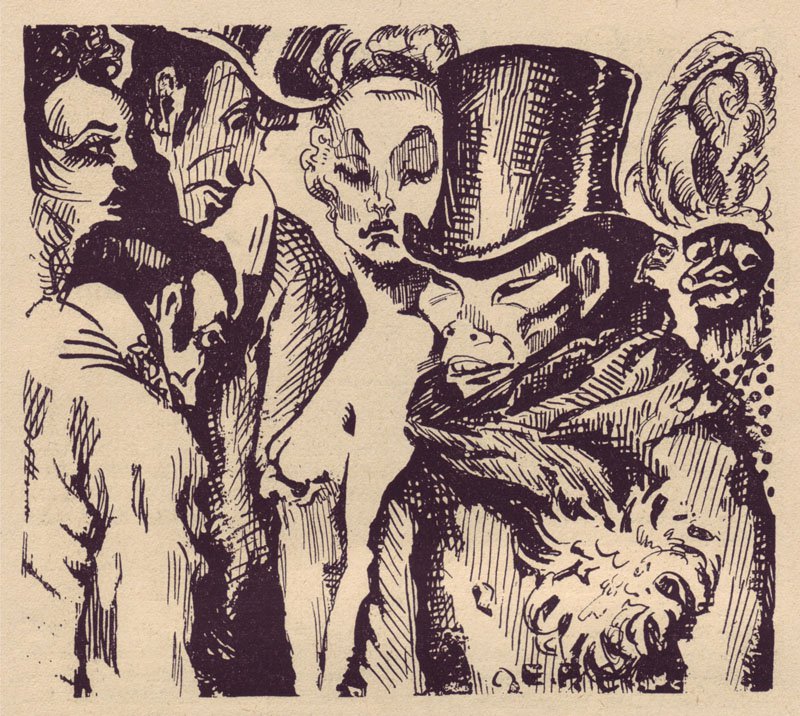
The magazine featured work from its editors Karl Hans Strobl and Alfons von Czibulka, from better-known contemporaries like H.G. Wells and Karel Capek, and from forefathers like Dickens, Pushkin, Guy de Maupassant, Poe, Voltaire, Washington Irving, Nathaniel Hawthorne, and others. “Although two issues of Der Orchideengarten were devoted to detective stories,” writes 50 Watts, “and one to erotic stories about cuckolds, it was a genuine fantasy magazine.” And it was also a gallery of bizarre and unusual artwork.
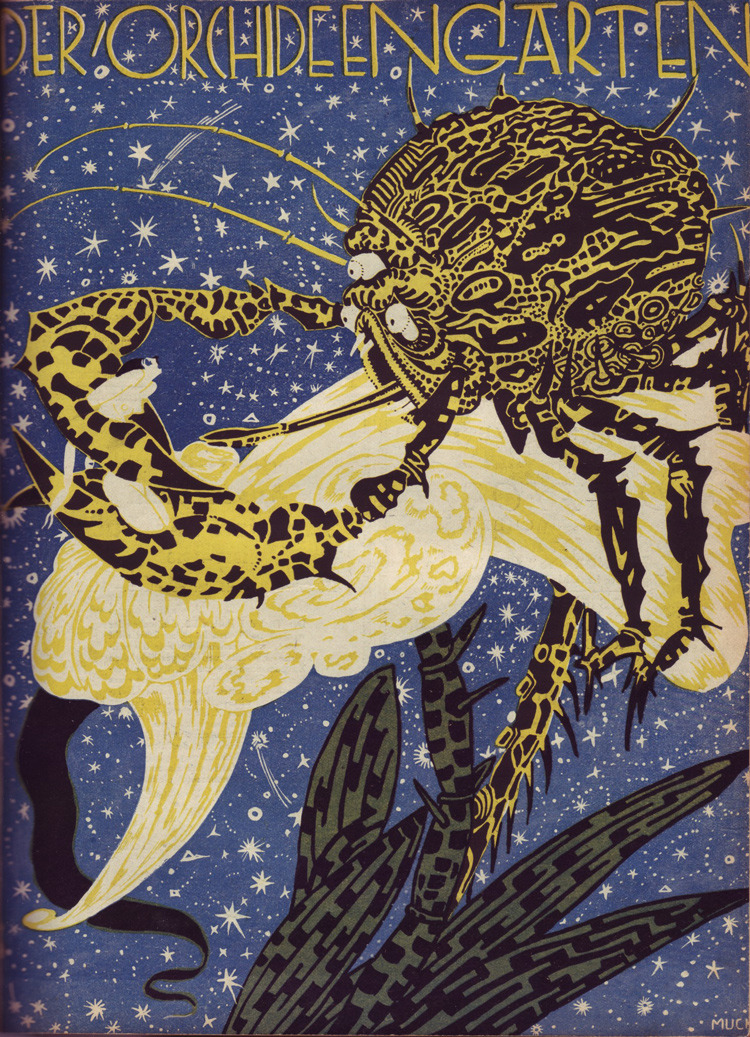
50 Watts quotes from Franz Rottensteiner’s description of the magazine’s art, which ranged “from representations of medieval woodcuts to the work of masters of the macabre such as Gustave Dore or Tony Johannot, to contemporary German artists like Rolf von Hoerschelmann, Otto Lennekogel, Karl Ritter, Heinrich Kley, or Alfred Kubin.” These artists created the covers and illustrations you see here, and many more you can see at 50 Watts, the black sun, and John Coulthart’s {feuilleton}.
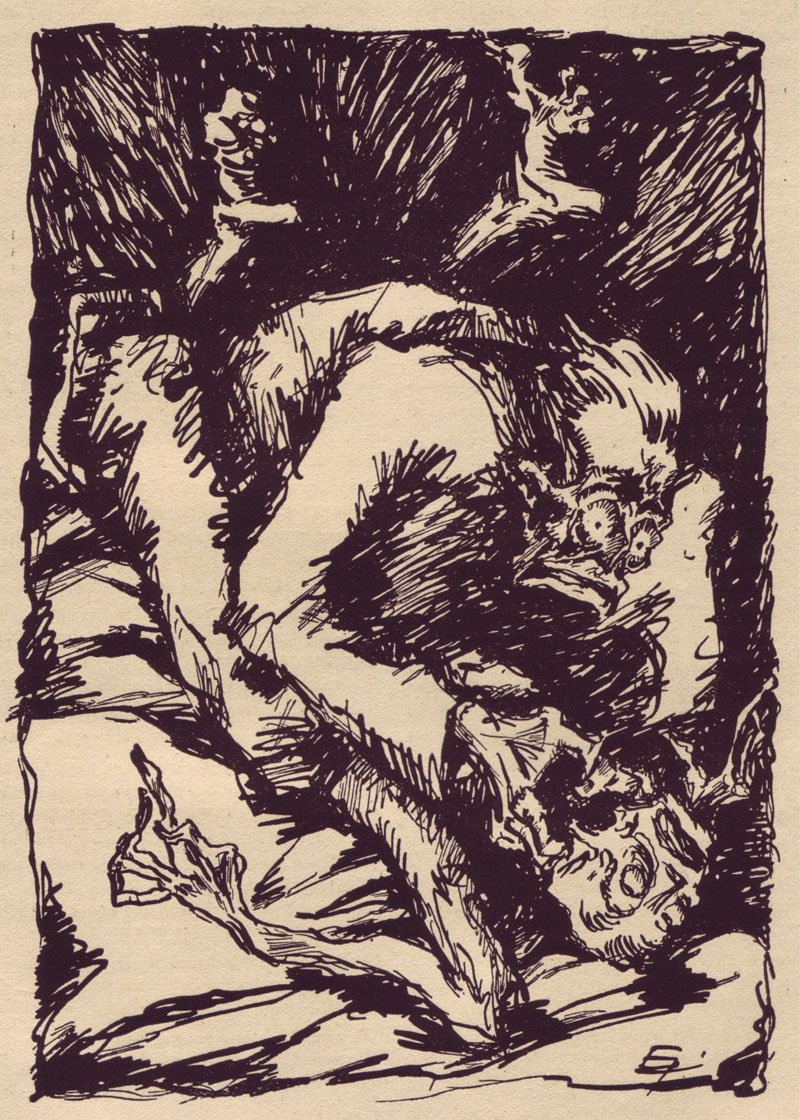
“What strikes me about these black-and-white drawings,” like the dense, frenzied pen-and-ink scene above, Coulthart comments, “is how different they are in tone to the pulp magazines which followed shortly after in America and elsewhere. They’re at once far more adult and frequently more original than the Gothic clichés which padded out Weird Tales and lesser titles for many years.” Indeed, though the format may be similar to its successors, Der Orchideengarten’s covers show the influence of Surrealism, “some are almost Expressionist in style,” and many of the illustrations show “a distinct Goya influence.”
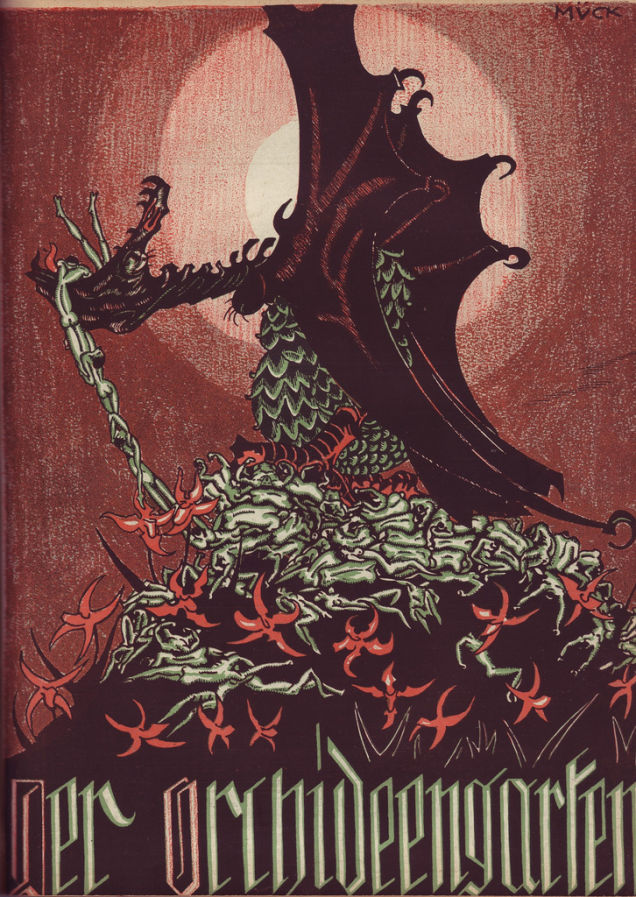
Popular fantasy and horror illustration has often leaned more toward the soft-porn of seventies airbrushed vans, pulp-novel covers, or the grisly kitsch of the comics. Rottensteiner writes in his 1978 Fantasy Book that this “large-format magazine… must surely rank as one of the most beautiful fantasy magazines ever published.” It’s hard to argue with that assessment. View, read (in German), and download original scans of the magazine’s first several issues over on this Princeton site.
Note: An earlier version of this post appeared on our site in 2016.
If you would like to support the mission of Open Culture, consider making a donation to our site. It’s hard to rely 100% on ads, and your contributions will help us continue providing the best free cultural and educational materials to learners everywhere. You can contribute through PayPal, Patreon, and Venmo (@openculture). Thanks!
Related Content:
Read Margaret Cavendish’s The Blazing World: The First Sci-Fi Novel Written By a Woman (1666)
The First Work of Science Fiction: Read Lucian’s 2nd-Century Space Travelogue A True Story
Free: 356 Issues of Galaxy, the Groundbreaking 1950s Science Fiction Magazine
Josh Jones is a writer and musician based in Durham, NC. Follow him at @jdmagness
Read More...Watch Errol Morris’s Tune Out the Noise Free Online: A Documentary About the Financial Revolution That Transformed Investing
You can’t beat the market. That, at least, is the advice we all encounter early on when first we try our hand at investing. Homespun though it may sound, the idea has academic roots: the Efficient Market Hypothesis, as the economists call it, holds that the prices in any financial market already reflect all available information relevant to what’s being traded within them. In the case of the stock market, for example, everything known — or indeed, knowable — about the future prospects of a particular company is already incorporated into its stock price, or might as well be. If the EMH is true, then it must also be true that nobody can beat the market, no matter how deep their experience or developed their instinct for picking stocks.
Nobel Laureate economist Eugene Fama, who’s done more than anyone alive to refine the EFM and keep it in circulation, appears as one of the interviewees in Tune Out the Noise, the Errol Morris-directed documentary above. So do a range of other figures, mostly septuagenarian and octogenarian, whose great success in their fields owes to their having trusted the wisdom of the market. All have been involved with the investment firm Dimensional Fund Advisors, which, since its founding in the early nineteen-eighties, has been one of the engines of change in its industry. In the first half of the twentieth century, investing had an almost mystical quality about it — a quality swept away by the “data revolution” of the second half.
That revolution was powered, of course, by computers. Most of Morris’ interviewees first found themselves placed in front of one of those hulking, inscrutable machines at some point in their tertiary education, more than likely at the University of Chicago. They learned to work those early computers’ punch cards and whirring reels of tape even as electronic computing itself first found its uses in civilization. Suddenly, though it demanded painstaking collection and programming work, it had become possible to examine stock market data and determine what patterns, if any, it contained, and whether any investor had consistently outperformed the average. The answers revealed would become the premise of not just “passive” investment firms like DFA, but also of the original creation of index funds like the S&P 500.
All this may not sound like the usual terrain of Errol Morris, whose previous documentaries have profiled everyone from pet cemetery operators to former U.S. secretaries of defense to Stephen Hawking. His films aren’t without their confrontational moments, though given that Tune Out the Noise was commissioned by DFA itself, it shouldn’t come as a surprise that Morris never shifts into interrogation mode (despite using his signature Interrotron rig to shoot the interviews). Despite claiming not to know anything about investing or financial markets going in, he finds plenty of overlap with interests that have long run through his work: epistemology, for example, and the nature of scientific revolution. After all, most any field has some connection to the inexhaustible subject of how we know, what we know, and what we can’t know. “People shrink from uncertainty, but it’s uncertainty that really creates opportunity,” DFA co-founder David Booth says to Morris. “What would the world be like if there were no uncertainty? I mean, pretty dull.”
Related Content:
“They Were There” — Errol Morris Finally Directs a Film for IBM
Understanding Financial Markets
Watch A Brief History of Time, Errol Morris’ Film About the Life & Work of Stephen Hawking
Based in Seoul, Colin Marshall writes and broadcasts on cities, language, and culture. He’s the author of the newsletter Books on Cities as well as the books 한국 요약 금지 (No Summarizing Korea) and Korean Newtro. Follow him on the social network formerly known as Twitter at @colinmarshall.
Read More...Meet the “Telharmonium,” the First Synthesizer (and Predecessor to Muzak), Invented in 1897
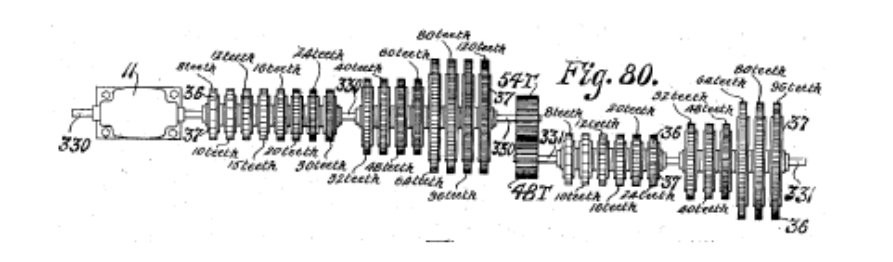
Before the New Year, we brought you footage of Russian polymathic inventor Léon Theremin demonstrating the strange instrument that bears his surname, and we noted that the Theremin was the first electronic instrument. This is not strictly true, though it is the first electronic instrument to be mass produced and widely used in original composition and performance. But like biological evolution, the history of musical instrument development is littered with dead ends, anomalies, and forgotten ancestors (such as the octobass). One such obscure oddity, the Telharmonium, appeared almost 20 years before the Theremin, and it was patented by its American inventor, Thaddeus Cahill, even earlier, in 1897. (See some of the many diagrams from the original patent below.)
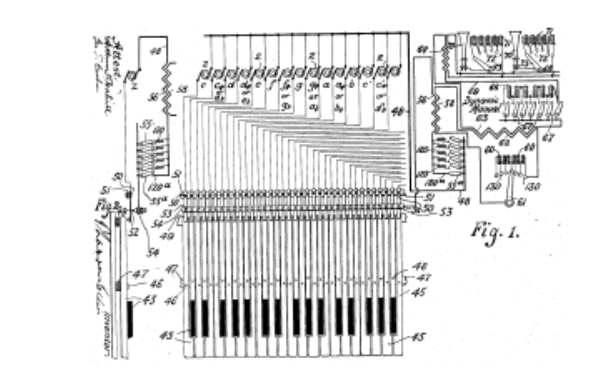
Cahill, a lawyer who had previously invented devices for pianos and typewriters, created the Telharmonium—also called the Dynamaphone—to broadcast music over the telephone, making it a precursor not to the Theremin but to the later scourge of telephone hold music. “In a large way,” writes Jay Williston at Synthmuseum.com, “Cahill invented what we know of today as ‘Muzak.’”
He built the first prototype Telharmonium, the Mark I, in 1901. It weighed seven tons. The final incarnation of the instrument, the Mark III, took 50 people to build at the cost of $200,000 and was “60 feet long, weighed almost 200 tons and incorporated over 2000 electric switches…. Music was usually played by two people (4 hands) and consisted of mostly classical works by Bach, Chopin, Greig, Rossini and others.” The workings of the gargantuan machine resemble the boiler room of an industrial facility. (See several photographs here.)
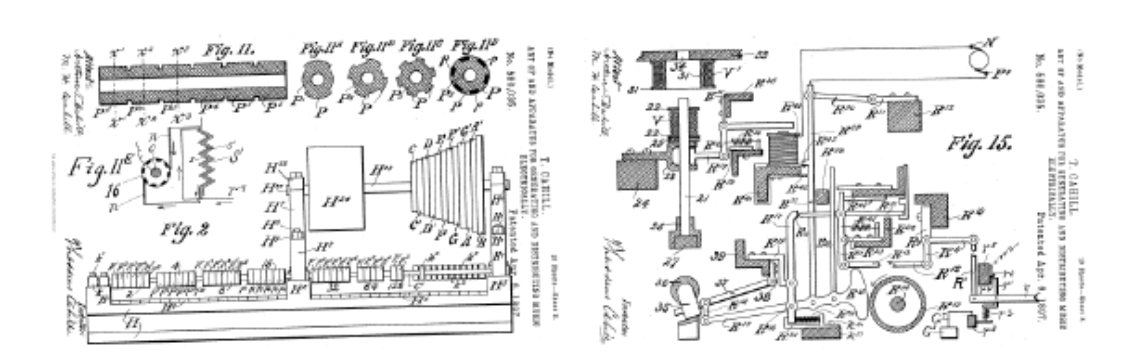
Needless to say, this was a highly impractical instrument. Nevertheless, Cahill not only found willing investors for the enormous contraption, but he also staged successful demonstrations in Baltimore, then—after disassembling and moving the thing by train—in New York. By 1905, his New England Electric Music Company “made a deal with the New York Telephone Company to lay special lines so that he could transmit the signals from the Telharmonium throughout the city.” Cahill used the term “synthesizing” in his patent, which some say makes the Telharmonium the first synthesizer, though its operation was as much mechanical as electronic, using a complicated series of gears and cylinders to replicate the musical range of a piano. (See the operation explained in the video at the top.) “Raised bumps on cylinders helped create musical contour notes,” writes Popular Mechanics, “not unlike a music box, with the size of the cylinder determining the pitch.”
The huge, very loud Telharmonium Mark III ended up in the basement of the Metropolitan Opera House for a time as Cahill worked on his scheme for pumping music through the telephone lines. But this plan did not come off smoothly. “The problem was,” Popular Mechanics points out,” all cables leak off radio waves. Sending a gigantic, amplified signal on turn-of-the-20th-century phone lines was bound to cause trouble.” The Telharmonium created interference on other phone lines and even interrupted Naval radio transmissions. “Rumor has it,” the Douglas Anderson School of the Arts writes, “that a New York businessman, infuriated by the constant network interference, broke into the building where the Telharmonium was housed and destroyed it, throwing pieces of the machinery into the Hudson river below.”
The story seems unlikely, but it serves as a symbol for the instrument’s collapse. Cahill’s company folded in 1908, though the final Telharmonium supposedly remained operational until 1916. No recordings of the instrument have survived, and Thaddeus Cahill’s brother Arthur eventually sold the last prototype off for scrap in 1950 after failing to find a buyer. The entire rationale for the instrument had been supplanted by radio broadcasting. The Telharmonium may have failed to catch on, but it still had a significant impact. Its unique design inspired another important electronic instrument, the Hammond organ. And its very existence gave musical futurists a vision. The Douglas Anderson School writes:
Despite its final demise, the Telharmonium triggered the birth of electronic music—The Italian Composer and intellectual Ferruccio Busoni inspired by the machine at the height of its popularity was moved to write his “Sketch of a New Aesthetic of Music” (1907) which in turn became the clarion call and inspiration for the new generation of electronic composers such as Edgard Varèse and Luigi Russolo.
The instrument also made quite an impression on another American inventor, Mark Twain, who enthusiastically demonstrated it through the telephone during a New Year’s gathering at his home, after giving a speech about his own not inconsiderable status as an innovator and early adopter of new technologies. “Unfortunately for Thaddeus Cahill,” writes William Weir at The Hartford Courant, “Twain’s support wasn’t enough to make a success of the Telharmonium.” Learn more about the instrument’s history from this book.
Note: An earlier version of this post appeared on our site in 2016.
Related Content:
Hear Seven Hours of Women Making Electronic Music (1938–2014)
Thomas Dolby Explains How a Synthesizer Works on a Jim Henson Kids Show (1989)
Josh Jones is a writer and musician based in Durham, NC.
Read More...Lynda Barry on How the Smartphone Is Endangering Three Ingredients of Creativity: Loneliness, Uncertainty & Boredom
The phone gives us a lot but it takes away three key elements of discovery: loneliness, uncertainty and boredom. Those have always been where creative ideas come from. — Lynda Barry
In the spring of 2016, the great cartoonist and educator, Lynda Barry, did the unthinkable, prior to giving a lecture and writing class at NASA’s Goddard Space Flight Center.
She demanded that all participating staff members surrender their phones and other such personal devices.
Her victims were as jangled by this prospect as your average iPhone-addicted teen, but surrendered, agreeing to write by hand, another antiquated notion Barry subscribes to:
The delete button makes it so that anything you’re unsure of you can get rid of, so nothing new has a chance. Writing by hand is a revelation for people. Maybe that’s why they asked me to NASA – I still know how to use my hands… there is a different way of thinking that goes along with them.
Barry—who told the Onion’s AV Club that she crafted her book What It Is with an eye toward bored readers stuck in a Jiffy Lube oil-change waiting room—is also a big proponent of doodling, which she views as a creative neurological response to boredom:
Boring meeting, you have a pen, the usual clowns are yakking. Most people will draw something, even people who can’t draw. I say “If you’re bored, what do you draw?” And everybody has something they draw. Like “Oh yeah, my little guy, I draw him.” Or “I draw eyeballs, or palm trees.” … So I asked them “Why do you think you do that? Why do you think you doodle during those meetings?” I believe that it’s because it makes having to endure that particular situation more bearable, by changing our experience of time. It’s so slight. I always say it’s the difference between, if you’re not doodling, the minutes feel like a cheese grater on your face. But if you are doodling, it’s more like Brillo. It’s not much better, but there is a difference. You could handle Brillo a little longer than the cheese grater.
Meetings and classrooms are among the few remaining venues in which screen-addicted moths are expected to force themselves away from the phone’s inviting flame. Other settings—like the Jiffy Lube waiting room—require more initiative on the user’s part.
Once, we were keener students of minor changes to familiar environments, the books strangers were reading in the subway, and those strangers themselves. Our subsequent observations were known to spark conversation and sometimes ideas that led to creative projects.
Now, many of us let those opportunities slide by, as we fill up on such fleeting confections as funny videos and all-you-can-eat servings of social media.
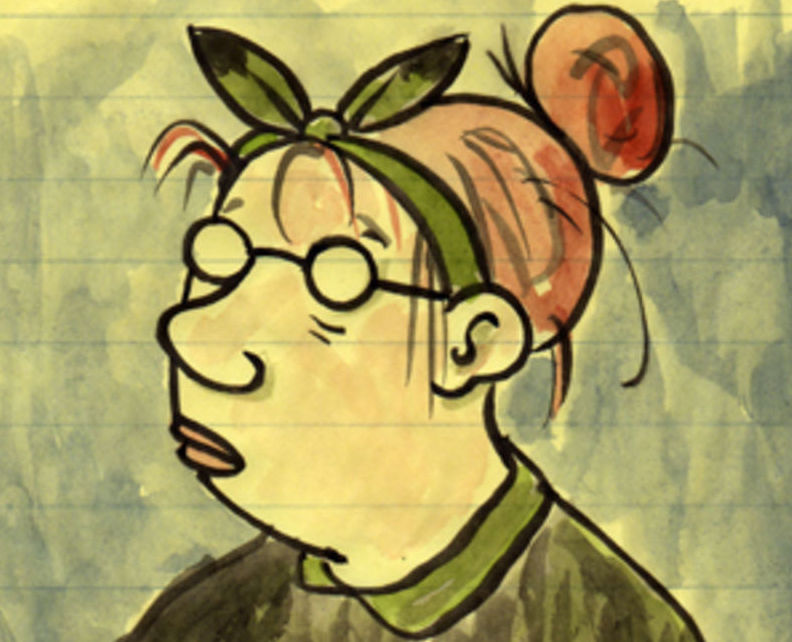
It’s also tempting to use our phones as defacto shields any time social anxiety looms. This dodge may provide short term comfort, especially to younger people, but remember, Barry and many of her cartoonist peers, including Daniel Clowes, Simon Hanselmann, and Ariel Schrag, toughed it out by making art. That’s what got them through the loneliness, uncertainty, and boredom of their middle and high school years.
The book you hold in your hands would not exist had high school been a pleasant experience for me… It was on those quiet weekend nights when even my parents were out having fun that I began making serious attempts to make stories in comics form.
- Adrian Tomine, introduction to 32 Stories
Barry is far from alone in encouraging adults to peel themselves away from their phone dependency for their creative good.
Photographer Eric Pickersgill’s Removed imagines a series of everyday situations in which phones and other personal devices have been rendered invisible. (It’s worth noting that he removed the offending articles from the models’ hands, rather that Photoshopping them out later.)
Computer Science Professor Calvin Newport’s book, Deep Work, posits that all that shallow phone time is creating stress, anxiety, and lost creative opportunities, while also doing a number on our personal and professional lives.
Author Manoush Zomorodi’s TED Talk on how boredom can lead to brilliant ideas, below, details a weeklong experiment in battling smartphone habits, with lots of scientific evidence to back up her findings.
But what if you wipe the slate of digital distractions only to find that your brain’s just… empty? A once occupied room, now devoid of anything but dimly recalled memes, and generalized dread over the state of the world?
The aforementioned AV Club interview with Barry offers both encouragement and some useful suggestions that will get the temporarily paralyzed moving again:
I don’t know what the strip’s going to be about when I start. I never know. I oftentimes have—I call it the word-bag. Just a bag of words. I’ll just reach in there, and I’ll pull out a word, and it’ll say “ping-pong.” I’ll just have that in my head, and I’ll start drawing the pictures as if I can… I hear a sentence, I just hear it. As soon as I hear even the beginning of the first sentence, then I just… I write really slow. So I’ll be writing that, and I’ll know what’s going to go at the top of the panel. Then, when it gets to the end, usually I’ll know what the next one is. By three sentences or four in that first panel, I stop, and then I say “Now it’s time for the drawing.” Then I’ll draw. But then I’ll hear the next one over on another page! Or when I’m drawing Marlys and Arna, I might hear her say something, but then I’ll hear Marlys say something back. So once that first sentence is there, I have all kinds of choices as to where I put my brush. But if nothing is happening, then I just go over to what I call my decoy page. It’s like decoy ducks. I go over there and just start messing around.
Note: An earlier version of this post appeared on our site in 2017.
Related Content:
How Information Overload Robs Us of Our Creativity: What the Scientific Research Shows
Ayun Halliday is an author, illustrator, and theater maker in NYC.
Read More...The Futurist Cookbook (1930) Tried to Turn Italian Cuisine into Modern Art
With the savage cuts in arts funding, perhaps we’ll return to a system of noblesse oblige familiar to students of The Gilded Age, when artists needed independent wealth or patronage, and wealthy industrialists often decided what was art, and what wasn’t. Unlike fine art, however, haute cuisine has always relied on the patronage of wealthy donors—or diners. It can be marketed in premade pieces, sold in cookbooks, and made to look easy on TV, but for reasons both cultural and practical, given the nature of food, an exquisitely-prepared dish can only be made accessible to a select few.
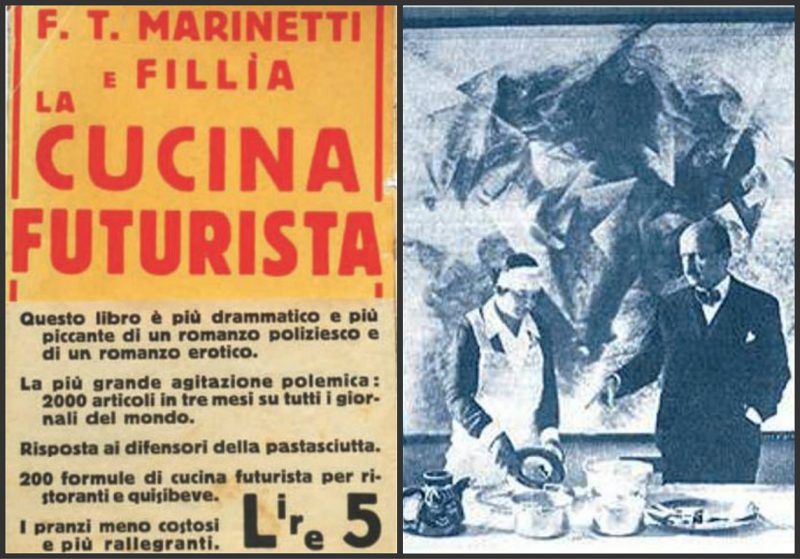
Still, we would be mistaken, suggested Futurist poet and theorist F.T. Marinetti (1876–1944), should we neglect to see cooking as an art form akin to all the others in its moral and intellectual influence on us. While hardly the first or the last artist to publish a cookbook, Marinetti’s Futurist Cookbook seems at first glance deadly, even aggressively, serious, lacking the whimsy, impractical weirdness, and surrealist art of Salvador Dali’s Les Diners de Gala, for example, or the eclectic wistfulness of the MoMA’s Artist’s Cookbook.
Just as he had sought with his earlier Futurist Manifesto to revolutionize art, Marinetti intended his cookbook to foment a “revolution of cuisine,” as Alex Revelli Sorini and Susanna Cutini point out. You might even call it an act of war when it came to certain staples of Italian eating, like pasta, which he thought responsible for “sluggishness, pessimism, nostalgic inactivity, and neutralism” (anticipating scads of low and no-carb diets to come).
Believing that people “think, dream and act according to what they eat and drink,” Marinetti formulated strict rules not only for the preparation of food, but also the serving and eating of it, going so far as to call for abolishing the knife and fork. A short excerpt from his introduction shows him applying to food the techno-romanticism of his Futurist theory—an ethos taken up by Benito Mussolini, whom Marinetti supported:
The Futurist culinary revolution … has the lofty, noble and universally expedient aim of changing radically the eating habits of our race, strengthening it, dynamizing it and spiritualizing it with brand-new food combinations in which experiment, intelligence and imagination will economically take the place of quantity, banality, repetition and expense.
In hindsight, the fascist overtones in Marinetti’s language seem glaring. In 1932, when the Futurist Cookbook was published, his Futurism seemed like a much-needed “jolt to all the practical and intellectual activities,” note Sorini and Cutini. “The subject [of cooking] needed a good shake to reawaken its spirit.” And that’s just what it got. The Futurist Cookbook acted as “a preview of Italian-style Nouvelle Cuisine,” with such innovations as “additives and preservatives added to food, or using technological tools in the kitchen to mince, pulverize, and emulsify.”
Yet, for all the high seriousness with which Marinetti seems to treat his subject, “what the media missed” at the time, writes Maria Popova, “was that the cookbook was arguably the greatest artistic prank of the twentieth century.” In an introduction to the 1989 edition, British journalist and historian Lesley Chamberlain called the Futurist Cookbook “a serious joke, revolutionary in the first instance because it overturned with ribald laughter everything ‘food’ and ‘cookbooks’ held sacred.” Marinetti first swept away tradition in favor of creative dining events the Futurists called “aerobanquets,” such as one in Bologna in 1931 with a table shaped like an airplane and dishes called “spicy airport” (Olivier salad) and “rising thunder” (orange risotto). Lambrusco wine was served in gas cans.
It’s performance art worthy of Dali’s bizarre costumed dinner parties, but fueled by a genuine desire to revolutionize food, if not the actual eating of it, by “bringing together elements separated by biases that have no true foundation.” So remarked French chef Jules Maincave, a 1914 convert to Futurism and inspiration for what Marinetti calls “flexible flavorful combinations.” See several such recipes excerpted from the Futurist Cookbook at Brain Pickings, read the full book in Italian here, and, just below, see Marinetti’s rules for the perfect meal, first published in 1930 as the “Manifesto of Futurist Cuisine.”
Futurist cuisine and rules for the perfect lunch
1. An original harmony of the table (crystal ware, crockery and glassware, decoration) with the flavors and colors of the dishes.
2. Utter originality in the dishes.
3. The invention of flexible flavorful combinations (edible plastic complex), whose original harmony of form and color feeds the eyes and awakens the imagination before tempting the lips.
4. The abolition of knife and fork in favor of flexible combinations that can deliver prelabial tactile enjoyment.
5. The use of the art of perfumery to enhance taste. Each dish must be preceded by a perfume that will be removed from the table using fans.
6. A limited use of music in the intervals between one dish and the next, so as not to distract the sensitivity of the tongue and the palate and serves to eliminate the flavor enjoyed, restoring a clean slate for tasting.
7. Abolition of oratory and politics at the table.
8. Measured use of poetry and music as unexpected ingredients to awaken the flavors of a given dish with their sensual intensity.
9. Rapid presentation between one dish and the next, before the nostrils and the eyes of the dinner guests, of the few dishes that they will eat, and others that they will not, to facilitate curiosity, surprise, and imagination.
10. The creation of simultaneous and changing morsels that contain ten, twenty flavors to be tasted in a few moments. These morsels will also serve the analog function […] of summarizing an entire area of life, the course of a love affair, or an entire voyage to the Far East.
11. A supply of scientific tools in the kitchen: ozone machines that will impart the scent of ozone to liquids and dishes; lamps to emit ultraviolet rays; electrolyzers to decompose extracted juices etc. in order to use a known product to achieve a new product with new properties; colloidal mills that can be used to pulverize flours, dried fruit and nuts, spices, etc.; distilling devices using ordinary pressure or a vacuum, centrifuge autoclaves, dialysis machines.
The use of this equipment must be scientific, avoiding the error of allowing dishes to cook in steam pressure cookers, which leads to the destruction of active substances (vitamins, etc.) due to the high temperatures. Chemical indicators will check if the sauce is acidic or basic and will serve to correct any errors that may occur: lack of salt, too much vinegar, too much pepper, too sweet.”
Note: An earlier version of this post appeared on our site in 2017.
Related Content
When Italian Futurists Declared War on Pasta (1930)
Salvador Dalí’s 1973 Cookbook Gets Reissued: Surrealist Art Meets Haute Cuisine
Josh Jones is a writer and musician based in Durham, NC.
Read More...Inside the Automats Where Coin-Operated Machines Created a Modern, Democratic Dining Experience
“Good evening,” said Alfred Hitchcock to the television viewers of America on March 25, 1959. “Tonight I’m dining at my favorite club. There are many advantages here. As you can see, informality is the rule. There is also the stimulation of intellectual companionship without the deafening quiet that pervades most clubs. Best of all, I like its privacy: only four persons are allowed at a table, and, of course, no one pays any attention to you.” This was an example of the deadpan irony with which the filmmaker introduced each broadcast of Alfred Hitchcock Presents, for the “club” of which he spoke was clearly an automat. Today, many readers under about 50 will never have heard the word, but at the time, it referred to a seemingly permanent institution in American life.
Or rather, an institution of urban American life, and above all in two cities, Philadelphia and New York. There, no one could think of automats without thinking of Horn & Hardart, in its heyday the largest restaurant chain in the world. The concept, which co-founder Joseph Horn imported over from Berlin in the early nineteen-tens, was of a restaurant with no waiters: rather, you could choose your dish à la carte from a wall of coin-operated compartments, paying the nickel or two that would allow you to take the food inside.
Salisbury steak, creamed spinach, baked beans, a ham-and-cheese sandwich, macaroni and cheese, chocolate pudding, strawberry rhubarb pie: whatever it was, the behind-the-scenes staff would replace it just as soon as you put the last one on your tray.
Smack of modernity though it once did (and in a way, still does), the term automat is somewhat misleading. We might describe the experience of visiting one as dining inside a giant vending machine, but the actual running of the operation was quite labor-intensive. Most of the work was performed out of the customer’s sight, as far away as in the large central commissaries that prepared many of the dishes to be transported daily to Horn & Hardart’s 88 locations. This sheer scale of operation allowed the chain to offer some of the cheapest meals commercially available, with the result that its automats boomed even — indeed, especially — during the Great Depression. Their economic barrier was low, and of sex and race, nonexistent; those who remember them describe them becoming some of the most democratic institutions in postwar America.
You can hear such memories recalled in the recent documentary The Automat by figures like Ruth Bader Ginsburg, Colin Powell, and Mel Brooks, who rhapsodizes about Horn & Hardart’s coffee, dispensed for just a nickel from elaborate dolphin-headed spigots. That degree of detail was standard in the interiors, whose marble, chrome, and glass look palatial by the standards of the fast-food joints that ultimately replaced the automat. That glory was one casualty of postwar suburbanization and hollowing-out of central cities that resulted. What with the American urban renaissance of the past few decades, attempts have been made to revive the automat concept, but perhaps, as Brooks puts it, “the logistics and the economics of today won’t allow anything that simple, naïve, and eloquent and beautiful to flourish again.” Ordering a meal brought straight to your door may be more convenient, but even delivery-app addicts have to admit that it will never have the same romance.
Related content:
How Edward Hopper’s Paintings Inspired the Creepy Suspense of Alfred Hitchcock’s Rear Window
Watch the “Biblio-Mat” Book-Vending Machine Dispense Literary Delight
How Fast Food Began: The History of This Thoroughly American (and Now Global) Form of Dining
Based in Seoul, Colin Marshall writes and broadcasts on cities, language, and culture. He’s the author of the newsletter Books on Cities as well as the books 한국 요약 금지 (No Summarizing Korea) and Korean Newtro. Follow him on the social network formerly known as Twitter at @colinmarshall.
Read More...The Adventures of Prince Achmed, the Oldest Surviving Animated Feature Film, Is Now in the Public Domain (1926)
Die Abenteuer des Prinzen Achmed, or The Adventures of Prince Achmed, lays fair claim to being the earliest animated feature film in existence. If we do grant it that title, it beats the next contender by more than a decade. While Prince Achmed came out a century ago, in 1926, Snow White and the Seven Dwarfs, whose production was presided over by a certain Walt Disney, didn’t reach theaters until 1937. The latter picture holds great distinction in the history of cinema, of course, not least that of being the first feature made with cel animation: the dominant technique throughout most of the twentieth century, and one whose digital replacement has been lamented by classic animation enthusiasts. But the quivering silhouettes of Prince Achmed show an alternative.
The making of Snow White was, by the standards of the day, a vast undertaking, requiring Disney to marshal artistic and industrial resources at a scale then unknown in animation. Prince Achmed, by contrast, owes its existence mostly to the work of one woman: Lotte Reiniger, who first learned the craft of scherenschnitte silhouette-making as a little girl in Berlin.
Scherenschnitte was inspired by what was thought to be ancient Chinese arts of paper-cutting and puppetry, but when watched today, Prince Achmed or the other animations Reiniger created bring more readily to mind traditional Javanese wayang kulit shadow puppet theater: an aesthetic that, in a sense, suits the source material ideally.
The episodes that constitute Prince Achmed’s narrative are drawn in large part from One Thousand and One Nights, a text whose centuries-long evolution bears the marks of not just many distinct cultures across Asia and the Middle East, but also those of more dramatic transformation through its folktales’ cultural transposition into French, then other European languages. What Reiniger brings to enchanting handmade life isn’t any particular place at any particular time, but rather an elegant, mysterious, quite literally arabesque realm that never really existed. In other words, Prince Achmed takes place in what can only be called the Orient — which, now that the film has fallen into the public domain, we can all visit whenever we like. And if such visits happen to inspire a new generation of Lotte Reinigers in this world of market-researched mega-budget animation, so much the better.
Related content:
The First Animated Feature Film: The Adventures of Prince Achmed by Lotte Reiniger (1926)
Watch the Oldest Japanese Anime Film, Jun’ichi Kōuchi’s The Dull Sword (1917)
Based in Seoul, Colin Marshall writes and broadcasts on cities, language, and culture. He’s the author of the newsletter Books on Cities as well as the books 한국 요약 금지 (No Summarizing Korea) and Korean Newtro. Follow him on the social network formerly known as Twitter at @colinmarshall.
Read More...Behold the First Realistic Depiction of the Human Face (Circa 25,000 BCE)
?si=HOvgnTtB4xSNqpNE
In 1894, archaeologist Édouard Piette discovered the “Venus of Brassempouy,” otherwise known as the “Lady with the Hood.” Unearthed in southwestern France and dating to around 25,000 BCE, this carving represents the earliest realistic depiction of a human face. The figure’s forehead, nose, and brows are carefully carved in relief, as is the hair, arranged in a neat geometric pattern. But what happened to the mouth? Or the eyes? We’re not sure.
The Venus is carved from mammoth ivory, likely using a stone flint, and stands just 3.65 cm tall. For some, it marks a major development in figurative art. Or, as historian Simon Schama has suggested, this figurine may well be the “dawn of the idea of beauty” in human culture.
Related Content
The World’s Oldest Cave Art, Discovered in Indonesia, Is at Least 67,800 Years Old
Algerian Cave Paintings Suggest Humans Did Magic Mushrooms 9,000 Years Ago
Was a 32,000-Year-Old Cave Painting the Earliest Form of Cinema?
A Stylish 2,000-Year-Old Roman Shoe Found in a Well
Exquisite 2300-Year-Old Scythian Woman’s Boot Preserved in the Frozen Ground of Siberia
Read More...The Greatest Double Agent Ever: How a Spanish Chicken Farmer Became the Most Important Double Agent in WWII
Juan Pujol García was one of the rare individuals whose participation in World War II made him a Member of the Order of the British Empire and earned him the Iron Cross. He gained that unlikely distinction in perhaps the riskiest of all roles in espionage, that of a double agent. Despite ultimately working for the Allied cause, he created an elaborate fictional persona — complete with an invented spy network operating across Great Britain — who professed loyalty to the Nazi cause. Not only did Pujol get this character plugged into the real German intelligence system, he also got him on its payroll, receiving what came to the equivalent of more than $6 million in today’s U.S. dollars for supplying information — information that ultimately contributed to the Axis’ loss of the war.
The story of how this chicken farmer from Barcelona became the most important double agent of World War II is told in the animated Primal Space video above. Unlike many of the spies history has remembered more clearly, Pujol didn’t begin his espionage career in the employ of any government in particular.
Radicalized, if that be the word, by the experience of having been drafted into the Spanish Civil War, he vowed to dedicate his life to “the good of humanity.” Turned away by the British embassy, to which he’d offered his services because Britain opposed Nazi Germany, he went freelance, re-inventing himself as a Third Reich-loyal Spanish military man seeking an assignment in the U.K. Taken on by Germany, he instead decamped to Lisbon, where he began manufacturing ersatz intelligence reports using newsreel footage and tourist brochures.
However makeshift, Pujol’s craft proved impressive to both Germany and Britain, which launched an international spy hunt for him. He thus accomplished his goal of becoming an official British double agent, in which capacity he arrived at his finest hour: misleading the Germans as to the 1944 “D‑Day” invasion of Normandy in an effort called Operation Fortitude. In Spanish, that would be Fortaleza, which became the title of an RTVE documentary about Pujol’s long-untold story a few years ago. But if any single word reflects Pujol’s contribution to history, that word must be Garbo, the code name assigned him by his first British case officer. After all, what other name — at least in 1942 — could quite so evocatively befit an agent whose skills of crafting and inhabiting invented characters made his handlers regard him as “the best actor in the world”?
Related content:
The CIA’s Former Chief of Disguise Show How Spies Use Costumes in Undercover Operations
The French Designed a Fake Replica of Paris to Fool German Bombers During World War I
Based in Seoul, Colin Marshall writes and broadcasts on cities, language, and culture. He’s the author of the newsletter Books on Cities as well as the books 한국 요약 금지 (No Summarizing Korea) and Korean Newtro. Follow him on the social network formerly known as Twitter at @colinmarshall.
Read More...Hear Aldous Huxley Read Brave New World. Plus 84 Classic Radio Dramas from CBS Radio Workshop (1956–57)
We seem to be living through yet another major moment for podcasting. Over the past two decades, the medium has gone from niche experiment to mainstream habit, becoming a regular part of how we learn, entertain ourselves, and pass the time. The popularity of podcasts—in an age of ubiquitous screens and perpetual distractions—speaks to something deep within us. Oral storytelling, as old as human speech, never really disappears. The medium evolves, platforms shift, distribution changes—but the basic appeal remains constant.
But the differences between this golden age of podcasting and the golden age of radio are still significant. Where the podcast is often off-the-cuff, and often very intimate and personal—sometimes seen as “too personal”—radio programs were almost always carefully scripted and featured professional talent. Even those programs with man-on-the street features or interviews with ordinary folks were carefully orchestrated and mediated by producers, actors, and presenters. And the business of scoring music and sound effects for radio programs was a very serious one indeed. All of these formalities—in addition to the limited frequency range of old analog recording technology—contribute to what we immediately recognize as the sound of “old time radio.” It is a quaint sound, but also one with a certain gravitas, an echo of a bygone age.
That golden age waned as television came into its own in the mid-fifties, but near its end, some broadcast companies made every effort to put together the highest quality radio programming they could in order to retain their audience. One such program, the CBS Radio Workshop, which ran from January, 1956 to September, 1957, may have been “too little too late”—as radio preservationist site Digital Deli writes—but it nonetheless was “every bit as innovative and cutting edge” as the programs that came before it.
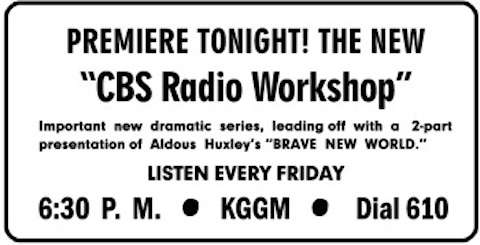
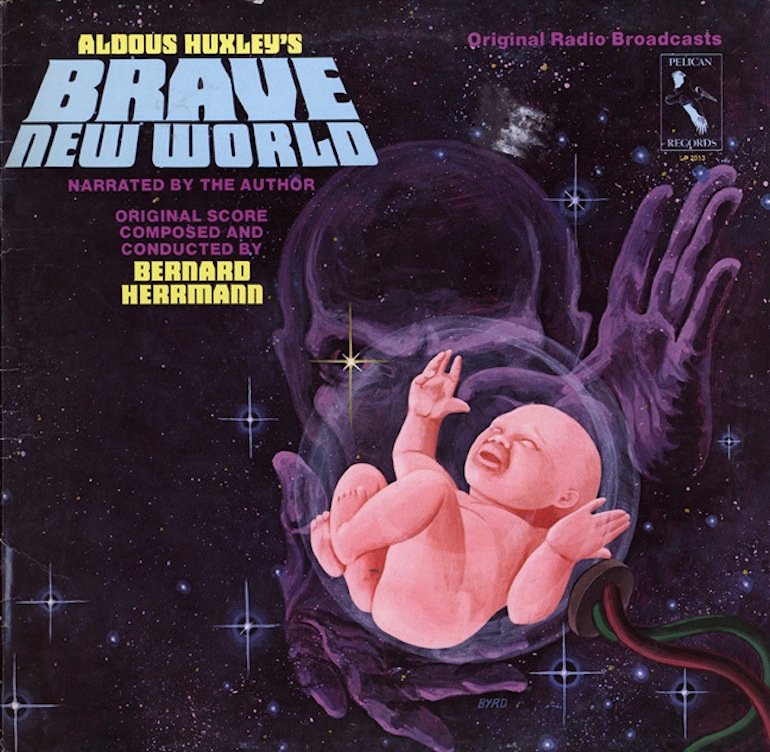
The first two episodes, right below, were dramatizations of Aldous Huxley’s Brave New World, read by the author himself. The series’ remaining 84 programs drew from the work of Antoine de Saint-Exupéry, James Thurber, H.L. Mencken, Mark Twain, Robert Heinlein, Eugene O’Neill, Balzac, Carl Sandburg, and so many more. It also featured original comedy, drama, music, and This American Life-style profiles and storytelling.
Huxley returned in program #12, with a story called “Jacob’s Hands,” written in collaboration with and read by Christopher Isherwood. The great Ray Bradbury made an appearance, in program #4, introducing his stories “Season of Disbelief” and “Hail and Farewell,” read by John Dehner and Stacy Harris, and scored by future film and TV composer Jerry Goldsmith. Other programs, like #10, “The Exurbanites,” narrated by famous war correspondent Eric Sevareid, conducted probing investigations of modern life—in this case the growth of suburbia and its relationship to the advertising industry. The above is but a tiny sampling of the wealth of quality programming the CBS Radio Workshop produced, and you can hear all of it—all 86 episodes—courtesy of the Internet Archive.
Sample streaming episodes in the player above, or download individual programs as MP3s and enjoy them at your leisure, almost like, well, a podcast. See Digital Deli for a complete rundown of each program’s content and cast, as well as an extensive history of the series. This is the swan song of golden age radio, which, it seems, maybe never really left, given the incredible number of listening experiences we still have at our disposal. Yes, someday our podcasts will sound quaint and curious to the ears of more advanced listeners, but even then, I’d bet, people will still be telling and recording stories, and the sound of human voices will continue to captivate us as it always has.
Note: An earlier version of this post appeared on our site in 2014.
Related Content:
X Minus One: Hear Classic Sci-Fi Radio Stories from Asimov, Heinlein, Bradbury & Dick
Hear 90+ Episodes of Suspense, the Iconic Golden Age Radio Show Launched by Alfred Hitchcock
Hear 149 Vintage Halloween Radio Shows from the Golden Age of Radio
Josh Jones is a writer and musician based in Durham, NC.
Read More...Support Us
We're hoping to rely on loyal readers, rather than erratic ads. Please click the Donate button and support Open Culture. You can use Paypal, Venmo, Patreon, even Crypto! We thank you!

About Us

Open Culture scours the web for the best educational media. We find the free courses and audio books you need, the language lessons & educational videos you want, and plenty of enlightenment in between.
Advertise With Us
FREE UPDATES!
GET OUR DAILY EMAIL
Get the best cultural and educational resources on the web curated for you in a daily email. We never spam. Unsubscribe at any time.
FOLLOW ON SOCIAL MEDIA
Open Culture editor Dan Colman scours the web for the best educational media. He finds the free courses and audio books you need, the language lessons & movies you want, and plenty of enlightenment in between.
Advertise With Us

