Thomas Jefferson’s Handwritten Vanilla Ice Cream Recipe
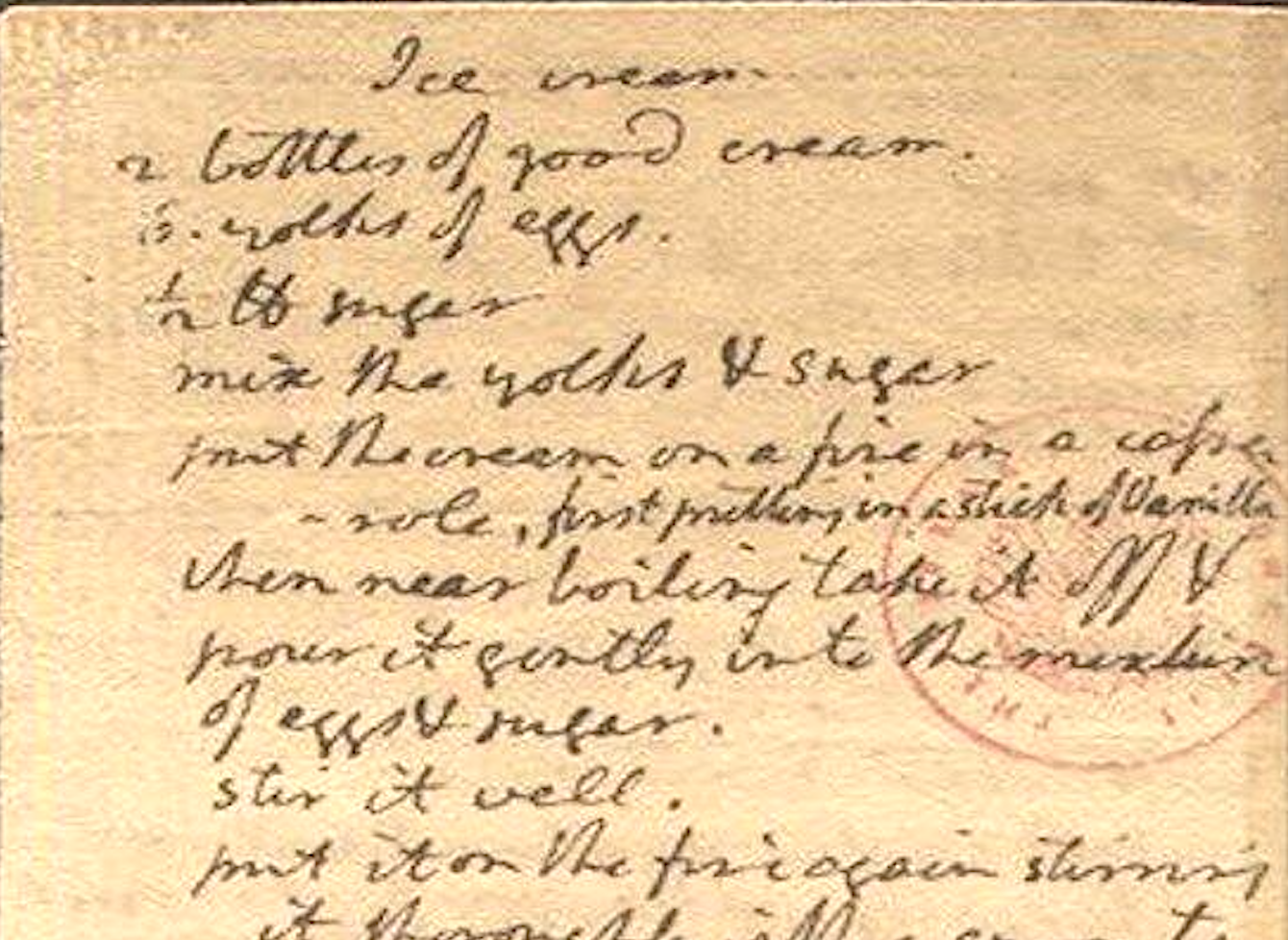
Here’s another thing you can credit Thomas Jefferson with: being the first known American to record an ice cream recipe. It’s one of 10 surviving recipes written by the founding father.
According to Monticello.org, ice cream began appearing “in French cookbooks starting in the late 17th century, and in English-language cookbooks in the early 18th century.” And there “are accounts of ice cream being served in the American colonies as early as 1744.” Jefferson likely tasted his fair share of the dessert while living in France (1784–1789), and it continued to be served at Monticello upon his return to Virginia. By the first decade of the 19th century, ice cream became increasingly common in cookbooks published throughout the U.S.
You can see the entire recipe for Jefferson’s vanilla ice cream here, and read a transcript below.
2. bottles of good cream.
6. yolks of eggs.
1/2 lb. sugarmix the yolks & sugar
put the cream on a fire in a casserole, first putting in a stick of Vanilla.
when near boiling take it off & pour it gently into the mixture of eggs & sugar.
stir it well.
put it on the fire again stirring it thoroughly with a spoon to prevent it’s sticking to the casserole.
when near boiling take it off and strain it thro’ a towel.
put it in the Sabottiere[12]
then set it in ice an hour before it is to be served. put into the ice a handful of salt.
put salt on the coverlid of the Sabotiere & cover the whole with ice.
leave it still half a quarter of an hour.
then turn the Sabottiere in the ice 10 minutes
open it to loosen with a spatula the ice from the inner sides of the Sabotiere.
shut it & replace it in the ice
open it from time to time to detach the ice from the sides
when well taken (prise) stir it well with the Spatula.
put it in moulds, justling it well down on the knee.
then put the mould into the same bucket of ice.
leave it there to the moment of serving it.
to withdraw it, immerse the mould in warm water, turning it well till it will come out & turn it into a plate
Note: An earlier version of this post appeared on our site in 2014.
Related Content:
The First American Cookbook: Sample Recipes from American Cookery (1796)
Leo Tolstoy’s Family Recipe for Mac and Cheese
Ernest Hemingway’s Favorite Hamburger Recipe
The Recipes of Iconic Authors: Jane Austen, Sylvia Plath, Roald Dahl, the Marquis de Sade & More
David Lynch Teaches You to Cook His Quinoa Recipe in a Strange, Surrealist Video
How to Actually Cook Salvador Dali’s Surrealist Recipes: Crayfish, Prawns, and Spitted Eggs
Read More...A Tour Inside the Chelsea Hotel: Once Home to Bob Dylan, Patti Smith, Leonard Cohen & More
We’ve all stayed at the Chelsea Hotel, though most of us have done so only in our minds, through such cultural artifacts as Leonard Cohen’s “Chelsea Hotel No. 2,” Bob Dylan’s “Sara,” Nico’s “Chelsea Girls,” Andy Warhol’s eponymous film that includes the Nico song, or Patti Smith’s Just Kids, which tells of the time she spent there with Robert Mapplethorpe. Enthusiasts of the work of everyone from Janis Joplin to Arthur C. Clarke to Miloš Forman to Dylan Thomas to Mark Twain may not know that they, too, thereby enjoy an indirect connection to that New York institution, which has stood on West 23rd Street since its construction in 1884.
At that time, it also stood quite tall, looming over every other apartment building in the city, and indeed over most of the rest of Manhattan. Nowadays, however, the cultural profile of the Chelsea Hotel (officially, and less coolly, the Hotel Chelsea) is higher than its physical one ever was.
Its reputation as a refuge for artists dates to the management of Stanley Bard, who inherited the business from his father in 1964. Already, a degree of dilapidation in the building itself, as well as the surrounding neighborhood, kept rents low enough to attract impecunious creative types. Bard displayed enough generosity to artists that, before long, Andy Warhol’s factory had more or less moved in.
The Chelsea’s latest transformation began in the mid-two-thousands with a series of takeovers and renovations not necessarily welcomed by the existing long-term residents, who appreciated the hotel precisely for its seeming imperviousness to gentrification. In the new Architectural Digest video above, current owner Sean MacPherson gives a tour of the luxurious Chelsea of the twenty-twenties, all of whose spaces have been meticulously curated to evoke its storied past. In its bar (with cigarette burns carefully preserved) guests can order a cocktail called the Two Dylans, named in homage to both Bob and Thomas; in the basement, they can choose from the largest selection of Japanese whiskey at a new restaurant named after former resident Teruko Yokoi. The experience of a nineteen-sixties New York bohemian is now available to all of us — or at least those of us who can come up with $500 per night.
If you want to revisit the hotel during its pre-restoration heyday, you can watch the 1981 documentary below. It will let you get glimpses of Andy Warhol, William S. Burroughs, Nico, and more.
Related content:
New York’s Famous Chelsea Hotel and Its Creative Residents Revisited in a 1981 Documentary
Nico Sings “Chelsea Girls” in the Famous Chelsea Hotel
Thanksgiving Menu at the Plaza Hotel in New York City (1899)
Watch Iggy Pop Perform Dylan Thomas’ “Do Not Go Gentle Into That Good Night”
Architect Breaks Down Five of the Most Iconic New York City Apartments
Based in Seoul, Colin Marshall writes and broadcasts on cities, language, and culture. He’s the author of the newsletter Books on Cities as well as the books 한국 요약 금지 (No Summarizing Korea) and Korean Newtro. Follow him on the social network formerly known as Twitter at @colinmarshall.
Read More...An Introduction to Outsider Artist Henry Darger and His Bizarre 15,000-Page Illustrated Masterwork
The expression “Don’t quit your day job” is often used as an insult, implying that the recipient’s creative skills aren’t up to attracting a career-supporting audience. But it can also be practical advice in certain cases, especially those of artists possessed of a sensibility too particular and strange to bear direct exposure to the marketplace. So it was with Henry Darger, who deliberately passed his 81 years in near-absolute obscurity, working increasingly menial janitorial jobs by day and, when not attending one of his five daily masses, obsessing over his art the rest of the time. That art took various forms, most notably The Story of the Vivian Girls, in What is Known as the Realms of the Unreal, of the Glandeco–Angelinian War Storm, Caused by the Child Slave Rebellion, which has been described as the longest work of fiction ever written — and the strangest.
As described in the video above from Fredrik Knudsen (and in the 2004 feature-length documentary In the Realms of the Unreal), its 15,145 pages relate the adventures of a set of immaculately virtuous little girls against the backdrop of an apocalyptic, ultra-violent religious war. When Darger’s landlords discovered the work after his death, they also turned up a variety of drawings, paintings, and collages, many of them at least obliquely related to the story.
Against backdrops alternately idyllic and harrowing, the Vivian girls often appear naked, sometimes bewilderingly outfitted with male genitalia. Though clearly composed without formal training of any kind, Darger’s visual compositions demonstrate an askew kind of proficiency, or at least a kind of staggering evolution over the course of decades. Whatever the appeal of his work, there’s never been an artist like him. Nor could there be, given the highly specific stretch of history occupied by his long yet rigidly bounded life.
Not long after Darger’s birth in the Chicago of 1892, the death of his mother followed by the incapacitation of his father plunged him into a childhood of Dickensian-sounding hardship, spent in institutions with names like the Illinois Asylum for Feeble-Minded Children. An aggrieved loner seemingly afflicted by what we would now call mental health difficulties from the start, he took a kind of refuge in the fantasy cohering in his head, one shaped equally by mass print media phenomena like Winnie Winkle and Little Annie Rooney, Civil War photographs, and ultra-devout Catholicism. Since his posthumous discovery and elevation to the status of the ultimate “outsider artist,” there’s been no end of speculation about his personal habits, sexual proclivities, and state of mind. But with all such questions beyond resolution, we can, for the moment, leave the last word to the artist himself: “It’s better to be a sucker who makes something than a wise guy who is too cautious to make anything at all.”
Related Content:
Explore a Digitized Edition of the Voynich Manuscript, “the World’s Most Mysterious Book”
Lewis Carroll’s Photographs of Alice Liddell, the Inspiration for Alice in Wonderland
Based in Seoul, Colin Marshall writes and broadcasts on cities, language, and culture. He’s the author of the newsletter Books on Cities as well as the books 한국 요약 금지 (No Summarizing Korea) and Korean Newtro. Follow him on the social network formerly known as Twitter at @colinmarshall.
Read More...How This Skyscraper Ruined Paris, and Why They’re Now Trying to Make It Invisible
The playwright Tristan Bernard is said to have eaten lunch at the Eiffel Tower every day, but not because he liked the menu in its café: rather, because it was the only place in Paris with no view of the Eiffel Tower. His view wasn’t wholly eccentric in the decades after its construction, in the late eighteen-eighties, when the structure had yet to become the most beloved in France, and perhaps in the world. Yet not far behind the Eiffel Tower as a must-visit tourist attraction in a town full of them is Paris’ least beloved building: the Tour Montparnasse, which since its completion in 1973 has stood in infamy as the only skyscraper in the center of the city.
Unlike the Eiffel Tower, which was commissioned in part to celebrate the centennial of the French Revolution, the Tour Montparnasse projects no political symbolism; unlike Notre-Dame de Paris, or Sacré-Cœur de Montmartre, it has no religious significance. Its purpose is wholly commercial, befitting a large office building with a shopping mall — or now, the remains of a shopping mall — at the bottom. But when it was first conceived in 1958, it embodied the very image of modernity in a built environment that was dilapidated where it wasn’t war-torn. A modern skyscraper would show the world, unmistakably, that Paris had stepped fully into the twentieth century of indoor plumbing, electricity, fast trains, and telecommunication.
This mission gained the full backing of none other than Andre Malraux, then France’s first Minister of Cultural Affairs. Unfortunately, nineteen-fifties Europe lacked the technology, expertise, and money required for a 60-story skyscraper, let alone one serving as the centerpiece of a sweeping redevelopment project that included gleaming new residential blocks and a completely rebuilt Montparnasse Station. The tower couldn’t even break ground until 1969, by which time the building’s once-cutting-edge mid-century design — hardly a universal hit even in maquette form — had already begun to look passé. (Part of the problem was surely its color, which architect Philippe Trétiack described as having “a touch of the nicotine stain about it.”)
When the Tour Montparnasse turned 50 a few years ago, I happened to be in Paris on my honeymoon. Nothing was happening to mark the occasion, apart from the long-ongoing discussions about whether to renovate the thing or just knock it down. The former option having won the day, you can see the details of the planned extreme makeover in the B1M video above. Rather than destroying the existing building, the idea is to do the next best thing and make it invisible. This ambitious project will install a new façade of clear glass and bands of sky gardens, among other changes, in order to lighten its burdensome visual mass. But however radical its transformation, one suspects that it will remain most appreciated as the only place in Paris without a view of the Tour Montparnasse.
Related content:
How Paris Became Paris: The Story Behind Its Iconic Squares, Bridges, Monuments & Boulevards
Watch the Building of the Eiffel Tower in Timelapse Animation
The Architectural History of the Louvre: 800 Years in Three Minutes
The Creation & Restoration of Notre-Dame Cathedral, Animated
Why Europe Has So Few Skyscrapers
Why Do People Hate Modern Architecture?: A Video Essay
Based in Seoul, Colin Marshall writes and broadcasts on cities, language, and culture. He’s the author of the newsletter Books on Cities as well as the books 한국 요약 금지 (No Summarizing Korea) and Korean Newtro. Follow him on the social network formerly known as Twitter at @colinmarshall.
Read More...Watch All of Vivaldi’s Four Seasons Performed on Original Baroque Instruments
Antonio Vivaldi’s The Four Seasons reigns as one of the world’s most recognizable early 18th-century pieces, thanks to its frequent appearances in films and television commercials.
Upon its debut in 1725, The Four Seasons stunned listeners by telling a story without the help of a human voice. Vivaldi drew on four existing sonnets (possibly of his own provenance), using strings to paint a narrative filled with spring thunderstorms, summer’s swelter, autumnal hunts and harvests, and the icy winds of winter.
The composer studded his score with precisely placed lines from the sonnets, to convey his expectations that the musicians would use their instruments to sonically embody the experiences being described.
For two hundred years, musicians cleaved closely to Vivaldi’s original orchestration.
The last hundred years, however, have seen a wide range of instruments and interpretations. Drums, synths, an electric guitar, a Chinese pipa, an Indian sarangi, a pair of Inuit throat singers, a Japanese a cappella women’s chorus, a Theremin and a musical saw are among those to have taken a stab at The Four Seasons’ drowsing goatherd, barking dog, and twittering birdies.
Remembering that Vivaldi himself was a great innovator, we suggest that there’s nothing wrong with taking a break from all that to revisit the original flavor.
The San Francisco-based early music ensemble, Voices of Music does so beautifully, above, with a video playlist of live performances given between 2015 and 2018, with the four concertos edited to be presented in their traditional order.
Voices of Music co-directors David Tayler and Hanneke van Proosdij were adamant that these high quality audio recordings would leave listeners feeling as if they are in the same room with the musicians and their baroque instruments. As Tayler told Early Music America:
We did tests where we sat in the audience listening to the mix. We stopped when we got to the point that it sounded like sitting in the audience. We didn’t want something that looked like a concert, with a CD playing in the background.
Multiple stationery cameras ensured that the mostly standing performers’ spontaneous physical responses to the music and each other would not pass unremarked. As tempting as it is to savor these joyful sounds with ears alone, we recommend taking it in with your eyes, too. The pleasure these virtuosos take in Vivaldi and each other is a delight.
You also won’t want to miss the English translations of the sonnet, broken into subtitles and timed to appear at the exact place where they appear in Vivaldi’s 300 year-old score.
Spring:
Allegro — 0:00
Largo — 3:32
Allegro — 6:13
Summer:
Allegro non molto — 10:09
Adagio — 15:31
Presto — 17:46
Autumn:
Allegro — 20:42
Adagio molto — 26:14
Allegro — 28:25
Winter:
Allegro non molto — 31:56
Largo — 35:29
Allegro — 37:25
While the audience reactions were edited from the presentation above, we’d be remiss if we didn’t direct you to a playlist wherein these virtuoso players are seen graciously accepting the applause of the crowds who were lucky enough to catch these performances in person.
Note: An earlier version of this post appeared on our site in 2021.
If you would like to support the mission of Open Culture, consider making a donation to our site. It’s hard to rely 100% on ads, and your contributions will help us continue providing the best free cultural and educational materials to learners everywhere. You can contribute through PayPal, Patreon, and Venmo (@openculture). Thanks!
Related Content:
See Vivaldi’s Four Seasons Visualized in Colorfully Animated Scores
Why We Love Vivaldi’s “Four Seasons”: An Animated Music Lesson
Ayun Halliday is an author, theatermaker, and the Chief Primatologist in NYC.
Read More...
Why Some People Think in Words, While Others Think in Pictures & Feelings
The age of social media has shown humanity a fair few truths about itself, not all of them flattering. But once in a while, one of the waves of discourse that roll through the internet really does help us better understand one another. Take the surprise some have expressed in recent years upon finding out that the expression to “picture” something in one’s head isn’t just a figure of speech. You mean that people “picturing an apple,” say, haven’t been just thinking about an apple, but actually seeing one in their heads? The inability to do that has a name: aphantasia, from the Greek word phantasia, “image,” and prefix -a, “without.”
That same template has lately been used to create another term, anendophasia, whose roots endo and phasia mean “inner” and “speech.” As you might expect, the word refers to the lack of an internal monologue. That sounds bizarre to many who hear it for the first time: some because they can’t imagine thinking in words, and others because they can’t imagine thinking in anything else.
These, as explained in the Voided Thoughts video above, are just some of the ways the experiences inside our heads differ. Some 40 percent of us hear and even have conversations with “internal voices,” about 50 percent of us see things in our mind’s eye instead, and some 20 percent report thinking exclusively in feelings. Those who belong to one of those groups will have trouble imagining what life is like for anyone in the others.
This owes to the inherent inaccessibility of one human being’s subjective experience to another, a condition that has bedeviled philosophers practically since the emergence of their profession. But scientific researchers have also been looking into it, and their studies have suggested that the capacity for internal monologues and mental pictures makes more than a trivial difference in one’s life. Visual thinkers, the video notes, tend to be better at memorization; verbal thinkers “usually have an edge when it comes to planning, problem-solving, and rehearsing,” but they’re also “more prone to looping thoughts.” In practice, most of us use both forms of thinking in different proportions depending on the situation, and thus, to an extent, enjoy both sets of advantages — and should watch out for both sets of disadvantages.
Related content:
How to Silence the Negative Chatter in Our Heads: Psychology Professor Ethan Kross Explains
How to Improve Your Memory: Four TED Talks Explain the Techniques to Remember Anything
Why You Do Your Best Thinking In The Shower: Creativity & the “Incubation Period”
What a Lack of Social Contact Does to Your Brain
Based in Seoul, Colin Marshall writes and broadcasts on cities, language, and culture. He’s the author of the newsletter Books on Cities as well as the books 한국 요약 금지 (No Summarizing Korea) and Korean Newtro. Follow him on the social network formerly known as Twitter at @colinmarshall.
Read More...Discover Khipu, the Ancient Incan Record & Writing System Made Entirely of Knots
Khipus, the portable information archives created by the Inca, may stir up memories of 1970s macrame with their long strands of intricately knotted, earth-toned fibers, but their function more closely resembled that of a densely plotted computerized spreadsheet.
As Cecilia Pardo-Grau, lead curator of the British Museum’s current exhibition Peru: a journey in time explains in the above Curators Corner episode, khipus were used to keep track of everything from inventories and censuses to historical narratives, using a system that assigned meaning to the type and position of knot, spaces between knots, cord length, fiber color, etc.
Much of the information preserved within khipus has yet to be deciphered by modern scholars, though the Open Khipu Repository — computational anthropologist Jon Clindaniel’s open-source database — makes it possible to compare the patterns of hundreds of khipus residing in museum and university collections.
Even in the Incan Empire, few were equipped to make sense of a khipu. This task fell to quipucamayocs, highborn administrative officials trained since childhood in the creation and interpretation of these organic spreadsheets.
Fleet messengers known as chaskis transported khipus on foot between administrative centers, creating an information superhighway that predates the Internet by some five centuries. Khipus’ sturdy organic cotton or native camelid fibers were well suited to withstanding both the rigors of time and the road.
A 500-year-old composite khipu that found its way to the British Museum organics conservator Nicole Rode prior to the exhibition was intact, but severely tangled, with a brittleness that betrayed its age. Below, she describes falling under the khipu’s spell, during the painstaking process of restoring it to a condition whereby researchers could attempt to glean some of its secrets.
Visit Museo Chileno de Arte Precolombino’s website to learn more about khipu in a series of fascinating short articles that accompanied their groundbreaking 2003 exhibit QUIPU: counting with knots in the Inka Empire.
Note: An earlier version of this post appeared on our site in 2022.
Related Content:
How the Incas Performed Skull Surgery More Successfully Than U.S. Civil War Doctors
Ayun Halliday is the Chief Primatologist in NYC.
Read More...The First American Cookbook: Sample Recipes from American Cookery (1796)
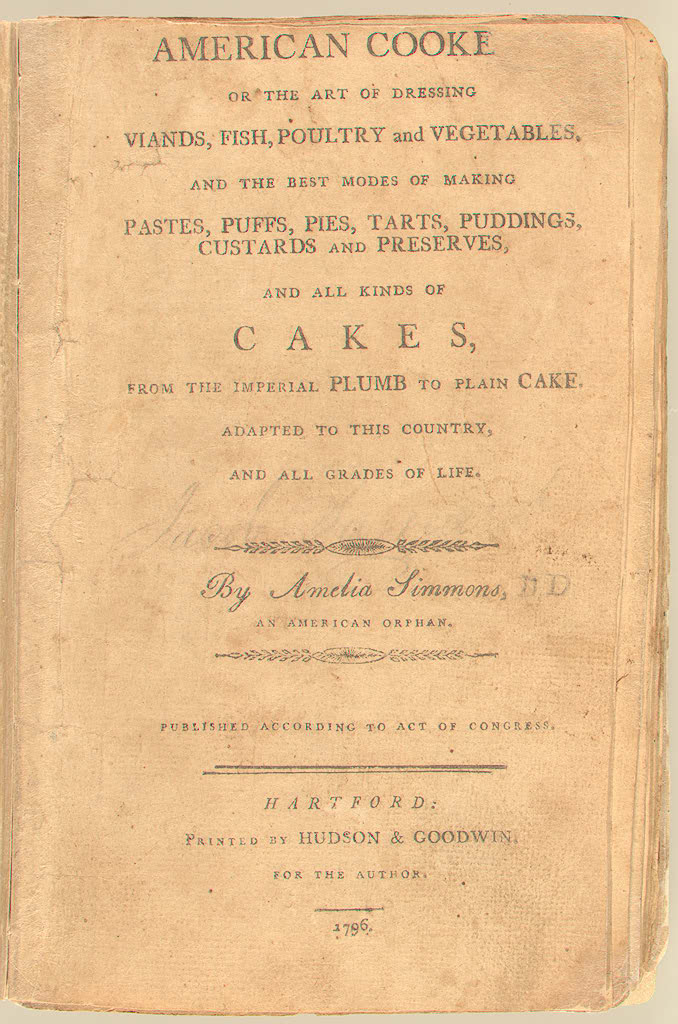
Image via Wikimedia Commons
On the off chance Lin-Manuel Miranda is casting around for source material for his next American history-based blockbuster musical, may we suggest American Cookery by “poor solitary orphan” Amelia Simmons?
First published in 1796, at 47 pages (nearly three of them are dedicated to dressing a turtle), it’s a far quicker read than the fateful Ron Chernow Hamilton biography Miranda impulsively selected for a vacation beach read.
Slender as it is, there’s no shortage of meaty material:
Calves Head dressed Turtle Fashion
Soup of Lamb’s Head and Pluck
Fowl Smothered in Oysters
Tongue Pie
Foot Pie
Modern chefs may find some of the first American cookbook’s methods and measurements take some getting used to.
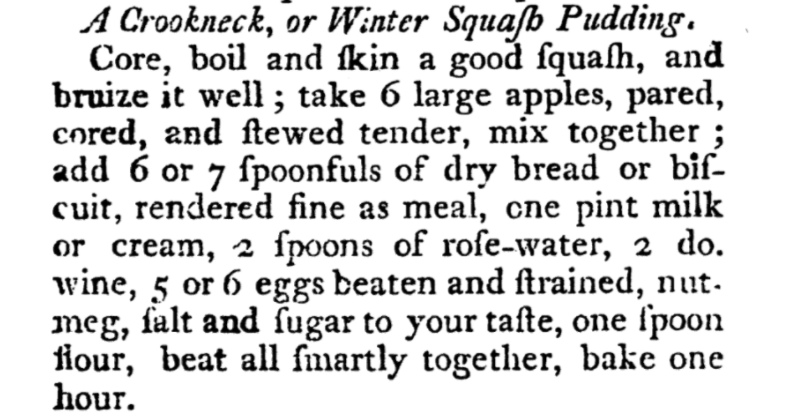
We like to cook, but we’re not sure we possess the wherewithal to tackle a Crookneck or Winter Squash Pudding.
We’ve never been called upon to “perfume” our “whipt cream” with “musk or amber gum tied in a rag.”
And we wouldn’t know a whortleberry if it bit us in the whitpot.
The book’s full title is an indication of its mysterious author’s ambitions for the new country’s culinary future:
American Cookery, or the art of dressing viands, fish, poultry, and vegetables, and the best modes of making pastes, puffs, pies, tarts, puddings, custards, and preserves, and all kinds of cakes, from the imperial plum to plain cake: Adapted to this country, and all grades of life.
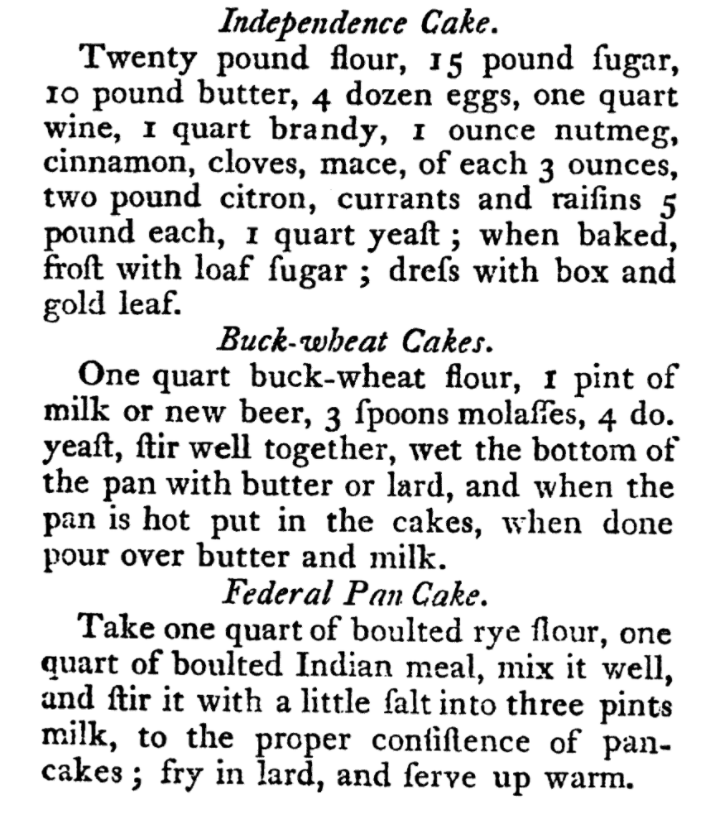
As Keith Stavely and Kathleen Fitzgerald write in an essay for What It Means to Be an American, a “national conversation hosted by the Smithsonian and Arizona State University,” American Cookery managed to straddle the refined tastes of Federalist elites and the Jeffersonians who believed “rustic simplicity would inoculate their fledgling country against the corrupting influence of the luxury to which Britain had succumbed”:
The recipe for “Queen’s Cake” was pure social aspiration, in the British mode, with its butter whipped to a cream, pound of sugar, pound and a quarter of flour, 10 eggs, glass of wine, half-teacup of delicate-flavored rosewater, and spices. And “Plumb Cake” offered the striving housewife a huge 21-egg showstopper, full of expensive dried and candied fruit, nuts, spices, wine, and cream.
Then—mere pages away—sat johnnycake, federal pan cake, buckwheat cake, and Indian slapjack, made of familiar ingredients like cornmeal, flour, milk, water, and a bit of fat, and prepared “before the fire” or on a hot griddle. They symbolized the plain, but well-run and bountiful, American home. A dialogue on how to balance the sumptuous with the simple in American life had begun.
(Hamilton fans will please note that the cake for the 1780 Schuyler-Hamilton wedding leaned more toward the former than anything in the johnnycake / slapjack vein…)
American Cookery is one of nine 18th-century titles to make the Library of Congress’ list of 100 Books That Shaped America:
This cornerstone in American cookery is the first cookbook of American authorship to be printed in the United States. Numerous recipes adapting traditional dishes by substituting native American ingredients, such as corn, squash and pumpkin, are printed here for the first time. Simmons’ “Pompkin Pudding,” baked in a crust, is the basis for the classic American pumpkin pie. Recipes for cake-like gingerbread are the first known to recommend the use of pearl ash, the forerunner of baking powder.
Students of Women’s History will find much to chew on in the second edition of American Cookery as well, though they may find a few spoonfuls of pearl ash dissolved in water necessary to settle upset stomachs after reading Simmons’ introduction.
Stavely and Fitzgerald observe how “she thanks the fashionable ladies,” or “respectable characters,” as she calls them, who have patronized her work, before returning to her main theme: the “egregious blunders” of the first edition, “which were occasioned either by the ignorance, or evil intention of the transcriber for the press.”
Ultimately, all of her problems stem from her unfortunate condition; she is without “an education sufficient to prepare the work for the press.” In an attempt to sidestep any criticism that the second edition might come in for, she writes: “remember, that it is the performance of, and effected under all those disadvantages, which usually attend, an Orphan.”
Read the second edition of American Cookery here. (If the archaic font troubles your eyes, a plainer version is here.) A facsimile edition of American Cookery can be purchased online.
Listen to a LibriVox audio recording of American Cookery here.
Note: An earlier version of this post appeared on our site in 2022.
Related Content:
Explore an Online Archive of 12,700 Vintage Cookbooks
The World’s Oldest Cookbook: Discover 4,000-Year-Old Recipes from Ancient Babylon
Discover the World’s Oldest Surviving Cookbook, De Re Coquinaria, from Ancient Rome
An Archive of 3,000 Vintage Cookbooks Lets You Travel Back Through Culinary Time
Ayun Halliday is an author, illustrator, theater maker and Chief Primatologist in NYC.
The Powerful Messages That Woody Guthrie & Pete Seeger Inscribed on Their Guitar & Banjo: “This Machine Kills Fascists” and “This Machine Surrounds Hate and Forces it to Surrender”

Photo by Al Aumuller, via Wikimedia Commons
Like another famous Okie from Muskogee, Woody Guthrie came from a part of Oklahoma that the U.S. government sold during the 1889 land rush away from the Quapaw and Osage nations, as well as the Muscogee, a people who had been forcibly relocated from the Southeast under Andrew Jackson’s Indian Removal Act. By the time of Guthrie’s birth in 1912 in Okfuskee County, next to Muskogee, the region was in the hands of conservative Democrats like Guthrie’s father Charles, a landowner and member of the revived KKK who participated in a brutal lynching the year before Guthrie was born.
Guthrie was named after president Woodrow Wilson, who was highly sympathetic to Jim Crow (but perhaps not, as has been alleged, an admirer of the Klan). While he inherited many of his father’s attitudes, he reconsidered them to such a degree later in life that he wrote a song denouncing the notoriously racist New York landlord Fred Trump, father of the current president. “By the time he moved into his new apartment” in Brooklyn in 1950, writes Will Kaufman at The Guardian, Guthrie “had traveled a long road from the casual racism of his Oklahoma youth.”
Guthrie was deeply embedded in the formative racial politics of the country. While some people may convince themselves that a time in the U.S. past was “great”—unmarred by class conflict and racist violence and exploitation, secure in the hands of a benevolent white majority—Guthrie’s life tells a much more complex story. Many Indigenous people feel with good reason that Guthrie’s most famous song, “The Land is Your Land,” has contributed to nationalist mythology. Others have viewed the song as a Marxist anthem. Like much else about Guthrie, and the country, it’s complicated.
Considered by many, Stephen Petrus writes, “to be the alternative national anthem,” the song “to many people… represents America’s best progressive and democratic traditions.” Guthrie turned the song into a hymn for the struggle against fascism and for the nascent Civil Rights movement. Written in New York in 1940 and first recorded for Moe Asch’s Folkways Records in 1944, “This Land is Your Land” evolved over time, dropping verses protesting private property and poverty after the war in favor of a far more patriotic tone. It was a long evolution from embittered parody of “God Bless America” to “This land was made for you and me.”
But whether socialist or populist in nature, Guthrie’s patriotism was always subversive. “By 1940,” writes John Pietaro, he had “joined forces with Pete Seeger in the Almanac Singers,” who “as a group, joined the Communist Party. Woody’s guitar had, by then, been adorned with the hand-painted epitaph, THIS MACHINE KILLS FASCISTS.” (Guthrie had at least two guitars with the slogan scrawled on them, one on a sticker and one with ragged hand-lettering.) The phrase, claims music critic Jonny Whiteside, was originally “a morale-boosting WWII government slogan printed on stickers that were handed out to defense plant workers.” Guthrie reclaimed the propaganda for folk music’s role in the culture. As Pietaro tells it:
In this time he also founded an inter-racial quartet with Leadbelly, Sonny Terry and Cisco Houston, a veritable super-group he named the Headline Singers. This group, sadly, never recorded. The material must have stood as the height of protest song—he’d named it in opposition to a producer who advised Woody to “stop trying to sing the headlines.” Woody told us that all you can write is what you see.
You can hear The Headline Singers above, minus Lead Belly and featuring Pete Seeger, in the early 1940’s radio broadcast of “All You Fascists Bound to Lose.” “I’m gonna tell you fascists,” sings Woody, “you may be surprised, people in this world are getting organized.” Upon joining the Merchant Marines, Guthrie fought against segregation in the military. After the war, he “stood shoulder to shoulder with Paul Robeson, Howard Fast, and Pete Seeger” against violent racist mobs in Peekskill, New York. Both of Guthrie’s anti-fascist guitars have seemingly disappeared. As Robert Santelli writes, “Guthrie didn’t care for his instruments with much love.” But during the decade of the 1940’s he was never seen without the slogan on his primary instrument.
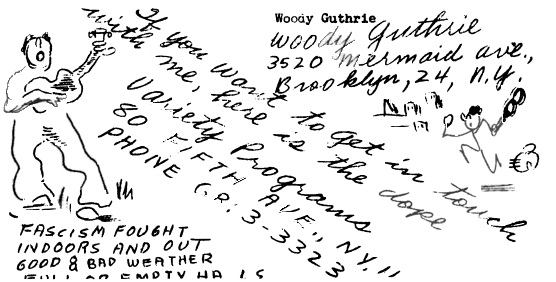
“This Machine Kills Fascists” has since, writes Motherboard, become Guthrie’s “trademark slogan… still referenced in pop culture and beyond” and providing an important point of reference for the anti-fascist punk movement. You can see another of Guthrie’s anti-fascist slogans above, which he scrawled on a collection of his sheet music: “Fascism fought indoors and out, good & bad weather.” Guthrie’s long-lived brother-in-arms Pete Seeger, carried on in the tradition of anti-fascism and anti-racism after Woody succumbed in the last two decades of his life to Huntington’s disease. Like Guthrie, Seeger painted a slogan around the rim of his instrument of choice, the banjo, a message both playful and militant: “This machine surrounds hate and forces it to surrender.”
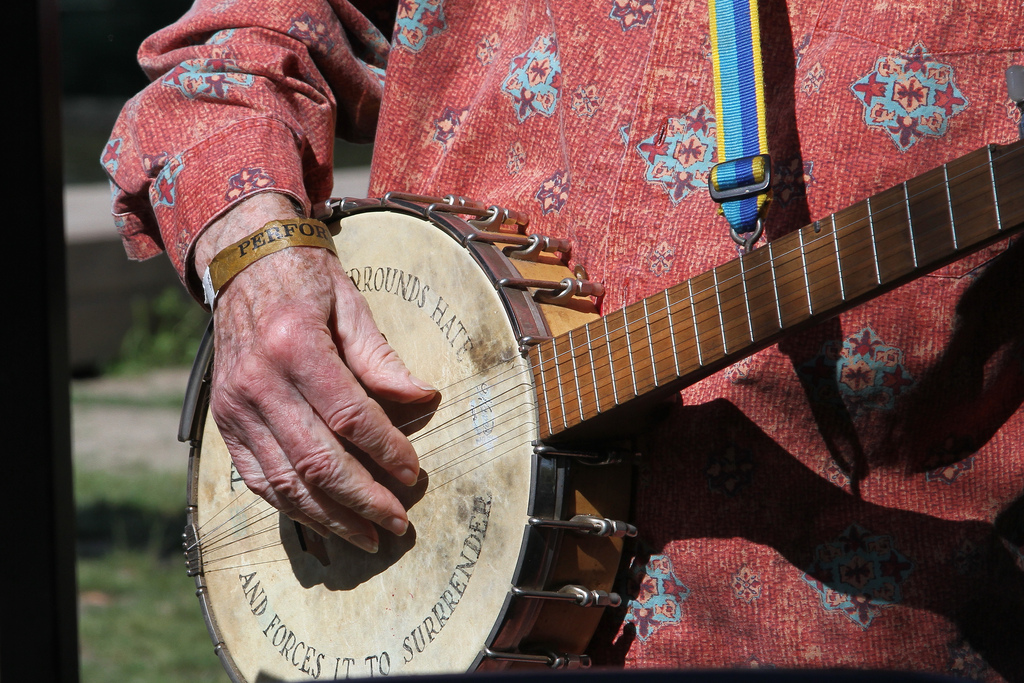
Photo by “Jim, the Photographer”
Seeger carried the message from his days playing and singing with Guthrie, to his Civil Rights and anti-war organizing and protest in the 50s and 60s, and all the way into the 21st century at Occupy Wall Street in Manhattan in 2011. At the 2009 inauguration of Barack Obama, Seeger sang “This Land is Your Land” onstage with Bruce Springsteen and his son, Tao-Rodriquez Singer. In rehearsals, he insisted on singing the two verses Guthrie had omitted from the song after the war. “So it was,” writes John Nichols at The Nation, “that the newly elected president of the United States began his inaugural celebration by singing and clapping along with an old lefty who remembered the Depression-era references of a song that took a class-conscious swipe at those whose ‘Private Property’ signs turned away union organizers, hobos and banjo pickers.”
Both Guthrie and Seeger drew direct connections between the fascism and racism they fought and capitalism’s outsized, destructive obsession with land and money. They felt so strongly about the battle that they wore their messages figuratively on their sleeves and literally on their instruments. Pete Seeger’s famous banjo has outlived its owner, and the colorful legend around it has been mass-produced by Deering Banjos. Where Guthrie’s anti-fascist guitars went off to is anyone’s guess, but if one of them were ever discovered, Robert Santelli writes, “it surely would become one of America’s most valued folk instruments.” Or one of its most valued instruments in general.
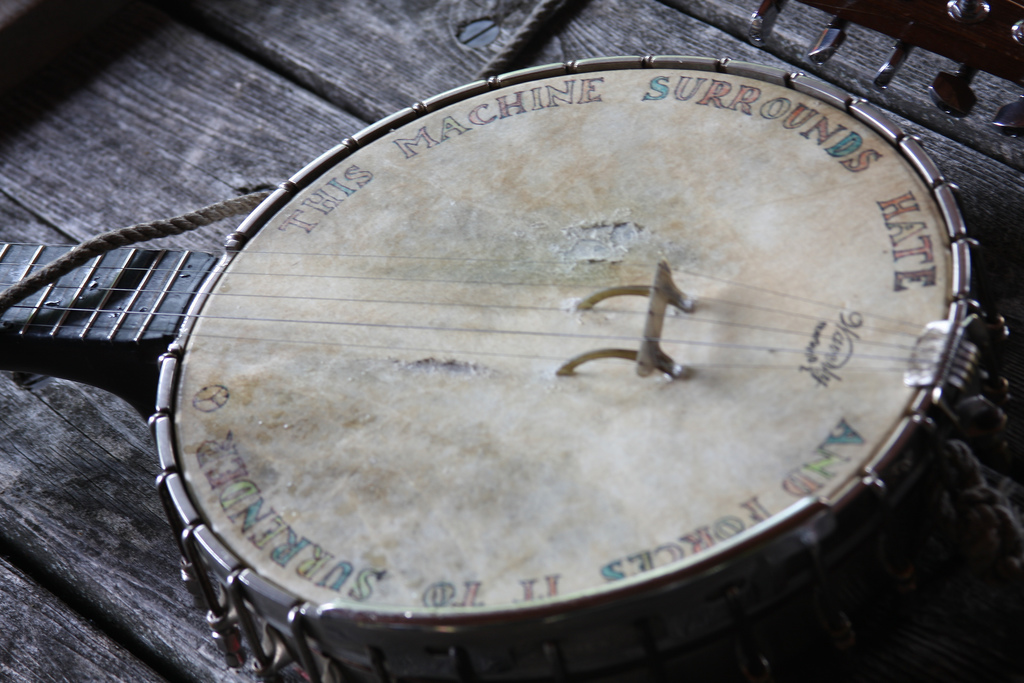
Photo by “Jim, the Photographer”
Note: An earlier version of this post appeared on our site in 2017.
Related Content:
Bruce Springsteen Won’t Back Down: Performs “Streets of Minneapolis” Live in Minneapolis
Hear Two Legends, Lead Belly & Woody Guthrie, Performing on the Same Radio Show (1940)
The Nazis’ 10 Control-Freak Rules for Jazz Performers: A Strange List from World War II
Josh Jones is a writer and musician based in Durham, NC.
Read More...Scott Galloway Unveils “Resist and Unsubscribe,” an Action Plan for Consumers to Push Back Against Government Overreach
As mentioned here last week, Scott Galloway argued that Americans have one way to reverse the violent overreach of the federal government: launch a one-month economic strike aimed at major tech and AI companies, with the goal of reducing America’s GDP and making the markets wobble. When the markets gyrated after “Liberation Day,” President Trump immediately rolled back many tariffs. Now, if Americans can flex their economic muscles in February, Galloway wagers the administration will rethink whether it wants to keep arresting journalists and letting masked ICE agents shoot civilians in the streets—with impunity.
Today, Galloway has launched a new website, Resist and Unsubscribe, that provides an action plan for a monthlong strike. In the “Ground Zero” section of the site, Galloway lists subscription services from America’s largest technology companies—Amazon, Meta, Google, Apple, Netflix, OpenAI, and Microsoft—and provides links that let users unsubscribe quickly. He also suggests holding off on buying new hardware and products from these companies (e.g. iPhones). If you use February to review your subscriptions and find ones to cut, you’ll clean up your personal finances. You’ll also get the attention of the major technology companies that account for one-third of the S&P 500. When the tech CEOs get “yippy,” so too will Trump.
In the “Blast Zone” section of Resist and Unsubscribe, Galloway lists consumer‑facing companies he has “identified as active enablers of ICE,” naming AT&T, Comcast, Lowe’s, Marriott, and Spotify among others. He explains how these companies support ICE and recommends specific services you can cancel or avoid. Scroll down the page to see these suggestions.
Visit Resist and Unsubscribe, find some services to cancel (it’s not a large sacrifice), and spread the word. You can also find more information about the Resist and Unsubscribe movement on Galloway’s blog, “No Mercy/No Malice.”
Related Content
Scott Galloway Explains How YOU Can Stop Government Overreach Using the Power of Your Purse
Bruce Springsteen Revives the Protest Song, Condemns ICE Violence in “Streets of Minneapolis”
Read More...Support Us
We're hoping to rely on loyal readers, rather than erratic ads. Please click the Donate button and support Open Culture. You can use Paypal, Venmo, Patreon, even Crypto! We thank you!

About Us

Open Culture scours the web for the best educational media. We find the free courses and audio books you need, the language lessons & educational videos you want, and plenty of enlightenment in between.
Advertise With Us
FREE UPDATES!
GET OUR DAILY EMAIL
Get the best cultural and educational resources on the web curated for you in a daily email. We never spam. Unsubscribe at any time.
FOLLOW ON SOCIAL MEDIA
Open Culture editor Dan Colman scours the web for the best educational media. He finds the free courses and audio books you need, the language lessons & movies you want, and plenty of enlightenment in between.
Advertise With Us



.jpg)
