Bruce Springsteen Revives the Protest Song, Condemns ICE Violence in “Streets of Minneapolis”
If there’s a silver lining to our tumultuous times, it’s that musicians are reviving the protest song, a tradition that has withered since the end of the Vietnam War. Credence Clearwater Revival’s “Fortunate Son,” Arlo Guthrie’s “Alice’s Restaurant,” Jimi Hendrix’s “Machine Gun”—these songs all took aim at the Johnson and Nixon administrations’ increasingly misguided war effort. But it was Neil Young who wrote the most damning protest song. When the Ohio National Guard shot and killed four students at Kent State in 1970, Young disappeared for a few hours and returned with the haunting lyrics of “Ohio.”
Tin soldiers and Nixon coming,
We’re finally on our own.
This summer I hear the drumming,
Four dead in Ohio.Gotta get down to it
Soldiers are cutting us down
Should have been done long ago.
What if you knew her
And found her dead on the ground
How can you run when you know?
With his new song released this week, Bruce Springsteen picks up this thread. “Streets Of Minneapolis” documents the murder of civilians in Minnesota’s largest city. On January 7, ICE agent Jonathan Ross shot Renee Good repeatedly in the head, leaving the mother of three dead. On January 24, two federal agents fired at least 10 shots at Alex Pretti, killing the ICU nurse instantly. Days later, the identity of these murderers remains hidden—something that news organizations oddly don’t seem troubled by, almost as if we’re quietly accepting that we’re living in a police state. When was the last time American agents could wear masks before killing civilians, and then hide behind a veil of anonymity after? Yeah, that’s normal.
On social media, Springsteen wrote: “I wrote this song on Saturday, recorded it yesterday and released it to you today in response to the state terror being visited on the city of Minneapolis. It’s dedicated to the people of Minneapolis, our innocent immigrant neighbors and in memory of Alex Pretti and Renee Good.” You can read the lyrics below.
Through the winter’s ice and cold
Down Nicollet Avenue
A city aflame fought fire and ice
‘Neath an occupier’s boots
King Trump’s private army from the DHS
Guns belted to their coats
Came to Minneapolis to enforce the law
Or so their story goes
Against smoke and rubber bullets
By the dawn’s early light
Citizens stood for justice
Their voices ringing through the night
And there were bloody footprints
Where mercy should have stood
And two dead left to die on snow-filled streets
Alex Pretti and Renee Good
Oh our Minneapolis, I hear your voice
Singing through the bloody mist
We’ll take our stand for this land
And the stranger in our midst
Here in our home they killed and roamed
In the winter of ’26
We’ll remember the names of those who died
On the streets of Minneapolis
Trump’s federal thugs beat up on
His face and his chest
Then we heard the gunshots
And Alex Pretti lay in the snow, dead
Their claim was self defense, sir
Just don’t believe your eyes
It’s our blood and bones
And these whistles and phones
Against Miller and Noem’s dirty lies
Oh our Minneapolis, I hear your voice
Crying through the bloody mist
We’ll remember the names of those who died
On the streets of Minneapolis
Now they say they’re here to uphold the law
But they trample on our rights
If your skin is black or brown my friend
You can be questioned or deported on sight
In chants of ICE out now
Our city’s heart and soul persists
Through broken glass and bloody tears
On the streets of Minneapolis
Oh our Minneapolis, I hear your voice
Singing through the bloody mist
Here in our home they killed and roamed
In the winter of ’26
We’ll take our stand for this land
And the stranger in our midst
We’ll remember the names of those who died
On the streets of Minneapolis
We’ll remember the names of those who died
On the streets of Minneapolis
Related Content
Nina Simone’s Live Performances of Her Poignant Civil Rights Protest Songs
Read More...RIP Gladys Mae West, the Pioneering Black Mathematician Who Helped Lay the Foundation for GPS
Gladys Mae West was born in rural Virginia in 1930, grew up working on a tobacco farm, and died earlier this month a celebrated mathematician whose work made possible the GPS technology most of us use each and every day. Hers was a distinctively American life, in more ways than one. Seeking an escape from the agricultural labor she’d already gotten to know all too well, she won a scholarship to Virginia State College by becoming her high school class valedictorian; after earning her bachelor’s and master’s degrees in mathematics, she taught for a time and then applied for a job at the naval base up in Dahlgren. She first distinguished herself there by verifying the accuracy of bombing tables with a hand calculator, and from there moved on up to the computer programming team.
This was the early nineteen-sixties, when programming a computer meant not coding, but laboriously feeding punch cards into an enormous mainframe. West and her colleagues used IBM’s first transistorized machine, the 7030 (or “Stretch”), which was for a few years the fastest computer in the world.
It cost an equivalent of $81,860,000 in today’s dollars, but no other computer had the power to handle the project of calculating the precise shape of Earth as affected by gravity and the nature of the oceans. About a decade later, another team of government scientists made use of those very same calculations when putting together the model employed by the World Geodetic System, which GPS satellites still use today. Hence the tendency of celebratory obituaries to underscore the point that without West’s work, GPS wouldn’t be possible.
Nor do any of them neglect to point out the fact that West was black, one of just four such mathematicians working for the Navy at Dahlgren. Stories like hers have drawn much greater public interest since the success of Hidden Figures, the Hollywood adaptation of Margot Lee Shetterly’s book about the black female mathematicians at NASA during the Space Race. When that movie came out, in 2016, even West’s own children didn’t know the importance of the once-classified work she’d done. Only in 2018, when she provided that information on a biographical form she filled out for an event hosted by her college sorority, did it become public. She thus spent the last years of her long life as a celebrity, sought out by academics and journalists eager to understand the contributions of another no-longer-hidden figure. But to their questions about her own GPS use, she reportedly answered that she preferred a good old-fashioned paper map.
Related content:
Black History in Two Minutes: Watch 93 Videos Written & Narrated by Henry Louis Gates Jr.
Based in Seoul, Colin Marshall writes and broadcasts on cities, language, and culture. He’s the author of the newsletter Books on Cities as well as the books 한국 요약 금지 (No Summarizing Korea) and Korean Newtro. Follow him on the social network formerly known as Twitter at @colinmarshall.
Read More...Lessons in Creativity from Rick Rubin: Focus on Your Art, Not the Audience
If you’ve heard Run‑D.M.C.‘s Raising Hell, Rage Against the Machine’s self-titled debut, Johnny Cash’s American Recordings, or Adele’s 21, you’ve heard the work of Rick Rubin. Yet even if you’ve listened closely to every song on which he’s been credited as a producer over the past 45 years, you may have trouble pinning down what, exactly, the work of Rick Rubin is. Though his résumé includes such professional achievements as co-founding both Def Jam Recordings and American Recordings, as well as sharing the presidency of Columbia Records for a stretch, he’s become best known in recent years as a kind of barefoot sage of creativity.
Rubin has proven ready to dispense sometimes-cryptic wisdom in whatever contexts he finds himself, and in the twenty-twenties, that role naturally involves appearing on a lot of long-form interview podcasts.
For Rubin in particular, the publication of his book The Creative Act: A Way of Being constituted an incentive — or perhaps an excuse — to take a seat across from popular podcasters like Lex Fridman, Jay Shetty, and Andrew Huberman. Naturally, these conversations spend a good deal of time on questions of what it takes to create a work of art, great or otherwise, in music or whichever medium it may be.
One of the most surprising points to which Rubin returns again and again is that the best art is never made to please an audience. Instead of trying to anticipate the tastes of others, you must first satisfy yourself with your work. Think back to your first encounter with your very favorite albums, films, or books, and you’ll realize the truth of Rubin’s words. Even then, it must have felt like the musician, the director, or the author didn’t guess what you wanted, but worked to create something personally resonant that went on to resonate with you — and, perhaps, millions of others as well.
The factors involved in such an artistic connection are many and inscrutable, in Rubin’s telling, and attempts at their explanation tend to verge on the mystical. But they can’t be reduced to a formula that applies always and everywhere, which means that creators of all kinds have to go through experience after long experience of trial and error throughout their careers. For many, this can necessitate getting a day job, Rubin’s advocacy of which puts him at odds with another of the most famous music producer/gurus of all time. But then, there’s more than one way to get creative in this world.
Related content:
Rick Rubin: The Invisibility of Hip Hop’s Greatest Producer
The Beastie Boys & Rick Rubin Reunite and Revisit Their Formative Time Together in 1980s NYC
Rick Rubin Revisits the Origins of Def Jam Records & the NYU Dorm Room Where It All Began
Malcolm Gladwell and Rick Rubin Launch a New Music Podcast, Broken Record: Listen Online
Based in Seoul, Colin Marshall writes and broadcasts on cities, language, and culture. He’s the author of the newsletter Books on Cities as well as the books 한국 요약 금지 (No Summarizing Korea) and Korean Newtro. Follow him on the social network formerly known as Twitter at @colinmarshall.
Read More...Discover the World’s First Earthquake Detector, Invented in China 2,000 Years Ago
The Renaissance did not, strictly speaking, occur in China. Yet it seems that the Middle Kingdom did have its Renaissance men, so to speak, and in much earlier times at that. We find one such illustrious figure in the Han dynasty of the first and second centuries: a statesman named Zhang Heng (78–139 AD), who managed to distinguish himself across a range of fields from mathematics to astronomy to philosophy to poetry. His accomplishments in science and technology include inventing the first hydraulic armillary sphere for observing the heavens, improving water clocks with a secondary tank, calculating pi further than it had been in China to date, and making discoveries about the nature of the moon. He also, so records show, put together the first-ever seismoscope, a device for detecting earthquakes.
A visual explanation of Zhang’s design appears in the ScienceWorld video above. His seismoscope, its narrator says, “was called hòufēng dìdòngyí, which means ‘instrument for measuring seasonal winds and movements of the earth,’ ” and it could “determine roughly the direction in which an earthquake occurred.”
Each of its eight dragon heads (a combination of number and creature that, in China, could hardly be more auspicious) holds a ball; when the ground shook, the dragon pointing toward the epicenter of the quake drops its ball into the mouth of one of the decorative toads waiting below. At one time, as history has recorded, it “detected an earthquake 650 kilometers, or 400 miles away, that wasn’t felt at the location of the seismoscope.”
Not bad, considering that neither Zhang nor anyone else had yet heard of tectonic plates. But as all engineers know, practical devices often work just fine even in the absence of completely sound theory. Though no contemporary examples of hòufēng dìdòngyí survive from Zhang’s time, “researchers believe that inside the seismoscope were a pendulum, a bronze ball under the pendulum, eight channels, and eight levers that activated the dragons’ mouths.” Moving in response to a shock wave, the pendulum would release the ball in the opposite direction, which would roll down a channel and release the mouth at the end of it. However innovative it was for its time, this scheme could, of course, provide no information about exactly how far away the earthquake happened, to say nothing of prediction. Fortunately, centuries of Renaissance men still lay ahead to figure all that out.
Related Content:
Based in Seoul, Colin Marshall writes and broadcasts on cities, language, and culture. He’s the author of the newsletter Books on Cities as well as the books 한국 요약 금지 (No Summarizing Korea) and Korean Newtro. Follow him on the social network formerly known as Twitter at @colinmarshall.
Read More...Brazilian Musician Seu Jorge Performs 15 Iconic Bowie Songs in Portuguese to Mark the 10th Anniversary of Bowie’s Passing
In 2004, the Brazilian musician Seu Jorge recorded a series of Portuguese covers of David Bowie songs for Wes Anderson’s film The Life Aquatic with Steve Zissou. The next year, he released a full album of 13 Bowie classics, and in 2016–2017, he even took the songs on tour. Now, in 2026, to mark the 10th anniversary of Bowie’s passing, Jorge returns with the performance above. Set against a beautiful Brazilian coastline, he sings some of Bowie’s most beloved tracks, all while in character as Pelé dos Santos, the role he played in Anderson’s film. See the full track list below and enjoy.
Lady Stardust
Rock ’n’ Roll Suicide
Queen Bitch
Oh! You Pretty Things
Suffragette City
Changes
Rebel Rebel
Quicksand
Five Years
Team Zissou
Ziggy Stardust
Space Oddity
When I Live My Dream
Life on Mars?
Starman
Related Content
David Bowie’s 100 Must Read Books
Every Wes Anderson Movie, Explained by Wes Anderson
Why Do Wes Anderson Movies Look Like That?
The Art Collection of David Bowie: An Introduction
Read More...Watch the Evolution of Paris Unfold in a Timelapse Video, from 300 BCE to 2025
Though it’s easily forgotten in our age of air travel and instantaneous global communication, many a great city is located where it is because of a river. That holds true everywhere from London to Buenos Aires to Tokyo to New York — and even to Los Angeles, despite its own once-uncontrollable river having long since been turned into a much-ridiculed concrete drainage channel. But no urban waterway has been quite so romanticized for quite so long as the Seine, which runs through the middle of Paris. And it was in the middle of the Seine, on the now-aptly named Île de la Cité, that Paris began. In the 3D time-lapse video above, you can witness the nearly two-and-a-half-millennium evolution of that tiny settlement into the capital we know today in just three minutes.
Paris didn’t take its shape in a simple process of outward growth. As is visible from high above through the video’s animation, the city has grown differently in each era of its existence, whether it be that of the Parisii, the tribe from whom it takes its name; of the Roman Empire, which constructed the standard Cardo Maximus (now known as the Rue Saint-Jacques) and Decumanus Maximus, among much other infrastructure; the Middle Ages, amid whose great (and haphazard) densification rose Notre-Dame de Paris; or the time of Baron Haussmann, whose radical urban renovations laid waste to great swathes of medieval Paris and replaced them with the broad avenues, stately residential buildings, and grand monuments recognized around the world today.
At first glance, the built environment of modern Paris can seem to have been frozen in Haussmann’s mid-nineteenth century — and no doubt, that’s just the way its countless many tourists might want it. But as shown in the video, the Ville Lumière has kept changing throughout the industrial era, and hasn’t stopped in the succeeding “globalization era.” More growth and transformation has lately taken place outside central Paris, beyond the encircling Boulevard Périphérique, but it would hardly do justice to history to ignore such more relatively recent, more divisive additions as the Tour Montparnasse, the Centre Pompidou, or the Louvre Pyramid. (When it was built in the eighteen-eighties, even the beloved Eiffel Tower drew a great deal of ire and disdain.) And though the venerable Notre-Dame may have stood on Île de la Cité since the fourteenth century, the thoroughgoing reconstruction that followed its 2019 fire has made it belong just as much to the twenty-first.
Related content:
A 3D Animated History of Paris: Take a Visual Journey from Ancient Times to 1900
How Paris Became Paris: The Story Behind Its Iconic Squares, Bridges, Monuments & Boulevards
A 3D Animation Reveals What Paris Looked Like When It Was a Roman Town
Take an Aerial Tour of Medieval Paris
The Architectural History of the Louvre: 800 Years in Three Minutes
Based in Seoul, Colin Marshall writes and broadcasts on cities, language, and culture. He’s the author of the newsletter Books on Cities as well as the books 한국 요약 금지 (No Summarizing Korea) and Korean Newtro. Follow him on the social network formerly known as Twitter at @colinmarshall.
Read More...Miles Davis Opens for Neil Young and “That Sorry-Ass Cat” Steve Miller at The Fillmore East (1970)
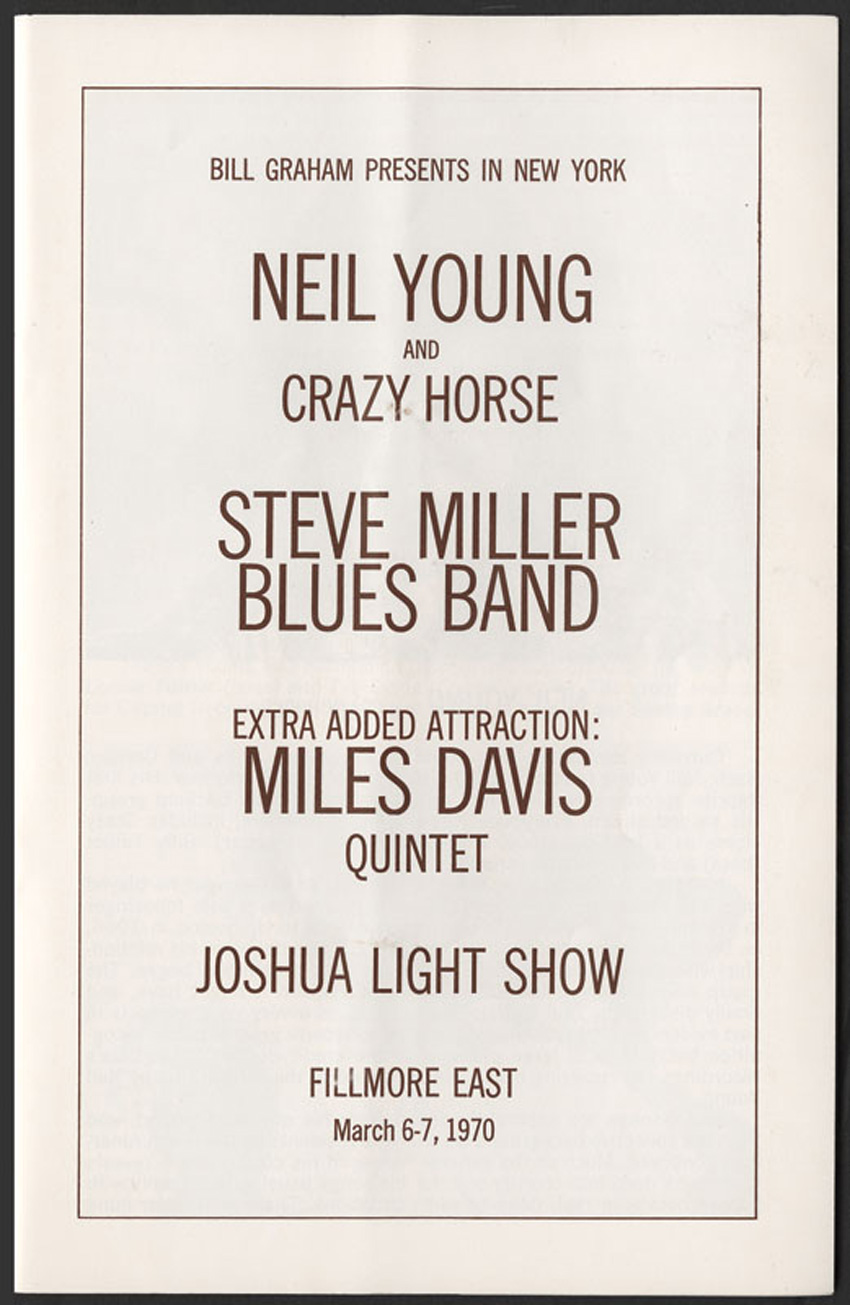
The story, the many stories, of Miles Davis as an opening act for several rock bands in the 1970s makes for fascinating reading. Before he blew the Grateful Dead’s minds as their opening act at the Fillmore West in April 1970 (hear both bands’ sets here), Davis and his all-star Quintet—billed as an “Extra Added Attraction”—did a couple nights at the Fillmore East, opening for Neil Young and Crazy Horse and The Steve Miller Band in March of 1970. The combination of Young and Davis actually seems to have been rather unremarkable, but there is a lot to say about where the two artists were individually.
Nate Chinen in At Length describes their meeting as a “minimum orbit intersection distance”—the “closest point of contact between the paths of two orbiting systems.” Both artists were “in the thrall of reinvention,” Young moving away from the smoothness of CSNY and into free-form anti-virtuosity with Crazy Horse; Davis toward virtuosity turned back into the blues.
Miles, suggested jazz writer Greg Tate, was “bored fiddling with quantum mechanics and just wanted to play the blues again.” The story of Davis and Young at the Fillmore East is best told by listening to the music both were making at the time. Hear “Cinnamon Girl” below and the rest of Neil Young and Crazy Horse’s incredible set here. The band had just released their beautifully ragged Everybody Knows this is Nowhere.
When it comes to the meeting of Davis and Steve Miller, the story gets juicier, and much more Miles: the difficult performer, not the impossibly cool musician. (It sometimes seems like the word “difficult” was invented to describe Miles Davis.) The trumpeter’s well-earned egotism lends his legacy a kind of rakish charm, but I don’t relish the positions of those record company executives and promoters who had to wrangle him, though many of them were less than charming individuals themselves. Columbia Records’ Clive Davis, who does not have a reputation as a pushover, sounds alarmed in his recollection of Miles’ reaction after he forced the trumpeter to play the Fillmore dates to market psychedelic jazz-funk masterpiece Bitches Brew to white audiences.
According to John Glatt, Davis remembers that Miles “went nuts. He told me he had no interest in playing for ‘those fu*king long-haired kids.’” Particularly offended by The Steve Miller Band, Davis refused to arrive on time to open for an artist he deemed “a sorry-ass cat,” forcing Miller to go on before him. “Steve Miller didn’t have his shit going for him,” remembers Davis in his expletive-filled autobiography, “so I’m pissed because I got to open for this non-playing motherfu*ker just because he had one or two sorry-ass records out. So I would come late and he would have to go on first and then when we got there, we smoked the motherfu*king place, and everybody dug it.” There is no doubt Davis and Quintet smoked. Hear them do “Directions” above from an Early Show on March 6, 1970.
“Directions,” from unreleased tapes, is as raw as they come, “the intensity,” writes music blog Willard’s Wormholes, “of a band that sounds like they were playing at The Fillmore to prove something to somebody… and did.” The next night’s performances were released in 2001 as It’s About That Time. Hear the title track above from March 7th. You can also stream more on YouTube. As for The Steve Miller Blues Band? We have audio of their performance from that night as well. Hear it below. It’s inherently an unfair comparison between the two bands, not least because of the vast difference in audio quality. But as for whether or not they sound like “sorry-ass cats”… well, you decide.
Note: An earlier version of this post appeared on our site in 2015.
Related Content:
The Night When Miles Davis Opened for the Grateful Dead in 1970: Hear the Complete Recordings
In 1969 Telegram, Jimi Hendrix Invites Paul McCartney to Join a Super Group with Miles Davis
Josh Jones is a writer and musician based in Durham, NC.
Read More...MTV Rewind Lets You Revisit 40,000 Music Videos & Commercials from the Golden Age of MTV

MTV still exists. At least, it still exists in the United States, or in certain of that country’s markets, for the time being. A flurry of premature obituaries recently blew through the internet after the announcement that the network had shut down in other parts of the world, Europe included. But even there, some expressed the sentiment that MTV had already died long before. And indeed, in the U.S., where it originally launched, asking who remembers when MTV actually used to play music videos has been a common lament for decades, aired even by generations too young to remember those days themselves. But members of any generation can now relive them — or live them for the first time — through a new site called MTV Rewind.
The first music video that greets the visitor is The Buggles’ “Video Killed the Radio Star,” and appropriately so, since it inaugurated MTV itself when it went live on August 1st, 1981. What follows are all the rest of the videos played on that first day, like Phil Collins’ “In the Air Tonight,” Blondie’s “Rapture,” David Bowie’s “Boys Keep Swinging,” and Kate Bush’s “Wuthering Heights.”
(Other, less widely remembered entries include no fewer than three songs by Cliff Richard, which speaks to the then-incomplete formation of the kind of pop-musical culture we still associate with MTV.) The site’s other playlists recreate other eras and genre-specific programs, from 120 Minutes to Total Request Live, Headbanger’s Ball to Yo! MTV Raps.
Currently, MTV Rewind’s music video count comes to about 40,000, enough to ensure any former addict of the network a stream of nostalgia hits. But the site’s creator (a 43-year-old American resident in Albania, according to the New York Times, known pseudonymously as “Flex”) has also incorporated vintage station IDs and commercials, many of them liable to trigger downright Proustian sensations in the right viewer. What may feel refreshing even to curious younger visitors is that, whichever channel they choose, the next video that plays is determined not by an algorithm attempting to predict their personal tastes. Rather, each playlist is shaped by the popular culture of a particular era, with enough left-field selections to keep it interesting: just the sort of thing in hopes of which we used to flip over to MTV, back when the idea of streaming video on our computers still sounded like sheerest fantasy. Enter MTV Rewind here.
Related Content:
Watch the First 2+ Hours of MTV’s Inaugural Broadcast (August 1, 1981)
All the Music Played on MTV’s 120 Minutes: A 2,500-Video Youtube Playlist
The Internet Archive Rescues MTV News’ Web Site, Making 460,000+ of Its Pages Searchable Again
The 50 Greatest Music Videos of All Time, Ranked by AV Club
Revisit Pop-Up Video: The VH1 Series That Reinvented Music Videos & Pop Culture
Based in Seoul, Colin Marshall writes and broadcasts on cities, language, and culture. He’s the author of the newsletter Books on Cities as well as the books 한국 요약 금지 (No Summarizing Korea) and Korean Newtro. Follow him on the social network formerly known as Twitter at @colinmarshall.
Read More...When Pianist Maria João Pires Prepared to Perform the Wrong Mozart Concerto, Then Recovered Miraculously
Imagine, if you will, taking a seat at the piano before a full house of 2,000 music lovers ready to hear Mozart’s Piano Concerto No. 20 in D minor — and, more importantly, on stage with an orchestra and conductor more than ready to play it. That would be difficult enough, but now imagine that you thought you were supposed to play the Piano Concerto No.23 in A major, another piece of music entirely. This is the stuff of nightmares, and indeed, the very situation in which pianist Maria João Pires found herself in 2013, after she’d been recruited to fill in for another player at an open rehearsal held at Amsterdam’s Concertgebouw. You can watch it unfold, assuming you can bear it, in the clip above.
As Pires says in the Classic FM interview below, it had been “perhaps 11 months” since she’d last played the piece into which she could hear the orchestra launching, “and that’s the moment where you start losing the memory of the details. That’s how the memory functions, you know. And when people see this panic, they perhaps don’t know that the reality is, we lose our memories after just a couple of months.”
It seems to have been the encouragement of conductor Riccardo Chailly that got her through the moment of panic and into a creditable performance. “You know it so well!” he insisted to her, and indeed, as he remembered later, “The miracle is that she has such a memory that she could, within a minute, switch to a new concerto without making one mistake.”
The eleventh-hour call Pires received asking her to take the gig was part of the problem, but so was a misheard number. According to the Köchel catalogue, which organizes all of Mozart’s work, the Piano Concerto No. 20 in D minor is 466, whereas the Piano Concerto No. 23 in A major is 488. Whether Pires misheard the K‑number or the caller misspoke, she soon found herself faced with a musical challenge for which she felt completely unprepared. In fact, she wasn’t: as Chailly knew, or at least banked on, her career as a classical pianist up to that point had given her all the experience she needed to draw upon to overcome the crisis. As her recovery reminds us, professionalism isn’t so much about making sure that things always go right as being able to handle it when they go wrong. It happens that Pires has gone through this particular kind of mix-up three times, which makes her a consummate professional indeed.
Related Content:
Watch the First Performance of a Mozart Composition That Had Been Lost for Centuries
Hear the Experimental Piano Jazz Album by Comedian H. Jon Benjamin — Who Can’t Play Piano
The Piano Played with 16 Increasing Levels of Complexity: From Easy to Very Complex
The Mistake Waltz: Watch the Hilarious Ballet by Legendary Choreographer Jerome Robbins
Based in Seoul, Colin Marshall writes and broadcasts on cities, language, and culture. He’s the author of the newsletter Books on Cities as well as the books 한국 요약 금지 (No Summarizing Korea) and Korean Newtro. Follow him on the social network formerly known as Twitter at @colinmarshall.
Read More...“Riders on the Storm” Performed by John Densmore, Robby Krieger and 20+ Musicians Around the World
Formed in 1965, the Doors burned hot until Jim Morrison died in 1971, and the band finally broke up in 1973. The group left behind more than a few fine songs—“Light My Fire,” “Break On Through (To the Other Side),” “L.A. Woman,” and “Roadhouse Blues,” to name a few. Above, the music collective Playing for Change pays tribute to another Doors classic, “Riders on the Storm.” Featuring performances by the two surviving Doors members John Densmore and Robby Krieger, the video also weaves in appearances by 20+ musicians, everyone from Lukas and Micah Nelson, to Don Was and Foo Fighters keyboardist Rami Jaffee. According to Playing for Change, the “performance reimagines the classic anthem as a meditation on unity, hope, and shared humanity,” qualities that otherwise seem in short supply today. Enjoy!
If you would like to support the mission of Open Culture, consider making a donation to our site. It’s hard to rely 100% on ads, and your contributions will help us continue providing the best free cultural and educational materials to learners everywhere. You can contribute through PayPal, Patreon, and Venmo (@openculture). Thanks!
Related Content
How the Doors Got Banned from The Ed Sullivan Show (1967)
“The Lost Paris Tapes” Preserves Jim Morrison’s Final Poetry Recordings from 1971
Jim Morrison Accurately Predicts the Future of Electronic Music in 1969
Read More...Support Us
We're hoping to rely on loyal readers, rather than erratic ads. Please click the Donate button and support Open Culture. You can use Paypal, Venmo, Patreon, even Crypto! We thank you!

About Us

Open Culture scours the web for the best educational media. We find the free courses and audio books you need, the language lessons & educational videos you want, and plenty of enlightenment in between.
Advertise With Us
FREE UPDATES!
GET OUR DAILY EMAIL
Get the best cultural and educational resources on the web curated for you in a daily email. We never spam. Unsubscribe at any time.
FOLLOW ON SOCIAL MEDIA
Open Culture editor Dan Colman scours the web for the best educational media. He finds the free courses and audio books you need, the language lessons & movies you want, and plenty of enlightenment in between.
Advertise With Us

