Elementary School Choir Sings the Grateful Dead’s “Ripple,” “Box of Rain,” “Brokedown Palace” & More: RIP Bob Weir
?si=euaFB6jMJ_TPxRmf
Down in Austin, Texas, music teacher Gavin Tabone leads the Barton Hills Choir, made up of 3rd- through 6th-grade students. Backed by professional musicians, the choir performs a wide-ranging mix of music, from classic pop and rock to indie songs by artists like Wilco, Muse, The Flaming Lips, and especially the Grateful Dead. Above and below, you can find performances of such Dead classics as “Ripple,” “Box of Rain” and “Going Down the Road Feeling Bad” → “I Know You Rider.” And if you head to their YouTube channel, you can find versions of “Cassidy,” “Touch of Grey,” “Scarlet Begonias,” “Brokedown Palace,” and more.
With the passing of Bob Weir this weekend, it seems like a fitting time to highlight these performances. Weir first joined the Dead when only a teenager, still basically a kid himself, and then continued the journey for the next 60 years, introducing the Dead’s songbook to successive generations of fans. In recent years, he talked about the Dead songbook enduring for the next 200 to 300 years, much as Beethoven remains with us today. As we watch elementary students perform Grateful Dead classics, it’s hard not to think that Weir was on to something.
Related Content
When the Grateful Dead Played at the Egyptian Pyramids, in the Shadow of the Sphinx (1978)
The Isolated Bass Grooves of The Grateful Dead’s Phil Lesh (RIP)
Stream a Massive Archive of Grateful Dead Concerts from 1965–1995
Read More...Trevor Noah Explains How Kintsugi, the Japanese Art of Repairing Pottery, Helped Him Overcome Life’s Tragedies
Trevor Noah ended his stint as the host of The Daily Show a little over three years ago, but he’s made himself into another kind of pop-cultural presence since then. In evidence, we have his appearance above on the popular podcast and YouTube show Diary of a CEO. For more than two and a half hours, Noah discusses with host Steven Bartlett (who, like Noah, also happens to be African-born with mixed parentage) his reasons for quitting that political-news-comedy TV institution, his struggles with depression, and the time his stepfather shot his mother in the head. She lived, owing to the miraculously unlikely trajectory of the bullet, but that didn’t stop the experience from becoming what Noah describes as the worst of his life.
Discussing all this brings to his mind the Japanese art of kintsugi (previously featured here on Open Culture). “It’s a practice of repairing pottery and ceramics that have broken,” Noah explains. “What happens is, you break a plate, or you break a vase or something,” and “they put it back together, these artisans who do it. But they don’t just glue it back together, they glue it back together and they sort of adorn it with a golden binding. And what you get is an object that is somehow more beautiful than before it was broken.”
Kintsugi struck him as “one of the most beautiful concepts, and a different way to think about being ‘fixed’ or ‘overcoming’ ”; it wasn’t “the idea that we are perfect, the way we were before something happened to us, but rather, it is that we get to wear our cracks with a new type of pride, and a new type of beauty.”
Noah would hardly be the only person to see in these reconstituted ceramic vessels with their gleaming kintsugi seams a metaphor for himself. Like more than a few public figures in the West, he’s been willing to discuss the vicissitudes of his life in detail, and even use them for material in work like his stand-up comedy and his memoir Born a Crime. But it is unusual, in a chat like this with millions and millions of viewers, to hear reference made to a half-millennium-old Japanese form of pottery repair. That possibility, of course, is central to the appeal of long-form interview podcasts, whose conversations have the time and space to go far down unexpected paths. The Daily Show may deliver more laughs per minute, but given its format’s time constraints, kintsugi-type talk is no doubt the first thing to get edited out — and the cut certainly won’t be highlighted.
Related Content:
How Japanese Kintsugi Masters Restore Pottery by Beautifying the Cracks
Stephen Fry on Coping with Depression: It’s Raining, But the Sun Will Come Out Again
Based in Seoul, Colin Marshall writes and broadcasts on cities, language, and culture. He’s the author of the newsletter Books on Cities as well as the books 한국 요약 금지 (No Summarizing Korea) and Korean Newtro. Follow him on the social network formerly known as Twitter at @colinmarshall.
Read More...Can Genius Be Taught? The Polgár Sisters and the Experiment That Put the Question to the Test
As any new parent soon finds out, there exists a robust market for products, services, and media that promise to boost a child’s intelligence. Some of these offerings come as close as legally possible to holding out the promise of putting any tot on the path to genius, brazenly begging the question of whether it’s possible to raise a genius in the first place. Still, the efforts parents have deliberately made in that direction have occasionally produced notable results, from epochal figures like Mozart or John Stuart Mill to the promising-mathematician-turned-streetcar-transfer-obsessed-recluse William Sidis. More recently came the Polgár sisters, who were successfully raised to become some of the greatest female chess players in history.
Having studied the nature of intelligence at university, their father László got it in his head that, since most geniuses started learning their subjects intensively and early, parents could cultivate genius-level performance in their children by directing that learning process themselves. He sought out a wife both intellectually promising and willing to devote herself to testing this hypothesis. Together they went on to father three daughters, putting them through a rigorous, custom-made education oriented toward chess mastery. Chess became the project’s central subject in large part because of its sheer objectivity, all the better for László Polgár to measure the results of this domestic experiment.
Nor could it have hurt, given the importance of retaining the interest of children, that chess was a game — and one with evocative toy-like pieces — that offers immediate feedback and feelings of accomplishment. For his daughters, Polgár has emphasized, learning involved none of the drudgery and busywork of school. “A child does not like only play: for them it is also enjoyable to acquire information and solve problems,” he writes in his book Raise a Genius! “A child’s work can also be enjoyable; so can learning, if it is sufficiently motivating, and if it means a constant supply of problems to solve that are appropriate for the level of the child’s needs. A child does not need play separate from work, but meaningful action.”
The proof of Polgár’s theories is in the pudding — or at any rate, in the ratings. All three of his daughters became elite chess players. Sofia, the middle one, became the sixth-strongest female player in the world; Susan, the eldest, the top-ranked female player in the world; Judit, the youngest, the strongest female chess player of all time. This despite the fact that their father was an unexceptional chess player, and their mother not a chess player at all. Some eagerly take the story of the Polgár sisters as a vindication of nurture over nature; others, scientific researchers included, argue that it only shows that practice is a necessary condition for this kind of genius, not a sufficient one. For my part, having kept an eye on a pair of infant twins while writing this, I’d be happy if my own kids could just master holding on to their bottles.
Related content:
Learn How to Play Chess Online: Free Chess Lessons for Beginners, Intermediate Players & Beyond
Meet Alma Deutscher, the Classical Music Prodigy: Watch Her Performances from Age 6 to 14
Hear the Pieces Mozart Composed When He Was Only 5 Years Old
Read an 18th-Century Eyewitness Account of 8‑Year-Old Mozart’s Extraordinary Musical Skills
Based in Seoul, Colin Marshall writes and broadcasts on cities, language, and culture. He’s the author of the newsletter Books on Cities as well as the books 한국 요약 금지 (No Summarizing Korea) and Korean Newtro. Follow him on the social network formerly known as Twitter at @colinmarshall.
Read More...Hear James Joyce Reads From Ulysses and Finnegans Wake In His Only Two Recordings (1924/1929)
As much as it is about every part of Dublin that ever passed by James Joyce’s once-young eyes, Ulysses is also a book about books, and about writing and speech—as mythic invocation, as seduction, chatter, and rhetoric, fulsome and empty. Words—two-faced, like open books—carry with them at least two senses, the meaning of their present utterance, and the verso shades of history. This is at least partly the import of Joyce’s mythical method, as it is that of all expositors of ancient texts, from preachers and theologians to literary critics. It seems particularly significant, then, that the passage Joyce chose for the one and only recording of a reading from Ulysses comes from the “Aeolus” episode, which parodies Odysseus and his companions’ encounter with the god of wind.
Joyce sets the scene in the newspaper offices of the Freeman’s Journal, epitome of writing in the present tense, where reporters and editors give puffed-up speeches punctuated by reductive, pithy headlines. Amidst this business, erudite professor MacHugh and Stephen Dedalus wax literary and historical, making connections. MacHugh recites “the finest display of oratory” he ever heard—a defense of the revival of the Irish language that compares the Irish people to Moses and the ancient Hebrews spurning the seductions of an oppressive empire in the person of an Egyptian high priest: Vagrants and daylabourers are you called: the world trembles at our name.
Joyce recorded the passage in 1924 at the urging of Shakespeare and Company founder Sylvia Beach, who persuaded the HMV gramophone studio in Paris to make the record, under the provision that she would finance it and that the studio’s name would appear nowhere on the product. Ulysses, recall, was in many places under a ban for obscenity (not lifted in the U.S. until 1933 by Judge John Woolsey). The recording session was painful for Joyce, who needed two attempts on two separate days to complete it, plagued as he was by his failing eyes. And yet Joyce, Beach wrote in her notes, “was anxious to have the recording made… He had made up his mind, he told me, that this would be his only reading from Ulysses… it is more, one feels, than mere oratory.” You can read the speech here while listening to Joyce read above. Beach called Joyce’s reading a “wonderful performance.” “I never hear it,” she wrote, “without being deeply moved.”
While Beach may have been satisfied with the recording, her friend, linguist C.K. Ogden pronounced it “very bad,” meaning, writes Beach, “it was not a success technically” (though it was not, in any case, “at all a commercial venture”). You will notice this immediately as you struggle to hear Joyce’s muted reading. Anxious to preserve his voice in a clearer document, Ogden captured Joyce reading from Finnegans Wake five years later at the studio of the Ornithological Society in Cambridge (he boasted of owning “the two biggest recording machines in the world”). By this time, Joyce’s eyesight had almost completely dimmed. Ogden photographed the text and enlarged it so that the letters were a half-inch tall, yet Joyce still could barely make them out and “supposedly needed someone to whisper along” (Beach, who was not present, imagined he must have known the passage by heart).
Joyce chose to read from the “Anna Livia Plurabelle” section of the experimental text—a passage “overflowing,” writes Mental Floss, with “allusions to the world’s rivers.” He reads in the voice of an old washerwoman, and begins with a most succinct statement of the temporal dimensions of language: “I told you every telling has a tailing.” Where Ulysses foregrounds literary history, Finnegans Wake dives deep into geologic time, and privileges the oral over the written. These are the only two recordings Joyce ever made, and they surely mark what were for him central locations in both books, though he also chose them for their ease of reading aloud and, perhaps, memorizing.
Note: An earlier version of this post appeared on our site in 2014.
Related Content:
James Joyce, With His Eyesight Failing, Draws a Sketch of Leopold Bloom (1926)
Hear All of Finnegans Wake Read Aloud: A 35 Hour Reading
What Makes James Joyce’s Ulysses a Masterpiece: Great Books Explained
Josh Jones is a writer and musician based in Durham, NC.
Read More...The Ancient Tool Used in Japan to Strengthen Memory & Focus: The Abacus
William Gibson famously observed that the future is already here, it’s just not evenly distributed. That line is often thought to have been inspired by Japan, which was already projecting a thoroughly futuristic image, at least in popular culture, by the time he made his debut with Neuromancer in 1984. But as anyone who’s spent enough time in the country understands — albeit not without frustration — even twenty-first-century Japan remains in many ways a pre-digital society. Many businesses only take cash, more than a few services require communication by fax, and there’s no substitute for a physical hanko seal on important documents. Even so, it may come as a surprise to learn that Japan still uses abacuses.
Or rather, Japan still uses abacuses as educational tools: you won’t see many shopkeepers pull them out while ringing up your purchases, but if you glance in the window of the right kind of private academy, you might well see young students furiously performing calculations the very old-fashioned way.
If they’re sufficiently advanced, as explained in the BBC video above, they won’t even have actual abacuses; they’ll just move around beads pictured in their heads. (It brings to mind how Dustin Hoffman’s savant in Rain Man explains his performance of seemingly impossible mental math: “I see it.”) Such intensive abacus education was common across northeast Asia in the mid-twentieth century, when the arithmetic skills it cultivated were important for both individual survival and national development.
It was that very development that tended to push the abacus into obsolescence. When Korea, where I live, could afford electronic calculators, the prestige associated with abacus mastery dissolved practically overnight. Determined Korean parents can still sign their children up for jupan classes, much as Chinese parents might encourage theirs to enter into suanpan competitions out of a sense of civilizational pride, but they have nothing like the status the soroban enjoys in Japan. That may be vindicated by neuroscientific research pointing toward the benefits learning the abacus can have on a developing brain’s cognitive functions. As the BBC video explains, abacus training enhances cognitive function by sharpening concentration, accelerating information processing, and strengthening visual memory, leading to improved memory and sustained focus. But as any enthusiast of Japanese craft culture knows, no matter how much harder it may be to do things with analog tools, sometimes it’s just more satisfying.
Related Content:
The Wonderful Wooden Marble Adding Machine
The Mathematics Behind Origami, the Ancient Japanese Art of Paper Folding
Based in Seoul, Colin Marshall writes and broadcasts on cities, language, and culture. He’s the author of the newsletter Books on Cities as well as the books 한국 요약 금지 (No Summarizing Korea) and Korean Newtro. Follow him on the social network formerly known as Twitter at @colinmarshall.
Read More...What’s Entering the Public Domain in 2026: Faulkner’s As I Lay Dying, All Quiet on the Western Front, Betty Boop & More
Though it isn’t the kind of thing one hears discussed every day, serious Disney fans do tend to know that Goofy’s original name was Dippy Dawg. But how many of the non-obsessive know that Mickey’s faithful pet Pluto was first called Rover? (We pass over in dignified silence the quasi-philosophical question of why the former dog is humanoid and the latter isn’t.) It is Rover, as distinct from Pluto, who passes into the public domain this new year, one of a cast of now-liberated characters including Blondie and Dagwood as well as Betty Boop — who, upon making her debut in Fleischer Studios’ Dizzy Dishes of 1930, has a somewhat canoid appearance herself. You can see them all in the video above from Duke University’s Center for the Study of the Public Domain, with much more information available in their blog post marking this year’s “Public Domain Day.”
The year 1930, write the Center’s Jennifer Jenkins and James Boyle, was one “of detectives, jazz, speakeasies, and iconic characters stepping onto the cultural stage — many of whom have been locked behind copyright for nearly a century.”
Novels that come available this year include William Faulkner’s As I Lay Dying, Dashiell Hammett’s The Maltese Falcon, and Agatha Christie’s The Murder at the Vicarage; among the films are Lewis Milestone’s Best Picture-winning All Quiet on the Western Front, Victor Heerman’s Marx Brothers picture Animal Crackers, and Luis Buñuel and Salvador Dalí’s L’Âge d’Or. In music, compositions like “I Got Rhythm” and “Embraceable You” by the Gershwin Brothers as well as recordings like “Nobody Knows the Trouble I’ve Seen” by Marian Anderson and “Sweet Georgia Brown” by Ben Bernie and His Hotel Roosevelt Orchestra have also, at long last, gone public.
Reflection on some of these works themselves suggests something about the importance of the public domain. With the title of Cakes and Ale, another book in this year’s crop, Somerset Maugham makes reference to “a classic public domain work, in this case Shakespeare’s Twelfth Night”; so, for that matter, does Faulkner, given that the line “as I lay dying” comes from the Odyssey. “To tell new stories, we draw from older ones,” write Jenkins and Boyle. “One work of art inspires another — that is how the public domain feeds creativity.” Today, we’re free to take explicit inspiration for our own work from Nancy Drew, “Just a Gigolo,” Blondie, Mondrian’s Composition with Red, Blue, and Yellow, Hitchcock’s Murder!, and much else besides. And by all means use Rover, but if you also want to bring in Dippy Dawg, you’re going to have to wait until 2028.
Related Content:
The Harlem Jazz Singer Who Inspired Betty Boop: Meet the Original Boop-Oop-a-Doop, “Baby Esther”
Cartoonists Draw Their Famous Cartoon Characters While Blindfolded (1947)
Vintage Audio: William Faulkner Reads From As I Lay Dying
16 Free Hitchcock Movies Online
Based in Seoul, Colin Marshall writes and broadcasts on cities, language, and culture. His projects include the Substack newsletter Books on Cities and the book The Stateless City: a Walk through 21st-Century Los Angeles. Follow him on the social network formerly known as Twitter at @colinmarshall.
Read More...Woody Guthrie Creates a Doodle-Filled List of 33 New Year’s Resolutions (1943): Beat Fascism, Write a Song a Day, and Keep the Hoping Machine Running
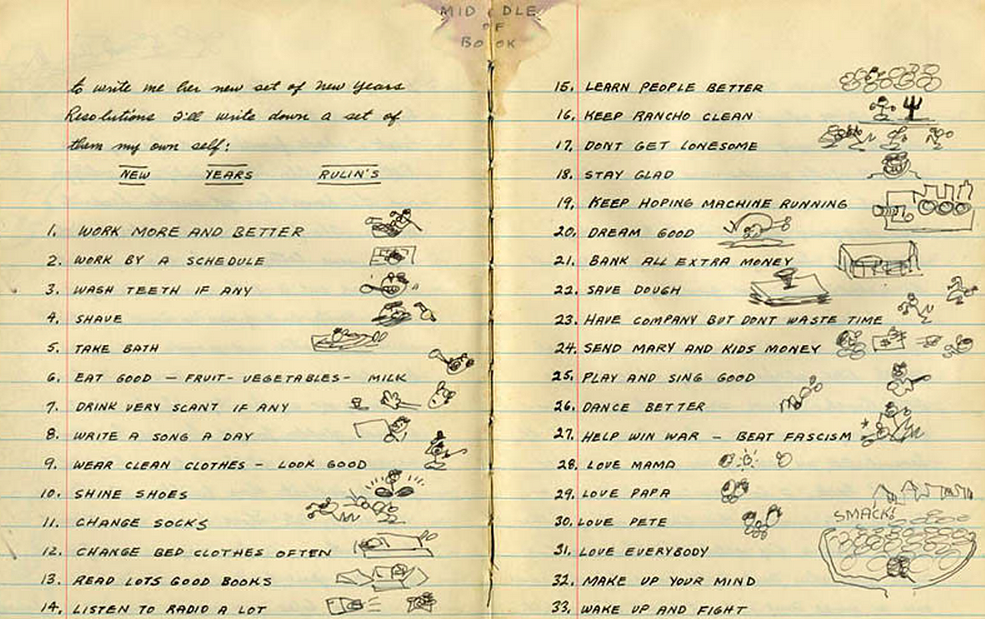
On January 1, 1943, the American folk music legend Woody Guthrie jotted in his journal a list of 33 “New Years Rulin’s.” Nowadays, we’d call them New Year’s Resolutions. Adorned by doodles, the list is down to earth by any measure. Family, song, taking a political stand, personal hygiene—they’re the values or aspirations that top his list. You can click the image above to view the list in a larger format. Below, we have provided a transcript of Guthrie’s Rulin’s.
1. Work more and better
2. Work by a schedule
3. Wash teeth if any
4. Shave
5. Take bath
6. Eat good — fruit — vegetables — milk
7. Drink very scant if any
8. Write a song a day
9. Wear clean clothes — look good
10. Shine shoes
11. Change socks
12. Change bed cloths often
13. Read lots good books
14. Listen to radio a lot
15. Learn people better
16. Keep rancho clean
17. Dont get lonesome
18. Stay glad
19. Keep hoping machine running
20. Dream good
21. Bank all extra money
22. Save dough
23. Have company but dont waste time
24. Send Mary and kids money
25. Play and sing good
26. Dance better
27. Help win war — beat fascism
28. Love mama
29. Love papa
30. Love Pete
31. Love everybody
32. Make up your mind
33. Wake up and fight
We wish you all a happy 2018.
If you would like to support the mission of Open Culture, consider making a donation to our site. It’s hard to rely 100% on ads, and your contributions will help us continue providing the best free cultural and educational materials to learners everywhere. You can contribute through PayPal, Patreon, and Venmo (@openculture). Thanks!
Note: This fine list originally appeared on our site back in 2014.
Related Content:
Marilyn Monroe’s Go-Getter List of New Year’s Resolutions (1955)
Antonio Gramsci Writes a Column, “I Hate New Year’s Day” (January 1, 1916)
The Top 10 New Year’s Resolutions Read by Bob Dylan
Read More...
How Far Back in History Can You Start to Understand English?
It’s easy to imagine the myriad difficulties with which you’d be faced if you were suddenly transported a millennium back in time. But if you’re a native (or even proficient) English speaker in an English-speaking part of the world, the language, at least, surely wouldn’t be a problem. Or so you’d think, until your first encounter with utterances like “þat troe is daed on gaerde” or “þa rokes forleten urne tun.” Both of those sentences appear in the new video above from Simon Roper, in which he delivers a monologue beginning in the English of the fifth century and ending in the English of the end of the last millennium.
An Englishman specializing in videos about linguistics and anthropology, Roper has pulled off this sort of feat before: we previously featured him here on Open Culture for his performance of a London accent as it evolved through 660 years.
But writing and delivering a monologue that works its way through a millennium and a half of change in the English language is obviously a thornier endeavor, not least because it involves literal thorns — the þ characters, that is, used in the Old English Latin alphabet. They’re pronounced like th, which you can hear when Roper speaks the sentences quoted earlier, which translate to “The tree is dead in the yard” and “The rooks abandoned our town.”
The word translate should give us pause, since we’re only talking about English. But then, English has undergone such a dramatic evolution that, at far enough of a remove, we might as well be talking about different languages. What Roper emphasizes is that the changes didn’t happen suddenly. Non-Scandinavian listeners may lack even an inkling that his farmer of the year 450 is talking about sheep and pigs with the words skēpu and swīnu, but his final lines, in which he speaks of possessing “all the hot coffee I need” and “friends I didn’t have in New York” in the year 2000, will pose no difficulty to Anglophones anywhere in the world. Even his list of agricultural wealth around the early thirteenth century — “We habben an god hus, we habben mani felds” — could make you believe that a trip 600 years in the past would be, as they said in Middle English, no trouble.
Related Content:
Tracing English Back to Its Oldest Known Ancestor: An Introduction to Proto-Indo-European
Hear the Evolution of the London Accent Over 660 Years: From 1346 to 2006
What Shakespeare’s English Sounded Like, and How We Know It
Where Did the English Language Come From?: An Animated Introduction
A Brief Tour of British & Irish Accents: 14 Ways to Speak English in 84 Seconds
The Entire History of English in 22 Minutes
Based in Seoul, Colin Marshall writes and broadcasts on cities, language, and culture. His projects include the Substack newsletter Books on Cities and the book The Stateless City: a Walk through 21st-Century Los Angeles. Follow him on the social network formerly known as Twitter at @colinmarshall.
Read More...The Life and Work of Afrobeat Creator Fela Kuti Explored by Radiolab’s Jad Abumrad
When discussing a musician like Fela Kuti, many of our usual terms fail us. They fail us, that is, if we came of age in a musical culture in which artists and bands put out an album of ten or so lyrics-forward songs every two or three years, promoting it on tour while also playing their biggest hits. Fela — as all his fans refer to him — could put out six or seven albums in a single year, and refused to play live any material he’d already recorded. Even the word song, as we know it, doesn’t quite reflect the nature of his compositions, which got expansive enough that two or three of them (or just one, half of it on each side) could fill a long-playing record.
Walter Benjamin said of great literary works that they either dissolve a genre or invent one, and Fela’s musical works invented the genre of Afrobeat. The sound of that genre, as explained by Noah Lefevre in the Polyphonic video above, reflects the distinctive formation of Fela himself, who was born and raised in Nigeria, studied at the Trinity College of Music in London, and came of age during the end of Africa’s era of decolonization. To a listener reared on Anglo-American popular music, his signature mixture of West African rhythms with jazz and funk textures sounds familiar enough — at least for the first ten or fifteen minutes, after which time the listening experience ascends to a different state entirely.
Sometimes it takes Fela just about that long to start singing, and when he does, he’s given to proclamations, chants, calls-and-responses, and political exhortations delivered in the kind of English that sounds highly unfamiliar to non-African listeners. Not that it’s always alienating: indeed, this particular combination of words and music has captivated generations of listeners from far outside its place of origin. One of them is David Byrne, who used Talking Heads’ Remain in Light as more or less a medium for channeling the musical spirit of Fela. Not that he himself was gone yet: indeed, he had almost two decades of his eventful life to go, one you can learn much more about from Fela Kuti: Fear No Man, a twelve-part biographical podcast by Jad Abumrad.
Brought into Fela’s world by a family connection, that former Radiolab host conducted dozens and dozens of interviews on the relationship between the man, his music, and the political context in which he found himself. The facts, as any Fela fan knows, don’t always align comfortably with mainstream sensibilities of the twenty-twenties — the charges range from essentialism to polygamy — but as Lefevre reminds us, an artist should be interpreted through the lens of his own culture and history. However many of us consider him a “problematic fave” today, Fela Kuti will always be the man who invented Afrobeat — and since nobody else has quite managed to replicate his grooves in their simultaneous tightness and looseness, bluntness and subtlety, perhaps also the man who dissolved it.
Related Content:
When Afrobeat Legend Fela Kuti Collaborated with Cream Drummer Ginger Baker
Zamrock: An Introduction to Zambia’s 1970s Rich & Psychedelic Rock Scene
The Awe-Inspiring But Tragic Story of Africa’s Festival In The Desert (2001–2012)
Stream 8,000 Vintage Afropop Recordings Digitized & Made Available by The British Library
Based in Seoul, Colin Marshall writes and broadcasts on cities, language, and culture. His projects include the Substack newsletter Books on Cities and the book The Stateless City: a Walk through 21st-Century Los Angeles. Follow him on the social network formerly known as Twitter at @colinmarshall.
Read More...Hear Debussy Play Debussy: A Vintage Recording from 1913
A century ago, the great French composer Claude Debussy sat down at a contraption called a Welte-Mignon reproducing piano and recorded a series of performances for posterity. The machine was designed to encode the nuances of a pianist’s playing, including pedaling and dynamics, onto piano rolls for later reproduction.
Debussy recorded 14 pieces onto six rolls in Paris on or before November 1, 1913. According to Debussy enthusiast Steve Bryson’s web site, the composer was delighted with the reproduction quality, saying in a letter to Edwin Welte: “It is impossible to attain a greater perfection of reproduction than that of the Welte apparatus. I am happy to assure you in these lines of my astonishment and admiration of what I heard. I am, Dear Sir, Yours Faithfully, Claude Debussy.”
The selection above is “La soirée dans Grenade” (“Grenada in the evening”), from Debussy’s 1903 trio of compositions titled Estampes, or “Prints.” Debussy was inspired by the Symbolist poets and Impressionist painters who strove to go beyond the surface of a subject to evoke the feeling it gave off. “La soirée dans Grenade” is described by Christine Stevenson at Notes From a Pianist as a “sound picture” of Moorish Spain:
Debussy’s first-hand experience of Spain was negligible at that time, but he immediately conjures up the country by using the persuasive Habenera dance rhythm to open the piece–softly and subtly. It insinuates itself into our consciousness with its quiet insistence on a repeated C sharp in different registers; around it circles a languid, Moorish arabesque, with nasal augmented 2nds, and a nagging semitone pulling against the tonal centre, occasionally interrupted by muttering semiquavers [16th notes] and a whole-tone based passage. Debussy writes Commencer lentement dans un rythme nonchalamment gracieux [Begin slowly in a casually graceful rhythm] at the beginning, but later Tres rythmé [Very rhythmic] in a brightly lit A major as the dance comes out of the shadows, ff [Fortissimo–loudly], with the click of castanets and the stamping of feet.
Debussy was 52 years old and suffering from cancer when he made his piano roll recordings. He died less than five years later, on March 25, 1918. Since then, his beautiful and evocative music has secured a place for him as one of the most influential and popular composers of the 20th century. As Roger Hecht writes at Classical Net, “Debussy was a dreamer whose music dreamed with him.”
If you would like to support the mission of Open Culture, consider making a donation to our site. It’s hard to rely 100% on ads, and your contributions will help us continue providing the best free cultural and educational materials to learners everywhere. You can contribute through PayPal, Patreon, and Venmo (@openculture). Thanks!
Note: An earlier version of this post appeared on our site in 2013.
Related Content:
Hear The Rite of Spring Conducted by Igor Stravinsky Himself: A Vintage Recording from 1929
Hear a 1930 Recording of Bolero, Conducted by Ravel Himself
Rare 1946 Film: The Great Russian Composer Sergei Prokofiev Plays Piano, Discusses His Music
Read More...Support Us
We're hoping to rely on loyal readers, rather than erratic ads. Please click the Donate button and support Open Culture. You can use Paypal, Venmo, Patreon, even Crypto! We thank you!

About Us

Open Culture scours the web for the best educational media. We find the free courses and audio books you need, the language lessons & educational videos you want, and plenty of enlightenment in between.
Advertise With Us
FREE UPDATES!
GET OUR DAILY EMAIL
Get the best cultural and educational resources on the web curated for you in a daily email. We never spam. Unsubscribe at any time.
FOLLOW ON SOCIAL MEDIA
Open Culture editor Dan Colman scours the web for the best educational media. He finds the free courses and audio books you need, the language lessons & movies you want, and plenty of enlightenment in between.
Advertise With Us

