Take a Tour of 18th-Century London, Recreated with AI
If you want to know what it was like to live in seventeenth-century London, read the diary of Samuel Pepys. While doing so, take note of his frequent references to the uncleanliness of the city’s streets: “very dirty and troublesome to walk through,” “mighty dirty after the rain,” and during the large-scale rebuilding in the aftermath of the Great Fire of 1666, “much built, yet very dirty and encumbered.” If you want to know what it was like to live in nineteenth-century London, read Charles Dickens. However much-lamented the difficulties it presents to young readers, the opening of Bleak House remains highly evocative, setting the scene with “as much mud in the streets, as if the waters had but newly retired from the face of the earth,” “dogs, undistinguishable in mire, and “horses, scarcely better; splashed to their very blinkers.”
This “mud,” an unspeakably foul admixture of substances, only began to recede permanently from London’s streets in the eighteen-fifties, after the installation of sewer systems. So normal for so long, its presence would hardly have been downplayed by the city’s observers back then, whether they recorded their observations on the page or on the canvas.
Even the painter’s idealizing impulse could only do so much, as evidenced by some of the shots included in the new video tour of eighteenth-century London from Majestic Studios above. Turning contemporary paintings and engravings into cinematic animations with artificial intelligence-generated video, it offers the next best thing to actual footage of the city as it would have been seen by the likes of Jonathan Swift, Samuel Johnson, Thomas Gainsborough, and Mary Wollstonecraft.
Seventeenth-century London was the cultural and commercial center of Georgian England, but also a city well on its way to becoming the center of the world. Some of its famous sights seen here in their eighteenth-century urban context include St. Paul’s Cathedral by Sir Christopher Wren, mastermind of the city’s post-Great Fire reconstruction; the old London Bridge, still lined with houses and shops; St. James’s Square after its transformation from a state once considered “muddy, neglected, and frankly, embarrassing for such prestigious addresses”; and the Tower of London on the bank of the River Thames. As for the river itself, it hardly goes ignored by the works of art that shape this video, or indeed un-glorified by them. But if you know anything about its condition before the turn of the twentieth century, you’ll be relieved that AI can’t yet restore its smell.
Related Content:
Take a Virtual Tour of Shakespeare’s Globe Theatre in London
The Evolution of London: 2,000 Years of Change Animated in 7 Minutes
The Oldest Known Footage of London (1890–1920) Features the City’s Great Landmarks
Hear the Evolution of the London Accent Over 660 Years: From 1346 to 2006
The Sights & Sounds of 18th-Century Paris Get Recreated with 3D Audio and Animation
Based in Seoul, Colin Marshall writes and broadcasts on cities, language, and culture. His projects include the Substack newsletter Books on Cities and the book The Stateless City: a Walk through 21st-Century Los Angeles. Follow him on the social network formerly known as Twitter at @colinmarshall.
Read More...Göbekli Tepe: The 12,000-Year-Old Ruins That Rewrite the Story of Civilization
We didn’t have civilization until we had cities, and we didn’t have cities until we had agriculture. So, at least, goes a widely accepted narrative in “big history” — a narrative somewhat troubled by the discovery of ruins on Göbekli Tepe, or “Potbelly Hill,” in southeastern Turkey. Apparently inhabited from around 9500 to 8000 BC, the ancient settlement predates the Pyramids of Giza by nearly 8,000 years, and Stonehenge by about 6,000 years. Though it was once believed to be a site used for ritual purposes only, later research unearthed evidence that suggests it was host to a variety of activities we associate with urban civilization, rather than what we usually think of hunter-gatherer sites. Does it amount to reason enough to revise our very understanding of the history of humanity?
“Like Stonehenge, Göbekli Tepe’s structure includes circles of T‑shaped limestone pillars, many of them featuring etchings of animals,” says YouTuber Joe Scott in the video above. These pillars are arranged into enclosures, which together constitute a site that “features archaeological complexity that probably would have been too advanced for hunter-gatherers.”
Klaus Schmidt, the archaeologist who led the excavations at Göbekli Tepe between 1996 and 2014, believed that it was “a sanctuary and maybe a regional pilgrimage center where people gathered to perform religious rites.” But since his death, evidence of houses, a cistern, and grain-processing tools has turned up, indicating “a fully fledged settlement with permanent occupation” well before the advent of farming. This finding indicates that social and technological innovations associated with ‘civilization’ may have emerged long before the advent of agriculture, cities, or domesticated animals — under conditions very different from what historians had previously assumed. But as to the reason it was all built in the first place, this new information has led to more questions than answers.
One less than generally accepted theory holds that Göbekli Tepe was an astronomical observatory, and perhaps also a memorial to a devastating comet strike that occurred 13,000 years ago. Maybe it was “a last-ditch effort by a hunter-gatherer society to hang on to their vanishing lifestyle as the world was transitioning to farming.” That could have been the first large-scale technological revolution in human history, but it certainly wouldn’t be the last, and as we here in the twenty-first century consider the ruins of Göbekli Tepe — most of which still have yet to be excavated — we naturally find ourselves thinking about the long-term survival prospects of our own civilization. But the more recent discovery elsewhere in Turkey of other, even older ruins with a distinctly urban structure may also make us feel that our way of life isn’t quite as modern as we’d imagined.
Related Content:
Explore the Ruins of Timgad, the “African Pompeii” Excavated from the Sands of Algeria
Pompeii Rebuilt: A Tour of the Ancient City Before It Was Entombed by Mount Vesuvius
A Cultural Tour of Istanbul, Where the Art and History of Three Great Empires Come Together
Based in Seoul, Colin Marshall writes and broadcasts on cities, language, and culture. His projects include the Substack newsletter Books on Cities and the book The Stateless City: a Walk through 21st-Century Los Angeles. Follow him on the social network formerly known as Twitter at @colinmarshall.
Read More...The Unlikely Friendship of Mark Twain and Nikola Tesla
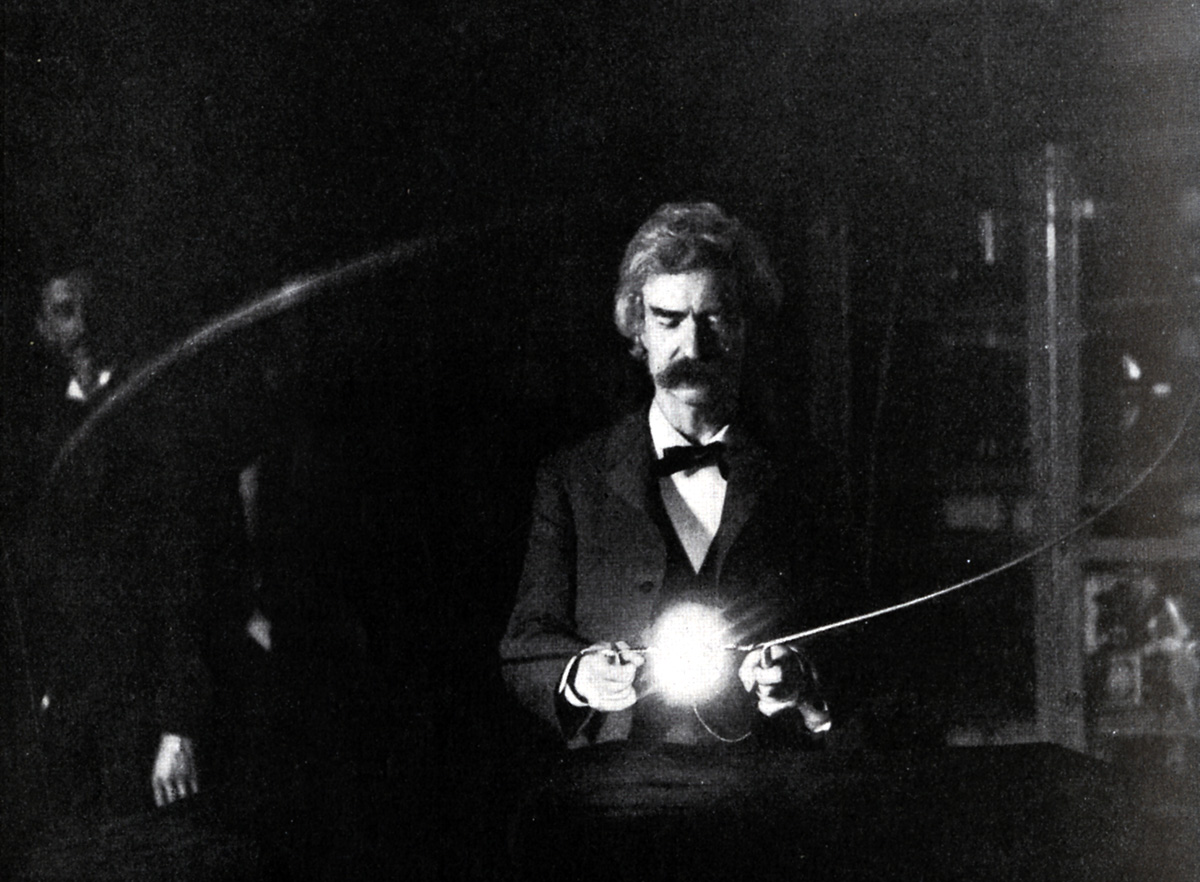
Mark Twain was, in the estimation of many, the United States of America’s first truly homegrown man of letters. And in keeping with what would be recognized as the can-do American spirit, he couldn’t resist putting himself forth now and again as a man of science — or, more practically, a man of technology. Here on Open Culture, we’ve previously featured his patented inventions (including a better bra strap), the typewriter of which he made pioneering use to write a book, and even the internet-predicting story he wrote in 1898. Given Twain’s inclinations, his fame, and the time in which he lived, it may come as no surprise to hear that he also struck up a friendship with the much-romanticized inventor Nikola Tesla.
As it happens, Tesla had become a fan of Twain’s long before they met, having found solace in the American writer’s books provided during a long, near-fatal stretch of childhood illness. He credits his recovery with the laughter that reading material provided him, and one imagines seeing life in the U.S. through Twain’s eyes played some part in his eventual emigration there.
By that point, Twain himself was living in Europe, though his frequent visits to New York meant that he could drop by Tesla’s lab and see how his latest experiments with electricity were going. It was there, in 1894, that the two men took the photograph above, in which Twain holds a vacuum lamp engineered by Tesla and powered (out of frame) by the electromagnetic coil that bears his name.
As Ian Harvey writes at The Vintage News, “Tesla was a scientist whose work largely revolved around electricity; at that time, making your living as a scientist and inventor could often mean having to be somewhat of a showman,” a pressure Twain understood. History has recorded that Tesla provided Twain with — in addition to an electricity-based constipation cure that worked rather too well — advice against putting his money into an uncompetitive automatic typesetting machine that, unfortunately, went unheeded. The onetime riverboat captain went on to make an even more unsound investment in a powder called Plasmon, which promised to end world hunger. Perhaps Tesla’s spiritual descendants are to be found in today’s Silicon Valley, inventing the future; Mark Twain’s certainly are, underwriting any number of far-fetched schemes, if with far less of a sense of humor.
Related Content:
Mark Twain Plays With Electricity in Nikola Tesla’s Lab (Photo, 1894)
Mark Twain Wrote the First Book Ever Written With a Typewriter
Mark Twain’s Patented Inventions for Bra Straps and Other Everyday Items
When David Bowie Became Nikola Tesla: Watch His Electric Performance in The Prestige (2006)
Based in Seoul, Colin Marshall writes and broadcasts on cities, language, and culture. His projects include the Substack newsletter Books on Cities and the book The Stateless City: a Walk through 21st-Century Los Angeles. Follow him on the social network formerly known as Twitter at @colinmarshall.
Read More...What Was the Most Revolutionary Painting of the 20th Century?: The Case for Picasso’s Les Demoiselles d’Avignon
Practically anyone could take one glance at Les Demoiselles d’Avignon and identify it as a Picasso, even if they’ve never seen it before and couldn’t say anything else about it. That alone goes some way to explaining why the painting would end up ranked as the most important artwork of the twentieth century, at least according to a study by University of Chicago economist David W. Galenson. For that title it beat out the likes of Robert Smithson’s Spiral Jetty, Richard Hamilton’s Just what is it that makes today’s homes so different, so appealing?, Marcel Duchamp’s Fountain and Nude Descending a Staircase, No. 2, and Picasso’s own Guernica.
With Les Demoiselles d’Avignon, Galenson writes, “the greatest artist of the century initiated the century’s most important artistic movement. Art scholars debate whether the Demoiselles should be considered a Cubist painting, but there is no question that it differed profoundly from all of the art that preceded it, and that it began the development of Cubism.”
Painted in ambitious response to Henri Matisse’s Le Bonheur de vivre, its rejection of traditional formality and beauty shocked even Picasso’s forward-thinking colleagues: “Not only did Matisse denounce the painting as an attempt to discredit modern art, but even Georges Braque, who would later join forces with Picasso in developing Cubism, was initially so shocked by the painting that he compared Picasso to the fairground fire-eaters who drank kerosene to spit flames.”
Of course, there was also the matter of the painting’s subject, five nude prostitutes in a Barcelona brothel. But as explained by Beth Harris and Steven Zucker in the Smarthistory video above, the Demoiselles wasn’t always about the demoiselles alone. “In the original sketches, the women were focusing on a male that was included, a sailor,” says Zucker. “There was also a medical student.” At some stages, Harris emphasizes, the latter carried a human skull, a piece of professional equipment but also “a reminder of death, a memento mori. And so there seems to be some tension here between the sensuality that the sailor is indulging in and a moralizing reminder that the pleasures of life are short”: an unusual perspective to be expressed by a 26-year-old, but then, Picasso wasn’t the usual artist.
Related Content:
Pablo Picasso’s Childhood Paintings: Precocious Works Painted Between the Ages of 8 and 15
Thousands of Pablo Picasso’s Works Now Available in a New Digital Archive
How to Understand a Picasso Painting: A Video Primer
Based in Seoul, Colin Marshall writes and broadcasts on cities, language, and culture. His projects include the Substack newsletter Books on Cities and the book The Stateless City: a Walk through 21st-Century Los Angeles. Follow him on the social network formerly known as Twitter at @colinmarshall.
The Great Wave Off Kanagawa by Hokusai: An Introduction to the Iconic Japanese Woodblock Print in 17 Minutes
When woodcut artist Katsushika Hokusai made his famous print The Great Wave off Kanagawa in 1830 — part of the series Thirty-six Views of Mount Fuji — he was 70 years old and had lived his entire life in a Japan closed off from the rest of the world. In the 19th century, however, “the rest of the world was becoming industrialized,” James Payne explains above in his Great Art Explained video, “and the Japanese were concerned about foreign invasions.” The Great Wave shows “an image of Japan fearful that the sea — which has protected its peaceful isolation for so long — would become its downfall.”
It’s also true, however, that The Great Wave would not have existed without a foreign invasion. Prussian blue, the first stable blue pigment, accidentally invented around 1705 in Berlin, arrived in the ports of Nagasaki on Dutch and Chinese ships in the 1820s. Prussian Blue would start a new artistic movement in Japan, aizuri‑e, woodcuts printed in bright, vivid blues.
“Hokusai was one of the first Japanese printmakers to boldly embrace the colour,” Hugh Davies writes at The Conversation, “a decision that would have major implications in the world of art.” When the country’s isolationist policies ended in the 1850s, “a showcase at the inaugural Japanese Pavilion elevated the artistic status of woodblock prints and a craze for their collection quickly followed.”
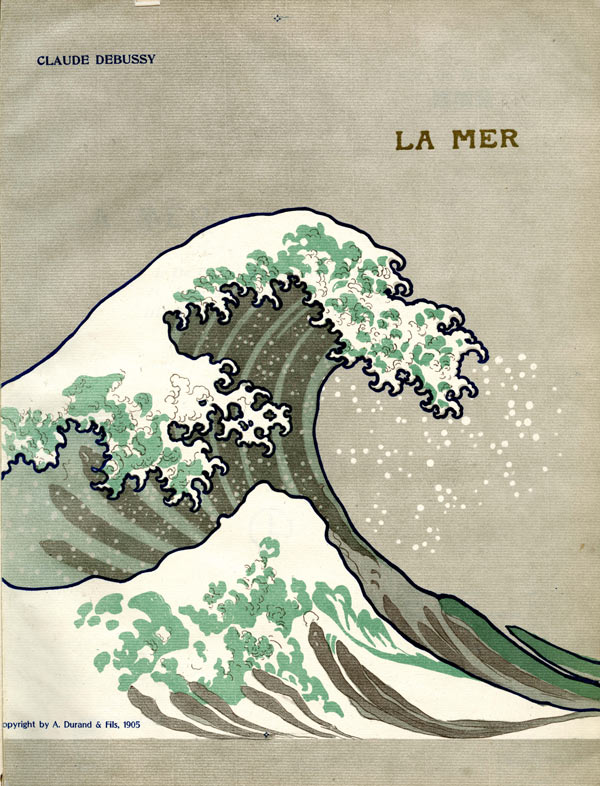
Chief among the works collected in the European and American fervor for Japanese prints were those from Hokusai, his contemporary Hiroshige, and other aizuri‑e artists. So famous was The Great Wave in the West by 1891 that French graphic artist Pierre Bonnard would satirize its stylish spray in an advertisement for champagne. A print of The Great Wave hung on Claude Debussy’s wall, and the first edition of his La Mer bore an adaptation of a detail from the print. As Michael Cirigliano writes for the Metropolitan Museum of Art:
Cultural circles throughout Europe greatly admired Hokusai’s work…. Major artists of the Impressionist movement such as Monet owned copies of Hokusai prints, and leading art critic Philippe Burty, in his 1866 Chefs-d’oeuvre des Arts industriels, even stated that Hokusai’s work maintained the elegance of Watteau, the fantasy of Goya, and the movement of Delacroix. Going one step further in his lauded comparisons, Burty wrote that Hokusai’s dexterity in brush strokes was comparable only to that of Rubens.
These comparisons are not misplaced, John-Paul Stonard explains in The Guardian: “That the Great Wave became the best known print in the west was in large part due to Hokusai’s formative experience of European art.” Not only did he absorb Prussian blue into his repertoire, but “prints from early in his career show him attempting, rather awkwardly, to apply the lesson of mathematical perspective, learnt from European prints brought into Japan by Dutch Traders.” By the time of The Great Wave, he had perfected his own synthesis of Western and Japanese art, over two decades before European painters would attempt the same in the explosion of Japanophilia of the late 19th and early 20th centuries.
Note: An earlier version of this post appeared on our site in 2021.
Related Content:
View 103 Discovered Drawings by Famed Japanese Woodcut Artist Katsushika Hokusai
Hokusai’s Action-Packed Illustrations of Japanese & Chinese Warriors (1836)
The Evolution of Hokusai’s Great Wave: A Study of 113 Known Copies of the Iconic Woodblock Print
Josh Jones is a writer and musician based in Durham, NC.
Read More...How a Dutch “Dementia Village” Improves Quality of Life with Intentional Design
People suffering from dementia lose their ability to take an active part in conversations, everyday activities, and their own physical upkeep.
They are prone to sudden mood swings, irritability, depression, and anxiety.
They may be stricken with delusions and wild hallucinations.
All of these things can be understandably upsetting to friends and families. There’s a lot of stigma surrounding this situation.
Taking care of a spouse or parent with dementia can be an overwhelmingly isolating experience, though no one is more isolated than the person experiencing severe cognitive decline firsthand.
While many of us would do anything to stay out of them, the sad fact is residential memory care facilities are often the end-of-the-line reality for those living with extreme dementia.
The Hogeweyk, a planned village just outside of Amsterdam, offers a different sort of future for those with severe dementia.
The above episode of By Design, Vox’s series about the intersection of design and technology, explores the innovations that contribute to the Hogeweyk’s residents’ overall happiness and wellbeing.
Rather than grouping residents together in a single institutional setting, they are placed in groups of six, with everyone inhabiting a private room and sharing common spaces as they see fit.
The common spaces open onto outdoor areas that can be freely enjoyed by all housed in that “neighborhood”. No need to wait until a staff member grants permission or finishes some task.
Those wishing to venture further afield can avail themselves of such pleasant quotidian destinations as a grocery, a restaurant, a barbershop, or a theater.
These locations are designed in accordance with certain things proven to work well in institutional settings — for instance, avoiding dark floor tiles, which some people with dementia perceive as holes.
But other design elements reflect the choice to err on the side of quality of life. Hand rails may help in preventing falls, but so do rollators and walkers, which the residents use on their jaunts to the town squares, gardens and public amenities.
The designers believe that equipping residents with a high level of freedom not only promotes physical activity, it minimizes issues associated with dementia like aggression, confusion, and wandering.
Co-founders Eloy van Hal and Jannette Spiering write that the Hogeweyk’s critics compare it to the Truman Show, the 1998 film in which Jim Carrey’s title character realizes that his wholesome small town life, and his every interaction with his purported friends, neighbors, and loved ones, have been a set up for a highly rated, hidden camera reality TV show.
They describe The Hogeweyk as a stage for, “the reminiscence world”, in which actors help the residents live in a fictitious world. Many Alzheimer’s experts have, however, valued The Hogeweyk for what it really is: a familiar and safe environment in which people with dementia live while retaining their own identity and autonomy as much as possible. They live in a social community with real streets and squares, a real restaurant with real customers, a supermarket for groceries and a theatre that hosts real performances. There is no fake bus stop or post office, there are no fake façades and sets. The restaurant employee, the handyman, the caretaker, the nurse, the hairdresser, etc.—in short: everyone who works at The Hogeweyk uses their professional skills to actually support the residents and are, therefore, certainly not actors.
Professional care and support goes on around the clock, but rarely takes centerstage. Normal life is prioritized.
A visitor describes a stroll through some of the Hogeweyk’s public areas:
In the shade of one of the large trees, a married couple gazes happily at the activity in the theatre square. An elderly gentleman, together with a young lady, intently study the large chess board and take turns moving the pieces. At the fountain, a group of women chat loudly on colourful garden chairs. The story is clearly audible—it is about a memory of a visit to a park in Paris which had the same chairs. Passers-by, old and young, greet the women enthusiastically. A little further on, a woman is talking to a man opposite her. She is gesturing wildly. After a while, another woman joins the conversation. The two women then walk through the open front door of Boulevard 15.
The covered passage smells of freshly-baked cookies. The scent is coming from De Bonte Hof. Amusing conversations can be heard that pause for a moment when the oven beeps in the kitchen that has been decorated in an old-fashioned style. A tray of fresh cookies is removed from the oven. Two women, one in a wheelchair, enter the venue, obviously seduced by the smell. They sample the cookies.
The supermarket across the street is very busy. Shopping trolleys loaded with groceries are pushed out of the shop. The rattle of a shopping trolley dissipates into the distance as it disappears from view towards Grote Plein. A man reluctantly pushes the full trolley while two women follow behind him arm in arm. The trio disappear behind the front door of Grote Plein 5.
A staffer’s account of a typical morning in one of Hogeweyk’s houses reveals more about the hands-on care that allows residents to continue enjoying their carefully designed home, and the autonomous lifestyle it makes possible:
Mr Hendricks wakes up on the sofa. He unzips his fly. I jump up and escort him to the toilet just in time. I grab a roll of medication for him from the medication trolley. He is now walking to his room. We pick out clothes together and I lay them out on his bed. He washes himself at the sink. I watch briefly before leaving. Fifteen minutes later, I poke my head through the door. That’s not how electric shaving works! I offer to help, but Mr. Hendricks is clearly a bit irritated and grumbles. He’ll be a little less shaven today. We’ll try again after breakfast…
We help Mrs Stijnen into the shower chair with the hoist. She is clearly not used to it. Discussing her extensive Swarovski collection, displayed in the glass case in her room, turns out to be an excellent distraction. She proudly talks about the latest piece she acquired this year. On to the shower. The two other residents are still sleeping. Great, that gives me the chance to devote some extra time to Mrs Stijnen today.
The doorbell rings again and my colleague, Yasmin, walks in. She’s the familiar face that everyone can rely on. Always present at 8 a.m., 5 days a week. What a relief for residents and family. She, too, puts her coat and bag in the locker. The washing machine is ready, and Yasmin loads up the dryer. The table in the dining room is then set. Yasmin puts a floral tablecloth from the cupboard on the table. Mr Hendricks lends a hand and, with some guidance, puts two plates in their place, but then walks away to the sofa and sits down. A Dutch breakfast with bread, cheese, cold cuts, jam, coffee, tea and milk is served. Yasmin is making porridge for Mrs Smit. As always, she has breakfast in bed. Yasmin helps Mrs Smit. It is now 08:45 and Mr Hendricks and Mrs Stijnen are sitting at the dining table. Yasmin pushes the chairs in and sits down herself. They chat about the weather, and Yasmin lends a helping hand when needed.
Mr Hendricks is really grumpy today and is currently grumbling at Mrs Jansen. I’m wondering if we’re overlooking something?
Learn more about the Hogeweyk, the world’s first dementia village here.
Watch a playlist of Vox By Design episodes here.
Note: An earlier version of this post appeared on our site in 2022.
Related Content
How Music Can Awaken Patients with Alzheimer’s and Dementia
Dementia Patients Find Some Eternal Youth in the Sounds of AC/DC
- Ayun Halliday is the Chief Primatologist in NYC.
Read More...Watch 50 David Bowie Music Videos Spanning Five Decades of Reinvention: “Space Oddity,” “Life on Mars?” “ ‘Heroes’,” “Let’s Dance” & More
Each of us has a different idea of when, exactly, the sixties ended, not as a decade, but as a distinct cultural period. Some have a notion of the “long sixties” that extends well into the seventies; if pressed for a specific final year, they could do worse than pointing to 1972, when David Bowie made his epoch-shifting appearance as Ziggy Stardust, backed by the Spiders from Mars, on the BBC’s Top of the Pops. It was also the year he released music videos for “Space Oddity,” the single that had begun to make his name at the time of the moon landing in 1969, and “Jean Genie,” the first single from Aladdin Sane, an album inspired in part by the debauchery of the American Ziggy tour he undertook after blasting off into stardom.
Having struggled in the sixties to find a suitable identity and audience, the young Bowie developed an unusually strong understanding of not just the music industry, but also the culture itself. One era was giving way to another, and nobody knew it better than he did. When all those hirsute figures in beards and denim, singing with ostentatious earnestness about love and freedom, disappeared, who would replace them?
In Bowie’s vision, the next phase belonged to clean-shaven, made-up androgynes in flamboyant designer costumes working grand, sometimes science fictional, and often inscrutable themes into what would strike concertgoers as almost complete theatrical experiences — and he would be the first and foremost among them.
Bowie, in other words, made the seventies his own, operating on his knowledge of and instincts about the media environment of that decade and how images would be made in it. By that time, he’d seen too many flashes in the pan of pop music to get complacent about his own prospects for endurance. The reception of “Space Oddity” as a novelty song did its part to motivate him to come up with his bisexual space-alien rock-star alter ego — and to motivate him to terminate that persona on stage in 1973. A couple of years before that, he had already sung of the importance of changes, a kind of manifesto that would guide his career through all the decades that remained. Never would Bowie adhere to a particular musical or aesthetic style for very long, an abiding tendency vividly on display in this playlist of 50 music videos on his official YouTube channel.
The experience of putting out music videos in the seventies placed Bowie well, especially compared to other artists of his generation, to make his mark on MTV in the eighties with a stadium-ready hit like “Let’s Dance.” The nineties found him taking the form in new directions, as with the cinephilically astute video for “Jump They Say” and the daringly action-free visual treatment of the reflective “Thursday’s Child” (from the album Hours…, which began as the soundtrack to the computer game Omikron: The Nomad Soul). Apart from this playlist, his channel also contains music videos for his later songs from the two-thousands and twenty-tens, from “New Killer Star” to “The Stars (Are Out Tonight)” to “Blackstar” — the nature of stardom having been a preoccupation since the beginning, even though he kept on changing to the very end.
Related Content:
Watch David Bowie Star in His First Film Role, a Short Horror Flick Called The Image (1967)
Watch David Bowie’s New Video for “The Stars (Are Out Tonight)” With Tilda Swinton
When Bowie & Jagger’s “Dancing in the Street” Music Video Becomes a Silent Film
Based in Seoul, Colin Marshall writes and broadcasts on cities, language, and culture. His projects include the Substack newsletter Books on Cities and the book The Stateless City: a Walk through 21st-Century Los Angeles. Follow him on the social network formerly known as Twitter at @colinmarshall.
Read More...The Groundbreaking Animation That Defined Pink Floyd’s Psychedelic Visual Style: Watch “French Windows” (1972)
You could argue that, of all rock bands, that Pink Floyd had the least need for visual accompaniment. Sonically rich and evocatively structured, their albums evolved to offer listening experiences that verge on the cinematic in themselves. Yet from fairly early in the Floyd’s history, their artistic ambitions extended to that which could not be heard. Can you really understand their enterprise, it’s fair to ask, if you remain merely one of their listeners, never entering the visual dimension — not just their album covers, reproductions of which still grace many a dorm room wall, but also their elaborate stage shows, music videos (which they were making before that form had a name), and films? One man had more responsibility for the development of the Floyd’s visual style than any other: Ian Emes.
In 1972, Emes took it upon himself to animate their song “One of These Days” from the previous year’s album Meddle. When the finished work, “French Windows,” aired on the BBC music show The Old Grey Whistle Test, it caught the eye of the Floyd’s keyboard player Rick Wright. The group then got in touch with Emes, asking to use “French Windows” as a projection behind their concerts.
They went on to commission further work from him, for songs like “Speak to Me,” Time,” and “On the Run” from The Dark Side of the Moon. This professional connection endured for decades. When Roger Waters put on his own performances of The Wall — including the enormously scaled show in Berlin in 1990 — he had Emes direct its animated sequences. The post-Waters version of Pink Floyd even called up Emes in 2015 to ask him to make a film to accompany their final album The Endless River.
It was, in a way, the completion of a circle: “One of These Days” is a mostly instrumental song, and The Endless River is a mostly instrumental album; “French Windows” uses rotoscoping, which involves tracing over live action footage to make more realistically smooth animation, and the Endless River film presents its own live action footage in a manner that sometimes verges on the abstract. Both works create their own visual environments, which dovetails with what Emes, who died two years ago, once described as the appeal for him of the Floyd: “They went to architecture college and so I think their music creates spaces. It creates environments of sound and I was so stimulated that my mind would soar, and so I would see images that were stimulated by the music.” Their music takes a different form before the mind’s eye of each fan, but it was Emes who made his visions a part of their legacy.
Related Content:
Psychedelic Scenes of Pink Floyd’s Early Days with Syd Barrett, 1967
Download Pink Floyd’s 1975 Comic Book Program for The Dark Side of the Moon Tour
How Pink Floyd Built The Wall: The Album, Tour & Film
Based in Seoul, Colin Marshall writes and broadcasts on cities, language, and culture. His projects include the Substack newsletter Books on Cities and the book The Stateless City: a Walk through 21st-Century Los Angeles. Follow him on the social network formerly known as Twitter at @colinmarshall.
Read More...The Ambitious Engineering Behind the Golden Gate Bridge
As many as a million people crossed the Golden Gate Bridge on foot to celebrate the 50th anniversary of its construction in 1987. More than a few of them would have remembered San Francisco as it was before it had its most iconic structure — and indeed, some would even remember walking across it once before, on its inaugural “Pedestrian Day” in 1937. Barring the possibility of unusually vigorous supercentenarians, that won’t be the case 12 years from now, on the Golden Gate Bridge’s 100th anniversary. But we’ll still be able to appreciate the enormous ambition of its builders, not least its chief design engineer Joseph Strauss, who, along with Charles Alton Ellis, made possible a project long assumed impossible.
The video from Sabin Civil Engineering at the top of the post explains every stage of the Golden Gate Bridge’s design and construction. Building a suspension bridge over the Golden Gate, the deep strait between San Francisco Bay and the Pacific Ocean, posed formidable challenges. The distinctive shape we know from so many photographs emerged in part from the need to anchor the bridge in such a way as to balance out the massive forces that would otherwise bend its towers inward, and the steel-on-steel construction of its suspenders and deck was necessary to prevent catastrophic crack formation.
The deck hangs from 250 pairs of cables, and each of the main cables that run the length of the bridge actually consists of 27,000 steel wires wound together. A system of thermal expansion joints accommodates regular elongation and shrinkage of nearly four feet.
And we haven’t even got into the underwater blasting and terrifying-looking drilling work required to put up the towers in the first place. In any case, the painstaking efforts of the engineers and laborers alike have surely been vindicated by the Golden Gate Bridge’s functionality and popularity over the past 88 years. Naturally, it’s had to undergo considerable maintenance and retrofitting in that time, and it would take a true romantic to ignore its limitations entirely. (Take its lack of rail capacity, which was neither technically nor economically feasible to incorporate during the Great Depression.) Still, when 300,000 people jammed themselves onto its deck at once on its 50th anniversary, it may have bent in the middle, but it didn’t break. That was a testament to the civil engineering acumen of Strauss and company — but let’s hope the centenary festivities are better organized.
Related content:
“The Bay Lights,” the World’s Largest LED Light Sculpture, Debuts in San Francisco
The 5 Innovative Bridges That Make New York City, New York City
A Mesmerizing Trip Across the Brooklyn Bridge: Watch Footage from 1899
Built to Last: How Ancient Roman Bridges Can Still Withstand the Weight of Modern Cars & Trucks
Based in Seoul, Colin Marshall writes and broadcasts on cities, language, and culture. His projects include the Substack newsletter Books on Cities and the book The Stateless City: a Walk through 21st-Century Los Angeles. Follow him on the social network formerly known as Twitter at @colinmarshall.
Read More...Dozens of M.C. Escher Prints Have Been Digitized & Put Online by the Boston Public Library
In addition to the iconic scene in Jim Henson’s Labyrinth, or appearances in animated TV shows and video games, M.C. Escher’s work has adorned the covers of albums like Mott the Hoople’s 1969 debut and the speculative fiction of Italo Calvino and Jorge Luis Borges. A big hit with hippies and 1960s college students, writes Heavy Music Artwork, his mind-bending prints became associated with “questioning accepted views of normal experience and testing the limits of perception with hallucinogenic drugs.” While he appreciated his cult following, Escher “did not encourage their mystical interpretations of his images.” Replying to one enthusiastic fan of his print Reptiles, who claimed to see in it an image of reincarnation, Escher replied, “Madame, if that’s the way you see it, so be it.”
Rather than illustrate higher states of consciousness or metaphysical entities, Bruno Ernst writes in The Magic Mirror of M.C. Escher, the artist intended to create practical, “pictorial representation of intellectual understanding.” Illustrations, that is, of philosophical and scientific thought experiments. The son of a civil engineer, Escher began his studies in architecture before moving to drawing and printmaking.
The challenge of creating built environments—even seemingly impossible ones—always seemed to occupy his mind. Along with themes from the natural world, a high percentage of his works center on buildings—inspired by formative early years in Rome and his admiration for Islamic art and Spanish architecture.
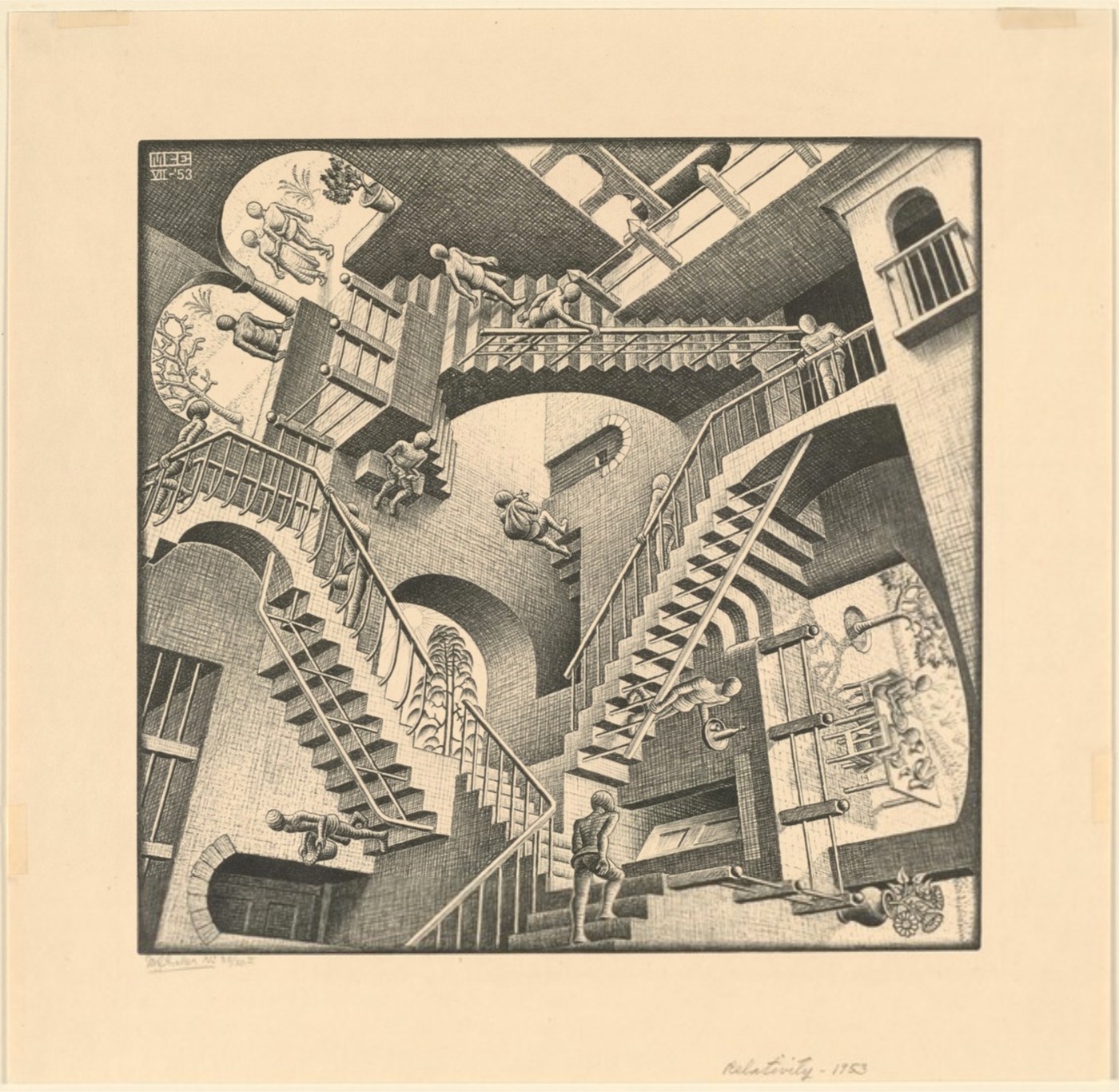
In the 50s and 60s Escher’s art piqued the interest of academics and mathematicians, an audience he found more congenial to his vision. He corresponded with scientists and incorporated their ideas into his work, meanwhile claiming to be “absolutely innocent of training or knowledge in the exact sciences.” In the 50s, Escher “dazzled” the likes of mathematicians like Roger Penrose and HSM Coxeter. In turn, notes Maev Kennedy, he “was inspired by Penrose’s perspectival triangle and Coxeter’s work on crystal symmetry.”
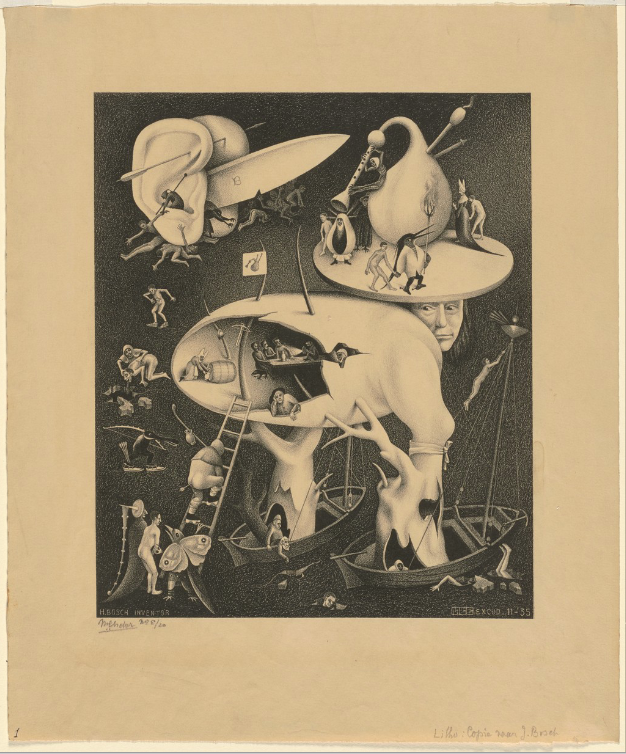
For all the excitement he created among mathematicians, it took a bit longer for Escher to get noticed in the art world. When Penrose’s uncle showed Escher’s version of the perspectival triangle to Picasso, “Picasso had heard of the British mathematician but not of the Dutch artist.” Escher’s fame spread outside of the sciences in part through the interests of the counterculture. He may have shrugged off mystical and psychedelic readings of his prints, but he had an innate penchant for the marvelously weird (see his copy of a scene, for example, from Hieronymus Bosch, above, or his surreal print Gravity, below).
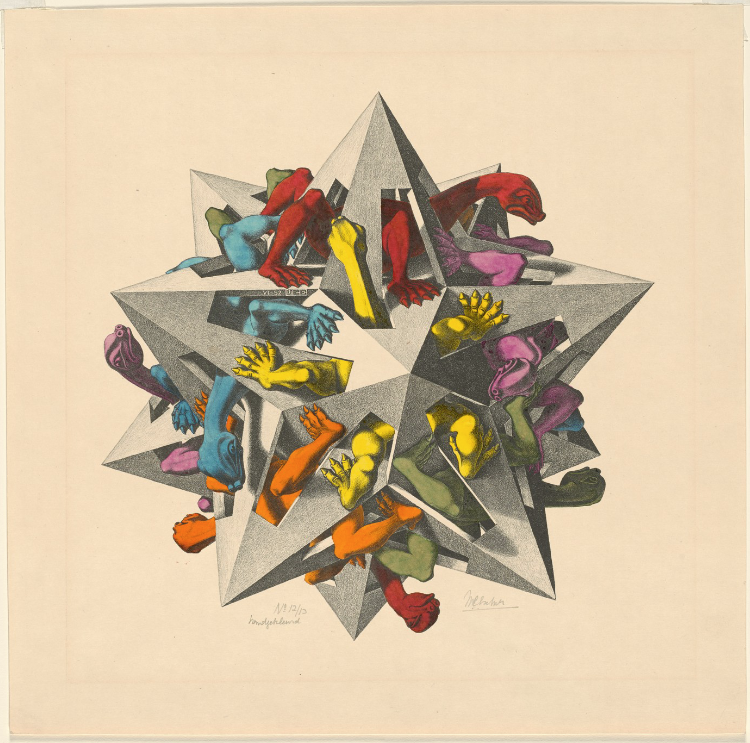
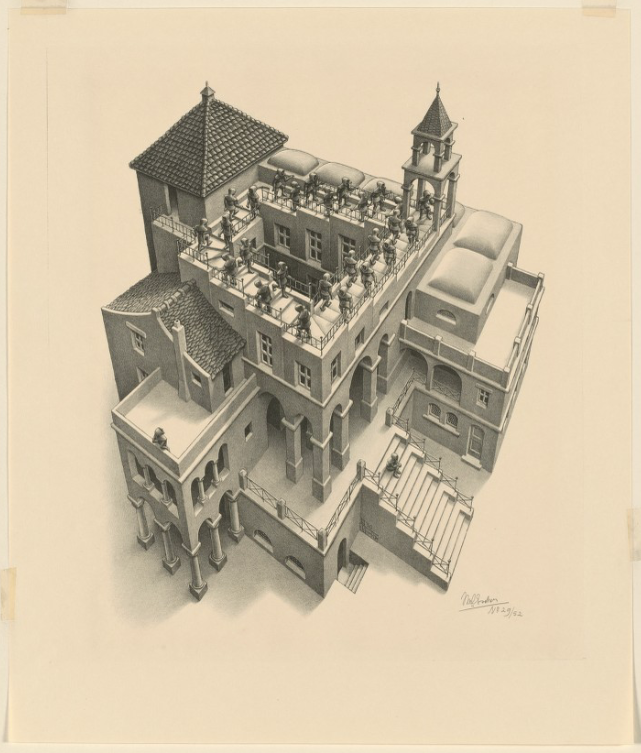
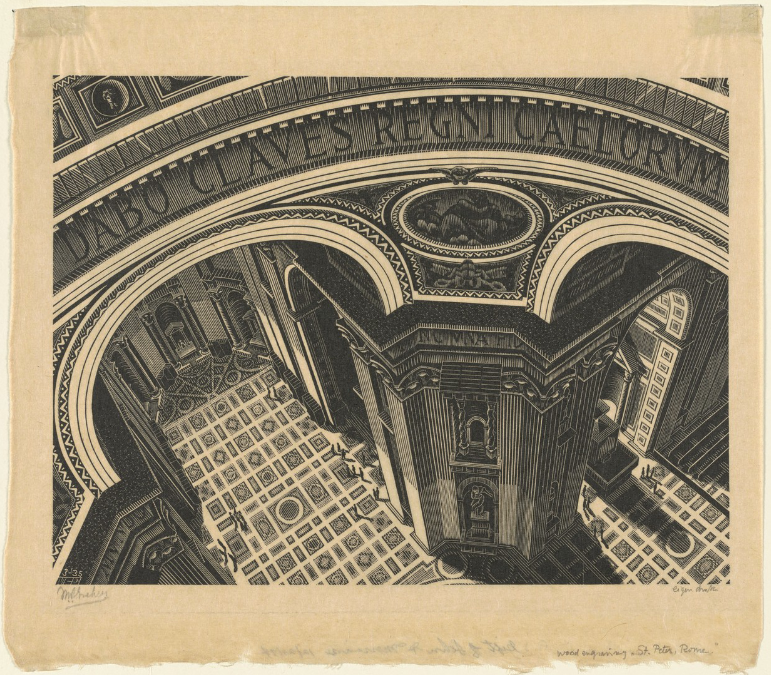
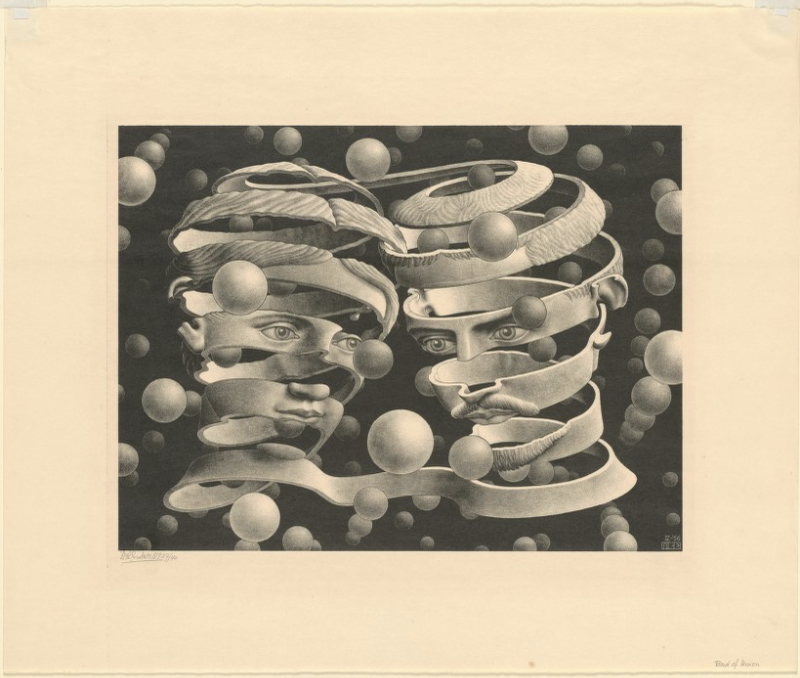
See the prints pictured here and a few dozen more digitized in high resolution at Digital Commonwealth, courtesy of Boston Public Library, who scanned their Escher collection and made it available to the public. Zoom into the fine details of prints like Inside Saint Peter’s, further up—a finely rendered but otherwise not-especially-Escher-like work—and the labyrinthine Ascending and Descending at the top. Whether—as Harvard Library curator John Overholt confesses—you’re a “nerd who loves M.C. Escher” for his mathematical mind, an artist with a mystical bent who loves him for his hallucinatory qualities, or some measure of both, you’ll find exactly the Escher you’re looking for in this digital gallery.
Note: An earlier version of this post appeared on our site in 2018.
Related Content:
M.C. Escher Cover Art for Great Books by Italo Calvino, George Orwell & Jorge Luis Borges
Josh Jones is a writer and musician based in Durham, NC.
Read More...Support Us
We're hoping to rely on loyal readers, rather than erratic ads. Please click the Donate button and support Open Culture. You can use Paypal, Venmo, Patreon, even Crypto! We thank you!

About Us

Open Culture scours the web for the best educational media. We find the free courses and audio books you need, the language lessons & educational videos you want, and plenty of enlightenment in between.
Advertise With Us
FREE UPDATES!
GET OUR DAILY EMAIL
Get the best cultural and educational resources on the web curated for you in a daily email. We never spam. Unsubscribe at any time.
FOLLOW ON SOCIAL MEDIA
Open Culture editor Dan Colman scours the web for the best educational media. He finds the free courses and audio books you need, the language lessons & movies you want, and plenty of enlightenment in between.
Advertise With Us


#/media/File:Mottthehoople1969.jpg)