Christopher Lee Reads Edgar Allan Poe: “The Raven,” “The Fall of the House of Usher,” “The Murders in the Rue Morgue” & More
Sir Christopher Lee and Edgar Allan Poe went way back. Or at least they went as far back as 1969, the year of The Oblong Box, a loose and lurid film adaptation of the eponymous story starring Lee and the also Poe-associated Vincent Price. Lee plays the doctor to whom a gang of grave-robbers delivers Price’s character, an Englishman disfigured in a voodoo ceremony who fakes his own death in order to escape the captivity of his brother. Whatever its entertainment value, the picture doesn’t rank especially high in the canon of Poe adaptations. Nor, for that matter, does the original story rank alongside works like “The Pit and the Pendulum,” “The Fall of the House of Usher,” “The Cask of Amontillado,” or “The Black Cat.”
You can hear Lee himself read all those macabre, imaginative stories and others besides in the YouTube playlist above. Some of the recordings come from Christopher Lee Reads Edgar Allan Poe Tales of Horror, the 1979 budget-label cassette previously featured here on Open Culture. Others include Lee’s performances of “The Masque of the Red Death,” “The Tell-Tale Heart,” “Hop-Frog,” and “The Murders in the Rue Morgue,” which is commonly credited with launching the entire genre of detective fiction.
Though now most widely remembered as a horror actor, the prolific Lee proved commanding in a variety of genres: in the final decade of his life, he appeared in numerous crime pictures, adaptations of The Golden Compass and Charlie and the Chocolate Factory, and several Star Wars and Lord of the Rings movies.
Not that he’d left Poe behind. Among the last credits Lee racked up in his lifetime is Extraordinary Tales, from 2013, a five-story anthology film in which he narrates “The Fall of the House of Usher.” Though British, his distinctive manner and slightly mid-Atlantic accent were as versatile on the screen as they were in readings of Poe, whose writing dates from a time when more than a few Americans still considered literature itself an import from across the pond. This Halloween, if you don’t have the hours free for a complete listen-through of the playlist do consider at least putting on “The Raven.” It remains a matter of debate among Poe enthusiasts to what extent Lee’s delivery of “nevermore” really captures the spirit of the poem, but it would be hard to imagine a more appropriate figure to preside over All Hallows’ Eve.
Related content:
Download The Complete Works of Edgar Allan Poe: Macabre Stories as Free eBooks & Audio Books
Watch Vincent Price Turn Into Edgar Allan Poe & Read Four Classic Poe Stories (1970)
Hours of Edgar Allan Poe Stories Read by Vincent Price & Basil Rathbone
A Reading of Edgar Allan Poe’s “The Raven” in 100 Celebrity Voices
Based in Seoul, Colin Marshall writes and broadcasts on cities, language, and culture. He’s the author of the newsletter Books on Cities as well as the books 한국 요약 금지 (No Summarizing Korea) and Korean Newtro. Follow him on the social network formerly known as Twitter at @colinmarshall.
Read More...What Ancient Latin Sounded Like, And How We Know It
Latin is a language
As dead as dead can be;
It killed the Romans long ago,
And now it’s killing me.
That famed ditty isn’t likely to resonate with many modern school children, but interest in ancient Rome remains fairly robust.
We’ve come to accept that those stately ruins were once covered in graffiti.
We can recreate their meals from hors d’oeuvres (Boiled Eggs with Pine Nut Sauce) to dessert (Pear Patina).
Thermae Romae, a popular Japanese manga-cum-feature-film, took us inside Emperor Hadrian’s bathhouse.
But what did the Romans sound like?
Kirk Douglas’ Spartacus? Or Laurence Olivier’s Crassus?
The HBO series Rome upheld the tradition of British accents.
Animator Josh Rudder of NativLang did a fair amount of digging in service of finding out What Latin Sounded Like, above.
(And he seems to have done so without the help of Derek Jarman’s NSFW Sebastiane, the only feature film to be filmed entirely in sermo vulgaris or vulgar Latin.)
Instead, he draws from ancient rhetorician Quintilian and Virgil’s poetic meter. Scroll backward through the Romance languages, and you’ll see Germanic tribes trading with and fighting ancient Roman troops.
The result is not so much a reconstructive pronunciation guide as a linguistic detective story.
Note: An earlier version of this post appeared on our site in 2016.
Related Content:
The Story of Lorem Ipsum: How Scrambled Text by Cicero Became Used by Typesetters Everywhere
Can Modern-Day Italians Understand Latin? A YouTuber Puts It to the Test on the Streets of Rome
Hear Nirvana’s “Smells Like Teen Spirit” Performed in Classical Latin
Discover the World’s Oldest Surviving Cookbook, De Re Coquinaria, from Ancient Rome
Ayun Halliday is an author, illustrator, theater maker and Chief Primatologist in NYC.
Read More...In 1897, London’s Lampposts Dispensed Hot Coffee, Tea, and “Fluid Beef”
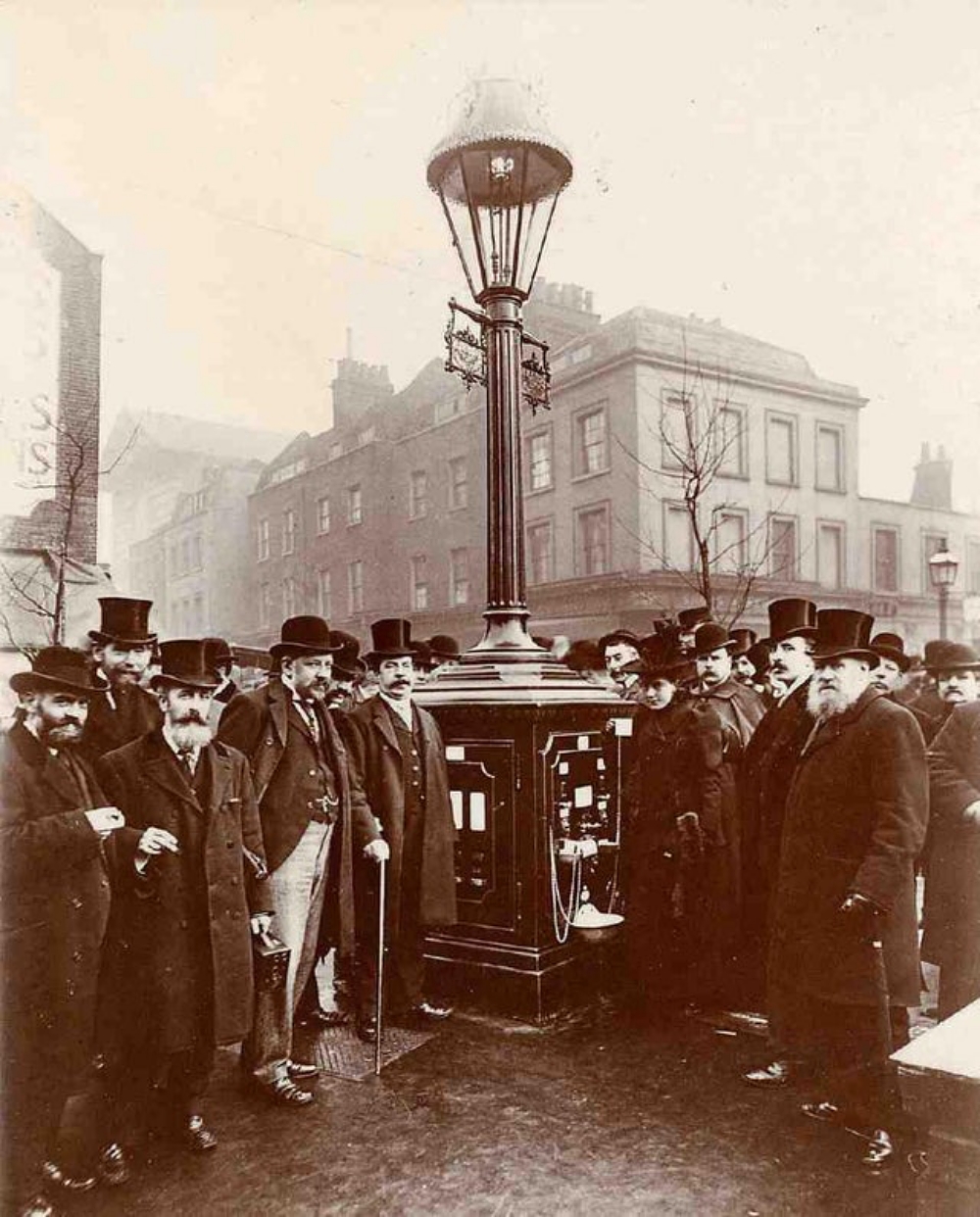
Any reader of Victorian literature will wonder how much a ha’penny was actually worth in those days. For a little more than a year at the very end of that period, it could buy you a cup of coffee, cocoa, milk, tea, or “fluid beef” — which would pour out of a lamppost on the corner. The Pluto Lamp, as it was branded, made its debut at the Victorian Era Exhibition, which was held in 1897 to celebrate the Queen’s Diamond Jubilee. Amid such attractions as a 360-degree panorama of ancient Rome, Pepper’s ghost illusions, and over 1,200 works of art by the likes of J. M. W. Turner, John Constable, and 180 specially selected female artists, a beverage-dispensing streetlight might seem mundane. Yet apart from being a technological marvel in its own way, it also presaged the technology-saturated streets one day to come.
Not long after the Victorian Era Exhibition, Pluto Lamps appeared in several London locations, including Exmouth Street in Clerkenwell, Leicester Square, and Rosebery Avenue. In addition to the illumination of their surroundings, and the drinks warmed by the excess heat thus generated, they in some cases offered postcards and four-to-the-penny cigarettes for sale as well.
However much attention the Pluto Lamps attracted as a novelty, this was still the infancy of the modern vending machine, whose deficiencies had yet to be fully worked out. It proved impossible, at the time, to defeat the enterprising scoundrels who used round pieces of tin in place of genuine currency, and in any case, maintenance costs seem to have proven unexpectedly high. (To say nothing of the prospect of drinking out of an enamel cup on a chain, shared with the entire public, which surely put off even some Victorians.)
All of the Pluto Lamps were decommissioned before the end of the nineteenth century, but they’d done their bit to expand public ideas of what was possible in the urban public realm. “For over a century, lamp posts would again do little more than shine light on to the city streets below,” writes Lukas Neckermann in Smart Cities, Smart Mobility. “But by the early twenty-first century, the spirit of the Pluto Lamps returned. City infrastructure and street furniture would once again become multi-purpose, multi-use, entrepreneurial, and connected.” And indeed, though talk of “smart cities” may now sound as dated and unappealing as that of fluid beef, lampposts have more recently been given such side jobs as vehicle charging, environmental protection, and even crime prevention. That last brings back to mind the Clerkenwell Pluto Lamp, equipped as it was with a telegraph recorder connected straight to Scotland Yard: a device that, had it lasted longer, might have inspired many a Victorian novelist.
Related content:
Jim Power, aka “the Mosaic Man,” Adorns the Lampposts of New York City’s East Village
Watch the “Biblio-Mat” Book-Vending Machine Dispense Literary Delight
Based in Seoul, Colin Marshall writes and broadcasts on cities, language, and culture. He’s the author of the newsletter Books on Cities as well as the books 한국 요약 금지 (No Summarizing Korea) and Korean Newtro. Follow him on the social network formerly known as Twitter at @colinmarshall.
Read More...Doctor Who’s Tom Baker Plays Douglas Adams’ Digital “Agent” in the AI-Predicting Hyperland (1990)
Cast your mind, if you will, back to the year 2020. It now feels like a different time, what with the spreading COVID-19 pandemic and the heated sociopolitical battles being waged online, and indeed in the (socially distanced) streets. That spring, we featured here on Open Culture an amusing retro-technological diversion called Hyperland. First broadcast on BBC2, the program stars The Hitchhiker’s Guide to the Galaxy author Douglas Adams as himself and Doctor Who’s Tom Baker as his agent. “You want fifteen percent?” the former asks the latter when they first meet in a vast wasteland of flickering television sets. Not at all: “I’m here to do your every slightest bidding,” Baker explains, “to fetch and carry for you, to work tirelessly and selflessly on your behalf, always ready, always willing, no job too small or too menial.”
Today, we can hardly share in Adams’ bewilderment, familiar as we are with the notion of what Baker calls a “software agent,” an “artificial and completely customizable personality” with “instant access to every piece of information stored digitally anywhere in the world: any picture or film, any sound, any book, any statistic, any fact, any connection between anything you care to think of.” We must remind ourselves that Hyperland was produced in 1990, when these lines would have struck all but the most computer-savvy and forward-looking viewers as sheer science fiction. Even three decades thereafter, they still sounded more or less like an elevated version of ordinary late-twentieth-century techno-optimism. Here in 2026, Baker’s services are close to being considered a basic necessity, at least in Silicon Valley and its global provinces.
Not so very long ago, Hyperland looked startlingly prescient about the rise of the World Wide Web, which would soon let its users seek out their own desired pieces of information and media, actively moving through links between them, in a manner unlike the passive viewing experience of television (with which it would, as no one then knew, one day converge). This was an unfamiliar idea to most people in 1990; hence the variety of clear and entertaining ways in which the program breaks down its technological basis, pulling up clips from its onscreen “database” like an interview with Ted Nelson, who coined the term hypertext. Like multimedia, that word may carry a whiff of antiquity today, but it was once on the lips of practically every technologist in popular culture — in a manner reminiscent of the lexicon that has sprung from new developments in artificial intelligence over the past few years.
At times, Baker’s character now looks almost realistic, as when Adams asks him to knock off the obsequiousness, or when he pulls up Kurt Vonnegut’s theory of story form before Adams fully gets the question out. Yet Hyperland devotes little time to AI per se. The program appeared in the wake of the eighties’ AI boom, when “expert systems” promised to solve problems in industry, medicine, and other sectors, but many of the field’s larger ambitions went unrealized. There followed a long “AI winter” in research and development, in whose climate Baker-as-“agent” would have been a means of humanizing an abstract-seeming concept of organizing and navigating information. Not that all his enthusiastically proffered services draw unqualified enthusiasm from Adams, who possessed a rare combination of Californian technophilia and British skepticism. His fascination with humanity’s digital future is ours — and so is his wariness.
Related Content:
Play The Hitchhiker’s Guide to the Galaxy Video Game Free Online, Designed by Douglas Adams in 1984
Pioneering Sci-Fi Author William Gibson Predicts in 1997 How the Internet Will Change Our World
Sci-Fi Author J.G. Ballard Predicts the Rise of Social Media (1977)
Based in Seoul, Colin Marshall writes and broadcasts on cities, language, and culture. He’s the author of the newsletter Books on Cities as well as the books 한국 요약 금지 (No Summarizing Korea) and Korean Newtro. Follow him on the social network formerly known as Twitter at @colinmarshall.
The Dark Story Behind Edgar Allan Poe’s Most Famous Photograph, Taken Four Days After a Laudanum Overdose
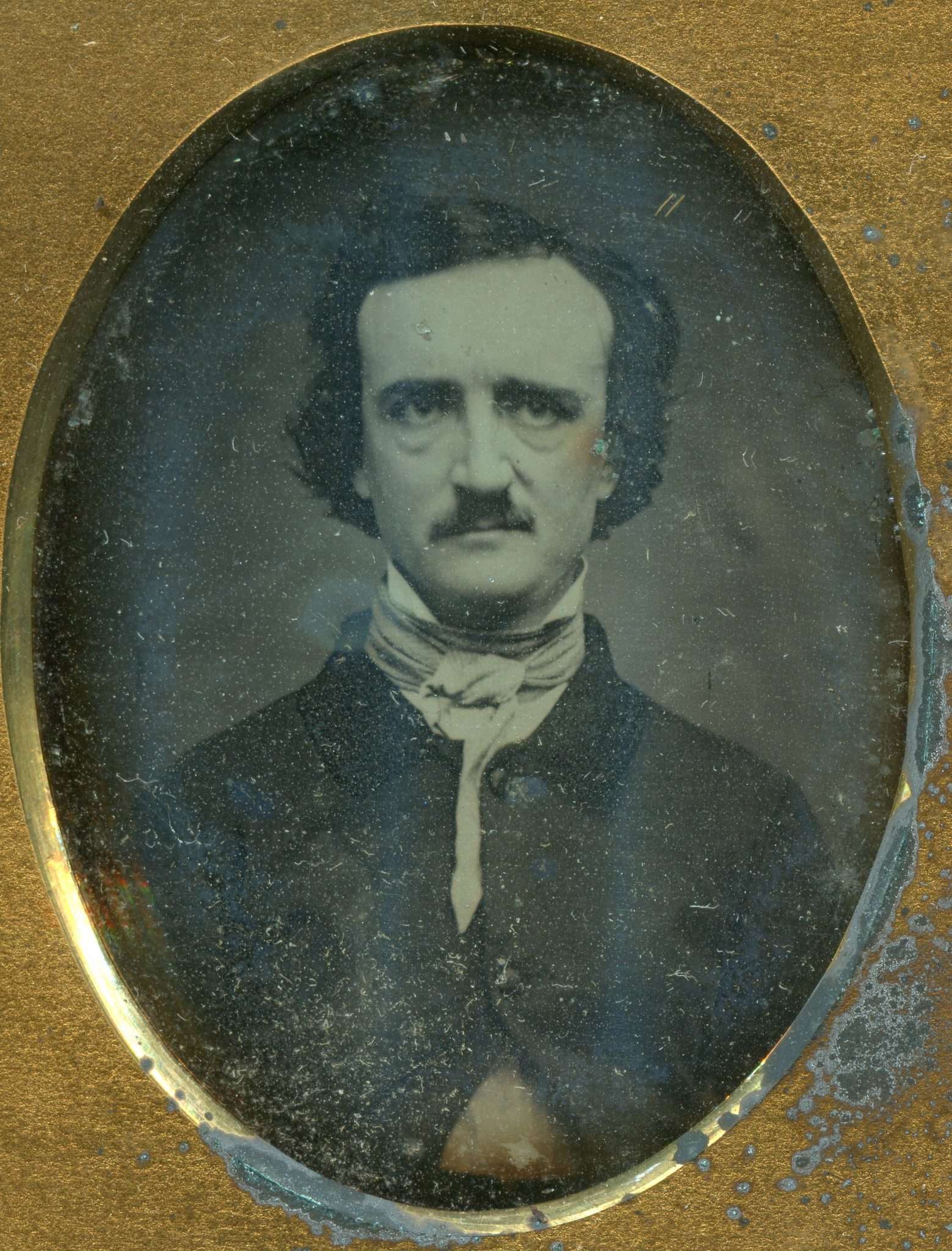
In the Halloween season, one American writer comes to mind more often than any other: Edgar Allan Poe. That owes in large part to his famously macabre tales like “The Tell-Tale Heart,” “The Cask of Amontillado,” and “The Masque of the Red Death,” written though they may have been with barely concealed contempt for their sensation-seeking magazine readership. But it also has to do with the image of the man himself. Or rather, it has to do with one image in particular: a daguerreotype photograph taken on November 9, 1848, at a Providence studio that has inspired practically every representation of Poe in popular culture since.
Known as Ultima Thule, this famous portrait was in fact just one of perhaps ten daguerreotypes for which Poe sat in his lifetime. Inventor Louis Daguerre’s early photographic process, which used silver-coated copper plates, fascinated Poe, who in an 1840 newspaper article called it “the most important, and perhaps the most extraordinary triumph of modern science.” He described its product as “infinitely more accurate in its representation than any painting by human hands,” though anyone sitting for a picture did have to sit still for minutes on end, resulting in not just the unsmiling visages we associate with nineteenth-century photography, but also in a combination of discomfort and slight blurring that can look vaguely otherworldly.
That quality may actually have enhanced the aura of Ultima Thule, which painter Michael J. Deas calls “the image of the tragic romantic poet: solemn, detached, consumed by his own wildly self-destructive nature.” It surely also made a difference that the portrait was made, in the words of poet Hervey Allen, “probably at the very hour when he looked the worst that he had ever looked in his life.” He’d been taken to the studio by a stranger with whom he’d spent the previous night binge-drinking. Just four days before that, he’d unsuccessfully attempted suicide by laudanum overdose, a rash action taken after the rejection of his marriage proposal by Sarah Helen Whitman, a widowed poet he hadn’t known long — and who would give her suitor’s immortal portrait its Latin name, borrowed from his poem “Dream-Land.”
The original daguerreotype, for which the studio probably paid the by-then notable, still perpetually hard-up Poe to sit, remained with its makers until it vanished around 1860, and its whereabouts have remained unknown ever since. But copies have allowed generation after generation of readers to behold Poe’s troubled visage when what Whitman called “all the stormy grandeur of that via Dolorosa had left its sullen shadow on his brow.” Through the drunken chaos and poverty of his life, the writer himself could see things to come. “The consequences of any new scientific invention will, at the present day exceed, by very much, the wildest expectations of the most imaginative,” he wrote, an observation true enough of photography 178 years ago, and no doubt even truer of what we use to make images today.
Related Content:
Iggy Pop Reads Edgar Allan Poe’s Classic Horror Story, “The Tell-Tale Heart”
Why Should You Read Edgar Allan Poe? An Animated Video Explains
The Mystery of Edgar Allan Poe’s Death: 19 Theories on What Caused the Poet’s Demise
7 Tips from Edgar Allan Poe on How to Write Vivid Stories & Poems
The First Photograph of a Human Being: A Photo Taken by Louis Daguerre in 1838
Based in Seoul, Colin Marshall writes and broadcasts on cities, language, and culture. He’s the author of the newsletter Books on Cities as well as the books 한국 요약 금지 (No Summarizing Korea) and Korean Newtro. Follow him on the social network formerly known as Twitter at @colinmarshall.
Read More...When a Cat Co-Authored a Paper in a Leading Physics Journal (1975)
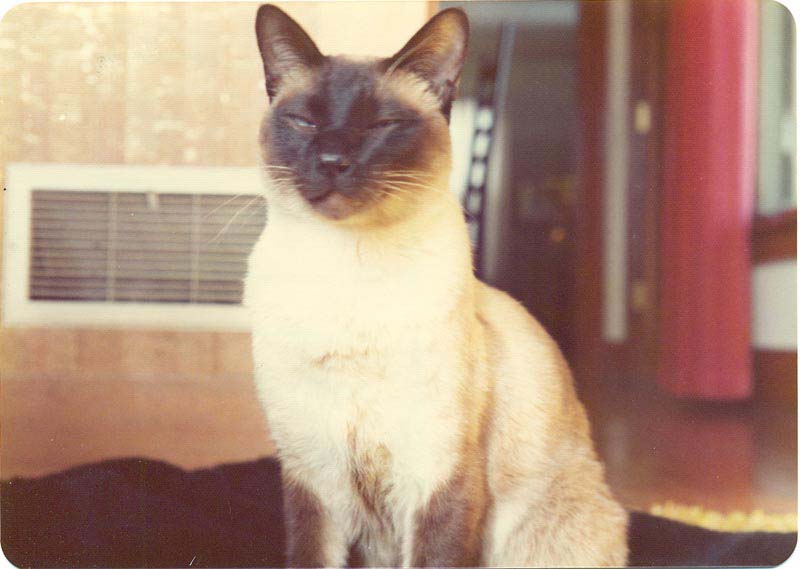
Back in 1975, Jack H. Hetherington, a physics professor at Michigan State University, wrote a research paper on low–temperature physics for the respected scientific journal Physical Review Letters. Before sending it off, Hetherington asked a colleague to review the paper, just to make sure it covered the right bases. What happened next Hetherington explained in the 1982 book, More Random Walks in Science:
Before I submitted [the article], I asked a colleague to read it over and he said, ‘It’s a fine paper, but they’ll send it right back.’ He explained that that is because of the Editor’s rule that the word “we” should not be used in a paper with only a single author. Changing the paper to the impersonal seemed too difficult now, and it was all written and typed; therefore, after an evening’s thought, I simply asked the secretary to change the title page to include the name of the family cat, a Siamese called Chester, sired one summer by Willard (one of the few unfixed male Siamese cats in Aspen, Colorado). I added the initials F D in front of the name to stand for Felix Domesticus and thus created F D C Willard.
The editors eventually accepted the paper, “Two‑, Three‑, and Four-Atom Exchange Effects in bcc 3 He.” And the ruse lasted until, remembers Hetherington, “a visitor [came to the university and] asked to talk to me, and since I was unavailable asked to talk with Willard. Everyone laughed and soon the cat was out of the bag.” (Pun surely intended.) Apparently only the journal editors didn’t find humor in the joke.
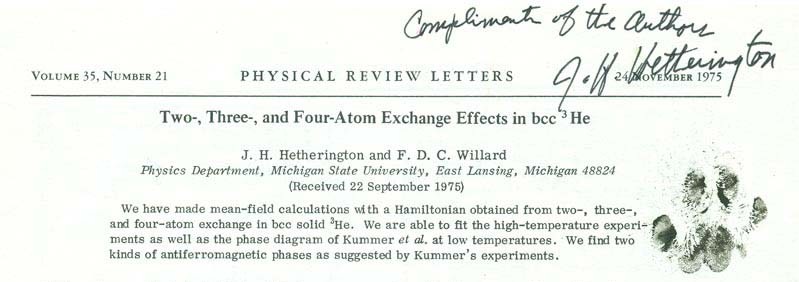
Above, you can see F.D.C. Willard’s signature (a paw print) on the front page of the article. The website, TodayIFoundOut, has much more on this enchanting little story.
If you would like to support the mission of Open Culture, consider making a donation to our site. It’s hard to rely 100% on ads, and your contributions will help us continue providing the best free cultural and educational materials to learners everywhere. You can contribute through PayPal, Patreon, and Venmo (@openculture). Thanks!
Note: An earlier version of this post appeared on our site in 2017.
Related Content:
The Shortest-Known Paper Published in a Serious Math Journal: Two Succinct Sentences
The Famous Schrodinger’s Cat Thought Experiment Gets Brought to Life in an Off-Kilter Animation
Insanely Cute Cat Commercials from Studio Ghibli, Hayao Miyazaki’s Legendary Animation Shop
Read More...How Vincent van Gogh’s Sister-in-Law Worked Tirelessly to Make Him Famous
No artist, no matter how solitary by nature, becomes a cultural phenomenon alone. That’s even true of such an isolated figure as Vincent van Gogh, whose death in obscurity at the age of 37 left open the question of who, if anyone, would vouchsafe his paintings to posterity. The support of the artist’s younger brother Theo is often given a good deal of credit for making his work possible, and not without reason. What’s somewhat less widely known is that Theo, who’d long been in poor health, died less than a year after Vincent’s suicide. The work of ensuring the latter’s legacy then fell to the former’s widow Johanna Bonger — or perhaps she understood that if she didn’t steward it, nobody else would.
As Cindy Poh explains in the Newsthink video above, Bonger inherited a great many of van Gogh’s works and stored them away while devising a plan to make them famous. Practically going door-to-door — and sometimes, it seems, literally going door-to-door — she stayed engaged with the late Theo’s art-world contacts. She cut sweetheart deals with museums and even donated artworks outright, increasing their chance of public exposure. She organized exhibitions everywhere from Paris to Berlin to London to New York, the most pivotal being one held at Amsterdam’s Stedelijk Museum in 1905. The 484 works put on display made it the largest van Gogh show in history, a record it still holds today.
At that time, well before The Starry Night and Sunflowers adorned coffee mugs in suburban households the world over, van Gogh’s art could still shock some critics with its unconventionality. Others, however, showed signs of the enrapturement that Bonger must have suspected would one day be possible. Thinking strategically, she preferred to sell fewer pieces for higher prices, preserving the value of his work and limiting its availability on the market. After her second husband’s death, she redoubled her dedication to the art that had become her life’s mission, even translating and publishing the hundreds of letters he’d left behind, most of which were sent to Theo. We’ve heard many artists described as married to their work, a cliché that applies well enough to Vincent van Gogh himself. But to be married to one’s brother-in-law’s work is a rarer thing indeed — and sometimes a more important one.
Related content:
1,000+ Artworks by Vincent Van Gogh Digitized & Put Online by Dutch Museums
Vincent Van Gogh’s The Starry Night: Why It’s a Great Painting in 15 Minutes
Behold the Newly-Discovered Sketch by Vincent van Gogh Sketch, “Study for Worn Out” (1882)
Discover the Only Painting Van Gogh Ever Sold During His Lifetime
Based in Seoul, Colin Marshall writes and broadcasts on cities, language, and culture. He’s the author of the newsletter Books on Cities as well as the books 한국 요약 금지 (No Summarizing Korea) and Korean Newtro. Follow him on the social network formerly known as Twitter at @colinmarshall.
Read More...
The Megaprojects That Even the Ancient Romans Couldn’t Pull Off: Rerouting the Tiber, Digging a Canal, and More
Some would call the United States of America the mightiest empire the world has ever known. Yet over the past half-century or so, it has shown a strange inability to build domestic infrastructure, at least at the efficiency or on the scale seen elsewhere in the world. (This will not come as news to American enthusiasts of high-speed rail.) Here on Open Culture, we’ve previously featured history YouTuber Garrett Ryan’s take on the question of whether the U.S. is now declining like the ancient Roman Empire. On a more recent video for his channel Told in Stone, he’s highlighted the megaprojects that even the Romans — who managed the Pantheon, the Colosseum, and the Pont du Gard, to say nothing of their uniquely long-lasting concrete itself — couldn’t pull off.
The Tiber may seem like a tame river today, but it wasn’t always so placid. In antiquity, rains caused it to flood every year. Senator-historian Cassius Dio recorded an incident in 54 BC when the suddenly rising waters caused not just houses but whole neighborhoods to collapse. The Tiber’s flooding worsened over time, inspiring Julius Caesar to propose re-routing it either around Rome or into a tunnel running beneath the city. Unfortunately, the Ides of March came before work could get underway. Augustus opted to dredge the river channel, and Tiberius championed diverting its tributaries. Only the construction of modern embankments in the nineteenth century brought the regular fluvial disasters under control, ensuring peace for strollers in search of their own dolce vita.
Roman ships sailing to Greece had to make their way around the Peloponnese, the south of the Greek peninsula. The dangers of that stretch were many, and did their part to sink the ship carrying the Antikythera Mechanism. The Isthmus of Corinth held out the promise of safer passage, at least for those willing to drag their laden ships over a bit of land. Digging a canal was, in some sense, the obvious solution, considered by both Julius Caesar and Caligula, but “only Nero was megalomaniacal enough to actually begin the project.” A decent amount of progress had been made before another instance of regicide (or perhaps, in this particular case, tyrannicide) put a stop to the work. Rather than being resumed by a later emperor, the canal “became a byword for hubris” — at least until the job was finally done in the uncommonly ambitious nineteenth century.
In central Germany, near where the village of Waldgirmes is today, Romans founded a city with many features of an imperial settlement, such as a classic street grid, pipes running from a central aqueduct, and a forum, at the center of which a gilded statue of Augustus on horseback once stood. Dating to the year 4 BC, the city was intended as a new capital for what the Romans called Germania, though it ended up abandoned after the Battle of the Teutoburg Forest only about a decade after its founding. “The buildings were burned,” Ryan says. “The head of Augustus’ equestrian statue was thrown down a well,” only to be discovered nineteen centuries later. That image could inspire a meditation on what may be the way of all empires — or serve as a warning to any American leader considering immortalizing himself and his horse in gold.
Related Content:
Ten Lost Roman Wonders: The World’s Longest Tunnel, Tallest Dam, Widest-Spanning Bridge & More
The Genius Engineering of Roman Aqueducts
How the Ancient Romans Built Their Roads, the Lifelines of Their Vast Empire
The Mystery Finally Solved: Why Has Roman Concrete Been So Durable?
Based in Seoul, Colin Marshall writes and broadcasts on cities, language, and culture. He’s the author of the newsletter Books on Cities as well as the books 한국 요약 금지 (No Summarizing Korea) and Korean Newtro. Follow him on the social network formerly known as Twitter at @colinmarshall.
Read More...Watch “The Midnight Parasites,” a Surreal Japanese Animation Set in the World of Hieronymus Bosch’s The Garden of Earthly Delights (1972)
Hieronymus Bosch’s bizarre paintings might have looked perfectly ordinary to his contemporaries, argues Stanley Meisler in “The World of Bosch.” Modern viewers may find this very hard to believe. We approach Bosch through layers of Freudian interpretation and Surrealist appreciation. We cannot help “regarding the scores of bizarre monsters”—allegories for sins and punishments far more legible in 15th-century Netherlands—“as a kind of dark and cruel comic relief.”
While Bosch might have intended his work as serious sermonizing, it is impossible for us to inhabit the medieval consciousness of his time and place. There’s just no getting around the fact that Bosch is really weird—weirder even (or more imaginatively allegorical) than nearly any other artist of his time. In some very important ways, he belongs to a 20th-century aesthetic of post-Freudian dream logic as much as he belonged to peculiar medieval visions of heaven and hell.
Bosch “described terrible, unbearable holocausts crushing mankind for its sins,” writes Meisler, visions that seemed both stranger and more familiar in the wake of so many man-made holocausts whose absurdities defy reason. What modern horrors does famed Japanese animator Yōji Kuri invoke in his psychedelic 1972 film “The Midnight Parasites,” above, a surrealist short set in the world of Bosch?
Dangerous Minds’ Paul Gallagher describes the plot, such as it is:
Here Kuri imagines what would life might be like if we all lived in Bosch’s painting “Garden of Earthly Delights.” It’s a basically shit and death or rather a cycle of life where blue figures live and die; eat shit and shit gold; are skewered, and devoured; are regurgitated and reborn to carry on the cycle once again.
Kuri’s satirical vision, in films long favored by countercultural audiences, has “bite,” writes Animation World Network’s Chris Robinson: “he helped lift Japanese animation out of decades of cozy narrative cartoons into a new era of graphic and conceptual experimentation. His films mock and shock, attacking technology, population expansion, monotony of modern society… Witnessing the surrender of Japan during WW2, the devastation of his country followed by the quick rise of Western inspired materialist culture and rampant consumption, Kuri, like many of his colleagues at the time, questioned the state and direction of his society and world.”
His creative appropriation of Bosch, “dark, dirty, oddly beautiful, with a groovy soundtrack,” Gallagher writes, may not, as Meisler worries of many modern takes, get Bosch wrong at all. Though the Dutch artist’s symbolism may never be comprehensible—or anything less than hallucinatory—to us moderns, Kuri’s half-playful reimagining uses Boschian figures for some serious moralizing, showing us a hell world governed by grave lapses and cruelties Bosch could never have imagined.
Note: An earlier version of this post appeared on our site in 2018.
Related Content:
The Meaning of Hieronymus Bosch’s The Garden of Earthly Delights Explained
Josh Jones is a writer and musician based in Durham, NC.
Read More...Why Cleopatra, Lawrence of Arabia, Ben-Hur & Other Hollywood Classics Still Look So Good
Cleopatra cost Twentieth Century Fox $44 million, by the studio’s own estimate. That may sound like the budget of one of those genre pictures that winds up going straight to streaming, but if we convert those 1963 dollars into current ones, it comes out to $480 million. The most expensive film ever made up to that point, it remained an industry symbol of near-parodically troubled production and grotesque cost inflation for decades. Like The Wizard of Oz, it failed to recoup its investment during its initial theatrical run, eventually turning a profit thanks only to re-releases and television rights sales. And yet, these six decades later, the investment seems to have proven sound, at least according to the video above from YouTube channel Wolfcrow, “Why Cleopatra Still Looks Like a Trillion Bucks.”
Unlike some infamously expensive movies, Cleopatra doesn’t leave you wondering where all the money went. Wolfcrow creator Sareesh Sudhakaran points out some of the myriad ways it manifests onscreen, from the 70-foot-long giant sphinx to the full-scale Alexandria harbor built on the coast to the Roman Forum set designed to be three times larger than the actual Roman Forum to the 65 or so outfits Elizabeth Taylor wears in the title role (to say nothing of the 26,000 other costumes made for all the other characters). Even the matte paintings and optical camera tricks still look convincing. The film’s production designers knew that nothing could be done by half measures, given that the 65mm Todd-AO stock used for filming would expose any flimsiness on the big screen.
Just as unforgiving was the ultra-wide aspect ratio used for the 1959 version of Ben-Hur, which necessitated painstaking labor on everything that went before the camera, but also a new approach to the composition of the shots themselves. Even those of us who’ve never seen the movie can call to mind images of its climactic chariot race, a sequence that earned its cultural impact the hard way.
It took five months to film on the largest set ever built at that time, with 1,500 extras in its stands. A few years later, Lawrence of Arabia took Hollywood grandeur up to the level of sublimity with its real desert landscapes. David Lean “was obsessed with scale and detail,” Sudhakaran explains. “He wanted the desert to be more than just a backdrop. He wanted it to be a character in the story,” which required meticulous planning of all the ways its natural light could possibly be used to dramatic effect.
Though Sudhakaran clearly has an interest in spectacles from the golden age of the Hollywood historical epics, he’s also made videos on lastingly impressive movies from other times and genres. When was the last time you sat down to enjoy the satirical urban techno-dystopia RoboCop, the comic-strip noir fantasia of Dick Tracy, or the flamboyant de-familiarized twenty-third century of The Fifth Element — or better yet, saw them properly screened at a revival house? When they came out, those films met with varying degrees of box-office success and critical praise, if not regarded as the absolute peak of cinematic sophistication. In our time, their ambition and craft look nothing short of astonishing, especially when we remember that they built their worlds in physical reality with real human beings, mostly analog techniques, and a whole lot of labor and imagination. Could even a trillion dollars buy the same results today?
Related Content:
The Scene That Reveals the Beauty of Classic Hollywood Cinema
Why Movies Don’t Feel Real Anymore: A Close Look at Changing Filmmaking Techniques
The Greatest Cut in Film History: Watch the “Match Cut” Immortalized by Lawrence of Arabia
Based in Seoul, Colin Marshall writes and broadcasts on cities, language, and culture. He’s the author of the newsletter Books on Cities as well as the books 한국 요약 금지 (No Summarizing Korea) and Korean Newtro. Follow him on the social network formerly known as Twitter at @colinmarshall.
Read More...Support Us
We're hoping to rely on loyal readers, rather than erratic ads. Please click the Donate button and support Open Culture. You can use Paypal, Venmo, Patreon, even Crypto! We thank you!

About Us

Open Culture scours the web for the best educational media. We find the free courses and audio books you need, the language lessons & educational videos you want, and plenty of enlightenment in between.
Advertise With Us

FREE UPDATES!
GET OUR DAILY EMAIL
Get the best cultural and educational resources on the web curated for you in a daily email. We never spam. Unsubscribe at any time.
FOLLOW ON SOCIAL MEDIA

Open Culture editor Dan Colman scours the web for the best educational media. He finds the free courses and audio books you need, the language lessons & movies you want, and plenty of enlightenment in between.
Advertise With Us

